
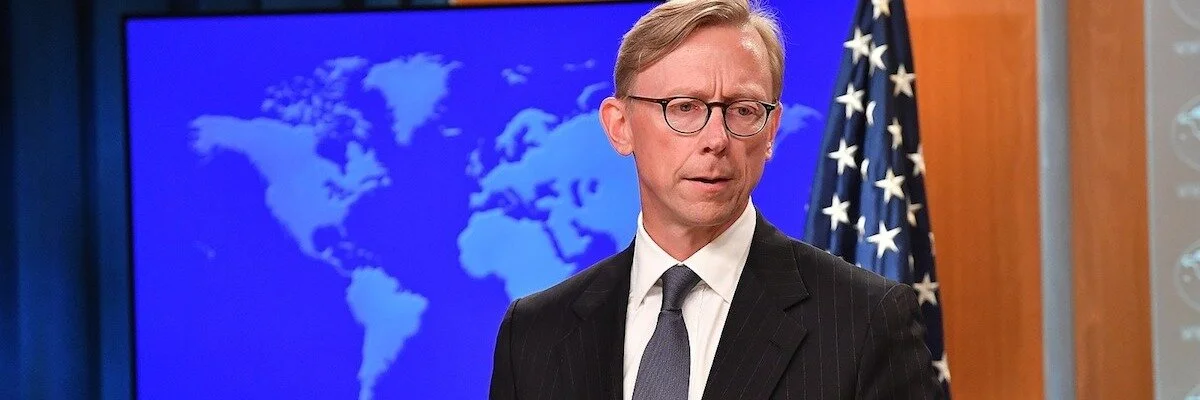
As Iran Faces Virus, Trump Admin Fails to Use Swiss Channel to Ease Medical Exports
A Swiss payment channel touted by the Trump administration as a solution to ease humanitarian trade with Iran under sanctions has so-far failed to process any transactions during Iran’s COVID-19 outbreak.
The report is published in partnership with the European Leadership Network.
Just a few days after Iran announced its first deaths from COVID-19 in February, the Trump administration’s Special Envoy for Iran Brian Hook was asked during a briefing for an update on the Swiss Humanitarian Trade Arrangement (SHTA), a payment channel intended to ease the sale of medicine and medical devices by Swiss companies to Iran. Responding to the question, Hook acknowledged that no further exports had been processed since a pilot sale of $2.55 million of medication a month earlier, but insisted that there were “more transactions coming.”
Two months later, over 6,000 Iranians have lost their lives to COVID-19, and the Swiss channel has yet to process any further transactions.
Since the Trump administration reimposed secondary sanctions on Iran in November 2018, the Swiss government has worked to establish a dedicated banking channel to ease the export of medical supplies to Iran. Switzerland is the second largest supplier of medicine to Iran after the European Union. While technically exempt from sanctions, the sale of medical supplies has been made more difficult as banks refuse to process Iran-related transactions. In a recent client note, former Director of the US Office of Foreign Asset Control (OFAC) John Smith detailed how “the Trump administration’s maximum pressure campaign has likely dissuaded many companies from exporting medicine and medical devices to Iran that they otherwise could.”
New data from the Swiss Federal Customs Administration makes clear that the export of medicine to Iran has weakened over the last year. As a result of these disruptions, ordinary Iranians face rising prices and shortages of sorely-needed medication, a situation all the more unacceptable during a global pandemic.
As COVID-19 spread in Iran, the Trump administration faced increased pressure to ease humanitarian trade. A statement organized by the European Leadership Network and The Iran Project and signed by 24 former senior officials from the United States and Europe warned that “failure to provide relief could have significant and long-lasting consequences for the reputation of the United States and Europe among the Iranian people.” But the administration has yet to respond to these calls with any sense of urgency, deflecting questions on humanitarian trade by pointing to the channel “set up through the Swiss to help the Iranian people.”
While Swiss officials originally hoped the payment channel would be ready in February 2019, it took nearly a year to complete negotiations with the Trump administration and launch the framework. Hawkish officials, including John Bolton, saw the channel as an unnecessary concession to Iran. The administration also proceeded with new sanctions designations that complicated implementation of the channel, including a move in September 2019 to impose new sanctions on the Central Bank of Iran that eliminated long-standing exemptions allowing the bank to play a role in humanitarian trade. The Swiss channel was only “finalized” by the US Treasury Department on 27 February, the same day a new general license was issued restoring key humanitarian exemptions for Iran’s central bank.
The failure to process further transactions through the channel over the last three months is surprising given the reported interest among “dozens” of Swiss companies. But the Trump administration has failed to address two key impediments.
First, companies wishing to use the channel are faced with extraordinary reporting requirements. European officials have likened these requirements to a “fishing expedition” for information about Iran’s financial sector. Rather than simply revive the arrangement that enabled Swiss entities to sustain sales of medicine to Iran after the Obama administration imposed devastating financial sanctions on Iran, the Trump administration increased the documentation and reporting requirements, demanding unprecedented disclosures by Swiss companies on the financial holdings of the Iranian banks from which they expect to receive payment. Even if Swiss exporters are prepared to overcome these hurdles, the channel is obviously ill-suited as a means to ease trade during a global pandemic when purchases of medical supplies need to be made quickly and reliably. Peter Harrell, who worked on Iran sanctions in the Obama administration, has argued that the Treasury Department ought to “temporarily relax some of the most oversight stringent requirements for this” in light of COVID-19.
Second, the Trump administration apparently failed to ensure that there was sufficient liquidity available to allow Iranian importers to pay their Swiss suppliers, leaving Swiss officials in a lurch. The Central Bank of Iran is believed to maintain CHF 50 million in reserves at Banque de Commerce et de Placements (BCP), the bank which has long played a central role in Swiss-Iran bilateral trade and around which SHTA has been designed. In addition, several Iranian private sector banks also hold funds at BCP. A rough estimate of the combined holdings is CHF 150 million. By comparison, Switzerland’s total exports of pharmaceutical products to Iran in 2019 was just over CHF 150 million.
Iranian authorities are reluctant to draw down these reserves, which would be nearly impossible to replenish while the country remains under “maximum pressure” sanctions. In a revealing interview from last December, Brian Hook suggested that Iran maintains access to just 10 percent of its foreign currency reserves. Notably, Iran’s central bank governor, Abdolnasser Hemmati, has suggested that Iran’s request for an emergency loan from the International Monetary Fund (IMF) could help address liquidity issues facing SHTA, stating that the IMF loan could be paid out via the Swiss channel in order to assuage concerns voiced by the Trump administration over the potential misuse of funds.
The successful operationalization of SHTA requires Iranian buy-in. Authorities in Tehran will be concerned about funneling critical trade of medical supplies through a channel made unreliable due to precarious access to financial resources. Meanwhile, recent enforcement actions taken against Halkbank in Turkey and the Industrial Bank of Korea—two banks that have historically supported humanitarian trade but which failed to maintain rigorous compliance standards—will test the resolve of executives at BCP. In another warning shot, OFAC last week announced a $7.8 million settlement agreement with Swiss technology firm SITA, which inadvertently used US-based servers to provide baggage handling services to an Iranian airline making it the “the first company to pay a large settlement merely for routing otherwise lawful transactions through U.S. computer servers.”
The troubled launch of the Swiss channel offers a cautionary tale for other countries seeking to ease humanitarian trade with Iran through good faith engagement with the Trump administration. Since November of last year, the South Korean government has been in discussions with the Trump administration over measures that could revive falling humanitarian exports to Iran. In December 2019, Korean pharmaceutical exports to Iran were down 47 percent year-on-year. Recently, Korean authorities announced that they had made some headway and that they are working to establish the Korean Humanitarian Trade Arrangement, an analogue of the Swiss channel that would be built around Woori Bank.
The Swiss government is advising the Korean government on how to meet the stringent requirements set-forth by officials in Washington. While South Korea is not a major exporter of pharmaceutical products to Iran, it is a former buyer of Iranian oil and Iran maintains significant reserves in the country. One possible solution to the liquidity problems facing SHTA may be to allow Iran’s central bank to draw on reserves held in South Korea in order to make payments to Swiss exporters. In March, Iranian Foreign Ministry Spokesperson Abbas Mousavi complained that the United States was “creating an obstacle for the transfer of Iran’s financial resources into the channel,” and cited an effort to draw “other financial resources in various countries” for use in SHTA.
Against this backdrop, references made by Trump administration officials to SHTA as evidence of efforts to protect humanitarian trade with Iran have been deceptive, if not deceitful. The Treasury Department’s recent reply to congresswoman Alexandria Occasio-Cortez’s letter warning of sanctions impacts on Iran's COVID-19 response, tellingly omits any reference to the Swiss channel, suggesting that the administration is aware that their failure to operationalize the channel during the COVID-19 crisis undermines voiced commitments to humanitarian trade.
Swiss officials should be applauded for continuing to pursue operationalization of the channel despite the hurdles put in front of them. They remain confident that further transactions will be made soon and note progress on a solution that would give Iran freer use of its foreign currency reserves. But the Trump administration abjectly failed to ensure its much-touted channel eased Iran’s access to medical supplies at the moment of greatest need for the Iranian people.
Photo: State Department
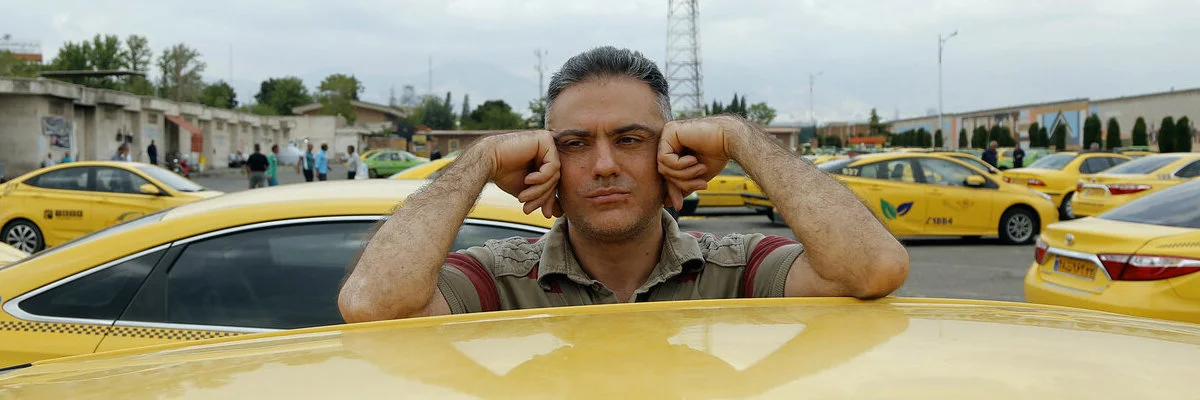
Why Hassan Rouhani Ended Iran’s Lockdown
Iran could face a devastating second wave of coronavirus infections as the country re-opens, but keeping the economy closed down without a safety net would have likely led to unrest.
By Saheb Sadeghi
As businesses resume their activities in Iran at the behest of President Hassan Rouhani, many experts have criticized the government’s decision and warned of a second wave of the coronavirus outbreak. Some even have accused Rouhani of favoring the economy over the health of the people.
According to the latest official figures, there are more than 95,000 confirmed coronavirus cases in Iran, and the death toll has exceeded 6,000.
On April 22, Rouhani described the reopening of businesses as “a necessity for the country.”
To understand the reasons behind Rouhani’s risky and possibly dangerous decision, one needs to look back at the Iranian economy’s condition before the coronavirus outbreak. Iran’s economic growth rate was negative 7 percent. Stagflation had put the economy into a serious crisis.
After the United States’ 2018 withdrawal from the nuclear deal and reimposition of sanctions, Iran’s foreign trade and oil exports declined dramatically—and political tensions with Gulf neighbors spiked as the United States deepened the crisis.
In the meantime, the International Monetary Fund had predicted that Iran’s economy would shrink 9.5 percent last year, and according to the Central Bank of Iran, the annual inflation rate reached 41 percent, the highest level in 25 years. The number of unemployed people had already reached about 3 million before the coronavirus crisis, and some estimates would suggest the number to be even higher.
Then came the coronavirus outbreak. After the government’s decision to shut down businesses, at least half of Iran’s economy, which is dominated by service sector jobs, was seriously affected. The living conditions and welfare of an estimated 7.3 million people became precarious as millions lost their jobs and others had their wages or hours cut.
The shutdown came at a time when many businesses were expecting almost 50 percent of their annual income during the last two months of the Iranian year before Nowruz, the Persian New Year, at the end of March.
Every year during the last Iranian month of Esfand (beginning in February and ending in March) and before the New Year people usually do most of their shopping. Esfand is followed by the first month of the year, Farvardin (March 20-April 19), which is generally a month of holidays and tourism. During Farvardin, many businesses—including restaurants, travel agencies, and hotels—tend to witness a boom, but this year their revenues reportedly fell by more than 90 percent.
Estimates suggest that Iran’s GDP has now decreased by about 15 percent as a result of the disruption to businesses, and that the economy will shrink further compared to last year. Businesses have reduced their activities as well as their workforce, and statistics show that about 36,000 people are applying for unemployment insurance each day.
Although the increase in the unemployment rolls caused by coronavirus outbreak has not been officially announced yet, some estimates indicate that 1 million Iranians have lost their jobs during the crisis, while other figures put the number at 2 million.
Under such circumstances, government support could have eased the pain, but extending a safety net was not an option in Iran. While income support measures were introduced all over the world to deal with the economic consequences of the coronavirus outbreak, Rouhani’s government could not afford to assist affected businesses due to a lack of financial resources, largely because U.S. sanctions have denied Iran access to its assets and money held in foreign banks.
The financial assistance amount that Rouhani has so far promised to support affected businesses is 100 trillion tomans ($6.25 billion), most of which is supposed to be paid to businesses in the form of loans. (One toman is equivalent to ten rials. Although the rial is the official currency, Iranians use the toman in everyday life.)
These loans have a three-year repayment term with a 12 percent interest rate. In the event of a second coronavirus outbreak and a bad economic situation, the government will give these loans to businesses; in normal times, bank loans would come with a higher 20 percent interest rate.
According to the Iranian economist Mohammad Hashem Botshekan, this economic package was more like a monetary policy than an economic stimulus; if the government were seriously considering an economic survival package, it would need to give interest-free loans to businesses, and it would provide free economic assistance to the people. Furthermore, the amount spent by the government compared to the volume of Iran’s GDP was insignificant.
After all, the U.S. government’s package accounts for approximately 10 percent of the country’s total GDP, the German and Japanese support packages are equivalent to about 20 percent of their GDPs, while the economic packages of some Persian Gulf countries accounts for about 30 percent of their GDPs. But the offered economic survival package from the Iranian government only equates to 2 percent of the country’s GDP.
Rouhani’s government also announced that it would give a 1 million-toman loan (about $62) to low-income families—an interest-free loan that would be repaid in 24 monthly installments, sparking widespread criticisms. This amount is equivalent to half of the minimum monthly salary of a laborer in Iran and would not do much to help people with their economic hardships.
But the Rouhani government’s revenues have shrunk dramatically. Since the coronavirus pandemic began, demand for oil has declined, pushing prices down. Moreover, another source of revenue for the Iranian government—taxes—has been seriously eroded due to the closure of businesses. Indeed, the government has stopped collecting taxes from some businesses that have been financially damaged as a result of the coronavirus pandemic—but it is the government that will decide which businesses receive a three-month deferment of tax payment.
In the end, Rouhani had only two options: Either he could go on with the shutdown of businesses and government bodies until the virus is brought under control and the medical and health system of the country is restored to normal, or, due to the dire economic situation, he could allow the businesses and government offices to resume their activities.
He opted for the latter and reopened the markets and government offices on April 11, a decision that sparked a great deal of criticism from medical experts as well as some high-ranking government officials such as the head of the judiciary, who criticized the government for prioritizing the economy over the health of the people.
Rouhani ordered almost all economic sectors, including financial markets and shopping centers to fully resume their activities. Some high-risk businesses such as sports clubs, big restaurants, and cinemas are not still allowed to reopen. Even now, several weeks after the decision was implemented, Iranian health officials are still declaring their opposition to it.
Since the reopening of businesses and government bodies, social distancing measures in Iran have not been observed; in a matter of few days, people began to act as if the coronavirus crisis was over and life had returned to normal.
Although the pace of coronavirus-related deaths has decreased recently, more than 1,200 new cases and about 100 deaths from the virus are still being reported each day. According to health officials in some cities, such as Tehran, the number of people infected with the coronavirus is increasing. Many doctors and officials in Iran’s health sector are scared, saying that the government’s decision to lift social distancing restrictions may soon lead to a second wave of infections.
Indeed, a resurgence of the pandemic could have a much more devastating impact. The illness and death of tens of thousands of people in a second wave would force businesses to close once again, and the Iranian health care system would come under immense pressure. Under such circumstances, the government would barely be able to keep the economy alive and stable. The government’s revenues would further shrink, and it would probably not be able to support poor and low-income families. In such a situation, millions of people could lose their jobs and a greater economic recession might put Iran’s economy at risk of collapse.
While Rouhani’s move could lead to a new outbreak with all the devastating consequences it brings, his unpopular decision has, for now, saved the economy from further deterioration and possible protests.
Rouhani’s decision was based on the view that Iran has passed through the first major wave of the coronavirus outbreak and that continuing curbs on economic activity are no longer justifiable. According to this view, an ongoing economic lockdown would have dangerous consequences for the country. The unemployment rate would rise sharply, many businesses would go bankrupt, and social unrest could follow.
While Rouhani is well aware that there is a risk of a second wave, the country cannot keep the lockdown in place for another month or two because the government cannot make up for the losses suffered by businesses, as wealthier governments in Europe and North America have done. That is why he is insisting on bringing the economy and society back to normal as soon as possible.
The country has yet to leave behind last November’s public protests against the substantial increase in the prices of gasoline, fear of reemergence of public protests and riots was evident in a letter sent to Rouhani by 50 economists on April 3. They cautioned him that the economic consequences of the coronavirus crisis could lead to unrest in the second half of the Persian Year 1399, which has just begun, and that the next year, 1400, would be a year of crisis.
Saheb Sadeghi is a columnist and foreign-policy analyst on Iran and the Middle East. Follow him at @sahebsadeghi.
Photo: IRNA
Iran Resorts to New Financial Tools to Shore-Up Economy
The COVID-19 crisis has forced Iran’s government to turn to little-used financial tools to help stabilize the economy and address a widening fiscal deficit.
The COVID-19 crisis has forced Iran’s government to turn to little-used financial tools to help stabilize the economy and address a widening fiscal deficit.
In the arena of monetary policy, the crisis is the first test of the new Open Market Operation (OMO) powers announced by the Central Bank of Iran (CBI) on January 18. To address the fiscal deficit, the Rouhani administration has pushed forward with long-planned privatization plans, conducting an Initial Public Offering (IPO) for SHASTA, the investment arm of the country’s largest social security provider. But the government faces hurdles as it resorts to largely unproven measures.
An underdeveloped interbank lending market will hamper OMOs. The interbank lending market in Iran was first established in June 2008. Despite the fact that the number and volume of transactions has grown substantially in recent years, with over 20,000 transactions registered in the last Iranian calendar year, the market remains hampered by the fact that Iranian banks do not maintain large reserves, meaning there are often too few banks with surplus liquidity in the market. As a result, it will be difficult for OMOs undertaken by CBI to influence the interest rate in the interbank market, limiting the central bank’s capacity to enact monetary policy through the bank-lending channel.
Iran’s interbank lending market also presents instrumental limitations. The most common mechanism by which needy banks secure liquidity is by direct borrowing from surplus banks, or, in times of emergency, turning to CBI as a lender of last resort. These loans are typically made without collateral and sometimes even without a formal contract. But given the prevalence of unsecured loans, there remains the possibility that the borrower might default.
While this possibility is generally understood to be low, it has likely increased given the current economic crisis. Iranian businesses will be seeking cheap financing to help them get through the difficult times. But given that Iranian banks struggle to determine the creditworthiness of their clients, any rapid expansion in lending could lead to greater issues with non-performing loans, particularly among the weaker banks.
The Central Bank of Iran had intended to use OMOs to adjust the inflation rate in accordance with its target for the current financial year, which is set at 20 percent—the annual inflation rate reached 41.2 percent in 2019-20.
On one hand, if the central bank aims to enable the country’s banks to lend to ailing businesses, the shift to the expansionary use of OMOs will be at odds with the inflation goals. On the other hand, now that the government is facing a record fiscal deficit, some Iranian economists are worried that the central bank may be pushed to use OMOs as a tool to generate government revenue, issuing bonds to finance expenditures. At a time when markets need clear leadership from regulators, the central bank’s priorities remain unclear.
While the central bank pursues new tools of monetary policy, the Rouhani administration has sought to tackle a fiscal deficit. The government’s IPO of SHASTA, also known as the Social Security Investment Company, was the largest IPO in Iranian history by market capitalization. The public offering of 10 percent of the company’s shares on April 15 generated USD 437 million in revenue for the government.
The strong performance of the Tehran Stock Exchange over the last year, despite the overall economic malaise, suggests that privatization of state-owned enterprises is a viable means for the government to generate much-needed revenues.
The Rouhani administration has long-pushed privatizations as a means to improve the finances of currently state-owned enterprises, to increase transparency, to improve corporate governance, and to reduce the footprint of the government in Iran’s economy. But any rush to privatize enterprises may lead to the loss of a “golden opportunity” as the government pursues public offerings to compensate for budget deficits without ensuring that the companies and their management become fully accountable to the public markets.
Iran has been grappling with serious challenges in the areas of fiscal and monetary policy in recent years. The Rouhani administration and the Central Bank of Iran have smartly sought to create new tools and establish new policies in response. But as the economy reels from the impact of COVID-19, these challenges have reached a point of crisis—the new tools may not be enough.
Photo: IRNA
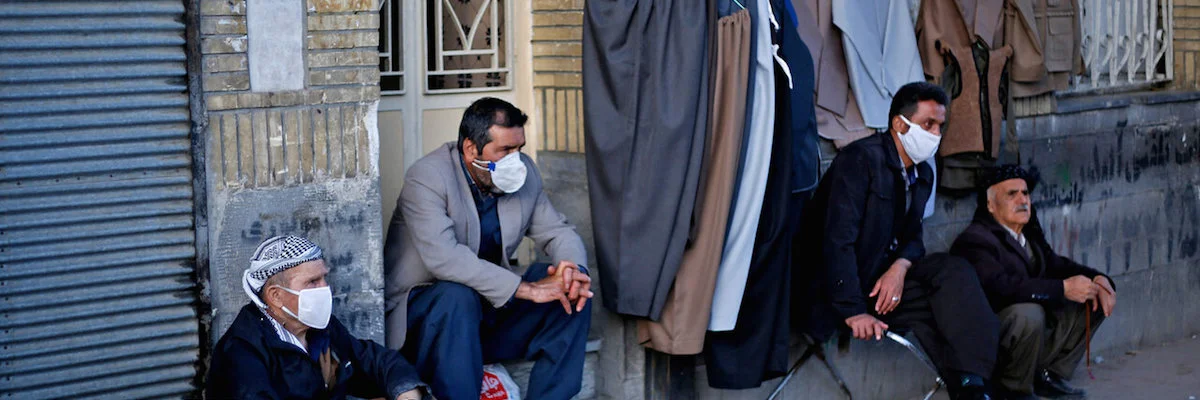
Bleak Estimates of Economic Impact Spur Iran to End Virus Lockdown
Several reports released by key ministries and research centers over the last few weeks warned of dire economic if the government did not rollback the lockdown, despite warnings from health experts about the risks of new infections.
Following two years of recession triggered by the Trump administration’s “maximum pressure” sanctions campaign, Iran was showing signs of economic recovery in the last quarter of 2019. But when authorities announced the country’s first confirmed deaths from COVID-19 in mid-February, Iran was thrust into a new crisis. According to official statistics, COVID-19 has caused over 5,000 deaths and 83,500 infections to date.
Fears that authorities were slow to contain the crisis have now been replaced by a new concern—like many developing economies, Iran may not be able to afford the protracted lockdown necessary to bring the virus fully under control.
Iran entered a partial lockdown on March 13, one week before the Nowruz holiday. The lockdown measures were further tightened on April 4, just after the holiday period ended. But on Saturday, authorities allowed some businesses to begin reopening, including shops and bazaars. The decision to rollback the containment measures despite the continued risk of infection was informed by a set of reports, which presented dire assessments of the virus’ economic impact.
A 17-page report published earlier this month by the Majlis Research Center, a highly-regarded research organization affiliated with Iran’s parliament, called on the Iranian government to focus on two goals: o provide more support for businesses through tax breaks and delaying debt servicing in order to prevent mass layoffs and to stimulate demand while shielding the most vulnerable in society from the economic blow of the pandemic. In support of containment measures, the report explained that “a maximal reduction in social interactions will be necessary for the coming month” in order to slow the spread of COVID-19. But at the same time it warned of the steep economic costs of any protracted lockdown.
Similarly focused on the impact of the lockdown on Iran’s service sector, an assessment by the Ministry of Welfare, Labor and Social Affairs suggested that lockdown measures put 4 million people at risk of long-term unemployment, a figure that includes 700,000 individuals who are informally employed.
The macroeconomic impact of the slowdown is also captured in new projections from the International Monetary Fund, which has revised its estimate for Iran’s 2020 economic growth from flat growth to a contraction of 6 percent, which would mark three consecutive years of substantial recession.
Iran’s Ministry of Economy released its own report on the eight challenges facing the Iranian economy for in the coming year. Foremost among these challenges is the impact of intensifying U.S. sanctions on Iran’s access to its foreign currency reserves—an challenge made more acute given that Iran’s foreign exchange earnings will be hit by both the historic low oil price and the slowdown in global trade, which will depress Iran’s non-oil exports. The report also noted the impact of the economic crisis on consumption. While consumption in Iran had remained relatively stable in the face of sanctions pressures, the lockdown and reduced purchasing power have reduced demand.
Efforts to provide relief to ordinary Iranians and boost consumption are straining government budgets already unbalanced by the low price of oil. The Rouhani government’s ratified budget for the current fiscal year—ending March 20, 2021—accounted for substantial oil exports and a global oil price of USD 50 per barrel. Although the government budgets are in disarray, the government has moved to introduce a fiscal stimulus to soften the economic blow of the lockdown.
The Rouhani administration has introduced a cash stimulus package that will provide between IRR 2 million to IRR 6 million in supplementary transfers (equivalent to USD 12 to USD 36 at the free market rate) to households already receiving welfare support. This “coronavirus transfer” will be paid for an initial period of four months. In addition, the government will make available a one-time no-interest loan of IRR 10 million (equivalent to USD 62) to the 24 million households which currently receive welfare transfers.
But the stimulus measures have been criticized as insufficient given the extent of the economic crisis and the hardship facing millions of Iranians. Acknowledging the shortcomings of the stimulus plan, central bank governor Abdolnasser Hemmati expressed regret, saying that if it were not for U.S. sanctions the government would have greater resources to support the public.
As is tradition, Iran’s Supreme Leader, Ali Khamenei, have a televised address on March 20 outlining his policy goals for the coming year. For this year, Khamenei has called for a “leap in production.” But as the government struggles to manage tradeoffs between public health crisis and economic welfare, the country’s policymakers are set to make a leap into the unknown.
Photo: IRNA
Iran’s Nurses Are Martyrs to Trump’s Maximum Pressure
The Trump administration’s sanctions have made it impossible for Iranian medical personnel to keep themselves safe amid the pandemic.
By Negar Mortazavi
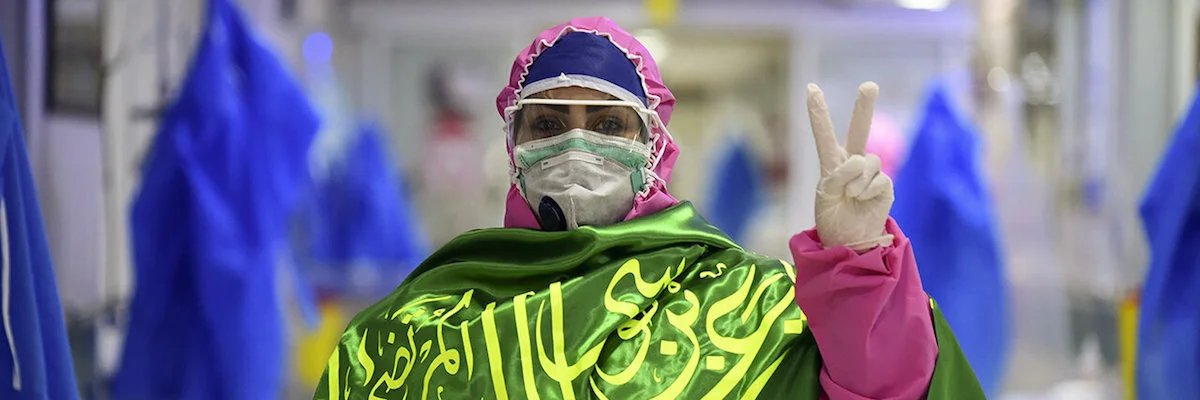
Narjes Khanalizadeh was a 25-year-old nurse in Gilan, a province along the Caspian Sea in northern Iran. In late February, after working with coronavirus patients at a hospital in the city of Lahijan, she fell sick. Within a few days, she was dead.
A week later, results from a coronavirus test that had been administered before her death came back positive, sparking anger and fear among the country’s nurses. Khanalizadeh, who had been working without adequate protective gear, is one of more than a dozen nurses who have died from the coronavirus since February, despite desperate warnings from nurses about shortages of personal protective equipment at hospitals, including at Khanalizadeh’s.
Upwards of 100 Iranian health workers have died from the coronavirus, prompting Iranian Supreme Leader Ayatollah Ali Khamenei to announce in March that doctors and nurses who die from the infection will be recognized as “martyrs,” an honorific usually used for soldiers who sacrifice themselves in battle and that authorizes the families of the deceased to receive certain benefits, such as subsidized housing and education. But Iran’s official response to the crisis has been slow and inefficient, and U.S. sanctions are making things worse. In 2018, U.S. President Donald Trump pulled out of the Iran nuclear deal and reimposed harsh economic sanctions on the country, hampering access to desperately needed medical supplies and equipment.
Now, Iran’s nurses—the majority of whom are women—are among those bearing the worst of the brunt of U.S. sanctions. Official death counts from the Iranian government aren’t broken out by profession and are widely believed to understate coronavirus fatalities. A group of doctors in Iran that has been tracking the deaths of health care workers puts the number of nurses who have died at at least 15 between late February and mid April, but even that almost certainly underestimates the toll as health workers have reportedly been instructed by government officials not to reveal information about shortages, infections, or deaths. Dozens more nurses have been infected, in part as a result of restrictions imposed by the Trump administration.
While food and medicine are exempt from U.S. sanctions, many medical supplies and certain types of equipment are not. To sell some protective items to Iran, including full face mask respirators and some decontamination systems used to sterilize them, companies need a special license from the U.S. Treasury Department (see here for a list of items requiring special authorization). In March, the Washington Post reported that the Trump administration has reduced the number of licenses granted to companies that export medical supplies to Iran.
Even when a license isn’t required to ship humanitarian items, some companies and banks avoid doing business with Iran altogether for fear of being penalized. The country also has far fewer financial resources available to purchase necessary supplies due to sanctions. “This year, Iran is running its largest ever fiscal deficit—50 percent of its budget,” said Hadi Kahalzadeh, a former economist for Iran’s Social Security Organization. “Iran’s health sector, especially hospitals and pharmacies, don’t have enough liquidity to purchase essential supplies. And the Iranian government doesn’t have the financial means to fill the gap.”
Alan Veisi, a biomechanics engineer at Baran MicroTech, a company in Iran that produces some medical equipment that the country isn’t able to import due to sanctions, said even one of Tehran’s most prominent hospitals, Imam Khomeini, has shortages of N95 masks, gloves, and protective gear. “They need 500 to 1000 masks every day,” he said. “But get only 300.” Other hospitals are experiencing similar shortages.
For Iran’s nurses, the risks of contracting the coronavirus are compounded by low wages, poor working conditions, and severe overwork. It begins with the fact that there are far too few of them. According to World Bank data from 2015, Iran has 1.9 nurses per 1,000 people, compared with 2.3 in China, 5.9 in Italy (in 2017), and 8.6 in the United States. Iran’s nurses are under intense psychological pressure, working long hours and even sleeping at hospitals. Some haven’t seen their children or families for days or weeks.
The toll hasn’t been merely psychological. Testing in Iran has so far been restricted only to severe cases, so the dozens of officially reported infections among nurses are likely a vast undercount. Meanwhile, the number of Iranian nurses who have died from the coronavirus is roughly on par with the number of nurses who have died in Italy, even though the official overall death toll there is more than four times higher, suggesting that Iranian nurses are disproportionately at risk. Many experts and human rights groups also believe the Iranian government is underreporting coronavirus deaths to dispel criticism of its response.
Where official mismanagement and harsh U.S sanctions are failing Iranian nurses and health care workers, nonprofit organizations are partially stepping into the void. Some of the need for protective equipment is being filled by humanitarian groups that already have licenses from the U.S. government to operate in Iran. One of these organizations, Relief International, has been importing N95 masks and Tyvek 400 protective coveralls. UNICEF Iran has also been importing two types of high-filtered respiratory surgical masks, N95 masks, and surgical gowns for Iranian health personnel. But even these organizations have had to overcome supplier reluctance to ship to Iran, and the need for protective equipment far surpasses what they are able to provide.
Domestic producers have picked up some of the slack, but many medical supplies produced in Iran still rely on foreign equipment and raw materials imported from abroad—at prices far higher than what they would get if they could buy from countries directly. “Iranian importers have to pay around 30 to 50 percent more for goods through third countries,” said Bijan Khajehpour, a managing partner at Eurasian Nexus Partners. “This means that for a total annual import figure of $50 billion, Iran will end up paying about $15 billion more than the value of the goods.”
There is bipartisan precedent in the United States for sanctions relief for Iran in times of crisis. After an earthquake devastated the country in 2003, the usually hawkish George W. Bush administration eased sanctions for three months to expedite aid and assistance. The Obama administration took similar measures after another earthquake hit Iran in 2012, easing sanctions for 45 days to facilitate humanitarian aid.
But despite both domestic and international calls for Trump to follow suit, the current administration is showing no signs of giving Iran any relief during the pandemic, other than vaguely worded offers to “assist the Iranian people in their response efforts.” Tehran rejected the overture as “insincere” and politically motivated. Last week, the State Department called the Iranian government’s requests for broader sanctions relief a “scam,” and the Trump administration has said it will block Iran’s request for $5 billion in emergency assistance from the International Monetary Fund to deal with the outbreak.
In March, Mohammad Sharifi Moghaddam, the head of a leading nurses’ union in Iran, told a local news organization that the death toll for nurses in Iran during the coronavirus pandemic has been “unnatural” compared with other countries that have been hit hard by the virus, blaming government mismanagement, staff shortages, and lack of protective equipment. While there is little question that the Iranian government’s response to the coronavirus has been a failure, U.S. sanctions have made the situation worse by disrupting other avenues for humanitarian aid—and the likely result is many more Iranian nurses and health care workers being made into martyrs.
Negar Mortazavi is an Iranian-American journalist covering Iran in English and Persian.
Photo: IRNA

In a Time of Crisis, Iranians Seek Comfort, Connection Through Music
The coronavirus outbreak has wrecked Iran’s cultural calendar, putting strain on finances of theaters and livelihoods of performers. But Iranian artists are rising to the occasion, finding ways to ensure their music reaches audiences at a time when it is needed most.
Iran is enduring one of the world’s worst outbreaks of COVID-19. Over 73,000 infections have been confirmed in official figures. Faced with uncertainty and isolated during a national lockdown, Iranians have sought comfort and connection through music.
The coronavirus outbreak has wrecked Iran’s cultural calendar, straining the finances of theaters and the livelihoods of performers. But Iranian artists are rising to the occasion, finding ways to ensure their music reaches audiences at a time when it is needed most.
Concerts are being given in empty performance halls, but streamed to millions online. Musicians are practicing in the solitude of their homes, but connecting with fans on social media.
Alternative band Bomrani, whose sound combines influences from traditional Iranian music, jazz, and gypsy punk, had planned to give four concerts in March—all canceled due to the outbreak. The band decided to experiment with an online concert
With Bomrani’s six members social distancing, they decided to release a recording of a concert performed last year on the grounds of Sa’dabad Palace. They used Instagram to stream the concert. The platform’s chat function allowed the band to connect with fans during the stream.
“It was really nice. The whole band was online. We were chatting with each other, making jokes, and fooling around. This created an intimate atmosphere,” said lead singer Behzad Omrani.
“People later told us that it felt as if Bomrani had thrown a party and we were sitting next to them listening to the music,” he added.
The band had tried live-streaming performances before. “But we didn’t take it that seriously. You can’t compare anything with the joy of performing in front of an audience but we have to make do with what we've got.”
Despite the serious times, Omrani explains that the band isn’t taking their online performances too seriously. “I don’t look at these concerts as doing society a service,” Omrani explained. “That’s not what art is to me. Giving online concerts is a way for me to express myself, to be myself, and to enjoy myself.”
Despite this, Bomrani do not shy away from difficult topics in their music. “We’ve got an album in the pipeline, ‘Probably There Is No Hero’. It’s about all we have been through over the past year both personally and as a country,” he said.
Iranians rang in Nowruz, the Persian New Year, three weeks ago, just as the coronavirus crisis mounted. Omrani describes the year just passed as “really harsh” and “totally unprecedented.”
He thinks the music industry in Iran will be changed by the experience of the coronavirus. “The outbreak has catalyzed a transformation. Five or six years ago no one would have believed that one day musicians would throw online concerts in Iran. Things are changing and they are changing fast.
Power of Music
Iranian authorities have also sought to use the power of music. But the concerts have not been without controversy.
As part of a broad “stay at home” campaign, Tehran Municipality organized a series of online concerts between March 27 and April 9. The concerts were recorded live at the central hall of Tehran’s iconic Milad Tower and streamed online, reaching a staggering five million viewers.
The popularity of the first concert caught the attention of the leadership of IRIB, the state broadcaster and de facto media regulator. Reports emerged that IRIB had prohibited the concert organizers from streaming video of the performers on stage.
On March 28, a performance by musician Omid Jahani was streamed with scenes from nature rather than video of the performer. But the following day, IRIB denied imposing any such rules and the concerts were streamed as originally planned, bringing performances from the likes of Roozbeh Bemani, Reza Yazdani, Sadollah Nasiri and Mohsen Sharifian into the living rooms of Iranians across the country.
Peace of Mind
Musician Siavash Mollaeian plays the kamancheh, a traditional string instrument that features in Iranian, Kurdish, and Azerbaijani music. He is an unlikely convert to online performances. “I’ve never been into social media and giving online concerts. It was never my thing,” he said.
“Following the outbreak, I was feeling down. Then a friend reached out to me and asked me totally out of the blue, ‘Why aren’t you giving concerts on Instagram? It would be really nice and you’d enjoy it.’”
After mulling it over for a few days, Mollaeian decided to give it a shot.
Now, regularly gives live performances for his followers on Instrgram. “I received messages telling me that my music instills a sense of calmness and rekindles hope. I didn’t expect that,” he said.
Mollaeian believes that the uncertainty introduced by the pandemic has taken a toll on people, who are increasingly anxious about the future. “My music is a reflection of my personal struggles. I think coming across works of art, people see what they long for. And these days what people need is peace of mind and hope.”
In a time of crisis, a deeper sense of community has emerged. “People are working hard to rekindle long lost friendships. They are more willing to go the extra mile to get in touch with strangers, to forge new fellowships, to go beyond boundaries,” Mollaeian explained.
Bridging the Gap
Two weeks ago, Mollaeian reached out to Aida Shahghasemi with a simple invitation: to perform a duet.
Shahghasemi is an Iranian-born singer and kamancheh player living in Minneapolis, Minnesota. She and Mollaeian have never met in person—they got to know one another through social media.
“We have known each other for years. We had discussed doing a joint project but had never managed to do so,” Mollaeian said.
The pandemic provided the two artists with a chance to bridge the 10,000-kilometer gap between Iran and the United States.
Shahghasemi is a music teacher who has also had to adapt as the coronavirus outbreak in the United States worsened. “My husband and I, along with our dog, have been self-isolating since March 13. Following the outbreak, I had to switch to giving online classes,” she said.
She has seen a surge in demand for classes over the past few weeks as people search for new hobbies to pass the time. But Shahghasemi thinks that for most of her new students, learning music, like the lockdown, will be temporary. “I think many of them might not have enough time to continue taking lessons after the pandemic is over,” she noted, wryly.
After agreeing to play a duet, Mollaeian and Shahghasemi did a trial run to test their Internet connection. But otherwise, they decided improvise their performance. On April 3, they performed a few pieces live on Instagram.
For Shahghasemi, the online performance lacked the ritual and the connection with the other musicians that make concerts special. “With these online performances, artists go online, people pop in, listen to half a song, get distracted by notification on their phones and drop out. It certainly wasn’t as fulfilling as performing in front of an audience,” she admitted.
Shahghasemi is hesitant to give it another try. “Maybe I’m holding myself back but I’m open to collaborating with my fellow artists and friends.”
But for Mollaeian the concert still felt meaningful, perhaps because of the lack of context. “While playing the duet it felt as if she was sitting next to me. So far, yet so close. We are practicing social distancing, but are we really distancing from each other? To me, it doesn’t seem that way. The crisis is bringing people together. New connections are being made.
“Iranian, American. In the face of this pandemic, these differences are immaterial,” Mollaeian said, referring to the longstanding animosity between the governments of the United States and Iran.
“Humans have been divided by borders and boundaries for ages. Technology has afforded us the opportunity to cross such boundaries—and with our music we have.”
Photo: Amir Jadidi
How Europe Can Help Iran Fight COVID-19
The Iranian healthcare system is reliant on long-standing relations with European suppliers to see it through the COVID-19 crisis. European governments should press the US to strengthen the humanitarian exemptions in its Iran sanctions.
This analysis was originally published by the European Council on Foreign Relations.
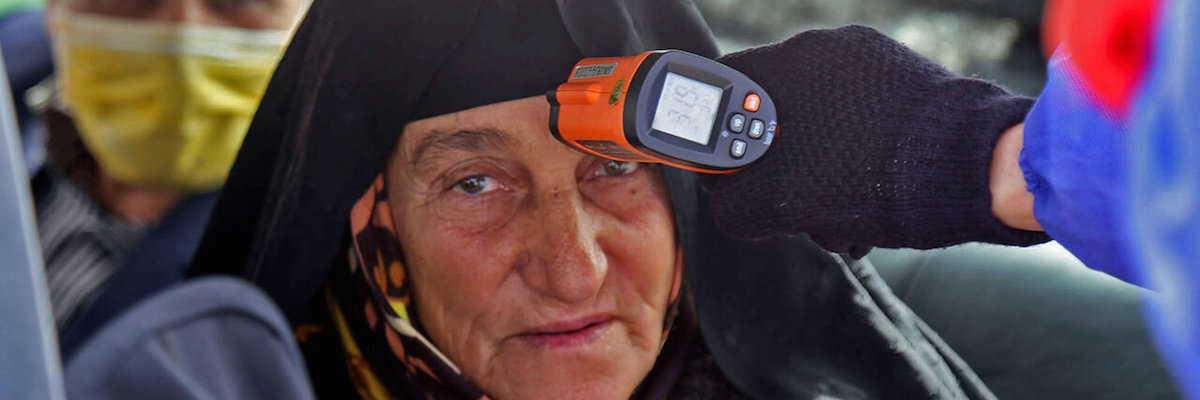
Iran became an early epicentre of the COVID-19 outbreak due to its close political and economic relations with China. Yet the Iranian healthcare sector overwhelmingly depends on European medicine and medical devices—products that China has been unable to replace. While the European Union and its member states must prioritize their own fight against the virus, they should also protect this important humanitarian connection with Iran.
The Iranian healthcare system is reliant on long-standing relations with European suppliers to see it through the crisis. If there is a grave breakdown in either this supply chain or Iran’s healthcare sector, it will spell trouble for Europe. Given that Iran continues to be the epicenter of the pandemic in a fragile Middle East, the coronavirus is likely to lead to increased refugee flows (particularly among Afghan communities) to Europe. Despite their conflicting opinions on the leadership in Tehran, Europe’s Iranian diaspora community – who, until recently, often travelled to Iran – broadly agree on the need for enhanced humanitarian assistance to Iran, which could save hundreds of thousands of people.
Following two years of recession linked to systematic mismanagement, falling oil prices, and the unique pressure created by US sanctions, Iran’s government is facing extreme trade-offs between the optimal public healthcare response and the need to prevent a full-blown economic crisis. These sanctions hamper Iran’s immediate response to COVID-19.. Despite their humanitarian exemptions, the measures make the import of medicine and medical equipment – as well as the raw materials needed to produce many of these goods in Iran – both slower and more expensive. This erodes the capacity of the Iranian healthcare system to replenish its inventories as Iran’s outbreak moves into its third month. Moreover, the Iranian government cannot afford the type of economic stimulus packages that governments across the globe have implemented to reduce the impact of lockdowns.
While the US has made general offers to send aid to Iran, leaders in Tehran will perceivethem as disingenuous for so long as the sanctions are in place. Given the sharp downturn in US-Iranian relations under the Trump administration, it is unrealistic to think that either the United States will provide full sanctions relief or that Iran will accept aid from a country it believes to be pursuing regime change in Tehran. Although the more hard-line elements within the Iranian system are suspicious of European assistance (as recently reflected in Iran’s sudden rejection of aid from Médecins Sans Frontières), there is some breathing room for the country to cooperate with Europe on this front.
Building on recent announcements by the EU, France, the United Kingdom, and Germany, European governments should continue to provide financial assistance and other aid to Iran’s public healthcare system and trusted NGO partners working in the country. European companies can also boost humanitarian trade via the Instrument in Support of Trade Exchanges (INSTEX) – which has now processed its first transaction, targeting Iran’s core public healthcare needs in the fight against COVID-19..
The European Commission has implemented export controls on key items in the fight against COVID-19, to minimize shortages in Europe. This move puts Iran and other low-income and developing countries at even greater risk, given their significant reliance on European exports. Rather than cut these supply chains, which forces Iran to turn to China and Russia, the EU should explore whether Iran could ramp up its production of basic medical equipment, such as surgical masks, to help meet demand in Europe. This would allow European manufacturers to focus on the production of more advanced items, such as face shields – the surplus of which it could/ sell to Iran.
Most importantly, European governments and the EU should press the US to strengthen the humanitarian exemptions in its sanctions. European leaders should urge the US Treasury to expand and clarify the scope of these exemptions to directly include products Iran needs to combat COVID-19 effectively. Such clarification, which could take the form of a “white list” of goods, should allow European companies to apply General License No. 8, under which the Central Bank of Iran can help facilitate humanitarian trade.
Given the unprecedented humanitarian fallout from the COVID-19 crisis, European governments should also urge the US administration to issue comfort letters to European banks that already conduct enhanced due diligence on trade with Iran. This would help reassure these banks that the US Office of Foreign Assets Control will not penalise them for providing payment channels to exporters of humanitarian goods. The Trump administration recently took the unprecedented step of issuing such a letter to Swiss bank BCP under the Swiss Humanitarian Trade Arrangement. As former US official Richard Newphew has argues, the US could provide similar letters to manufacturers and transport firms, helping reassure companies across the entire medical supply chain that they can facilitate sales to Iran.
While the International Monetary Fund reviews Iran’s $5 billion loan request, European governments should press the Trump administration to temporarily allow Tehran to access Iranian foreign currency reserves. In this, the administration could restore the escrow system that enabled Iran to use its accrued oil revenues to purchase humanitarian goods prior to May 2019. These funds (including those in Europe) could be subject to existing enhanced due diligence requirements and spent within the countries in which they are currently located. The funds in Europe could also be linked to INSTEX.
Such US measure could be connected to humanitarian steps by Iran, not least the release of American detainees. In particular, France and the UK – some of whose nationals Tehran has released from prison (either permanently or temporarily) in recent weeks – should stand ready to support these efforts. Europeans actors should emphasize that targeted relief need not change the substance of the Trump administration’s policy on Iran or reduce its leverage in potential negotiations with the country. Should Europe and the US fail to provide relief to Iran in such grave circumstances, this would turn the Iranian public against them for generations. And it would give ammunition to those in Iran who favor confrontation with the West.
Photo: IRNA
Iranian Civil Society, Businesses Step-Up in Virus Fight
Faced with the gravity of the COVID-19 outbreak, members of Iranian civil society and private sector business leaders have joined the fight against the virus, seeking to address gaps in the government’s response.
It may be springtime, but the nights are still chilly in Shiraz. It is 2:30 am. The streets of Iran’s fifth largest city are deserted and Ali Mousavi and his team of volunteers are walking along the boulevards and back-alleys with their disinfection equipment.
Shiraz has been an epicenter for cases of COVID-19 in Iran. Less than two weeks ago the city council wrote a letter to Iran’s president, Hassan Rouhani, expressing grave concerns over the soaring number of the new cases and calling for the government to take more serious action.
But many Shirazis were not content to wait for government interventions that tend to arrive slowly and often fail to provide adequate support. Mousavi, who is a lecturer at a local university, decided to take matters into his own hand by launching a volunteer effort, as they had last year in response to the deadly flash floods that hit Shiraz.
Mousavi and his team began disinfecting neighborhoods just a few days after Iran officially disclosed its first cases of COVID-19. Starting with two groups of 20 volunteers, there are now over 300 people contributing their time. Mousavi reports on the group’s efforts on Twitter.
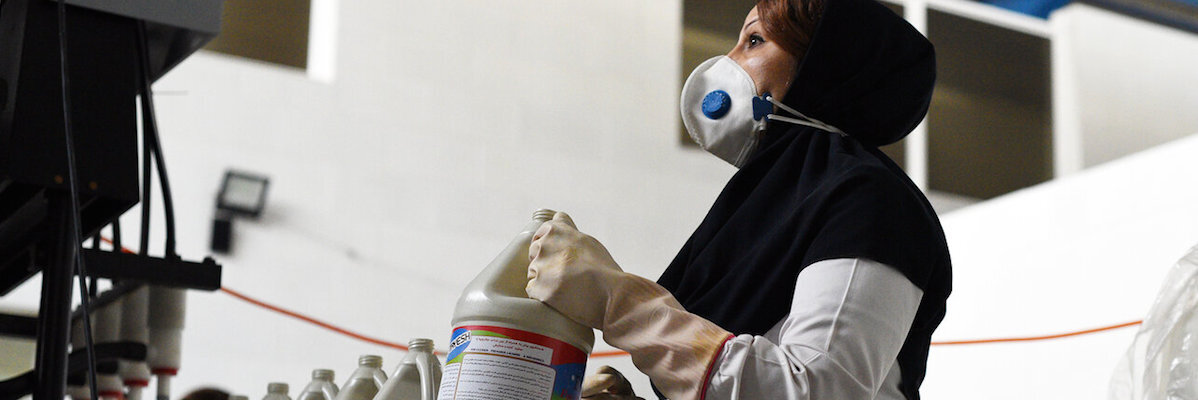
The volunteers have also helped with the production of protective face masks and hand sanitizer. “A local factory was understaffed and we could contribute manpower,” Mousavi explained. “With the coordination of Shiraz University of Medical Sciences, our team started working at the facility in three shifts producing 20,000 disposable surgical masks daily to meet the new demand.”
Grassroots Efforts Across Iran
COVID-19 has killed over 3,603 in Iran and the country has registered more than 58,000 cases of the illness, with 2,483 new cases announced just yesterday.
The government’s slow response to the virus allowed it to spread unhindered for several weeks before serious action was taken.
As the toll from the outbreak continues to mount, already diminished stockpiles of critical medical equipment are nearly depleted. To make matters worse, the Iranian government faces a significant budget deficit as a result of a collapse in the global oil price, a fall in regional trade, the pressure of U.S. sanctions, and fiscal mismanagement.
Faced with the gravity of the situation, members of Iranian civil society and private sector business leaders have joined the fight against COVID-19, seeking to address gaps in the government’s response.
Groups of concerned citizens have organized in dozens of cities across Iran, mobilizing to support sanitation efforts, to increase production of critical supplies, and to deliver groceries and medication to the homes of those most vulnerable to infection, including the elderly and those living in underprivileged communities.
A group of young seminary students in Mashhad were lauded after they volunteered to wash the bodies of coronavirus victims before burial, in keeping with Islamic custom—a risky job that few people were willing to do.
Volunteers are working selflessly, putting themselves at risk to help people in need, explained Mousavi, describing it as the “right spirit.” When asked whether any of his volunteers had been infected, Mousavi responded “no one so far, thank God.”
Mousavi and his team, like many similar groups around the country, are funded by donations. “Many people think we receive financial help from the government or military institutions, but in reality we receive limited support from those bodies.” He presents a receipt for a purchase of 400 pairs of industrial gloves for his disinfection teams, paid for by donations.
So far, Mousavi has collected around USD 20,000 in donations to purchase food and basic supplies for vulnerable households, especially those families that have lost their breadwinners to COVID-19.
Major Companies Join the Effort
Perhaps the largest philanthropic campaign under way in Iran is the Nafas Campaign (nafas means “breath” in Persian, but it is also the base of the Persian idiom for “trust in oneself”). Launched in late February, over 200 companies from Iran’s private sector have joined the campaign, coordinated by chambers of commerce and the philanthropic arms of several of Iran’s largest firms. Together, the members have donated over USD 1,000,000, medical equipment, in-kind services, and cash assistance to help fight COVID-19.
The Nafas Campaign has managed to supply ventilators to hospitals across the country. Last week, the campaign donated 55 ventilators, valued at around USD 350,000, to hospitals in Golestan, a province facing one of the most severe outbreaks of COVID-19 in the country.
Hospitals are also facing unprecedented demand for medical oxygen cylinders—and the Tehran Compressed Gas Association has stepped-up. Mahrad Ebad, vice chairman of the association, described a market under strain. "Unfortunately, in recent months, oxygen cylinders have been in short supply in Iran for variety of reasons, including high demand, sanctions pressures, and the depreciating rial. Prices have skyrocketed and we are seeing cylinders sold at prices as high as 2 to 3 million toman (USD 125 to USD 185).”
“Within the framework of our support to the Nafas Campaign, we have procured and donated over 1800 oxygen cylinders for use at hospitals across the country.” Ebad added.
Medical systems around the world are scrambling to procure N95 masks used by healthcare workers to protect themselves from the risk of infection. Tapping into the supplier relationships of its member companies, the Nafas Campaign has imported over 500,000 N95 masks from China, with another 120,000 masks slated to arrive in the coming days.
The Nafas Campaign’s flagship project was the construction of the Nafas Clinic, a center where patients can be tested for COVID-19 and other acute respiratory disease. Built in just eight days, the clinic, located in Tehran’s Sadeqieh square and adjacent to Ebnesina Hospital, has the capacity to test 300 patients daily and is open 24 hours, seven days a week.
Despite these successes, campaign members continue to be disappointed by the bureaucratic hurdles and lengthy custom clearance procedures that have delayed delivery of critically needed items to hospitals. “It is unacceptable that such key supplies are held for days merely for certain bureaucratic processes while our medical centers are facing shortage of protective gears,” said Farzin Fardis, communications director for the campaign. The campaign has called on the government to reduce the red tape.
Fadis believes the campaign is pioneering a new model of civic action, and the private sector nature of the initiative has enabled donations to be solicited from Iranians abroad. “The fact that so many businesses have come together to cooperate in civic activities as part of this campaign, sets an important precedent in Iran and we hope that when the coronavirus crisis is over, this campaign will be considered a successful model for such efforts.”
Photo: IRNA
Under Lockdown, Iranians Rediscover the Joys of Baking Bread
Iranians are staying at home, doing their part to “flatten the curve” as the country confronts COVID-19. Adjusting to confinement at a stressful and uncertain time, many Iranians have found a new and creative pastime—baking bread.
Iranians are staying at home, doing their part to “flatten the curve” as the country confronts COVID-19. Adjusting to confinement in a stressful and uncertain period, many have found a new pastime—baking bread.
The bustling streets of Iran’s cities are now deserted, although the country’s lockdown measures are not as strict as those in Italy or France. The government has instructed bakeries to keep normal working hours and bakers continue to be well-supplied with flour, which is heavily subsidized in Iran.
Some customers continue to line up—keeping a safe distance from one another—and many bakeries have stopped accepting cash to avoid bakers handling spare change. But many Iranians have opted to stop visiting bakeries, if only to limit their time outside.
Unable to get fresh bread each day, Iranians have turned to store-bought brands. Others have bought bread to freeze, hoping it would last them during the lockdown.
On March 13, armed forces chief of staff Mohammad Bagheri, announced that security forces would begin enforcing restrictions on intercity travel, a move many interpreted to mean that a full lockdown was imminent. Iranians rushed to stock up on essentials.
Hearing the news, Ahmad, who declined to share his last name, headed to the nearest bakery. Married and with two children, he bought stacks of bread that could sustain his family for at least a week. “At the time I thought if the government imposed a lockdown, at least we’d have bread to eat.”
Although Iranian cuisine is often associated with rice, bread is the true staple. Iranian per capita bread consumption is 160 kilograms each year—by some accounts the second highest level in the world. It should be no surprise then that the global “bread-baking boom” would reach Iran.
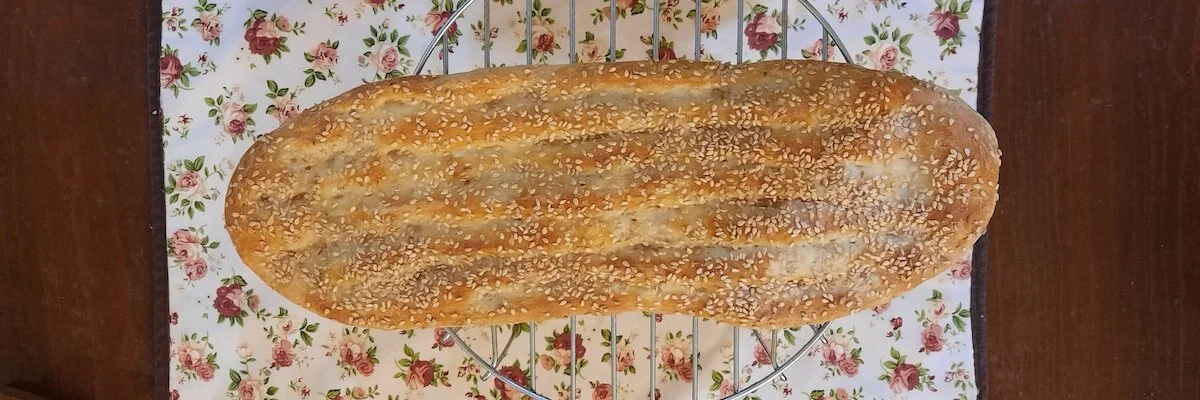
Nasim Moghaddam is a manager at an Iranian startup. She is immune-compromised and has been self-isolating since early March. Four weeks into her quarantine, with ample time to take on a new project, she tried her hand at baking Lavash and Barbari, two of the most popular Iranian flatbreads.
“I have always been into cooking and baking. I had even tried baking bread once or twice before. Bread-baking takes time and effort, but time is something I’ve got in abundance these days,” she said.
Moghaddam explained that baking helps her wind down during these stressful days. “Baking takes your mind off all the tensions. You need to concentrate on what you are doing or you will simply ruin what you are making.”
Maryam Keshtparvar, a psychologist, believes many Iranians are seeking ways to cope with the profound psychological effects of the pandemic. “The first priority for everyone has become the urge for survival and people feel that that they have been deprived of the many securities of modern life. This can trigger fear and anxiety,” she said.
Keshtparvar notes that as people settle into a new routine at home while they wait out outbreak, new pastimes are gaining popularity. “Some of these activities may be considered throwbacks to an earlier age. People have started growing vegetables and baking bread at home. They find themselves experimenting with soil, plants, and flour. This newfound familiarity with the elements rekindles calm in people.”
Artist Pooya Shahsiah and her husband Ehsan started baking bread a few months before COVID-19 outbreak. But they have taken their baking to new heights since beginning self-isolation. The pair have come to see baking bread as a “creative experience that has a prevailing presence during your daily life.”
Pooya recalled the origin of their hobby in an Instagram post, writing, “One day I woke up and found Ehsan trying to bake bread. A new hobby, I thought to myself, which he’d give up on soon. But he didn’t. This still comes as a surprise to me, but we have not bought bread even once over the past six months.” In the same post, she explains the basics of baking sourdough bread.
Their loaves have won fans. “We have been receiving calls from friends asking us to bake them a loaf or two,” she said, laughing boisterously. “We might even start selling bread.” The couple is currently going through as much as 8 kilograms of flour a week.
Speaking by phone, the couple explained that for them, baking has an emotional significance. “For years, Ehsan longed for the taste of bread his late aunt baked. Sourdough was the answer,” Shahsiah explained. “Some even name their sourdough starters as if they were newborn babies. We don’t, but we certainly pamper our starter.”
Posting about their baking exploits on social media, the couple was asked by friends to share their starter, which helps speed the fermentation process. “We did, just to give them a head start in the process. But I was worried that they wouldn’t take proper care of it. You need to pay attention to minuscule details. The smallest details can change the outcome.”
The pair learned how to bake by watching YouTube tutorials, accessed by VPN.
Over the past few weeks, as the coronavirus outbreak grew worse, similar tutorials have been uploaded to Aparat, Iran’s leading video-sharing platform. Even IRNA, a state news agency, has published an article entitled “How to Make Taftoon Bread at Home: An Enjoyable Pastime.”
Those who have tried it tend to agree.
Photo: Nasim Moghaddam
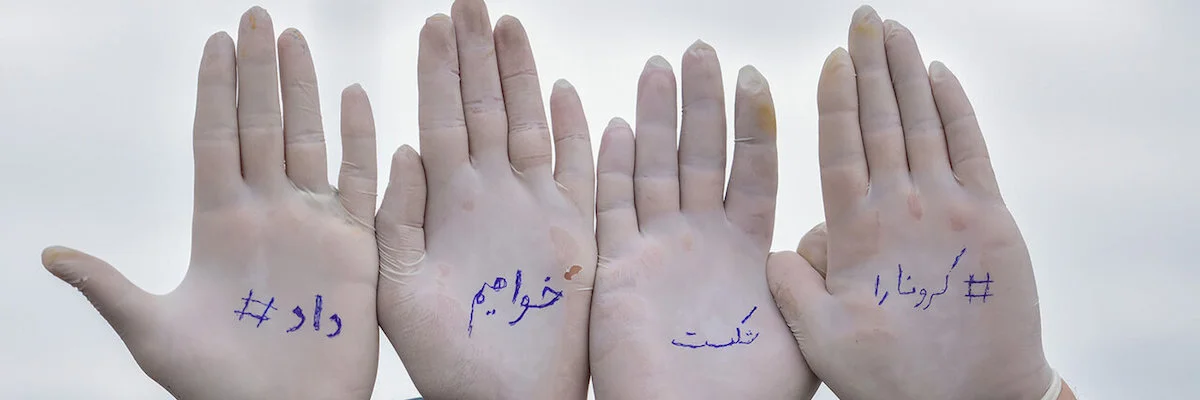
As Coronavirus Spreads, Iranian Doctors Fear the Worst
The combination of Iran’s physical interconnectivity and its relative political and economic isolation pose unprecedented challenges for international public health, particularly as U.S. sanctions constrain the supply of raw materials and imported medical supplies.
By Esfandyar Batmanghelidj and Abbas Kebriaeezadeh
Iran is often described as an isolated country, but the spread of the coronavirus has made clear that the Islamic Republic is less isolated than often assumed. Iran’s significant trade links with China, where COVID-19 originated, left the country vulnerable to the spread of the virus.
The outbreak in Iran is one of the world’s largest, with more than 2,300 confirmed cases and 77 declared deaths. Many of the first cases registered in other places—including Iraq, Lebanon, Georgia, Qatar, New Zealand, and even New York—are attributable to individuals who had traveled from Iran. Clearly, notwithstanding the attempts of U.S. President Donald Trump’s administration to isolate Iran politically and economically, Iran remains connected to the world. It follows that Iran’s success or failure to manage its coronavirus outbreak will directly impact the threat of a pandemic.
The combination of Iran’s physical interconnectivity and its relative political and economic isolation pose unprecedented challenges for international public health. The first two weeks of Iran’s coronavirus outbreak have been similar to those in other countries. Authorities were slow to take measures such as closing of schools and universities and canceling of public gatherings, including briefings and government meetings that contributed to the infection of numerous officials.
As the severity of the crisis became clearer, members of the public became anxious, adding to the strain on Iran’s health care system. People rushed to pharmacies and stores to purchase supplies. They rushed to hospital emergency rooms worried that a persistent cough could be COVID-19.
These are understandable reactions and are always preferable to indifference—any successful public-health campaign requires individual members of the public to take responsibility and proactive action. But as the number of confirmed cases mounted, so too did demand for respiratory masks and contamination suits, symptom relief medication, and immunity-boosting vitamins, as well as disinfectants, detergents, and related hygiene equipment.
Given its sophisticated manufacturing base, Iran produces many of these products domestically, limiting the initial impact of sanctions on the availability of medicine and equipment. However, inventories in pharmacies and shops are running low. Importers are struggling to get their hands on new inventory and factories are struggling to ramp up local production to keep up with the rising demand. U.S. sanctions are largely to blame for these disruptions.
The Iranian companies producing medicine, disinfectants, and protective clothing also have a supply-chain problem; they are dependent on imported ingredients and materials. For example, even though antiviral drugs are manufactured in Iran, the raw materials are almost entirely supplied from China and India. Should Iranian manufacturers run out of these raw materials, it will be very difficult, if not impossible, to effectively contain and treat COVID-19 in Iran. U.S. sanctions are constraining the supply of raw materials and imported goods in two ways.
First, there is the issue of transport links. Even before the outbreak of the virus, the Trump administration’s reimposition of secondary sanctions on Iran in November 2018 saw many airlines and international shipping companies end their presence in the Iranian market. As a result, for a country of its size, Iran is unusually reliant on regional hubs for both air travel and freight forwarding.
As neighbors impose travel restrictions, Iran is facing difficulties in sustaining imports, particularly for time-sensitive deliveries by air. The World Health Organization recently faced delays in supplying Iran with coronavirus testing kits “due to flight restrictions” that prevented their dispatch from the United Arab Emirates.
The kits were eventually delivered via a commercial flight from Baghdad, but that route may also be closed as Iraq as now announced its first confirmed cases of the virus. A subsequent delivery of equipment did arrive in Tehran from Dubai—but only after the Emirati government arranged a military transport at the request of the World Health Organization.
Second, even if a viable means of delivery can be found, it has been well documented how U.S. secondary sanctions have restricted humanitarian trade with Iran by scaring off most banks from facilitating the necessary payments.
The imports that do take place—from major suppliers such as Germany, Switzerland, and China—reflect long-standing business relationships in which the foreign exporter and Iranian importer have put the facilitating bank (usually a small merchant bank) at ease by preparing extensive compliance documentation.
The fact that humanitarian trade is currently conducted in this manner—a slow, inflexible process—makes it inherently difficult for Iranian entities, particularly governmental entities such as the Ministry of Health and Medical Education, to quickly identify new suppliers and purchase the required goods during a public health crisis. Moreover, sanctions have both weakened Iran’s currency and made it difficult for Iran to access its foreign exchange reserves, further adding to the time and cost of any emergency purchases.
Medical professionals in Iran are seeing the early signs of shortages. They are calling the Iranian vendors of respiratory masks, surgical gowns, and ventilators only to hear that the goods are out of stock. They are struggling to get antiviral medication even to those patients exhibiting the most acute symptoms.
While much of the global attention towards Iran’s response to coronavirus has focused on the question of whether or not the Iranian government has adequately managed the outbreak, there is a far more urgent concern among Iran’s doctors. If Iranian pharmaceutical companies and medical equipment manufacturers are unable to establish speedy and reliable means to import raw materials, the country could soon face a humanitarian catastrophe.
The Trump administration has made an offer of humanitarian assistance to Iran—but has provided no detail. To address the impact of sanctions on Iran’s ability to import and manufacture key items, it would be straightforward for the administration to provide greater legal clarity to exporters and the banks on which they rely—for example by expanding the definition of “humanitarian” goods so as to include items needed to fight COVID-19, such as respiratory masks and disinfection equipment, as well as raw materials, within the scope of existing general licenses.
Given that it is unlikely that the United States will take any such steps, it is commendable that the governments of France, Germany, and the United Kingdom have dispatched “equipment for laboratory tests as well as… protective body suits and gloves” to Iran. They will also be providing “urgent additional financial support close to €5 million to fight the COVID-19 epidemic affecting Iran, through the WHO or other UN agencies.” But these are stopgap measures.
To address the vulnerabilities of Iran’s domestic medical and medical equipment manufacturers, European governments could utilize the Instrument in Support of Trade Exchanges (Instex) trade mechanism, which was established to ease humanitarian trade between Europe and Iran by creating a standard compliance protocol and by eliminating the need for European banks to receive payments directly from Iranian banks.
The company, which boasts nine European states among its shareholders, has yet to make its first transaction. Nonetheless, policymakers are adamant that the company is nearly operational. Aiding Iran in its fight against coronavirus could provide INSTEX a renewed sense of purpose.
Of course, Western governments are increasingly preoccupied with their own coronavirus outbreaks, and further assistance may be difficult to coordinate. The Iranian health care system and the companies that supply the nation’s hospitals will continue to fight coronavirus without all the resources they need—a situation that has drawn parallels to the country’s experience during the Iran-Iraq War.
Nevertheless, Iran’s experience with COVID-19 offers a cautionary tale about the intersection of sanctions policy and international public health. The economic vulnerabilities that sanctioning countries seek to create in target countries never exist in true isolation. Just as a virus will attack the most vulnerable members of any given population, the coronavirus is now attacking the global health system at its most vulnerable points—before spreading everywhere else.
Esfandyar Batmanghelidj is the founder of Bourse & Bazaar. Follow him at @yarbatman.
Abbas Kebriaeezadeh is a professor of pharmacology at the Tehran University of Medical Sciences He is vice chairman of the Iranian Pharmaceutical Industries Syndicate and chairman of Baran Chemical and Pharmaceutical Company.
Photo: IRNA
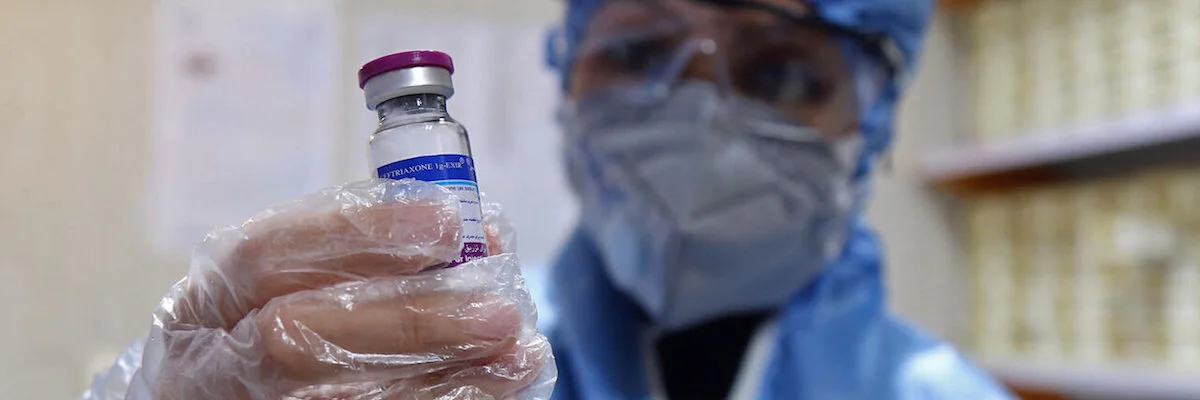
Europe-Iran Trade Mechanism Completes Landmark Iran Sale
The Germany foreign ministry has announced that INSTEX, the trade mechanism backed by nine European states to facilitate humanitarian trade with Iran, has completed its first transaction.
The Germany foreign ministry announced on Tuesday that INSTEX, the Iran trade mechanism backed by nine European states, has completed its first transaction.
"France, Germany and the United Kingdom confirm that INSTEX has successfully concluded its first transaction, facilitating the export of medical goods from Europe to Iran. These goods are now in Iran," the ministry said in a statement.
An individual with knowledge of the transaction, speaking on background, said that a German exporter had used the INSTEX mechanism to receive payment for the sale of medication to an Iranian private sector importer. The transactions was later reported to be worth EUR 500,000.
The sale is consistent with INSTEX’s initial mission to facilitate humanitarian trade, currently impinged by the impact of U.S. secondary sanctions on banking ties between Europe and Iran.
Officially launched in January 2019, INSTEX was slow to operationalize as French, German, and British officials grappled with the political and technical challenges of establishing a novel state-owned trade mechanism.
But in the summer of last year, INSTEX hired its first managing director and expanded its team, leading to a step-change in the company’s operations.
The new management resisted pressure to conclude an initial transaction as soon as possible—European officials had explored providing a factoring service as a stopgap—and instead sought facilitate a sale that would utilize the cross-border clearing mechanism. Through this mechanism, INSTEX makes payments to European exporters on behalf of Iranian importers, reducing the transaction costs associated with Europe-Iran trade. These sales are netted against exports made by Iranian companies, who are paid in turn by INSTEX’s Iranian counterpart, STFI.
INSTEX management has been working on several transactions in parallel, on the back of strong interest from European exporters to engage the mechanism. The German foreign ministry statement concludes, “INSTEX and its Iranian counterpart STFI will work on more transactions and enhancing the mechanism.”
Photo: IRNA

The Coronavirus Crisis Is a Diplomatic Opportunity for the United States and Iran
Washington and Tehran could use the COVID-19 public health emergency to show goodwill, dial down tensions while saving face, and avoid a dangerous confrontation.
By Robert Malley and Ali Vaez
If Iran’s leaders thought things couldn’t get worse, they were wrong. The country faces three simultaneous crises: a public health emergency that is worsening by the hour, tensions with the United States that have once again grown in the past few days, and an economic picture that could go from troubled to dire in a matter of months.
The confluence of a coronavirus pandemic, security threats, and financial troubles has deepened the political system’s legitimacy crisis in the wake of last month’s parliamentary elections that saw the lowest turnout in the Islamic Republic’s history. Washington might view this as a validation of its so-called maximum pressure strategy against Tehran, but if it fails to capitalize on this moment to de-escalate tensions and lay the groundwork for a mutually beneficial diplomatic settlement, the leadership in Tehran is likely to become more aggressive in the region, increasing the risk of a conflict that neither side appears to want.
Since the dramatic escalations of late 2019 and early 2020, which culminated in the killing of the Islamic Revolutionary Guard Corps commander Qassem Suleimani and Iranian missile strikes on Iraqi bases hosting U.S. forces, both Iran and the United States appeared content to return to their respective corners.
But there has been a steady stream of incidents in Iraq, with at least seven attacks near U.S. diplomatic facilities inside Baghdad’s Green Zone and U.S. military installations in Iraq throughout January and February. These attacks spiked on March 11 following a barrage of rockets that killed three members of the U.S.-led coalition, including two Americans, and injured more than a dozen others at an Iraqi army base, Camp Taji, north of Baghdad.
U.S. Secretary of Defense Mark Esper subsequently assessed that “Iranian-backed Shiite militia groups” were responsible. Secretary of State Mike Pompeo warned that “those responsible must be held accountable.” A day later, the United States retaliated against an Iranian-backed Iraqi militia in Iraq, which in turn fired more rockets into Camp Taji on March 14 and again on March 17.
This latest moment of peril is playing out against the backdrop of a dramatic COVID-19 outbreak in Iran, which has the third-highest number of confirmed cases and fatalities anywhere in the world. The Iranian government was slow in responding to the outbreak; and when it finally realized its scale and scope, Tehran was hampered by shortages caused by sanctions. Moreover, the government has kept a worryingly tight grip on the information flow to save face, prompting fears that the death toll—currently listed as 988—is probably much higher than the official figures suggest.
With Tehran’s initial response being dismissive of the risks of the virus’s spread and slow to mobilize against it, the government is now pleading for international assistance. Having already scored several calamitous own goals in recent months—raising fuel prices with little warning in November 2019, then violently suppressing subsequent protests, and in January downing a Ukrainian civilian airliner in the apparent belief it was an incoming U.S. missile—the government’s response to the coronavirus crisis could increase the population’s sense that its leadership is incompetent.
Meanwhile, the impact of the rapidly spreading disease and collapse in oil prices will likely present almost unprecedented challenges to an economy that is already beset by government mismanagement and under siege from U.S. sanctions.
One Iranian official calculated a drop of 18 percent in trade as a result of the pandemic—and that was before Iraq, a key regional trade partner, announced a full closure of the two countries’ common land borders and the price of crude tumbled below $30 per barrel. (While Iran’s exports have been blocked by the United States since April 2019, it has continued to make sales to China, albeit at sharply reduced levels.) The combination of reduced regional trade, evaporation of remaining oil revenue, and COVID-19’s impact on domestic business could prove catastrophic.
But that doesn’t mean that Tehran will bow to U.S. pressure and back down. Indeed, since May 2019, when the Iranian government chose to counter U.S. maximum pressure with a blend of nuclear and regional provocations, the system’s hard-liners have contended that high-risk brinkmanship yields greater dividends than restraint.
The coronavirus outbreak has now put more pressure on the leadership’s calculus. Feeling besieged and with no obvious diplomatic exit ramp, Iran might conclude that only a confrontation with the United States might change a trajectory that’s heading in a very dangerous direction.
This is also the view of Gen. Kenneth McKenzie, the head of U.S. Central Command, who told Congress on March 10 that the outbreak “probably makes them, in terms of decision-making, more dangerous rather than less dangerous.”
With U.S. President Donald Trump focused on the domestic economic and electoral effects of the coronavirus and the Iranian leadership highly reluctant to display any weakness to the United States, neither side is likely in the mood to engage the other.
That would be a missed opportunity. Indeed, both Washington and Tehran have floated ideas that, if acted upon, could break the current vicious cycle. Pompeo has urged the Iranian government—which furloughed tens of thousands of convicts due to fears of an epidemic in prisons—to free U.S. prisoners and other dual and foreign nationals on humanitarian grounds. The death of any of those inmates from COVID-19 would be a stain Iran might find hard to erase.
Conversely, Iran has asked the International Monetary Fund for emergency funding and a substantial list of essential equipment ranging from gloves and masks to portable respiration and X-ray machines. If the Trump administration stands in the way of such basic needs—by voting against an IMF loan to Iran—the United States would find it hard to overcome the impression that it had acted inhumanely.
The most logical and mutually beneficial outcome would be a two-phased humanitarian de-escalation. Iran would need to first agree to furlough all detained foreigners as the U.S. facilitates the transfer of medicine and medical equipment Iran needs to contain the outbreak and save lives without any sanctions-related delays.
In the second phase, the U.S. government could agree not to block the IMF loan to Iran while Tehran freezes its nuclear escalation and reins in its allied groups in Iraq, preventing any further attacks on U.S. forces and assets. This phase could also comprise another prisoner swap, either on par with the one-for-one exchange that happened back in December or, even better, a broader exchange of prisoners. This would be a win-win: putting tensions with Iran on ice, providing Trump with another success in his efforts to free Americans detained abroad, and providing Tehran with some economic reprieve and the means to save lives at home.
Since 2018, when the Trump administration pulled out of the nuclear deal with Iran, Washington and Tehran have been on a collision course pitting unrealistic U.S. demands against Iranian inflexibility. For either side to let a possible diplomatic off-ramp pass by would mean that a dangerous and deadly situation might again take a turn for the worse.
Robert Malley is president and CEO of the International Crisis Group. He served as a special assistant for the Middle East under President Barack Obama. Follow him at @Rob_Malley.
Ali Vaez is the director of Iran Project at the International Crisis Group and an adjunct professor at Georgetown University's School of Foreign Service. Follow him at @AliVaez
Photo: IRNA
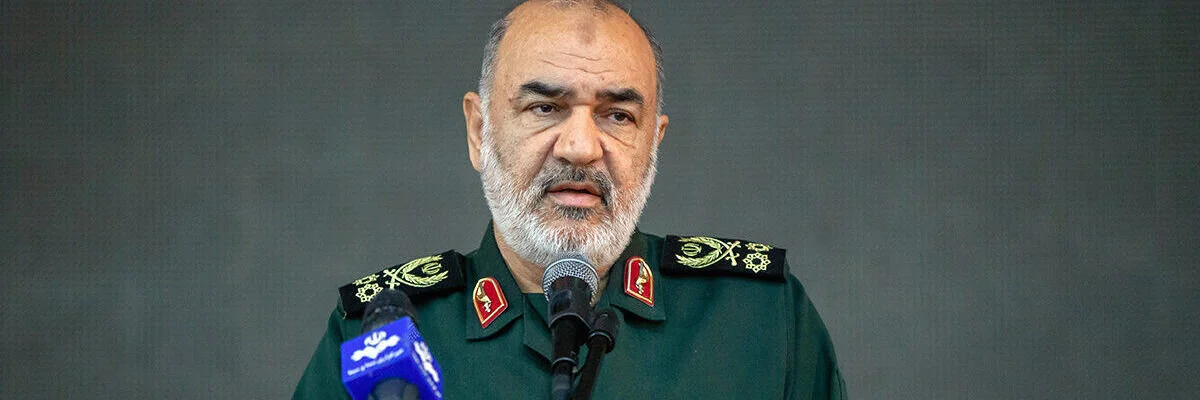
Will Iran Follow North Korea’s Path and Ditch the NPT?
In the past year, the prospect of withdrawing from the NPT has transformed from a fringe idea among hard-liners in Iran into a real policy option that resonates with a surprisingly large spectrum of Iranian society.
By Mahsa Rouhi
Washington’s “maximum pressure” campaign against Iran has recently pushed each side into a series of escalatory moves and countermoves. Since U.S. President Donald Trump took office, his administration has hoped that Iran would eventually relent and make concessions on its nuclear program, missile development, and regional activities, but it seems increasingly likely that Iran may instead decide that its best path forward is to follow North Korea’s example and withdraw from the Nuclear Non-Proliferation Treaty (NPT), long considered the global cornerstone for preventing the spread of nuclear weapons. (Three years after pulling out in 2003, North Korea tested its first nuclear weapon.)
The mainstream view in Iran until recently was that withdrawing from the NPT would bring further diplomatic isolation, lead to increased sanctions, and court a U.S. military strike on Iran’s nuclear facilities. Therefore, it would be counterproductive to Tehran’s larger aspirations of regional leadership and reintegration into the international community. But recent events have caused Tehran to reevaluate those ambitions, as they seem increasingly far-fetched. In the past year, the prospect of withdrawing from the NPT has transformed from a fringe idea among hard-liners in Iran into a real policy option that resonates with a surprisingly large spectrum of Iranian society.
Iran still maintains that it does not seek nuclear weapons, but as the International Atomic Energy Agency revealed on March 3, Iran has nearly tripled its stockpile of low-enriched uranium to 1,021 kilograms (1.1 tons) since November 2019. This amount, if further enriched, would be enough for a nuclear bomb, if Iran decided to cross the line.
It hasn’t helped that diplomatic relations between Iran and the other parties to the 2015 Iran nuclear deal have rapidly deteriorated. Since May 2019 Iran has scaled back on its commitments, and on Jan. 5, it announced it would no longer abide by the operational restrictions on the low-enriched uranium stockpile, enrichment capacity, percentage of enrichment, amount of enriched material, and research and development.
In response, three of the remaining parties to the accord—France, Germany, and the United Kingdom (known as the E3)—triggered the deal’s dispute resolution mechanism. Iran takes issue with this, arguing that it already triggered the mechanism itself after the United States pulled out of the deal in 2018. The E3 and the European Union disagree and have been trying, with middling success, to persuade Russia and China to side with them on the matter.
This measure—if all steps are exhausted—could ultimately refer Iranian noncompliance to the U.N. Security Council and trigger the snapback of U.N. sanctions within weeks. However, as long as no party declares that Iran has not taken steps to resolve the dispute, it can remain bottled up indefinitely in the Joint Commission, the body charged with overseeing the accord. Since Iran has not taken further provocative steps, such as enriching to 20 percent, the other parties seem content to kick the can down the road.
This is for the best. Iran’s foreign minister, Mohammad Javad Zarif, has stated that if U.N. Security Council sanctions are reimposed, Iran may exit not merely the nuclear deal but also the NPT.
It is not just the prospect of U.N. economic sanctions that upsets Iranians, but the notion of again falling under provisions of Chapter VII of the U.N. Charter, which allows the Security Council to take military and nonmilitary action to “restore international peace and security.”
The idea of withdrawing from the NPT is not new, but is now being discussed widely in moderate circles, including by the speaker of the parliament, Ali Larijani. This turn in strategic thinking is due to the ramping up of U.S. sanctions, particularly on oil sales and what Iran sees as the failure of other parties to provide sanctions relief promised under the deal. Under these circumstances, Iranians increasingly believe they have nothing to gain from the deal and little more to lose by going rogue—since their country is already being treated as an outcast. The heightened tensions with Washington and the increasing possibility of conflict add to Iranians’ sense that the cards are stacked against them no matter what
To the Iranian government, U.S. pressure could potentially become an existential threat to its survival.
Iran’s strategy since 2003 can best be described as nuclear hedging: The country has been developing nuclear capabilities in order to maintain the option of building a weapon in the future should it decide to do so, while also downplaying and sidestepping international opposition in order to build negotiating leverage. However, the heavy toll from Trump’s efforts since 2018 to deprive Iran of oil revenues appears to be changing Iran’s cost-benefit calculus.
Its economy shrank by 9.5 percent last year and is projected to remain flat in the coming year. Foreign investment has declined and oil exports have dropped dramatically. Iran’s currency, the rial, has deeply depreciated and inflation has risen dramatically, increasing the cost of living for ordinary people in Iran. Economic turmoil, in turn, has created a tense domestic situation: In November 2019, nationwide protests over the sudden increase in gasoline prices put new pressure on the government. The devastating impact of COVID-19, which has hit Iran particularly hard, exacerbates the gloom.
To the Iranian government, U.S. pressure could potentially become an existential threat to its survival. The government therefore needs a game-changer. Feeling driven into a corner, Iran could consider withdrawing from the NPT as the only option left to ensure self-preservation. In a sense, they are falling for the same fatalistic logic applied by hawks in Israel and the United States who argue that since a conflict with Iran is inevitable in the future, it is best to weaken their adversary and face any conflict now rather than later. Many of the political elite feel that they should take the gamble now rather than after a few years with more limited oil revenue.
If Iran does decide to withdraw, it would not necessarily imply a decision to build nuclear weapons. It considers that rejoining the NPT will be a valuable bargaining chip. In addition, it could openly accelerate its enrichment program for the purpose of building leverage for future negotiations. However, advocates of withdrawal point out that Iran is already suffering many of the same international consequences as North Korea—sanctions, pariah status—without any of the benefits.
Tehran is suffering now from problems that Pyongyang only encountered after withdrawing from the NPT. So why not build a bomb for the sake of regime security and regional prestige?
After all, Iran complied with the nuclear deal for three years, only to ultimately be threatened with new rounds of sanctions.
Some hard-line voices in Tehran argue that a nuclear weapon capability would boost Iran’s regional status like never before and might also guarantee the regime’s survival, as the risk of toppling a nuclear government in an already destabilized region would be too high for the West. In short, they conclude, a nuclear-armed Iran would have an upper hand in the international community.
However, Iran is aware of the risks of following North Korea’s path. Despite its nuclear escalation, North Korea has not been able to negotiate tangible sanctions relief. Leaving the NPT would likely unite the international community—including China and Russia—against Iran, and could provoke the United States, Israel, and at least one of the Gulf states, or a combination of these powers, to launch military strikes against its nuclear facilities.
Such an attack, which would be hard to keep from expanding to a large-scale war, would destroy Iran’s nuclear enrichment capabilities in the near term, but would almost guarantee that Iran would continue to build nuclear weapons in clandestine facilities.
However, if faced with renewed military threats from the United States, and if the E3 continues to prove unable to defuse mounting economic pressure and potential U.N. sanctions, Iran is likely to take this step.
The government in Tehran is under immense internal pressure from hard-line factions and from the public.
In the summer of 2021, a new, most likely hard-line, president will take office. If Iran has not obtained significant sanctions relief by then, it is possible that the new president will seek to achieve for Iran the status his compatriots yearn for—likely through negotiations, with the open question being whether this will occur before or after Iran has built a nuclear weapon.
With the future of the nuclear deal in doubt, it is essential for the Europeans, China, and Russia to take firm action on sanctions relief, as well as diplomatic and economic reintegration. Such actions and assurances would de-escalate the situation, decrease the possibility of military attack and slow down Iran’s policy shift
The severity of COVID-19 in Iran gives the remaining parties to the deal a strong reason to provide sanctions relief and assistance in humanitarian fields such as sending medical supplies. Doing so would also show good faith and signal to Iranians the benefits of remaining part of the international community. It can also set a more positive foundation for diplomacy and encourage restraint on Iran’s part not to cross a red line on its nuclear activities.
It is vital that Iran continue its compliance with the International Atomic Energy Agency and remain party to NPT, in order to keep the door open for future agreements and prevent the worst-case scenarios of war or a nuclear-armed Iran.
Mahsa Rouhi is a research fellow with the nonproliferation and nuclear policy program at the International Institute for Strategic Studies. Follow her at @MahsaRouhi.
Photo:IRNA
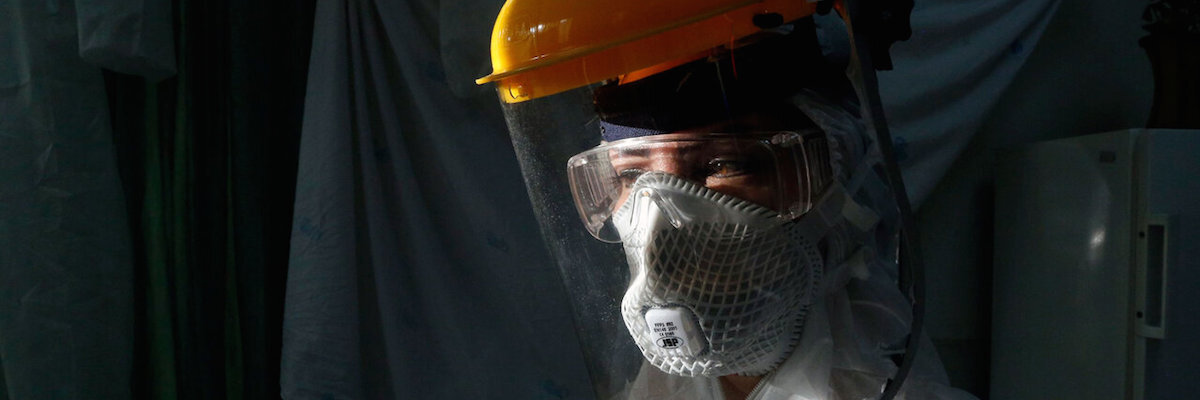
New European Limits on Medical Gear Exports Put Iranians at Risk
The European Commission has announced a new regulation that will establish export controls for Personal Protective Equipment (PPE), a category of goods that includes the face shields, gloves, masks, and other protective gear. The new policy could make it more difficult for Iran to source the equipment necessary to protect doctors and nurses fighting COVID-19.
As the world grapples with shortages of the medical equipment needed to fight the COVID-19 pandemic, the European Commission has announced a new regulation that will establish export controls for Personal Protective Equipment (PPE), a category of goods that includes the face shields, gloves, masks, and other protective gear that help medical professionals limit their exposure to bacteria and viruses. The regulation will limit the sale of these PPE items to countries outside the European Union (EU)—exports of these items were valued at USD 12 billion last year.
Analysis by Chad Bown of the Peterson Institute for International Economics makes clear how the European Commission’s move could have significant consequences for non-European countries that largely supply their healthcare systems with protective equipment made by European firms. Bown argues that the new policy could prove “self-defeating,” both because it may serve to “disrupt supply chains” and also because the new act could “block EU exports of vital equipment to the world’s poorest victims of the pandemic.”
The European Union is home to many of the world’s largest producers of medicine and medical equipment. With the support of their governments, these firms have encouraged “developing countries to open up their markets to imports, facilitating a system in which these countries have come to rely on EU suppliers for their essential medical equipment.” Iran is one such country.
When looking at EU exports to Iran of the PPE items specifically covered under the new regulation, two things become clear. First, Iran was importing significantly more of these goods prior to the Trump administration’s reimposition of secondary sanctions beginning in May 2018. Total exports to Iran fell from EUR 39 million to just EUR 13 million last year, suggesting that Iran’s healthcare system was already grappling with limited inventories of face shields, gloves, and other protective equipment even before the COVID-19 outbreak.
Second, despite the fall in trade, it is clear that EU is a significant supplier of PPE items to the Iranian healthcare system—a fact that leaves Iranian doctors and nurses vulnerable as the bloc begins to enforce the newly announced export controls. This vulnerability is made more clear when looking to EU exports in proportion to exports from Iran’s other leading trade partner: China. In the category of face shields, which account for around half the total value of world PPE exports to Iran, 35 percent of exports were dispatched from the EU.
This figure is lower than the proportion identified by Bown for many countries that trade with Europe, reflecting how sanctions have deterred European suppliers from the Iranian market over the last decade, enabling Chinese suppliers to expand market share. Nonetheless, the EU accounts for about one-fifth of all PPE exports in value terms, meaning that Iran’s healthcare system will be hit as the new export controls are implemented. Already struggling to procure goods through existing supply chains, Iranian importers—and the hospitals that depend on them—may find the supply chains cut altogether.
Moreover, the administrative burden of complying not only with the new export control regime but also with new sanctions regulations will put Iranian buyers at the back of the line for any sales that are to be licensed. European manufacturers of personal protective equipment will want to get whatever limited inventory available for sale to third party countries to the buyers who can make payment and take delivery in the shortest amount of time—Iranian importers are not those buyers.
The new regulation does indicate that some accommodations will be made for the provision of European aid. The regulation states, “exports of certain quantities of specific products may be authorized under specific circumstances such as to ensure assistance provided to third countries.” Iran has already received aid from France, Germany, and the United Kingdom as well as assistance provided by the EU itself. But the regulation has the effect of cutting long-standing commercial relationships between European manufacturers and importers in countries like Iran, and replacing them with a highly political procurement channel. It is not clear how European policymakers will prioritize who receives aid including PPE items—will it be the countries currently facing the most acute outbreaks, such as Iran, or will it be the countries where Europe sees the most favorable political and economic relations, such as Norway.
In the face of such uncertainty, China has mobilized resources to increase aid shipments and commercial sales of medical equipment to countries around the world, including Iran. But Chinese suppliers cannot replace European suppliers in each and every country as the COVID-19 pandemic spreads. As Bown, concludes, “to ensure the hospital equipment to fight the pandemic arrives where and when it is needed the most, policymakers must coordinate and cooperate globally.” The European Union is the only global actor that could effectively marshall such an approach.
As a country with a large manufacturing base, Iran can be part of the solution. Iranian firms have already taken steps to increase production of face masks, disinfectants, hospital beds and other products and equipment for which there is growing global demand. Rather than seek to cut its supply chains with non-EU countries, European authorities could seek to increase imports of basic PPE items such as surgical masks or gowns from countries like Iran, leaving European firms to focus on ramping up production of more advanced equipment such as face shields, generating a surplus for export. In short, the same notions of comparative advantage that led to the creation of today’s complex supply chains should inform their retooling during the COVID-19 crisis. Abandoning economic interdependence will put everyone at greater risk.
Photo: IRNA
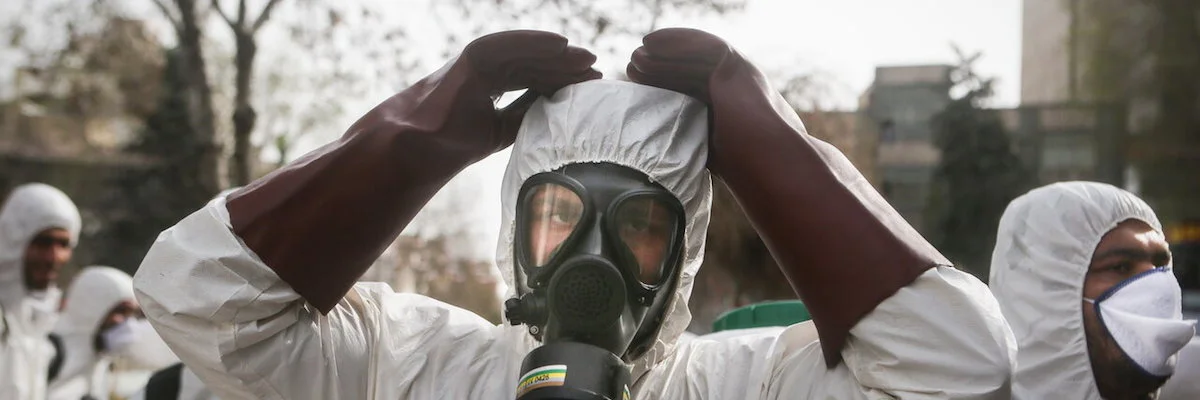
Iran's Urgent IMF Loan Request Challenges Trump Policy
For the first time in 60 years, Iran has requested a loan from the International Monetary Fund (IMF), seeking emergency financing to support its efforts to combat COVID-19. If the IMF fails to provide Iran financial assistance that it makes available to countries in similar situations, the fund’s reputation will take a hit, as the fact of effective American control over its operations is laid bare.
This article was originally published by Responsible Statecraft.
For the first time in 60 years, Iran has requested a loan from the International Monetary Fund (IMF), seeking emergency financing to support its efforts to combat COVID-19. On March 4, the IMF announced that it would make available up to $50 billion in financial assistance through its Rapid Financing Instrument (RFI), a facility targeting “low-income and emerging markets.”
Iran’s request for financial assistance reflects the acute challenges the country faces in its efforts to control the country’s COVID-19 outbreak—over 14,000 Iranians have been infected according to official statistics. The government has mobilized extensive resources to try to respond to the public health crisis, but the Iranian economy is being pushed to a breaking point. Iran is seeking $5 billion in emergency assistance from the IMF, funding that could dramatically improve the prognosis not only for the Iranian economy, but also the health and wellbeing of the Iranian public.
As medical professor Abbas Kebriaeezadeh and recently explained, Iran is struggling to replenish inventories of medicine and medical equipment both because of supply chain disruptions related to border closures and other related restrictions as well as underlying weakness in Iran’s access to the international financial system that make payments cumbersome to complete. Short term aid from the World Health Organization and European governments, as well as countries such as China, Japan, and Qatar, has helped Iran meet immediate needs for supplies. But as the outbreak continues, and as other countries begin to confront their own public health crises, Iran will need to rely on commercial sources of medicine and medical equipment.
However, even if Iran is able to find suppliers that are able to speedily and reliably dispatch these much-needed goods, the country would still face a balance of payments problem—precisely the problem that the IMF’s RFI facility is supposed to solve. Trade data for February, before the outbreak arrived in Iran, point to significant vulnerability as Iran’s non-oil trade deficit reached $1.68 billion on the back of $4.33 billion in imports and just $2.65 billion in exports.
Since the Trump administration eliminated waivers permitting the purchase of Iranian oil in May 2018, Iran has struggled to earn the dollars and euros that are needed to keep its economy supplied with advanced goods. Consequently, over the 18 months, Iran has seen inflation reach as high as 40 percent, straining the finances of ordinary households and pushing as many as 1.6 million Iranians below the poverty line.
Iran’s economy will be hit hard by the various efforts to contain the country’s COVID-19 outbreak. Of particular concern for Iranian economists, among them Masoud Nili, a long-time advisor to the Rouhani administration, is how the skyrocketing cost of healthcare will force the central bank to pump liquidity into the economy, causing a situation Nili calls “inflationary coronavirus.” A shortage of foreign currency will make inflation worse, as the rial continues to lose value relative to other currencies. A loan from the IMF would help Iran’s central banks keep importers of foreign medicine and medical goods supplied with foreign currency, thereby easing inflationary pressures.
Importantly, Iran would not necessarily receive the IMF loan in Iran. More practically, the funds would be deposited into dollar and euro-denominated accounts controlled by the Central Bank of Iran, but maintained in Europe. So few Iranian banks maintain correspondent accounts in Europe that bringing the IMF assistance back to Iran, only to allocate it to commercial banks to be transferred on behalf of clients to suppliers in Europe, would add significant time and expense to the urgent transactions. Depositing the funds in Europe would also eliminate the risk of their misuse—financial regulators will be able to track Iran’s use of the loan within the European financial system. The loan isn’t being paid in cash, after all.
Moreover, given that the funds would likely remain in Europe, the U.S. Treasury Department could insist on oversight of the IMF loan, including the review of due diligence documentation that would be required in each instance where funds originating from the IMF are being paid into the account of a European pharmaceutical or medical equipment supplier—the suppliers have a clear interest in ensuring their sale of goods is fully compliant with U.S. secondary sanctions.
This type of oversight would not be dissimilar to the compliance framework behind the Swiss Humanitarian Trade Arrangement (SHTA), a payments channel created after the Swiss government sought clearer authorizations from the Trump administration to maintain the sale of medicine and medical equipment to Iran by Swiss firms, which include some of the world’s largest suppliers of these goods.
In light of the balance of payments problem and more fundamental issues in cross-border payments, 11 European governments have backed a trade mechanism called INSTEX. But this mechanism was created after requests made to the Trump administration for clarifications around humanitarian trade with Iran were rebuffed. Given the significant role played by the United States in the IMF, the Trump administration would need to effectively approve any financial assistance given to Iran by the IMF—the political and legal issues around an IMF loan to Iran therefore have more in common with the Swiss arrangement.
In this way, by calling upon the IMF to provide it access to a facility that the fund has offered to all similar countries confronting COVID-19, Iran is effectively asking the fund’s leadership to seek such an approval from the Trump administration in order to open the kind of financial channel that Iran’s central bank has found increasingly difficult to maintain. In the two years since the Trump administration launch its “maximum pressure” sanctions campaign, Iran has struggled to freely access the ample foreign currency reserves—valued at around $70 billion—that it maintains in accounts around the world. This is in large part due to the hesitance of central banks, including European central banks, the Bank of Japan, and the Reserve Bank of India, to invite scrutiny from U.S. sanctions enforcement authorities and possibly compromise their ties with the U.S. financial system. If, because of these longstanding impediments, the IMF fails to provide Iran financial assistance that it makes available to countries in similar situations, the fund’s reputation will take a hit, as the fact of effective American control over its operations is laid bare.
It is unlikely that Iran will receive an IMF loan, but interestingly the official request comes just days after the Treasury Department clarified authorizations that permit financial dealings with the Central Bank of Iran in order to facilitate humanitarian trade — further evidence that administration officials do not see systemic issues related to terrorist financing or money laundering stemming from Iran’s humanitarian trade. The latest clarifications became necessary after an unprecedented move to sanction Iran’s central bank under new authorities in September had been widely perceived to eliminate the longstanding humanitarian exemption.
Clearly, there is a discussion-taking place within the Trump administration about the acceptable level of isolation for Iran’s central bank, especially if that isolation harms the Iranian people. While Iran is unable to directly engage with the Trump administration over these issues given the lack of diplomatic ties and ongoing political tensions, the outreach to the IMF can be seen as an effort to help shape the internal debate over these policies at the State Department and Treasury Department. Iran’s request is legitimate, its economic needs are acute, and the stakes could not be higher. Iran should get this loan.
Photo: IRNA

Shutters Come Down for Iran’s Cafés and Restaurants
While Iran’s economy has struggled over the last two years, the country has nonetheless seen a boom in new restaurant and café openings, especially in the bustling capital, Tehran. But the COVID-19 outbreak has brought the shutters down at establishments across the country, leaving the owners to wonder if they will ever open again.
While Iran’s economy has struggled over the last two years, the country experienced a boom in new restaurant and café openings, especially in the bustling capital, Tehran. Even in times of financial hardship, a foodie culture has seen Iranians of all walks of life enthusiastically patronize new restaurants, cafés, and fast-food joints.
But the COVID-19 outbreak, which has now led to the infection of more than 15,000 Iranians according to official figures, has brought the shutters down at establishments across the country, leaving the owners to wonder if they will ever open again.
“Many businesses will not be able to survive this crisis if it lasts for a month or two. Even if they survive, the crisis will lead to layoffs and a sharp surge in prices,” said Shahram Rajabi, owner of Sakura Sushi Restaurant, which is located in Ava Center, a mall in the upscale Aqdasiyeh neighborhood of Tehran.
Rajabi owns two other food businesses in Ava Center—a bakery and a café. In total, he employs 70 people—it is not clear how much longer he can afford to keep them on the payroll. “Only the bakery is still open. Sales have dropped 80 percent, but we have kept the doors open. The café and restaurant’s employees are all on paid leave.”
Nowruz—a two-week period during with Iranians celebrate the new year—is fast approaching. Before Iran found itself in the midst of a public health crisis, bakeries were already working around the clock to prepare the confections and treats that Iranians traditionally enjoy during the holiday. But this year there is little cause for celebration.
“With the fear of coronavirus hanging over everything, no one is in the mood to celebrate. People aren’t buying ready-made confectionaries. These businesses will be forced to dump what they had baked. All that money and effort will go to waste,” Rajabi said. “The pandemic is taking a harsh toll on businesses and is pushing many to the verge of bankruptcy. I don’t know how long we can survive,” he added.
Social Media Outreach
Behzad Mosayyebi is the owner of Café Hedayat in Shiraz, where he employs around 25 people. He too is struggling to keep his business afloat.
“A week after news broke about COVID-19 spreading in Iran, our sales plummeted by 70 percent. Initially, we tried to keep business going but a week into the outbreak, with sales nose-diving we were forced to shutter the café,” Mosayyebi said.
Currently, his employees are on paid leave. “Employees are the most valuable assets of any business. We have invested in training our staff. But if the situation does not improve in a month or so we’ll be forced to let our staff go.”
Mosayyebi acknowledged that even after the epidemic is over, the café might need to hike prices to cover its losses—but he hopes his customers will remain loyal even if they go weeks or months without visiting.
In order to keep his clientele engaged, Mosayyebi has launched a campaign on Instagram, which features his employees and social media influencers offering easy recipes and cooking tutorials for everything from dal to pasta.
Other restaurants have also launched similar campaigns. Vitrin Kitchen, a trendy eatery located in Tehran’s A.S.P Towers, recently closed in light of the spread of COVID-19. Vitrin’s chef, Armin Milani, has self-quarantined at home. But from his kitchen, he continues to keep the restaurant’s Instagram active by posting pictures of his latest creations, accompanied by short reflections on being in isolation. His posts reach over 60,000 followers.
Some restaurants, especially fast-food chains, have endeavored to remain open despite the outbreak. These establishments have turned to social media to reassure buyers that they are doing their best to keep their food “COVID-19 Free.” Popular burger joint Burgerator has posted a video on Instagram that shows the body temperature of its staff being checked and explains how “every surface is sanitized.” The video ends with a tag line, “We care for you.”
Famous fast-food chain Barooj is sending out text messages to customers announcing a new offer: “half-cooked” pizza. Customers are meant to finish cooking the pizza in their home oven. The text message explains that “high temperature kills coronavirus.” One of the oldest delivery pizza shops in Tehran, Dar-be-Dar, has likewise started selling par-baked pizza.
Perseverance
Just a few days after Iran announced its first confirmed case of COVID-19, employees at Yerma House café off Karimkhan Street in downtown Tehran, were geared-up with latex gloves and face masks.
Located in a chic pre-Islamic Revolution building, Yerma House is part gallery and part café. A large self-portrait by Frida Kahlo dominates the space and the aroma of freshly roasted coffee and spices usually waft through the air.
Startled by the staff’s appearance, a customer asked “what was the hassle for.” The cashier, her headscarf fashioned as a turban, replied, “We are just trying to keep you safe, love.” Later the same day, the manager decided to shutdown the café until further notice.
Yerma’s manager, Neda Hengami, is worried. “The COVID-19 outbreak hit us hard. Right now I am trying to help people get through the crisis and pass time while social distancing by conducting a writing contest.”
Hengami feels a responsibility to sustain the business and find a way to keep paying her employees as they face difficult times. She said that she is considering setting up a take-away-only service. “But I’m not certain whether it’d work. We can’t do much, can we?”
At the end of the interview she recalled a passage from Strait is the Gate, a novel written at the turn of the 20th century by André Gide. “I read the book ages ago,” she explained. “There is a section where Gide describes a Bible sermon.” Hengami proceeded to quote from memory: “Enter ye in at the strait gate: for wide is the gate and broad is the way that leadeth to destruction, and many there be which go in thereat. Because strait is the gate, and narrow is the way, which leadeth unto life, and few there be that find it.”
“The passage has stuck with me over the years. It has helped me through the hard times,” she said.
Photo: IRNA
Europe Still Needs INSTEX to Help Solve the Iran Crisis
At a time when constructive diplomatic relations between Europe and Iran may prove instrumental in efforts to stave off a regional conflict, the speedy operationalization of INSTEX remains an imperative—a point underscored by EU foreign policy chief Josep Borrell following his first trip to Tehran earlier this month.
This article was originally published by the European Leadership Network.
Over the last few months, the mission of INSTEX has grown significantly more complicated. Tensions between the United States and Iran have reached new highs following the assassination of Iranian Major General Qassem Soleimani, and European leaders have called for de-escalation as fears grow of direct conflict. Iran’s recent elections, marked by historically low turnout, have ushered in a more conservative parliament, sceptical of Western intentions. Already hamstrung by delays, the intended political function of INSTEX—to encourage Iran to remain in compliance with the Joint Comprehensive Plan of Action (JCPOA)—has been thrown further into doubt.
However, at a time when constructive diplomatic relations between Europe and Iran may prove instrumental in efforts to stave off a regional conflict, the speedy operationalisation of INSTEX remains an imperative—a point underscored by EU foreign policy chief Josep Borrell following his first trip to Tehran earlier this month.
INSTEX has quietly increased the tempo of its consultations with its Iranian counterpart, the Special Trade and Finance Instrument (STFI), in Tehran and other European capitals. The project was buoyed by the decision of six European countries–Belgium, the Netherlands, Sweden, Denmark, Finland, and Norway–to join the company as shareholders.
The new shareholders will provide further capital to enable INSTEX to grow its team and operational capacity. Having relied on support from staff at E3 foreign and economic ministries until late last year, INSTEX now has its own full-time staff members. The new hires have helped the company present itself more credibly with key stakeholders in Europe and Iran who now perceive the company to be a serious, long-term undertaking.
As has been reported, a first transaction was nearly completed on the eve of the December 6 meeting of the JCPOA Joint Commission. But rather than pursue quick wins, INSTEX and STFI are now resolved that the first transactions serve as a proof-of-concept for the operationalisation of the core service.
The core service INSTEX will offer, which can be referred to as a “cross-border clearing mechanism,” aims to eliminate the need for companies trading goods and services between Europe and Iran to make payments between the financial systems of the two jurisdictions. At a time when few European banks are willing to send or receive Iran-related payments, INSTEX can help make European trade with Iran both more reliable and affordable.
INSTEX has made progress in defining its onboarding procedures and compliance guidelines as part of an overall business model designed in collaboration with a wide range of stakeholders. The company is now in a position to ramp-up its engagement with potential clients this year, and there is a significant interest among European enterprises. Until now, such interest has been channelled through companies’ respective foreign ministries. Importantly, these companies are not only small and medium enterprises but also include major multinational companies with active sales or manufacturing business in Iran. The wide-range of interest is critical information for INSTEX as it begins its own proactive outreach.
INSTEX intends to be less expensive than all other payment solutions available to conduct trade with Iran. The significant transaction costs associated with foreign exchange conversions and wire transfers currently required to conduct trade between Europe and Iran have been a significant driver of the increased cost of imports, particularly humanitarian goods, adding to inflationary pressure in Iran and hardship for ordinary Iranians. The goal is to deliver a solution that facilitates trade at a meaningful scale to help ameliorate these conditions.
This has been the main point of scepticism about INSTEX—a severe imbalance in trade has been taken to mean that the value of Iranian exports to Iran will act as a ceiling for the value of trade that can be cleared through the mechanism. Here, those familiar with INSTEX express confidence. Working with E3 policymakers, INSTEX has identified a source for the required liquidity, allowing the mechanism to work without perfect balance in credits and liabilities.
There have also been longstanding concerns that the reimposition of countermeasures by the Financial Action Task Force (FATF) might interfere with the operationalisation of INSTEX. But given the robust due diligence framework established by INSTEX, Iran’s return to the so-called FATF “blacklist” is not expected to prevent the mechanism from maintaining the banking services necessary for its operation.
While the business case and operational model for INSTEX are clearer than ever before, the company continues to face political headwinds in Washington, European capitals, and Tehran. The first transaction is being pursued at precisely the moment when both the American government is doubling down on “maximum pressure” and European and Iranian governments are reconsidering their strategies in light of wider developments.
European governments have opted to trigger the JCPOA’s Dispute Resolution Mechanism (DRM) given growing concerns regarding Iran’s progressive steps to reduce its compliance with the agreement’s nuclear restrictions and the eroded credibility of the agreement’s credibility as a non-proliferation agreement. Triggering the DRM will no doubt complicate the overall political environment, particularly as UN and EU sanctions snapback remains a possibility should the subsequent negotiations fail to address concerns. But there remain several clear reasons why European and Iranian authorities should proceed with the operationalisation of INSTEX.
First, trade in food and medicine will remain permissible even if EU sanctions are reimposed as demonstrated by the perseverance of European economic operators active in the sale of food and medicine during the sanctions period of 2008-2016. There is a clear role for INSTEX to play in safeguarding and facilitating humanitarian trade even in a scenario where Europe-Iran diplomatic ties deteriorate considerably. In this sense, even if INSTEX fails to save the Iran nuclear deal, its innovative mechanism has a role to play as a tool for humane European foreign policy and the defence of European economic sovereignty.
Second, Iran has emerged as an epicentre of the global public health crisis caused by the spread of the COVID-19 coronavirus. Iranian authorities have already received support and diagnostic kits from the World Health Organization as they seek to contain the spread of the virus, which has so far killed at least sixteen people. Should the public health crisis in Iran intensify, further medication and equipment may be needed. Presently, the indirect effect of sanctions on humanitarian trade makes it difficult for Iranian authorities to source products from new suppliers—onerous due diligence requirements for humanitarian trade discourage financial institutions from onboarding new clients. Such restrictions may encumber Iran’s response to the coronavirus. INSTEX can be used to ensure Iran remains able to make payments to European suppliers and receive speedy and reliable deliveries of the equipment necessary to deal with the coronavirus outbreak.
Finally, as made clear in the aftermath of the assassination of Qassem Solaimani, tensions between the United States and Iran may yet lead to outright war. The Iranian escalatory steps that would contribute to the initiation of any such conflict would no doubt test European resolve to operationalise INSTEX as presently intended. However, in the context of war, Europe’s humanitarian obligations will be even more important. Facilitating the flow of food and medicine to the Iranian population will be crucial should Europe wish to reduce harm to the civilian population and present itself as a credible mediator between the United States and Iran. In this context, and given the existing pressures on humanitarian trade, an operational INSTEX would be a crucial tool for peace-minded European foreign policy. In short, further political and economic investment in the INSTEX project is consistent with European preparedness for such worst-case scenarios.
European policymakers have few tools with which to influence the direction of the brewing security, economic, and public health crises in the Middle East. Against this backdrop of uncertainty and instability, INSTEX deserves greater high-level political support as a key means by which Europe can reassert its credibility as the only major global actor whose economic operators are significantly invested in the economic and humanitarian wellbeing of the people of Iran and the wider Middle East.
Photo: IRNA
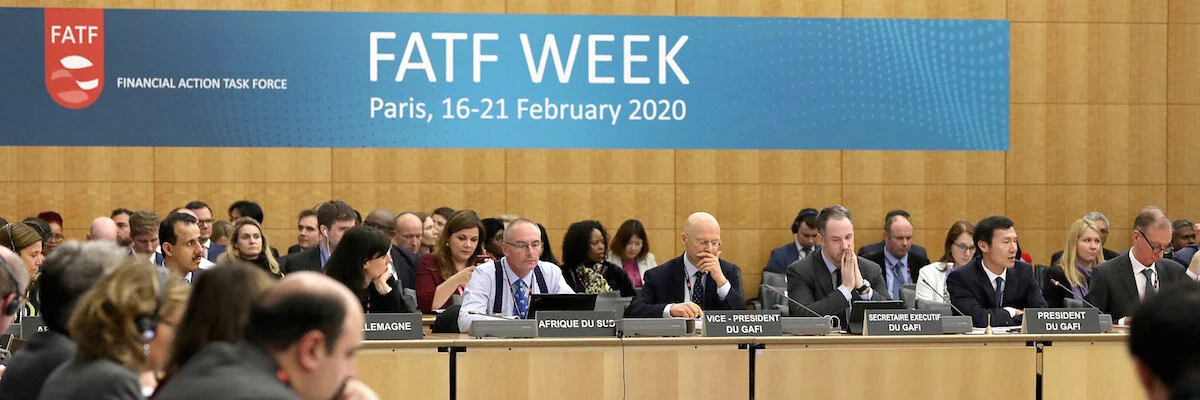
Trump Administration Pressures Global Financial Watchdog to ‘Blacklist’ Iran
The Financial Action Task Force (FATF), a global body that sets standards to combat money laundering and terrorist finance, has placed Iran back on its infamous “blacklist,” following the failure of Iranian policymakers to enact two key bills in accordance with an action plan set in 2016.
This article was originally published by Responsible Statecraft.
The Financial Action Task Force (FATF), a global body that sets standards to combat money laundering and terrorist finance, has placed Iran back on its infamous “blacklist,” following the failure of Iranian policymakers to enact two key bills in accordance with an action plan set in 2016.
The FATF statement, issued on Friday at the conclusion of the body’s latest plenary meeting, calls on members to “to apply effective countermeasures” following Iran’s failure to implement “the Palermo and Terrorist Financing Conventions in line with the FATF Standards.”
Such countermeasures include increase monitoring, reporting, and auditing of Iran-related financial transactions for all financial institutions worldwide. While members can decide how to reimpose the countermeasures, the decision taken by FATF serves as a kind of external validation of the Trump administration’s claims that the Iranian financial system is regularly used to facilitate money laundering and terrorist finance on a massive scale. This characterization is a principle justification for the administration’s “maximum pressure” sanctions campaign and U.S. officials had been dogged in pressuring FATF to call “time out” on Iran’s reform process.
The FATF decision will be deeply disappointing to many officials in the Rouhani administration who had expended extraordinary political capital to try and get the necessary legislation enacted, succeeding in getting four key bills passed by parliament, but only managing to have two bills enacted into law. Opposition by hardliners had been fierce — the FATF issue was linked to the slow-rolling crisis around the nuclear deal and the Trump administration’s sanctions campaign. The politicization of the action plan reforms — both in Tehran and in Washington — was perhaps unprecedented in the history, putting “the task force is between a rock and a hard place,” as Tom Keatinge, as RUSI Director of the Centre for Financial Crimes and Security Studies, has recently observed.
The FATF’s decision could have a significant impact on Iran’s economy, but likely indirectly. Iranian officials who advocated for implementation of the action plan insisted that failure to do so would lead to international banks, including banks in Russia and China, to cut ties with Iran. More precisely, the reimpositon of countermeasures means that it will be exceedingly difficult for Iran to open any new cross-border financial channels. But the countermeasures set to be reimposed, including FATF’s exhortation of its members to impose enhanced supervision and reporting requirements for financial institutions handling Iran-related payments reflect a level of oversight already adopted by the few global financial institutions that continue to transact with Iran. For example, European officials do not expect the FATF decision to interfere with the operationalization of INSTEX, the mechanism established to support European trade with Iran, given the longstanding policies of the banks on which INSTEX will rely.
Existing banking channels are unlikely to be constricted for the express reason that Iran is back on the blacklist — although this does not preclude that the FATF decision will be used as a timely excuse to stop handling Iran-related payments by some banks.
The more likely damage to Iran’s economy will arise from the setback that FATF’s decision represents for the wider push for financial transparency reforms in Iran, which including everything from calls for greater fiscal transparency to the adoption of international standards for accounting. In May of last year, I wrote about how this broad campaign was suffering under the pressures of a “financial war” waged by the Trump administration. Although “transparency has become a discourse and ongoing demand” in Iran, to use the words of one reformist parliamentarian, a pervading paranoia got in the way of reforms, including those required by the FATF.
As I wrote at the time, many Iranians increasingly feared that when sanctions were being applied too aggressively, any increase in financial transparency was “akin to exposing the location of a piece of critical infrastructure and leaving it vulnerable to attack.” The Trump administration sought to actively stoke this paranoia through its use of public messaging and sanctions designations, causing a significant rift with European partners engaged in a technical dialogue with the Rouhani administration over the reform process.
I have been closely following the FATF issue for three years, during which time I have had the opportunity to discuss the action plan and its implementation with American, European, and Iranian officials as well as business leaders engaged in trade between Europe and Iran. There remain many unknowns about the economic impact and the damage the countermeasures will have. But what is profoundly clear is how easy it was for the Trump administration to seek to interfere with the apolitical work of FATF and the fragile process of financial transparency reforms in Iran, even though that process was driven in large part by the concerns of the Iranian electorate around systemic corruption.
In this way, the FATF experience offers a cautionary tale. To whatever extent the current nuclear deal will remain resilient in the face of the Trump administration’s maximum pressure and reduced compliance from Iran, and to whatever extent a new deal may be strengthened to avoid a repeat of the current crisis, any diplomatic reset with Iran will require greater protection of the myriad technical processes of reconnection and reform that will be necessary to ensure that promises are delivered. We promised to give Iran a chance. We failed those who tried to take it.
Photo: FATF
Treasury Department Makes Unprecedented Iran Sanctions Move
For the first time, the Treasury Department has issued a letter of comfort to a foreign financial institution conducting sanctions exempt trade with Iran. This move, made in accordance with the launch of a new Swiss channel for humanitarian trade with Iran, could introduce a new tool for U.S. authorities which have struggled to provide credible sanctions relief.
On Thursday, Swiss authorities announced that they had processed a pilot transaction through the Swiss Humanitarian Trade Arrangement (SHTA), a new payment channel that intends to ease the sale of food and medicine to Iran by Swiss companies. Work on this channel began in late 2018 following the Trump administration’s reimposition of secondary sanctions on Iran.
Expectations around the mechanism should be tempered with caution. The Trump administration dragged its feet for over a year before supporting the mechanism, despite clear evidence that sanctions were causing humanitarian harm. Additionally, Iranians might be reluctant to use the mechanism. There are concerns that some of the conditions imposed on the SHTA by the Treasury Department could be used as a part of a “fishing expedition” for information that could be used to interfere with routine trade.
But hidden in the mechanics of SHTA’s initial 2.3 million-euro transaction is an unprecedented provision that could help address growing concerns that the Trump administration’s “maximum pressure” sanctions campaign will be impossible to lift even in the aftermath of new negotiations with Iran.
The relevant provision is hidden in the jargon of a statement issued last October describing Treasury’s framework for SHTA: “Provided that foreign financial institutions commit to implement stringent, enhanced due-diligence steps, the framework will enable them to seek written confirmation from Treasury that the proposed financial channel will not be exposed to U.S. sanctions.”
A press release on the SHTA released by Swiss authorities confirms that the initial transaction was processed on the basis that the Treasury Department “has given the necessary assurances to the Swiss bank involved for this specific transaction.”
Such assurances, when provided in written form, are called “letters of comfort.” This is likely the first ever transaction in which the department addressed the concerns of a foreign financial institution by providing a letter of comfort, despite the fact that the transaction was technically sanctions exempt.
This is highly significant, given that the architects of the Trump administration's Iran policy have spoken publicly about their efforts to build a “sanctions wall.” Building the wall involves creating a web of complex designations related to Iran’s role as a “state sponsor of terrorism, including its terror-financing central bank; its missile program, which is progressing toward an intercontinental ballistic missile; and its human-rights abuses and corruption.” The intention is to heighten the risk perception of banks and businesses in order to keep them from doing business with Iran even if a new deal is stuck.
For those who do want to do business in Iran, this problem first surfaced during the Obama administration. In the months immediately following the implementation of the nuclear deal with Iran, U.S. officials toured Europe and encouraged companies to go ahead with their plans for Iran, and financial institutions to process Iran-related payments on behalf of their clients. But companies found themselves hitting a wall as banks remained reticent to offer the required services.
Bankers were anxious about what was and wasn’t allowed, and made their concerns known at a meeting with Secretary of State John Kerry. But the Obama administration resisted calls from European bankers and officials to provide letters of comfort, relying instead on the technical permissions afforded under sanctions relief and their verbal encouragement.
This approach might have sufficed had more time been available for economic operators to develop a new understanding of the compliance risks emanating from Iran, but the election of President Donald Trump and his campaign promises to discard the Iran nuclear deal cut short any such period of recalibration. Had the Obama administration employed comfort letters, more trade and investment could have been completed in the period between the nuclear deal’s implementation and Trump’s inauguration.
Here, the launch of SHTA establishes an important and hopeful precedent, and may improve the prospects of negotiations toward an end to the U.S.-Iranian standoff. Fears of a “sanctions wall” have contributed to Tehran’s unwillingness to enter any talks. But if Trump or any future president credibly combines quick and decisive sanctions relief with letters of comfort, it would be a game-changer for multinational companies engaged in Iran and the banks on which they rely.
Photo: Wikicommons
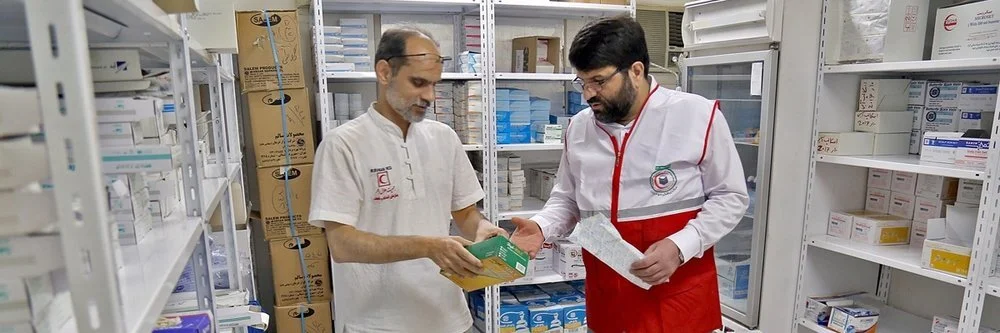
Swiss Channel for Iran Humanitarian Trade Launches After Lengthy Delay
The Swiss Humanitarian Trade Arrangement (SHTA), a payment mechanism to enable humanitarian goods to be delivered to Iran, is about to be implemented. On 27 January, an initial payment for the shipment of medicines to Iran was approved in the form of a trial run.
This press release was issued by the Embassy of Switzerland in Iran.
The Swiss Humanitarian Trade Arrangement (SHTA), a payment mechanism to enable humanitarian goods to be delivered to Iran, is about to be implemented. On 27 January, an initial payment for the shipment of medicines to Iran was approved in the form of a trial run.
The aim of the Swiss Humanitarian Trade Arrangement (SHTA) is to ensure that exporters and trading companies in the food, pharmaceutical and medical sectors based in Switzerland have a secure payment channel with a Swiss bank through which payments for their exports to Iran are guaranteed. In this way, Switzerland is helping to supply the Iranian population with agricultural commodities, food, medicines and medical equipment. This is in keeping with Switzerland’s humanitarian tradition.
The SHTA was developed by Switzerland in close cooperation with the relevant authorities in the USA and Iran, as well as with selected Swiss banks and companies. Under the SHTA, the US Department of the Treasury will provide the banks involved with the necessary assurances that the financial transactions can be processed in accordance with US legislation.
In return, exporters and banks participating in the SHTA will provide SECO with detailed information about their business activities and business partners in Iran, and the transactions they carry out. SECO will verify this information and, in cooperation with the US Treasury Department, ensure that increased due diligence has been exercised in respect of the transactions carried out. To this end, SECO will also make the information received from the banks and exporters available to the US Treasury Department.
Negotiations on the SHTA are nearing completion. SECO, together with the FDFA and the State Secretariat for International Financial Matters SIF, has been working intensively since the end of 2018 to implement such a humanitarian payment mechanism. The Federal Council approved the implementation of the SHTA in principle on 20 January 2020.
As a pilot transaction, an initial payment for the shipment of medicines to Iran by a Swiss pharmaceutical company was authorized on 27 January. The shipment consists of cancer drugs and drugs required for organ transplants. The medicines are valued at approximately EUR 2.3 million. As the SHTA is not yet in force, the US Treasury has given the necessary assurances to the Swiss bank involved for this specific transaction.
Since the US withdrew from the nuclear agreement with Iran in May 2018 and reintroduced unilateral US sanctions, it has become increasingly difficult for Swiss exporters to supply humanitarian goods to Iran, although such shipments are in principle not subject to US sanctions. Due to the legal risks associated with US sanctions, hardly any financial institutions are willing to make payments in connection with Iran. The few remaining payment channels are expensive, complex and not very reliable.
Photo: IRNA
