

How Trump Can Strike Gold for America in Iran
Trump loves gold. If he remains pragmatic and focused when it comes to Iran, he could strike gold in several ways.
There is a curious line in the Omani statement issued following the latest round of nuclear negotiations between the United States and Iran in Rome, which concluded on Saturday. The statement declares that Iran’s foreign minister, Abbas Araghchi, and Trump’s special envoy, Steve Witkoff aim to “seal a fair, enduring and binding deal which will ensure Iran [is] completely free of nuclear weapons and sanctions.” The sentence is striking because it implies that the US is considering lifting primary as well as secondary sanctions, something that goes beyond the sanctions relief provided under the Joint Comprehensive Plan of Action (JCPOA).
Is this just a case of sloppy drafting by the usually diligent Omani mediators? Well, the Wall Street Journal has reported that Iran has offered Trump a high-level meeting in Washington if a deal can be reached, something that would be difficult to imagine if Iran were to remain under an effective US embargo after the deal’s implementation.
Iranian officials have certainly been touting the possible economic benefits of a renewed nuclear deal for the US. When Araghchi described Iran as a “trillion-dollar opportunity” in a recent op-ed, he had one investor in mind—Donald Trump. As the US and Iran take further steps in the nuclear negotiations, Iranian officials have been eager to make clear that agreeing a new nuclear deal, which would at a minimum require the US to lift secondary sanctions on Iran, could prove a boon not just for the Iranian economy but also for the American economy. To emphasize the point, Iranian President Masoud Pezeshkian even announced that Iran’s Supreme Leader, Ali Khamenei, has “no objection” to American investment in Iran—an attempt to conjure a positive atmosphere ahead of the first round of indirect talks between Araghchi and Witkoff in Muscat.
It remains unclear whether the Trump administration will be able to achieve a viable deal with Iran. The administration’s position on key issues, such as Iran’s ability to maintain uranium enrichment, remains ambiguous, and there is significant distrust on both sides. If the negotiations are to succeed, they will need to find a win-win formula—hence the Iranian insistence on portraying any new agreement as not just a nuclear deal, but also a business deal. Iranian leaders have been watching Trump’s recent moves—his aggressive use of tariffs, his imposition of a critical mineral deal on Ukraine—and they have smartly concluded that Trump cares more about American enrichment than Iranian enrichment.
Is Iran really open for American businesses? The answer is yes, especially if Iranian and American policymakers make the restoration of their bilateral economic relationship a priority alongside restoration of a nuclear deal. Lifting primary sanctions would have a dramatic impact on US-Iran economic relations. But even if those sanctions remain in place, there are ways in which the US and Iran can structure their bilateral economic relations, opening new channels for trade and investment.
The heyday of US-Iran economic relations dates to the 1960s and 1970s. American firms like General Electric, General Motors, and DuPont played a central role in Iran’s industrialization, helping the country’s oil and manufacturing sectors achieve global prominence. Consumer brands like Gillette, Colgate, and Coca‐Cola were beloved by Iranian households.
The 1979 Islamic Revolution brought an end to diplomatic relations between the United States and Iran. That year, the US imposed sanctions targeting the Iranian economy for the first time. The New York Times reported on the exodus of American firms from Iran with a report titled, “Iranian Festival Is Over For American Business.”
But the change in Iran’s geopolitical and ideological orientation did not change a basic economic reality—the 1990s were an era of unipolarity and it was prudent to do business with the world’s largest economy. Iranian President Hashemi Rafsanjani tried to rekindle economic relations with the United States, believing that higher levels of trade and investment would help restore relations between the two countries. He offered the Islamic Republic’s first post-revolution oil field development contract to ConocoPhillips, maneuvering around domestic opposition to the deal. But the deal was blocked by the Clinton administration, which subsequently tightened US sanctions on Iran. The episode served as an early warning that the hardliners most capable of thwarting diplomacy were those in Washington, not Tehran.
American firms maintained a small presence in Iran in the early 2000s while European firms emerged as Iran’s preferred partners. The Europeans established joint ventures and wholly owned subsidiaries in the country and did brisk business. French oil giant Total took over the deal first offered to Conoco-Philips. French and German automakers retooled the Iranian automotive industry, making it one of the largest in the world. European brands flew off supermarket shelves as Iranian household purchasing power recovered on the back of 16 consecutive years of economic growth.
Iran’s economy hit a stumbling block in 2012 as the international community tightened international sanctions—with the measures hinging on President Obama’s unprecedented package of financial sanctions imposed at the start of that year. Subsequent nuclear negotiations focused on restoring Iran’s trade and investment ties with Europe, but the Obama administration did understand that enabling more trade between the US and Iran could create broader constituencies in Washington who backed the JCPOA, which was implemented in January 2016.
While primary sanctions remained in place after implementation of the deal, the JCPOA opened three pathways for US business that wished to pursue opportunities in Iran. First, certain US companies were able to apply for specific licenses from the Office of Foreign Asset Control (OFAC), part of the Treasury Department, permitting deals that would otherwise be blocked by primary or secondary sanctions. Among the contracts licensed in this way were the roughly $20 billion in deals Boeing negotiated for the sale of commercial aircraft to Iranian airlines, contracts that became symbolic of the nuclear agreement’s broader potential.
Many American companies took advantage of General License H, which stipulated that non-US subsidiaries of US companies could broadly engage with the Iranian economy. For example, Procter & Gamble, which ran its Iran operation out of its Swiss subsidiary, rapidly re-entered the Iranian market, where it could reliably generate over $100 million in annual revenue. American technology companies took advantage of a similar license called General License D-1 to export digital services to Iranian users.
Finally, American companies were even able to export to directly Iran without relying on a licensing regime if their sales were consistent with longstanding exemptions for humanitarian trade. Medical device companies like GE Healthcare and Baxter enjoyed bumper sales to Iranian hospitals. Pharmaceutical giants like Eli Lilly and Pfizer also increased sales, taking advantage of an opening in financial and logistics channels. American commodities giants like Cargill and Bunge sold wheat, sugar, and soybeans to Iranian buyers, including crops grown on American farms.
In short, American companies were making inroads in Iran as recently as eight years ago. It was President Trump’s unilateral decision to exit the Iran nuclear deal and reimpose secondary sanctions that brought an end to these renewed economic relations, leading to the cancellation of billions of dollars of contracts.
Immediately after Trump’s election, Boeing began to lobby the administration not to withdraw from the JCPOA—something Trump had promised to do on the campaign trail. The planemaker argued that the huge Iran contracts supported “tens of thousands of US jobs” and tried to appeal to Trump’s interest in reviving American industry. The appeals did not work. But it is easy to imagine Trump grasping benefits of a massive Boeing deal at this juncture, given the how darling of American industry has lost its shine. Demand for aircraft in Iran could also help compensate for the impact of Trump’s new China trade war on Boeing. Earlier this week, China banned the purchased of American aircraft, putting hundreds of Boeing orders in doubt.
The JCPOA experience makes clear that there was no prohibition in Iran against doing business with US companies. In fact, relations with the US nosedived after Trump’s abrogation of the nuclear deal, but some direct economic links persisted. Iran offered a lifeline for many American soybean farmers who were hammered during Trump’s first trade war with China. When China retaliated by ending the import of American soybeans, crashing the price, Bunge stepped in, delivering multiple cargoes of American-grown soybeans to Iran, even as Trump brought secondary sanctions back in force.
Clearly, a new nuclear deal could rekindle US-Iran economic relations. But the rebound in trade and investment will likely be modest unless there is a concerted effort by both the American and Iranian governments to make deeper economic relations a cornerstone of a new deal—especially if primary sanctions remain in force. Most American firms will be wary about entering the Iranian market given the inherent concerns that any deal between the two countries could break down, leading Trump to reimpose sanctions once again. Companies are also increasingly risk averse in the face of a volatile global economy. Leaving it to the private sector to singlehandedly realize the economic opportunities of the nuclear deal, the strategy taken back in 2016, is unlikely to work. Bilateral trade may rise from its low base, but investment will not materialize given risk perceptions, meaning there will be little in the way of shared incentives to bind the US and Iran together. A more structured plan for cooperation is needed.
Iranian negotiators are seeking structured cooperation, although their vision remains somewhat ill-defined. Reprising a demand from the talks that were undertaken with the Biden administration, Iranian negotiators continue to target some form of “guarantees” that would ensure the US cannot easily and costlessly withdraw from the nuclear deal while Iran remains in compliance with its obligations. Political and legal guarantees will have little weight. But deeper US-Iran economic cooperation can act as a kind of “technical guarantee” that serves to increase the credibility of the long-term commitments enshrined in any new nuclear deal.
Trump’s turn towards a decidedly “America First” economic policy might actually help Iran as it tries to find a win-win formula for economic cooperation that goes beyond increased purchases of American consumer goods, pharmaceutical products, and agricultural commodities. As economist Djavad Salehi-Isfahani has recently detailed in a review of investment data, Iran desperately needs to renew its capital stock and reverse a decade of technological regression. Meanwhile, the US is trying to rekindle domestic manufacturing of capital goods. The interests align nicely.
The economic commitments related to any new US-Iran nuclear deal should be structured to enable Iranian industrial giants to make major purchases of American-made capital goods—machinery, equipment, aircraft, and vehicles.
Iran’s capital stock is primarily European and was installed around 20 years ago, when European firms were making major investments in the country. But a significant portion of this machinery remains American in origin or design—a reflection of the fact that large parts of Iran’s industrial sectors have not been updated since the 1970s. Many turbines spinning in Iranian power plants and diesel locomotives chugging on Iranian rails are based on GE designs. Many drill heads used to bore oil wells are derivatives of Schlumberger designs—the Texas company’s former Iran subsidiary lives on. Another former American subsidiary, Iran Combine Manufacturing Company, was once called “Iran John Deere.” The company continues to produce trademark green and yellow tractors and combine harvesters—using American designs from 50 years ago. American engineers will find familiar technologies in use at Iranian industrial plants. Renovating and upgrading these facilities will be straightforward, especially given the incredible acumen of Iranian industrial engineers and technicians who will be eager partners.
Importantly, a surprisingly small portion of Iran’s capital stock is Chinese. Chinese exports of capital goods to Iran totaled $6 billion in 2023. But this is the same level as achieved in 2017, the last year that Iran enjoyed sanctions relief. Meanwhile, Chinese investment in Iran has languished under sanctions, plateauing since 2014. There are no major Chinese manufacturing investments in the country and Iran has not been able to substitute the loss of its European industrial partners with Chinese partners. That leaves a uniquely large and open market for American exporters—perhaps the last major economy in the world where the US could reasonably overtake China as an industrial partner.
Given the aligned interests of their respective industrial policies, the US and Iran should think ambitiously about the scope of their economic relations. Iranian firms will be eager customers for new machinery and equipment. Crucially, this kind of trade does not make Iran dependent on the US. Rather, it restores the strength and resilience of the Iranian industrial sector. Once capital goods are installed, they can last for decades—a kind of guarantee that the benefits of a US-Iran deal will last.
Finally, Iranian purchases of American equipment must be financed by American banks. This will make it more likely that the financial logjams associated with JCPOA sanctions relief will be solved. If US banks do business with Iran on Trump’s instructions, global banks will follow. Notably, Trump’s efforts to revitalize the Export-Import Bank could give American exporters access to crucial export credit, insurance, and guarantees.
Trump loves gold. If he remains pragmatic and focused when it comes to Iran, he could strike gold in several ways. He could forge the kind of nuclear deal Thomas Pickering once called the “gold standard for non-proliferation agreements,” once again subjecting Iran to the strictest IAEA verification regime ever devised. He could earn billions in export revenue for the US—and given the US is unlikely to import much Iranian oil—generate a rare trade surplus with a country that is poised to return to its position as one of the twenty largest economies in the world. Finally, if Trump is ambitious and if Iran’s leaders are courageous, he could finally earn the gold medal he has always wanted—a Nobel Prize.
Photo: The White House

To Avoid a Currency Crunch, Iranian Automakers Are Trading Nuts for Bolts
The outlook for the Iranian automotive industry looked dire until Iranian automakers stumbled upon an unexpected solution.
In a typical year, 10 out of every 100 dollars that Iran spends on Chinese goods goes towards car parts. While the China-Iran trade relationship has languished under sanctions, China has remained a critical supplier for the Iranian automotive industry, which continues to produce over one million automobiles annually.
But over the last year, Iranian automakers have struggled to keep the parts flowing. Parts imports from China totalled $653 million in 2024, a precipitous 43 percent decline when compared to the previous year.
The fall in imports has led to a shortage of car parts in Iran, with consumers facing long wait times and soaring prices. The impact has been most acute for Iran’s private sector automakers, who mainly assemble cars using complete knock-down kits imported from China. Whilst Iran’s state-owned automakers are supported by a large ecosystem of domestic parts manufacturers, private-sector automakers remain heavily dependent on Chinese imports to keep their customers’ cars on the road.
The main cause for declining imports has been a lack of access to foreign currency, a consequence of US secondary sanctions restricting Iran’s banking relations with China. Even though Iranian oil exports to China have rebounded in recent years, they have not alleviated Iran’s foreign exchange crisis. Iranian companies seeking to import goods from China have struggled to receive timely allocations of renminbi through the Central Bank of Iran’s foreign exchange market.
As the currency bottleneck grew tighter over the course of 2024, imports continued to fall, and by the summer, the situation was being described as a “crisis.” In September, imports of car parts from China hit a nadir, with just $26 million worth of parts departing for Iran that month—a 65 percent year-on-year drop.
The outlook for the Iranian automotive industry looked dire until Iranian automakers stumbled upon an unexpected solution. In need of a new source of renminbi, many Iranian automotive firms turned to the pistachio business. Like oil, pistachios are a valuable commodity in which Iran is a world-leading producer. Unlike oil, pistachios are exempt from secondary sanctions.
Iranian automotive companies began purchasing pistachios from growers and leveraging their logistics networks to ship them to China. As a result, Iranian pistachio exports to China quickly surged to historic highs, enabling a modest recovery in car parts imports. In the last six months of 2024, Iran exported $195 million worth of in-shell pistachios to China—more than 2.5 times the volume achieved in the same period in 2023.
Pistachio growers and wholesalers, however, were not happy. Many Iranian pistachio wholesalers had given up on exports—leaving the Chinese market open to new entrants. The requirement to repatriate export earnings through the centralised foreign exchange market made margins unattractive for many agricultural firms. But for automotive companies, profit from pistachio sales was never the primary objective. Selling nuts provided a quick way for them to earn the foreign currency they needed to import car parts, which could then be resold in Iran at much higher margins. By October, industry leaders were complaining of “chaos in Iran's pistachio trade” as automakers turned into “inefficient competitors of Iran's real pistachio exporters.”
Pistachio exporters are reportedly seeking an understanding with the automakers who edged onto their turf. They plan to sell their foreign currency to automakers at a rate agreed with the supervision of the Central Bank of Iran, ensuring sufficient margins to incentivise them to prioritise exports once again.
Sanctions have not crushed the Iranian economy, but they have made pistachios more valuable than oil, forced importers to become exporters, and pushed automakers into competition with farmers. In adapting to sanctions pressure, the solution to one crisis can beget another, leaving a country trading nuts for bolts.
Photo: IRNA

Uzbekistan’s President Hopes a Decree Will Spur Green Economic Growth
Declaring 2025 as the Year of Environmental Protection and the Green Economy signals a shift toward making sustainability a central development priority in Uzbekistan.
In November last year, during the parliamentary meeting of the Oliy Majlis, Uzbekistan’s legislature, Uzbek President Shavkat Mirziyoyev proposed that 2025 would be the “Year of Environmental Protection and the Green Economy.” He emphasised that the strategic goal of “New Uzbekistan” is to achieve environmental sustainability and economic growth by transitioning to a resource-efficient, green development model.
Each year since gaining independence, the Uzbek president has issued a decree on the eve of Constitution Day, observed on 8 December, setting the strategic priority for his administration for the coming year. These decrees generally reflect development priorities, as reflected in the Year of Support for Youth and Business (2024), Year of Development of Science, Education and the Digital Economy (2020), Year of Active Investments and Social Development (2019), and so on. While not all goals are fully achieved within a given year, these decrees provide a foundation for advancing the country’s socioeconomic development by setting out a framework for further legislation and policy formation at various levels of government.
As the most populous country in Central Asia with 37 million inhabitants, Uzbekistan faces pressing environmental challenges, including water shortages, soil erosion, desertification, and air pollution. The ongoing Aral Sea crisis, for instance, remains the country’s most significant ecological disaster, affecting not only Uzbekistan but also its neighbouring countries. While Uzbekistan has made strides in economic modernisation in recent years, environmental policy has often lagged behind.
Declaring 2025 as the Year of Environmental Protection and the Green Economy signals a shift toward making sustainability a central development priority. A successful implementation of this year's decree will determine whether the country can transition to a low-carbon economy, improve resource efficiency, and enhance climate resilience—aligning with global commitments such as the UN Sustainable Development Goals and the Paris Agreement.
The 2025 programme aims to improve the country's environmental situation by focusing on several areas of intervention. The main objectives of the decree are community-level initiatives, such as creating green spaces, encouraging technical assistance to reduce emissions, and attracting financing for large projects.
In terms of community-level initiatives, the decree emphasizes public engagement by linking health and lifestyle improvements to its environmental vision. For example, the programme promotes a national movement for “green families,” encouraging environmental stewardship alongside healthy eating, daily physical activity, and the use of eco-friendly transportation. This holistic approach aims to cultivate an eco-conscious culture, ensuring that residents actively participate in and benefit from the country’s environmental transformation efforts.
Equally important is technical assistance to reduce emissions, which is critical given Uzbekistan’s current reliance on fossil fuels and outdated industrial practices; these factors exacerbate air and water pollution, undermine public health and economic productivity.
Complementing these efforts, securing funding for large-scale projects is essential for modernising infrastructure and expanding renewable energy technologies. This, in turn, supports sustainable economic growth, generates new job opportunities, and reduces vulnerability to environmental shocks. Together, these initiatives form a comprehensive strategy that balances immediate community-level improvements with the broader systemic changes necessary for a resilient and sustainable future.
Small projects have also been underway, spurring forward the goals outlined in the state programme. This has included a tree-planting campaign organised by the Ministry of Ecology, Environmental Protection, and Climate Change in cooperation with the Zamin International Public Foundation, held on 19 March 2025. The Oxygen Park Project was developed as part of the national Yashil Makon ("Green Space") initiative to enhance Tashkent’s greenery, create a favourable environmental setting, and improve recreational spaces for residents and visitors. Projects like this one demonstrate how the decree seeks to mobilise support for grassroots projects while also securing investment for wide-reaching impacts, such as advancements in renewable energy.
If administered successfully, the initiative will not only continue to expand urban green spaces but also enhance the overall ecological aesthetic of neighbourhoods through improved street landscaping and the development of “shaded walking streets” where trees and greenery are strategically planted. These measures aim to provide residents with accessible recreational areas, reduce urban heat, and improve air quality.
In recent years, Uzbekistan has already been actively working to reduce its carbon footprint by developing green energy and implementing energy-saving technologies in cooperation with companies such as Masdar and ACWA Power. As part of the state programme, the share of renewable energy sources out of total electricity generated is set to increase significantly to 26 percent. To achieve this, 16 new green power plants with a total capacity of 3.5 GW will be launched, alongside the construction of hydroelectric power stations with a combined capacity of 160 MW.
Additionally, the programme plans to install small solar panels in 35,000 households and 27,000 private and social facilities. By the end of 2026, 3,000 small hydropower plants with a combined capacity of 164 MW are set to be constructed. A key step in advancing the ‘green’ economy will be the introduction of special tariffs for electricity generated from solar and wind power, as well as waste utilisation, starting from 1 April 2025.
To support these efforts, significant investments are expected, with the state programme explaining how the government plans to take measures from 2025 to attract concessional loans and grant funds to support green and low-carbon development projects from international financial institutions and investment banks. Up to EUR 200 million will be gradually attracted from the European Bank for Reconstruction and Development, while the World Bank will provide USD 10 million to help reduce methane emissions in the energy sector. Additionally, the Korea International Cooperation Agency, through the Global Green Growth Institute, will contribute USD 6.5 million in technical assistance to enhance green cooperation between Uzbekistan and Korea. Under the World Bank’s iCRAFT project, USD 7.5 million will be secured to support the reduction of 500,000 tons of greenhouse gas emissions. Furthermore, the German Society for International Cooperation will invest EUR 20 million to promote industrial greening and reduce harmful gas emissions from nitric acid production facilities.
Beyond the year-long government scheme, Uzbekistan is already taking noteworthy steps to position Central Asia as a key hub for the development of a green economy and clean energy, particularly in solar and wind power. Each year, Uzbekistan commissions about 2 GW of new solar and wind generation capacity, contributing to the region’s efforts to develop sustainable energy infrastructure. Though, additionally, one major initiative is the revival of the Great Silk Road through regional energy interconnectivity, linking Central Asia, the Caucasus, and Europe via a unified energy corridor. A recently signed multilateral agreement with Kazakhstan and Azerbaijan at COP29 will enable the export of renewable electricity through the Middle Corridor, with Azerbaijan constructing an undersea cable along the Black Sea to connect to Europe. This initiative will establish reliable transmission routes for environmentally friendly energy, further strengthening Uzbekistan’s role in the global energy transition.
Another major initiative is a large-scale environmental restoration project designed to mitigate the effects of climate change. This includes establishing 100,000 hectares of green zones on the dried seabed of the Aral Sea and expanding forested areas in the Aral region to 2.1 million hectares. Given the profound environmental and socio-economic impacts of the Aral Sea crisis on its littoral states, this initiative is a crucial step towards regional ecological recovery and long-term sustainability.
Yet, for a country rich in natural resources, significant challenges remain. This includes resistance from traditional energy sectors reliant on fossil fuels and concerns over the financial burden of large-scale green investments. Uzbekistan ranks 11th globally in natural gas production and 14th in reserves, making it crucial to balance fossil fuel export interests with energy transition efforts. The challenge lies in balancing the energy transition and green economy measures with its interests in the fossil fuel trade, where a strategic approach is needed to leverage existing energy assets while investing in renewable alternatives
Promisingly, previous decrees, such as the Year of Active Investments and Social Development, which took place in 2019, appear to have delivered tangible results. That year, the value of foreign direct investment reached $4.2 billion, more than tripling the previous year’s total. The share of investment in GDP rose to 37 percent, also reflecting substantial growth. Additionally, Uzbekistan secured its first international credit rating and successfully placed $1 billion in bonds on the global market. While the decree may not have been solely responsible for these economic outcomes, it nonetheless helped direct the focus of relevant government ministries and agencies.
Translating the 2025 ambitions into tangible results will require sustained political will and transparency, particularly from government agencies responsible for policy execution. President Mirziyoyev has been a key advocate for the green transition, backed by institutions such as the Ministry of Ecology, Environmental Protection, and Climate Change.
In this regard, the declaration of 2025 as the Year of Environmental Protection and the Green Economy may build a foundation for energy transition and sustainable development. By institutionalising environmental priorities, the government is signalling its intent to balance economic growth with sustainable development.
Photo: Uzbekistan Presidential Administration

The Job of Iran's Central Bank Governor Just Got Harder
If the free market exchange rate reflects the mood of Iran’s economy, the commercial exchange rate measures its pulse.
Last Friday, Iran’s Supreme Leader, Ali Khamenei, declared that negotiations with the United States were “not smart, wise, or honourable.” Addressing an audience of Iranian military brass, Khamenei did not explicitly rule out negotiations. But his tone made it clear that Iran was not about to begin talks with the Americans, despite American President Donald Trump stating just two days earlier that he wishes to start working on a nuclear deal with Iran “immediately.”
As is the case in sanctioned economies, when hopes deflate, prices inflate. Within the few days following Khamenei’s speech, the dollar appreciated nearly 7 percent against the Iranian rial, pushing the free-market exchange rate towards the threshold of 1 million rials to the dollar.
The free market accounts for a very small proportion of Iran’s multi-faceted foreign exchange market, generally reflecting the prices available to individuals purchasing physical bills at exchange bureaus. The free market dollar is the dollar that ordinary Iranians use to protect their savings in the face of chronic inflation (dollars stuffed under the mattress, so to speak) or to take their wealth abroad (dollars hidden in a briefcase, so to speak). These limited uses explain why the price of the free market dollar is such an important signal in the Iranian economy: it is the country’s highest-frequency measure of economic sentiments.
In this respect, Khamenei’s speech appears to have gifted Trump the first victory of his renewed “maximum pressure” policy. Despite Trump indicating he was “unhappy” to sign the presidential memo which directed his cabinet to increase pressure on Iran—and despite the limited scope and impact of his only enforcement action so far, the designation of three oil tankers—the rial plummeted against the dollar. Sometimes maximum pressure is self-inflicted.
Now that Iranian leaders appear to have rejected the opportunity to negotiate with Trump, at least for now, the question becomes whether maximum pressure policies will begin to have more than psychological impacts for Iran’s economy.
This question can be answered by monitoring the indicator that really matters for Iran’s economy— the commercial foreign exchange rate. Until recently, this was called the NIMA rate. The NIMA foreign exchange market was a centralized electronic system established by the Central Bank of Iran in 2018 to streamline the purchase and sale of foreign exchange among Iranian companies. The commercial exchange rate has been notably stable in recent weeks, showing little movement after Trump signed his presidential memo or after Khamenei declared that negotiating with the United States is “not smart.” This is not because Iran’s central bankers have managed to inure the commercial exchange rate to psychological impacts—it is because the impact was preempted in December.
The NIMA rate began to slide in the days after Trump’s election victory on November 4, 2024. This may indicate that, like in the free market, Trump’s victory spurred more demand for hard currency. Iranian companies, anticipating the return of maximum pressure, may have sought to import more goods and build-up inventories in order to mitigate future disruptions in their supply chains. Though, it is also possible that the election outcome led to a change in foreign exchange supply. For example, financial institutions facilitating Iran’s access to hard currency may have grown wary of future sanctions enforcement and could have begun to throttle payments flowing from customers to Iranian exporters. Whatever the reason, the commercial exchange rate was rising at a steady clip.
By mid-December, as rolling blackouts began to hit Tehran, the Central Bank made a dramatic move to devalue the rial. Between December 12 and December 16, the dollar price rose nearly 10 percent—the sharpest such increase since the NIMA rate was established. On December 14, the Central Bank issued an announcement about the new price-level and a plan to restructure the centralized foreign exchange market under the Iran Currency and Gold Exchange Center. Central bank governor Mohammad Reza Farzin, like his predecessors, has instituted new rules and names for Iran’s multi-level foreign exchange market; the aim is for these largely superficial changes to help the central bank manage the largely intractable structural imbalances of the foreign exchange market.
The central bank aims to encourage Iran’s major exporters, such as firms exporting petrochemical products and steel, to sell their foreign exchange earnings through the new Iranian Commercial Foreign Exchange Market. From the outset, Iran’s major exporters have been reluctant to supply the central bank’s foreign exchange market, despite regulations mandating them to repatriate foreign exchange earnings. Managers at these firms who had the political weight to ignore regulations have known that, in an environment where the rial was expected to continually weaken, holding onto dollars was a smart bet.
By allowing a sudden devaluation of the rial in December, the central bank made a major concession to the major exporters. The move may help the bank keep the foreign exchange market supplied with dollars and euros, but it fails to address the fundamental issue which is found on the other side of the ledger—there is no underlying demand for rials given the dim prospects for the Iranian economy.
It is yet to be determined what “maximum pressure” will mean during the second Trump term. Unlike in the first term, there is no Mike Pompeo and Brian Hook to lead the pressure campaign. Plus, little had to be done to restore maximum pressure, as the new presidential memo set out, given that the Biden administration had never rolled back the sanctions imposed during Trump’s first term.
Still, if Trump decides he has been jilted by the Iranians, he could take a more forceful approach to maximum pressure. Any such shift in rhetoric will no doubt push the free-market exchange rate to new highs. The real indicator of whether maximum pressure is hitting Iran’s economy will be the movement of the commercial foreign exchange rate. If the free market rate reflects the mood of Iran’s economy, the commercial rate measures its pulse.
Photo: IRNA

Iranian Architects Are Reshaping Their Country, Visually and Politically
Amidst recent years of social and political turmoil in Iran, a blossoming architectural scene is ever-present and defiant.
In a busy intersection in Iran’s capital city, Tehran, there is a "deceptively simple" metro station. The structure is meticulously constructed of up to 300,000 traditional bricks—a major collaboration between the station’s architects and local artisans.
Having secured the commission for the station at a time of significant protests in Iran, KA Architecture Studio wanted to recognise how public spaces “are the place of conflict in the metropolis of Tehran between the government and the people.” Such statements reflect the growing political significance that Iranian architects ascribe to their work, even when working on commissions from the government.
By placing projects like the Jahad Metro Plaza at arterial points of the city, architects in Iran are redefining the way public areas are used and determining points of congregation. In turn, their design choices spark discussion around the social and political significance of architecture beyond mere aesthetics.
Amidst recent years of social and political turmoil in Iran, a blossoming architectural scene is ever-present and defiant. Cropping up across major metropolises like Tehran and Mashhad and smaller cities like Ahvaz and Kelarabad, are new and intriguing structures, including luxury glass apartment buildings, eco-resorts with integrated mazes, colourful domed retreats, and geometric complexes. Through their ambitious designs, the structures being introduced to Iran’s cityscapes and landscapes challenge the view of Iran as a country without prospects.
These new buildings embody a cultural shift, in which features like open facades and glass walls take on a political significance. In a recent op-ed, Tehran-based correspondent Najmeh Bozorgmehr described how windows and balconies were once simply functional elements of homes in Tehran—“used for drying laundry or storing seasonal fruits and vegetables.” But today, the enlargement of open spaces in the home and the adoption of glass facades are indicative of a slow transition away from cloistered private spaces and towards an assertion of transparency and personal freedom.
While Iran’s wave of progressive architecture is growing, the completed projects vary in their accessibility to communities across Iran. Some cater to the ultra-rich, others seek to tie in varying strands of society. What can be said about either type of project is that they both strive to address qualms about Iran’s sociopolitical condition, while also attempting to invigorate a new wave of artistry, celebrate and interpret cultural heritage, and encourage a sense of community.
Historically, architects in Iran had to mask the political implications of their field. In a notable example, Architecture Magazine, long a leading publication for Iranian architects, did not “want to have the slightest conflict with the world of politics," according to one historian. Ambivalence was chosen to ensure the “survival of the architectural profession as an independent practice, on the one hand guaranteed [architects’] livelihood[s] and on the other was of great importance for the government's ‘nation-building’” objectives. But this cautious approach faded in the following decades, given that the architectural profession, like everything else in Iran for that matter, was clearly entangled with the political circumstances of the country. In 2022, during the aftermath of the arrest and death of Mahsa Amini while in the custody of the morality police, many architectural studios halted operations in solidarity and emphasised their commitment to the people.
Notably, many talented Iranian architects choose to remain in Iran despite the limitations politics may pose for their career—a decision that may be difficult to understand given the extent of brain drain plaguing other industries in the country. Mainly driven by political repression and, in turn, isolation from the global economy, young, highly-skilled Iranians are increasingly fleeing for better opportunities elsewhere. Even Iranian President Masoud Pezeshkian has claimed that up to 80 percent of students are contemplating emigration.
In an interview for this article, one young Iranian architect described his decision to stay as a “professional choice.” Architects in Iran can still pursue ambitious projects. For instance, Hooba Design Group has announced plans for a futuristic and eco-friendly residential complex in Kelarabad with a design guided by “regional architecture and local environmental laws.” Composed of stacked volumes of villas, each with their own glass facades and airy interiors, the renderings show a bold vision. Projects like this are encouraging Iranian architects to match the ambition of architects in Europe or the United States, where many had studied or worked before returning to Iran.
The homegrown team behind the Hooba project, like others, speaks to a sentiment articulated by the late Iranian architect, Ali Akbar Saremi. After having spent many years in the US, Saremi returned to Iran. When asked why he returned, he stated, “when I finished university and got my doctorate, there was no reason for me to stay there anymore. We wanted to return and develop our country… After all, our homeland is here and there was no reason to stay there.” His advice to rising architects was to “try to understand what is going on in the world,” as “we are the architects of a social class and we must understand the ins and outs of our society as well as other societies.” Such ideas have proven influential, with many Iranian architects thinking actively about their capacity to use architecture to shape social relations.
The most ambitious architects are further encouraged by opportunities for domestic recognition in the field. Memar Magazine, founded in 1988, is a bimonthly Persian publication on architecture and urban design. The prestigious Memar Award was initiated by the magazine in 2001 and strives to recognise the most prominent Iranian architects and their projects. The prize promotes a tangible sense of prestige, motivation, and visibility for architects in Iran to establish themselves both domestically and internationally, “paving the way for them to attract more clients who seek progressive designs for their projects.” Putting young designers in the spotlight in this way is a critical aspect of their pursuit of larger projects, drawing in capital to this specific industry.
Iranian architecture has also earned international accolades. The Jahad Metro Plaza, for one, was recognised by the RIBA International Awards for Excellence, as well as the Dezeen Awards. Architect Alireza Taghaboni, upon winning the Royal Academy Dorfman Award, explained how he aimed for his architecture “to have a productive purpose in a country where the context is political,” representing concerns with domestic issues in an international context.
Alongside politics, Iranian architects must also consider the state of the economy. Notable architect Farhad Ahmadi has stated that “if architecture wants to flourish in a society, the culture, knowledge, management, and economy of that country must also flourish.” It may be surprising, therefore, that a country facing significant economic challenges is home to a burgeoning architecture scene. But wealthy Iranians consider real estate to be a safe investment, and thus the field is supported by a steady stream of private commissions—even as sanctions and other economic headwinds continue to affect the construction sector. Hossein Hamdieh, an architectural researcher, noted in an interview that ‘‘avant-garde designs are often created for moneyed minorities who have both the appetite and the means to invest in such lavish, costly projects.”
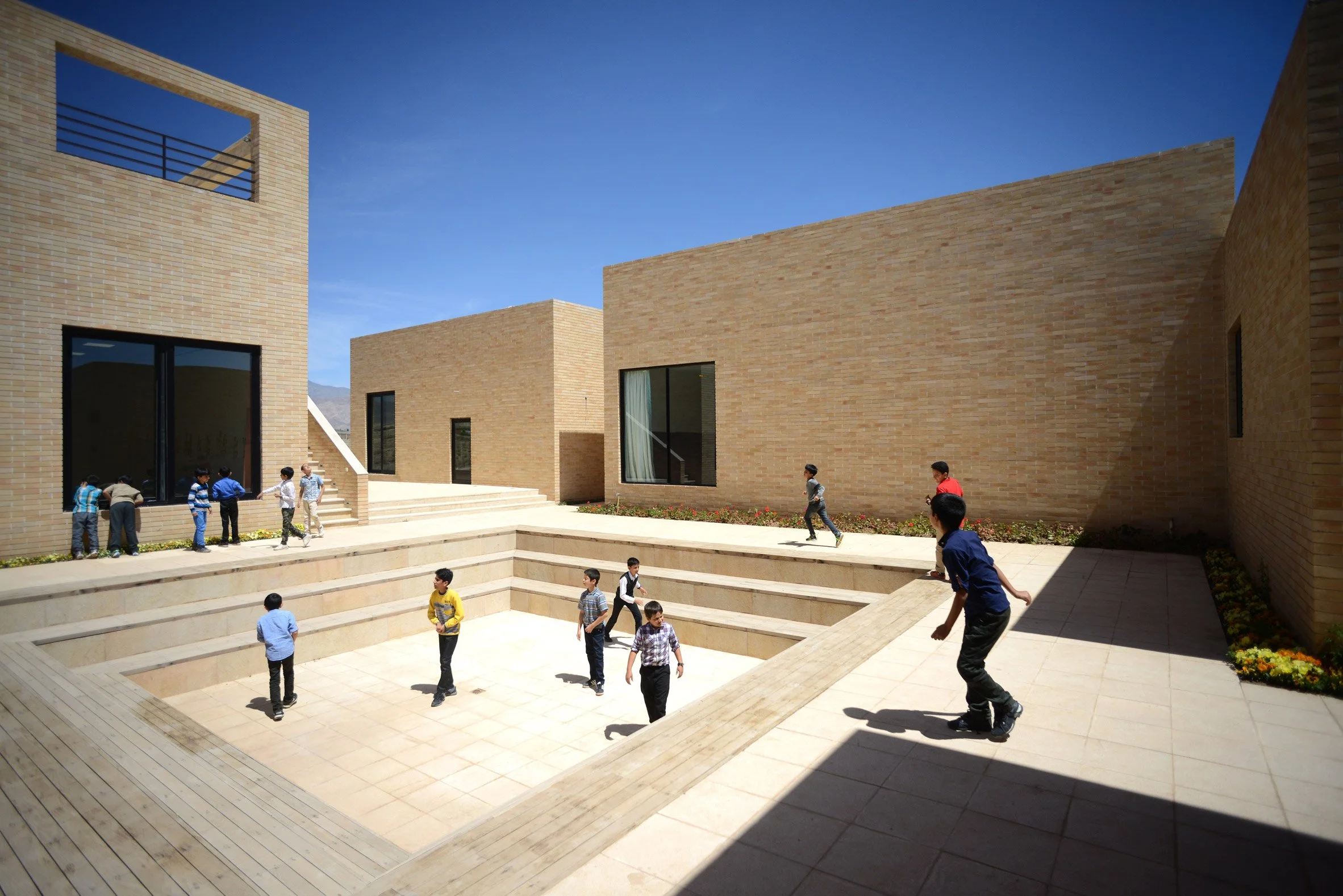
On the other hand, Iranian architects have long developed projects with specific social objectives, such as improving the welfare of ordinary people or addressing environmental issues. These projects are often delivered in partnership with civil society organisations. For instance, FEA Studio, on the behalf of the NGO Noor-e Mobin, designed an intricate network of classrooms in the desert, near Bastaam, Iran. Opened in 2014, the G2 Primary School, as it is called, is designed in ways that allow children to play freely, featuring open air rooms with balcony-style railings to maintain their safety. FEA Studio commented that “it's a complex in which the children can grow and taste life,” serving the pedagogical goals of the school.
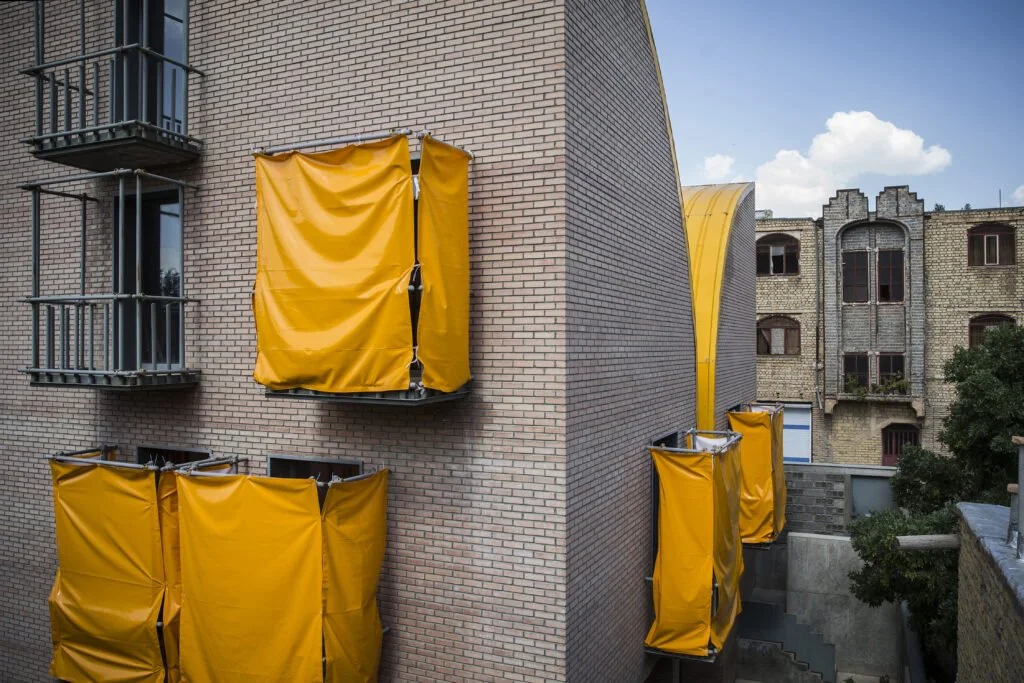
In another social project, ZAV Architects fit adjustable outdoor curtains to the balconies of an girls orphanage in Khansar, Iran. The Habitat for Orphan Girls is a residential centre aiming to protect young women, ages seven to 16, supporting them to flourish in adverse life circumstances. This particular project drew attention in the context of the anti-hijab movement in Iran. The architects aimed to allow the girls a comfortable and protected outdoor space where they can sit without a headscarf or hair covering, but used a striking yellow color to make these liminal spaces visible.
ZAV Architects’ founder, Mohamadreza Ghodousi told Dezeen that the building has the aesthetic appeal of interacting colourfully with the rest of the city, while also reminding its inhabitants that the “hijab is dynamic and you may have the right to wear it or not.” The project won the Memar Award in 2020.
The current sentiment among Iranian architects may be best summarized by one of the best, Leila Araghian. Araghian won the prestigious Aga Khan Prize for her 270-metre long bridge, Pol-e Tabiat, which connects Taleghani Park and Ab-o-Atash Park in northern Tehran. When asked what she finds exciting about contemporary architecture and design, she responded: “the possibility to affect the environment which can affect the human experience of the space seems fascinating to me. It makes me feel powerful.” It is precisely this outlook that promotes architecture as a tool for social renewal, transforming quotidian spaces for Iranians to feel a sense of liberation, agency, and connectedness.
Architecture in Iran today is more than just an artistic or functional endeavor; it is a medium for expression, resistance, and societal transformation. As architects navigate the challenges of working within an increasingly restrictive political environment, they continue to create structures that serve as both aesthetic marvels and meaningful social statements.
Whether through luxurious glass facades symbolising a desire for transparency, or community-driven projects that foster inclusivity and interaction, contemporary Iranian architecture reflects the country’s shifting landscape. At its core, this architectural movement challenges perceptions of Iran, both domestically and internationally, proving that even in times of hardship, creativity and innovation can flourish. Architects in Iran are shaping more than just skylines—they are reimagining and rebuilding the very structures of public and private life.
Photos: Mohammad Hassan Ettefagh, Soroush Majidi, ZAV Architects

Can Abbas Araghchi Reshape Iran's Foreign Policy?
Iran’s new foreign minister has an opportunity to reshape the country’s foreign policy, cutting a creative path through the rigid confines of the political landscape.
On August 21, Iranian lawmakers confirmed veteran diplomat Abbas Araghchi as the country’s new foreign minister. Araghchi secured the support of 247 out of 288 MPs in Iran’s parliament, the Majles. Despite the vote total, Araghchi’s nomination was fiercely contested by hardliners. His confirmation hearing reflected the ongoing struggle between pragmatism and hardline revolutionary ideals that continue to shape the country’s foreign policy, and previewed many pitfalls he will face as foreign minister.
To secure his confirmation, Araghchi, like all of President Masoud Pezeshkian’s cabinet nominees, reaffirmed his unwavering loyalty to revolutionary ideals of the Islamic Republic and the Supreme Leader’s directives. Araghchi was addressing a legislature dominated by hardliners. During the parliamentary elections in March, the Guardian Council, a vetting body, had disqualified many moderate candidates. Voters responded by boycotting the elections and hardliners solidified their hold on the legislature.
While many of Pezeshkian’s nominees faced resistance, Araghchi’s confirmation as foreign minister was especially fraught. The confirmation hearings also took place while Iranian officials await the outcome of the Gaza ceasefire negotiations and continue to warn they will hit back at Israel for the assassination of Hamas political leader Ismail Haniyeh in Tehran on July 30. In Iran’s current political climate, loyalty to the revolution is often measured by one’s stance on foreign policy issues, particularly regarding the U.S., Israel, and Iran’s support for “resistance front” groups such as Hezbollah and Hamas. Any deviation from the hardline position on these issues is characterized as betrayal.
Iran’s Supreme Leader, Ali Khamanei, sets the strategic framework, redlines, and priorities for foreign policy, as underscored during his endorsement of Masoud Pezeshkian’s election on July 28. While the foreign minister and president must operate within these parameters, they still hold a vote in the Supreme National Security Council and can use public statements to put pressure on unelected bodies in Iran. Additionally, their personal ties to other national security figures, such as senior leaders of the Islamic Revolutionary Guard Corps (IRGC), can enable them to influence policy.
Despite these means, the outgoing administration did not seek to actively shape Iran’s foreign policy. Neither President Ebrahim Raisi nor Foreign Minister Hossein Amir-Abdollahian, who were both killed in a helicopter accident in May, sought to advance a foreign policy that conflicted with the Supreme Leader’s redlines, the IRGC’s influence, or the parliament’s lawmaking. By contrast, the Rouhani administration, during which Araghchi was deputy foreign minister, publicly clashed with other power centers. This dynamic explains why Araghchi, like other nominees who served under Rouhani, drew sharp criticism from staunch hardliners.
Critics focused on Araghchi’s past as Iran’s lead nuclear negotiator, a role he held from 2013 to 2021. MPs like Mohammadreza Ahmadi Sangar and Mohammadreza Sabbaghian argued that the Joint Comprehensive Plan of Action (JCPOA), which Araghchi helped craft, was flawed from the start—a misguided deal that left Iran vulnerable to the whims of President Donald Trump, who withdrew from the agreement in 2018. Amirhossein Sabeti, a protégé of Saeid Jalili, who lost the presidential election to Pezeshkian, was perhaps Araghchi’s most vocal opponent. Sabeti argued that in the last months of the Rouhani administration, Araghchi was seeking a new nuclear deal that went beyond Khamanei’s redlines and would have effectively dismantled the resistance front. He also criticized the loss of nuclear capabilities that were key concessions of the JCPOA, including the decommissioning of the Arak reactor.
Iranian legislators have been seeking a greater role in defining Iran’s foreign policy. They want the kind of influence wielded by the U.S. Congress over international negotiations. In 2020, the Majles passed the Strategic Action Law, which effectively bars attempts to revive the JCPOA in its original form. The law, which was pushed by hardliners and endorsed by Khamenei, is as a double-edged sword—it provides leverage but also limits the flexibility needed to strike a deal that would relieve Iran’s economic woes.
For Araghchi, the JCPOA represented a calculated risk that preserved Iran’s position on the global stage, even as the Trump administration tried—and failed—to bury the deal at the United Nations Security Council. It is a legacy he has defended. During his hearing, Araghchi pointed out that the Raisi administration undertook its own nuclear negotiations. Even so, he indicated that he will take a fresh approach to any new talks and “strive to get the best agreement” in light of the Strategic Action Law. During his speech, he vowed to prioritize sanctions neutralization, a priority set forth by the Supreme Leader. But he also highlighted the necessity of lifting sanctions.
Araghchi understands that solving the nuclear issue is the key to addressing many of Iran’s economic challenges. The Pezeshkian administration aims to implement the ambitious 7th Development Plan, which targets an 8 percent annual growth rate—a goal that seems far-fetched given Iran’s economic isolation under sanctions. Iran needs around $60 billion in annual foreign direct investment. According to Hadi Ghavami, an MP who spoke in favor of Araghchi’s nomination, the country currently receives one-thirtieth of that amount.
During his confirmation hearing, Araghchi emphasized that while relations with the U.S. will continue to be defined by antagonism, his goal is to manage the rivalry and avoid escalation. This is part of the “heroic flexibility” needed to return back to the negotiating table. He also called upon Europe to enhance its ties with Tehran and to “return back to the list of areas of priorities for Iran.” The relationship with Europe remains fraught, clouded by the fallout from the JCPOA, the Woman, Life, Freedom protests, and Iran’s support for Russia in its war on Ukraine. Yet Araghchi emphasized that constructive global engagement is essential for any vision for development and managed to get hardliners to vote for him despite this vision.
Iranian officials have heavily invested in the country’s “Eastward turn” in recent years. The push for closer alignments with Russia and China began during the Rouhani administration but reached new heights under Raisi. But the strategy has not paid off. While Iran’s security relationship with Moscow is deeper than ever before, it has also become a liability, isolating Iran further from the international community. In a similar vein, China’s role as a key economic partner for Iran cannot be understated. Yet, there’s growing concern in Tehran that the relationship has become too one-sided, especially as Iran’s neighbors enjoy economic rewards from their trade with China.
At the same time, Tehran has recognized the opportunities presented by a shifting global landscape. Iran is looking to expand its influence into the Global South—Latin America, Africa, and East Asia. Through this understanding, multilateralism is a key factor in Iran’s core foreign policy strategy, reflected in the increasing involvement in platforms like BRICS, the Shanghai Cooperation Organization, and the Eurasian Economic Union. For Tehran, these alliances are more than symbolic; they are part of a broader effort to counterbalance sanctions pressure while positioning Iran as a significant player in a multipolar world. Pezeshkian has been invited to attend the upcoming BRICS summit in Russia in October, soon after he participates at the UN General Assembly in New York for the first time in September.
To secure the trust of the hardliners, Araghchi declared that “resistance diplomacy” is at “the foundation of Iran's foreign policy approach.” In this view, supporting groups like Hezbollah and Hamas is not just policy; it is a core principle of the revolution. Araghchi’s challenge is to convince the international community that Iran’s continued support for the resistance front is not an inherent threat to regional or global security. This is a difficult task when considering the fragility of the growing rapprochement and diplomatic engagements between Iran and the Arab states. There is considerable skepticism amongst Iran’s southern neighbors about the trajectory of the country’s foreign policy and whether deescalation can be sustained.
Ultimately, Araghchi will need to strike a balance when reshaping Iran’s foreign policy. He must find a way to pursue pragmatic diplomacy in a way that coheres with the ideas of resistance that hold sway over Iran’s hardline politicians. A cautionary tale can be seen in the legacy of Foreign Minister Javad Zarif, under whom Araghchi served as deputy foreign minister. Despite securing major concessions for Iran in various high-stakes negotiations, he failed to penetrate the conservative decision-making circles that ultimately dictate Iran’s broader foreign policy.
Araghchi may have more success. MPs appear encouraged by Pezeshkian’s effort to form a “unity cabinet” and seem to appreciate Araghchi’s closer alignment to key power centers. Iran’s new foreign minister has an opportunity to reshape the country’s foreign policy, cutting a creative path through the rigid confines of the political landscape. Whether he succeeds will depend on his ability to recast pragmatism as a tool of resistance.
Photo: IRNA

With Diverse Tactics, Women's Rights Activists Shaped Iran's Elections
Even if most women voters did not participate in the election, they still had a significant impact on its outcome
Although there are no official statistics on the number of women who participated in the fourteenth presidential election in Iran, evidence suggests that participation was limited. Mardomak, a research firm, reviewed a random sample of over 8,000 Iranian twitter users one week before the election. Of this sample, just 18 percent were women who supported Pezeshkian. Double that proportion supported one of the two hardline candidates, Saeed Jalili and Mohammad Bagher Ghalibaf, while 39 percent intended to abstain from the election.
But even if most women voters did not participate in the election, they still had a significant impact on its outcome. In a recent interview with the reformist newspaper Etemad, Shirin Ahmadnia, a sociology professor at Allameh Tabataba’i University, underscored the ways in which women have transformed the political arena through new forms of activism, including election boycotts.
For years, the Iranian women’s movement had adopted a “pressure from below, bargaining from above” approach to activism, aiming to bring about reform through a combination of tactics. But political elites were unswayed by the social pressure and unwilling to engage in good-faith negotiations—the situation of women remained largely the same, whether a moderate or fundamentalist was president. The Women, Life, Freedom movement, which emerged after the death of Mahsa (Jina) Amini, brought a new urgency to the fight for gender equality. Iranian women were no longer mobilizing to with the goal of reform. They wanted fundamental political change.
The death of Ebrahim Raisi in a helicopter accident led to new elections. Surprisingly, the Guardian Council, a vetting body, approved Pezeshkian to run. Faced with an unexpected election and a surprising candidate, some women activists did choose to vote, casting their ballots for Pezeshkian, who was backed by reformists and moderates. My conversations with nine women’s rights activists in Iran revealed complex feelings about the election and the best tactics to improve the status of women in Iranian society. Their names have been changed for their own safety.
Leila, an activist and writer, did not vote in either round of the election, but she deliberated voting in the second round. “I have not participated in elections since 2021. I asked myself: Should women participate in the elections when the presidential candidates promise nothing about women’s rights? As a woman, why should I participate in the elections of a state that does not show flexibility for women’s rights?”
Leila understood why some women may have opted to vote when Pezeshkian made it to the second round. “I think some of those who had not voted in the first round participated in the second round because [Jalili] represented religious fundamentalism, which worried me too. But in the end, I decided not to vote because I believed Pezeshkian’s chances of winning were high.”
Historically, women’s rights activists have been considered part of the reformist’s base. But a perceived neglect of women’s demands has led the reformists to lose much of this support. Maryam, a journalist who focuses on women’s issues has volunteered for reformist campaigns in the past. But she did not vote for Pezeshkian. She referred to a feeling of disappointment as candidates failed to make good on their promises. “I did not vote because I have no hope. My friends and I feel disillusioned with the reformists, with politics, and with elections. The president does not play a pivotal role in this dictatorial system.”
Many women experience double discrimination due to their ethnicity. Sahar, an activist from the Iranian province of Kurdistan, viewed abstention as a form of civil resistance. “I did not vote because civil laws, family rights, and political rights discriminate against me due to my gender,” she explained. “Legal reform has stalled for years. Moreover, my ethnicity, language, and identity still lack representation in political discussions.”
Sahar criticized Pezeshkian’s stance on women, adding “According to Pezeshkian, women’s social presence and gender justice are intertwined with their role within the family. He believes a woman’s identity should be defined solely within the family institution. In essence, women are denied individual freedoms and citizenship rights beyond household duties. His traditional thinking fails to recognize each woman’s independent identity.”
While many Iranian women grew disillusioned in the aftermath of the Women, Life, Freedom protests, for others, the turning point came earlier. For Haleh, who was jailed for her activism against the compulsory hijab law, this moment came after the downing of Ukraine International Airlines Flight PS752, which was hit by Iranian anti-aircraft missiles in January 2020. Explaining her decision to boycott the election, Haleh pointed to the failure of the government to create accountability.
“The main reason for me, even before the candidates were announced and before knowing whether we would have a reformist candidate or not, was that after the plane incident, I became disillusioned with the reforms,” Haleh explained. I was convinced that the path we had followed all these years would no longer work. In the past, I had hope and believed that voting for the reformists would lead us down the right path. But now, I ask myself, what difference does it make whether Jalili or Pezeshkian is president?”
While few women’s rights activists believe that Pezeshkian’s victory will lead to fundamental change, particularly on women’s issues, some believe that having a reform-minded president will make a difference. Many women’s rights activists saw voting for Pezeshkian as a chance to address economic hardships, revitalize social movements, and create greater space for women to voice their demands. Many women’s rights activists are struggling to make a living, which makes it difficult for them to sustain their activism.
According to Soudabeh, an activist and social worker, Pezeshkian’s promise to put technocrats back in charge of policy earned him the vote of some women. “They believed that Pezeshkian could address the deterioration of Iran’s economy by appointing people who are more knowledgeable and moderate to key positions. Iran’s situation is like a person with an incurable disease, and the Pezeshkian’s presidency might help slow or reverse the country’s deterioration.”
Some women’s rights activists working in governmental organizations or managing NGOs expressed a similar hope for the Pezeshkian administration. Shahla, an employee of a governmental organization, contrasted the Rouhani and Raisi governments. “During the Rouhani administration, despite its weaknesses, some women activists held management positions. With the fundamentalist representatives now in parliament, we cannot expect fundamental changes, but we are optimistic about social openings for women under Pezeshkian. Positive changes have already begun in our organization, indicating that while the president may not be able change the structure of the system, he can still influence social policies. I believe the state has acknowledged public dissatisfaction and is considering implementing changes, however small.’’
Despite Iran’s structural discrimination against women, some women’s rights activists still believe that they must not abandon the political arena. They seek improvements, however small, such as creating spaces to express their demands. Shadi, who runs an NGO for women, described the risks when fundamentalists gain power. “Most of us with NGOs working on women’s rights encouraged others to vote despite facing punishment for our activism. We endured the suffocating atmosphere of the Raisi era. Now, a small hope has emerged. Since Pezeshkian has been elected, some people in the governmental organizations we deal with have retreated from their fundamentalist stances.”
Shadi challenged the notion that activists should welcome the further deterioration of conditions in Iran. “Some have criticized me for founding an NGO, believing that increasing social problems could lead to the [Islamic Republic’s] downfall. In these years, so many women have been killed, yet nothing has happened to the state. These expectations are abstract. We must protect women and create spaces where diverse voices are heard,” she insisted. “We must not allow fundamentalists to take power in all three branches of government.”
Reyhaneh, an activist and law student, voted for Pezeshkian in the first round of the election. “I voted in the first round because I believe that the social movements need revitalization, and Pezeshkian’s presidency offers a greater likelihood of this compared to Jalili. Additionally, my decision was grounded in a pragmatic view of potential changes in the country.” Reyhaneh hoped for “less fear on the streets, less suppression of university students, and fewer professors dismissed.”
But she abstained in the second round. “In the second round, I paid closer attention to the debates, and the inconsistency of Pezeshkian’s statements about the economy dissuaded me from voting. For instance, he once emphasized that we should not allow people to experience poverty; yet in another context, he advocated for minimal government intervention.’’
Reyhaneh has low expectations as Pezeshkian prepares for his inauguration. “I don’t anticipate a reversal in policies regarding hijab, which concerns many of us. There may be some changes in the distribution of positions held by women, and more educated women may enter the government roles, but the glass ceiling will likely remain intact.’’
Saba, a sociologist who supported Pezeshkian, understands why many of her fellow activists refused to vote. She says Iranian women are engaging in “intentional neglect.” These women are no longer abstaining from voting to express anger towards Iran’s political elite. Instead, they are indifferent. “Women are signaling to the state, ‘We want nothing to do with you. We are forging our own paths, building our own businesses to maintain independence, crafting our own narratives, and creating separate media spaces on social platforms. Every day, we distance ourselves further from you,’” Saba explained.
In a campaign statement addressing “the main demands of today’s women,” Pezeshkian acknowledged that “today’s women do not want someone other than themselves to decide their marriage, education, career, clothing, and lifestyle.” Pezeshkian was the only candidate to issue such a statement, which declared that “the expansion and realization of gender justice will not only improve the condition of women but also to the revival of life in Iran.’’ He promised to “respect [women’s] choices” and to “provide a platform” for Iranian women “to become the best versions of themselves.”
Pezeshkian will begin his term without a mandate from Iranian women, but it is still in his interest to fulfill his promises to them. Should he fail to do so, Iranian women will boldly challenge him, as they have challenged his predecessors.
Photo: IRNA

Iran's Presidential Election Combines Low Turnout with High Stakes
Iran’s two presidential candidates have presented two diverging visions for the future of the Islamic Republic at a time when most Iranians have come to question the fundamental tenets of their political system.
The second round of Iran’s snap presidential election marks a critical moment for the country. On July 5, voters will decide between former deputy head of parliament Masoud Pezeshkian and ex-nuclear negotiator Saeed Jalili. While both candidates will struggle to restore power and prestige to the office of the president, the outcome of the election will be highly consequential for Iran, especially as the succession of Supreme Leader Ali Khamenei looms. Pezeshkian and Jalili have presented two diverging visions for the future of the Islamic Republic at a time when most Iranians have come to question the fundamental tenets of their political system.
The political divisions in Iran now extend beyond the long-running rivalry between “Principalists” and “Reformists.” Cleavages exist within progressive and conservative groups and between those who believe in the continuation of the Islamic Republic and those seeking fundamental political change. The record-low turnout in the election’s first round—just 40 percent of eligible voters cast ballots—reflects how a focus on ideological policies has alienated the electorate. In 2021, 18 million people voted for Ebrahim Raisi, whose shock death in a helicopter accident triggered new elections. On June 28, the combined vote for Jalili and third-place contender Mohammad Bagher Ghalibaf, the leading conservative candidates, totaled less than 13 million.
Reformists have likewise struggled to mobilize voters. Progressive Iranians want action on a wide ranging of issues, including women’s rights, internet censorship, political freedoms, minority rights, foreign relations, jobs and wages, healthcare, climate change, and education. While Pezeshkian, who received 10.4 million votes in the first round, has acknowledged these demands, most progressive voters do not believe he can foster change, and have so far stayed away from the polls.
Moreover, many Iranians opted not to vote because of a widespread belief that the election is illegitimate, owing to perceived election engineering and vote tampering. Many influential political figures have boycotted the snap elections, labelling the process an “election circus.” The sham election that brought Raisi to power in 2021 underscored the regime’s commitment to its own dogma, sacrificing decades of legitimacy earned through elections that were not free, but were competitive.
Raisi was a weak president, presiding over a system in which the executive’s powers are curtailed. Unelected bodies and interests groups enjoy significant influence over government policy in Iran and the Supreme Leader sets the red lines. Voters are under no illusions about the limits of the Iranian president’s power. But within the bounds of Iran’s political system, the divergence in the domestic and foreign policies of different presidents are often stark.
During the debates earlier this week, Pezeshkian and Jalili showcased their contrasting visions. Jalili comes from a self-proclaimed shadow government. He has led from the shadows for eleven years since securing just 4.17 million votes in the 2013 presidential election, which was won by Hassan Rouhani. Jalili champions a future where Iran is detached from Western influence. He vehemently opposes any engagement with the United States and, to a lesser extent, European countries. As a member of the Supreme National Security Council, Jalili used his political power to stymie revival of the Iran nuclear deal. Many fear that, if elected, Jalili might withdraw from the Non-Proliferation Treaty, thrusting Iran back into a nuclear crisis.
On the domestic front, Jalili’s camp includes ultra-conservatives vying for strict Islamic governance, more censorship, and tighter hijab laws and social restrictions. Even though Jalili has positioned himself as a kind of status-quo candidate, poised to maintain the policies of the Raisi administration, he is a divisive figure even within conservative circles. Some Raisi and Ghalibaf allies have indicated that they will support Pezeshkian over Jalili.
That Pezeshkian appeals to some conservatives points to the challenge he faces in mobilizing disaffected voters. His background distinguishes him from recent presidential candidates. He is an accomplished cardiac surgeon with certificates from the United States and Switzerland and served as Mohammad Khatami’s health minister. Some voters have connected with his personal story. Pezeshkian lost his wife and son in a car crash in 1993. He has not remarried.
Pezeshkian has said his foreign policy will be based on “engagement with the world,” which includes “negotiations for lifting sanctions.” Pezeshkian may be permitted to revive talks over the Iran nuclear deal—there is growing awareness among policymakers across Iran’s political specturm that sanctions relief is necessary for getting the economy back on track. However, he will face significant challenges in advancing his domestic policies. The parliament is dominated by hardliners, who will make it difficult for Pezeskhian to confirm his preferred ministers, which may include his outspoken campaign surrogates, former foreign minister Mohammad Javad Zarif and former communications minister Mohammad-Javad Azari Jahromi. Without an intervention from the Supreme Leader to encourage post-election unity, the political paralysis in Iran could prove even worse than in the final years of the Rouhani administration.
The specter of further political paralysis has no doubt deterred voters from believing in the viability of a Pezeshkian presidency. Boycotting the first round allowed the Iranian electorate to send a strong political signal that they will not allow their votes to legitimize a political system that is failing them.
But the stakes seem different now. A Pezeshkian victory appears a real possibility. If 10.4 million had not voted for Pezeshkian in the first round, it would have been reasonable for disaffected voters to completely boycott the election. But on the eve of the final round, voters may be thinking more tactically about the stakes of this election. A Pezeshkian presidency is a chance to hit the brakes at a time when Iran is accelerating towards a deeper political, economic, and social crisis. Whether Pezeshkian can turn the car around remains to be seen. But preventing Jalili from driving the country off a cliff might be reason enough to vote.
Photo: IRNA

Iran's Instagram Crackdown is Jeopardising Women's Livelihoods
In recent years, Iranian women have accounted for a growing share of major Iranian accounts on Instagram, seizing economic opportunities that are unavailable in Iran’s offline economy. Today, that progress is at risk.
Iranian women have been striving to enhance their socioeconomic status, both online and offline. Statistics show that this is not an easy task: in 2023, the World Economic Forum ranked Iran 143rd out of 146 countries in its annual gender gap report. Iran also sits at 144th for economic participation and opportunity. Consequently, many women resort to informal employment in areas such as sales, homeworking, catering, and domestic work. Due to the informal nature of this kind of work, it is difficult to collect data on the number of women in such roles.
Although it has become increasingly difficult for Iranians—particularly women—to make a living, many micro-entrepreneurs have used Instagram to start businesses. Due to its relatively low entry barriers and easy access to potential customers, the platform had been ideal for this purpose. However, Iranian women are now encountering serious obstacles. A move by authorities to block Instagram and throttle internet speeds, as well as steep increases in internet package prices and arrests of prominent influencers, have all made it more difficult for women to seek economic opportunities online.
World Bank figures from 2021 show that approximately 79 percent of Iran’s population uses the internet. In February 2024, the Iranian Students’ News Agency (ISNA) reported that after Telegram, WhatsApp was the most popular platform, with about 47.7 million users. Instagram ranked third, with 47 million users. Of Iranian Instagram users, 46 percent are female—more than 21 million women.
For the last five years, Abolfazl Hajizadegan, a sociologist at the University of Tehran, has published an annual report on Iran's social media sphere. Hajizadegan’s most recent report clearly shows that, despite the shutdown of Instagram by the Islamic Republic (which occurred at the beginning of the Woman, Life, Freedom movement in Iran), women persist in their online presence.
In this piece, I have chosen to focus specifically on accounts from which influencers generate income. The accounts I discuss do not necessarily belong to the most famous people but to ones who have amassed a large number of followers and are engaged in online business.
The table above is drawn from Hajizadegan’s reports and shows that the share of women has increased among Iranian social media influencers. Among lifestyle-oriented accounts on Instagram, the proportion of women has risen from 58 percent in 2019 to 89 percent in 2023. One of the women who has experienced the highest growth in followers in recent years is Yegane Rezaee, a lifestyle blogger. With one million followers, she chronicles her daily life and earns an income through sponsored posts.
Women are strongly represented among fashion and beauty accounts and one of the influencers in this area is Farzaneh Mezon, who has 153,000 followers. Mezon advertises her products by showcasing various outfits in the photos she uploads. Perhaps because of her popularity, her online store was blocked in July 2023. She soon posted the following statement on Instagram: “Our website has been blocked by a court order. We have been asked to delete all photos that go against Islamic values and the proper hijab framework.” Farzaneh was able to continue her work after appealing to her followers, who wrote comments of solidarity under the post and vowed to support her in making the necessary changes to her website.
Iranian women also account for a growing share of Instagram accounts focused on educational content. The share of women-led accounts has risen from 14 percent in 2019 to 45 percent in 2023. Havin Hosseiny manages a page that focuses on empowering women by improving their life skills. Her bio states, “Our goal is to improve women’s mental health and help them increase their income.’’ With 739,000 followers, she explains gender equality to the audience on her page by publishing short animated videos with attractive content and simple language. She also founded the Havin School, which offers online courses for women that focus on issues such as personal relationships, career advancement, self-confidence, stress reduction, and financial awareness. In addition to providing free educational content, she earns money from other educational workshops.
In the comedy and entertainment field, the gap between women and men remains significant despite women’s share increasing from 6 percent in 2019 to 29 percent in 2023. Zeinab Musavi, known as Emperor Kuzco, creates short comic videos. With 645,000 followers, she is one of the most famous Iranian comedians online. To earn an income, she asks her followers to donate any amount they wish: “These videos I create and publish on this page are my job. And if you enjoy them, you can contribute through two links I have provided in my bio.’’
Men dominate the sports pages. However, pages such as the one run by Elnaz Rekabi, a competition climber with 653,000 followers, are among the most popular on Instagram. It is worth bearing in mind that the low number of women participating in this field likely reflects restrictions placed on female athletes. For instance, the Instagram page of Sogol Rahbar, a bodybuilder with 290,000 followers, was temporarily shut by the Law Enforcement Command of the Islamic Republic of Iran, known by its Persian acroynym, FARAJA. A post on Rahbar’s account carried this message: “Due to the publication of criminal content against public morals and decency, Faraja has blocked this page.’’ However, after deleting posts deemed to depict “improper hijab,’’ Sogol resumed her activities. She earns money through advertising, providing exercise and nutrition programmes, and conducting online classes.
According to Hajizadegan’s research, women do not run any popular religious pages. However, conservative values are represented in other spheres. For example, there are business pages run by conservative women, one of whom is Khadije Faghih, who teaches mat weaving and has 37,800 followers. In addition to publishing free educational content, she earns money by holding classes.
Because Iranian women are excluded from the formal economy, many have sought opportunities in the informal economy. The widespread use of social media platforms has allowed many creative and enterprising women to engage in online business. Instagram is one of the most widely used platforms in Iran, but the crackdowns following the Women, Life, Freedom movement, have created new obstacles for women seeking opportunities on the platform. Moves by authorities to pressure women to observe the “proper hijab’’ have economic consequences. Moreover, President Ebrahim Raisi has yet to fulfill an election promise to provide free internet to all people on low incomes. Instead, internet prices remain high, and the government filtering of platforms like Instagram means that people are forced to buy virtual private networks (VPNs). This has dramatically reduced internet access for economically disadvantaged women.
According to the Tehran-based Beta Research Center, more than two million Iranian businesses market products and services on Instagram, and less than one-fifth of these enterprises also sells their products offline. Importantly, 64 percent of these businesses are owned by women, who have been disproportionately impacted by the internet crackdowns. Rural women who relied on online businesses for their livelihoods have been especially affected—many have been forced to peddle their products on city streets.
In February, Iran’s National Center for Cyberspace officially prohibited the use of VPNs. At present, despite campaigns to repeal the new prohibition, the future of the Iranian internet is uncertain. In recent years, Iranian women have accounted for a growing share of major accounts on Instagram, seizing economic opportunities that are unavailable in Iran’s offline economy. Today, their livelihoods are in jeopardy.
Photo: Farzaneh Mezon

The Shadow of Sanctions in Istanbul's Housing Market
Sanctions have pushed thousands of Russian and Iranian buyers into Istanbul’s housing market. Many Istanbul residents blame the influx of foreign investors for rising property prices.
Istanbul residents are experiencing a cost of living crisis. Prices of food, clothing, and other essentials have spiked. Property prices have also surged and Istanbulites are spending a growing share of their income on housing. The high prices are primarily due to President Erdoğan’s heterodox belief that lowering interest rates can lower inflation, a so-called “low interest rate, low inflation theory.”
But many in Istanbul blame the higher prices on foreign property investors, who they believe are crowding out locals in the housing market. This resentment played an important role in the Turkish presidential election earlier this year. The leading opposition candidate, Kemal Kılıçdaroğlu, campaigned on banning the sale of homes to foreigners for at least five years. While the public anger is real, the actual impact of foreign investment on housing prices is not as concrete.
In recent years, the Turkish government has courted foreign investors, seeking an influx of foreign currency to replenish reserves dangerously depleted during the Turkish central bank’s defense of the lira. To help shore up its own economy, the government has enacted policies to make Türkiye a more attractive destination for foreign investment and residence. The outreach to foreign investors has been timely—Russian and Iranian investors have been eager to protect their assets from waves of Western sanctions.
Russian and Iranian investment in Türkiye rose markedly after the imposition of sanctions. When the US reimposed sanctions on Iran in 2018, the number of Iranians starting businesses in Türkiye jumped. Russian investment followed a similar pattern. When Russia annexed Crimea in 2014, the sanctions levied by the US and the EU coincided with a rise in the number of Russians registering Turkish companies. The largest spike—in the past two years—followed Russia’s invasion of Ukraine.
Property investments follow a straightforward pattern—when the US imposes sanctions, capital flees to Türkiye. In 2022, Russians purchased just under 15,000 Turkish residential properties, while Iranians purchased just over 9,000.
For Russians and Iranians, sanctions and growing fear of instability were push factors. Meanwhile, the Turkish government’s deliberate courting of the fleeing capital pulled investors to Istanbul, Antalya, and Ankara. The physical proximity of Türkiye to Russia and Iran make its cities attractive destinations. More importantly, the Turkish government is under no threat of being sanctioned and Turkish banks continue to be connected to SWIFT and other international banking systems.
While Russian and Iranian companies have established operations in Türkiye, the country is also a destination for individuals seeking to avoid economic isolation and instability in their home countries. Türkiye advertises citizenship to foreigners if they invest over four hundred thousand dollars in Turkish property. For wealthier Russians and Iranians, this offers a pathway to a new passport. The only condition for gaining Turkish citizenship is to maintain the requisite investment for at least three years and to confirm the investment with the land registry.
But acquiring Turkish citizenship does not appear to be the main goal of Russian and Iranian investors. The passport policy implemented five years ago has not led to a significant rise in foreign investors receiving Turkish citizenships. Of the tens of thousands that have bought Turkish property, less than five percent gained Turkish citizenship. While Iranians have made up a large percentage of those who receive investment-based passports, more Iranians bought property in August 2018 more than those who received a passport that year.
The fact that passports make such a small proportion of total foreign buyers—particularly those from sanctioned countries—raises additional questions. It is unclear whether those who have qualified for citizenship based on their investment of at least $400,000, fail to do so because of a lack of knowledge, indifference, or the bureaucratic slog. But clearly, Russian and Iranian buyers are more interested in acquiring an asset in a safe market than they are in becoming Turkish citizens.
Foreign purchases of residential properties have spiked in recent years, particularly in Istanbul, but also in other major cities of Türkiye, such as Antalya and Ankara. In Istanbul, Russians buyers have concentrated in Beylikdüzü, Kadıköy, Bağcılar, and Sarıyer districts. Iranians have focused on Esenyurt, Kağıthane, Sarıyer, Kartal, and Maltepe.
The market share of foreign buyers in Istanbul’s residential property market has nearly tripled in just five years, rising from 3.43 percent in 2017 to 9.61 percent in 2022. But these purchases remain a small share of Türkiye’s overall residential market. In October, purchases of Istanbul property accounted for less than 15 percent of all residential property sales in Türkiye, according to data from the Turkish Statistical Institute.
While foreign buyers are playing a bigger role in the Istanbul property market, there is no clear link between the rise in the proportion of foreign buyers and higher house prices. While yachts and luxury developments attest that there are rich Russians and Iranians in Istanbul, the volume of home purchases point towards a middle class involvement in the market. This could pit middle class Russian and Iranian buyers against members of the Turkish middle class, but foreigners and Turks have very different paths to purchasing homes in Istanbul.
The Turkish mortgage market is still developing and approval rates remain low. Buyers are expected to make a downpayment of nearly 80 percent, and the mortgage interest rate remains around 20 percent. Last year, only about half of all homes bought in Türkiye were purchased with a mortgage. Turkish lenders do not offer mortgages to foreigners, which means outside investors to make their property investments in cash.
Another difference is the commission that the brokerage receives for selling a given property. While the brokerage receives a commission from both foreign and domestic buyers, the currency of the commission depends on the buyer. Real estate brokers prefer to be paid their commission in stable euros or dollars, meaning that foreign buyers have a comparative advantage over Turkish buyers.
These advantages may explain why the rise in foreign property investment has not more clearly contributed to higher prices. Foreign buyers do not need to pay a premium on market prices in order to make property investments. By offering cash payments and attractive commissions, they may be able to secure a purchase agreement with a lower offer than a Turkish buyer would need to make. While sales to Russian and Iranian buyers have boomed in key neighbourhoods, there is no clear link between these purchases and price increases at the district level, according to data from Endeksa, a Turkish real estate analytics company.
Even if Russian and Iranian investment is not a major contributor to the cost of living crisis, it has cast a shadow on the housing market by shaping public perception. Young Turkish professionals who saved for years in the hopes of buying a home are now seeing their savings eaten away by inflation. Both for aspiring homeowners and renters, the doubling of housing costs has required cuts to other kinds of spending, adding to a perception of diminished standards of living. The response of the government has been to raise minimum wages and increase salaries for civil servants, but support for wages does not mitigate the underlying housing shortage. The Turkish government has also taken steps to lower housing demand, aiming these policies at poor refugees, mainly Syrians, by limiting their work visas and encouraging them to move onwards to Europe.
Most studies on sanctions impacts focus on the senders and the targets. The impacts of sanctions on political and economic circumstances in third countries are largely overlooked. In the case of Türkiye, capital flight from both wealthy and middle class Russians and Iranians has created new dynamics in the housing market. Understanding this capital flight is important for understanding the effectiveness of financial sanctions. Countries like Türkiye can modify their policies to accommodate this capital flight, potentially undermining the goals of those governments imposing sanctions. But these policies can have unintended consequences, like the shadow of sanctions cast on Istanbul’s housing market.
Photo: Canva

How Female Vendors in Tehran's Metro are Forced Underground
With both economic sanctions and government policies damaging women’s status, female vendors are fighting on domestic and foreign fronts to sustain their livelihoods.
“It is like working in a mine; you use subways for commuting, but we have to work underground for at least seven hours,” said Soudabeh, a young woman who works as a peddler in the Tehran Metro. To protect her anonymity, I have changed her name, along with those of all the women interviewed here.
The number of female vendors working in the subway is growing, but no official statistics record how many there are. They are an integral part of the daily life of Tehran Metro: circulating among passengers with bags containing cosmetics, socks, clothes, sandwiches, books, and more. Most female vendors work in the front and rear wagons of the trains, normally designated for women. Despite the efforts of municipal authorities and police to curb their activities, they persist in utilising the public transportation system as a workplace.
Women marginalised from Iran’s formal economy resort to making a living in the subway. Soudabeh is one of the thousands of female vendors. She is divorced and living with her mother. Peddling is only a secondary occupation for Soudabeh, who has been working since high school. She is a fitness trainer and works mornings in a gym, but her wages from that job are not sufficient to meet the household’s needs, so she must also work underground, in the metro.
Making ends meet requires Soudabeh to work even on holidays. She underscores the significance of financial independence for women: “A woman who has income can decide for herself. Women should have the capacity to tackle their challenges in society. If a woman who has a job gets divorced, she will not tell herself I burned all the bridges behind me and do not have a way to survive.”
In the past, children often took their parents’ place in a family business. Today, however, when all they may inherit is poverty, they follow their mothers into the metro to earn money.
Ala has not gone to university because she thinks it is futile for her future. Her mother’s twelve years of work in the subway became Ala’s path, too. Still, she considers working in the subway to be better than having an employer: “Working for yourself is better than working for other people. An employer might not provide me with a steady income. My friend’s employer did not pay her because his store did not sell for a month. Here, in the subway, you have your daily earnings.”
Flexible working hours and being your own boss are motives that many female vendors emphasise when asked why they do the job. Faced with patriarchal norms in society that expects women to do housework and take care of children, leading to a dearth of employment opportunities, they have little choice but to be self-employed. Mona sells bags and hats. She suffered from domestic violence and recently got divorced. Born in Mashhad, she has worked since she was twelve years old when she had to quit school because her family could not afford to keep her in education. She migrated to Tehran after her marriage. After several years working in a restaurant, Mona had to change her job and became a subway vendor: “I worked in a restaurant. I love socializing with people. When I worked there, my passion for the job was so intense that customers thought it was my restaurant. However, I had to quit my job due to my circumstances. Daily responsibilities such as picking up my daughter at school make flexible working hours in the subway a practical choice to me.”
Economic instability is one of their persistent concerns. Many have to go to the bazaar daily to acquire goods, and they face escalating prices influenced by the fluctuating value of the US dollar. Tara resides in Navab and has a bachelor’s degree in IT. She sells rhinestones and jewlery, purchasing some of her goods from the bazaar while others are hand-made. She expresses concern about escalating dollar prices: “I remember when the dollar suddenly surged to fifteen thousand tomans. I got so stressed that I failed all of the final exams. Why should I be worried about the dollar’s price?! If prices were stable, we would not endure this relentless pressure.”
Rising prices are a concern because vendors do not have much capital to stockpile goods. Indeed, the minimal initial outlay requirement is one of the reasons women choose this job. Tara, struggling to find an IT job in a company, took goods from her brother, also a vendor, to the subway to sell. “My mom works in people’s homes. I did not want to depend on her financially anymore. My mom is exhausted. I pondered how I would make money to assist her. So, I decided to work. Observing young women like myself work in the subway, I thought, ‘Why not me? Why do I not work?’ One day, I went to the metro but could not sell anything. I felt shy. But after four months, I could not bear the financial strain. I brought some of my brothers’ goods on the subway. A female vendor guided me. I told her, ‘I cannot advertise because I feel shy.’ She assured me she would teach me. We sold all the tops together, and its profits became my initial capital. After that, I brought chewing gum, and now I sell rhinestones.”
Sanctions contribute to an economic crisis that has exerted the greatest pressure on the lower classes. Forouzan resides with her family downstairs in her mother-in-law’s home in a disadvantaged district of Tehran. She sells scarves to make ends meet. The night before we spoke, she had learned she was pregnant. She was thinking about whether to keep her baby or have an abortion. Her husband works in a relative’s shop. His salary is insufficient, so both must work to cover their needs. Forouzan has a bachelor’s degree in economics and had worked in a bakery before vending on the subway. She observes the economic strain on the lower classes: “I think the elite become richer following shocks such as sanctions and surges in the dollar price. Their properties, homes, and cars become more valuable, but people like us become more and more vulnerable.”
One of the most formidable challenges female vendors face is daily confrontation with municipal agents and police officers. The officers try various tactics to expel the peddlers, such as confiscating vendors’ goods. Despite these challenges, the women continue their work, but they feel the pressure of such daily stresses. One female vendor wondered, “If they become successful in preventing us from working one day, what will happen to my family and me?”
To prevent the agents from confiscating their goods, women have developed ways to outwit them. In central stations like Khomeini, where there are greater numbers of officers, they do not get out of wagons. Some pretend they are passengers. Others employ strategies like concealing goods under a chador or in their bags.
Yalda and her husband both work in the subway. Yalda sells underwear. “I know which stations have more agents and avoid getting off there,” she explains.
The stories of these women show them grappling with patriarchal norms, state policies, and economic precarity. They also show the men in their lives worried about losing their bargaining power if their wives earn wages. Paradoxically, harsh financial circumstances often compel them to accept women’s economic role.
Yalda’s husband did not allow her to register at university. However, their financial problems meant she was able to convince him to allow her to work. Eventually, compelled to quit his job when they failed to pay his salary, he too stepped into the work Yalda had begun, and now they make a living together as peddlars.
The state expects women to perform traditional roles, to be good wives and mothers. Policies reinforce conventional gender roles, and the home is deemed the most appropriate sphere for women. Female vendors’ experiences in their daily confrontations with authorities make it clear that the Islamic Republic’s policies not only fail to create formal job opportunities for women, but they actively work to exclude women from their hard-won informal employment.
I conducted these interviews in Tehran’s metro in 2019 and 2020. I talked to 111 female vendors. I immersed myself in their world and observed them working, escaping, and trying to survive. I sat beside them when they were working on station platforms, accompanied them inside wagons, and witnessed their escape strategies from the police and how they navigated challenges to their survival. I have been honored to listen to their stories and document their resistance.
With both economic sanctions and government policies hurting their prospects, female vendors are fighting on both domestic and foreign fronts to sustain their livelihoods.
Photo: IRNA

Solar Power’s Water Problem in the Gulf
The scale of solar investments is far from shifting the GCC away from its heavy dependence on fossil energy and solar power is far less promising in the Arabian Peninsula than many outside observers might think.
This article is part of a series exploring regional energy cooperation in the Gulf and is published in cooperation with Istituto Affari Internazionali.
Since the inauguration of the Mohammed Bin Rashid Al Maktoum Solar Park in Dubai in 2013, the Gulf Cooperation Council (GCC) has become home to an increasing number of solar power installations. Emirati leaders have so far invested the most in large utility-scale solar in the region, but their peers in Saudi Arabia, Qatar, Oman, Kuwait, and Bahrain have also begun to set up new solar parks in recent years.
The Arabian Peninsula’s desert landscapes might seem to be perfect for large solar power facilities like those being developed in the GCC states. Vast and largely uninhabited, the Arabian Desert gets plentiful sunshine: it receives around 3400 hours of sunshine per year, compared with averages of around 1600 hours in Germany or 2900 hours in Spain.
But solar power needs much more than desert sunshine to work. Arid landscapes present various infrastructure challenges, including high temperatures that can damage solar arrays and remoteness from established energy transmission lines. And where sunshine is most abundant, water is not.
Indeed, water scarcity is the most important limit on the grand promises of GCC governments to overhaul and decarbonise the region’s energy system. The Arabian Desert is one of the most arid places on earth, typically receiving under 4 inches (100 mm) of rain per year, and already facing near total depletion of its groundwater.
Unfortunately, today’s solar technology requires substantial amounts of water. Celebratory discussions about solar power are often illustrated with photographs of sparkling PV arrays. These solar panels are always pristine, recently cleaned arrays. Unfortunately, such a scene is a rare encounter in the Arabian Desert, where dust and blowing sand is quick to cover the solar panels and mirrors of both PV (photovoltaic) systems and CSP (concentrated solar power) systems.
Aware of desert solar’s dust problem, companies like Arizona’s First Solar and Luxembourg’s SolarCleano have promoted waterless cleaning systems. Yet these technologies are still not advanced enough to employ on a large, industrial scale. Solar technology companies based in the Gulf are also aware of this problem and have tried to engineer their own solutions. For example, Saudi Arabia’s NOMADD has designed its namesake “NO Water Mechanical Automated Dusting Device” to address the challenge of cleaning of solar panels in the Arabian Peninsula.
While robotic PV-cleaning systems are deployed in some sites today, waterless cleaning technologies are expensive and have failed to scale up beyond small, pilot projects. As a result, the GCC’s small-scale solar installations and the large-scale solar parks continue to use water to clear dust and debris from their panels. Most of that water is desalinated sea water, which is produced with a huge energy cost and substantial CO2 emissions. In this case, then, solar energy produced in the Arabian Peninsula’s desert parks is far from green—it is actually incredibly wasteful.
Renewable energy’s water footprint
The water footprint of solar power extends beyond just cleaning. Water is also used in extracting diverse minerals needed to manufacture PV cells and batteries, such as lithium, cobalt, tellurium, and gallium, as well as in the manufacturing process itself. Mining for the renewable energy sector largely takes place outside of the Arabian Peninsula, but Saudi Arabia’s new investments in mining, described as advancing global efforts to “decarbonize,” will invariably expand this water footprint in the region.
Water is integral to all modern forms of electricity generation, including fossil fuels, and nuclear, alongside renewables. Required water inputs vary by the source, in large part because the infrastructures needed to generate, store, and transmit energy all have different geographies. The solar water footprint contrasts to the water demands for coal, for example, where water is first used to extract coal from the earth, and then in power plant cooling operations like all thermoelectric power systems (coal, natural gas, and nuclear).
Proponents suggest that the water demands of renewables are a significantly lower than those of traditional fossil fuels. This is probably true. But even so, estimates from the IEA (International Energy Agency) use absolute numbers that reflect a limited proportion of renewables in the overall global energy supply mix. These estimates also tend to neglect the physical geography of renewable energy installations siting—like whether a proposed solar park is located in a desert where it is liable to dust problems that increase its water needs.
Overpromising solar to hype hydrogen
Encouraged by partners in Europe and Asia, Gulf fossil fuel producers are increasingly keen to promote hydrogen energy and state-backed efforts to develop hydrogen are now found in the UAE, Saudi Arabia, and Oman. In many cases, these projects are framed as key to transforming the region into future “green” hydrogen hubs. Creating hydrogen energy requires vast amounts of energy and for it to be “green,” this energy must come from renewables.
To date, the amount of renewable energy produced in the Arabian Peninsula is so limited that none of the impressive green hydrogen targets in the Gulf are realistic. Local programs that position the Arabian Peninsula as a new green hydrogen hub overpromise their future solar energy capacity. They overpromise solar both in the present, because the production capacity simply is not there, and also in the future, because the region’s water supplies are insufficient to deliver on local renewable energy promises. Instead, the new Gulf hydrogen programs are on track to locally lock in natural-gas generated hydrogen. Meanwhile, the water limits of solar power’s expansion are a fundamental obstacle to any future for “green” hydrogen in the region.
Just like the solar power parks that they depend on, new hydrogen energy schemes can only represent an improvement on the CO2 footprint of traditional fossil fuel energy sources if the production site decisions take water into account. If any renewable energy project’s water footprint is not carefully evaluated, then the most likely outcome will be that it turns into a big “green wash,” a convoluted mess of energy infrastructure that is built in the name of being green, but does not actually result in any CO2 reductions. And perhaps the most tragic outcome of this green theater would be if it only exacerbates local water shortfalls that then exacerbate the climate crisis, as they are met with yet more carbon-emitting desalinated seawater.
Water and energy futures
Although water is one of the most forgotten elements in today’s discussions about energy systems, the water-energy nexus has come into sharper focus recently and has been integrated in the climate talks under the UAE COP28 presidency’s Water4Climate initiative. Yet, similar to how mainstream climate change discussions are defined globally, water is often just reduced to an issue of “water security” for vulnerable populations. This is, of course, an important issue. But it is almost entirely divorced from the problem of water use and planning in the implementation of high-tech energy infrastructure around the world.
Regardless of whether oil and gas is “phased out” or “phased down,” fossil fuels are on their way out. Yet high-tech energy infrastructure, including renewables, will continue to be prioritised by political and economic leaders in the Arabian Peninsula. The question is where those infrastructures will be located.
Since the Gulf’s energy leaders want to remain central to the post-oil energy system, they are already investing in renewable energy abroad. For example, the UAE’s Masdar has stakes in solar parks, wind farms, and geothermal energy operations all across the world, including in neighbouring Gulf states like Iraq. Likewise, UAE-based AMEA Power was set up several years ago with the express purpose of investing in foreign renewable energy projects – and is growing at breakneck speed. Renewables have also been major targets for foreign investment from Saudi Arabia’s ACWA Power, which has also been the most aggressive actor in setting up hydrogen partnerships with foreign partners in Eurasia and the MENA region, including in Morocco, Uzbekistan, Kazakhstan, China, and beyond.
These future energy partnerships are already fostering regional cooperation and they will continue to do so. However, it is essential that water be at the centre of all considerations about how renewable energy infrastructures are located. In particular, if solar parks are located in places that strain water resources in a partner country—such as with growing water problems from Morocco’s Noor solar plant—then they are likely to provoke local opposition and accusations of “water grabbing” and neocolonialism.
No map can answer the question of how renewable energy landscapes should be ideally configured, because all geography is political. But decision-makers in the GCC, in neighbouring countries like Iraq and Iran, and in countries spearheading climate action, must think critically about where to locate renewable energy infrastructures. To take serious, coordinated action toward scaling renewable energy in a way that actually reduces carbon emissions, water usage must be the primary consideration.
Photo: Canva

In Iran, ‘Ordinary Women’ Lead an Extraordinary Movement
One year has passed since the tragic death of Mahsa (Jina) Amini in police custody and the start of the Woman, Life, Freedom movement, which has induced cultural transformations within society and families in Iran.
One year has passed since the tragic death of Mahsa (Jina) Amini in police custody, the event that ignited the Woman, Life, Freedom movement. This movement has provided a platform for acknowledging the enduring struggles of ordinary women in Iran, a battle that had been ongoing long before September 16, 2022. By “ordinary women,” I refer to individuals outside the elite and activist spectrum, adapting from sociologist Asef Bayat’s definition of “ordinary people” in his book Revolutionary Life. The struggles of ordinary women in Iran were often ignored or sidelined until last year. While I respect the efforts of all women’s rights activists dedicated to improving women’s rights in Iran, I believe the “Mahsa movement” stands on the shoulders of ordinary women, many of whom may not belong to the middle class or possess feminist knowledge, but who are undeniably fighting for the freedom to lead ordinary lives.
The Woman, Life, Freedom movement has induced cultural transformations within society and families in Iran. Many parents who previously advised their daughters to accept the mandatory hijab as a “minor issue” have now thrown their support behind their daughters’ quest for freedom of choice. The presence of women with uncovered hair has become more widely accepted. Women feel safer going out without the hijab. As one woman told me, “before the Woman, Life, Freedom movement, when I went out without hijab, I felt I was breaking social norms and that I was doing something weird in the eyes of society. But now I feel safe and know if somebody scolds me about the hijab, other people in the streets will come to protect me.’’ These cultural changes in the Iranian society are not limited to the hijab issue. The status of women within families has largely changed, and more women are gaining autonomy.
One of the most intriguing aspects of the Mahsa movement is the newfound overt support from men. Women have historically borne the brunt of struggles against a patriarchal society and state, but the Mahsa movement marks a turning point where men have joined in supporting women’s causes. Whether this support will extend to other women’s issues, such as unequal inheritance and divorce laws, remains to be seen.
The Woman, Life, Freedom movement has also significantly transformed the subjectivity of ordinary women. It has united women with shared experiences and pain, reminding them that they are not alone. While there have always been small support networks among women, this movement has elevated this solidarity to a national (and international) scale. In one instance, I saw a police officer who wanted to confiscate a vendor’s goods in the Tehran subway. Women inside the wagon rushed to save the vendor, pulling her and her goods inside. The collective struggle to reclaim public spaces has emboldened women, many of whom now proclaim, “I have become braver.”
But the Mahsa movement has not been limited to women’s rights alone. The movement initially protested against mandatory hijab but, like an umbrella, it now encompasses a range of other issues in Iran, including the unbearable economic challenges and ethnic and religious discrimination. Protesters have also been calling for the overthrow of the Islamic Republic. Yet, the state’s brutal suppression of these protests underscores the complexity of achieving political goals such as regime change. According to Jack Goldstone, a scholar of social movements, the Mahsa movement continues to lack some of the key factors needed for a full-scale revolution, such as an organised programme and the involvement of older generations.
The conflict between Iranian authorities and Iranian women dates back to the establishment of the Islamic Republic in 1979, when women’s rights were among the first to be compromised. Women did come to the streets to protest against the enactment of the compulsory hijab law and abrogation of the family protection law in March 1979—but the state prevailed in curtailing women’s rights. Four decades later, despite various policies, ideological education, and unequal laws aimed at curbing their economic, social, and political opportunities, Iranian girls and women are trying to break free from traditional gender roles.
What is undeniable today is the Iranian women’s desire for both “freedom” and an “ordinary life.” These two desires resonate strongly in my conversations with many Iranian women from around the country. Iranian women have made strides in education despite numerous obstacles. They are rising against gender-based oppression and have exhibited remarkable resilience in their quest. However, their economic participation remains disproportionately low, forcing many into the informal economy. Women are also denied the right to run for president, and the majority are disqualified to run for public office.
The Iranian state has persistently attempted to exclude women from various spheres, yet they persist in resisting. They aspire to careers as diverse as football referees, aerospace engineers, mathematicians, musicians, and much more. The evolving lifestyle of ordinary women highlights the failure of the Islamic Republic’s discourse in imposing gender roles. Their fight for the freedom to choose how they dress is just one aspect of the broader rights they seek. According to political scientist Fatemeh Sadeghi, the actions of Iranian women are not rooted in anger. Rather, they represent the transformation of anger into a force for change. Accordingly, political change, in their view, will emerge from social empowerment. These women are, in essence, revolutionaries without a revolution. They do not want to achieve freedom through revolution. They aim to achieve revolution through freedom.
Photo: Rouzbeh Fouladi

As Iran Sells More Oil to China, the U.S. Gains Leverage
A new report, citing data from Kpler, an analytics company, claims that Iranian oil exports to China will reach 1.5 million barrels per day this month, the highest level in a decade.
A new report from Bloomberg, citing data from Kpler, an analytics company, claims that Iranian oil exports to China will reach 1.5 million barrels per day this month, the highest level in a decade. The report has led to a flurry of criticism from hawks that President Biden is failing to enforce U.S. sanctions on Iran’s oil exports and thereby gifting Iran billions of dollars in oil revenue. But in reality, Iran appears unable to spend most of the money—a situation that is giving Biden leverage he can use in future negotations.
Iran’s resurgent oil exports are earning the country a lot of money. The crude oil price is currently hovering at around $80. Iran discounts its oil for Chinese customers, so the actual selling price is probably closer to $74 dollars per barrel. At this price, Iran’s 1.5 million barrels per day of exports are earning the country around $3.3 billion per month.
These back of the envelope calculations are necessary because China’s customs administration stopped reporting the value and volume of oil imported from Iran back in May 2019, when the Trump administration revoked a series of waivers permitting limited purchases of Iranian oil by select countries. When looking to the Chinese data alone, Iran’s export revenue appears much smaller than it is, hiding the true trade balance.
In the most recent three months for which we have customs data, Iran’s imports from China averaged $826 million. In the same period, Iran’s non-oil exports to China averaged $357 million. When not counting Iran’s oil exports, Iran appears to be running a trade deficit with China of around $469 million. But when adding the reasonable estimate of $3.3 billion of oil exports, the monthly trade balance swings dramatically in Iran’s favor. In recent months, Iran has likely run a trade surplus with China of around $2.8 billion per month.
In other words, Iran is earning billions of dollars it appears unable to spend. After all, Chinese goods, especially parts and machinery, are a lifeline for Iranian industry. If Iran was able to buy more Chinese goods, it would be doing so. Two other data points confirm this interpretation. Exports from the UAE to Iran remain depressed, so Chinese goods are not arriving in Iran indirectly. Purchasing managers’ index data for the manufacturing sector also indicates that Iranian firms continue to struggle with low inventories of raw materials and intermediate goods. Moreover, Iran is continuing to doggedly pursue the release of its frozen assets, including $6 billion that will be made available for humanitarian trade as part of the recent U.S.-Iran prisoner deal. Iran would not be so desperate to strike such deals were its oil revenues in China readily accessible. In short, Iran is selling its oil and earning money, but it is not getting the full economic benefit from the surge in oil exports.
Chinese exporters and their banks remain wary of trading with Iran, where entities and whole sectors remain subject to U.S. secondary sanctions. For most Chinese multinational companies, trading with Iran is not worth the risk. In the first six months of this year, Chinese exports to Iran averaged $898 million per month. Exports remain 35% lower than in the first six months of 2017, the most recent year during which Iran enjoyed sanctions relief.
It remains to be seen whether Iran can sustain this new, higher level of oil exports. Oil markets can be fickle, and China’s economic wobbles could depress demand. But for now, Iran’s significant trade surplus with China also means that its renminbi reserves must be growing. This is a novel situation. Historically Iran has run a small trade surplus with China. Between January 2012, when the Obama administration launched devastating financial and energy sanctions on Iran, and January 2016, when the implementation of the nuclear deal granted Iran significant sanctions relief, the average monthly trade surplus was just $511 million (China’s purchases of Iranian oil are reflected in customs data for this period). In other words, assuming its oil revenues are stuck in China, Iran’s reserves are now growing four times faster than in that period.
At first glance, this might look like a major failure for the Biden administration. Biden purposefully maintained the “maximum pressure” sanctions imposed by Trump in an effort to sustain leverage for negotiations and Iranian oil exports remain subject to U.S. secondary sanctions. But those who claim that Biden is failing to enforce his sanctions are failing to see the wisdom of the current U.S. enforcement posture.
First, Biden is loath to deepen already heightened tensions with China. Sanctioning Chinese refiners for their purchases of Iranian oil, thereby targeting China’s energy security, would be a dramatic escalation in the growing economic competition between Washington and Beijing. Second, such escalation would be entirely pointless given the circumstances around Iran’s oil exports—namely that Iran is not getting the normal economic benefits. Given that Iran is earning more money but cannot spend it, the U.S. is actually gaining leverage for future negotiations.
Unlike Trump, Biden has made a serious effort to engage in nuclear diplomacy with Iran and is likely to continue those efforts if there is a reasonable opportunity to achieve a new diplomatic agreement that contains Iran’s nuclear program. But U.S. negotiators have struggled to make a compelling offer to their Iranian counterparts. Many Iranian policymakers felt the promised economic uplift of sanctions relief would be too small. Iran’s opening gambit in the negotiations with Biden included the claim that sanctions had inflicted $1 trillion of damage to Iran’s economy and that Iran was owed compensation.
With its oil exports significantly depressed, Iran has been unable to significantly grow its foreign exchange reserves, which the IMF estimates at around $120 billion. If Iranian officials believe that they need to remediate $1 trillion of economic damage, the windfall represented by the unfreezing of foreign exchange reserves does not count for much.
The longer the sanctions remain in place, the more money will be needed to undo the cumulative effects of U.S. sanctions, which have now hobbled Iran’s economy for over a decade. It is politically impossible for Biden to promise any kind of compensation for Iran—the best that the U.S. can do is promise to once again unfreeze Iran’s own money as part of a new diplomatic agreement.
For this reason, it is a good thing if Iran’s reserves are growing. Iran’s oil exports to China are kind of like payments made as part of a deferred annuity insurance contract. One day, Iran will be able to cash out on that policy. But it can only cash out if it meets the conditions set by the U.S. In other words, every barrel of oil Iran is currently selling to China is increasing U.S. leverage for future talks. It would be wise to let the oil flow.
Photo: Canva

Iran Paid for Su-35 Jets, But Russia Won’t Deliver Them
Earlier this month, Brigadier General Hamid Vahedi, Iran’s air force commander, ended weeks of speculation about the imminent delivery Russian Sukhoi Su-35 fighter jets.
Earlier this month, Brigadier General Hamid Vahedi, Iran’s air force commander, ended weeks of speculation about the imminent delivery Russian Sukhoi Su-35 fighter jets. “Regarding the purchase of Su-35 fighter jets [from Russia], we need them, but we do not know when they will be added to our squadron. This is related to the decision of [Iran’s] high-ranking officials,” he stated in an interview on state TV.
Vahedi's comments sparked speculation about dysfunction in the Russia-Iran partnership, including that Israel had successfully convinced Russia to postpone delivery of the advanced fighter jets to Iran.
While officials in Tehran continue to pursue a partnership with Russia, it is increasingly clear that Russian officials see their relationship with Iran as little more than a card that can be played according to their needs.
Russia’s potential sale of Su-35 jets to Iran has been connected to the deeper military cooperation between the two countries since the Russian invasion of Ukraine in February 2022. Iranian drones are being used by Russian forces to bomb Ukrainian cities. The first drones were transferred from Iran to Russia around one year ago.
But Iran has been waiting for far more than a year to receive the Su-35, which would prove a major upgrade in capabilities for Iran’s aging air force, largely comprised of American jets in service since before the 1979 revolution.
According to one current and one former diplomat with direct knowledge of the matter, Iran made “full payment” for 50 Su-35 fighter jets during the second term of President Hassan Rouhani. The officials requested anonymity given the sensitivity of Iran’s arms purchases. According to the former diplomat, at the time of purchase Russia had promised to deliver the Su-35s in 2023. Neither source expects that the deliveries will be made this year.
A third source, a security official, speaking on background, expressed disappointment that Vahedi’s “uncoordinated interview” had called attention to the fact that the deliveries were now in doubt. Iranian officials feel embarrassment over Russia’s failure to adhere to commitments.
The delay in the delivery could be traced to the strong relationship between Russia and Israel. In June, Axios reported that Israeli officials confronted Russian counterparts over Russia’s growing military cooperation with Iran and the possibility of Russia providing Iran advanced weapon systems. Israeli Prime Minister Benjamin Netanyahu disclosed the “open and frank” dialogue with Russian officials in a closed-door hearing with Israeli lawmakers on June 13.
In the view of the former diplomat, due to their arrogance, Iranian hardliners “fell into the trap” of believing that they were an equal partner to Russia, simply because “the Russians are queuing up to buy arms from them.”
The drone transfers have contributed to Iran’s political isolation, giving Western officials the impression of deepening cooperation between Russia and Iran, even as the Iranian Foreign Ministry continues to claim that Iran remains a neutral party in the Ukraine war. According to the security official, neutrality remains the consensus position of the Iran’s Supreme National Security Council, but he warned that country’s military brass may not all share that same view.
Notwithstanding the ambitions of Iranian generals, Russia continues to treat Iran far worse than an ally. Earlier this week, Russia issued a joint statement with the Gulf Cooperation Council (GCC), affirming the United Arab Emirate’s claims on three Iranian islands: the Greater Tunb, the Lesser Tunb, and Abu Musa. The statement enraged Iranian officials. Ali Akbar Velayati, a senior advisor to Iran’s Supreme Leader, called Russia’s assent to the statement “a move borne of naivety.” Iran’s foreign minister and its government spokesperson stressed in statements that Iran will not tolerate claims on the three islands from any party. The officials had made such statements before—a China-GCC joint statement from December 2022 caused a similar public outcry.
As Iranian officials are forced to defend their ties with Russia once again, a question remains. Why does Iran have so little leverage over Russia, even after the Russian invasion of Ukraine? The answer lies in the mindset of Iranian officials.
Back in May, Iran’s Supreme Leader, Ali Khamanei, declared that “Dignity in foreign policy means saying no to the diplomacy of begging.” The slogan “diplomacy of begging” has become popular among conservatives and the hardliners, who have used it to condemn the signing of the Joint Comprehensive Plan of Action (JCPOA) and to accuse former Iranian foreign minister Javad Zarif of begging the West for sanctions relief. But if begging the West for sanctions relief is wrong, why are hardliners eager to beg Russia for the Sukhoi jets?
Tehran’s ties with Moscow were never built on trust. They were built on mutual fears and mutual needs. Were the administration of President Ebrahim Raisi to realize that looking to the West does not preclude political and economic relations with Russia and China, Iran could strengthen its position in the Middle East and regain leverage in its relationship with Russia. Until then, the Russians will continue to look at their relationship with Iran as a nothing more than playing card.
Photo: Wikicommons

When it Comes to Middle East Diplomacy, Chinese and European Interests Align
In March, China managed to a broker a détente between Iran and Saudi Arabia, achieving a diplomatic breakthrough that had eluded European governments. But Europe and China have shared interests in the region and there is scope for the two powers to work together to foster further multilateral diplomacy.
A version of this article was originally published in French in Le Monde.
In March, China managed to a broker a détente between Iran and Saudi Arabia, achieving a diplomatic breakthrough that had eluded European governments. But Europe and China have shared interests in the region and there is scope for the two powers to work together to foster further multilateral diplomacy.
Europe and China, which both depend on energy exports from the Persian Gulf, have long relied on the US-led security architecture in the region. But the 2019 attacks on oil tankers in the UAE and oil installations in Saudi Arabia, widely attributed to Iran, were a watershed moment. Shifting US interests and President Trump’s erratic reaction to those attacks forced the Chinese and Europeans to take more responsibility for regional security over the last four years.
In 2020, China presented its idea for regional security in the Persian Gulf, arguing that with a multilateral effort, the Persian Gulf region can become “an oasis of security.” In the time since, the agreement between Saudi Arabia and Iran, signed in March, can be considered an outcome of such efforts.
European governments have also sought to back multilateral diplomacy. France was intent on creating a platform for Tehran and Riyadh to engage in dialogue. President Macron helped launch the Baghdad Conference for Cooperation and Partnership that was held in August 2021. The conference was a unique opportunity to gather countries that had not sat around the same table for years. Officials from Iraq, Iran, Kuwait, Qatar, Saudi Arabia, and the UAE, in addition to Egypt, Jordan, Turkey, and France participated. Oman and Bahrain joined the second gathering which took place last December in Amman, Jordan.
The European Union also expressed its support for the Baghdad process. Joseph Borrell said during the Second meeting that “promoting peace and stability in the wider Gulf region… are key priorities for the EU.” Adding that “we stand ready to engage with all actors in the region in a gradual and inclusive approach.”
The Joint Communication to the European Parliament and the Council on a strategic partnership with the Gulf reflects the EU’s keenness on expanding its engagements with the region, particularly on economic ties. The partnership is focused on the GCC, but it mentions that “involvement of other key Gulf countries in the partnership may also be considered as relations develop and mature”—a reference to Iran and Iraq.
Clearly, China and the European Union have multiple areas of mutual concern in the Persian Gulf region. Ensuring freedom of navigation, the undisrupted flow of oil and gas from the region, and non-proliferation of nuclear weapons are shared priorities. But while China is now a central player in the strategic calculations of all states in the region, the Europeans are being largely left out.
European diplomatic outreach has faltered in the face of new political pressures arising from Iran’s continued nuclear escalations, its involvement in Russia’s war against Ukraine, and its repression of ongoing protests for democratic change.
The French president was coincidently in China when the Beijing Agreement was signed, and he welcomed the rapprochement between Saudi Arabia and Iran. Given shared interests, European officials must now find ways to engage with Chinese counterparts on fostering greater regional diplomacy in the Persian Gulf.
There are reports that a regional summit will take place in Beijing later this year, involving all GCC states, Iran and Iraq. This is an important opportunity for multilateral dialogue and cooperation. European governments should consult with regional players and China to secure a seat at the meeting. The EU can help regional countries find ways to jointly tackle basic issues that have impeded economic growth which have resulted in spillover effects such as increased food insecurity and inability to mitigate the rising challenges of climate change.
In parallel, the Baghdad Conference could emerge as an EU-backed platform for economic cooperation in tandem to the now ongoing political and security dialogue process in China. The EU can draw in regional countries to help with reconstruction efforts in Iraq, a country that is in dire need of foreign investment. Given the shuttle diplomacy conducted by Iraqi officials between Iran and Saudi Arabia, and considering the role of France and the EU in the Baghdad conference, it would be apt to explore EU-supported joint economic projects in Iraq, especially those projects that create mutual economic interests between Iran and Saudi Arabia.
Whether in Baghdad, Amman, or Beijing, inclusive regional gatherings are needed to address common economic challenges facing all eight countries surrounding the Persian Gulf. Europe can make significant contributions towards regional dialogue on economic integration by helping to create multilateral platforms, transfer knowhow and technology, and provide financial support. These are areas where China has significantly increased its activities, but European countries enjoy far greater experience in establishing the institutions and infrastructure needed for regional economic development. European officials can leverage this experience to support regional diplomacy. Such efforts would also cement European regional influence at a time when US influence may be waning.
The newly appointed EU Special Representative for Gulf Affairs, Luigi Di Maio, should directly oversee and coordinate initiatives in support of economic diplomacy and integration in the region, finding common ground with China to head off competition. Achieving security through stronger diplomacy and deeper economic ties represents a transformative goal that the region can rally around.
Photo: IRNA

SIPRI Has Revised Four Years of Data on Iran's Military Spending
SIPRI has corrected its data on Iran’s military spending, applying a more relevant exchange rate for dollar conversions. Instead of ranking as the 14th largest military spender in the world in 2021, Iran was actually ranked 39th.
SIPRI—the Stockholm International Peace Research Institute—has just published its “Yearbook” for 2022. The flagship annual publication offers civilian and military leaders around the world a way to compare military spending between countries and to gauge which countries are investing in greater military power.
Last year, I identified a major problem with the data about Iran’s military spending. The 2021 Yearbook estimated Iran’s military spending at $24.6 billion, a total that put it just above Israel in the rankings, as the 14th largest military spender in the world. This did not make sense.
Iran’s military, while posing a threat within the region, does so primarily because of inexpensive missile and drone systems and heavy reliance on proxy forces. Iran’s military lacks the kinds of advanced aircraft, armour, and other systems that are typically found in the arsenals of the world’s top military spenders.
A closer examination of the SIPRI data, and communication with SIPRI’s researchers, revealed that the Swedish think tank had been using the wrong exchange rate to convert Iran’s local currency military expenditures into dollar values. The researchers were using the “official” central bank exchange rate, which has for several years been a subsidised exchange rate used exclusively for the import of essential goods.
This common mistake has been rectified. SIPRI researchers note in the 2022 Yearbook dataset that they are using the NIMA exchange rate to convert to dollars, which results in a far better estimate of the Iranian state’s true purchasing power. The historical data has been corrected going back to 2018.
The impact of the correction is significant. The revised figures mean that instead of ranking as the 14th largest military spender in the world in 2021, Iran was actually ranked 39th. In 2022, spending totalled $6.8 billion. That is a mere fraction of the military spending of regional rival Saudi Arabia, which spends an estimated $75 billion. Iran even spends less on its military than regional minnow Kuwait.
SIPRI should be commended for making this correction. But in certain respects, the damage has been done. For several years their data was used to suggest that Iran posed a much greater threat to regional and global security than it truly did. A significant number of authoritative publications and news reports relied upon the SIPRI data to put Iran’s military spending in context and unfortunately used the inflated dollar totals published between 2018 and 2021. Those inflated figures conformed to a pervasive and convenient narrative—this may explain why the issue went unresolved for so long.
Photo: IRNA

Are Sanctions Boosting Corporate Profits in Iran?
Iranian listed companies have managed to grow profits despite major cost pressures stemming from sanctions. This may be because firms are exercising extraordinary pricing power.
Last year I wrote a major report examining how the inflation generated by sanctions hurts households in Iran. In the report, I note evidence of “the increased cost of inputs being passed on to consumers.” In other words, citing anecdotal evidence, I suggested that Iranian firms were raising prices to protect their margins and that this was contributing to inflation. But the report lacked a substantive review of how firms react to the pressures created by financial and sectoral sanctions.
Firm behaviour under sanctions is understudied. The widespread assumption is that sanctions are bad for business. After all, they create significant dysfunction in the targeted economy. But the firm-level evidence is mixed. Sanctions do not tend to drive firms out of business, suggesting that companies find ways to adjust to the obvious cost pressures. Hadi Esfahani’s firm-level research has shown that “exits” (companies going out of business) played only a small role in changes in output, employment, and exports following the imposition of financial and sectoral sanctions in Iran in 2012. Saeed Ghasseminejad and Mohammad Jahan-Parvar’s study of Iranian companies listed on the Tehran Stock Exchange between 2011 and 2016 provides evidence that sanctions negatively impact profitability, but even sanctioned firms remained profitable in the period of their study. The profitability of firms that were subject to sectoral sanctions fell from an average of 16 percent to 11 percent—the margins remained healthy.
But what are the processes that are enabling Iranian firms to adjust to sanctions? A potential answer can be found in a new paper by Isabella Weber and Evan Wasner titled “Sellers’ Inflation, Profits and Conflict: Why Can Large Firms Hike Prices in an Emergency?” Using data on the profit margins of major US companies in the years following the COVID-19 pandemic, Weber and Wasner examine how firms “exercise pricing power to enhance or protect short-run profitability” in the face of acute cost pressures.
While the new research by Weber and Wasner does not discuss sanctioned economies, they describe conditions that can also be observed in Iran. Sanctions represent first and foremost a change in the supply environment—an emergency characterised by surging input costs. Financial and sectoral sanctions force most foreign companies to cease supplying customers in the targeted economy. But even when inputs remain available, currency devaluation triggered by the impact of sanctions on foreign exchange revenue and the accessibility of reserves makes those inputs more expensive. As a result, firms in the targeted country face supply chain bottlenecks and significant cost pressures. Purchasing managers’ index data from Iran makes clear that high producer prices and difficulties maintaining raw material and machinery inventories are the most persistent challenge facing Iranian manufacturing firms.
Moreover, the processes that Weber and Wasner believe underpin the “sellers’ inflation” that occurred after the COVID-19 pandemic in the United States are also at play in Iran. First, “sector-wide cost increases” lead to an “implicit agreement” among firms to raise prices. This occurs because “all firms want to protect their profit margins and know that the other firms pursue the same goal.” While state firms do dominate some sectors of Iran’s economy, such as the automotive industry, the broader manufacturing sector is dominated by private sector firms and is generally unconsolidated. The price increases seen in Iran reflect such implicit agreements and not price leadership by a few dominant firms.
Second, Weber and Wasner argue that “bottlenecks can create temporary monopoly power which can even render it safe to hike prices not only to protect but to increase profits.” In Iran, bottlenecks arose due to the effects of sanctions on imports. Under sanctions, domestic manufacturers face less competition from imported goods and the same bottlenecks also make it difficult to ramp-up output. Given the production constraints, it is nearly impossible for firms to grab market share by undercutting the competition and boosting sales. Because firms will not substantially sacrifice sales by raising prices, they can be understood to enjoy a kind of monopoly power.
Third, much like how the ongoing pandemic disruptions legitimise “price hikes and create acceptance on the part of consumers to pay higher prices,” so too do sanctions help render demand less elastic. Iranian consumers have come to understand high rates of inflation as the outcome the American sanctions and their own government’s monetary policy. While there has been some scrutiny of predatory pricing by Iranian firms in recent years, the pervading view is that firms must raise prices to survive. There is little scrutiny of whether firms are doing more than just surviving when they raise prices.
Finally, firms can raise prices because they know that consumers will keep buying. Weber and Wasner explain that “selling goods that people depend on” grants many firms extraordinary pricing power. Helpfully, the chief financial officer of Procter & Gamble has publicly boasted about this fact, stating that the company is ideally “positioned for dealing with an inflationary environment… starting with the portfolio that is focused on daily-use categories, health, hygiene, and cleaning, that are essential to the consumer versus discretionary categories which in these environments are the first ones to lose focus from the consumer.” Importantly, a significant proportion of Iran’s manufacturing base is devoted to household essentials. Meanwhile, Weber and Wasner point to government interventions during inflationary episodes as another reason why consumers put up with higher prices. Just like the stimulus checks that helped shore consumer spending during the COVID-19 pandemic in the United States, so too have cash transfers played a role in supporting household expenditures in Iran in the face of sanctions pressures.
Given that the same basic conditions for sellers’ inflation appear to exist in the US and Iran, it would be worthwhile to replicate the Weber and Wasner methodology to study the pricing power and profitability of Iranian companies. But even without a full study, a cursory review of the net margins of Iranian firms raises significant concerns that sanctions are increasing their pricing power of these firms and possibly even boosting their profitability. Comparing the net margins of companies listed in Iran’s securities exchanges (excluding financial firms) with inflation rates over the last decade reveals that, in general, profit margins rise in periods where inflation is elevated. In the four years leading up to March 2018, while Iran benefited from sanctions relief, the average profit margin for listed companies was 17 percent, while the average annual inflation rate was 11 percent. Since March 2018 and after Trump imposed “maximum pressure” sanctions on Iran, the average profit margin has risen to 26 percent. In the same period, annual inflation has averaged 40 percent. In short, Iranian companies appear to be more profitable on average when the country is under US secondary sanctions.
The continued profitability of Iranian firms has two ramifications for Western policymakers. First, it is a clear indication that elites in sanctioned economies can continue to accrue wealth, even as sanctions succeed in creating macroeconomic pressure. Second, if firms are in fact generating sellers’ inflation as part of their response to sanctions pressure, the economic resilience of firms is connected to the economic pain of households. Notably, Weber and Wasner raise the prospect that sellers’ inflation inevitably leads to “distributional conflict.” In their view, given that “living standards decline as real wages fall with rising prices,” labour will eventually push back on the profit maximisation by companies and demand higher wages. This too is a consideration highly relevant to Iran, which has seen an intensification of distributional conflict over the last decade. Protests over economic grievances have become more common, particularly protests over stagnant, delayed, or unpaid wages. Four consecutive years where inflation has exceeded 30 percent has eroded the living standard of Iranian households. In this context, firms may not be able to sustain their profit margins forever—in the medium-term, ever-rising prices will lead to demand destruction. However, while Weber and Wasner suggest that American firms have engineered a “a temporary transfer of income from labour to capital,” the implications for Iran, where firms have enjoyed increasing pricing power for the better part of a decade, are more dire.
The fact that Iranian firms have proven resilient under sanctions does have its benefits. This resilience has helped keep Iran’s economy from sliding into a deeper crisis. The resilience of businesses is also critical if Iran is to take advantage of any sanctions relief offered in a future diplomatic agreement. But the processes that underpin this resilience have significant distributional consequences. The sustained profitability of Iranian companies under sanctions represents an extraordinary and ongoing transfer of economic welfare from households to firms. In effect, not only are sanctions failing to weaken Iranian companies and their elite owners, but they are also hurting Iranian households profoundly. This suggests that the enhanced pricing power of Iranian firms and inflated corporate dividends are under-examined contributors to rising economic inequality in Iran, where the top income decile now controls nearly one-third of the country’s wealth. Sanctions were meant to make Iranian companies pay, but it is the Iranian people who are footing the bill.
Photo: IRNA

Ageing Energy Infrastructure is Holding Central Asia Back
Central Asia faces rising demand for energy, spurred by population growth and climate change, but most of the region’s power generation and transmission infrastructure dates to the Soviet era.
Blackouts and "rationalisation" of energy consumption (a euphemism for coordinated blackouts) are all too frequent in Central Asia. Energy shortages arising from limited generation, insufficient energy imports, or the poor state of the transmission network mean that blackouts recur. This winter, however, the situation grew significantly worse. Amid exceptional cold weather, many households, businesses, and schools remained without heating and electricity for days on end. Unusually, the blackouts not only afflicted communities in remote regions but also capital cities.
Most of the region’s inefficient power generation and transmission infrastructure dates to the Soviet era. Central Asia faces rising demand for energy, spurred by population growth and climate change. Steadily rising energy consumption has strained power grids. Demand from new types of consumers, such as cryptocurrencies miners, has also exacerbated recent crises.
At the same time that they face chronic energy shortages, Central Asian states must also significantly cut carbon emissions and accelerate the transition to clean energy—a challenging path, especially for Kazakhstan, Uzbekistan, and Turkmenistan, where domestic production of hydrocarbons secures the majority of domestic energy consumption.
Besides generation capacity, natural gas supplies and distribution present their own technical and political problems. Kazakhstan is the world’s ninth-largest exporter of coal and crude oil and twelfth largest exporter of natural gas; its total energy production covers more than twice its energy demand. Yet, it has not been able to reliably supply electricity within its own territory. In mid-January, Turkmenistan, despite sitting on one of the world's ten largest natural gas reserves, disrupted gas supplies to Uzbekistan for over a week due to technical problems. Last year, several regions of Uzbekistan, Kazakhstan, and Kyrgyzstan were hit by blackouts caused by a technical incident in the so-called “energy ring,” a Soviet-era grid connecting border regions of these three countries, including the Kyrgyz and Uzbek capitals and Kazakhstan’s largest city, Almaty.
Central Asian authorities and international stakeholders have acknowledged the urgent situation facing the energy sector. The existing infrastructure is being operated “well beyond its shelf-life,” and loses caused by inefficiency may reach around 20% in the electricity sector.
But addressing all these demand-side and supply-side challenges simultaneously is impossible; governments in the region will have to prioritize specific sub-areas of their energy sectors. In the meantime, they will need to grapple with new economic challenges arising in part from Russia’s invasion of Ukraine.
The recent blackouts sparked considerable public anger given the financial impact, health risks, and general discomfort. Protests took place in several cities across Kazakhstan, Kyrgyzstan, and Uzbekistan. While these recent protests were small, the “Bloody January” protests in Kazakhstan and the Karakalpakstan protests in Uzbekistan point to the possibility that social and economic grievances can give rise to more significant unrest. Furthermore, many families relied on stoves to keep their homes warm, adding to the already high levels of pollution in Central Asia cities, resulting in further complains.
These extensive blackouts are also of concern to potential international investors. Without stable supplies of such basic utilities, investors will be deterred from Central Asia, leading to further economic stagnation. The ongoing crisis is a big test for Kazakhstan and Uzbekistan, and to a lesser extent Kyrgyzstan, three countries whose presidents have linked their political legitimacy with improving the economic and social conditions inside their country. To create jobs for their growing populations, these countries must grow their economies. But to grow their economies, the countries must boost energy production and significantly improve the distribution network. Securing the necessary financial resources for the extensive renovation of energy infrastructure is they key step for solving the energy shortages in the region. But securing new financing has become even harder because of the Russian invasion of Ukraine, which has significantly added to the already significant risks of investing in Central Asia, resulting from power struggles and corruption within the ruling regimes.
This has not stopped Central Asian leaders from promising new injections of investment in energy generation and improvement of the existing grid. President Shavkat Mirziyoyev of Uzbekistan announced a package of $1 billion to be invested in energy generation in the Tashkent region. But Mirziyoyev’s promise of new investment was clearly a political ploy, an effort to respond to public anger. The details of the investment and the expected economic, social, and political impact remain unclear. Governments in the region are luring new investors in the renewable energy sectors by setting ambitious targets. Kazakhstan aims to introduce new projects totaling 6.5 GW by 2035 and Uzbekistan plans to launch 7 GW of new capacity by 2030. However, many of these projections include nuclear power projects involving Russia’s Rosatom, which are now very unlikely to break ground.
Successful renovation of the energy sector at the national level also requires stronger political partnerships between countries given knock-on effects in the broader region. Tajikistan and Uzbekistan deliver electricity to Afghanistan, but domestic power outages in Uzbekistan briefly halted the export last month. Such disruptions in the national or regional grids are bound to reoccur and will add to the hardships faced by Afghans.
ADB predicts that demand will rise 30 percent across the entire CAREC region (which includes Central Asia, the Caucasus, Mongolia, and Pakistan). This means that no country has significant excess capacity it can share with its neighbors. The bank’s estimates put the cost of energy infrastructure modernisation for the region at between $136 billion to $339 billion by 2030. Upgrading transmission and distribution infrastructure alone is estimated to cost between $25 billion to $49 billion.
There are also other hidden costs. For example, the state usually subsidises electricity, gas, and coal, and any price increase brings a high risk of public dissatisfaction. Furthermore, there is a vast discrepancy in consumption between the winter seasons and the summer, which both generation and transmission infrastructure needs to reflect. The revenue potential of energy exports is deeply intertwined with the global economic situation. Hence, current estimates and political promises are bound to be revised sooner or later.
The recurring blackouts and subsequent deep freeze in Central Asia were caused by three decades of neglect, corruption, and poor planning. Any significant improvement in the situation would require years of persistent effort to overcome economic and political challenges. After the disruptions of the pandemic and the Russian invasion of Ukraine, valuable time has been lost to begin the urgently needed modernisations of power plants and grids. For ordinary people in Kazakhstan, Kyrgyzstan, Uzbekistan, Tajikistan, and Turkmenistan, the countdown to the next winter has already begun.
Photo: David Trilling

Iran's Special Relationship with China Beset by 'Special Issues'
This week, Iranian president Ebrahim Raisi flew to China for a three-day state visit at the invitation of Xi Jinping, marking the first full state visit by an Iranian president in two decades.
On February 14, Iranian president Ebrahim Raisi flew to China for a three-day state visit at the invitation of Xi Jinping, marking the first full state visit by an Iranian president in two decades. For Beijing, hosting Raisi was an attempt to regain Tehran’s trust after the significant controversy generated by the China-GCC joint statement issued following Xi’s visit to Riyadh in December. For Tehran, taking a large delegation to Beijing was an opportunity to remind the world that China and Iran enjoy a special relationship.
On the eve of the visit, Iran, a government newspaper, published a 120-page special issue of its economic insert entirely focused on China-Iran relations. Given the newspaper’s affiliation and the timing of the publication, the special issue is something like a white paper on the Raisi administration’s China policy and the perceived importance of a functional partnership with China.
The cover of the special issue speaks for itself—it calls for the creation of a triangular trade relationship between Iran, China, and Russia. Another headline declares that the Raisi administration is “reconstructing broken Iran-China ties.” In his pre-departure remarks, Raisi doubled down on this message, noting that Iran “has to pursue compensation for the dysfunction that existed up until now in its relations with China.” With this statement, Raisi both cast blame on Hassan Rouhani, his predecessor, for failing to maintain stronger ties with China, while also implying that China had let Iran down by failing to begin implementation of a 25-year Comprehensive Strategic Partnership agreement signed in 2021.
Iran’s grievances aside, the overall tone of the special issue is laudatory, suggesting that the Raisi administration has chosen to overlook China’s apparent endorsement of the UAE’s claim over the three contested Persian Gulf islands, which caused an uproar in Iran following the China-GCC consultations in December. But a development just before Raisi’s trip generated new controversy.
According to reports, Chinese oil major Sinopec has withdrawn from investing in the significant Yadavaran oil field located on the Iran-Iraq border. The Iranian government began negotiating with Sinopec in 2019 to develop the project's second phase. The negotiations were slow-going, in part because of the challenges created by US secondary sanctions.
Fereydoun Kurd Zanganeh, a senior official at the National Iranian Oil Company (NIOC), has denied the reports, claiming that negotiations with Sinpoec are ongoing. According to him, the Chinese energy company “has not yet announced in any way that it will not cooperate in the development of the Yadavaran field.” Whether or not Sinopec has actually withdrawn from Yadavaran, the slow pace of the negotiations and the difficulty for Chinese companies to deliver major projects—as in the case of Phase 11 of the South Pars gas field—reflect that China is an unreliable partner for Iran, at least while Iran remains under sanctions.
Nonetheless, the Raisi administration is keen to attract more Chinese investment. In an interview with ISNA published on January 28, Ali Fekri, a deputy economy minister, said that he “is not happy with the volume of the Chinese investment in Iran, as they have much greater capacity.” According Fekri, since the Raisi administration took office, the Chinese have invested $185 million in 25 projects, comprising of “21 industrial projects, two mining projects, one service project, and one agricultural project.” As indicated by the low dollar value relative to the number of investments, Chinese commitments have been limited to small and medium-sized projects. Beijing has mainly invested in projects that, according to Fekri, offer China the opportunity to import goods from Iran.
Comparative data shows Iran falling behind other countries in the race to attract Chinese investment. For instance, according to the data complied by the American Enterprise Institute, China committed $610 million in Iraq and a striking $5.5 billion in Saudi Arabia in 2022 alone. With secondary sanctions in place, the prospect of more Chinese investments in Iran is unrealistic.
Despite these obvious challenges, Iranian officials have been reluctant to admit that external factors are shaping China-Iran relations. Ahead of Raisi’s departure to China, Alireza Peyman Pak, the head of the Iran Trade Promotion Organization (ITPO), denied that Xi Jinping’s visit to Saudi Arabia in December had precipitated a cooling of Beijing’s relations with Tehran.
“Such an interpretation is by no means correct. A country with an economy of $6 trillion naturally tries to develop its economy by working with all countries,” he said. Peyman Pak pointed to recent trade data to bolster his case. “In the past ten months, we have seen a 10 percent growth in exports to China compared to the same period last year,” he added, leaving out that the growth comes from a low base—China-Iran trade has languished since 2018.
In recent months, Peyman Pak has played a prominent role in brokering memorandums of understanding between Russian and Iranian companies—part of the push for a deeper Russia-Iran economic partnership. His participation in the delegation heading to China suggests that the Raisi administration is serious about shaping a triangular trade alliance between Tehran, Moscow, and Beijing. So far, that economic alliance exists only in the form of various non-binding agreements. China and Iran signed 20 agreements worth $10 billion during Raisi’s visit.
These agreements, like those before them, have a low chance of being implemented, especially while the future of the JCPOA remains in doubt. For now, China-Iran relations are limited to the text of white papers, memorandums, and statements. For his part, Xi offered Raisi some encouraging words. He reiterated China’s opposition to “external forces interfering in Iran’s internal affairs and undermining Iran’s security and stability” and promised to work with Iran on “issues involving each other’s core interests.” No doubt, the special relationship between China and Iran is beset by special issues.
Photo: IRNA