
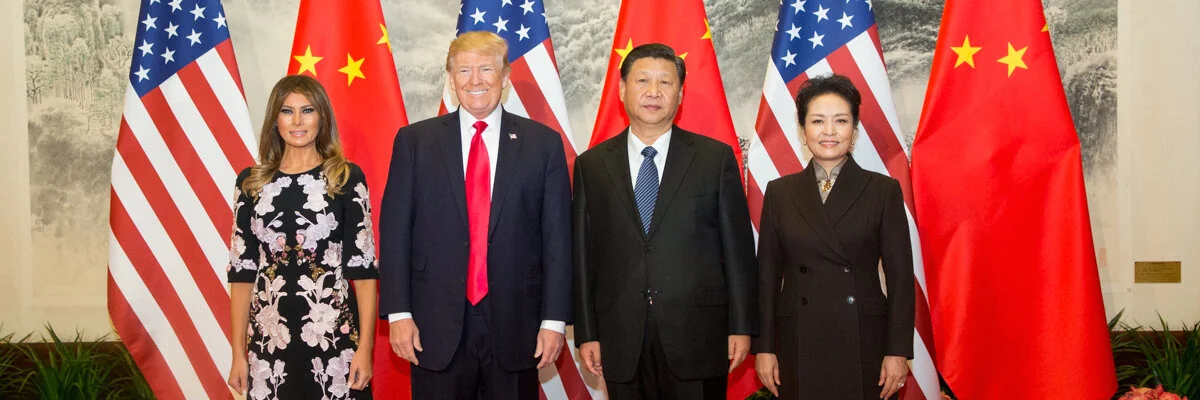
Concern in Iran Over China Commerce as Trump Gets Trade Deal
The contents of an email shared with Bourse & Bazaar by an official at Iran’s communications ministry suggest that China’s Bank of Kunlun is weighing whether to cease processing Iran-related payments. There is growing concern in Tehran that China may be planning to downgrade its trade relationship with Iran.
Last week, an official from Iran’s communications ministry received an email from a Chinese supplier informing them that Bank of Kunlun, the state-owned bank at the heart of China-Iran bilateral trade, is weighing whether to cease processing Iran-related payments.
The email warned that after an April 9 deadline, “Kunlun may stop handling payment [sic] from Iran. For the exact situation then, we can only wait for further notice from the bank.”
The bank was set to inform clients that “all the payment [sic] should be received and goods should be shipped before April 9, and all PI (pro forma invoice) dates should be before January 10.”
The official, who shared the contents of the email with Bourse & Bazaar on condition of anonymity, speculated that the change in policy at Bank of Kunlun could be related to the recent agreement reached between Chinese and American negotiators over the first phase of a new trade deal.
If the email proves accurate, this would not be the first time that Kunlun has suddenly changed its policy in response to political developments in Washington. The bank paused its Iran business for one-month period following the Trump administration’s reimposition of secondary sanctions on Iran in November 2018. When Iran transactions were resumed, a new policy limited payments for trade in “humanitarian and non-sanctioned goods and services between Iran and China,” minimizing direct contravention of U.S. sanctions.
Reached for comment, Wu Peimin, the economic counselor at the Chinese embassy in Tehran, stated the embassy had not been made aware of any impending change in policy at Kunlun and that concerns amount to a “hypothetical situation.”
As analysts Julia Gurol and Jacopo Scita detail in a recent report, China’s has continued to purchase Iranian oil in defiance of U.S. sanctions in an “attempt to appease Iran and avoid a full-scale conflict in the Persian Gulf.” Although China has rebalanced its imports in favor of Saudi Arabia and could easily find an alternative supplier for the low volumes of oil still imported from Iran, recent incidents such as the attack on the Aramco facilities in Abqaiq and Khurais have made clear the risks to Chinese energy security if Iran acts on threats to prevent all exports through the Strait of Hormuz in the event it is prevented from exporting its oil.
But while China’s strategic interests are well-served by maintaining trade ties with Iran, albeit at reduced levels, there remains the possibility that China may have made tactical concessions related to Iran as part of its trade negotiations with the United States. For their side, U.S. officials have insisted that they would not reduce sanctions pressure on Chinese firms trading with Iran in order to gain concessions from Beijing related to the trade deal.
Chinese trade with Iran has fallen due to sanctions pressures, but remains a pillar of Iran’s economic resiliency in the face of the Trump administration’s “maximum pressure” sanctions campaign. Iran’s bilateral trade with China totaled USD 23 billion last year. While the annual total has fallen 34.5 percent, Iran has sustained significant oil and non-oil exports to China, totaling just over USD 13.2 billion dollars. The earnings from this trade have enabled Iran to afford continued imports of Chinese raw materials, parts, and machinery that support Iran’s manufacturing sector—total imports were USD 9.7 billion in 2019.
Much of this trade was facilitated through the payment channels available at Kunlun, a so-called “bad bank” sanctioned by the United States in 2012 for its critical role in supporting Chinese trade with Iran, particularly oil purchases by major state refiners like CNPC and Sinopec.
Mohammad Reza Karbasi, who is responsible for international affairs at the Iran Chamber of Commerce, expressed confidence that even if Kunlun proceeds to eliminate its Iran business, other smaller Chinese banks will step-in to support the longstanding bilateral trade between China and Iran.
“Iran is important to China and the same is true the other way round as well. Sure, there are attempts by Western governments to try and interfere with the expansion of ties between us, but we believe the Chinese won’t let them succeed given the trust that has been built between our two counties through years of cooperation,” Karbasi said.
In a recent interview focused on the trade deal, Treasury Secretary Steven Mnuchin stated that the Trump administration was “working closely with [China] to make sure that they cease all additional activities [with Iran]." The Trump administration has continued to sanction Chinese firms engaged in Iran trade, most recently targeting several buyers of Iranian oil.
Mnuchin also stated that “China state companies are not buying oil from Iran.” The statement remains factually incorrect—Chinese firms such as CNPC remain directly engaged in Iran oil purchases—but it may refer to a new understanding between China and the United States that is yet to be implemented.
Richard Nephew, who led sanctions policy at the State Department during the Obama administration, recently told S&P Platts that he does not expect such designations and the related pressure to compel China to drop it’s Iran trade outright.
However, reports that Iran’s January oil exports are significantly higher than the monthly average since May 2019 may reflect stockpiling of cheap Iranian oil by Chinese refiners ahead of an expected change in policy and reduction in imports. A similar pattern was observed when exports peaked in March 2019 ahead of the May 2019 revocation of the waiver permitting Chinese purchases of Iranian oil.
Given the timing, concerns in Tehran center on whether China will further downgrade its trade with Iran in order to avoid jeopardizing its new understanding with the Trump administration on larger issues of economic policy.
Massoud Maleki, the director of the Bureau for Developing Countries at the Tehran Chamber of Commerce said he was skeptical of reports Kunlun would bring an end to its Iran business, but warned of the consequences if there were such disruptions.
“Iran and China’s trade is not a paltry amount for it to be carried out through suitcase trade or exchange bureaus. If this is true, then I’m afraid that we will have to deal with a whole lot of hardship. This, I presume, is unlikely, but if it’s confirmed we must prepare and take necessary measures,” said Maleki.
Farhad Ehteshamzad, an Iranian industrialist and former head of Iran Auto Importers Association, echoed the call for preparations in case the U.S.-China trade deal has changed China’s intentions regarding trade with Iran.
“Transactions through the Bank of Kunlun had already been made difficult during the past two or three months. Kunlun in China was like one of our small credit institutions in Iran before being trusted with the responsibility to handle Iran payments. It gets all its reputation via collaboration with Iranian businesses.’
He added that if the industry ministry official had received such an email, the Central Bank of Iran has also been forewarned and urged officials to ensure that the Iranian funds currently held in accounts at Kunlun are not blocked.
“An emergency meeting should be held to determine how much capital lies in the bank and to inform traders and economic players before their money gets blocked. Also, if there is the possibility for certain goods to be shipped before April 9, this has to be done. If there isn’t, then money has to be transferred from Kunlun bank to other banks as quickly as possible before the money is out of reach.”
Ehteshamzad estimates that around 80 percent of payments made to support China-Iran bilateral trade are currently processed via Kunlun. “Yet, this does not mean if the bank stops its services, trade will come to a halt,” he insisted.
Citing the creativity and resolve of Iran’s private sector, Ehteshamzad noted that Iranian business boast “a myriad ways to circumnavigate the U.S. sanctions. The only downside to this is that transaction costs will rise, meaning goods will take longer to be delivered and will cost more.”
For now, Iran’s business community is waiting nervously to see whether decisions made in Washington and Beijing will force them to put their creative powers to use once again.
Photo: U.S. Embassy Beijing
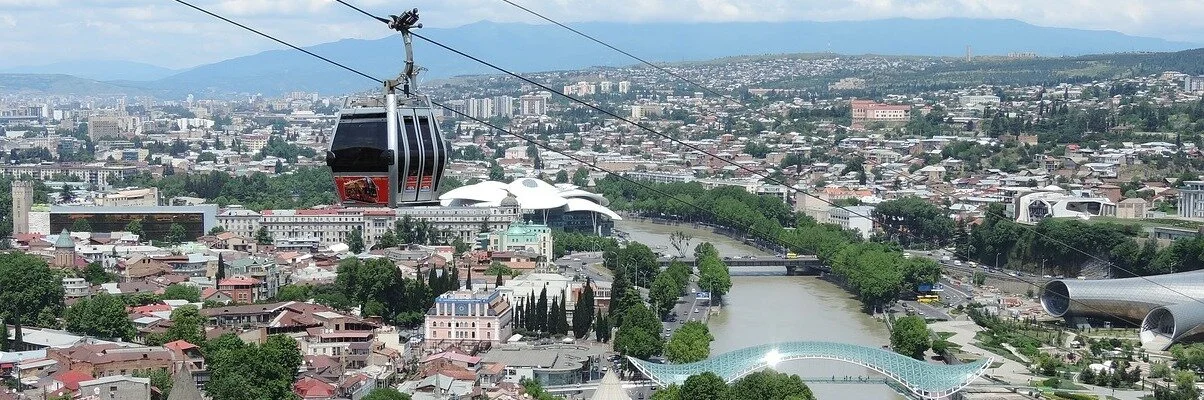
Iranians Find a Wary Refuge in Georgia
Immigration from Iran to Georgia has been sharply increasing: Since 2012 the net number of Iranian immigrants in Georgia has increased more than tenfold, reaching 3,413 in 2018, the last year for which statistics are available. The same year, Iranians made up the largest group of foreign nationals getting temporary residence permits.
This article was originally published in Eurasianet.
Ali had not been home to Iran for over three years. But in early January, when he decided to leave the restaurant he runs in Tbilisi and go visit his family in Tehran, he couldn’t have known what was to come.
Ali has lived in Georgia for several years—one of thousands of Iranian expats here—and has been hesitant to go home for safety reasons. Ten years ago, as a student in the city of Hamadan, he participated in the massive anti-government protests in Iran that became known as the Green Movement. The protests ultimately were put down and participants continue to face legal trouble. “I have had an open court case pending since then,” Ali told Eurasianet. (Names and other identifying elements in this story have been changed for the interviewees’ safety.)
Geographic proximity and relaxed travel regulations have made the South Caucasus an attractive destination for Iranians to live and visit. Hundreds of thousands come every year as tourists to Azerbaijan, Armenia and Georgia; thousands to do business and hundreds as refugees.
It's particularly attractive for Iranian emigres critical of their government, as they can stay out of reach of the authorities but still in touch with their families. “There are only 40 countries that let us in without visas. Georgia is one of them,” said Saman, another Tbilisi-based Iranian.
Saman’s job in Tbilisi has put him at odds with the Iranian authorities and he can no longer go home. His family, however, can visit him in Georgia.
“My mom, my sister and my brother have come here to see me, but my dad is too old to travel,” Saman said. “It’s something that haunts me. Every time my mother, my sister or my brother call, I fear it’s the call that is going to tell me that my dad is gone.”
Immigration from Iran to Georgia has been sharply increasing. Since 2012 the net number of Iranian immigrants in Georgia has increased more than tenfold, reaching 3,413 in 2018, the last year for which statistics are available. The same year, Iranians made up the largest group of foreign nationals getting temporary residence permits: 5,346, or 87 percent of the total.
But as immigration has increased, Georgia has tightened the screws on arrivals from Iran.
A growing number of Iranians have been denied entry and residence permits over the last two years, victims of anti-immigration domestic politics in Georgia, attempts to crack down on transit migration, and security concerns.
And many temporary residence permit-holders, like Ali, are concerned that their permits will not be extended.
Because of the growing crackdown in Georgia, Ali became convinced that he will be forced soon to leave Georgia. He decided to apply to graduate school in another country, and went back to Iran at New Year’s to gather some documents and visit his family.
His trouble began upon arrival at Tehran’s airport. When the border police detained him, took his passport and thoroughly examined his phone, Ali feared that his student political activism was coming back to haunt him. While he eventually was let into the country, he worried that he wouldn’t later be allowed to leave.
Two days later, an American drone killed Iranian General Qassem Solaimani in Baghdad, bringing U.S.-Iranian tensions to a boil. The jittery Iranian military shot down a Ukrainian passenger jet, sparking domestic protests and prompting the cancellation of many flights.
“The situation was pretty awful. Everyone was worried about war, as you have a confrontation between two crazy governments, both known for making rash decisions,” Ali said. “I couldn’t help thinking that all this had to happen when I finally came home after so much time. My friends were joking that I’m bad luck.”
Although Ali made it out of Iran and back to Tbilisi, he says he has decided to never go back. He and Tbilisi’s other Iranians closely follow the news back home and ponder the personal ramifications.
“I was speaking to my family and we thought they should also come here to Georgia if things get really bad,” Saman said.
But many of the conversations about Iran take place in private or in social media anonymity.
“Many [Iranians in Tbilisi] have tried to limit their contacts with other Iranians, as you never know who reports back to the government,” Saman said.
The Azerbaijan Precedent
Georgia has a less-than-sterling record of providing a safe environment for dissidents from nearby countries. A number of Azerbaijani dissidents in Georgia have been harassed by their repressive government; in the most egregious case, the Georgian authorities are accused of aiding and abetting an Azerbaijani journalist’s abduction from the center of Tbilisi and delivery to a prison in Baku.
Iran doesn’t likely have the same sway in Tbilisi as does Azerbaijan. “Azerbaijan is the largest investor in Georgia and the ruling family is a key sponsor of the Georgian economy and the establishment, so our political elite is eager to entertain the Azerbaijani government’s requests,” said Giorgi Gobronidze, assistant professor of political science at the European University in Georgia, speaking at a recent conference on the security implications of the Iran-U.S. conflict for the South Caucasus. “Iran, by contrast, does not have significant economic or political influence in Georgia, nor it will be given similar access.”
And Tehran, too, has bigger issues to deal with than its dissidents in Georgia. Giorgi Koberidze, a security expert and guest lecturer at the Georgian Institute of Public Affairs, said at the same conference that Iran concentrates its influence in the Middle East, particularly Lebanon, Iraq and Palestine. “The Iranian government cannot afford to waste its efforts on Georgia or this region,” Koberidze said.
Still, Saman isn’t taking his chances and long ago chose not to integrate with the Iranian expat community in Georgia, out of concerns that word could get back to Iran and prompt the authorities to put pressure on his family. “I don’t have any Iranian friends here outside my office. I don’t go to Iranian places,” he said.
If they want, Iranians have plenty of places in Georgia where can they mingle. There are many Iranian-run restaurants and bars in Tbilisi and a few in Batumi, on Georgia’s Black Sea coast. Iranians, in fact, make up the largest single share (31 percent) of the foreign nationals who set up businesses in Georgia between 2015 to 2018.
But when it comes to debating politics, many Iranian expats opt for social media, often using fake monikers. Online discussions turned particularly heated following the Soleimanii killing and the threat of war with the U.S., with some anti-establishment Iranians seeing military intervention as a means of getting rid of the regime they hate.
“There are a lot of people who are frustrated, who think they have exhausted all the other ways of changing the regime, and they hope that an American invasion will help bring it down,” said Ali. “I was trying to tell them that war is something that affects everyone, that there will be no winners.”
But Aram, an Iranian in Tbilisi married to a Georgian, favors the U.S.’s hardline policy and sanctions against Iran, arguing that the government would never fall without a push from the outside. “For a long time, I thought Trump was an idiot, but sometimes it takes one to fix a problem made by other idiots,” he said.
Saman believes that the change in Iran has to come from inside, is against foreign intervention and is skeptical about U.S. sanctions. He was in London recently and tried to use his credit card to buy a subway ticket, but it was rejected—apparently the result of sanctions. “It’s made the life of ordinary Iranians more complicated, but did it do anything to the regime? Yes, there were protests, but nothing has really changed,” he said.
Photo: Wikicommons
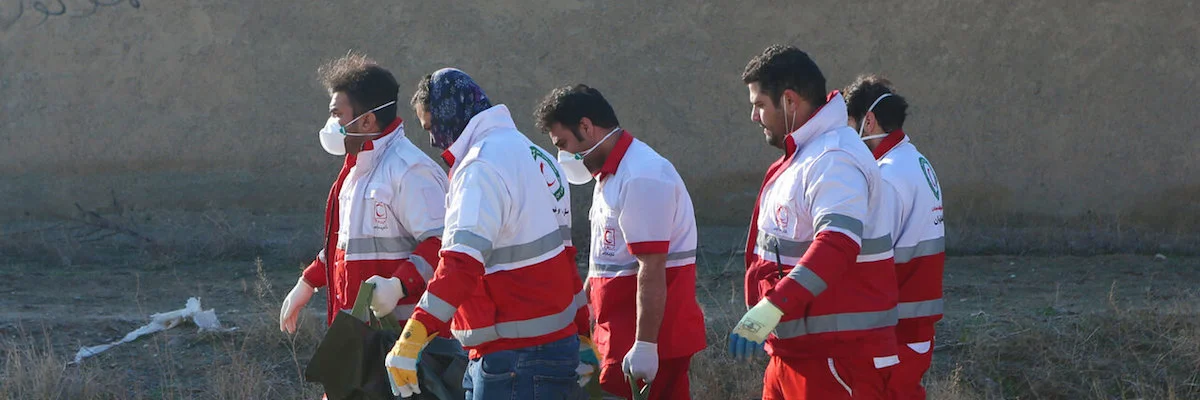
An Opportunity in Iran’s Latest Tragedy
The Ukraine International Airlines Flight 752 tragedy presents the Trump administration an opportunity to demonstrate its often-stated goodwill toward the Iranian people by responding to the formal invitation from Iran and enabling the participation of US experts from Boeing and investigative body NTSB.
Iran has sought international assistance in the investigation of the crash of Ukraine International Airlines Flight 752, which killed all 176 people onboard on Wednesday. But the ongoing tensions between Washington and Tehran threaten to prevent the involvement of American experts in the investigation of what brought down the Boeing 737-800 aircraft.
The U.S. National Transportation Safety Board faces two quandaries. It must determine whether the Trump administration’s sanctions on Iran prohibit engagement with Iranian authorities in the investigation, and whether it is safe to send investigators to the crash site at a time when the two countries are in a heightened state of confrontation.
NTSB experts are widely recognized as among the best crash investigators in the world and they regularly participate in investigations at the behest of foreign governments, under a process outlined in Annex 13 of the Convention on International Civil Aviation.
Boeing Co. has said it is ready “to assist in any way needed,” but the airplane maker, too, must reckon with sanctions restrictions.
American sanctions on Iran require NTSB investigators to procure a license from the Treasury Department in order to work with Iranian counterparts—such clearances can take as long as a year to be issued.
The tragedy presents the Trump administration an opportunity to demonstrate its often-stated goodwill toward the Iranian people by immediately issuing the licenses. In return, the U.S. should seek public assurances about the safety of American experts who would travel to Iran, and for these experts to be provided access to the plane’s black boxes—which Iranian officials are reportedly reluctant to provide.
Part of this reluctance stems from the fact that Iranian civil aviation officials believe their own efforts to improve the safety of Iran’s airlines have been significantly hampered by the Trump administration’s “maximum pressure” sanctions policy. Boeing’s contracts to sell 100 aircraft to Iranian airlines were cancelled when the U.S. withdrew from the Iran nuclear deal in May 2018—Iranian airlines fly some the oldest aircraft still in service anywhere in the world. The reimposition of secondary sanctions also blocked Iran’s ability to purchase spare parts from U.S. suppliers for its existing fleet, and even prohibited the sale of training manuals and technical documentation.
The International Civil Aviation Organization, a United Nations body, has long gathered evidencedemonstrating that U.S. sanctions hamper the safety of the Iranian aviation industry. A 2010 ICAO Universal Safety Audit found that “Iranian carriers are unable at present to fulfill most requisite ICAO aviation safety and maintenance standards and recommended practices (SARPs)… because they were denied access to updated aircraft and aircraft spare parts and post-sale services around the world.” The rate of passenger fatalities in Iran is 5.5 times higher than in the rest of the world.
As a foreign carrier, the safety of the Ukraine International Airlines flight is unlikely to have been impacted by these sanctions issues. But the death of over 100 Iranian nationals in the crash has compounded the grief for a country where planes all-too-regularly experience catastrophic accidents.
When issuing licenses to enable U.S. participation in the investigation, the Trump administration should also respond to the wider concerns around aviation safety in Iran by issuing licenses for planemakers such as Airbus SE, Boeing and ATR to resume sales of safety-related materials, including flight manuals used in pilot training and schematics used in aircraft maintenance. These limited licenses would in no way undermine the Trump administration’s “maximum pressure” policy, but could generate some trust between American and Iranian authorities seeking to de-escalate tensions.
This would not be the first time that the U.S. has sought space for understanding and cooperation with Iran under tragic circumstances. In the aftermath of the devastating 2003 Bam Earthquake, American search and rescue teams traveled to Iran to provide disaster aid and medical assistance to survivors—without in any way compromising the U.S. position on Iran’s nuclear program.
This is another moment for that kind of cooperation.
Photo: IRNA
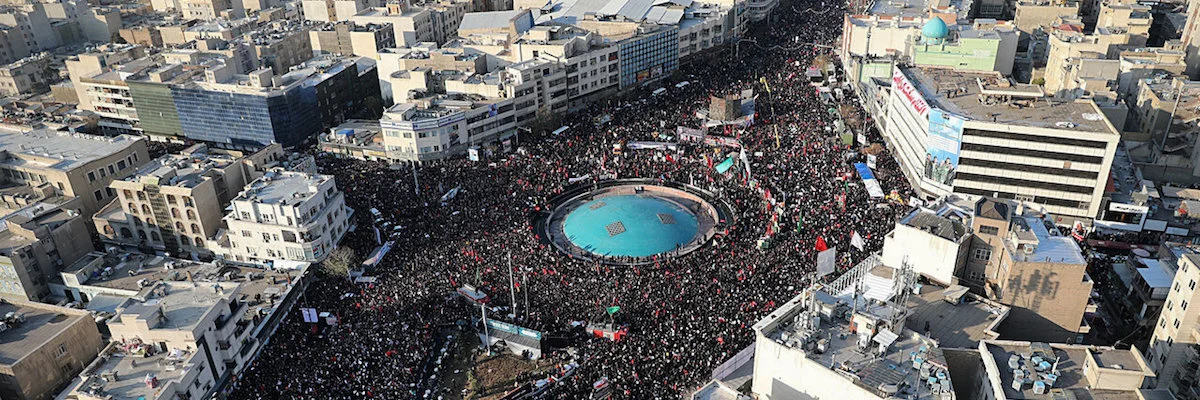
Iranian Businesses Take Stock After Soleimani Assassination
Iran’s business community is taking stock after the assassination of Major General Qassem Soleimani as the possibility of a direct conflict with the United States threatens serious consequences for an already beleaguered Iranian economy. Both the currency market and stock market saw further losses on Monday, the final day of a three-day period of mourning.
Iran’s business community is taking stock after the assassination of Major General Qassem Soleimani while the possibility of a direct conflict with the United States threatens serious consequences for an already beleaguered Iranian economy.
The economic impact of Soleimani’s death was first felt in currency markets on Saturday, the first day of the working week in Iran. The dollar was priced at about IRR 133,500 before currency markets opened, but jumped to IRR 137,500 by Saturday’s close. On Sunday, the dollar appreciated further against the real to close at IRR 139,500, marking a 4.5 percent drop in value over the two days. The Iranian rial has stabilized over the last year after losing more than 60 percent of its value in 2018.
Similar volatility was could be seen in Iran’s main stock market, which had made significant gains over the last year. TEDPIX, the main index of the Tehran Stock Exchange (TSE), closed at 367,334.20 on Saturday, down by 4.6 percent. It dropped another 1.4 percent by Sunday’s close to reach 362,259.30.
Both the currency market and stock market saw further losses on Monday, the final day of a three-day period of mourning. Millions of Iranians have taken to the streets of Iran’s major cities to participate in funeral processions.
Supreme Leader Ali Khamenei has vowed to exact “severe revenge” for Soleimani’s death. Secretary of the powerful Supreme National Security Council Ali Shamkhani said Sunday that Iran’s “response to this crime will certainly be military, but won’t be limited to military efforts.”
Trump has doubled down on the assassination, using Twitter to threaten the destruction of 52 targets in Iran, including sites important to the “Iranian culture.” Perhaps indicating his knowledge of the target list, Senator Lindsey Graham suggested the president should target Iran’s oil refineries in further airstrikes.
The economic ramifications of a direct conflict with the United States would be serious. But even absent war, the heightened tensions and greater uncertainty will have an impact on the business environment in Iran.
“We are now in a state of limbo where it is unclear what will happen next,” said market analyst Hamid Babalhavaeji.
Babalhavaeji told Bourse & Bazaar he is indeed worried about a potential armed conflict, but also pointed out that Iran’s economy is already in a state of economic war, gripped by high uncertainty and confined to short-term strategies.
Iran’s economy has struggled in the face of a volatile currency and high inflation since the US unilaterally withdrew from the JCPOA nuclear deal and reimposed secondary sanctions last year.
As to whether foreign companies currently working with Iran will be discouraged continuing their dealings as tensions rise, Babalhavaeji believes only a direct conflict touching Iranian soil would have a meaningful negative impact.
In his view, the economy’s key vulnerability is disruptions to the flow of trade through Iran’s southern ports in the Persian Gulf. “But for now, the main issue continues to be sanctions and challenges in transfer of money,” he said.
Iran’s difficulties in international banking have been compounded by its slow progress in implementing an action plan set forth by the Financial Action Task Force (FATF).
In October, the intergovernmental global standard-setting body for anti-money laundering and combating terrorist financing body renewed the suspension of active countermeasures against Iran, but placed a fast-approaching deadline for further progress on legislative reforms.
“If before February 2020, Iran does not enact the Palermo and Terrorist Financing Conventions in line with the FATF Standards, then the FATF will fully lift the suspension of counter-measures and call on its members and urge all jurisdictions to apply effective counter-measures,” the organization declared.
In the weeks prior to the Soleimani assassination, there appeared to be progress in getting the two outstanding bills passed. The Expediency Council, a body that arbitrates disputes between Iran’s parliament and the Guardian Council, had blocked implementation of the bills, arguing that they threatened national security.
But aggressive lobbying by the Rouhani administration and stakeholders in the business community had sought to explain the risks of not passing the required legislation by the mid-February deadline. Pedram Soltani, vice chairman of the Iran Chamber of Commerce, Industries, Mines and Agriculture, had revealed that the governor of the Central Bank of Russia had informed the governor of Iran’s central bank, Abdolnasser Hemmati, that Russian banks would be unable to work with Iranian banks should Iran fail to implement the FATF reforms.
The assassination of Soleimani and Iran’s unfolding national security crisis, will likely halt efforts to enact the Palermo and Terrorist Financing Conventions. Iranian business leaders hope that FATF member states recognize the impossibility of passing such sensitive reforms in the wake of the unprecedented American airstrike, granting more time for reform.
Ali Khosroshahi, an executive vice president at Sepehr Investment Bank, thinks the repercussions of Soleimani’s assassination should be viewed in the context of Iran’s existing economic isolation, which has left companies battling significant financial constraints.
“We are already in war conditions from an economic standpoint. This event has only made things more difficult and increased tensions alongside a whole set of other conditions,” he said.
Khosroshahi expects that if a major political breakthrough—which he considers unlikely—does not materialize, Iran’s economy will continue to experience high inflation at least until the end of the next calendar year in early 2021.
Speaking on background given the sensitive nature of the topic, a board member of a large Iranian manufacturing firm said that his company has yet to do formal contingency planning around further escalation, but that so far there “hasn’t been any noticeable effect on business as the events have yet to affect material or financing flows.”
The board member suggested that while “what happened wasn’t expected by anyone” the risk of conflict was already “accounted for” in Iranian markets. In his view, it’s global investors that have yet to properly “educate themselves about the growing risks” as Trump grows more erratic.
As financial economist Peter Dragicevich told Bloomberg, “Everyone got comfortable in that fact that the truce in the trade war had come through and the outlook for 2020 looked a little bit better and then we had another geopolitical reminder come through.”
The US-Iran tensions are “going to be a big driver of markets in the short term,” he added.
Photo: IRNA
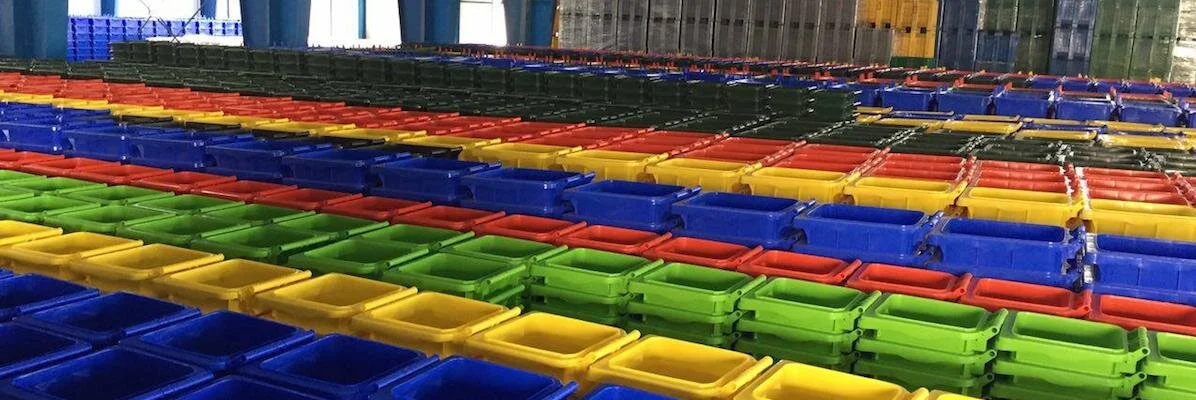
Iranian Garbage Can Found as U.S. Embassy in Baghdad Stormed
The storming of the U.S. embassy in Baghdad by Iran-backed militias produced many surreal scenes, but perhaps none more so than that captured in a video shared widely on social media. The short clip shows a green garbage can found at the embassy, which the protestors recognized as an Iranian-made product.
One day after a deadly US airstrike which killed 25 militiamen, members of several Iraqi paramilitary groups aligned with Iran marched on the U.S. embassy in Baghdad, breaching the outer wall of the compound, which is set behind multiple checkpoints in the heavily guarded Green Zone.
Facing no resistance from Iraq’s security forces, the protestors moved on the embassy, risking further escalation between the United States and Iran days after the death of an American contractor in a rocket attack linked to the Kataib Hezbollah militia. U.S. President Donald Trump warned in a tweet that Iran would “be held fully responsible” for the attack on the U.S. embassy, although he later told reporters that he did not expect a war.
The day’s events produced many surreal scenes, but perhaps none more so than that captured in a video shared widely on social media. The short clip shows a green plastic garbage can, which protestors had recognized as an Iranian-made product. Several men can be heard laughing as they remark on the irony of finding an Iranian garbage can in use behind the walls of the U.S. embassy.
The otherwise unremarkable garbage can may offer a metaphor for the senseless contest between the United States and Iran for political and military influence in Iraq. The fact that the U.S. embassy is using Iranian garbage cans serves as a reminder that basic economic logic can still override the competition that has so frustrated the Iraqi people by stymying development and stoking violence.
A logo visible in the video, written in Persian, indicates the garbage can was manufactured by Razak Chemie. The company, also known as Razak Plast, specializes in the production of plastic garbage cans and dumpsters. Based in Tehran, Razak Chemie, exports to a wide range of markets, including Iraq. It is part of Iran’s large and well-developed manufacturing base, which converts the country’s natural resources—in this case the petrochemical derivatives of oil production—into higher value finished goods.
It is likely that the contractor responsible for sanitation services at the U.S. embassy compound purchased the garbage can from a local wholesaler—perhaps even a local subsidiary of Razak Chemie. A product like a garbage can is exempt from sectoral sanctions on Iran, and Razak Chemie is not a sanctioned entity. It may not have occurred to anyone to check the origin of the garbage can—certainly no one would have anticipated the garbage can would feature in a video shot by Kataib Hezbollah members behind the embassy walls.
Economically speaking, it makes perfect sense that the U.S. embassy in Baghdad would use Iranian garbage cans, potentially in addition to other Iranian products. As one of Iraq’s largest trading partners and—along with Turkey—the neighbor with the largest manufacturing base, Iran is an obvious supplier for a wide range of consumer and industrial goods.
Sure, the contractor at the U.S. embassy could have sourced the same kind of garbage cans from China. But it is likely that Razak Chemie’s products were simply more affordable and more readily available than those from other companies and countries.
A Chinese-made garbage can sold in Iraq would have traveled a long way. It would also have been produced with plastic pellets imported from abroad—very possibly from Iran itself. Between January and November 2019, China imported USD 2.3 billion of plastics from Iran, a category which includes the raw materials necessary for injection molding of industrial garbage cans. Given Razak Chemie can source key raw materials domestically and can get its products to Baghdad via a simple 11-hour journey by truck, cost-competitiveness is to be expected.
A similar business case applies to a wide range of Iranian manufactured goods now exported to Iraq. Last year, Iran-Iraq bilateral trade amounted to USD 12 billion. When Iranian President Hassan Rouhani visited Baghdad in April 2019, he announced an ambitious goal to grow that figure to USD 20 billion by 2021. By comparison, in 2018, U.S.-Iraq bilateral trade was just over USD 13 billion. However, of that amount nearly USD 12 billion was exports of Iraqi crude oil to the United States. In short, the U.S. is not selling basic products like garbage cans to Iraq—and those products, when not manufactured domestically in Iraq, are frequently sourced from Iran over other global suppliers.
Whatever vision policymakers in Washington may have for economic development in Iraq, it will require the respect for Iraq’s deep economic ties with Iran and the utility of those ties. Of course, in the interests of Iraq’s economic sovereignty and development, these ties ought to be based on fair competition and comparative advantages. Ideally, more of Iraq’s consumables will one day be made domestically, but perhaps it will be through joint ventures in which an experienced firms like Razak invest in Iraqi manufacturing. Already, several major Iranian companies have established local manufacturing plants in Iraq, contributing much-needed foreign direct investment and transferring technological knowhow while also creating jobs.
Iran-backed militias may have made it behind the walls of the U.S. embassy, but Razak Chemie’s garbage can made it there first—unthreateningly and usefully. The United States can no more expect to excise Iranian commercial activity from the Iraqi economy than it can expect to end German commercial activity in Poland—economic development necessitates regional integration.
Photo: Razak Plast
Iran is Losing Sight of its 'Developmental Vision'
Today, a new Iranian precariat is seeking economic justice. Iranian economic planners and policymakers, like their fellow technocrats around the world, are struggling to find the pathway to continued growth in the face of factional infighting and foreign interference.
This article was originally published by the Atlantic Council.
On December 11, Iran’s information minister announced via social media that he had a “surprise” to reveal. Mohammad-Javad Azari Jahromi, the Islamic Republic’s youngest-ever cabinet minister, had been the subject of intense criticism from the Iranian public following a week-long internet blackout. Authorities had taken the unprecedented step to cut internet access in response to the nationwide protests that erupted on November 15 following a subsidy reform that doubled fuel prices. Angered by the crackdown, many Iranians “surprised” Jahromi by blocking him on Twitter.
Undeterred, Jahromi made his grand reveal on December 12: a slickly produced video that showed Iran’s postal service delivering a package to the information ministry by drone. While such drones may be helpful for rural communities and disaster response, Iranians were understandably bewildered by the PR stunt.
Jahromi’s postal drone offers a metaphor for perhaps the central political challenge facing the Islamic Republic. In the wake of a brutal response to protests that has left over 300 dead, commentators have pointed to a crisisof legitimacy now facing Iran’s leaders and their ideological tenets. But in reality, it is the compounding failure of technocrats like Jahromi to manage a decade of economic volatility that best explains Iran’s new political turmoil.
As a recent study of the fuel protests shows, “economic grievances were likelier to inspire protest in areas where frustration with the whole system was endemic… Economic hardship turned frustrations with the system into assertive protest activities.” The protests appear to have comprised largely of individuals newly confronting economic hardship, which suggests the emergence of a precariat class in Iran. Just last year, 1.6 million Iranians fell into poverty due to high inflation. The study details how the counties in Iran which saw protests were often those more dependent on state support, meaning that the withdrawal of that support—such as the reduction of the fuel subsidy—was felt most acutely. As the study observes, “the Islamic Republic, through its long-term developmental and welfare programs, has empowered a citizenry that now resists neoliberal policies, such as cuts to energy subsidies.”
These long-term developmental and welfare programs are the underappreciated pillars of the Islamic Republic. As sociologist Kevan Harris has described, state-society relations in Iran have been shaped by a “developmental vision” established when the young Islamic Republic began to emerge from the brutal Iran-Iraq War. As revolutionary fervor and wartime zeal ebbed, a core group of technocrats, many of whom had served in the Shah’s civil service and who had been educated abroad, began to set the country’s development agenda. After a few years of structural readjustment, the country’s economy started to grow, and the technocrats became firmly ensconced in the powerstructures of the Islamic Republic.
Iran’s GDP per capita peaked in 2012, buoyed by record-high oil prices. But the same year, the international community imposed strict sanctions on Iran over its nuclear program, triggering a 7.4 percent contraction and ending 23 years of consecutive increases in GDP per capita, which had risen from just over $2,200 in 1989 to just under $8,000 by 2012. The developmental vision of the Islamic Republic had significantly improved the welfare of the average Iranian. For millions of Iranian households, development meant the arrival of electricity, gas, refrigeration, personal mobility—and in the last decade, access to the internet. But success in economic development is inherently relative. Iran fared much better than Iraq in the two decades following their eight-year war. Iraq’s GDP per capita had been higher than Iran’s in 1989, at $3,800, but rose to just $6,800 by 2012, having lagged behind Iran even before the 2003 US invasion. In the same period, however, Poland, which emerged from its stagnation behind the Iron Curtain in 1989, saw its GDP per capita rise from just below $1,800 to $13,000, becoming a widely touted example of successful development.
That Iran finds itself between Iraq and Poland on the measure of GDP per capita speaks to the predicament facing the country’s technocrats. The political establishment in Iran is, in some respects, the victim of its success. Economic development became, even in an ostensibly “revolutionary” state, the foremost expectation of governance among the Iranian people. The Islamic Republic has only recently ceased delivering consistent distributive economic growth, leaving chronic and underlying issues of inflation, unemployment, and corruption unassuaged by economic expansion. Sanctions—which have deprived the country of investment, stifled trade, and weakened the currency—have contributed to nearly a decade of stagnation.
In a prescient 2011 study on the impact of economic crises on Iran’s youth, economist Djavad Salehi-Esfahani concludes with a question. He wonders how a lack of economic opportunity “shapes the attitudes of Iran’s youth about the country’s future and their ability to lead and build the nation.” Are Iranian youth “slowly losing not only their skills but also their hope and optimism?”
While Jahromi was busy toying with postal drones, a new budget was being prepared for the forthcoming Iranian year (March 2020). As analyst Henry Rome explains in his study of the new budget, the Iranian government will seek to mitigate the harms of high inflation, which the IMF projects at around 30 percent next year, by instituting new cash transfers and increasing the wages of public sector employees. Overall, the new budget represents an 8 percent increase in spending in rial terms. But with the contribution of oil revenues down from 29 percent in last year’s budget to a likely-too-optimistic 9 percent, the government will be seeking to increase tax revenue in to fulfill its fiscal burdens, ostensibly increasing the importance of functional state-society relations.
Iran’s technocrats will continue to seek policy solutions to address widespread economic frustrations and alleviate poverty. But as Salehi-Isfahani observes in his study from eight years ago, there is only so much that the technocratic solutions can achieve. In the face of myriad economic pressures, including “maximum pressure” sanctions, Iran’s resilience is a remarkable achievement, but it is nonetheless approaching a kind of political limit. Referring to the government’s response to the economic malaise of the Mahmoud Ahmadinejad years, Salehi-Isfahani notes, “there are new policy initiatives ranging from the reform of the nation’s decades-old subsidies, to amending the family laws, to reviving population growth, not to mention the nuclear standoff with the West, but none that help salvage Iran’s demographic gift.” That an article written years ago describes the current dilemmas so accurately speaks to Iran’s stagnation.
In the aftermath of the protests, Iran’s political elites have begun to realize the stakes. In a speech one week after the fuel protests, Mohsen Rezaei, the hardline secretary of the country’s influential Expediency Council, acknowledged that Iran was failing to deliver economic development. Pointing to the importance of economic development in state-society relations, Rezaei stated, “Since the beginning of the revolution until today each government of the Iranian people has tried to make an impact on the economy, and particularly in the last two decades the focus various stakeholders has been the economy, but we have yet to find a pathway that gives us optimism for the future.” While the Islamic Republic had proven able to “address the issue of elections, defense, security, and freedom,” it had failed to reach the optimal model for “economic development and economic justice.”
Today, an Iranian precariat class is seeking economic justice. Iranian economic planners and policymakers, like their fellow technocrats around the world, are struggling to find the pathway to continued growth in the face of factional infighting and foreign interference. Signing-off in his announcement of the postal drone, Jahromi declared, “We must make Iran the best and most advanced country in the world!”
If only it were so easy.
Photo: IRNA

Iran Needs Humanitarian Aid. Trump Should Help.
Medicines and foodstuffs are exempted from the U.S. sanctions on Iran, but the prospect of punishment has spooked potential suppliers, and especially foreign banks. Although this problem is easily fixed, President Donald Trump’s administration has been shamefully tardy in doing so.
It was the smallest of gestures, and might easily have been missed if it wasn’t for the identities of those involved. In the chamber of the United Nations Security Council on Thursday, the American ambassador to the UN walked over to her Iranian counterpart to offer condolences.
Kelly Craft was responding to a speech by Majid Takht-Ravanchi, in which the Iranian ambassador mourned the death of Ava, a two-year-old girl in Tehran, whose doctors had been unable to procure bandages for skin blisters caused by a rare genetic disease. Takht-Ravanchi blamed U.S. sanctions — specifically, their impact on supplies of essential medicines.
It would’ve been easy enough to dismiss the story as a disingenuous play for sympathy, and an opportunistic attempt to deflect blame by a regime that has in recent weeks slaughtered hundreds of its own citizens—including children. But Craft was right to express compassion for the plight of ordinary Iranians. In fact, a bigger, more meaningful gesture is long overdue: making sure no other Ava need die for her government’s faults.
Medicines and foodstuffs are exempted from the U.S. sanctions on Iran, but the prospect of punishment has spooked potential suppliers, and especially foreign banks. Although this problem is easily fixed, President Donald Trump’s administration has been shamefully tardy in doing so.
What it will take is for the U.S. to green-light a proposed Swiss channel for humanitarian trade, and to expand the channel’s mandate to include non-Swiss suppliers. The channel has been in the works for more than a year. The most obvious European beneficiaries would be Swiss drugmakers Roche Holding AG and Novartis AG, and the food group Nestle SA, which have a long history of trade with Iran. But there’s no logical reason other companies, even American ones, shouldn’t be allowed to use the conduit.
U.S. authorities have blocked the channel, mainly by dragging their feet in clarifying what they would and would not allow through it. Some progress was announced in October, and still more earlier this month.
This isn’t good enough. While it’s true that the Iranian regime uses the sanctions as a convenient cover for its own failings — and some of the medical shortages are of its own making — there’s no gainsaying that trade restrictions inflict real pain on many people. Human-rights groups have documented how the sanctions harm Iranians’ right to health.
At the same time, they have encouraged European governments to seek alternative routes such as INSTEX, a so-called “special purpose vehicle” designed to sidestep the American financial system. It hasn’t worked yet. But it has put the Trump administration in the unedifying position of threatening its allies over humanitarian trade.
American intransigence on this has also given Iran a stick with which to beat the Europeans. When not shedding crocodile tears over Ava, the regime in Tehran threatens to ratchet up its enrichment of uranium, unless Europe opens up trade channels.
By clearing the legal and bureaucratic path for the Swiss channel, the Trump administration would not only be doing the right thing by the Iranian people, it would be revealing the regime’s threats for what they are: nuclear blackmail. It would also free the Europeans to impose sanctions of their own, guilt-free.
All of this is long overdue. But if politics requires a propitious moment for the big gesture, it so happens that one is close at hand: January marks the 40th anniversary of Switzerland’s role as the de-facto representative of American interests in Tehran. It’s hard to think of a better time to announce a Swiss-American humanitarian channel.
And should the channel need a name, something more meaningful than “INSTEX,” something that conveys a political message as well as a humanitarian one ... how about Ava?
Photo: IRNA

Iran Looks to Central Asia in Effort to Grow Exports
In the first two weeks of December, Iranian government officials and business leaders participated in bilateral economic summits with counterparts from Tajikistan, Kyrgyzstan, and Uzbekistan—the highest-level economic exchanges with these countries in several years. Iran is expanding its “neighborhood policy” to Central Asia as it seeks to grow its non-oil exports.
Over the past year, Iran has faced disruptions in its foreign trade relations following the withdrawal of the United States from the Joint Comprehensive Plan of Action. Trade with partners like Europe and China has suffered because of U.S. secondary sanctions. In the face of these uncertainties, Iran has adopted a “neighborhood policy” as it seeks to protect trade flows. The policy has been recently expanded to Central Asian states, which serve both as an export market as well as the geographic bridge as Iran seeks to strengthen integration with Russia and China. For the landlocked Central Asian states, Iran is a vital conduit to international waters. In a May 2018 speech, President Rouhani described closer ties with Central Asia as a “fundamental policy.” The policy is now in the early stages of implementation.
At the beginning of December, Tehran hosted two economic summits with Tajikistan and Kyrgyzstan, the first such meetings in two and three years respectively. A week later, an Iranian delegation traveled to Tashkent in an effort to deepen trade ties.
On December 2, a joint commission of economic cooperation was held between Iran and Tajikistan. Iranian energy minister Reza Ardakanian presided over the meeting, which focused primarily on cooperation in energy and transportation projects. Iranian contractors have a history of infrastructure development in Tajikistan, such as the Anzob Tunnel completed in 2015 and Sangtuda 2 hydroelectric power plant. But discussions at the joint commission focused on new projects that would improve Tajikistan’s links to export markets through Iran, and also help support increased bilateral trade, such as the construction of warehouse facilities at Chabahar Port, and the completion of a railway corridor that would link Tajikistan and Turkey through Iran as part of the integration efforts of the Economic Cooperation Organization.
As part of a broader effort to reset political relations, Iran’s President Rouhani made a state visit to Dushanbe in March 2019. Tajik President Emomali Rahmon may soon make his first visit to Iran in six years.
Just a day after the summit with Tajik officials, Iran held a similar high-level commission with Kyrgyzstan. Mohammad Eslami, Iran’s minister of roads and urban development, led the Iranian participation in what was the first commission meeting in three years. The negotiations, which resulted in an extensive memorandum, included a focus on banking ties and transport links.
In the area of banking the Iranian and Kyrgyz officials discussed the establishment of a protocol to ease trade conducted in national currencies among commercial banks. Iranian economy minister Farhad Dejapsand and his Kyrgyz counterpart, Hukan Batov, also discussed the establishment of a joint export bank and export credit agency to help facilitate trade. In the area of transit ties, Iranian and Kyrgyz officials continued dialogue on the use of Iran’s Chabahar port, where Kyrgyzstan has owned land since 2007 following a land swap with Iran, but has yet to develop warehouses or other infrastructure at the site. Iran has sought expanded ties with Kyrgyzstan in recent years. Kyrgyzstan so far is the only Central Asian state to have agreed a 10-year strategic roadmap with Iran—the agreement was signed in December 2016.
A week after the Tajikistan and Kyrgyzstan summits, Iranian industries minister Reza Rahmani led a delegation of over 50 Iranian companies for a two-day business summit in Tashkent, Uzbekistan. Like Tajikistan and Kyrgyzstan, Uzbek companies use Iranian ports to get their goods to global markets. But with a population of 33 million, Uzbekistan also represents a significant potential market for Iranian exporters. Iran’s Zagros Airlines has re-established a direct light between Tehran and Tashkent, after a three-year hiatus. Bilateral trade between Iran and Uzbekistan grew 40 percent in 2018.
Increased trade with neighbors such as Iraq and Turkey has been a key contributor to Iran’s economic resiliency over the past decade, particularly as sanctions depressed exports to markets like Europe and China. In this regard, improved relations with Central Asian states have a strategic importance for Iran in the face of the U.S. “maximum pressure” sanctions companies. Moreover, the Central Asian states will also play an important role in China’s growing sphere of economic influence and as part of the Russian led Eurasian Economic Union, with which Iran has recently concluded a free trade agreement. If the plans discussed by Iran with its Central Asian neighbors are properly implemented, a new pathway for regional economic development will be opened in the medium-term.
Photo: Railnews.ir
After the Iran Protests: How Europe Can Keep Diplomacy Alive
The aftermath of the protests presents significant challenges for the Iranian leadership. The Islamic Republic is dealing with severe economic difficulties and a fraying of the political fabric. Washington will use the recent unrest to argue against Europe engaging with Tehran. But diplomacy remains the only viable path to deescalation. Europeans, led by Emmanuel Macron, must protect the space for dialogue.
This article was originally published by the European Council on Foreign Relations.
The Middle East is facing a wave of protests—with the latest unrest in Iran sweeping the country in November. For the moment, a swift government crackdown that reportedly left at least 208 dead has largely brought the protests to an end. An unprecedented internet shutdown during the unrest means that information and debate from inside Iran are now going viral, with observers seeking to take stock of what it could mean for the country. While much remains unclear, the episode has shaken a fragile Iranian nation, diminished the already dwindling popular support for the Rouhani administration, and further complicated European efforts to reduce tensions between the United States and Iran.
The protests were sparked after Iranians woke up to steep hikes in petrol prices of around 50 percent brought in overnight in mid-November. The Iranian state has long subsidized fuel, but Iranian officials argued that this was a necessary step to address the budget deficit (hard hit by US sanctions cutting off oil revenues) and to tackle illicit fuel-smuggling organizations. The new approach has also allowed an increase in cash transfer subsidies to Iran’s poorest.
The move predictably provoked the greatest anger among Iran’s lower earners, who are barely making ends meet. People immediately took to the streets to voice their fury at the decision, and at the political establishment more broadly. Similar to the last round of protests in Iran in late 2017 and early 2018, most of those who participated appeared to be young and from lower-income households. However, while the unrest in 2017 and 2018 stretched out over a longer period and remained largely peaceful, the latest protests were short-lived, with signs of greater coordination among those that took to the streets and hard-headed action by state authorities in response.
Some Iranian interlocutors from the policy community view the crackdown by the security apparatus as reflective of panic and anxiety in the Iranian security establishment. But others believe the Iranian state felt confident and strong in taking these actions, that it was ready to communicate its preparedness to immediately quash any serious threat, and to introduce a state of fear before protests spread further.
The aftermath of the protests presents significant challenges for the Iranian leadership. The Islamic Republic is now a pressure cooker, dealing with an unprecedented degree of harsh US sanctions that are have brought about severe economic difficulties, and a fraying of the political fabric. If economic reforms are not forthcoming to weather the storm of sanctions, tackle corruption, and provide relief to Iranian households, Iran will likely face periodic protests with ever higher levels of state repression.
For Rouhani himself, expectations were already low for the parliamentary election due in February. Now, given the brutal repression of these protests, growing numbers of those members of Iran’s middle class that previously backed the president are now likely to avoid political participation. And, over the past year, Iran’s Reformist faction, which had allied with Rouhani’s centrist presidential campaign, has conducted a fierce debate about whether to stand in the election given huge disappointment at the pace of reforms. Recent events have only intensified this debate. Hardliners are therefore expected to make significant gains in parliament and make life much tougher for Rouhani in the final year of his presidency.
Rouhani’s weakened position will make it even more difficult for him to push through any form of pro-diplomacy policy in his last year. The president has repeatedly stated that he is open to negotiations with the US given the right parameters—and he reiterated this after the end of the recent protests. Powerful figures inside Iran, such as the Supreme Leader and senior figures within the Islamic Revolutionary Guard Corps, have rejected the possibility of such negotiations, but Rouhani still has some limited ammunition. This was demonstrated by the recent detainee exchange between Iran and the US—a small but noteworthy sign of diplomatic success.
How far Rouhani can move forward will be influenced not just by internal dynamics but also by the US and Europe. The response by Iranian authorities to the protests complicates the political optics for European governments seeking to provide Iran with economic benefit to sustain the nuclear deal, which now hangs by a thread. Moreover, Washington will likely use the state repression inside Iran to double down against European engagement with Tehran, arguing that there are no moderate actors for change within the Iranian leadership.
Despite these pressures, European governments can still strike the right balance on Iran. Amid the protests, the EU called for “maximum restraint” from Iran. And the newly appointed EU high representative, in a stern statement, called for “credible investigations” into the events. European governments can also consider calling for a special session at the United Nations Human Rights Council to press for impartial investigations into the use of force in the recent protests in both Iran and Iraq.
In parallel, Europe should still move forward with processing the first transactions through the Instrument in Support of Trade Exchanges (INSTEX). This should be rooted in a duty of care towards the Iranian people, namely that Europe acknowledges the severe economic pressures placed on Iranians following the reimposition of US sanctions. Europeans must remain focused on facilitating quicker and cheaper access to humanitarian goods for the Iranian people. If this can simultaneously help prevent a further unravelling of the nuclear deal, this would be no bad outcome.
Greater internal pressure combined with increased weakness for Rouhani will likely push Iran towards a more confrontational stance, and diminish Rouhani’s ability to pursue political solutions. The US and Iran have already twice recently come dangerously close to military conflict, following Iran’s downing of the US drone in June and attacks against Saudi Arabia’s Aramco oil facility in September. US intelligence officials reportedly believe that Iran has increased its stockpile of short-range missiles inside Iraq, and military officials have warned of potential impending attacks by Iran. If the country continues to be suffocated economically by US sanctions, it will continue its withdrawal from the nuclear deal and up the ante in the region.
In the meantime, it is imperative that Emmanuel Macron pursue his initiative to reduce tensions between Tehran and Washington. Senior US officials have vowed to continue the “maximum pressure” campaign, and its proponents are likely to view the recent protests as proof that the policy is working. But Europeans should make clear that the policy has so far backfired in terms of softening Iran’s posture on the nuclear and regional files and only succeeded at pushing the country into a greater state of securitization and internal oppression. Macron should seek to quickly use the positive, and most likely short-lived, political momentum from the US-Iran detainee exchange to impress on both sides that diplomacy can deliver concrete outcomes, and that it is much the preferred option to another cycle of escalation.
Photo: IRNA
In Wake of Internet Shutdown, Iran's Programmers Face Uncertain Future
Iran’s programmers had to battle a suspicious state and a dismissive public to usher Iran into the digital age. Now, in the aftermath of a nationwide internet blackout, triggered in response to the recent protests, the resolve of the country’s programming community is being tested like never before.
About twenty years ago, when Milad Nouri first told his parents and university instructors that he wanted to be a programmer, they thought he was another good-for-nothing youth.
Today, Nouri is one of the veteran programmers who have helped lead Iran’s digital revolution, contributing to the launch of companies whose apps and online services are used by millions of Iranians daily, greatly contributing to country’s economy.
Nouri and his fellow programmers had to persistently battle a suspicious state and a dismissive public. Over the years, many left the fight and sought new opportunities abroad, while others remained in Iran and paved the way for the emergence of a genuine startup ecosystem—at last Iran’s has entered its digital age. But a recent nationwide internet shutdown has hit morale in the programmer community like nothing before.
On November 15 an unexpected decision to hike fuel prices threefold led to widespread protests. As part of their crackdown, the following day, Iranian authorities decided to hit a kill switch and—in an unprecedented move—cut off the nation from the World Wide Web.
The internet blackout, which lasted for nearly a week, has cast a dark shadow over Iranian online businesses and the programmer community. Many programmers are once again debating whether they should stay and fight for internet freedom in Iran, or pull up stakes and move abroad. Nouri and his peers are facing a new test of their resilience and resolve.
Alien Technology
Reflecting on the early years of his career as a programmer, Nouri recalls the beeps and screeches of the dial-up modems and that used to connect him to the internet. “I used to go online as soon as my parents went to bed,” Nouri explains, as his parents did not appreciate that the phone line was busy when he was online.
“The funny thing is that this habit got me into trouble too,” Nouri tells me. His parents, like many others, were worried about the sleepless hours he was spending behind the glare of his computer screen.
Computers were still alien technology in those years. State-run broadcasters did little to familiarize people with the nascent digital world. On the contrary, state television sowed seeds of distrust. Numerous “documentaries” were broadcast that called on parents to be vigilant because the internet would surely “corrupt the youth.” Nouri remembers these programs. “Whenever such shows came on TV, my parents and relatives would give me worried looks,” he says.
Inevitable Change
During his programming career, Nouri has seen three presidents come to power: Mohammad Khatami, Mahmoud Ahmadinejad, and Hassan Rouhani.
During Khatami’s tenure, the country’s technological infrastructure was extremely underdeveloped. The internet penetration rate and average connection speeds were low. Nouri tells me that for a long time, when friends and family asked him what he did for a living, he would lie: "I would just say, ‘I am a university student.’ Most people didn’t know what programming was. And even if they did, they wouldn’t acknowledge it as a job. To be honest, no one made money out of this line of work, so they weren’t really wrong either.”
In the late 2000s, some Iranian businesses started to invest in online advertising, but it was not until the arrival of smartphones that big money first entered the startup ecosystem.
Given political tensions during Ahmadinejad’s two terms—especially in 2009—curbs were imposed on internet access, hampering the growth of Iranian online services and, by extension, the newfound fortunes of local programmers.
But once tensions eased and more investment was directed towards digital innovation, programmers saw their incomes and social status rise again. When President Rouhani was elected for his first time in 2013, he and his administration jumped on the “digital economy” bandwagon and promoted support for such businesses as part of wider reforms to curb Iran’s overreliance on the oil industry.
Following this shift in policy, Iranian startups found room to grow. Careers in computer programming became a trendy and talented programmers were aggressively sought by employers. The same state-run TV channels that once demonized technology were broadcasting programs to teach people about computer science. As ventures grew, Iranian programmers found themselves handsomely paid. Parents began to encourage their children to study computer science at university.
In many ways these changes were inevitable. The spread of cheap smartphones and 3G networks brought millions of Iranians online. For businesses, digital services became a crucial way to reach customers. While Iran’s tech entrepreneurs acknowledge that Rouhani and his administration officials, and in particular the current ICT minister Mohammad Javad Azari Jahromi, have supported the transformations, they believe that the changes were largely inevitable.
During Rouhani’s first term,a nuclear deal was forged with the world powers, granting Iran sanctions relief and opening the country to foreign investment. An influx of foreign capital reshaped Iran’s digital economy, especially in the e-commerce sector. Iran’s political elite could no longer ignore global digital developments.
In the last fiscal year, the nominal value of Iran’s e-commerce market grew 30.5 percent and reached IRR 2.08 quadrillion ($18.4 billion), according to data published by the E-Commerce Development Center of Iran. This impressive growth has seen the senior executives of digital ventures elevated as exemplars of Iran’s dynamic economy. But as executives and investors today enjoy access to senior officials, even sitting down the president for “friendly chats,” the pioneering programmers have been somewhat forgotten.
Nerd Power
The first batch of successful Iranian startups were established by programmers who had both the technical knowledge and the vision necessary to create entirely new business models. But as the Iranian startup ecosystem has matured, tech companies have increasingly hired new managers who do not have a programming background. Coders were forced to take a back seat. “Nowadays, we are just seen as people who turn caffeine into code,” Nouri says.
The programming community has reacted by holding onto their irreverent spirit. Like their peers around the world, Iranian programmers revel in the stereotype of coffee-drinking, introverted nerds always hunched behind their laptops.
The subculture manifests itself on social media, especially on occasions like International Programmers’ Day when Iranian coders trade stories on Twitter and Instagram, or when Iranian social media users joke that it is now cooler in Iran to have a programmer as a boyfriend than a footballer.
The world’s most powerful nerds—Bill Gates, Mark Zuckerberg, and the late Steve Jobs—are revered by Iranian programmers as leaders to emulate, their triumphs known through books like Walter Isaacson’s biography Steve Jobs and movies like The Social Network.
For this reason, some Iranian politicians rail against programmer subculture as too Westernized and too progressive. While it is true that those involved in the digital economy tend to be more socially progressive, the subculture also remains male-dominated. Numerous cases of misogyny and harassment make clear that a lot of Silicon Valley’s most regressive features are also found in the Iranian ecosystem.
Uncertain Future
After the United States withdrew from the Iran nuclear deal and reimposed harsh secondary sanctions, the Iranian economy entered a period of crisis. Many businesses, including tech firms, can hardly make ends meet. The depreciation of the rial over the past two years has also hurt the purchasing power of ordinary people—programmers, like many other Iranians, are increasingly considering emigration, knowing that their skills are in demand abroad. Industry insiders say about 1 in every 5 programmers wants to emigrate.
At the Dayhim Innovation Factory in southeast Tehran, 60 young programmers were hunched behind laptops. They had gathered from across Iran for a coding boot camp held in the once-deserted industrial plant, which had been recently transformed into an innovation hub. During a short break between their classes, the students talked about their dreams and aspirations, asking that only their first names be used.
Wearing a black Linkin Park t-shirt, 20-year-old Sina, relayed his dream to leave Iran. “I grew up listening to Western music, watching Hollywood movie. Life is more fun in the west. Or that’s how it looks,” he laughs, adding, “I want to experience that fun life first hand.”
Sina was honing his programming skills to boost his chances of starting a new life abroad. Many of the young men, all of them between 16 and 24, had similar aspirations.
The internet blackout has shaken the resolve of even the most committed of Iran’s programmers. A prominent programmer known simply as Jadi, who has blogged about the internet in Iran since 2006, captured the sentiment in a widely shared tweet: “The number of people who have left [Iran] in the last two years is shocking… [So is] the number of people that are trying to find a way to leave now… And there is no way to argue, ‘Just stay.’”
But 20-year-old Esmaeil from Esfahan thinks he will stay. In his view, “Iran’s fast-growing tech market provides programmers with a golden opportunity.” Esmaeil believes that given low competition in the sector and growing investment from domestic backers, programmers can continue to make easy money in Iran.
A contrarian streak might be the only thing that can save Iran’s programmer community.
Photo: IRNA
New Cash Transfers May Lift 2 Million Iranians Out of Poverty
The gasoline price hike of November 15 triggered widespread violent protests in Iranian cities. Three days later the government announced that it would increase the amount of cash transfers to compensate for the price increase and soften its blow. But do the new transfers adequately compensate for the gasoline price increase?
This article is republished from the author’s economics blog.
The gasoline price hike of November 15 triggered widespread and violent protests in Iranian cities. Three days later the government implemented an increase in the amount of cash transfers to compensate for the price increase and soften its blow. But do the new transfers adequately compensate for the gasoline price increase? My estimates below show that they more than compensate those in the bottom 40 percent of the population—generally considered to be the vulnerable part of the population—while the top 40 percent lose. Most people in the middle break even.
Estimating the net effect of the increase in the price of gasoline and cash transfers is not straightforward. Unlike the 2010 cash transfers initiated by President Ahmadinejad as part of his subsidy reform program, the new transfers are implemented in a complex way. Instead of universal and uniform per person transfers, they are intended for people in the bottom 70 percent of the income distribution, and are less than proportional to family size. A single member family receives IRR 550,000 (about $20 PPP) per month, with smaller increases for additional members that go to zero for households larger than 5. Given ambiguities in who is in the bottom 70 percent and how household size is measured, it is difficult to get a precise count on the number of recipients and on how the new cash transfers will impact living standards and the poverty rate in coming months and years.
If household size were to follow the census and survey definitions, which are based on a common expenditure pool rather than familial links, close to one million people would be excluded because they live in families with more than five members, but in the 2010 program some households split when registering for the transfers. For example, son or daughter in laws often opted for separate cash transfer accounts. The same may happen now.
With a few reasonable assumptions and using household size as reported by the Household Expenditure and Income Survey (HEIS) of the Statistical Center of Iran, we can use the survey for 2018 to estimate the size of the net transfer for each household in 2019.
I first inflate daily per capita expenditures (PCE) observed in HEIS 2018 by the CPI to simulate the distribution of expenditures in 2019. To these I add the amount of transfer per person (IRR 550,000 for a family of one with increments for larger families up to a family of five) and subtract from them the increase in expenditures on gasoline. I use gasoline consumption in 1397 to decide the level of the price hike for rationed and free market gasoline.
In the table below, “PCE” is the value of the PCE in 2018 inflated by the consumer price index (CPI). So, for the bottom 20 percent of the population PCE averaged to IRR 114,000 per day (about $5 PPP), net change in income was IRR 125,410 and “PCE after” are the same averages after adding the amount of transfer and subtracting the increase in gasoline expenditures. For the bottom quintile, this is nearly 10 percent larger. The averages for the amount of transfer and the net change show that the bottom 60 percent of the population, the intended target of cash transfers, do benefit from the program while the top 40 percent lose. Per capita expenditures of the bottom 20 percent, most of whom are classified as poor according to the World Bank $5.5 PPP daily poverty line, will increase by 9.9 percent. This is a sizable gain that can reverse the rising trend in poverty that I documented in my last analysis.
In these calculations the government does not come ahead, so after paying the transfers there is not much left to cover its deficit, if that was part of the plan.
The new transfers also make a difference for the poverty rate, cutting it by 3.4 percentage points, much of it in rural areas (see Table 2). A total of 2.8 million people can move out of poverty (as defined by a poverty line of $5.5 PPP and a PPP rate of IRR 25,000 per USD). Note that the average decrease in poverty for the entire current year will be smaller than indicated in Table 2 because the program will only affect incomes for the last 4 months of the Iranian year 2019/2020 which ends in 20 March 2020.
In short, these simple calculations show that, for the poorest 20 percent, the net effect of the gasoline price hike and transfers is positive and noteworthy. For the middle class it is a wash and for the higher income quintiles, who have been the principal beneficiaries of cheap gasoline for decades, it is time to pay up.
Photo: IRNA
Europe’s Trade With Iran Is Worth Saving
As the Trump administration’s “maximum pressure” sanctions campaign rolls on, it might seem like Europe not only lacks the means to defend its trade with the Islamic Republic, but also that there’s little left to defend. But even with significant barriers, Europe continues to export billions of dollars of parts, machinery, and transport equipment to Iran.
Can trade between Europe and Iran be saved? French President Emmanuel Macron’s $17 billion Hail Mary pass came up short. Instex, the so-called “special purpose vehicle” to evade American sanctions, is stuck in the doldrums. Most European companies are steering clear of business with Iran. European imports of Iranian oil have dropped to zero.
As the Trump administration’s “maximum pressure” sanctions campaign rolls on, it might seem like Europe not only lacks the means to defend its trade with the Islamic Republic, but also that there’s little left to defend.
But a closer look at the trade data tells a different story. European technology is deeply embedded in Iran’s economy, particularly in the country’s large industrial sector, which employs around one in every three Iranian workers. (By comparison, the oil sector employs around one in every 200.) The export of European parts, machinery, and transport equipment—captured under Chapter 7 of the Standard International Trade Classification system—is arguably a more important indicator of Europe-Iran trade relations than Europe’s purchases of Iranian oil.
The value of European SITC 7 exports to Iran has halved since the Trump administration reimposed secondary sanctions in November 2018. Looking to European Union totals, the average monthly export value was $970 million in the 12 months prior to the reimposition of sanctions, falling to an average of $433 million in the subsequent 10 months for which data is available. Iran’s industrial sector is largely dominated by state-owned enterprises, most of which are included in the U.S. Treasury Department’s sanctions list and therefore off limits for European firms that want to maintain commercial links with the U.S.
But even with these significant barriers, Europe continues to export billions of dollars of parts, machinery, and transport equipment to Iran. Exports to private companies are not proscribed under U.S. sanctions where sector-wide sanctions, such as those on Iran’s energy sector, are not in place. This means that so long as European firms are able to find a bank willing to accept payment for exports—an increasingly difficult task—trade can take place.
This trade is worth defending and European officials should not be disheartened by their recent struggles to sustain bilateral trade in the face of American sanctions. The persistence of this trade also makes clear that Iran, cannot simply give up on Europe, despite the political rhetoric of Supreme Leader Ali Khamenei.
There is a common misconception that the multilateral sanctions campaign which ran from March 2008 to January 2016, and which included EU sanctions, forced Iran to turn away Europe in favor China. While Iran’s trade with China grew considerably in this period—Chinese exports of parts, machinery, and transport equipment grew from $2.9 billion in 2007 to $7.8 billion in 2015—similar growth can be seen in most industrializing countries of the world. After all, the sanctions period corresponded with the emergence of China as a major exporter of high-value manufactured goods.
However, European exports to Iran rebounded immediately after sanctions were lifted. The relative proportion of Chinese-to-European exports in the SITC 7 category fell from 2.58 in 2015 to 1.13 last year. Despite China’s newfound dominance, Europe was able to win back much of its share of Iran’s imports of parts, machinery, and transport equipment.
Why? Because of a kind of path dependency. When Iranian industry went through its last major phase of modernization, in the early 2000s, European firms took the lead in establishing factories and transferring technology. French engineers got Iran’s automotive sector in gear, German engineers got locomotive manufacturing on track, and Italian engineers got the food industry cooking.
To keep those assembly lines running, Iran needs European inputs. Even if Chinese firms have become major suppliers, they have not yet been able to wean Iranian industry away from dependency on Europe. In large part, this is because the previous round of sanctions was at its peak intensity for only 20 months—from January 2012 to November 2013, when the nuclear negotiations resulted in some initial sanctions relief, including the suspension of sanctions on the automotive sector.
As a result, Iran’s industrial sector has never felt it had to fully eliminate its reliance on European parts and technology. It takes years to set up factories and supply chains; it will take years for sanctions to undo the path dependencies established through historical trade ties.
Even if the overall value of European trade with Iran has fallen in both absolute and relative terms, Europe retains a crucial and assured role in the future of the Iranian economy. Iranian politicians—however disappointed with European efforts to withstand U.S. sanctions—cannot simply cast aside relations with the West. This gives Europe unique leverage.
As Iran announces further reductions of its commitments under the nuclear deal, some in Europe will call for the reimposition of EU sanctions, which would devastate industrial trade with Iran. Iranian authorities no longer believe that the U.S. can impose meaningful economic pressure on Iran—but Europe can.
This makes Europe a more consequential party to any negotiations than is widely appreciated. Whereas the U.S. reimposed sanctions and then sought talks, Europe ought to take a different approach. Rather than making the future of the nuclear deal beholden to a $17 billion credit line or the innovations of Instex, Europe should put its regular trade with Iran at the center of its diplomacy. The practical need for parts, machinery, and transport equipment can inspire pragmatism at a time of rising tensions.
Photo: MAPNA
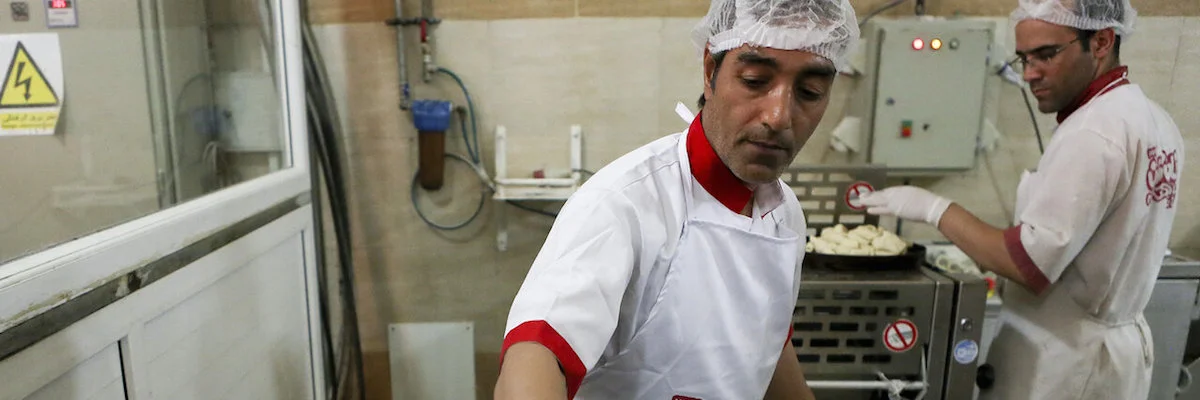
Rising Employment Casts Doubt on IMF’s Grim Forecast for Iran’s Economy
Earlier this month, the Statistical Center of Iran reported a record high level of employed Iranians, with nearly 25 million people in work. Meanwhile, the IMF has revised down its 2019 projection for Iran’s economic growth to -9.5 percent. What explains the divergent narratives in Iran’s employment data and growth data?
This article is republished from the author’s economics blog.
In October, the IMF downgraded its forecast of Iran’s economic growth for 2019 from -6 to -9.5 percent. The adjustment brought the IMF’s assessment of Iran’s economic performance closer to that of the World Bank (-8.7 percent) and is revising opinion regarding the ineffectiveness of sanctions in forcing Iran to renegotiate the 2015 nuclear deal. It has strengthened the hand of Iran foes who argue that sanctions are about to bear fruit and urge the Trump administration to stay the course and ignore appeals from Europeans to ease pressure on Iran.
The Financial Times, quoting an unnamed Iranian economist, added alarm to the downgrading by suggesting that Iran’s situation may be worse than it was during the Iran-Iraq war or the Anglo-Soviet occupation of Iran during World War 2. The idea that life in Iran is anything like the 1940s or the 1980s is nonsense, and the FT reporter who files her reports from Tehran can (but did not) attest to that. It is easy to dismiss this comparison as silly, but the dire predictions of sharp contraction by IMF and the World Bank for the year should be taken seriously. And by seriously I mean to ask why they are at odds with new employment data from Iran.
Surprising Growth in Employment
Earlier this month, the Statistical Center of Iran (SCI) release the latest results of its labor force (LFS) survey, for summer 2019. The summer quarter of 2019 (third quarter of the Gregorian year 2019) recorded the highest number of people employed ever, 24.75 million people, up by 3.3 percent relative to summer 2018, when sanctions first hit, and 1.5 percent relative to spring 2019. More than 795,000 jobs had been created since summer 2018, reducing the number unemployed by 430,000 and the unemployment rate to 10.5 percent.
Significantly, this was not due to lower participation in the labor force, which had actually increased by 1.1 percent, so this was not the case of discouraged workers leaving the labor force. Also significant to note is the fact that employment grew in all sectors, especially in manufacturing, where employment expanded by 4.6 percent compared to the same quarter in 2018, even though is was the hardest hit by sanctions (except for oil).
A similar pattern existed after the first wave of sanctions in 2012, when the currency crashed and the economy entered negative growth, but employment seemed steady for a while before the effect of Rouhani’s austerity program to bring down inflation in 2013 began to show itself in employment (manufacturing employment, in particular, was on the upswing till late 2013).
Divergent Narratives
What explains the strong discord between the international forecasts and employment figures in 2019?
Before answering this question I should first discuss an often-heard concern that Iranian data are somehow doctored and therefore unreliable, more so than data from other developing countries which form the basis of our understanding of the rest of the world. Many analysts (including me) have worked with the raw data for the labor force survey of Iran (LFS), which are all available on the SCI’s data portal. The LFS was designed by ILO experts to bring Iran’s employment data into line with the rest of the world. The old employment survey, which stopped more than ten years ago did not conform to international standards. For example, it classified a person as employed if he or she had worked at least two days in the week prior to interview. The new survey follows the ILO guidelines and defines the employed as those who have worked at least one hour in the past week. It is therefore disappointing that some so-called experts, inside and outside Iran, reject the SCI data for this very reason. On a recent BBC Persian panel, an expert questioned the criterion of a minimum of one hour in defining employment. Responding to this type of criticism, a while back SCI published a report showing that defining employment more strictly increases the unemployment rate by one or two points only. Lack of trust in official data runs deep in Iran, and is at times quite healthy. However, in the case of SCI this is unwarranted because its surveys are publicly available in unit record and have become the workhorse for most economic research on Iran.
Now, to answer the question, there are two explanations for the difference in outlook offered by the employment data and the revised IMF forecast that seem plausible. First, the main reason for the lower revised estimate may be Iran’s falling oil exports. Since most United States waivers for buying Iranian oil have expired oil exports have dropped below half a million barrels per day—how far below I do not know. Arithmetics dictate to lower the growth projection for the year if the original projection assumed higher oil exports. However, the link between oil and the rest of Iran’s economy involves more than arithmetics and does not extend to employment. The oil sector employs less than half a percent of Iran’s workforce, so its contraction does not automatically bring down the rest of the economy. Had the IMF chosen to report growth of the non-oil GDP, as they should since it measures the level of economic activity in Iran much better than GDP including oil, they would have made a more moderate downward adjustment. On 2018/2019, as I noted last month, non-oil GDP fell by less than half the rate of the total GDP.
The second plausible explanation is that the IMF’s forecasting model, about which I know next to nothing, may fail to capture the possibilities for substitution in the Iranian economy. The rise of the dollar brings a large change to the price structure in Iran, opening substantial opportunities for profitable production in the non-oil sectors that employ the 99 percent of the workforce. These are the sectors which are overwhelmed by cheap imports when oil income lowers their prices.
So, in reverse order, and as economic textbooks read, when oil income drop and prices of imports increase, demand shifts from foreign to home goods, encouraging firms to hire workers and expand production. For example, in the past visits to Iran I might have bought a box of Kellogg’s cereal because it tasted better than the Iranian brand and was only twice as expensive. But this past summer, with devaluation having increased the price ratio to four or five, I decided to buy the Iranian brand. Surprisingly, it tasted better, either because the quality had improved or because prices determine taste for Isfahanis!
The engine of this shift in demand and employment is shown in the chart below, which depicts the dramatic change in the real effective exchange rate (EER) in the past two decades. (EER here is the exchange rate deflated by the difference between the inflation rates of Iran and the OECD). The EER fell by more than half during the oil boom of the 2000s, which saw the oil price rise 8 times. This explains why during this period imports flooded Iran’s markets and employment stagnated. Tellingly, during the five years between the censuses of population 2006 and 2011, the economy produced only 14,000 jobs each year, compared to nearly 800,000 jobs since the return of sanctions over a year ago.
The tightening of sanctions in 2011-2012 lowered oil exports and forced a similar realignment of the rial against foreign currencies in early 2012, which was followed by a modest increase in employment and output, as the graph in this post shows.
Dark Clouds on the Horizon
The World Bank has noted that rial’s depreciation can help with economic recovery, and the Iranian economic press have published stories of how responsive is Iran’s private sector to improved incentives for production. But, I would advise caution in becoming too optimistic. The biggest improvement in incentives in production has come in producing for export markets (saffron and pistachios prices are pegged to the US dollar), but sanctions limit how far (beyond its neighbors) and how much Iran can export. Even meeting local demand faces limitations as most goods produced in Iran use some foreign-produced inputs. About 45 percent of Iran’s imports are of this type.
Other dark clouds on the horizon that no doubt have influenced the lower forecasts of international organizations include the possibility of the return of UN sanctions and resumption of high inflation in Iran. The return of the UN sanctions would make it harder for Iran’s remaining trade partners to work with it, or at least they would exact a higher price for working with Iran. The current impasse with Europeans over INSTEX does not bode well in this regard.
Even without the return of the UN sanctions, Iran’s narrow window of trade can close if organizations such as FATF downgrade the credibility and security of Iran’s banking system, thus discouraging existing partners from handling money flow in and out of Iran for fear of being penalized elsewhere. Regulations to assure the rest of the world that Iran’s bank are being watched and regulated with respect to money laundering have passed Iran’s parliament but face stiff opposition on their way to become law.
As for inflation, it has been falling in Iran for the past six months, which indicates that, as in the 2012 episode, the economy may be on its way to return to normalcy (meaning below 20 percent!). What threatens this trend is the budget deficit, that the government is running out of ways to pay its workers and for the services it provides (it has given up building anything new). The government appears to have managed well so far, delicately balancing the need to keep its services going and to assure the private sector that inflation is under control. How long it can do this with parliamentary elections approaching and Iran’s polity divided as ever, is anyone’s guess. But, any attempt to increase incomes without producing more goods—i.e., populist money printing—will derail the path to recovery that new employment data seem to promise.
High inflation will destabilize the economy by making the exchange rate volatile and less predictable, which is bad for producers. Equally bad is if the government decided to keep the exchange rate constant in nominal terms, which it to let it depreciate at the rate of inflation, as was done after the currency collapse in 2012 when the EER gradually fell and lost nearly all the gain as a result of the devaluation.
Photo: IRNA
Iran’s Economic Resiliency Makes Talks More Likely
At first glance, the IMF’s new projection that Iran’s economy will contact 9.5% this year seems to support the Trump administration’s claims that its “maximum pressure” sanctions campaign is bringing the Iranian economy to the brink. But Iran’s economy is poised rebound to zero growth next year—despite the sanctions.
The International Monetary Fund has revised downward its projections for Iran’s economy this year, predicting a 9.5% contraction, as against its previous projection of a 6% shrinkage. It will be the economy’s worst performance since 1984, when Iran was mired in a war with Iraq.
At first glance, this seems to support the Trump administration’s claims that its “maximum pressure” sanctions campaign is bringing the Iranian economy to the brink of collapse. But this view is challenged by the IMF’s projection that the decline will halt in 2020, when Iran’s economy will rebound to zero growth—despite the sanctions.
A closer examination reveals an economic recovery is already underway, as stability returns to consumer prices, manufacturing, trade, and the Iranian currency. Somewhat counterintuitively, this could improve the prospects of talks between Iran and the U.S. A stable economy may reassure the Islamic Republic that it can negotiate from a position of some strength.
The most obvious sign of the recovery is the rebounding rial. Since May, the Iranian currency has appreciated 40% against the dollar. The Central Bank of Iran introduced new technologies to connect exchange bureaus with banks, creating a unified foreign-exchange market that is digitally supervised, making it harder for speculators to abuse the market. The new systems appear to be working—even as geopolitical tensions reached new highs this summer, the currency market remained unfazed.
A stronger rial has helped ease inflation. The consumer price index rose just 6.1% in September—the slowest pace since the reimposition of sanctions 18 months ago. Abdolnasser Hemmati, the central bank governor, is predicting “further easing of inflation in the coming months.”
Stability in the foreign-exchange market has also helped support a recovery in manufacturing. After several months of contraction at the beginning of the year, manufacturing activity gradually expanding, as reflected in the purchasing manager’s index (PMI) complied by the Iran Chamber of Commerce. Iran’s PMI score has exceed 50 in five of the past seven months as firms report improved inventories of intermediate goods.
The rebound in manufacturing has helped the Tehran Stock Exchange acquire the unlikely mantleas the world’s best-performing exchange over the past year. More importantly, the fact that most of Iran’s factories are finding ways to sustain output means they can keep their workers employed and foreign customers supplied.
Iran’s non-oil exports are projected to reach a record level of over $40 billion this year. The result of an effort by the government and private sector to boost regional trade, this may be the first year in Iran’s modern history that non-oil exports will exceed oil exports, which will be constrained to around $10 billion following the Trump administration’s revocation of key sanctions waivers in May.
While the fall in oil exports has certainly constrained Iran’s foreign-currency earnings and government revenues, a structural adjustment towards non-oil exports is taking place. It is often overlooked that the oil industry has rarely accounted for more than 20% of GDP. Iran is not in fact an oil economy.
Ordinary Iranians remain generally gloomy about the economy, but there are signs the mood is shifting. In a recent nationally-respresentative survey 54% of respondents felt the economy was continuing to get worse, compared with 64% in April last year. In the same period, the proportion of respondents who believe the economy is getting better has risen 3.5 points to 30.5%. This may reflect the belief of 63% of respondents that Trump’s sanctions campaign is maxed out.
That a recovery is underway does not diminish the harm has been done by U.S. sanctions. Iranian households are feeling a great deal of pain. As detailed in the IMF report, consumer prices increased 35% over the past year, and unemployment rose from 14.5% to 16.8%. The “maximum pressure” campaign has immiserated millions even as it has failed to collapse the Iranian economy.
Still, economic resiliency is an enabling factor for diplomacy. Recent Iranian overtures for talks with the U.S. and other world powers may reflect, not a fear of pressure, but a confidence that Tehran can survive it.
It is often assumed Iran was forced into nuclear negotiations in 2013 by the debilitating impact of U.S., United Nations and European Union sanctions. What is missed in this analysis is that although the sanctions resulted in a sharp 7.4% contraction of the Iranian economy 2012, this was followed by an immediate recovery: GDP shrank a mere 0.2% in 2013. Iran agreed to the negotiations precisely because the economy had demonstrated resiliency—the government was confident it would not need to grovel for economic relief. The likelihood of a rebound in 2020 may allow history to repeat itself.
Photo: IRNA

New Trump Admin Channel for Iran Humanitarian Trade Comes With a Killer Catch
◢ The Treasury Department has announced that it will operationalize a financial channel to facilitate humanitarian trade with Iran, after privately acknowledging to European officials that recent sanctions imposed on the Central Bank of Iran (CBI) risked encumbering trade in food and medicine. But the new channel may cause more problems than it solves.
The Treasury Department has announced that it will operationalize a financial channel to ease humanitarian trade with Iran, after acknowledging to European officials that recent sanctions imposed on the Central Bank of Iran (CBI) risked encumbering trade in food and medicine.
The channel, which was originally expected to become operational in February 2019, was first was first proposed by the Swiss government in the aftermath of the Trump administration’s reimposition of secondary sanctions on Iran in November of last year.
Switzerland is a leading exporter of pharmaceutical products to Iran. The Swiss government had sought to safeguard its bilateral trade by seeking legal clarity from the Treasury Department on behalf of Swiss banks. But the National Security Council, then led by John Bolton, blocked its operationalization despite support for the channel within the State Department.
The new announcement expands the scope of the channel to include any American or foreign financial institution engaged in humanitarian trade with Iran. This expanded scope and the timing of the move likely reflect concerns over the impact to humanitarian trade resulting from the Trump administration’s move to designate Iran’s central bank under a terrorism authority. That sanctions designation eliminated a long-standing exemption permitting a role for CBI in trade in food and medicine.
Over the last few weeks, European multinationals involved in the sale of humanitarian goods to Iran have been scrambling to understand the impact of the new designation on CBI. The Treasury Department failed to issue guidance in the aftermath of the designation to inform changes to compliance policies.
In particular, European companies engaged in the sale of food and pharmaceuticals were unclear as to whether the reliance of their customers on foreign currency allocations made by the Central Bank of Iran constitutes exposure to the new designation. Bourse & Bazaar contacted treasury managers and compliance officers at six European multinational companies in the days following the designation of the central bank. All refused to provide comment, but confirmed that the new sanctions had triggered internal reviews.
The move to finally launch the humanitarian channel appears to be an attempt to manage the unintended consequences of CBI’s terrorism designation. Over the last few weeks, European officials raised concerns with American counterparts about the impact of humanitarian trade. Speaking on background, a European official confirmed to Bourse & Bazaar that U.S. officials had described the launch of the humanitarian channel as a way to assuage those concerns.
Under the new framework, financial institutions which accept payments related to the sale of food and medicine to Iran will be permitted to “seek written confirmation from Treasury that the proposed financial channel will not be exposed to U.S. sanctions.” For years, European banks have sought “comfort letters” from the Office of Foreign Assets Control (OFAC) for humanitarian trade. It has been OFAC policy not to provide such letters and humanitarian transactions are not eligible for the licensing process due to the exempt nature of the trade. In this regard, the new framework represents a significant shift in policy.
But the new framework may introduce more problems than it solves. In order to receive such comfort letters, the financial institutions must undertake an enhanced due diligence process, reporting to Treasury “a great deal of information on a monthly basis.” The due diligence requirements go far beyond what has been considered the industry standard process for companies engaged in trade with Iran. Considering the significant costs and administrative burdens of such reporting, the requirement will likely limit the uptake of the new framework to those financial institutions engaged in the greatest volume of humanitarian trade with Iran.
The reporting requirements will also raise concerns among Iranian banks. Among the information requested by the Treasury Department are the “monthly statement balances with the value, currency, and balance date of any account of an Iranian financial institution” held at the foreign bank and used for humanitarian trade.
Concurrently with its announcement of the new channel, the Treasury Department identified Iran as “a jurisdiction of primary money laundering concern under Section 311 of the USA PATRIOT Act.” As Tyler Cullis warned in Bourse & Bazaar in July, this move could independently have a devastating impact on humanitarian trade:
Under the proposed rule, US banks would be required to undertake “special due diligence” with respect to correspondent accounts maintained on behalf of foreign financial institutions. Such “special due diligence” does not require that US banks close the accounts of foreign banks that themselves maintain accounts for Iranian banks so long as such banks do not permit Iran indirect access to the US correspondent account. But US banks are unlikely to narrowly tailor their conduct to the precise nuances of law and will show reluctance to continue banking foreign correspondents that themselves bank Iran. As a result, European banks that maintain accounts on behalf of Iranian financial institutions are likely to take steps to shutter such accounts so as to sustain their own accounts at US banks.
It is unclear whether companies can opt not to seek comfort letters through the new framework. Some financial institutions may prefer to maintain trade without the additional legal clarity as they have done since the reimposition of secondary sanctions last year, relying on the existing general licenses issued by the Treasury Department to permit humanitarian trade.
But the Treasury Department’s pursuit of “unprecedented transparency into humanitarian trade” and its allegations of Iran’s use of “so-called humanitarian trade to evade sanctions and fund its malign activity,” may see Trump administration officials pressure companies to use the new framework, requiring disclosures of sensitive financial information that will be unacceptable to Iranian banks and companies wary of U.S. intentions. The Trump administration’s latest gesture to ease humanitarian trade may end up doing just the opposite.
The Treasury Department’s announcement may be intended to pre-empt next week’s launch of a major report from Human Rights Watch that is expected to show significant failures on the part of the United States to safeguard humanitarian trade in accordance with its own sanctions policies. The administration continues to claim that its “unprecedented economic pressure” is “not directed at the people of Iran.”
Photo: IRNA
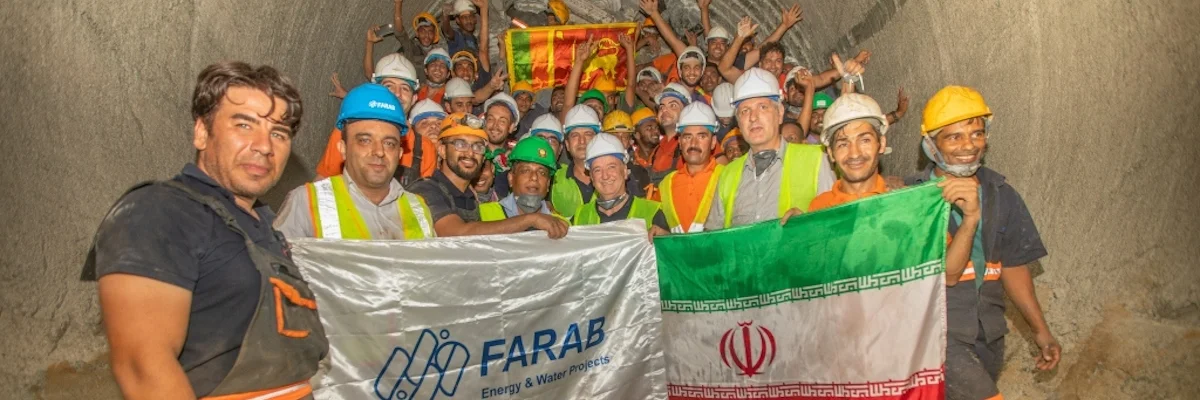
For Iranians, Light at the End of a Sri Lankan Tunnel
◢ An Iranian contractor has completed a water supply tunnel in Bandarawela, Sri Lanka, earning the praise of thousands on social media. The technical capacity of Iranian contractors remains unheralded, even as both state and private sector firms assemble impressive portfolios of completed transport, energy, and urban development projects abroad.
An Iranian contractor has completed a water supply tunnel in Bandarawela, Sri Lanka, earning the praise of thousands on social media.
Farab Company, an engineering firm, completed a 15-kilometer-long water supply tunnel as part of its work on the Uma Oya Multipurpose Development Project, a USD 530 million hydropower complex comprised of two dams and 25 kilometers of tunnels. The project, which broke ground in 2008, is majority financed by the government of Iran.
Pashoutan Ahmaddezfouli, the project manager on the tunnel’s construction, described it as one of the longest such tunnels in Sri Lanka and among the “few long water transmission tunnels of the world to lack intermediate access,” making its construction, which used two tunnel boring machines, technically difficult.
In a tweet that has now gone viral, Iranian twitter user Mazdak Ghiasi shared his “pride” at the news, which had not been widely reported in Iranian media. The tunnel’s completion was celebrated by Iranian on social media as an example of the capabilities of Iranian engineering firms, which have growing track record in delivering international projects. Farab has active hydroelectric projects underway in Kenya and Tajikistan.
Other Iranian contractors have also expanded overseas in recent years. State power and rail giant MAPNA has active projects in Iraq and Turkmenistan. Kayson, a leading general contractor, undertook its first overseas project in in Kyrgyzstan two decades ago. It has since delivered projects in India, Iraq, Venezuela, Belarus, Oman, and Cameroon, among other markets.
The Iranian government has encouraged the export of technical services as part of its efforts to diversify the country’s sources of Iran’s foreign exchange revenue and support deeper economic diplomacy. But the major barrier remains financing. Sanctions prevent Iranian contractors from participating in projects backed by the typical international financiers, such as development banks. The Iranian government itself has limited means to step-in and extend financing in order to bring projects like Uma Oya to fruition.
As a result, the technical capacity of Iranian contractors remains largely unheralded, even as both state and private sector firms slowly assemble impressive portfolios of completed transport, energy, and urban development projects. In this regard, Iran is actually well positioned to play an active role in the infrastructure development boom envisioned by China’s Belt and Road Initiative and Russia’s International North-South Transport Corridor. It is merely being held back by sanctions.
Perhaps this is why the success of the Farab engineers resonated with so many ordinary Iranians. The completion of a water tunnel in Sri Lanka served as a reminder of Iran’s untapped potential to make a change in the world by sharing the talents of its people. Even as sanctions restrict Iran, these prodigious talents remain undiminished—like the light at the end of the tunnel.
Photo: Farab Company
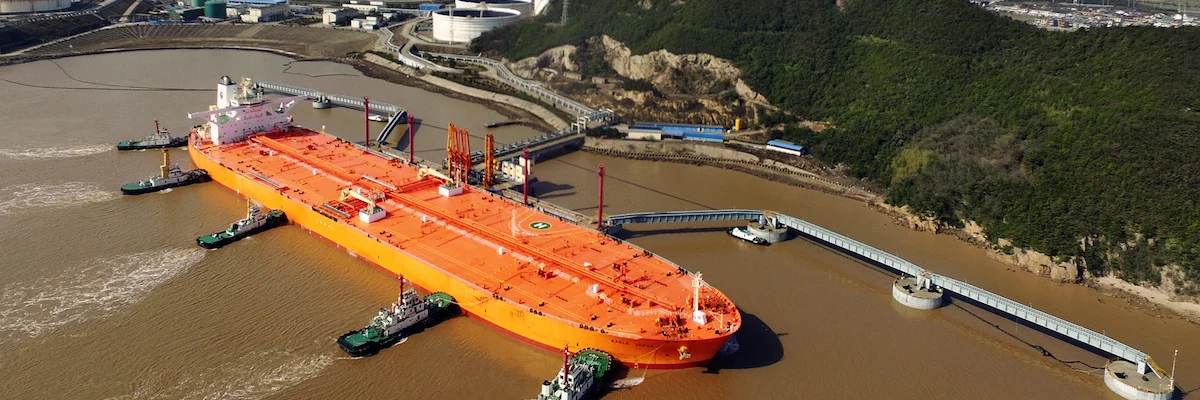
China’s Declared Imports of Iranian Oil Hit a (Deceptive) New Low
◢ New data from China’s customs administration show a significant drop in purchases of Iranian oil. The declared value of September imports was just USD 254 million, down 34 percent from August and down 80 percent from the same month last year. But observed exports from Iran remain high, suggesting that the customs data is not capturing the full value of Iranian oil sales to China.
New data from China’s customs administration show a significant drop in purchases of Iranian oil. The declared value of September imports was just USD 254 million, down 34 percent from August and down 80 percent from the same month last year.
The September data appears to end a period of relative stability for Chinese imports of Iranian oil following the Trump administration’s revocation of a key sanctions waiver in May, since when China has continued to purchase Iranian oil in direct violation of U.S. sanctions.
But the decline in purchases of Iranian oil was not matched by a decline in Chinese purchases of non-oil goods. Non-oil imports from Iran exceeded USD 500 million in September, a level of monthly trade that has remained stable since April of this year and which is consistent with the monthly average observed over the last two years.
This suggests that the fluctuation in oil purchases is not related to a system-wide disruption in China-Iran trade such as the banking difficulties that stymied commerce late last year. Additionally, Chinese exports to Iran did not decline month-on-month in September.
According to data provided by TankerTrackers.com, fewer barrels of oil were observed departing Iran in August than in July. Observed exports amounted to around 670,000 bpd in August, down by about 130,000 bpd from the previous month. This drop in observed exports offers one explanation as to why Chinese declared imports of Iranian oil were lower in September than in August—export levels in a given month tend to appear as declared imports in the following month given the four week journey of tankers at sea.
Notably, any decision to scale back imports of Iranian oil in September would have predated the Trump administration’s move to sanction tanker subsidiaries of Chinese state shipping giant COSCO involved in the transport of Iranian oil. The Chinese government has reportedly asked the Trump administration to remove sanctions on COSCO as part of its ongoing trade negotiations.
In July, U.S. officials had publicly expressed concern about continued Chinese purchases of Iranian oil, suggesting that China was given prior warning that its tanker fleet could be targeted with sanctions designations. This may have spurred China to reduce the use of its own VLCC tankers in the transport of Iranian oil. The fleet of the National Iranian Tanker Company (NITC) has long been the primary means by which Iranian oil is exported to China, but having fewer Chinese tankers picking up oil from terminals in Iran would nonetheless reduce export capacity, depressing overall imports.
However, data on observed exports from Iran does not correspond to the drop in declared imports in September’s customs data. The value of the observed exports is considerably higher than the USD 250 million in Chinese purchases declared for September. The market value of Iran’s August exports is over USD 1.2 billion. Syria is the only other customer currently purchasing Iranian oil and imports significantly less than China. So where is the additional oil going?
Some tankers which departed Iran for China in August are still in transit, waiting for ship-to-ship transfers that will take the Iranian crude to its final port destination. Other tankers may have delivered their oil into bonded storage, meaning that the oil has not yet been sold to China and is therefore not captured in the customs data.
But the most obvious explanation for why declared imports lag observed exports is actually captured in the customs data—just not in the entry for Iran. Reports earlier this summer noted ship-to-ship transfer activity off the coast of Malaysia that appeared to be tied to exports from Iran. Chinese customs data from the last few months illustrates how the drop declared imports from Iran is concurrent with a marked increase in imports from Malaysia.
Since May of this year, Malaysia has exported an average of USD 1.2 billion worth of oil to China each month. The monthly average in the twelve months leading up to May was just USD 1 billion. Re-export of Iranian oil via Malaysia allows China to overcome the capacity problem introduced by the threat of sanctions on major players like COSCO. China can use smaller tankers for the final leg of the journey from Iran, picking up oil from Iranian VLCCs.
Looking ahead, TankerTrackers.com has reported total Iranian exports of around 485,000 bpd in September, a decline of 185,000 bpd when compared to the previous month. With less crude at sea, the value of oil imports declared in China’s October customs data may even fall below the September level. Yet there is little evidence that China is making a strategic decision to further decrease imports of Iranian oil. On the contrary, the strategy to sustain a baseline of imports appears to be growing more sophisticated.
Photo: Depositphoto
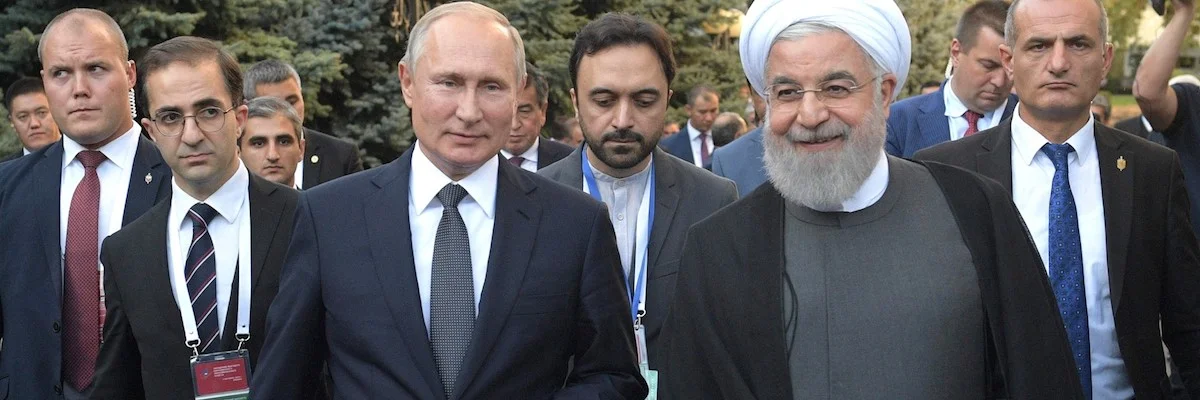
Iran Trade Deal with Russia-Led Bloc Warrants Cautious Optimism
◢ A free trade agreement between Iran and the Eurasian Economic Union (EAEU) will come into force on October 27, enabling preferential trade between Iran and a trading bloc comprised of 183 million people. But a leading research body has cautioned that the “low level of Iran’s commercial complimentary” with the EEAU market will temper prospects in the short term.
On September 30, Iranian President Hassan Rouhani arrived in Yerevan, Armenia to attend the Eurasian Economic Union (EAEU) Summit. A free trade agreement (FTA) between Iran and the EAEU will come into force on October 27, creating conditions for preferential trade between Iran and the current EEAU members: Armenia, Belarus, Kazakhstan, Kyrgyzstan and Russia. The FTA will give Iran access to a single market comprised of 183 million people and with an aggregate GDP of USD 4 trillion.
Iranian policymakers have welcomed the FTA with cautious optimism. With parliamentary elections fast approaching, the Rouhani administration and parliamentarians alike are eager to implement policies that may help bolster Iran’s economy as sanctions cause a sharp recession. Reza Rahmani, Iran’s industry minister has stated that the FTA could help counteract Iran’s isolation in the face of U.S. sanctions. Mohammadreza Jahanbiglari, an economist and member Iran’s Chamber of Commerce, has predicted that if properly implemented, the FTA could see Iran’s trade turnover with EAEU member states quadruple to reach USD 10 billion within one year—a view echoed by Mehdi Mirashrafi, the head of Iran’s customs administration. The Iran Chamber of Commerce has been invited to establish a specific body to support exchanges with EAEU counterparts.
However, the highly regarded Islamic Parliament Research Center, the research arm of the country’s legislative assembly, has issued a more conservative assessment, outlining in a June 2019 report that the “low level of Iran’s commercial complimentary” with EAEU member states will result in a “minor impact from the FTA on the country's economy.”
The Parliament Research Center nonetheless concluded that the FTA could help Iran develop its non-oil exports, a central aim of the doctrine behind the “Economy of Resistance” called for by the Supreme Leader, Ali Khamenei. Under the FTA, a list of 502 goods will enjoy preferential tariffs when exported to the EAEU.
Utilization of the so-called “soft infrastructure” represented by the FTA may also spur the development of Iran’s geo-economic position in the Middle East through the creation of new “hard infrastructure.” Russian leadership of the EAEU is complimentary with its “Pivot to the East” strategy. In this context, Iran can provide the shortest, safest, and cheapest route for Russian goods to the Indian Ocean as envisioned in the International North–South Transport Corridor (INSTC). During the Yerevan summit, Iranian foreign minister, Mohammad Javad Zarif highlighted the pivotal role Iran can play in these plans, tweeting, “With parallel work on North-South & South-West Transit Corridors, ground paved for expansion in regional trade & cementing of our role as vital transit hub.”
Despite practical concerns about the facilitation of trade in the face of US secondary sanctions, Iran will also likely find a sympathetic group of countries among the EAEU, which has an anti-sanctions outlook. The EAEU Treaty was signed on May 29, 2014, after the first round of sanctions were imposed against Russia. Like Iran, Russia has seen the expansion of trade among the countries of the former Soviet Union as a possible bulwark against sanctions.
Before leaving Iran for the Yerevan summit, President Rouhani highlighted the potential for the FTA with the EAEU to help Iran mitigate the effects of U.S. sanctions. One of the key issues barriers for Iran’s cross-border trade is the absence of reliable banking channels. Iran and Russia have been exploring the use of local currencies in bilateral trade as well as the use of a new Russian bank messaging system called SPFS, which is intended as an alternative to SWIFT. Abdolnasser Hemmati, the governor of Iran’s central bank, has stated that Russia has agreed to Iran’s proposal to expand SPFS to the countries of the EEAU.
Beyond banking, Iranian business leaders are concerned about the harmonization of the trading regimes. For example, while EEAU countries use the more detailed 10-digit “Harmonized System” (HS), Iran uses the 8-digit version. Proper harmonization will require input from a wide range of Iranian regulatory bodies, including the customs administration, the National Standard Organization, the Veterinary Organization, and the Food and Drugs Administration. Aside from the administrative challenges on the Iranian side, there are also concerns around the internal dynamics of the EAEU, in which economic ambitious have not been matched with the kind of political frameworks that have made the European Union customs union so successful. The FTA between Iran and the EAEU is an interim agreement that will remain in force for three years—a short period to overcome a wide range of bureaucratic hurdles.
While Iran might not find drastic gains by joining the EAEU, it certainly has nothing to lose. Over time, if enabled by the creation of more robust banking channels and investment in new transport infrastructure, Iran’s non-oil trade with the EAEU could prove a real boon for the economy.
Photo: Kremlin.ru

Burned by Trump, Iranians Report Negative Views of the United States
◢ Three new waves of nationally-representative surveys conducted by the University of Maryland paint a damning picture of the Trump administrations policy towards Iran. Negative perceptions of the United States among the Iranian public are at their highest level recorded in a decade of public opinion research.
Three new waves of nationally-representative surveys conducted by the University of Maryland over the past six months paint a damning picture of the Trump administration’s Iran policy. Negative perceptions of the United States among the Iranian public are at the highest recorded level in over a decade of public opinion research conducted by the university’s Center for International and Security Studies at Maryland (CISSM) and IranPoll.
Long considered one of the most “pro-American” populations in the Middle East, 86 percent of Iranians reported unfavorable views of the United States, of which 73 percent reported “very unfavorable” views. Perceptions of the United States were most positive in August 2015, shortly after the Joint Comprehensive Plan of Action (JCPOA) was agreed by Iran and the United States, France, Germany, the United Kingdom, Russia, and China. As frustrations grew over the implementation of sanctions relief and following the Trump administration’s withdrawal from the deal negative perceptions steadily increased.
Iranians believe that US sanctions policy is intended to cause direct harm to ordinary people. While the Trump administration claims that humanitarian goods and supplies may freely enter Iran, 70 percent of Iranians believe that US policy intends to block humanitarian trade.
“As the United States increases it pressure on Iran, Iranians are becoming more distrustful and disdainful of the United States, making them less likely to encourage their government to adopt conciliatory policies toward the United States and its allies,” said Ebrahim Mohseni, a research associate at CISSM and one of the report’s authors.
But the negative perceptions of the United States are not merely shaped by sanctions impacts. More fundamentally, Iranians are increasingly doubtful that the United States offers a model to emulate. In 2005, during the Iraq War, a Zogby survey found 37 percent of Iranians saying “America is a model country for its values and freedoms.” Now, the percentage expressing that view has plummeted to 12 percent.
This growing antagonism towards the United States tracks growing disillusionment with the nuclear deal. For the first time, a majority of Iranians (52 percent) disapprove of the JCPOA, and 59 percent believe Iran should withdraw outright.
To this end, three-in-four Iranians support the government’s new policy of gradually exceeding some JCPOA limits and threatening withdrawal unless other signatories do more to allow Iran to benefit from the deal. This new policy of escalation enjoys much higher levels of support than the policy of “strategic patience” which was in place until May of this year. That policy, which was based on the expectation that Europe, Russia, and China, would step in to mitigate the economic harm of sanctions, was supported by just 53 percent of respondents in May.
Given the failure of “strategic patience” to result in tangible economic support for Iran, a clear majority of respondents—69 percent—lack confidence that the remaining parties in the nuclear deal will uphold their obligations. This proportion has risen 33 points since January 2018. Recent European efforts, such as the establishment of a state-owned trade intermediary called INSTEX, are only looked upon positively by 24 percent of respondents. Nearly half of respondents do not even believe Europe is making a genuine effort to address Iran’s economic hardships.
However, despite the failures of Europe, Russia, and China to come to Iran’s economic aid, pessimism about the economic has not in fact increased among the Iranian public. A notable 68 percent of Iranians have negative views of the economy. But the proportion has fallen from 72 percent in April of last year, when the country was in the grips of an acute currency crisis.
The proportion of Iranians who believe the economy is getting worse has also fallen to 54 percent from 64 percent in April last year, lending credence to reports that an economic recovery is underway. Iranians continue to blame domestic mismanagement and corruption as a greater contributor to economic hardship than sanctions. But the proportion has shifted somewhat, with gap shrinking from 31 to 17 points since January 2018 as sanctions impacts become more pronounced and as the government seeks to address mismanagement more directly.
"One of the main objectives of the Trump administration’s ‘maximum pressure’ campaign is to increase economic and political dissatisfaction until the Iranian government either acquiesces to Secretary of State Pompeo’s twelve demands or is replaced by a form of government more to the United States’ liking,” said Nancy Gallagher, director of the Center for International and Security Studies at Maryland (CISSM), and one of the report’s authors.“Our data, however, indicate that contrary to what US officials anticipated, public dissatisfaction with the economy has gone back to where it was before US withdrawal from the JCPOA. More importantly, public attitudes in Iran are hardening against the types of policy changes that the Trump administration is trying to achieve.”
Those who say the sanctions are negatively impacting Iran’s economy are not more supportive of Iran making major concessions than those who say the sanctions are having little or no negative impact. This may be in part because Iranians believe that “maximum pressure” is maxed-out. A notable 63 percent of Iranians believe the United States has sanctioned Iran to the fullest and “cannot make Iran’s economic conditions more difficult…even if it tries,” while only 35 percent think the United States can “greatly worsen” the economy.
Iranians also continue to believe in the resiliency of their economy. A clear majority see a silver lining to the sanctions. A resounding 81 percent of Iranians agree with the statement: “While it’s unfortunate that some outside powers are still blocking Iran’s participation in the world economy, we can use current circumstances to build up our domestic industries to meet our own needs. This will reduce unemployment and make our society more resilient.”
Troublingly for those hoping for a second chance at diplomacy, 72 percent of Iranians now think that the JCPOA shows “it is not worthwhile for Iran to make concessions” because other powers will not follow through—a five point increase from January of 2018. However, did express support for Iran returning to full compliance with the JCPOA if other parties to the deal—and the United States—were to do the same. Only 45 percent said they would approve of Iran fully complying with all of its JCPOA obligations if European signatories made specific commitments to increase trade and investment, but an additional 24 percent would approve of Iran’s return to full compliance if the United States also allowed Iran’s main customers to resume purchasing oil.
Fifty-three percent would be willing to enter negotiations on a broader deal with the P5+1 signatories of the JCPOA is all parties were to fully honor their side of the original bargain. However, only 18 percent would negotiate with the Europeans on broader issues before the United States had rejoined the JCPOA and lifted all nuclear-related sanctions.
The survey’s first wave was conducted one week after the Trump administration designated the Iranian Revolutionary Guard Corps (IRGC) a terrorist organization. The responses showed extensive public support for the IRGC. Sixty-one percent thought the IRGC “performed very well” in response to the severe spring floods. Three quarters of Iranians said in May 2019 that the IRGC’s activities in the Middle East have made Iran more secure; five months later, as regional tensions approached a fever pitch, the number holding that view rose to 81 percent.
The three new waves were conducted by telephone interview and each included a sample size of over 1000 respondents. The resulting data, and the trends that can be illustrated over years of research, give lie to the Trump administration’s assurances that “maximum pressure” is advancing American interests. Not only has the administration’s policy turned Iranian sentiments towards the United States more negative, but the regional insecurity that has resulted from that policy has improved perceptions of the role of the IRGC.
Photo: IRNA

Why Iran Pays More for Each Kilogram of European Medicine
◢ Since the year 2000, Iran has about doubled its annual imports of pharmaceutical products from the European Union, reflecting both advances in Iranian healthcare and the growth in Europe-Iran trade ties. But a distortion in the value of trade relative to quantity means that Iran is paying significantly more than the likes of Russia, Turkey, and Pakistan for each kilogram of medication.
Since the year 2000, Iran has about doubled its annual imports of pharmaceutical products from the European Union, reflecting both advances in Iranian healthcare and the growth in Europe-Iran trade ties. This growth has remained durable in the face of multilateral—and more recently—unilateral sanctions. Pharmaceutical products can be sold under longstanding humanitarian exemptions under both the US and EU sanctions regimes.
Yet, reporting from Iran has highlighted the significant disruptions in the price and availability of many medications in Iran. Iranian medical professionals complain that despite the exemptions, sanctions are making it more difficult for patients to reliably and affordably access medication. US officials have countered that there has not been an dramatic drop in pharmaceutical exports to Iran, but their defense relies on an incomplete picture of the nature of the trade disruption. Iranian patients are not principally struggling because of a supply disruption. They are suffering because of a price distortion that can be observed in the relationship between the quantity of European pharmaceutical exports to Iran, and the declared value of those exports.
To contextualize the distortions in European pharmaceutical exports to Iran, it is possible to conduct Pearson correlation analyses for the quantity and value of monthly pharmaceutical exports from the European Union to Russia, Turkey, Pakistan, and Iran for the period between January 2000 and June 2019. Intuitively, we would expect that an increase in the quantity of exports from Europe to these countries would be correlated with an increase in the declared value of those exports—if Europe is selling more it should be earning more.
This is clearly the case when looking to European pharmaceutical exports to Russia, Turkey, and Pakistan in this period. The observed correlations are strongly positive and statistically significant. However, the underlying data tell slightly different stories for each country. In the case of Russia, the magnitude of the increase in the value of exports since 2000 has been greater than the increase in quantity. In Turkey, the opposite is true. To put it more simply, Russia is buying slightly more medicine at a significantly higher price, while Turkey is buying significantly more medicine at a slightly higher price. That is an observation that deserves its own analysis, but in the context of understanding comparative differences with Iranian purchases of European medicine, what matters is that in both cases an increase in quantity of medicine exported correlates with an increase in the value of medicine exported.
The data for Russia, Turkey, and Pakistan shows relatively low levels of volatility. This can be seen when the value and quantity of monthly exports are indexed. Fluctuations each month can be explained by a range of factors such as seasonal or cyclical demand, as well as variation in the composition of exports, particularly in terms of price. Many medicines weigh roughly the same amount, but have vastly different prices—consider the price of aspirin and the price of pills used in the treatment of rare diseases.
Sudden spikes in pharmaceutical exports are often related to disaster response. The December 2005 spike in European exports to Pakistan corresponds to the 2005 Kashmir earthquake, which killed nearly 90,000 people. The August 2010 spike in exports to Russia corresponds to a weeks long heatwave that led to thousands of deaths and triggered extensive wildfires.
Putting these spikes in context, and looking to fluctuations over time, we see that the expected relationship holds—the greater the quantity of pharmaceutical products exported from Europe to Russia, Turkey, and Pakistan, the greater the declared value of those exports.
In the case of Iran, the expected relationship also holds, but not so definitively. Looking to the period between January 2000 and June 2019, the correlation between quantity of exports and value of exports is still positive and statistically significant, but is notably weaker. The explanation becomes clear when looking at a chart of indexed export quantity and value. Sales of European pharmaceutical products to Iran are marked by huge volatility. In more recent years, it appears that the declared value of exports has increased without a commensurate increase in the quantity.
There has been extensive reporting on the impact of sanctions on Iran’s ability to reliably important pharmaceutical products. To test whether the relative weakness in the relationship between export quantity and value is sanctions related, it is possible to test the relationship in two time periods. Multilateral sanctions on Iran reached their apogee in July 2012, when the United States imposed strict sanctions intended to cut off Iranian banks from the global financial system. The number of correspondent banking relationships dwindled, meaning that even for trade in pharmaceuticals, which remained an exempted category, European exporters and Iranian importers faced significant challenges in identifying viable banking channels. When such channels were found, their use typically entails higher transaction costs and payment delays.
Looking to the period prior to July 2012, we can observe a moderately positive and statistically significant correlation between export quantity and value. When limiting the analysis to the period after July 2012, that relationship is only weakly positive. This is a remarkable finding, suggesting that since 2012, the price paid by Iranian importers for European pharmaceuticals is only loosely related to the quantity of goods ordered. Sanctions may have exacerbated whatever factors led the relationship between quantity and value to be weaker than that observed for Russia, Turkey, and Pakistan.
As a consequence of the weakened relationship between quantity and value, Iranian importers are paying significantly more for each kilogram of European medication they purchase than importers in Russia, Turkey, or Pakistan. In the period between June 2018 and June 2019, European exports to Iran can be “priced” at EUR 8464 for each 100 kilograms exported. By comparison, exports to Russia were just EUR 5707 for each 100 kilograms, while exports to Turkey were EUR 5645. In the case of Russia and Turkey there may be economies of scale at play—the value of monthly European pharmaceutical exports to these countries are on average 9 and 3.5 times higher, respectively, than those to Iran. But even Pakistan, which imports less than half the pharmaceutical products that Iran imports from Europe each month, benefits from a significantly lower price of EUR 7509 per 100 kilograms. Taking the average of the price enjoyed by Russia, Turkey, and Pakistan, in the most recent 12 months for which data is available, Iran paid EUR 2723 more for each 100 kilograms of pharmaceutical products. This premium is almost certainly being passed onto consumers, with devastating effects.
It is difficult to say to what extent distortions in Europe-Iran pharmaceutical trade are attributable to sanctions impacts. Certainly Turkey, Russia, and Pakistan do not share the same experience of being targeted by unilateral and multilateral sanctions, though they do share many of the same political and economic risk factors that can serve as an impediment to bilateral trade. There are other possible explanations for Iran’s highly volatile pharmaceutical imports, including issues related to the devaluation of the Iranian rial, the use of middlemen in transactions, and changes in the composition of imports related to protectionist policies.
Looking to total relative proportion of total export quantities in 2018, it is possible to take a snapshot of the composition of European exports to the four countries. What we find is that the composition of exports is broadly similar, with nearly all of the top ten export categories for Iran represented among the top ten for Russia, Turkey, and Pakistan, albeit with differences in proportion. What is clear is that all of the countries import significant volumes of pharmaceutical ingredients, such as vitamins, for use in domestic pharmaceutical manufacturing. Iran imports significantly more vitamin E than the other countries, but significantly less wadding. Neither is a particularly expensive good.
What is most remarkable about the price distortion is that it can be observed through European customs data. In this data, the value of goods is reflective of the value declared by the European seller at time of export. This distinguishes the analysis here from reports focusing on the price increases observed by Iranian consumers. It would appear that at least some of the exorbitant increases in the price of medication for Iranians are attributable to disruptions in trade that originate outside of Iran, rather than tariffs, hoarding, price gouging, or other market disruptions that are known to exist within Iran.
The price distortion also challenges the conception of sanctions impacts on pharmaceutical trade as being principally about reduced export volumes or shortages within Iran. The analysis presented here suggests that European pharmaceutical exports to Iran could theoretically grow in both absolute value and quantity under sanctions, and yet there could still be harms felt by Iranian consumers if the price of medication continues to rise unchecked. This means that sanctions policy cannot be defended on the basis that trade data shows limited disruption in the value or quantity of exports. The price related disruption shown here only becomes clear when looking to the relationship between export value and quantity over time. Any significant increase in the price of medication at time of export will necessarily lead to circumstances where the sick and dying in Iran cannot afford the medication they need.
Photo: IRNA
