

How Trump Can Strike Gold for America in Iran
Trump loves gold. If he remains pragmatic and focused when it comes to Iran, he could strike gold in several ways.
There is a curious line in the Omani statement issued following the latest round of nuclear negotiations between the United States and Iran in Rome, which concluded on Saturday. The statement declares that Iran’s foreign minister, Abbas Araghchi, and Trump’s special envoy, Steve Witkoff aim to “seal a fair, enduring and binding deal which will ensure Iran [is] completely free of nuclear weapons and sanctions.” The sentence is striking because it implies that the US is considering lifting primary as well as secondary sanctions, something that goes beyond the sanctions relief provided under the Joint Comprehensive Plan of Action (JCPOA).
Is this just a case of sloppy drafting by the usually diligent Omani mediators? Well, the Wall Street Journal has reported that Iran has offered Trump a high-level meeting in Washington if a deal can be reached, something that would be difficult to imagine if Iran were to remain under an effective US embargo after the deal’s implementation.
Iranian officials have certainly been touting the possible economic benefits of a renewed nuclear deal for the US. When Araghchi described Iran as a “trillion-dollar opportunity” in a recent op-ed, he had one investor in mind—Donald Trump. As the US and Iran take further steps in the nuclear negotiations, Iranian officials have been eager to make clear that agreeing a new nuclear deal, which would at a minimum require the US to lift secondary sanctions on Iran, could prove a boon not just for the Iranian economy but also for the American economy. To emphasize the point, Iranian President Masoud Pezeshkian even announced that Iran’s Supreme Leader, Ali Khamenei, has “no objection” to American investment in Iran—an attempt to conjure a positive atmosphere ahead of the first round of indirect talks between Araghchi and Witkoff in Muscat.
It remains unclear whether the Trump administration will be able to achieve a viable deal with Iran. The administration’s position on key issues, such as Iran’s ability to maintain uranium enrichment, remains ambiguous, and there is significant distrust on both sides. If the negotiations are to succeed, they will need to find a win-win formula—hence the Iranian insistence on portraying any new agreement as not just a nuclear deal, but also a business deal. Iranian leaders have been watching Trump’s recent moves—his aggressive use of tariffs, his imposition of a critical mineral deal on Ukraine—and they have smartly concluded that Trump cares more about American enrichment than Iranian enrichment.
Is Iran really open for American businesses? The answer is yes, especially if Iranian and American policymakers make the restoration of their bilateral economic relationship a priority alongside restoration of a nuclear deal. Lifting primary sanctions would have a dramatic impact on US-Iran economic relations. But even if those sanctions remain in place, there are ways in which the US and Iran can structure their bilateral economic relations, opening new channels for trade and investment.
The heyday of US-Iran economic relations dates to the 1960s and 1970s. American firms like General Electric, General Motors, and DuPont played a central role in Iran’s industrialization, helping the country’s oil and manufacturing sectors achieve global prominence. Consumer brands like Gillette, Colgate, and Coca‐Cola were beloved by Iranian households.
The 1979 Islamic Revolution brought an end to diplomatic relations between the United States and Iran. That year, the US imposed sanctions targeting the Iranian economy for the first time. The New York Times reported on the exodus of American firms from Iran with a report titled, “Iranian Festival Is Over For American Business.”
But the change in Iran’s geopolitical and ideological orientation did not change a basic economic reality—the 1990s were an era of unipolarity and it was prudent to do business with the world’s largest economy. Iranian President Hashemi Rafsanjani tried to rekindle economic relations with the United States, believing that higher levels of trade and investment would help restore relations between the two countries. He offered the Islamic Republic’s first post-revolution oil field development contract to ConocoPhillips, maneuvering around domestic opposition to the deal. But the deal was blocked by the Clinton administration, which subsequently tightened US sanctions on Iran. The episode served as an early warning that the hardliners most capable of thwarting diplomacy were those in Washington, not Tehran.
American firms maintained a small presence in Iran in the early 2000s while European firms emerged as Iran’s preferred partners. The Europeans established joint ventures and wholly owned subsidiaries in the country and did brisk business. French oil giant Total took over the deal first offered to Conoco-Philips. French and German automakers retooled the Iranian automotive industry, making it one of the largest in the world. European brands flew off supermarket shelves as Iranian household purchasing power recovered on the back of 16 consecutive years of economic growth.
Iran’s economy hit a stumbling block in 2012 as the international community tightened international sanctions—with the measures hinging on President Obama’s unprecedented package of financial sanctions imposed at the start of that year. Subsequent nuclear negotiations focused on restoring Iran’s trade and investment ties with Europe, but the Obama administration did understand that enabling more trade between the US and Iran could create broader constituencies in Washington who backed the JCPOA, which was implemented in January 2016.
While primary sanctions remained in place after implementation of the deal, the JCPOA opened three pathways for US business that wished to pursue opportunities in Iran. First, certain US companies were able to apply for specific licenses from the Office of Foreign Asset Control (OFAC), part of the Treasury Department, permitting deals that would otherwise be blocked by primary or secondary sanctions. Among the contracts licensed in this way were the roughly $20 billion in deals Boeing negotiated for the sale of commercial aircraft to Iranian airlines, contracts that became symbolic of the nuclear agreement’s broader potential.
Many American companies took advantage of General License H, which stipulated that non-US subsidiaries of US companies could broadly engage with the Iranian economy. For example, Procter & Gamble, which ran its Iran operation out of its Swiss subsidiary, rapidly re-entered the Iranian market, where it could reliably generate over $100 million in annual revenue. American technology companies took advantage of a similar license called General License D-1 to export digital services to Iranian users.
Finally, American companies were even able to export to directly Iran without relying on a licensing regime if their sales were consistent with longstanding exemptions for humanitarian trade. Medical device companies like GE Healthcare and Baxter enjoyed bumper sales to Iranian hospitals. Pharmaceutical giants like Eli Lilly and Pfizer also increased sales, taking advantage of an opening in financial and logistics channels. American commodities giants like Cargill and Bunge sold wheat, sugar, and soybeans to Iranian buyers, including crops grown on American farms.
In short, American companies were making inroads in Iran as recently as eight years ago. It was President Trump’s unilateral decision to exit the Iran nuclear deal and reimpose secondary sanctions that brought an end to these renewed economic relations, leading to the cancellation of billions of dollars of contracts.
Immediately after Trump’s election, Boeing began to lobby the administration not to withdraw from the JCPOA—something Trump had promised to do on the campaign trail. The planemaker argued that the huge Iran contracts supported “tens of thousands of US jobs” and tried to appeal to Trump’s interest in reviving American industry. The appeals did not work. But it is easy to imagine Trump grasping benefits of a massive Boeing deal at this juncture, given the how darling of American industry has lost its shine. Demand for aircraft in Iran could also help compensate for the impact of Trump’s new China trade war on Boeing. Earlier this week, China banned the purchased of American aircraft, putting hundreds of Boeing orders in doubt.
The JCPOA experience makes clear that there was no prohibition in Iran against doing business with US companies. In fact, relations with the US nosedived after Trump’s abrogation of the nuclear deal, but some direct economic links persisted. Iran offered a lifeline for many American soybean farmers who were hammered during Trump’s first trade war with China. When China retaliated by ending the import of American soybeans, crashing the price, Bunge stepped in, delivering multiple cargoes of American-grown soybeans to Iran, even as Trump brought secondary sanctions back in force.
Clearly, a new nuclear deal could rekindle US-Iran economic relations. But the rebound in trade and investment will likely be modest unless there is a concerted effort by both the American and Iranian governments to make deeper economic relations a cornerstone of a new deal—especially if primary sanctions remain in force. Most American firms will be wary about entering the Iranian market given the inherent concerns that any deal between the two countries could break down, leading Trump to reimpose sanctions once again. Companies are also increasingly risk averse in the face of a volatile global economy. Leaving it to the private sector to singlehandedly realize the economic opportunities of the nuclear deal, the strategy taken back in 2016, is unlikely to work. Bilateral trade may rise from its low base, but investment will not materialize given risk perceptions, meaning there will be little in the way of shared incentives to bind the US and Iran together. A more structured plan for cooperation is needed.
Iranian negotiators are seeking structured cooperation, although their vision remains somewhat ill-defined. Reprising a demand from the talks that were undertaken with the Biden administration, Iranian negotiators continue to target some form of “guarantees” that would ensure the US cannot easily and costlessly withdraw from the nuclear deal while Iran remains in compliance with its obligations. Political and legal guarantees will have little weight. But deeper US-Iran economic cooperation can act as a kind of “technical guarantee” that serves to increase the credibility of the long-term commitments enshrined in any new nuclear deal.
Trump’s turn towards a decidedly “America First” economic policy might actually help Iran as it tries to find a win-win formula for economic cooperation that goes beyond increased purchases of American consumer goods, pharmaceutical products, and agricultural commodities. As economist Djavad Salehi-Isfahani has recently detailed in a review of investment data, Iran desperately needs to renew its capital stock and reverse a decade of technological regression. Meanwhile, the US is trying to rekindle domestic manufacturing of capital goods. The interests align nicely.
The economic commitments related to any new US-Iran nuclear deal should be structured to enable Iranian industrial giants to make major purchases of American-made capital goods—machinery, equipment, aircraft, and vehicles.
Iran’s capital stock is primarily European and was installed around 20 years ago, when European firms were making major investments in the country. But a significant portion of this machinery remains American in origin or design—a reflection of the fact that large parts of Iran’s industrial sectors have not been updated since the 1970s. Many turbines spinning in Iranian power plants and diesel locomotives chugging on Iranian rails are based on GE designs. Many drill heads used to bore oil wells are derivatives of Schlumberger designs—the Texas company’s former Iran subsidiary lives on. Another former American subsidiary, Iran Combine Manufacturing Company, was once called “Iran John Deere.” The company continues to produce trademark green and yellow tractors and combine harvesters—using American designs from 50 years ago. American engineers will find familiar technologies in use at Iranian industrial plants. Renovating and upgrading these facilities will be straightforward, especially given the incredible acumen of Iranian industrial engineers and technicians who will be eager partners.
Importantly, a surprisingly small portion of Iran’s capital stock is Chinese. Chinese exports of capital goods to Iran totaled $6 billion in 2023. But this is the same level as achieved in 2017, the last year that Iran enjoyed sanctions relief. Meanwhile, Chinese investment in Iran has languished under sanctions, plateauing since 2014. There are no major Chinese manufacturing investments in the country and Iran has not been able to substitute the loss of its European industrial partners with Chinese partners. That leaves a uniquely large and open market for American exporters—perhaps the last major economy in the world where the US could reasonably overtake China as an industrial partner.
Given the aligned interests of their respective industrial policies, the US and Iran should think ambitiously about the scope of their economic relations. Iranian firms will be eager customers for new machinery and equipment. Crucially, this kind of trade does not make Iran dependent on the US. Rather, it restores the strength and resilience of the Iranian industrial sector. Once capital goods are installed, they can last for decades—a kind of guarantee that the benefits of a US-Iran deal will last.
Finally, Iranian purchases of American equipment must be financed by American banks. This will make it more likely that the financial logjams associated with JCPOA sanctions relief will be solved. If US banks do business with Iran on Trump’s instructions, global banks will follow. Notably, Trump’s efforts to revitalize the Export-Import Bank could give American exporters access to crucial export credit, insurance, and guarantees.
Trump loves gold. If he remains pragmatic and focused when it comes to Iran, he could strike gold in several ways. He could forge the kind of nuclear deal Thomas Pickering once called the “gold standard for non-proliferation agreements,” once again subjecting Iran to the strictest IAEA verification regime ever devised. He could earn billions in export revenue for the US—and given the US is unlikely to import much Iranian oil—generate a rare trade surplus with a country that is poised to return to its position as one of the twenty largest economies in the world. Finally, if Trump is ambitious and if Iran’s leaders are courageous, he could finally earn the gold medal he has always wanted—a Nobel Prize.
Photo: The White House

To Avoid a Currency Crunch, Iranian Automakers Are Trading Nuts for Bolts
The outlook for the Iranian automotive industry looked dire until Iranian automakers stumbled upon an unexpected solution.
In a typical year, 10 out of every 100 dollars that Iran spends on Chinese goods goes towards car parts. While the China-Iran trade relationship has languished under sanctions, China has remained a critical supplier for the Iranian automotive industry, which continues to produce over one million automobiles annually.
But over the last year, Iranian automakers have struggled to keep the parts flowing. Parts imports from China totalled $653 million in 2024, a precipitous 43 percent decline when compared to the previous year.
The fall in imports has led to a shortage of car parts in Iran, with consumers facing long wait times and soaring prices. The impact has been most acute for Iran’s private sector automakers, who mainly assemble cars using complete knock-down kits imported from China. Whilst Iran’s state-owned automakers are supported by a large ecosystem of domestic parts manufacturers, private-sector automakers remain heavily dependent on Chinese imports to keep their customers’ cars on the road.
The main cause for declining imports has been a lack of access to foreign currency, a consequence of US secondary sanctions restricting Iran’s banking relations with China. Even though Iranian oil exports to China have rebounded in recent years, they have not alleviated Iran’s foreign exchange crisis. Iranian companies seeking to import goods from China have struggled to receive timely allocations of renminbi through the Central Bank of Iran’s foreign exchange market.
As the currency bottleneck grew tighter over the course of 2024, imports continued to fall, and by the summer, the situation was being described as a “crisis.” In September, imports of car parts from China hit a nadir, with just $26 million worth of parts departing for Iran that month—a 65 percent year-on-year drop.
The outlook for the Iranian automotive industry looked dire until Iranian automakers stumbled upon an unexpected solution. In need of a new source of renminbi, many Iranian automotive firms turned to the pistachio business. Like oil, pistachios are a valuable commodity in which Iran is a world-leading producer. Unlike oil, pistachios are exempt from secondary sanctions.
Iranian automotive companies began purchasing pistachios from growers and leveraging their logistics networks to ship them to China. As a result, Iranian pistachio exports to China quickly surged to historic highs, enabling a modest recovery in car parts imports. In the last six months of 2024, Iran exported $195 million worth of in-shell pistachios to China—more than 2.5 times the volume achieved in the same period in 2023.
Pistachio growers and wholesalers, however, were not happy. Many Iranian pistachio wholesalers had given up on exports—leaving the Chinese market open to new entrants. The requirement to repatriate export earnings through the centralised foreign exchange market made margins unattractive for many agricultural firms. But for automotive companies, profit from pistachio sales was never the primary objective. Selling nuts provided a quick way for them to earn the foreign currency they needed to import car parts, which could then be resold in Iran at much higher margins. By October, industry leaders were complaining of “chaos in Iran's pistachio trade” as automakers turned into “inefficient competitors of Iran's real pistachio exporters.”
Pistachio exporters are reportedly seeking an understanding with the automakers who edged onto their turf. They plan to sell their foreign currency to automakers at a rate agreed with the supervision of the Central Bank of Iran, ensuring sufficient margins to incentivise them to prioritise exports once again.
Sanctions have not crushed the Iranian economy, but they have made pistachios more valuable than oil, forced importers to become exporters, and pushed automakers into competition with farmers. In adapting to sanctions pressure, the solution to one crisis can beget another, leaving a country trading nuts for bolts.
Photo: IRNA

GCC and Central Asia Want More Trade, But Connectivity Remains a Hurdle
The transit corridor competition that is currently underway between Iraq, Iran, and Afghanistan will increase the land connectivity options among the GCC and Central Asian countries.
Over the course of the past five years, the six countries of the Gulf Cooperation Council (GCC) and the five republics of Central Asia have taken several important steps to expand their economic and diplomatic relations. In addition to the advancement of bilateral relations among members of these two blocs, efforts have also been made at the regional level involving multiple countries from both sides. This includes several gatherings at the ministerial level, as well as the 2023 GCC-C5 summit that convened the six GCC and five Central Asian countries—Kyrgyzstan, Kazakhstan, Uzbekistan, Tajikistan, and Turkmenistan—in Saudi Arabia. The high-level summit resulted in a joint statement on the framework for economic relations. Preparations are currently underway for a follow-up summit in May 2025 in Samarkand.
The volume of trade between the two blocs is currently small. According to data compiled by the World Bank, the share of GCC countries in total exports of goods by Central Asian countries was only 0.8 percent in 2022. The ratio was even smaller for Central Asia’s largest economy, Kazakhstan, which exported only $462 million to GCC countries. This amounted to 0.55 percent of its $83.5 billion total goods exports in that year.
Trade relations are expected to expand from this low base if the forthcoming summit in Samarkand is fruitful. Not only is the GCC interested in the minerals, metals, and agricultural commodities that Central Asia can offer, but both regions are moving toward economic diversification. This will increase the range of manufactured and semi-processed goods that they can exchange.
While both sides have expressed a strong desire to expand their investment and trade relations in many sectors, transit routes and transportation costs pose important considerations for their respective political leaders and business communities. In their July 2023 summit, the leaders of GCC and Central Asia were already mindful of this issue. Connectivity was addressed in the Article 12 of the Summit’s Joint Statement: “The leaders stressed the importance of developing connected transportation routes between the two regions, building strong logistical and commercial networks, and developing effective systems that contribute to the exchange of products.”
The transport networks between GCC and Central Asia cross through several countries. Three distinct transport routes can potentially provide land connectivity between the regions in the coming years. These are the North-South Transport Corridor (NSTC) that runs mainly through Iran, the Development Road Project (DRP) that runs through Iraq, and the Trans-Afghan Corridor. Each of these multi-modal routes presents its own unique opportunities and challenges.
Firstly, it is important to consider the NSTC route through Iran. Currently the Central Asian countries have access to highway and rail transit through Iran to the Persian Gulf and the Gulf of Oman. With cooperation of Iran, Russia, and several Central Asian countries the rail connectivity has been operational since 2016. The trans-Iranian Railway connects the Sarakhs railway station on Iran-Turkmenistan border to the Bandar Abbas port on the Persian Gulf and this route is already in use by the Central Asian countries.
Highway transit for cars and trucks is also operational; Iran’s network of roads and highways connects the Iran-Turkmenistan border crossings to several seaports in the Persian Gulf, from which containers can be transported to GCC countries by ship. The railroad transit will expand further with the completion of the Sarakhs-Chabahar railway line. Nearly two thirds of this route is already complete. The only remaining piece is the Chabahar-Zahedan segment which is currently under construction, though progress is slow due to economic sanctions. Iranian government officials expect this project to be completed by late 2025.
These transit routes through Iran are safe, offering the shortest and most cost-effective routes for GCC-CA connectivity. However, many GCC economic operators will avoid using this route in compliance with the U.S. economic sanctions against Iran. GCC countries have demonstrated high compliance with the U.S. sanctions against Iran because of their heavy reliance on American security and military protection; this cooperation is likely to continue in the future.
Another transit route that can be used for trade between the GCC and Central Asia is the proposed north-south Development Road Project, which will, using rail and highway, connect Iraq’s Faw port at the tip of the Persian Gulf to Turkey’s broader transport network. This project is currently in its final planning stage according to Iraq’s Transport Minister, Razzaq Muhibis Al-Saadawi. After the recent improvement of diplomatic relations between Iraq and GCC countries, Qatar and the UAE have expressed an interest in providing additional financial support, assisting Iraq and Turkey in the endeavor.
The DRP offers a significantly longer transit route compared to the Iran option. Additionally, it requires greater international coordination, as it passes through multiple countries—Iraq, Turkey, Georgia, and Azerbaijan—before requiring sea transport across the Caspian Sea to reach either Turkmenistan or Kazakhstan for connections to Central Asia. The Turkey-Turkmenistan segment, which is part of the Belt and Road Initiative’s middle corridor between Asia and Europe, is already operational. If Azerbaijan and Turkey can convince Armenia to provide them with a transit corridor, this route will become shorter and more cost efficient, yet still less economical than the Iran option.
The DRP also faces several geopolitical and governance challenges. Kurdish militias that are in war with Turkey operate in the mountainous regions of Northern Iraq, near the Turkish border, posing a security risk to the road both during its construction and after completion. The Iraqi government’s opposition to the participation of the Kurdish Regional Government (KRG) poses another obstacle to the viability of this project as disagreements between Baghdad and KRG can lead to more disruption.
Another challenge is the many governance issues in Iraq’s fragmented government structure, which has reduced the government’s efficacy and ability to implement long-term plans. Fortunately, Iraq’s political system has become more stable in recent years, contributing to better conditions for the implementation of the DRP. A recent security agreement between Turkey and Iraq might also reduce the security risks in northern Iraq.
A third land transit route between the GCC and Central Asia is the Trans-Afghan option, which will offer rail transit from Uzbekistan to Pakistan’s Karachi and Gwadar seaports on the Arabian Sea through Afghanistan. Cargo would be able to be transported from these ports to various GCC destinations in the Persian Gulf by ship. The Trans-Afghan Corridor has received support from Kazakhstan and Uzbekistan as the primary Central Asian stakeholders. Uzbekistan has also approached Qatar and the UAE for financial investment in this project, which is estimated to cost $7 billion.
Under the previous Afghan government, the Taliban posed a security risk to the Trans-Afghan Corridor. Now, in a turn of events, the Taliban-led government is a strong supporter, engaging in active negotiations with all stakeholders to expedite the project. In 2024, Afghanistan signed an agreement with Uzbekistan and the UAE to launch a feasibility study for the project. Pakistan is also lobbying the Central Asian countries, Qatar, and the UAE for support.
Another important tailwind behind this project is the support of several other countries, including Russia and Belarus, which are also interested in development of the Afghan route. For Russia, which faces sanctions and security risks along its Baltic and Mediterranean transit routes, the Trans-Afghan Corridor will serve as an additional branch of the already operational NSTC route through Iran. In addition to the Uzbek option, Russia is also advancing an alternative branch of the Trans-Afghan railway via the Turkmenistan-Afghanistan border, further expanding the capacity of transit routes through Afghanistan.
The transit corridor competition that is currently underway between Iraq, Iran, and Afghanistan will increase the land connectivity options among the GCC and Central Asian countries in the coming years, reducing exposure to the risk factors in any single country that lies between the two blocs. While at present the only operational route is via Iran, it is encumbered by sanctions risks. The completion of the DRP and the Trans-Afghan Corridor will provide valuable alternatives despite being lengthier and hence more expensive. Their development will be reassuring to both the GCC countries and the Central Asian countries as they seek to boost trade ties as part of a process of West Asian integration.
Photo: Leonid Andronov

Reconstruction Aid, Not Sanctions Relief, is What Syria Really Needs
The price tag of Syrian reconstruction will be high, but Western governments can afford it.
Last week, the Biden administration issued General License 24, which removes prohibitions on a range of transactions with Syrian governing institutions, even while sanctions targeting Syrian entities and individuals remain in place. Syria’s newly appointed foreign minister, Asaad Al-Shaibani, welcomed the Biden administration’s move, but insisted that the US must lift all sanctions, which “constitute a barrier and an obstacle to the rapid recovery and development of the Syrian people.” The UN envoy for Syria, Geir Pedersen, has similarly called for “significant further efforts to adjust sanctions.” Meanwhile, German officials are reportedly discussing a plan that would see the EU ease sanctions on Syria so long as Syrian authorities implement political reforms.
These discussions on sanctions relief are important and reflect the urgency of such relief for Syria’s economic recovery. Syria is entangled in a web of US, EU, and UN sanctions. These measures include sanctions targeting the Syrian state and key economic sectors, which were imposed to weaken the Assad regime. Separate sanctions target Hayat Tahrir al-Sham (HTS), a designated terrorist organization that comprises the core of the new Syrian leadership. But while determining a timeline and conditions for sanctions relief is important, Western officials and Syrian authorities are already sliding into a debate over what sanctions relief is warranted and at what stage. Meanwhile, Syrian civil society actors, cognizant of the precarious humanitarian situation in Syria, are being forced to use their political energy to advocate for sanctions relief, when the relief is not what truly matters for the stabilization of Syria.
The debate over sanctions relief risks becoming a distraction from the far more important aim of securing reconstruction aid. Syria is a country devastated by a brutal civil war. While sanctions exacerbated economic hardships in the country, contributing to currency devaluation, hyperinflation, and soaring budget deficits, the measures were significantly tightened only in 2019, at which point the Syrian economy had already effectively collapsed. In short, sanctions relief will not suffice to restore the Syrian economy.
The inadequacy of sanctions relief as both a political and economic goal becomes especially clear when considering what sanctions relief really entails. Sanctions are nothing more than language contained in laws and regulations. As such, lifting sanctions means nothing more than the creation of new legal language. While the imposition of sanctions does impose legal prohibitions that prevent governments or private sector actors from engaging in certain economic activities, lifting sanctions does not introduce any obligations for those actors to resume economic activities.
Clearly, sanctions relief cannot be the primary goal of advocacy. Removing legal prohibitions for economic engagement with Syria is very important, but it is a simply a means to an end. The goal of advocacy must be to push Western governments to take action that will really make a difference. What Syria needs is for Western governments to forthrightly commit to providing billions of dollars of reconstruction aid that can help resurrect the Syrian economy.
To this end, it is troubling is that Western governments have so far said little about their commitment to reconstruction in Syria. The recent visit of the German and French foreign ministers to Damascus was followed by headlines declaring that the EU would “will not fund new Islamist structures” rather than headlines committing European financing for reconstruction.
While European governments did provide Syria much-needed humanitarian aid during the long civil war, support for reconstruction will require a far greater political commitment. Not only is the scale of financial assistance required much larger, but the aid must be provided in parallel with what will surely be a complex political transition. The challenge of creating more inclusive political institutions in Syria may explain Western equivocation on the issue of reconstruction aid. But the reluctance to even signal the possibility that substantial aid could be forthcoming reflects a typical cynicism in Western capitals. To ensure that Syria secures both sanctions relief and the billions of dollars in aid, Syrian authorities and Syrian civil society must be unified in their calls for reconstruction support. There are several reasons why effective advocacy requires clear messaging that the paramount goal is reconstruction assistance, and not sanctions relief.
First, sanctions relief itself will not restore the Syrian economy, even if it is provided quickly. As Karam Shaar and Benjamin Fève have detailed, the economic situation in Syria is dire. The economy has contracted 80 percent since the onset of the civil war. Nine out of ten Syrians live below the poverty line. The damage to cities and infrastructure is extensive. A 2018 study used satellite imagery to identify over 100,000 damaged structures in Syria’s major cities, including thousands of homes destroyed by the Assad regime’s criminal use of barrel bombs on civilian targets. In this context, rebuilding Syria’s economy means replacing the capital stock while also restoring economic institutions and networks. A 2019 estimate on the costs of reconstruction put the figure as high as $400 billion. Given the scale of the devastation, post-conflict recovery in Syria is not something that can be accomplished through the resumption of private sector business activity. A resumption of trade and investment in Syria will certainly help stabilize the economy and improve the welfare of ordinary Syrians. But rebuilding critical infrastructure and restoring public services, actions necessary for Syria’s long term economic development, will require massive investments made by the Syrian state, with funds provided by foreign donors. This is precisely how Western governments have sought to support economic recovery in Ukraine, where the United States and EU have so far provided a combined $67 billion of financial support to the government. A similar commitment must be made for Syria.
Second, if sanctions relief is cast as the main goal of advocacy, Syrian stakeholders risk enabling Western governments to wash their hands of the responsibility to provide reconstruction assistance. We already see signs that Western governments will be content to provide sanctions relief so long as they can foist the responsibilities of reconstruction on other actors—the issuance of the General License 24 was quickly followed by the dispatch of Turkish and Qatari floating power plants to Syria. It was also no surprise that Al-Shaibani made his first overseas visit to Saudi Arabia, another potential reconstruction donor. Western governments should not leave Syrian authorities to seek reconstruction assistance from regional powers alone. Such an arrangement would give regional powers extraordinary influence over the course of the political transition in Syria. Western governments, meanwhile, will have little influence beyond the leverage provided by their remaining sanctions, and will therefore be inclined to keep those sanctions in place. While the US began to ease sanctions on Sudan in 2017, a paltry increase in aid contributed to Sudan’s slide into a deep economic crisis just one year later. The imposition of austerity measures by President Omar al-Bashir in 2018 spurred a new round of unrest, eventually triggering a new civil war. To avoid the same fate, Syria needs reconstruction support from a wide range of donor countries. This will ensure that the issue of reconstruction is not unduly politicized. Western policy must shift from the mindset of economic coercion to one of economic inducements.
Third, the best way to ensure that sanctions relief works is to ensure Western governments are committed to providing reconstruction aid. Providing effective sanctions relief is a complex process. Even if Western authorities issue new licenses or rollback sanctions designations altogether, the implementation of sanctions relief depends on proactive outreach by authorities to provide guidance and encourage economic operators to take advantage of the more permissive environment for trade and investment. Western governments have tended to take a lackadaisical approach to the provision of such guidance unless the lingering sanctions are preventing the implementation of their own policies. A cautionary tale can be seen in the aftermath of the 2016 peace deal between the Colombian government and FARC, a rebel group designated by the US as a foreign terrorist organization (the same designation that applies to HTS). The US supported the peace deal but provided limited aid for its implementation. The US aid program was mainly focused on supporting the Columbian government in implementation of the deal, rather than supporting reintegration of the FARC rebels into civilian life. This is partly why FARC was only removed from the FTO list in 2021, five years after its fighters had demobilized. Had US authorities been required to engage with FARC at an early stage because of their own policy commitments, there would have been greater urgency to remove the legal impediments to such engagement by any and all actors. Ultimately, the delay in providing sanctions relief jeopardized implementation of the peace deal.
Finally, there are certain kinds of aid and technical assistance that only Western governments can provide to Syria. For example, rebuilding Syria's economy will require reform of the banking sector, including through the implementation of anti-money laundering and counter-terrorist financing controls that give international banks and financial institutions confidence they can avail themselves of sanctions relief and transact with Syrian banks. If Western governments lift sanctions, but do not help Syrian banks improve their financial integrity, then the economic recovery will falter, largely due to overcompliance among private sector operators. Here, the cautionary tale is Iran, where the lifting of nuclear sanctions in 2016 led to a modest recovery in trade and investment. However, failure to support Iran's push to comply with critical financial crime regulations left Iranian banks unable to reintegrate with the global financial system. Foreign companies seeking to re-establish operations in Iran faced tremendous barriers as they struggled to conduct even routine banking operations. Unsurprisingly, foreign firms also struggled to secure financing for trade or investment deals. The failure to mobilize more investment into Iran left the nuclear deal vulnerable to domestic and foreign political opponents, and the deal effectively collapsed in 2018 following a unilateral US withdrawal.
If Syrian authorities and civil society demand that Western governments provide reconstruction assistance, they will benefit from sanctions relief. But if they allow the parameters of the debate to focus on sanctions relief alone, whatever relief and reconstruction support materializes will certainly prove insufficient. In this sense, Syrians must not only push Western governments to recognize their direct responsibility to redress the economic consequences of sanctions, but also the expediency of contributing to Syrian reconstruction generously and broadly. The price tag of Syrian reconstruction will be high, but Western governments can afford it. What no one can afford is to squander this historic opportunity to build a more prosperous, equitable, and resilient economy in Syria.
Photo: Ahmed Akacha

Can Abbas Araghchi Reshape Iran's Foreign Policy?
Iran’s new foreign minister has an opportunity to reshape the country’s foreign policy, cutting a creative path through the rigid confines of the political landscape.
On August 21, Iranian lawmakers confirmed veteran diplomat Abbas Araghchi as the country’s new foreign minister. Araghchi secured the support of 247 out of 288 MPs in Iran’s parliament, the Majles. Despite the vote total, Araghchi’s nomination was fiercely contested by hardliners. His confirmation hearing reflected the ongoing struggle between pragmatism and hardline revolutionary ideals that continue to shape the country’s foreign policy, and previewed many pitfalls he will face as foreign minister.
To secure his confirmation, Araghchi, like all of President Masoud Pezeshkian’s cabinet nominees, reaffirmed his unwavering loyalty to revolutionary ideals of the Islamic Republic and the Supreme Leader’s directives. Araghchi was addressing a legislature dominated by hardliners. During the parliamentary elections in March, the Guardian Council, a vetting body, had disqualified many moderate candidates. Voters responded by boycotting the elections and hardliners solidified their hold on the legislature.
While many of Pezeshkian’s nominees faced resistance, Araghchi’s confirmation as foreign minister was especially fraught. The confirmation hearings also took place while Iranian officials await the outcome of the Gaza ceasefire negotiations and continue to warn they will hit back at Israel for the assassination of Hamas political leader Ismail Haniyeh in Tehran on July 30. In Iran’s current political climate, loyalty to the revolution is often measured by one’s stance on foreign policy issues, particularly regarding the U.S., Israel, and Iran’s support for “resistance front” groups such as Hezbollah and Hamas. Any deviation from the hardline position on these issues is characterized as betrayal.
Iran’s Supreme Leader, Ali Khamanei, sets the strategic framework, redlines, and priorities for foreign policy, as underscored during his endorsement of Masoud Pezeshkian’s election on July 28. While the foreign minister and president must operate within these parameters, they still hold a vote in the Supreme National Security Council and can use public statements to put pressure on unelected bodies in Iran. Additionally, their personal ties to other national security figures, such as senior leaders of the Islamic Revolutionary Guard Corps (IRGC), can enable them to influence policy.
Despite these means, the outgoing administration did not seek to actively shape Iran’s foreign policy. Neither President Ebrahim Raisi nor Foreign Minister Hossein Amir-Abdollahian, who were both killed in a helicopter accident in May, sought to advance a foreign policy that conflicted with the Supreme Leader’s redlines, the IRGC’s influence, or the parliament’s lawmaking. By contrast, the Rouhani administration, during which Araghchi was deputy foreign minister, publicly clashed with other power centers. This dynamic explains why Araghchi, like other nominees who served under Rouhani, drew sharp criticism from staunch hardliners.
Critics focused on Araghchi’s past as Iran’s lead nuclear negotiator, a role he held from 2013 to 2021. MPs like Mohammadreza Ahmadi Sangar and Mohammadreza Sabbaghian argued that the Joint Comprehensive Plan of Action (JCPOA), which Araghchi helped craft, was flawed from the start—a misguided deal that left Iran vulnerable to the whims of President Donald Trump, who withdrew from the agreement in 2018. Amirhossein Sabeti, a protégé of Saeid Jalili, who lost the presidential election to Pezeshkian, was perhaps Araghchi’s most vocal opponent. Sabeti argued that in the last months of the Rouhani administration, Araghchi was seeking a new nuclear deal that went beyond Khamanei’s redlines and would have effectively dismantled the resistance front. He also criticized the loss of nuclear capabilities that were key concessions of the JCPOA, including the decommissioning of the Arak reactor.
Iranian legislators have been seeking a greater role in defining Iran’s foreign policy. They want the kind of influence wielded by the U.S. Congress over international negotiations. In 2020, the Majles passed the Strategic Action Law, which effectively bars attempts to revive the JCPOA in its original form. The law, which was pushed by hardliners and endorsed by Khamenei, is as a double-edged sword—it provides leverage but also limits the flexibility needed to strike a deal that would relieve Iran’s economic woes.
For Araghchi, the JCPOA represented a calculated risk that preserved Iran’s position on the global stage, even as the Trump administration tried—and failed—to bury the deal at the United Nations Security Council. It is a legacy he has defended. During his hearing, Araghchi pointed out that the Raisi administration undertook its own nuclear negotiations. Even so, he indicated that he will take a fresh approach to any new talks and “strive to get the best agreement” in light of the Strategic Action Law. During his speech, he vowed to prioritize sanctions neutralization, a priority set forth by the Supreme Leader. But he also highlighted the necessity of lifting sanctions.
Araghchi understands that solving the nuclear issue is the key to addressing many of Iran’s economic challenges. The Pezeshkian administration aims to implement the ambitious 7th Development Plan, which targets an 8 percent annual growth rate—a goal that seems far-fetched given Iran’s economic isolation under sanctions. Iran needs around $60 billion in annual foreign direct investment. According to Hadi Ghavami, an MP who spoke in favor of Araghchi’s nomination, the country currently receives one-thirtieth of that amount.
During his confirmation hearing, Araghchi emphasized that while relations with the U.S. will continue to be defined by antagonism, his goal is to manage the rivalry and avoid escalation. This is part of the “heroic flexibility” needed to return back to the negotiating table. He also called upon Europe to enhance its ties with Tehran and to “return back to the list of areas of priorities for Iran.” The relationship with Europe remains fraught, clouded by the fallout from the JCPOA, the Woman, Life, Freedom protests, and Iran’s support for Russia in its war on Ukraine. Yet Araghchi emphasized that constructive global engagement is essential for any vision for development and managed to get hardliners to vote for him despite this vision.
Iranian officials have heavily invested in the country’s “Eastward turn” in recent years. The push for closer alignments with Russia and China began during the Rouhani administration but reached new heights under Raisi. But the strategy has not paid off. While Iran’s security relationship with Moscow is deeper than ever before, it has also become a liability, isolating Iran further from the international community. In a similar vein, China’s role as a key economic partner for Iran cannot be understated. Yet, there’s growing concern in Tehran that the relationship has become too one-sided, especially as Iran’s neighbors enjoy economic rewards from their trade with China.
At the same time, Tehran has recognized the opportunities presented by a shifting global landscape. Iran is looking to expand its influence into the Global South—Latin America, Africa, and East Asia. Through this understanding, multilateralism is a key factor in Iran’s core foreign policy strategy, reflected in the increasing involvement in platforms like BRICS, the Shanghai Cooperation Organization, and the Eurasian Economic Union. For Tehran, these alliances are more than symbolic; they are part of a broader effort to counterbalance sanctions pressure while positioning Iran as a significant player in a multipolar world. Pezeshkian has been invited to attend the upcoming BRICS summit in Russia in October, soon after he participates at the UN General Assembly in New York for the first time in September.
To secure the trust of the hardliners, Araghchi declared that “resistance diplomacy” is at “the foundation of Iran's foreign policy approach.” In this view, supporting groups like Hezbollah and Hamas is not just policy; it is a core principle of the revolution. Araghchi’s challenge is to convince the international community that Iran’s continued support for the resistance front is not an inherent threat to regional or global security. This is a difficult task when considering the fragility of the growing rapprochement and diplomatic engagements between Iran and the Arab states. There is considerable skepticism amongst Iran’s southern neighbors about the trajectory of the country’s foreign policy and whether deescalation can be sustained.
Ultimately, Araghchi will need to strike a balance when reshaping Iran’s foreign policy. He must find a way to pursue pragmatic diplomacy in a way that coheres with the ideas of resistance that hold sway over Iran’s hardline politicians. A cautionary tale can be seen in the legacy of Foreign Minister Javad Zarif, under whom Araghchi served as deputy foreign minister. Despite securing major concessions for Iran in various high-stakes negotiations, he failed to penetrate the conservative decision-making circles that ultimately dictate Iran’s broader foreign policy.
Araghchi may have more success. MPs appear encouraged by Pezeshkian’s effort to form a “unity cabinet” and seem to appreciate Araghchi’s closer alignment to key power centers. Iran’s new foreign minister has an opportunity to reshape the country’s foreign policy, cutting a creative path through the rigid confines of the political landscape. Whether he succeeds will depend on his ability to recast pragmatism as a tool of resistance.
Photo: IRNA

The Shadow of Sanctions in Istanbul's Housing Market
Sanctions have pushed thousands of Russian and Iranian buyers into Istanbul’s housing market. Many Istanbul residents blame the influx of foreign investors for rising property prices.
Istanbul residents are experiencing a cost of living crisis. Prices of food, clothing, and other essentials have spiked. Property prices have also surged and Istanbulites are spending a growing share of their income on housing. The high prices are primarily due to President Erdoğan’s heterodox belief that lowering interest rates can lower inflation, a so-called “low interest rate, low inflation theory.”
But many in Istanbul blame the higher prices on foreign property investors, who they believe are crowding out locals in the housing market. This resentment played an important role in the Turkish presidential election earlier this year. The leading opposition candidate, Kemal Kılıçdaroğlu, campaigned on banning the sale of homes to foreigners for at least five years. While the public anger is real, the actual impact of foreign investment on housing prices is not as concrete.
In recent years, the Turkish government has courted foreign investors, seeking an influx of foreign currency to replenish reserves dangerously depleted during the Turkish central bank’s defense of the lira. To help shore up its own economy, the government has enacted policies to make Türkiye a more attractive destination for foreign investment and residence. The outreach to foreign investors has been timely—Russian and Iranian investors have been eager to protect their assets from waves of Western sanctions.
Russian and Iranian investment in Türkiye rose markedly after the imposition of sanctions. When the US reimposed sanctions on Iran in 2018, the number of Iranians starting businesses in Türkiye jumped. Russian investment followed a similar pattern. When Russia annexed Crimea in 2014, the sanctions levied by the US and the EU coincided with a rise in the number of Russians registering Turkish companies. The largest spike—in the past two years—followed Russia’s invasion of Ukraine.
Property investments follow a straightforward pattern—when the US imposes sanctions, capital flees to Türkiye. In 2022, Russians purchased just under 15,000 Turkish residential properties, while Iranians purchased just over 9,000.
For Russians and Iranians, sanctions and growing fear of instability were push factors. Meanwhile, the Turkish government’s deliberate courting of the fleeing capital pulled investors to Istanbul, Antalya, and Ankara. The physical proximity of Türkiye to Russia and Iran make its cities attractive destinations. More importantly, the Turkish government is under no threat of being sanctioned and Turkish banks continue to be connected to SWIFT and other international banking systems.
While Russian and Iranian companies have established operations in Türkiye, the country is also a destination for individuals seeking to avoid economic isolation and instability in their home countries. Türkiye advertises citizenship to foreigners if they invest over four hundred thousand dollars in Turkish property. For wealthier Russians and Iranians, this offers a pathway to a new passport. The only condition for gaining Turkish citizenship is to maintain the requisite investment for at least three years and to confirm the investment with the land registry.
But acquiring Turkish citizenship does not appear to be the main goal of Russian and Iranian investors. The passport policy implemented five years ago has not led to a significant rise in foreign investors receiving Turkish citizenships. Of the tens of thousands that have bought Turkish property, less than five percent gained Turkish citizenship. While Iranians have made up a large percentage of those who receive investment-based passports, more Iranians bought property in August 2018 more than those who received a passport that year.
The fact that passports make such a small proportion of total foreign buyers—particularly those from sanctioned countries—raises additional questions. It is unclear whether those who have qualified for citizenship based on their investment of at least $400,000, fail to do so because of a lack of knowledge, indifference, or the bureaucratic slog. But clearly, Russian and Iranian buyers are more interested in acquiring an asset in a safe market than they are in becoming Turkish citizens.
Foreign purchases of residential properties have spiked in recent years, particularly in Istanbul, but also in other major cities of Türkiye, such as Antalya and Ankara. In Istanbul, Russians buyers have concentrated in Beylikdüzü, Kadıköy, Bağcılar, and Sarıyer districts. Iranians have focused on Esenyurt, Kağıthane, Sarıyer, Kartal, and Maltepe.
The market share of foreign buyers in Istanbul’s residential property market has nearly tripled in just five years, rising from 3.43 percent in 2017 to 9.61 percent in 2022. But these purchases remain a small share of Türkiye’s overall residential market. In October, purchases of Istanbul property accounted for less than 15 percent of all residential property sales in Türkiye, according to data from the Turkish Statistical Institute.
While foreign buyers are playing a bigger role in the Istanbul property market, there is no clear link between the rise in the proportion of foreign buyers and higher house prices. While yachts and luxury developments attest that there are rich Russians and Iranians in Istanbul, the volume of home purchases point towards a middle class involvement in the market. This could pit middle class Russian and Iranian buyers against members of the Turkish middle class, but foreigners and Turks have very different paths to purchasing homes in Istanbul.
The Turkish mortgage market is still developing and approval rates remain low. Buyers are expected to make a downpayment of nearly 80 percent, and the mortgage interest rate remains around 20 percent. Last year, only about half of all homes bought in Türkiye were purchased with a mortgage. Turkish lenders do not offer mortgages to foreigners, which means outside investors to make their property investments in cash.
Another difference is the commission that the brokerage receives for selling a given property. While the brokerage receives a commission from both foreign and domestic buyers, the currency of the commission depends on the buyer. Real estate brokers prefer to be paid their commission in stable euros or dollars, meaning that foreign buyers have a comparative advantage over Turkish buyers.
These advantages may explain why the rise in foreign property investment has not more clearly contributed to higher prices. Foreign buyers do not need to pay a premium on market prices in order to make property investments. By offering cash payments and attractive commissions, they may be able to secure a purchase agreement with a lower offer than a Turkish buyer would need to make. While sales to Russian and Iranian buyers have boomed in key neighbourhoods, there is no clear link between these purchases and price increases at the district level, according to data from Endeksa, a Turkish real estate analytics company.
Even if Russian and Iranian investment is not a major contributor to the cost of living crisis, it has cast a shadow on the housing market by shaping public perception. Young Turkish professionals who saved for years in the hopes of buying a home are now seeing their savings eaten away by inflation. Both for aspiring homeowners and renters, the doubling of housing costs has required cuts to other kinds of spending, adding to a perception of diminished standards of living. The response of the government has been to raise minimum wages and increase salaries for civil servants, but support for wages does not mitigate the underlying housing shortage. The Turkish government has also taken steps to lower housing demand, aiming these policies at poor refugees, mainly Syrians, by limiting their work visas and encouraging them to move onwards to Europe.
Most studies on sanctions impacts focus on the senders and the targets. The impacts of sanctions on political and economic circumstances in third countries are largely overlooked. In the case of Türkiye, capital flight from both wealthy and middle class Russians and Iranians has created new dynamics in the housing market. Understanding this capital flight is important for understanding the effectiveness of financial sanctions. Countries like Türkiye can modify their policies to accommodate this capital flight, potentially undermining the goals of those governments imposing sanctions. But these policies can have unintended consequences, like the shadow of sanctions cast on Istanbul’s housing market.
Photo: Canva

How Female Vendors in Tehran's Metro are Forced Underground
With both economic sanctions and government policies damaging women’s status, female vendors are fighting on domestic and foreign fronts to sustain their livelihoods.
“It is like working in a mine; you use subways for commuting, but we have to work underground for at least seven hours,” said Soudabeh, a young woman who works as a peddler in the Tehran Metro. To protect her anonymity, I have changed her name, along with those of all the women interviewed here.
The number of female vendors working in the subway is growing, but no official statistics record how many there are. They are an integral part of the daily life of Tehran Metro: circulating among passengers with bags containing cosmetics, socks, clothes, sandwiches, books, and more. Most female vendors work in the front and rear wagons of the trains, normally designated for women. Despite the efforts of municipal authorities and police to curb their activities, they persist in utilising the public transportation system as a workplace.
Women marginalised from Iran’s formal economy resort to making a living in the subway. Soudabeh is one of the thousands of female vendors. She is divorced and living with her mother. Peddling is only a secondary occupation for Soudabeh, who has been working since high school. She is a fitness trainer and works mornings in a gym, but her wages from that job are not sufficient to meet the household’s needs, so she must also work underground, in the metro.
Making ends meet requires Soudabeh to work even on holidays. She underscores the significance of financial independence for women: “A woman who has income can decide for herself. Women should have the capacity to tackle their challenges in society. If a woman who has a job gets divorced, she will not tell herself I burned all the bridges behind me and do not have a way to survive.”
In the past, children often took their parents’ place in a family business. Today, however, when all they may inherit is poverty, they follow their mothers into the metro to earn money.
Ala has not gone to university because she thinks it is futile for her future. Her mother’s twelve years of work in the subway became Ala’s path, too. Still, she considers working in the subway to be better than having an employer: “Working for yourself is better than working for other people. An employer might not provide me with a steady income. My friend’s employer did not pay her because his store did not sell for a month. Here, in the subway, you have your daily earnings.”
Flexible working hours and being your own boss are motives that many female vendors emphasise when asked why they do the job. Faced with patriarchal norms in society that expects women to do housework and take care of children, leading to a dearth of employment opportunities, they have little choice but to be self-employed. Mona sells bags and hats. She suffered from domestic violence and recently got divorced. Born in Mashhad, she has worked since she was twelve years old when she had to quit school because her family could not afford to keep her in education. She migrated to Tehran after her marriage. After several years working in a restaurant, Mona had to change her job and became a subway vendor: “I worked in a restaurant. I love socializing with people. When I worked there, my passion for the job was so intense that customers thought it was my restaurant. However, I had to quit my job due to my circumstances. Daily responsibilities such as picking up my daughter at school make flexible working hours in the subway a practical choice to me.”
Economic instability is one of their persistent concerns. Many have to go to the bazaar daily to acquire goods, and they face escalating prices influenced by the fluctuating value of the US dollar. Tara resides in Navab and has a bachelor’s degree in IT. She sells rhinestones and jewlery, purchasing some of her goods from the bazaar while others are hand-made. She expresses concern about escalating dollar prices: “I remember when the dollar suddenly surged to fifteen thousand tomans. I got so stressed that I failed all of the final exams. Why should I be worried about the dollar’s price?! If prices were stable, we would not endure this relentless pressure.”
Rising prices are a concern because vendors do not have much capital to stockpile goods. Indeed, the minimal initial outlay requirement is one of the reasons women choose this job. Tara, struggling to find an IT job in a company, took goods from her brother, also a vendor, to the subway to sell. “My mom works in people’s homes. I did not want to depend on her financially anymore. My mom is exhausted. I pondered how I would make money to assist her. So, I decided to work. Observing young women like myself work in the subway, I thought, ‘Why not me? Why do I not work?’ One day, I went to the metro but could not sell anything. I felt shy. But after four months, I could not bear the financial strain. I brought some of my brothers’ goods on the subway. A female vendor guided me. I told her, ‘I cannot advertise because I feel shy.’ She assured me she would teach me. We sold all the tops together, and its profits became my initial capital. After that, I brought chewing gum, and now I sell rhinestones.”
Sanctions contribute to an economic crisis that has exerted the greatest pressure on the lower classes. Forouzan resides with her family downstairs in her mother-in-law’s home in a disadvantaged district of Tehran. She sells scarves to make ends meet. The night before we spoke, she had learned she was pregnant. She was thinking about whether to keep her baby or have an abortion. Her husband works in a relative’s shop. His salary is insufficient, so both must work to cover their needs. Forouzan has a bachelor’s degree in economics and had worked in a bakery before vending on the subway. She observes the economic strain on the lower classes: “I think the elite become richer following shocks such as sanctions and surges in the dollar price. Their properties, homes, and cars become more valuable, but people like us become more and more vulnerable.”
One of the most formidable challenges female vendors face is daily confrontation with municipal agents and police officers. The officers try various tactics to expel the peddlers, such as confiscating vendors’ goods. Despite these challenges, the women continue their work, but they feel the pressure of such daily stresses. One female vendor wondered, “If they become successful in preventing us from working one day, what will happen to my family and me?”
To prevent the agents from confiscating their goods, women have developed ways to outwit them. In central stations like Khomeini, where there are greater numbers of officers, they do not get out of wagons. Some pretend they are passengers. Others employ strategies like concealing goods under a chador or in their bags.
Yalda and her husband both work in the subway. Yalda sells underwear. “I know which stations have more agents and avoid getting off there,” she explains.
The stories of these women show them grappling with patriarchal norms, state policies, and economic precarity. They also show the men in their lives worried about losing their bargaining power if their wives earn wages. Paradoxically, harsh financial circumstances often compel them to accept women’s economic role.
Yalda’s husband did not allow her to register at university. However, their financial problems meant she was able to convince him to allow her to work. Eventually, compelled to quit his job when they failed to pay his salary, he too stepped into the work Yalda had begun, and now they make a living together as peddlars.
The state expects women to perform traditional roles, to be good wives and mothers. Policies reinforce conventional gender roles, and the home is deemed the most appropriate sphere for women. Female vendors’ experiences in their daily confrontations with authorities make it clear that the Islamic Republic’s policies not only fail to create formal job opportunities for women, but they actively work to exclude women from their hard-won informal employment.
I conducted these interviews in Tehran’s metro in 2019 and 2020. I talked to 111 female vendors. I immersed myself in their world and observed them working, escaping, and trying to survive. I sat beside them when they were working on station platforms, accompanied them inside wagons, and witnessed their escape strategies from the police and how they navigated challenges to their survival. I have been honored to listen to their stories and document their resistance.
With both economic sanctions and government policies hurting their prospects, female vendors are fighting on both domestic and foreign fronts to sustain their livelihoods.
Photo: IRNA

As Iran Sells More Oil to China, the U.S. Gains Leverage
A new report, citing data from Kpler, an analytics company, claims that Iranian oil exports to China will reach 1.5 million barrels per day this month, the highest level in a decade.
A new report from Bloomberg, citing data from Kpler, an analytics company, claims that Iranian oil exports to China will reach 1.5 million barrels per day this month, the highest level in a decade. The report has led to a flurry of criticism from hawks that President Biden is failing to enforce U.S. sanctions on Iran’s oil exports and thereby gifting Iran billions of dollars in oil revenue. But in reality, Iran appears unable to spend most of the money—a situation that is giving Biden leverage he can use in future negotations.
Iran’s resurgent oil exports are earning the country a lot of money. The crude oil price is currently hovering at around $80. Iran discounts its oil for Chinese customers, so the actual selling price is probably closer to $74 dollars per barrel. At this price, Iran’s 1.5 million barrels per day of exports are earning the country around $3.3 billion per month.
These back of the envelope calculations are necessary because China’s customs administration stopped reporting the value and volume of oil imported from Iran back in May 2019, when the Trump administration revoked a series of waivers permitting limited purchases of Iranian oil by select countries. When looking to the Chinese data alone, Iran’s export revenue appears much smaller than it is, hiding the true trade balance.
In the most recent three months for which we have customs data, Iran’s imports from China averaged $826 million. In the same period, Iran’s non-oil exports to China averaged $357 million. When not counting Iran’s oil exports, Iran appears to be running a trade deficit with China of around $469 million. But when adding the reasonable estimate of $3.3 billion of oil exports, the monthly trade balance swings dramatically in Iran’s favor. In recent months, Iran has likely run a trade surplus with China of around $2.8 billion per month.
In other words, Iran is earning billions of dollars it appears unable to spend. After all, Chinese goods, especially parts and machinery, are a lifeline for Iranian industry. If Iran was able to buy more Chinese goods, it would be doing so. Two other data points confirm this interpretation. Exports from the UAE to Iran remain depressed, so Chinese goods are not arriving in Iran indirectly. Purchasing managers’ index data for the manufacturing sector also indicates that Iranian firms continue to struggle with low inventories of raw materials and intermediate goods. Moreover, Iran is continuing to doggedly pursue the release of its frozen assets, including $6 billion that will be made available for humanitarian trade as part of the recent U.S.-Iran prisoner deal. Iran would not be so desperate to strike such deals were its oil revenues in China readily accessible. In short, Iran is selling its oil and earning money, but it is not getting the full economic benefit from the surge in oil exports.
Chinese exporters and their banks remain wary of trading with Iran, where entities and whole sectors remain subject to U.S. secondary sanctions. For most Chinese multinational companies, trading with Iran is not worth the risk. In the first six months of this year, Chinese exports to Iran averaged $898 million per month. Exports remain 35% lower than in the first six months of 2017, the most recent year during which Iran enjoyed sanctions relief.
It remains to be seen whether Iran can sustain this new, higher level of oil exports. Oil markets can be fickle, and China’s economic wobbles could depress demand. But for now, Iran’s significant trade surplus with China also means that its renminbi reserves must be growing. This is a novel situation. Historically Iran has run a small trade surplus with China. Between January 2012, when the Obama administration launched devastating financial and energy sanctions on Iran, and January 2016, when the implementation of the nuclear deal granted Iran significant sanctions relief, the average monthly trade surplus was just $511 million (China’s purchases of Iranian oil are reflected in customs data for this period). In other words, assuming its oil revenues are stuck in China, Iran’s reserves are now growing four times faster than in that period.
At first glance, this might look like a major failure for the Biden administration. Biden purposefully maintained the “maximum pressure” sanctions imposed by Trump in an effort to sustain leverage for negotiations and Iranian oil exports remain subject to U.S. secondary sanctions. But those who claim that Biden is failing to enforce his sanctions are failing to see the wisdom of the current U.S. enforcement posture.
First, Biden is loath to deepen already heightened tensions with China. Sanctioning Chinese refiners for their purchases of Iranian oil, thereby targeting China’s energy security, would be a dramatic escalation in the growing economic competition between Washington and Beijing. Second, such escalation would be entirely pointless given the circumstances around Iran’s oil exports—namely that Iran is not getting the normal economic benefits. Given that Iran is earning more money but cannot spend it, the U.S. is actually gaining leverage for future negotiations.
Unlike Trump, Biden has made a serious effort to engage in nuclear diplomacy with Iran and is likely to continue those efforts if there is a reasonable opportunity to achieve a new diplomatic agreement that contains Iran’s nuclear program. But U.S. negotiators have struggled to make a compelling offer to their Iranian counterparts. Many Iranian policymakers felt the promised economic uplift of sanctions relief would be too small. Iran’s opening gambit in the negotiations with Biden included the claim that sanctions had inflicted $1 trillion of damage to Iran’s economy and that Iran was owed compensation.
With its oil exports significantly depressed, Iran has been unable to significantly grow its foreign exchange reserves, which the IMF estimates at around $120 billion. If Iranian officials believe that they need to remediate $1 trillion of economic damage, the windfall represented by the unfreezing of foreign exchange reserves does not count for much.
The longer the sanctions remain in place, the more money will be needed to undo the cumulative effects of U.S. sanctions, which have now hobbled Iran’s economy for over a decade. It is politically impossible for Biden to promise any kind of compensation for Iran—the best that the U.S. can do is promise to once again unfreeze Iran’s own money as part of a new diplomatic agreement.
For this reason, it is a good thing if Iran’s reserves are growing. Iran’s oil exports to China are kind of like payments made as part of a deferred annuity insurance contract. One day, Iran will be able to cash out on that policy. But it can only cash out if it meets the conditions set by the U.S. In other words, every barrel of oil Iran is currently selling to China is increasing U.S. leverage for future talks. It would be wise to let the oil flow.
Photo: Canva

Sanctions, CBDCs, and the Role of ‘Decentral Banks’ in Bretton Woods III
In a world with two parallel financial systems, a country would not necessarily have a single reserve bank.
In a recent conversation on the Odd Lots podcast, Zoltan Pozsar offered an interesting use case for central bank digital currencies (CBDCs), a potentially transformative technology that 86 percent of central banks are “actively researching” according to a BIS survey from 2021.
Pozsar, a former Credit Suisse strategist who is setting up his own research outfit, believes that a new global monetary order is emerging—he calls it “Bretton Woods III.” As part of this order, the adoption of CBDCs will enable central banks to play a more pivotal role in global trade through the formation of a “state-to-state” network that is intended to be independent of Western financial centres and the dollar. In this network, central banks will play a “dealer” role when it comes to providing liquidity for trade among developing economies. Commenting on China’s push to internationalise the renminbi, Pozsar set out his vision:
You need to imagine a world where five, ten years from now we are going to have a renminbi that’s far more internationally used than today, but the settlement of international renminbi transactions are going to happen on the balance sheets of central banks. So instead of having a network of correspondent banks, we should be thinking about a network of correspondent central banks and a world where you have a number of different countries and in which each of those different countries have their banking systems using the local currency but when country A wants to trade with country B… The [foreign exchange] needs of those two local banking systems are going to be met by dealings between two central banks.
In short, Pozsar believes that the adoption of CBDCs will enable the creation of a “new correspondent banking system” built around central banks. But even if central banks do begin to use CBDCs to settle trade, reducing dependence on dollar liquidity and legacy correspondent banking channels, the underlying problem motivating CBDC adoption will remain.
Moving away from the dollar-based financial system is foremost about geopolitics. Globalisation, as we have known it, reinforced a unipolar order. The United States was able to leverage its unique position in the global economy into unrivalled superpower status. In the last two decades, the weaponisation of the dollar further augmented U.S. power—Americans are uniquely able to wage war without expending military resources, which is another kind of exorbitant privilege. As Pozsar notes, the countries moving fastest towards CBDCs are those that are either currently under a major U.S. sanctions program (Russia, Iran, Venezuela etc.) or at risk of being targeted (China, Pakistan, South Africa etc.) These countries recognise “that it is pointless to internationalise your currency through a Western financial system… and through the balance sheets of Western financial institutions when you basically do not control that network of institutions that your currency is running through.” As Edoardo Saravalle has argued, the power of U.S. sanctions is actually underpinned by the central role of the Federal Reserve in the global economy.
Adopting CBDCs would enable countries to reduce the proportion of their foreign exchange reserves held in dollars while also reducing reliance on U.S. banks and co-opted institutions such as SWIFT to settle cross-border payments. However, even if countries reduce their exposure to the dollar-based financial system in this way, U.S. authorities will still be able to use secondary sanctions to block central banks from the U.S. financial system for any transaction with a sanctioned sector, entity, or individual. Any financial institution still transacting with a designated central bank could likewise find itself designated.
Moreover, even if Bretton Woods III emerges, leading to the formation of a robust parallel financial system that is not based on the dollar, central banks will continue to engage with the legacy dollar-based financial system. It is difficult to image a central bank correspondent banking network in which nodes are not shared between the dollar-based and non-dollar based financial networks. As such, the threat of secondary sanctions or being placed on the FATF blacklist—moves that would cut a central banks access to key dollar-based facilities—will remain a significant threat.
Even Iran, which is under the strictest financial sanctions in the world, including multiple designations of its central bank, continues to depend on dollar liquidity provided through a special financial channel in Iraq. A significant portion of Iran’s imports of agricultural commodities continue to be purchased in dollars. Iran earns Iraqi dinars for exports of natural gas and electricity to its neighbour. The Iraqi dinars accrue at an account held at the Trade Bank of Iraq. The dinar is not useful for international trade, and so Iran converts its dinar-denominated reserves into dollars to purchase agricultural commodities—a waiver issued by the U.S. Department of State permits these transactions. The dollar liquidity is provided by J.P. Morgan, which plays a key role in the Trade Bank of Iraq’s global operations, having led the creation of the bank after the 2003 invasion.
The fact that the most sanctioned economy in the world depends on dollar liquidity for its most essential trade suggests that central banks will remain subject to U.S. economic coercion, owing to continued use of the dollar for at least some trade. But even in cases where Iran conducts trade without settling through the dollar, U.S. secondary sanctions loom large.
For over a decade, China has continued to purchase large volumes of Iranian oil in violation of U.S. sanctions, paying for the imports in renminbi. Iran is happy to accrue renminbi reserves because of its demand for Chinese manufactures. But owing to sanctions on Iran’s financial sector, Iranian banks have struggled to maintain correspondent banking relationships with Chinese counterparts. When the bottlenecks first emerged more than a decade ago, China tapped a little-known institution called Bank of Kunlun to be the policy bank for China-Iran trade.
The bank was eventually designated by the US Treasury Department in 2012. Since then, Bank of Kunlun has had no financial dealings with the United States, but that has not eased the bank’s transactions with Iran. Bank of Kunlun is owned by Chinese energy giant CNPC, an organisation with significant reliance on U.S. capital markets. When the Trump administration reimposed secondary sanctions on Iran in 2018, Bank of Kunlun informed its Iranian correspondents that it would only process payment orders or letters of trade in “humanitarian and non-sanctioned goods and services,” a move that was intended to forestall further pressure on CNPC. Ultimately, Bank of Kunlun had far less exposure to the U.S. financial system that China’s own central bank ever will, a fact that points to the limits of a central bank correspondent banking network. For CBDCs to serve as a defence against the weaponised dollar, they would need to be deployed by institutions that maintain no nexus with the dollar-based financial system. It is necessary to think beyond central banks.
What Pozsar has failed to consider is that in a world with two parallel financial systems, a country would not necessarily have a single reserve bank. Alongside central banks, we can envision the rise of what I call decentral banks. If a central bank is a monetary authority that is dependent on the dollar-backed financial system and settles foreign exchange transactions through the dollar, a decentral bank is a parallel authority that steers clear of the dollar-backed financial system and settles foreign exchange transactions through CBDCs. The extent to which Bretton Woods III really represents the emergence of a new bifurcated global monetary order depends not only on the adoption of CBDCs, but also the degree to which the innovations inherent in CBDCs enable countries to operate two or more reserve banks whose assets and liabilities are included in a consolidated sovereign balance sheet.
Again, Iran offers an interesting case study for what this innovation might look like. The reimposition of U.S. secondary sanctions on Iran in 2018 crippled bilateral trade between Europe and Iran. Conducting cross-border financial transactions was incredibly difficult owing to limited foreign exchange liquidity and the dependence on just a handful of correspondent banking relationships. France, Germany, and the United Kingdom took the step to establish INSTEX. As a state-owned company, INSTEX would work with its Iranian counterpart, STFI, to establish a new clearing mechanism for humanitarian and sanctions-exempt trade between Europe and Iran. The image below is taken from a 2019 presentation used by the management of INSTEX to explain how trade could be facilitated without cross-border financial transactions.
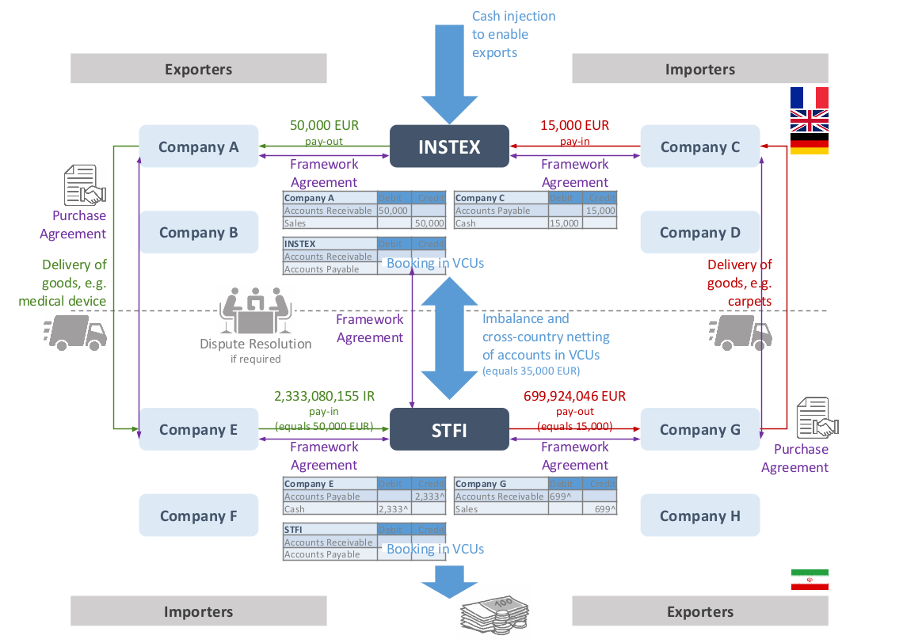
The model is strikingly like Pozsar’s suggestion that CBDCs will enable central banks to settle trades using their balance sheets, rather than relying on the liquidity of banks and correspondent banking relationships. INSTEX and STFI were supposed to net payments made by Iranian importers to European exporters with payments made by European importers to Iranian exporters, using a “virtual currency unit” to book the trade. The likely imbalances would be covered by a cash injection into INSTEX (Europe was exporting far more than it was importing after ending purchases of Iranian oil). It was an elegant solution, which sought to scale-up the methods being used by treasury managers at multinational companies operating in Iran to purchase inputs and repatriate profits.
Earlier this year, INSTEX was dissolved. Its shareholders, which eventually counted ten European states, lacked the political fortitude to see the project through. Notwithstanding bold claims about preserving European economic sovereignty in the face of unilateral American sanctions, there was always a sense among European officials that Iran was undeserving of a special purpose vehicle. But as the world moves to a new financial order, more institutions like INSTEX will emerge. Pozsar’s vision is bold insofar as he believes central banks will establish new cross-border clearing mechanisms based on CBDCs. But if new digital currencies can emerge to displace the dollar in the global monetary order, so too can new institutions be established.
Pozsar’s vision for Bretton Woods III becomes more convincing if one considers that the emergence of institutions such as decentral banks could lead to the creation of correspondent banking networks that are truly divorced from the dollar-based financial order. However, there remain plenty of reasons to doubt that such a system will emerge. Pozsar appears to have given little consideration to the issue of state capacity. Most countries have poorly managed central banks as it is—in the Odd Lots interview he pointed to Iran and Zimbabwe as early movers on CBDCs. We should have low expectations for the ability of most governments to develop and implement new technologies such as CBDCs or to establish wholly new institutions such as decentral banks. Moreover, the ability of the U.S. to use carrots and sticks to interfere with those efforts should not be underestimated.
There may be compelling structural drivers for something like Bretton Woods III, namely the rise of China and the overall shift in the global distribution of output. But somewhere along the way those structural drivers need to be converted into institutional processes. Bretton Woods is shorthand for the idea that monetary rules are as important for the operation of the global economy as the macroeconomic fundamentals. Countries reluctant to break the rules will struggle to rewrite them.
Photo: Canva

Are Sanctions Boosting Corporate Profits in Iran?
Iranian listed companies have managed to grow profits despite major cost pressures stemming from sanctions. This may be because firms are exercising extraordinary pricing power.
Last year I wrote a major report examining how the inflation generated by sanctions hurts households in Iran. In the report, I note evidence of “the increased cost of inputs being passed on to consumers.” In other words, citing anecdotal evidence, I suggested that Iranian firms were raising prices to protect their margins and that this was contributing to inflation. But the report lacked a substantive review of how firms react to the pressures created by financial and sectoral sanctions.
Firm behaviour under sanctions is understudied. The widespread assumption is that sanctions are bad for business. After all, they create significant dysfunction in the targeted economy. But the firm-level evidence is mixed. Sanctions do not tend to drive firms out of business, suggesting that companies find ways to adjust to the obvious cost pressures. Hadi Esfahani’s firm-level research has shown that “exits” (companies going out of business) played only a small role in changes in output, employment, and exports following the imposition of financial and sectoral sanctions in Iran in 2012. Saeed Ghasseminejad and Mohammad Jahan-Parvar’s study of Iranian companies listed on the Tehran Stock Exchange between 2011 and 2016 provides evidence that sanctions negatively impact profitability, but even sanctioned firms remained profitable in the period of their study. The profitability of firms that were subject to sectoral sanctions fell from an average of 16 percent to 11 percent—the margins remained healthy.
But what are the processes that are enabling Iranian firms to adjust to sanctions? A potential answer can be found in a new paper by Isabella Weber and Evan Wasner titled “Sellers’ Inflation, Profits and Conflict: Why Can Large Firms Hike Prices in an Emergency?” Using data on the profit margins of major US companies in the years following the COVID-19 pandemic, Weber and Wasner examine how firms “exercise pricing power to enhance or protect short-run profitability” in the face of acute cost pressures.
While the new research by Weber and Wasner does not discuss sanctioned economies, they describe conditions that can also be observed in Iran. Sanctions represent first and foremost a change in the supply environment—an emergency characterised by surging input costs. Financial and sectoral sanctions force most foreign companies to cease supplying customers in the targeted economy. But even when inputs remain available, currency devaluation triggered by the impact of sanctions on foreign exchange revenue and the accessibility of reserves makes those inputs more expensive. As a result, firms in the targeted country face supply chain bottlenecks and significant cost pressures. Purchasing managers’ index data from Iran makes clear that high producer prices and difficulties maintaining raw material and machinery inventories are the most persistent challenge facing Iranian manufacturing firms.
Moreover, the processes that Weber and Wasner believe underpin the “sellers’ inflation” that occurred after the COVID-19 pandemic in the United States are also at play in Iran. First, “sector-wide cost increases” lead to an “implicit agreement” among firms to raise prices. This occurs because “all firms want to protect their profit margins and know that the other firms pursue the same goal.” While state firms do dominate some sectors of Iran’s economy, such as the automotive industry, the broader manufacturing sector is dominated by private sector firms and is generally unconsolidated. The price increases seen in Iran reflect such implicit agreements and not price leadership by a few dominant firms.
Second, Weber and Wasner argue that “bottlenecks can create temporary monopoly power which can even render it safe to hike prices not only to protect but to increase profits.” In Iran, bottlenecks arose due to the effects of sanctions on imports. Under sanctions, domestic manufacturers face less competition from imported goods and the same bottlenecks also make it difficult to ramp-up output. Given the production constraints, it is nearly impossible for firms to grab market share by undercutting the competition and boosting sales. Because firms will not substantially sacrifice sales by raising prices, they can be understood to enjoy a kind of monopoly power.
Third, much like how the ongoing pandemic disruptions legitimise “price hikes and create acceptance on the part of consumers to pay higher prices,” so too do sanctions help render demand less elastic. Iranian consumers have come to understand high rates of inflation as the outcome the American sanctions and their own government’s monetary policy. While there has been some scrutiny of predatory pricing by Iranian firms in recent years, the pervading view is that firms must raise prices to survive. There is little scrutiny of whether firms are doing more than just surviving when they raise prices.
Finally, firms can raise prices because they know that consumers will keep buying. Weber and Wasner explain that “selling goods that people depend on” grants many firms extraordinary pricing power. Helpfully, the chief financial officer of Procter & Gamble has publicly boasted about this fact, stating that the company is ideally “positioned for dealing with an inflationary environment… starting with the portfolio that is focused on daily-use categories, health, hygiene, and cleaning, that are essential to the consumer versus discretionary categories which in these environments are the first ones to lose focus from the consumer.” Importantly, a significant proportion of Iran’s manufacturing base is devoted to household essentials. Meanwhile, Weber and Wasner point to government interventions during inflationary episodes as another reason why consumers put up with higher prices. Just like the stimulus checks that helped shore consumer spending during the COVID-19 pandemic in the United States, so too have cash transfers played a role in supporting household expenditures in Iran in the face of sanctions pressures.
Given that the same basic conditions for sellers’ inflation appear to exist in the US and Iran, it would be worthwhile to replicate the Weber and Wasner methodology to study the pricing power and profitability of Iranian companies. But even without a full study, a cursory review of the net margins of Iranian firms raises significant concerns that sanctions are increasing their pricing power of these firms and possibly even boosting their profitability. Comparing the net margins of companies listed in Iran’s securities exchanges (excluding financial firms) with inflation rates over the last decade reveals that, in general, profit margins rise in periods where inflation is elevated. In the four years leading up to March 2018, while Iran benefited from sanctions relief, the average profit margin for listed companies was 17 percent, while the average annual inflation rate was 11 percent. Since March 2018 and after Trump imposed “maximum pressure” sanctions on Iran, the average profit margin has risen to 26 percent. In the same period, annual inflation has averaged 40 percent. In short, Iranian companies appear to be more profitable on average when the country is under US secondary sanctions.
The continued profitability of Iranian firms has two ramifications for Western policymakers. First, it is a clear indication that elites in sanctioned economies can continue to accrue wealth, even as sanctions succeed in creating macroeconomic pressure. Second, if firms are in fact generating sellers’ inflation as part of their response to sanctions pressure, the economic resilience of firms is connected to the economic pain of households. Notably, Weber and Wasner raise the prospect that sellers’ inflation inevitably leads to “distributional conflict.” In their view, given that “living standards decline as real wages fall with rising prices,” labour will eventually push back on the profit maximisation by companies and demand higher wages. This too is a consideration highly relevant to Iran, which has seen an intensification of distributional conflict over the last decade. Protests over economic grievances have become more common, particularly protests over stagnant, delayed, or unpaid wages. Four consecutive years where inflation has exceeded 30 percent has eroded the living standard of Iranian households. In this context, firms may not be able to sustain their profit margins forever—in the medium-term, ever-rising prices will lead to demand destruction. However, while Weber and Wasner suggest that American firms have engineered a “a temporary transfer of income from labour to capital,” the implications for Iran, where firms have enjoyed increasing pricing power for the better part of a decade, are more dire.
The fact that Iranian firms have proven resilient under sanctions does have its benefits. This resilience has helped keep Iran’s economy from sliding into a deeper crisis. The resilience of businesses is also critical if Iran is to take advantage of any sanctions relief offered in a future diplomatic agreement. But the processes that underpin this resilience have significant distributional consequences. The sustained profitability of Iranian companies under sanctions represents an extraordinary and ongoing transfer of economic welfare from households to firms. In effect, not only are sanctions failing to weaken Iranian companies and their elite owners, but they are also hurting Iranian households profoundly. This suggests that the enhanced pricing power of Iranian firms and inflated corporate dividends are under-examined contributors to rising economic inequality in Iran, where the top income decile now controls nearly one-third of the country’s wealth. Sanctions were meant to make Iranian companies pay, but it is the Iranian people who are footing the bill.
Photo: IRNA

Iran's Special Relationship with China Beset by 'Special Issues'
This week, Iranian president Ebrahim Raisi flew to China for a three-day state visit at the invitation of Xi Jinping, marking the first full state visit by an Iranian president in two decades.
On February 14, Iranian president Ebrahim Raisi flew to China for a three-day state visit at the invitation of Xi Jinping, marking the first full state visit by an Iranian president in two decades. For Beijing, hosting Raisi was an attempt to regain Tehran’s trust after the significant controversy generated by the China-GCC joint statement issued following Xi’s visit to Riyadh in December. For Tehran, taking a large delegation to Beijing was an opportunity to remind the world that China and Iran enjoy a special relationship.
On the eve of the visit, Iran, a government newspaper, published a 120-page special issue of its economic insert entirely focused on China-Iran relations. Given the newspaper’s affiliation and the timing of the publication, the special issue is something like a white paper on the Raisi administration’s China policy and the perceived importance of a functional partnership with China.
The cover of the special issue speaks for itself—it calls for the creation of a triangular trade relationship between Iran, China, and Russia. Another headline declares that the Raisi administration is “reconstructing broken Iran-China ties.” In his pre-departure remarks, Raisi doubled down on this message, noting that Iran “has to pursue compensation for the dysfunction that existed up until now in its relations with China.” With this statement, Raisi both cast blame on Hassan Rouhani, his predecessor, for failing to maintain stronger ties with China, while also implying that China had let Iran down by failing to begin implementation of a 25-year Comprehensive Strategic Partnership agreement signed in 2021.
Iran’s grievances aside, the overall tone of the special issue is laudatory, suggesting that the Raisi administration has chosen to overlook China’s apparent endorsement of the UAE’s claim over the three contested Persian Gulf islands, which caused an uproar in Iran following the China-GCC consultations in December. But a development just before Raisi’s trip generated new controversy.
According to reports, Chinese oil major Sinopec has withdrawn from investing in the significant Yadavaran oil field located on the Iran-Iraq border. The Iranian government began negotiating with Sinopec in 2019 to develop the project's second phase. The negotiations were slow-going, in part because of the challenges created by US secondary sanctions.
Fereydoun Kurd Zanganeh, a senior official at the National Iranian Oil Company (NIOC), has denied the reports, claiming that negotiations with Sinpoec are ongoing. According to him, the Chinese energy company “has not yet announced in any way that it will not cooperate in the development of the Yadavaran field.” Whether or not Sinopec has actually withdrawn from Yadavaran, the slow pace of the negotiations and the difficulty for Chinese companies to deliver major projects—as in the case of Phase 11 of the South Pars gas field—reflect that China is an unreliable partner for Iran, at least while Iran remains under sanctions.
Nonetheless, the Raisi administration is keen to attract more Chinese investment. In an interview with ISNA published on January 28, Ali Fekri, a deputy economy minister, said that he “is not happy with the volume of the Chinese investment in Iran, as they have much greater capacity.” According Fekri, since the Raisi administration took office, the Chinese have invested $185 million in 25 projects, comprising of “21 industrial projects, two mining projects, one service project, and one agricultural project.” As indicated by the low dollar value relative to the number of investments, Chinese commitments have been limited to small and medium-sized projects. Beijing has mainly invested in projects that, according to Fekri, offer China the opportunity to import goods from Iran.
Comparative data shows Iran falling behind other countries in the race to attract Chinese investment. For instance, according to the data complied by the American Enterprise Institute, China committed $610 million in Iraq and a striking $5.5 billion in Saudi Arabia in 2022 alone. With secondary sanctions in place, the prospect of more Chinese investments in Iran is unrealistic.
Despite these obvious challenges, Iranian officials have been reluctant to admit that external factors are shaping China-Iran relations. Ahead of Raisi’s departure to China, Alireza Peyman Pak, the head of the Iran Trade Promotion Organization (ITPO), denied that Xi Jinping’s visit to Saudi Arabia in December had precipitated a cooling of Beijing’s relations with Tehran.
“Such an interpretation is by no means correct. A country with an economy of $6 trillion naturally tries to develop its economy by working with all countries,” he said. Peyman Pak pointed to recent trade data to bolster his case. “In the past ten months, we have seen a 10 percent growth in exports to China compared to the same period last year,” he added, leaving out that the growth comes from a low base—China-Iran trade has languished since 2018.
In recent months, Peyman Pak has played a prominent role in brokering memorandums of understanding between Russian and Iranian companies—part of the push for a deeper Russia-Iran economic partnership. His participation in the delegation heading to China suggests that the Raisi administration is serious about shaping a triangular trade alliance between Tehran, Moscow, and Beijing. So far, that economic alliance exists only in the form of various non-binding agreements. China and Iran signed 20 agreements worth $10 billion during Raisi’s visit.
These agreements, like those before them, have a low chance of being implemented, especially while the future of the JCPOA remains in doubt. For now, China-Iran relations are limited to the text of white papers, memorandums, and statements. For his part, Xi offered Raisi some encouraging words. He reiterated China’s opposition to “external forces interfering in Iran’s internal affairs and undermining Iran’s security and stability” and promised to work with Iran on “issues involving each other’s core interests.” No doubt, the special relationship between China and Iran is beset by special issues.
Photo: IRNA

Iran Trade Mechanism INSTEX is Shutting Down
At the end of January, the board of Instrument in Support of Trade Exchanges (INSTEX) took the decision to liquidate the company.
At the end of January, the board of the Instrument in Support of Trade Exchanges (INSTEX) took the decision to liquidate the company. Established in January 2019 by the United Kingdom, France, and Germany, INSTEX’s shareholders later came to include the governments of Belgium, Denmark, the Netherlands, Finland, Spain, Sweden, and Norway.
The state-owned company had a unique mission. It was created in response to the Trump administration’s withdrawal from the Iran nuclear deal in May 2018. European officials understood that the reimposition of US sanctions would impede European trade with Iran. The nuclear deal was a straightforward bargain. Iran had agreed to limits on its civilian nuclear programme in exchange for the economic benefits of sanctions relief. If European firms were unwilling or unable to trade with Iran, that basic quid-pro-quo would be undermined. For this reason, supporting trade with Iran was seen as a national security priority.
In August 2018, EU high representative Federica Mogherini and foreign ministers Jean-Yves Le Drian of France, Heiko Maas of Germany, and Jeremy Hunt of the United Kingdom, issued a joint statement in which they committed to preserve “effective financial channels with Iran, and the continuation of Iran’s export of oil and gas” in the face of the returning US sanctions. They pointed to a “European initiative to establish a special purpose vehicle” that would “enable continued sanctions lifting to reach Iran and allow for European exporters and importers to pursue legitimate trade.”
In November 2018, when the basic parameters of a special purpose vehicle were still being formulated by European officials, I co-authored the first public white paper explaining why establishing such a company made sense. Conversations with European and Iranian bankers and executives had made clear to me that trade intermediation methods were being widely used to get around the lack of adequate financial channels between Europe and Iran. If these methods could be packaged as a service by an entity backed by European governments, it would reassure European companies about remaining engaged in the Iranian market, while also reducing costs.
A few months later, INSTEX was founded. In the beginning, the company was run by the Iran desks at the EU and E3 foreign ministries. The officials tasked with working on INSTEX, who were often very junior, quickly realised they had little knowledge of the mechanics of EU-Iran trade. When they sought to enlist help from colleagues at finance ministries and central banks, they frequently met resistance. Many European technocrats were reluctant to support a project which had the overt aim of blunting US sanctions power, even at a time when figures such as French finance minister Bruno Le Maire and Dutch prime minister Mark Rutte were making bold statements about the need for European economic sovereignty. Even INSTEX’s inaugural managing director, Per Fischer, departed given concerns over his association with a company that had been maligned by American officials as a sanctions busting scheme. Then, in May 2019, when the Trump administration cancelled a set of sanctions waivers, European purchases of Iranian oil ended. That left INSTEX as Europe’s only gambit to preserve at least some of the economic benefits of the nuclear deal for Iran.
Later that year, INSTEX hired its first real team after a new group of European governments joined as shareholders and injected new capital into the company. For a time, things looked more promising. Under the newly appointed president, former German diplomat Michael Bock, a small group of talented individuals worked to define INSTEX’s mission and build a commercial case for the company’s operation. Their efforts led to INSTEX’s first transaction, which was completed in March 2020—the sale of around EUR 500,000 worth of blood treatment medication. The political pressure to provide Iran some gesture of tangible support during the pandemic had also greased the wheels in European governments.
But many considered the INSTEX project doomed even before the first transaction was completed. Certainly, Iranian officials were derisive of the special purpose vehicle. Given that Europe had failed to sustain its imports of Iranian oil and was unable to use INSTEX for that purpose, focusing instead on humanitarian trade, Iranian officials dismissed the effort, even after the feasibility of the special purpose vehicle was proven. That it took more than a year to process the first transaction also meant that the Europeans missed their chance to fill the vacuum caused by the US withdrawal from the nuclear agreement. Without full cooperation from its Iranian counterpart, which was called the Special Trade and Finance Instrument (STFI), INSTEX could not reliably net the monies owed by European importers to Iranian exporters with those owed by Iranian exporters to European importers.
European officials will no doubt blame Iran for the fact that INSTEX failed, and it is true that the Iranian government never fully appreciated the political significance of European states taking concrete steps to counteract even the indirect effects of US sanctions. Of course, the decision to liquidate the company follows a spate of recent actions by the Iranian government—nuclear escalation, the sale of drones to Russia, and the brutal repression of protests—that make the continued operation of INSTEX politically untenable.
But most of the blame for INSTEX’s failure must lie with the Europeans—the company’s demise predates Iran’s recent transgressions. European officials promised a historic project to assert their economic sovereignty, but they never really committed to that undertaking. A mechanism intended to support billions of dollars in bilateral trade was provided paltry investment. European governments never figured out how to give INSTEX access to the euro liquidity needed to account for the fact that Europe runs a major trade surplus with Iran when oil sales are zeroed out. For the Iranians, this alone was the evidence that European leaders saw INSTEX as a political gesture that might placate Tehran, rather than an economic instrument that would bolster Iran’s economy in the face of Trump’s “maximum pressure.”
Paradoxically, Iran will lose nothing as the liquidators shut down INSTEX, quietly selling the few assets the company had accumulated—laptops, office chairs, and perhaps some nifty pens. It is Europe that is losing out. INSTEX was supposed to be a testbed for new ways of facilitating trade without relying on risk-averse banks to process cross border transactions. Successful innovation in this area would have given a new dimension to European economic diplomacy and helped Europe assert the power of the euro in global trade.
With the writing on wall, INSTEX’s management made one final attempt to give the company a future. Beginning in 2021, the company pursued a French banking license—a pivot that INSTEX’s board had approved on a provisional basis, but which was halted in early 2022. It is hard to overstate how significant it would have been had INSTEX emerged as a state-owned bank with a specific mandate to process payments on behalf of European companies that wish to work in high-risk jurisdictions, including those under broad US sanctions programme. Such a bank could have become a powerful tool for Europe to assert its economic might in the face of US sanctions. Moreover, it would even have been useful in cases where Europe is applying sanctions, like Russia. After all, a commitment to humanitarianism means that goods such as food and medicine must continue to be bought and sold even when most transactions with a given country are prohibited. INSTEX could have helped make European sanctions powers more targeted and more humane.
For a company that managed just one transaction, a surprising amount has been written about INSTEX. It has been the subject of news reports, think pieces, and academic articles. Even if many people struggled to understand what the special purpose vehicle aimed to do, its existence was novel and therefore noteworthy. For those insiders directly involved in the company’s saga, and for those of us who have closely followed from the outside, the main takeaway seems to be that there is much yet to be learned about the complex ways in which US sanctions impact European policy towards countries like Iran, through both political and economic vectors. In this respect, INSTEX did achieve something. A group of technocrats in European foreign ministries and finance ministries learned valuable lessons, often reluctantly and with great difficulty, about the limits of Europe’s economic sovereignty. Whether those lessons can be institutionalised remains to be seen. But a fuller post-mortem on INSTEX would no doubt offer important lessons for the future of European economic power in a world dominated by US sanctions. Learning those lessons would be its own special purpose.
Photo: Wikicommons

When it Comes to Iran, China is Shifting the Balance
Xi Jinping’s recent trip to Riyadh, his first foreign visit to the Middle East since the pandemic, suggests that China may no longer seek to treat Iran and its Arab neighbours as equals.
In 2016, during his first trip to the Middle East, Chinese Premier Xi Jinping visited both Riyadh and Tehran, a reflection of China’s effort to balance relations among the regional powers of the Persian Gulf. But Xi’s recent trip to Riyadh, his first visit to the Middle East since the pandemic, suggests that China is no longer aiming to treat Iran and its Arab neighbours as equals.
Following the meetings in Riyadh, China and the GCC issued a joint statement. Four of the eighteen points that comprise the joint statement directly pertain to Iran. In the declaration, China and the GCC countries called on Iran to cooperate with the International Atomic Energy Agency as part of its obligations under the beleaguered Joint Comprehensive Plan of Action (JCPOA). Using strong and direct language, the statement additionally called for a comprehensive dialogue involving regional countries to address Iran’s nuclear programme and Iran’s malign activities in the region. The language used was less neutral than that typically seen in Chinese communiqués and instead took the tone of Saudi and Emirati talking points regarding Iran.
Iranian officials were especially vexed to see that China had effectively endorsed longstanding Emirati claims to three islands: Greater Tunb, Lesser Tunb, and Abu Musa. The islands, located in the Strait of Hormuz, were occupied by the Imperial Iranian Navy in 1971 after the withdrawal of British forces. Ever since, Iran has considered the three islands as part of its territory. The United Arab Emirates (UAE) has made periodic attempts over the last four decades to regain control of the islands, claiming that before the British withdrawal, the territories were administered by the Emirate of Sharjah. While the statement does not go so far as to declare that the islands belong the UAE, China’s call for negotiations over their status inherently undermines Iran’s claims.
The reaction of Iranian officials and the public has been sharp. The day after the statement was published, Iranian newspapers featured bitter headlines. One newspaper even provocatively questioned China’s claim over Taiwan. Iranian Foreign Minister Hossein Amir-Abdollahian tweeted that the three Persian Gulf islands belong to Iran and demanded respect for Iran’s territorial integrity. Meanwhile, Iran’s Assistant Foreign Minister for Asia and the Pacific met with the Chinese Ambassador to Iran, Chang Hua, to express “strong dissatisfaction” with the outcome of the China-GCC summit.
Amid the polemic generated by the China-GCC statement, the Chinese official news agency Xinhua announced that Vice Premier Hu Chunhua would visit Iran and the UAE next week. If the stopover in Tehran was intended as a Chinese gesture to ease tensions, the move is likely to backfire. While “Little Hu” had been expected to gain a prestigious seat in the Politburo Standing Committee during the recent National Congress of the Chinese Communist Party (CCP), he was instead demoted from the Politburo and is expected to be removed as Vice Premier in March 2023. Considering Xi’s triumphal visit to Riyadh, the optics surrounding Hu’s planned visit to Tehran are especially bad.
As Xi begins his third term as China’s leader, he appears to be viewing relations with Iran through the prism of liability, rather than opportunity. Despite the fanfare surrounding the beginning of Iran’s long-awaited accession to the China-led Shanghai Cooperation Organisation (SCO) in September, this was a relatively shallow political move. The SCO is an organisation with a limited institutional capacity and substantial internal divisions—Iran’s accession did not herald the opening of a new era in Sino-Iranian relations.
Two issues appear to be hampering China-Iran relations. First, negotiations to restore the JCPOA have failed. With sanctions in place, Iran has struggled to attract Chinese investment and cooperation, especially when compared to Saudi Arabia and the UAE. As I argued in March, economic ties are a pillar of the Comprehensive Strategic Partnership (CSP) that China and Iran have devised, but relaunching economic relations between the two countries requires successful nuclear diplomacy and the lifting of US secondary sanctions. Beijing and Tehran announced the beginning of the CSP implementation phase last January when the nuclear talks appeared likely to succeed. Today, the prospects for implementing the CSP are nill and China-Iran trade is continuing to languish at around $1 billion in total value per month.
Second, Iran’s decision to sell military drones to Russia, thereby becoming actively involved in the war in Ukraine, is proving a significant strategic miscalculation. By actively supporting Russia’s war of aggression, Iran has taken itself out of a large bloc of countries, nominally led by China, that have adopted an ambiguous position towards the conflict. This bloc, which notably includes the GCC countries, is neither aligned with Ukraine and NATO nor openly against Russia and its coalition of hardliner states. In short, Iran’s overt alignment with Russia is at odds with China’s approach.
Meanwhile, the evident strains in US relations with Saudi Arabia and the UAE have created an opening for China to deepen ties with the two regional powers. In some respects, this opening has diminished China’s need to cultivate a deeper partnership with Iran. Ties with Tehran had long been attractive as a means to counterbalance US influence in the region. But Beijing’s success in building deeper relations with Riyadh and Abu Dhabi, two capitals that have long taken their cues from Washington, suggests that China is gaining new means to check US power in the Middle East.
China-Iran relations have seesawed plenty over the years, but the outcome of Xi’s visit to Saudi Arabia suggests a new and more negative outlook for bilateral ties. While Iran tries in vain to “turn East,” China may be shifting away.
Photo: IRNA

As Protests Continue, Biden Should Enable Remittance Transfers to Iran
The Biden administration should adjust its sanctions policies to authorise remittance transfers to Iran, making it possible for Iranians in the diaspora to support their family members in ways that strengthen capacities for political participation.
Protests in Iran are continuing as the Iranian people bravely maintain a presence in the streets and on social media. So far, Iranian authorities have given no clear indication that they will reform policies in line with protest demands and have signalled that a larger crackdown may be coming.
While the protests have meaningfully shifted the political discourse around women’s rights and state repression, it is unclear whether Iran’s civil society has the resources necessary to generate a large and lasting protest movement that maintains pressure on Iranian authorities and raises the costs of further crackdowns. One critical factor is the economic disempowerment of Iranian society over the last decade.
Between 2010 and 2020, the spending power of the average Iranian household has fallen by just over 20%. This loss of economic welfare is primarily the result of U.S. sanctions, particularly those imposed in 2012 and re-imposed in 2018. In the two decades leading up to 2012, Iranian households enjoyed an unbroken period in which living standards were rising.
U.S. sanctions policy has made protests in Iran more frequent, but also less likely to succeed. The economic precarity that has become a dominant feature of the Iranian social condition over the last decade makes it harder to sustain protest movements. Many Iranians literally cannot afford to organise and mobilise over weeks and months. Workers are reluctant to strike given the risk of losing their jobs. Even those who retain the economic means to protest lack the tools to organise.
In institutional terms, sanctions have weakened the formal and informal civil society organisations that help mobilise the middle class and channel middle class resources towards political action. Charities, advocacy groups, legal aid providers are starved of resources. Civic-minded women, who are at the forefront of Iran’s new protest movement, have been hit especially hard. As one Iranian activist put it last year, “Activists are struggling to survive… If they do end up with a bit of time at the end of the day for their activism, they are often too exhausted and preoccupied with economic survival to be effective.”
The recent protests have no doubt energised a wide range of social groups in Iran, but looking in both economic and institutional terms, the balance of power between Iranian state and Iranian society has clearly shifted in the state’s favour. Mobilisations have become more frequent, but they tend to be smaller and more fleeting, making it easier for the state to either crackdown or to simply wait out the protests.
As such, the Biden administration should adjust its sanctions policies to broadly authorise remittance transfers to Iran, making it possible for Iranians in the diaspora to support family and friends in ways that reduced economic hardship and strengthen capacities for political participation.
Remittance flows are restricted because banks and money transfer companies do not facilitate transfers to Iran owing to sanctions on the Iranian financial system. Most remittances are therefore made via exchange bureaus (known to Iranians as sarafis) or are hand-carried into Iran by individuals. U.S. persons are explicitly authorised to hand-carry personal remittances but are not permitted to use money service businesses. The financial flows made through exchange bureaus and hand-carry channels are difficult to track and so the true extent of remittance flows may not be reflected in authoritative estimates, but Iran is likely receiving far less remittance transfers than countries with similar economic characteristics.
The World Bank estimates Iran received $1.3 billion of remittances in 2021, equivalent to just one-tenth of a percent of GDP. By comparison, Thailand, a country with a higher per capita GDP ($19,000 vs. $16,000 in PPP terms) and a smaller population (70 million vs. 84 million), received $9.0 billion of remittances, equivalent to 1.8 percent of GDP.
It is unlikely that exchange bureaus and physical transfers total in the many billions of dollars. In short, Iran’s remittances inflows are much lower than expected given the size of the economy and the economic needs of the population. Remittances flows are far too limited to shore the economic welfare of households in the face of the generalised economic crisis to which sectoral sanctions contribute—a fact evidenced by the erosion of household consumption over the last decade.
A significant body of academic research suggests that remittances encourage political participation, including in protests. In a 2017 paper, Malcolm Easton and Gabriella Montinola use individual-level data from Latin America to explore the relationship between the receipt of remittances and political participation. They find that “remittance recipients are more likely to select protest rather than the base response” whether in a democracy or autocracy. Additionally, in autocracies, remittances make political change seem more achievable. Easton and Montinola explain that “receiving remittances increases the odds of selecting protest relative to believing change is not possible by 34%.” Abel Escriba-Folch, Covadonga Meseguer, and Joseph Wright arrive at a similar conclusion in their 2018 study which used individual-level data from eight African countries. They find strong evidence that “remittances increase protest by augmenting the resources available to political opponents” and “remittances may thus help advance political change.”
The Iranian diaspora in the United States is the largest and most politically active in the world. As U.S. persons, members of the diaspora living in the United States are unable to send remittances to Iran beyond the hand-carry method, which is not an option for those who cannot travel to Iran for personal or political reasons, or who are opting not to travel to Iran due to the increased risks facing dual nationals. To provide routine and reliable financial support to family and friends in Iran, members of the Iranian diaspora should be able to avail themselves of money service businesses or other payments solutions.
The relevant regulation does stipulate that remittance transfers “processed by a United States depository institution or a United States registered broker or dealer in securities” are authorised. However, there is a lack of such institutions offering remittance services for Iran—U.S. banks do not maintain correspondent accounts at Iranian financial institutions. As such, the Biden administration should update its regulations to enable U.S. persons to make remittances transfers through other channels. This can be done through the issuance of a new general license with two aims.
First, the Biden administration could authorise the use by U.S. persons of money service businesses, such as Europe-based exchange bureaus, to transfer non-commercial, personal remittances to Iran. Second, and perhaps more usefully, the Biden administration could authorise the use by U.S. persons of cryptocurrency exchanges to purchase USDC stablecoins and transfer those stablecoins as non-commercial, personal remittances to Iran. The administration would also need to authorise U.S. cryptocurrency exchanges to onboard users in Iran.
Exchange bureaus can typically make deposits to accounts at Iranian financial institutions. The existing regulations do state that U.S. banks can engage with money service businesses in third-countries to make remittance transfers to Iran. But that makes such transfers subject to the discretion of U.S. banks. The guidance should be modified such that U.S. persons can directly engage exchange bureaus, for example those in Europe, to make transfers to Iranian bank accounts. Making it possible for U.S. persons to use third-country money service businesses would have an immediate impact on the volume of remittances sent to Iran. However, this channel cannot scale indefinitely as money service businesses generally need to balance inflows and outflows to make transfers in a netting process.
The use of cryptocurrency could be even more impactful. While few Iranians maintain cryptocurrency accounts, the technology provides one of the few scalable options for enabling U.S. persons to make remittance transfers to Iran. So long as cryptocurrency exchanges receive guidance that allows them to onboard Iranian users, Iranians can be expected to adopt the technology and U.S. persons will be able to transfer cryptocurrency without a constraint on scale.
The authorisation should be limited to exchanges and should not cover transfers made directly to addresses or via wallet providers, because of the additional controls that the exchange can impose. It is technically feasible for cryptocurrency exchanges (such as Coinbase and FTX) to limit the value of transfers that can be received and held by Iranian users in line with the provisions of the authorisation. Additionally, transactions processed by the exchange do not happen on cryptocurrency blockchains, they are run within the exchange’s internal database. This enables the exchange to freeze any account held by its user and block further transfers if necessary. Moreover, the exchange could ensure that users were only able to transfer certain cryptocurrencies to Iran, such as traceable USD stablecoins which are pegged to the dollar (the best option is USDC, which has a track record of cooperation with US regulators). This would ensure that exchanges are not providing a platform for speculative trading by Iranian users and that Iranians do not have a perverse incentive to hold onto their remittances. These exchanges can also require additional KYC for U.S. persons and Iranian individuals on either end of a given transfer.
To be effective, these authorisations would need to be followed by extensive outreach by the U.S. Department of Treasury and U.S. Department of State to ensure that money service businesses and cryptocurrency exchanges begin supporting Iran-related transfers. U.S. authorities would also impress the importance of monitoring for suspicious transactions and could ask for data on the remittance flows to enable better enforcement. Any authorisation could be granted based on a limit to the value of remittances made by a U.S. person each month—a limit as low as a few hundred U.S. dollars could make a significant difference in supporting basic household welfare in Iran.
There is a risk of abuse by individuals seeking to transfer funds to designated entities or individuals in Iran. But the risk is limited. Flows of USDC cannot be directly taxed or expropriated by the state. To spend any remittances they have received, Iranians would either need to pay for goods and services by transferring USDC to another Iranian user that has created an account on the exchange, or by finding an Iranian user who is willing to exchange USDC for cash.
The lack of hard currency flows means that the proposed action does not entail a substantive change to the structure of U.S. sanctions on Iranian economic sectors and state-owned and controlled entities. Even so, the authorisations can significantly boost the economic resources of Iranian civil society and enable more robust political participation, including in protests. However, the decision to participate in the protests lies with each Iranian. Unlike a strike fund, this policy does not create an incentive for protest, nor are the remittances made contingent on certain kinds of political action.
There is a precedent for this approach. Even while adding sanctions on the Maduro government, the Trump and Biden administrations have notably allowed Venezuelans to continue to use U.S.-based financial services, such as the payments app Zelle, to send and receive U.S. dollars. This has had the effect of shielding many Venezuelans from even steeper declines in economic welfare as the country experienced a steep sanctions-induced recession.
Enabling Iranian-Americans to make remittance transfers to their family members in Iran within the context of existing sanctions regulations would mean that the Biden administration is not only seeking to deprive the Iranian state of resources for repression but is also working actively to preserve the power of the civil society at a time of general economic crisis. This is what true solidarity would look like.
Photo: IRNA

Do Sanctions Pose an 'Irreversible Knowledge' Problem?
Western governments believe that Iran’s continued enrichment activities are allowing Iranian nuclear scientists to gain “irreversible knowledge.” But what if sanctions pose their own irreversible knowledge problem?
As the deadlock over the future of the Joint Comprehensive Plan of Action (JCPOA) continues, there is growing concern that Iran’s nuclear activities are hollowing out the benefits of the nuclear deal, even if it were to be successfully restored. Western governments believe that Iran’s enrichment activities are allowing Iranian nuclear scientists to gain “irreversible knowledge.” Even if Iran comes back into full compliance with its non-proliferation commitments under the JCPOA, it will have edged closer to becoming a threshold nuclear state.
Irreversible knowledge is powerful shorthand. A joint statement issued by France, Germany, and the United Kingdom in March 2021 noted that the recent breaches of the JCPOA were “providing Iran with irreversible knowledge gain that it did not possess prior to signing the JCPOA, as well as permanently and significantly enhancing Iran’s enrichment capacity.” In January of this year, Republican lawmakers sent a letter to U.S. Secretary of State Antony Blinken to urge him to abandon the nuclear talks and increase pressure on Iran, in part because Iran was continuing “to gain irreversible knowledge” as it produced more enriched uranium. In May, Israeli Defense Minister Benny Gantz warned that “Iran continues to accumulate irreversible knowledge and experience in the development, research, production, and operation of advanced centrifuges.”
Clearly, the concept of irreversible knowledge is well defined among those parties seeking renewed non-proliferation commitments from Iran, as well as those parties seeking to scupper any deal. According to Kelsey Davenport, the Biden administration will remain committed to the nuclear talks so long as the “the non-proliferation benefits of restoring the JCPOA outweigh the irreversible knowledge that Iran has gained.” Crucially, the nuclear deal prevents Iran from gaining further nuclear knowledge—commitments to cease significant enrichment activities and to dismantle advanced centrifuges reflect concrete measures that prevent the kind of nuclear research and production activities consistent with a weapons programme. By preventing additional knowledge gains, the JCPOA restricts Iran’s inherent nuclear capabilities.
In return for its compliance with these restrictions and strict monitoring, Iran receives significant sanctions relief—this is the basic quid-pro-quo of the JCPOA. Iran continues to place significant value on sanctions relief, especially as its economy languishes, but even so, the terms of the agreement are not as fair as they might seem.
Countries that apply sanctions (sanctionists) regularly use economic coercion to achieve non-proliferation goals. The Biden administration, like its predecessors, believes that the economic pain of sanctions forces uncooperative countries like Iran to the negotiating table, where non-proliferation agreements can be hammered out. Whether Iran entered into the nuclear negotiations because of economic pressure is up for debate. Notwithstanding, non-proliferation experts have heralded sanctions as a critical part of the arms control toolbox.
But what if the use of sanctions as part of non-proliferation diplomacy introduces another kind of irreversible knowledge problem, one overlooked by Western policymakers? Afterall, non-proliferation agreements impose no restrictions on the ability of sanctionists to further develop their means of economic coercion. Even after a deal like the JCPOA is adopted and implemented, sanctionists can continue to advance their understanding of how to apply and enforce sanctions with devastating effect. This irreversible knowledge is gained in three ways.
First, sanctionists can continue to study the target’s economy even after the implementation of a non-proliferation agreement. Some Iranian critics of the nuclear deal have complained that re-entering the JCPOA will make Iran more vulnerable to sanctions by increasing economic dependence on the West. But the issue is more subtle than that. Whether or not trade increases with Western companies after the lifting of sanctions, Western governments can continue to study the Iranian economy to understand its composition and its vulnerabilities in ways that will aid the design of future sanctions, whether those are broad sectoral measures or specific designations. Indeed, the U.S. continued to apply sanctions on Iran even after the nuclear deal was agreed, designating additional entities on the basis of terrorism or human rights related authorities. Even if these moves did not amount to a direct violation of the JCPOA, they did reflect how the U.S. was continuing to gain knowledge about how to target Iranian individuals and firms even after the deal’s implementation.
Second, sanctionists can continue to apply sanctions on other countries in ways that advance knowledge about how to make sanctions hurt. Were the JCPOA restored in full today, the United States and Europe would still be applying sanctions on a wide range of countries, most notably Russia. The application of sanctions in Russia, for example, provides practical experience that can inform how future sanctions on Iran might be made more harmful. Were Iran to gain irreversible nuclear knowledge in an analogous manner, Iranian nuclear scientists would be enriching uranium outside their borders, while ceasing the problematic research in Iran. In this way, even if sanctionists were to completely abstain from applying sanctions on Iran after the implementation of the JCPOA, they would still retain the ability to use sanctions in other countries in ways that expand capabilities.
Third, sanctionists can continue to strengthen the institutions responsible for designing and imposing sanctions. Whereas Iran could not install more centrifuges were it to re-join the nuclear deal, the U.S. can continue to increase staff within key offices such as the U.S. Treasury Department’s Office of Foreign Assets Control. As a result, the JCPOA actually exacerbates the escalation dominance of the U.S. over Iran. Sanctionists are inherently better prepared for the breakdown—whether wilful or accidental—of any non-proliferation agreement in which sanctions relief has been traded for non-proliferation commitments.
In this way, the irreversible knowledge gained by sanctionists represents a serious challenge to non-proliferation efforts. Conceptually, as U.S. and European officials increasingly conceive of sanctions as “economic weapons” and describe themselves as “nerd warriors” it is appropriate to apply to sanctions the concept of irreversible knowledge that has so far been only been invoked in the context of Iran’s nuclear programme.
The threat posed by the irreversible knowledge of sanctionists has weighed on Iran’s participation the nuclear negotiations. It is not merely the possibility of Trump’s re-election in 2024 that has cast a shadow over the talks, but also the fact that any administration that might wish to reimpose sanctions on Iran in the future will have a much deeper understanding of Iran’s economic responses to maximum pressure. For example, when the Trump administration sought to drive Iran’s oil exports down to “zero,” they did not expect that Iran would end up maintaining exports above 1 million barrels per day, with oil passing through the UAE and Malaysia, before heading to China. The role of intermediation in sustaining oil exports under sanctions is now a known feature of Iran’s economic resilience strategy. This datapoint can be incorporated into future sanctions design. There are countless other examples of where real and actionable knowledge has been gained by the U.S. and Europe that can be used to hammer Iran’s economy. As demonstrated by the circumstances of Trump’s withdrawal, Iran’s compliance with its commitments under the nuclear deal offers no guarantee that it will avoid the return of sanctions.
Western negotiators have tried to account for Iran’s fears about another U.S. withdrawal from the JCPOA by engaging in a dialogue on possible political or technical guarantees that might serve to make the nuclear deal robust. But the discussion over guarantees is focused on reducing the probability of sanctions “snapback.” No solutions have been offered to try and curtail the impact of snapback. Theoretically, the impact of snapback gets worse as the U.S. and Europe gain more knowledge about how to deploy sanctions for maximum effect. Truly mitigating the risks for Iran means addressing both probability and magnitude.
Western diplomats will no doubt continue to use sanctions to advance their non-proliferation agenda and the JCPOA is a good deal that ought to be restored. But Iran’s bitter experience under the nuclear deal makes clear that to create more durable and equitable non-proliferation agreements, Western officials must find ways to account for the fact that there is a fundamental asymmetry in the manner in which non-proliferation agreements deal with the issue of irreversible knowledge. Sanctions work by weaponising normal economic interdependencies. This makes it difficult to imagine that the knowledge gains of sanctionists can be curtailed. At best, these knowledge gains must be compensated for, either by limiting the non-proliferation demands made of countries like Iran, for example by granting them more leeway to undertake certain kinds of research, or by devising other more complex mechanisms, such as some kind financial annuity for non-proliferation agreements that kicks-in irrespective of the fault for the deal’s demise.
For now, the solutions are unclear. But if they are to be found, policymakers and experts committed to global non-proliferation must recognise their one-sided approach to irreversible knowledge within the context of non-proliferation regimes. Under the JCPOA, Iran’s ability to gain nuclear knowledge is constrained, but the U.S. and Europe can continue to hone their sanctions. This asymmetry is emblematic of a significant flaw in all agreements that trade sanctions relief benefits for nuclear restrictions and monitoring commitments.
Photo: state.gov

An Open Letter from 61 Iranian Economists Issues Stark Warning
An open letter co-signed by 61 Iranian economists addresses the government and the Iranian people about the country’s economic challenges.
Editor’s Note: This open letter co-signed by 61 Iranian economists was widely published in Iranian media outlets on June 10, 2022. The letter spurred significant debate and even controversy, with at least one economist claiming they were included as a signatory without foreknowledge of the letter’s content. The letter has been translated here in full in its original form given its insightful diagnosis of the economic challenges facing Iran.
Honorable People of Iran, Dear Compatriots,
Greetings,
When the 13th government took office, electoral rivals were ousted from the country's electoral institutions, bringing apparently uniform governance to the political landscape. In this climate, some analysts predicted, optimistically or naively, an accelerated resolution of the nuclear dispute with the West, as well as the formation of a government backed with maximum support of those holding political power, the military, and the official media in combating corruption, restoring the general business climate, and achieving macroeconomic stability. This was especially the case given that Mr. Raisi's views, programs, and promises as a presidential candidate foretold the formation of an inclusive government that would effectively use the country's vast knowledge and managerial experience. They were reported to have prepared and would implement a 7,000-page reform program with the support of dozens of research institutes and faculties of economics to address critical issues such as inflation, unemployment, and the closure of businesses.
Without tying the nation's livelihood and economy to nuclear negotiations, Mr. Raisi had promised the country would experience 5 percent economic growth, produce one million new jobs and one million new housing units annually, and to rapidly eradicate absolute poverty. He envisaged that the inflation rate would be reduced by 50 percent and then to single digits. Iran's non-oil exports would increase from $35 billion in 2021 to $70 billion in 2022, and the country's total foreign exchange needs would be met using non-oil exports.
In the meantime, many economic and political experts and intellectuals cautioned with foresight and compassion that such promises would not be realisable unless an early agreement was reached in the Vienna talks—after lengthy and exhausting two-year negotiations. Despite under-utilised human and physical capacities, a large number of unfinished projects, and billions of dollars of blocked foreign exchange resources, some of these promises could be fulfilled in the event of a nuclear deal and the FATF's approval, as well as the end of the COVID-19 epidemic; however, their entire fulfilment was also contingent on having good and developmental governance and a well-thought-out plan.
It is unfortunate, however, that since the beginning of April 2022, social unrest and public concern for livelihood and the viability of businesses have reached an explosive stage with the rise in disappointing news reports from the nuclear talks and numerous policy shocks to the country's economy, including the labor and the goods and services markets, followed by the elimination of the preferential exchange rate for essential goods. In the first few months of the year, the inflation and exchange rates have both reached new highs. Official policymakers have referred to the induction of multiple shocks and the escalation of macroeconomic instability as "economic surgery and reform" and "tough decisions for the economy" without considering the far-reaching repercussions of those decisions, the beginning and end, the scope, framework, and depth of this surgery, and its next steps or consequences for the general public. The prerequisites and instruments of economic surgery, such as the structure and function of governance, the attainment of an adequate level of public trust and appreciation, and the establishment of economic stability, were largely disregarded. Despite unofficial restrictions on independent media, numerous experts, economic and social experts, managers, and business owners have issued numerous warnings about the dire consequences of foreign policy inaction and recent ill-considered and erroneous policies over the past few months.
Hereby, the signatories of this letter, a group of economists of the country, convey our scientific analysis, apprehensions, advisories, and some strategies to help amend policies and alleviate the concerns of the dear people of Iran, purely out of a sense of national and social responsibility and moral and professional commitment to the people.
An Overview of the Government's Economic Surgery Policy
After the parliament agreed to eliminate the preferential exchange rate (USD1 = 4,200 tomans), the government's "economic reform" program began on May 9, 2022, with the Presidential TV address. These amendments led to the elimination of the preferential exchange rate for dairy products, animal and poultry feeds, eggs, oil, and certain medicines and medical devices. These items are referred to as essentials in the household basket. Before this decision, pasta, cakes, bulk bread, and confectionery products were taken off the list of items eligible for a preferential exchange rate upon eliminating the subsidy on industrial flour in April.
The government's policy, dubbed "economic surgery,” was rushed into effect without the administrative arrangements necessary to compensate producers and consumers. This may be a transient solution to the pressing budget deficit problem in the face of sanctions and the global food price crisis; it cannot be an economic reform program, however.
The government and parliament have removed the preferential exchange rate of basic goods and introduced it as the beginning of economic surgery. This decision is made while the annual budget contains thousands of billions in tomans for unneeded, nebulous, and removable expenditures, the permanent or temporary omission of which poses no threat to the government's primary missions or the people's general livelihood. Furthermore, this high-risk policy was implemented in the world's most alarming food security circumstances (amid the risk of global hunger and poverty). To date, there is no information on the financial nature of this policy, its resources, expenditures, or the degree of its imbalance. Even for the first time in recent decades, information tables on the sources and expenditures of explicit subsidies (Table 14 of the General Government Budget) and other sections of the Budget Law have not been published, making it impossible to evaluate or comment on them.
Our admonition to government officials is that the country's situation is extremely precarious, and insisting on eliminating subsidies during this miserable time will exhaust the public's patience and turn them against the ruling system and government. This confrontation can be very costly for both sides of the aisle. Reasonably, after the nation's economy and global food markets have returned to normal, macroeconomic stability has been established, and social tensions have been diminished, economic measures such as the unification of exchange rates, reforms in the four markets of the economy, and the organization of consumer subsidies can be implemented, all based on a prudent plan. Likewise, consideration must be given to the support of vulnerable groups in this scenario. At the macroeconomic level, the successful implementation of economic reforms requires certain unavoidable prerequisites, including the following:
Oil and non-oil export revenues, sufficient and reassuring reserves, and the availability of foreign exchange to manage potential fluctuations
Development of vivid and effective policies to stabilise the macroeconomy by regulating inflationary financial and budgetary factors
Low-cost access to global markets, including the market for basic goods and services, and, if necessary, low-cost financing sources and methods
If policymakers insist on continuing this unfortunate and risky practice, the government and the media should take full responsibility, explicitly and courageously, for the policies implemented and all their social and political consequences. Importantly, they should also avoid attributing failures to past pitfalls or the pressures and suggestions of economists outside the government. Nor should they label these suggestions as sabotage against the government and aggressively rebuff the criticisms of experts and those concerned with the national economy. This form and process of policymaking is at odds with, at least, the scientific approaches and indices of Iranian economists.
A Depiction of the Trends of Macroeconomic Indicators and the Outlook for Iran's Development
Development requires a "strong society–strong state" wherein the empowered state lays the foundation (in the form of public and regulatory goods) for the community's empowerment. An empowered society also requires a government that can pave the way for development through development-oriented governance and facilitative policymaking to ensure higher prosperity, employment, comprehensive social justice, security, and tranquility.
According to global comparative reports, indicators of the public business environment, quality of governance, perceptions of corruption, economic competitiveness, property rights, and other factors that lay the groundwork for long-term and inclusive growth and development, are on the decline placing Iran near the bottom of global rankings. Iran, for instance, was ranked 150 out of 180 nations in the most recent survey regarding anti-corruption efforts, and ranked 127 out of approximately 200 countries on the good governance index. In recent years, the social trust index, a measure of social capital that had risen to nearly 70 percent after the Islamic Revolution in 1981 (1360), has plummeted to the very concerning level of approximately 20 percent. The marriage-to-divorce ratio has decreased from 14 percent at the start of the revolution to around 3 percent today.
Due to poor governance, we have been unable to capitalise on the golden opportunities presented by the country's vast human and creative capital, oil revenues, and demographic window so as to achieve rapid economic growth. Oil exports have brought the country over 1.3 trillion dollars since the Revolution began. During this time, the country entered a demographic window in which the population's age structure was more conducive than ever to rapid economic growth. During this period, the country's per capita income has increased by less than 1 percent. Our country is on the verge of a long-term crisis due to the sharp decline in social capital, the inevitable outflows and large-scale layoffs of human capital, the spread of corruption, and the destruction of natural resources and the environment.
Iran's average GDP growth from 1980 to 2018 was approximately 1.6 percent, whereas China, India, Turkey, Malaysia, UAE, and Pakistan averaged between 4 percent and 10 percent during the same period. This meagre growth has occurred despite the fact that, nearly 50 years ago, Iran's economic growth prospects were considered superior to or on par with those of these nations. Due to sluggish economic growth, Iran's share of the global economy has decreased from 1 percent to approximately half a percent over the same period.
In the last decade, Iran's economy experienced the deepest stagflation in 70 years due to oppressive and unprecedented sanctions and the COVID-19 pandemic. The economy was marked by an average growth rate close to zero, an average inflation rate of above 20 percent, a negative and declining rate of gross fixed capital formation—even less than the compensation for depreciation over the past three years—and even more worrisome, an annual financial capital outflow of 10 to 20 billion dollars, depending on optimistic or pessimistic estimates. In the last ten years, the productivity rate of production parameters has been declining in a concerning manner, and the exchange rate has experienced a 30-fold increase (3000 percent). Although the national unemployment rate is still below 10 percent, it exceeds 15 percent in low-income (often border) provinces. In the last four decades, the average inflation rate has been 20 percent, and in the last three years, it has surpassed 35 percent. The misery index is approximately 50 percent, and inflation in 2021 was greater than 40 percent. Iran's imports have decreased from $70 billion in 2011 to approximately $35 billion in 2021 due to the implementation of sanctions and the reduction of oil export revenues.
These deteriorations have resulted in unequal income distribution and the spread of poverty across society. The Iranian Statistics Center has reported that Iran's average Gini coefficient between 2011 and 2018 was 0.408. This metric indicates that Iran is one of the most unequal societies in the Middle East, itself one of the most unequal regions on a global scale, during the relevant period. According to the report, during the same years, 1 percent of Iran's population, comprising the wealthiest strata of society, had an average of 16.3 percent of the country's total income, which is equivalent to 40 percent of the income of the poorest strata. Official reports suggest that the social and prospective outlooks of housing, education, and health inequality are far more unfortunate and worrisome. The Ministry of Cooperatives, Labor, and Social Welfare's report notes that the poverty rate increased from 22 percent in 2017 to 32 percent in 2019 due to the sharp increase in the poverty line basket price between 2018 and 2019. This means that in 2019, 32 percent of the country's population, 26.5 million people, are living below the poverty line, and sadly, estimates indicate that it has extended to nearly 40 percent of Iranian households in 2021. In the last decade, with an economic growth rate close to zero and a population growth of about 13 percent, the average Iranian has become 13 percent poorer. However, inflation and inequality mechanisms such as ineffective redistribution policies and corruption have placed the majority of the burden of poverty on low- and middle-income deciles, low-wage earners, and those employed in the economy's informal sector.
The macroeconomic developments of the past decade, i.e., the period of unprecedented intensification of economic, financial, commercial, and technological sanctions, have had the most significant impact on the living conditions of households and the increase in the poverty rate. Looking into macroeconomic variables has two major implications for Iranians' living conditions: first, a decline in welfare and worsening living conditions across the board for all Iranian households, and second, a more severe decline in welfare in low-income groups (1). Although the legal minimum wage for 2022 increased by 57 percent, the same wage, which fails to account for a large proportion of informal workers, is about $4.7 a day and $1.57 for a family of three. It falls below the international poverty threshold of $2 per day. In addition, many large firms, which are confronted with rapidly rising costs and declining demand, have adjusted their labor force, meaning that workers have been the primary losers of this policy due to their decreased share of national income.
The constant increase in the exchange rate and its inescapable effects on the volume of liquidity, on the one hand, and the reduction of revenue sources and the unorthodox and rapid growth of government expenditures, on the other, have resulted in enormous budget deficits, which are the primary cause of accelerating inflation. The escalating exchange rate-inflation spiral has placed the nation at risk of triple-digit, runaway inflation. Widespread corruption and the collapse of social capital, intensified rent-seeking ties, particularly in foreign trade and financial markets, the sharp decline in investment over the past two decades, and high inflation have cast a shadow over the future of Iran's economy and led to an inevitable, damaging, and irreparable outflow of financial and intellectual capital to other nations.
In recent years, as a result of the rise in the exchange rate and the cancerous growth of the budget deficit, the government has been forced to raise the price of energy carriers on occasion and eliminated the preferential exchange rate for the import of basic commodities this year. Experience has demonstrated, however, that the effects of such policies are extremely short-lived due to pervasive corruption, the collapse of social capital, the increase in the exchange rate, and the budget's ailing structure. Indeed, the budget deficit reoccurs shortly after and at a more considerable scale. Direct subsidies have not helped to offset the decline in public purchasing power and have not prevented the decline in people's livelihoods. Moreover, the government's monetary and fiscal policies have exacerbated the widening divergence.
In summary, the economic situation in Iran is very concerning, based on an abundance of evidence, and there seems to be no prospect of improvement or departure from this current state. Indeed, the downward trend of institutional performance indices (such as quality of governance, general business environment, corruption, economic competitiveness, and innovation), as well as other key parameters such as the outflow of financial and human capitals and the declining rate of economic investments over the past few years, is a substantially more ominous sign for the Iranian economy in future.
Honourble and patient people of Iran,
Dear Iranians,
Regrettably, the indicators and evidence presented above are not simply numbers on a page; they tell a heartbreaking story of hopelessness, the absence of a bright horizon, a lack of a favourable environment for production and business enterprises, a steady decline in people's purchasing power, growing poverty, and shrinking livelihoods. The obvious outcome of long-term exposure to such high inflation and a steadily rising exchange rate is a sense of social powerlessness and gradual decline. Inequality and income and asset gaps resulting from inflation, corruption, or dysfunctional fiscal and monetary policies, have turned trust and coexistence between the winners and losers of this bitter game into hatred and resentment, causing social capital to be shattered and destroyed. On the other hand, in the current state of the country, where economic and social policies are shrouded in secrecy, any criticism of the government is interpreted as part of a malicious plot against the governing system, making it difficult for experts or academic circles to raise such issues openly. Even more difficult is persuading the rulers and policymakers to accept that the Iranian people's suffering is now due to their long-term ineptitude and mismanagement.
It would be too naive to attribute this disorderliness solely to economic and financial factors such as large and growing budget deficits. Our economic and social problems—including the destruction of natural and environmental resources, systematic corruption, the destruction of social capital, the massive migration of human and innovative capital, the outflow of financial capital, the budget deficit and even the sanctions—are in a more general analysis, the product of poor governance and disregard for the scientific foundations of public policy.
If only our policymakers could foresee that now is not the time for a tug-of-war and coercive measures on national and global scales.
If only the esteemed President knew that economic policy is not the venue for an apprenticeship, trial and error, hasty decisions, or unthoughtful manipulations of prices and mediating factors. In fact, having the trust and the psychological and social support of society, having a stable environment based on international cooperation and coexistence, and having a strong bureaucracy equipped with modern knowledge and technology, are some necessary requirements for reforms or, in their own words, "economic surgery."
Dear compatriots,
Based on a review of global experiences and the scientific analysis of national experts and signatories of this letter, the first step to escape this dilemma is to fundamentally alter the nation's foreign strategies and policies, and the second is to alter the manner in which the country is governed. Two long leaps should be taken to solve Iran's complex economic and social issues and compensate for its stagnation in global economic competition:
Fundamental reforms in foreign policy by adopting a policy of peaceful coexistence and dignified cooperation with the countries in the region and especially neighbouring countries, as well as balanced and active interaction with major economic powers; also, paying attention to the minimum demands of the honourable people of Iran to improve the living conditions of Iranian people and to promote Iran's position globally. Without restoring the JCPOA and removing FATF-imposed restrictions on the Iranian banking sector, it is pointless to address macroeconomic stability policy and low-cost access to global markets.
Without an improvement in the quality of governance, economic surgery or reform will result in pervasive corruption, irreparable poverty and inequality, and deteriorating social and political stability. The prerequisites for effective governance and vital reforms are as follows:
Improving the quality of governance, the absolute and unequivocal rule of law at all levels, and government accountability for its decisions and public demands
Minimising political and economic corruption by applying maximum transparency mechanisms to the processes and outcomes of all policies, decisions, allotments, and appointments
Establishing an impartial, wholesome, accessible, affordable, and dependable judicial system for all social groups
Accepting and assisting in the creation of a space for dialogue, criticism, and oversight for scientific associations, universities, civic institutions, specialised and professional inclusive organisations, and independent media, and committing to the rules and goals of such a cause in practice
Possessing a robust and accountable executive and bureaucratic system with convenient and trustworthy databases
Possessing updated and potent information and communication technologies to implement targeted support and subsidy programs, carry out specific payments for specific target groups, and purchase specific goods and services from specific centres at specific times
Establishing and expanding the coverage of the welfare and social security system and efficient health insurance through equitable and efficient taxation (not by doubling the financial pressure on the critical sources of pension funds)
Fostering a competitive environment for the private sector's entrepreneurs and business owners while avoiding government monopolies or security conditions in the marketplace
Conceiving and implementing a production-focused incentive system that encourages the manufacturing sector and restricts destructive and unproductive activities
For policymakers and government officials to address the current turmoil, some clear implementation plans are also proposed:
It is incumbent upon the President and his principal colleagues to report on economic policies and programs, as well as their resources and expenditures, unambiguously and vividly, to seek consultation and advice from knowledgeable and specialised individuals, and to courageously take responsibility for their decisions.
A report on the sources and expenditures of the newly established subsidy, the number of households covered by it, and this year's budget imbalance should be publicised officially and transparently. A program of maximum financial discipline should be formulated, published, and implemented, including a revision of the 2022 budget based on public interests rather than the interests of specific groups. More specifically, the government should eliminate budget lines involving rents and overt and covert support for specific groups and centres, the removal of which has no harm to the essential activities of the government in exercising its sovereignty and public welfare provision.
A preferential exchange rate should be provided for the import of basic commodities, particularly wheat (until global food security concerns are resolved) and medicine (until compensatory mechanisms in the social security system are established), and any decisions or policies that involve price shocks upsetting the balance for vulnerable groups should be avoided.
In certain instances, cash subsidies intended to offset the negative effects of pricing policies are ineffective. It is imperative to build on up-to-date information and new information technologies, as well as close collaboration between the banking system and the goods distribution system, to allocate the payment subsidy in an entirely purposeful way for purchasing basic goods and ensuring food security in pre-specified purchase terminals.
The government monopoly on importing basic goods should be reformed into an effective competition. Accordingly, in addition to state-owned companies, all known and authorised traders should be permitted to purchase and import the basic goods required by the country from international markets in any quantity using export currency so as to maintain a sufficient level of strategic stocks of goods.
Concluding Remarks
To put it bluntly, successful price reforms necessitate broad government accountability, citizen participation in decision-making, the application of elite knowledge, and extensive communication with the rest of the world based on global standards.
Ultimately, while emphasising the motivation of the signatories of this letter to assist in resolving the current turmoil for the benefit of the people, we request that expert criticism be given due consideration.
With the people are God's hands.
Tomorrow, when the vestibule of truth becometh revealed,
Ashamed the way-farer, who, illusory work, made.
The List of Signatories of the Statement of Economists Addressed to the Honourable People of Iran
1. Ebrahimi Taghi, Ferdowsi University of Mashhad
2. Arbab Hamidreza, Allameh Tabataba’i University
3. Asgharpour Hossein, University of Tabriz
4. Afghah Morteza, Chamran University of Ahwaz
5. Akbari Nematollah, University of Isfahan
6. Elahi Naser, Mofid University
7. Emamverdi Ghodratollah, Azad University of Tehran
8. Amin Ismaili Hamid, Jihad Daneshgahi Institution
9. Amini Minoo, Payam Noor University, Tehran Branch
10. Olad Mahmud, Urban Economics
11. Ahangari Abdolmajid, Chamran University of Ahwaz
12. Bagheri Mojtaba, Mofid University
13. Bakhshi Lotfali, Allameh Tabataba’i University
14. Behboodi Davoud, University of Tabriz
15. Beheshti Mohammadbagher, University of Tabriz
16. Pazooki Mehdi , Planning Organization
17. Pishbin Jahanmir, Chamran University of Ahwaz
18. Tahsili Hasan, Ferdowsi University of Mashhad
19. Takieh Mehdi, Allameh Tabataba’i University
20. Chinichian Morteza, Allameh Tabataba’i University
21. Hosseini Seyed Mohammad, Research Institute of Islamic Sciences and Culture
22. Khatayi Mahmud, Allameh Tabataba’i University
23. Khodaparast Mehdi, Ferdowsi University of Mashhad
24. Khalili Tehrani Abdolamir, Shahid Beheshti University
25. Dadgar Yadollah, Shahid Beheshti University
26. Delangizan Sohrab, Razi University
27. Dahmardeh Nazar, University of Sistan and Baluchestan
28. Dehkordi Parvaneh, Payam Noor University, Tehran Branch
29. Rahdari Morad, Payam Noor University, Tehran Branch
30. Satarifar Mahommad, Allameh Tabataba’i University
31. Sahabi Bahram, Tarbiat Modares University
32. Shajari Hushang, University of Esfahan
33. Sharif Mostafa, Allameh Tabataba’i University
34. Sharifzadegan Mohammad Hossein, Shahid Beheshti University
35. Sadeghi Tehrani Ali, Allameh Tabatabai University
36. Sadeghi Saqdel Hossein, Tarbiat Modares University
37. Taheri Abdollah, Allameh Tabataba’i University
38. Asi Reza, Allameh Tabataba’i University
39. Ebadi Jafar, University of Tehran
40. Azizi Ahmad, Former Deputy of Currencies of the Central Bank and University Lecturer
41. Asari Arani Abbas, Tarbiat Modares University
42. Isazadeh Saeed, Bu Ali University
43. Firoozan Tohid, Kharazmi University
44. Ghanbari Hasanali, Shahid Beheshti University
45. Ghanbari Ali, Tarbiat Modares University
46. Karimi Zahra, Mazandaran University
47. Kia Al-Husseini Seyed Ziaoddin, Mofid University
48. Lashkari Mohammad, Payam Noor University, Mashhad Branch
49. Mohammadzadeh Parviz, University of Tabriz
50. Maziki Ali, Allameh Tabataba’i University
51. Mostafavi Mehdi, Ferdowsi University of Mashhad
52. Mostafavi Montazeri Sayyed Hassan, Tarbiat Modares University
53. Monsef Abdolali, Payam Noor University, Tehran Branch
54. Musaei Meysam, University of Tehran
55. Mousavi Mirhossein, Al-Zahra University
56. Mousavi Habib, Azad University of Arak
57. Mirzaei Hujjatullah, Allameh Tabataba’i University
58. Mehdikhani Alireza, Azad University of Arak
59. Hadi Zanouz Behrouz, Allameh Tabataba’i University
60. Varhami Vida, Shahid Beheshti University
61. Yusefi Muhammad Raza, Mofid University

Is Iran's 'Bread' Subsidy Reform a Half-Baked Idea?
A new round of protests has begun in Iran. People are taking to the streets following a controversial subsidy cut perceived as an increase in the price of bread.
A new round of protests has begun in Iran. People are taking to the streets following a controversial subsidy cut perceived as an increase in the price of bread. These protests were inevitable in a country in which there are so many economic and political grievances and in which civil society and labour groups, demoralised about their ability to influence policymaking through the ballot box, have turned to mobilisations to get their voices heard and their anger registered.
The policy that has triggered the protests has been widely reported as a cut to a “bread subsidy” that has suddenly increased the cost of bread and cereal-based products. This is inaccurate. The subsidy that has been eliminated was an exchange rate subsidy. The government had been providing Iranian importers allocations of hard currency below market prices. This policy indirectly subsidised the purchase of wheat and a few other foodstuffs by the importers. It did not directly subsidise the purchase of bread by ordinary people.
Importers could apply for foreign exchange allocations from the Central Bank of Iran to import wheat. In theory, this would allow them to bring wheat to the Iranian market at a lower price. But in practice, the subsidy had long ago stopped working. Several distortionary effects of the policy were likely generating inflationary pressure across the economy.
First, the exchange rate subsidy was poorly targeted. To put it simply, the Iranian government was intervening to make foreign money cheaper, not bread prices themselves. The subsidy was therefore ill-suited to stabilise prices when Iran’s import needs rose, a periodic occurrence when the domestic harvest falls short of targets. It was also unable to counteract the effects of global increases in the price of wheat. Breads and cereals prices have risen steadily in Iran for years, quadrupling since 2018.
Second, providing foreign exchange at a subsidised rate was exacerbating Iran’s fiscal deficit. Financing this deficit is a major driver of inflation in Iran. The official subsidised exchange rate diverged from the exchange rate on which Iran’s government budget is balanced in 2015. Since then, the spread between the two rates has increased dramatically. The subsidised exchange rate has been fixed at IRR 42,000 since 2019. The exchange rate in the Iranian government budget for the year beginning March 2022 is IRR 230,000. As this spread widened, the Central Bank of Iran faced increasing difficulty in meeting demand among importers for subsidised foreign exchange, creating a foreign exchange liquidity crunch that made it harder to stabilise Iran’s currency outright. In recent years, the Iranian government was spending around $12 billion in hard currency on a subsidised basis.
Third, this additional exchange rate volatility has increased the pass-through effects related to Iran’s dependence on imports more broadly. The Central Bank of Iran has had partial success in stabilising the exchange rate by introducing a centralised foreign exchange market for importers and exporters called NIMA. But Iran’s economic policymakers were tying their own hands in the stabilisation of this exchange rate, which is far more critical for Iran’s economic performance, by diverting precious foreign exchange resources towards essential goods importers. When it comes to inflation generally, the government ought to focus on intermediate goods on which “made in Iran” products depend. The exchange rate subsidy for essential goods was making it harder to stabilise the exchange rate for all other goods.
Fourth, the exchange rate subsidy was always subject to abuse. Particularly in the early years, importers were known to seek and receive allocations of subsidised foreign exchange and either pocket those allocations or turn around and sell on the hard currency to other firms at the market rate. This kind of profiteering was difficult to police. As more scrutiny came upon the allocations, importers with political connections were most likely to continue receiving allocations from the Central Bank of Iran, making enforcement politically fraught.
The evidence that the exchange rate subsidy had failed can be seen in consumer price index data. Bread and cereals inflation has outpaced general inflation since last summer. This is a likely reflection that, in practice, a diminishing volume of wheat imports were being conducted using the subsidised exchange rate—the reform was already being priced-in by the newly elected Raisi government. The sudden price increases were are seeing now are more likely the result of price gouging. Firms across the food supply chain are using the policy reform as an opportunity to raise prices, knowing the blame will be cast on the government.
Whether or not the reform is half-baked, the idea has been cooking in the oven for a long time. The subsidy cut was years in the making and the preferential exchange rate was nearly nixed in 2019, as the Iranian economy underwent a painful adjustment following the reimposition of U.S. secondary sanctions. At the time, the Iran Chamber of Commerce, the voice of the country’s private sector, issued a strong statement calling for the elimination of the subsidy. But the reform was eventually shelved—the Rouhani administration had been cowered by the 2017 and 2018 economic protests, which were instrumentalised by their political rivals.
In the end, the Central Bank of Iran took a different tack. They kept the exchange rate in place but began to eliminate the range of imports eligible for the rate. Initially, importers could apply for subsidised foreign exchange allocations for the purchase of 25 essential goods and commodities. As of September 2021, that list was cut down to just seven goods—wheat, corn, barley, oilseeds, edible oil, soybeans and certain medical goods.
These were preparatory steps for the elimination of the subsidy. In practice, many Iranian grain importers had stopped using the subsidised exchange rate, both in anticipation of its elimination and because it was impractical. One of the fundamental problems facing Iran’s food supply chain is that even when Iranian importers can identify buyers and arrange logistics—difficult things to do when under sanctions—the payments that need to be made for those purchases are often delayed. Importers that were applying to the Central Bank of Iran for allocations of subsidised foreign exchange might wait weeks before the money hit their accounts. Cargo ships would sit idle off Iran’s shores, unable to deliver the grain until the seller received their funds. These delays added costs. The Iranian importers were on the hook for huge fees as the ships they chartered remained out of service. Importers that opted to use the NIMA rate have been able to make payments to their suppliers more quickly and reliably. This is because there is far more liquidity in the NIMA market, in which foreign exchange is supplied by Iranian exporters who are repatriating their export revenues as required by law.
Overall, there is a sound economic argument for eliminating the subsidised exchange rate. But that does not mean that there will not be pain for ordinary people in the short term and the protests are motivated in part by an expectation of further pain. The abject failure to communicate a plan around the subsidy reform will lead to its own distortionary effects, including predatory pricing. Failing to communicate directly and clearly with the Iranian public about this major reform is its own kind of contempt, even if the reform itself is not contemptuous.
In that vein, the elimination of the subsidised exchange rate has been criticised as “neoliberal” and in many respects, it is. As part of the continuity in economic policy, the Raisi administration appears to be continuing the Rouhani administration’s commitment to austerity, seeking relief from inflation through fiscal tightening. The national protests in 2017 and 2018 were triggered by the same anxieties around the government’s perceived failure to protect economic welfare within the Islamic Republic’s social contract.
But on the other hand, this is not a simple economic reform. Iranian officials have likened it to “economic surgery” necessary to repair an economy weakened by sanctions. The reform also does not preclude other redistributive policies. The subsidised exchange rate was a poorly designed and inefficient policy that did more for a small number of elites than it did for Iran’s poor.
The Raisi administration has promised to soften the blow of the reform by providing targeted cash transfers (for two months) to the most vulnerable in Iranian society. Electronic coupons are also being provided. Iran has a good track record with cash transfers, which do something the exchange rate subsidy did not. Such transfers directly boost the consumption of ordinary people in the face of rising prices. If the government can use the fiscal savings from the elimination of an inefficient and poorly targeted policy to shore the economic welfare of Iran’s poor more directly, while also addressing long-running distortions in the foreign exchange markets, this reform may succeed yet. But if the government fails to communicate clearly about its implementation of the reform, the Iranian public will continue to only see failure.
Photo: IRNA

SIPRI Has Overstated Iran's Military Spending For Years
SIPRI produces the world’s most authoritative data on global military expenditure and the arms trade. But for years they have been overstating the size of Iran’s military budget.
SIPRI—the Stockholm International Peace Research Institute—produces the world’s most authoritative data on global military expenditure and the arms trade. The SIPRI Yearbook, a flagship annual publication, offers civilian and military leaders around the world a way to compare military spending between countries and to gauge which countries are investing in greater military power.
This year, the SIPRI Yearbook includes some significant statements about Iran’s military expenditure—which is estimated at $24.6 billion. In a factsheet summarising key trends, SIPRI’s researchers declared “Iran increased its military spending by 11 percent, making it the 14th largest military spender in 2021. This is the first time in 20 years that Iran has ranked among the top 15 military spenders.”
We are accustomed to thinking about Iran as a major military spender because we frequently hear about the country’s military, its missile programme, and its nuclear weapons ambitions. But on closer examination, SIPRI’s figures for Iran do not add up.
Iran is a country that is under the most significant sanctions programme in the world and its economy has stagnated for a decade. But SIPRI’s data suggests that Iran is spending even more than Israel, ranked 15th in the world with $24.4 billion in military expenditure in 2021. The comparison with Israel—a country in which the military is constantly procuring the most advanced military equipment in the world, including from foreign manufacturers—is clarifying. If Iran were indeed spending even more money, what could it possibly be spending all that money on? Iran produces nearly all its military hardware domestically, has basically no heavy armour, no modern air force, no modern naval fleet, and few advanced weapons systems. The country’s defence is primarily assured by a ballistic missile programme, which while impressive, is not a programme that costs nearly $25 billion to operate.
So where did SIPRI go wrong? The answer is simple and reflects a common mistake made by researchers who rightly want to put Iranian financial data into a comparative framework. To produce global rankings and to make data on military spending comparable over time, SIPRI converts local currency expenditures into US dollars. In 2021, SIPRI calculated Iran’s total expenditure in local currency at IRR 1033 trillion. In an email exchange, a SIPRI researcher clarified for me that SIPRI defines military expenditure using the following formula:
Military expenditure = Ministry of Defence and Armed Forces Logistics Total + Armed Forces General Staff Total + Artesh Joint Staff Total + Sepah Joint Staff (IRGC) Total + Armed Forces Social Security Organization Total
This is a reasonable formulation and corresponds to how Iranian sources calculate military spending. So there is no reason to doubt SIPRI’s calculation of military spending in local currency terms.
For most countries, the next step in the analysis involves finding the average dollar exchange rate for the given year and dividing the total expenditure by that figure. But Iran does not have a single exchange rate and SIPRI’s researchers picked the wrong one. Over the years, they have relied upon data for Iran’s official dollar exchange rate published by the World Bank and sourced from the Central Bank of Iran. This was also confirmed in my email exchange with the SIPRI researcher. On face, this seems like the right approach—SIPRI is using an “official” rate from an authoritative source. But in Iran, the official exchange rate does not reflect market prices. It is a subsidised exchange rate that is only used for the importation of certain essential commodities, such as wheat and medicine. Since 2019, the official exchange rate has been capped at IRR 42,000. This is the rate that SIPRI mistakenly used to calculate Iran’s total military expenditure for 2021.
The exchange rate that ought to have been used is the exchange rate defined within the government budget itself. The Iranian government balances its budget by relying in part on foreign exchanges revenues, principally earned through the sale of oil. Prior to the budget for the Iranian calendar year 1395, which was submitted in November 2015, the official exchange rate was indeed the reference rate used in the budget. But after several years of sanctions pressure, the Central Bank of Iran could no longer prop up the value of the currency. So while the official exchange rate was kept low as a means to subsidise the purchase of key imports, a separate exchange rate was defined in the budget. The rates have diverged dramatically since.
Each budget includes a revenue target from the sale of oil and a target volume of oil sales. By comparing these two numbers with the price of oil fixed in the budget, it is possible to arrive at the dollar exchange rate on which the budget depends. This exchange rate, which we can call the budget exchange rate, expresses how many rials the Iranian government estimates it can spend for each dollar it earns. It is therefore a much better exchange rate to use when trying to account for different levels of purchasing power between countries when it comes to government expenditure.
For the draft budget in the Iranian calendar year 1401, which was submitted in November 2021 and forms the basis of SIPRI’s 2021 expenditure estimate, the budget exchange rate was IRR 230,000—a rate five times higher than the IRR 42,000 official rate. In other words, SIPRI’s 2021 yearbook overstates Iran’s military spending by a factor of five. Using the budget exchange rate, Iran’s total military expenditure is just $4.5 billion, a total that places Iran outside of the Top 40 military spenders in the world. The below chart compares the military expenditures reported by SIPRI using the official exchange rate and expenditures calculated according to the budget exchange rate.
In the last few years, annual inflation in Iran has been as high as 40 percent, leading to a sharp increase in nominal expenditures. But by using the official exchange rate, which has been capped since 2019, SIPRI has failed to account for the impact of inflation on relative prices between the dollar and rial. In some respects, this is a surprising mistake for the researchers to make, as analysts of Iran’s military expenditures have warned about the difficulty of pinning down real expenditures given Iran’s topsy-turvy economy. In 2018, Jennifer Chandler, a researcher at IISS noted that in “large increases in local currency, impressive as they might seem, do not necessarily reflect an over-prioritisation of the regime on defence spending.”
Another way to examine whether Iran is spending more on its military is to simply convert from nominal to real spending in the local currency, avoiding the pitfalls represented by the exchange rate. To do so, we can deflate the nominal military spending using Consumer Price Index data published by the Central Bank of Iran. This analysis reveals that Iran’s military spending has been flat for two decades, just barely keeping up with inflation.
The Iranian government does take its defence seriously. But it has developed the means to ensure that defence cheaply by focusing on specific capabilities such as ballistic missiles and drones and by relying on proxies as part of a “forward defence” strategy. Iran’s military does not look like a military backed by $24.6 billion dollars of spending in a single year—where are the next generation fighters, battle tanks, and naval vessels? Yet, regional actors and Western governments continue to assess that the Iranian military poses a significant threat, even while real military expenditures have been flat. To put it another way, Iran has been able to maintain its military spending in the face of sanctions in part because it has long been parsimonious. This raises questions about the wisdom of trying to throttle Iran’s economy to address security threats.
The mistake SIPRI has made is understandable given the scope of the yearbook project and the difficulty of accounting for the peculiarities of each country’s economy. Yet, Iran is likely the country whose military spending is under the greatest international scrutiny, meaning that the impact of the mistake is profound. The exaggerated military expenditures unwittingly reported by SIPRI have reinforced the view of the Iranian military as especially large and threatening. The figures have also been used by a wide range of actors, including Iran’s regional rivals, to justify their own increases in military spending and the acquisition of advanced weapons systems. In this way, the presumed value of military spending has overshadowed the sober assessment of military capabilities. Encouragingly, SIPRI have told me they will “definitely investigate” the exchange rate issue. They will be forced to do so because of a planned change in Iran’s foreign exchange policy that will see the subsidised rate eliminated altogether during this budget year. But while a correction would be welcome, the damage has already been done.
Photo: IRNA

Russia’s Economic Crisis Threatens Uzbekistan from Within
Significant attention has been paid to the impact of the Ukraine crisis and Russia’s economic contraction on Uzbekistan. But Uzbekistan’s exposure to the crisis does not just stem from the contraction of remittances coming from Russia.
This article was originally published by the East Asia Forum.
Russia’s invasion of Ukraine is devastating the lives of Ukrainian civilians and impacting the global economy. Low-income economies that were hit hardest by the COVID-19 pandemic, such as Uzbekistan, are the most vulnerable to supply chain disruptions and potential political unrest caused by the invasion.
Significant attention has been paid to the impact of the Ukraine crisis and Russia’s economic contraction on Uzbekistan. But this analysis is somewhat incomplete—Uzbekistan’s exposure to the crisis does not just stem from the contraction of remittances coming from Russia.
The greatest danger for Central Asian economies emanates from weak political institutions. The economic shock rippling from Russia to Uzbekistan is compounding the economic effects of the COVID-19 pandemic, which had already spurred protectionist economic policy and threatened the reform agenda in Uzbekistan. This new crisis might convince policymakers to impose trade restrictions, price controls and rollback reforms.
Since 2016, bold market reforms have enabled Uzbekistan to unlock higher rates of economic growth. But public sector entities will likely seek further subsidies and preferential schemes from the state, attributing their inefficiency to yet another economic shock. This could further entrench rentierism in an economy that has been taking important strides towards fiscal discipline, privatisation and the targeting of fiscal spending towards private sector businesses and households.
To emerge from the new economic crisis, Uzbekistan must double down on its reform agenda. Policy interventions might be necessary to support businesses given the scale of the economic crisis. But these interventions should be targeted and limited to avoid hobbling reforms. Instead of providing carte blanche support for inefficient businesses—raising the government debt burden—Uzbekistan should condition state aid in ways that support reforms, especially those reforms seeking to reduce state dominance of the economy.
The Uzbek government continues to provide preferential loans, subsidies for economic operators and preferential tax regimes in ways that favour state-owned enterprises and politically-connected firms. Economic resources flow from taxpayers to these firms, while households and small and medium-sized enterprises remain vulnerable to economic headwinds. The country’s privatisation plan, a largely untapped source of government revenue, risks being further delayed as state-owned enterprises cite the crisis as a reason to slow critical reforms. The speed and transparency of privatisation auctions should be increased.
The stalled land reform must also be advanced. Agriculture accounts for 28 per cent of the Uzbek economy and employs the same proportion of the labour force. The government should expand property rights reform cover to all types of land, including agricultural land, which would boost private investment and production of food staples now subject to rising prices. This reform could also soften the blow of lower remittances, as repatriated labour migrants could earn their livelihoods as smallholder farmers or agricultural labourers.
In the case of Uzbekistan, a country in which expansive price controls have historically distorted incentives, the temptation to introduce price ceilings should be avoided. Higher prices will encourage producers to increase supply—increased investment by private producers will boost employment and eventually stabilise prices.
The government should continue to prioritise inclusive development by focusing on poverty reduction. Uzbekistan has made progress in measuring poverty. Uzbek President Shavkat Mirziyoyev has acknowledged that 12–15 per cent of the population is living below the poverty line and created specialised registries to capture unemployed youth, vulnerable women and people with disabilities.
Such approaches have also underpinned the rollout of programs targeted at the community level. Some initiatives, such as the free school meals and conditional cash transfers for the purchase of agricultural equipment or livestock, will likely produce mixed results due to distorted incentives. Other community-based initiatives, such as cash transfers for families dependent on labour migrants, record educational subsidies, incentives to hire women and mass health screenings, are more promising.
But citizens are not merely a target for support during periods of economic crisis—they are also a source of economic resilience. The government should continue to engage communities to better target fiscal interventions during the crisis. Uzbekistan’s timely Open Budget initiative gathered 6.7 million votes and offers a powerful platform for local communities to voice their needs in the pursuit of a more efficient allocation of state resources.
Easing the registration and operation of NGOs will result in the broader empowerment of vulnerable populations and better distribution of state aid. This may improve trust in the state institutions by ensuring that a larger portion of aid reaches the intended audiences.
The government needs to carefully delimit policy interventions so as not to derail the broader reform agenda that requires Uzbekistan to move away from excessive state intervention in the banking sector. For a short period, the Central Bank of Uzbekistan instituted recommended exchange rates for the Russian rouble that were effectively compulsory and below market rates. Over 80 per cent of Uzbekistan’s banking sector being state-owned is especially concerning at a time when policymakers are under pressure to expand financial support to banks.
Given the new economic reality, Uzbekistan should prioritise its talks on WTO membership and actively pursue new trade partnerships. To incentivise both local producers and foreign suppliers to continue to meet the needs of Uzbek consumers, fostering free markets is vital. Uzbek policymakers should resist the temptation to revert to the orthodoxies of the planned economy as they devise their crisis response—the best way out of the crisis is to look forward, not back.
Photo: Kremlin.ru

Responding to Sanctions from the Supply-Side
For both policymakers applying sanctions and those seeking to resist sanctions, better policy outcomes require supply-side thinking.
One of the fundamental asymmetries of sanctions policy is that countries that apply sanctions have many opportunities to do so. Countries targeted by sanctions are usually only targeted once. Those using sanctions get to practice their economic statecraft. Those facing sanctions get a single shot to try and secure their economic survival.
The question of how countries use their one shot has been little studied, especially since the emergence of financial sanctions as the primary tool of Western economic statecraft. This is a fundamentally important area of study. The efficacy of sanctions is a function of the resilience of the target. If a target can resist the coercive effects of sanctions in the medium-run, it is less likely that the sanctions will lead to the intended change in behaviour, particularly if the intended behaviour change is significant. Being able to estimate the resilience of the target is therefore a requirement for the judicious use of sanctions.
In a recent essay, I discussed how the Russian economy might respond to sanctions. My analysis drew on the experience of Iran, a country that has proven remarkably resilient in the face of the most expansive sanctions ever imposed. President Trump’s Iran envoy, Brian Hook, once stated “Because of our pressure, Iran’s leaders are facing a decision: Either negotiate with us or manage economic collapse.” We know that Iran managed to stave economic such a collapse. But was Iran’s response to the sanctions-induced economic crisis a good one?
Iranian economic policymaking is about as deft as in most middle-income countries. The grit of firms and households, which fought hard to prevent their own financial ruin, flattered Iranian policymakers. There were some successful policy interventions, such as a move to better regulate foreign exchange through the creation of a new parallel market, and the limited use of cash transfers to soften the blow of the economic downturn on households. But overall, it is difficult to conclude that Iran is a case study for an effective policy response to a sanctions crisis.
This is not to say Iran lacks sharp minds. But in the fog of economic war, a misunderstanding of the nature of the economic crisis and a reliance on textbook economics, combined to prevent a more nimble and effective policy response. The policy failure reflected an inability to respond to the key economic impact of sanctions—higher rates of inflation—with the correct set of policy tools. The Iranian government responded to persistent high inflation through a combination of monetary and fiscal interventions. Absent was any active industrial policy. This may come as a surprise. Helmed by a “revolutionary” government, Iran might have been expected to favour economic centralisation and public investment in its response to economic crises. But as a review of the statements and commentary of leading economic policymakers and economists makes clear, whether the interventions were monetarist or Keynesian, they have generally been focused on shielding aggregate demand from the sanctions pressure by seeking to control inflation or to compensate for its effects.
In a recent op-ed in the Financial Times, Iran’s finance minister, Ehran Khandouzi declared that the Raisi administration is seeking “to change the course of fiscal policy,” by aiming to “promote economic growth, price stability, and inclusive growth.” As part of this plan, Khandouzi called for “increasing government investment,” noting that the “public sector must play a more active role in investing in physical capital.” The timing of the op-ed was curious—talks over the future of the Iran nuclear negotiations have languished. By publishing his commentary in a leading international newspaper, Khandouzi may have been aiming to signal the Raisi administration’s readiness to engage with the global economy. Even so, the message of the op-ed was calculated. While Khandouzi notes that the negotiations in Vienna “could potentially lead to positive economic outcomes for Iran,” he concludes by explaining that the country is “ready for whatever scenario emerges — pessimistic or otherwise.”
In recent years, supply-side responses to inflation have come to the fore, particularly after the COVID-19 pandemic during which Western governments experienced inflationary pressures directly related to supply chain disruptions. As Yakov Feygin has written, the COVID-19 crisis “created bottlenecks in the production of practically every commodity.” For Feygin and other supply-side economists, the pandemic was a clarifying moment that “an active industrial policy” was a necessary part of any response to the “upward pressure on prices” that emerged as households continued to demand consumer goods and durables at a time when factories were forced to cut back production. Such an industrial policy would see policymakers “use the spending power of the government to issue long-term capital to vital but low-margin sectors.”
Could Khandouzi’s call for a “change in fiscal policy” see the emergence of an active industrial policy and a true supply-side response to inflation? Iran’s Supreme Leader, Ali Khamanei, has frequently cited the need to increase domestic production, which has been interpreted as a nod to import substitution. In an address given in March marking the start of the Iranian new year, Khamenei declared that “Production is the key to solving economic problems and the path to pass through economic difficulties.” However, looking beyond the Supreme Leader’s slogans, it is notable that more economic policymakers in Iran are increasingly connecting the specific problem of high prices to the challenge of low production. In a 2020 interview, Ali Salehabadi, now serving as governor of the Central Bank of Iran, expressed a decidedly supply-side outlook. “It goes without saying that the root of inflation in our country is not only monetary, but also related to real variables such as production. That is, increasing production in the long run will reduce inflation. Therefore, the growth of production will make the preparations for improving the living and economic conditions of the people,” he said. For his part, Khandouzi highlighted how “negative net investment in recent years” is “severely undermining future production and household welfare.”
There is no doubt that sanctions induce monetary and fiscal shocks that explain a significant portion of their inflationary impact. Moves to freeze Iran’s central bank reserves led to a shortage of foreign exchange. This weakened the Iranian rial. The Iranian government also printed money to finance budget deficits caused by the impact of sanctions on government revenues, principally oil revenues. But to fully capture the macroeconomic impact of sanctions it is important to look at goods, and not money alone. Financial sanctions hurt because they are the most effective means to determine what goods a target country can buy and sell in global markets. Sure, sectoral sanctions and export controls impact trade, putting pressure on the target country’s balance of payments. But countries have a knack at finding new buyers and suppliers (and intermediaries) who are willing to skirt these measures. What proves harder is finding banks willing to facilitate payments to those buyers or suppliers. It was not until financial sanctions cut Iranian banks, including the country’s central bank, from the global financial system in 2012, that there was a major impact on Iran’s current account. If an economy is highly import dependent, these disruptions have a direct inflationary impact. If the targeted country is relatively industrialised, producing more of the goods it consumes domestically, then the impact is less direct. This is the case in Iran and likely for Russia. In Iran, a decade of diminished imports of raw materials and intermediate goods have suppressed industrial output, in turn creating upward pressure on prices. In other words, consumer prices rose because producer prices rose. Iran experienced a supply-side shock.
As the short-run shock gives way to medium-run stagnation, persistent inflation and other economic impacts, such as unemployment, will lead to reduced demand—this is demand destruction. But in the immediate period after the imposition of sanctions demand remains mostly unchanged, even as inflation mounts. Households are inherently reluctant to cut back on spending in ways that will appreciably reduce quality of life and will therefore dip into savings. As prices rise further, families will increase the proportion of their expenditure on key categories, such as food and other consumer goods, including durables—demand for these goods is relatively inelastic. These are also the goods that Iran’s manufacturing sector tends to produce, given the large domestic market. This is partly why the supply-side challenge emerges. Consider the spending behaviours of a middle-class family in the aftermath of a sanctions shock. As the economic outlook worsens and as inflation expectations rise, that family will cut back on discretionary spending. They may delay the purchase of a luxury car or cancel a planned vacation abroad. But those decisions do not alleviate broader, society-wide price pressure because that consumption was either met through imports or facilitated by the Iranian services sector and not underpinned by domestic industry.
In more formal terms, under a major sanctions programme, aggregate demand in the targeted economy will fall. But in a relatively developed economy with a large domestic manufacturing base, the contraction in aggregate demand will be smaller than the contraction in aggregate supply for two reasons. First, uncertainty over future demand will see producers reduce investment. While sceptical of government interventions, Iranian private sector business leaders have sounded the alarm that a decade of low-investment is hitting production. Second, even when firms do have the means to invest, they may not be able to do so. Sanctions can prevent firms from acquiring the needed machinery and equipment, leading to the degradation of the capital stock and a drop in output. For example, sanctions on the Iranian oil sector made the acquisition of equipment more difficult, leading to concerns over the productive capacity of oil and gas fields.
Implicit in this analysis is the assumption that in the medium-run, sanctions will be lifted. Even so, the effects of reduced investment are significant. In the short-term, as producer prices rise, aggregate supply falls faster than demand, adding to inflationary pressure. But the nature of this contraction is where the real pain of sanctions lies. The shift in aggregate supply is not temporary, and it cannot be fully reversed through the lifting of sanctions because of a change in the elasticity of aggregate supply. In other words, enduring sanctions makes it fundamentally more difficult for an economy to bounce back when sanctions are eventually lifted in the medium-run. The relationship between the elasticity of aggregate supply and extended economic recessions has not been well-studied. This may be because a normal recession, even if lengthy, does not inherently impact the components of long-run aggregate supply—land, labour, capital and, productivity. But sanctions do not cause normal recessions. Sanctions prevent investment in capital goods by prohibiting or complicating the import of machinery and equipment. In this way, the prolonged lack of investment leads to a degradation of the capital stock. Mothballed facilities can be difficult to recommission and those assembly lines that do restart may be using obsolete technology. Iran’s leading automaker still produces the Peugeot 206, which was first introduced in France in 1998. In this way, while the lifting of sanctions may lead to a recovery of demand, particularly as restored foreign exchange revenues serve to strengthen the currency and boost purchasing power, producers may not be able to rapidly increase output in response to the expansion in demand.
The implication is that policymakers ought to think about major sanctions programmes—those that induce several years of high inflation—from the supply-side. In the short-run, the primary economic impact of sanctions is higher inflation, but in the medium-run, even after the lifting of sanctions, the pain of sanctions lingers as supply remains constrained. This is also why the beneficial impact of sanctions relief on the monetary and fiscal situation of the target country may not be sufficient to lead to a normalisation in price levels. On one hand, the upfront capital expenditure necessary to overhaul productive sectors may be prohibitively high after an extended period of underinvestment—in the aggregate, the targeted economy will struggle to ramp-up production at pre-sanctions rates. On the other hand, turning to imports to compensate for the new inelasticity of domestic supply will introduce its own price pressures, particularly given the lingering effects of sanctions on foreign trade, such as higher transaction costs. Under these conditions, sanctions relief is insufficient to deliver growth. As Nicholas Mulder and I have argued, countries ravaged by sanctions require sanctions reconstruction.
This analysis suggests that true sanctions resilience requires supply-side interventions. Finding ways to prevent the contraction in output is more important than trying to shore consumption, especially given the ways in which greater inelasticity in supply will diminish the prospects for the sanctioned country to recover under conditions when sanctions are eventually lifted. Taking this view, the response of Iranian policymakers to the inflation problem is peculiar. The focus on monetary policy reflects a textbook approach. Even in the aftermath of sanctions that obviously degraded supply chains and limited production, Iranian officials primarily viewed inflation as a phenomenon related to the growing money supply, which needed to be addressed through tighter monetary policy and higher interest rates. To put it another way, the response to the crisis focused on the production of money and the price of money, even though the sanctions crisis was largely, if not predominantly, about the production of goods and the price of those goods. This is why the rise of supply-side rhetoric among Iranian economic policymakers is so intriguing.
Beyond the economic significance of any forthcoming change in Iran’s policy response to sanctions, there are political implications that ought to be considered. If belated supply-side interventions make countries like Iran more resilient to sanctions, beyond the levels of resilience currently observed following faltering and orthodox demand-side interventions, sanctions may become less effective over time, especially as those countries yet to be targeted with economic weapons learn from the experiences of those that have.
Counterintuitively, greater economic resilience among sanctions targets may also benefit those states imposing sanctions. If targeted countries can successfully devise an industrial policy that minimises the negative impact on the elasticity of aggregate supply, for example through financial support for productive firms and greater efforts to protect supply chains for machinery and equipment, it will make the economy more responsive to sanctions relief and reduce medium-run price distortions. Policymakers applying sanctions tend to do so under the false impression that sanctions can be imposed and lifted with the flip of a switch. Sanctions can certainly be imposed quickly—the sanctions imposed on Russia were applied with record speed. But their rollback is laborious, and the economic benefits can be slow to materialise, in large part due to the changes in the components of aggregate supply. Good sanctions policy requires maximising short-run pain while minimising medium-run harms. For both policymakers applying sanctions and those seeking to resist sanctions, better policy outcomes require supply-side thinking.
Photo: IRNA