

Uzbekistan's Energy Transition Depends on Systematic Reforms
To achieve its energy transition, Uzbekistan must go beyond a project-by-project approach.
In the realm of global and energy security, 2024 was a year of unprecedented uncertainty. With issues ranging from ongoing conflicts in Ukraine and Gaza, tensions around Taiwan, and escalating populism and nationalism in the US and Europe, there were heightened concerns over energy security and the control of supply chains. US President Donald Trump’s first month in office has further fuelled the sense of an impending crisis, particularly with regards to his rhetoric around the conflicts in Ukraine and Gaza, the adoption of tariffs, and the abandonment of green policy.
Any discussion of energy transition trends must therefore be visualised in the form of a triangle, ensuring that the competing and often contradictory goals of energy security, minimising climate impact, and ensuring energy affordability are in tension. Each country, sector, and policy crystallise a set of trade-offs between different points on this triangle.
To achieve net zero by 2050, unprecedented changes in industrial structures and infrastructure are needed. The transmission and storage systems required to support a greater and faster reliance on renewable power generation may not yet exist. While energy efficiency is acceptable politically, it is a complex challenge that requires action in disparate area—not least in consumer behaviour.
Whilst the government of Uzbekistan has adopted ambitious plans to double GDP by 2030, it has underlined its aim to achieve this sustainably, scaling up its commitments to mitigate climate change and reduce the emissions intensity of GDP. In its Nationally Determined Contribution to 2030, Uzbekistan aims to generate at least 40 percent of its electricity from renewable sources and cut greenhouse gas emissions by 30 percent per unit GDP from 2010 levels. The challenge of reforming the energy sector and achieving such goals is inflated, however, by the predominance of outdated infrastructure, the continuation of unsustainable subsidies, and significant fluctuations in energy demand.
It should be noted that the decision as to when to promote what energy source is not binary; the process involves numerous trade-offs and, on occasion, political messaging, in order to achieve energy security. On a practical level, however, these resources cannot be deployed in an expedient and uniform manner that substitutes fossil fuels. In an inflationary cycle combined with facing the prospect of a global recession, the price of energy remains as important as energy security and climate change mitigation. An affordable energy transition is taking precedence and governments are opting towards the natural inclination of regulating prices and softening the price impacts for customers.
Yet with fluctuations in energy demand significant, the ability of a power system to cope with peak demand is crucial. The introduction of pricing that corresponds with demand is an unavoidable element in attracting investment in energy capacity. Power shortages have also triggered sectoral reforms and tariff increases. Electricity tariffs for businesses were increased in October 2023, and tariffs for households increased in May 2024, allowing the government to partially cut subsidies, as well as their plans to establish a unified platform for electricity trading by the end of 2024 and a liberalized wholesale power market by 2026.
That being said, Uzbekistan is making progress toward diversifying its power generation with the use of renewable sources. For example, in terms of the economy, over 80 percent of total energy use is still generated by gas; as far as power generation goes, its genesis remains equally dominant.
Although significant attention has been given to Saudi Arabia’s ACWA Power securing agreements to invest $15 billion in expanding power generation capacity, and the United Arab Emirates’ Masdar sponsoring both conventional and renewable power plants, Uzbekistan’s reliance on Russian gas continues to grow. Following a dramatic decline in domestic gas production, Uzbekistan started importing Russian natural gas in October 2023, annual gas imports of 2.8 billion cubic metres (bcm) agreed for a period of two years, with a potential increase up to 10bcm per year by 2030.
The economy’s heavy reliance on natural gas is a risk to the country’s decarbonisation, with gas consumption having to decline by 40 percent in order to achieve net zero in 2060. By minimising reliance on gas imports and pursuing the decarbonization of its economy, Uzbekistan can strengthen its energy security. Uzbekistan’s decarbonization efforts depend on strengthening cross-border energy flows, particularly through enhanced power transmission and a more flexible regional electricity trade. By optimising the use of regional energy resources, Uzbekistan can not only prevent power shortages but also contribute to greater regional stability and security.
It has been estimated that over $200 billion of investment is needed in the Uzbek energy system to achieve net zero by 2060. Given the scale of resources required and limitations within government finances, the private sector must be the primary investor for the green transition. In turn, accelerating the development of the country’s private sector is critical to absorb the costs and take advantage of the opportunities of the transition. The focus on decarbonisation and adaptation to climate change functions as a catalyst for the continuation of economic reforms and further support for investment.
The government has repeatedly expressed its intentions to create a better environment for private investment, using public-private partnerships (PPPs) in the energy and infrastructure sectors. Private capital can be secured to fund projects through the active participation of other stakeholders, including the use of blended finance. The strategic use of public money and development finance reduces the risk for private capital by allocating certain risks to governments or development financial institutions (DFIs). DFIs can play other roles beyond direct funding to incentivise the flow of private capital. They do this by developing new products and mechanisms that extend beyond political risk insurance to cover technology. Moreover, they ramp up risk for new technology, trade and foreign exchange risks, such as insurance products or co-lending mechanisms with the private sector through which a DFI provides subordinated debt.
What is necessary in the context of energy transition, however, goes beyond a project-by-project approach. Instead, a systematic approach and large-scale commitments by governments are required to encourage the development of a stable pipeline of investible and bankable projects, rather than a series of one-off projects in an uncertain regulatory environment. Global experience demonstrates that the key to attracting private capital for energy transition projects is assuring potential investors that political leadership remains committed to net-zero targets and will not change course. It also requires creating strong market demand through policies and regulations that encourage growth and establishing a competitive, stable tax regime that incentivises investment.
In Uzbekistan, structural reforms are needed to encourage foreign direct investment as a capital flow. The government must implement a comprehensive package of reforms, including strengthening market competition, eliminating preferential treatment, increasing energy prices, and removing subsidies. Stronger financial regulations should be adopted, and trade should be facilitated through measures such as accession to the World Trade Organisation. Additionally, climate concerns must be at the core of public investment decisions.
On this foundation, local demand and market signals can be created through incentive programs. These may include standards and tradable certificates, tax credits, and feed-in tariffs or contracts for different structures. As is already the case in Uzbekistan, PPPs can also play a role, with governments supporting market development by acting as quasi-private offtakers or by creating markets for ancillary services.
Crucially, only by reforming state-owned enterprises (SOEs) and subsequently providing attractive investment opportunities can an accelerated privatization process and a decarbonised economy be achieved. Whilst the government has recognised the need to improve energy efficiency and reduce carbon emissions for effective policy adoption, several challenges remain. There is a need for greater transparency and information on the activities and impact of SOEs, which are the largest carbon emitters. Additionally, an inventory of fossil fuel subsidies must be created to establish energy pricing, reduce subsidies, and introduce price incentives.
This remains a significant challenge due to ongoing concerns about the corporate governance and financial reporting of SOEs. Yet, only by addressing these issues can the government begin to implement a policy aligned with the country’s Nationally Determined Contribution and develop a realistic roadmap for the green transition. It will also enable better project prioritisation for climate change mitigation.
The Uzbek government must gain credibility through the implementation of consistent medium-term fiscal policies and by providing the predictability that is a prerequisite for medium-term economic growth. Indeed, the quality of government expenditure is increasingly important, with policy trade-offs required in response to the reduction of the fiscal space available. This also extends to the need to manage the inevitable tensions arising from price increases.
Not only does the unbundling of utilities require consumer prices to rise to offset the cost of their modernization, there also needs to be a demand for the green transition. Goods and services with a higher environmental impact need to be made more expensive. With regards to the social aspect of the green transition, such price increases must be well-conceived and gradual. The raising of energy prices should not lead to the impoverishment of parts of the population: a just transition should be ensured through the protection of vulnerable households.
Finally, policies need to be adopted to promote and support regional connectivity—an important catalyst for regional economic growth in the face of global uncertainty, economic fragmentation, and increased costs. Regional policy dialogue and coordination can provide a foundation for the structural reform in trade, a process realised through the harmonisation of technical regulations and standards and their revision with international green standards and practices.
The development of cross-border connections and regional power trading platforms can facilitate the expansion of renewable energy generation while improving coordination in water resource management to prevent shortages and their consequences. Given the region’s diverse energy mixes, establishing a balanced system for regional trade is essential to ensuring its energy security and economic growth.
Photo: ACWA Power

Climate Policy and Cross-Border Hydrocarbon Development in the Gulf
Greater Gulf cooperation on hydrocarbons, as a part of balanced strategies incorporating climate protection, could manage some of these threats and promote longer-term cooperation solutions to problems facing the region’s critical economic sector.
This article is part of a series exploring regional energy cooperation in the Gulf and is published in cooperation with Istituto Affari Internazionali.
The Gulf countries are leading global producers and exporters of oil and gas. They have long reserves lives at current production levels, well beyond 2050, and substantial potential to increase reserves through field development, enhanced recovery, and exploration. They are intrinsically low-carbon producers measured by upstream emissions per barrel, although this is obscured in Iran and Iraq by high levels of flaring of unused associated gas (a by-product of oil production) and leakage of methane. They have strong involvement of state oil companies in oil and gas production, though this varies from an effective monopoly (Kuwait) to a leading role for international operators (Iraq and Oman).
With the exception of Iraq, they have large domestic petrochemical industries. Saudi Arabia and, increasingly, the UAE, have extensive international investments in refining and petrochemicals across the US, Europe, and Asia. While this is mainly on their own account, Kuwait does have a stake in the important new Duqm refinery in Oman. The region’s oil exporters also make use of the extensive oil storage and bunkering facilities in the UAE and Oman. On the other hand, Qatar is the world’s biggest LNG exporter and has a major expansion programme to be completed during 2026-27, Oman and the UAE are smaller LNG exporters (the UAE also expanding), while Iran is an important supplier of gas by pipeline to Turkey and Iraq.
The role of the Gulf states as oil exporters has limited the potential for cooperation between them. The dominance of the state in the upstream industry means that cross-border hydrocarbon investment is very limited. Mubadala Energy, the energy arm of the Abu Dhabi government strategic development company, has some upstream assets in Qatar and Oman, and utility Taqa has oil operations in the Kurdistan region of Iraq. QatarEnergy recently entered a project in southern Iraq led by TotalEnergies for development of oil, gas, water injection and solar power. Sanctions and political disputes have prevented any GCC investment in Iran’s hydrocarbon sector. There has been some interest, for example, and various plans since the early 2000s for gas and electricity connections, and most recently, discussions between Saudi Arabia, the UAE, and Iran in July 2023 concerning investment and the development of shared fields.
Gas is more promising for cooperation, given that some of the Gulf states are relatively gas-short. The most notable project, Dolphin, exports gas from Qatar by pipeline to the UAE, with small volumes continuing to Oman. Dolphin faced opposition from Saudi Arabia, which argued that the pipeline crossed its own maritime territory. A similar plan to supply Qatari gas to Kuwait was entirely blocked by Saudi Arabia, which did not want the smaller GCC states to be linked beyond its influence. Although LNG exports from Qatar to the UAE stopped during the boycott of Doha between June 2017-January 2021, Dolphin continued operating as normal, a sign of its importance to both countries, and of the promise of energy projects to constrain conflict.
Some oil and gas fields in the Gulf lie across borders. In general, countries have developed them competitively, extracting as much as possible without an agreement with the neighbouring state. The most notable field affected by a boundary dispute is the large gas-field Dorra, known in Iran as Arash, which lies partly in Kuwaiti waters, partly in the Kuwaiti section of the Partitioned Neutral Zone with Saudi Arabia, and partly, in Tehran’s view, in Iranian waters. Kuwait’s shortage of gas leads to heavy domestic use of polluting and expensive oil. An agreement on Dorra, perhaps via a joint development zone without concession of sovereignty, could be a way forward. Such agreements have enabled Saudi Arabia to supply half of the oil from the Abu Safa field to Bahrain as part of a boundary settlement and Qatar and the UAE to divide the resources of the offshore Bunduq oil-field.
The most important cross-boundary field, not just in the Gulf but in the world, is called the North Field in Qatar and South Pars in Iran. It is world’s biggest gas field. The field, which also contains shallower cross-boundary oil resources, has been developed by each side without formal agreement, but there are tacit understandings to avoid one side moving too far ahead of the other on extraction levels. Qatar imposed a moratorium on further development of the North Field in 2005, and lifted it in 2017. Ostensibly this was for technical reasons, more plausibly for gas market management purposes, but it also gave Iran time to catch up to and even exceed relative Qatari production levels. As Iran’s own output from South Pars increased, so eventually Qatar was able to decide to raise production further, without risking tensions with Iran over unfair levels of extraction.
More intra-regional gas trade would enable reducing the use of oil in the power sector. Qatar, Iran (if its gas resources were properly developed), and the Kurdistan Region of Iraq, would be natural gas suppliers by pipeline to neighbours. This would require more regional trust, and transparency to put gas supplies on a reliable commercial basis. Cross-border investment in gas-using sectors such as petrochemicals, multi-country gas networks, and robust arbitration procedures, could create structures that would be more resistant to politically- or commercially-motivated cut-offs. Iran is, for example, a 10 percent shareholder in Azerbaijan’s important Shah Deniz gas field and in the South Caucasus Gas Pipeline from Azerbaijan to Turkey via Georgia, along with BP, Russia’s Lukoil and Turkish and Azeri state entities. But the recent history of Russian gas supplies to Europe, and the interruption of federal Iraqi and Kurdistan region oil exports through Turkey, reveals how even long-standing pipeline deals with strong mutual profitability can be derailed.
As COP28 in Dubai signalled, climate policy will exert ever-greater influence on the oil and gas industry: first through requirements to zero-out its own emissions, second through a longer-term reduction in demand, at least for oil. The Gulf countries present a wide spread of economic and environmental vulnerability, and sophistication of climate policy ranges from the very limited (Iraq) to the relatively advanced (UAE). The Oil and Gas Decarbonisation Charter (OGDC) concluded at COP28 was signed by the national oil companies of Abu Dhabi, Sharjah, Bahrain, Oman, and Saudi Arabia, among others, but not by Iran, Iraq, Kuwait, or Qatar.
With the exception of Qatar, all of the Gulf countries are members either of OPEC or the OPEC+ alliance. OPEC and the OGDC, as well as other structures such as the Oil and Gas Climate Initiative, offer potential to foster cooperation on decarbonisation paths within the petroleum industry, which include ending flaring and methane leakage, improving energy efficiency, electrifying operations, and incorporating renewable and nuclear power, implementing carbon capture and storage, piloting carbon dioxide removal technologies, producing sustainable aviation and maritime fuels, and developing hydrogen and its derivatives.
Specific cooperation would include aligning standards and regulations; sharing technological learnings and best practices; conducting joint studies on regional carbon dioxide storage capacity or satellite monitoring of methane leakage; and possibly some shared infrastructure, though this is more challenging and probably not essential. Joint investments, either within the Gulf countries or in third countries, could include the production of low-carbon hydrogen and sustainable fuels.
This collaboration can also include policy-related and diplomatic endeavours, on areas such as carbon caps, prices or taxes, international carbon trading under the Paris Agreement’s Article 6.4, dealing with the growing use of carbon border tariffs, and appropriate certification and regulation for low-carbon hydrogen.
The global energy market has been evolving rapidly, notably with the rise of Asia as the world’s key importer and consumer of energy and emitter of greenhouse gases, and the evolution of the natural gas business into a truly internationalised market via LNG trade. Most recently, the Russian invasion of Ukraine, the elimination of most of its pipeline gas exports to the EU, and a near-total ban on imports of Russian oil by the EU and other Western countries, have reshaped the global energy market and the patterns of trade in Gulf energy. The increasing US-China tensions, and the moves towards more diversity and robustness in supply chains and greater domestic self-sufficiency in key energy-related materials and technologies, is another emerging and evolving theme.
Greater Gulf cooperation on hydrocarbons, as a part of balanced strategies incorporating climate protection, could manage some of these threats and promote longer-term cooperation solutions to problems facing the region’s critical economic sector.
Photo: Aramco

Pipelines and the Challenges of Energy Integration in the Middle East
The legacies of the Middle East’s major oil and gas pipelines offer important lessons for regional leaders hoping to integrate energy markets and infrastructure.
This article is part of a series exploring regional energy cooperation in the Gulf and is published in cooperation with Istituto Affari Internazionali.
Energy cooperation in the Middle East has long been pursued through the establishment of petroleum pipelines, built with the goals of connecting to energy markets in the broader Eurasian context, diversifying oil export routes, and reducing vulnerability. After several years of renewed regional diplomacy in the Gulf and an increase in the level of regional trade and investment, energy integration is once again on the agenda in bilateral and multilateral forums.
However, in a region characterised by both internal instability and external threats, most intra-regional energy trade agreements have been short-lived. The legacies of the Middle East’s major oil and gas pipelines offer important lessons for regional leaders hoping to integrate energy markets and infrastructure.
The region’s seven major pipelines have existed for a cumulative 445 years. But they have only been active for 168 of those years. In other words, the seven pipelines have been operational for just one-third of their lifetimes. Every international oil pipeline in the region has also shut down at least once, and the majority remain closed today.
Political conflicts within producing and transit countries, as well as interstate disputes, remain the primary reasons for pipeline shutdowns. While the mutual dependency stabilising factor ensures continued oil supply from the region, short-term interruptions persist due to geopolitical tensions. Historical events like the Arab oil embargoes and international sanctions against Iraq and Iran underscore the region's susceptibility to temporary disruptions. The military attacks during the eight-year war between Iran and Iraq (1980-88) prompted a reconsideration in pipeline strategies in the region as the conflict both underscored the vulnerability of the infrastructure to military attacks, but also their potential in assisting countries at times of isolation.
For example, Iraq, whose meagre Gulf coastline was blocked during the war and its export outlets through the Mediterranean (Syria and Lebanon) were shut down, sought to diversify its export channels through pipelines with Turkey and Saudi Arabia. Iran, on the other hand, facing security concerns due to sporadic Iraqi air strikes on its territories, also explored pipeline options to bypass vulnerable terminals. But the 1986 Iraqi strikes on Iran’s Larak and Sirri terminals raised doubts about the security and usefulness of such infrastructure, resulting in the postponement or cancelation of many pipeline projects.
In the 1980s, to reduce dependence on the Strait of Hormuz and vulnerability to Iranian threats, Saudi Arabia built its main export pipeline “Petroline” from the oil-producing Eastern Province to Yanbu on the Red Sea. Yet, liftings at the Red Sea must transit through the Suez Canal which is controlled by Egypt or through the Strait of Bab Al-Mandeb which is controlled by Yemen. Oil could also be piped through the Sumed pipeline which links, within Egypt, the Gulf of Suez to the Mediterranean, or through the Eilat-Ashkelon pipeline in Israel. But these avenues pose their own challenges.
The Eilat–Ashkelon pipeline has recently gained attention, with press reports of the UAE considering it for transporting crude from the Red Sea to the Mediterranean. Interestingly, this pipeline was built in 1968 as a joint-venture between Israel and Iran to transport Iranian crude oil to Europe. However, Iran ceased using the pipeline following the 1979 Revolution and the subsequent nationalisation of the pipeline by Israel. Today, with the ongoing war in Gaza and the fate of Arab-Israeli normalisation agreements mean the future of this pipeline is uncertain.
Limited Success in Gas Cooperation
In the realm of gas pipelines, the Middle East has seen some limited success, but only few interstate gas pipelines have been built. The first interstate gas line in the region was built in 1986 linking Iraqi fields to Kuwait. This short-lived pipeline closed after the Iraqi invasion of Kuwait and switched to supplying water for Iraqi troops. Around the same time, a small gas link was constructed between Oman and the UAE’s emirate of Ras Al-Khaimah. That link later expanded and became the much larger Dolphin pipeline which came on stream in 2007, supplying Qatari gas to the UAE and Oman.
In the Eastern Mediterranean, a gas pipeline linking Egypt and Israel was initially built to channel Egyptian gas to Israel, before reversing its flow to supply Israeli gas to Egypt. On a more regional scale, the Arab Gas Pipeline (AGP), built in 2003, has been linking Egypt, Jordan, Syria, and Lebanon, and has plans to connect to the European network in Turkey. However, the AGP has faced serious challenges since its inauguration, including the acute shortage of gas feedstock from Egypt.
The development of liquified natural gas (LNG) has also dealt a blow to the prospects of increasing gas pipelines around the Middle East. In fact, Bahrain, the UAE, Kuwait, and Jordan are already operating LNG import terminals, while Oman, Saudi Arabia, and Lebanon are pursuing the same strategy as well. The LNG option has been favoured over gas pipelines as a result of many factors, including the security related factors as well as the competitive costs and prices for building the different parts of its chain, i.e. the liquefaction plants, transport vessels, and regasification units.
Revitalising Pipelines
Despite persistent challenges, international pipelines are needed in the region and they can be an efficient and secure way of energy trade, if operated properly. To turn a new page, addressing various issues is crucial. First and foremost, the issue of transit fees must be clearly resolved, especially if a third country is involved in the transit. Those fees, returned in cash or commodities, could well affect the entire economic feasibility of a pipeline network project.
Adherence to World Trade Organization (WTO) agreements is also a significant challenge. In fact, each member of the WTO has to give the owner or operator of any pipeline passing through its territories full and free access to its own domestic market. That right for market access has not always been admitted by all Middle Eastern countries.
There is also the question of “energy independency” which needs to be addressed. In the Gulf and the broader region, governments are hesitant to depend on neighbouring countries for their fuel supplies. At the same time, the psychological desire among oil-producing countries for self-sufficiency also promotes a greater willingness to burn more liquid fuels than import gas, despite their higher relative and opportunity costs and the damage they induce on the environment.
Trust building measures and gradual expansion of bilateral and multilateral engagements could contribute to increasing energy cooperation, in addition to increasing the interdependency between the countries along the routes of pipelines through transit fees and large reliance on the pumped supplies.
Gas pricing is a challenge which is further compounded by the fluctuations in demand throughout the year. Demand for electricity, and consequently for natural gas, peaks in the summer for the majority of countries in the region, and consequently gas sales fall in the winter. To offset these challenges, regional countries could either create storage facilities at the upstream producing end or at the downstream consuming side. This requires much closer regional cooperation on gas.
While the challenges are evident, the pursuit of energy cooperation through pipelines in the Middle East remains a complex yet vital endeavour, requiring continuous adaptation to geopolitical realities and global market dynamics. Despite the current favouring of LNG over gas pipelines, policymakers must keep the idea of building a regional gas network on the agenda.
Regional players need to learn from past failures and match infrastructure with institutions to provide platforms for dispute resolutions and enhanced cooperation. Such a way forward could bolster regional economic development, enhance intra-regional trade, and contribute to long-term political cooperation and economic integration in the broader region.
Photo: Aramco

Solar Power’s Water Problem in the Gulf
The scale of solar investments is far from shifting the GCC away from its heavy dependence on fossil energy and solar power is far less promising in the Arabian Peninsula than many outside observers might think.
This article is part of a series exploring regional energy cooperation in the Gulf and is published in cooperation with Istituto Affari Internazionali.
Since the inauguration of the Mohammed Bin Rashid Al Maktoum Solar Park in Dubai in 2013, the Gulf Cooperation Council (GCC) has become home to an increasing number of solar power installations. Emirati leaders have so far invested the most in large utility-scale solar in the region, but their peers in Saudi Arabia, Qatar, Oman, Kuwait, and Bahrain have also begun to set up new solar parks in recent years.
The Arabian Peninsula’s desert landscapes might seem to be perfect for large solar power facilities like those being developed in the GCC states. Vast and largely uninhabited, the Arabian Desert gets plentiful sunshine: it receives around 3400 hours of sunshine per year, compared with averages of around 1600 hours in Germany or 2900 hours in Spain.
But solar power needs much more than desert sunshine to work. Arid landscapes present various infrastructure challenges, including high temperatures that can damage solar arrays and remoteness from established energy transmission lines. And where sunshine is most abundant, water is not.
Indeed, water scarcity is the most important limit on the grand promises of GCC governments to overhaul and decarbonise the region’s energy system. The Arabian Desert is one of the most arid places on earth, typically receiving under 4 inches (100 mm) of rain per year, and already facing near total depletion of its groundwater.
Unfortunately, today’s solar technology requires substantial amounts of water. Celebratory discussions about solar power are often illustrated with photographs of sparkling PV arrays. These solar panels are always pristine, recently cleaned arrays. Unfortunately, such a scene is a rare encounter in the Arabian Desert, where dust and blowing sand is quick to cover the solar panels and mirrors of both PV (photovoltaic) systems and CSP (concentrated solar power) systems.
Aware of desert solar’s dust problem, companies like Arizona’s First Solar and Luxembourg’s SolarCleano have promoted waterless cleaning systems. Yet these technologies are still not advanced enough to employ on a large, industrial scale. Solar technology companies based in the Gulf are also aware of this problem and have tried to engineer their own solutions. For example, Saudi Arabia’s NOMADD has designed its namesake “NO Water Mechanical Automated Dusting Device” to address the challenge of cleaning of solar panels in the Arabian Peninsula.
While robotic PV-cleaning systems are deployed in some sites today, waterless cleaning technologies are expensive and have failed to scale up beyond small, pilot projects. As a result, the GCC’s small-scale solar installations and the large-scale solar parks continue to use water to clear dust and debris from their panels. Most of that water is desalinated sea water, which is produced with a huge energy cost and substantial CO2 emissions. In this case, then, solar energy produced in the Arabian Peninsula’s desert parks is far from green—it is actually incredibly wasteful.
Renewable energy’s water footprint
The water footprint of solar power extends beyond just cleaning. Water is also used in extracting diverse minerals needed to manufacture PV cells and batteries, such as lithium, cobalt, tellurium, and gallium, as well as in the manufacturing process itself. Mining for the renewable energy sector largely takes place outside of the Arabian Peninsula, but Saudi Arabia’s new investments in mining, described as advancing global efforts to “decarbonize,” will invariably expand this water footprint in the region.
Water is integral to all modern forms of electricity generation, including fossil fuels, and nuclear, alongside renewables. Required water inputs vary by the source, in large part because the infrastructures needed to generate, store, and transmit energy all have different geographies. The solar water footprint contrasts to the water demands for coal, for example, where water is first used to extract coal from the earth, and then in power plant cooling operations like all thermoelectric power systems (coal, natural gas, and nuclear).
Proponents suggest that the water demands of renewables are a significantly lower than those of traditional fossil fuels. This is probably true. But even so, estimates from the IEA (International Energy Agency) use absolute numbers that reflect a limited proportion of renewables in the overall global energy supply mix. These estimates also tend to neglect the physical geography of renewable energy installations siting—like whether a proposed solar park is located in a desert where it is liable to dust problems that increase its water needs.
Overpromising solar to hype hydrogen
Encouraged by partners in Europe and Asia, Gulf fossil fuel producers are increasingly keen to promote hydrogen energy and state-backed efforts to develop hydrogen are now found in the UAE, Saudi Arabia, and Oman. In many cases, these projects are framed as key to transforming the region into future “green” hydrogen hubs. Creating hydrogen energy requires vast amounts of energy and for it to be “green,” this energy must come from renewables.
To date, the amount of renewable energy produced in the Arabian Peninsula is so limited that none of the impressive green hydrogen targets in the Gulf are realistic. Local programs that position the Arabian Peninsula as a new green hydrogen hub overpromise their future solar energy capacity. They overpromise solar both in the present, because the production capacity simply is not there, and also in the future, because the region’s water supplies are insufficient to deliver on local renewable energy promises. Instead, the new Gulf hydrogen programs are on track to locally lock in natural-gas generated hydrogen. Meanwhile, the water limits of solar power’s expansion are a fundamental obstacle to any future for “green” hydrogen in the region.
Just like the solar power parks that they depend on, new hydrogen energy schemes can only represent an improvement on the CO2 footprint of traditional fossil fuel energy sources if the production site decisions take water into account. If any renewable energy project’s water footprint is not carefully evaluated, then the most likely outcome will be that it turns into a big “green wash,” a convoluted mess of energy infrastructure that is built in the name of being green, but does not actually result in any CO2 reductions. And perhaps the most tragic outcome of this green theater would be if it only exacerbates local water shortfalls that then exacerbate the climate crisis, as they are met with yet more carbon-emitting desalinated seawater.
Water and energy futures
Although water is one of the most forgotten elements in today’s discussions about energy systems, the water-energy nexus has come into sharper focus recently and has been integrated in the climate talks under the UAE COP28 presidency’s Water4Climate initiative. Yet, similar to how mainstream climate change discussions are defined globally, water is often just reduced to an issue of “water security” for vulnerable populations. This is, of course, an important issue. But it is almost entirely divorced from the problem of water use and planning in the implementation of high-tech energy infrastructure around the world.
Regardless of whether oil and gas is “phased out” or “phased down,” fossil fuels are on their way out. Yet high-tech energy infrastructure, including renewables, will continue to be prioritised by political and economic leaders in the Arabian Peninsula. The question is where those infrastructures will be located.
Since the Gulf’s energy leaders want to remain central to the post-oil energy system, they are already investing in renewable energy abroad. For example, the UAE’s Masdar has stakes in solar parks, wind farms, and geothermal energy operations all across the world, including in neighbouring Gulf states like Iraq. Likewise, UAE-based AMEA Power was set up several years ago with the express purpose of investing in foreign renewable energy projects – and is growing at breakneck speed. Renewables have also been major targets for foreign investment from Saudi Arabia’s ACWA Power, which has also been the most aggressive actor in setting up hydrogen partnerships with foreign partners in Eurasia and the MENA region, including in Morocco, Uzbekistan, Kazakhstan, China, and beyond.
These future energy partnerships are already fostering regional cooperation and they will continue to do so. However, it is essential that water be at the centre of all considerations about how renewable energy infrastructures are located. In particular, if solar parks are located in places that strain water resources in a partner country—such as with growing water problems from Morocco’s Noor solar plant—then they are likely to provoke local opposition and accusations of “water grabbing” and neocolonialism.
No map can answer the question of how renewable energy landscapes should be ideally configured, because all geography is political. But decision-makers in the GCC, in neighbouring countries like Iraq and Iran, and in countries spearheading climate action, must think critically about where to locate renewable energy infrastructures. To take serious, coordinated action toward scaling renewable energy in a way that actually reduces carbon emissions, water usage must be the primary consideration.
Photo: Canva

As Iran Sells More Oil to China, the U.S. Gains Leverage
A new report, citing data from Kpler, an analytics company, claims that Iranian oil exports to China will reach 1.5 million barrels per day this month, the highest level in a decade.
A new report from Bloomberg, citing data from Kpler, an analytics company, claims that Iranian oil exports to China will reach 1.5 million barrels per day this month, the highest level in a decade. The report has led to a flurry of criticism from hawks that President Biden is failing to enforce U.S. sanctions on Iran’s oil exports and thereby gifting Iran billions of dollars in oil revenue. But in reality, Iran appears unable to spend most of the money—a situation that is giving Biden leverage he can use in future negotations.
Iran’s resurgent oil exports are earning the country a lot of money. The crude oil price is currently hovering at around $80. Iran discounts its oil for Chinese customers, so the actual selling price is probably closer to $74 dollars per barrel. At this price, Iran’s 1.5 million barrels per day of exports are earning the country around $3.3 billion per month.
These back of the envelope calculations are necessary because China’s customs administration stopped reporting the value and volume of oil imported from Iran back in May 2019, when the Trump administration revoked a series of waivers permitting limited purchases of Iranian oil by select countries. When looking to the Chinese data alone, Iran’s export revenue appears much smaller than it is, hiding the true trade balance.
In the most recent three months for which we have customs data, Iran’s imports from China averaged $826 million. In the same period, Iran’s non-oil exports to China averaged $357 million. When not counting Iran’s oil exports, Iran appears to be running a trade deficit with China of around $469 million. But when adding the reasonable estimate of $3.3 billion of oil exports, the monthly trade balance swings dramatically in Iran’s favor. In recent months, Iran has likely run a trade surplus with China of around $2.8 billion per month.
In other words, Iran is earning billions of dollars it appears unable to spend. After all, Chinese goods, especially parts and machinery, are a lifeline for Iranian industry. If Iran was able to buy more Chinese goods, it would be doing so. Two other data points confirm this interpretation. Exports from the UAE to Iran remain depressed, so Chinese goods are not arriving in Iran indirectly. Purchasing managers’ index data for the manufacturing sector also indicates that Iranian firms continue to struggle with low inventories of raw materials and intermediate goods. Moreover, Iran is continuing to doggedly pursue the release of its frozen assets, including $6 billion that will be made available for humanitarian trade as part of the recent U.S.-Iran prisoner deal. Iran would not be so desperate to strike such deals were its oil revenues in China readily accessible. In short, Iran is selling its oil and earning money, but it is not getting the full economic benefit from the surge in oil exports.
Chinese exporters and their banks remain wary of trading with Iran, where entities and whole sectors remain subject to U.S. secondary sanctions. For most Chinese multinational companies, trading with Iran is not worth the risk. In the first six months of this year, Chinese exports to Iran averaged $898 million per month. Exports remain 35% lower than in the first six months of 2017, the most recent year during which Iran enjoyed sanctions relief.
It remains to be seen whether Iran can sustain this new, higher level of oil exports. Oil markets can be fickle, and China’s economic wobbles could depress demand. But for now, Iran’s significant trade surplus with China also means that its renminbi reserves must be growing. This is a novel situation. Historically Iran has run a small trade surplus with China. Between January 2012, when the Obama administration launched devastating financial and energy sanctions on Iran, and January 2016, when the implementation of the nuclear deal granted Iran significant sanctions relief, the average monthly trade surplus was just $511 million (China’s purchases of Iranian oil are reflected in customs data for this period). In other words, assuming its oil revenues are stuck in China, Iran’s reserves are now growing four times faster than in that period.
At first glance, this might look like a major failure for the Biden administration. Biden purposefully maintained the “maximum pressure” sanctions imposed by Trump in an effort to sustain leverage for negotiations and Iranian oil exports remain subject to U.S. secondary sanctions. But those who claim that Biden is failing to enforce his sanctions are failing to see the wisdom of the current U.S. enforcement posture.
First, Biden is loath to deepen already heightened tensions with China. Sanctioning Chinese refiners for their purchases of Iranian oil, thereby targeting China’s energy security, would be a dramatic escalation in the growing economic competition between Washington and Beijing. Second, such escalation would be entirely pointless given the circumstances around Iran’s oil exports—namely that Iran is not getting the normal economic benefits. Given that Iran is earning more money but cannot spend it, the U.S. is actually gaining leverage for future negotiations.
Unlike Trump, Biden has made a serious effort to engage in nuclear diplomacy with Iran and is likely to continue those efforts if there is a reasonable opportunity to achieve a new diplomatic agreement that contains Iran’s nuclear program. But U.S. negotiators have struggled to make a compelling offer to their Iranian counterparts. Many Iranian policymakers felt the promised economic uplift of sanctions relief would be too small. Iran’s opening gambit in the negotiations with Biden included the claim that sanctions had inflicted $1 trillion of damage to Iran’s economy and that Iran was owed compensation.
With its oil exports significantly depressed, Iran has been unable to significantly grow its foreign exchange reserves, which the IMF estimates at around $120 billion. If Iranian officials believe that they need to remediate $1 trillion of economic damage, the windfall represented by the unfreezing of foreign exchange reserves does not count for much.
The longer the sanctions remain in place, the more money will be needed to undo the cumulative effects of U.S. sanctions, which have now hobbled Iran’s economy for over a decade. It is politically impossible for Biden to promise any kind of compensation for Iran—the best that the U.S. can do is promise to once again unfreeze Iran’s own money as part of a new diplomatic agreement.
For this reason, it is a good thing if Iran’s reserves are growing. Iran’s oil exports to China are kind of like payments made as part of a deferred annuity insurance contract. One day, Iran will be able to cash out on that policy. But it can only cash out if it meets the conditions set by the U.S. In other words, every barrel of oil Iran is currently selling to China is increasing U.S. leverage for future talks. It would be wise to let the oil flow.
Photo: Canva

Ageing Energy Infrastructure is Holding Central Asia Back
Central Asia faces rising demand for energy, spurred by population growth and climate change, but most of the region’s power generation and transmission infrastructure dates to the Soviet era.
Blackouts and "rationalisation" of energy consumption (a euphemism for coordinated blackouts) are all too frequent in Central Asia. Energy shortages arising from limited generation, insufficient energy imports, or the poor state of the transmission network mean that blackouts recur. This winter, however, the situation grew significantly worse. Amid exceptional cold weather, many households, businesses, and schools remained without heating and electricity for days on end. Unusually, the blackouts not only afflicted communities in remote regions but also capital cities.
Most of the region’s inefficient power generation and transmission infrastructure dates to the Soviet era. Central Asia faces rising demand for energy, spurred by population growth and climate change. Steadily rising energy consumption has strained power grids. Demand from new types of consumers, such as cryptocurrencies miners, has also exacerbated recent crises.
At the same time that they face chronic energy shortages, Central Asian states must also significantly cut carbon emissions and accelerate the transition to clean energy—a challenging path, especially for Kazakhstan, Uzbekistan, and Turkmenistan, where domestic production of hydrocarbons secures the majority of domestic energy consumption.
Besides generation capacity, natural gas supplies and distribution present their own technical and political problems. Kazakhstan is the world’s ninth-largest exporter of coal and crude oil and twelfth largest exporter of natural gas; its total energy production covers more than twice its energy demand. Yet, it has not been able to reliably supply electricity within its own territory. In mid-January, Turkmenistan, despite sitting on one of the world's ten largest natural gas reserves, disrupted gas supplies to Uzbekistan for over a week due to technical problems. Last year, several regions of Uzbekistan, Kazakhstan, and Kyrgyzstan were hit by blackouts caused by a technical incident in the so-called “energy ring,” a Soviet-era grid connecting border regions of these three countries, including the Kyrgyz and Uzbek capitals and Kazakhstan’s largest city, Almaty.
Central Asian authorities and international stakeholders have acknowledged the urgent situation facing the energy sector. The existing infrastructure is being operated “well beyond its shelf-life,” and loses caused by inefficiency may reach around 20% in the electricity sector.
But addressing all these demand-side and supply-side challenges simultaneously is impossible; governments in the region will have to prioritize specific sub-areas of their energy sectors. In the meantime, they will need to grapple with new economic challenges arising in part from Russia’s invasion of Ukraine.
The recent blackouts sparked considerable public anger given the financial impact, health risks, and general discomfort. Protests took place in several cities across Kazakhstan, Kyrgyzstan, and Uzbekistan. While these recent protests were small, the “Bloody January” protests in Kazakhstan and the Karakalpakstan protests in Uzbekistan point to the possibility that social and economic grievances can give rise to more significant unrest. Furthermore, many families relied on stoves to keep their homes warm, adding to the already high levels of pollution in Central Asia cities, resulting in further complains.
These extensive blackouts are also of concern to potential international investors. Without stable supplies of such basic utilities, investors will be deterred from Central Asia, leading to further economic stagnation. The ongoing crisis is a big test for Kazakhstan and Uzbekistan, and to a lesser extent Kyrgyzstan, three countries whose presidents have linked their political legitimacy with improving the economic and social conditions inside their country. To create jobs for their growing populations, these countries must grow their economies. But to grow their economies, the countries must boost energy production and significantly improve the distribution network. Securing the necessary financial resources for the extensive renovation of energy infrastructure is they key step for solving the energy shortages in the region. But securing new financing has become even harder because of the Russian invasion of Ukraine, which has significantly added to the already significant risks of investing in Central Asia, resulting from power struggles and corruption within the ruling regimes.
This has not stopped Central Asian leaders from promising new injections of investment in energy generation and improvement of the existing grid. President Shavkat Mirziyoyev of Uzbekistan announced a package of $1 billion to be invested in energy generation in the Tashkent region. But Mirziyoyev’s promise of new investment was clearly a political ploy, an effort to respond to public anger. The details of the investment and the expected economic, social, and political impact remain unclear. Governments in the region are luring new investors in the renewable energy sectors by setting ambitious targets. Kazakhstan aims to introduce new projects totaling 6.5 GW by 2035 and Uzbekistan plans to launch 7 GW of new capacity by 2030. However, many of these projections include nuclear power projects involving Russia’s Rosatom, which are now very unlikely to break ground.
Successful renovation of the energy sector at the national level also requires stronger political partnerships between countries given knock-on effects in the broader region. Tajikistan and Uzbekistan deliver electricity to Afghanistan, but domestic power outages in Uzbekistan briefly halted the export last month. Such disruptions in the national or regional grids are bound to reoccur and will add to the hardships faced by Afghans.
ADB predicts that demand will rise 30 percent across the entire CAREC region (which includes Central Asia, the Caucasus, Mongolia, and Pakistan). This means that no country has significant excess capacity it can share with its neighbors. The bank’s estimates put the cost of energy infrastructure modernisation for the region at between $136 billion to $339 billion by 2030. Upgrading transmission and distribution infrastructure alone is estimated to cost between $25 billion to $49 billion.
There are also other hidden costs. For example, the state usually subsidises electricity, gas, and coal, and any price increase brings a high risk of public dissatisfaction. Furthermore, there is a vast discrepancy in consumption between the winter seasons and the summer, which both generation and transmission infrastructure needs to reflect. The revenue potential of energy exports is deeply intertwined with the global economic situation. Hence, current estimates and political promises are bound to be revised sooner or later.
The recurring blackouts and subsequent deep freeze in Central Asia were caused by three decades of neglect, corruption, and poor planning. Any significant improvement in the situation would require years of persistent effort to overcome economic and political challenges. After the disruptions of the pandemic and the Russian invasion of Ukraine, valuable time has been lost to begin the urgently needed modernisations of power plants and grids. For ordinary people in Kazakhstan, Kyrgyzstan, Uzbekistan, Tajikistan, and Turkmenistan, the countdown to the next winter has already begun.
Photo: David Trilling

Can 'Unitisation' of Oil and Gas Fields Power Diplomacy in the Persian Gulf?
The shared oil and gas fields in the Persian Gulf and Gulf of Oman are largely untapped areas for bilateral and multilateral cooperation.
In March, the Saudi Energy Minister met with his Kuwaiti counterpart to sign an agreement for the joint development of a shared offshore gas field. The Dorra field lies about 50 miles off the coast at the border between Saudi Arabia and Kuwait and is around the same distance from Iran’s southwestern shores. The field could produce 1 billion cubic feet of natural gas and 84,000 barrels of condensate per day.
Shortly after the Saudi-Kuwaiti declaration, Iran’s Foreign Ministry swiftly expressed its dismay and said that any step for the joint development of the field—called the “Arash” field in Iran—must be carried out in cooperation between the three countries. In a surprising response, Saudi Arabia and Kuwait invited Iran to hold negotiations to determine the eastern limit of the joint, energy-rich, offshore area. While the proposed talks have yet to take place, the Dorra-Arash field is a clear example of how an area of contestation has the potential to be turned into an area for cooperation, if the political and security environment of the region allows.
As key regional players move towards de-escalation and dialogue, evidenced by the end of the intra-GCC conflicts as well as Saudi Arabia and the United Arab Emirates’ diplomatic engagements with Iran, it is worth considering potential for regional energy diplomacy. The shared oil and gas fields in the Persian Gulf and Gulf of Oman are largely untapped areas for bilateral and multilateral cooperation. Iran and Qatar share the largest gas reserve in the world and Iran shares a further two-dozen oil and gas fields in the Persian Gulf with the Gulf Cooperation Council (GCC) countries and Iraq. There are also numerous fields shared among the GCC states and Iraq. To move the energy produced by these fields, regional countries have long mulled pipelines projects, such as one between Iran and Oman, as well as talks for the re-exportation of Iranian gas as Liquified Natural Gas (LNG) by Qatar and Oman.
But most of the shared fields amongst the Persian Gulf states are either inactive or are disputed. In the absence of cooperation agreements, countries have mainly opted to develop and extract the reserves on their own. Disputes over median lines, extraction rights, and varying concessions have often led to tensions between regional states.
Iran has disputed Kuwait and Saudi Arabia’s claims on the Dorra-Arash field since it was discovered in the 1960s. At the time, maritime boundaries in the Persian Gulf were poorly defined and bordering countries did not pay much attention to them. This was also the case for the South Pars-North Dome field—the shared gas field between Iran and Qatar—as the median line between the two countries had been negotiated before the gas field’s discovery in 1971. When Iran and Qatar determined their boundaries two years prior, the predominant factor underlying the delimitation was equidistance.
Because of the fact that the boundaries continue to be poorly defined, Kuwait, Saudi Arabia, and Iran have each asserted their sovereignty on the Dorra-Arash field by awarding overlapping concessions throughout the past five decades. By the year 2000, Saudi Arabia and Kuwait had reached an agreement on the corresponding offshore zones where their concessions could be awarded. In retaliation for its exclusion in the negotiations, Iran deployed drilling equipment to the field the following year. A cycle of actions and retaliations that have largely continued to date, rendering the field underdeveloped on the Saudi, Kuwaiti, and Iranian sides altogether.
The output from the Dorra-Arash field will have an “inconsequential” impact on today’s global gas and LNG markets in the wake of the Russian invasion of Ukraine and rising global demands, as Wayne Ackerman argues. This is primarily because the three countries will need to use the outputs to satisfy their own domestic energy demands. But inconsequential as it might be, the output from the field is significant in both adding to the global gas reserves and establishing an area for inclusive multilateral cooperation in the region.
Economic diplomacy, if enacted through joint projects such as the development of the Dorra-Arash gas field, could give new impetus to relations between Iran and GCC countries. The establishment of a long-term cooperation project to jointly develop the Dorra-Arash field would provide a way to measure the state of regional economic diplomacy in the region and provide Iran and its GCC neighbours to show good faith. Another possible area for cooperation is in the Salman field shared between Iran and the UAE. So far, Iran and Iraq appear the closest to putting join development plans into action. Following years of negotiations, they recently decided to form joint technical groups to develop energy ties and shared fields.
In this context, the European, and Asian, countries and companies could step in to promote confidence-building measures between the Persian Gulf countries by proposing multilateral projects with their participation. External players, particularly those who have the capacity to mediate and work with both Iran and the GCC states, could assist the regional countries in defining their boundaries using international law, proposing win-win multilateral projects, and investing in the development of the fields.
The GCC states and Iran have largely overlooked the benefits of “unitisation,” the joint development of an oil or gas field extending across two or more territories. Unitisation would allow the GCC states and Iran, as well as external players such as European or Asian companies, to jointly develop shared fields and benefit from cost-effective solutions for extraction, processing, and export. Regional leaders should leverage energy cooperation to creating the shared incentives necessary to make regional diplomacy more durable.
Photo: Shana.ir

Iran Can Solve Turkmenistan’s Natural Gas Dilemma
Turkmenistan has long struggled to sell its enormous natural gas reserves to a diverse range of customers. With the country’s natural gas surplus expected to rise even higher in the coming years, increasing exports to Iran may be the best solution.
Bordering Iran on the northeast, Turkmenistan is a Central Asian country with a population of 6 million. What Turkmenistan lacks in population it makes up in enormous energy reserves. Domestically produced natural gas accounts for 80 percent of the feedstock used for electricity production. In 2006, discovery of the world’s second largest natural field, Galkynysh, saw the country become the country with the fourth largest natural gas reserves worldwide.
From the first days of independence from Soviet Union, Turkmen energy policy has focused on the diversification of its export destinations. At the time, Russia was the primary customer. But tensions in energy negotiations with Russia in 1997 led to concerns over dependence on a single country for energy exports. Turkmenistan launched negotiations with Iran to create a new market for its natural gas exports. That same year, the Korpezhe–Kurt Kui pipeline was commissioned and began exporting 6 billion cubic meters (bcm) per year of natural gas to Iran as part of a 25 year-long contract.
Since then, Turkmenistan has pursued other destinations for its natural has exports, with mixed success. In 2006, Turkmenistan and China signed a production sharing contract to develop a large portion of Turkmenistan’s natural gas reserves as well as an agreement on the construction of the Turkmenistan–China gas pipeline. The initial phase of the pipeline was inaugrated in 2009. That same year, the Turkmen government failed to agree upon the new contractual terms with Russia, leading to a 75 percent decrease in the volume sold to their primary customer. China became Turkmenistan’s leading customer, with construction of parallel lines on the Turkmenistan–China gas pipeline continuing through 2014.
The collective capacity of the three pipelines equaled 55 bcm per year, making China the largest buyer of Turkmenistan natural gas with more than 30 percent share of exports. Today, Turkmenistan is seeking new customers to prevent over-dependence on the Chinese energy market. For this purpose, in 2015, Turkmenistan launched construction a new pipeline connecting Turkmenistan’s natural gas fields to Afghanistan, Pakistan, and India—this project is known as TAPI pipeline.
Despite these efforts, Turkmenistan has failed to find a reliable means to increase its export capacity and its natural gas production surplus is only set to grow. Turkmenistan’s largest natural gas field, Galkynysh, currently produces 30 bcm per year. Predictions show that the number may rise to 70 bcm per year by 2025. Moreover, offshore fields which are producing at their minimum capacities, may see production rise to 20 bcm per year in near future. In addition, there are several undeveloped small fields, production potential of which estimated to be 20 bcm per year. Turkmen officials have made even more optimistic predictions of future production of natural gas. For instance, Ashirguli Begliyev, CEO of state energy giant Turkmengaz, has declared that production totals will reach as high as 230 bcm per year by 2030.
Looking to consumption side, subsidies have led to natural gas consumption figures higher than international averages. In 2015, domestic consumption was 34 bcm and is expected to rise 5 percent annually. Therefore, domestic consumption will ultimately reach to 55 bcm per year by 2030. Looking at difference between production and consumption, and subtracting the 50 bcm per year of exports to China, Turkmenistan’s surplus natural gas production can be expected to rise to at least 40 bcm per year by the end of the decade.
For Iran, Turkmenistan’s growing surplus is not only a potential source of competition in the global natural gas market, but also an opportunity. Turkmenistan will need to find ways to export its production to various new and existing customers at higher volumes than every before. Turkmen policymakers have four options.
First, Turkmenistan may rely on the TAPI pipeline. This pipeline is designed to export 30 bcm per year of natural gas through Afghanistan and Pakistan to its final destination, India. Although TAPI is the main prospect for Turkmenistan’s natural gas exports, particularly because the project is supported by the United States as an alternative to the suspended Iran–Pakistan gas pipeline, also known as the Peace pipeline, the TAPI project remains hampered by instability and security issues in Afghan territory.
Second, Turkmenistan may rely on the planned Trans-Caspian pipeline. If constructed, the pipeline would connect Turkmenistan’s gas fields to the European customers through Azerbaijan. However, the technical complexities of pipeline construction in deep sea areas, legal issues around maritime boundaries, the negative views of Russia and Iran towards the project, and Azerbaijan’s reluctance to extend the pipeline to Turkmenistan all make implementation an unlikely prospect.
Third, Turkmenistan could seek the construction of a new pipeline to China, relaying on a route across its Central Asian neighbors of Uzbekistan, Tajikistan, and Kyrgyzstan. However, such an option would be at odds with Turkmenistan’s efforts to diversify its export destinations.
Finally, Turkmenistan could seek to increase export volumes to Iran, either through the full utilization of the 24 bcm per year of capacity available in existing pipelines or through the construction of new infrastructure. Increasing natural gas exports to Iran may prove Turkmenistan’s best option. For Iran, there are also numerous benefits. Due to Iran’s proximity to Turkemistan’s natural gas fields import costs would be low. The addition of supply from Turkmenistan would enable Iran to supply the northeast, while using its southern natural gas fields to increase export volumes to Iraq and other customers. Iran’s central role in the region can also enable the country to serve as a natural gas hub, including for liquid natural gas shipments through the Persian Gulf.
Considering the difficulties associated with facilitating exports to Azerbaijan, Afghanistan, and China, Turkmenistan and Iran have an opportunity to enter new gas deals on the basis of clear mutual benefits. Iran’s strategy to become the natural gas hub of the region depends on developing several gas corridors with its neighbors—gas-rich Turkmenistan ought to be a key partner in this strategy.
Photo: IRNA

Iran's Oil Sector is Breaking Out
Iran’s oil exports are rising and the sector is growing for the first time in two years. The recovery poses a dilemma for Biden, who faces a growing constituency in Tehran unsure if there's enough to be gained should the US be allowed to rejoin the JCPOA.
In August 2019, Mike Pompeo took something of a victory lap. Speaking to MSNBC, he declared that the Trump administration had “managed to take almost 2.7 million barrels of [Iranian] crude oil off of the market.” A few months prior, the United States had reimposed secondary sanctions on Iran’s oil sector, revoking eight waivers that allowed Iran’s major oil customers to temporarily continue purchasing Iranian oil. Without the waivers, just one major buyer remained—China. At the time of Pompeo’s boast, China was buying a negligible volume of Iranian oil in direct violation of US sanctions. Beijing protested loudly about the extraterritorial impact of US sanctions, but proved unable or unwilling to instruct its major refiners, banks, and tanker companies to sustain the previous level of imports from Iran.
In Tehran, the loss of oil revenues was adding to the political and fiscal pressures felt by the Rouhani administration, already reeling from the economic fallout following Trump’s withdrawal from the Joint Comprehensive Plan of Action (JCPOA). Iran’s oil minister, Bijan Zanganeh, vowed in October 2019 to “use every possible way” to sustain Iran’s oil exports. In the subsequent year, Iran made its tankers “go dark,” engaged in ship-to-ship transfers off the coast of the UAE and Malaysia to hide the provenance of its oil, sold to opportunistic new customers including Syria and Venezuela, and intensively lobbied China to resume purchases at higher volumes.
Today it is Zanganeh who is taking a victory lap. He told reporters last week that Iran’s oil exports are “much better than many assume,” and the oil ministry has announced that it would begin ramping-up oil production. Data from TankerTrackers.com, which observes the number of tankers leaving Iran’s ports in order to estimate oil exports, suggests a steady uptick in sales. January 2021 will be the fifth month in a row that Iran has exported in excess of 1 million barrels per day of crude oil and condensates. The new monthly level marks a significant increase from the average of 695,000 barrels per day Iran managed in the 12 months following the Trump administration’s revocation of the oil waivers.
Should the Iranian oil industry recover in the first half of 2021, buoyed by the rise in oil prices from their pandemic lows, the sector would cease to be the deadweight holding Iran’s economy back. The second quarter of this Iranian calendar year marked the first in over two years in which Iran’s oil and gas sector was not in contraction. The International Monetary Fund, the World Bank, and the Institute for International Finance all project Iran’s economy to return to growth in 2021 on the basis of conservative projections for oil production and exports achieved in the absence of sanctions relief. Iran appears poised to match those projections.
Iran’s rising oil exports pose a dilemma for President Joe Biden, who intends to bring the US back into the nuclear deal. There is a significant political constituency in Tehran that believes that allowing the US to rejoin the JCPOA would be a strategic mistake. The Biden administration has signalled that JCPOA re-entry would serve as the foundation for follow-on talks, a prospect that has Iranian hardliners concerned that the international community will try to force Iran into making painful concessions on strategic issues such as the country’s ballistic missile program.
The Rouhani administration remains strongly in favor of renewed talks and has indicated that it would welcome reentry into the JCPOA should the Biden administration decisively lift the sanctions imposed by Trump and thereby deliver Iran an economic uplift. But the attractiveness of Rouhani’s preferred approach depends entirely on the perceived opportunity cost should Iran fail to engage in new talks. This cost appears to be shrinking as Iran’s economic recovery picks-up steam and as the ferocity of political opposition Biden faces on the JCPOA becomes clear. Iran’s Supreme Leader, Ali Khamenei, presented “defusing sanctions and overcoming them” as the preferred alternative to Rouhani’s efforts for “lifting sanctions” in a important speech last November—a nod to the growing doubts that negotiations are necessary in the short-term.
For now, Iran’s political establishment remains open to negotiations because the country would be entering new talks from a position of relative strength. But that same strength will enable Iran’s hardliners to close the door on diplomacy should Biden dither.
Biden may be tempted to address the dilemma he faces be reasserting economic leverage. But attempting to drive down the oil exports with further sanctions would be a mistake. The only measures that might serve to stop China’s purchases of Iranian crude would require designations on China’s state-owned refiners such as Sinopec and CNPC, subsidiaries of which are widely represented in the portfolios of American and European institutional investors. Such a move would not only risk triggering a true economic war with China, but it would also cause a significant disruption to energy and financial markets.
Moreover, the risks of Iranian retaliation remain high. Iranian leaders have consistently warned that it would seek to deny oil exports by neighbors should it be prevented from selling its own oil. The September 2019 cruise missile attacks on Saudi Aramco’s Abqaiq and Khurrais facilities, which caused production capacity to drop by half, serves as an example of the very real nature of that threat.
Clearly, Biden has no easy means to bring Iranian exports back down. So long as China continues buying, Iranian persistence will ensure the barrels reach the buyers. A few more months of sustained recovery in exports may be enough to convince Iran’s ascendent hardliners that the country’s economic outlook under sanctions is no longer so negative as to be a political or practical liability, meaning their opposition to the JCPOA will carry no real cost. Biden needs to move fast if he is to save the basic quid-pro-quo that underpins the nuclear deal.
To do so, Biden must take steps to widen the opportunity cost between diplomacy and defiance once again. His administration ought to immediately issue new, temporary oil waivers in order to enable Iran to export oil without directly contravening US sanctions. Such a move would benefit US allies such as Italy, South Korea, Japan, and India, which count among Iran’s historical oil customers—US sanctions policy would no longer be at odds with their energy security.
The waivers would also help de-escalate tensions with China enabling cooperation on the creation of a stronger non-proliferation framework for the Middle East. The Trump administration used Iran sanctions as a means to target major Chinese enterprises including telecommunications firms Huawei and ZTE and shipping giant COSCO. These designations and the systemic threat their proliferation posed to the Chinese economy have spurred Chinese authorities to begin development of an alternative to the SWIFT bank messaging system and to instruct state lenders to prepare contingencies for further US sanctions pressure. Similar measures have even been contemplated by European governments. These moves foreshadow how the overuse of US sanctions threatens their long-term efficacy. Issuing new oil waivers would see Biden remove the primary impetus for these mitigation efforts in China and other countries.
Restoring the waivers would also be welcomed by Iran, which could expect to see oil exports double, rising above the level possible through the complex and expensive methods of sanctions evasion currently in use. The additional foreign exchange revenue afforded by the waivers would help Iran more fully address its balance of payments crisis, easing pressure on the country’s currency and thereby reducing the rampant inflation that has led to hardship for millions of Iranians. The Biden administration can be confident that the additional revenues would have this effect because of the restrictions in place around their use. The waiver system, first designed during the Obama administration, sees revenues accrue in escrow accounts carefully monitored by authorities in the countries which have been granted the waivers. This oversight ensures that the funds are used for the purchase of sanctions-exempt goods and not for what the Trump administration termed “malign activities.” The funds cannot be transferred to Iran nor any third country without specific approvals.
Despite these restrictions, for Iranian stakeholders, the issuing of new waivers would represent an important gesture, indicating Biden’s seriousness about restoring the economic benefits originally envisioned under the JCPOA, and setting the stage for US-Iran talks on the sequencing of steps to restore mutual compliance with the nuclear deal. Should those talks fail, Biden would surely revoke the waivers and Iran would return to selling oil in defiance of US sanctions. But should the talks succeed, the early provision of the waivers will have served to accelerate the reestablishment of Iran’s sales to oil customers, helping the country win back coveted market share.
Iran’s oil industry is breaking out. Issuing new oil waivers is the best way to ensure Iran ceases to seek leverage by reducing its compliance with the nuclear deal and begins to believe again in the potential for “win-win” diplomacy with the United States.
Biden needs to give up some pressure in order to gain back control.
Photo: SHANA

China’s Declared Imports of Iranian Oil Hit a (Deceptive) New Low
◢ New data from China’s customs administration show a significant drop in purchases of Iranian oil. The declared value of September imports was just USD 254 million, down 34 percent from August and down 80 percent from the same month last year. But observed exports from Iran remain high, suggesting that the customs data is not capturing the full value of Iranian oil sales to China.
New data from China’s customs administration show a significant drop in purchases of Iranian oil. The declared value of September imports was just USD 254 million, down 34 percent from August and down 80 percent from the same month last year.
The September data appears to end a period of relative stability for Chinese imports of Iranian oil following the Trump administration’s revocation of a key sanctions waiver in May, since when China has continued to purchase Iranian oil in direct violation of U.S. sanctions.
But the decline in purchases of Iranian oil was not matched by a decline in Chinese purchases of non-oil goods. Non-oil imports from Iran exceeded USD 500 million in September, a level of monthly trade that has remained stable since April of this year and which is consistent with the monthly average observed over the last two years.
This suggests that the fluctuation in oil purchases is not related to a system-wide disruption in China-Iran trade such as the banking difficulties that stymied commerce late last year. Additionally, Chinese exports to Iran did not decline month-on-month in September.
According to data provided by TankerTrackers.com, fewer barrels of oil were observed departing Iran in August than in July. Observed exports amounted to around 670,000 bpd in August, down by about 130,000 bpd from the previous month. This drop in observed exports offers one explanation as to why Chinese declared imports of Iranian oil were lower in September than in August—export levels in a given month tend to appear as declared imports in the following month given the four week journey of tankers at sea.
Notably, any decision to scale back imports of Iranian oil in September would have predated the Trump administration’s move to sanction tanker subsidiaries of Chinese state shipping giant COSCO involved in the transport of Iranian oil. The Chinese government has reportedly asked the Trump administration to remove sanctions on COSCO as part of its ongoing trade negotiations.
In July, U.S. officials had publicly expressed concern about continued Chinese purchases of Iranian oil, suggesting that China was given prior warning that its tanker fleet could be targeted with sanctions designations. This may have spurred China to reduce the use of its own VLCC tankers in the transport of Iranian oil. The fleet of the National Iranian Tanker Company (NITC) has long been the primary means by which Iranian oil is exported to China, but having fewer Chinese tankers picking up oil from terminals in Iran would nonetheless reduce export capacity, depressing overall imports.
However, data on observed exports from Iran does not correspond to the drop in declared imports in September’s customs data. The value of the observed exports is considerably higher than the USD 250 million in Chinese purchases declared for September. The market value of Iran’s August exports is over USD 1.2 billion. Syria is the only other customer currently purchasing Iranian oil and imports significantly less than China. So where is the additional oil going?
Some tankers which departed Iran for China in August are still in transit, waiting for ship-to-ship transfers that will take the Iranian crude to its final port destination. Other tankers may have delivered their oil into bonded storage, meaning that the oil has not yet been sold to China and is therefore not captured in the customs data.
But the most obvious explanation for why declared imports lag observed exports is actually captured in the customs data—just not in the entry for Iran. Reports earlier this summer noted ship-to-ship transfer activity off the coast of Malaysia that appeared to be tied to exports from Iran. Chinese customs data from the last few months illustrates how the drop declared imports from Iran is concurrent with a marked increase in imports from Malaysia.
Since May of this year, Malaysia has exported an average of USD 1.2 billion worth of oil to China each month. The monthly average in the twelve months leading up to May was just USD 1 billion. Re-export of Iranian oil via Malaysia allows China to overcome the capacity problem introduced by the threat of sanctions on major players like COSCO. China can use smaller tankers for the final leg of the journey from Iran, picking up oil from Iranian VLCCs.
Looking ahead, TankerTrackers.com has reported total Iranian exports of around 485,000 bpd in September, a decline of 185,000 bpd when compared to the previous month. With less crude at sea, the value of oil imports declared in China’s October customs data may even fall below the September level. Yet there is little evidence that China is making a strategic decision to further decrease imports of Iranian oil. On the contrary, the strategy to sustain a baseline of imports appears to be growing more sophisticated.
Photo: Depositphoto

Squeezing Gas Prices or Iran? Trump Must Choose
◢ The deadline for the US administration to decide whether to extend sanctions waivers granted to buyers of Iranian oil is now less than a month away, and President Donald Trump faces a tricky decision. He undoubtedly wants to increase pressure on the Persian Gulf nation, but in doing so he risks stoking oil prices and with them those all-important gas prices in swing states back home.
The deadline for the US administration to decide whether to extend sanctions waivers granted to buyers of Iranian oil is now less than a month away, and President Donald Trump faces a tricky decision. He undoubtedly wants to increase pressure on the Persian Gulf nation, but in doing so he risks stoking oil prices and with them those all-important gas prices in swing states back home.
Brian Hook, the US Special Representative for Iran, believes oil market conditions are better this year than they were in 2018 for accelerating the goal of “zeroing out all purchases of Iranian crude,” or so he told reporters last week. But the numbers tell a different story.
That is going to make it more difficult for Trump to go in hard on the remaining buyers of Iran’s oil.
Crude prices have risen nearly 50 percent since Christmas, with WTI popping above USD 62.50 a barrel last week for the first time in almost five months. Retail gasoline prices are on a tear, too. The latest data from the Department of Energy show gas prices up by 18 percent since late February, bringing them back to where they were this time last year.
Meanwhile, in the Persian Gulf, Iran’s visible exports of crude and condensate—a light form of oil produced from gas fields—have been rising steadily since the start of the year. Part of this increase may be due to more of the nation’s oil tankers sending out the radio signals that allow them to be tracked, after much of the fleet turned off transponders to disguise their movements immediately after sanctions were re-imposed. But customs data from importing nations show a similar upward trend.
America’s squeeze on Iran nevertheless allowed some nations to purchase its oil, under a series of six-month-long waivers. These were granted to eight countries, including China, South Korea, Iran, Japan and Turkey, as the restrictions were imposed in November. An estimated 1.76 million barrels a day of crude and condensate left Iran for those five countries in March, up from 1.42 million in February, according to Bloomberg tanker tracking.
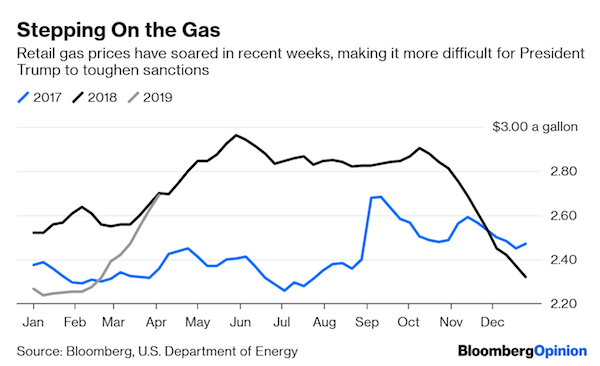
This trend contradicts Hook’s assertion that the US is “on the fast track to zeroing out all purchases of Iranian crude.” Three countries that got waivers have cut their purchases to zero, he added. In fact, those three countries—Taiwan, Greece and Italy—haven’t exercised their wavers at all since they were granted. Refiners in Greece and Italy have not received any Iranian cargoes since October, while Taiwan took its last delivery in September.
President Trump’s sanctions have been only slightly tougher than those imposed by his predecessor, despite offering fewer waivers. That will no doubt act as an additional spur for him to heap pressure on the country. But he is going to face difficulties if he wants to get much tougher on Iran next month.
Gas prices remain important to the president and their recent rise must be a source of concern.
The deteriorating situation in two of the “Shaky Six” oil-producing countries I identified a couple of weeks ago is also going to make toughening up the Iran sanctions more difficult.
Venezuela’s oil production is said to have plunged by half during blackouts that rolled across the country last month. Heavy tar-like oil began to solidify in pipelines and tanks after heating systems lost power, causing substantial damage that could take months to fix.
Sanctions imposed on Venezuela’s state oil company have accelerated the output decline, depriving Petroleos de Venezuela of its biggest buyer and the supplier of the light oil it needs to dilute the extra-heavy crude it produces. Output will fall further as the political crisis drags on.
Libya’s production is also at risk again as forces loyal to strongman Khalifa Haftar advance on the capital, Tripoli, threatening a major escalation in violence. Output rose above 1 million barrels a day last month for the first time this year, after the country’s biggest oil field was restarted following a three-month armed occupation. That recovery is now at risk again.
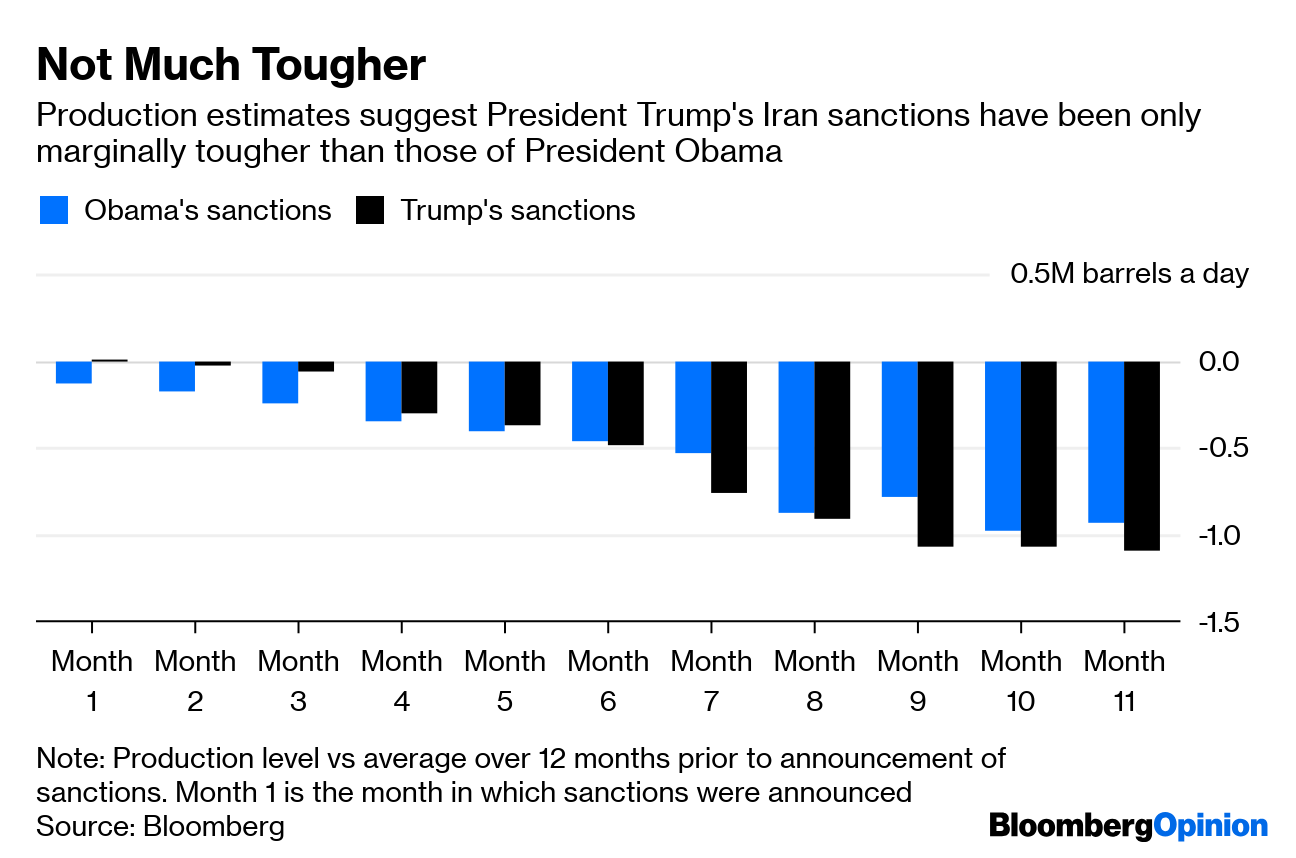
There are two things Trump can do, and his national security team is divided on the course he should follow.
He can allow the unused Iran waivers to expire, claiming a tougher stance without actually affecting oil flows, and perhaps trim the volumes that the remaining countries are permitted to import. Expect particular pressure on Japan and South Korea, who may be more willing than the others to acquiesce to US demands.
He can also continue to lean on Saudi Arabia and the rest of the OPEC+ group to raise output. The Saudis would be very happy to boost production at the expense of their rival, but they will be much less willing than they were last year to do that before seeing Trump actually impose tougher sanctions.
If he has to choose between lower gas prices and tougher Iran sanctions, domestic considerations will probably hold sway. Expect more tweets aimed at Saudi Arabia and OPEC, followed by an extension of five of the eight the waivers, probably permitting reduced volumes of purchases for some, if not all.
Photo Credit: IRNA

Iran Oil Exports: 8 Waivers and the OPEC Meeting
◢ Iran’s oil exports are likely to remain limited in 2019, with significant negative impact on Iran’s economy. Last month, the Trump administration reimposed sanctions on Iran’s energy sector as part of its ‘maximum pressure’ campaign against. But it nevertheless sought to prevent an unhelpful spike in oil prices ahead of the midterm elections. As a result the United States issued eight waivers to importers of Iranian oil:.
This article was originally published by the European Council on Foreign Relations.
Last month, the Trump administration reimposed sanctions on Iran’s energy sector as part of its ‘maximum pressure’ campaign against Iran. But it nevertheless sought to prevent an unhelpful spike in oil prices ahead of the midterm elections. As a result the United States issued eight waivers to importers of Iranian oil: China, India, Japan, South Korea, Turkey, Taiwan, Italy, and Greece. The waivers allow these countries to import a limited amount of oil from Iran without falling foul of US sanctions.
The ‘waiver effect’ was visible from the outset: oil prices dropped the day the waivers were announced. At the same time the market expected other oil producers—particularly Saudi Arabia and Russia—to cut back their temporary production, which had increased over the previous few months to cover Iran’s drop in production. Saudi Arabia and Russia agreed to this at the 7 December OPEC meeting.
The waiver decision initially appeared to be a major setback for the US ‘zero oil’ policy. Yet these eight waivers had a significant impact on the psychology and expectations of the oil market. They have created a perception that there will be an oversupply in the market in the short term, and at least through to the end of 2019.
Now, weeks on from the granting of the waivers, no guidelines or details have been announced publicly with regard to how much these countries will be able to import. This has created confusion in the market as to how much Iran will produce up to April 2019, when the 180-day waiver issued for most of these countries is set to end. Upon the announcement of the waivers, many market analysts had anticipated that Iran’s oil exports would increase to 1.5 million barrels per day (mbpd).
However, the reality could be more complicated. Iran’s oil exports are actually unlikely to increase beyond 1.1 mbpd. At most, they could increase to 1.3 mbpd if market conditions are tight and there is not enough supply in the market. And if China decides to ramp its imports back up to 500,000-560,000 barrels per day (bpd) Iran’s oil exports could increase even further, up to 1.5 mbpd.
Several factors prevent Iran oil exports from increasing significantly over the 180-day period.
China
Under the 2012-15 Obama-era nuclear sanctions, China imported roughly 440,000-530,000 bpd from Iran. However, in October 2018, in light of incoming US sanctions, its imports dropped to about 300,000 b/d. Chinese companies heavily invested in the US are worried and cautious about compliance with the sanctions. China National Petroleum Company—Iran’s largest oil consumer in China—reportedly halted its imports in October and November in order to prevent any potential risk against its business and investment interests in the US. Even though the company announced that it might resume imports from Iran, the market does not expect imports to exceed more than 300,000-360,000 bpd. Adequate market supplies provided by Saudi Arabia’s and Russia’s production mean the Chinese are disinclined to import more ‘problematic’ Iranian oil.
Besides US sanctions exposure for Chinese companies, the ongoing trade negotiations with the US are likely to influence China’s decisions. The US government is granting—on a case-by-case basis—waivers on export tariffs to Chinese companies for their trade with, and exports to, the US. It is likely that major companies and the Chinese government are exercising caution with their oil imports from Iran to avoid other sources of tension with Washington. CNPC has also recently suspended its investment in Iran’s South Pars giant gas field in order to minimise tensions over the trade negotiations. It is noteworthy that Saudi Aramco recently singed five new crude oil supply contracts with China to supply its new refinery capacity in 2019. This will significantly increase Saudi Arabia’s market share in China, reaching a total of about 1.6 mb/d. Saudi Arabia exported an average of about 1 mbpd of oil to China in first 10 months of 2018. This will increase Saudi Arabia’s market share in China by about 11 percent on 2017.
Simply put, China is using its Iran oil imports as part of its tariff negotiations with the US. This is spilling over into China’s own negotiations with Iran. Knowing Iran’s limitations for export, Bejing is bargaining hard and strong with Tehran over prices and delivery conditions. China was very late to issue oil purchase orders to National Iranian Oil Company for the month of November. Chinese refineries waited late – the third week of October—to submit their purchase orders to Iranian authorities.
Limited Shipping Capacity and Payment Issues
Iran’s oil exports have dropped significantly since August 2018 following the implementation of the first round of US secondary sanctions. These put strict limitations on Iran’s oil insurance and shipping. Most of the oil shipped since then has gone through the National Iranian Tanker Company (NITC), even oil shipments to China. Lack of access to adequate insurance has increased the risk of shipping. Most tanker owners are either unwilling to rent their tankers for shipping Iranian oil cargoes or are demanding very high leasing premiums. Hence, importers are mostly relying on NITC to deliver their oil cargoes. This has also impacted on Iran’s refined petroleum products and petrochemical export.
Historically, and in the months since August, NITC’s oil shipments stood at between only 1-1.1 mbpd; this too will prevent Iran from increasing its exports. This is especially the case for Iran’s allocated shipping export capacity to the European Union countries holding waivers (Italy and Greece), as most of its domestic shipping capacity is busy delivering oil to its customers in Asia. Meanwhile, like China, European countries will remain wary of the risks of importing Iranian oil even with the waivers in place.
Sanctions limit Iran’s access to its oil income in the form of cash and hard currency. Due to the latest US sanctions, importers of Iranian oil have to keep Iran’s oil revenues in an escrow account, and Iran can use this credit to purchase certain goods or services. Even for these clients, payment restrictions could also keep oil purchases lower than Tehran hopes. China, India, and Turkey have diverse trade relations with Iran and in theory could pay for Iranian oil with goods such as food and medicine. However, for countries such as Japan and South Korea, paying back Iran’s oil money is complicated. In the case of South Korea, Iran recently signed a food-for-oil agreement. However, there are limitations in terms of volumes and diversity of Iran’s required food from each particular country. Iran has not signed any similar contracts with Japan yet. Auto and electronics industry owners in Asian countries are highly hesitant to barter their products with Iranian oil money, again because they fear losing one of their largest markets: the US.
OPEC
The uncertainty over Iran’s oil exports created a difficult decision-making environment for OPEC members and their non-OPEC allies during their 7 December meeting to finalise a decision over production cuts. This decision aimed to maintain market balance. OPEC and Russia finally agreed to cut their production by 1.2 m/bd, of which OPEC will cut 800,000 b/d and non-OPEC countries (mostly Russia) will cut about 400,000b/d. This volume is in line with Iran’s oil exports of 1.1-1.3 mbpd until the end of the 180-day period. Russian and Saudi Arabian oil production had increased to historic highs in the past few months.
Saudi Arabia in particular came under pressure to reduce its production and generate higher prices, to in turn maintain domestic budget balances. Given the recent warm political, energy, and investment ties between Russia and Saudi Arabia, Russia supported Saudi Arabia’s target for higher oil prices. If not Saudi Arabia’s oil price target of USD 70 per barrel, Russia is supporting at least price range of around USD 60-65 per barrel. Russia also agreed to join OPEC members in a further production cut.
Another significant outcome of this meeting was that Iran was excluded from any production or export cut as its production and export is already below its usual capacity due to the sanctions. In November, Iranian crude oil exports fell slightly below 3 mbpd. The sanctions have not only had a significant impact on Iran crude oil exports, but they have also had a negative impact on Iran’s petroleum product exports. This means that some Iranian refineries are unable to run at full capacity given their export limitations.
A variety of factors are set to impact on the oil market and Iranian oil exports. If the market is adequately supplied and prices remain relatively low, even importers that have received waivers will have little incentive to import oil from Iran. With the prospects of US export capacity rising in 2019 and Saudi Arabia’s and Russia’s own considerable export capacity, Iranian oil exports of 1.1-1.3 mbpd or even less may ensue. If prices remain low countries with waivers may still choose not to import oil from Iran even up to the level for which they received the waivers. Taiwan, Italy, Greece, Turkey, and Japan might behave in this way if they are not convinced that the economic profit of importing Iranian oil is not greater than the risks related to shipping and insuring Iranian oil cargoes. Iran’s oil exports are likely to remain limited in 2019, and so the country’s annual budget for 2019 is based on an export of 1.5 mbpd. This could have a significant negative impact on Iran’s economy—particularly if oil prices remain relatively low throughout 2019.
Photo Credit: IRNA

Could Trump Deliver Iran an Oil Windfall?
◢ The president’s recent statement that OPEC may have something to do with the president’s own decision to create a crisis with Iran. While attention is duly paid to how much Americans have to pay at the pump, a more subtle and complicated story will soon play out with respect to Iran and the reapplication of US sanctions ordered by Trump on May 8, 2018. In fact, unless oil prices are contained, the primary result of the president’s action may be to ensure that Iran profits from the oil market risks that sanctions have created.
This article is republished here with permission from the Columbia University Center of Global Energy Policy.
The president’s recent statement that OPEC should reduce their prices may merely be an attempt to assign blame for rising gasoline prices in the midst of the US driving season or an even more cynical attempt to rally his political base in opposition to globalism. Or, it may have something to do with the president’s own decision to create a crisis with Iran. While attention is duly paid to how much Americans have to pay at the pump, a more subtle and complicated story will soon play out with respect to Iran and the reapplication of US sanctions ordered by Trump on May 8, 2018. In fact, unless oil prices are contained, the primary result of the president’s action may be to ensure that Iran profits from the oil market risks that sanctions have created.
In Theory
A simple chart helps to bear out the point. Figure 1 is a representation of three important data points: how much oil Iran might be able to export on a given day, the price of its oil, and its daily revenue. On May 8, Iran exported approximately 2.4 million barrels per day (bpd) of oil. On that day, oil was trading at approximately USD 75 per barrel. As a result, we can assume that Iran’s oil revenue for that day was USD 180 million (as reflected by the red line).
Figure 1: Daily Oil Revenue at Various Prices and Export Volume
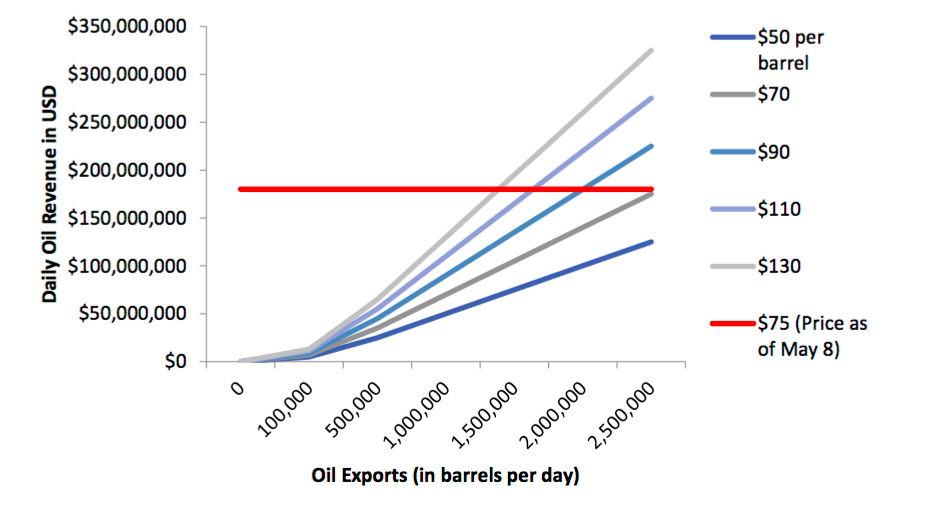
If instead oil had been trading at USD 130 per barrel on that day, Iran would have earned over USD 310 million. And if oil had been trading at USD 50 per barrel, Iran would have earned only USD 120 million—in all, a fairly straightforward math problem to solve.
Where things get more complicated is when one takes into account falling Iranian oil exports and potentially rising oil prices.
Naturally, if oil prices remain roughly the same, every lost barrel of Iranian oil exports means a real economic loss to the Iranian government. If Iranian oil exports decrease from 2.4 million bpd to 1.5 million bpd, Iran will experience a loss of approximately USD 67 million in its revenue stream. Taken over the course of a year, this would mean lost national revenue approaching USD 25 billion, a substantial sum for a country with significant economic problems and strained liquidity.
However, if oil prices go up, then—as Figure 1 shows—the immediate revenue impact of sanctions can be mitigated, potentially entirely. The red line’s intersection with various price curves shows this: at USD 130 per barrel, Iran need only export 1.38 million bpd to average the same daily revenue as at USD 75 per barrel with 2.4 million bpd in exports. With a more conservative oil price increase—for example, to only USD 100 per barrel—Iran would generate the same revenue if it exported only 1.8 million bpd.
But of course, the effects are magnified when an entire year’s worth of sales is factored in, as Table 1 demonstrates.
Table 1: Annual Revenue for Average Export Rates
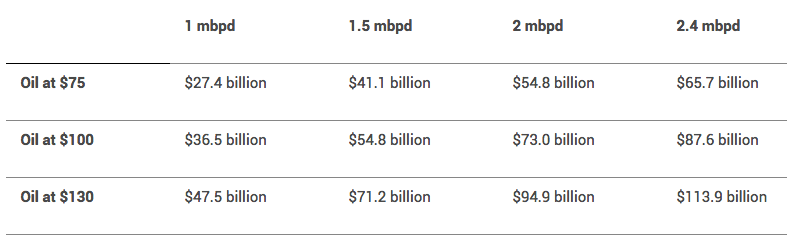
Even if the Trump administration is able to reduce Iranian oil sales to 1 mbpd, at higher oil prices, Iran’s ability to compensate is substantial. A more meager reduction, matched by higher prices? Iran might profit.
In Practice
There are myriad reasons why a simple mathematical abstraction is incapable of capturing the diversity of reactions and feedback loops that will determine Iranian oil sales and revenues. It is worth noting in this context that US officials had similar concerns that removing Iranian oil from the market would cause prices to go up during the 2011–2013 Iran sanctions experience and that these fears were ultimately unfounded. Arguably, this came because of the moderation shown by the Obama administration in its demands for reductions—20 percent every 180 days—and the revelation of US shale oil production. But still, it is an indication that unexpected forces can intervene.
To start, prices are in part set by supply and certainly by expectations of supply. To the extent that Iranian supply is not taken off the market, then this will have a moderating impact on prices, slowing their rise and ensuring that Iran bears the brunt of the sanctions pressure. The same would apply if additional supply were to be added by other producers, though finding 2.4 million bpd to add to the market by November 4 is not possible. By the same token, if the United States were able to prevent Iran from exporting any oil, then any increase in price would also not be enjoyed by Iran, no matter how high prices might go. Of course, the higher prices would be felt elsewhere in the global economy and back home in the United States. But from the simple perspective of “putting pressure on Iran,” such a scenario would mitigate the dynamics discussed here.
Moreover, oil revenue is not a perfect proxy for sanctions pressure on Iran. One of the elements of US sanctions against Iran is that Iran is barred from freely accessing its revenues held in foreign banks. Instead, per US law, banks are required to make Iran’s funds available only for bilateral trade or for the purchase of humanitarian goods. Any banks that fail to abide by these restrictions can be prohibited from opening or holding correspondent bank accounts with U.S. financial institutions – effectively banned from doing business in the United States. With this in mind, even higher oil prices and record Iranian oil revenues might not meaningfully buttress the Iranian economy if those revenues are locked up in foreign banks. But this in turn requires assumptions to be made about the level of cooperation that the United States might enjoy in sancitnos implementation. Many banks in Europe and in Asia will resist provoking US sanctions and isolation. Some, however, may decide it is worth the risk, as Chinese Bank of Kunlun did in 2012 when it was sanctioned by the United States. It remains a reasonably profitable institution, notwithstanding US sanctions, and may even become more so if other Chinese transactions with Iran were to flow through it. There is nothing in particular to stop other banks in other countries from pursuing the same path, if they determine the cost is worth the benefits.
This in turn informs another important element: whether all of this will matter in affecting Iranian behavior. From 2012–2013, the United States denied Iran over $50 billion in oil sales and prevented it from using billions more that were held in banks around the world. The result, at least in part, was the negotiation and implementation of the Joint Comprehensive Plan of Action (JCPOA). That might not be the result of another round of sanctions. Diplomacy with the United States has lost its luster in Iran, and its leaders are now talking about the possible use of military instruments to blockade the Persian Gulf, as they have in the past. Even if this extreme scenario does not come to pass, the idea that Iran’s response to renewed economic pressure would be to deal with the United States and to offer further concessions than in 2013–2015 is, at this point, hopeful speculation. There are many different factors that could undermine this hope, from the practical (Will any US partners work with the United States on sanctions?) to the theological (Would Iran be prepared to negotiate with the "Great Satan" again?). Even more importantly, these factors will interplay with one another in ways that we may not be able to anticipate at the outset.
One factor, to be sure, will be the effect of sanctions on oil prices. Given the risks of this strategy, one need hope the United States has a better plan than badgering OPEC.
Photo Credit: EPA/Shutterstock

As Trump Goes Nuclear On Iranian Oil, Europe Must Match His Brinkmanship
◢ As the US chooses the "nuclear option" on Iran's oil, Europe must find leverage and force the US to walk back on its announced policy of driving down Iranian oil exports to zero. The negative consequences for European economy could prove significant, and the risks of regional escalation are high. There are three measures that the EU can pursue to pressure Trump and prevent a dangerous escalation.
This article was originally published in LobeLog.
In the view of veteran observers of the oil industry, Trump has “gone nuclear.” Speaking during a background briefing on Tuesday, a senior state department official announced that the the Trump administration wants to completely eliminate imports of Iranian oil by its current customers. The official told journalists that, during a tour of countries that has already begun with a visit to Japan, U.S. officials will be “requesting that their oil imports go to zero, without question.”
Until recently, there had been an expectation that the Trump administration would issue significant reduction exceptions as was the case under the Obama administration, allowing countries to sustain some level of imports from Iran if significant reductions take place. Indeed, the guidance issued by the U.S. Treasury on May 8 following Trump’s withdrawal from the Joint Comprehensive Plan of Action, made specific reference to significant reduction exceptions as part of the reapplication of oil sanctions. These exceptions were to be devised following “the Secretary of State, in consultation with the Secretary of the Treasury, the Secretary of Energy, and the Director of National Intelligence” as consistent with “past practice.” A survey of oil analysts conducted by S&P Platts after May 8 suggested that “US oil sanctions on Iran will likely have an immediate impact of less than 200,000 bpd and will block less than 500,000 bpd after six months.” The announced policy is akin to a reduction of over 2 million barrels per day.
Something seems to have shifted during the OPEC meeting. As reports emerged that Japan had been asked to cease its imports of Iranian crude, Bijan Zanganeh, Iran’s oil minister, engaged in expectation management. During an interview with Bloomberg Television, he stated, “I don’t believe [the Japanese] can receive a waiver from the United States,” adding that Iran would need to “find some other way” to mitigate the effect of the oil sanctions. With Saudi Arabia cavalierly announcing that it will boost its production to record levels in July, it is easy to see how a Saudi commitment to raise production would have been coordinated with an American effort to eliminate Iran’s export market entirely.
To this end, Iran is facing the most serious challenge to its economy and political integrity to date. The Trump administration has taken its avowed commitment to exert “unprecedented financial pressure” far beyond the realm of coercion and into the realm of destruction. For Iran’s government, which receives about half of its revenues from oil sales, the prospects are grim. Of course, such an outcome is consistent with the regime-change goals of the Trump administration and its regional allies. They are seeking to engineer a collapse from within. But what is seemingly unaccounted for in such a scenario is the immense risk of regional chaos and conflict if they push Iran’s government to the brink. The risk is not merely that instability will lead to violence and mass displacement that could spill beyond Iran’s borders, but more likely that when faced with a near-existential threat, Iran’s ruling elite will seek to regain leverage in the most destructive ways possible.
In one plausible scenario, the Iranian reaction to the total embargo of its oil sales will be to try and impose a physical blockade on Saudi exports by closing the Strait of Hormuz and engaging in a new “tanker war.” The threat to close the strait has been a constant feature of hardline rhetoric from Iran over the years, and the move is easier said than done. But any suggestion that Iran could escalate in such a manner would no doubt spook oil markets—about 18 million barrels per day, equivalent to 20 percent of global supply, pass through the strait each day.
European Response
The prospect of a global oil crisis spurred by Trump’s brash move to deny waivers should frighten European leaders. Aside from the risks of confrontation in the region that would stem from any blockade attempt, the knock-on effects of an even short-term supply crisis could send the already fragile Eurozone economies into a recession. European officials have been quick to note the risks, characterizing the move as “really unhelpful and part of an escalation plan” and declaring that Europe “strongly disagree[s] with this plan.”
The timing could not be more fraught for Europe, which had been expected to present its long-awaited package of economic measures to Iran in the next week. These measures, intended to help incentivize Iran’s continued compliance with the JCPOA in the face of U.S. sanctions snapback, will have little meaning if the preservation of oil imports cannot be assured. Realistically, it will be difficult for Europe to find a way to maintain a viable importation mechanism in the absence of exemptions. If circumvention is not an option, Europe must find new leverage and compel the United States to change its policies. There are three actions that can be taken.
First, European governments must buy themselves and Iran time to reduce the chaos factor. Accelerating and increasing imports of Iranian oil over the next few months, basically allowing Iran to frontload its expected 2019 exports before the sanctions deadline kicks in, would help ensure that Iran retains an ability to sustain the rising pressure. Indian imports of Iranian oil surged in May in anticipation of the U.S. sanctions. European governments should, as a matter of national security, use any excess storage capacity to purchase as much Iranian oil as possible. In order to encourage Europe’s more independent oil traders and refiners to take on these purchases, Iran would need to offer attractive commercial terms in something akin to a flash sale.
Europe should also consider its own coercive measures. American oil exports to Europe have recently reached levels of around 500,000 barrels per day, levels approaching those of Iran. It would be relatively straightforward for Europe to declare that it will seek to eliminate imports of American oil to Europe as a countermeasure for Trump’s move to ban Iranian imports. The impact on the oil-producing American heartland and Trump’s political base could be profound. Importantly, Europe would not necessarily seek to use sanctions in order to enforce such a move. Sanctioning European companies that trade American oil would inhibit the ability of these multinational companies to pick up supply from other producers worldwide. A much more elegant way to impose a cost on the Americans would be to take a page out of the tariffs playbook. Imposing a hefty oil-import tariff would make it commercially unattractive for refiners to important American crude, and so the decision to cease importing American oil would technically be a voluntary decision rather than a decision requiring legal enforcement.
Sanctioning Trump
Finally, European entities could target Trump’s personal assets as damages for the costs incurred due to his prohibition on Iranian oil imports. Congressman Keith Ellison (D-MN) and Vox editor Matthew Yglesias have both recently argued that sanctioning Trump personally may be the best way to change his behavior. As Ellison puts it, “Sanctions targeting Trump’s own companies will sting in a way that he cannot ignore.”
But there may be a more elegant solution already at Europe’s disposal. The EU has initiated the revival of the so-called Blocking Regulation, a 1996 EU law designed to prohibit compliance with US sanctions by EU companies. The regulation includes a “clawback provision” that provides a mechanism for EU entities to sue for damages for costs arising from sanctions. The recovery of damages “may be obtained from the natural or legal person or any other entity causing the damages or from any person acting on its behalf or intermediary.” This broad definition could clearly be extended to Trump.
Moreover, the “recovery could take the form of seizure and sale of assets held by those persons, entities, persons acting on their behalf or intermediaries within the Community, including shares held in a legal person incorporated within the Community.” In short, Trump’s property and assets in Europe could be seized and sold. Given that the assessed costs related to a complete cessation of Iranian oil imports could easily amount to billions of dollars, Trump could ostensibly be threatened with the total seizure of his Europe-based wealth. Of course, the legal action probably would not need to go that far. Dragging the Trump Organization into European court would probably wake up Trump. He has a history of settling in the face of legal challenges, so a threat to his personal empire may force him to rethink his abuse of the American empire.
If Europe can muster the political courage to pursue these measures in the face of catastrophic security and economic risks introduced by the total oil embargo, it can gain the necessary leverage to push the United States to a more reasonable position. Europe must not rely on China or India or Turkey to skirt the U.S. sanctions. Given the immensity of the threat to global security arrangement represented by the abrogation of the JCPOA, and the global economic arrangement underpinned by the current composition of the oil markets, Europe must match Trump’s “nuclear option” with its own. Perhaps this kind of mutually assured financial destruction can bring the world back from the brink.
Photo Credit: IRNA

Cañete to Discuss Vital Central Banking Solution on Iran Visit
◢ Europe’s Commissioner for Climate Action and Energy, Miguel Arias Cañete is set to travel to Tehran this weekend. Cañete’s visit will include discussions on possible new payment mechanisms designed to allow Europe to repatriate oil revenues to Iran’s central bank despite despite Trump’s withdrawal from the nuclear deal, offering a vital lifeline for the Iranian economy as sanctions begin to bite.
In a statement released Friday, European Commission president Jean-Claude Juncker declared that the Commission has a “duty… to do what we can to protect our European businesses, especially SMEs.”
As Europe steps-up its efforts to fulfill that duty, the commission took two concrete steps, launching the formal process to revive the blocking regulation that will prohibit EU companies from “complying with the extraterritorial effects of US sanctions.” The regulation also “allows companies to recover damages arising from such sanctions from the person causing them.”
The European Commission also launched the formal process to enable the European Investment Bank (EIB) to finance activities in Iran under an EU budget guarantee. Helga Schmid, Secretary General of the European External Action Service, first announced that EIB would be receiving such a mandate, at the Europe-Iran Forum, a business conference organized by Bourse & Bazaar, in October 2017.
Friday’s statement further highlighted the pending visit of Europe’s Commissioner for Climate Action and Energy, Miguel Arias Cañete, to Tehran. The visit, which will take place over the weekend, is a continuation of a program of “sectoral cooperation” launched in 2016.
But the most significant announcement was the news that the European Commission is “encouraging member states to explore the possibility of one-off bank transfers to the Central Bank of Iran” in order to assist Iran in receiving “oil-related revenues, particularly in case of US sanctions which could target EU entities active in oil transactions with Iran.”
Experts have pointed to the creation of channels for such transfers as an important short-term measure. A report published earlier this month by International Crisis Group, suggests enabling “pertinent European central banks to process related payments” as a means of “empowering those in the Iranian leadership who advocate continued compliance with the deal.”
Speaking on background, an EU official confirmed that Cañete’s visit would include “discussions on how the mechanics of all of this would work.” European authorities have identified two priorities: “One is to work out how you can facilitate payment of Iran for imports of oil to the European Union. But, secondly and equally importantly, the repatriation of Iranian funds that are currently in the European Union.”
The emphasis on repatriation is especially important as Iran seeks a route to sustained economic growth despite the snapback of primary and secondary U.S. sanctions. Economists have identified that increased public investment could help Iran achieve growth in the absence of the foreign investment that had been expected to follow the lifting of sanctions in 2015. Typically, half of Iran’s oil revenues are earmarked for the government budget, and a just under a third of revenues are allocated to the National Development Fund.
During recent consultations, experts from the International Monetary Fund implored Iranian authorities “to explore the scope to use oil revenues to fund bank recapitalization, and noted the importance of replenishing the Oil Stabilization Fund to provide the budget a buffer.”
Seen in this context, oil revenues are a lifeline for the Iranian economy. As Iran’s economy begins to lose momentum in advance of full sanctions snapback, Iranian business leaders and consumers will be watching intently to see if Europe can keep oil flowing in and revenues flowing out.
Photo Credit: Wikicommons

Iran’s Energy Sector Takes Stock After Year of Ambivalent Results
◢ The last Iranian year, which ended in March, saw several interesting developments for Iranian energy, both domestically and internationally. Despite persistent challenges, Iran is keen to build on the momentum of last year’s developments. In doing so, the question of whether the Trump administration will stay in the JCPOA and renew sanctions waivers on May 12 will have great importance.
This article was adapted from a report originally published by the Oxford Institute for Energy Studies.
The last Iranian year, which ended in March, saw several interesting developments for Iranian energy, both domestically and internationally.
Numerous challenges remain, hampering the growth of the country’s energy industry – not the least due to complex politics in Iran and abroad. In particular, Iranian energy is overshadowed by mounting uncertainty due to the standoff over the future of the nuclear deal. Nevertheless, there has been progress not seen in years.
Internationally, Iran commenced natural gas exports to Iraq in June 2017. This was Tehran’s first successful natural gas export project in over a decade.
Moreover, Tehran concluded its first two international energy contracts following the introduction of a new fiscal scheme, the Iran Petroleum Contract (IPC), and the implementation of the Joint Comprehensive Plan of Action (JCPOA), as the nuclear deal is formally known.
In July 2017, Petropars formed a consortium with French major Total and China’s to develop the eleventh phase of the giant South Pars natural gas field. In March 2018, the National Iranian Oil Company concluded a contract with Russia’s Zarubezhneft and private Iranian company Dana Energy to increase output at the Aban and West Payedar oil fields.
These events constitute important milestones on Iran’s journey to re-connect with global energy. At the same time, it would be wrong to assume that the obstacles hampering the growth of Iran’s energy sector are now overcome—not only because of Trump and the uncertain future of the JCPOA.
Rather, in each of these cases, the circumstances have been rather unique. As for Iraq, close political ties with Baghdad allowed for the project to succeed. This distinguishes the Iraq project from other export plans, where political and commercial issues remain complicated—for example Oman and Pakistan (ongoing) or the United Arab Emirates (in the early 2000s).
Shortly after natural gas exports to Iraq commenced, the Total/CNPC contract was signed. But here, too, the circumstances are rather unique. First, the company has a long history with Iran and the complicated international politics accompanying the country’s energy sector. Already in the 1990s, the French company’s planned engagement in Iran played a key role in the EU’s action to push back against extraterritorial US sanctions. These were introduced by Washington under the 1996 Iran and Libya Sanctions Act (ILSA). In response to ILSA (as well as US extraterritorial sanctions against Cuba), the EU introduced so-called “Blocking Regulations” legislation and filed a dispute against the US at the World Trade Organisation.
The EU’s moves forced the Clinton administration into adopting sanctions waivers, which suspended the implementation of US secondary sanctions and allowed Total to proceed in Iran. Ever since, despite being forced to leave the country in 2010 due to EU sanctions, Total has remained committed to Iran, openly criticised sanctions against the country, and always kept its office in Tehran open—different from other companies.
Second, Total is able to bring its own finance to Iran. The company affords the initial $1 billion investment from its own reserves. With the reluctance of major international banks to return to Iran, fearing punitive measures by the US, finance for large projects remains a huge problem. Being able to bring its own finance sets Total apart.
Last but not least, Total is investing in Iranian natural gas, not oil. In the political economy of Iranian energy, the two hydrocarbons differ markedly. More than half of Iran’s oil production is exported, while less than 5% of the country’s natural gas output is sent abroad. An advancement of Iranian natural gas capacities frees some oil for exports. But the link between increases in production and export revenue is much weaker. Thus, investing in natural gas does not immediately lead to more hard currency at the disposal of the Iranian state.
In light of this, a case can be made that investments in Iranian natural gas projects are more acceptable to Washington than oil. At any rate, both before and after the conclusion of the South Pars contract, Total has frequently acknowledged the importance of the US position for its engagement.
Iran’s second international energy contract, with Zarubezhneft, was particular, too. It combined two firsts in one contract: the deal marked Iran’s first upstream contract with a Russian company and also the first international contract awarded to a private Iranian company, Dana Energy.
Beyond this, the deal is further testimony to the fact that Zarubezhneft, controlled by the Russian government, seems unimpressed by the Trump administration’s harshening stance towards Iran. Unlike Western IOCs, Russian (and also Chinese) state-owned companies might benefit from being able to take a different position when it comes to assessing political and economic risks related to Iranian energy.
The significance of different risk-assessments cannot be underestimated: Iran’s energy sector continues being surrounded by multiple and complex political and economic challenges. These include ample supplies in global energy, efforts by conventional producers to keep barrels away from markets, domestic political opposition to international and especially Western companies in Iran, and—almost overshadowing everything else—the prospect of the US leaving the JCPOA.
Parallel to the ups and downs at the international level, the domestic politics of Iranian energy saw interesting developments, too. In January 2018, Supreme Leader Khamenei reportedly told the Revolutionary Guards (IRGC) to divest from those parts of their wide-spanning business conglomerate that are “irrelevant” to their core purpose. If followed up by meaningful action, this would have wide-ranging consequences for Iran’s energy sector, where the IRGC maintain a considerable presence.
However, several economic and political questions in this regard remain unresolved until now. Politically, it will need to be defined which of the IRGC’s economic activities are actually considered being “irrelevant." Arguing Iran should reduce international dependencies, conservatives might call for the IRGC to maintain a certain presence in strategically vital sectors, including energy. Economically, it is unclear who could actually take over businesses from the guards. Considering the sheer size of the IRGC’s economic holdings, Iran’s private sector seems unprepared to stem a larger IRGC divestment. Meanwhile, foreign ownership remains highly problematic in Iran.
All this suggests that IRGC divestment from the energy sector and the broader economy would at best be slow and gradual. Somewhat, the process has already begun as the administration of president Rohani reduced the number of public contracts awarded to the IRGC in recent years. Still, the IRGC have yet to indicate their willingness to actually divest. It would therefore likely take years until the IRGC have meaningfully reduced their economic profile.
Moving forward, Iran is keen to build on the momentum of last year’s developments. In doing so, the question of whether the Trump administration will stay in the JCPOA and renew sanctions waivers on May 12th will have great importance.
At the same time, a withdrawal of the US from the JCPOA and the re-imposition of nuclear-related US sanctions would not immediately bring Iran back to its pre-sanctions position. In particular, it is unlikely that Tehran’s oil exports would collapse to pre-JCPOA levels.
Europe’s role is crucial here: As long as Tehran fulfils its commitments under the JCPOA, the EU is unlikely to bring back its energy and finance sanctions against Iran. These, however, were deceive in forcing down Iranian oil exports by more than half after 2012.
Some Asian countries, most likely Japan and South Korea, might voluntarily reduce parts of their imports of Iranian oil. But without Europe joining the sanctions effort, the re-imposition of US nuclear sanctions is unlikely to dramatically affect Iranian oil exports.
Nevertheless, if the US decides to withdraw from the JCPOA on May 12th, this would obviously still hit Iranian energy hard. Very likely, it would effectively prevent further European IOCs from engaging in the country—and thereby significantly hamper the growth of Iran’s energy sector.
Photo Credit: AP/REX

Long-Awaited Total Deal Signals Rising Investor Confidence in Iran
◢ On Monday, Total will sign a long-awaited USD 5 billion deal to develop Iran's South Pars gas field, becoming the first international oil company to commit to a post-sanctions investment.
◢ The Total deal indicates rising confidence that political and banking challenges can be addressed, and the contract signing will likely buoy investor confidence across sectors.
On Monday, Total will sign a long-awaited contract to develop Iran’s South Pars gas field in cooperation with China National Petroleum Company and Iranian firm Petropars. Total has been involved in developing the South Pars project since 1997 when it was the first international oil company to be awarded a contract following the Islamic Revolution. The landmark deal, which sees Total committed to a 20 year development roadmap, is valued nearly USD 5 billion. Total's share is 50.1%.
The announcement of the contract signing ceremony follows eight months of deliberations since the heads of terms was signed in November 2016. In the intervening period, Total has had to navigate a changing political environment, stubborn banking challenges, and wavering investor confidence. The move to conclude the contract signals positive developments in each of these three areas.
Total CEO Patrick Pouyanné, who has shown some bravado by speaking publicly about this deal as it progressed, had stated in February that progressing to a contract was contingent on the U.S. continuing its implementation of secondary sanctions relief as part of the Joint Comprehensive Plan of Action (JCPOA). With the increasingly hostile rhetoric of the Trump administration, continued sanctions relief had remained in doubt. But the administration has since confirmed Iran's compliance with the JCPOA and issued the relevant sanctions relief waivers in mid-May. Just a few days later, Iranian president Hassan Rouhani won a landslide reelection, solidifying his mandate to pursue international engagement and investment.
Total will also feel secure in the fact that European government leaders have been very vocal in their support for Iran and the nuclear deal. Federica Mogherini, Theresa May, Angela Merkel, and a host of European ambassadors have strongly advocated that the US stay the course with the nuclear deal both at the White House and on Capitol Hill. Looking together at these factors, Total must feel confident that the political environment remains conducive to the company's long-term investment in Iran.
At a more practical level, Pouyanné had acknowledged in April that Iran’s as-of-yet unsolved banking challenges were an impediment Total’s investment. The hesitance of international banks to provide financing or facilitate the recurring transactions necessary for day-to-day business in the country required Total to make a special effort to find its own solution. Pouyanné disclosed that Total was testing a new banking mechanism to get money in and out of Iran in a compliant way. This likely means that a medium-sized bank, probably French, has carved out a channel for Total to transfer funds to Iran without involving U.S. persons or U.S. dollars, thereby avoiding a so-called “U.S. nexus.”
While major European banks remain hesitant to do this kind of creative banking for Iran transactions, boards of directors are showing an increasing willingness to make exceptions on behalf of their largest clients and at the behest of national governments. Total's move suggests that the banking channel they created works, and this fact may help other large firms in their negotiations to receive banking facilities for Iran business.
Finally, Total’s contract signing will no-doubt boost confidence across sectors among both international and domestic investors. While Boeing and Airbus have notably concluded major contracts prior to the Total deal, the agreements for the sale of aircraft represent large-scale trade. The Total deal, which involves direct ownership and operation of physical, immovable assets in Iran, is true foreign direct investment with all of the attendant risk. That Total is proceeding is even more impressive considering the company will not start seeing revenues until 2021, when it has committed to bringing the first new gas to Iran's large domestic market.
Additionally, proceeding to a full contract reflects that Total was satisfied with the terms of Iran's new standard oil and gas contract, known as the IPC contract. While Total’s clear desire to be the first-mover in Iran’s energy sector has meant that they have been somewhat more willing to overlook the known deficiencies in the IPC model, fear of missing out may see peer companies like Shell, Eni, and OMV decide to press forward with their own investment plans within the existing IPC framework.
For Iran, the true value of the Total deal lies outside the oil and gas sector, which only accounts for about one-fifth of the country's economy. Rather, it is the investor confidence furnished by the Total deal, which will spur activity in other areas like infrastructure, transport, pharmaceuticals, and FMCG, that will really move the needle. Investors in these sectors will no-doubt welcome the deal as the sign of a rising tide.
Photo Credit: Wikicommons

Extention of Key Incentive Scheme Boosts Iran's Renewable Energy Market
◢ The recent extension of Iran's Feed-in-Tariffs scheme has renewable energy investors pushing to close deals in the next 12 months to take advantage of the strong government incentive packages.
◢ But FiTs won't last forever, and Iranian energy authorities are working to improve the general mechanisms that support foreign investment in Iran's renewable sector, including the use of Iran's first competitive bidding tenders for renewable energy projects.
Since the lifting of sanctions, Iran’s renewable market has emerged as an exciting destination for international green energy developers and investors. Growth can largely be attributed to a generous Feed-in-Tariffs (FiTs) scheme and the government’s continued effort to promote policies that, in combination, aim to strike the right balance between promoting Iran’s renewable market, removing barriers to project deployment, and building the technical capacities of the domestic industry. By looking at some of the recent but important developments in Iran’s renewable energy (RE) market, including the nature of government policies, it becomes clear that the Rouhani administration has set a path for growth enabled by international investment.
Iran’s generous program of green subsidies has been the key determinant of the attractiveness of its renewable market, and with the government’s recent decision to maintain its current FiTs for another 12 months, the market is set to shift into a higher-gear. The extension of the FiTs scheme, which was delivered through a decree signed by the Minister of Energy in mid-March 2017, demonstrated the continued commitment of the government in sustaining the momentum of its favorable renewable energy investment landscape among many of its regional and international competitors. The consistency in the nature of Iran’s renewable policies in the last three years is by extension, a major confidence-building measure for developers and investors, whose interest in a given market is not cultivated by generous FiTs alone, but also by stable and predictable policy environment.
Interestingly, the recent extension Iran’s FiTs scheme comes at a time when in most of other markets across the globe, governments are either reducing, halting or terminating their FiTs schemes all together. This has been a major cause of concern for green developers and investors with huge vested interest in those markets. With a reduction in government incentives and flattened demand in the European market, green developers and investors are now eagerly looking into opportunities in other attractive markets. Iran comes at the top of the list.
Opportunities and Limits of Feed-in-Tariffs
The extension of Iran’s FiTs scheme presents a window of opportunity that will not be around forever, and so the countdown has already begun for developers to take advantage of the existing rates by signing their Power Purchase Agreements (PPAs) with Iran’s Renewable Energy Organization (SUNA) prior to March 2018. In light of this, it is projected that this year SUNA will expand its pipeline of renewable projects to be developed by international developers in partnership with local partners.
Currently, Iran’s FiTs scheme stipulates a 20-year PPA framework that supports a series of 13 renewable plants. The structure of the scheme is deliberately designed to increase the solar and wind capacities of the country, while also encourage procurement of smaller-scale projects by offering higher margin of profit for systems under 10MW and 30MW capacities. The reason behind this policy is twofold. On the one hand, it allows an experimental approach, where the impact of the initial projects that are pending construction and connection in this fledgling market can be assessed, and on other hand, it enables for the competence and commitment of developers to be evaluated in smaller projects prior to issuing further licenses for larger-scale developments. For the most capable developers, Iran’s FiTs system and structure simply means a strategy of portfolio aggregation—that is, building smaller projects that can be aggregated at a later stage. Therefore, many of renewable projects that will mushroom across different regions of the country in the next 24 months will consist of solar photovoltaic plants with 10MW to 30MW of capacity.

Nevertheless, the success and growth of Iran’s RE market cannot not rest on its generous FiTs scheme alone. For example, rival renewable markets, such as UAE, Jordan and Egypt, are currently developing and deploying projects on a much larger-scale than Iran without even considering the need to offer a generous FiTs scheme. For example, the launch of Dubai’s recent large-scale 200MW solar project in March, which was implemented at a record-low bid of 5.6 cents per kilowatt-hour, was product of a competitive RE tendering scheme, which is an alternative means of engaging developers.
The rapid pace of progress in the region’s RE markets, has made Iranian authorities ever more conscious that in parallel to providing FiTs, they need to institute and maintain multiple complementary mechanisms, such as competitive bidding tenders. Taking this in mind, the recent announcement of Yazd Regional Electricity Company for its plans to hold Iran’s first RE tender on the development of a 150MW utility-scale solar project is precisely aligned with this new emerging strategy of Iran—that is, to maintain its current FiTs scheme for broadly incentivizing development projects on smaller-scale, while phase in competitive bidding tenders as a new complementary measure to support larger-scale projects.
Project Deployment Mechanisms
In parallel to government’s effort to incentivize this market in the last two years, SUNA has also been hard at work in addressing deficiencies in regulations, removing barriers-to-entry, and setting a viable and functioning mechanism for project procurement and development. Designing an effective implementation framework, is in many respects the most challenging part of the puzzle for new emerging renewable markets, such as Iran. It requires a significant deal of coordination between various bureaucracies and organizations, followed by a synchronization of relevant policies and regulatory frameworks that enable project procurement and development. The good news is that the Iranian RE market has made great strides in this regard. The successful launch of the 14MW Hamedan solar park in February 2017, followed with the upcoming launch of Esfahan 10MW solar park, would not have been possible without a functioning project development mechanisms.
The achievements of SUNA in responding to many of technical and non-technical impediments of project implementation framework and regulation deficiencies means that the organization can now expand its activities into other important areas, such as more active investment promotion activities.. This includes establishing and developing new synergies and facilitating dialogue with international RE bodies for learning best practises in areas of policy, technology and financial resources, while also engaging with both local and international financial investors to provide the necessary project finance facilities. The recent delegations from the International Renewable Energy Agency (IRENA) and the Norwegian Export Credit Guarantee Agency to Iran to hold meetings with SUNA reflect the increased communication and engagement of this organization with international stakeholders and bodies.
Building Technical Capacity
Support for renewable energy will not only bring numerous environmental benefits, but will also have significant economic yields for the country. The RE sector can important source of job growth should investment support local capabilities and infrastructure. Iran’s renewable market, despite in its infancy, has already inspired countless entrepreneurs to set up localized businesses in the value chain of renewable power generation and development solutions.
This has not gone unnoticed by the government, which has particularly designed its FiTs scheme in order to foster technical capacity within the industry. The program supports local businesses and entrepreneurs active in this field by allocating a premium of up to 30% on base FiTs rates to those projects that utilize locally-produced content. This premium is attractive enough to encourage international developers to maximize integration of domestically produced technologies, or to explore new local manufacturing of key components.
The next generation of Iranian electrical engineers and technicians has already demonstrated resilience, technical expertise and an entrepreneurial-mindset by not only creating and supporting the value chain of electricity generation of the country, but also exporting their services, equipment, and technologies to the regional markets. To demonstrate, Iran’s power industry, exported over USD 3 billion in electric engineering services and goods to the regional market last year. Aside from supportive policies, the long-term potential to use Iran as a launchpad for regional expansion, sets the country's renewable energy market apart from its regional rivals. Investors are beginning to take note.
Photo Credit: Financial Tribune

Emerging Privatization in Iran's Energy Sector Deserves a Second Look
◢ A preliminary agreement between OMV and Dana Energy heralds the push for privatization in Iran's oil and gas sector
◢ While the majority of contracts have been signed with state-owned oil firms, the new IPC framework enforces structures and management practices that support privatization
The recent news that Austrian oil firm OMV has signed a preliminary agreement with Dana Energy, Iran’s largest and perhaps most capable private oil exploration and production firm, heralds the future of Iran’s energy sector. The agreement between an international oil company (IOC) and a private Iranian energy company is a significant development, given Iran’s long-held promise to privatize its oil and gas industries. The goal of privatization has been a constant feature of the Iran’s five-year economic plans since the 1990s. As economic sanctions were tightened beginning in 2011, investment dwindled and policymakers focused on promoting self-sufficiency in the oil and gas industries. Without access to new equipment, new technology, or best-in-class expertise, Iran’s production collapsed. This decline threatened government budgets as Iran lost global market share. Very quickly, Iranian authorities realized that achieving self-sufficiency actually required foreign investment-- there were too many technologies and management practices yet to be mastered in Iran’s oil and gas industries.
Iran’s reentry into global energy markets has been one of the most heralded aspects of the sanctions relief afforded as part of the JCPOA nuclear deal. Within the larger scope of economic reform, there was a strong expectation that the Rouhani administration would push for a greater role for the private sector in Iran’s oil and gas industry, finally getting the program of privatization back on track. The commitment is evidenced by the several private companies included in the Ministry of Petroleum’s list of approved local E&P partners for new tenders.
However, the first oil production contract under the new Iran Petroleum Contract (IPC) framework was awarded to Persia Oil & Gas Industry Development, a quasi-state company affiliated with Setad (the entity decreed by Supreme Leader Khomeini that encompasses both publicly and privately held assets, including various industries, companies, and real estate holdings.) The awarding of the contract in October, 2016 raised concerns that Rouhani’s support for private enterprise in the energy sector was being blocked by entrenched interests. A recent report by Reuters examined the range of contracts awarded since Implementation Day. The report concluded that state-owned enterprises were winning the lion-share of the new business, including oil and gas sectors. Of the 110 major contracts examined (collectively valued at USD $80 billion), only 17 contracts, worth USD $14.6 billion, were granted to private sector businesses.

The primacy of state enterprise has raised concerns among policy groups in Europe and Washington that the economic benefits of the Iran nuclear deal are not driving economic liberalization. The concern is particularly acute in the energy sector, given the immense importance of oil and gas revenues to government budgets and the significant involvement of state entities such the IRGC in the extractive industries.
There are, however, several reasons why critics should remain optimistic about the prospects for privatization. The Reuters report overlooks important context for the evaluation of post-sanctions contracts, particularly in the energy sector. First, state enterprise was better positioned than the private sector to win the early post-sanctions contracts. The initial wave of economic interest in post-sanctions Iran was marked by delegations led by economic ministers. Naturally, these government-to-government efforts focused on deals in sectors where government-involvement remains high both in Iran and in Europe. While it is widely known that companies like Iran Air, MAPNA, and Iran Khodro are state owned, it is worth remembering that their potential foreign partners like Airbus, Siemens, and Renault count European governments among their major shareholders. In the short term, while political uncertainty remains high, economic activity will naturally favor state-owned or state-backed enterprises in both Europe and Iran.
Second, concerns about awarding contracts to state entities ignore the matter of the actual contractual obligations of the parties. This is particularly important in the oil and gas industry, where the new IPC contracts enshrine clear provisions that support privatization in the long term. While the former “buyback” contracts treated the IOCs as contractors who handed off exploration and production projects to NIOC for operation, the new IPC contracts call for joint-ventures between IOCs and a local exploration and production (E&P) partner at the contracting stage, with a similar joint-venture managing operations when the project is production-ready. Two such examples are the Shell and NIOC oil exploration agreement and Total’s gas deal with Chinese state oil firm CNPC and NIOC subsidiary Petropars. In both cases, the state ownership interests represented by Iran’s NIOC or China’s CNPC will be diluted in the exploration and operation joint-ventures through the participation of Shell and Total, major private sector shareholders. In effect, the next wave of companies that will own Iran’s production capacity will include foreign, private sector ownership, even if domestic private firms are frozen out. This aspect of the agreements represents a significant shift that is missed when merely identifying the signatories to the contract. The obligation of the signatories to own and operate the assets is paramount.
Another provision in the IPC contracts that supports the agenda of privatization hinges on the question of technical and managerial knowledge transfer. In this sense, privatization can be understood as the propensity to behave in a manner consistent with the norms of private enterprise. While Iranian state-owned enterprises may be winning the majority of oil and gas contracts in the near term, the means by which they are defining their cooperation with foreign energy companies has moved to new ground. The new IPC contracts took long to develop, not simply because of the terms that were being offered to foreign companies in Iran’s energy sector, but also because of the new obligations being placed on Iranian energy firms.
The new joint venture companies established as part of IPC contracts will need to operate to the standards of the major shareholders, namely companies like Shell, Total, and Norway’s DNO. When compared to the companies previously operating Iran’s oil and gas fields, these newly-minted JV firms will need to conduct business more transparently, all the while reacting to market forces and adopting the global best-practices on which foreign partners will insist. Indeed, the IOCs working in Iran are required by the IPC framework to “gradually transfer” managerial positions to Iranian nationals in order to “facilitate the process of know-how and managerial skills transfers to the Iranian party.” While it might be unreasonable to expect oil companies to transfer ideas like corporate social responsibility and environmental protection, more fundamental skills like corporate governance, robust accounting, and compliance and risk management will be critical to the successful operation of the new JVs and will therefore have to be transferred to Iranian managerial teams. The significance of this shift cannot be overstated. It would be meaningless to privatize companies that would continue the bad habits and poor management typical of Iranian state-owned enterprises. Moreover, a well-operated and responsible state-owned oil company is compatible with Western business practice. Italy’s Eni and Norway’s Statoil are good examples.
Overall, the privatization of Iran’s oil and gas industry is proceeding at a greater pace than what a cursory look to the active players would suggest. Given that the redevelopment of Iran’s energy sector is only at the nascent stages of a decades-long process, it is far too early to sound the alarm.
Photo Credit: OMV

Renewable Iran: Creating the Energy Network of the Future
◢ The global energy industry continues to find greater value in efficiency and clean technology, with a rapidly growing reliance on renewable energy. But Iran lags behind.
◢ Now that Iran prepares to once again open doors to the international business community, the time is right for renewables to have a greater role in the country’s energy mix.
The global energy industry continues to find greater value in efficiency and clean technology, with a rapidly growing reliance on renewable energy. For Iran and the Middle East however, oil and gas have hardly been challenged as the dominant industry forces. But now that Iran prepares to once again open doors to the international business community, we must ask if renewables can, or even should, play a greater role in the future of Iran’s energy sector.
So, what’s the problem?
Iran is the country with the world’s largest conventional gas reserves and is the world’s third largest producer of natural gas - behind the US and Russia. Given these abundant reserves and production, you have to question why has a country of Iran’s population been a consistent net importer of natural gas during the last decade. The answer is Iran has very high per capita consumption of gas and other fossil fuels, with much of it going into power generation. In 2014, Iran burned 50 billion cubic meters of gas for power generation: that is more than in the UK, Germany, Italy, and France combined. In fact, in 2013, Iran consumed more gas than China, and was the 8th biggest energy consumer in the world, despite being the 32nd largest economy (World Bank) and the 17th most populated country.
Moreover, according to the International Energy Agency (IEA), Iran is among the top ten global emitters of CO2. Iran is the top emitter in the Middle East and accounts for almost a third of the region’s total carbon emissions. Fossil fuels account for almost 98% of Iran’s total primary energy consumption.
Of the 70 gigawatts (GW) of power generation capacity installed in the country, only around 11 GW are low carbon sources with most of that hydro (10 GW) while 1 GW is nuclear, and 0.1 GW is either solar or wind. The rest is largely old, inefficient, and polluting fossil fuel power plants burning either fuel oil or natural gas. According to Iran’s Ministry of Energy, over the past decade electricity demand has grown by almost 6% annually, and is expected to grow by at least 2% - 4% through the end of the decade. There are now more than 30 million grid connected clients in Iran, compared to less than 20 million only ten years ago.
So, Iran faces the problem, how can it meet this rapidly growing electricity demand while reducing its consumption of gas and fuel oil to eliminate imports (and facilitate exports), reducing carbon emissions to more average global per capita levels, effectively addressing the challenging air quality issues, and still attracting foreign investment and new technology?
The Role of Renewables
The answer is likely to be found in a combination of a modernisation of its power generation capacity, greater energy efficiency, and much greater reliance on renewable forms of generation.
In terms of renewables, Iran is naturally blessed with very good solar and wind conditions. Iran receives around 300 days of sunshine each year, compared to less than 64 days in Germany, the world’s leader in solar power with almost 25% of the global solar power capacity. The Global Wind Energy Council stated that some of Iran’s mountainous areas in the west and northeast have unique wind corridors that have plenty of potential for renewable generation.
The Iranian government is starting to get that renewables should now be an important part of the country’s energy strategy. In early 2014, Iran’s Ministry of Energy unveiled its plans for adding some 5 GW of renewable power capacity, mostly wind, to the country’s power fleet by 2018. Since the beginning of 2014, construction for around 400 MW of renewable capacity has started, and contracts for more than 500 MW have been awarded. The Iranian government increased its budget for renewable energy by more than 400% last year to around $60 million; although still small, the growth is going in the right direction.
Iran has also adopted a number of new policies towards renewable expansion, using similar policies to many Western European countries and opening up the sector to foreign investors. The Ministry of Energy has set up the Renewable Energy Organization (SUNA) that will administer these policies that include a feed-in-tariff scheme, under which the Ministry of Energy will buy the power generated from renewable sources at set tariffs for a 20 year period. At the set energy tariffs, investors are expect to be able to recover a full return on their investment in around four years of operations. In addition, the Iranian government is committed to providing up to 50% of the cost of installing residential solar panels, and to installing solar panels in public buildings.
Another spur to renewables growth comes from the calls to introduce a carbon emissions trading scheme. In February 2014, Iran announced that it is planning to introduce an emission trading scheme (ETS) that would cover its power sector. Although little information is available about the structure of the scheme, it is certain that such ETS's are designed to discourage the use of inefficient fossil fuel burning power plants. The emissions cap will eventually increase the power generation costs for inefficient power plants and will further support the growth of clean energy and renewables.
With all the challenges Iran is facing, renewable energy offers a unique sustainable solution for Iran to fundamentally overcome these issues, while providing significant investment opportunities for international investors, and also boosting the overall sustainability of economic growth.
Photo Credit: Wikimedia