
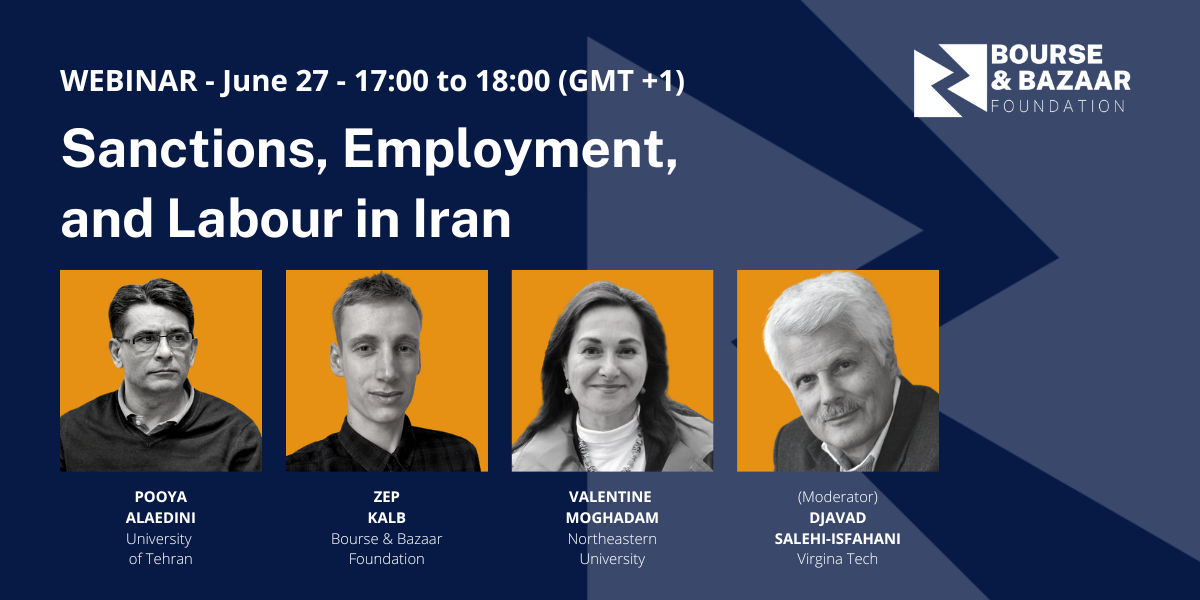
Sanctions, Labour, and Employment in Iran
Webinar - June 27 - 17:00 to 18:00 (GMT +1)
June 27 - 17:00 to 18:00 (GMT +1)
Sanctions have had a significant impact on Iran’s labour force, pursuing many people out of work and degrading the quality of employment for many of those who remained employed, especially women and other economically vulnerable groups. Iran offers a key case study for the impact of sanctions on employment and labour relations. In this panel discussion, three experts on Iranian labour politics and state-society relations examined the outlook for the labour force in Iran as the country’s economy remains stagnant. The panel unpacked the condition of “precarity” facing many Iranian households and explore how economic grievances are being expressed.
Register
Panelists
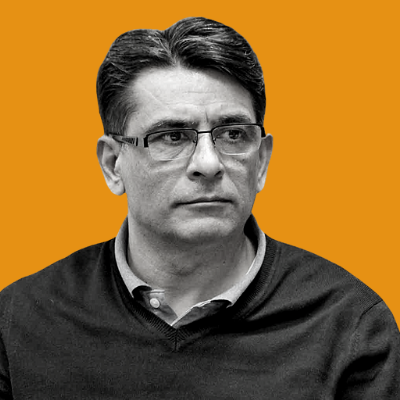
Pooya Alaedini is an Associate Professor in the Department of Development and Social Policy, Faculty of Social Sciences, University of Tehran. His areas of interest are urban and regional studies, social policy, and industrial and employment development. He most recently edited Social Policy in Iran: Main Components and Institutions (Routledge, 2021).

Zep Kalb is a PhD Candidate in the Department of Sociology at UCLA and Visiting Fellow at the Bourse and Bazaar Foundation. He is writing his dissertation on workers' protests, labour politics, and economic development in post-revolutionary Iran.

Valentine Moghadam is Professor of Sociology and International Affairs at Northeastern University. In addition to her academic career, she has been Senior Research Fellow and Coordinator of the Research Program on Women and Development, UNU/WIDER (1990-95) and Section Chief, Gender Equality and Development, Human and Social Sciences Sector, UNESCO (2004-06).
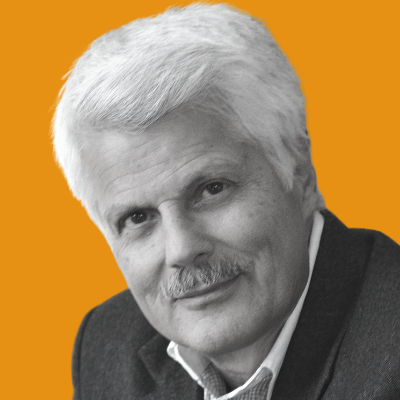
(Moderator) Djavad Salehi-Isfahani is Professor of Economics at Virginia Tech and a Board Member at the Bourse & Bazaar Foundation.
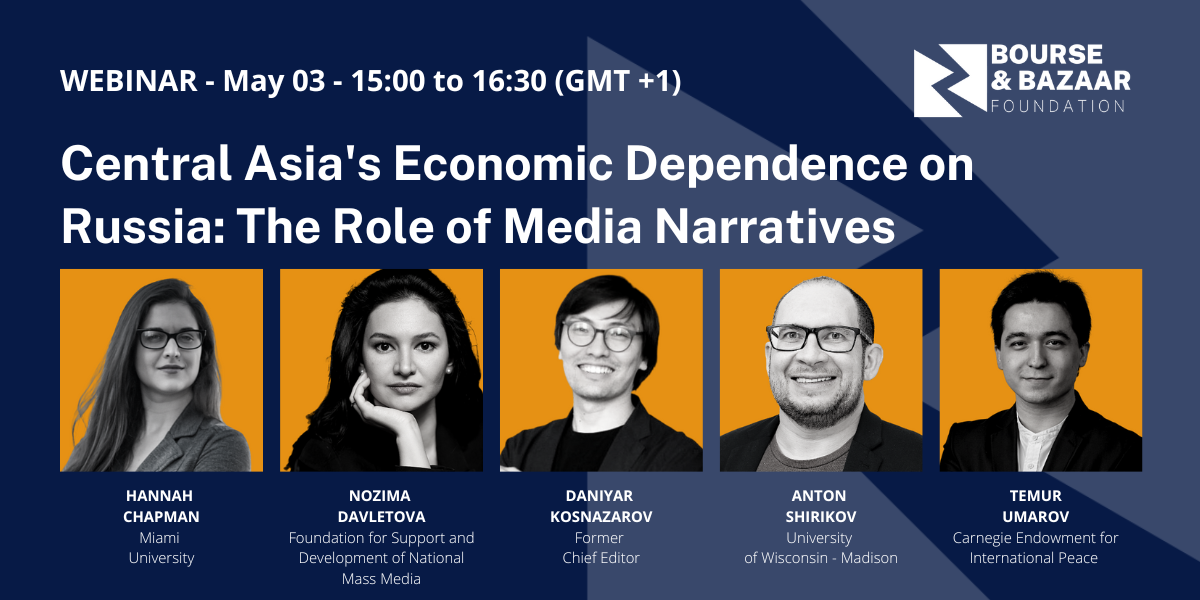
Central Asia's Economic Dependence on Russia
Webinar - May 03 - 15:00 to 16:30 (GMT +1)
May 03 - 15:00 to 16:30 (GMT +1)
In the aftermath of Russia’s invasion of Ukraine, new attention is being paid to the role of Russian state media in advancing narratives about the war and its impacts. These narratives have a special significance for those countries that may be exposed to Russia’s economic downturn under sanctions, including the countries of Central Asia. Economic sentiments in Central Asia are shaped in part by narratives advanced by Russian state media, which have used their influence among audiences in the region to build support for Russia-oriented economic policymaking and regional economic projects such as the Eurasian Economic Union.
Now, as the Russian economy enters a crisis, this same influence may be used to undermine moves by Central Asian governments to reduce their exposure to the Russian economy. This webinar explored the role that Russian media narratives play in the formation of economic sentiments and economic policy in Central Asia, tracing how the public perceptions of Central Asian dependence on Russia can act as a self-fulfilling prophecy, closing the political space for more comprehensive rethinking about how Central Asian states position themselves in the global economy.
Panelists

Hannah Chapman is the Karen and Adeed Dawisha Assistant Professor of Political Science at Miami University and Faculty Associate at the Havighurst Center for Russian and Post-Soviet Studies.
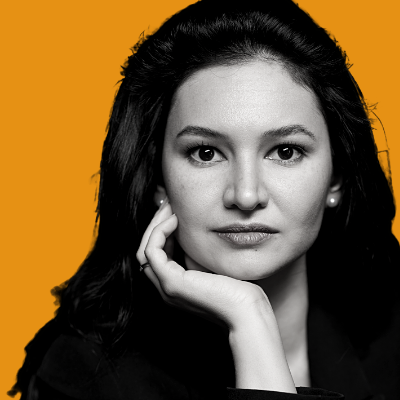
Nozima Davletova is Director of the Foundation for Support and Development of National Mass Media and an Adjunct Professor at Webster University Tashkent. She was formerly a research fellow at George Washington University.

Daniyar Kosnazarov is an experienced journalist and editor based in Kazakhstan. He was formerly Chief Editor of The Steppe and a former Visiting Researcher at the George Washington University’s Central Asia Program.

Anton Shirikov is a PhD Candidate in Political Science at the University of Wisconsin-Madison. Anton studies propaganda and misinformation in Russia and other countries. Previously, he worked as a journalist and editor in various Russian independent media.

Temur Umarov is a fellow at the Carnegie Endowment for International Peace. A native of Uzbekistan, Temur Umarov is an alumnus of the Carnegie-Tsinghua Center’s Young Ambassadors and the Carnegie Endowment’s Central Asian Futures programs.
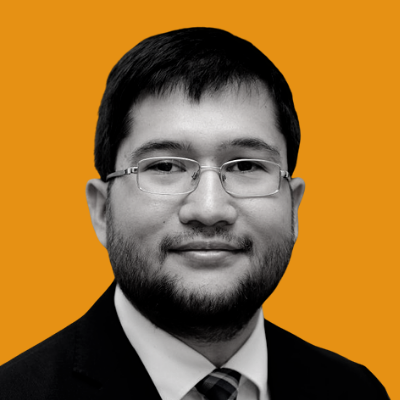
Moderator - Khasan Redjaboev is a Visiting Fellow at the Bourse & Bazaar Foundation. He is a PhD Candidate in Political Science at the University of Wisconsin-Madison.
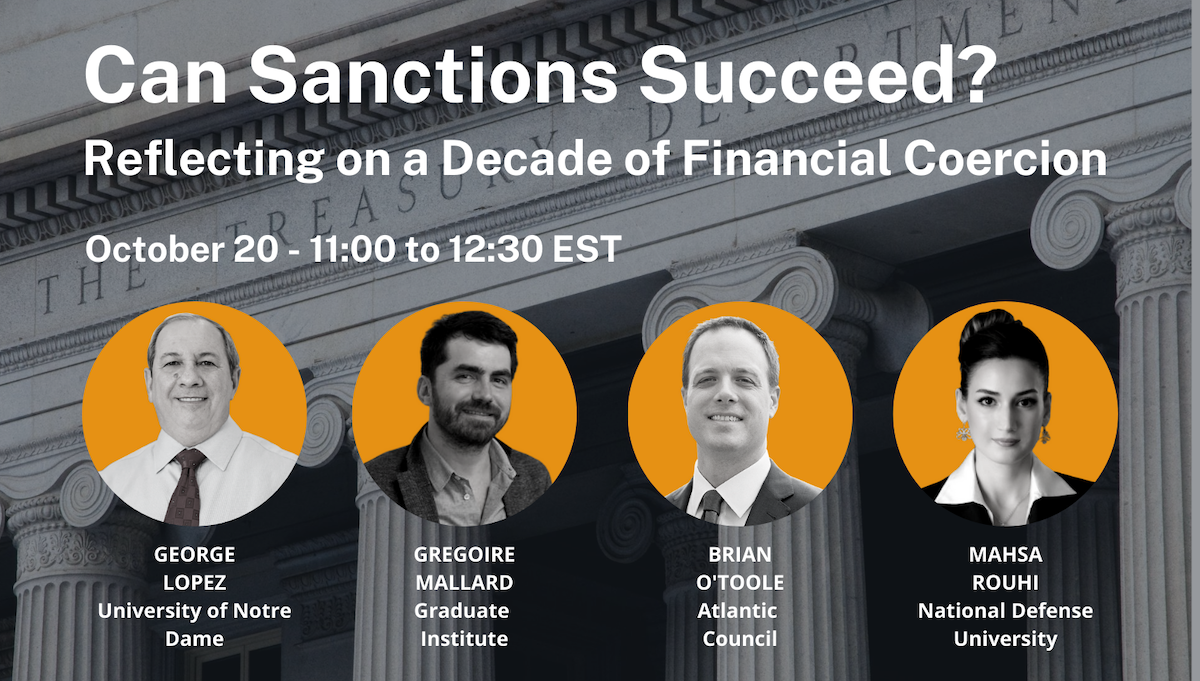
Reflecting on a Decade of Financial Coercion
Zoom Webinar - October 20 - 11:00 AM to 12:30 PM EST
Zoom Webinar - October 20 - 11:00 AM to 12:30 PM EST
The Bourse & Bazaar Foundation and Institute for Peace & Diplomacy are co-hosting an upcoming panel discussion entitled “Can Sanctions Succeed: Reflecting on a Decade of Financial Coercion.”
Over the last decade, sanctions have become a dominant tool of foreign policy. U.S. policymakers, in particular, have embraced sanctions as a seemingly low-cost means to try and coerce states to change behaviours. Yet the most significant unilateral and multilateral sanctions programs—imposed on Iran, Venezuela, Syria, and Cuba—have yet to lead to durable diplomatic breakthroughs. Even so, sanctions are being imposed in an increasing number of cases, reflecting an assumption among policymakers that they are an effective tool. This panel discussion will go back to basics and ask "can sanctions succeed," assessing how sanctions work, how they are applied, and the goals they are intended to achieve.
The webinar will be held on Zoom. Registration can be completed at the link below:
Panelists

George Lopez
Professor Emeritus of Peace Studies
University of Notre Dame

Gregoire Mallard
Director of Research
Graduate Institute of International and Development Studies

Brian O'Toole
Senior Non-Resident Fellow
Atlantic Council

Mahsa Rouhi
Research Fellow
National Defense University
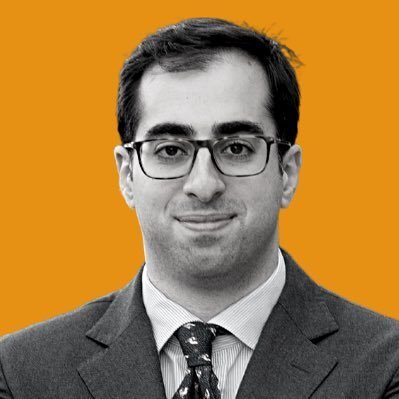
(Moderator) Esfandyar Batmanghelidj
Founder and CEO
Bourse & Bazaar Foundation

Iran's Cultural Heritage in the Sanctions Era
Webinar - April 27 - 11:00 AM to 12:30 PM EST
Iran's astounding cultural heritage developed over many eras. But in the last decade, Iranian cultural heritage has had to contend with the sanctions era, a period in which political and practical challenges have made heritage management, research, and cultural tourism more difficult. In this unique webinar hosted by the Heritage Management Organization and the Bourse & Bazaar Foundation, these challenges will be discussed by experts with first-hand knowledge of how Iran's cultural sector has had to adapt in order to remain connected to global exchanges on arts, culture, and shared patrimony.
The discussion will be moderated by Kyle Olson of the University of Pennsylvania, whose five-part article series published by the Bourse & Bazaar Foundation, explored the impact of sanctions on the cultural heritage sector in Iran.
Panelists
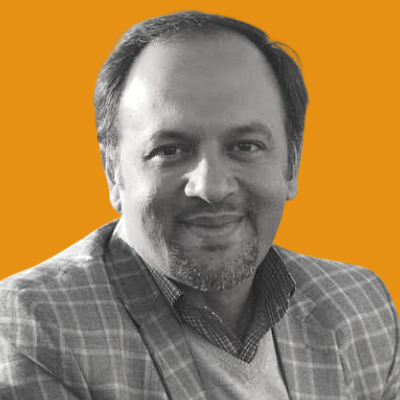
S. Hadi Ahmadi
Director General for Conservation and Revitalisation of Architectural Heritage
Iranian Ministry of Cultural Heritage, Tourism & Handicrafts

Leila Amineddoleh
Founding Partner
Amineddoleh & Associates LLC

Brian Daniels
Vice President for Cultural Heritage
Archaeological Institute of America
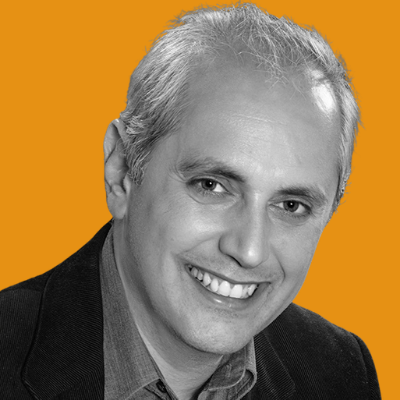
Evangelos Kyriakidis
Founding Director
Heritage Management Organization

(Moderator) Kyle Olson
PhD in Archaeology
University of Pennsylvania