

China Unexpectedly Gambles on European Mechanism to Sustain Iran Trade
◢ China has halted its financial transactions with Iran as part of an unexpected gamble on the future of its trading relationship with the Islamic Republic. According to Majid Reza Hariri, deputy president of the Iran-China Chamber of Commerce, China is hoping to sustain its trade with Iran without putting its financial system in the crosshairs of US authorities by joining the special purpose vehicle being devised by Europe for this purpose.
China has halted its financial transactions with Iran as part of an unexpected gamble on the future of its trading relationship with the Islamic Republic.
Earlier this month, ahead of the reimposition of US sanctions on November 4, China’s Bank of Kunlun informed its clients that it would stop handling all Iran-related payments. The news followed months of speculation that Kunlun, the financial institution at the heart China-Iran trade for more than a decade, would bow to US sanctions pressure.
According to Majid Reza Hariri, deputy president of the Iran-China Chamber of Commerce, China is hoping to sustain its trade with Iran without putting its financial system in the cross hairs of US authorities by joining the special purpose vehicle (SPV) currently being devised in Europe. In the meantime, Chinese trade with Iran has ground to a halt as no banks are available to facilitate transactions.
"It seems that the fate of our trade with China is linked to the support package being prepared by the European Union," Hariri told Bourse & Bazaar in reference to the SPV promised by Iran’s key European trading partners.
The SPV would facilitate trade with Iran by offering a netting service between exporters and importers, reducing the need for funds to be transferred between Iranian banks and foreign financial institutions. Such financial transactions are increasingly difficult due to the risks posed to international banks by US sanctions.
"We are waiting for this financial mechanism to be finalized and for China to join the SPV," Hariri said. In a statement in September, EU High Representative Federica Mogherini stipulated that the SPV “could be opened to other partners in the world.”
Under the previous round of international sanctions, Beijing had designated Kunlun as its primary bank to process billions of dollars payments related to Chinese imports of Iranian oil. The bank also supported the significant growth in non-oil trade between China and Iran as European companies were forced to leave the market when US and EU sanctions came into force.
Kunlun’s perseverance led to US Department of Treasury sanctioning the bank in 2012, but the so-called “bad bank,” shielded by political support from Beijing, continued to maintain its lucrative connections to Iran.
Given this history, the news that Kunlun was cutting-off Iran has served to indicate the intensity of the Treasury Department’s sanctions threats.
Hariri relayed that during his recent trip to China, it became clear that China’s major commercial banks increasingly fear being targeted by US authorities because of links to Kunlun, even if they are not involved in Iran trade themselves.
Bourse & Bazaar also spoke to the chief executive of an Iranian industrial group that conducts significant business with Chinese firms. The executive, who requested anonymity given commercial sensitivities, relayed that large Chinese suppliers do not “want to be in export list, which is where US eyes are looking” because of a pervading fear that “in the weeks following November 4, the US will be making example cases,” targeting companies to create a “system-wide scare.”
Until the situation is better understood, Chinese authorities have opted to pause their trade with Iran and to “let chips fall into place and then figure out way” to sustain commercial ties.
The sudden pause in trade with Iran may explain why China imported an “unprecedented” 20 million barrels of oil to its Dalian refinery in October, twenty times the normal volume. Pointing to issues of energy security, oil analysts do not expect China to cease its imports of Iranian oil, and so the October purchases may have been intended to buy China some time to see if the SPV will become operational.
Two of China’s leading refiners, Sinopec Group and China National Petroleum Corporation, the parent company of Bank of Kunlun, have not placed any orders to purchase Iranian oil in November.
Reports suggest that the SPV will be legally established on or around the November 4 sanctions deadline, but it may take several months for operations to begin in earnest. There remain many hurdles. EU member states are understandably less than enthusiastic about the prospect of hosting the financial channel that will be perceived by US authorities as an attempt to circumvent sanctions.
If SPV fails to become operational or is unable to accept Chinese participation, it will fall to China and Iran to find a new bilateral banking channel, explained Hariri. "If the EU continues with its procrastination, we can once more restart efforts to continue bilateral banking relations," he said.
It is unclear what a new financial channel look like. On Monday, Iranian reports cited "credible sources" to claim that Beijing aims to establish "a new banking mechanism" to continue working with Iran and several meetings have already been held on the matter.
Iran may seek to hold an ownership stake in the new banking channel. The concept that Iranians could become shareholders in Chinese banks has been floated for about a decade. But new draft rules issued by the Chinese regulators may present Iran with a new window of opportunity. Regulators now allow foreign entities to set up wholly owned banks and branches in China.
As Hariri points out, any negotiations over the Chinese participation in the SPV or the creation of a new banking channel are made more complicated by the fact that Iran currently lacks an ambassador to Beijing. Nonetheless, it seems likely that sooner or later Iran-China trade will resume, even under US sanctions. Iran is too lucrative a market for China to simply ignore.
The question is how long Iran’s business community can wait for the rebound. While Iran may have sold a bumper volume of oil in October, private sector companies were caught off guard by China’s move to halt trade. In a matter of weeks, inventories of manufacturing inputs and finished goods will begin to run out.
Photo Credit: Xinhua
Parsian Bank CEO: US Treasury Made ‘Mistake’ in Iran Sanctions Designation
◢ In an exclusive interview with Bourse & Bazaar, CEO of Iran’s Parsian Bank, which was sanctioned last week by the US Treasury, has described the designation of the bank as a Specially Designated Global Terrorist (SDGT) a “mistake.” The move against one of Iran’s leading private sector banks by has many in Iran’s banking sector worried about the ongoing viability of humanitarian trade.
The CEO of Iran’s Parsian Bank, which was sanctioned last week by the US Treasury, has described the designation of the bank as a Specially Designated Global Terrorist (SDGT) a “mistake.” The unprecedented move against one of Iran’s leading private sector banks by US authorities has many in Iran’s banking sector worried, especially with regards to the ongoing viability of humanitarian trade.
On October 16, the US Treasury Office of Foreign Assets Control (OFAC) designated twenty Iranian entities as SDGTs for allegedly providing support to Bonyad Taavon Basij, a holding company associated with Iran’s Basij paramilitary force. Several banks and financial institutions were among the targeted entities—the most prominent among them was Parsian Bank, a private sector financial institution.
Parsian was designated "for assisting, sponsoring, or providing financial, material, or technological support for, or financial or other services to or in support of, Andisheh Mehvaran Investment Company", itself one of several intermediaries ultimately linked back to Bonyad Taavon Basij.
The designation of Parsian seemed to confirm growing concerns that the Trump administration intends to target Iranian banks previously exempt from secondary sanctions as part of its “maximum pressure” policy on Iran.
According to Parsian Bank’s CEO, Kourosh Parvizian, US authorities have exaggerated a financial link in order to designate the bank. "Parsian was sanctioned because one company, Andisheh Mevaran, bought and sold less than 0.3 percent of the total shares of the bank in the stock market," Parvizian told Bourse & Bazaar, adding that such a small shareholder would have no influence over the management or operations of the bank, meaning that any financial link fell well below OFAC’s typical concern with the “control” of Iranian companies by sanctioned entities.
The number of shares purchased by Andisheh Mehvaran even falls below the normal threshold for regulatory oversight by the Central Bank of Iran. The markets regulator only requires approval for share purchases when real or legal persons are seeking to purchase more than 5 or 10 percent of the firm's total outstanding shares respectively. Parsian Bank has 23.7 billion shares currently outstanding on the Tehran Stock Exchange and counts over 70,000 shareholders.
By either deliberately or negligently misconstruing the bank as beholden to Andisheh Mehvaran, US treasury officials made a “mistake at the expense of over 70,000 shareholders and 6.5 million customers of a bank that handles the transactions behind the majority of imports of foodstuffs, medicine and other humanitarian trade items for the Iranian people," Parvizian said.
The belief that Parsian Bank’s designation is a result of a "mistake" runs counter to the views of many sanctions attorneys, who believe that the Trump administration is trying to send signal of zero-tolerance to Iranians banks and their international partners.
Adam Smith, of law firm Gibson Dunn & Crutcher, told the Wall Street Journal’s Samuel Rubenfeld that the designation of Parsian Bank “will make it more difficult to get financing for humanitarian projects.” Smith, a former Treasury Department official, is “very nervous” about how a more hardline sanctions policy from the Trump administration could impact humanitarian trade.
Iran's Foreign Minister Javad Zarif seemingly agrees that the designation of Parsian Bank was intended to send a signal, slamming the Trump administration’s “addiction to sanctions” in a tweet. Zarif specifically pointed to the eight degrees of separation between Parsian Bank and Bonyad Taavon Basij, the primary target of the sanctions action.
Iran’s foreign minister also decried the disregard for the ruling earlier this month from the International Court of Justice (ICJ) which called on the US to lift restrictions on humanitarian trade. Likewise, Parvizian stated, “The designation [of Parsian] runs counter to remarks made by senior US officials that foodstuffs and medicines will not be targeted by sanctions.”
In the aftermath of the designation, Parsian Bank has sought to reassure its customers and shareholders. Shortly after Parsian was added to the SDGTs list, the bank released statements both for the general public and for its shareholders declaring that operations will not be significantly impacted since the bank had already halted all dollar-denominated transactions years ago due to sanctions. Parvizian added, "I cannot say the sanctions won't have any effects, but those effects won't be what the US wants.”
But in some respects, the damage has already been done. Parvizian is understandably upset that his customers and shareholders will bear the brunt of the designation. They had put their trust in the bank being spared from the full extent of sanctions since Parsian was among the Iranian banks that enjoyed a favorable position relative to the wider Iranian financial system prior to the JCPOA nuclear deal. "On top of everything, the designation has considerably increased our reputational risk," he said.
Over the years, the bank’s reputation has benefited from its investments in raising managerial standards, including improving anti-money laundering (AML) and combating financing of terrorism (CFT) compliance procedures as well as know your customer (KYC) due diligence. Parvizian believes that US authorities are fully aware of Parsian’s efforts in these areas.
"For instance, during our non-dollar dealings with Iraq, even the Central Bank of Iraq made an inquiry with US authorities about Parsian and they had answered positively," he said.
That Parsian serves as an example for other banks in compliance standards is especially important given the intense debate that has surrounded Iran’s progress on instituting the reforms required by the Financial Action Task Force (FATF) action plan.
Last Friday, the global standard-setting body extended Iran's deadline to complete its action plan until February, a victory over US and several of its allies have long sought to blacklist the Islamic Republic. The push for financial reforms will be harder to justify if banks like Parsian, which are among the closest to meeting FATF standards in their international operations, will nonetheless be targeted with new US sanctions.
As relayed by Parvizian, the history of private sector banking in Iran is a story of overcoming adversity. This episode is no different. The bank, which had not been contacted or otherwise informed by the OFAC prior to its designation, is now working through "defined channels" to explore whether it can appeal to have the designation reversed.
Photo Credit: Ibena.ir
Under Trump, US Sale of Medical Goods to Iran Down Nearly 40%
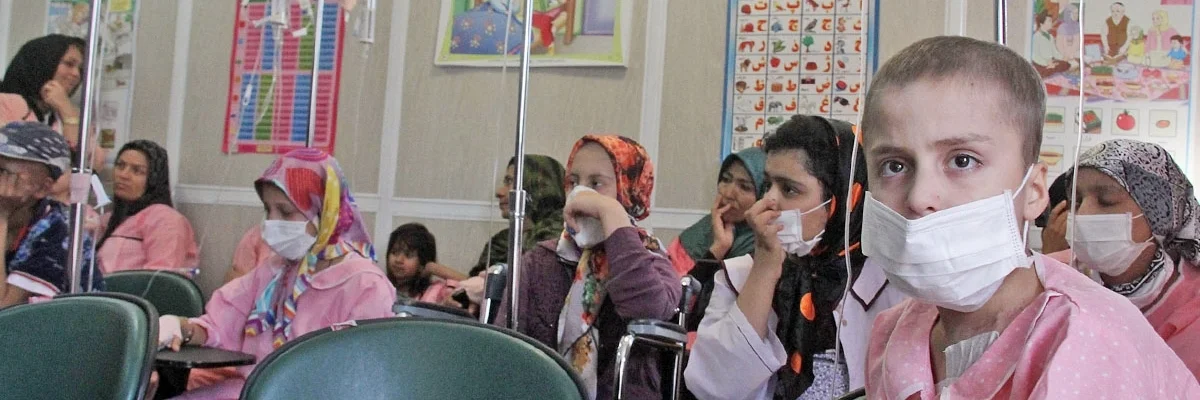
◢ With just two weeks until Trump reimposes secondary sanctions on Iran, administration officials are under increasing pressure to prove that the returning sanctions will not adversely impact humanitarian trade. Looking to US Census Bureau export data, a clear pattern emerges—the export of humanitarian goods like food and medicine remains significantly lower than average monthly values registered during the Obama years.
With just two weeks until Trump reimposes secondary sanctions on Iran, administration officials are under increasing pressure to prove that the returning sanctions will not adversely impact humanitarian trade.
Secretary of State Mike Pompeo has declared that “sanctions and economic pressure are directed at the regime and its malign proxies, not at the Iranian people.” But a review of US trade data shows that humanitarian exports from the US to Iran have withered under the Trump administration, lending credence to claims that while sanctions exemptions for humanitarian trade persist in principle, companies are struggling to avail themselves of these exemptions in practice.
In August, US exports to Iran surprisingly surged to nearly USD 150 million dollars, levels not seen since late 2008, when the Bush administration oversaw the sale of a significant volume of wheat to Iran, pushing monthly exports above USD 100 million for several months. The sudden increase in US exports to Iran was even reported upon by Iranian media outlets.
Looking into the content of those exports, just over USD 140 million dollars of the August trade is attributable to the sale of American soybeans to Iran, the number one destination for the crop that month. Due to Trump’s trade war, the export of soybeans to China has collapsed 95 percent, making commodities traders eager to offload supply to Iran.
But August’s sharp increase in exports to Iran remains exceptional for the Trump administration. Looking to data for the twenty months of the Trump presidency, a clear pattern emerges—along with overall trade, the export of humanitarian goods like food and medicine remains significantly lower than average monthly values registered during the Obama years.
Isolating humanitarian trade within United States Census Bureau export data can be done by analyzing twenty-one of ninety-nine standard “Schedule B” commodity codes, used to categorize trade in live animals, cereals, food oils, pharmaceuticals, and medical devices, among other goods that may fall under sanctions exempt or readily licensed trade.
Looking to the average monthly export value for goods in these categories, the Trump administration’s average of USD 15.4 million is actually about 6 percent higher than the monthly average of 14.5 million dollars registered during the Obama years. However, the Trump average is significantly distorted by the bumper trade in soybeans during July and August. When excluding these two months from the calculation of the Trump average, the monthly export value falls to just USD 7.1 million dollars, about half the level seen during the Obama years.
The significant decline in humanitarian trade is also evidenced by looking to the median monthly export value, which may better account for the natural volatility in US exports to Iran. In the 96 months of the Obama presidency, the median value of humanitarian exports to Iran was USD 9.4 million dollars per month. In the 20 months of the Trump presidency so far, the same figure has fallen to USD 5.8 million dollars per month, a 40 percent reduction.
The most regular kind of humanitarian trade between the US and Iran is the export of pharmaceutical goods. There was just a single month during the whole Obama presidency in which no exports of pharmaceutical products to Iran were registered. Likewise, pharmaceutical exports to Iran have so far been registered in every month of the Trump presidency. However, even in this routine trade, the Trump administration is falling short.
Under Obama, the United States exported an average of USD 2.1 million in pharmaceutical products to Iran each month. Under Trump, that monthly average export value has collapsed to just USD 720,000, a paltry one-third of the former level.
Importantly, in the last few years, the trade in medical devices to Iran has outpaced trade in pharmaceuticals, which may point to Iran succeeding in finding other suppliers of key medications while also boosting domestic production. The shift begins around March 2014, shortly after the January 2014 implementation of the Joint Plan of Action (JPOA)—the precursor of the nuclear deal—in accordance with which the Obama administration began to expand secondary sanctions relief for humanitarian trade, including pharmaceutical exports to Iran. It is likely that European exports continue to offset the fall in American exports, including the reexport of American-made products from European divisions of American companies.
However, when adding medical devices and equipment into an overall calculation of exports of medical goods, the picture remains dire. During the Obama years, the US exported an average of USD 6.3 million in medical goods each month. In the first 20 months of the Trump administration, that figure has fallen to USD 4.6 million, a significant 37 percent drop.
The decline of medical exports to Iran is unlikely to reflect falling Iranian demand. There were no exports of medical devices or equipment to Iran during the first nine months of the Trump presidency. But in October 2017, the same month when Trump “decertified” the JCPOA nuclear deal, exports of medical devices and equipment began again, and have recently reached the highest monthly level since 2015, despite the fact that the sharp devaluation of the real has made such imports much more expensive. Add to this the clear evidence from Iran that sanctions are beginning to result in shortages in key medicines and foodstuffs, and it is obvious that there remains significant scope for the Trump administration to expand its humanitarian trade with Iran.
It would seem that the Trump administration has reached a kind of crossroads when it comes to its strategy for humanitarian trade with Iran. It has publicly insisted that it will allow trade to flow and export volumes in the last few months are more consistent with the decade-long pattern of exports in food and medicine sustained by the US concurrently with the imposition of secondary sanctions.
At the same time, moves such as the recent sanctions targeting Parsian Bank, suggest that the administration is unwilling to send reliable signals to those companies and financial institutions engaged in vital humanitarian trade with Iran. Whether the administration will make good on its own reassurances and meet its moral obligation to facilitate humanitarian trade with Iran remains to be seen.
Photo Credit: IRNA

Iran’s Oil Exports Rise Month-to-Month Ahead of Sanctions Deadline
◢ A new report from TankerTrackers.com indicates that Iran exported an average 2.2 million bpd of crude oil in the first two weeks of October, a 10 percent rise from the September average. October’s higher export volumes could reflect long-standing customers buying more oil ahead of planned reductions in November, when sanctions are expected to prevent many refiners from taking Iranian crude.
A new report from TankerTrackers.com indicates that Iran exported an average of 2.2 million bpd of crude oil in the first two weeks of October, a 10 percent rise from the September average.
October’s higher export volumes may reflect long-standing customers buying more oil ahead of planned reductions in November, when sanctions are expected to prevent many refiners from taking Iranian crude.
But the exports are nonetheless significantly higher than what many market analysts had projected and so far constitute just a 10 percent reduction average export volumes prior to President Trump’s withdrawal from the nuclear deal in May. Reports had suggested exports would fall to just over 1 million bpd in October.
Add to this the news that refiners like Turkey’s Turpas and India’s MRPL may receive sanctions waivers that will allow them to sustain purchases of Iranian crude and it looks increasingly possible that Iran will be able to sustain export volumes well-above 1 million barrels per day following the reimposition of sanctions on November 5.
When broad sanctions were last introduced on Iran’s oil sector in 2012, exports fell from 2.6 million bpd to just 1.4 million bpd in 2014 as countries tapered their imports of Iranian crude.
Should Iran manage to sustain export volumes around 2014 levels, it would be a significant achievement both because of the Trump administration’s effort to drive Iran’s exports to “zero” and also because of the important factor of oil prices. Back in 2014, oil prices fell 40 percent between June and December, settling to below USD 40 per barrel in 2015.
With today’s oil price double that figure, Iran is approaching November with a more bullish outlook than many had predicted. Iranian oil minister Bijan Zanganeh recently stated that the United States “has done most of the things it could do, and there is not much left to do against Iran,” with the aim of restricting exports.
On the other hand, as David Sheppard of the Financial Times writes, “While there may be more crude than first anticipated in the market for now, should the US ultimately succeed in hammering Iran’s exports lower the market could be in for a sharp shock after November 4.”
It looks like we are heading for a photo finish.
Photo Credit: IRNA
New Sanctions on Iran’s Parsian Bank Threaten Humanitarian Trade
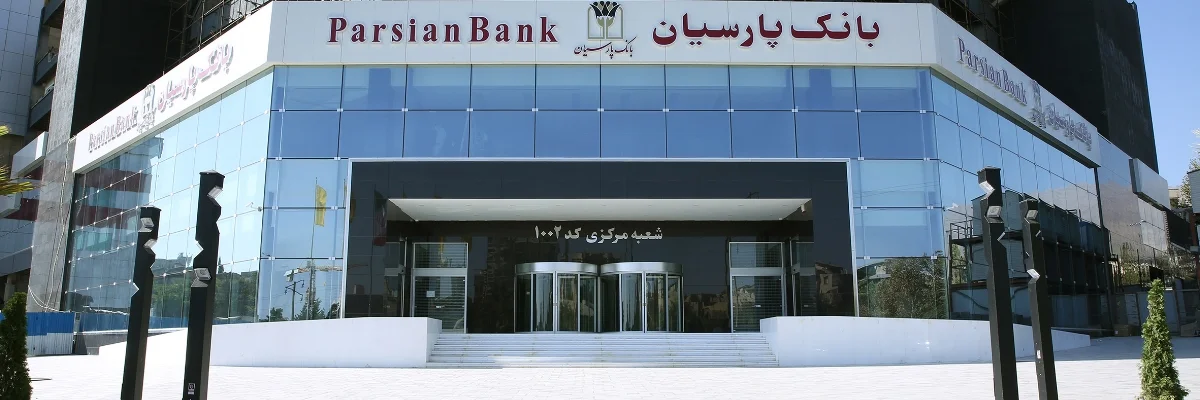
◢ On Tuesday, the US Treasury Department’s Office of Foreign Assets Control (OFAC) applied new sanctions on “at least 20 corporations and financial institutions” associated with Bonyad Taavon Basij. While the designation of bonyads has been a common feature of US sanctions policy for over a decade, yesterday’s action reflects a significant break with sanctions policy under the Obama administration. Included among the targeted entities is Parsian Bank, one of Iran’s leading private sector banks and a vital conduit for trade with Europe, especially humanitarian trade.
On Tuesday, the U.S. Treasury Department’s Office of Foreign Assets Control (OFAC) applied new sanctions on “at least 20 corporations and financial institutions” associated with the Bonyad Taavon Basij, encompassing activities in “Iran’s automotive, mining, metals, and banking industries.”
While the designation of bonyads, which are best understood as holding companies, has been a common feature of US sanctions policy for over a decade, yesterday’s action actually reflects a significant break with sanctions policy under the Obama administration. Included among the targeted entities is Parsian Bank, one of Iran’s leading private sector banks and a vital conduit for trade with Europe, especially humanitarian trade.
In the previous sanctions period, Parsian had been among the Iranian banks that were not subject to secondary sanctions despite being designated along with the rest of the Iranian financial system. This was due to the fact that the Treasury Department had no derogatory information at the time to suggest the bank was engaged or linked to terrorist financing. Indeed, Parsian, established in 2001, has a reputation as among the most trustworthy and well-managed Iranian banks.
Now, US authorities consider Parsian a Specially Designated Global Terrorist (SDGT), a kind of designation shared with the Qods Force of the Islamic Revolutionary Guard Corps (IRGC) among other state and quasi-state groups. The bank is now subject to secondary sanctions, meaning that non-US persons which conduct business with the bank are open to the risk of being sanctioned themselves.
In this way, the new sanctions designation has substantiated fears that had been rising among senior bankers in Iran. There was growing concern that the Trump administration would go beyond the designations of the previous US administration when placing Iran’s banks under secondary sanctions once again. Concerns first rose when OFAC issued its first guidance document following President Trump’s withdraw from the Iran nuclear deal on May 8. The guidance left it ambiguous as to how banks such as Parsian, previously exempt from secondary sanctions, would be treated.
Iranian bankers will also be dismayed that the new designation has come after Iran has made notable progress in passing legislation in accordance to the FATF action plan, which seeks to improve the integrity of Iran’s financial system. A crucial FATF plenary meeting takes place this week in Paris during which Iran’s progress will be evaluated. Further efforts on FATF reform will be hard to justify for domestic stakeholders if banks like Parsian are to be blacklisted by the US Treasury.
Alongside Pasargad Bank, Middle East Bank, and Saman Bank, Parsian was among the few Iranian financial institutions with standards reflective of FATF requirements for anti-money laundering and combatting terrorist financing procedures. These banks were therefore those entrusted by multinational companies to handle local banking needs. Even compliant trade would be impossible for these companies if all Iranian financial institutions are off-limit. A local bank is necessary for basic commercial operations.
According to Tyler Cullis, a sanctions lawyer with the Washington firm Ferrari & Associates, “Today’s designation action had everything to do with sending a signal to the world that all business with Iran is potentially sanctionable.”
In Cullis’ assessment, the links between Parsian and the entity at the heart of the new designations are unusually distant, suggesting a political motive “to inform the private sector that no amount of due diligence” is adequate—a departure from the more practical stance taken by OFAC in the past.
“Treasury designated Bank Parsian for providing material support to an Iranian entity that was seven layers removed from the Basij. It is unlikely that any reasonable amount of due diligence would have apprised Bank Parsian of the fact that it may have been engaged in sanctionable conduct under U.S. law,” Cullis notes.
The day before the new designation was issued, Special Envoy for Iran Brian Hook was in Luxembourg, meeting with European foreign ministers. On his agenda was a structured dialogue about humanitarian trade. Cognizant of the risks posed by returning US sanctions to their effort to keep Iran in the nuclear deal, European leaders have been seeking clarity on humanitarian trade since June. No concrete assurances have been issued to date. The issue has also caught the attention of the International Court of Justice, which recently ruled that unless the United States lifts restrictions on humanitarian trade with Iran, it will find itself in violation of international law.
While the State Department has given lip service to the issue of humanitarian trade, with Secretary of State Pompeo offering assurances that “sanctions and economic pressure are directed at the regime and its malign proxies, not at the Iranian people,” the designation of Parsian suggests that the Treasury Department is not on the same page. Not only is the Parsian designation peripheral to the action against Bonyad Taavon Basij, but eliminating the ability of the bank to engage in humanitarian trade surely outweighs the value of its designation from the standpoint of minimizing terrorist finance threats. Iranians are already suffering in the face of shortages of medicine, an area of trade in which Parsian was highly active.
Treasury Secretary Steven Mnuchin’s statement, issued alongside the new designations, does make reference to “real world humanitarian consequences” but only insofar as “business entanglements with the Bonyad Taavon Basij network… fuel the Iranian regime’s violent ambitions across the Middle East.”
All too aware of their own government’s malign activities, the Iranian people await the Trump administration’s reckoning with the true humanitarian consequences of its own policies.
Photo Credit: Parsian Bank
Iranian Newspaper Editors Decry Trump's 'Immoral' Sanctions
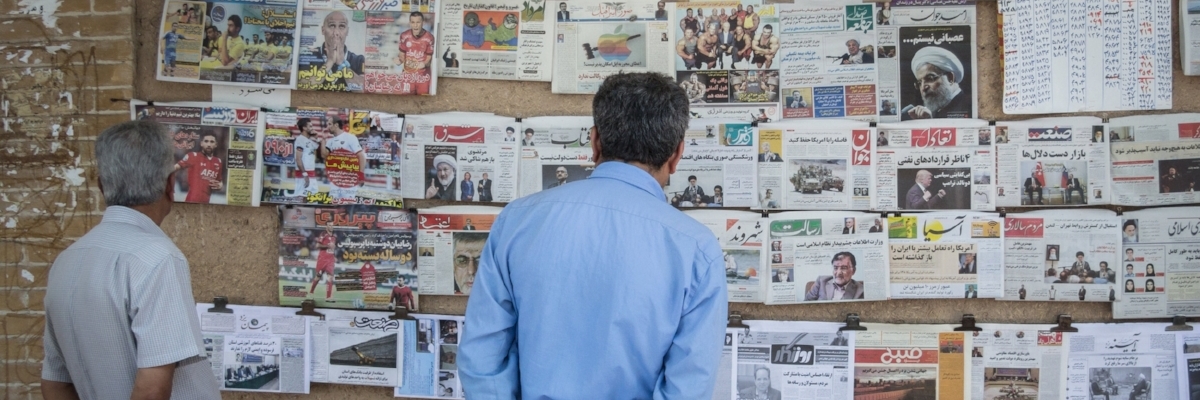
◢ In a remarkable joint editorial published Monday, the editors of four of Iran’s leading newspapers—Iran, Hamshahri, Etelaat, and Sazandegi—have invoked the United States Declaration of Independence to decry the reimposition of sanctions as a violation of the “unalienable rights” of the Iranian people to “life, liberty and the pursuit of happiness.”
In a remarkable joint editorial published Monday, the editors of four of Iran’s leading newspapers—Iran, Hamshahri, Etelaat, and Sazandegi—have invoked the United States Declaration of Independence to decry the reimposition of sanctions as a violation of the “unalienable rights” of the Iranian people to “life, liberty and the pursuit of happiness.”
Published in both Persian and English, the editorial casts President Trump’s decision to leave the Iran nuclear deal and to reimpose sanctions as inconsistent with both the spirit of the US constitution and the letter of international law. Drawing extensively on the values of international liberalism and citing an intellectual legacy from “Thomas Jefferson to Francis Fukuyama,” the editorial serves as an example of the increasingly vocal position taken by Iranian editors and journalists when it comes to holding both the Iranian government and foreign governments to task for restrictions on freedom.
Most strikingly, the self-proclaimed “freethinking” and “freestanding” journalists question the claims of the Iranian and US governments alike. “The US government claims that its sanctions are targeted on Iranian governance, not on Iranian people, while Iranian government believes that the sanction would come to no harm,” note the editors. They forcefully disagree, arguing that “contrary to what governments claim, the US tyrannical sanctions have brought about destructive repercussions for the lives of millions of Iranian citizens who legitimately enjoy the right of life under optimal conditions.”
The criticism of the Iranian government’s line of sanctions is especially notable given that two of the four newspapers, Iran and Hamshahri, are affiliated with the presidency and the municipality of Tehran, respectively. Moreover, while Sazandegi is a reformist paper, Etelaat is known to have a conservative outlook, suggesting that the editorial position crosses political lines.
The editors explain that the “access to medicine, drugs and medical equipments” offers “obvious proof” that it is “children, women and men” who are “actually targeted by blind sanctions.” The recession caused by sanctions will see “many job opportunities lost” in industry and agriculture, effects that will “subsequently provoke escalation of poverty among the households, and these households are just those who constitute Iranian people.”
Citing the principles of the International Human Rights Charter, the recent ruling of the International Court of Justice, and the UN Charter’s provisions for the role of the Security Council in the “authorization of any coercive measure, including sanctions,” the editors detail how Trump’s reimposition of sanctions violates international law. This appeal to multilateral institutions and international legal norms, which are under attack by illiberal political movements around the world, is remarkable.
Looking to American leadership at large, the editors question the Trump administration’s might-makes-right approach to international affairs, asking “Is economic power and authority, by its very nature, sufficiently eligible to foreclose the authenticity of collective rationality, removing it from the processes of decision and policy-making in the international arena?” They also ask whether the “eccentric development” of Trump’s withdrawal from the nuclear deal heralds an attempt to undermine the United Nations, “the highest institution in the world that works based on collective rationality and democratic values.”
The editorial ends with an exhortation to “free-thinking peers all around the globe” to “speak out in defense of the truth” lest the achievements of liberal thinkers including “Thomas Jefferson, John Dewey and Walter Lippmann to Abraham Lincoln, Mahatma Gandhi, Martin Luther King, Nelson Mandela, John Stuart Mill, Friedrich Hayek and Karl Popper and to Isaiah Berlin, Hannah Arendt, Francis Fukuyama” be lost.
High-minded in both principles and style, the editorial is nonetheless an important expression of the kind of righteous indignation felt among many Iranians. For now, the imposition of sanctions is taking place without a clear justification—Iran continues to uphold its commitments under the JCPOA. As such, while there is anger over the Rouhani administration’s somewhat facile reassurances regarding the impact of sanctions, there is greater anger felt towards the Trump administration, which has appeared to cast aside the long-standing liberal principles of American leadership, simply to enact suffering on the Iranian people.
Photo Credit: Depositphotos
Bankless Task: Can Europe Stay Connected to Iran?
◢ With US sanctions on Iran’s banking sector due to come into effect soon, European countries are now considering measures that would facilitate trade transactions with Iran through a new legal and institutional structure. European governments have been reviewing this legal entity, known as a Special Purpose Vehicle (SPV), for months. The timing of this public announcement suggests that they have a degree of confidence that the SPV can become operational, and that Europe can use the model to showcase its ability to deliver on its commitments.
This article is re-published with permission from the European Council on Foreign Relations.
As part of the effort to salvage the Iran nuclear deal, European governments have vowed to sustain their economic ties—not least their banking connections—with Iran. From 4 November, American sanctions targeting Iran’s banks will make it extremely difficult for European companies to engage in transactions with firms in the country. Many of the pathways to reducing the secondary impact of US secondary sanctions on the European financial sector present significant technical and political challenges—which stem from the US financial system’s global dominance and the integration of the US and European banking sectors. Moreover, the Iranian financial sector must take several proactive steps to ensure it meets the international compliance standards European banks require.
The Banking Blockage
With the incoming US sanctions, European companies face an even greater struggle to engage in transactions with Iran. For instance, Swedish automaker Volvo is leaving Iran because, as one of its spokesman put it, “with all these sanctions and everything that the United States put [in place] ... the [banking] system doesn’t work in Iran … We can’t get paid.”
This problem has driven most of the multinationals once active in the Iranian market to suspend their operations there, ahead of the new round of US sanctions. There is a widespread expectation that several Iranian private banks and the Central Bank of Iran will be designated entities under the measures.
Some European companies, such as Airbus and Total, require a licence or waiver from the US authorities to continue their operations in Iran, as they work in sectors subject to targeted sanctions. Many areas of Iranian trade, such as that in basic goods, are either unsanctionable or will be exempt from the measures. Yet US sanctions have adversely affected even these areas, as outlined in a recent ruling of the International Court of Justice.
Such restrictions on trade arise from the contamination risk that US secondary sanctions pose to European financial institutions, which generates unique pressure on the Iranian banking sector. This risk combines with Iran’s current shortfalls in meeting its commitments under a Financial Action Task Force (FATF) action plan – although the recent passage of the Combating Financing of Terrorism Bill suggests that Tehran is raising its compliance standards. Until the FATF changes Iran’s designation as a high-risk jurisdiction, global financial institutions will limit their dealings with Iranian banks.
Since President Donald Trump withdrew the US from the Iran nuclear deal in May this year and announced the re-imposition of secondary sanctions on Iran, banks in Europe have come under growing direct and indirect pressure from American regulators. Following the repeal of international sanctions on Iran in 2016, many large European banks began quietly facilitating transactions involving Iran for their largest industrial clients, especially those with long-standing operations in the country. Among these institutions, Danske Bank was the most visibly open to business with Iran, even opening a €500 million line of credit to support Danish firms’ expansion in the country. But as it falls into disrepute over suspected money laundering at its Estonian subsidiary, Danske Bank has opted to cease transactions involving Iran as an immediate show of responsiveness to US regulators. More broadly, banks tend to jettison their business with Iran if regulators exert pressure on them, even in the absence of a direct compliance issue.
Meanwhile, small European banks are coming under pressure from their larger competitors. When these institutions, which have relatively limited exposure to the US financial system, engage in Iran-related transactions, their routine SEPA transfers – payments to other banks within the Single European Payments Area – are often refused outright. This isolates the banks and complicates other aspects of their business. And the refusals extend beyond Europe. Asian banks have shown increasing concern about dealing with small European financial institutions that engage in business with Iran, understanding that they too could fall foul of the US authorities.
Europeans banks have been reluctant to engage with Iran due to fears about the response from their shareholders and creditors. This is most clear in the case of the European Investment Bank (EIB), which has refused to invest in Iran. European governments (which number among the bank’s shareholders) encouraged the EIB to consider lending to Iran, but the bank’s leadership felt that investing in the country would jeopardise its ability to raise capital from American institutional investors in the bond market.
Europe’s Possible Solutions
Despite their efforts to sustain economic channels with Iran, European governments have been unable to ease this pressure on banks. With US sanctions on Iran’s banking sector due to come into effect soon, European countries are now considering measures that would facilitate trade transactions with Iran through a new legal and institutional structure.
On the sidelines of the recent United Nations General Assembly, EU High Representative Federica Mogherini announced that “EU Member States will set up a legal entity to facilitate legitimate financial transactions with Iran and this will allow European companies to continue trade with Iran, in accordance with European Union law, and could be opened to other partners in the world”.
European governments have been reviewing this legal entity, known as a Special Purpose Vehicle (SPV), for months. The timing of this public announcement suggests that they have a degree of confidence that the SPV can become operational, and that Europe can use the model to showcase its ability to deliver on its commitments.
US Secretary of State Mike Pompeo immediately responded that he was “disturbed and indeed deeply disappointed” at the news. US National Security Advisor John Bolton commented: “we will be watching the development of this structure that doesn’t exist yet and has no target date to be created. We do not intend to allow our sanctions to be evaded by Europe or anybody else.”
There remains scant detail on the SPV. In her statement, Mogherini added that more information will become available “as the technical work continues in the coming days”. It may be advisable for European actors involved in the creation of the SPV to keep the details private for now. Operationalising the SPV will require a period of trial and error. Making the details of the project public in its early stages would provide the structure’s opponents with further opportunities to undermine it.
Can the SPV Model Work?
Reportedly, an internal European Commission paper describes the European Union’s efforts to “bundle and reduce cross-border payments to and from Iran”. In this way, the SPV would “avoid or severely restrict the role of commercial banks in the payment system and protect payment transactions with Iran from US sanctions”. European policymakers’ apparent consideration of this approach indicates that they want to avoid placing critical European financial institutions, such as the EIB, in the crosshairs of the Trump administration.
To operationalise the SPV, policymakers will need to quickly make progress in several technical areas. Firstly, European governments need to determine how aggressively they will push back against US sanctions; this is a consideration of the first order for the structure and operation of the SPV. Theoretically, the SPV could facilitate payments for what the US authorities consider to be sanctionable activity. Indeed, European officials have openly discussed their intention to use the SPV to support purchases of Iranian oil.
As guidelines from the US Treasury’s Office of Foreign Assets Control make clear, even barter arrangements involving petroleum or petroleum products from Iran are sanctionable – on the basis that they provide “material support” to Iran’s oil industry “regardless of whether a financial institution is involved”. However, because the envisaged SPV would bypass the US financial system and foreign branches of US banks, the American authorities would have no direct jurisdiction over it. Thus, transactions the SPV facilitated would not give rise to the same kind of civil liability that led to hefty fines on Europe’s largest banks in the previous era of sanctions.
The US authorities could, in theory, prevent entities engaged in the SPV from accessing the US market. American officials have stressed that US sanctions will target European central banks and SWIFT – an international payments messaging system headquartered in Belgium – if these institutions facilitate transactions with Iran. Furthermore, this targeting would extend beyond entities engaged in oil purchases, covering all companies that use the SPV to engage in transactions with Iran – even those in sectors that are exempt from sanctions, such food and pharmaceuticals.
European governments working on the SPV will have to find a way to counter such measures. On a technical level, they may be able to use creative structuring solutions. The SPV could be set up primarily as a payment mechanism for only small and medium-sized companies that are content to be excluded from the US market. And the mandate of the SPV could initially facilitate just payments for trade that is exempt from US sanctions.
The SPV is most likely to succeed if takes this approach, starting off small and gradually expanding. The basic structure of the vehicle is replicable. One SPV could focus on sanctionable trade related to support for Iran’s oil, automotive, or aviation sectors. Another could be limited to sanctions-exempt trade in consumer goods, food, and pharmaceuticals – allowing multinationals to use it as a convenient payment channel. With multiple SPVs available, companies could engage with Iranian entities in accordance with their appetite for risk and their business models.
Each SPV could take a different form. It could be a stand-alone, state-owned bank; a conduit for payments that European central banks ultimately facilitate; or simply a clearing house for companies that transfer money to Iran, repatriate funds from the country, or engage in barter trade with it.
The process of establishing the SPV will prove instructive in testing the limits of America’s sanctions power and US willingness to use sanctions as a weapon against its putative allies. Reports indicate that the US Department of the Treasury is already starting to push back against the White House over proposals to sanction European financial institutions, particularly SWIFT, for maintaining ties with Iran.
Of course, creating the SPV will require significant technical work. For its part, Iran will need to demonstrate that its financial system is also continuing to reform in accordance with international standards on money-laundering and terrorism financing. European governments will closely watch the country’s progress in implementing the FATF action plan ahead of an important review on 14-19 October.
From a political perspective, Iran has drawn encouragement from European countries’ sustained and unanimous commitment to the nuclear agreement. Iranian President Hassan Rouhani praised Europe for taking a “big step” to maintain trade. Iran’s foreign minister, Javad Zarif, stated that while implementing the SPV will be difficult, Iran is willing to show “a little bit more patience” with Europe. The SPV is an important immediate contribution to improving conditions for trade between Europe and Iran, but both sides must view it as the start of a road map for long-term economic engagement.
Photo Credit: Depositphoto
Iran’s Oil Exports May Be More Resilient Than Headlines Suggest
◢ Iran is resorting to “Houdini tricks” to sustain oil exports as US sanctions loom and new data suggests the magic might be working. While S&P Global Platts has reported Iran’s September exports at about 1.7 million bpd, marking an 11 percent decline from August, data from TankerTrackers.com, puts the export volume at just over 2 million bpd. The divergence in the datasets represents not merely 300,000 bpd, but also the difference between two narratives about the state of Iran’s exports in the face of returning US sanctions.
Iran is resorting to “Houdini tricks” to sustain oil exports as US sanctions loom. New data suggests the magic might be working. With new sleights of hand including disappearing oil tankers, the use of floating storage, and ship-to-ship transfers, tracking Iranian exports is getting harder than ever, leading to divergent estimates from oil analysts.
While S&P Global Platts has reported Iran’s September exports at about 1.7 million bpd, marking an 11 percent decline from August, data from TankerTrackers.com, a service which reports shipments and storage of crude oil globally, puts the export volume at just over 2 million bpd. The divergence in the datasets represents not merely 300,000 bpd, but also the difference between two narratives about the state of Iran’s exports in the face of returning US sanctions.
As part of S&P Global Platts’ announcement of the September figures, Paul Sheldon, chief geopolitical adviser at company, stated, "Iranian export losses have already accelerated faster than we expected.” On this basis, Platts is predicting Iran’s exports will fall to 1.1 million bpd by November, when U.S. sanctions on Iran’s oil industry are set to return. Similar analysis from Bloomberg and Reuters has contributed to the sense that Iran’s exports are dropping fast. But these assessments may be leaving a significant number of barrels uncounted by failing to properly capture tankers which have turned off their geolocation transponders.
Samir Madani, founder of TankerTrackers.com, emphasizes that such tactics are making life more difficult for those trying to measure Iran’s export volumes. "September was a very resource-demanding month from a vessel tracking perspective for not just us at TankerTrackers.com but at some of the other trackers in the industry,” he said.
For Madani and his team, properly tracking tankers laden with Iranian oil requires extensive use of satellite imagery. “The reason is because roughly half of the exports were cloaked, meaning vessel crews switched off their AIS geolocation transponders before arriving into Iran to arrange the collection of crude oil,” Samir explained. “Their transponders were switched back on many days later, once they were already out of the immediate Gulf area.”
To overcome these cloaking tactics, Madani uses daily satellite imagery to “factor in vessels that were no longer broadcasting their positions.” This methods helps explain the significant discrepancy between his September estimate of Iran’s exports to China and that published by Platts. According to Madani, Iran’s state-owned National Iranian Tanker Company is particularly adept at cloaking exports in this manner, drawing on a playbook perfected in the previous sanctions period.
Any underlying resilience of Iranian exports is particularly important following reports that the United States is “actively considering waivers on Iran oil sanctions.” The exploration of waivers represents a break with the Trump administration’s previously communicated intention that “exports of Iranian oil and gas and condensates drops to zero.”
The level of imports covered by such “significant reduction exemptions” or SREs is typically determined by looking to historical import levels and the level of imports that can be reasonably restricted by sanctions. In this context, that Iran has been able possibly sustain over 2 million bpd in exports just one month before the reimposition of US sanctions bodes well for the extent of the waivers that may be offered. In likely anticipation of waivers from US authorities, India has already announced that it plans to import at least 9 million barrels of Iranian crude in November.
In an interview conducted during the United Nations General Assembly, President Hassan Rouhani told NBC’s Lester Holt that “The United States is not capable of bringing our oil exports to zero” and describe the Trump’s administration's threats as “empty of credibility.” Despite hopeful signs, Iran’s oil exports magic show is still in its first act. Whether Rouhani can outdo the great Houdini is yet to be seen.
Photo Credit: Imaginechina
Unintimidated, Iranian Lawmakers Pass Counter-Terror Financing Bill
◢ Over the last six months, the public debate in Iran around FATF-related reforms has reached a surreal crescendo. Seldom do countries experience such intensive political debates over measures as technical and obtuse as financial regulations. But 143 lawmakers voted bravely to pass the final of four bills required by the FATF action plan, in a landmark vote that may increases chances that Iran maintains ties with international financial institutions in the face of returning sanctions.
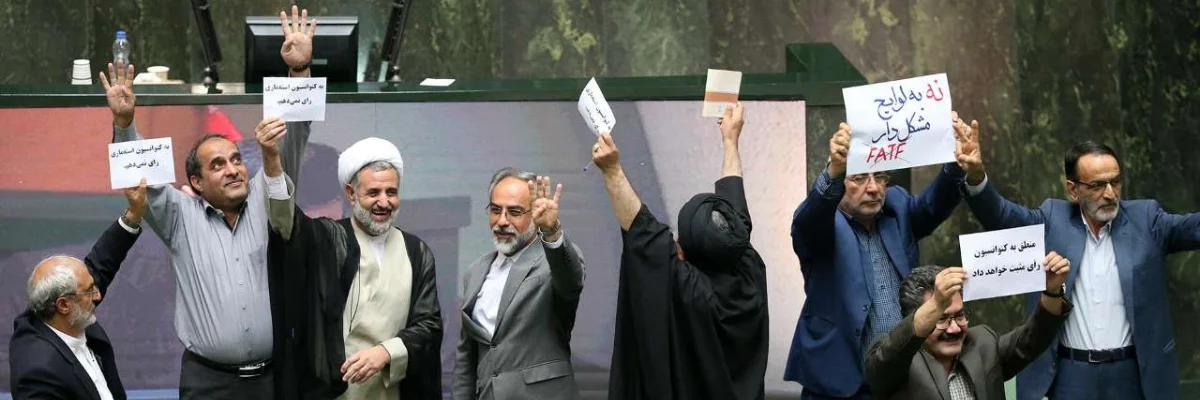
On Sunday, Iranian lawmakers approved a bill that may see Iran join the International Convention for the Suppression of the Financing of Terrorism of the United Nations. The bill passed by 143 votes to 120 in a highly contentious session of parliament. The landmark vote keeps hopes alive that Iran may yet earn closer ties with the international financial system.
The success of the vote comes despite a fierce campaign to try and derail crucial financial reforms. The legislation marks the last of four bills intended to address items on Iran's Financial Action Task Force (FATF) action plan to improve anti-money laundering (AML) and combating financing of terrorism (CFT) standards. The three others include a bill aimed at Iran's accession to the United Nations Convention Against Transnational Organized Crime—known as the Palermo Convention—and two bills to amend existing AML and CFT laws. The CFT legislation was signed into law by the Guardian Council, the country's highest constitutional entity, on August 1. The two other bills were passed by parliament on September 25 following amendments to assuage concerns raised by the Guardian Council.
The Guardian Council still needs to ratify the three remaining laws called for by the FATF action plan. The clock is ticking. The FATF will judge Iran’s progress with its action plan at its next plenary meeting, which commences on October 14. The intergovernmental organization had suspended active countermeasures against Iran pending completion of the action plan, but the tone of its last assessment suggests patience is wearing thin and that Iran could be returned to the so-called “blacklist,” jeopardizing its few operable international banking relationships.
No doubt, opponents to financial reform in Iran will continue their fight and seek to sway the Guardian Council’s deliberations. The council is comprised of six clerics appointed by Supreme Leader Ali Khamenei and six jurists elected by the parliament.
Iran's current saga with the FATF reform process began in earnest in June 2016 when then-economy minister Ali Tayyebnia accepted the action plan, prompting the initial suspension of countermeasures for one year in recognition of Iran's high-level political commitment. It has since extended suspensions three further times.
Over the last six months, the public debate around FATF-related reforms has reached a surreal crescendo. Seldom do countries experience such intensive political debates over measures as technical and obtuse as financial regulations.
On one side of the raging debate stand the administration of President Hassan Rouhani and a majority of parliamentarians, who are responding to the needs of private sector businesses, which have called for the adoption of the action plan through both official statements and individual appeals. Iran’s banking sector also backs the measures as financial institutions rightly fear they will be more isolated than ever—especially in face of U.S. sanctions—if Iran fails to show a serious commitment to reducing money laundering and terrorist financing risks.
The opposition is varied, but unified in fear. As conservative politician and parliament deputy Ali Motahari explained after Sunday's vote, the opponents are generally concerned that they will have to divulge financial information that would compromise opaque dealings. "There are some who may really have personal interests in the [FATF bills] not being approved because they will be cut off from massive profits if there are reforms in the banking system," Motahari said.
At a political level, opponents claim that adoption of the FATF recommendations could hamper financial support for Iran’s allies, especially Lebanon's Hezbollah, which the US has classified as a terrorist organization. Of course, some opponents are simply looking to undermine the Rouhani administration by delivering yet another political defeat.
Opponents to the FATF reforms have spent liberally to orchestrate a campaign designed to intimidate lawmakers into voting down the bills. For months, MPs have received near-daily anonymous text messages. The messages, many of which have been shared on social media by MP Mahmoud Sadeghi, an outspoken supporter of ratification of the bills, include content ranging from religious arguments to outright threats which aim to compel MPs to reject the proposed legislation.
The battle over the laws has also been fought through print and digital media. Hardliners have minced no words criticizing Rouhani's economic team from the moment FATF's action plan was published. Most dramatically, the ultraconservative Kayhan newspaper stunned many by saying FATF adoption would constitute betraying the blood of those who lost their lives in the recent terrorist attack in Ahvaz. The paper also engaged in fearmongering by claiming that FATF adoption would further depreciate Iran's currency against the U.S. dollar.
"This is a psychological war. Clearly, Iran's economic problems won't be all suddenly resolved through FATF," financial expert Mehdi Pazouki told Bourse & Bazaar in reference to the intensity of the political debate around what are basic economic reforms.
Sunday's vote was a bizarre spectacle. While high-level officials including Foreign Minister Javad Zarif and central bank governor Abdolnasser Hemmati attended the session in support of the bill, dozens of protester rallied outside, holding up banners and chanting in defiance.
Speaking in advance of the vote, Zarif tempered expectations, explaining that the FATF bills will not resolve all problems. But he was adamant that the new regulations will prevent the emergence of future economic problems. According to Zarif, Russia and China, two of Iran's biggest trading partners, have asserted they will be forced to refuse financial services should Iran fail to adhere to FATF standards.
Taking the podium, hardliner MPs caused mayhem, symbolically tearing-up the proposed law and throwing the scraps at parliament speaker Ali Larijani.
Pazouki agrees that failing to satisfy the FATF action plan will amount to a kind of self-sanctioning. "If we wish to work with the global community, especially developed nations and European Union partners, we will need to adopt FATF requirements. We would have had to make these reforms even if the U.S. hadn't withdrawn from the JCPOA,” he explained.
Echoing the message sent resolutely by the 143 lawmakers who voted for the bill, Pazouki points to the cynicism of the opposition. "Only money launderers, terrorist financiers and tax evaders should be worried about passage of the bills," he says. "If we are proponents of fighting corruption and money laundering, the FATF regulations are certainly in favor of transparency.”
Photo Credit: IRNA
Fears Grow That Trump Sanctions Will Throttle Iran's Humanitarian Trade
◢ The second and final sanctions deadline of November 4 is drawing near. After this date, unilateral US sanctions on Iran’s financial sector will once again come into force. According to Iranian bankers and government officials, this could mean that Iran struggles to import humanitarian goods, including basic foodstuffs, despite longstanding exemptions for trade in these goods.
The second and final sanctions deadline of November 4 is drawing near. After this date, unilateral US sanctions on Iran’s financial sector will once again come into force. According to Iranian bankers and government officials, this could mean that Iran struggles to import humanitarian goods, including basic foodstuffs.
The sale of essential foodstuffs and medicine to Iran is exempt from sanctions, giving latitude to US officials to reiterate their claims that sanctions are targeted and not intended to hurt the Iranian people. However, while no direct legal barriers might exist for trade in humanitarian goods, potential restrictions slapped on banks that facilitate the necessary transactions might yet cause problems.
Prior to the nuclear deal, Iran’s private sector banks were exempt from secondary sanctions and thereby to be able to handle humanitarian trade payments. As sanctions are set to be reimposed, ambiguities about the scope of the returning restrictions forthcoming from the Office of Foreign Assets Control (OFAC) of the U.S. Department of Treasury have left bank leaders and government officials in Iran with more questions than answers.
To understand the growing fears around the maintenance of humanitarian trade, Bourse & Bazaar spoke to several senior bankers and government officials in Iran and executives from global trading companies who are key stakeholders in this trade. All requested to remain unnamed given the sensitive subject matter.
A veteran banker and a board member of a major Iranian private bank described two possible scenarios. "U.S. officials have said they aim to reinstate sanctions that were lifted as a result of the nuclear deal. If we use this as the basis, the interpretation is that private banks that were previously exempt from secondary sanctions and any foreign banks working with them on humanitarian trade will once again be exempt," he said.
But he warned that this time may very well be different given that the US has hardened its rhetoric and promised “maximum pressure” from the sanctions. "Your guess is as good as mine,” he quipped.
He said his bank is currently conducting business as usual but has seen some foreign counterparts take preemptive measures to reduce their transaction volume ahead of the November deadline.
“Some banks are implementing a number of limitations over concerns about what happens next. They are already doing some of the things that will be expected of them once sanctions return on November 5,” he said.
An official at the international department of another major Iranian bank expressed the same feeling of uncertainty, and highlighted concerns that private sector banks like his will not be spared from secondary sanctions this time around.
“We are already facing issues with imports of some essential goods even before [the November] sanctions snap back,” he said. In his assessment, if the bank becomes subject to secondary sanctions, there is little to nothing Iran’s central bank can do to support them.
While Iranian bankers may feel powerless to prevent the return of secondary sanctions, they are also concerned about risks stemming from an area in which Iranian stakeholders do have control—compliance with the Financial Action Task Force (FATF) action plan, which outlines steps for Iran to improve anti-money laundering and combating financing of terrorism standards.
Iran has until mid-October to demonstrate sufficient progress to the FATF or its already embattled banking system will become more isolated than ever. Time is running out for Iran to pass the required legislation in the face of domestic pushback from local interest groups and persistent lobbying by FATF member states including the US and Israel.
“If we don’t pass the bills related to the FATF, we are effectively sanctioning ourselves,” stated the deputy chairman of one of Iran’s largest private sector banks.
These external and internal threats to routine banking between Europe and Iran could have significant knock-on effects for humanitarian trade.
Speaking on background, an executive at a major multinational commodity company described how even if food sales to Iran remain permitted under US sanctions, the imposition of secondary sanctions on Iran’s private sector banks could make the trade effectively impossible.
The Government Trading Corporation of Iran (GTC), the trading arm of country’s agriculture ministry, confirmed these concerns but insisted that contingency planning is underway.
A senior official involved in foreign trade for GTC said, “We are at the moment implementing measures to ensure that we won’t have problems concerning humanitarian trade.”
The official could not share further details, beyond explaining that any such measures will fall outside the boundaries of the banking system—a likely allusion to the use of barter trade, a method which helped sustain imports in the previous sanctions period.
“We will continue to conduct our business even after November sanctions are in place because we have had the experience of working under sanctions before and the sanctions didn’t stop us,” the official said. “You can be sure that sanctions will only serve to increase costs, not close the way entirely.”
The recent announcement that the European Union would be establishing a special purpose vehicle to facilitate humanitarian trade will offer some encouragement that a significant disruption to food imports can be avoided. But with the sanctions deadline just weeks away, the risks of dangerous supply shocks are rising by the day.
Photo Credit: IRISL
Europe Can Use Local Currency Bonds to Sustain Economic Ties with Iran
◢ For over a year, European governments have been struggling to determine how they can create a financing facility for projects in Iran. But what if it is a mistake to focus on “external” finance? One underreported effect of Iran’s currency crisis has been the rapid expansion of liquidity in the market. In this environment, a local currency bond offered by a European-owned, Iranian-registered development bank would be highly appealing.
For over a year, European governments have been struggling to determine how they can create a financing facility for projects in Iran. Access to external finance was a major expectation of the sanctions relief promised in return for Iran’s implementation of the JCPOA nuclear deal. With the full return of US sanctions just weeks away, the prospect that Europe will be able to contribute to Iranian economic development through project finance is growing slim.
The European Investment Bank has rejected calls to invest in Iran citing its reliance on global institutional investors, many of them American, to raise capital. A mooted European Monetary Fund, which would source its investment capital from European central banks, is still just a policy idea. Member-state financing vehicles, such as Italy’s Invitalia and France’s Bpifrance have proven unable to engage Iran, despite encouragement from government leaders.
But what if it is a mistake to focus on “external” finance? What if rather than try to source capital from outside of Iran to finance projects within the country, Europe sought to make use of the wealth already within Iran?
One underreported effect of Iran’s currency crisis has been the rapid expansion of liquidity in the market. Iranians are scrambling to convert their devaluing rials into safe-haven assets such as dollar and euro banknotes, gold, property, and even cars. But this scramble, which has seen Iranians draw down their vulnerable rial savings, has led to a rapid expansion in liquidity, which is itself creating inflationary pressure. The Central Bank of Iran is even considering raising interest rates in an effort to reabsorb some of over USD 350 billion floating around the economy.
Perhaps surprisingly, as the currency crisis has unfolded, the Tehran Stock Exchange has hit historic highs. Iranians investors—particularly those whose wealth exceeds that which can be reasonably protected through the purchase of property and gold coins—are increasingly seeing securities and other forms of equity investment as a way to hedge against devaluation. The only problem is that this kind of reinvigorated investment is unlikely to help Iran avoid a recession, particularly in the non-oil sector. Investments on the Tehran Stock Exchange does not lead to the efficient and smart fixed capital formation the country needs to achieve real growth.
The demonstrable hunger for investment opportunities resulting from inflation fears and rising liquidity presents a valuable opportunity. In other emerging markets, such investor demand has been successfully use to source the capital necessary for impactful development projects. The best example can be seen in the financing methods of the European Bank for Reconstruction and Development.
EBRD was established in 1991 to support the liberalization of the Eastern Bloc economies after the fall of the USSR. Just a few years after its launch, EBRD began to tap local investors as a source for its project financing by borrowing and lending in local currencies. EBRD issued its first local currency loan in 1994, denominated in the Hungarian forint. Since then, the bank has issued 722 loans across 26 currencies valued at EUR 12.4 billion.
Local currency financing has been made possible through the issuance of local currency bonds. These bond offerings are issued under local laws and regulations, but are backed by the creditworthiness of ERBD and the steady strength of the Euro. Such “local currency Eurobonds” can be particularly useful to offer domestic investors a hedge against inflation.
In November 2016, EBRD issued a “pioneering” EUR 92 million “inflation-linked Eurobond” in the local currency of Kazakhstan. The bonds have a five-year maturity and “pay a coupon of 3-month Consumer Price Index (CPI) rate plus 10 basis points per annum.” EBRD is also seeking to have the security listed on the Kazakhstan Stock Exchange to make the bond even more accessible to local investors.
When the note was launched, Philip Brown, managing director at Citi Global Markets Limited, which managed the issuance, commented on the “demand for inflation protection from the increasingly sophisticated investor base in Kazakhstan. This trade highlights the useful role the EBRD can play in helping local investors meet their needs and in doing so, develop new markets.” While the likes of Citibank would not be managing such a bond issuance in Iran for obvious reasons, it is easy to see how Iran’s own sophisticated investor class would see a rial Eurobond as an attractive asset to guard against rising inflation.
A local currency bond offering would help Europe and Iran achieve several goals. First, European governments would finally be able to source and deploy the the billions of euros in financing that had been promised to Iran in various credit lines, only to be stymied by the hesitance of European banks to facilitate the underlying transactions in the project finance. Second, it would empower European governments to more directly influence regulatory reform in Iran’s banking and finance sector—a role EBRD has actively and successfully played in the markets in which it has investment since its inception. Third, the new bond would help the Central Bank of Iran reign-in excess liquidity in the market in a manner that is likely to create the greatest long-term value for the economy at large. Fourth, the establishment of a European-Iranian development bank would be a powerful political signal at a time when support for the JCPOA is wavering.
Like European Investment Bank, EBRD is too exposed to the United States in order to pursue projects in Iran itself—the US is a 10 percent shareholder of the bank. In order to pursue local currency financing, European governments would need to establish a new state-owned development bank in order to issue the rial-denominated Eurobonds.
Unlike EBRD and for reasons related to sanctions risks, this should be done through the creation of an Iran-registered financial institution owned by European governments, which would enlist the support of local investment banks and brokerages to bring the bond to market. This European-owned and Iranian-registered development bank would raise capital locally and invest locally, reducing the needs to engage in international transactions that are complicated by the returning sanctions. Conceptually, such an institution would be a kind of inverse of the Hamburg-based EIH Bank, but with a development finance rather than trade finance focus.
The creditworthiness of the new bank would be assured based on a sovereign guarantee for the bank and its liabilities from the European shareholders. The fact that the ownership of the bank will not overlap with its country of operation also limits risk. For similar reasons, no multilateral development bank worldwide has had to resort to its callable capital to date.
The envisaged bank would face several challenges including a lack of robust monetary policy in Iran, a relative lack of transparency within capital markets, and high domestic interest rates which could undercut the attractiveness of the bond offering. It would also need to conduct know-your-customer due diligence above and beyond that conducted by Iran’s own brokerages. But the myriad challenges in Iran are probably no greater than those faced in countries such as Kazakhstan, Georgia, and Ukraine where European financial actors have been able to successfully structure the credit facilities.
Encouragingly, the bond market in Iran has matured considerably over the last few years, and local companies and government agencies have developed capabilities in structuring debt instruments with the help of local investment banks and in compliance with the rules of Islamic finance. In the seven years since Islamic sukuk bonds were first introduced to the market, around USD 4 billion in debt has been issued.
Today, Iran’s leading companies regularly raise financing on the order of USD 100 million through individual bond offerings. A local currency Eurobond, which would be used to finance the transformative projects that had been envisioned for post-sanctions Iran, would easily raise amounts on this order. To bring this idea to fruition, European governments would simply need to combine a proven capacity for financial innovation and the commitments of their central banks, two contributions that cannot be sanctioned by the United States.
Photo Credit: Depositphotos
Can Iran Weather the Oil-Sanctions Storm?
◢ In the coming weeks, the US administration will intensify its economic pressure on Iran through sanctions designed to curtail the country’s oil exports. Given that these exports account for a significant percentage of state revenue, the measures will hit Iran hard. Yet the sanctions will also have an impact on energy markets far beyond Iran, and may lead to a rise in global oil prices.
This article has been republished with permission from the European Council on Foreign Relations.
In the coming weeks, the US administration will intensify its economic pressure on Iran through sanctions designed to curtail the country’s oil exports. Given that these exports account for a significant percentage of state revenue (despite government efforts at economic diversification), the measures will hit Iran hard. Yet the sanctions will also have an impact on energy markets far beyond Iran, and may lead to a rise in global oil prices. Moreover, they could have a negative effect on global energy security by tapping into most of the spare capacity in the market.
Since President Donald Trump withdrew the United States from the Iran nuclear deal (formally known as the Joint Comprehensive Plan of Action, or JCPOA) in May this year, US officials have stated that they aim to prevent Iran from exporting any oil whatsoever. Although the second phase of the new US sanctions only come into effect on 4 November, Iranian oil production and exports have already started to decline – partly because the US has issued conflicting statements on whether it will provide sanctions waivers to some importers, and partly because the August 2018 round of US sanctions set restrictions on payments, shipping, and insurance.
If the Trump administration truly seeks to ensure that Iran will export no oil, this is a strikingly different approach to that both the Obama administration and the European Union pursued between 2012 and 2015. These earlier measures caused Iran’s oil exports to drop by around 40 percent, to an average of 1.5 million barrels per day (mb/d). In contrast, the new sanctions are likely to reduce Iran’s oil exports to less than 1 mb/d by November. There are several reasons for this difference. One is that the Trump administration has taken a much tougher stance on importers of Iranian oil. Under the Obama administration, the US expected other countries to significantly reduce but not totally end their imports of Iranian oil. Although the Obama administration never stated a clear target for this reduction, it amounted to around 20 percent. Notably, the EU also banned imports of Iranian oil and EU member states halted almost all such imports.
Having borne the brunt of US secondary sanctions in 2012-2015, companies and countries around the world are now well aware of the consequences of non-compliance. They also have a good idea of how accurately the US tracks Iranian exports and how far its surveillance capabilities reach. The Obama administration had to engage in extensive negotiations with importers of Iranian oil to explain the consequences of non-compliance. This time around, the rules of the game are much clearer.
Another factor is that, unlike in 2012, there now is enough oil to make up the shortfall in the market. In recent weeks, traders and importers of Iran’s oil have said they can easily find substitutes for the product. Major oil producers such Saudi Arabia, the United Arab Emirates, and other OPEC members have collectively increased their supply of oil by around 1 mb/d since May, and have signed contracts with importers to provide substitutes for Iran’s oil in the future. However, this substitution of Iranian oil weakens the security of global energy markets: buyers are tapping into most of the world’s spare oil production capacity, heightening the risk of a rise in oil prices.
As oil prices are now much lower than they were between 2012 and 2015, the discount rates at which Iran hopes to export oil provide relatively little incentive for buyers to violate US sanctions. Meanwhile, by restricting financial transactions with Iran and the insurance of Iranian oil, the US sanctions that came in to force in August 2018 have created a tighter regime than that implemented under the Obama administration.
New Obstacles to Iran’s Exports
Ambiguities over how the US will enforce its sanctions make it difficult to estimate the size and duration of the coming decline in Iran’s oil exports. While the US sanctions in place during 2012-2015 accompanied similar EU measures and had a basis in UN sanctions targeting Iran’s nuclear programme, the US is now implementing unilateral sanctions while Russia, China, and Europe continue to support the sanctions relief specified in the JCPOA.
Yet US secondary sanctions have proved to be powerful. There are indications that importers of Iranian oil such as Japan, South Korea, Sri Lanka, and most European countries will no longer buy the product after November. Although China has consistently stated that it will continue to import oil from Iran, it is also attempting to use this position as leverage against President Trump in its ongoing trade war with the US. India, which buys more Iranian oil than any country other than China, significantly reduced its imports of the product in August, but is still negotiating with US administration over sanctions waivers.
Following the introduction of US sanctions on Iran-related financial transactions and oil tanker and cargo insurance, Iran’s crude oil exports dropped from an estimated 2.3 mb/d in July 2018 to less than 2 mb/d the following month. As such, the cause of the decline is not necessarily compliance with the US ban on Iran’s oil imports but rather the new challenges of paying for, and safely transporting, the product. Judging by purchase contracts at the National Iranian Oil Company and other sources, exports of Iranian oil may drop as low as 750,000-850,000 b/d by November.
In August, amid this sharp decline in Iranian oil exports, OPEC increased oil production to 32.89 mb/d, its highest level in ten months. It appears likely that OPEC will further increase production, despite Iran’s efforts to lobby against such a move. Potentially adding to Tehran’s woes, Russia – which is not a member of OPEC – increased its oil output by around 148,000 b/d to 11.215 mb/d in July, coming close to its post-Soviet record high of 11.247 mb/d.
As no sanctions regime is immune to shifts in the market, time could work against the US policymakers targeting Iran. Along with the increased oil supply from OPEC countries and Russia, other market conditions could have a drastic effect on Iran’s oil exports. The US administration’s ambiguous statements on the scope and duration of its sanctions could lead to non-compliance and even cause the measures to fall apart earlier than planned. For instance, if countries such as India and China continue to import discounted Iranian oil while others stop doing so, the sanctions regime may gradually become ineffective. This is especially so given that, if oil prices rise in line with market expectations, Iran’s discounts on barrels of oil and freight costs will become increasingly appealing.
Nonetheless, the new round of US sanctions will undoubtedly damage Iran’s economy. At a time when it is grappling with several domestic economic challenges, the Iranian government will have to be careful in dealing with further cuts to its revenue. Of course, having survived a series of US and EU oil embargos in the last four decades, Iranian leaders may decide to weather this latest storm through strategic patience and reliance on an “economy of resistance”. Tehran may feel it can manage these sanctions while continuing to comply with the JCPOA, allowing the measures to gradually erode.
China, Russia, and many European countries seemingly aim to support this approach, creating financial incentives that maintain Iranian compliance with the JCPOA (even if most European countries and companies are likely to comply with US sanctions). These incentives will be designed to help Iran’s economy survive the sanctions, partly by mitigating the decline in Iranian oil exports.
It is unclear whether this approach will work. The Iranian economy currently appears vulnerable to the new sanctions: the Central Back of Iran has been forced to devalue the rial much faster in recent months than it did during 2012-2015. The aftershocks of the currency devaluation and rapid inflation may exacerbate the sporadic unrest across the country that began last January – mostly due to Iranians’ economic grievances.
If American sanctions truly block the majority of Iran’s oil exports, the country may opt for an aggressive response. Iranian leaders, including President Hassan Rouhani, have suggested that Iran will disrupt oil shipments from neighbouring countries, targeting the Strait of Hormuz and/or Bab el-Mandeb. Iran could also engage in cyber sabotage or attacks in the Middle East intended to create panic among oil traders, driving up global oil prices. Such operations would create widespread chaos and perhaps lead to the formation a global political and military alliance against Iran.
The prospect of further talks between Tehran and Washington is fading as Iran’s oil production and exports continue their decline. But the ongoing negotiations between Iranian leaders and supporters of the JCPOA may produce a compromise that encourages Iran to wait patiently, in the hope that the course of events will turn in its favor and it will overcome the sanctions.
Photo Credit:
Iran's Currency Crisis Is Decades in the Making
◢ The experience of countries such as China show that currency devaluation can be managed and even turned beneficial for the economy by enabling the growth of exports. But in Iran, the devaluation of the rial has never been proactively managed, and subsequent administrations have only sought to respond to repeated currency crises, about once each decade. As Iran faces another such episode, it remains to be seen whether a real monetary policy might finally emerge.
The deliberate devaluation of the national currency is a staple of modern monetary policy. Its thoughtful application has led to decades of economic growth for export-oriented countries such as China. The Iranian government has allowed the rial to grow consistently weaker for decades. Why hasn’t the country seen the same economic windfall?
Economists answer this question with caution. The consensus view is that the most important factor in the success of the policy of devaluation is a country’s foreign trade balance. The policy works if a country is export-oriented, manufacturing globally competitive tradable goods. But being an oil-oriented economy and suffering from negative trade balance, as in the case of Iran, hinders the economy.
Emboldened by oil revenues paid in foreign exchange, subsequent administrations have sought to preserve the purchasing power of rial for the consumption of imported goods and not for domestically made products. In fact, the dominant policy in the last 40 years subsidized foreign commodity consumers, favoring importers, affluent Iranians enjoying dual citizenship, and even smugglers—groups whose spending depends on foreign exchange. These policies have letdown domestic manufacturers and ordinary Iranians, now victimized by a monetary policy that has created havoc across the economy, in a repeat of the currency crises of 1990s the 2010s
Experts have continued to recommend that the government allow market forces to determine equilibrium forex rates. If the monetary regulator does decide to intervene in supply and demand of hard currency, the real forex rate should be specified at a higher level with the constant adjustment of the nominal rate as per domestic and foreign inflation differentials. This approach is thought to incentivize exports and enhance import substitution , which is believed to ultimately contribute to economic development in Iran.
Exchange rates are likely to spike if government or domestic economic players bear large foreign exchange liabilities on their books at a time when the value of the rial drops or access to credit is limited. In such a scenario, the enhancement of exports and reduction of imports can balance trade payments. But once higher forex rate adjustment is not capable of exerting an acceptable amount of impact on export growth and import cuts, the current account balance may not remain sufficiently positive to help government or manufacturers meet their foreign currency debts and obligations.
This vicious cycle is made worse by groups with vested interests, which exert their pressure against the government reforms. Both quantitative and qualitative evidence suggest that the commercial and political interest groups play a major role in shaping the regime of exchange rates in Iran. Actors involved in international trade and business are more inclined to advocate a fixed exchange rate policy. These economic agents, regardless of domestic macroeconomic climate, seek predictability in currency prices in order to protect their own interests. On the other hand, there are importers and non-tradable commodity manufacturers prefer a floating exchange rate system, which allows them to benefit tremendously from rial devaluations.
Generally speaking, there are two mechanisms available to regulators to manage currency market volatility—endogenous management and exogenous management. The latter approach has seen the management of currency crises with the use of central bank forex reserves. But this mechanism, which is reactive and open to manipulation by interest groups, has never been able to bring lasting results.
Iranian officials must recognize endogenous management as the only tool at hand to minimize the incentives of the currency speculators, and push excess liquidity to other asset classes like the housing market or capital market. The Tehran Stock Exchange is already benefiting hugely from the capital exodus from the banking system due to rising inflation rate. Additionally, the housing market can absorb the liquidity if the proper measures are undertaken to encourage investment in the sector. Such an intervention could calm the currency crisis in the short-term and help protect job growth now that unemployment is set to rise.
As is evident today, failure to regulate foreign exchange markets can bring the whole economy to a standstill and raise real and expected inflation. When the exchange rate rises hand-in-hand with inflation, Iran’s economy sees stagflation, resulting in a severe loss of total national income. These were the dynamics when Iran experienced its first currency crisis in 1994-95.
Furthermore, the depreciation of the rial negatively impacts the economy given that foreign exchange revenues are considered to be essential resource for the importation of intermediate and capital goods. Under such circumstances, if exchange rates rise, the cost of manufacturing and, in turn, inflation stands to rise as well. Consequently, investment levels are decreasing. This will depress total demand leading to reduced business activities and a jump in consumer prices. This more dramatic scenario, which is taking root now, is similar to that faced by Iranians at the end of Ahmadinejad presidency in 2012-2013. The outcome this time round is hard to predict.
Photo Credit: Depositphoto
7 Charts That Challenge the Distorted View of Iran's Economy
◢ There is a growing sense that Iran has squandered its chance to join the ranks of the BRICs—Brazil, Russia, India, and China—which count as the great emerging markets of the world. As sanctions return, as the rial sheds value, and as protests become routine, Iran is increasingly portrayed as an economic basket case where state collapse is just around the corner. But comparing Iran’s macroeconomic performance with Brazil, another country that has contended with widespread protests and economic angst for over three years, paints a very different picture.
Recently, a number of people have insisted to me that Iran has squandered its chance to joint the ranks of the BRICs—Brazil, Russia, India, and China—which count as the great emerging markets of the world. As sanctions return, as the rial sheds value, and as protests become routine, Iran is increasingly portrayed as an economic basket case where state collapse is just around the corner.
But even a cursory look to the recent experiences of BRIC markets makes it clear that Iran’s pains are not unique. In particular, Brazil has been in a near constant state of political and economic crisis since 2014, when an investigation called Operation Carwash uncovered massive corruption within Petrobras, a state-owned energy company, which was at the center of a “corruption machine” enriching allies of then President Dilma Rousseff. Since these revelations, millions of Brazilians have participated in protests around the country, their anger only increasing as a recession brings higher inflation and rising unemployment.
As I relayed in an interview with Brazilian newspaper Folha de S.Paolo, in January of this year, the slogans of the protests then emerging across Iran and still visible today, echo those of the protests that have been roiling in Brazil. The reason for this is simple. From a developmental standpoint, Iran’s economy is very similar to those of the BRIC countries, especially Brazil.
The policy failures of the Iranian government have garnered much attention in light of the recent protests. But they are not unique. They are the same failures that can be observed in Brazil, as well as other upper-middle income economies undergoing complex economic transitions. The frustrated cry of the Iranian protestor is the same cry as that of the Brazilian protestor. Sure, there is some local political and economic dialect. But the language of corruption and inequality is the same.
Despite this, the economic crisis in Iran has been characterized as a uniquely Iranian phenomenon, resulting from a set of political circumstances which can be traced back to the 1979 Islamic Revolution. Looking to Iran and Brazil in a comparative framework offers an important corrective to this characterization. Similar combinations of macroeconomic conditions produce similar political manifestations—protests against corruption, anger at social injustice, even calls to overthrow the government.
Put in its proper context, what is most unique about the crisis in Iran is not the economic reality, but the political reaction. Despite the clear parallels between the cases in Brazil and Iran, we do not see foreign powers “reaching for a regime change strategy” to alleviate the frustrations of the Brazilian people. No doubt, the failures of the Iranian government to create a robust economy are partially political failures. The country has an antagonistic relationship with the world’s superpower and its political elites are continually embroiled in needless scandal.
But as the seven charts below show, Iran is not an outlier when it comes to its economic performance. Governments of very different political persuasions and institutional frameworks—like those of Brazil and Iran—routinely fail to solve the fundamental challenges of economic development precisely because economic growth is difficult to achieve, harder to sustain, and insufficient to improve living standards. This is the context in which we ought to objectively understand and grapple with the idea of economic reform in Iran.
1. Struggles with Inflation
Both Iran and Brazil have long tried to keep inflation in check. Brazil suffered from extreme inflation in the early 1990s, hitting nearly 3000 percent. Iran also went through a period of chronic inflation, hitting an official rate of 50 percent in 1995. By the later part of the decade, both countries began to bring inflation under control. In 2016, the inflation rates in Brazil and Iran converged. Both are back on an upward trend, contributing to public frustration over the cost of living.
2. Stubborn Unemployment
One of the main drivers of recent protests in both Iran and Brazil has been anger over chronic unemploument. In Brazil, unemployment has risen sharply due to the recent economic downturn, and is now approaching levels seen in Iran. Revelations of deep-seated corruption in government have led Iranians and Brazilians to share the belief that their government officials are more concerned about their personal economic wellbeing than about creating jobs and tackling inequality.
3. Ease of Doing Business Rankings
Weak rule of law and the lack of transparency which enable corruption also serve as barriers to investors and entrepreneurs. Iran and Brazil are ranked 124th and 125th respectively in the World Bank’s Doing Business rankings. While the performance of Iran and Brazil varies across the constituent parts of the overall score, it is clear that conducting business in the two countries is similarly onerous and risky.
4. The Role of Foreign Direct Investment
However, despite the fact that Brazil is just as difficult a place to do business as Iran, the Brazilian economy has attracted nearly 25 times more net foreign direct investment (FDI) than Iran in the period from 1980 to 2016. Brazil’s economy has been burnished with over USD 1 trillion dollars in FDI, while Iran’s economy has secured just USD 44 billion in the same period. Brazil’s success in attracting foreign investment began around 1995, when the country was coming out of its hyperinflation crisis and when a new class of emerging market investors began to finance the new wave of globalization. Iran missed out on this emerging markets gold-rush. The passing of the Iran Libya Sanctions Act in 1996 by the U.S. Congress and the intensification of sanctions in 2008 at a time when global investors sought elusive growth in emerging markets in the aftermath of the global financial crisis, saw Iran’s FDI inflows stagnate.
5. Similar Growth, Differing Volatility
Despite missing out on FDI inflows, Iran has not been a growth laggard. Over the period of 1980 to 2017, Brazil and Iran achieved the exact same average annual GDP growth: 2.45 percent. The key difference is that Iran’s growth has been more volatile given that it is principally driven by oil revenues and is therefore tied to fluctuations in the global oil price. International sanctions have also frustrated economic growth in Iran.
6. Brazil’s Debt-Fueled Growth
But if Iran’s growth has been fueled by oil, Brazil’s growth has been fueled by its own global market—the debt market. Brazil’s external debt has skyrocketed, exceeding 70 percent of GDP, as the country has repeatedly turned to international bond markets and IMF loans in order to counteract domestic economic fragility and soften the impact of recessions. The recourse to debt allows Brazil to reduce economic volatility. While Iran’s oil buyers can be fickle, creditors are always ready to offer Brazil more financing.
7. GDP Per Capita
Iran and Brazil have seen similar overall levels of economic growth in the last four decades and standards of living, as measured by purchasing power, have likewise been improving at a similar rate. But this is all the more remarkable given that Brazil has enjoyed much greater access to international investment and financing. Even so, the average Iranian today enjoys greater purchasing power than the average Brazilian. The gap in GDP per capita widened during Brazil’s recent economic downturn, but it will likely narrow again as Iran enters its own economic crisis, marked by returning inflation and a devalued currency. Nonetheless, Iran can be said to have delivered greater economic dividends to its population than one of the vaunted BRICs, even without the stimulus of international finance.
Photo Credit: Bourse & Bazaar
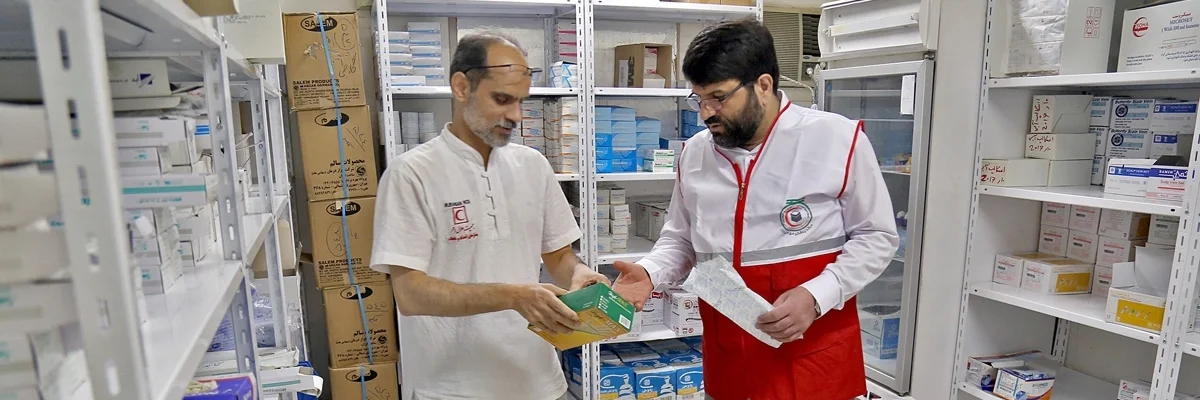
Iran: The Case for Protecting Humanitarian Trade
◢ A crisis is looming in Iran’s healthcare sector: patients are reporting shortages in life-saving medicine. The situation is expected to worsen once US sanctions on Iran are reimposed in November. European and US companies that can provide the advanced medicine and equipment needed to treat chronic diseases inside Iran are grappling with how to sustain their operations. New US sanctions will put the health of ordinary Iranians at risk. Europe can take concrete steps to minimize this—steps which also support its ongoing commitment to the nuclear deal.
This article has been republished with permission from the European Council on Foreign Relations.
A crisis is looming in Iran’s healthcare sector: patients are reporting shortages in life-saving medicine. The situation is expected to worsen once US sanctions on Iran are reimposed in November. European and US companies that can provide the advanced medicine and equipment needed to treat chronic diseases inside Iran are grappling with how to sustain their operations. The goods that are making it into Iran are being sold at soaring prices due to a sharp currency downturn following Donald Trump’s sanctions decision.
Millions of ordinary Iranians are bracing themselves for the impact of these sanctions. The UN special rapporteur for human rights warned that the sanctions will undermine human rights in the country, drive people into poverty, and make imported goods unaffordable. The impact of incoming sanctions on the humanitarian sector contradicts the US administration’s repeated statements in support of the Iranian people.
Iranians experienced similar hardship between 2012-2013 when the United States and Europe introduced the severest of sanctions to pressure Iran to restrict its nuclear program. At the time, the US Treasury provided broad authorization and exceptions for the sale of medicine and medical devices. Yet only a limited number of Western companies managed to operate under these conditions. Many were forced to halt or downsize trade due to disruptions in banking and high operational costs.
A repeat of this situation must be prevented. Unilateral US sanctions must not be allowed to needlessly cause suffering to millions of Iranian citizens. This is especially the case given that Iran continues to implement restrictions on its nuclear program under the 2015 deal. Europe, China, and Russia have also vowed to uphold the agreement.
The overarching hurdle facing many companies that export medical goods and services to Iran is related to securing banking services and finance to enable such transactions to happen. This includes a recent foreign currency shortage with which to reimburse European companies. The lack of clarity over how the US will enforce its sanctions has exacerbated these problems. For example, while the latest US OFAC guidelines reaffirm that there is broad authorization for humanitarian transactions, there is ambiguity over how extensively the US will use secondary sanctions to target private Iranian banks.
Since the nuclear deal, such banks were clearly exempt from secondary sanctions. That meant that non-US companies could establish ties with such banks to facilitate payments for the sale of humanitarian goods to Iran. Their position is now unclear. The US has outlined plans to sanction the Central Bank of Iran (CBI); but it is inevitable that any local private Iranian bank will have to transact with the CBI. Under the current US sanctions framework it is unclear if this would trigger a designation for that local bank, meaning that European banks would most likely refuse to transact with that entity.
Such uncertainty can effectively block payment channels into Iran and prevent life-saving assistance from reaching doctors and Iranian patients. Indeed, several leading pharmaceutical companies currently engaged in Iran have shared with us their concerns that banks, insurance companies, and distribution channels that have facilitated humanitarian trade with Iran are getting cold feet, fearing they could fall foul of US sanctions. Competing interpretations of the OFAC guidelines also are causing over-compliance by European companies whose board members are reluctant to accept reputational damage in the US even for humanitarian exchanges with Iran.
For Iranians, access to basic healthcare is a constitutionally protected fundamental human right. In recent years, health conditions in Iran have been gradually improving for underprivileged patients. In part this has been due to the easing of international sanctions that have made healthcare products more affordable and easily accessible. President Hassan Rouhani’s government also introduced new reforms that offer healthcare to almost 11 million previously unprotected people.
Treatment for chronic diseases is a major challenge for Iran where successful treatment requires advanced devices, training, and pharmaceuticals that are often provided through Western companies. Protecting access of such companies to Iran is therefore imperative.
As global powers look to salvage the nuclear deal despite the US withdrawal, they should seek to preserve humanitarian trade with Iran. Despite opposing views between Europe and the US on the nuclear agreement, saving the lives of Iranians should not be a topic of debate. Brian Hook, the newly appointed US special representative for Iran, recently stated that the US and Europe should be working together to “find lasting solutions that truly support Iran’s people”. Europe should press the US to fulfill this offer by working to immediately facilitate and remove obstacles to humanitarian trade with Iran.
European governments should urge the US Treasury to quickly clarify the ambiguities created by its latest guidelines and ensure that a reasonable number of Iranian private financial institutions remain exempt from US secondary sanctions. The European Union should double down on efforts to ensure payment channels with Iran are preserved, including Iran’s access to the SWIFT financial messaging service. As a matter of priority it should aim for banks in Europe to remain open for humanitarian trade with Iran. To help foreign companies sustain the profit margins of operations inside Iran, the Iranian government could also offer cost-saving incentives for companies that import medicine and medical goods into the country.
The European Commission recently announced it will provide an €18m economic package for the social benefit of ordinary Iranians. If required, it should introduce similar new provisions after November to bridge any gaps in funding and payment facilities for medicine exported by European companies. This lending mechanism (in euros as opposed to US dollars), should be large enough to at least cover the import of life-saving medicine into Iran and should be flexible enough to respond to new needs. The EU and Iran could also consider establishing a medical fund for donating pharmaceuticals and equipment to Iran. In such instances, no banking transactions will be required and therefore the risks to European companies will be reduced.
The EU could also encourage expanded scientific cooperation with Iran in medical research and training. Relative to many countries in the Middle East, Iran has advanced public and private medical research institutions that are likely to welcome such bilateral cooperation. In fact, Iranian and US scientists have long engaged in successful health diplomacy projects. European governments can support and facilitate such humanitarian-focused projects. Such measures from Europe can demonstrate that their commitment to the humanitarian needs of Iranian people goes beyond rhetoric.
Many Western governments view sanctions as an effective economic tool to alter the actions of adversary states. Yet sanctions have repeatedly hit ordinary people the hardest and resulted in a negative impact on health in the targeted country. The human cost of sanctions in countries such as Iraq, Iran, Syria, and Venezuela has been severe. Going forward, the international community must implement safeguards to fully protect humanitarian sectors of trade. As Europe pledges to demonstrate its commitment to the Iran nuclear deal, it could take a lead in this dialogue and provide concrete solutions.
Photo Credit: IRNA
Here's How the European Commission Will Allocate EUR 18 Million in Iran
◢ This month, the European Commission approved an initial tranche of EUR 18 million in development funding from an larger package of EUR 50 million that has been allocated to support projects in Iran. This represents a highly significant, “first-of-its-kind,” intervention to support Europe-Iran trade and investment. However, the funding is not primarily intended as an attempt to mitigate the effect of returning U.S. secondary sanctions. As made clear in the “action document” which details how the development funding will be distributed, the European Commission has allocated the funding “in line with the European Consensus on Development” to provide “targeted support in the areas of Prosperity, Planet and People.”
For Iran, EUR 18 million represents just a drop in the bucket in terms of the foreign direct investment that the country needs for its economic development. But in terms of development funding, this amount, an initial tranche of a larger EUR 50 million bilateral allocation introduced by the European Commission and the European External Action Service this month, represents a highly significant, “first-of-its-kind,” intervention to support Europe-Iran trade and investment.
Iran is an unusual recipient for European development aid—by the usual metrics, the country is too rich. But after some internal political wrangling, the European Commission decided to proceed with a “special measure” in order to support the policy priorities of the European Union, namely the preservation of the Joint Comprehensive Plan of Action (JCPOA).
However, the funding is not primarily intended as an attempt to mitigate the effect of returning U.S. secondary sanctions. Rather, as made clear in the “action document” which details how the development funding will be distributed, the European Commission has allocated the funding “in line with the European Consensus on Development” to provide “targeted support in the areas of Prosperity, Planet and People.”
In the area of “Prosperity,” the European Commission will seek “increased and diversified trade in goods and services” by supporting better trade policy, more effective investment promotion activities, and greater support for entrepreneurship and innovation. In the area of “Planet,” the European Commission will seek “the decoupling of economic growth from environmental degradation” by supporting programs that improve waste management and reduce water and air pollution through technologies that improve efficiency and greater awareness among policymakers and the general public. Finally, in the area of “People,” the Commission seeks to support “comprehensive and evidence-based drug use prevention, treatment, rehabilitation and social reintegration” with a special focus on the use of opiates such as heroin and its role in spreading HIV/AIDS. The “Prosperity” and “Planet” areas have been allocated EUR 8 million in funding, while “People” has been allocated EUR 2 million.
The implementation of the funding differs in each area and will use both direct and indirect management, with the Commission ensuring that “that the EU appropriate rules and procedures for providing financing to third parties are respected” in all cases.
Funding in the area of “Prosperity” will be allocated through the International Trade Center (ITC), a United Nations agency. The ITC will assist Iran’s Trade Promotion Organization, a agency of the Ministry of Industry, Mine and Trade to develop a “national export strategy” with a particular focus on boosting the capacity of small and medium-sized enterprises (SMEs) as well as the internal managerial and technological capacity of TPO. ITC and TPO will also collaborate to develop a “Youth Trade Accelerator Program” which will youth-led enterprises. Initial meetings have already been held between ITC officials and Iran’s TPO and the cooperation envisioned and funded by the Commission builds on an MOU signed between ITC and TPO in 2016.
In the area of “Planet,” the European Commission will directly administer the funding on the bases of grants and will reply upon “pillar-assessed” organizations from its member states, a designation that applies to those organizations which have been pre-approved to implement resources from the European Union’s general budget. Efforts in this area will build on the EU-Iran framework for technical cooperation on the environment signed by Iran’s vice president for environment Masoumeh Ebtekar and EU environment commissioner Karmenu Vella in Brussels in September 2016. A consortium of member-state organizations is expected partner with Iranian stakeholders to drive the implementation of pilot projects that “contribute to enhancing Iran’s self-reliance in the areas of addressing water pollution and integrated water resources management, air pollution, waste management and soil degradation.”
Finally, in the area of “People,” funding will be directly managed and dispersed via grants. The Commission will issue a single call in the “first trimester of 2019” for proposals “to finance projects aiming at comprehensive and evidence-based drug use prevention, treatment, rehabilitation and social reintegration, with special emphasis on high-risk groups.” Interestingly, these grants will not be made directly to Iranian institutions. Instead, eligibility criteria mandate that grants flow to “agency, non-governmental organization, public sector operator, local authority, international research organization, university or university related organization” from an EU member state or a small group of international organizations. While the public health benefits of these grants will no doubt be substantial, these restrictions raise the question of how much of the financial impact of the EUR 2 million in grant funding allocated for the area of “People” will be felt in Iran.
Overall, the Commission’s efforts are encouraging for their scope and the clear willingness to deepen bilateral ties between the European Union and Iran at a fraught political moment. But beyond good intentions, implementation will be key. To this end, the Commission outlines a series of “assumptions” which underpin the feasibility of the planned cooperation with Iran.
The envisaged cooperation requires that “Iran ensures the necessary human, financial and material resources to facilitate the implementation of projects as far as cooperation with national authorities is required” and—in a crucial consideration given still-unexplained arrests of Iranian environmentalists—that “technical exchanges and cooperation between public sector and civil society actors… remain non-sensitive and feasible.”
Photo Credit: European Commission
For Payment Service Venmo, 'Persian🍕' Raises Alarms
◢ Venmo is a “digital wallet” connected to one’s bank account that allows users to instantly send and receive money. Venmo users commonly include little messages when sending money to friends. But as a recent experience shows, including the words “Iranian” or “Persian” in a memo, even in reference to a pizza dinner among Iranian friends, can have transactions blocked for further review. Yet including the word “cocaine” in a payment memo will not lead to a compliance review, despite the violation of Venmo’s user agreement. This reflects the unique stigma around Iran transactions.
A few weeks ago, a group of my Iranian-American friends and I gathered after work and chatted about the current political climate over dinner. Like many millennials, we ordered food from Seamless and at the end of the night used Venmo—a “digital wallet” connected to one’s bank account that allows users to instantly send and receive money —to pay back the host for purchasing pizzas and salad for the group.
When sending her contribution to the host, one of my friends wrote “Persian🍕” in the caption. Venmo users commonly include little messages when sending money to friends. But this time the transaction was flagged and blocked immediately. Why? Because the word “Persian” was included in the transaction memo.
Tyler Cullis, an associate attorney at Ferrari & Associates, a sanctions law firm in Washington D.C., explained that “certain words trigger and raise a red flag with Venmo and its parent company, PayPal.” These triggers are any words that could raise potential sanctions compliance issues and require their compliance team to further review the payment to make sure it is not violating any sanctions law. “These regulations are laws, and U.S. persons acting in violation of them may be subject to civil and criminal penalties,” he added.
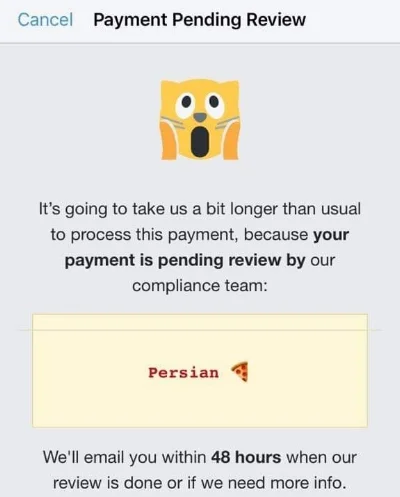
According to current U.S. law, companies have to stop any payments if they believe it to be of Iranian origin because their facilitation, intentional or not, would be a sanctions violation according to the relevant regulations, which specifically prohibit U.S. persons from engaging in any transaction or dealing in or related to goods or services of Iranian-origin.
The pizza that was ordered certainly did not come from Iran—perhaps to the dismay of many Iranians in the diaspora who swear by actual Persian pizza—ketchup and all. Plus, I would think that it would become quite soggy after it was in transatlantic transit from Tehran to Washington.
Venmo’s algorithm scans for “suspicious” transactions based on certain keywords, but it is often inconsistent and illogical. When asked how one would know whether a transaction would inadvertently include a banned word or whether a list would be published on their website for further clarity, a Venmo spokesperson stated that they would not share that since users could then potentially find a way around it.
While perhaps this may only seem to be a minor inconvenience, the impact of Venmo and PayPal’s targeted actions goes far beyond sending and receiving money for food transactions. Small businesses, academic departments, and nonprofit organizations have been directly impacted this blanket ban. Various humanitarian organizations have also had their transactions flagged for further review, delaying the receipt of donations.
Last December, after a major earthquake shook the Khuzestan region of Iran, several individuals affiliated with larger groups hosted fundraisers to gather supplies and money to send to several U.S. based organizations with OFAC licenses. In Washington D.C., one such fundraiser was organized and several donations were blocked when users typed in “Iran earthquake relief” in the memo line on Venmo to purchase their entry to the event. Individuals and smaller groups attempting to make a small impact in their community are the ones affected given many folks don’t have cash on hand or credit card machines and Venmo is known to be a fast and effective substitute.
A representative at Venmo stated that all transactions are reviewed by their compliance team for security purposes but if “something seems off, it is further investigated.” I was also told that if a transaction seems to be “against their user agreement” then it will be flagged for further review.
Several provisions violate the user agreement listed on the Venmo website, however none of those transactions had been immediately flagged. If one types in “drugs,” “cocaine,” or “heroin” into the memo line—clear violations of Venmo’s user agreement which states users may not use Venmo to conduct transactions that involve “tobacco products, prescription drugs and devices, drug paraphernalia, narcotics, steroids, certain controlled substances or other products that present a risk to consumer safety”—the transactions are not immediately flagged for additional review nor blocked.
It’s important to note that Venmo can only be set up by someone with a U.S. bank account and U.S. mobile number. These requirements make it near impossible for Iranians in Iran to engage with and utilize the app.
So what does Venmo consider to be more problematic ? A transaction entitled “Persian 🍕” or “Cocaine 👃”? That a harmless transaction for food is more strictly regulated than a transaction which could potentially be for the sale of controlled substances reflects the stigma attached to anything labeled “Iranian” or “Persian” by users.
Policing transactions with low risks of being actual sanctions violations, but ignoring those significantly more likely to be blatant violations of their own company’s user agreement and potentially abetting illegal activities, is counterintuitive. If Venmo and PayPal truly cared about users not abusing their app and making sure their transactions are appropriate, they should aim to address this issue more intelligently, and not merely implement a blanket ban against certain cultures and keywords.
Photo Credit: Venmo
Can Europe Defend Itself And Iran From U.S. Sanctions?
◢ In an op-ed published in the German newspaper Handelsblatt, German Foreign Minister Heiko Maas declared that the “the US and Europe have been drifting apart for years.” In order to defend the JCPOA and protect European companies active in Iran from U.S. sanctions, Maas has outlined three initiatives: “establishing payment channels independent of the US, a European monetary fund, and an independent SWIFT [payments] system.” This has given many in Iran hope that Europe might still be able to create an “economic package” to save the JCPOA. But Maas’s vision is not an economic package. It is an economic process, which may prove transformative, but only in the long term.
This article was originally published in LobeLog.
In an op-ed published in the German newspaper Handelsblatt, German Foreign Minister Heiko Maas declared that the “the US and Europe have been drifting apart for years.” Nowhere is this clearer than in the disagreement between the United States and Europe over the fate of the Iran nuclear deal. When President Trump withdrew from the Joint Comprehensive Plan of Action (JCPOA) and announced his intention to reimpose secondary sanctions that would impact European businesses, he made clear that he wouldn’t treat Europe in what Maas called a “balanced partnership.” In response, Maas believes that Europe must “bring more weight to bear” in global affairs.
In order to defend the JCPOA and protect European companies active in Iran from U.S. sanctions, Maas outlined three initiatives: “establishing payment channels independent of the US, a European monetary fund, and an independent SWIFT [payments] system.” These initiatives echo ideas expressed by French economy minister Bruno Le Maire in the aftermath of Trump’s withdrawal from the JCPOA. Le Maire has called for European governments to work together to protect Europe’s economic autonomy by creating “independent, sovereign European financial institutions which would allow financing channels between French, Italian, German, Spanish and any other countries on the planet.” Le Maire has declared that “the United States should not be the planet’s economic policeman.”
It will be difficult to realize the political designs of Maas and Le Maire within the economic structures that link Europe and global markets, including Iran. As Maas concedes, “the devil is in thousands of details.” It should be no surprise, therefore, that speaking to President Hassan Rouhani’s cabinet last week, Supreme Leader Ali Khamenei declared that Iran “must not pin hope on the Europeans for issues such as the JCPOA or the economy,” noting that promises must be examined with “skepticism.”
Iran should not take for granted the hopeful vision of more resolute European leadership, especially if that leadership promises to deliver fairer political and economic outcomes for Iran. But in light of the present economic crisis, the Iranian government and Iranian people can no longer afford to take a long-term view when it comes to fundamental questions like access to the international financial system, whether or not that system continues to be dominated by the United States. As such, it is important to try and discern the specific and short-term implications of the new political vision espoused by leaders like Maas and Le Maire.
First, there has been the greatest progress in designing possible payment channels that would help sustain transactions in the face of U.S. secondary sanctions. As an initial step, the central banks of France, Germany, the United Kingdom, Austria, and Sweden have indicated their openness to establishing payment channels with the Central Bank of Iran that would be immune to sanctions since the U.S. government is unlikely to take the extreme step of sanctioning European central banks for transacting with Iranian entities. Importantly, these central banks, which would be facilitating transactions on an ad hocbasis, would not need to rely on payment systems such as SWIFT.
However, the central banks have established a pre-condition: Iran must fully implement the Financial Action Task Force (FATF) action plan. But even if Iran does successful implement the FATF reforms, and even if European central banks fulfill their promise, the creation of limited payment channels does not amount to an independent financial system. In such a scenario, the impact of U.S. sanctions on European and Iranian banks will continue to prevent trade and investment in meaningful volumes.
Second, the creation of an independent payment messaging system is essential to enabling those smaller European banks that lack a “U.S nexus” to transact with Iranian banks, thereby enabling trade and investment at higher volumes. To this end, Maas has called for the creation of “an independent SWIFT [payments] system.” Notably, Maas’ statement makes it clear that European leaders do not expect to successfully defend the independence of SWIFT in its current form. SWIFT, headquartered near Brussels, is a cooperative owned by its member financial institutions, including major American banks such as Citibank and JP Morgan. Even so, SWIFT represents a rare global financial institution in which the United States is not dominant, but dependent. Some analysts, among them former officials from the U.S. Department of Treasury, have observed that it would be harmful to U.S. economic interests to sanction SWIFT. In fact, when SWIFT disconnected Iranian banks from its system in 2012, this was only because the organization voluntarily agreed to do so in accordance with European sanctions policy at the time, not because of the realistic threat that the U.S. would sanction the entity.
It is not entirely clear whether Maas wants Europe to insist on SWIFT’s independence or to devise new messaging systems altogether. A new system would be technically easy to establish but would prove difficult to monitor for possible money laundering or terrorist financing, an important political consideration. Although the former approach would certainly deliver Iran a more immediate solution on banking challenges stemming from U.S. sanctions, given that Iranian banks were reconnected to the SWIFT following implementation of the nuclear deal, Europe will more likely take the latter, more time-intensive approach. German Chancellor Angela Merkel responded to Maas’ op-ed (which she called an “important contribution”) by noting that “on the question of independent payment systems, we have some problems in our dealings with Iran…on the other hand we know that on questions of terrorist financing, for example, SWIFT is very important.” Merkel’s comments suggest that political capital will most likely be spent creating a minimal, ad hoc messaging system in support of transactions with Iran rather than defending the independence of SWIFT in the face of a U.S. sanctions threat.
Finally, if payment channel and payment messaging solutions can be devised, Europe will need to ensure financing flows through these channels to Iran, in order to spur economic growth and support infrastructure and energy projects led by European companies. Here, Maas has pointed to the creation of a European Monetary Fund. Plans for the creation of such a fund have been circulating in European capitals for over a year and are based on upgrading the European Stability Mechanism (ESM), the entity that managed the bailouts of Eurozone states made necessary by the global financial crisis. Currently, ESM borrows on capital markets by issuing bonds. Such a reliance on capital markets has proven the critical barrier to the European Commission’s effort to get the European Investment Bank (EIB), which finances capital projects around the world, to invest in Iran. Like ESM, EIB raises capital by selling bonds, often to American institutional investors. Understandably, the CEO of EIB has publicly rejected calls to invest in Iran, stating that to do so “would risk the business model of the bank.”
The creation of a European Monetary Fund would be supported by financing drawn directly from European central banks and not capital markets, limiting exposure to U.S. investors, and therefore to the risk of U.S. sanctions. Such an institution would also reduce European reliance on the International Monetary Fund and World Bank, which remain politically dominated by the United States. Whereas countries such as Turkey and Egypt have readily used IMF financing to fuel growth and weather economic crisis, longstanding tensions between the United States and the Islamic Republic mean that Iran has been unable to secure IMF loans.
European governments are aware of the need to support Iran’s economic development through capital allocation. The European Commission’s recent move to allocate to Iran 18 million euros of a planned 50 million euros of development aid in order to “widen economic and sectoral relations” demonstrates the desire to fund growth. The European Commission simply lacks the right financial institutions to provide such capital to Iran at a meaningful scale.
Overall, Maas’ message contains real, practical ideas about how to not only sustain trade and investment in Iran in the face of secondary sanctions but also strengthen Europe’s economic sovereignty in lasting ways. However, Iran must recognize that there is no readymade “economic package” that Europe can deliver to save the JCPOA. There is only an “economic process” where improvements in the facilitation of trade and investment will occur over time and in sequence.
In the coming months, it will be feasible to institute a payment channel between central banks. In the coming year, it will be feasible to establish a new payment messaging system. Finally, over the course of several years, Iran could benefit from the creation of a European Monetary Fund, financing from which could truly transform prospects for Iran’s economy. For its part, Iran must remain willing to undertake its own economic process, beginning with critical FATF reforms. In this way, if Europe and Iran each grow stronger, through a renewed insistence on independence and autonomy, the prospects for political and economic cooperation will actually improve. The United States cannot be the fulcrum on which all partnerships must balance.
Photo Credit: German Federal Foreign Office
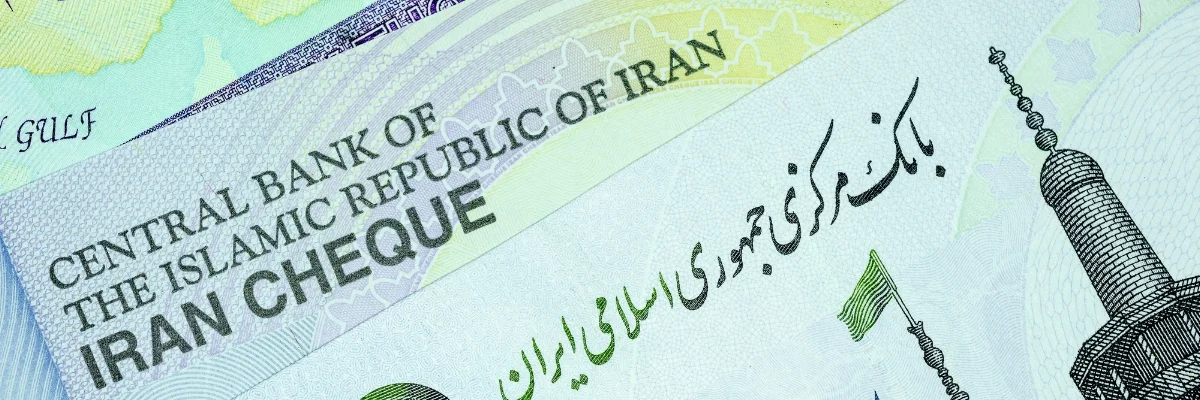
Iran's Currency Crisis is a Supply-Side Story
◢ On Monday, the Iranian rial sank to a historic low. But those Iranians who scrambled to convert their rials into dollars found it difficult to do so—as they have for months. This important detail of the current crisis has gone largely unexamined. While the determinants for demand for foreign exchange are well understood, the second determinant of market prices—foreign exchange supply—remains subject to mere passing mention. This is a mistake. Iran’s currency crisis is a supply-side story.
On Monday, the Iranian rial sank to a historic low. But those Iranians who scrambled to convert their rials into dollars found it difficult to do so—as they have for months. Since April, reports on the accelerating crisis have consistently noted a lack of hard currency available at Iran’s exchange bureaus.
This important detail of the current crisis has gone largely unexamined in foreign reportage. While the determinants for demand for foreign exchange—widespread anxiety about the state of the economy and the return of sanctions—are well understood, the second determinant of market prices—foreign exchange supply—remains subject to mere passing mention. This is a mistake. Iran’s currency crisis is a supply-side story.
In the absence of data, it is hard to show quantitatively that the currency crisis is primarily a supply-side phenomenon, but there are numerous factors that make this likely. Iran has been prevented from repatriating its foreign exchange reserves held in Europe. Its regional neighbors have vowed to cease using the US dollar to conduct bilateral trade. Illicit networks that have long funneled US currency to the black market have been interrupted. Most tellingly, the Trump administration is being urged by its close advisors to “quickly exacerbate the regime’s currency crisis” by interfering with Iran’s foreign exchange supply.
While the government has no doubt failed to inspire confidence in its economic leadership, contributing to the ouster of both the central bank governor and economy minister, it is unlikely that expectations of rising inflation and economic recession alone would create so dramatic a rush to the safe-haven of the dollar.
In an interview with Euronews, economist Saeed Laylaz, offers more detail on how the historic exchange rate principally reflects a shortage phenomenon. “You might imagine that the dollar price of 12,000 or 13,000 toman accounts for 100 percent of the currency market, when in actuality we have various companies completing imports with a dollar at a price less than 8,000 toman in the secondary market,” Laylaz explains. In his assessment, while the 8,000 toman rate accounts for 80 percent of transactions on the secondary market, “the dollar bill is 12,000 toman.” Greenbacks are physically scarce and this accounts for the historic prices making headlines worldwide.
For companies with access to dollars at 8,000 toman and especially for those enterprises with access to dollars at the government rate of 4,200 toman, the price of the physical dollar bill offers an immense opportunity for arbitrage. The temptation for companies to divert a portion of their foreign exchange into the most lucrative and speculative parts of the free market has proven hard to ignore. One example can be seen in the petrochemical sector, where major companies, including state-owned enterprises, have been slow to make their foreign exchange available for sale on the secondary market through NIMA, the country’s centralized marketplace, despite instructions from the central bank and oil ministry.
Economist Hossein Raghfar described these companies as “accountable to no one” when it became apparent that they may have sought to sell their currency at the free market rate, rather than at the lower official exchange rate, despite the government instruction. Nonetheless, in the assessment of Masoud Nili, the government's chief economic advisor, this kind of arbitrage activity is a symptom of the rising premium and not its root cause. Nili comes close to acknowledging that the government's focus on profiteering in the early months of the crisis was an attempt to deflect from more consequential interruptions in foreign exchange supply.
It is likely that the primary cause of the currency crisis is a severe shortage in foreign exchange. This places the Rouhani administration in an especially difficult bind. It might seem straightforward that increasing the foreign exchange supply would help stabilize the rial and prevent the speculation enabled by the extreme scarcity of the dollar and euro. Mohammad Reza Farzanegan looks at some of these issues in his study of illegal trade in Iran from 1970 to 2002. He confirms that easing the ability of actors to “acquire more subsidized exchange” will lead to some part of the currency to be “sold in the black market of foreign exchange.” The actions of the petrochemical companies offer a perfect case study.
This is especially important at a time when the incentives for illegal import activity are increasing. Farzanegan writes that “whenever state intervention drives a wedge between international and domestic prices… there is an incentive for underground activities.” In subsequent research he has shown convincingly that the “wedge between international and domestic prices” can be applied externally—sanctions spur “underground activities.” In this way, making foreign exchange more readily available may stabilize the exchange rate, but it can serve to accelerate rent-seeking and smuggling, the agents of which have historically used their trading networks to take their profits offshore.
The specter of capital flight looms large over the administration. In a recent address, newly appointed central bank governor Ehsan Hemmati announced that the country would not use oil revenues in order to prop-up the currency. In a likely related move, Iran has decided not to seek to transfer EUR 300 million in cash from its funds in Germany to Iran to increase foreign exchange supply. A report in Shargh, a leading newspaper, suggests that the government had decided not to intervene to support the rial in order to prevent capital flight by allowing the dollar to become a scarce and expensive "luxury item."
A recent report by Iran’s Parliamentary Research Center estimated that capital flight in the year leading up to March 20 amounted to USD 13 billion dollars. By comparison, during the Ahmadinejad administration, that figure was possibly ten times higher, with reports suggesting that between USD 100-200 billion was taken out of the economy as sanctions tightened. Between 2005-2012 Iran generated USD 639 billion in oil revenues, with falling exports offset to a degree by historic oil prices. Yet Ahmadinejad left office with Iran’s foreign exchange reserves at only around USD 50 billion higher than when he entered.
To prevent capital flight on that order, the Rouhani administration can prioritize rate convergence and stabilization over interventions that would significantly lower the price of the dollar. The Central Bank of Iran has sought to "bridge" the two sides of the market that Laylaz describes, announcing that "authorized exchanges can sell foreign currency bought from exporters and other sources registered through the SANA system, in the form of banknotes in the open market." The banknotes would be purchasable upon request from the central bank. In this way, any increase in the supply of banknotes at the upper end of the market will be associated with reduced supply at the lower end, helping push the rate to convergence, even if the rate remains historically high. A high exchange rate may be a necessary evil in order to protect fragile economic growth.
In a study of the Iran’s economy from 1981-2012, Hoda Zobeiri, Narges Roshan and Milad Shahrazi of the University of Mazandaran identify a strong negative relationship between capital flight and economic growth in Iran. By trapping capital at home, even devaluing rials, the Rouhani administration might hope that wealth is committed domestically towards investments and capital formation that can sustain growth. Some evidence that this may be taking place can be seen in the fact that the Tehran Stock Exchange is on a historic bull run.
Laylaz and others have criticized the administration for “adding fuel to the fire of the market” by failing to curb the demand for foreign currency. But by focusing on demand, critics will miss important supply-side phenomena, such as how the currency shortage may slow the capital flight that has historically preceded the reimposition of sanctions. Whether or not this is an intentional outcome of the Rouhani administration’s policy, that the inability or unwillingness to increase foreign exchange supply may be consistent with attempts to limit illicit trade and capital flight is a surprising outcome and one that deserves to be formalized as part of wider efforts to manage and minimize rent-seeking in Iran.
Photo Credit: Depositphotos
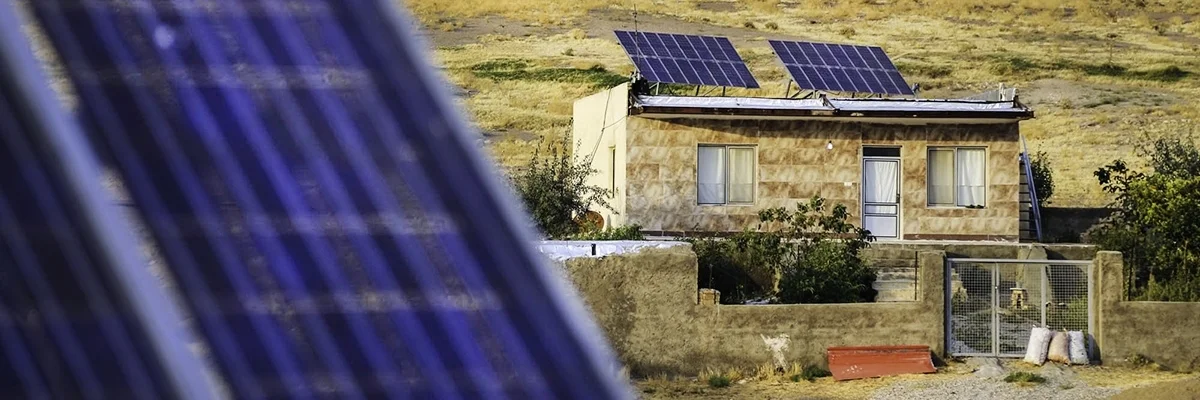
Can Chinese Investment Bring Sunshine Back to Iran's Solar Industry?
◢ Renewable energy has been one of the brightest sectors in the Iranian economy, achieving 70 percent growth in the last Iranian year according to official data. But this encouraging growth is now in doubt. The Trump administration’s unilateral withdrawal from the JCPOA nuclear deal has brought economic uncertainty for local investors and made foreign direct investment increasingly difficult. While there are steps the government can take to reassure local and foreign investors, as with other sectors of Iran’s economy, the withdrawal of European investors from Iran’s solar industry may mean that “Chinese money turns out to be the only option.”
Renewable energy has been one of the brightest sectors in the Iranian economy, achieving 70 percent growth in the last Iranian year according to official data. There are currently 85 large-scale and more than 1,850 small-scale renewable power plants feeding electricity into the national grid. The overall capacity of renewable power plants in Iran reached 637 MW this month. A further 41 large-scale power plants with a total output capacity of 431 MW are currently under construction across the country.
Overall, the sector is projected to generate 1,000 MW of clean electricity annually by 2022. This additional capacity is especially important as policymakers seek to meet rising electricity demand and prevent summer blackouts in coming years. It is also a source of export revenue. Iran has exported USD 4.1 billion worth of electricity to its neighbors over the last five years, with renewable energy a growing contributor.
The environmental benefits are also significant. Growing use of renewable energy has saved 541 million liters of increasingly precious water and replaced the consumption of 600 million liters of fossil fuels in the past ten years.
At a smaller scale, an increasing number of farmers, struggling with a chronic shortage of water supplies, are turning to solar power generation on their farms. Farmers in Esfahan who are no longer permitted to cultivate rice are taking advantage of a 20-year government guarantee for the supply of electricity. It is estimated that over 1,000 small-scale solar power plants are now installed in farms across rural Iran.
Attractive Legal Structure
But this encouraging growth is now in doubt. The Trump administration’s unilateral withdrawal from the JCPOA nuclear deal has brought economic uncertainty for local investors and made foreign direct investment increasingly difficult.
Mohammad Sadegh Zadeh, deputy minister of energy and head of the Renewable Energy and Energy Efficiency Organization (SATBA), recently announced that the sector has attracted IRR 100 trillion (USD 940 million) from local private-sector investors over the last two years. Foreign investment has been even more important, contributing USD 1.7 billion, nearly 70 percent of total investment since President Rouhani took the office in 2013.
Foreign investors completed several projects in this period. These include a 20 MW solar farm in Mahan backed by Swiss investors, five German-backed solar power plants in Hamedan with a total capacity of 38.5 MW, the first phase of a 50 MW solar plant backed by Italian investors, two Greek-backed 10 MW solar farms in Yazd and Isfahan; a 10 MW solar farm in Tehran backed by French investors, as well as further projects developed by Turkish, Austrian and Swedish companies.
However, Trump’s unilateral exit from the 2015 nuclear agreement with Iran, and his decision to re-impose sanctions against the country, pose a new threat toward foreign investments. The effects are already being felt in the sector.
British developer Quercus, which was set to develop Middle East’s largest solar power plant in Iran, decided to halt its work in the country, while other developers are reportedly re-thinking their plans for their future activities in the country, especially as even routine banking transactions become more difficult.
The depreciation of the rial and the tight foreign exchange market also pose a challenge for developers and make the incentives in Iran’s electricity market less attractive, according to Shahriar Sabet, a London-based renewable energy investor.
“Iran has created an attractive legal structure for investors which includes the power purchase agreement and FIPPA [Foreign Investment Promotion and Protection Act]... Also the feed-in-tariff (FiT) is an important factor as it remains one of the highest paid in the world,” Sabet says.
“Although with depreciation in rial, the FiT has dropped significantly but under FIPPA investors can still repatriate their capital and revenue under official exchange rate”, Sabet explains. “ The government is working hard to continue allocating the official exchange rate to the sector for the repatriation of revenues which in this climate is another positive sign,”
Sabet also emphsises that “institutionally, Iran has tried very hard to prioritize the renewable energy sector, with coordination between the Ministry of Energy, Ministry of Economy, SATBA, and local grid companies, to create a very supportive platform with clear procedures for foreign investment.”
“The current conditions, internally and internationally, have adverse effects on the market. However if Iran maintains its current structures, our view is that it is a market to invest in. I do believe those who are on the ground should not abandon their projects and confront the headwinds and new investors should also explore ways to enter this highly attractive and relatively stable sector in Iran,” Sabet insists.
The Need for Government Guarantees
But the government still has options to save the sector. Ehsan Imani, an expert in feasibility studies of renewable power plants, believes that the government needs to focus on three major issues to keep foreigners interested in the market.
“Payment guarantees could be the very first and the most effective tool to revive the market’s attraction. The feed-in-tarrif also should remain high although it is still higher than some other countries even after drops in recent months the. Investors cannot easily ignore Iran if the government reconsider its pricing policy and issue payment guarantees,” he explains.
Sabet agrees on the need for guarantees: “Issuing such guarantees for smaller projects will create more confidence and boost the flow of investment albeit at smaller scale.”
Regular settlement is also of high importance from Imani's point of view: “Late payments naturally could change the minds of those investors who are plans to enter the market.”
Until the recent currency crisis, SATBA had reportedly managed to meet its payment requirements on time. The Central Bank of Iran has offered to make payments in yuan instead of euros, a move not favored by European investors.
The Sun Rises in the East
As with other sectors of Iran’s economy, the withdrawal of European investors from Iran’s solar industry may mean that “Chinese money turns out to be the best available option while other investors have to miss the opportunity,” as Sabet puts it.
Chinese investors face fewer barriers to investment according to Imani, “They face no serious restrictions to sell facilities to Iran, and payments are easy to make–[even if it is paid in yuan].”
This is especially true because Chinese companies lead the world in the manufacturing of solar panels. Because the panels merely need to be installed in Iran, up to 80 percent of the total investment cost for a solar project in Iran can be paid directly to Chinese panel suppliers or plant designers in local currency.
Recent developments in the market suggest a growing role for Chinese investors. In July, Yazd province officials signed an agreement with a partnership of Chinese and Italian firms for the development of a transformative 500-1,000 MW of solar projects. The agreement includes installing 20,000 small 5 KW power plants in residential units across the province.
The provincial government in Qom province signed an MOU with a major Chinese company to develop of a 30 MW power plant in the central province. Chinese firms have also reportedly reached agreements for development of large solar power plants and the local manufacturing of solar panels in Fars, Zanjan, North Khorasan and East Azarbaijan provinces.
For Iran’s solar sector, the sun may be setting in the West. But it may rise again in the East.
Photo Credit: IRNA
