

Iran Trade Mechanism INSTEX is Shutting Down
At the end of January, the board of Instrument in Support of Trade Exchanges (INSTEX) took the decision to liquidate the company.
At the end of January, the board of the Instrument in Support of Trade Exchanges (INSTEX) took the decision to liquidate the company. Established in January 2019 by the United Kingdom, France, and Germany, INSTEX’s shareholders later came to include the governments of Belgium, Denmark, the Netherlands, Finland, Spain, Sweden, and Norway.
The state-owned company had a unique mission. It was created in response to the Trump administration’s withdrawal from the Iran nuclear deal in May 2018. European officials understood that the reimposition of US sanctions would impede European trade with Iran. The nuclear deal was a straightforward bargain. Iran had agreed to limits on its civilian nuclear programme in exchange for the economic benefits of sanctions relief. If European firms were unwilling or unable to trade with Iran, that basic quid-pro-quo would be undermined. For this reason, supporting trade with Iran was seen as a national security priority.
In August 2018, EU high representative Federica Mogherini and foreign ministers Jean-Yves Le Drian of France, Heiko Maas of Germany, and Jeremy Hunt of the United Kingdom, issued a joint statement in which they committed to preserve “effective financial channels with Iran, and the continuation of Iran’s export of oil and gas” in the face of the returning US sanctions. They pointed to a “European initiative to establish a special purpose vehicle” that would “enable continued sanctions lifting to reach Iran and allow for European exporters and importers to pursue legitimate trade.”
In November 2018, when the basic parameters of a special purpose vehicle were still being formulated by European officials, I co-authored the first public white paper explaining why establishing such a company made sense. Conversations with European and Iranian bankers and executives had made clear to me that trade intermediation methods were being widely used to get around the lack of adequate financial channels between Europe and Iran. If these methods could be packaged as a service by an entity backed by European governments, it would reassure European companies about remaining engaged in the Iranian market, while also reducing costs.
A few months later, INSTEX was founded. In the beginning, the company was run by the Iran desks at the EU and E3 foreign ministries. The officials tasked with working on INSTEX, who were often very junior, quickly realised they had little knowledge of the mechanics of EU-Iran trade. When they sought to enlist help from colleagues at finance ministries and central banks, they frequently met resistance. Many European technocrats were reluctant to support a project which had the overt aim of blunting US sanctions power, even at a time when figures such as French finance minister Bruno Le Maire and Dutch prime minister Mark Rutte were making bold statements about the need for European economic sovereignty. Even INSTEX’s inaugural managing director, Per Fischer, departed given concerns over his association with a company that had been maligned by American officials as a sanctions busting scheme. Then, in May 2019, when the Trump administration cancelled a set of sanctions waivers, European purchases of Iranian oil ended. That left INSTEX as Europe’s only gambit to preserve at least some of the economic benefits of the nuclear deal for Iran.
Later that year, INSTEX hired its first real team after a new group of European governments joined as shareholders and injected new capital into the company. For a time, things looked more promising. Under the newly appointed president, former German diplomat Michael Bock, a small group of talented individuals worked to define INSTEX’s mission and build a commercial case for the company’s operation. Their efforts led to INSTEX’s first transaction, which was completed in March 2020—the sale of around EUR 500,000 worth of blood treatment medication. The political pressure to provide Iran some gesture of tangible support during the pandemic had also greased the wheels in European governments.
But many considered the INSTEX project doomed even before the first transaction was completed. Certainly, Iranian officials were derisive of the special purpose vehicle. Given that Europe had failed to sustain its imports of Iranian oil and was unable to use INSTEX for that purpose, focusing instead on humanitarian trade, Iranian officials dismissed the effort, even after the feasibility of the special purpose vehicle was proven. That it took more than a year to process the first transaction also meant that the Europeans missed their chance to fill the vacuum caused by the US withdrawal from the nuclear agreement. Without full cooperation from its Iranian counterpart, which was called the Special Trade and Finance Instrument (STFI), INSTEX could not reliably net the monies owed by European importers to Iranian exporters with those owed by Iranian exporters to European importers.
European officials will no doubt blame Iran for the fact that INSTEX failed, and it is true that the Iranian government never fully appreciated the political significance of European states taking concrete steps to counteract even the indirect effects of US sanctions. Of course, the decision to liquidate the company follows a spate of recent actions by the Iranian government—nuclear escalation, the sale of drones to Russia, and the brutal repression of protests—that make the continued operation of INSTEX politically untenable.
But most of the blame for INSTEX’s failure must lie with the Europeans—the company’s demise predates Iran’s recent transgressions. European officials promised a historic project to assert their economic sovereignty, but they never really committed to that undertaking. A mechanism intended to support billions of dollars in bilateral trade was provided paltry investment. European governments never figured out how to give INSTEX access to the euro liquidity needed to account for the fact that Europe runs a major trade surplus with Iran when oil sales are zeroed out. For the Iranians, this alone was the evidence that European leaders saw INSTEX as a political gesture that might placate Tehran, rather than an economic instrument that would bolster Iran’s economy in the face of Trump’s “maximum pressure.”
Paradoxically, Iran will lose nothing as the liquidators shut down INSTEX, quietly selling the few assets the company had accumulated—laptops, office chairs, and perhaps some nifty pens. It is Europe that is losing out. INSTEX was supposed to be a testbed for new ways of facilitating trade without relying on risk-averse banks to process cross border transactions. Successful innovation in this area would have given a new dimension to European economic diplomacy and helped Europe assert the power of the euro in global trade.
With the writing on wall, INSTEX’s management made one final attempt to give the company a future. Beginning in 2021, the company pursued a French banking license—a pivot that INSTEX’s board had approved on a provisional basis, but which was halted in early 2022. It is hard to overstate how significant it would have been had INSTEX emerged as a state-owned bank with a specific mandate to process payments on behalf of European companies that wish to work in high-risk jurisdictions, including those under broad US sanctions programme. Such a bank could have become a powerful tool for Europe to assert its economic might in the face of US sanctions. Moreover, it would even have been useful in cases where Europe is applying sanctions, like Russia. After all, a commitment to humanitarianism means that goods such as food and medicine must continue to be bought and sold even when most transactions with a given country are prohibited. INSTEX could have helped make European sanctions powers more targeted and more humane.
For a company that managed just one transaction, a surprising amount has been written about INSTEX. It has been the subject of news reports, think pieces, and academic articles. Even if many people struggled to understand what the special purpose vehicle aimed to do, its existence was novel and therefore noteworthy. For those insiders directly involved in the company’s saga, and for those of us who have closely followed from the outside, the main takeaway seems to be that there is much yet to be learned about the complex ways in which US sanctions impact European policy towards countries like Iran, through both political and economic vectors. In this respect, INSTEX did achieve something. A group of technocrats in European foreign ministries and finance ministries learned valuable lessons, often reluctantly and with great difficulty, about the limits of Europe’s economic sovereignty. Whether those lessons can be institutionalised remains to be seen. But a fuller post-mortem on INSTEX would no doubt offer important lessons for the future of European economic power in a world dominated by US sanctions. Learning those lessons would be its own special purpose.
Photo: Wikicommons

What Role Do Economic Conferences Play in Uzbekistan’s Development?
Uzbekistan is seeking a dialogue with the world and economic conference can serve to build trust and generate credibility.
Back in November, I travelled to Samarkand to attend the Uzbekistan Economic Forum. I had been to the ancient city nearly a dozen times, but this was my first professional event there. The Uzbekistan Economic Forum did not suddenly convince everyone that Uzbekistan is a special country. But it did show that Uzbekistan was becoming a more normal one.
Not everyone in Uzbekistan was happy with the conference. Some journalists and bloggers questioned why Uzbekistan’s government needed to convene yet another major and costly event. Others wondered if the return on investment would be worth it. Concerningly, the costs of the forum were not disclosed. Clearly, the organisers could have done a better job in publicly communicating the rationale for such a large event and why such conferences matter. To me, there are three reasons why they do.
First, Uzbekistan needs to foster regular dialogue with businesses partners, investors, and lenders who are independent from the government. Such actors are accountable to their shareholders, are subject to intense international media scrutiny, and must follow varied regulations around governance and sustainibility. Therefore, they can audit Uzbekistan’s achievements and shortcomings more honestly, generating important information for local media and civil society.
A country whose debt burden is equal to 40 percent of its economic output must be open to scrutiny of its economic policies and institutions. The forum’s thoughtful programme presented the opportunity for such scrutiny, with topics ranging from political reforms to economic inclusivity. The organizers brought in people who could ask tough questions (including former CNN and Bloomberg journalists) as chairpersons for the panel discussions. Senior representatives from the IMF, IFC, World Bank, European Bank for Reconstruction and Development (EBRD), Asian Development Bank, Asian Infrastructure and Investments Bank, regional central bankers, financiers, investors, and many consultants featured on these panels.
There was a time when frankness came at a cost. In May 2003, panelists from the EBRD, which was leading Uzbekistan through its protracted post-communist transition, spoke truthfully about the country’s economic and political shortcomings at the Annual Meeting in Tashkent. By 2005, EBRD war hardly making any loans in Uzbekistan and by 2007 it had exited the country altogether, unable to operate in an environment in which the authorities demanded deference. It was not until a decade later that EBRD returned to Uzbekistan. Today, the bank has 65 active projects with over EUR 2 billion in total portfolio value. With that much at stake, it is reasonable to expect that the EBRD and peer institutions will continue to speak up, especially as its activists continue to push the bank to live-up to its pro-democracy mandate.
Second, Uzbekistan needs a platform to prove its bureaucratic capacity, as it seeks to stay the course of increasingly difficult structural reforms. In contrast to heavily protocolled political events with predetermined outcomes such as the Shanghai Cooperation Organization or Inter-Parliamentary Assembly, participants of economic forums in Uzbekistan are more demanding, represent diverse stakeholders, and care about performance dynamics. The newly formed Ministry of Economy and Finance, the Ministry of Labor and Poverty Reduction, and the Ministry of Justice—which oversee social policy—face new challenges every day. The nominally independent Central Bank and the judiciary are undergoing significant changes with unclear outcomes. They will all need to prove that they can uphold Uzbekistan’s domestic and international commitments and pay the bills.
At the same time, reform-minded public administrators themselves need businesses, civil society groups, and international professionals to get their president's attention in the highly centralized system. In Uzbekistan, the presidential administration can be reactive, prioritizing issues in response to media coverage, expert commentary, formal reports, and face-to-face meetings. It is no secret that certain business leaders may enjoy better access to the president that many ministers do not have. So, it is good when investors are both long-term thinkers and legally bound to seek clean deals. These investors and reform-minded public administrators can form coalitions as part of two-level game through which domestic reformers in transition economies find the means with which to amplify their voices.
Alongside many countries “stuck in transition,” the Uzbek government continues to face challenges outlined by the IMF in its 2014 review marking 25 years after the end of communism in Europe. Uzbekistan needs to reign in its exorbitant public expenditures, improve the business climate, enable market competition, enforce state divestment, and ensure rule of law. It was reassuring that almost all keynote speakers in Samarkand said the same. By the end of the first day (most discussions can be watched freely online), it was clear that there was broad consensus about what needs to happen to enable prosperity.
The Uzbek ministers and senior officials speaking at the conference shared this consensus and acknowledged problems. Some even joked, earning sincere laughter from the diverse audience. Importantly, the conference was held in Uzbek and English — this was more than political symbolism. Russia’s war on Ukraine has had varied effects on the Uzbek economy. These have been mostly negative (e.g. reduced financial inflows and increased social policy burden), though there have been a few silver linings (e.g. capital relocation, higher commodity prices, and parallel exports). After independence, Uzbekistan, like other post-Soviet states, pursued legislative and regulatory harmonisation with Moscow. But the country’s bureaucracy is starting to look beyond Russia. The use of the Uzbek language helps the central government connect to a wider swath of society. The use of English, meanwhile, represents a search for a wider cooperation with foreign countries.
Finally, these conferences help set expectations—and there are many expectations being set. That Uzbekistan will privatise the promised 1,000 more state-owned enterprises. That utility and energy prices will be liberalized. That the economic growth will be increasingly supported by foreign direct investment rather than direct borrowing. That more will be done to empower and separate the judiciary from the executive branches. That the Oliy Majlis, Uzbekistan’s legislature, will pass new competition law and that it will be signed. That Uzbek GDP will rise to USD 100 billion by 2026 and USD 160 billion by 2030. That the country embraces a free market economy, trusting that its people can achieve more with less state intervention. Whether Uzbekistan meets these high expectations is something that can be assessed when it is time to gather for another forum.
Uzbekistan is seeking a dialogue with the world. We can quibble about the optics of such conferences, but they do serve to build trust and generate credibility. There was a time when economic conferences in Uzbekistan had long titles, glorified the present, and discussed the future in only abstract terms. Back then, the desired outcome was applause—those conferences played no role in the country’s economic development. In Samarkand, a different kind of conference took place.
Photo: Uzbekistan Economic Forum

How Shifts on Instagram Drove Iran's 'Mahsa Moment'
Iranians are using Instagram for political activism like never before. But these changes were not sudden. The “Mahsa Moment” was driven by user trends on social media that have been years in the making.
This article was originally published in Persian.
In a narrative crafted by various political and intellectual currents, the “Iranian Instagram” is often presented as a means of depoliticising the attitudes and behaviours of the Iranian people, with its users engaging in vulgar content, falling for false news and claims, cursing at famous figures, and morbidly posting accounts of the more attractive sides of their daily lives. This same formulation is used by the conservative movement (also called the Principalists movement) to realise their policy of "organisation" and "protection" of the Internet. Using comparable language, pro-change political currents also direct users to ostensibly more political platforms, such as Twitter and Clubhouse. However, if this is the case, why has Instagram become one of the most prominent platforms for expressing and even organising political protests in the “Mahsa Moment?”
The simplest and shortest response to this question is to attribute everything that has occurred over the past two to three months to the Islamic Republic's enemies. This response has been heard repeatedly on official domestic media in recent months. Some of the self-proclaimed leaders of the people's protests in the media outside of Iran have given the same answer in different words, claiming that these events are the result of their years of hard work and meticulous planning. This type of analysis of people's collective actions is not only unenlightening and ineffectual but is a significant contributor to the current crisis.
However, another approach might be to temporarily set aside preconceived notions about online social networks in favour of a more empirically grounded and scientifically sound approach to answering this question. A portion of the answer to this question can be found by analysing the changing trends on Iranian Instagram.
Those of you who have been following along for the past three years may recall that I began a longitudinal study of Iranian Instagram in 2019 and have since published an analytical update three times in the early fall of 2019, 2020, and 2021. This year, data collection and analysis took longer than usual due to Internet filtering and interruptions, delaying the report preparation for the fourth phase of this research.
With these explanations, the findings of the fourth consecutive year of this research will be presented within the context of the question posed at the beginning of the report. The findings of this study demonstrate that the transformation of the Iranian Instagram space at the “Mahsa Moment” into a platform for online protests and the organisation of offline protests cannot be attributed to a pre-planned project. Rather, we must understand and analyse this phenomenon in light of the agency of users and the gradual changes that have occurred on Instagram in Iran over the past few years. In addition, despite tightening restrictions over the past year, Iranian Instagram continues on its path, both quantitatively and qualitatively, consistent with the previously optimistic changes.
Figure 1 depicts the frequency of active popular Iranian Instagram pages between 2019 and 2022. Despite the tightening of various restrictions facing Iranian users on Instagram, the number of active Iranian pages on Instagram with more than 500,000 followers increased by 17% in 2022, reaching 2,654.
Figure 1: Frequency of active Iranian Instagram pages with over 500k followers from 2019 to 2022
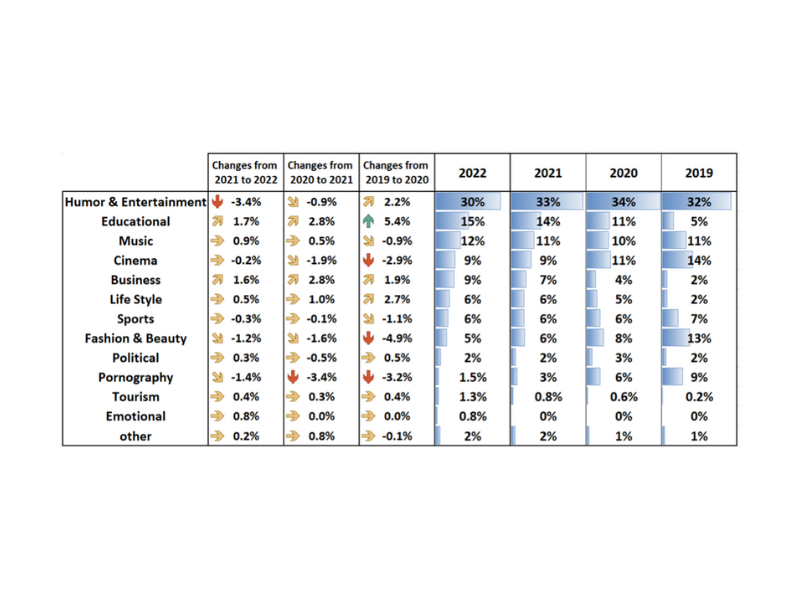
As displayed in Table 1, the share of "humour and entertainment", "fashion and beauty", and "pornography" pages among the most popular Iranian Instagram pages has decreased significantly over the past year. While the decline in "fashion and beauty" and "pornography" pages continues a longer trend, the declining ratio of "humour and entertainment" pages on Iranian Instagram over the past year is something new. In contrast, the percentage of "educational" and "business" Instagram pages has continued to rise in 2022.
The appearance of "tourism" and "emotional" pages on popular Iranian Instagram pages in 2022 is another notable change. On the tourism pages, content pertaining to tourism in various regions of Iran and the world is published, whereas, on the emotional pages, content that represents human feelings and emotions are published.
Table 1: Share of popular pages by primary subject from 2019 to 2022
The trend of changes in the network of relationships between popular Iranian Instagram pages is illustrated in Figure 2 using the Indegree Index. When comparing the changing trend of the graphs from 2019 to 2022, we observe that education (dark blue), business (brown), lifestyle (orange), and fashion and beauty (pink) pages have become increasingly integrated within their respective fields and have distanced themselves from other fields. In the upper portion of the graphs, from 2019 to 2022, we notice an increase in the intertwining of sports screens (pale blue), movies (green), and music (red). In other words, these three types of popular accounts—also known as "celebrity” accounts—have gradually shaped a field that is related to issues outside of their profession. In this multifaceted field, in addition to celebrity pages, there are humour, entertainment, political, and social pages (yellow, black, and grey).
Figure 2: Changes in the network of relationships between popular Iranian Instagram pages from 2019 to 2022, as measured by the Indegree Index
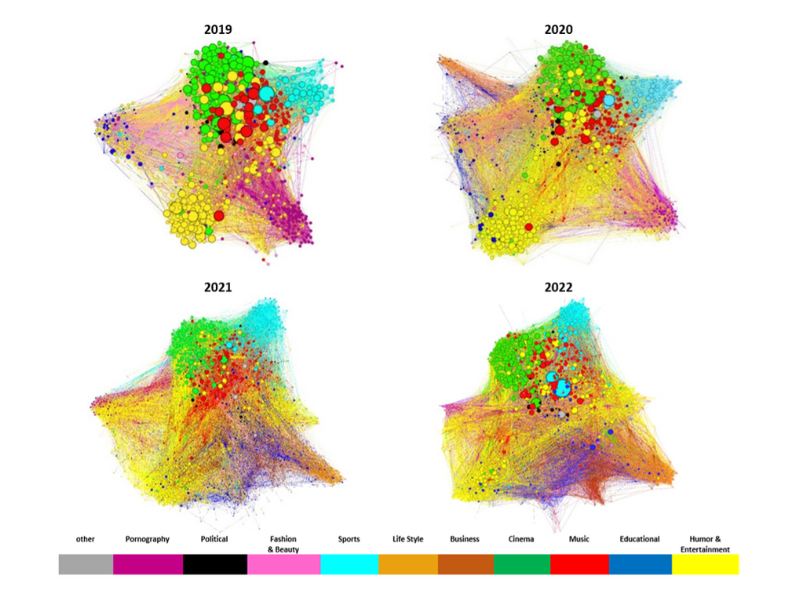
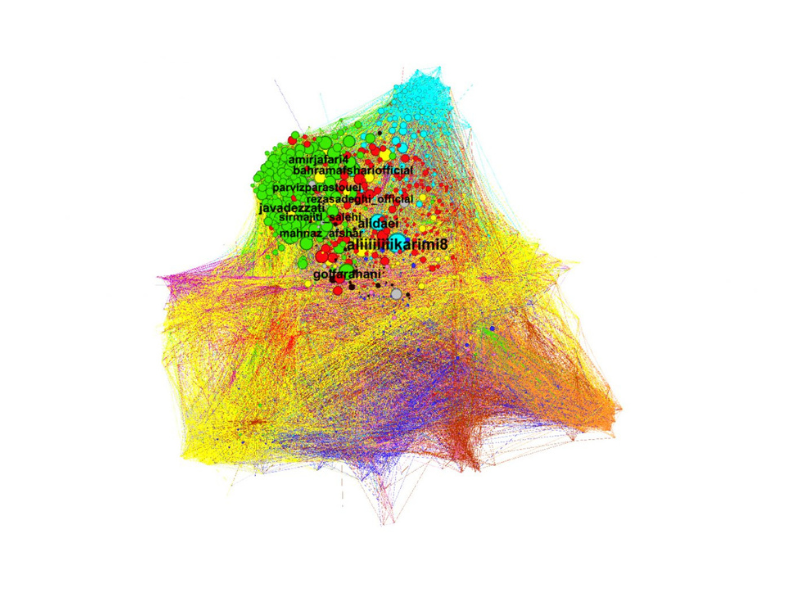
Figure 3 displays the ten Iranian Instagram influencers with the highest authority based on the Authority index. All of these individuals belong to one of the three categories: sports, film, or music. These three categories also overlap. Moreover, with the exception of two individuals, the rest post additional content on the page related to their audience's political, economic, and social concerns and demands, as well as their profession and area of expertise. Let us refer to this type of celebrity as a "celebrity-activist.”
By a significant margin, Ali Karimi has the highest authority among the most popular Iranian Instagram pages, followed by Ali Daei, Golshifteh Farahani, Javad Ezzati, Amir Jafari, Bahram Afshari, Mahnaz Afshar, Majid Salehi, Parviz Parastui, and Reza Sadeghi.
Figure 3: Network relations between popular Iranian Instagram pages in 2022, as per the Authority Index
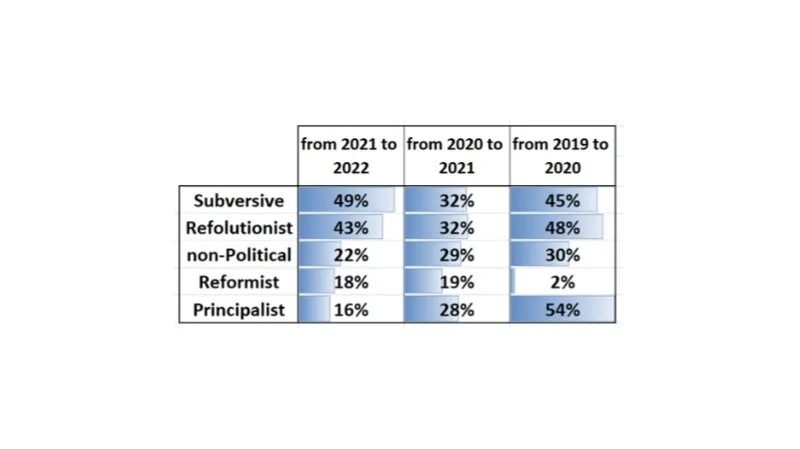
By reflecting on Table 2 and reviewing Table 1, we can gain a greater appreciation for the reasons why celebrity-activists on Iranian Instagram gain authority. Table 2 demonstrates that the number of followers of popular subversive pages has increased by 49% over the past year. This index was 43% for refolutionist (neither revolutionist nor reformist), 22% for non-politicals, 18% for reformists, and 16% for conservatives (Principalists). Comparing these statistics to those from previous years reveals that the notion of protesting the current political situation has become increasingly popular and a sought-after item on Iranian Instagram over the past year.
In contrast, as shown in Table 1, the proportion of political pages (individuals, groups, or organisations professionally engaged in political activity) among the most popular Iranian Instagram pages did not change significantly between 2019 and 2022, fluctuating by approximately 2%. In other words, Iranian political professionals of various political orientations lack the capacity and acceptance to represent the nation's political attitudes and demands. Iranian Instagram users have increased pressure on other popular Iranian Instagram pages, requesting that they reflect and even represent the political protests of the Iranian people. As previously explained, education, business, lifestyle, and fashion and beauty pages have not directly engaged with this demand of users due to professional considerations; however, a substantial portion of the movie, sports, and music pages have responded positively to the demand of their followers, largely due to their professional considerations. In actuality, it is the crisis of political representation that has placed celebrities in the position of representing the political demands of the Iranian people and given rise to the phenomenon of "celebrity-activists.”
In this sense, these are the people who have agency and have utilised the smallest opportunities to protest the status quo. In this way, they also take advantage of the opportunities provided by celebrities. In such a scenario, political professionals dissatisfied with the formation of these relationships between users and celebrities alter the truth and promote the narrative that "these excited people" have been duped by "illiterate celebrities!" Almost every political faction has employed such insults on occasion. Of course, these same "illiterate celebrities,” once defended participating in elections and voting for reformists, thereby increasing voter turnout. But, at the current time when celebrities are under the pressure of users and the online space has aligned with the Mahsa movement, conservatives and a significant portion of reformers assert that "the excited people" have been duped by the celebrities they follow. In actuality, instead of taking fundamental and principled measures to address the escalating crisis of political representation, political professionals sometimes align themselves with "concerned artists and athletes" and "intelligent people" and sometimes curse "illiterate celebrities" and "excited people" in accordance with their immediate interests.
Table 2: The rise in followers of popular Iranian Instagram pages by political orientation from 2019 to 2022
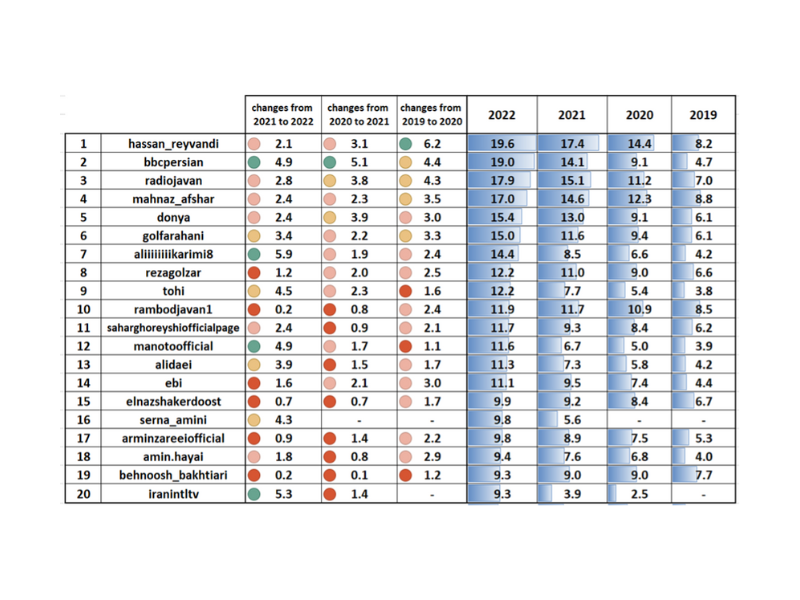
The relationship between Instagram users and popular pages has gradually developed an inherent logic over time, which can be made more tangible by examining a few examples from Table 3. Hassan Reyvandi's number of followers increased by more than 6 million between 2019 and 2020, when, in addition to political protest, the production of humour and entertainment content independent of official media was considered a high-demand commodity on Instagram. Consequently, he moved from third place in 2019 to first place in 2020. From 2020 to 2021, when humorous content independent of the official media still had some appeal, Reyvandi maintained his position by keeping a considerable distance from other prominent pages. Nonetheless, Reyvandi's position has been weakened over the past year, when "opposition to the existing political conditions" became the high-demand commodity on Iranian Instagram. Indeed, it is highly probable that he will soon be demoted. Rambod Javan has already experienced this fall. After failing to meet the expectations of political dissidents on Instagram, he dropped from the second most popular Iranian Instagram page in 2018 to the tenth most popular in 2019. Behnoosh Bakhtiari's position declined even further. Bakhtiari, who had the fourth most popular Iranian Instagram page in 2019, was harshly criticised by many Instagram users after taking several controversial positions, including publishing an Instagram post against the three protesters of November 2019 who were sentenced to execution. As a result, her page fell from the fourth most popular Iranian Instagram page to the nineteenth position within three years. Such evidence demonstrates that, contrary to the misleading term "influencer,” the resultant of the collective will of users has a substantially more direct and significant effect on the behaviour of influencers, not the reverse.
Table 3: Follower counts of the most popular Iranian pages from 2019 to 2022, per million users
From 2019 to 2021, the percentage of female Instagram celebrities in Iran rose from 32% to 42%. However, there has been no discernible change in the gender distribution of famous people over the past year. Likewise, while the percentage of popular pages based in Iran increased from 76% to 81% between 2019 and 2021, there has been no significant change in this regard over the past year.
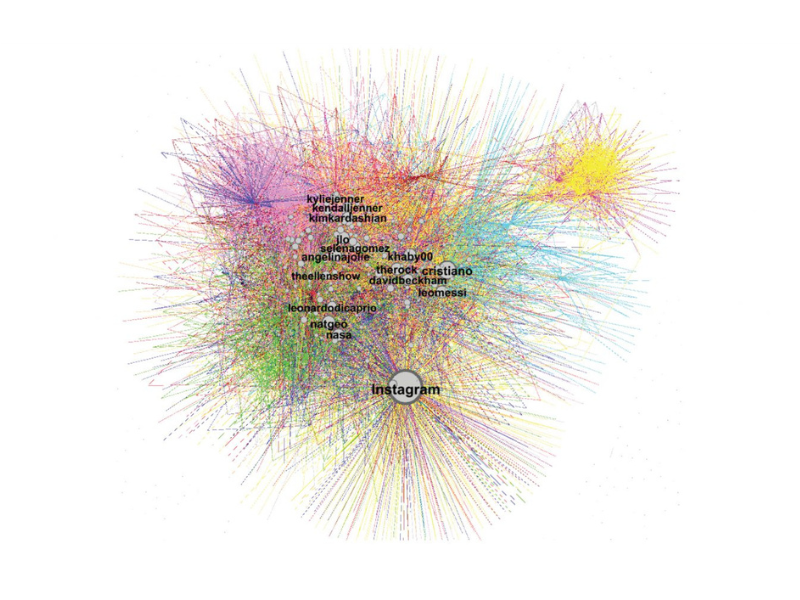
Let us conclude by examining the influence network of popular Iranian pages as affected by global authority pages. Based on the Authority Index, none of the foreign pages with high authority among the most popular Iranian Instagram pages are political. NASA, National Geographic, Leonardo DiCaprio, and Ellen DeGeneres have the most authority among film-oriented pages. Kylie Jenner, Kendall Jenner, and Kim Kardashian have the strongest authority among fashion and beauty pages. Jennifer Lopez, Selena Gomez, and Angelina Jolie have the highest authority jointly among the cinema and fashion and beauty pages. Moreover, Lionel Messi and Cristiano Ronaldo have the greatest authority among sports pages, while Khaby Lame, Dwayne Douglas Johnson, David Beckham, and the official Instagram page are authoritative among various sections of popular Iranian Instagram pages.
Figure 4: The position of authoritative international pages among popular Iranian pages on Instagram based on the Authority Index
Today, and particularly in the post-Mahsa era, the events that occur within the framework of online social networks are increasingly scrutinised by various political currents. Analysts with differing political leanings are discussing the relationship between online social networks and the collective protest actions of the Iranian people more than ever before. However, a quantitative increase in the analysis of online social networks can be considered a positive event if these analyses are continuously reviewed in conjunction with research findings in this field. Otherwise, it will not only be unenlightening but will also lead to the propagation of false stereotypes and, as a result, incorrect decisions and policies regarding this relatively new phenomenon.
Users' actions on online social networks may be correct in some cases but incorrect in others. It is crucial that whenever we find the actions of users to be inappropriate, we avoid blindly attributing everything to intelligent services, media, think tanks, or opportunistic and deceitful people. Instead of believing in these conspiracy theories, we should seek a more accurate understanding of the logic behind their actions and decisions using different methods and the logic of the situation in which users find themselves.
This methodological and analytic error is not unique to supporters of the government but is frequently committed by pro-change political currents when they encounter unpleasant phenomena in online social networks. In recent years, as a result of such a circumstance, many activists, analysts, and even some sociologists have shifted their focus from the lower levels of politics to security issues and have become experts on security issues and whistleblowers of media conspiracies and enemy think tanks.
The narrative of "excited and gullible users" is one of the recurring stereotypes regarding online social networks. In this narrative, social network users are uneducated and naive individuals who are constantly exploited by deceptive and opportunistic individuals, groups, and organisations. Throughout the past few years, and especially in the last few months, a great deal of commentary on Iranian Instagram has been based on this narrative. Interestingly, proponents of this narrative rarely question the veracity of this view and appear to see no need for scientific evidence to verify its veracity.
The results of the fourth phase of the longitudinal research I have conducted on Iranian Instagram users demonstrate conclusively that this narrative is highly misleading. Indeed, when criticising a false stereotype, we must take care not to fall into another false stereotype. Consequently, I hope that the caution that I have attempted to observe in writing this research report will be noted by the readers and that the research findings will be interpreted with the same caution.
Photo: IRNA

Regional Economic Integration Comes into Focus at Second Baghdad Conference
At the second meeting of the Baghdad Conference on Cooperation and Partnership, regional economic integration was a new focus for the countries involved.
The second meeting of the Baghdad Conference on Cooperation and Partnership took place in Amman, Jordan on December 20. Last year’s meeting in Baghdad initiated a process for multilateralism, dialogue, and cooperation between Iraq and its neighbours, some of whom met for the first time in years. This year’s gathering in Amman cemented the initiative as an annual regional summit and, importantly, added economic integration to the regional agenda.
In August 2021, former Iraqi prime minister, Mustafa Al-Kadhimi, with the support of French president Emmanuel Macron, managed to bring together officials from Egypt, Iran, Jordan, Kuwait, Qatar, Saudi Arabia, Turkey, and the United Arab Emirates, as well as representatives from the European Union, Gulf Cooperation Council (GCC), Arab League, Organisation of Islamic Countries, and the United Nations. This year, in addition to all those who participated in the first conference, the two missing GCC states—Oman and Bahrain—were present as well.
Al-Kadhimi largely succeeded by focusing on foreign policy, particularly as he sought to ease regional tensions. He was instrumental in revitalising relations with Iraq’s neighbours, which had been strained for years. He was also key in kickstarting dialogue between Iran and Saudi Arabia, as well as setting the stage for Iran-Egypt and Iran-Jordan talks. His hosting of the first Baghdad Conference positioned him—and by extension Iraq—as a trusted regional intermediary.
That is why Iraq’s recent transition to a new government was initially met with concern around the region. Mohamed Shia Al-Sudani’s seemingly pro-Iran stance was expected to once again strain Iraq’s ties with its Arab neighbours. There were reports that Saudi Arabia paused negotiations with Iran because of this change of government in Baghdad. But Al-Sudani’s efforts to retain the mantle passed by Al-Kadhimi put regional leaders at ease. He has committed to continuing his predecessor’s efforts to secure regional and international support for the development of Iraq—Baghdad remains in the title of the conference for this reason.
At the conference, Al-Sudani said, “The priority now lies in strengthening the bonds of cooperation and partnership between our countries through interdependence in infrastructure, economic integration and joint investments.” To that end, he argued that regional states should “strive to work together to transform from consuming to manufacturing countries by establishing joint industrial zones that enhance our collective industrial capacity and link the supply chains to one integrated chain capable of competing in global markets and launching mega projects in various sectors.”
By focusing on economic opportunities, Al-Sudani connected the Baghdad Conference to a wider agenda. He was also making an appeal for support from partners beyond the region, such as the European Union. EU High Representative Josep Borrell was present at the gathering in Amman.
In the Joint Communication on a “Strategic Partnership with the Gulf,” which was published in May 2022, the European Union praised the first Baghdad Conference and committed to supporting the region-led process. While France was the only European country supporting the Iraqi initiative initially, the European Union called for a follow-up process to the Baghdad Conference “with EU involvement” and as part of “a structured, EU-facilitated dialogue process”.
In the face of rising competition with other external players, such as China, Russia, and even India and Japan, European countries and the EU are falling behind. But Europeans can make significant contributions towards regional dialogue on economic integration by helping to create multilateral platforms, transfer know-how and technology, and provide financial support. European expertise can help the region find ways to jointly tackle the basic issues that have impeded economic growth and have resulted in spillover effects, such as increased food insecurity and inability to mitigate the rising challenges of climate change.
Establishing a new development fund by using existing instruments and institutions is key. This would mean including sovereign wealth funds, co-investment programmes, economic zones, or multi-party investment initiatives through regional banks or multinational institutions. The Islamic Development Bank, the various state-owned sovereign wealth funds within the GCC, as well as the European Investment Bank, and the European Bank for Reconstruction and Development, have all supported projects that have a multilateral or regional outlook. This could happen through matching funds allocated to the initiative by involved parties.
Through its Global Gateway project, the EU and regional partners could also “explore joint initiatives in third countries through triangular cooperation, financial support, capacity building and technical assistance.” The EU can draw in the regional players to help with reconstruction efforts in Iraq. The Global Europe Instrument foresees projects and investments in Iraq as well. The Instrument aims to fund international cooperation through grants, technical assistance, financial instruments, and budgetary guarantees.
Cooperation in developing a particular port or completing segments of Iraq’s national railway should be the priority. Exploring joint investments in Iraq’s oil and gas industry as well as green energy transition should also be considered.
Dust and sandstorms, as well as drought and water scarcity, are causing huge financial and human costs for Iraq, but also for all neighbouring countries, as well. Key projects that combat shared environmental challenges, which have proven to be the easiest avenue for cooperation, should be explored.
Even though various regional tensions remain, the outlook for regional cooperation and multilateralism seems bright and the Baghdad Conference is helping define a framework for broader regional cooperation, with integration as its aim. As Dutch diplomat Jeanine Hennis-Plasschaert, Special Representative of the Secretary-General for the United Nations Assistance Mission for Iraq, reflected during the meeting, the “demonstration of regional partnership” can now “result in a number of concrete steps.” Hennis-Plasschaert added that these steps “might even lead to a framework for regional integration as an effective means of achieving prosperity, peace and security.”
Photo: King Abdullah Press Office

When it Comes to Iran, China is Shifting the Balance
Xi Jinping’s recent trip to Riyadh, his first foreign visit to the Middle East since the pandemic, suggests that China may no longer seek to treat Iran and its Arab neighbours as equals.
In 2016, during his first trip to the Middle East, Chinese Premier Xi Jinping visited both Riyadh and Tehran, a reflection of China’s effort to balance relations among the regional powers of the Persian Gulf. But Xi’s recent trip to Riyadh, his first visit to the Middle East since the pandemic, suggests that China is no longer aiming to treat Iran and its Arab neighbours as equals.
Following the meetings in Riyadh, China and the GCC issued a joint statement. Four of the eighteen points that comprise the joint statement directly pertain to Iran. In the declaration, China and the GCC countries called on Iran to cooperate with the International Atomic Energy Agency as part of its obligations under the beleaguered Joint Comprehensive Plan of Action (JCPOA). Using strong and direct language, the statement additionally called for a comprehensive dialogue involving regional countries to address Iran’s nuclear programme and Iran’s malign activities in the region. The language used was less neutral than that typically seen in Chinese communiqués and instead took the tone of Saudi and Emirati talking points regarding Iran.
Iranian officials were especially vexed to see that China had effectively endorsed longstanding Emirati claims to three islands: Greater Tunb, Lesser Tunb, and Abu Musa. The islands, located in the Strait of Hormuz, were occupied by the Imperial Iranian Navy in 1971 after the withdrawal of British forces. Ever since, Iran has considered the three islands as part of its territory. The United Arab Emirates (UAE) has made periodic attempts over the last four decades to regain control of the islands, claiming that before the British withdrawal, the territories were administered by the Emirate of Sharjah. While the statement does not go so far as to declare that the islands belong the UAE, China’s call for negotiations over their status inherently undermines Iran’s claims.
The reaction of Iranian officials and the public has been sharp. The day after the statement was published, Iranian newspapers featured bitter headlines. One newspaper even provocatively questioned China’s claim over Taiwan. Iranian Foreign Minister Hossein Amir-Abdollahian tweeted that the three Persian Gulf islands belong to Iran and demanded respect for Iran’s territorial integrity. Meanwhile, Iran’s Assistant Foreign Minister for Asia and the Pacific met with the Chinese Ambassador to Iran, Chang Hua, to express “strong dissatisfaction” with the outcome of the China-GCC summit.
Amid the polemic generated by the China-GCC statement, the Chinese official news agency Xinhua announced that Vice Premier Hu Chunhua would visit Iran and the UAE next week. If the stopover in Tehran was intended as a Chinese gesture to ease tensions, the move is likely to backfire. While “Little Hu” had been expected to gain a prestigious seat in the Politburo Standing Committee during the recent National Congress of the Chinese Communist Party (CCP), he was instead demoted from the Politburo and is expected to be removed as Vice Premier in March 2023. Considering Xi’s triumphal visit to Riyadh, the optics surrounding Hu’s planned visit to Tehran are especially bad.
As Xi begins his third term as China’s leader, he appears to be viewing relations with Iran through the prism of liability, rather than opportunity. Despite the fanfare surrounding the beginning of Iran’s long-awaited accession to the China-led Shanghai Cooperation Organisation (SCO) in September, this was a relatively shallow political move. The SCO is an organisation with a limited institutional capacity and substantial internal divisions—Iran’s accession did not herald the opening of a new era in Sino-Iranian relations.
Two issues appear to be hampering China-Iran relations. First, negotiations to restore the JCPOA have failed. With sanctions in place, Iran has struggled to attract Chinese investment and cooperation, especially when compared to Saudi Arabia and the UAE. As I argued in March, economic ties are a pillar of the Comprehensive Strategic Partnership (CSP) that China and Iran have devised, but relaunching economic relations between the two countries requires successful nuclear diplomacy and the lifting of US secondary sanctions. Beijing and Tehran announced the beginning of the CSP implementation phase last January when the nuclear talks appeared likely to succeed. Today, the prospects for implementing the CSP are nill and China-Iran trade is continuing to languish at around $1 billion in total value per month.
Second, Iran’s decision to sell military drones to Russia, thereby becoming actively involved in the war in Ukraine, is proving a significant strategic miscalculation. By actively supporting Russia’s war of aggression, Iran has taken itself out of a large bloc of countries, nominally led by China, that have adopted an ambiguous position towards the conflict. This bloc, which notably includes the GCC countries, is neither aligned with Ukraine and NATO nor openly against Russia and its coalition of hardliner states. In short, Iran’s overt alignment with Russia is at odds with China’s approach.
Meanwhile, the evident strains in US relations with Saudi Arabia and the UAE have created an opening for China to deepen ties with the two regional powers. In some respects, this opening has diminished China’s need to cultivate a deeper partnership with Iran. Ties with Tehran had long been attractive as a means to counterbalance US influence in the region. But Beijing’s success in building deeper relations with Riyadh and Abu Dhabi, two capitals that have long taken their cues from Washington, suggests that China is gaining new means to check US power in the Middle East.
China-Iran relations have seesawed plenty over the years, but the outcome of Xi’s visit to Saudi Arabia suggests a new and more negative outlook for bilateral ties. While Iran tries in vain to “turn East,” China may be shifting away.
Photo: IRNA

Participatory Budgeting Opens Path for Democratic Reform in Uzbekistan
A participatory budgeting initiative may prove a vital step forward in Uzbekistan’s political development if it opens the path to wider democratic reforms.
Since his inauguration in 2016, President Shavkat Mirziyoyev has paved the way for many policy reforms in Uzbekistan. Four of these reforms stand out as truly consequential.
The first two reforms are economic. The move to a mostly market-based foreign currency regime and the implementation of tax reforms delivered significant positive stimuli for economic growth and helped to open the Uzbek economy to foreign investment.
The third reform put an end to the abhorrent practice of state-sponsored forced and child labor. Possibly more than any other, this reform has earned Uzbekistan international praise. The Economist named Uzbekistan “country of the year” in 2019, describing it as a country “that abolished slavery.” Although labour rights and state intervention issues persist in cotton production clusters, the reform effort still successfully stigmatised forced labor among top officials, improved many labour conditions, and opened the Uzbek cotton and textile industry to international trade.
The fourth reform has garnered less international attention but is no less significant. The Citizens’ Initiative Budget is a participatory budgeting platform that lets the public decide where they think it is best to spend public money. The policy aims at better redistribution through decentralization of budget planning.
The initial outcomes are exciting: 7.8 million votes were cast in support of 61,500 spending projects in 2022. The votes determined the allocation of USD 100 million across 98 percent of all micro-districts (mahallas) in Uzbekistan. Compare this to 2021, when 6.72 million votes were collected on 69,700 projects. This year voter turnout increased, while the collective action improved with fewer—and likely more realistic—nominated projects. It is estimated that 33 percent of Uzbek adults participated in the voting process in 2022. A prominent blogger suggested that the participatory budgeting process was the country’s most competitive election. While tongue in cheek, this reaction to participatory budgeting points to its significance—people mobilise and vote for the option that best represents their needs.
Without true electoral accountability in the country, Uzbekistan’s central government often receives distorted signals from its people. That is why reforms that leverage the tools of participatory democracy are so crucial. Arguably the most significant recent example of distorted signals was when in July of this year Karakalpakstan’s legislature and government unanimously supported the constitutional amendments to dissolve its semi-autonomous status. Mass civil unrest erupted leading to deaths, injuries, and property damage. President Mirziyoyev later berated the Karakalpak lawmakers for failing to communicate the people’s concerns and wishes to the central government.
Alongside the participatory budget, another valuable source of signals is Uzbekistan’s media environment, which has become more free since 2016 as outspoken bloggers and probing journalists write for a range of independent digital media outlets. Even though the state-owned national television, radio, and print media have little impact on policymaking and there remains censorship, the Presidential Administration now regularly cites Telegram messages and local reports when demoting bureaucrats and municipality heads—a sign that the media is supporting accountability. Investigative reporting also sometimes forces municipal or regional authorities to abandon or adjust unpopular decisions before public anger escalates.
As promising such anecdotal occurrences of accountability may be, they do not and cannot accurately represent or equitably empower all the people of Uzbekistan. For one, there is a clear digital divide in how many people own smartphones and can afford or access the internet. Richer urban areas with better education, more infrastructure, higher incomes, and more active civil society enjoy a greater capacity to mobilise and take advantage of initiatives like participatory budgeting. These divides can be self-reinforcing. Therefore, as a rule, central governments try to keep urban residents more content.
Another reality is that such feedback channels mostly enable short term policy interventions, and do not necessarily help in gauging long term sustainable development priorities and population needs. While participatory approaches and media attention can help citizens respond when, for example, a green space is endangered, other important decisions about where to build roads and schools or when hire doctors and buy vaccines have much steeper collective action costs. Without regular bottom-up elections, in which politicians are asked to define their policy agendas and are held accountable to those agendas, it is difficult to collect informational signals on what the population wants even if everyone agrees on the essentials.
The Citizens’ Initiative Budget may prove a vital step forward in Uzbekistan’s political development if it opens the path to wider democratic reforms. Such reforms may be necessary if Uzbekistan wants to build on five years of strong economic growth—social scientists agree that the quality of political institutions determines economic outcomes.
Encouragingly, Uzbekistan is set to substantially expand its participatory budgeting platform. In 2022, the government will increase funding to nearly USD 250 million and has pledged at least USD 700 million to be disbursed in 2023. Moreover, the government has proposed that all infrastructure projects in micro-districts will be funded through participatory budgeting. A recently circulated draft white paper from the Presidential Administration suggests granting 28 districts expanded local governance authority, giving local legislators full-time paid employment, and empowering local residents with the ability to recall underperforming lawmakers and officials.
Ultimately, the essential condition for good governance at any level is enabling free and fair elections. Free and fair elections will optimise distribution of economic resources, enable growth, reduce corruption, and advance inclusion and happiness. As the success of the Citizens’ Initiative Budget shows, the Uzbek people are ready to take charge of their shared political future.
Photo: AXP Photography

Long-Awaited Uzbek-Kyrgyz Border Deal Sparks Unrest
The final demarcation of the Uzbek-Kyrgyz border was expected to be a tremendous political victory for Kyrgyzstan. But instead of celebration, the agreement has spurred domestic unrest and intensified repression.
In October, the final demarcation of the Uzbek-Kyrgyz border was expected to be successfully concluded after three decades of negotiations. The agreement was supposed to be a tremendous political victory for Kyrgyzstan, especially for President Sadyr Japarov. But instead of celebration, the agreement has spurred domestic unrest and intensified repression.
Most visibly, the unrest is due to the Kempir-Abad water reservoir in the Uzgen district. The local population in Uzgen believes that the government and president’s close ally Kamchybek Tashiev's negotiating team failed to fully address state borders, land ownership, and water management in the area and did not adequately explain the deal to the public. Concerns about ceding the important reservoir to another country and abandoning Kyrgyz land were frequently voiced, but the government downplayed concerns. Some members of a parliamentary committee responsible for the preliminary approval of the new border also complained about the secrecy of the agreement. The exact full wording of the deal was not published, which led to uncertainty about what they were actually voting for, and some parliamentarians refused to vote at all.
Japarov faced opposition to the announced border agreement both in media and in the streets. On October 22, a committee for the protection of Kempir-Abad reservoir was formed. Activists also organised a demonstration denouncing the deal and demanding transparent public discussions. However, Japarov labeled the protests as the product of the "evil intentions” of a few opponents.
To succeed, the regime has resorted to silencing the opposition voices until the deal is officially signed. On October 23, there was a mass detention of two dozen vocal opposition activists in Bishkek and elsewhere around the country. The Kyrgyz government also decided to take action against the local operations of Radio Free Europe and blocked the broadcaster’s website for two months over the alleged spreading of disinformation. Later, the National Security Committee—headed by Tashiev—ordered Demir Bank to close RFE’s local account.
The crisis over Kempir-Abad and the entire border demarcation process illustrates one of the core problems of the current Kyrgyz government: an authoritarian approach to sensitive domestic issues. On the agreement with Uzbekistan, Japarov and Tashiev decided to push the deal through the opposition using their political influence and power. There is no exact date of the official signature announced, and under the current circumstances, neither the official implementation nor peaceful acceptance of the deal by the Kyrgyz society is certain.
Since his ascendence to power after large public protests in October 2020, Japarov has relied on his image as a strong national leader. Issues regarding territory, national interests, mineral resources, and economic prosperity have formed the core aspects of his political agenda. In recent months, however, he has faced mounting challenges in every domain. Moreover, attempts by Kyrgyzstan to present a border agreement regarding Kempir-Abad failed last year. Experiencing the same failure again would be a huge blow to Japarov’s political career.
Aside from its border issues with Uzbekistan, Kyrgyzstan also lacks fully demarcated borders with Tajikistan. Various factors have delayed the demarcation process since the dissolution of the former Soviet Union. These include complicated physical geography, mixed ethnic populations, and domestic political stakes. Tensions between Kyrgyzstan and Tajikistan have been rising in the past few years and there is little hope that the situation will improve in the foreseeable future.
The government’s nationalist rhetoric has not helped. This rhetoric has been accompanied by armed clashes and unprecedented levels of violence earlier this year. Neither Bishkek nor Dushanbe are interested in launching a full-scale war against one another, and destabilisation of the wider region is against the interests of their neighbours too. Even so, neither side has shown the willingness to engage in negotiations. For the time being, leaders in Kyrgyzstan and Tajikistan are using to justify consolidation of power at home.
While condemnable, Japarov and Tashiev’s attempts to secure the regime's position by silencing critics are hardly surprising. But the scale of the repression is concerning. Despite domestic turmoil, Kyrgyzstan still enjoys a reputation as a country with a more vibrant civil society and greater democratic mechanisms than its neighbours in Central Asia. However, researchers, activists, and civil society members interviewed by the author in recent months unanimously pointed to a worsening outlook and cited the disappearance of previously understood “red lines” and the unpredictability of authorities’ punitive actions.
Tashiev’s participation at a meeting with Vladimir Putin in Moscow last week under the auspices of the Commonwealth of Independent States illustrates Kyrgyzstan's slide towards more oppression. During the meeting in Moscow, non-governmental organisations and international bodies were labeled as threats and destructive forces.
The unrest and regime instability in Kyrgyzstan may have a negative impact also on other international projects, including the China-Kyrgyzstan-Uzbek railway, which has been on the table for two decades with no traction until last month when it was finally put forward. If the unrest persists, the parties to the rail deal may run out of patience. Moreover, Uzbekistan may either delay the ratification of the border agreement or demand more favourable conditions at Bishkek’s expense.
But even if the border deal materialises and both Kyrgyzstan and Uzbekistan implement the agreement, issues on the ground will likely persist. The newly demarcated border requires effective border management, trust, and mutual endorsement by the locals on both sides. Without a proper arrangement, even a minor skirmish might escalate to a major border conflict. Moreover, the contested future of the Kempir-Abad water reservoir further adds to the complexity to an already fragile situation at the Kyrgyz-Uzbek border.
Photo: Press Service of the President of Uzbekistan

As Protests Continue, Biden Should Enable Remittance Transfers to Iran
The Biden administration should adjust its sanctions policies to authorise remittance transfers to Iran, making it possible for Iranians in the diaspora to support their family members in ways that strengthen capacities for political participation.
Protests in Iran are continuing as the Iranian people bravely maintain a presence in the streets and on social media. So far, Iranian authorities have given no clear indication that they will reform policies in line with protest demands and have signalled that a larger crackdown may be coming.
While the protests have meaningfully shifted the political discourse around women’s rights and state repression, it is unclear whether Iran’s civil society has the resources necessary to generate a large and lasting protest movement that maintains pressure on Iranian authorities and raises the costs of further crackdowns. One critical factor is the economic disempowerment of Iranian society over the last decade.
Between 2010 and 2020, the spending power of the average Iranian household has fallen by just over 20%. This loss of economic welfare is primarily the result of U.S. sanctions, particularly those imposed in 2012 and re-imposed in 2018. In the two decades leading up to 2012, Iranian households enjoyed an unbroken period in which living standards were rising.
U.S. sanctions policy has made protests in Iran more frequent, but also less likely to succeed. The economic precarity that has become a dominant feature of the Iranian social condition over the last decade makes it harder to sustain protest movements. Many Iranians literally cannot afford to organise and mobilise over weeks and months. Workers are reluctant to strike given the risk of losing their jobs. Even those who retain the economic means to protest lack the tools to organise.
In institutional terms, sanctions have weakened the formal and informal civil society organisations that help mobilise the middle class and channel middle class resources towards political action. Charities, advocacy groups, legal aid providers are starved of resources. Civic-minded women, who are at the forefront of Iran’s new protest movement, have been hit especially hard. As one Iranian activist put it last year, “Activists are struggling to survive… If they do end up with a bit of time at the end of the day for their activism, they are often too exhausted and preoccupied with economic survival to be effective.”
The recent protests have no doubt energised a wide range of social groups in Iran, but looking in both economic and institutional terms, the balance of power between Iranian state and Iranian society has clearly shifted in the state’s favour. Mobilisations have become more frequent, but they tend to be smaller and more fleeting, making it easier for the state to either crackdown or to simply wait out the protests.
As such, the Biden administration should adjust its sanctions policies to broadly authorise remittance transfers to Iran, making it possible for Iranians in the diaspora to support family and friends in ways that reduced economic hardship and strengthen capacities for political participation.
Remittance flows are restricted because banks and money transfer companies do not facilitate transfers to Iran owing to sanctions on the Iranian financial system. Most remittances are therefore made via exchange bureaus (known to Iranians as sarafis) or are hand-carried into Iran by individuals. U.S. persons are explicitly authorised to hand-carry personal remittances but are not permitted to use money service businesses. The financial flows made through exchange bureaus and hand-carry channels are difficult to track and so the true extent of remittance flows may not be reflected in authoritative estimates, but Iran is likely receiving far less remittance transfers than countries with similar economic characteristics.
The World Bank estimates Iran received $1.3 billion of remittances in 2021, equivalent to just one-tenth of a percent of GDP. By comparison, Thailand, a country with a higher per capita GDP ($19,000 vs. $16,000 in PPP terms) and a smaller population (70 million vs. 84 million), received $9.0 billion of remittances, equivalent to 1.8 percent of GDP.
It is unlikely that exchange bureaus and physical transfers total in the many billions of dollars. In short, Iran’s remittances inflows are much lower than expected given the size of the economy and the economic needs of the population. Remittances flows are far too limited to shore the economic welfare of households in the face of the generalised economic crisis to which sectoral sanctions contribute—a fact evidenced by the erosion of household consumption over the last decade.
A significant body of academic research suggests that remittances encourage political participation, including in protests. In a 2017 paper, Malcolm Easton and Gabriella Montinola use individual-level data from Latin America to explore the relationship between the receipt of remittances and political participation. They find that “remittance recipients are more likely to select protest rather than the base response” whether in a democracy or autocracy. Additionally, in autocracies, remittances make political change seem more achievable. Easton and Montinola explain that “receiving remittances increases the odds of selecting protest relative to believing change is not possible by 34%.” Abel Escriba-Folch, Covadonga Meseguer, and Joseph Wright arrive at a similar conclusion in their 2018 study which used individual-level data from eight African countries. They find strong evidence that “remittances increase protest by augmenting the resources available to political opponents” and “remittances may thus help advance political change.”
The Iranian diaspora in the United States is the largest and most politically active in the world. As U.S. persons, members of the diaspora living in the United States are unable to send remittances to Iran beyond the hand-carry method, which is not an option for those who cannot travel to Iran for personal or political reasons, or who are opting not to travel to Iran due to the increased risks facing dual nationals. To provide routine and reliable financial support to family and friends in Iran, members of the Iranian diaspora should be able to avail themselves of money service businesses or other payments solutions.
The relevant regulation does stipulate that remittance transfers “processed by a United States depository institution or a United States registered broker or dealer in securities” are authorised. However, there is a lack of such institutions offering remittance services for Iran—U.S. banks do not maintain correspondent accounts at Iranian financial institutions. As such, the Biden administration should update its regulations to enable U.S. persons to make remittances transfers through other channels. This can be done through the issuance of a new general license with two aims.
First, the Biden administration could authorise the use by U.S. persons of money service businesses, such as Europe-based exchange bureaus, to transfer non-commercial, personal remittances to Iran. Second, and perhaps more usefully, the Biden administration could authorise the use by U.S. persons of cryptocurrency exchanges to purchase USDC stablecoins and transfer those stablecoins as non-commercial, personal remittances to Iran. The administration would also need to authorise U.S. cryptocurrency exchanges to onboard users in Iran.
Exchange bureaus can typically make deposits to accounts at Iranian financial institutions. The existing regulations do state that U.S. banks can engage with money service businesses in third-countries to make remittance transfers to Iran. But that makes such transfers subject to the discretion of U.S. banks. The guidance should be modified such that U.S. persons can directly engage exchange bureaus, for example those in Europe, to make transfers to Iranian bank accounts. Making it possible for U.S. persons to use third-country money service businesses would have an immediate impact on the volume of remittances sent to Iran. However, this channel cannot scale indefinitely as money service businesses generally need to balance inflows and outflows to make transfers in a netting process.
The use of cryptocurrency could be even more impactful. While few Iranians maintain cryptocurrency accounts, the technology provides one of the few scalable options for enabling U.S. persons to make remittance transfers to Iran. So long as cryptocurrency exchanges receive guidance that allows them to onboard Iranian users, Iranians can be expected to adopt the technology and U.S. persons will be able to transfer cryptocurrency without a constraint on scale.
The authorisation should be limited to exchanges and should not cover transfers made directly to addresses or via wallet providers, because of the additional controls that the exchange can impose. It is technically feasible for cryptocurrency exchanges (such as Coinbase and FTX) to limit the value of transfers that can be received and held by Iranian users in line with the provisions of the authorisation. Additionally, transactions processed by the exchange do not happen on cryptocurrency blockchains, they are run within the exchange’s internal database. This enables the exchange to freeze any account held by its user and block further transfers if necessary. Moreover, the exchange could ensure that users were only able to transfer certain cryptocurrencies to Iran, such as traceable USD stablecoins which are pegged to the dollar (the best option is USDC, which has a track record of cooperation with US regulators). This would ensure that exchanges are not providing a platform for speculative trading by Iranian users and that Iranians do not have a perverse incentive to hold onto their remittances. These exchanges can also require additional KYC for U.S. persons and Iranian individuals on either end of a given transfer.
To be effective, these authorisations would need to be followed by extensive outreach by the U.S. Department of Treasury and U.S. Department of State to ensure that money service businesses and cryptocurrency exchanges begin supporting Iran-related transfers. U.S. authorities would also impress the importance of monitoring for suspicious transactions and could ask for data on the remittance flows to enable better enforcement. Any authorisation could be granted based on a limit to the value of remittances made by a U.S. person each month—a limit as low as a few hundred U.S. dollars could make a significant difference in supporting basic household welfare in Iran.
There is a risk of abuse by individuals seeking to transfer funds to designated entities or individuals in Iran. But the risk is limited. Flows of USDC cannot be directly taxed or expropriated by the state. To spend any remittances they have received, Iranians would either need to pay for goods and services by transferring USDC to another Iranian user that has created an account on the exchange, or by finding an Iranian user who is willing to exchange USDC for cash.
The lack of hard currency flows means that the proposed action does not entail a substantive change to the structure of U.S. sanctions on Iranian economic sectors and state-owned and controlled entities. Even so, the authorisations can significantly boost the economic resources of Iranian civil society and enable more robust political participation, including in protests. However, the decision to participate in the protests lies with each Iranian. Unlike a strike fund, this policy does not create an incentive for protest, nor are the remittances made contingent on certain kinds of political action.
There is a precedent for this approach. Even while adding sanctions on the Maduro government, the Trump and Biden administrations have notably allowed Venezuelans to continue to use U.S.-based financial services, such as the payments app Zelle, to send and receive U.S. dollars. This has had the effect of shielding many Venezuelans from even steeper declines in economic welfare as the country experienced a steep sanctions-induced recession.
Enabling Iranian-Americans to make remittance transfers to their family members in Iran within the context of existing sanctions regulations would mean that the Biden administration is not only seeking to deprive the Iranian state of resources for repression but is also working actively to preserve the power of the civil society at a time of general economic crisis. This is what true solidarity would look like.
Photo: IRNA

Iranian Women are Colliding with the Iranian State
Iranian women, supported by the many men who have now joined them, are challenging the discrimination they have experienced for decades.
On the day that Ebrahim Raisi, Iran’s President, was giving a speech at the United Nations headquarters in New York about the double standards with which human rights are pursued around the world, a tear gas canister flew past me and hit a car that was parked a few metres away. I was among the protesters running down Palestine Street in the centre of Tehran, and the tear gas was being fired directly at us by anti-riot police. We were doing nothing more than shouting slogans, but any of us could have been severely injured or killed—this was not an isolated incident. According to human rights groups, more than 90 people have been killed in the ongoing protests across Iran. The protests were ignited by the death of 22-year-old Mahsa Amini while she was in the custody of the morality police. The authorities have responded to these protests with a brutal crackdown—beating, shooting, arresting—and an internet blackout that has blocked access to platforms such as WhatsApp and Instagram.
Twenty years ago, it would have been hard to imagine that dozens of cities in Iran would erupt in protests against imposed religious rules. The death of Zahara Bani Yaghuob, an Iranian medical doctor arrested by authorities in Hamedan in 2007, did not lead to widespread protests at the time. But the Iranian state is reaping what they have unintentionally sown. Despite rolling back some women’s rights, such as the Family Protection Law introduced under Mohammad Reza Pahlavi, and imposing an Islamic dress code, after the revolution, a so-called Islamic educational system helped more women in rural and lower social classes to receive an education. While women in upper and middle social classes benefited from progressive laws prior to the revolution, traditional families, typically from disadvantaged backgrounds, felt more comfortable sending their daughters to school under Islamic laws. Today, women account for 60 percent of university students in Iran. It is no coincidence that Generation Z, now on the frontlines of the recent protests, are the children of Iran’s 1980s baby boomers. Generation Z’s parents were the first cohort to see a dramatic shift in the numbers of women receiving higher education in Iran.
A few hours before the tear gas canister nearly struck me on Palestine Street, I was passing security forces on Revolution Avenue when a man in plain clothes and a helmet came up to me and said, “Our cameras will capture your face. If I see you again in this area, you’ll get arrested.” “For what crime?” I asked. “No offence required,” he replied, “I have the power, and I’ll use it against you.”
The man’s boast is the key to understanding the recent protests in Iran. After Sepideh Rashnoo was harassed on a bus by a fellow citizen over her “improper” hijab in July, the dangerous power that had been delegated to pro-regime citizens became clearer. Iranians watched Rashnoo, a writer and artist, make a humiliating forced “confession” on national TV. In contrast to Rashnoo’s humiliation, the woman who harassed her over her hijab enjoyed a kind of authority bestowed upon her by the government.
Along with the morality police, the citizens who have been granted this authority stepped up their policing of the hijab rules since Raisi’s election, which was marred by record low turnout. The death of Mahsa Amini while in police custody has revealed the conflict between the Iranian government and citizens who do not want to comply with rules they believe infringe on their civil rights. There is significant disillusionment and profound doubt about the prospects of reforming a system that has shown zero interest in compromise. If the Green Movement’s slogans were full of verses from Qur’an and other Islamic references, the slogans heard in the recent protests contain no Islamic references and no requests for narrow reforms.
Despite the economic stagnation, systematic corruption, and mismanagement in recent years, economic grievances do not feature in the slogans either. The protests have coalesced around dissatisfaction about how the Iranian state relates to society. The protests that erupted after Mahsa Amini’s death emerged mainly from marginalised groups: Kurds who are an ethnic minority, the middle class which as encountered so much hostility from the government, women who are not even recognised or protected in the system if not wearing a hijab, and the working class who have witnessed widespread governmental corruption in the recent years.
While living under the strict rules of an increasingly authoritarian state, the future for these oppressed groups is grim—they see a dead end. Accordingly, for the Iranian authorities, the unification of these various social groups, which has happened for the first time since the 1979 revolution, poses a new challenge.
In recent years, Iran’s middle class has been shrinking because of international sanctions and economic decline. Still, they have had some spaces, such as social media and satellite television, to engage with progressive ideas on human rights. Long before the recent protests forced Iran’s national television to address the issue of compulsory hijab on their programmes, subjects such as the hijab, personal freedom, and gender politics have been debated on social media and foreign-based television channels before large audiences. In this way, two different worlds have coexisted and one is now crashing into the other.
Are we witnessing another revolution in Iran? It is hard to ascertain. Iran’s state ideology still has sincere supporters, not just at home but also across the region. Some analysts have pointed to the limited number of protesters to suggest the protests are a “virtual revolution” that exists only on social media. Still, a revolutionary turn does not necessarily depend on the number of active protesters; it arises from a dead-end situation. Following Ayatollah Khamenei’s speech in which he called the protests “riots” and blamed a foreign plot for the unrest, the obstruction has never been clearer.
Nevertheless, there is a movement in Iran. Motivated by their anger following Mahsa Amini’s death, a growing number of women who have found the courage to go out with their hair uncovered in public. For a political system that places enormous emphasis on women’s appearance, this is a profound form of protest. Iranian women, supported by the many men who have now joined them, are challenging the discrimination they have experienced for decades. They have already achieved a great victory by making their voice heard around the world.
Photo: EPA-EFE

Can SCO Members Achieve Connectivity in the Face of Conflict?
If the SCO is to mature as an organisation and make good on its vision of connectivity, it must also serve as a platform for conflict resolution.
The two-day Shanghai Cooperation Organisation (SCO) summit took place last week in Samarkand, Uzbekistan. Aside from agreeing to the Samarkand Declaration, which summarises the intention of SCO members to foster deeper economic partnerships, the gathered leaders also signed 44 documents consisting of numerous memorandums, roadmaps, and action plans for cooperation in tourism, artificial intelligence, and energy.
The SCO leaders mostly focused on the importance of new transit routes and economic cooperation. Chinese President Xi Jinping, who travelled to the summit as part of his first foreign tour since the COVID-19 pandemic, touted ambitious plans to expand economic cooperation with Central Asian states.
Negotiations over the China–Kyrgyzstan–Uzbekistan railway took place in the sidelines of the summit and the three parties agreed to conduct a feasibility study with a view to constructing the new route. Uzbek officials also lobbied for another transit corridor from Uzbekistan through Afghanistan and Pakistan, but support among SCO members has been tepid given the need to engage with the Taliban government in Kabul.
Uzbekistan also signed 17 cooperation agreements with Iran focused primarily on transport and trade. Tashkent is seeking further access to Iran’s Chabahar port for its economic development. The Iranian delegation, led by president Ebrahim Raisi, signed a Memorandum of Obligations that paves the way for full SCO membership. Iran’s accession process could be completed in less than a year. The presence of Turkish President Recep Tayyip Erdogan and Belarusian President Aleksandr Lukashenko reflected the SCO’s interest in expanding its influence, even among non-member countries.
But the spirit of cooperation and the visions of connectivity were undermined by reminders of the numerous conflicts in which SCO member countries are involved. During the summit, Russian President Vladimir Putin’s interactions with fellow leaders were tainted by the war in Ukraine. While there were no official statements about the Ukraine invasion during the summit, most member states found their way to express dissatisfaction with the economic turmoil and destabilisation caused by Russia's invasion. Indian Prime Minister Narendra Modi told his Russian counterpart that “now is not an era of war.” Several leaders, including Kyrgyz President Sadyr Japarov, made Putin wait in front of cameras before meeting him—a power move that Putin has famously used in recent years.
China, too, expressed its concerns over the consequences of the current events in Ukraine. The strongest message came in the form of vocal support for Kazakhstan. In a statement, Xi said that “no matter how the international situation changes, we will continue to resolutely support Kazakhstan in protecting its independence, sovereignty, and territorial integrity.” Russian hawks had recently threatened Kazakhstan after Kazakh leaders took steps to distance themselves from Moscow.
But the war in Ukraine was not the only conflict to cast a shadow over the summit. During the summit, clashes began between two member states, Tajikistan and Kyrgyzstan. Meanwhile, tensions also rose between Armenia and Azerbaijan, an SCO dialogue partner whose president, Ilham Aliyev was in attendance at the summit.
The border between Tajikistan and Kyrgyzstan has been troubled since the demise of the Soviet Union. The former Soviet Republics have failed to properly demarcate their shared border due to complicated geographic terrain, mixed ethnic populations, and general political instability. But since last year, the regular border clashes have become more dangerous and more deadly. New clashes between Tajik and Kyrgyz forces erupted during the SCO summit, leaving dozens dead and hundreds injured. As the clashes between the two Central Asian republic escalated, Russia attempted to show its influence. Just after the summit, Putin spoke with the Tajik and Kyrgyz presidents and called on them to "prevent further escalation." Both countries are members of the Russia-led Collective Security Treaty Organization. A tenuous ceasefire is now in place.
Other SCO member states and dialogue partners may be implicated in the conflict if it escalates further. Earlier this year, Tajikistan began production of Iranian-designed drones as part of a novel joint venture. Meanwhile Kyrgyzstan has purchased Bayraktar drones from Turkey.
The Samarkand Summit demonstrated the value of the SCO as a platform for bilateral and multilateral initiatives of its member and associate countries. The SCO is especially attractive for strong personalist leaders, whose politics prevent active participation in other international rules-based blocs and bodies. However, because the SCO does not contribute to a rules-based order, the organisation has struggled in the face of conflict—such as the clashes that took place last week between Tajikistan and Kyrgyzstan.
If the SCO is to mature as an organisation and make good on its vision of connectivity, it must also serve as a platform for conflict resolution. Until now, SCO member states have viewed longstanding tensions among other members as something outside the bounds of the bloc. India is assuming presidency of the SCO and Modi did chide Putin over his invasion of Ukraine during their bilateral meeting. Will far-flung conflicts in Eastern Europe, the Caucasus, and Central Asia, be of little concern or too costly to ignore?
Photo: Kremlin.ru

Grief and Grievance in Iran’s Growing Protests
For four days, protestors have been in Iranian streets. Iran has seen multiple waves of unrest in recent years. But this time, the protests seem different.
For four days, protestors have marched on Iranian streets. The protests were triggered by the killing of Mahsa Amini, who was fatally injured while in the custody of the Guidance Patrol, a police unit in Iran that mainly enforces the country’s Islamic dress code. Amini, who was 22 years old, died last Friday after several days in a coma. She was visiting Tehran from the province of Kurdistan to see her relatives.
Iran has seen multiple waves of protests in recent years. In 2017, protests erupted in response to a sharp drop in the value of the rial and grew to include claims of economic mismanagement and corruption. In 2019, nationwide protests were triggered by a fuel subsidy reform and Iranians took to the streets to decry declining living standards. In 2021, protests focused on water rights recurred in various Iranian provinces. This year, labour protests have taken place across the country as a public sector employees and blue-collar workers seek job security and wage increases.
In many respects these protests have been linked. In each round of unrest, protestors mobilised because of similar grievances, mainly economic. They shouted the same slogans—“Death to the dictator!”—expressing anger at a sclerotic political establishment. They faced the same brutal response from security forces, who injured and killed with impunity.
But the protests triggered by the killing of Mahsa Amini appear different and are arguably more significant. While there are similarities with previous protests when considering the grievances, the slogans, and the repression, there is something distinct about the emotions being foregrounded as the mobilisations take place.
So far, people of different backgrounds and different classes have joined these protests. They have taken to the streets of Amini’s hometown of Saghez and have assembled on college campuses in Tehran to express their anger and sadness. These protests are motivated by grief, not mere grievance. Grief has opened the way for a new, wider mobilisation.
As my colleague Zep Kalb has observed, looking across recent protests in Iran, “solidarity has been hard to obtain.” Reflecting on last year’s water protests in Esfahan, Kalb explained that the protests forced “ordinary Iranians, state organisations, and political elites” to “compete fiercely about how to share the country’s increasingly scarce water resources.” Communities involved in the protests shared the same grievances—they were all demanding their water rights—but in an environment of scarcity their demands pitted them against one another.
The same can be said for the earlier rounds of economic protests in Iran. The individuals who took to the streets all shared economic grievances and wished an end to their unfair treatment in the face of low wages, high prices, and growing inequality, due in large part to the accumulative effect of sanctions. But the protests, while frequently dispersed, did not overcome class and communal divisions.
The fragmented nature of these past protests has made it easier for authorities to respond with carrots and sticks, shirking calls for broader reform. Last year, Iranian authorities used live rounds to suppress protests in Khuzestan, a region in southwest Iran beset by poverty pollution, and water shortages. Their use of violence in a region many Iranians see as a backwater had limited political repercussions. Earlier this month, the Raisi administration inaugurated a major water infrastructure project to increase water supply in 26 cities in the province. In this way, national resources have been used to address local grievances, while systemic reforms are rejected. After all, many Iranian protestors did not necessarily care if the restoration of their rights and economic welfare came at the expense of others and without broader reform. In this way, the politics of scarcity has undermined the solidarity necessary for broader mobilisation.
But the emotion that has brought so many Iranians to the streets after Amini’s death—grief—is anything but scarce. A photograph of Amini’s parents, utterly alone and in a mournful embrace in the hospital ward, struck a chord and was widely shared on social media. Millions of Iranians have endured such private moments of grief in recent years. The scene in the hospital ward even evoked the unprocessed pain of the COVID-19 pandemic—during which 144,000 Iranians lost their lives according to official statistics. The sadness of Amini’s killing was profoundly relatable.
There is also anger. Another daughter of Iran has had her life ruined or ended by state brutality. Over the last year, apprehensions had grown about the increasingly aggressive actions of the Guidance Patrol and Amini’s killing was the inevitable conclusion.
If Amini’s death seemed inevitable, it was also because the same thing has happened before. Comparisons have been made with the death of the “Blue Girl” in September 2019. Sahar Khodayari set herself on fire as an act of protest and died of her injuries a week later. Khodayari had faced prosecution for attempting to attend a football match at the stadium of Esteghlal, her beloved club, whose uniforms are blue.
Another aspect of Amini’s death, the idea that she was killed simply because she was in the wrong place at the wrong time, has led to comparisons with the January 2020 downing of Ukraine International Airlines Flight 752, in which 176 people were killed. Iranian authorities admitted shooting down the civilian airliner, which was departing from Tehran’s international airport, but claims it was accidental. In the aftermath of such senseless events, many Iranians, especially women and youth, feel they live in the wrong place at the wrong time.
Perhaps unsurprisingly, a nationally representative poll conducted by Gallup in 2021 reveals Iran to be a country beset by anger and sadness. Respondents were asked what emotions they had felt in the previous day. The responses were stark—34 percent experienced anger, 36 percent experienced pain, 40 percent experienced sadness, and 43 percent experienced stress. Responding to Amini’s death, journalist Omid Tousheh captured the national mood succinctly in a tweet: “Grief, anger, and desperation pour forth from the door and the walls.”
The hope for Iran is that these crushing feelings will not lead to dejection. There is a power in the emotions that are being unleashed in this new round of protests. There remains a possibility that a broad mobilisation can lead to reform, if the Iranian people can harness the deep solidarity that grief—not grievance—can foster.
Photo: AP

As China-Led Bloc Heads to Samarkand, Leaders Struggle to Find Common Aims
Members of the China-led Shanghai Cooperation Organisation will meet later this week in Samarkand. But the assembled leaders may struggle to find common ground in the face of regional and global crises.
This week, Uzbekistan is hosting the Shanghai Cooperation Organisation (SCO) in Samarkand. The two-day summit begins on September 15. The leaders of China, Russia, India, Pakistan, Iran and other member and observer states are expected to attend. It will be the first time since the 2019 summit in Bishkek, Kyrgyzstan, that leaders will meet face to face in the SCO format.
The upcoming summit in Samarkand aims to present the organisation as a stable, capable, and evolving bloc with the capacity to address regional and global crises. For the host nation, Uzbekistan, the summit is a chance to promote the “Spirit of Samarkand” and to encourage global cooperation over global competition.
For years, the Uzbek government has sought to deepen its relations with other SCO member states. Having the opportunity to host the summit cements Uzbekistan’s position as a valuable member of the SCO community and allows it to push its regional agenda forward. Connectivity, cooperation, and the promotion of regional stability are at the core of President Shavkat Mirziyoyev’s goals, outlined on the eve of the summit.
Iran Takes Next Membership Step
One of the most important events expected to take place during the summit is Iran’s signing of binding documents related to its admission as a full member of the organisation. Iran’s accession will mark only the third time since its founding in which the SCO has admitted a new member—India and Pakistan joined in 2017. While Iran’s membership will not become official for at least another year, the procedures for its full membership will commence at the summit. Iranian leaders have faced a long wait for admission—it has been 15 years since Iran formally applied to join the bloc.
Tehran views joining the SCO as an important diplomatic achievement. The SCO represents a platform for non-western alignment and provides a platform for negotiations on tangible security and economic projects with other member states. Taking Iran on board, however, does not automatically guarantee either significant immediate benefits for Iran or an increase in the bloc’s capacity to effectively address security and economic challenges facing Asia, particularly while Iran remains under US secondary sanctions.
Eyes on Afghanistan
The situation in Afghanistan has proved strategically important for all SCO members, and especially the Central Asian republics. Security and humanitarian issues in Afghanistan were discussed in a large international conference hosted by Uzbekistan in July.
Among the Central Asian states, Uzbekistan is the loudest supporter of a taking a proactive approach towards the Taliban. While there are clear political issues with the Taliban, the Uzbek government realises that the critical south-eastern infrastructure corridor runs through Afghanistan. Development of this route promises significant economic benefits for Uzbekistan. The Uzbek president has stated that the SCO “must share the story of its success with Afghanistan.” In other words, it is a task for all regional states to engage with Kabul, and this task may become a benchmark for the capacity of SCO as an organisation. However, Afghanistan must become stable and a reliable partner to allow for its own development, as well to enable regional infrastructure projects to advance.
Tajikistan has a fundamentally different view towards the regime now in charge in Kabul. Dushanbe remains highly critical of the Taliban, raising concerns regarding terrorism and the safety of the Tajik ethnic groups in Afghanistan. However, neither Mirziyoyev or Emomali Rahmon, his Tajik counterpart, wishes to see Afghanistan further destabilised. China, India, and Russia basically hold the same position. Most regional countries are facing security threats from the Islamic State Khorasan Province and its affiliated groups. To add to the worries of the Central Asian states, Pakistan, a major player in Afghanistan, has itself faced political turmoil in the past year following the ousting of Prime Minister Imran Khan.
A Russian Dilemma
Russian president, Vladimir Putin, will face a difficult task in presenting his country as a global power in the face of unsuccessful military operations in Ukraine and economic strains caused by sanctions. The countries of Central Asia have close economic ties to Russia and are suffering the inevitable consequences of Moscow’s isolation.
As most regional countries are engaged in efforts to find ways to mitigate the negative impact of the Russian invasion of Ukraine, Moscow is expecting a not-so-warm welcome in Samarkand. Recently reported battlefield losses in Ukraine have incentivised some SCO member states to more forcefully resist Moscow's ongoing attempts to influence their foreign policy, including their aims and activities within the organisation.
The SCO is largely dominated by China rather than Russia, but Russia has long been seen as a key partner in shaping the bloc’s political and economic aims. But it appears that Russia’s future position and influence within the organisation will be increasingly determined by the priorities of other member states and not Moscow’s ambitions. Moreover, while Russia’s ties with China have been described as a “partnership with no limits” by Chinese officials, the upcoming summit will be the first time Xi and Putin meet in-person since the start of the Ukraine invasion. Their engagements on the side-line of the summit will be telling of the extent of the bilateral partnership, particularly within the framework of the SCO.
Struggling for Common Aims
According to the Uzbek foreign ministry, numerous agreements on cooperation in specific areas, ranging from digital security to climate change, are will be discussed at the summit. The SCO is also seeking to establish partnerships with countries outside its primary geographical core, namely with Egypt, Saudi Arabia, and Qatar, in an effort to further extend the bloc’s political reach.
Until now, the greatest advantage of the SCO was that the bloc did not impose strict rules or apply pressure to prevent its members from cooperation with non-member states, even those who may be perceived as adversaries to China and Russia. This flexibility has been particularly important for Central Asian states who maintain significant security and economic relations with the United States and Europe alongside their partnerships with China, Russia, and India—as required by their multi-vector foreign policies.
Since the Russian invasion of Ukraine, however, that flexibility seems at risk. For example, Russian politician Nikolai Patrushev recently declared that military training provided by the United States to certain SCO members poses a threat to Russia. Such accusations will no doubt colour bilateral and multilateral engagements in Samarkand.
Issued at the end of the summit, the "Samarkand Declaration" will present "a comprehensive political declaration on the SCO's position on international politics, economy and a range of other aspects." To what extent the SCO will be able to accommodate its members' varied and even contradictory aims is a question yet to be answered. The Samarkand summit will convene an organisation still searching for its trajectory.
Photo: Wikicommons

Can 'Unitisation' of Oil and Gas Fields Power Diplomacy in the Persian Gulf?
The shared oil and gas fields in the Persian Gulf and Gulf of Oman are largely untapped areas for bilateral and multilateral cooperation.
In March, the Saudi Energy Minister met with his Kuwaiti counterpart to sign an agreement for the joint development of a shared offshore gas field. The Dorra field lies about 50 miles off the coast at the border between Saudi Arabia and Kuwait and is around the same distance from Iran’s southwestern shores. The field could produce 1 billion cubic feet of natural gas and 84,000 barrels of condensate per day.
Shortly after the Saudi-Kuwaiti declaration, Iran’s Foreign Ministry swiftly expressed its dismay and said that any step for the joint development of the field—called the “Arash” field in Iran—must be carried out in cooperation between the three countries. In a surprising response, Saudi Arabia and Kuwait invited Iran to hold negotiations to determine the eastern limit of the joint, energy-rich, offshore area. While the proposed talks have yet to take place, the Dorra-Arash field is a clear example of how an area of contestation has the potential to be turned into an area for cooperation, if the political and security environment of the region allows.
As key regional players move towards de-escalation and dialogue, evidenced by the end of the intra-GCC conflicts as well as Saudi Arabia and the United Arab Emirates’ diplomatic engagements with Iran, it is worth considering potential for regional energy diplomacy. The shared oil and gas fields in the Persian Gulf and Gulf of Oman are largely untapped areas for bilateral and multilateral cooperation. Iran and Qatar share the largest gas reserve in the world and Iran shares a further two-dozen oil and gas fields in the Persian Gulf with the Gulf Cooperation Council (GCC) countries and Iraq. There are also numerous fields shared among the GCC states and Iraq. To move the energy produced by these fields, regional countries have long mulled pipelines projects, such as one between Iran and Oman, as well as talks for the re-exportation of Iranian gas as Liquified Natural Gas (LNG) by Qatar and Oman.
But most of the shared fields amongst the Persian Gulf states are either inactive or are disputed. In the absence of cooperation agreements, countries have mainly opted to develop and extract the reserves on their own. Disputes over median lines, extraction rights, and varying concessions have often led to tensions between regional states.
Iran has disputed Kuwait and Saudi Arabia’s claims on the Dorra-Arash field since it was discovered in the 1960s. At the time, maritime boundaries in the Persian Gulf were poorly defined and bordering countries did not pay much attention to them. This was also the case for the South Pars-North Dome field—the shared gas field between Iran and Qatar—as the median line between the two countries had been negotiated before the gas field’s discovery in 1971. When Iran and Qatar determined their boundaries two years prior, the predominant factor underlying the delimitation was equidistance.
Because of the fact that the boundaries continue to be poorly defined, Kuwait, Saudi Arabia, and Iran have each asserted their sovereignty on the Dorra-Arash field by awarding overlapping concessions throughout the past five decades. By the year 2000, Saudi Arabia and Kuwait had reached an agreement on the corresponding offshore zones where their concessions could be awarded. In retaliation for its exclusion in the negotiations, Iran deployed drilling equipment to the field the following year. A cycle of actions and retaliations that have largely continued to date, rendering the field underdeveloped on the Saudi, Kuwaiti, and Iranian sides altogether.
The output from the Dorra-Arash field will have an “inconsequential” impact on today’s global gas and LNG markets in the wake of the Russian invasion of Ukraine and rising global demands, as Wayne Ackerman argues. This is primarily because the three countries will need to use the outputs to satisfy their own domestic energy demands. But inconsequential as it might be, the output from the field is significant in both adding to the global gas reserves and establishing an area for inclusive multilateral cooperation in the region.
Economic diplomacy, if enacted through joint projects such as the development of the Dorra-Arash gas field, could give new impetus to relations between Iran and GCC countries. The establishment of a long-term cooperation project to jointly develop the Dorra-Arash field would provide a way to measure the state of regional economic diplomacy in the region and provide Iran and its GCC neighbours to show good faith. Another possible area for cooperation is in the Salman field shared between Iran and the UAE. So far, Iran and Iraq appear the closest to putting join development plans into action. Following years of negotiations, they recently decided to form joint technical groups to develop energy ties and shared fields.
In this context, the European, and Asian, countries and companies could step in to promote confidence-building measures between the Persian Gulf countries by proposing multilateral projects with their participation. External players, particularly those who have the capacity to mediate and work with both Iran and the GCC states, could assist the regional countries in defining their boundaries using international law, proposing win-win multilateral projects, and investing in the development of the fields.
The GCC states and Iran have largely overlooked the benefits of “unitisation,” the joint development of an oil or gas field extending across two or more territories. Unitisation would allow the GCC states and Iran, as well as external players such as European or Asian companies, to jointly develop shared fields and benefit from cost-effective solutions for extraction, processing, and export. Regional leaders should leverage energy cooperation to creating the shared incentives necessary to make regional diplomacy more durable.
Photo: Shana.ir

Do Sanctions Pose an 'Irreversible Knowledge' Problem?
Western governments believe that Iran’s continued enrichment activities are allowing Iranian nuclear scientists to gain “irreversible knowledge.” But what if sanctions pose their own irreversible knowledge problem?
As the deadlock over the future of the Joint Comprehensive Plan of Action (JCPOA) continues, there is growing concern that Iran’s nuclear activities are hollowing out the benefits of the nuclear deal, even if it were to be successfully restored. Western governments believe that Iran’s enrichment activities are allowing Iranian nuclear scientists to gain “irreversible knowledge.” Even if Iran comes back into full compliance with its non-proliferation commitments under the JCPOA, it will have edged closer to becoming a threshold nuclear state.
Irreversible knowledge is powerful shorthand. A joint statement issued by France, Germany, and the United Kingdom in March 2021 noted that the recent breaches of the JCPOA were “providing Iran with irreversible knowledge gain that it did not possess prior to signing the JCPOA, as well as permanently and significantly enhancing Iran’s enrichment capacity.” In January of this year, Republican lawmakers sent a letter to U.S. Secretary of State Antony Blinken to urge him to abandon the nuclear talks and increase pressure on Iran, in part because Iran was continuing “to gain irreversible knowledge” as it produced more enriched uranium. In May, Israeli Defense Minister Benny Gantz warned that “Iran continues to accumulate irreversible knowledge and experience in the development, research, production, and operation of advanced centrifuges.”
Clearly, the concept of irreversible knowledge is well defined among those parties seeking renewed non-proliferation commitments from Iran, as well as those parties seeking to scupper any deal. According to Kelsey Davenport, the Biden administration will remain committed to the nuclear talks so long as the “the non-proliferation benefits of restoring the JCPOA outweigh the irreversible knowledge that Iran has gained.” Crucially, the nuclear deal prevents Iran from gaining further nuclear knowledge—commitments to cease significant enrichment activities and to dismantle advanced centrifuges reflect concrete measures that prevent the kind of nuclear research and production activities consistent with a weapons programme. By preventing additional knowledge gains, the JCPOA restricts Iran’s inherent nuclear capabilities.
In return for its compliance with these restrictions and strict monitoring, Iran receives significant sanctions relief—this is the basic quid-pro-quo of the JCPOA. Iran continues to place significant value on sanctions relief, especially as its economy languishes, but even so, the terms of the agreement are not as fair as they might seem.
Countries that apply sanctions (sanctionists) regularly use economic coercion to achieve non-proliferation goals. The Biden administration, like its predecessors, believes that the economic pain of sanctions forces uncooperative countries like Iran to the negotiating table, where non-proliferation agreements can be hammered out. Whether Iran entered into the nuclear negotiations because of economic pressure is up for debate. Notwithstanding, non-proliferation experts have heralded sanctions as a critical part of the arms control toolbox.
But what if the use of sanctions as part of non-proliferation diplomacy introduces another kind of irreversible knowledge problem, one overlooked by Western policymakers? Afterall, non-proliferation agreements impose no restrictions on the ability of sanctionists to further develop their means of economic coercion. Even after a deal like the JCPOA is adopted and implemented, sanctionists can continue to advance their understanding of how to apply and enforce sanctions with devastating effect. This irreversible knowledge is gained in three ways.
First, sanctionists can continue to study the target’s economy even after the implementation of a non-proliferation agreement. Some Iranian critics of the nuclear deal have complained that re-entering the JCPOA will make Iran more vulnerable to sanctions by increasing economic dependence on the West. But the issue is more subtle than that. Whether or not trade increases with Western companies after the lifting of sanctions, Western governments can continue to study the Iranian economy to understand its composition and its vulnerabilities in ways that will aid the design of future sanctions, whether those are broad sectoral measures or specific designations. Indeed, the U.S. continued to apply sanctions on Iran even after the nuclear deal was agreed, designating additional entities on the basis of terrorism or human rights related authorities. Even if these moves did not amount to a direct violation of the JCPOA, they did reflect how the U.S. was continuing to gain knowledge about how to target Iranian individuals and firms even after the deal’s implementation.
Second, sanctionists can continue to apply sanctions on other countries in ways that advance knowledge about how to make sanctions hurt. Were the JCPOA restored in full today, the United States and Europe would still be applying sanctions on a wide range of countries, most notably Russia. The application of sanctions in Russia, for example, provides practical experience that can inform how future sanctions on Iran might be made more harmful. Were Iran to gain irreversible nuclear knowledge in an analogous manner, Iranian nuclear scientists would be enriching uranium outside their borders, while ceasing the problematic research in Iran. In this way, even if sanctionists were to completely abstain from applying sanctions on Iran after the implementation of the JCPOA, they would still retain the ability to use sanctions in other countries in ways that expand capabilities.
Third, sanctionists can continue to strengthen the institutions responsible for designing and imposing sanctions. Whereas Iran could not install more centrifuges were it to re-join the nuclear deal, the U.S. can continue to increase staff within key offices such as the U.S. Treasury Department’s Office of Foreign Assets Control. As a result, the JCPOA actually exacerbates the escalation dominance of the U.S. over Iran. Sanctionists are inherently better prepared for the breakdown—whether wilful or accidental—of any non-proliferation agreement in which sanctions relief has been traded for non-proliferation commitments.
In this way, the irreversible knowledge gained by sanctionists represents a serious challenge to non-proliferation efforts. Conceptually, as U.S. and European officials increasingly conceive of sanctions as “economic weapons” and describe themselves as “nerd warriors” it is appropriate to apply to sanctions the concept of irreversible knowledge that has so far been only been invoked in the context of Iran’s nuclear programme.
The threat posed by the irreversible knowledge of sanctionists has weighed on Iran’s participation the nuclear negotiations. It is not merely the possibility of Trump’s re-election in 2024 that has cast a shadow over the talks, but also the fact that any administration that might wish to reimpose sanctions on Iran in the future will have a much deeper understanding of Iran’s economic responses to maximum pressure. For example, when the Trump administration sought to drive Iran’s oil exports down to “zero,” they did not expect that Iran would end up maintaining exports above 1 million barrels per day, with oil passing through the UAE and Malaysia, before heading to China. The role of intermediation in sustaining oil exports under sanctions is now a known feature of Iran’s economic resilience strategy. This datapoint can be incorporated into future sanctions design. There are countless other examples of where real and actionable knowledge has been gained by the U.S. and Europe that can be used to hammer Iran’s economy. As demonstrated by the circumstances of Trump’s withdrawal, Iran’s compliance with its commitments under the nuclear deal offers no guarantee that it will avoid the return of sanctions.
Western negotiators have tried to account for Iran’s fears about another U.S. withdrawal from the JCPOA by engaging in a dialogue on possible political or technical guarantees that might serve to make the nuclear deal robust. But the discussion over guarantees is focused on reducing the probability of sanctions “snapback.” No solutions have been offered to try and curtail the impact of snapback. Theoretically, the impact of snapback gets worse as the U.S. and Europe gain more knowledge about how to deploy sanctions for maximum effect. Truly mitigating the risks for Iran means addressing both probability and magnitude.
Western diplomats will no doubt continue to use sanctions to advance their non-proliferation agenda and the JCPOA is a good deal that ought to be restored. But Iran’s bitter experience under the nuclear deal makes clear that to create more durable and equitable non-proliferation agreements, Western officials must find ways to account for the fact that there is a fundamental asymmetry in the manner in which non-proliferation agreements deal with the issue of irreversible knowledge. Sanctions work by weaponising normal economic interdependencies. This makes it difficult to imagine that the knowledge gains of sanctionists can be curtailed. At best, these knowledge gains must be compensated for, either by limiting the non-proliferation demands made of countries like Iran, for example by granting them more leeway to undertake certain kinds of research, or by devising other more complex mechanisms, such as some kind financial annuity for non-proliferation agreements that kicks-in irrespective of the fault for the deal’s demise.
For now, the solutions are unclear. But if they are to be found, policymakers and experts committed to global non-proliferation must recognise their one-sided approach to irreversible knowledge within the context of non-proliferation regimes. Under the JCPOA, Iran’s ability to gain nuclear knowledge is constrained, but the U.S. and Europe can continue to hone their sanctions. This asymmetry is emblematic of a significant flaw in all agreements that trade sanctions relief benefits for nuclear restrictions and monitoring commitments.
Photo: state.gov

An Open Letter from 61 Iranian Economists Issues Stark Warning
An open letter co-signed by 61 Iranian economists addresses the government and the Iranian people about the country’s economic challenges.
Editor’s Note: This open letter co-signed by 61 Iranian economists was widely published in Iranian media outlets on June 10, 2022. The letter spurred significant debate and even controversy, with at least one economist claiming they were included as a signatory without foreknowledge of the letter’s content. The letter has been translated here in full in its original form given its insightful diagnosis of the economic challenges facing Iran.
Honorable People of Iran, Dear Compatriots,
Greetings,
When the 13th government took office, electoral rivals were ousted from the country's electoral institutions, bringing apparently uniform governance to the political landscape. In this climate, some analysts predicted, optimistically or naively, an accelerated resolution of the nuclear dispute with the West, as well as the formation of a government backed with maximum support of those holding political power, the military, and the official media in combating corruption, restoring the general business climate, and achieving macroeconomic stability. This was especially the case given that Mr. Raisi's views, programs, and promises as a presidential candidate foretold the formation of an inclusive government that would effectively use the country's vast knowledge and managerial experience. They were reported to have prepared and would implement a 7,000-page reform program with the support of dozens of research institutes and faculties of economics to address critical issues such as inflation, unemployment, and the closure of businesses.
Without tying the nation's livelihood and economy to nuclear negotiations, Mr. Raisi had promised the country would experience 5 percent economic growth, produce one million new jobs and one million new housing units annually, and to rapidly eradicate absolute poverty. He envisaged that the inflation rate would be reduced by 50 percent and then to single digits. Iran's non-oil exports would increase from $35 billion in 2021 to $70 billion in 2022, and the country's total foreign exchange needs would be met using non-oil exports.
In the meantime, many economic and political experts and intellectuals cautioned with foresight and compassion that such promises would not be realisable unless an early agreement was reached in the Vienna talks—after lengthy and exhausting two-year negotiations. Despite under-utilised human and physical capacities, a large number of unfinished projects, and billions of dollars of blocked foreign exchange resources, some of these promises could be fulfilled in the event of a nuclear deal and the FATF's approval, as well as the end of the COVID-19 epidemic; however, their entire fulfilment was also contingent on having good and developmental governance and a well-thought-out plan.
It is unfortunate, however, that since the beginning of April 2022, social unrest and public concern for livelihood and the viability of businesses have reached an explosive stage with the rise in disappointing news reports from the nuclear talks and numerous policy shocks to the country's economy, including the labor and the goods and services markets, followed by the elimination of the preferential exchange rate for essential goods. In the first few months of the year, the inflation and exchange rates have both reached new highs. Official policymakers have referred to the induction of multiple shocks and the escalation of macroeconomic instability as "economic surgery and reform" and "tough decisions for the economy" without considering the far-reaching repercussions of those decisions, the beginning and end, the scope, framework, and depth of this surgery, and its next steps or consequences for the general public. The prerequisites and instruments of economic surgery, such as the structure and function of governance, the attainment of an adequate level of public trust and appreciation, and the establishment of economic stability, were largely disregarded. Despite unofficial restrictions on independent media, numerous experts, economic and social experts, managers, and business owners have issued numerous warnings about the dire consequences of foreign policy inaction and recent ill-considered and erroneous policies over the past few months.
Hereby, the signatories of this letter, a group of economists of the country, convey our scientific analysis, apprehensions, advisories, and some strategies to help amend policies and alleviate the concerns of the dear people of Iran, purely out of a sense of national and social responsibility and moral and professional commitment to the people.
An Overview of the Government's Economic Surgery Policy
After the parliament agreed to eliminate the preferential exchange rate (USD1 = 4,200 tomans), the government's "economic reform" program began on May 9, 2022, with the Presidential TV address. These amendments led to the elimination of the preferential exchange rate for dairy products, animal and poultry feeds, eggs, oil, and certain medicines and medical devices. These items are referred to as essentials in the household basket. Before this decision, pasta, cakes, bulk bread, and confectionery products were taken off the list of items eligible for a preferential exchange rate upon eliminating the subsidy on industrial flour in April.
The government's policy, dubbed "economic surgery,” was rushed into effect without the administrative arrangements necessary to compensate producers and consumers. This may be a transient solution to the pressing budget deficit problem in the face of sanctions and the global food price crisis; it cannot be an economic reform program, however.
The government and parliament have removed the preferential exchange rate of basic goods and introduced it as the beginning of economic surgery. This decision is made while the annual budget contains thousands of billions in tomans for unneeded, nebulous, and removable expenditures, the permanent or temporary omission of which poses no threat to the government's primary missions or the people's general livelihood. Furthermore, this high-risk policy was implemented in the world's most alarming food security circumstances (amid the risk of global hunger and poverty). To date, there is no information on the financial nature of this policy, its resources, expenditures, or the degree of its imbalance. Even for the first time in recent decades, information tables on the sources and expenditures of explicit subsidies (Table 14 of the General Government Budget) and other sections of the Budget Law have not been published, making it impossible to evaluate or comment on them.
Our admonition to government officials is that the country's situation is extremely precarious, and insisting on eliminating subsidies during this miserable time will exhaust the public's patience and turn them against the ruling system and government. This confrontation can be very costly for both sides of the aisle. Reasonably, after the nation's economy and global food markets have returned to normal, macroeconomic stability has been established, and social tensions have been diminished, economic measures such as the unification of exchange rates, reforms in the four markets of the economy, and the organization of consumer subsidies can be implemented, all based on a prudent plan. Likewise, consideration must be given to the support of vulnerable groups in this scenario. At the macroeconomic level, the successful implementation of economic reforms requires certain unavoidable prerequisites, including the following:
Oil and non-oil export revenues, sufficient and reassuring reserves, and the availability of foreign exchange to manage potential fluctuations
Development of vivid and effective policies to stabilise the macroeconomy by regulating inflationary financial and budgetary factors
Low-cost access to global markets, including the market for basic goods and services, and, if necessary, low-cost financing sources and methods
If policymakers insist on continuing this unfortunate and risky practice, the government and the media should take full responsibility, explicitly and courageously, for the policies implemented and all their social and political consequences. Importantly, they should also avoid attributing failures to past pitfalls or the pressures and suggestions of economists outside the government. Nor should they label these suggestions as sabotage against the government and aggressively rebuff the criticisms of experts and those concerned with the national economy. This form and process of policymaking is at odds with, at least, the scientific approaches and indices of Iranian economists.
A Depiction of the Trends of Macroeconomic Indicators and the Outlook for Iran's Development
Development requires a "strong society–strong state" wherein the empowered state lays the foundation (in the form of public and regulatory goods) for the community's empowerment. An empowered society also requires a government that can pave the way for development through development-oriented governance and facilitative policymaking to ensure higher prosperity, employment, comprehensive social justice, security, and tranquility.
According to global comparative reports, indicators of the public business environment, quality of governance, perceptions of corruption, economic competitiveness, property rights, and other factors that lay the groundwork for long-term and inclusive growth and development, are on the decline placing Iran near the bottom of global rankings. Iran, for instance, was ranked 150 out of 180 nations in the most recent survey regarding anti-corruption efforts, and ranked 127 out of approximately 200 countries on the good governance index. In recent years, the social trust index, a measure of social capital that had risen to nearly 70 percent after the Islamic Revolution in 1981 (1360), has plummeted to the very concerning level of approximately 20 percent. The marriage-to-divorce ratio has decreased from 14 percent at the start of the revolution to around 3 percent today.
Due to poor governance, we have been unable to capitalise on the golden opportunities presented by the country's vast human and creative capital, oil revenues, and demographic window so as to achieve rapid economic growth. Oil exports have brought the country over 1.3 trillion dollars since the Revolution began. During this time, the country entered a demographic window in which the population's age structure was more conducive than ever to rapid economic growth. During this period, the country's per capita income has increased by less than 1 percent. Our country is on the verge of a long-term crisis due to the sharp decline in social capital, the inevitable outflows and large-scale layoffs of human capital, the spread of corruption, and the destruction of natural resources and the environment.
Iran's average GDP growth from 1980 to 2018 was approximately 1.6 percent, whereas China, India, Turkey, Malaysia, UAE, and Pakistan averaged between 4 percent and 10 percent during the same period. This meagre growth has occurred despite the fact that, nearly 50 years ago, Iran's economic growth prospects were considered superior to or on par with those of these nations. Due to sluggish economic growth, Iran's share of the global economy has decreased from 1 percent to approximately half a percent over the same period.
In the last decade, Iran's economy experienced the deepest stagflation in 70 years due to oppressive and unprecedented sanctions and the COVID-19 pandemic. The economy was marked by an average growth rate close to zero, an average inflation rate of above 20 percent, a negative and declining rate of gross fixed capital formation—even less than the compensation for depreciation over the past three years—and even more worrisome, an annual financial capital outflow of 10 to 20 billion dollars, depending on optimistic or pessimistic estimates. In the last ten years, the productivity rate of production parameters has been declining in a concerning manner, and the exchange rate has experienced a 30-fold increase (3000 percent). Although the national unemployment rate is still below 10 percent, it exceeds 15 percent in low-income (often border) provinces. In the last four decades, the average inflation rate has been 20 percent, and in the last three years, it has surpassed 35 percent. The misery index is approximately 50 percent, and inflation in 2021 was greater than 40 percent. Iran's imports have decreased from $70 billion in 2011 to approximately $35 billion in 2021 due to the implementation of sanctions and the reduction of oil export revenues.
These deteriorations have resulted in unequal income distribution and the spread of poverty across society. The Iranian Statistics Center has reported that Iran's average Gini coefficient between 2011 and 2018 was 0.408. This metric indicates that Iran is one of the most unequal societies in the Middle East, itself one of the most unequal regions on a global scale, during the relevant period. According to the report, during the same years, 1 percent of Iran's population, comprising the wealthiest strata of society, had an average of 16.3 percent of the country's total income, which is equivalent to 40 percent of the income of the poorest strata. Official reports suggest that the social and prospective outlooks of housing, education, and health inequality are far more unfortunate and worrisome. The Ministry of Cooperatives, Labor, and Social Welfare's report notes that the poverty rate increased from 22 percent in 2017 to 32 percent in 2019 due to the sharp increase in the poverty line basket price between 2018 and 2019. This means that in 2019, 32 percent of the country's population, 26.5 million people, are living below the poverty line, and sadly, estimates indicate that it has extended to nearly 40 percent of Iranian households in 2021. In the last decade, with an economic growth rate close to zero and a population growth of about 13 percent, the average Iranian has become 13 percent poorer. However, inflation and inequality mechanisms such as ineffective redistribution policies and corruption have placed the majority of the burden of poverty on low- and middle-income deciles, low-wage earners, and those employed in the economy's informal sector.
The macroeconomic developments of the past decade, i.e., the period of unprecedented intensification of economic, financial, commercial, and technological sanctions, have had the most significant impact on the living conditions of households and the increase in the poverty rate. Looking into macroeconomic variables has two major implications for Iranians' living conditions: first, a decline in welfare and worsening living conditions across the board for all Iranian households, and second, a more severe decline in welfare in low-income groups (1). Although the legal minimum wage for 2022 increased by 57 percent, the same wage, which fails to account for a large proportion of informal workers, is about $4.7 a day and $1.57 for a family of three. It falls below the international poverty threshold of $2 per day. In addition, many large firms, which are confronted with rapidly rising costs and declining demand, have adjusted their labor force, meaning that workers have been the primary losers of this policy due to their decreased share of national income.
The constant increase in the exchange rate and its inescapable effects on the volume of liquidity, on the one hand, and the reduction of revenue sources and the unorthodox and rapid growth of government expenditures, on the other, have resulted in enormous budget deficits, which are the primary cause of accelerating inflation. The escalating exchange rate-inflation spiral has placed the nation at risk of triple-digit, runaway inflation. Widespread corruption and the collapse of social capital, intensified rent-seeking ties, particularly in foreign trade and financial markets, the sharp decline in investment over the past two decades, and high inflation have cast a shadow over the future of Iran's economy and led to an inevitable, damaging, and irreparable outflow of financial and intellectual capital to other nations.
In recent years, as a result of the rise in the exchange rate and the cancerous growth of the budget deficit, the government has been forced to raise the price of energy carriers on occasion and eliminated the preferential exchange rate for the import of basic commodities this year. Experience has demonstrated, however, that the effects of such policies are extremely short-lived due to pervasive corruption, the collapse of social capital, the increase in the exchange rate, and the budget's ailing structure. Indeed, the budget deficit reoccurs shortly after and at a more considerable scale. Direct subsidies have not helped to offset the decline in public purchasing power and have not prevented the decline in people's livelihoods. Moreover, the government's monetary and fiscal policies have exacerbated the widening divergence.
In summary, the economic situation in Iran is very concerning, based on an abundance of evidence, and there seems to be no prospect of improvement or departure from this current state. Indeed, the downward trend of institutional performance indices (such as quality of governance, general business environment, corruption, economic competitiveness, and innovation), as well as other key parameters such as the outflow of financial and human capitals and the declining rate of economic investments over the past few years, is a substantially more ominous sign for the Iranian economy in future.
Honourble and patient people of Iran,
Dear Iranians,
Regrettably, the indicators and evidence presented above are not simply numbers on a page; they tell a heartbreaking story of hopelessness, the absence of a bright horizon, a lack of a favourable environment for production and business enterprises, a steady decline in people's purchasing power, growing poverty, and shrinking livelihoods. The obvious outcome of long-term exposure to such high inflation and a steadily rising exchange rate is a sense of social powerlessness and gradual decline. Inequality and income and asset gaps resulting from inflation, corruption, or dysfunctional fiscal and monetary policies, have turned trust and coexistence between the winners and losers of this bitter game into hatred and resentment, causing social capital to be shattered and destroyed. On the other hand, in the current state of the country, where economic and social policies are shrouded in secrecy, any criticism of the government is interpreted as part of a malicious plot against the governing system, making it difficult for experts or academic circles to raise such issues openly. Even more difficult is persuading the rulers and policymakers to accept that the Iranian people's suffering is now due to their long-term ineptitude and mismanagement.
It would be too naive to attribute this disorderliness solely to economic and financial factors such as large and growing budget deficits. Our economic and social problems—including the destruction of natural and environmental resources, systematic corruption, the destruction of social capital, the massive migration of human and innovative capital, the outflow of financial capital, the budget deficit and even the sanctions—are in a more general analysis, the product of poor governance and disregard for the scientific foundations of public policy.
If only our policymakers could foresee that now is not the time for a tug-of-war and coercive measures on national and global scales.
If only the esteemed President knew that economic policy is not the venue for an apprenticeship, trial and error, hasty decisions, or unthoughtful manipulations of prices and mediating factors. In fact, having the trust and the psychological and social support of society, having a stable environment based on international cooperation and coexistence, and having a strong bureaucracy equipped with modern knowledge and technology, are some necessary requirements for reforms or, in their own words, "economic surgery."
Dear compatriots,
Based on a review of global experiences and the scientific analysis of national experts and signatories of this letter, the first step to escape this dilemma is to fundamentally alter the nation's foreign strategies and policies, and the second is to alter the manner in which the country is governed. Two long leaps should be taken to solve Iran's complex economic and social issues and compensate for its stagnation in global economic competition:
Fundamental reforms in foreign policy by adopting a policy of peaceful coexistence and dignified cooperation with the countries in the region and especially neighbouring countries, as well as balanced and active interaction with major economic powers; also, paying attention to the minimum demands of the honourable people of Iran to improve the living conditions of Iranian people and to promote Iran's position globally. Without restoring the JCPOA and removing FATF-imposed restrictions on the Iranian banking sector, it is pointless to address macroeconomic stability policy and low-cost access to global markets.
Without an improvement in the quality of governance, economic surgery or reform will result in pervasive corruption, irreparable poverty and inequality, and deteriorating social and political stability. The prerequisites for effective governance and vital reforms are as follows:
Improving the quality of governance, the absolute and unequivocal rule of law at all levels, and government accountability for its decisions and public demands
Minimising political and economic corruption by applying maximum transparency mechanisms to the processes and outcomes of all policies, decisions, allotments, and appointments
Establishing an impartial, wholesome, accessible, affordable, and dependable judicial system for all social groups
Accepting and assisting in the creation of a space for dialogue, criticism, and oversight for scientific associations, universities, civic institutions, specialised and professional inclusive organisations, and independent media, and committing to the rules and goals of such a cause in practice
Possessing a robust and accountable executive and bureaucratic system with convenient and trustworthy databases
Possessing updated and potent information and communication technologies to implement targeted support and subsidy programs, carry out specific payments for specific target groups, and purchase specific goods and services from specific centres at specific times
Establishing and expanding the coverage of the welfare and social security system and efficient health insurance through equitable and efficient taxation (not by doubling the financial pressure on the critical sources of pension funds)
Fostering a competitive environment for the private sector's entrepreneurs and business owners while avoiding government monopolies or security conditions in the marketplace
Conceiving and implementing a production-focused incentive system that encourages the manufacturing sector and restricts destructive and unproductive activities
For policymakers and government officials to address the current turmoil, some clear implementation plans are also proposed:
It is incumbent upon the President and his principal colleagues to report on economic policies and programs, as well as their resources and expenditures, unambiguously and vividly, to seek consultation and advice from knowledgeable and specialised individuals, and to courageously take responsibility for their decisions.
A report on the sources and expenditures of the newly established subsidy, the number of households covered by it, and this year's budget imbalance should be publicised officially and transparently. A program of maximum financial discipline should be formulated, published, and implemented, including a revision of the 2022 budget based on public interests rather than the interests of specific groups. More specifically, the government should eliminate budget lines involving rents and overt and covert support for specific groups and centres, the removal of which has no harm to the essential activities of the government in exercising its sovereignty and public welfare provision.
A preferential exchange rate should be provided for the import of basic commodities, particularly wheat (until global food security concerns are resolved) and medicine (until compensatory mechanisms in the social security system are established), and any decisions or policies that involve price shocks upsetting the balance for vulnerable groups should be avoided.
In certain instances, cash subsidies intended to offset the negative effects of pricing policies are ineffective. It is imperative to build on up-to-date information and new information technologies, as well as close collaboration between the banking system and the goods distribution system, to allocate the payment subsidy in an entirely purposeful way for purchasing basic goods and ensuring food security in pre-specified purchase terminals.
The government monopoly on importing basic goods should be reformed into an effective competition. Accordingly, in addition to state-owned companies, all known and authorised traders should be permitted to purchase and import the basic goods required by the country from international markets in any quantity using export currency so as to maintain a sufficient level of strategic stocks of goods.
Concluding Remarks
To put it bluntly, successful price reforms necessitate broad government accountability, citizen participation in decision-making, the application of elite knowledge, and extensive communication with the rest of the world based on global standards.
Ultimately, while emphasising the motivation of the signatories of this letter to assist in resolving the current turmoil for the benefit of the people, we request that expert criticism be given due consideration.
With the people are God's hands.
Tomorrow, when the vestibule of truth becometh revealed,
Ashamed the way-farer, who, illusory work, made.
The List of Signatories of the Statement of Economists Addressed to the Honourable People of Iran
1. Ebrahimi Taghi, Ferdowsi University of Mashhad
2. Arbab Hamidreza, Allameh Tabataba’i University
3. Asgharpour Hossein, University of Tabriz
4. Afghah Morteza, Chamran University of Ahwaz
5. Akbari Nematollah, University of Isfahan
6. Elahi Naser, Mofid University
7. Emamverdi Ghodratollah, Azad University of Tehran
8. Amin Ismaili Hamid, Jihad Daneshgahi Institution
9. Amini Minoo, Payam Noor University, Tehran Branch
10. Olad Mahmud, Urban Economics
11. Ahangari Abdolmajid, Chamran University of Ahwaz
12. Bagheri Mojtaba, Mofid University
13. Bakhshi Lotfali, Allameh Tabataba’i University
14. Behboodi Davoud, University of Tabriz
15. Beheshti Mohammadbagher, University of Tabriz
16. Pazooki Mehdi , Planning Organization
17. Pishbin Jahanmir, Chamran University of Ahwaz
18. Tahsili Hasan, Ferdowsi University of Mashhad
19. Takieh Mehdi, Allameh Tabataba’i University
20. Chinichian Morteza, Allameh Tabataba’i University
21. Hosseini Seyed Mohammad, Research Institute of Islamic Sciences and Culture
22. Khatayi Mahmud, Allameh Tabataba’i University
23. Khodaparast Mehdi, Ferdowsi University of Mashhad
24. Khalili Tehrani Abdolamir, Shahid Beheshti University
25. Dadgar Yadollah, Shahid Beheshti University
26. Delangizan Sohrab, Razi University
27. Dahmardeh Nazar, University of Sistan and Baluchestan
28. Dehkordi Parvaneh, Payam Noor University, Tehran Branch
29. Rahdari Morad, Payam Noor University, Tehran Branch
30. Satarifar Mahommad, Allameh Tabataba’i University
31. Sahabi Bahram, Tarbiat Modares University
32. Shajari Hushang, University of Esfahan
33. Sharif Mostafa, Allameh Tabataba’i University
34. Sharifzadegan Mohammad Hossein, Shahid Beheshti University
35. Sadeghi Tehrani Ali, Allameh Tabatabai University
36. Sadeghi Saqdel Hossein, Tarbiat Modares University
37. Taheri Abdollah, Allameh Tabataba’i University
38. Asi Reza, Allameh Tabataba’i University
39. Ebadi Jafar, University of Tehran
40. Azizi Ahmad, Former Deputy of Currencies of the Central Bank and University Lecturer
41. Asari Arani Abbas, Tarbiat Modares University
42. Isazadeh Saeed, Bu Ali University
43. Firoozan Tohid, Kharazmi University
44. Ghanbari Hasanali, Shahid Beheshti University
45. Ghanbari Ali, Tarbiat Modares University
46. Karimi Zahra, Mazandaran University
47. Kia Al-Husseini Seyed Ziaoddin, Mofid University
48. Lashkari Mohammad, Payam Noor University, Mashhad Branch
49. Mohammadzadeh Parviz, University of Tabriz
50. Maziki Ali, Allameh Tabataba’i University
51. Mostafavi Mehdi, Ferdowsi University of Mashhad
52. Mostafavi Montazeri Sayyed Hassan, Tarbiat Modares University
53. Monsef Abdolali, Payam Noor University, Tehran Branch
54. Musaei Meysam, University of Tehran
55. Mousavi Mirhossein, Al-Zahra University
56. Mousavi Habib, Azad University of Arak
57. Mirzaei Hujjatullah, Allameh Tabataba’i University
58. Mehdikhani Alireza, Azad University of Arak
59. Hadi Zanouz Behrouz, Allameh Tabataba’i University
60. Varhami Vida, Shahid Beheshti University
61. Yusefi Muhammad Raza, Mofid University

EU Embargo of Russian Oil Spells Trouble for Iran
European Union leaders have agreed on a landmark embargo of Russian oil that will seek to slash imports by 90 percent by the end of the year. That is bad news for Iran.
European Union leaders have agreed on a landmark embargo of Russian oil that will seek to slash imports by 90 percent by the end of the year. The embargo represents a major intensification of European sanctions on Russia following the invasion of Ukraine.
For most oil producers, the embargo will be a boon. While the measures were widely expected and therefore may have been partly priced-in by traders, oil prices jumped on the news. Saudi Arabia, for one, is already planning how it will spend the windfall enabled by high oil prices.
But for Iran, and to a lesser extent Venezuela, the embargo of Russian oil is bad news. For countries whose oil exports are subject to U.S. or EU sanctions, China is the buyer of last resort. For several years, China has been the sole country to continue significant purchases Iranian and Venezuelan crude oil, ignoring the threat of U.S. secondary sanctions. These imports have been an important contributor to Iran’s economic resilience under sanctions. However, this is not because revenues are flowing back to Iran. The revenues accruing in China are being used to sustain Iran’s imports of crucial intermediate goods for the country’s manufacturing base.
Iran has also benefited from increased financial resources in the United Arab Emirates and Malaysia, two countries which are serving to intermediate Chinese imports of Iranian oil. Most Iranian oil arriving in China is declared as an import from the UAE or Malaysia. As it stands, Iran is consistently exporting more than 1 million barrels per day of crude oil to China.
Russia’s rise as a major energy exporter to China corresponds to the period in which Iranian oil was taken off the market due to the impacts of US, EU, and UN sanctions programmes—Iran’s demise as an oil exporter helped open the door for Russian exports.
The new EU embargo on Russian oil will intensify competition between Russia and Iran in China’s oil market. Russian suppliers are already offering buyers a 30 percent discount on benchmark prices, a much steeper discount than Iran has offered Chinese buyers in recent years. Russia and Iran will be competing for the business of the limited number of Chinese refiners willing to process “sanctioned” oil.
Already, some Chinese “teapot” refiners are replacing Iranian oil with Russian oil because of the attractive discounts on offer. So far, customs data does not reflect a dramatic swing away from Iranian imports. But it is early days and the embargo will dramatically change incentives. According to the IEA, around “60 percent of Russia’s oil exports go to OECD Europe, and another 20 percent go to China.” While some customers, such as India, might import the Russian barrels that would have otherwise gone to Europe, political and economic realities will require Russia to push more oil into the Chinese market.
Looking to Chinese customs data for April, Russia’s ability to squeeze Iran becomes clear. It is clearly a more important supplier of crude oil to China. While logistical bottlenecks might prevent an immediate jump in Chinese purchases, all of the Russian barrels already flowing to China are newly subject to discounts—China can insist on lower prices now that the EU embargo is in place. This in turn creates pressure for Iran to match Russian discounts or risk losing market share.
While it is possible that the further pressure on global supply might push oil prices even higher, minimising the loss of revenue for Iran even as Chinese imports fall, in the medium term, Russia has the means to bully Iran due to its lower fiscal breakeven price and lower production costs. At the outset of the COVID-19 pandemic, Vladimir Putin boasted that Russia could withstand oil prices of as low as $25 dollars per barrel for as long as a decade. Iran’s oil sector, already weakened by a decade of sanctions, does not have the same ability to endure low prices. In short, Russia can afford to undercut Iran.
Plus, for whatever period that Russian oil is not subject to U.S. secondary sanctions, Chinese tankers and refiners may prefer to handle Russian crude, due to the lower risk of enforcement action.
Iran has a couple of options here. First, it could try and negotiate an arrangement with Russia, agreeing not to engage in a race to the bottom when it comes to pricing their sanctioned barrels for China. Iran might even be able to play a role as an intermediary in Russian energy exports to China, importing refined products across the Caspian and exporting crude oil to China as part of a swap arrangement. But this kind of cooperation is highly unlikely given the track record of Russia-Iran relations and the fact that Russia sees Iran as the junior partner in the relationship.
The second option would be for Iran to try and get itself out of this predicament by taking decisive steps to restore the nuclear deal. Doing so would see the rollback of U.S. secondary sanctions on Iranian oil and enable the resumption of exports to European buyers precisely when those buyers need it most. Earlier this month, EU High Representative Josep Borrell commented on the heightened value of the nuclear deal for Europe in the wake of the Russia crisis. He told the Financial Times that “Europeans will be very much beneficiaries from this deal” as the “the situation has changed now.” He added that “it would be very much interesting for us to have another [crude] supplier.”
Earlier this week, Iranian officials boasted that oil revenues were up 60 percent year-on-year owing to the high oil prices. But the situation has changed now. As the EU moves forward with its historic embargo, Iran’s oil revenues are suddenly in Russian crosshairs.
Photo: Kremlin.ru

Is Iran's 'Bread' Subsidy Reform a Half-Baked Idea?
A new round of protests has begun in Iran. People are taking to the streets following a controversial subsidy cut perceived as an increase in the price of bread.
A new round of protests has begun in Iran. People are taking to the streets following a controversial subsidy cut perceived as an increase in the price of bread. These protests were inevitable in a country in which there are so many economic and political grievances and in which civil society and labour groups, demoralised about their ability to influence policymaking through the ballot box, have turned to mobilisations to get their voices heard and their anger registered.
The policy that has triggered the protests has been widely reported as a cut to a “bread subsidy” that has suddenly increased the cost of bread and cereal-based products. This is inaccurate. The subsidy that has been eliminated was an exchange rate subsidy. The government had been providing Iranian importers allocations of hard currency below market prices. This policy indirectly subsidised the purchase of wheat and a few other foodstuffs by the importers. It did not directly subsidise the purchase of bread by ordinary people.
Importers could apply for foreign exchange allocations from the Central Bank of Iran to import wheat. In theory, this would allow them to bring wheat to the Iranian market at a lower price. But in practice, the subsidy had long ago stopped working. Several distortionary effects of the policy were likely generating inflationary pressure across the economy.
First, the exchange rate subsidy was poorly targeted. To put it simply, the Iranian government was intervening to make foreign money cheaper, not bread prices themselves. The subsidy was therefore ill-suited to stabilise prices when Iran’s import needs rose, a periodic occurrence when the domestic harvest falls short of targets. It was also unable to counteract the effects of global increases in the price of wheat. Breads and cereals prices have risen steadily in Iran for years, quadrupling since 2018.
Second, providing foreign exchange at a subsidised rate was exacerbating Iran’s fiscal deficit. Financing this deficit is a major driver of inflation in Iran. The official subsidised exchange rate diverged from the exchange rate on which Iran’s government budget is balanced in 2015. Since then, the spread between the two rates has increased dramatically. The subsidised exchange rate has been fixed at IRR 42,000 since 2019. The exchange rate in the Iranian government budget for the year beginning March 2022 is IRR 230,000. As this spread widened, the Central Bank of Iran faced increasing difficulty in meeting demand among importers for subsidised foreign exchange, creating a foreign exchange liquidity crunch that made it harder to stabilise Iran’s currency outright. In recent years, the Iranian government was spending around $12 billion in hard currency on a subsidised basis.
Third, this additional exchange rate volatility has increased the pass-through effects related to Iran’s dependence on imports more broadly. The Central Bank of Iran has had partial success in stabilising the exchange rate by introducing a centralised foreign exchange market for importers and exporters called NIMA. But Iran’s economic policymakers were tying their own hands in the stabilisation of this exchange rate, which is far more critical for Iran’s economic performance, by diverting precious foreign exchange resources towards essential goods importers. When it comes to inflation generally, the government ought to focus on intermediate goods on which “made in Iran” products depend. The exchange rate subsidy for essential goods was making it harder to stabilise the exchange rate for all other goods.
Fourth, the exchange rate subsidy was always subject to abuse. Particularly in the early years, importers were known to seek and receive allocations of subsidised foreign exchange and either pocket those allocations or turn around and sell on the hard currency to other firms at the market rate. This kind of profiteering was difficult to police. As more scrutiny came upon the allocations, importers with political connections were most likely to continue receiving allocations from the Central Bank of Iran, making enforcement politically fraught.
The evidence that the exchange rate subsidy had failed can be seen in consumer price index data. Bread and cereals inflation has outpaced general inflation since last summer. This is a likely reflection that, in practice, a diminishing volume of wheat imports were being conducted using the subsidised exchange rate—the reform was already being priced-in by the newly elected Raisi government. The sudden price increases were are seeing now are more likely the result of price gouging. Firms across the food supply chain are using the policy reform as an opportunity to raise prices, knowing the blame will be cast on the government.
Whether or not the reform is half-baked, the idea has been cooking in the oven for a long time. The subsidy cut was years in the making and the preferential exchange rate was nearly nixed in 2019, as the Iranian economy underwent a painful adjustment following the reimposition of U.S. secondary sanctions. At the time, the Iran Chamber of Commerce, the voice of the country’s private sector, issued a strong statement calling for the elimination of the subsidy. But the reform was eventually shelved—the Rouhani administration had been cowered by the 2017 and 2018 economic protests, which were instrumentalised by their political rivals.
In the end, the Central Bank of Iran took a different tack. They kept the exchange rate in place but began to eliminate the range of imports eligible for the rate. Initially, importers could apply for subsidised foreign exchange allocations for the purchase of 25 essential goods and commodities. As of September 2021, that list was cut down to just seven goods—wheat, corn, barley, oilseeds, edible oil, soybeans and certain medical goods.
These were preparatory steps for the elimination of the subsidy. In practice, many Iranian grain importers had stopped using the subsidised exchange rate, both in anticipation of its elimination and because it was impractical. One of the fundamental problems facing Iran’s food supply chain is that even when Iranian importers can identify buyers and arrange logistics—difficult things to do when under sanctions—the payments that need to be made for those purchases are often delayed. Importers that were applying to the Central Bank of Iran for allocations of subsidised foreign exchange might wait weeks before the money hit their accounts. Cargo ships would sit idle off Iran’s shores, unable to deliver the grain until the seller received their funds. These delays added costs. The Iranian importers were on the hook for huge fees as the ships they chartered remained out of service. Importers that opted to use the NIMA rate have been able to make payments to their suppliers more quickly and reliably. This is because there is far more liquidity in the NIMA market, in which foreign exchange is supplied by Iranian exporters who are repatriating their export revenues as required by law.
Overall, there is a sound economic argument for eliminating the subsidised exchange rate. But that does not mean that there will not be pain for ordinary people in the short term and the protests are motivated in part by an expectation of further pain. The abject failure to communicate a plan around the subsidy reform will lead to its own distortionary effects, including predatory pricing. Failing to communicate directly and clearly with the Iranian public about this major reform is its own kind of contempt, even if the reform itself is not contemptuous.
In that vein, the elimination of the subsidised exchange rate has been criticised as “neoliberal” and in many respects, it is. As part of the continuity in economic policy, the Raisi administration appears to be continuing the Rouhani administration’s commitment to austerity, seeking relief from inflation through fiscal tightening. The national protests in 2017 and 2018 were triggered by the same anxieties around the government’s perceived failure to protect economic welfare within the Islamic Republic’s social contract.
But on the other hand, this is not a simple economic reform. Iranian officials have likened it to “economic surgery” necessary to repair an economy weakened by sanctions. The reform also does not preclude other redistributive policies. The subsidised exchange rate was a poorly designed and inefficient policy that did more for a small number of elites than it did for Iran’s poor.
The Raisi administration has promised to soften the blow of the reform by providing targeted cash transfers (for two months) to the most vulnerable in Iranian society. Electronic coupons are also being provided. Iran has a good track record with cash transfers, which do something the exchange rate subsidy did not. Such transfers directly boost the consumption of ordinary people in the face of rising prices. If the government can use the fiscal savings from the elimination of an inefficient and poorly targeted policy to shore the economic welfare of Iran’s poor more directly, while also addressing long-running distortions in the foreign exchange markets, this reform may succeed yet. But if the government fails to communicate clearly about its implementation of the reform, the Iranian public will continue to only see failure.
Photo: IRNA

SIPRI Has Overstated Iran's Military Spending For Years
SIPRI produces the world’s most authoritative data on global military expenditure and the arms trade. But for years they have been overstating the size of Iran’s military budget.
SIPRI—the Stockholm International Peace Research Institute—produces the world’s most authoritative data on global military expenditure and the arms trade. The SIPRI Yearbook, a flagship annual publication, offers civilian and military leaders around the world a way to compare military spending between countries and to gauge which countries are investing in greater military power.
This year, the SIPRI Yearbook includes some significant statements about Iran’s military expenditure—which is estimated at $24.6 billion. In a factsheet summarising key trends, SIPRI’s researchers declared “Iran increased its military spending by 11 percent, making it the 14th largest military spender in 2021. This is the first time in 20 years that Iran has ranked among the top 15 military spenders.”
We are accustomed to thinking about Iran as a major military spender because we frequently hear about the country’s military, its missile programme, and its nuclear weapons ambitions. But on closer examination, SIPRI’s figures for Iran do not add up.
Iran is a country that is under the most significant sanctions programme in the world and its economy has stagnated for a decade. But SIPRI’s data suggests that Iran is spending even more than Israel, ranked 15th in the world with $24.4 billion in military expenditure in 2021. The comparison with Israel—a country in which the military is constantly procuring the most advanced military equipment in the world, including from foreign manufacturers—is clarifying. If Iran were indeed spending even more money, what could it possibly be spending all that money on? Iran produces nearly all its military hardware domestically, has basically no heavy armour, no modern air force, no modern naval fleet, and few advanced weapons systems. The country’s defence is primarily assured by a ballistic missile programme, which while impressive, is not a programme that costs nearly $25 billion to operate.
So where did SIPRI go wrong? The answer is simple and reflects a common mistake made by researchers who rightly want to put Iranian financial data into a comparative framework. To produce global rankings and to make data on military spending comparable over time, SIPRI converts local currency expenditures into US dollars. In 2021, SIPRI calculated Iran’s total expenditure in local currency at IRR 1033 trillion. In an email exchange, a SIPRI researcher clarified for me that SIPRI defines military expenditure using the following formula:
Military expenditure = Ministry of Defence and Armed Forces Logistics Total + Armed Forces General Staff Total + Artesh Joint Staff Total + Sepah Joint Staff (IRGC) Total + Armed Forces Social Security Organization Total
This is a reasonable formulation and corresponds to how Iranian sources calculate military spending. So there is no reason to doubt SIPRI’s calculation of military spending in local currency terms.
For most countries, the next step in the analysis involves finding the average dollar exchange rate for the given year and dividing the total expenditure by that figure. But Iran does not have a single exchange rate and SIPRI’s researchers picked the wrong one. Over the years, they have relied upon data for Iran’s official dollar exchange rate published by the World Bank and sourced from the Central Bank of Iran. This was also confirmed in my email exchange with the SIPRI researcher. On face, this seems like the right approach—SIPRI is using an “official” rate from an authoritative source. But in Iran, the official exchange rate does not reflect market prices. It is a subsidised exchange rate that is only used for the importation of certain essential commodities, such as wheat and medicine. Since 2019, the official exchange rate has been capped at IRR 42,000. This is the rate that SIPRI mistakenly used to calculate Iran’s total military expenditure for 2021.
The exchange rate that ought to have been used is the exchange rate defined within the government budget itself. The Iranian government balances its budget by relying in part on foreign exchanges revenues, principally earned through the sale of oil. Prior to the budget for the Iranian calendar year 1395, which was submitted in November 2015, the official exchange rate was indeed the reference rate used in the budget. But after several years of sanctions pressure, the Central Bank of Iran could no longer prop up the value of the currency. So while the official exchange rate was kept low as a means to subsidise the purchase of key imports, a separate exchange rate was defined in the budget. The rates have diverged dramatically since.
Each budget includes a revenue target from the sale of oil and a target volume of oil sales. By comparing these two numbers with the price of oil fixed in the budget, it is possible to arrive at the dollar exchange rate on which the budget depends. This exchange rate, which we can call the budget exchange rate, expresses how many rials the Iranian government estimates it can spend for each dollar it earns. It is therefore a much better exchange rate to use when trying to account for different levels of purchasing power between countries when it comes to government expenditure.
For the draft budget in the Iranian calendar year 1401, which was submitted in November 2021 and forms the basis of SIPRI’s 2021 expenditure estimate, the budget exchange rate was IRR 230,000—a rate five times higher than the IRR 42,000 official rate. In other words, SIPRI’s 2021 yearbook overstates Iran’s military spending by a factor of five. Using the budget exchange rate, Iran’s total military expenditure is just $4.5 billion, a total that places Iran outside of the Top 40 military spenders in the world. The below chart compares the military expenditures reported by SIPRI using the official exchange rate and expenditures calculated according to the budget exchange rate.
In the last few years, annual inflation in Iran has been as high as 40 percent, leading to a sharp increase in nominal expenditures. But by using the official exchange rate, which has been capped since 2019, SIPRI has failed to account for the impact of inflation on relative prices between the dollar and rial. In some respects, this is a surprising mistake for the researchers to make, as analysts of Iran’s military expenditures have warned about the difficulty of pinning down real expenditures given Iran’s topsy-turvy economy. In 2018, Jennifer Chandler, a researcher at IISS noted that in “large increases in local currency, impressive as they might seem, do not necessarily reflect an over-prioritisation of the regime on defence spending.”
Another way to examine whether Iran is spending more on its military is to simply convert from nominal to real spending in the local currency, avoiding the pitfalls represented by the exchange rate. To do so, we can deflate the nominal military spending using Consumer Price Index data published by the Central Bank of Iran. This analysis reveals that Iran’s military spending has been flat for two decades, just barely keeping up with inflation.
The Iranian government does take its defence seriously. But it has developed the means to ensure that defence cheaply by focusing on specific capabilities such as ballistic missiles and drones and by relying on proxies as part of a “forward defence” strategy. Iran’s military does not look like a military backed by $24.6 billion dollars of spending in a single year—where are the next generation fighters, battle tanks, and naval vessels? Yet, regional actors and Western governments continue to assess that the Iranian military poses a significant threat, even while real military expenditures have been flat. To put it another way, Iran has been able to maintain its military spending in the face of sanctions in part because it has long been parsimonious. This raises questions about the wisdom of trying to throttle Iran’s economy to address security threats.
The mistake SIPRI has made is understandable given the scope of the yearbook project and the difficulty of accounting for the peculiarities of each country’s economy. Yet, Iran is likely the country whose military spending is under the greatest international scrutiny, meaning that the impact of the mistake is profound. The exaggerated military expenditures unwittingly reported by SIPRI have reinforced the view of the Iranian military as especially large and threatening. The figures have also been used by a wide range of actors, including Iran’s regional rivals, to justify their own increases in military spending and the acquisition of advanced weapons systems. In this way, the presumed value of military spending has overshadowed the sober assessment of military capabilities. Encouragingly, SIPRI have told me they will “definitely investigate” the exchange rate issue. They will be forced to do so because of a planned change in Iran’s foreign exchange policy that will see the subsidised rate eliminated altogether during this budget year. But while a correction would be welcome, the damage has already been done.
Photo: IRNA

Russia’s Economic Crisis Threatens Uzbekistan from Within
Significant attention has been paid to the impact of the Ukraine crisis and Russia’s economic contraction on Uzbekistan. But Uzbekistan’s exposure to the crisis does not just stem from the contraction of remittances coming from Russia.
This article was originally published by the East Asia Forum.
Russia’s invasion of Ukraine is devastating the lives of Ukrainian civilians and impacting the global economy. Low-income economies that were hit hardest by the COVID-19 pandemic, such as Uzbekistan, are the most vulnerable to supply chain disruptions and potential political unrest caused by the invasion.
Significant attention has been paid to the impact of the Ukraine crisis and Russia’s economic contraction on Uzbekistan. But this analysis is somewhat incomplete—Uzbekistan’s exposure to the crisis does not just stem from the contraction of remittances coming from Russia.
The greatest danger for Central Asian economies emanates from weak political institutions. The economic shock rippling from Russia to Uzbekistan is compounding the economic effects of the COVID-19 pandemic, which had already spurred protectionist economic policy and threatened the reform agenda in Uzbekistan. This new crisis might convince policymakers to impose trade restrictions, price controls and rollback reforms.
Since 2016, bold market reforms have enabled Uzbekistan to unlock higher rates of economic growth. But public sector entities will likely seek further subsidies and preferential schemes from the state, attributing their inefficiency to yet another economic shock. This could further entrench rentierism in an economy that has been taking important strides towards fiscal discipline, privatisation and the targeting of fiscal spending towards private sector businesses and households.
To emerge from the new economic crisis, Uzbekistan must double down on its reform agenda. Policy interventions might be necessary to support businesses given the scale of the economic crisis. But these interventions should be targeted and limited to avoid hobbling reforms. Instead of providing carte blanche support for inefficient businesses—raising the government debt burden—Uzbekistan should condition state aid in ways that support reforms, especially those reforms seeking to reduce state dominance of the economy.
The Uzbek government continues to provide preferential loans, subsidies for economic operators and preferential tax regimes in ways that favour state-owned enterprises and politically-connected firms. Economic resources flow from taxpayers to these firms, while households and small and medium-sized enterprises remain vulnerable to economic headwinds. The country’s privatisation plan, a largely untapped source of government revenue, risks being further delayed as state-owned enterprises cite the crisis as a reason to slow critical reforms. The speed and transparency of privatisation auctions should be increased.
The stalled land reform must also be advanced. Agriculture accounts for 28 per cent of the Uzbek economy and employs the same proportion of the labour force. The government should expand property rights reform cover to all types of land, including agricultural land, which would boost private investment and production of food staples now subject to rising prices. This reform could also soften the blow of lower remittances, as repatriated labour migrants could earn their livelihoods as smallholder farmers or agricultural labourers.
In the case of Uzbekistan, a country in which expansive price controls have historically distorted incentives, the temptation to introduce price ceilings should be avoided. Higher prices will encourage producers to increase supply—increased investment by private producers will boost employment and eventually stabilise prices.
The government should continue to prioritise inclusive development by focusing on poverty reduction. Uzbekistan has made progress in measuring poverty. Uzbek President Shavkat Mirziyoyev has acknowledged that 12–15 per cent of the population is living below the poverty line and created specialised registries to capture unemployed youth, vulnerable women and people with disabilities.
Such approaches have also underpinned the rollout of programs targeted at the community level. Some initiatives, such as the free school meals and conditional cash transfers for the purchase of agricultural equipment or livestock, will likely produce mixed results due to distorted incentives. Other community-based initiatives, such as cash transfers for families dependent on labour migrants, record educational subsidies, incentives to hire women and mass health screenings, are more promising.
But citizens are not merely a target for support during periods of economic crisis—they are also a source of economic resilience. The government should continue to engage communities to better target fiscal interventions during the crisis. Uzbekistan’s timely Open Budget initiative gathered 6.7 million votes and offers a powerful platform for local communities to voice their needs in the pursuit of a more efficient allocation of state resources.
Easing the registration and operation of NGOs will result in the broader empowerment of vulnerable populations and better distribution of state aid. This may improve trust in the state institutions by ensuring that a larger portion of aid reaches the intended audiences.
The government needs to carefully delimit policy interventions so as not to derail the broader reform agenda that requires Uzbekistan to move away from excessive state intervention in the banking sector. For a short period, the Central Bank of Uzbekistan instituted recommended exchange rates for the Russian rouble that were effectively compulsory and below market rates. Over 80 per cent of Uzbekistan’s banking sector being state-owned is especially concerning at a time when policymakers are under pressure to expand financial support to banks.
Given the new economic reality, Uzbekistan should prioritise its talks on WTO membership and actively pursue new trade partnerships. To incentivise both local producers and foreign suppliers to continue to meet the needs of Uzbek consumers, fostering free markets is vital. Uzbek policymakers should resist the temptation to revert to the orthodoxies of the planned economy as they devise their crisis response—the best way out of the crisis is to look forward, not back.
Photo: Kremlin.ru

Qatar and Iran Devise Game Plan for the 2022 World Cup
Qatar’s transport minister made a two-day trip to Iran’s Kish Island, during which officials and businesspersons from both countries explored possible teamwork as Qatar prepares to host the 2022 World Cup.
In just the last two months, Iran and Qatar have signed 20 bilateral agreements—14 were signed during Iranian President Ebrahim Raisi’s trip to Doha in February, and another six were signed when Qatari transport minister, Jassim bin Saif Al Sulaiti, traveled to Kish Island earlier this week. Among the 20 agreements, Iran and Qatar decided to waive visa requirements for the citizens of both countries, expand transportation links by air and sea, find practical ways in which Kish and other Iranian islands and free zones can play a role during the 2022 World Cup, increase trade through commercial ports, and link free zones. Moreover, Raisi proposed the establishment of an Iran Trade Center in Qatar “to introduce Iran’s capacities and potentials to Qatari merchants and economic actors.”
During his two-day visit to the island of Kish, an Iranian resort destination located just 270 kilometres from Doha, Al Sulaiti was hosted by Iran’s Minister of Roads and Urban Development, Rostam Ghasemi. The Iranian government has made Kish the focal point of its offer to assist Qatar during the hosting of the 2022 World Cup. The trip included visits to the port of Kish Island and the Kish International Airport expansion project, as well as some of the sporting facilities located on the island. Aside from the prospects for the World Cup, Iranian and Qatari delegations are hoping for expanded connectivity between the island and Doha to enable more trade and tourism. Al-Sulaiti and his delegation also met onetime presidential hopeful Saeed Mohammad, the former head of Khatam al-Anbiya, a major IRGC-linked construction firm. Mohammad is now the head of the Supreme Council of Free Trade-Industrial and Special Economic Zones.
Iranian officials have ambitious plans for the 2022 World Cup—which may prove difficult to realise. While the tournament will be hosted by Qatar alone, there is potential for other countries in the region to play a role by accommodating teams and tourists, particularly given capacity constraints in Qatar itself. Iran cannot offer the leisure experiences that many football fans will expect during their trip, but Iranian officials hope that those fans seeking to justify the journey to Qatar with more cultural and natural attractions could be drawn to Iran. Officials want to “create the grounds for foreign fans and tourists to travel to [mainland] Iran during their leisure times” stated Ghasemi.
Under the proposed plans, tourists could visit Kish and either decide to stay on the island for the entirety of their trip or obtain a visa to visit other Iranian cities. Leila Azhdari, the official in charge of foreign tourism at Iran’s tourism ministry, has stated that “the foreign ministry had agreed to waive visas for travel from Qatar for two months during the World Cup, which will end on December 18.” According to the plan, tourists will be able to apply for “free single or multiple-entry passes for 20-day stays” during the World Cup.
Even if a visa scheme can be devised, logistical challenges will remain. Currently, there are no flights from Kish to Doha. While there were talks of Kish Air trying to establish a route from Kish to Doha from 2018, this route was never launched. Just last month, Mohammad claimed that there will be 400 weekly flights from Kish to Doha during the World Cup and they are in talks to secure four cruise ships to ferry passengers during that period. There is currently only one established ferry route that goes from Bushehr to Doha, owing to the fact that marine diesel is not subsidised by Iran and so operating these routes is less economical.
A lack of transport infrastructure has not prevented private sector entrepreneurs and Kish’s local government from preparing for the World Cup. In January 2020 a special committee was formed by the management of the Kish Free Zone Organization and a budget of IRR 520 billion (approx. $2 million) was allocated to standardise two existing football fields and to build three new ones. The committee also targeted the completion of new five five-star hotels by November. According to Masihollah Safa, Chairman of the Association for Hotel Owners in Kish, there are 52 hotels in total on the island with 12,000 rooms in four- or five-star hotels and another 8000 rooms in budget accommodations and unofficial housing that could be used during the World Cup.
Kish is also being promoted as a destination for Iranians inside and outside the country seeking accommodation during the World Cup. Iran is playing in the tournament on November 21, 25, and 29, meaning that if fans wish to watch all three matches in the group stage, they must stay in Doha for at least nine nights. The expense of such a trip may be prohibitive for many Iranians and most Iranians do not have international bank cards. Using Kish as a gateway will allow Iranian fans to book travel packages that include transportation, accommodation, and game tickets. These packages include options for return flights on the day of the matches so that the fans do not need to secure accommodation in Doha.
The Kish Free Zone Organization is also organising a soccer festival during the 2022 World Cup and is attempting to secure an agreement with the Iranian national team to host their training camp on the island, according to Mohsen Gharib, Chairman of the Association of Investors in Kish. The island is also being put forward as a possible base camp for other national teams competing in Qatar.
Al Sulaiti’s visit to Kish appears to have been successful. Businessmen who attended the meetings between Iranian and Qatari government officials were generally pleased with the fact that relations between the two countries have been elevated to this level. Some business leaders are concerned that politically connected firms might crowd-out private businesses seeking to engage with Qatari counterparts.
I spoke to Iran’s Ambassador to Qatar, Hamidreza Dehghani, following the Qatari delegation’s visit to Kish. He acknowledged the many remaining hurdles facing both the potential role for Kish during the World Cup and also for the future of trade and economic relations between Doha and Tehran. Finding alternative modes of payment for foreigners and solutions for the issue with visas were top of his mind. More importantly, he believed that work must be done to counter the negative perceptions toward Iran if it is to be an attractive destination for foreigners.
But there is optimism that the strong relations between the Iranian and Qatari governments might finally translate into mutually beneficial economic engagements as diplomatic dialogue is increasingly focused on questions of regional economic integration. More than four decades since it was first touted as a resort destination, Kish might finally have its moment.
Photo: IRNA