
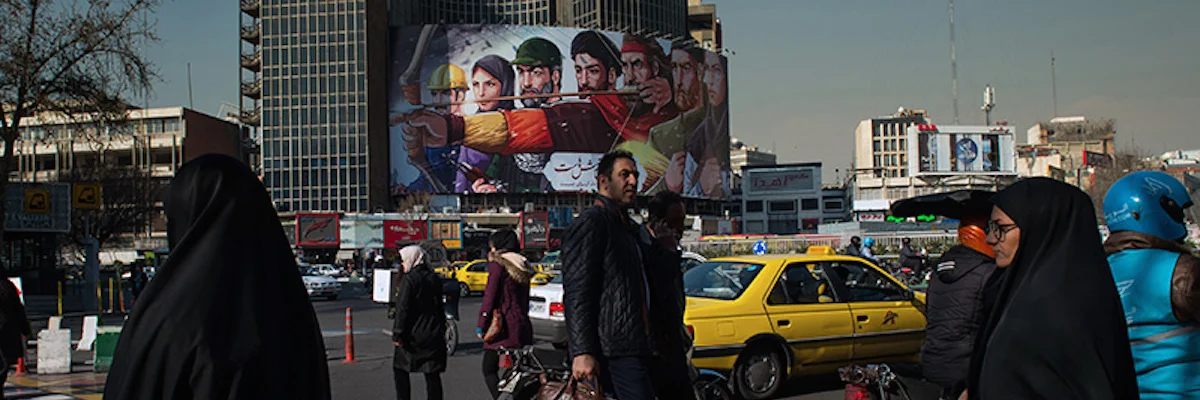
Europe Tries to Sidestep the U.S. Finance System
◢ The standoff between the Trump administration and Iran is escalating, and Europe is caught in the middle. Brussels and national governments in the U.K., France and Germany, meanwhile, have been criticized by Iran for their response to U.S. sanctions. Europeans “speak eloquently”, Iran’s foreign minister Mohammad Javad Zarif said in February. “They also need to walk the walk.” But it would be wrong to dismiss Europe’s efforts as hopeless.
The standoff between the Trump administration and Iran is escalating, and Europe is caught in the middle. The U.S. is exerting pressure through renewed economic sanctions, and hardliners in Tehran are issuing fiery threats of retaliation.
Brussels and national governments in the U.K., France and Germany, meanwhile, have been criticized by both sides for promising to preserve trade with Iran while also treading softly with the Americans to avoid a full-blown diplomatic crisis. Europeans “speak eloquently”, Iran’s foreign minister Mohammad Javad Zarif said in February. “They also need to walk the walk.”
But it would be wrong to dismiss Europe’s efforts as hopeless.
A big source of contention for both Washington and Tehran is INSTEX, a special-purpose vehicle unveiled by Paris, Berlin and London in January. Its ultimate ambitions are bold: To keep trade between Iran and Europe going without relying on cross-border financial transactions (which might fall foul of the U.S.). While not explicitly a sanctions-busting vehicle, it was clearly designed with President Trump in mind. It was his re-imposition of the U.S. trade ban that led to Iranian banks being cut off from the SWIFT banking network, and to international businesses scrapping their investment plans in the Islamic Republic.
By using INSTEX like a central clearing house, the idea would be that buyers and sellers in Iran and Europe could get their money without making transfers into and out of the Middle East country. It’s a complicated system, but in a very simplified form you could imagine having a European trader who wants to buy gas from an Iranian supplier and a European manufacturer who wants to sell aircraft parts to an Iranian company. Instead of the trader paying the Iranians for the gas, they would transfer the money to their fellow European manufacturer (in lieu of payment from its Iranian customer). At the same time, the Iranian aircraft company would pay its compatriot gas supplier for the supplies sent to Europe. Hence no cross-border money flows.
To be clear, INSTEX right now only wants to deal in humanitarian essentials – medicine and food, for example – but Europe has said it wants to expand the facility in the long term. Combined with new “blocking regulations” that make it an offense for EU businesses to comply with U.S. extraterritorial sanctions, there’s a loud message here that Europe’s leaders want to go their own way.
Criticism has focused on the everyday practicality of using INSTEX beyond those humanitarian aims, plus the wisdom of Europe resisting its key NATO ally, whose dominant currency affords it huge extra-territorial reach when waging economic war. For the Trump administration, the special purpose vehicle is a misguided attempt to “break” American sanctions and offer cover to the Islamic Republic. For Iran, it’s a paper tiger. Zarif says Europe has dragged its feet and is clearly reluctant to launch the system.
Neither complaint is entirely fair. INSTEX is obviously a work-in-progress, a sketch on paper more than a reality. But for London, Paris and Berlin, whose unity tends to crumble under U.S. pressure, a public commitment to this vehicle is a kind of success in itself. And it is being taken seriously by parts of the American establishment, who are aware of any risks—however distant—to the dollar’s dominance. “The plumbing is being built and tested to work around the United States,” former Treasury Secretary Jack Lew warned in February. “There will increasingly be alternatives that will chip away at the centrality of the United States.”
In Iran, behind the official skepticism, there are signs of progress. Press reports suggest Tehran has set up its own matching facility for INSTEX, which is needed to make the system work. Europe has also insisted that Tehran has to meet certain standards to participate, including conforming to global rules on money-laundering and terrorist financing. If this happens, it would be significant.
It will probably take years for INSTEX to become genuinely viable in terms of participating countries and trade flows. But it’s serving a political purpose already: Giving Iran an incentive to stay aboard the nuclear deal, and reminding the U.S. that sanctions overreach may harm its interests. INSTEX can’t stop the Middle East from sliding into war, but it’s a marker worth laying down.
Photo: Bloomberg
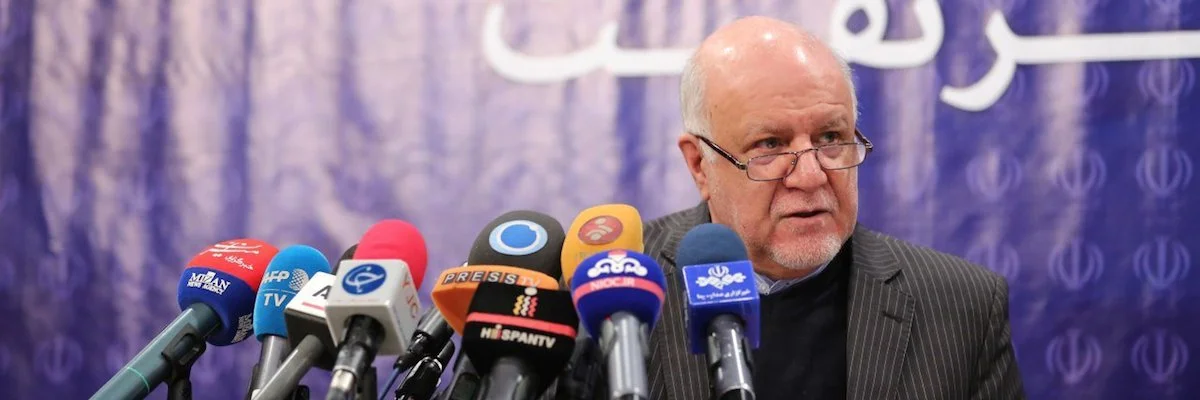
Sanctions Pressure Spurs Debate on Iran’s OPEC Membership
◢ Mohammed Barkindo, the Secretary General of the Organization of the Petroleum Exporting Countries (OPEC), will arrive in Tehran tomorrow to visit an annual oil exhibition. Iran is one of the five founding members of OPEC, which is set to mark its 60 year anniversary. Despite this long history, the extraordinary challenges facing Iran’s oil industry have spurred industry leaders to debate three scenarios regarding Iran’s membership in OPEC.
This article was originally published in Persian in Hamshahri Newspaper.
Today, the 24th edition of the Tehran International Oil and Gas Exhibition opens. Tomorrow, the U.S. waivers permitting the purchase of Iranian oil will be revoked. In 2016, the year when the JCPOA was implemented, around 600 foreign companies came to Tehran to participate in the oil exhibition. This year, just 65 foreign companies are taking part.
Mohammed Barkindo, the Secretary General of the Organization of the Petroleum Exporting Countries (OPEC), will arrive in Tehran tomorrow to visit the oil exhibition. Iran is one of the five founding members of OPEC, which is set to mark its 60 year anniversary. Despite this long history, the extraordinary challenges facing Iran’s oil industry have spurred industry leaders to debate three scenarios regarding Iran’s membership in OPEC.
In the first scenario, Iran would suspend its membership in OPEC until the oil sanctions are lifted. In the second scenario, Iran would announce its departure from OPEC. In the third scenario, Iran would remain a member of OPEC and strive to use its influence within the organization to address the new challenges. These scenarios have yet to be formally deliberated by government officials, but reflect a growing debate among key figures in the oil industry.
Should Iran suspend its membership in OPEC, the remaining members will likely face pressure from Saudi Arabia and the United Arab Emirates to abolish the membership of those countries which have suspended their participation for more than six months. What would be the next step? Would it not be a political failure for Iran to be ejected from an organization of which it is a founding member? Clearly, suspension of membership in OPEC is an unacceptable scenario.
There is no doubt that given the present oil embargo on Iran, Iranian officials will have limited influence on OPEC decisions beyond expressing expert opinions. It will obviously be very difficult for Bijan Namdar Zanganeh, Iran’s oil minister, to attend OPEC meetings for this reason. As a member of OPEC, the number of barrels produced and exported is determined by the consensus of the cartel, so Iran would presumably need to follow targets on which it has had limited input. Hard days await Iran’s oil minister in Vienna. But what would Iran gain by leaving OPEC? Such a move would be a loud political protest against Saudi Arabia and the UAE, which have taken practical steps to weaken Iran’s oil industry. But afterwards, will those rivals not be able to more easily pursue their energy politics, and use OPEC to further advance the isolation of Iran?
The sober, resolute, and reasonable approach would be for Iran to maintain its membership in the most influential organization of the developing world. Iran should remain a member of OPEC to ensure it can continue to engage with global media and influence public opinion on energy matters. It is true that Iran will be unable to meaningfully influence OPEC’s decisions in the near future, but the country should still demonstrate a resolute approach to unprecedented pressures in the energy market. Participating in OPEC meetings provides an important opportunity to remain close to future decisions. Any effort to isolate Iran would reflect the strategy of Saudi Arabia, the UAE, and their bullying partner, the United States. During OPEC meetings and on the sidelines, Iran’s oil minister can expose the cynical intentions of some members to harm the interests of the Iranian people. OPEC, aside from its role advancing the interests of oil producing states, gives Iran a platform to be heard. Iran should not give away this platform. It should not cede the table to others.
Photo: IRNA

Putting Iranian People Before Non-Proliferation
◢ Until American policymakers can conceive of relations with Iran as something more than a set of tactical accommodations designed to address threat perceptions, they are unlikely to solve the question of Iranian proliferation decisively. It is discouraging to see Democratic candidates articulate their intentions towards Iran exclusively within the paradigm of the JCPOA and its ability to curtail Iran’s nuclear program.
This article was originally published on LobeLog.
With such a vibrant economy and society, it is hard to be anything but optimistic about Iran in the long term, even in the recent dark days. Iran’s challenges have always been about prospects in the short term, lurching as it has between domestic and foreign crises. Concerns about the short term have shaped the thinking of foreign stakeholders, who have held off on investments or engagements because of fears of political or economic turmoil. Similar doubts have also crowded the thinking of Iranians themselves, who respond to turmoil by making self-serving decisions, which often prove costly for society down the line. In this way, Iran’s circumstances have been about opportunities delayed, about a widening gulf between short-term pain and the promise of long-term prosperity.
As they look back at the 2015 nuclear deal (the Joint Comprehensive Plan of Action or JCPOA), many Iranians see that its promise was wrapped up in the expectation that such a “grand bargain” would help Iran bridge the gulf between the circumstances of today and the prosperity of tomorrow. Iran, by both making and receiving careful concessions in the course of multilateral negotiations with the world powers had in effect brought forward the time horizon for its own bright future.
Today, the gulf is widening again. In a rare instance of transparency, Trump administration officials openly refer to their Iran policy as an “economic war.” Sanctions are no longer being used as tools of coercive diplomacy, but of economic destruction. Worse still, the operative logic of the most recent sanctions is to create a “sanctions wall.” For the first time, the United States is applying sanctions for the express purpose of making previous sanctions more difficult to lift. This was declared intention of designating the Revolutionary Guards a foreign terrorist organization.
The recent decision to revoke the oil waivers—which does nothing more than remove what proponents of the “significant reduction exemptions” had themselves described as a “humanitarian channel” in which oil revenues flowed into escrow accounts—will place unprecedented economic pressure on Iran, just as intended. The effects of such mounting pressure have been plain to see.
In the last few days, I have spoken to several friends and colleagues in Iran. With each call, the individuals on the other end of the line feel so much farther away than they did even just a few weeks ago. On Tuesday, I was discussing the ramifications of the oil waiver issue with an Iranian journalist. He asked me what Iran’s government could do in response. I instantly felt the responsibility to offer an answer, a ray of hope. But my answer was so obviously unconvincing, with even my Persian falling short as I tried to formulate the pitiful sentences, that I felt embarrassed. Not because of the answer itself, but because suddenly the fiction of shared experiences was made clear.
For the last few years, those of us who deal with Iranian interlocutors on a regular basis could find some joy and motivation in the idea that our lived experiences were converging. More outsiders could engage Iran and more Iranians could engage the wider world. But the reality of political and economic isolation is just that—a deep and pervading separation that makes it clear that although all sides were poised to share the dividends of the JCPOA, only one side will truly bear the costs of its collapse.
Power and the People
Iran’s halting push for nuclear and ballistic missile technology has generally been understood in the context of a regional-security dilemma. Facing huge asymmetries in military power, Iran has sought to develop the means for its own defense.
But it is unclear if the security dilemma is a salient formulation in a period in which a historic non-proliferation agreement has become something of a political curse for its Iranian stewards and a source of abject disappointment for the voters who brought those political leaders to office.
In many respects, the political prospects for the JCPOA were always going to be judged by a simple formula—would Iran appear more powerful with the agreement or without it? In this sense, the state visits, foreign investment, cultural exchanges, and other dividends of diplomacy were meant to provide a spectacle of power, a font of pride, that would displace those grainy images of centrifuges in their neat rows or the footage of missiles emblazoned with political slogans.
The dividends of diplomacy never really materialized. Today, appearing “powerless” is the ultimate political liability for the Iranian state and its leadership. Iran has been made to look weak as trading partners make risible efforts to protect commercial ties in the face of U.S. pressure. The Rouhani government has been made to look weak, out-maneuvered by a shambolic Trump administration. Most troubling, the Iranian people feel powerless as their standard of living is eroded by forces outside of their control, even the forces of Mother Nature herself.
These circumstances give new meaning to the notion of “power hungry.” It is not Iran’s elites who are power hungry. They enjoy ample power. It is the Iranian people who crave power. There seems to be a belief among some in Washington that this hunger—perhaps even literal hunger—will drive the Iranian people to seize power from the elites.
But I foresee a different scenario. Recent surveys have shown a marked increase in the number of Iranians seeking “retaliation” in the face of U.S. violations of the JCPOA. There is genuine anger and frustration among large swaths of the public, directed both at the United States and at the Iranian establishment.
These emotions cannot remain undirected—and Iran’s imperfect democracy offers the channel. Routine elections present Iranian politicians the opportunity to respond to this hunger for power by co-opting it. Just as the disempowered in Eastern Europe, Latin America, Southeast Asia, and the United States have voted for politicians who obsess over expressions of power, so too might Iranians choose to displace their own powerlessness by investing their political capital in a “strongman.”
In such a scenario, the decision to revitalize or expand the nuclear and ballistic missile programs is no longer about calibrating regional security or asserting sovereignty against the West. The centrifuges and missiles themselves become symbols of power, a kind of spectacle around which people can rally. At some level, this is the basic rally-around-the-flag effect that many have been warning about. But this effect has yet to be turned into the sine qua non of domestic politics in Iran. Even under former President Mahmoud Ahmadinejad, there remained a fundamental technocratic orientation of the government.
Rethinking Non-Proliferation
For this reason, non-proliferation must be re-conceived as a political project in the post-JCPOA era. Within the context of the JCPOA, the empowerment of the Iranian people was always seen as a secondary outcome of the agreement’s non-proliferation achievements. In a striking illustration, the Trump administration has been messaging its intention to “support the Iranian people” more vociferously, if disingenuously, than the Obama administration and other parties to the JCPOA ever did.
On one hand it is encouraging to see Democratic Party candidates seek to break with the Trump administration’s “maximum pressure” policy and throw their support behind a multilateral agreement. And yet it is discouraging to see these candidates articulate their intentions towards Iran exclusively within the paradigm of the JCPOA and its ability to curtail Iran’s nuclear program. This fixation on non-proliferation overlooks the fact that in the course of the coming political season in Iran, the JCPOA will likely become too toxic to serve as the crux of a reoriented US policy on Iran, even if the policy of diplomatic engagement with the West remains viable and even if Iran technically remains in compliance.
What if Democrats pointed to their readiness for a deeper reckoning with the failure of the JCPOA? Would it not be so much more meaningful for a Democratic candidate to declare, “We let the Iranian people down when we reimposed sanctions on them while their government was still in compliance with the JCPOA. Our mission should be to restore trust so that Iranians can count on America to honor its obligations.”
Earlier this week, President Hassan Rouhani gave an important speech in which he underlined that he is a “man of negotiation” but emphasized that negotiations are impossible until the United States essentially shows Iran due respect. As American proponents of engagement with Iran look to the future, they must recognize that the failure of the JCPOA was not encompassed in the decision of the Trump administration to withdraw, but rather in the set of cascading institutional failures that allowed the administration to drastically shift the nature of U.S. policy towards Iran, as well as towards the remaining parties of the JCPOA, without paying any real political cost. The Democrats, and all who care about the integrity of American foreign policy, must reckon with these failures. A willingness to do so is far more important than reentering a moribund deal as a matter of political reflex.
Until American policymakers can conceive of relations with Iran as something more than a set of tactical accommodations designed to address threat perceptions, they are unlikely to solve the question of Iranian proliferation decisively. Proponents of engagement must make sure that they are building a bridge to help Iranians cross from short-term turmoil to the long-term prosperity they have been regrettably denied. Non-proliferation is just one pillar of this bridge.
Photo: Depositphoto
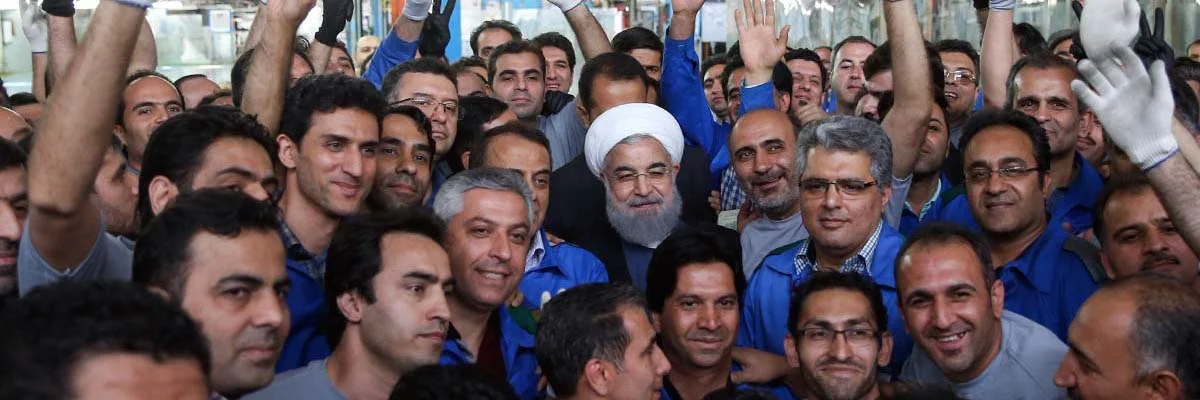
Iran Automakers Face Rocky Road as Output Falls While Demand Rises
◢ Iran’s automakers have pre-sold more than 1 million vehicles, most of which are earmarked for delivery to customers in the Iranian fiscal year that started in March. But with vehicle production declining at a steep rate, fulfilling these orders will be no easy task.
Iran’s automakers have pre-sold more than 1 million vehicles, most of which are earmarked for delivery to customers in the current Iranian year that started in March. But with vehicle production declining at a steep rate, fulfilling these orders will be no easy task.
Following the reimposition of US secondary sanctions in November of last year, the Iranian economy has begun to contract. Inflation is driving up the price of goods, including automobiles.
For instance, the cheapest vehicle in the Iranian market, SAIPA’s Pride sedan, is now sold at IRR 450 million, just over USD 10,000. The same model was offered for just IRR 200 million one year ago. Despite the sharp increase in prices, demand for cars has also increased.
With the rial losing around 70 percent of its value over the past few months, many have rushed to convert their cash into safe-haven assets—including foreign currency, gold coins, real estate and even cars. Iranian consumers see cars as a safe investment and it is not uncommon for used cars to actually appreciate in value during periods of high-inflation.
Pre-orders for entry-level models like the Pride have also increased as consumers typically interested in more expensive models, such as locally produced Peugeots, are priced out of the luxury bracket.
Mounting Pre-Orders
With US sanctions taking a toll on the country’s auto industries, Iran’s automakers face an uphill battle to deliver the pre-ordered cars on time.
In order to service mounting debts, state automakers Iran Khodro and SAIPA sought permission from authorities to launch extended sales periods in which they racked-up 1 million preorders, with cash being injected into company balance sheets.
But just as the orders are becoming due, sanctions are restricting the import of critical parts and raw materials needed for the automakers to produce sufficient vehicles. Production output has declined significantly.
During the 11 months to February 20th, Iranian automotive companies produced 873,243 cars and commercial vehicles, indicating a 38 percent year-on-year decline in output. Output at Iran Khodro fell to 386,523 vehicles compared to 653,593 at the same period last year, reflecting a 41 percent decline. Meanwhile, total vehicle output at SAIPA has fallen to 381,085 from 605,348 at the same point last year—down 37 percent.
Foreign exchange rates have hit all-time highs and production costs have soared, forcing car companies to increase prices. With production plummeting, prices in the automotive market have been further distorted by dealers and middlemen who have sought to raise prices in the secondary market.
Persistent Hopes
Iranian automakers must therefore strike a balance between supply constraints and robust demand. Pre-sale deposits are an important source of cash flow for car companies, but delays in delivery can cause negative publicity and also add to financial pressure. In a quirk of #Iran’s automotive market, pre-sale terms entitle customers to get back their deposit with accrued interest in the event they decide not to take delivery of the vehicle—in effect customer deposits are a kind of loan made to the automaker.
Given these pressures, Iran’s automakers must aim to sustain output despite headwinds. Firms have actually targeted increased output in the coming year. Leading automakers plan to produce at least 1.2 million vehicles in the 2019-2020 fiscal year, leveraging their experience in the previous sanctions period to boost local capacities and establish new supplier relationships.
Iranian car companies have tried to forge new ties with international automakers like Russian car company AvtoVAZ. SAIPA is in talks with AvtoVAZ to import auto parts and completely knocked down (CKD) kits from Russia to restore production to normal levels.
Iranian automakers have also sought to expand operations outside of Iran to help earn much needed cash. Earlier last week, a joint venture between Iran Khodro and Azermash OJSC started pre-sales of a jointly-produced Peugeot 206 in Azerbaijan.
The joint venture was inaugurated during a state visit to Baku by President Hassan Rouhani last March. In addition to the Peugeot 206, two sedan models designed by Iran Khodro, the Dena and Dena+, will be produced at the Khazar Car Factory, located in the Neftchala Industrial District in southeast Azerbaijan.
With an initial annual production capacity of 10,000 vehicles, the Khazar Car Factory will increase output to 15,000 vehicles. The joint venture partners hope to produce 6,000 vehicles this year.
Photo: IRNA
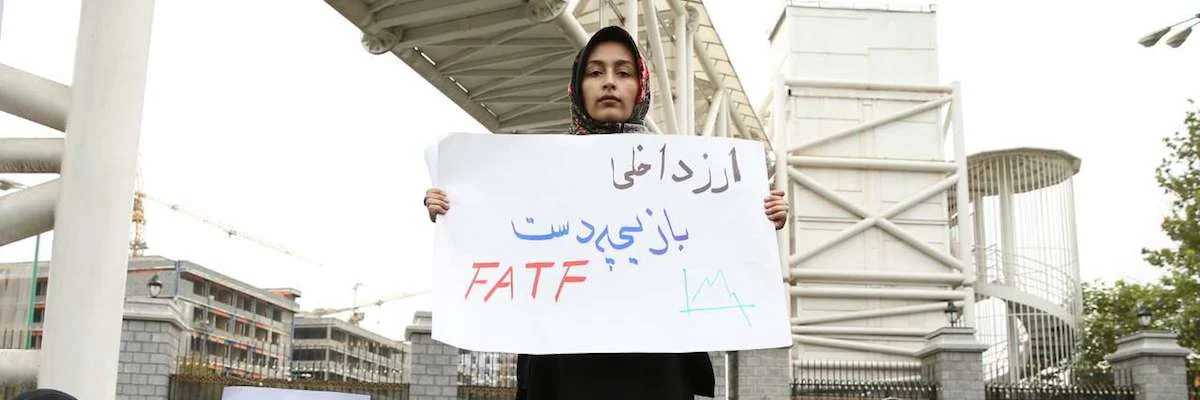
Iranian Bankers Fear IRGC Terrorism Designation Dooms Vital Financial Reforms
◢ Reform-minded Iranians, especially those inside the ailing banking system, are worried that the US government’s step to designate Iran’s Islamic Revolutionary Guard Corps (IRGC) as a terrorist organization has doomed a years-long effort to get the Islamic Republic off a consequential global blacklist.
Reform-minded Iranians, especially those inside the ailing banking system, are worried that the US government’s step to designate Iran’s Islamic Revolutionary Guard Corps (IRGC) as a terrorist organization has doomed a years-long effort to get the Islamic Republic off a consequential global blacklist.
The administration of Iranian President Hassan Rouhani has been working hard to meet the requirements of the action plan set by the Financial Action Task Force (FATF), the intergovernmental organization established with the mandate of combatting money laundering and terrorism financing.
The required reforms have caused deep political divisions, with opponents arguing that Iran will be compromising its sovereignty should it appease the FATF, while porposents argue that failing to pass the required legislation will eliminate final links Iran maintains with foreign financial institutions while under US sanctions.
Undaunted even as death threats were made against them, a majority of Iran’s parliament voted to pass all four FATF bills over the course of several months. The supervisory Guardian Council then ratified two of the laws, while two others were considered deficient. The council and parliament have failed to find a consensus on adjustments to these two bills, which pertain to regulations that deter terrorist financing and organized crime. Now the powerful Expediency Council must vote to break the deadlock on ratification.
Meanwhile, the clock is ticking for Iran to show progress on the FATF action plan. At the end of its February plenary sessions, the FATF announced, “If by June 2019, Iran does not enact the remaining legislation in line with FATF Standards, then the FATF will require increased supervisory examination for branches and subsidiaries of financial institutions based in Iran.”
When the Trump administration took the controversial move to designate the IRGC a Foreign Terrorist Organization (FTO), the first time the FTO designation had been applied to a part of a foreign state, the condemnations in Iran came swiftly.
As Rohollah Faghihi reports for Al Monitor, hardliners opposed to engagement with the West pointed to the FTO designation to show the futility of the FATF reforms. The day after the FTO designation was announced, Expediency Council member Gholamreza Mesbahi-Moqadam said the designation has decreased the chances that the FATF bills woild be ratified. “The move has strengthened the council’s [unfavorable] stance about the FATF and the chances of the bills not being approved has increased,” he said. Others have even placed the chances of ratification at zero.
Members of Iranians banking community, who have been advocating for FATF reforms for years as part of a larger drive for modernization of the financial sector, share in this pessimism. A senior Iranian banker speaking to Bourse & Bazaar on condition of anonymity agreed that the FTO designation has harmed the odds of the bill passing, by shifting the environment away from constructive discussion and cooperation towards sloganeering.
“The designation has major political implications, the full scope of which has yet to become clear, but I find it unlikely that the bills will be approved under current circumstances,” the banker said. “Essentially whenever the situation gains an emotional aspect, decisions also become largely emotional.”
Several high-level Iranian officials have also confirmed that the FTO designation will have an impact on the FATF bills. Secretary of the Expediency Council Mohsen Rezaei, who counts himself among those opposed to the bills, has said the FTO designation will be factored in forthcoming decisions based on “national interests.”
Meanwhile, Laya Joneydi, Iran’s Vice President for Legal Affairs, suggested it was a mistake to conflate decision-making about the FATF bills and the FTO designation since the two issues are “fully separable.” She did, however, point out that the designation will prompt the Rouhani government to consider any new “reservations” about the two bills.
A source inside the Central Bank of Iran also confirmed to Bourse & Bazaar on condition of anonymity that the IRGC designation should be expected to have an impact on the FATF bills.
“The central bank has always been in favor of having the bills pass into law, but we have already concluded all expert reviews of the bills and now everything depends on the views of the Expediency Council. At at the moment it seems the number of council members opposed to the bills is higher,” the source said.
Central Bank Governor Abdolnasser Hemmati has on multiple occasions voices his support for enacting the bills into law, saying Iran needs to do more to comply with international financial standards. In his latest remarks in early March, he said safeguarding and strengthening what little international banking ties Iran retains is a “necessity.”
In late February, Rouhani mounted his strongest support yet for the bills, saying “we cannot give the country to 10-20 people and say we follow your decisions”. The president called on the Expediency Council to facilitate passage of the bills lest Iran lose its already tenuous link to the global financial system.
But not everyone inside Iran’s isolated banking system is pessimistic about salvaging the FATF action plan.
“The bills will certainly face delays, but we predict that they will ultimately be signed into law,” a senior member of a banking sector association told Bourse & Bazaar on condition of anonymity.
The official likened the situation surrounding the issue to the Iran nuclear deal, noting that many analysts thought such a multilateral agreement could never be reached given opposition from hardliners.
“I believe some members of the Expediency Council harbor doubts about some of the contents of the FATF bills but are not opposed to them outright. Those doubts will be cleared in time,” the official said.
The question remains whether the FATF will continue to show patience as Iran’s complex domestic politics slow the pace of reform even further.
Photo: IRNA
Devastating Floods Further Strain Iran's Creaking Economy
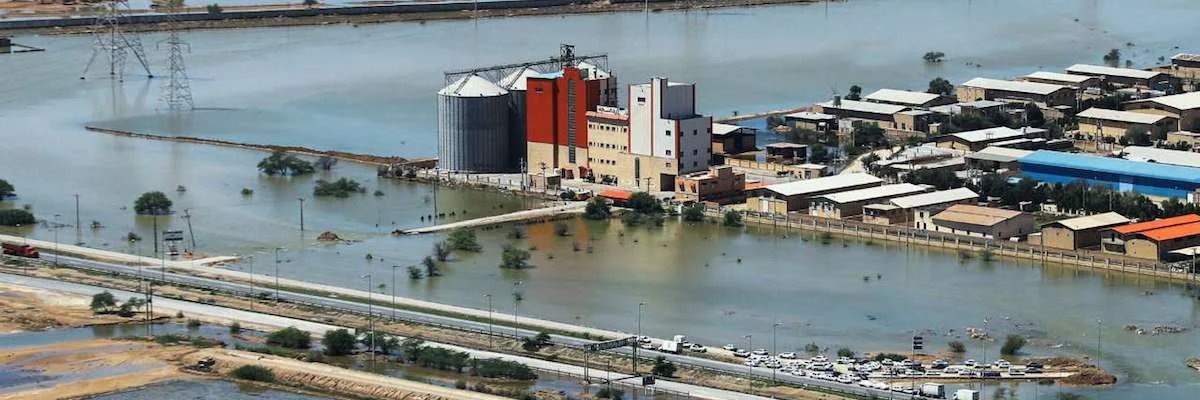
◢ Iran’s economy was already creaking as two weeks of flooding devastated communities across the country, killing 76 people and damaging critical infrastructure and industries. Hundreds of thousands of Iranians have been left to pick up the pieces at a time when economic pressures may mean that their government and fellow countrymen will struggle to provide adequate relief.
Iran’s economy was already creaking as two weeks of flooding devastated communities across the country, killing 76 people and damaging critical infrastructure and industries. Hundreds of thousands of Iranians have been left to pick up the pieces at a time when economic pressures may mean that their government and fellow countrymen will struggle to provide adequate relief.
Initial estimates put the flood damage at USD 3.5 billion. Nearly 90,000 homes have been rendered uninhabitable. Thousands of farms have also been submerged, with damage to the agricultural sector alone estimated at nearly USD 200 million. Across the agricultural centers of Golestan, Khuzestan, Lorestan, and Mazandaran, over 800,000 hectares of crops have been destroyed.
Individual communities have been hammered as factories and farms have closed. In the northern town of Agh Ghala, 5000 people have been rendered jobless after the floods devastated 15 individual industrial plants. At least 60 chicken farms have also suffered major damage.
Although Iran’s largest factories remain intact, the Ministry of Industry has identified 400 industrial sites across six provinces that were hit by flooding. In Lorestan province alone, over 100 manufacturing facilities were affected.
In oil-rich but underdeveloped Khuzestan, the floods hit oil fields and sugarcane fields alike. Officials have confirmed that downpours partially destroyed five out of seven sugar producing factories in the Arab-majority province, including the Dehkhoda Sugarcane Cultivation and Industry Company. Floodwaters also inundated over 30,000 hectares of the adjacent sugarcane fields.
Iran’s roads infrastructure has also seen significant damage. Roads Minister Mohammad Eslami, told reporters that nearly 14,000 kilometers of roads, making up a third of the country's overall network, has been damaged.
An Underwhelming Response
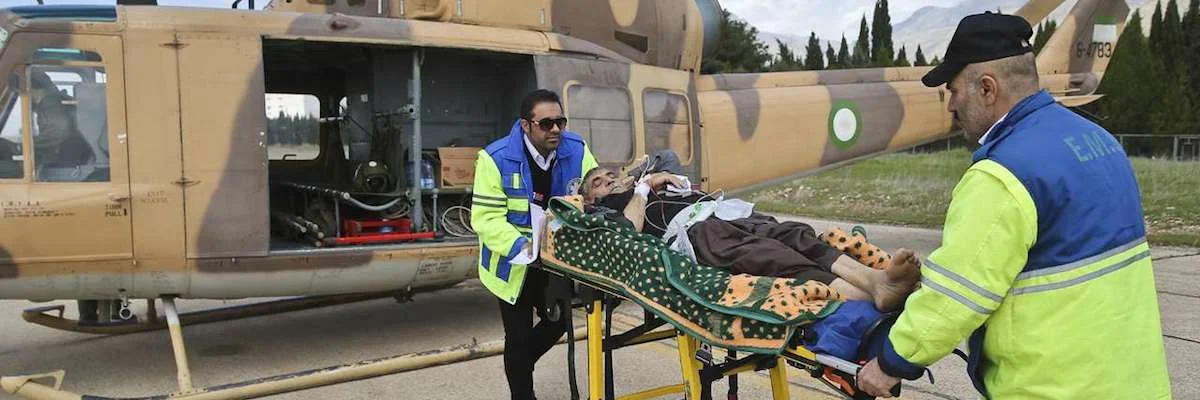
As Iranians take stock of the devastation, the debate over the government’s disaster management has only grown more heated. On one hand, relief efforts have been complicated by US secondary sanctions. The country's Red Crescent Society issued a statement lamenting "inhumane US sanctions" which it said had blocked the transfer of international cash contributions. "Not a single dollar or euro [in foreign transactions] has managed to get through," the organization said in an updated statement broadcast on state TV a week later. The Iranian agency has also complained about how its ageing fleet of 24 helicopters has slowed response to the disaster.
On the other hand, the government seems to have done little to address public anger over perceived mismanagement. Iranian social media has hosted numerous videos of citizens berating government officials, including an argument between the governor-general of Khuzestan province and a frustrated local who criticized the government for "aiding Syrians" while neglecting the plight of the flood-stricken at home. In an offensive tone, the governor-general attacked the man for being a "rude opponent" of the regime. The viral video sparked a backlash, prompting the interior minister to intervene and ask the governor-general to apologize to the man. Two days later, another video was released with a title suggesting an apology. But interviewed later, the man in the first video denied claims that he had been approached by the governor-general for an apology.
Flood relief has also become a new battleground for political rivalries. The recent move by the Trump administration to designate the Islamic Revolutionary Guard Corps (IRGC) as a terrorist organization spurred supporters to share photos of IRGC officers and commanders, rushing to provide aid to flood-stricken villages in muddy fatigues. "This is a terrorist back from a dangerous terror operation with his gun, a shovel in his hands," tweeted one user in a sarcastic tone meant to question the logic behind the US measure.
But Iranians have found hope in extraordinary acts of service. In a video widely circulated last week, a group of young men locked arms to form a human dam as rampaging waters threatened to break through a levee in Dehlavieh, near the city of Ahvaz. The dramatic scene was printed on the front pages of leading newspapers.
Reconstruction Efforts Begin
As the extent of the flood damage continues to become clear, the government now considers it "inevitable" that it will be necessary to draw upon foreign currency reserves held by the country’s sovereign wealth fund, the National Development Fund of Iran.
But grassroots reconstruction will also depend in part on donations from the public. In the aftermath of the 2017 earthquake in Kermanshah, which killed over 600, low levels of confidence in government agencies saw the public seek out other fundraising initiatives, including efforts spearheaded by celebrities, who raised huge sums for relief and reconstruction. But a lack of transparency and later controversies surrounding some of those appeals seems to have led the public to once again donate primarily through traditional agencies.
An opinion poll conducted by the Iranian Students Polling Agency (ISPA), suggests that confidence in government relief organizations has risen when compared to previous disasters, notably the 2017 earthquake. In a sign of the country’s economic hardship, 58 percent of respondents said they had not donated because of their own financial circumstances, while 42 percent of respondents had made a donation. Those who were able to give reported donating to a wide range of organizations, including the Red Crescent, the Iman Khomeini Relief Foundation, local mosques, celebrity-led campaigns, as well as directly to flood victims. Just 19 percent of respondents expressed doubts that the donations would reach flood victims. Of the recipient organizations, the Red Crescent, which has already collected over USD 30 million in private donations from within Iran, was the most trusted, chosen by 31 percent of respondents. The Iman Khomeini Relief Foundation was the chosen recipient organization for just 8 percent of respondents, lower even than direct donations to flood victims.
The challenge now facing Iran’s government is how to maintain momentum and political attention as devastated communities face years-long recovery efforts. As Iran’s economy faces unprecedented strain, it may be the strength of Iran’s social ties that determine the fate of the thousands whose livelihoods have been disrupted.
Photo: IRNA
Economic War on Iran is America’s New ‘Forever War’
◢ The administration of US President Donald Trump last week designated the Islamic Revolutionary Guard Corps, part of Iran’s armed forces, as a Foreign Terrorist Organization. With the future of both the Iran nuclear deal and prospects for US-Iran diplomacy at stake, a political fallout is the clear intention behind designating the IRGC a terrorist organization.
This article was originally published in the Asia Times.
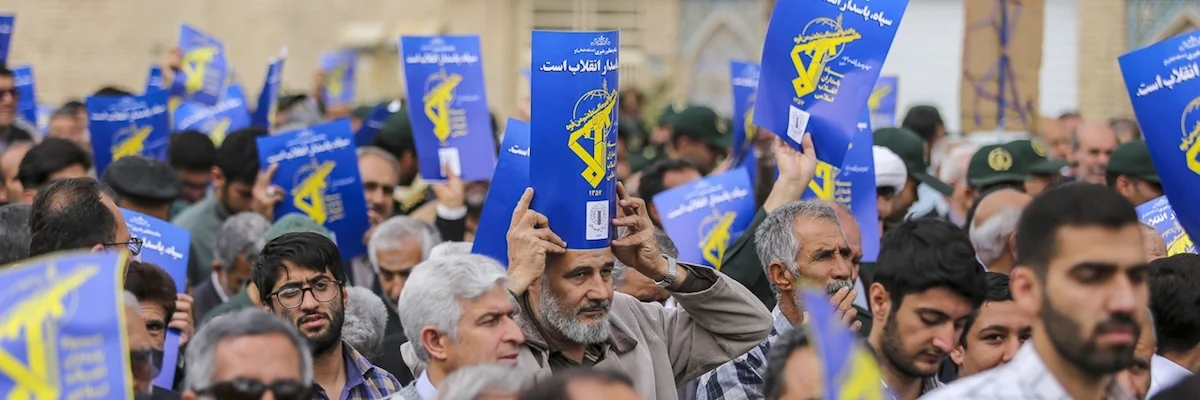
The administration of US President Donald Trump last week designated the Islamic Revolutionary Guard Corps, part of Iran’s armed forces, as a Foreign Terrorist Organization. A White House statement boasted that it was “the first time that the United States has ever named a part of another government as an FTO” and declared that the “action will significantly expand the scope and scale of our maximum pressure on the Iranian regime.”
In a briefing related to the announcement of the new designation, Secretary of State Mike Pompeo told reporters that he hopes “other governments and the private sector will now see more clearly how deeply the IRGC has enmeshed itself in the Iranian economy through both licit and illicit means”.
While there is no doubt that the Trump administration is waging a self-described “financial war” on Iran, designating the IRGC as a terrorist organization has little to do with adding new economic pressure, despite the administration’s claims. As sanctions attorney Tyler Cullis has argued, the IRGC and the wider Iranian economy are already subject to a “veritable labyrinth of US sanctions” meaning that “the designation of the IRGC as an FTO has limited, if any, immediate practical consequence.”
While the new designation does introduce increased criminal liabilities for those individuals or entities that can be shown to have provided “material support” to the IRGC, legitimate businesses were adequately deterred from engaging with the IRGC because of risks stemming from pre-existing sanctions designations.
Building a Sanctions Wall
The new designation may have limited economic impact, but it has certainly proved politically provocative. In Tehran, leaders from across political lines were unified in their condemnation of the designation and in their solidarity with the IRGC. In Washington, officials at the Pentagon and Central Intelligence Agency reportedly consider the move counterproductive, possibility putting US military and intelligence assets in the Middle East at risk of blowback. In Paris, French President Emmanuel Macron has called for all sides to practice restraint. He also spoke to Iranian President Hassan Rouhani by phone to reassure him of European support for the nuclear deal, which the US abandoned in May 2018.
In Baghdad, Iraqi Prime Minister Adel Abdel Mahdi told reporters that his government had tried to persuade the Trump administration not to proceed with the designation, noting that any escalation “would make us all losers.”
With the future of both the Iran nuclear deal and prospects for US-Iran diplomacy at stake, a political fallout is the clear intention behind designating the IRGC a terrorist organization. In an op-ed in The Wall Street Journal published just a week before the designation, the head of the hawkish Foundation for Defense of Democracies called for the Trump administration to create a “sanctions wall” that would hobble efforts by a potential Democratic president to re-enter the Iran nuclear deal in 2021. Mark Dubowitz has been among the most vocal proponents of designating the IRGC as a Foreign Terrorist Organization.
To understand how the FTO designation helps build a “sanctions wall,” it is important to consider how such a designation fits into the recent development of US sanctions powers. Today’s financialized sanctions were largely developed in response to the “forever wars” of the US invasions of Afghanistan and Iraq and the realization that the “war on terror” could not be won through conventional military conflict.
With public sentiment turning against further military deployments, and with the threat of terrorism expanding in part because of the fallout of the US invasions in the Middle East, the Treasury Department was tasked to develop new sanctions powers intended to weaken terrorist organizations by cutting their access to financial resources. As described by Juan Zarate, who served as deputy national security adviser for combating terrorism under president George W Bush, the US sought to develop its means of “financial war,” in which sanctions would “increasingly become the national-security tools of choice for the hard international security issues facing the United States.”
By the time Barack Obama took office as president, the use of sanctions in the “global war on terror” was overtaken by a new national-security imperative: addressing the perceived threat of Iranian nuclear proliferation. Suddenly, sanctions tools that had been developed primarily to target terrorist financing were being turned against governments, in part by leaning on the formal designation of countries like Iran as “state sponsors of terror.”
Building a Stigma
The application of sanctions seemed sensible – the US would leverage its primacy in the global financial system in order to block the assets of terrorist organizations and their state sponsors, while also putting their commercial enablers in legal jeopardy. Obama saw “diplomacy, backed with strong sanctions” as a direct alternative to reliance on military brinksmanship – ”a failed policy that has seen Iran strengthen its position.”
But there were unintended effects. While the US was tightening its sanctions on Iran, American officials toured the world warning companies that, despite their extensive due diligence, the opaque nature of the Iranian system meant an ever-present risk that routine commercial transactions could see funds diverted to designated groups that finance terrorism.
The stigma that arose around Iran’s economy and particularly its financial sector was so great that when Obama’s bet on diplomacy and sanctions finally paid off in the form of the historic JCPOA (Joint Comprehensive Plan of Action) nuclear deal, he ultimately proved unable to deliver Iran the economic benefits of sanctions relief promised as part of the agreement, bringing it to the brink of collapse. Even though the US lifted a large proportion of its sanctions on Iran as a matter of legal fact, companies and the banks Tehran needed remained fearful to engage, rendering the practical impact negligible.
Opponents of Obama’s nuclear deal were quick to recognize this fact. When Trump came into office having promised to tear up a “decaying and rotten deal.” some even argued that his administration could advance its anti-Iran agenda while remaining in the JCPOA on the basis that Iran was receiving no meaningful benefits. Eventually Trump did withdraw from the agreement, but as hawks opposed to engagement with Iran look to the post-Trump future, whether that future arrives in 2021 or 2025, there is a clear desire to exploit the ways in which sanctions themselves have proven a liability to diplomacy.
In this way, given the lack of practical impact, the designation of the IRGC as a terrorist organization has little to do with the activities of the corps as a military force, concerning though they may be.
Rather, by designating part of Iran’s state as a terrorist organization, a label that extends to millions of conscripts, those who wish to build a “sanctions wall” are seeking to close a political feedback loop. Not only does the FTO designation aim retroactively to justify the whole architecture of US sanctions on Iran, but even if the political circumstances between Washington and Tehran change in the future, sanctions will continue to be justified as a matter basic definitions. A future US administration seeking to lift sanctions on Iran will not merely need to argue the political expediency of that decision – it will now be forced in effect to “redefine” the most powerful force in Iranian national security, a tall order after 40 years of entrenched animosity.
What the FTO designation makes clear it that “financial war” on Iran is America’s new “forever war.”
Photo Credit: IRNA
Political Risks Outweigh Legal Impact of IRGC Terrorism Designation
◢ The Trump administration announced the designation of the Islamic Revolutionary Guards Corps (IRGC)—a branch of Iran’s armed forces—as a Foreign Terrorist Organization (FTO) pursuant to section 219 of the Immigration and Nationality Act (INA). While the practical effect of the FTO designation is negligible at best, the risks to the US from the designation could be severe.
This article was originally published by The Black List.
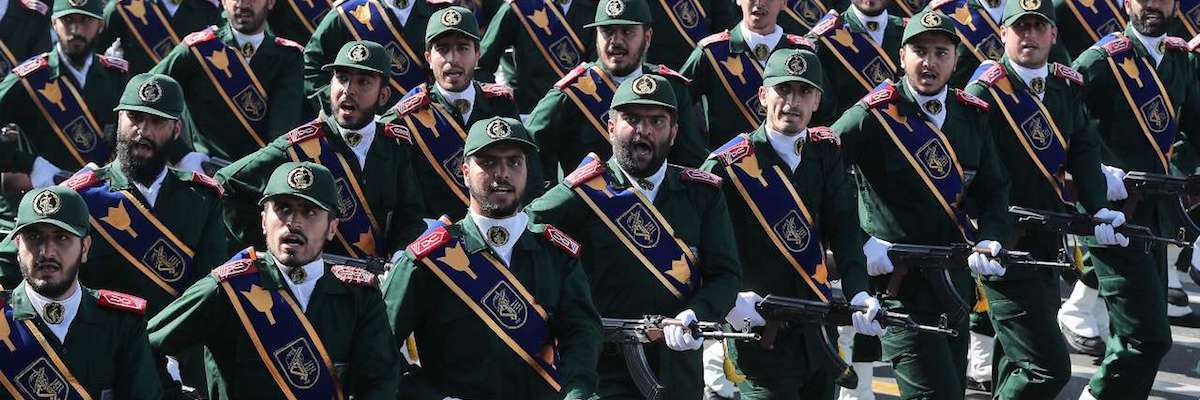
The Trump administration announced the designation of the Islamic Revolutionary Guards Corps (IRGC)—a branch of Iran’s armed forces—as a Foreign Terrorist Organization (FTO) pursuant to section 219 of the Immigration and Nationality Act (INA). In the White House press statement, President Trump called the designation “unprecedented,” underscoring that it represents “the first time that the United States has ever named a part of another government as a FTO.”
Trump underlined that the designation “will significantly expand the scope and scale of our maximum pressure on the Iranian regime.” Secretary of State Mike Pompeo echoed those remarks in his own press conference announcing the designation, noting that the designation “will help starve the regime of the means to execute [the IRGC’s] destructive policy.” Helping amp up the designation action, US officials (dubiously) argued that the designation will target more than 11 million people comprising the IRGC’s network.
Hyperbole aside, the practical effect of the FTO designation is negligible at best. Considering the multiple sanctions programs under which the IRGC is currently designated, the FTO designation appears entirely superfluous, exerting no additional substantial pressure against the IRGC.
On the other hand, the risks to the US from the designation could be severe. As long reported, the Department of Defense and the CIA have been steadfastly opposed to designating the IRGC an FTO—viewing the designation as fraught with consequences for US troops and without material benefit for the United States. Their opposition appears to have been overcome, however, by those in the White House and State Department who have rallied to increase the pressure-in substance or rhetoric-against Iran regardless of the potential consequences.
Legal Authority for FTO Designation and the Sanctions Consequences
12 U.S.C. § 1189 authorizes the Secretary of State to designate an organization an FTO if the Secretary finds that the organization is a foreign organization that engages in terrorist activity that threatens US nationals or US national security. The Secretary’s intent to designate a foreign organization an FTO is first communicated to members of the Congress, along with the findings and factual basis for the Secretary’s decision to designate the organization, which explains the apparent delay between President Trump’s announcement and the formal designation of the IRGC as an FTO.
The immediate consequences of an FTO designation are limited in scope. Pursuant to 12 U.S.C. § 1189(2)(C), the Secretary of Treasury is given discretionary authority to require US financial institutions to block all financial transactions involving assets of an FTO. In addition, all members of an FTO are prohibited from entering the United States under 12 U.S.C. § 1182(a)(3). This latter provision could be used to block Iranian persons who performed mandatory military service in Iran from entering the United States. This could explain the “11 million people” claim by members of the Trump administration.
Preexisting US Sanctions Targeting IRGC
The IRGC is already designated under multiple U.S. sanctions authorities—most of which cover the ground of an FTO designation. For instance, the IRGC is designated under:
E.O. 13224 as a Specially Designated Global Terrorist;
E.O. 13382 as a WMD Proliferator;
E.O. 13553 as a human rights abuser; and
E.O. 13606 as a human rights abuser as well.
These designations have significant U.S. secondary sanctions consequences. For instance, 31 C.F.R. § 561.201 exposes foreign financial institutions that conduct a significant financial transaction with, or provide significant financial services for or on behalf of the IRGC or a person designated pursuant to E.O. 13224 or E.O. 13382, to correspondent or payable-through account sanctions. In addition, the Iran Freedom Counter-Proliferation Act subjects foreign banks to correspondent or payable-through account sanctions, and foreign persons to menu-based sanctions, for engaging in significant transactions with Iranian persons, which would include the IRGC.
Due to the serious secondary sanctions consequences inherent in dealing with the IRGC, OFAC has long given the IRGC its own program tag “[IRGC]” to aid foreign persons seeking to comply with U.S. sanctions targeting the group.
In addition, multiple US statutory authorities require the President to identify officials, agents, or affiliates of the IRGC and to impose sanctions with respect to them. These reporting requirements ensure that the U.S. remains hyper-focused on the IRGC and its activities and prepared to impose additional designations as warranted.
Practical Consequences of FTO Designation
Amidst this veritable labyrinth of US sanctions targeting the IRGC, the designation of the IRGC as an FTO has limited, if any, immediate practical consequence. For instance, the blocking of the IRGC’s assets is already mandated by the executive authorities under which the IRGC is designated—some of which also impose visa requirements. Iranian persons who formerly served in the IRGC have long been subject to intensified scrutiny from US immigration authorities and have often been denied entry on these grounds.
The sole possible additional consequence arising from an FTO designation is the extraterritorial criminal jurisdiction afforded over foreign persons acting outside the United States that knowingly provide material support to an FTO. 18 U.S.C. § 2339B states that persons who knowingly provide material support or resources to an FTO or attempt or conspire to do so are subject to fine or imprisonment of not more than twenty (20) years (unless death results from the prohibited act). Material support is defined broadly to include any property or service.
18 U.S.C. § 2339B(d)(1) expressly provides for extraterritorial criminal jurisdiction, stating that there is jurisdiction over an offense “if . . . after the conduct required for the offense occurs an offender is brought into or found within the United States, even if the conduct required for the offense occurs outside the United States.” This means that foreign persons providing material support to an FTO are subject to criminal prosecution in the United States, even if the foreign person has no legal status in the United States; acted outside of the United States; and the conduct did not touch or otherwise have effects within the United States.
This provision could lead foreign parties conducting business with Iran to exercise even more heightened due diligence with regard to their dealings. Yet, the consequences of dealing with the IRGC are already especially dire, and foreign parties doing legitimate trade with Iran are likely to have taken steps to ensure the absence of IRGC-related parties.
So What’s the Purpose...?
Considering the negligible benefits of an FTO designation, the Trump administration appears to have two things in mind through its designation of the IRGC: (1) to invite an Iranian response that could collapse the nuclear deal and risk a broader conflict with the United States; and (2) to use the threat of criminal prosecution to deter even legitimate business with Iran, as members of the Trump administration have long claimed that the IRGC controls broad sectors of the Iranian economy. This latter element could also be used to constrain a future President from re-entering the Iran nuclear accord and complying with its terms, considering the potential political pitfalls inherent in rescinding the FTO designation.
Indeed, chief proponent of the FTO designation and close adviser to the Trump administration Mark Dubowitz of the Foundation for Defense of Democracies stated that the designation “just layers on top of all of the current sanctions an additional and more expansive, punitive measure that will deter more business and . . . diminish current business that’s still ongoing between the Europeans and the Iranians, and the Asians and the Iranians.” The purpose of this, he earlier wrote, is to “make the case for dismantling these sanctions [hard],” thereby “block[ing] [the next administration] from delivering sanctions relief to Iran” consistent with the Iran nuclear accord.
Such motivations—if accurately depicting internal deliberations by the administration—would prove a grave abuse of the FTO designation process and the broader use of US sanctions authorities to target activities anathema to US security interests.
Photo Credit: IRNA
Squeezing Gas Prices or Iran? Trump Must Choose
◢ The deadline for the US administration to decide whether to extend sanctions waivers granted to buyers of Iranian oil is now less than a month away, and President Donald Trump faces a tricky decision. He undoubtedly wants to increase pressure on the Persian Gulf nation, but in doing so he risks stoking oil prices and with them those all-important gas prices in swing states back home.
The deadline for the US administration to decide whether to extend sanctions waivers granted to buyers of Iranian oil is now less than a month away, and President Donald Trump faces a tricky decision. He undoubtedly wants to increase pressure on the Persian Gulf nation, but in doing so he risks stoking oil prices and with them those all-important gas prices in swing states back home.
Brian Hook, the US Special Representative for Iran, believes oil market conditions are better this year than they were in 2018 for accelerating the goal of “zeroing out all purchases of Iranian crude,” or so he told reporters last week. But the numbers tell a different story.
That is going to make it more difficult for Trump to go in hard on the remaining buyers of Iran’s oil.
Crude prices have risen nearly 50 percent since Christmas, with WTI popping above USD 62.50 a barrel last week for the first time in almost five months. Retail gasoline prices are on a tear, too. The latest data from the Department of Energy show gas prices up by 18 percent since late February, bringing them back to where they were this time last year.
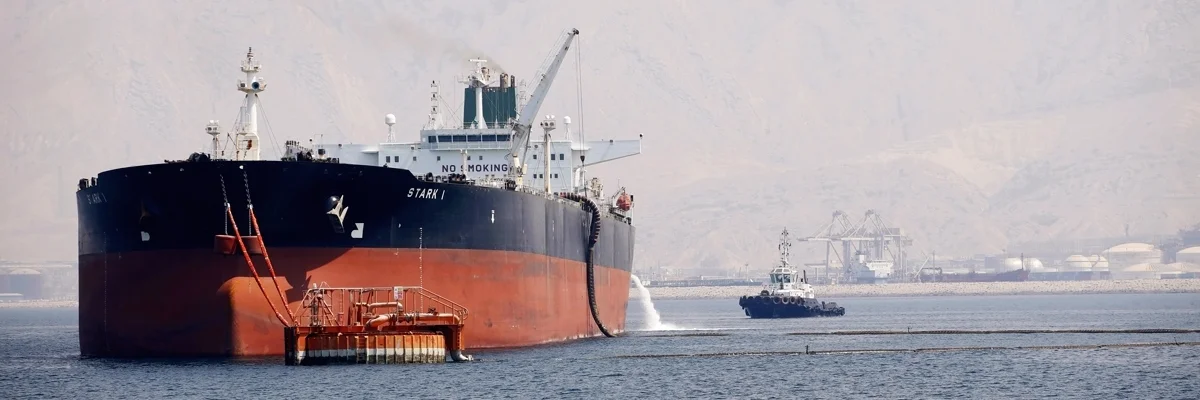
Meanwhile, in the Persian Gulf, Iran’s visible exports of crude and condensate—a light form of oil produced from gas fields—have been rising steadily since the start of the year. Part of this increase may be due to more of the nation’s oil tankers sending out the radio signals that allow them to be tracked, after much of the fleet turned off transponders to disguise their movements immediately after sanctions were re-imposed. But customs data from importing nations show a similar upward trend.
America’s squeeze on Iran nevertheless allowed some nations to purchase its oil, under a series of six-month-long waivers. These were granted to eight countries, including China, South Korea, Iran, Japan and Turkey, as the restrictions were imposed in November. An estimated 1.76 million barrels a day of crude and condensate left Iran for those five countries in March, up from 1.42 million in February, according to Bloomberg tanker tracking.
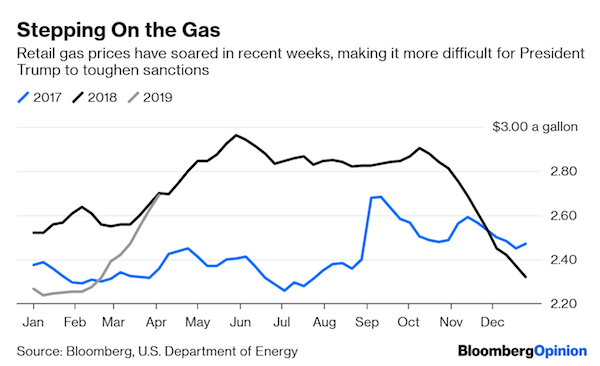
This trend contradicts Hook’s assertion that the US is “on the fast track to zeroing out all purchases of Iranian crude.” Three countries that got waivers have cut their purchases to zero, he added. In fact, those three countries—Taiwan, Greece and Italy—haven’t exercised their wavers at all since they were granted. Refiners in Greece and Italy have not received any Iranian cargoes since October, while Taiwan took its last delivery in September.
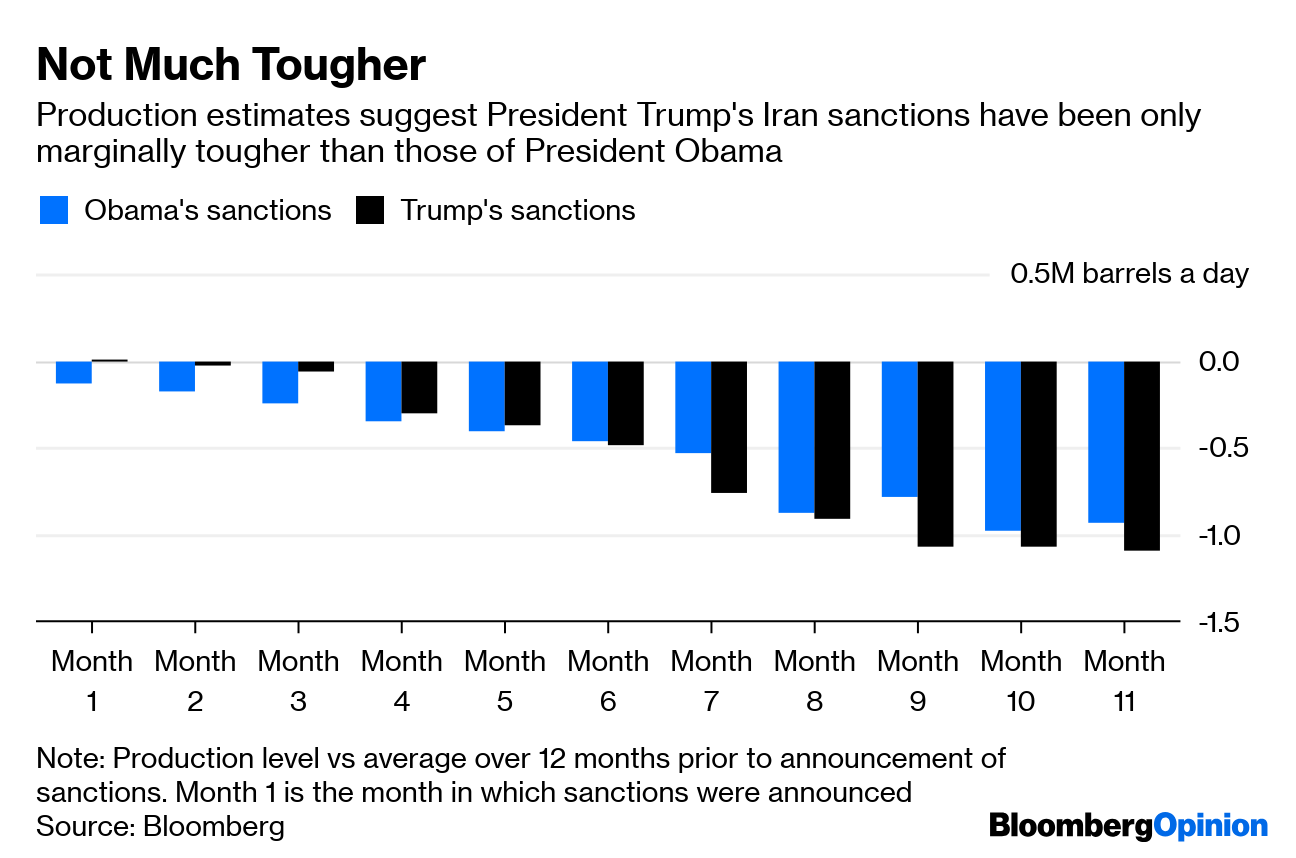
President Trump’s sanctions have been only slightly tougher than those imposed by his predecessor, despite offering fewer waivers. That will no doubt act as an additional spur for him to heap pressure on the country. But he is going to face difficulties if he wants to get much tougher on Iran next month.
Gas prices remain important to the president and their recent rise must be a source of concern.
The deteriorating situation in two of the “Shaky Six” oil-producing countries I identified a couple of weeks ago is also going to make toughening up the Iran sanctions more difficult.
Venezuela’s oil production is said to have plunged by half during blackouts that rolled across the country last month. Heavy tar-like oil began to solidify in pipelines and tanks after heating systems lost power, causing substantial damage that could take months to fix.
Sanctions imposed on Venezuela’s state oil company have accelerated the output decline, depriving Petroleos de Venezuela of its biggest buyer and the supplier of the light oil it needs to dilute the extra-heavy crude it produces. Output will fall further as the political crisis drags on.
Libya’s production is also at risk again as forces loyal to strongman Khalifa Haftar advance on the capital, Tripoli, threatening a major escalation in violence. Output rose above 1 million barrels a day last month for the first time this year, after the country’s biggest oil field was restarted following a three-month armed occupation. That recovery is now at risk again.
There are two things Trump can do, and his national security team is divided on the course he should follow.
He can allow the unused Iran waivers to expire, claiming a tougher stance without actually affecting oil flows, and perhaps trim the volumes that the remaining countries are permitted to import. Expect particular pressure on Japan and South Korea, who may be more willing than the others to acquiesce to US demands.
He can also continue to lean on Saudi Arabia and the rest of the OPEC+ group to raise output. The Saudis would be very happy to boost production at the expense of their rival, but they will be much less willing than they were last year to do that before seeing Trump actually impose tougher sanctions.
If he has to choose between lower gas prices and tougher Iran sanctions, domestic considerations will probably hold sway. Expect more tweets aimed at Saudi Arabia and OPEC, followed by an extension of five of the eight the waivers, probably permitting reduced volumes of purchases for some, if not all.
Photo Credit: IRNA
Here’s How the United States Can Help Iran's Flood Recovery
◢ In order improve preparedness for frequent earthquakes, floods, sandstorms, and heat-waves, Iran urgently needs to upgrade its surveying and monitoring technologies to better model and predict meteorological, hydrological, and geological events. The United States should create a new general license to remove the sanctions-related barriers to Iran’s acquisition of these much needed technologies.
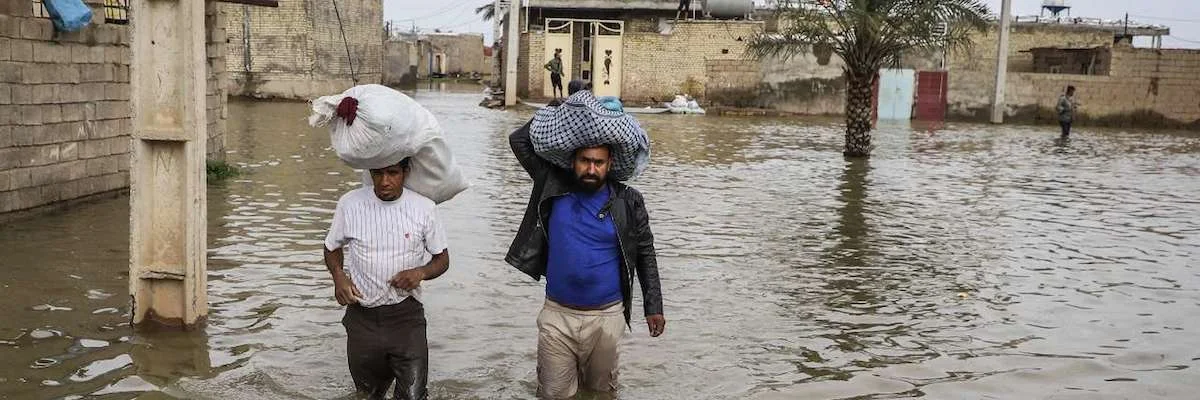
Over the last two weeks, Iran has been ravaged by unprecedented floods, resulting in over 60 deaths and the devastation of whole communities. The natural disaster has only added to the the country’s woes, already reeling from an economic crisis brought about in part by the reimposition of the Trump administration’s decision to reimpose secondary sanctions in November 2018. The coincidence of tightening sanctions and a major natural disaster has led for calls for the Trump administration to take steps to ensure that sanctions policies do not unduly interfere with relief efforts. In the aftermath of the 2003 Bam Earthquake, the Bush administration established new licenses to ensure that the program of then-expanding US sanctions would not stymie relief efforts in Iran, which even came to include the dispatch of American search-and-rescue teams. In 2012, the Obama administration took similar steps to ensure financial aid could reach Iran in the aftermath of yet more devastating earthquakes.
So far, the Trump administration has given no indication that it intends issue new licenses to provide legal clarity to those individuals and organizations wishing to provide aid or to support relief efforts in Iran. A brief statement from Secretary of State Pompeo declared that the US “stands ready to assist and contribute to the International Federation of Red Cross and Red Crescent Societies, which would then direct the money through the Iranian Red Crescent for relief.” However, in an indication of the depth of the Trump administration’s sympathies, Pompeo also claimed that “it is the [Iranian regime’s] mismanagement that has led to this disaster.”
Given the administration’s commitment to imposing “maximum pressure” on Iran through an ever-expanding sanctions program, it is highly unlikely that the administration will prove willing to make it easier for American or foreign entities to provide substantial material or financial relief for the recent floods. However, despite the Trump administration’s regrettable political stance, there are still measures that administration should take—with encouragement from Congress—to ensure that Iran is able to more effectively recover from the floods, in particular by enabling preparedness efforts in advance of the next major natural disaster.
Iran, like all countries worldwide, is facing new and growing challenges related to both climate change and natural disasters. In addressing these challenges, proactive measures of preparation, prediction, and prevention will always have a greater bearing on the protection of human life and mitigation of destruction than the provision of financial aid for relief efforts in the aftermath of a disaster. But in order to succeed in boosting national preparedness for frequent earthquakes, floods, sandstorms, and heat-waves, Iran urgently needs to upgrade its surveying and monitoring technologies to better model and predict meteorological, hydrological, and geological events.
Acquisition of these technologies has been made significantly more difficult by the recent reimposition of US secondary sanctions, meaning that even if Iran takes on board the difficult lessons of the recent floods, it will be hampered in its ability to adapt. The Trump administration should create a new general license to permit the sale of such surveying and monitoring technologies, which produce nothing more than useful information that can be used to save lives. Over the last decade, Iran has undertaken several systematic reviews of its climate change and disaster readiness. In each instance, the acquisition of better technology has been identified as key a priority for authorities.
In December 2017, Iran submitted its “Third National Communication” to the United Nations Framework Convention on Climate Change, a major report which detailed the country’s assessment of the challenges posed by climate change and the status of its preparedness and remediation efforts. The report, compiled by Iran’s Department of Environment in collaboration with the United Nations Development Programme, offers a sober assessment of the Iran’s failures to adequately deal with the effects of climate change—failures which stem largely from weak regulations and mismanagement. But the report also highlights how “years of economic instability and unfair sanctions have delayed mitigation and adaptation measures.” In particular, the report notes that “this situation even has prevented civil technologies transfer to Iran, which has constrained mitigation measures and actions.”
As part of the its national communication report, Iran also submitted a separate “Technological Needs Assessment.” Focused largely on technologies that would help increase energy efficiency and reduce emissions, the report also details ways in which Iran has struggled to acquire the survey and monitoring technology necessary to understand and adapt to new climate change phenomena. New technology is needed to identify “the emerging environmental phenomena and challenges such as desertification, drought, sand and dust storms… and mainstreaming environmental considerations in future national development plans.” Notably, the report also details that “climate change causes inconsistencies in historical and data series obtained from the meteorological and hydrometric monitoring stations,” a reference to the fact that Iran is seeing more unprecedented weather events. Today, Iran’s dams are nearly at capacity after historic rainfall, offering a real world example “of greater inaccuracies in estimating water return period for designing and construction of hydrostructures.”
Beyond climate change, a similar emphasis on the need to improve monitoring technologies can be seen in Iran’s official assessments of disaster readiness. Iran’s 2013 assessment report for disaster readiness, complained in accordance with the United Nation’s Hyogo Framework for Action, identified “neither comprehensive nor substantial” achievement in regards to the availability of “national and local risk assessments based on hazard data and vulnerability information.” The report’s authors point to a wide range of issues preventing effective monitoring for natural disaster risks and providing adequate warnings to the population. These challenges include a lack of satellite imagery and the software to interpret that imagery, a lack of a robust climatological models to develop seasonal forecasts, and a lack of tools to predict the severity of complex weather phenomena while they are developing. Pointing to the dual threats of earthquakes and weather-related disasters, the report notes that sanctions are “a serious hindrance in the increase of seismic monitoring instruments and upgrading early warning systems.”
The lack of sophisticated meteorological tools can also contribute to the loss of life even when there is no full-blown natural disaster. In February 2018, an Aseman Airlines ATR 72-212 aircraft crashed in Iran’s Zagros Mountains, killing all 66 people on board. The interim investigation report released last month by Iran’s Civil Aviation Organization concludes that the accident was mainly the result of “human factors,” including the actions of the cockpit crew. However, the accident transpired as the aircraft entered adverse weather conditions and the investigators have concluded that contributing factors included a lack of “significant meteorological information” about the wind conditions in the mountain area. This oversight was identified in part because data provided by Météo-France, the French national meteorological association, was more accurate in modeling the wind and ice formation conditions at the time of the accident than the data available to Iran’s own meteorological agency. The report recommends that the Islamic Republic of Iran Meteorological Organization undertake efforts to research how it can provide more sophisticated information on mountain weather hazards, something which will require new monitoring technologies.
Multiple agencies in Iran, looking at issues of climate change, disaster management, and aviation safety, have formally detailed the need for more advanced survey and monitoring technologies. They have also identified sanctions as a major impediment to the acquisition of these technologies. It is a common claim that Iranian authorities point to sanctions to deflect away from their own mismanagement. However, in regards to climate change and disaster management efforts, sanctions-related challenges have consistently been described by authorities as just one of many challenges, most of which stem for domestic failures of best-practice adoption. Additionally, the effect of sanctions on Iran’s ability to acquire these much needed surveying and monitoring technologies is readily observed in the relevant trade data.
A general license issued by US Treasury Office of Foreign Assets Control would drastically increase the ease with which suppliers of meteorological, geological, and hydrological monitoring equipment could determine the compliance of sales to Iranian customers. Such a license would benefit US companies as there is precedent for sales of such equipment to Iran. In 2007 and 2008, before US secondary sanctions on Iran were expanded, with just under USD 8,000 dollars worth of “surveying instruments and appliances,” specifically exported in 2007 and just under USD 80,000 exported in 2008, according to trade data from the US Census Bureau.
But more importantly, a general license would significantly impact the ability of European companies, including the European subsidiaries of American companies, to export meteorological, geological, and hydrological survey and monitoring instruments to Iran. Europe is by far the largest exporter of such technology to Iran, but it’s exports have been significantly impacted by US secondary sanctions.
A review of European exports to Iran since 2000 makes it clear that the vast majority of “hydrographic, oceanographic, hydrological, meteorological or geophysical instruments” (HS code 9015) were purchased by Iran prior to 2009, meaning that much of the technology Iran has deployed is at least a decade old. The imposition of international sanctions on Iran saw exports in these categories fall precipitously, with totals falling from a high of over EUR 16 million in 2006 to just over EUR 375,000 in 2014. A small recovery can be observed in 2016, when Iran received sanctions relief following the implementation of the Joint Comprehensive Plan of Action, but the limited recovery tallied suggests that the lingering impact of US sanctions on banking channels and the anticipation of the Trump administration’s possible withdrawal from the JCPOA dampened sales. In a concerning indication of the likely impact of the reimposition of US secondary sanctions on Iran in November 2018, European exports of goods in these categories fell to just over EUR 5,000 in December of last year, rising slightly to just over EUR 40,000 in the first month of this year. A general license would help address the decline in exports by giving legal clarity to European companies and banks regarding the status of the trade.
Given the seriously degraded commercial environment, any new general license would need to make several provisions. The license should draw on the model of General License D-1, which covers sales to Iran of “certain services, software, and hardware incident to personal communications.” The operational relationship between climate monitoring hardware, captured datasets, and modeling software would be critical to reflect in the license. However, General License D-1 only allows the provision of communications-related services to the government of Iran on the basis they are “no cost.” In the case of the survey and monitoring technology necessary for climate change or disaster readiness, any license must include the more expansive provisions outlined in the longstanding exemptions for humanitarian trade of food and medicine with Iran. Specifically, the general license should authorize sales “to the Government of Iran, to any individual or entity in Iran, to persons in third countries purchasing specifically for resale to any of the foregoing.” In addition, the general license must authorize the activities necessary for the related transactions, such as “the making of shipping and cargo inspection arrangements, the obtaining of insurance, the arrangement of financing and payment, shipping of the goods, receipt of payment, and the entry into contracts.” It should also include permissions for training and technical assistance necessary for the proper implementation of newly acquired technologies in the field. Finally, given that these sales will be denominated in foreign currency, the license must enable Iran to use funds originating from the Central Bank of Iran, such as funds currently held in escrow accounts related to the Trump administration’s waivers for the import of Iranian crude.
The establishment of such a general license, if matched by genuine and proactive communication from the US Department of State and US Department of Treasury, would significantly improve Iran’s ability to acquire much needed surveying and monitoring instruments. Because of its own political decisions, the Trump administration can do little to help Iran respond to the recent devastating floods. However, if American policymakers, including leaders in Congress, truly wish to see the resolution of the current political disagreements with Iran and to reduce the costs borne by the Iranian people, they ought to think long-term. Decisions taken today to provide targeted sanctions relief can help Iranian authorities save lives tomorrow. The provision of scientific tools can empower Iranian stakeholders with more sophisticated information about the evolving risks of floods, earthquakes, forest fires, sandstorms, heat-waves, droughts, and other threats. Preventing Iran’s access to this critical information, even if the unintended consequence of a broad sanctions policy, in no way serves US national security interests and only serves to complicate the earnest work of individuals and organizations committed to protecting lives by improving Iran’s response to mounting environmental threats.
Photo Credit: IRNA
Lack of Helicopters Shows Sanctions Impact on Iran Flood Response
Recent statements by US and Iranian officials have spurred debate as to the role sanctions may have played in the unconvincing nature of Iran’s response to unprecedented floods, which have killed over 50 people and caused widespread devastation. A look at Iran’s failure to procure rescue helicopters helps answer that question.
In a brief statement issued on Tuesday, US Secretary of State Mike Pompeo offered condolences to “the victims of the recent floods in Iran” while claiming, “it is the [Iranian regime’s] mismanagement that has led to this disaster.” Pompeo asserted that the Trump administration “stands ready to assist and contribute to the International Federation of Red Cross and Red Crescent Societies, which would then direct the money through the Iranian Red Crescent for relief.”
Pompeo’s statement appears to have been spurred by reports that the Iranian Red Crescent Society (ICRS) is unable to accept international aid due to a lack of viable banking channels. Ali Asghar Peyvandi, the head of the Iranian Red Crescent Society, told reporters in Iran that “Prior to the [reimposition of US] sanctions, we had some Red Crescent accounts connected to SWIFT, and we sought international aid through them. However, at present, these accounts have been sanctioned and there is no possibility for money transfers from other countries.”
These statements have led to questions as the role sanctions may have played in Iran’s unconvincing response to unprecedented floods, which have killed over 50 people and caused widespread devastation. But in the context of rescue and relief operations, the ability to raise funds after a disaster matters far less than the level of preparedness before the disaster, especially in a country like Iran with its substantial financial resources. So even if sanctions are impeding the delivery of financial aid, a more important question is whether or not sanctions had a meaningful impact on preparedness. A look at Iran’s failure to procure rescue helicopters helps answer that question.
On Tuesday, Iranian Foreign Minister Javad Zarif pointed to sanctions-related impediments in a tweet, stating, “Blocked equipment includes relief choppers.” Placing blame on the US, Zarif declared, "This isn't just economic warfare; it's economic TERRORISM.” Zarif’s anger likely stems from the fact that Iran had attempted to purchase much-needed search-and-rescue helicopters over the last few years, but was thwarted by both the failed implementation of sanctions relief under the JCPOA as well as the reimposition of sanctions by the Trump administration.
The Iranian Red Crescent Society (IRCS) operates an air rescue fleet that it has long needed to modernize. In 2015, with the prospect of sanctions relief on the horizon, IRCS approached foreign suppliers with the intention to purchase 28 new helicopters to augment its fleet of Russian-made Mil Mi-171 cargo helicopters and Iranian-made Bell-412 utility helicopters. Airbus Helicopters came forward as an early suitor and collaborated with ICRS on corporate social responsibility projects to help build trust. In 2016, the Airbus Foundation and ICRS launched a program to “to train thousands of Iranian teenagers aged between 12 and 14 in robotics and resilience techniques, developing their skills to respond to disasters and ensuring safer and more resilient communities for the future.” Even American defense contractor Lockheed Martin, parent company of helicopter-maker Sikorsky, publicly stated that it was studying the feasibility of selling civilian helicopters to Iran.
In 2017, drawing on new funding made available by parliament, the Iran’s Ministry of Health sought to purchase 45 BK-117 air ambulances from Airbus Helicopters configured for rapid response to accidents and medical emergencies in urban areas. A report on the delivery of the first two aircraft notes that Iran had just 21 air ambulances in operation at the time. Just a couple months later, in November 2017, a massive earthquake hit Kermanshah, killing 600 and once again demonstrating the urgency for Iran to upgrade its search-and-rescue capacity.
But the continued presence of US primary sanctions made it difficult for Iran to secure financing for the ICRS and Ministry of Health helicopter acquisitions, slowing the delivery of the aircraft. Helicopters can also be considered “dual-use,” given possible military applications of key parts, and so the deals were subject to significant scrutiny by US and European regulators. Just 8 helicopters had been delivered to the Ministry of Health by Airbus by the time that the Trump administration withdrew from the JCPOA nuclear deal and reimposed secondary sanctions on Iran. ICRS did not take delivery of any new helicopters.
Today, ICRS has responded to the unprecedented flooding in Iran with just “23 rescue and relief helicopters,” which are spread thinly across multiple provinces as they deliver supplies and transport the injured to medical facilities. ICRS’s old fleet lacks night vision technology, meaning that only Iran’s military can run rescue operations at night.
Importantly, Iran’s disaster relief agencies were aware of such shortcomings and have tried to address them. Between 2005-2015, the United Nations spearheaded a “global blueprint for disaster risk reduction efforts” called the Hyogo Framework for Action (HFA). Iran was among the 168 participating countries, which undertook a systematic evaluation of their disaster readiness.
Iran’s final assessment report, published in 2013, evaluates Iran’s level of disaster preparedness in regards to whether “financial reserves and contingency mechanisms are in place to support effective response and recovery when required.” The report notes encouragingly that Iran has set aside “national contingency and calamity funds.” But key constraints include “international sanctions and restrictions and lack of cooperation in providing humanitarian equipment” as well as “insufficient equipment when a large-scale disaster happens.” Put more simply, the report concludes that while sanctions have a limited impact on the availability of financial resources for disaster response, they have a serious detrimental impact on the ability to procure adequate rescue equipment. The effort to acquire new helicopters in the brief period in which Iran was provided sanctions relief reflects an attempt to address such shortcomings.
Discussing the impact of sanctions on the rescue operations after the recent floods does not deflect from the Iranian government’s ultimate responsibility for the ineffective response to the disaster. Nor does it excuse the negligence that created longstanding vulnerabilities, such as failing to ensure “risk sensitive regulation in land zoning and private real estate development,” shortcoming identified in Iran’s HFA report. But sanctions will remain even when the floods subside. It is imperative for American policymakers to account for the ways that “maximum pressure” policies directed towards Iran will continue to complicate Iran’s efforts to prepare for the next natural disaster. Facilitating donations will mean little if Iran is unable to procure the equipment that will make its disaster response more effective in the next instance.
Photo Credit: IRNA
With Focus on Economic Relations, Iran-Iraq Ties Move Into the 'Daylight'
◢ Expectations were high when Iranian president Hassan Rouhani visited neighboring Iraq last month. During the trip, his first as president, Rouhani signed multiple trade deals with Iraq, where the return of peace and stability has renewed the government’s focus on economic development. Iran’s reinvigorated diplomacy towards Iraq reflects a new diplomatic and economic strategy towards its onetime foe.
Expectations were high when Iranian president Hassan Rouhani visited neighboring Iraq last month. During the trip, his first as president, Rouhani signed multiple trade deals with Iraq, where the return of peace and stability has renewed the government’s focus on economic development. The deals covered a variety of sectors including railway construction, electricity infrastructure, and engineering services.
Today, the volume of annual bilateral trade between Iran and Iraq stands at around USD 12 billion. But Rouhani has targeted ambitious growth, saying the two sides should aim to reach USD 20 billion in trade.
The deputy governor-general of Iran's southeastern Khuzestan province—close to the Iraqi border—said Rouhani's trip prepared the ground for the growth of trade in the Arvand Free Economic Zone. Agreements to complete a railway link connecting the southwestern Iranian town of Shalamcheh to the Iraqi Port of Basra and the decision to eliminate visa fees for travelers were among the most notable achievements of the trip. The tourism sector is booming as Iraqis find it increasingly appealing to visit cities in Iran’s west as well as the northeastern holy city of Mashhad, a popular destination for Iraq's Shiite pilgrims. Iranian pilgrims also travel to Iraq in huge numbers, visiting shrines in Najaf and Karbala.
Any planned growth in bilateral trade will depend on Iran and Iraq addressing a range of financial disagreements, exacerbated in part by US secondary sanctions. Since the reimposition of sanctions by the Trump administration in November, complaints have grown among Iranian stakeholders—including oil minister Bijan Zanganeh—that Badghad was effectively siding with Washington given non-payment of rising debts. Prior to Rouhani’s visit, Iran’s central bank governor, Abdolnasser Hemmati, traveled to Baghdad for technical meetings and secured commitments that Iraq would pay significant arrears related to the import of Iranian natural gas and electricity. A few weeks later, Rouhani told his Iraqi counterpart, Barham Salih that using national currencies in banking transactions would help protect bilateral trade from sanctions pressures.
Just last week, Rouhani stressed in a phone conversation with Iraqi Prime Minister Adil Abdul-Mahdi that an agreement to dredge the Arvand River—signed during his visit to Baghdad—was being implemented. Rouhani was speaking in the context of recent deadly floods that have left behind a trail of death and destruction in several Iranian provinces. During the phone call, Iraqi Prime Minister Adel Abdul-Mahdi noted that Iraqis have warmly welcomed proposals that would see a greater presence of Iranian firms in their country.
For its part, the Iraqi government has sought to reassure Iran of its commitment to expanded economic ties with Iran, despite Iraq’s continued reliance on security and economic support from the US. "Iraq insists that the interests of our friendly and neighboring country must be met. We will do our best to reduce tensions in this regard and decrease the damage that will be done to the Iranian nation," declared President Salih.
Overall, Rouhani’s visit won praise across Iran’s political landscape. Hardline newspaper Kayhan, usually highly critical of the Rouhani administration, described the president’s visit as “an act of resistance” to US pressure, which served to “provide relief to the economy.” Financial newspaper Donya-e-Eqtesad, similarly highlighted “Tehran's message to Washington from within Baghdad.”
Iranian media also took pride in comparing Rouhani’s visit to the recent visit to Baghdad of US President Donald Trump. Iran’s state television focused on a series of comments Trump made following his return from Iraq, in which he complains about the secretive style of his visit. Trump sneaked into Iraq "in the dark" while Rouhani landed in "broad daylight,” boasted several Iranian papers. The obvious displeasure of US officials at Iraq’s warm welcome of Rouhani also featured in reports about the trip.
Iran’s reinvigorated diplomacy towards Iraq reflects a new diplomatic and economic strategy towards its onetime foe. By placing a greater priority in ties with Iraq, Iran is seeking to both mitigate the impact of US sanctions, while also countering US influence. In some ways, this strategy is a continuation of the tug of war between the US and Iran which began in the aftermath of the US invasion of Iraq in 2003.
For some Iraqis, this contest for influence reflects an unacceptable threat to Iraq’s sovereignty. Even the country's top Shiite cleric Grand Ayatollah Ali al-Sistani raised the matter with Rouhani when the latter visited the holy city of Najaf. The highly revered religious leader stressed Iraq's sovereignty in his meeting with Rouhani, the first Iranian president to have secured such an audience.
Emerging from nearly two decades of conflict, first during the Iraq War and then during the rise of the Islamic State (ISIS), Iraq is now entering a post-war era in which reconstruction will be the foremost political priority. Iran, which played a role in the defeat of ISIS, sees for itself a constructive role in this new phase of Iraq’s development. It remains to be seen to what extent U.S. economic sanctions and political opposition prevent tighter bilateral ties between Iraq and Iran.
Photo Credit: IRNA
Why China Isn’t Standing By Iran
◢ Last week, Iran’s economic minister was in Beijing for talks on bilateral trade and investment. An official readout of the discussions from China’s commerce ministry describes China and Iran as “comprehensive strategic partners.” Unfortunately for Iran, the data tells a different story from the official rhetoric.
Last week, Iran’s economic minister was in Beijing for talks on bilateral trade and investment. An official readout of the discussions from China’s commerce ministry describes China and Iran as “comprehensive strategic partners.” This echoes the language used by President Xi Jinping a few weeks earlier, when he welcomed a delegation that included Iran’s foreign minister, oil minister and parliament speaker. Xi declared that “No matter how the international and regional situation changes, China’s resolve to develop a comprehensive strategic partnership with Iran will remain unchanged.”
Unfortunately for Iran, the data tells a different story from the official rhetoric.
The reimposition of U.S. secondary sanctions on Iran in November has significantly slowed Chinese-Iranian bilateral trade. Chinese exports to Iran—mainly crucial machinery and parts for Iran’s manufacturing sector—fell from USD 1.2 billion in October to just USD 428 million in February. Exports had averaged $1.6 billion a month in the period from 2014 until the beginning of 2018.
Imports from Iran, mainly crude oil, which had fallen to $1 billion in October, rose after November, when the Trump administration granted China a waiver to permit continued oil purchases. Imports hit USD 1.3 billion in February, of which USD 866 million is attributed to oil imports. These figures are consistent with the monthly averages in the period from 2014 until the beginning of 2018.
In short, while China is continuing to benefit from Iran’s energy resources, Iran is struggling to use its earnings to purchase Chinese exports.
This challenges the long-standing assumption in Tehran that China would stand by Iran despite sanctions pressures. In the previous sanctions period from 2008 to 2016, Chinese businesses significantly expanded their commercial presence in Iran, stepping in as Western companies exited the market. Iranians welcomed commercial partnerships with a country they believed to be economically minded, and unconcerned by Iran’s regional activities or its domestic governance.
These hopes received an early jolt in October, when the Iranian business community was left scrambling after Bank of Kunlun, the state-owned bank at the heart of China-Iran trade, suspended most financial transactions with Iran. Although the bank resumed trade in January, it announced a new policy: It would only service trade exempt from U.S. secondary sanctions. This means trade in food, medicine and consumer goods, for which China is not Iran’s leading source of imports. Bank of Kunlun’s move is consistent with the terms of the oil waiver, which requires Iran’s earnings be paid into an escrow account and used exclusively for non-sanctioned bilateral trade.
Seen through the prism of short-term considerations, China’s policy adjustments at the expense of its trade with Iran are easy to understand. As Pedram Soltani, vice president of the Iran Chamber of Commerce, has observed, the roiling trade war with the U.S. remains a much higher priority for China. Additionally, the arrest of Huawei executive Meng Wanzhou has made Chinese enterprises, particularly those with the most global reach, reticent to engage opportunities in Iran for fear of being similarly targeted by American authorities.
But China’s acquiescence to secondary sanctions is inconsistent with Beijing’s stated opposition to extraterritorial sanctions. In October, foreign ministry spokesperson Hua Chunying told reporters: “China always opposes the unilateral sanctions and long-arm jurisdiction. China’s normal cooperation with Iran under the framework of the international law is reasonable, legitimate and legal, and it should be respected and upheld.”
While Europe has made extraordinary efforts to both assert its economic sovereignty and preserve the nuclear deal, even going so far as to establish a new state-owned trade financial intermediary, China has taken no commensurate effort to shield its own trade from the long arm of American law.
Also, by downgrading the trading relationship with Iran, Beijing is in effect signaling to Washington that secondary sanctions can be used to stymie China’s economic ambitions abroad. As the U.S. struggles to respond to China’s Belt-and-Road strategy and its new role as a Eurasian superpower, there will be a temptation to use sanctions to raise barriers to China’s expansion. By failing to resist secondary sanctions on Iran now, China is inviting more pressure on key trade and investment relationships in the future, while also shirking its obligation to help preserve the nuclear deal.
It is possible that Chinese-Iranian trade could recover to a new steady state later this year, and that Beijing could designate a new bank to facilitate non-oil exports. But when the waivers come up for renewal in early May, the Trump administration could make such a waiver contingent on China continuing to downsize its non-oil trade with Iran. Since Iran is more important for China as an energy supplier than as an export market, China will likely sacrifice its exports to sustain oil imports—especially since it is unclear that Iran has sufficient leverage to insist that China avoid making such a trade-off.
Photo Credit: IRNA
Iraq's Top Cleric Joins Game of Thrones
◢ Ostensibly, Iranian President Hassan Rouhani’s visit to Iraq was meant to deepen economic ties between the two neighbors, historically divided by political and sectarian enmities as much as they are connected by geography. Only one Iraqi leader could have kept Rouhani at arm’s length: Grand Ayatollah Ali al-Sistani, But he didn’t. The audience he gave the Iranian president says as much about Sistani’s own political adventurism as it does about Iraq’s subservience to Iran.
This article was originally published by Bloomberg Opinion.
Ostensibly, Iranian President Hassan Rouhani’s visit to Iraq was meant to deepen economic ties between the two neighbors, historically divided by political and sectarian enmities as much as they are connected by geography. The trip was also meant to demonstrate to the U.S. that Tehran and Baghdad would still do business with each other, despite the Trump administration’s sanctions on Iran.
None of this was especially remarkable: the Islamic Republic’s influence over Iraq has grown exponentially in recent years, underscored by Iran’s control of Shiite militias that have captured much of the state security apparatus and now loom ever larger on the political stage. No Iraqi government, much less one led by Prime Minister Adel Abdul Mahdi, a weak Shia politician, would dare give a representative of the Iranian regime anything less than an effusive welcome.
Only one Iraqi leader could have kept Rouhani at arm’s length: Grand Ayatollah Ali al-Sistani, the country’s most revered cleric. But he didn’t. The audience he gave the Iranian president in the Shia holy city of Najaf says as much about Sistani’s own political adventurism as it does about Iraq’s subservience to Iran.
First, a little background. Sistani, now 88, became a Grand Ayatollah—the highest office in the Shia clergy—during the reign of Saddam Hussein. That he survived the dictator, who ordered the assassination of clerics he disliked, is a testament to Sistani’s studious avoidance of politics. His Friday sermons, often delivered by proxies as he himself aged, made little or no reference to the tyrant’s repression of the Shia.
After a U.S.-led coalition toppled Saddam in 2003, Sistani was able to comment more openly about the way the country was being ruled, criticizing first the American administrators and then the Iraqi governments that followed. But when politicians, keenly aware of his sway over tens of millions of potential voters, sought his endorsement, Sistani demurred. The most he would do is express indirect support for a coalition of Shia parties.
That began to change after the 2014 parliamentary election, which resulted in a hung parliament, followed by frenetic behind-the-scenes jockeying for power by the two-term Prime Minister Nouri al-Maliki and other Shia contenders. A letter from Sistani, calling for the “selection of a new prime minister who has wide national acceptance,” was interpreted as a thumbs-down for Maliki: he was not new, and, having lost control of large parts of the country to ISIS, did not have wide national acceptance.
Four years later, the beneficiary of Sistani’s intervention, Prime Minister Haider al-Abadi, would himself fall at the Grand Ayatollah’s command. After another indecisive election, Sistani opined that politicians in power should not retain their offices. Although Abadi had only been in charge for one term, during which he had overseen the recapture of territory from ISIS, he was weakened by discontent over corruption and shortages of water and electricity: Sistani’s decree doomed him. (Sistani is apparently untroubled by the public offices that Abdul Mahdi has previously held, including two cabinet posts and the vice presidency, none of them with any distinction.)
Throughout, Sistani remained uninterested in Iraq’s external relations. In 2008, when Mahmoud Ahmadinejad became the first Iranian president to visit postwar Iraq, the Grand Ayatollah turned down requests for an audience. Nor did Sistani meet any American president. He did receive Turkey’s President Recep Tayyip Erdogan in 2011.
So why now—and why Rouhani? Grand Ayatollahs tend not to care about quotidian matters such as economic ties, or sanctions. Nor would Sistani feel threatened by Iran’s proxy militias: his personal prestige is so great, they would not dare move against him.
One explanation: By welcoming Rouhani, a relatively moderate cleric, Sistani is sending a message to Iran’s Supreme Leader, Ayatollah Ali Khamenei, a hardliner. That would mark the first time that Sistani has sought to meddle in the politics of a neighboring country—and a traditional enemy, to boot. Doing so is uncharacteristically bold.
To what end, though? Some analysts reckon a blessing from Sistani, who enjoys a wide following in Iran, will strengthen Rouhani’s hand back home. But this is hard to credit: Iranian hardliners have never placed much store by outside clerics, even one so venerable as Sistani. Their power derives from the likes of Khamenei, and looks set to be extended by Ebrahim Raisi, the cleric who runs Iran’s judiciary and will have the greatest say in who succeeds the Supreme Leader.
The other possibility is that Sistani is sending a message to Baghdad—that he is now taking an interest in foreign policy, or at least in Iraqi-Iranian relations. Abdul Mahdi, a reluctant prime minister lacking any political standing, is in no position to object, but many Iraqis will rightly be alarmed. This is especially true of Iraqi Sunnis, many of whom live in fear of the militias backed by the regime Rouhani represents.
The wider Arab world will have noticed that Sistani has never extended the courtesy of an audience to any visiting Arab head of state—whether King Abdullah of Jordan, the Emir of Kuwait, or the presidents of Tunisia, Lebanon and Libya. Dabbling in foreign affairs, the Grand Ayatollah may find, can be a lot trickier than domestic politics.
Photo Credit: IRNA
Confronting Failure, Iran Government Mulls New Currency Policy
◢ Despite mounting evidence that the Iranian government’s policy of allocating subsidized foreign currency for the importation of essential goods has failed, the Rouhani administration has signaled that it plans to maintain the policy for at least another year. But lawmakers and Rouhani’s own cabinet ministers may force the administration to change course.
Despite mounting evidence that the Iranian government’s policy of allocating subsidized foreign currency for the importation of essential goods has failed, the Rouhani administration has signaled that it plans to maintain the policy for at least another year. But lawmakers and Rouhani’s own cabinet ministers may force the administration to change course.
On March 2, Iran’s parliament approved the allocation of USD 14 billion in oil export revenues for the import of essential goods, including food and medicine, during the upcoming Iranian year (beginning March 20). In doing so, MPs gave the green light for the Rouhani administration to continue to make foreign exchange available to importers of essential goods at the subsidized rate of IRR 42,000 to the dollar.
However, lawmakers also encouraged the government to consider an alternative approach that would require essential goods importers to purchase foreign exchange at the IRR 90,000 rate available on the centralized NIMA marketplace. The government would then redirect the savings from the elimination of the currency subsidy towards programs that directly assist Iranian consumers and manufacturers.
Despite the nudge from parliament to consider a new approach, it appears that the administration is intent on maintaining the subsidy for at least another year. The head of the Management and Planning Organization, Mohammad Baqer Nobakht, confirmed this to be the administration’s position in an interview just prior to the parliamentary vote.
The Rouhani government “unified” the country’s dual foreign exchange rates at IRR 42,000 to the dollar in early April as the rial hit new lows due to political uncertainty surrounding Iran’s nuclear deal and the possible reimposition of sanctions by the United States. The foreign exchange rates diverged again shortly thereafter, but the Rouhani administration has persisted in using the “unified” fixed rate for the importation of essential goods.
Rouhani recently claimed that he personally disagreed with the fixed rate when it was first proposed and only consented to rate unification after dozens of top economists backed the move. His administration has since maintained that the allocation of subsidized foreign exchange continues to be the best policy to stabilize prices of essential goods.
Meanwhile, high levels of inflation have dimmed prospects for Iran’s middle and lower classes. The Iranian public has felt the pressure of price hikes, and essential goods have not been spared, despite Rouhani promising otherwise on national television.
Beyond the lived experience of Iranians, new research has also cast doubt on the effectiveness of subsidization. On February 22, the Parliament Research Center published its findings of the government subsidized currency allocation policy. According to the PRC, the price of essential goods as a category increased by 42 percent during the first three quarters of the current Iranian year that ended on December 21.
By comparison, the price of imported goods not eligible for the subsidized rate increased 73 percent in the same period. However, the consumer price index increased by nearly 40 percent, meaning that the increase in the price of essential goods still outpaced general inflation by a significant margin. The question for policymakers is whether this minimal impact on the price of essential imports is worth the many adverse side effects for the wider economy.
At time when Iran’s foreign exchange revenues are being squeezed by the Trump administration’s “maximum pressure” policy, the Iranian government cannot afford to misallocate USD 14 billion in oil revenue to a subsidization program that may serve to increase corruption and rent-seeking.
Iran’s central bank governor Abdolnasser Hemmati also admitted as much in a frank statement. “In effect, allocating subsidized currency to essential goods has failed to prevent their price hikes in the medium term due to the nature of market in the economy and the weakness of the distribution and supervision systems,” he wrote in a March 9 Instagram post. “Therefore, in most cases the subsidies have gradually moved away from consumers and benefited importers.” Hemmati signaled that a change in the policy may be in order by stating the government will “make the best decision.”
Economy minister Farhad Dejpasand later echoed Hemmati’s view, stating that “The government is currently studying several policies, and we definitely will adopt an approach to minimize the pressure on the poorest sections of society.
“Based on competitive open market principles, any fixed rates that diverge from the open market rate, such as the subsidized IRR 42,000 dollar exchange rate, are a mistake,” Mohammad Mahidashti, a macroeconomic analyst currently serving as an advisor at Iran’s Ministry of Economic Affairs and Finance told Bourse & Bazaar.
“There is simply no positive aspect in this subsidized currency allocation by the government, perhaps save for giving it a justification and a populist slogan to show that the administration is trying to decrease prices of essential goods,” he said.
Mahidashti believes the way forward is for the government to cut its losses as soon as possible by eliminating the subsidized rate and moving toward true rate unification, which he considers both doable and absolutely necessary.
Indeed, the PRC report also called on the Rouhani administration to either fully eliminate subsidized currency allocation or significantly trim the list of essential goods eligible to receive cheap currency. Even in the event of choosing the second route, the parliamentary think-tank said the subsidized rate must be higher and the IRR 42,000 rate is no longer justifiable.
Iran’s private sector, which has for years called for true rate unification would surely embrace such a move. Shortly after Hemmati’s admission of the failure of the subsidized foreign exchange policy, deputy president of the Iran Chamber of Commerce Pedram Soltani welcomed the announcement as a sign that things may be changing. He tweeted, “Subsidized currency is the source of rent and misuse. Let’s stop the flow!”
Photo Credit: IRNA
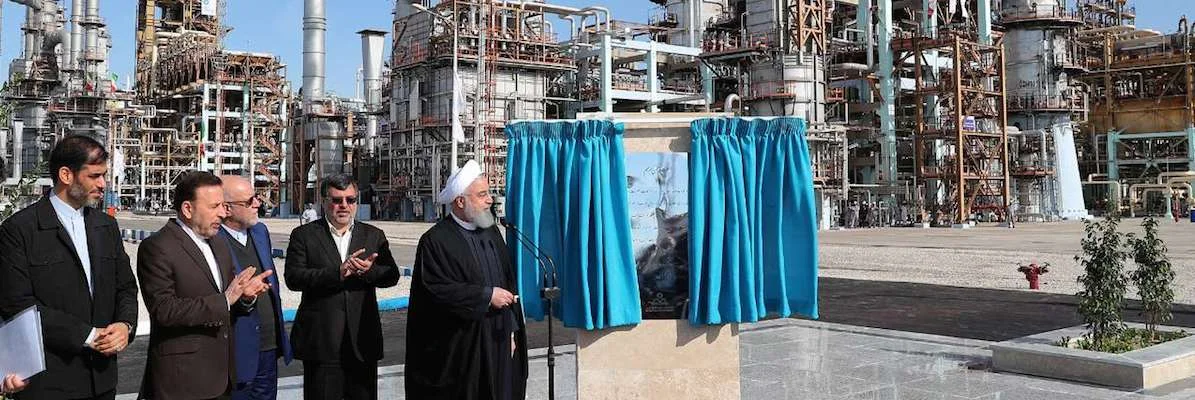
Iran Declares Gasoline Self-Sufficiency but Challenges Still Remain
◢ Aiming to achieve self-sufficiency in the production of gasoline, Iran recently launched the third phase of the Persian Gulf Star Refinery, after a massive investment of USD 4 billion. But given rising consumption, the future of genuine gasoline self-sufficiency in Iran might be less bright than the new developments at the Persian Gulf Star suggest.
During a grandiose opening ceremony attended by President Hassan Rouhani and Oil Minister Bijan Zanganeh, Iran inaugurated the third phase of its Persian Gulf Star Refinery in the energy-rich south February 18, declaring "self-sufficiency" in fulfilling national gasoline demand.
Located 25 kilometers west of the port city of Bandar Abbas, the refinery will enable Iran's average daily gasoline production to reach 105 million liters, according to official figures.
The facility, fed by condensate from the South Pars Gas Field in the Persian Gulf, converts light crude into gasoline and other byproducts. The launch of the third phase has been described as a gigantic step in a country whose economy is slowing the face of sanctions reimposed following President Donald Trump's withdrawal from the Joint Comprehensive Plan of Action (JCPOA).
Despite sitting on the world's fourth-largest proved crude oil reserves, Iran has been historically reliant on imports to meet domestic gasoline demand due to insufficient refining capacity.
The latest phase of the Persian Gulf Star Refinery has cost the country USD 4 billion, financed entirely by domestic investment, with no foreign loans secured for the project. While producing 45 million liters of gasoline and 15 million liters of gasoil per day, the refinery also delivers 3 million liters of aviation fuel, as well as 130 tons of sulfur. Iran's oil ministry expects to save USD 15 million per day as imports volumes are expected to fall. The savings are especially important for a government already struggling to supply foreign currency markets amid increasing international banking restrictions.
"Iran's gasoline production has made history with its giant leaps in the past five years," declared Zanganeh during the inauguration ceremony, adding that increased gasoline production would help Iran "to counter unilateral US sanctions".
With the new refinery added to Iran's gasoline production cycle, Iran could feasibly export surplus production. Yet uncertainty related to US sanctions as well as skyrocketing consumption at home in recent years seem to have made the government think twice about export plans. "We have intentionally decided not to export our [surplus] gasoline, because we are planning to maintain good storage,” Zanganeh added without elaborating further.
With Iran's budget largely dependent upon its oil income, experts have for long sounded the alarm on the long-term consequences of the country's single-commodity economy. Consecutive administrations have, therefore, pursued policies to make the economy less reliant on the sale of crude oil. While the goal is yet far from being met, the Rouhani government has focused on diversifying energy exports to include other, higher-value petrol products such as gasoline and gasoil.
"Self-sufficiency in gasoline and gasoil production and moving toward exports were targets set and pursued by the government of Hope and Prudence," reported Arman, a reformist newspaper. In a February 19 editorial, the paper noted that in the face of disruptions caused by the US pullout from the JCPOA, Iran's oil ministry had redoubled efforts toward the self-sufficiency in gasoline production and that more countries besides Iraq and Afghanistan are expected to join the list of Iran's gasoline customers.
The inauguration of the new refinery phase took place just one week after nationwide ceremonies to mark the fortieth anniversary of Iran's Islamic Revolution. State media outlets hailed "gasoline self-sufficiency" as an “achievement and blessing" bestowed by the Islamic Revolution upon the nation. "It came at a time of economic war being waged on our country, with the enemies going the extra mile to inject disappointment in [the minds of] young Iranians," declared a report from the Islamic Republic News Agency (IRNA).
The governor-general of Hormozgan province had earlier described the new refinery as a successful example of Iran’s push to establish a "resistance economy", a term coined by Iran's Supreme Leader Ayatollah Ali Khamenei. The concept has now evolved into a directive to all government institutions, a strategy to neutralize Western measures and a roadmap toward economic independence during sanctions times.
The leading contractor involved in the project was Khatam al-Anbia Construction Headquarters, known by the acronym GHORB. The company is an engineering, procurement, and construction firm with a near monopoly over Iran's mega projects. GHORB is affiliated with Iran's powerful Islamic Revolutionary Guard Corps (IRGC).
Saeed Mohammad, the company’s managing director, told Iran's state TV that the country's share in the enormous South Pars Field now exceeds that of neighboring Qatar. Mohammad also noted that the project was executed by an exclusively Iranian team with an average age of around 30 years old.
But even with the new refining capacity, worries persist that Iran's new gasoline self-sufficiency may be short-lived as domestic consumption continues to rise. The country’s average daily consumption last summer stood at 97 million liters, according to a report by the financial newspaper Donya-e-Eqtesad. Notwithstanding the total capacity of 105 million liters achieved after the inauguration of the third phase, the 9% annual consumption growth rate "will use up the stored gasoline,” the newspaper reports.
Consumption continues to rise because gasoline in Iran remains cheap. Despite rising inflation, Iran's government has in recent years maintained a cap on the price of gasoline. Experts lament the fact that with considerable subsidies allocated to gasoline, the government has not only failed to curb the consumption, but has in fact stoked it. President Rouhani's budget plan for the upcoming Iranian year offers no provision to reduce subsidies in order to reduce consumption.
The future of genuine gasoline self-sufficiency in Iran might be less bright than the development of the Persian Gulf Star Refinery suggests.
Photo Credit: IRNA

A New Narrative for Iranian Foreign Policy
◢ What does Zarif's averted resignation mean for Iranian diplomacy? With the erosion of a unipolar world Iran has the chance to shift its foreign policy, whilst continuing to comply with the JCPOA and maintain broad diplomatic engagement.
This article was originally published by IISS.
On Monday, Iranian Foreign Minister Mohammed Javad Zarif announced his resignation in a late-night Instagram post, sending shockwaves through political circles in Iran and abroad. Just ten days earlier, Javad Zarif’s fiery performance at the Munich Security Conference had won him praise across the political spectrum in Iran. At a time when public support for the JCPOA among Iranians has slipped to just 51%, Zarif’s strong message struck a chord with the Iranian public, who flooded social media with clips of him defending Iran’s missile program and refuting any notion that the West held the moral high ground. Zarif also made clear that while Europe has made the ‘right political statements’ regarding the JCPOA, it has yet to prove that it is willing ‘to pay the price’ to defend the deal in the face of US ‘bullying’.
Iranian President Hassan Rouhani has rejected Zarif’s resignation, citing Supreme Leader Ayatollah Sayyid Ali Hosseini Khamenei’s trust in and esteem for Zarif. But the foreign minister’s reasons for tendering his resignation are hardly opaque. With parliamentary and presidential elections on the horizon, and the economy falling under increasing pressure, he has had to reassure the public of the Rouhani administration’s nationalist credentials and parry accusations of weak leadership from hardliners, which tried to impeach him in December 2018 over his support for Iran’s Financial Action Task Force reforms. The last straw was reportedly his exclusion from meetings with Syrian President Bashar al-Assad, who was in Tehran on Monday. Zarif felt that the foreign ministry was being unduly sidelined, and told an Iranian newspaper that he sought to defend the ‘integrity’ of the ministry by resigning. Should he stay on, Rouhani and Khamenei’s testimonials may help Zarif prevent the Foreign Ministry’s marginalisation.
Preserving the JCPOA
Regardless of who is foreign minister, Iran’s public diplomacy must find a new balance. Zarif’s resignation illustrates how growing divergence in foreign policy between the Iran’s moderates and hardliners could impede the critical political mission of preserving the JCPOA until 2021, when Iran’s newly elected president will likely have the chance to engage a new American president.
Just as the JCPOA remains the signature foreign policy achievement of the Rouhani administration, it also serves as a symbol of multilateralism for the E3 and especially the European Union. However, as demonstrated by the tortured wording of the recent European Council conclusions on Iran, there is growing fatigue in Europe over efforts to shield the JCPOA from the Trump administration’s attacks and increasing frustration over what are perceived as Iran’s destabilising activities in the Middle East and—in light of attempted political assassinations—in Europe. Many European officials view Iran as intractable and are inclined to take a much harsher stance, albeit short of the Trump administration’s ‘maximum pressure’ campaign.
So far, officials in favour of engagement and incentivisation continue to set the overall tenor of European policy on Iran. But the emerging political dynamics indicate that a tougher line from Iran will probably lead to a tougher line from Europe. Pressure has thus increased on Iran’s moderates to reassure European stakeholders of their firm commitment to constructive engagement while also showing domestic strength by following principles established over the four decades of the Islamic Republic. Achieving these dual aims will require the Iranian government to cast Iran’s continued compliance with the JCPOA as a defining element of Iran’s national vision.
The erosion of a unipolar world order may facilitate this objective. The United States appears to be losing its berth as the primary architect and steward of the global political and economic system. Through a combination of “America First” policies and the abuse of foreign policy tools such as extraterritorial sanctions, the Trump administration has prompted European leaders to question longstanding structural imbalances in the transatlantic relationship, and to call openly for greater political and economic autonomy. Thomas Wright has observed that the Munich Security Conference marked the end of the “transatlantic charade.”
Multipolar Opportunities
Iranian leaders could exploit this development in several ways. Firstly, they could link Iran’s traditional challenge to US primacy with Europe’s developing interest in strategic autonomy. The launch of the INSTEX special purpose vehicle, which seeks to facilitate Europe–Iran trade in the face of US secondary sanctions, is a start. In Munich, citing near-term practical limitations, Zarif characterised INSTEX as insufficient to honour European commitments to save the nuclear deal, echoing a sentiment shared widely in Tehran. He may have missed an opportunity to cast INSTEX as emblematic of an accelerating European push for greater strategic independence.
Secondly, the Rouhani administration might downplay the withdrawal of the United States from the nuclear deal precisely on account of Washington’s diminished leadership. Any Iranian visions of Iran’s centrality to the prospective integration of Eurasia driven by the remaining non-Iranian parties to the JCPOA—Europe, Russia and China – are exaggerated. In fact, there appears to be little momentum behind Iran’s inclusion in emerging political and economic structures, in part due to US sanctions. But Iran can still project general optimism about a stronger political and economic role in the Eurasian geopolitical space on the basis of positive relations with Europe, Russia and China. In this context, the JCPOA could be portrayed not as an agreement imposed by the United States to shackle Iran but rather as an important security and economic pact that could support its normalization in Eurasia.
Finally, Iran can highlight its interest in advancing the establishment of a multipolar world. For two decades Iran’s foreign policy debate has focused on the choice between East and West. Hardliners have argued that Iran should look east, and forge closer ties with Russia and China, which overlook Iran’s human rights failings and remain largely neutral with respect to Iran’s Middle East activities. Moderates have typically argued that Iran must look west and establish closer ties with the United States and Europe, even if this requires a commitment to political reform. This dichotomy may be obsolete, or at least less useful.
Provided Iranian officials can maintain Iran’s broad diplomatic engagement, they could leave the door open to improved dialogue with the United States while placing the onus on American leaders to earn back trust of the remaining parties to the deal. It bodes well that the Democratic National Committee has already adopted a resolution calling upon the US to re-enter the JCPOA.
Photo Credit: IRNA
Facing a Damaging Ban, Iran’s Crypto Community Seeks Policy Breakthrough
◢ A new draft framework put forward by the Central Bank of Iran proposes a ban on the use of global cryptocurrencies for payments within the country, disappointing members of Iran’s burgeoning “crypto” community. The central bank has given the community one month to offer feedback on the proposed rules and now members are hard at work trying to reach a consensus to solve a thorny problem of monetary policy.
For decades, Iranians have had to contend with almost complete isolation from international payment systems due to US sanctions. The situation has only worsened following President Donald Trump’s decision to withdraw from the Iran nuclear deal and embark on a “maximum pressure” campaign that targets average Iranians.
Given these restrictions on traditional banking, it should come as little surprise that Iran is home to a vibrant and passionate cryptocurrency community. Iranians are increasingly turning to bitcoin and other cryptocurrencies to transact with the outside world. Soheil Nikzad, a board member of the Iran Blockchain Community, recently estimated that USD 10 million worth of bitcoin transactions are conducted in Iran on a daily basis.
The decentralized and anonymous nature of cryptocurrency payments means that the Iranian government has so far proven unable to stop adoption of the new technology. But regulators are trying to exert greater control as made clear when the Central Bank of Iran (CBI) published its draft regulatory framework on cryptocurrencies in late January.
The “version 0.0” framework asserts that “using global cryptocurrencies as methods of payment inside the country is forbidden.” Even though the framework recognizes global cryptocurrencies and allows them to be traded in official exchanges in accordance with the country’s foreign currency rules, the proposed ban on their use for payments has disappointed many in the local “crypto” community.
“I don’t view CBI’s framework as remotely adequate because they’ve forbidden many things and in doing so, they’ve created barriers for people trying to develop valuable projects,” blockchain researcher Hamid Babalhavaeji told Bourse & Bazaar, referring to CBI’s ban on the issuance of rial-backed tokens as an example.
Babalhavaeji’s frustration is shared by many in the community. Twitter feeds and Telegram channels are abuzz with debates and sharp criticism of the CBI framework. But there are nuances at play.
“Within the existing legal frameworks, including sensitive rules concerning foreign currencies and money laundering, it was perhaps the best that could be proposed at the moment,” Babalhavaeji acknowledged.
In this vein, many in the community believe it would be unproductive to simply dismiss the proposed framework as just another instance of overbearing regulations. The community understands the pressures faced by the government, which is grappling with what senior Iranian officials have referred to as an “economic war” being waged on Iran by the U.S.
Reimposed US sanctions have contributed to the rial losing more than 60 percent of its value in 2018. Naturally, at a time when public trust in the national currency is at a low, CBI wishes to keep a tight leash on the currency markets.
Authorizing several dozen global cryptocurrencies as methods of payment inside the country, some of which are pegged to global currencies, could further weaken the rial, threatening the livelihoods of millions of Iranians as inflation worsens due to currency volatility.
On one hand, businesses would be tempted to establish payment gateways to accept cryptocurrencies pegged to the US dollar or other stable globally currencies. As wealthier Iranians begin to earn and spend cryptocurrencies, those in the working class, still paid in rials, would see their meager wages lose even more purchasing power.
On the other hand, fully eliminating the prospect of using global cryptocurrencies as a local method of payment could hurt Iran in other ways. It would create a stigma around a promising new technology, stalling innovation and deterring would-be enthusiasts from employing cryptocurrencies to meet Iran’s need for robust and legitimate payment solutions.
The central bank has given the community one month to offer feedback and has vowed to review and reevaluate its framework in six-months. The crypto community is hard at work trying to devise practical solutions.
One proposal would see cryptocurrency payments connected to the rial, meaning that certified gateways would accept cryptocurrency payments, but the actual clearance would be made in rials. Another proposal would see the payments cleared using Iran’s forthcoming official rial-backed cryptocurrency. Community members aim to arrive at a consensus soon, which they will present to the central bank.
“At the end of the day, it’s about coming up with creative ideas to make the best out of a restrictive framework. We don’t want to create any potential legal challenges for the central bank,” Babalhavaeji said.
Despite the payments dilemma, some have welcomed CBI’s draft framework as a step forward. The proposed regulations recognize cryptocurrency mining as a legitimate industry, authorize digital wallets and cryptocurrency exchanges, and allow issuance of tokens that are not backed by rials, foreign currencies, or gold and other precious metals. Furthermore, the new framework is slated to replace the blanket ban on cryptocurrencies that was issued in April 2018 in the early days of the currency crisis.
“In 2017 when cryptocurrency prices were soaring and new investors were pouring into markets, strange rumors circulated that purchasing and holding cryptocurrencies is illegal in Iran and at times the central bank would be referenced as the source,” explained Tina Kheiri, a young crypto and blockchain educator with Iran Blockchain Academy.
“At least people active in this field now have the reassurance that their activities don’t violate any laws, and this alone should encourage more newcomers to enter the industry,” she added.
But Kheiri also believes the proposed framework ought to be more flexible. She would like to see more straightforward initial coin offerings (ICOs) for businesses and greater use of cryptocurrencies for routine transactions—such as when selling tickets for her courses.
Kheiri also thinks she might have a solution for the threat posed by cryptocurrencies to Iran’s currency markets. “Boosting the mining industry could encourage major players to invest in Iran due to its cheap electricity, something that could actually attract foreign currencies and increase the value of the rial,” she explained.
The community is not short of innovative ideas, but it remains to be seen whether it will achieve a policy breakthrough with the central bank.
Photo Credit: Bourse & Bazaar

The United States and Iran are in a Quantum War
◢ It took just under an hour for staff at Israel’s Government Press Office to delete a tweet that suggested that Prime Minister Benjamin Netanyahu had finally decided to wage war on Iran. The conflict Iran faces today is neither a hot war nor a cold war. It is a quantum war—a superimposition of two states of conflict. Put another way, depending on when you observe the facts, Iran is both at war and it is not.
It took just under an hour for staff at Israel’s Government Press Office to delete a tweet that suggested that Prime Minister Benjamin Netanyahu had finally decided to wage war on Iran. The office replaced that tweet with another one that clarified that Israel merely seeks to join with Arab nations to “combat Iran.” The most striking thing about the whole fiasco was not that the prime minister was agitating for war. It was that the English word in the original translations seemed so precise and unambiguous: war.
There was a kind of refreshing clarity to the translation that has been elusive in Iran policy, particularly as articulated by the Trump administration. Donald Trump has placed sanctions on Iran ostensibly as an alternative to military confrontation, but he still refers to the sanctions program as part of an “economic war.” The administration creates exemptions for humanitarian trade but ensures that they are not operable. Officials declare their unwavering support for the Iranian people, but bar them from entering the United States under the “Muslim Ban.” The U.S. government devises covert programs to sabotage Iran’s defensive capabilities but then leaks their existence to the press.
Fittingly, Netanyahu’s mistranslation fiasco came during a summit that Trump administration officials insisted was “not a trash-Iran conference.” Yet the prime minister himself assured reporters that the meeting was focused on Iran.
At first glance these might just seem like the hallmarks of the Trump administration’s chaotic, incoherent, and hypocritical policymaking. But perhaps these contradictions are the basis of a new kind of warfare. The conflict Iran faces today is neither a hot war nor a cold war. It is a quantum war—a superimposition of two states of conflict. Put another way, depending on when you observe the facts, Iran is both at war and it is not.
Iran has been stuck in a kind of liminal space of international relations for four decades. But the international community and Iran’s domestic political constituencies now face an unprecedent number of internal divisions over the question of Iran’s place in the world.
Whereas Iran once counted on the support of Russia and China and the relative ambivalence of the Arab states to head off a multilateral challenge from the United States and Europe, today, the United States joins the Arab states and Israel to form a nascent coalition against Iran. These anti-Iranian actors seem principally united by a shared perception of Iran’s threat expressed in increasingly ideological terms. Lacking political legitimacy, such a coalition can neither marshal the kind of containment required for a cold war nor credibly engage in a hot war. What is left is quantum war.
In some respects, this is the worst circumstance for Iran. Whereas hot and cold wars tend to unite people in the country under attack, a quantum war is politically more insidious. Some Iranians believe the nuclear deal is still viable and channels of dialogue with Europe still open, so they remain committed to diplomacy. Others focus on airstrikes from Israel and terrorist attacks abetted by Arab governments, and therefore see no alternative to conflict. According to the 2019 worldwide threat assessment from the director of national intelligence, as a result of such dynamics, “regime hardliners will be more emboldened to challenge rival centrists by undermining their domestic reform efforts and pushing a more confrontational posture toward the United States and its allies.” The Iranian public is equally divided. Today half of Iranians support the nuclear deal, while half do not.
In response to such domestic pressures, Iran has once again returned to hedging on matters related to its foreign relations. In the same week that President Hassan Rouhani announced his willingness to negotiate with the United States should it “repent,” Supreme Leader Ali Khamenei declared that when it comes to the United States, “no problem can be solved.”
The quantum war also poses dilemmas for Europe, which finds itself struggling to craft a coherent policy. A recent statement from the foreign affairs council of the European Union inelegantly sought to warn Iran on its role in Syria, its ballistic missile activities, and its role in assassination plots on European soil while also boasting of the extraordinary efforts being made to sustain bilateral trade in the face of U.S. secondary sanctions. The contradictions do not merely exist on paper. Divisions are increasing not just among EU member states but also within foreign ministries about the right pathway on Iran. Depending on whom you ask, Iran is either a possible regional partner or an incorrigible regional proliferator. Of course, disagreement, debate, and compromise are part of effective policymaking. But at the same time, the European response to the quantum war increasingly resembles quantum diplomacy.
When Erwin Schrödinger devised his famous “Schrödinger Cat” thought experiment to describe the phenomenon of superimposed states, he used a term apt for discussions of foreign policy: verschränkung, or “entanglement.” In the context of quantum mechanics, entanglement occurs “when two particles are inextricably linked together no matter their separation from one another.” Moreover, “although these entangled particles are not physically connected, they still are able to share information with each other instantaneously.”
Few concepts could better describe the quantum war between the United States and Iran, separated by space, but linked in time, signaling their intentions with the immediacy of tweets.
Photo Credit: IRNA
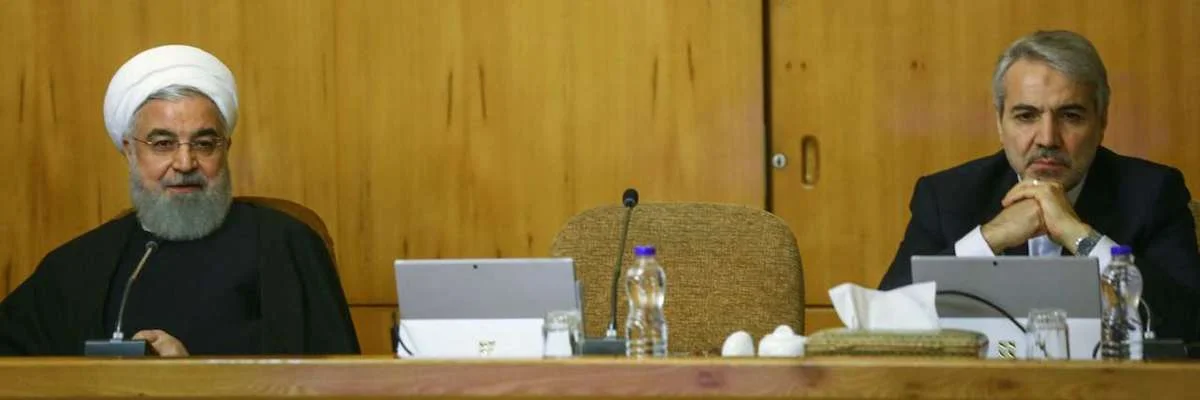
Iran's Government Falling into a Debt Trap of Its Own Making
◢ President Rouhani’s budget proposal for the upcoming Iranian year will see the government run a deficit amounting to about 10 percent of GDP or 60 percent of the state’s general budget, excluding oil revenues and withdrawals from the National Development Fund. Rather than increase tax collection to ease budget gaps, the Rouhani administration plans to tap Iran’s nascent debt markets to cover its public spending requirements.
President Rouhani’s budget proposal for the upcoming Iranian year will see the government run a deficit amounting to about 10 percent of GDP or 60 percent of the state’s general budget, excluding oil revenues and withdrawals from the National Development Fund.
Rather than increase tax collection to ease budget gaps, the Rouhani administration plans to tap Iran’s nascent debt markets to cover its public spending requirements. Rouhani’s cabinet intends to issue at least IRR 5 trillion government treasury bills and sukuk bonds in the next Iranian calendar year. For debts already nearing their maturity, it will have to repay close to IRR 3.3 trillion in 2019-20. The recourse to debt markets has economic commentators increasingly concerned over state’s ability to cover rising liabilities in the coming years.
The concern extends to the think tank of the Iranian parliament. Their assessment is that over the next four to five years Iran’s government debt may reach 50-70 percent of GDP, leaving little “fiscal space.” According to the Sixth Development Plan (2016-21), the government is required to keep government debt, including the debt of state-owned enterprises, at below 40 percent of GDP. But it looks likely that the government will exceed this level. Should Iran’s government debt exceed 70 percent of GDP, the fiscal position would be high-risk. Meanwhile, by 2021, interest charges on bonds will constitute 4 percent of GDP, while the total budget deficit is meant to remain below 3 percent of GDP according to parliamentary researchers.
Looking worldwide, high government debt is associated with financial crises. According to data from the OECD, two third of countries hit by the 2009 financial crises were those whose government debt-to-GDP ratio exceeded 60 percent.
When looking to the fraction of the total debt ratio, it is important to consider both the numerator and the denominator. The fact that government bonds in Iran offer 20 percent returns means that interest payments can quickly balloon. Unlike Japan or the United States where interest rates on government bonds are zero percent and 2.4 percent respectively, keeping tabs on fiscal space in Iran requires accounting for the cost of the debt to the government, not merely the amount of debt issued. ‘
Moreover, given that Iran has experienced limited economic growth in recent years and is poised to enter a recession, its fiscal space is expected to decrease. According to the study conducted by The Center for the Management of Debt and Financial Assets of Iran, this proportion was approximately 55.6 percent in 2015.
Putting aside the risks posed by the Rouhani governments turn to debt markets, it is worth asking whether there have been any clear macroeconomic benefits. In the assessment of parliament researchers, the Rouhani administration’s turn to debt markets is only sensible if increased government spending helps generate economic growth.
But with government revenues expected to stagnate, it is unlikely that Rouhani will have sufficient means to encourage the infrastructure projects and other investments to keep Iran’s economic growth at the 2.5 percent level experienced in the first six months of this Iranian year—particularly given the reimposition of US secondary sanctions.
Low or negative growth rates combined with the high interest rates of debt securities mean that the government’s insatiable appetite to underwrite its budget through bond markets may backfire, forcing the Central Bank of Iran to print more money to pay debts, exacerbating the cycle of inflation and devaluation to the detriment of the whole economy. To avoid such an outcome, the Rouhani government must match its turn to debt markets with an effort to expand the tax base.
Photo Credit: IRNA
