
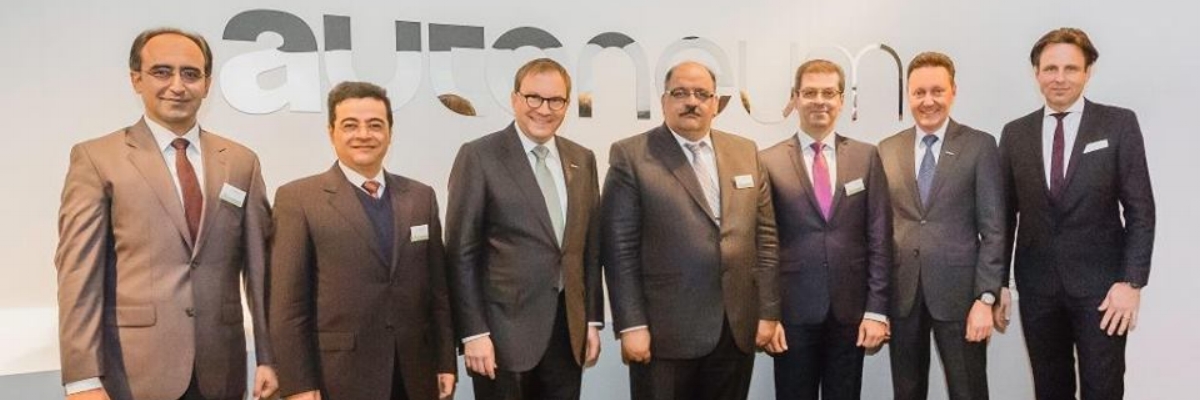
Autoneum Deal Underscores Huge Potential in Iranian Auto Parts Industry
◢ Swiss auto parts company Autoneum has entered into a new license agreement with Ayegh Khodro Toos to manufacture components for a new locally-produced Peugeot SUV beginning in 2019.
◢ The deal points to the potential in Iran's auto parts sector, where private sector companies, which are often SMEs with specific areas of expertise, dominate. Projections suggest exports of Iranian auto parts could rise to USD 6 billion by 2025.
Switzerland’s Autoneum, a world leader in the acoustic and thermal insulation for automotive applications, has signed a new exclusive license agreement with Ayegh Khodro Toos (AKT), an Iranian auto parts company that specializes in noise and vibration damping materials.
Autoneum and AKT will establish a new production like at AKT’s facility in Mashhad in order to begin producing carpet systems and dashboard parts. The first parts will come off the production line in 2019. According to company materials, AKT employs 95 technicians and controls 75% of the market for automotive insulation.
These parts will support the production of a new "SUV" by IKAP, the joint venture between Iran Khodro and Groupe PSA. The unnamed vehicle is most likely the Peugeot 3008, for which imports to Iran of complete vehicles will begin in early 2018.
Commenting on the new agreement, Martin Hirzel, CEO of Autoneum, highlighted Iran’s potential as “a central automotive hub for the Middle East, Far East and the Caucasus region.” Hirzel sees “strong sales potential” as the company seeks to meet the needs of customers in this regional market.
The new licensing agreement follows a common model in the Iranian auto parts industry, in which a foreign company brings technology and manufacturing specifications to a local partner, in order to supply the Iranian joint-ventures or CKD contract manufacturing agreements of the likes of PSA Groupe, Renault-Nissan, and Daimler. These parts are the lifeblood of a burgeoning Iranian automotive sector, which produced over 600,000 vehicles in the first half of 2017, registering 18% year-on-year growth.
The Iranian Auto Parts Manufacturers Association (IAPMA) estimates that there are 1200 parts manufacturers in the country generating USD 8 billion in annual sales. IAPMA ambitiously projects that Iranian auto parts market could generates sales of USD 32 billion by 2025. A major contributor of growth will be an expansion in exports, which are currently less than USD 200 million, but are expected to rise to USD 6 billion by 2025, a thirty-fold increase.

Major Iranian auto parts manufacturers such as Ezam and Crouse manufacture under license for global players such as Bosch, Mahle, Mando, and Valeo. The new agreement between AKT and Autoneum shows the potential for smaller, specialist parts manufacturers to strike similar deals that improve the quality and sophistication of the parts available for the local market and for export.
Photo Credit: Autoneum

American Medical Company Second Sight Enters Iranian Market
◢ Second Sight has entered the Iranian market with two procedures in Shiraz. Patients were implanted with the Argus II system, which provides an artificial form of useful vision to those suffering from degenerative loss of sight.
◢ The company entered into a partnership with Iranian firm Arshia Gostar Darman in 2016 and holds a license from the U.S. Department of Treasury that permits the sale of its devices Iran.
Second Sight, a publicly-listed American company which develops and manufacturers visual prosthetics, has announced its market entry into Iran with two landmark procedures. Two patients in Shiraz suffering from Retinis Pigmentosa, a category of genetic disorder which leads to the degeneration of cells in the retina, have had their sight partially restored with the implantation of the company’s Argus II device.
The milestone procedures were carried out last month at Shiraz Pars Hospital and the Khalili Hospital of the Shiraz Medical Science University. The devices were successfully implanted by Professor Mohsen Farvardin and his team. The Argus II system uses a small video camera mounted to a patient’s glasses to send images to a small patient-worn video processing unit. This small computer then processes the images and sends corresponding visual instructions to an antenna in the retinal implant. The implant emits small pulses of electricity to the stimulate the remaining photoreceptors in the retina, allowing the patient to perceive visual patterns.
The procedures were facilitated by Second Sight’s exclusive local distribution partner, Arshia Gostar Darman Company, an established supplier of sound processors and cochlear implants that help remediate hearing loss. Second Sight and Arshia Gostar Darman entered into a partnership in July 2016, at which time Second Sight had received a specific license from the U.S. Office of Foreign Asset Control (OFAC) to permit the sale of the company's medical devices in Iran.
Second Sight’s market-entry announcement came just one day after the U.S. Department of Treasury levied a USD 1.2 million fine on another American medical company, Dentsply Sirona. US regulators found that between 2009-2012, Dentsply made 37 shipments of dental equipment and supplies to Iran via its international subsidiaries. Company personnel concealed the fact that the goods were destined for Iran. In its public notice, OFAC indicated that products sold by Dentsply “were likely eligible for a specific license.”
The divergent experiences of Second Sight and Dentsply point to persistent challenges for specialist American medical companies that wish to supply the Iranian market. These companies, though smaller than the global behemoths such as Merck or Johnson & Johnson, play a vital role in the healthcare sector as they bring advanced therapies and innovative devices to market. While U.S. licensing policy is generally accommodating of the sales of medicines and medical equipment to Iran on humanitarian grounds, the regulatory burden and legal costs for these companies can be inhibitive. Securing an OFAC license is nearly always necessary in order to operate in a compliant manner.
At a time when the prospects for renewed American trade with Iran have dimmed, Second Sight's recent success offers a welcome reminder of the opportunities that persist in the pharmaceutial and healthcare sector.
Photo Credit: Second Sight
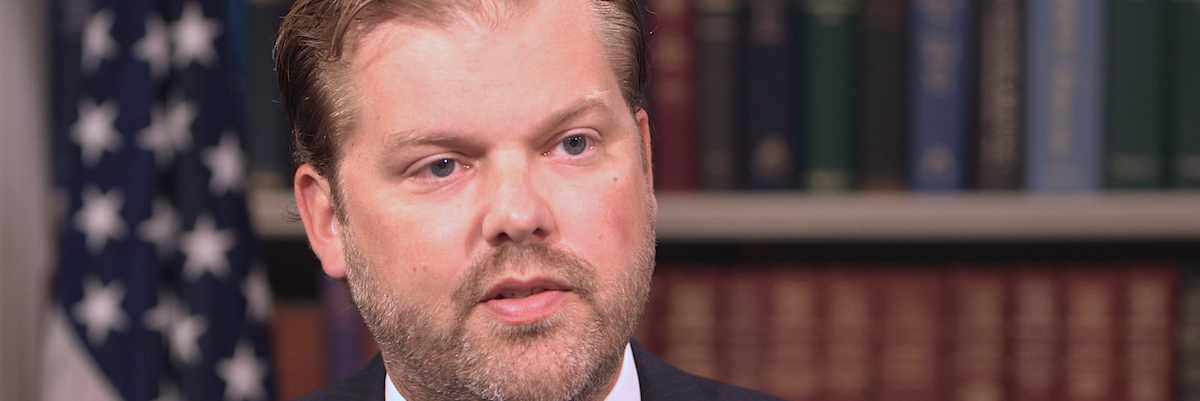
Senior American Diplomat To Be Replaced With "Trump Loyalist" in Key Iran Role
◢ Chris Backemeyer, Deputy Assistant Secretary for Iranian Affairs at the U.S. Department of State, is set to be replaced by Andrew Peek, a political appointee described as a "Trump loyalist."
◢ Backemeyer had a decade of experience working on the Iran file. His replacement represents the most significant loss of expertise on Iran policy to date.
As first reported in Foreign Policy, American career diplomat Chris Backemeyer, the Deputy Assistant Secretary for Iranian Affairs, is to be moved to a new role within the State Department’s Bureau of Near Eastern Affairs. Backemeyer will be replaced by Andrew L. Peek, a former intelligence officer in the U.S. Army with no prior diplomatic experience. Peek previously served Republican senators as a foreign policy advisor and has been described as a “Trump loyalist.”
The news comes as the Joint Commission is set to meet in Vienna this week to discuss the implementation of the Joint Comprehensive Plan of Action (JCPOA).
Backemeyer's move marks the year’s fourth and perhaps most significant change to the wider team overseeing Iran policy at the department. In January, Jarrett Blanc, who served as Deputy Lead Negotiator for Iran Nuclear Implementation, left the State Department (as is customary follow for political appointees following a change in administration) taking up a position as a Senior Fellow at the Carnegie Endowment for International Peace. In April Sahar Nowrouzzadeh, a career civil servant, was removed from the State Department's’ Policy Planning Team largely due to attacks from conservative media outlets focusing on her role in helping to craft the Obama administration’s Iran policy. In August, Ambassador Stephen Mull, a career diplomat, left the position of Lead Coordinator for Iran Nuclear Implementation to take up a fellowship at Georgetown University. He remains with the department.
Backemeyer’s reassignment stands out because of his direct involvement in the Joint Commission of the Joint Comprehensive Plan of Action and his decade of experience on Iran. Backemeyer has worked on the Iran file since 2007, rising to the role of Deputy Director of the Office of Sanctions Policy and Implementation before serving as Director for Iran on the National Security Council in the Obama White House.
The American delegation to the Joint Commission meeting next week will still be led by Tom Shannon, the Under Secretary for Political Affairs, who lacks Backemeyer’s specialist knowledge of Iran sanctions or the complex political issues surrounding the implementation of the JCPOA. While, Backemeyer is currently on paternity leave and was not scheduled to attend the upcoming Joint Commission meeting, the loss of his expertise will no doubt raise concerns among his Joint Commission peers, especially as the future of the JCPOA remains in doubt following Trump’s decertification of the deal in October.
The personnel change will also prove troubling to multinational companies pursuing trade and investment opportunities with Iran. Backemeyer spearheaded the Obama administration’s public outreach to companies and financial institutions following the lifting of U.S. secondary sanctions on Iran. This outreach was supported by a small team of “Iran watchers” stationed at several key embassies including London, Paris, and Berlin, as well as the Iran Regional Presence Office in Dubai.
While this outreach ceased following Trump’s inauguration, that Backemeyer and his team had remained in their positions gave business leaders some reassurance that American diplomats were at least aware and understanding of their frustrations with sanctions policy, even if solutions were not always forthcoming.
It remains to be seen whether new appointee Peek will make any similar effort to listen to the policymakers and business leaders who remain committed to constructive diplomacy and commercial engagement with Iran. Peek described the JCPOA as "America's diplomatic disaster" in a November 2013 column and wrote in March 2015 that the "core problem" with the nuclear deal "is that lifting the sanctions hamstrings US efforts to prevent the largest and strongest power in the Middle East from dominating the Middle East." Clearly, the early signs are less than promising.
Photo Credit: Politico

Rentierism and Rivalry Between Riyadh and Tehran
◢ Though widely described as move to consolidate political power, Crown Prince Mohammad bin Salman's decision to arrest members of the Saudi elite points to anxiety about Saudi Arabia's economic prospects and the risks of rentierism.
◢ The rivalry between Saudi Arabia and Iran is driven by the fact that the Kingdom is increasingly economically vulnerable at a time when Iran's fortunes are set to improve.
This article was originally published in LobeLog.
In response to the rivalry between Saudi Arabia and Iran, the United States has long pursued a strategy of counterbalancing, extending its security umbrella to cover the kingdom and the GCC states. But as promises of security fade in the face of decreasing belief in the American commitment, infighting in the GCC, and the advent of Saudi military adventurism, security is no longer a sufficient paradigm for policy that seeks to temper an intensifying regional rivalry.
In Saudi Arabia, a young Crown Prince, Mohammad bin Salman (MbS), is poised to rule a country that—on its current trajectory—faces a sustained economic decline as oil revenues shrink and the population grows. By contrast, having demonstrated considerable economic resilience under sanctions and significantly reduced its dependence on oil rents, Iran may finally be poised to achieve sustained growth.
This divergence in fortunes is at the heart of the regional conflict. Should MbS wish to prevent Iranian domination of the region, he will need to secure Saudi Arabia’s economic future and redefine the contribution of economic rents to state power—a puzzle of political economy. In the absence of any robust solution, he will resort, as most rulers do, to externalizing the political instability that will no doubt threaten him within the kingdom’s borders (see Vladimir Putin). The cynical war in Yemen gives an early indication of how such weakness may tragically precipitate further regional conflict.
The power differential between Saudi Arabia and Iran reflects the degree to which the kingdom remains a rentier state and the degree to which the Islamic Republic does not. In the assessment of political scientist Michael Herb, between 1972-1999, the “degree of rentierism” in Saudi Arabia was 80% while in Iran it was just 55%. To the extent that rentierism is understood as a fundamental liability in a country’s long-term political and economic stability, any intervention to temper the rivalry between Saudi Arabia and Iran will need to contend with the fundamental configuration of Saudi political economy, enabling moderation through strength.
Blurry Vision
MbS’s dramatic move to arrest scores of Saudi elites, including Minister of the National Guard Prince Mutaib bin Abdallah and the billionaire chairman of Kingdom Holdings Prince Alwaleed bin Talal, has been widely described as a “purge” or “soft coup.”
But as as executive director of the Arabia Foundation Ali Shihabi has argued, the arrests had little impact on MbS’s political fortunes. He writes, “In actuality, Saudi Arabia completed its political transition last June when King Salman replaced MBN with MBS as heir to the throne.” To this end, it is “wrong to interpret last weekend’s arrests as an action that materially increases the political risk to the monarchy.” Rather, Shihabi suggests that MBS intended to send a message “to political and economic elites that their entitlement to extreme wealth and privilege, and their impunity, is coming to an end.”
The economic consequences of the arrests could be significant. According to a statement on the arrests from the Saudi attorney general, “at least USD $100 billion has been misused through systematic corruption and embezzlement over several decades.” Shihabi believes that MbS will seek the “recovery of substantial ill-gotten assets from many members of the elite” as part of his effort to correct for perceived abuses.
It is tempting to think, in accordance with MbS’s deliberate self-marketing as an earnest reformer, that the move against corruption is an expression of political strength. This may be true within the internal dynamics of the Saudi Royal family—no doubt his moves against family members were bold. But when viewed within the wider economic context, the need to vilify quasi-state appropriation of wealth in the kingdom speaks to a brewing economic crisis and an acute sense of weakness.
In July, the IMF revised down projections for Saudi GDP growth in 2017 to just 0.1%, with growth for 2018 projected at a paltry 1.1%. In the face of low oil prices and general underperformance, the Saudi economy is teetering on the edge of a recession for the first time since 2010. The overall value of the economy has fallen by over $100 billion in just three years.
Saudi Arabia remains a rich country. But a dwindling cash pile (down nearly $300 billion from the 2014 high) and the first indications of oil’s impending decline as a source of rents have triggered a time-bomb for MbS. The county’s population is ballooning, with the working age population set to grow by 6 million in a country with just 41% workforce participation. MbS is poised to be the first king in Saudi history for whom oil rents will not meet the country’s economic needs or help consolidate his absolute rule.
The much touted Vision 2030 plan is an attempt to defuse this timebomb through an expansive set of economic and social reforms. In the near term, MbS is aiming to introduce an additional $100 billion annually from non-oil revenue by 2020. As described in a fawning profile in Bloomberg Businessweek, MbS “has already reduced massive subsidies for gasoline, electricity, and water. He may impose a value-added tax and levies on luxury goods and sugary drinks.”
But taxing soda is not going to replace declining oil revenues, and the likely impact of the proposed reforms are being oversold. At a more fundamental level, there are no plans to introduce an income tax, and in order to stave unrest from the least fortunate Saudis, cash handouts are still planned. As though to burnish his populist chops, MbS told Bloomberg, “We don’t want to exert any pressure on [the poor]. We want to exert pressure on wealthy people.”
The prince's turn to populism may be a novel chapter in the House of Saud’s playbook for regime survival, but it reflects a confused approach to reformation of a broken political economy. By failing to consider the importance of taxation, MbS seems unwilling to renege on what historian Toby Craig Jones calls the “devil’s bargain” of Saudi political economy, where “no taxation without representation” is perverted to “no representation without taxation.”
To date, the essential challenge of Saudi political economy remains unaddressed. So long as the country’s rulers depend on a dwindling natural resource or the fickle commitment of international investors to drive economic growth, the state will remain weak.
Lessons From Iran
Across the Persian Gulf, Iran’s leaders have made their own Faustian bargains concerning political economy, but the 1979 revolution provided a hard reset that addressed the central liability currently facing their Saudi rivals. The revolution served to give the government more levers by which to grapple with the chief risk that plagues rentier economies—income inequality. Iran’s present level of income inequality, as measured by the GINI coefficient, is just below 0.4. At the time of the Islamic Revolution, the level was 0.5.

According to a growing body of evidence, Iran’s combination of resource rents distribution with a progressive income tax has been fundamental to the country’s ability to mitigate inequality, especially given that Iran’s large population renders resource rents alone an insufficient source of government revenue for this purpose. In 2015, for the first time in over 50 years, tax revenues surpassed oil revenues as the primary source of government income.
A recent study by economists Mohammad Reza Farzanegan and Mohammad Mahdi Habibpour of resource rents distribution in Iran concludes that “any transfer policy that uses oil and gas rents which are publicly-owned and managed in Iran will decrease income inequality and poverty.” However, the authors find that “resource dividend” (RD) policies that combine the distribution of oil rents with income tax have the greatest effect at reducing income inequality. In a sample of 140,000 households, the so-called RD policies saw the GINI coefficient fall from 0.44 to 0.32 in rural areas, and 0.39 to 0.33 in urban areas—reductions in line with the overall improvements in Iranian income inequality since the Islamic Revolution.
President Hassan Rouhani continues to battle stubborn inequality, and the perception of misappropriation of rents through government corruption is a major source of political contention. In this sense, Rouhani’s own campaign of arrests, largely targeting elites connected to Iran’s Revolutionary Guard, mirrors the moves by MbS. But there is a crucial difference. Rouhani is trying to address corruption because he needs to better distribute rents, half of which originate from taxation, in lockstep with economic expansion. MbS is namechecking corruption because he needs to consolidate rents as he faces a economic stagnation—a position of relative weakness.
A Common Aim
In a lengthy interview with the influential Iranian foreign affairs magazine Diplomacy, former Iranian ambassador to Riyadh Hossein Sadeqi makes an emphatic case that MbS will avoid repeating the “Pahlavi scenario,” largely because of a deliberate effort to seek advice from “intellectual centers” including think tanks and consultancies. Sadeqi acknowledged that “Saudi Arabia has a single-product economy in which corruption exists,” but he also puts faith in the country’s capacity for reform, highlighting early progress instituting the Vision 2030 reforms, particularly in a social context.
This measured and hopeful assessment points to an important consideration for American policymakers. Shifting the emphasis in regional balancing away from military parity towards economic parity opens the door for a less confrontational dialogue between Saudi Arabia and Iran. The Iranian government has strong interests in Saudi Arabia’s economic stability. The international community should seek to ensure that a concerted program of training and technical assistance, rather than arms transfers to meet security demands, is made available to support MbS’s reform program.
Moreover, any program that seeks to address the residual challenges of rentierism could be a rare opportunity to bring senior Saudi and Iranian stakeholders around the same table to discuss how best to address destabilizing inequality and preserve standards of living in the post-oil world. The Iranian experience would be hugely instructive if Saudi leaders could be convinced to accept some well-intentioned advice.
Photo Credit: Wikicommons
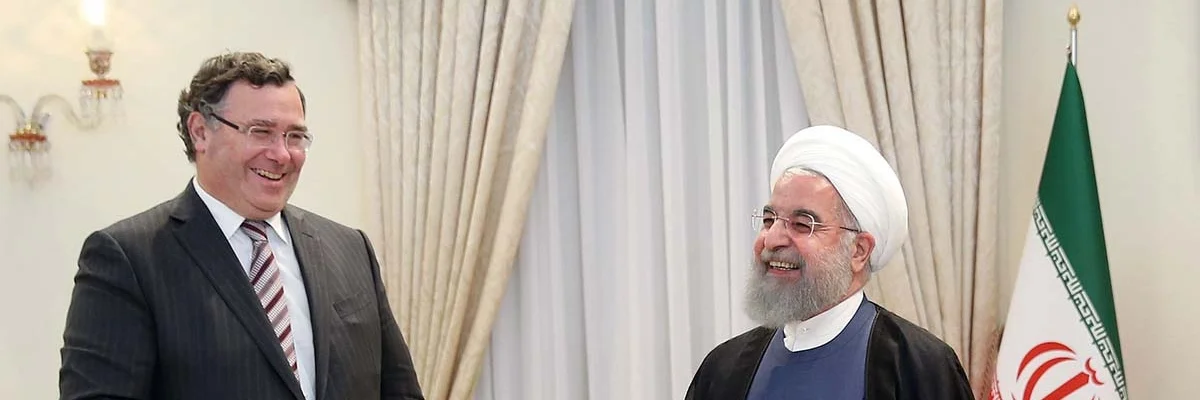
Oil Giant Total Takes to Twitter to Underscore Iran Commitment
◢ In a series of tweets published on Tuesday, Total's press office pushed back on reports that the company is rethinking its Iran strategy in light of pressure from the United States.
◢ The tweets emphasize that Total CEO Patrick Pouyanné sees no political barriers to the South Pars gas deal, and is simply waiting to see whether following Congressional action legal conditions will allow the deal to move forward.
In an unusual move, Total's press office issued a series of tweets on Tuesday in order to correct an apparent mischaracterization of the company's position on its planned USD 4.8 billion gas deal in Iran.
A piece published by CNN Money on Tuesday, and later echoed by Reuters, suggested that Total was "rethinking" its comittment to Iran in light of the company's large presence in the U.S. and President Trump's opposition to the Iran deal. The piece centered on comments made to CNN Money on the sidelines of an energy conference in Abu Dhabi, with Total CEO Patrick Pouyanné stating that "If there is a sanctions regime [on Iran], we have to look at it carefully... We work in the U.S., we have assets in the U.S., we just acquired more assets in the U.S."
But a series of tweets from Total's official press office account have since sought to dispel the idea that there has been any change in the company's policy towards Iran. The tweets explain how the comments made by Pouyanné are consistent with those made in several interviews since Trump's de-certification of the JCPOA Iran Deal.
Total's response clarifies that the company remains committed to its project in Iran's South Pars gas field and draws attention to an earlier interview in which Pouyanné stated he does not see a political barrier to conducting business in Iran. That Total is continuing to push ahead on its Iranian project demonstrates considerable resolve, especially given the company's extensive operations in both the United States and Saudi Arabia, two countries whose governments largely oppose Iran's economic opening. Indeed, the company has recently moved to more directly manage political risks by opening an office in Washington.
Pouyanné's comments to CNN Money do however raise the possibility that the United States will reimpose secondary sanctions, which would penalize non-U.S. entities for conducting business with Iran. Such a "snapback" scenario would compel nearly all European multinational firms, including Total, to pull back from the market. Total, like many other companies, is simply waiting to see what legal approach Congress is likely to take. Pouyanné told CNN, "We are working on the project. We launched the tenders, we should award contracts by January... I hope by that time, Congress will have an answer for the president and the president will have to renew, or not [renew], the certification."
Encouragingly, it remains unlikely that Congress will opt for snapback, which would constitute withdrawal from the JCPOA. Total's landmark deal still seems poised to open a new era of energy investment in Iran.
Photo Credit: IRNA
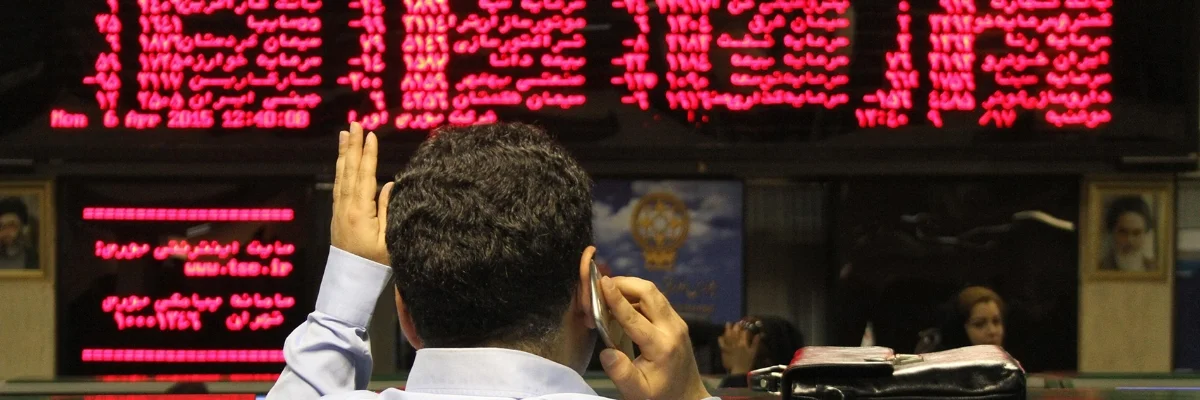
Iran Starved of Investor Capital Needed to Fuel Extensive Privatizations
◢ Morteza Lotfi, the newly appointed head of SHASTA has recently announced a new effort for SHASTA to divest from a large portion of its portfolio, offering a second chance at the privatizations pursued a decade ago.
◢ But political barriers and a dearth of capital, particularly from foreign investors, risks rendering SHASTA's plan dead on arrival as Iran seeks to liberalize without crucial liquidity.
Iran’s long but troubled drive for privatization received a boost earlier this month. Morteza Lotfi, the recently appointed head of Iran’s Social Securities Investment Company (SHASTA), the country’s largest pension provider, announced that SHASTA would list the remaining 25% of its subsidiary companies not currently on the Tehran Stock Exchange. The move was intended to make the companies “more competitive and their financial status more transparent.”
A few weeks later, Lofti made a further announcement that SHASTA plans to sell its stake in 130 companies in a two stage process. An initial tranche of 40 companies has reportedly been prepared for this divestment. Taken together, the two announcements suggest a renewed push for privatization, taking enterprises out of the limbo of SHASTA’s quasi-state ownership in which they have largely languished.
While the market value of the proposed privatization was not given, SHASTA is known to have around 200 subsidiary companies and its holdings are cumulatively valued at USD 9 billion. On this basis, the 130 companies poised for sale could therefore have an estimated value of around USD 5.5 billion, with the caveat that the companies to be offloaded are likely the underperforming firms, with lower valuations than the portfolio average. Nonetheless, in terms of the number of companies and their likely market value, SHASTA’s move would be another historic step in Iran’s economic liberalization.
But there are reasons to doubt that SHASTA’s push for privatization will proceed as planned. SHASTA’s own holdings are a legacy of previous failures in Iran’s faltering drive to reduce state control of the economy. SHASTA’s portfolio of assets expanded most rapidly beginning 10 years ago, when privatization efforts overseen by the Ahmadinejad administration fell short in the face of political pressure, economic unpreparedness, and general mismanagement.
In the course of privatizations in this period, a staggeringly small percentage of the formerly state-owned assets actually passed into the true private sector. As Kevan Harris writes, citing a 2010 parliamentary commission report, “Out of seventy billion USD worth of assets of SOEs divested since 2006 only 13.5 percent of the shares had gone to the private sector.” The vast majority of assets were transferred to the control of "parastatals" and cooperatives such as SHASTA. Critics saw this privatization as merely a “relocation” of state-ownership.

Today, the political barriers to the proposed asset sale remain strong. SHASTA is the investment arm of the Social Securities Organization, which provides healthcare entitlements and pensions benefits for a large proportion of Iran’s middle and working-class members of the labor force. SHASTA’s financial returns are intended to cover the costs of these welfare benefits, and are therefore highly politicized. As Harris explains, “Pensioners would hardly accept a selloff of SHASTA’s investment portfolio to the private sector without major guarantees of future entitlements by the state.” The Rouhani administration has committed to reducing entitlements, but given that SHASTA provides a pension to nearly 40% of the Iranian population, any major change to its portfolio could be a flash-point for opposition.
Aside from the political barriers, SHASTA’s bold plan faces another major obstacle. Iran’s equities markets are insufficiently capitalized to facilitate the sale of the 130 companies at sufficiently high prices.The current market capitalization of the Tehran Stock Exchange is about USD 100 billion. Relative to the overall size of the market, a USD 5 billion divestment by SHASTA, already the market’s single largest shareholder, would be difficult to absorb by other investors, particularly investors outside the circle of bonyads and other quasi-state holding companies.
Some within Iran’s financial sector see Lotfi’s announcements as an empty gesture. As relayed by one financial executive in Tehran, who preferred to remain anonymous, “We are used to these kind of gestures from high new management of SHASTA. They need the money and everyone knows it. But they don’t have the guts to push the button when it’s time.”
The Rouhani administration is well aware of this structural barrier to privatization, and has hoped that in the course of the post-sanctions economic rebound, new injections of capital by foreign investors would boost privatization prospects by alleviating the liquidity problem. Recent developments such as the partnership between Italy’s Azimut and Iran’s Mofid Entekhab bode well for the role of foreign institutional asset managers in the TSE, but there remains a long way to go before Iran can witness the foreign capital fueled privatizations that helped rapidly liberalize the BRIC economies. While the overall number of foreign investors trading on the TSE rose following the lifting of international sanctions and although foreigner trading value has doubled in the last year, this progress is measured from a very low base.
By comparison, around 60% of shares on the Borsa Istanbul are owned by foreign investors. Acknowledging the important role foreign investors will need to play to see through the off-selling, Lotfi disclosed, “Talks are underway with the Turkish government for dual listing of some of [SHASTA’s] subsidiaries on Borsa Istanbul, which would be a positive step toward attracting foreign investment.”
SHASTA's intended move reflects the precise kind of privatization efforts that Western economic policymakers have long advocated in liberalizing markets. But unlike in other liberalization scenarios, Iran's economic actors find themselves hamstrung by structural challenges that few in the international community seem keen to address. As SHASTA looks to right the wrongs of past privatization efforts, a more concerted effort should be made to support inflows of foreign investment. If success in privatization is to be achieved this time around, Iran's equity market investors will need foreign investors to help carry the burden and unlock the opportunity.
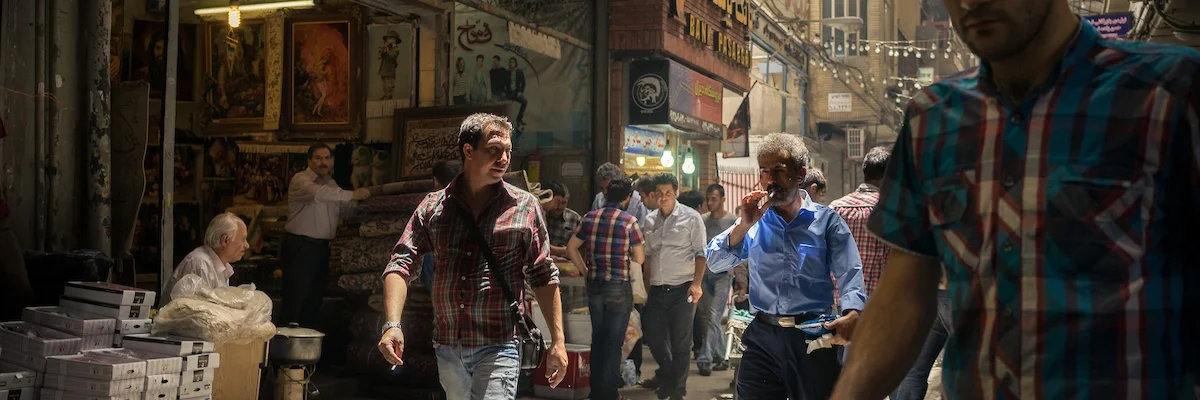
Killing Iran’s Economy Won’t Help the U.S.
◢ The Trump administration's new Iran policy focuses largely on targeting the IRGC in the name of American national security. But IRGC will not stop its expansionism in the Middle East because of sanctions and sanctions will not weaken the Iranian government at home.
◢ If the Trump administration continues to harm Iran's economy, the biggest losers will be the Iranian people, caught between punitive U.S. policies and an illiberal regime.
The Trump administration has announced a set of seemingly aggressive policies against Iran, including decertifying the nuclear agreement known as the Joint Comprehensive Plan of Action (JCPOA). The thrust of the “new” U.S. policy on Iran appears to be the imposition of additional sanctions against organizations such as the Islamic Revolutionary Guards Corps (IRGC). Critics of the JCPOA claim that new sanctions will not only “fix” the JCPOA, but also help roll back Iran’s increasing influence in the Middle East. Both assumptions are wrong.
The JCPOA has been effective in constraining Iran’s nuclear program, a fact confirmed by the International Atomic Energy Agency and the other parties to the JCPOA, namely the United Kingdom, France, Germany, Russia, and China. The Trump administration’s actions not only risk undermining an effective agreement, but are unlikely to change Iran’s regional policies or weaken the Iranian regime at home. Iran’s economy is likely to be damaged by any new U.S. sanctions, with foreign investment having already slowed in response to Trump’s rhetoric. The biggest losers will not be the Iranian regime but the Iranian people, whose striving the U.S. has long hoped would bring about a less antagonistic Iran.
The IRGC is responsible for Iran’s impressive expansion across the Middle East. Iran is a primary power-broker in Iraq, Syria, and Lebanon; Tehran also wields substantial influence in Afghanistan and even in relatively far off countries such as Yemen. The IRGC is also a major economic player in Iran. So it may seem to make sense that sanctions against the IRGC would help curtail its power in the Middle East. Yet the opposite is true.
Money is not the IRGC’s only motivation in shaping Iran’s regional policies. Rather, a combination of revolutionary zeal, fear of external enemies, Iranian nationalism, and regional instability have also fueled the IRGC’s successes in the region. Yes, it does take substantial funding for Iran to expand its power. Tehran not only funds Hezbollah and the Assad regime in Syria, but a myriad of pro-Iranian groups in Iraq, Afghanistan, and Palestine. But Iran was able to expand its regional power even under the severest of sanctions imposed prior to JCPOA. The rise of the Islamic State and state collapse in places such as Syria have allowed Iran to exploit fear and instability to expand its power. The region’s Shi’a populations, while not always ideologically aligned with Iran, have little choice but to turn to Tehran for protection in the face of extremist Sunnis. Iran does not need billions of dollars to be powerful given the IRGC’s ability to mobilize historically disaffected Shi’a to their cause.
New U.S. sanctions are also likely to undermine President Hassan Rouhani’s attempts to liberalize the economy. Opponents of the JCPOA often claim that “moderates” such as Rouhani are indistinguishable in terms of goals and ideology from the IRGC. No one in Iran’s political establishment can be considered pro-American; yet to ignore or deny political realities in Iran does a disservice to American interests. Rouhani’s government was able to negotiate the JCPOA in spite of Supreme Leader Ayatollah Ali Khamenei’s deep suspicions. The Iranian president hoped that the sanctions relief promised by the JCPOA would help liberalize Iran’s economy and attract substantial foreign investment, decreasing Iran’s dependence on energy exports and potentially weakening the IRGC’s grip in key economic sectors.
To be sure, economic liberalization may enrich Rouhani’s faction and regime insiders largely opposed to American influence in the region; but millions of middle class Iranians who envision better U.S.-Iran relations will also benefit from privatization, foreign investment, and the attendant new job opportunities. U.S. sanctions against the IRGC, which could slow the process of liberalization, will ultimately punish all Iranians, including those who want better ties with Washington. Khamenei’s claims that America can never be trusted will appear increasingly as fact rather than mere political rhetoric. The Trump administration’s efforts to decertify Iran and undermine the JCPOA without justification will reinforce the Iranian public’s suspicions of U.S. intentions. This also would quiet any segment of the Iranian public that might object to Iran’s nuclear pursuits at high cost to the economy.
The IRGC will not stop its expansionism in the Middle East because of sanctions. And sanctions will not weaken the Iranian regime at home. Sanctions may have worked in building American leverage before the JCPOA. But, political conditions in Iran and America’s standing both in the Middle East and across the globe have changed considerably in the last few years. The U.S. is losing its credibility among the Iranian public and U.S. allies who helped negotiate the JCPOA. And Iran is more powerful in the Middle East than before, especially as international powers such as Russia, regional states such as Iraq, and even Turkey turn to Iran as the region’s decisive actor. The biggest losers will be the Iranian people, caught between punitive U.S. policies and a illiberal regime.
Photo Credit: Thomas Cristofoletti
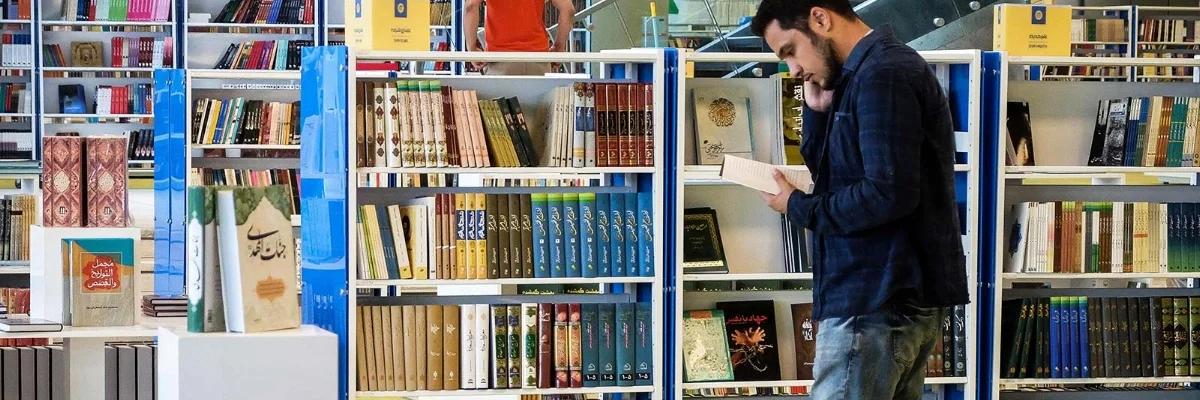
Iran Sanctions Policy Increasingly Throttles Free Trade in Ideas
Since 1988, the Berman Amendment has limited the authority of the President to restrict the exchange of information as part of American sanctions policy. But the new sanctions designation of the IRGC and recent voluntary actions by American companies suggest that the long standing protection for the free trade of ideas is under threat.
This article was originally published in LobeLog.
In 1988, as legislators were creating the legal basis for the modern use of economic sanctions as a tool of American foreign policy, an important amendment was added to two laws, the Trading With the Enemy Act (TWEA) and the International Emergency Economic Powers Act (IEEPA). The so-called Berman Amendment was devised to withdraw the president’s authority to use sanctions to prohibit the import or export of informational materials, whether directly or indirectly.
Former Representative Howard L. Berman (D-CA), who put forward the amendment, felt that support for access to information was a cornerstone of American foreign policy and should not be undermined by any program of economic sanctions. He stated: “The fact that we disapprove of the government of a particular country ought not to inhibit our dialog with the people who suffer under those governments…. We are strongest and most influential when we embody the freedoms to which others aspire.” In 1994, the provisions in the Berman Amendment were expanded in the Free Trade in Ideas Act in response to the fast changing media landscape. The definition of “informational materials” came to apply “regardless of format or medium of transmission” to “any information or informational materials.”
Since then, American sanctions policy has generally sought to ensure that the targeting of commercial and financial channels does not inhibit the transmission of information. This is perhaps best exemplified in the case of the sanctions regime levied on Iran, the most extensive ever devised. Even in the case of Iran, exemptions exist in the sanctions regulations for activities such as, publishing, journalism, Internet communications, and even organizing events. In addition, more specific permissions are granted in the form of so-called General Licenses issued by the U.S. Treasury’s Office of Foreign Assets Control (OFAC). These include General License D-1, which permits the use of certain software or hardware for personal communications, and General Licence G, which licenses the export or import of educational services to and from Iran. Companies can also apply for specific licenses, which have been awarded to enable publishing, research, and communications activities that may be more commercial in nature, but are still consistent with the notion of “free trade in ideas.”
However, recent developments suggest that American regulators have lost sight of the absolute importance of protecting informational exchange. On October 13, the U.S. Treasury designated Iran’s Islamic Revolutionary Guard Corps (IRGC) as a “Specially Designated Global Terrorist” (SDGT) As several sanctions designations had already blocked the IRGC, the new action made little difference to the prohibitions around commercial and financial dealings with the Guards. But the push for a terrorism designation did have one new and substantive outcome.
In the FAQ note issued to clarify the new designation, OFAC explains that the new designation draws upon a counterterrorism authority, Executive Order 13224, which was not previously applied to the IRGC. As a result of this new authority, the IRGC “may not avail themselves of the so called ‘Berman exemptions’ under the International Emergency Economic Powers Act (IEEPA) relating to personal communication, humanitarian donations, information or informational materials, and travel.”
This represents one of the first instances in an Iran sanctions designation in which OFAC has specifically clarified that the provisions of the Berman Amendment do not apply. Sanctions experts are quick to point out that, despite the new designation, OFAC will necessarily prioritize enforcing possible illicit financial support for the IRGC above the possible transmission of information, which could be as innocuous as usage of social media platforms or distribution of news media. But if the loss of the exemptions is the only substantive legal consequence of the new designation, then the stakes are actually quite high. As sanctions attorney Clif Burns sharply observed in a blog post, “It is now a federal crime for a U.S. person to give a copy of The Bible to anyone in the IRGC.”
American policymakers may not harbor any sympathies for members of the IRGC, but the manner in which the designation affects informational exchange is emblematic of a general failure in US sanctions policy to adequately consider or protect the free trade in ideas with people and entities, even those on the opposing sides of an adversarial relationship. Beyond the nefarious IRGC, members of Iranian civil society also see their access to information increasingly restricted. In August, Iranian apps were removed from both Apple’s App Store and Google Play, causing an uproar among Iranian users. In September, the online-course platform Coursera began to limit a wider range of content for users based in Iranian, citing sanctions regulations.
For now, the likes of Apple, Google, and Coursera are making voluntary decisions to limit their service provision to Iranian users. But the moves were likely spurred by the marked shift in Iran policy between the Obama and Trump administrations. These companies may have changed their policies in accordance with a stricter interpretation of General License D-1, which had previously been used to justify providing Iranian users access to these online platforms. During the Obama years, the “spirit” of OFAC’s enforcement mandate was clear and informational exchange was in fact encouraged within the scope of exemptions and general licenses.
It may seem tenuous to link the IRGC’s new designation with the recent experiences of Iranian Internet users. But in both cases, the overall disposition of American sanctions policy has clearly moved away from the political and ethical intentions behind the Berman Amendment. Even if the impact on information flows is so far inadvertent and primarily reflective of voluntary actions by the companies operating informational platforms, OFAC could absolutely be doing more to provide comfort around the general permissibility of informational exchange.
The consequences of any reduced “trade in ideas” with Iran will be profound. The United States is limiting its means to influence decisionmaking within the IRGC at precisely the same moment that it is undermining the ability of Iranian civil society to freely access informational services. It is unclear how removing the Berman exemptions for the IRGC weakens the organization. If anything, it may make it harder for Iranian and foreign stakeholders to help influence key reforms that would help mitigate the IRGC’s political and economic might.
For example, with the new designation, a non-governmental organization with a so-called U.S. nexus (such as funding that originates in the United States, or U.S. nationals on the staff) can no longer seek to treat IRGC affiliates as subjects in any research or technical-assistance programs. This is particularly concerning as Iran’s government seeks to push forward with a program of economic liberalization and attempts to induce the IRGC to sell assets and reduce their economic footprint. The Rouhani government needs foreign assistance to cleave the IRGC from its role in the economy, but that assistance may now be prohibited if the informational materials in question are ultimately earmarked for IRGC affiliates.
In March of this year, American University in Beirut agreed to pay a penalty of $700,000 to settle claims in a civil suit brought by the United States. The penalty was tied in part to the provision of “material support” to Jihad al-Binaa, an organization linked to the SDGT-designated Hezbollah, on a university database “for the stated purpose of connecting Non-Governmental Organizations (“NGOs”) with students and others interested in assisting them.” The IRGC has a much wider range of affiliated entities than most organizations designated under counterterrorism authorities, including commercial entities, welfare organizations, and educational institutions. If even listing these entities in a database can be seen as tantamount to material support, warranting an enforcement action, then the SDGT designation could significantly reduce the scope for responsible dialogue with the IRGC, whether direct or indirect.
Considering the fundamental role that both government-backed and independent research and technical assistance programs played in fomenting political and economic liberalization in formerly embargoed countries such as the former Soviet Republics, China, and Vietnam, any policy that blocks informational exchange will deprive the United States of some of its best foreign-policy tools.
There are times when blocking economic relations is necessary. But there is no situation in which the total denial of the free trade of ideas is sensible. The Berman Amendment is much more than a quirk of sanctions policy. It is among the most lucid formulations of liberalism in American foreign policy. In devising its approach to Iran, the Trump administration would do well not to lose sight of how the exchange of ideas has long made American foreign policy great.
Photo Credit: Rouzbeh Fouladi

In Reprieve for Multinational Business, Trump to Stave Snapback of Iran Sanctions
◢ Later today, President Trump will decertify Iran's compliance with the JCPOA on national security grounds. However, early reporting based on background briefings provided to European officials makes clear that administration does not intend to walk away from the Iran Deal.
◢ Instead, Trump is pushing the issue of Iran policy to Congress, recommending new actions to counteract Iran, but not going so far as to recommend the full "snapback" of sanctions.
Following a lengthy interagency review, Donald Trump will today unveil his new Iran policy, bringing to an end months of speculation as to his administration's intentions. Despite Trump’s view of the Iran Deal as “the worst deal ever,” early reports make clear that Trump will not be withdrawing from the Joint Comprehensive Plan of Action (JCPOA).
Despite recent political uncertainty, underlying commercial momentum has remained strong in 2017. Trade between Europe and Iran nearly double in the first half of 2017, compared to the same period the year prior. The Iranian government reports that commitments of foreign direct investment have risen 55% in the last Iranian calendar year. The spectre of decertification has been seen as a risk to this steady growth.
On Thursday, the Trump administration provided background briefings to European diplomats and the members of the press outlining the content of the pending announcement. While specific details of the new strategy remain embargoed until shortly before Trump’s speech, which will be made at 12:45 EST, reporting by the Julian Borger of The Guardian and the Matthew Lee of the Associated Press, outlines a strategy that is less damaging than had been feared.
While President Trump will formally decertify Iran’s compliance with the JCPOA, he will do so not in denial of Iran’s technical compliance with the agreement, which has been subject to eight confirming reports by the International Atomic Energy Association (IAEA), but rather on the basis of America’s national security interest, in accordance with a specific provision for decertification stipulated in the Iran Nuclear Agreement Review Act (INARA).
The move to decertify will push the issue of the Iran Deal to Congress. The Trump administration is seeking new amendments to INARA in an attempt to address perceived “flaws” in the JCPOA. These include new provisions relating to Iran’s ballistic missile program and the activities of Iran’s Islamic Revolutionary Guard Corps (IRGC) that would automatically trigger the snapback of secondary sanctions in the event of a violation. Importantly, the administration is also seeking an amendment to INARA to remove the requirement for Trump to certify Iran’s compliance every 90 days, a move widely seen as a face-saving maneuver for an administration beset by infighting on the issue.
Crucially for multinational businesses active in Iran, the administration will not be recommending Congress reimpose the sanctions removed as part of the implementation of the JCPOA, which would have been tantamount to America’s withdrawal from the deal. The administration has also decided not to designate the IRGC as a terrorist organization, a move which would have risked drawing the Iranian government into an escalation.
As such, Trump’s announcement will have little immediate bearing on the ability of multinational companies to continue to trade and invest in Iran. Business leaders had long expected Trump to eventually decertify Iran’s compliance and had proceeded with commercial contracts accounting for such a move. In a recent survey of business leaders, 68% of Iranian respondents and 63% of non-Iranian respondents considered snapback a likely or very likely outcome of decertification. The fact that the administration is not recommending the reimposition of secondary sanctions will be seen as a reprieve. The question that now remains is the extent to which Congress wishes to redefine the scope of compliant trade and investment through amendments to INARA.
In what some business leaders see as a silver lining of the turmoil caused by the decertification issue, it may be that more definitive action by Congress could actually help safeguard the implementation of the JCPOA and by extension the operations of multinational businesses in Iran. For example, removing the rolling certification requirements would reduce political uncertainty surrounding the deal and its continued implementation.
Moreover, that Trump is not withdrawing from the agreement demonstrates that coordinated diplomacy can protect the JCPOA in Washington, and by extension, protect market access. In response to rising political uncertainty, and in the lead-up to today's announcement, European governments and the European business community significantly increased their level of direct dialogue on matters related to Iran Deal implementation. This dialogue helped ensure that the missions of the European diplomatic corps and the business community were mutually reinforcing. The progress made by businesses in engaging in Iran, with notable deals signed this summer by many of Europe’s industrial giants, helped underline the strategic value of the JCPOA for Europe beyond the realm of security issues.
The diplomatic efforts will need to continue. Congress is expected to make its determinations regarding the amendments to INARA within the next two months. There is significant risk that Congress could introduce new provisions to INARA that make compliance politically untenable for the Iranian government, which will see possible automatic snapback as a kind of booby trap. However if Congress takes a more sensible approach, the Iran Deal may yet emerge stronger than before. The new Trump strategy is minimal in its prescriptions. European leaders, must step in to define what a workable Iran policy looks like for all parties.
Photo Credit: Wikicommons
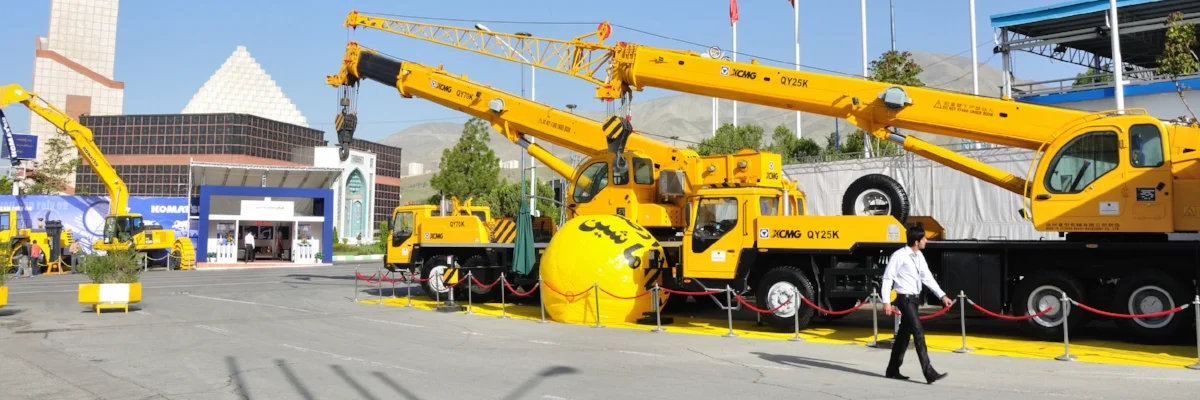
Majority of Business Leaders Blame Trump for Slow Iran Investments
◢ A new survey by Bourse & Bazaar and IranPoll finds that business leaders believe Trump's rhetoric has slowed the pace of trade and investment by multinational companies in Iran.
◢ However, the results come at a time when the underlying commercial momentum seems strong. This suggests that Trump's words are having an impact not on those most directly working with Iran, but on the stakeholders on whom they rely.
This article was originally published in LobeLog.
As President Donald Trump threatens to de-certify Iran’s compliance with the JCPOA, the political environment around post-sanctions trade and investment has grown more contentious. Yet, at the same time, after extensive negotiations with leading multinational companies, Iran has witnessed landmark agreements signed across industries, with billions of dollars of investment committed and financing agreements inked. For those business leaders continuing to push ahead in Iran, and for the Iranian public to whom they are accountable, the question is what to make of such contradictions.
To examine this and other questions, Bourse & Bazaar partnered with IranPoll to conduct a unique survey focused on economic attitudes and business confidence in Iran. The survey was conducted in August 2017 and covered a representative sample of 700 Iranians.
Several of the questions centered on post-sanctions investment and the political importance of the JCPOA. But perhaps most notably, 70% of Iranians surveyed believe that multinational companies are “moving slower than they could” to trade and invest in Iran following the lifting of international sanctions. Of this group, a significant 76% of Iranians identified “pressure or fear of the United States” as the key reason, compared to just 16% would blamed Iran’s “weak business environment.”
It is certainly sensible for Iranians to blame Trump’s antipathy towards the nuclear deal as a primary reason for the slow pace of Iran’s post-sanctions economic recovery. But this view might unfairly discount the inherent difficulties of investing in Iran, a fact that the Obama administration highlighted when concerns over the slow pace of economic engagement first emerged in early 2016.
It seemed a reasonable assumption that the “experts” who are the business leaders or policymakers actually trying to make trade and investment happen might have a different, more nuanced view than the Iranian public. The barriers to trade and investment in Iran are very real. The country ranks 120 in the World Bank’s “Ease of Doing Business” rankings, having actually fallen three places in the last year.
Results of the “Expert” Survey
To investigate this assumption, IranPoll and Bourse & Bazaar administered an online survey that collected responses from just over 250 “experts,” sampled based on their active involvement in Iran trade and investment matters. Of these respondents, 79% held either a master's degree or PhD, and 70% were professionals from European or Iranian private-sector enterprises. The remainder worked in state-owned enterprises, government agencies, or policy institutes. Importantly, 70% of respondents considered themselves to be either somewhat or well-informed about investing in Iran.
In an amazing example of statistical congruence, 70% of the expert respondents surveyed believe that multinational companies are “moving slower than they could” on trade and invest in Iran. Of this group, 76% blame “pressure or fear of the United States” for the slow movement, with just 17% blaming Iran’s challenging business environment. These proportions directly mirror the results seen in the survey of the Iranian public. How can it be that these experts, who know all too well that Iran is a difficult place to do business, are seemingly discounting those difficulties in the face of Trump’s rhetoric?
The answer may lie in the slow and steady progress that has been made in Iran trade and investment in the last year. Major contracts signed in 2017 include the first major post-sanctions investment in Iran’s oil sector, the first automotive investment majority owned by a foreign multinational, and the first equity stake taken by a global financial institution in an Iranian financial services firm, in addition to several major financing agreements and even more unheralded deals. This overall momentum, hidden to all but those watching Iran most closely, suggests that business leaders, as well as the regulators and policymakers with whom they work, have gained a sharper understanding of how to conduct business in the country. Although Iran’s economy remains rife with obstacles, business leaders are proving more adept navigators. For example, in the same survey, 74% of respondents said that they believe they know the right people to conduct business in Iran. As business leaders gain confidence in their own abilities and greater means to manage challenges within their control, the turmoil in Washington remains the key complication to trade and investment plans.
But if the business leaders are able to recognize American rhetoric as superficial, why exactly is it slowing the pace of trade and investment? This is likely because the rhetoric is impacting decision-making not for those closest to projects in Iran but for those stakeholders on whom they rely.
Commercial Agenda Advances
Reading the headlines on Iran, driven by Trump’s soundbites, it would be easy to believe that Iran is an untenable place to do business in the current political environment. Yet, the “country managers” who run business divisions in Iran for multinational companies have made considerable progress over the last year in pushing forward a commercial agenda. This contradiction may explain why 69% of respondents in the expert survey felt that international media outlets are not an accurate source of information about Iran’s “trade and investment environment.”
The slowdown occurs when the question of Iran crosses the desks of decisionmakers further from the point of contact. By dint of their progress, country managers increasingly need to draw on support from other parts of their multinational organizations and suppliers and partners in order to execute strategy. Most crucially, as a project reaches contract stage, it becomes imperative to find a financing solution. This requires the country manager to both bring his senior executives on board with the project plan and then seek engagement from a financial institution. When critical decisions reach this wider circle of stakeholders, headlines become far more salient. These stakeholders cannot draw on firsthand experience to bolster their confidence in an Iran-related commercial decision and rely instead on the incomplete picture painted in the international media. Understandably, they find it difficult to act decisively in the face of uncertainty, particular when personal or company reputations come into play.
In this way, Trump’s rhetoric is slowing the momentum of trade and investment prior to any snapback of sanctions. No doubt, Trump’s impending decision on decertification of Iran’s compliance with the JCPOA does make snapback a potential outcome. Tellingly, 68% of Iranian respondents and 63% of non-Iranian respondents in the expert survey considered snapback a likely or very likely outcome of decertification.
However, in this intervening period, during which there has been no instrumental change in US policy, the reported slowdown in trade and investment helps demonstrate a deficiency in how deal supporters are counteracting Trump’s message. The critical point is that Trump only has his message. Given the track record of his administration, he is unlikely to have a cohesive Iran policy at any stage, even if he decides to decertify.
Deal supporters in Washington ought to define the economic scope of sensible Iran policy more clearly and thereby support business confidence more actively. The imperative here follows directly from what it means to offer “sanctions relief.” As a policy tool, sanctions impose political ideology on economic structures. The act of sanctions “designations” makes a normative judgement about the objective composition of an economy, defining the acceptable level of commercial relations with certain economic actors. Consequently, crafting an effective post-sanctions policy requires its own congruence between ideology and structure.
In the case of Iran, the objective reality that trade and investment are incentivizing structural liberalization in Iran’s economy needs to be expressed and valued in ideological terms. Encouragingly, European stakeholders have become more assertive in presenting such a vision. Helga Schmid, secretary general of the European External Action Service, stated in a recent speech at the 4th Europe-Iran Forum, “We recognize that it is important that the benefits of the Iranian deal are felt directly by the Iranian people and Iranian businesses. This is necessary for the success of the deal, but it is also in the interest of the EU, its Member States and economic operators.”
Deal supporters in Washington should likewise be more confident in declaring that, where sanctions relief allows, companies ought to be free in engaging in trade and investment in Iran. Commerce not only helps preserve the nuclear deal but it can also help incentivize financial, industrial, and legal reforms, in a manner akin to how enterprise has helped successfully open economies in Eastern Europe, Latin America, and Southeast Asia. Of course, this amelioration will only take place in the medium to long term. But in the near term, a tactical insistence on stronger messaging around economic engagement is necessary to support those stakeholders whose work is so crucial to the quid-pro-quo of the deal and whose activities are fundamental to winning the hearts and minds of an Iranian public already so hopeful that engagement will deliver a brighter future.
Photo Credit: Wikicommons
In First, Global Financial Institution Takes Equity Stake in Iranian Financial Services Firm
◢ New deal between Azimut Group and Mofid Securities represents a landmark deal for Iran's financial services sector. Azimut Group is taking a 20% stake in Mofid Entekhab.
◢ The two companies will launch new investment offerings, largely targeting foreign investors. A capital raise will support the expansion of the local sales and advisory teams.
Mofid Securities, Iran’s largest independent brokerage and financial advisory company, has entered into a major new agreement with Azimut Group, one of Europe’s leading asset managers. The agreement will see Azimut take a 20% stake in Mofid Entekhab, the asset management business of Mofid Securities, as Azimut and Mofid seek to bring a higher standard of asset management offerings to the Iranian market for both domestic and foreign investors.
The new deal makes Azmiut the first global financial institution to make an equity investment in an Iranian financial services company. It comes at a time when Iran’s financial services sector has made recent headway in reconnecting with global counterparts. New financing deals with Austria’s Oberbank and Denmark’s Danske Bank and an announced commitment from French bank BPI suggest that more foreign capital is set to flow to Iran in 2018, so long as the possible snapback of secondary sanctions does not take place. Similarly, investor appetite has grown with investment companies deploying foreign capital in Iran’s public and private equities in historic volumes.
With the minority acquisition and joint pro rata capital increase, Azimut will help Mofid Entekhab to develop new investment strategies in local asset classes. Marketing will see a boost with an expanded, locally trained sales force. Most importantly, Azimut and Mofid intend to launch new offshore funds to enable foreign investors to gain exposure to promising Iranian equities.
Mofid Entekhab currently manages USD 89 million in six mutual funds and managed accounts, with 8% market share among Iran’s equity funds. The Mofid Group, founded in 1994, has earned a reputation for its innovation in the Iranian financial sector. The company has invested considerably to raise the standards of its services to international standards. Notably, Mofid owns Pouya Finance, the fintech company behind BourseView, the most extensive financial data platform for Iran’s capital markets.
The new partnership with Azimut is consistent with Mofid’s effort to provide clients to “a new suite of financial advisory and wealth management services in line with the highest international standards,” said Hamid Azaraksh, Chairman of Mofid Securities. Azaraksh states that the company’s strategic goal is “to capitalize on [its] track record as the leading financial intermediary in Iran and create with Azimut a benchmark for the local asset management industry.”
For Azmut, the deal represents a bold move into a country with immense financial potential. Sergio Albarelli, CEO of Azimut Holding, described the deal as “a historical first step for a global player entering the Iranian financial market.” Albarelli noted the compatibility of Mofid and Azimut, based on “core values of independence and commitment to performance.”
The deal, announced just a week before U.S. President Donald Trump is set to declare whether he intends to “de-certify” Iran’s compliance with the JCPOA, offers another example of the strong European commitment to economic engagement with Iran, which is now in evidence across sectors.
Photo Credit: Mofid Securities
New Survey Examines Iranian Attitudes Towards Foreign Investment, Multinational Companies
New survey conducted by IranPoll in partnership with Bourse & Bazaar looks at Iranian attitudes towards economic reform and foreign investment with new detail. Iranians demonstrate high degree of openness to foreign investment and the economic reforms necessary to facilitate that investment. But they want multinational companies to do more to localize their offerings effectively.
A first-of-its-kind survey on attitudes towards trade and investment in Iran conducted by public opinion firm IranPoll in partnership with Bourse & Bazaar, a business media company, points to strong public support in Iran for greater trade with other countries and related economic reforms. A resounding 85% of respondents feel that “growing trade and business ties between Iran and other countries” was leading to good or very good outcomes for the country.
The results of the landmark survey will be presented by IranPoll CEO Dr. Amir Farmanesh to an audience of over 400 European and Iranian business leaders and policymakers at the 4th Europe-Iran Forum, which takes place on October 3-4 in Zurich, Switzerland.
The survey, which was conducted in August 2017 among a representative urban sample of 700 Iranians has been published at a crucial time when debate over the Joint Comprehensive Plan of Action (JCPOA), also known as the Iran Deal, reaches a fever-pitch. While President Trump has expressed his disapproval with the deal, it remains popular among a majority of Iranians, with 62% of respondents approving. But doubts and frustrations have emerged since the agreement was concluded in 2015. Acutely aware of President Trump’s rhetoric, 77% of Iranians have little or no confidence that the United States “will live up to its obligations under the agreement.” By contrast, public confidence in the European commitment to the JCPOA remains strong, with 57% of respondents believing the Europeans will stick with the agreement.
“Contrary to the reputation and image of the US, Europe’s image in Iran has improved significantly since the signing of the JCPOA and Iranians welcome greater trade and economic engagement with European companies” commented Dr. Farmanesh, the CEO and President of IranPoll. “Yet, only a minority of Iranians believe European producers have a good understanding of the needs and the taste of the Iranian people, which means European companies need to take extra steps not only to familiarize themselves with Iran's business environment but also to demonstrate their appreciation for the tastes, lifestyles, and culture of the Iranian society.”
Against the backdrop of political uncertainty, economic dividends of the agreement remain unclear. While 43% of Iranians report that the “availability of goods made by multinational companies” has increased in Iran since the nuclear deal, majorities say foreign investment and job creation by multinational companies have not increased since the signing of the JCPOA. . However, Iranians do see improvements in the way businesses are operating, with both Iranian and multinational firms making greater efforts towards supporting employee training and technological innovation in Iran when compared to five years ago.
“These findings send an emphatic message to policymakers and business leaders worldwide. Iran may prove to have one of the most receptive populations for a robust agenda of economic engagement,” said Esfandyar Batmanghelidj, founder of Bourse & Bazaar. “The nuclear deal has clearly opened a window of opportunity and encouraged Iranians to think globally and ambitiously. The question remains whether the trade and investment that Iranian have been anticipating will be forthcoming.”
Robust Support for Global Economic Engagement
While public sentiment towards globalization has soured in many countries around the world, Iranians believe that Iran should increase its role in the globalized economy. A majority of Iranians (62%) believe that globalization is having a positive effect worldwide, with just a third (33%)believing the effect is “negative.” Specifically in the case of Iran, a dominant 85% of respondents felt that “growing trade and business ties between Iran and other countries” is leading to good or very good outcomes for the country. Iranians also see positive effects on job creation and wages with 51% of respondents believing that “trade with other countries” creates jobs, and 40% of respondents believing there is an attendant increase in wages (36% see no impact).
As the country reaches out to foreign partners, members of the Iranian public have a strong opinions as to which countries have the most to offer. European countries and Japan are the most desired trading partners among Iranians. The greatest confidence was expressed for German and Japanese investments, with 66% and 67% respondents stating that there is “a lot” of benefit for Iran when these countries invest. French, Swiss, and Italian investments were also seen as highly beneficial. Importantly, European firms have made significant inroads in the Iranian market in the last few months, with notably deals signed by European multinationals such as Total, Renault, Alstom, and Siemens.
"Now I will read you the names of some countries. As I read the name of each, please tell me the degree to which you think it would be in Iran’s interest for more companies from that country to invest and trade with Iran:"

During the period of economic sanctions, China became Iran’s largest trading partner, surpassing the European Union. However, while 65% of Iranians believe that Chinese investment in Iran is in Iran’s interest, only 19% strongly believe that to be the case. That Iranians exhibit significantly less confidence in the benefits of Chinese investment may help explain why the Europeans have been able to conclude the lion’s share of new commercial agreements following the lifting of international sanctions.
Despite the negative view of Iran in the United States, half of Iranians believe that American investment would benefit Iran (19% strongly).
The level of confidence in a foreign nation’s role as investor generally correlates with the perception of the quality of that country’s products. German and Japanese products were seen as having the highest quality, with 69% and 62% of respondents reporting products from those countries as being of “very good” quality. Chinese products were seen as having the lowest quality, with 61% of respondents reporting the quality as “somewhat bad” or “very bad.”
As Iran begins to modify its laws and policies to help facilitate foreign investment, the domestic debate on economic policy in Iran has become more important. While 56% of respondents believe that Iran should keep tariffs on imports in place, there is clear public support for economic reforms that will help spur foreign investment by major multinationals. An overwhelming majority (86%) of respondents would approve of policies that make it easier for multinational banks to operate in Iran and 87% support policies that encourage foreign investment. The same proportion of respondents would approve of policies to make it easier for “heads of multinational companies” to travel to Iran.
Confidence in the Business Community
Beyond the clear public support for the macroeconomic benefits of globalization, Iranians also have strong opinions about the role of the business community in the process of economic development.
At a time when the Trump administration is threatening to de-certify Iran’s compliance with the JCPOA and re-impose broad sanctions on the country, the pace of multinational investment in Iran has frustrated Iranians, with 70% of those surveyed suggesting that multinational companies are “moving slower than they could” to invest in Iran. When asked what is causing multinational companies to move slowly, 77% of respondents identified “fear of the United States” as the primary reason.
"Are multinational companies moving as rapidly as they can to trade and invest with Iran now that some sanctions have been lifted, or are they moving slower than they could?"

Moreover, Iranians are ambivalent as to whether Iranian and multinational companies will contribute to job creation in the next year, with just 7% of respondents believing that Iranian companies will create “a lot of jobs.” In comparison, 7% believe that multinationals will create “a lot of jobs.”
While it remains ambiguous whether jobs will be created in the near-term, Iranians do have a clear sense of who they consider to be the primary drivers of economic progress in Iran. Despite the historical dominance of Iran’s state-owned enterprises, when asked to evaluate whether state, private, or multinational companies will be the main contributors to economic improvement, just 31% chose state companies. Iran’s private sector companies enjoy the greatest degree of the public’s confidence, with 41% of respondents believe these firms “can best help to improve economic conditions” in Iran and 21% of respondents see multinational companies having the most positive effect. The confidence in private enterprise demonstrates further public support for Iran’s accelerating efforts of privatization in the post-sanctions period. That support for private firms and multinationals combined outweighs that for the economic leadership of state firms lends support to government efforts to support foreign investment and privatization in tandem.
"Which one of the following kinds of companies do you think can best help to improve economic conditions in Iran?"

Yet, Iranians still do not feel their economy is accountable to the public. A majority of those surveyed, 57%, believe that Iran’s economy is “run by a few big interests” while just 38% believe it is “run for all the people.” One measure of success in the coming years of economic reform will be whether this proportion shifts.
Iranians Leveraging Their Influence
Not merely passive observers of Iran’s economic transformation, Iranians intend to drive economic reforms from the ground-up. Most notably, those seeking jobs have clear expectations that companies to which they are applying for employment respect corporate social responsibility. While 86% of respondents gave job security the highest score for importance when seeking employment at an Iranian company, salary was deemed less important than the reputation of the company, how the company treats its customers, and the company’s commitment to the public health and safety. Similar sentiments were expressed about environmental protections as well, with 58% of Iranians declaring that the environment should be protected, “even if the economy suffers to some extent.”
Importantly, the vast majority of Iranians believe they have “freedom of choice and control” over their direction in life, with 93.4% agreeing with the notion that “people shape their own fate.” Tellingly, 49% agreed with this statement in the strongest terms. These findings suggest that Iranians have a strong individual impulse and a confidence that if afforded the right opportunities they will be motivated to pursue them. The question remains whether policymakers and business leaders both in Iran and abroad will take heed.
MTN Group Offers a Glimpse of the Future for Iran Investor Relations
◢ MTN Group presented its interim results on August 3rd, which included an extensive look at the operational and financial progress in their Iran joint-venture, MTN Irancell.
◢ The transparent look at Iran for investors, analysts, and media is somewhat unprecedented and shows a future where major multinationals will report on Iran in the same way as any other market.
On August 3rd, the same day that President Rouhani officially launched his second term, South Africa’s MTN Group, a major telecommunications company, presented its 2017 interim results.
As a publicly traded multinational company, MTN’s presentation had all the trappings of a modern investor relations conference: a live-stream on Periscope, a dedicated hashtag (#MTNResults), a web portal, and significant media attention.
But the presentation also included something that perhaps no other company could boast—a direct and wide-ranging discussion of Iran business operations.
The MTN Irancell joint-venture makes Iran one of MTN Group’s most important markets, covering nearly 50,000 million subscribers, and generating USD 1.2 billion in revenue in 2016. Iran is MTN’s third most valuable market after South Africa and Nigeria despite operating in Iran in a joint-venture.

Despite the importance of the market, for several years MTN downplayed its Iran operations as international sanctions were levied on Iran. The country was mentioned sparingly in investor reports and primarily in regards to steps MTN had taken to mitigate regulatory and sanctions risks.
But in a sign of the new post-sanctions environment, Thursday’s presentation, led by Group CEO Rob Shuter and Group CFO Ralph Mupita, included considerable detail on the progress MTN has made in the Iranian market, with subscriber numbers and revenues rising. Their presentation offers a compelling example of the proactive financial communications that more listed firms are bound to follow in the coming years.
By way of comparison, the half-year presentation of Groupe PSA, the corporate entity of Peugeot and Citroen, made little mention of Iran despite Iran being the best-performing market and the source of key sales growth.
The MTN presentation set a strong example for how Iran can be positioned within the strategic vision of a company. MTN Group is active in a number of complex markets, including South Africa, Ghana, Cameroon, and even Syria and Sudan. For Group CEO Shuter, the company mission is to “build credibility as an operator of emerging markets telecommunications.” This mission helps explain the Group’s commitment to the Iran and the appetite for the risk and uncertainty it poses.
The Group’s resolve was tested as the imposition of financial sanctions on Iran had made it impossible to repatriate revenues from MTN Irancell. Following the nuclear deal, MTN was able to reestablish its banking channel, and has since repatriated nearly USD 1 billion in cash.
Buoyed by the fact that Iran revenues can more reliably contribute to the group’s overall performance, Shuter noted that the Iran joint-venture is a “very high margin business” even with the “significant government revenue share.” MTN holds 49%, while Iran Electronic Industries is a relatively passive majority partner. The company expects Iran is continue to deliver growth. Data usage, the most lucrative revenue source for MTN, rose 160% in Iran year-on-year. MTN plans to drive more data usage through investments in thousands of 3G and 4G sites. Data revenue is already up 68% in the first half of 2017.

The public disclosure of detailed operational and financial data of an Iran business unit remains rare. For globally-recognized listed company, reporting financial results is mandated. But in Iran major state and private companies listed on the stock exchange have yet to adopt best-practices for investor relations. MTN’s clear effort to report on their Iran operations in a manner consistent with other markets a kind of proactive communications that will need to be adopted by other multinational firms as they enter into joint-ventures in the market.
MTN’s relatively passive partner in Iran, Iran Electronic Industries, which owns 51% of MTN Irancell, is a state-owned enterprise. Multinationals in the oil and gas, automotive, metals and mining, and infrastructure sectors are currently entering into similar engagements with state enterprises.
As more multinational companies establish joint-ventures with Iran, investors both within Iran and abroad will gain access to more detailed financial results and strategic outlooks. The foreign partners (and foreign regulators) will require transparency, and these requirements could prove transformative.
Finally, the MTN presentation offered a vision of innovation that did not just include Iran, but put Iran at its center. Group CEO Shuter highlighted Snapp, Iran’s answer to Uber, as an example of a market-leading start-up to emerge from an MTN-backed accelerator.
No doubt, for the analysts, investors, and journalists watching the MTN interim results it was a case of “business as usual”—another well-scripted, well-choreographed company presentation. But for those with an eye on Iran, the presentation was reminder that investor relations in that market has a long way to go, particularly for those multinationals currently trading in the country. With its transparency and bold vision, MTN is setting a strong example that others ought to follow.
Photo Credit: MTN Group
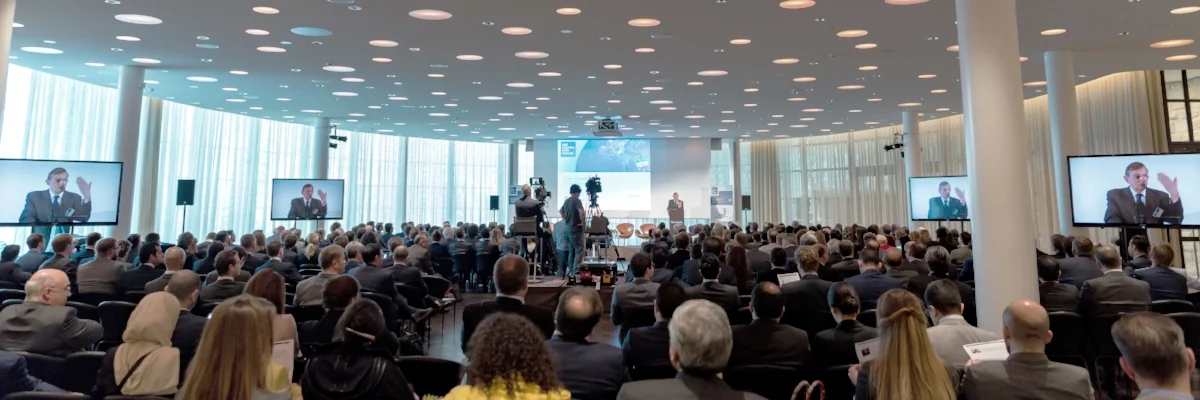
“Davos of Iran” to Convene as Post-Sanctions Trade and Investment Reaches Critical Juncture
◢ European business leaders and policymakers will convene with their Iranian counterparts at a critical time during the 4th Europe-Iran Forum in Zurich on October 3-4, 2017.
◢ The business community will be meeting to set an agenda for trade and investment as the Trump administration signals its skepticism regarding the Iran nuclear deal.
European business leaders and policymakers will convene with their Iranian counterparts at a critical time, setting an agenda for trade and investment as the Trump administration signals its skepticism regarding the Iran nuclear deal.
The fourth edition of the Europe-Iran Forum, which has been called the “Davos of Iran,” returns to the historic Dolder Grand Hotel in Zurich on October 3-4, 2017. The summit is set to be the most significant gathering of Iranian and European business leaders and policymakers to date, demonstrating a clear commitment to the economic dividends of the nuclear deal.
“Multinational companies have now spent two years studying the feasibility of new investments in Iran, and pressure is increasing for long-expected deals to reach the contract stage. Encouragingly, with a number of major agreements signed in the last few months, it seems the commitment to the Iranian market remains strong,” said Esfandyar Batmanghelidj, founder of the Europe-Iran Forum.
“The aim now is for European leaders to work with Iranian partners to find a sustainable agenda for trade and investment with a view to the long term.”
Helga Schmid, Secretary General of the European External Action Service (EEAS) and a key figure in the negotiation of the Joint Comprehensive Plan of Action (JCPOA) will give a keynote speech outlining the European commitment to the nuclear deal and the provision of sanctions relief to Iran in exchange for its verified compliance. This is the first time that the Secretary General, one of Europe’s top diplomats, will address an audience of business leaders on these matters.
The European push for “business diplomacy” will be bolstered by the participation of an unprecedented multilateral gathering of senior diplomats, including the Belgian, British, Danish, Dutch, and Polish ambassadors to Iran.
There will also be strong representation from the Rouhani administration, which is determined to push forward its agenda of economic engagement following a resounding election victory in May and the President’s inauguration on August 5.
Mohammad Khazaee, the Deputy Minister for Economic Affairs and Finance and President of the Organization for Investment, Economic, and Technical Assistance of Iran (OIETAI), will outline the administration’s agenda for monetary policy and regulatory reform. Iran is seeking to make more progress on banking challenges, particularly by improving its compliance with the recommendations of the Financial Action Task Force (FATF), an intergovernmental body that establishes regulatory standards for international finance.
Deputy Minister of Industry, Mine, and Trade Mehdi Karbasian, and Deputy Minister of Foreign Affairs Seyyed Kazem Sajjadpour, will also speak at the 4th Europe-Iran Forum.
Senior business leaders from Iran speaking at the conference include Farzaneh Sharafbafi, the newly appointed CEO of Iran Air and the first woman to lead Iran’s national airline. This will be Dr. Sharafbafi’s first major international address in her new role. Iran Air’s pending deals with Airbus and Boeing, valued at USD $10 billion and USD $17 billion respectively, count among Iran’s most important post-sanctions contracts.
Dr. Mohammad Saeedi, Chairman and Managing Director of the Islamic Republic of Iran Shipping Lines (IRISL), will outline how Iran seeks to modernize its merchant fleet and port infrastructure to keep up with rising trade flows. Iran’s non-oil trade hit nearly USD $30 billion in the four months since the beginning of the Iranian calendar year (March 2017).
Masoud Khansari, President of the Tehran Chamber of Commerce, Industries, Mines, and Agriculture, will detail the ways in which Iran’s private sector has been empowered to drive economic growth across sectors, including those traditionally dominated by state enterprise.
A wide range of panels will discuss how Iran is succeeding in attracting foreign investment through new partnership models. Of particular importance will be a panel on transportation and logistics, with senior representatives from Alstom, Siemens, and Port of Antwerp discussing the holistic regeneration of Iran’s transport infrastructure and the concrete achievements of their companies in the market, in addition to ongoing efforts to mitigate risk and ensure adherence with global compliance standards.
Moreover, several of Iran’s key private equity and venture capital executives will explore how foreign capital has begun to enter Iran, supporting growth within the vibrant private sector.
Omid Gholamifar, CEO of Serkland Invest, a Swedish investment company focused on Iran, and a participant on the private equity panel, notes, “Over the last two years, foreign investors have deployed venture capital in Iran, supporting young digital businesses. Those investments have done well, spurring entrepreneurship and bringing new services to the market. Now investors are beginning to look at more mature companies and these growth capital investments could turbocharge Iran's private sector."
The Forum will also mark the release of a new study measuring business confidence in Iran, commissioned in partnership with noted research firm IranPoll. The first-of-its-kind survey examines attitudes among Iranians towards domestic and multinational businesses, as well as the extent to which Iranians believe that business leaders will deliver on important commitments such as job creation, environmental protection, and innovation.
The 4th Europe-Iran Forum is organized by Bourse & Bazaar in partnership with Adam Smith Conferences. It is supported by KPMG, Dentons, and Manoir Industries among other world-class sponsors.
Photo Credit: Europe-Iran Forum
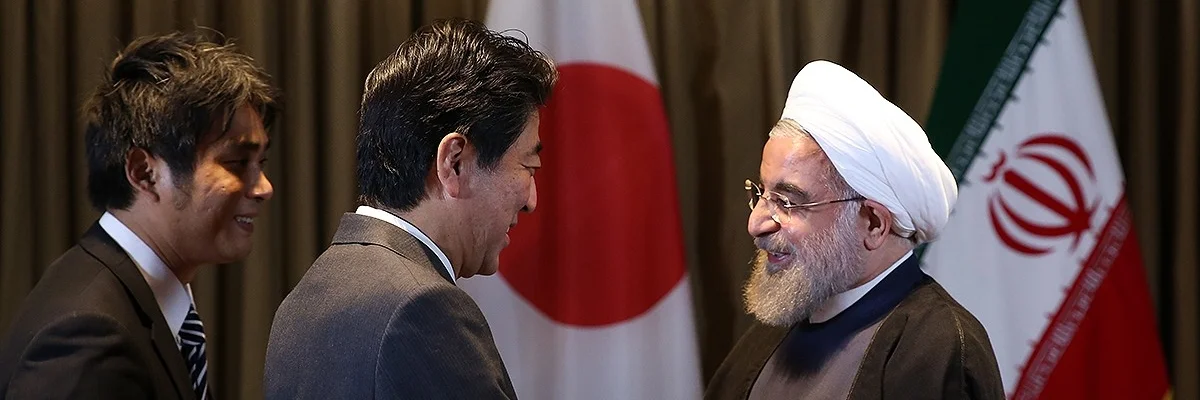
Struggling to Trade With Iran, Japanese Companies Look to European Examples
◢ Japan is one of Iran's major historical trading partners. But Japanese companies have fallen behind European, Chinese, and Korean firms in post-sanctions investment.
◢ Japanese companies are now looking to European firms as they seek to balance political and reputational risks, especially in the absence of a high-level delegation to Iran.
On July 19, Bourse & Bazaar held a round table in Tokyo, part of a global series of meetings being held in advance of the 4th Europe-Iran Forum. This event, hosted by the JIME Center of the Institute for Energy Economics, Japan’s leading Middle East research institute, brought together senior executives from some of the largest Japanese companies to discuss their progress and frustrations in the Iranian market.
Since Implementation Day, Japan has been slowly increasing its economic activity in Iran. Japan has committed to establishing a financing facility worth USD 10 billion to support new investments in Iran by Japanese companies, which have begun to sign new investment contracts across several sectors. Most recently, Toyo Engineering Corporation signed an agreement with Iran’s National Iranian Oil Company to rehabilitate Iran’s Salman oil and gas field in partnership with domestic oil firm Petropars.
However, the pace of post-sanctions trade and investment has lagged behind expectations. Japan was among Iran’s most established trading partners prior to the tightening of international sanctions, and Japanese multinationals have longstanding partnerships in the country. But the rush of activity from European and Korean multinationals has seemingly left the Japanese behind. Japanese executives are asking: “How are the Europeans doing it?” As Trump ups his rhetoric against Iran, and as the GCC crisis continues to roil, Japanese companies are trying to understand and replicate the ability of European multinationals to forge ahead and sign binding commercial agreements in Iran.
On one hand, Japanese companies should be better suited than their European counterparts to crack-open the Iranian market. From a management perspective, Japanese multinationals benefit from tight coordination across sectors and secondarily, a close relationship with the relevant government ministries. The so-called keiretsu, or business groups, link together financial institutions, industrial giants, energy firms, and shipping companies into informal groups that commonly work together in domestic and international markets. Though keiretsu ties are now looser than in their 1990s heyday, bids for large infrastructure or industrial projects by Japanese multinationals are often enhanced by the provision of financing by the main keiretsu bank. At a time when Iran is starved for financing, and while European companies are struggling to enlist major banks for Iran investments, this historic coordination could put Japan in a highly competitive position. Japanese megabanks maintain significant non-dollar financial channels and Iran possesses significant yen-denominated reserves in Japan—proceeds from decades of oil sales.
Yet, coordination is also a curse when the importance of coordination among companies is also reflected within decision-making processes. Japanese companies are managed on the basis of consensus. Approval for decisions is achieved through the process of nemawashi, by which support for an idea is achieved by gathering input and support from a wide range of internal stakeholders. This process both helps explain the impressive track record of Japanese companies in finding commercially successful strategies, but it is also a reflection of the high-degree of caution exercised by Japanese managers, who seek a wide consensus on any given strategy, rather than assume sole responsibility for risky decisions.
Both the aversion to risk and the responsibility for risk pose an understandable barriers when comes to Iran investments. Multiply risk aversion across company departments, and then across the companies within a keiretsu group, and subsequently, the prospects for an Iran investment “green light” grow slim. The Japanese country managers responsible for business development in Iran have the unenviable task of seeking especially broad consensus for key decisions, likely involving a greater number of individuals than in a European corporate context. Consensus-building is further complicated by the fact that the political environment for Iran trade and investment seems to change on a near weekly basis. The longer the decision-making process, the more likely it will be that decision-makers will want to reevaluate in light of recent developments.
Crucially, Japanese management teams are struggling to build consensus around new investments in Iran in part because of lack of political support. The largest Japanese enterprises are in regular communication with organizations such as the Ministry of Economy, Trade and Industry (METI), the Ministry of Foreign Affairs, and the Japanese External Trade Organization (JETRO). Each of these organizations boast staff with deep knowledge of the Iranian market and experience executing large agreements that is perhaps even deeper than among the equivalent European agencies. But Japan, unlike Europe, has yet to set an overarching policy regarding renewed economic ties in Iran, rendering this coordination with government inert.
The lack of high-level political support remains the primary difference between the recent experiences of European and Japanese enterprises in Iran. Japanese Prime Minister Shinzo Abe was scheduled to travel to Iran in August 2016, only for the trip to be delayed over concerns that Japan’s first such visit since 1978 could sour possible ties with Donald Trump, who was growing resurgent in the U.S. presidential elections at the time. While Rouhani and Abe did meet on the sidelines of the United Nations General Assembly in October 2016, a high-level state visit to Iran is now on indefinite hold. Trump's eventual triumph saw Abe become among the first world leaders to visit the new president, in February of this year. While numerous European heads of state have traveled to Iran in the last two years, offering valuable political support to their engaged companies, Abe’s lack of a clear stance leaves Japanese companies exposed to possible reputational risks in the United States possibility even at the hands of Trump himself.
Second, Japan’s government and Japanese companies are contending with political pressure from Saudi Arabia and the United Arab Emirates. While Iran was Japan’s largest exporter of oil up until the tightening of international sanctions in 2012, Iranian oil imports were replaced by imports from Saudi Arabia and the United Arab Emirates. Recent data from the Petroleum Association of Japan shows Saudi and UAE oil accounting for a combined 70% of the country's imports.

The governments of Saudi Arabia and the United Arab Emirates have used this energy dependence to send a clear message to Japanese companies regarding Iran: “It is us or them.” This pressure explains in part why Japan’s oil imports from Iran in 2017 are down 51% on the previous year. Japanese companies report being pressured not to invest in Iran, at the risk of losing major contracts in Saudi Arabia and UAE. European companies have also been subject to similar pressure from Saudi and Emirati authorities, but have been more effective in pushing back on false ultimatums. In a recent investor call, Total CFO Patrick de la Chevardiere disclosed that the company had informed its Saudi partners about its intention to sign a full agreement to develop Iran’s South Pars Gas field.
Absent more direct political support, Japanese companies may remain frustrated in their attempts to engage Iran’s investment opportunities more aggressively. But there are a few strategies that could help create basic momentum behind investment plans while still mitigating risk.
First, Japanese companies need to take the keiretsu mentality and use it to create consortia with European firms. European companies have already sought partnerships with Chinese financial and industrial partners to help spread the risk of projects in Iran. Japanese multinationals should more actively position themselves as possible partners for such arrangements, particularly given that Japanese companies already operate substantial business units or joint-ventures in Europe with many of the European companies engaged in Iran.
Second, Japanese companies should be more creative in seeking ways to build credibility and stakeholder relationships in Iran. European companies, cognizant that significant investments would take a long time to move from initial discussions to binding contract, have used smaller projects to help demonstrate their commitment to the market while negotiations are ongoing. One compelling example can be seen in the case of French carmaker Renault, which has provided hardware and expertise to support the study of electric vehicles by students at Azad University. Japanese companies, which lead the world in many technologies, would be well-positioned to devise similar knowledge transfer projects in Iran. Such efforts who help build stakeholder relationships and also provide Japanese companies early examples of corporate social responsibility in Iran that can be used to help mitigate reputational risk.
Japanese ambitions in Iran may remain constrained by politics for some time. But Japanese multinationals can and should remain committed to the market, seeking creative solutions to remain present and active. Ceding market share to European, Chinese, and Korean multinationals would prove a strategic blunder, particularly as cooperation remains a viable option.
Photo Credit: IranThisWay
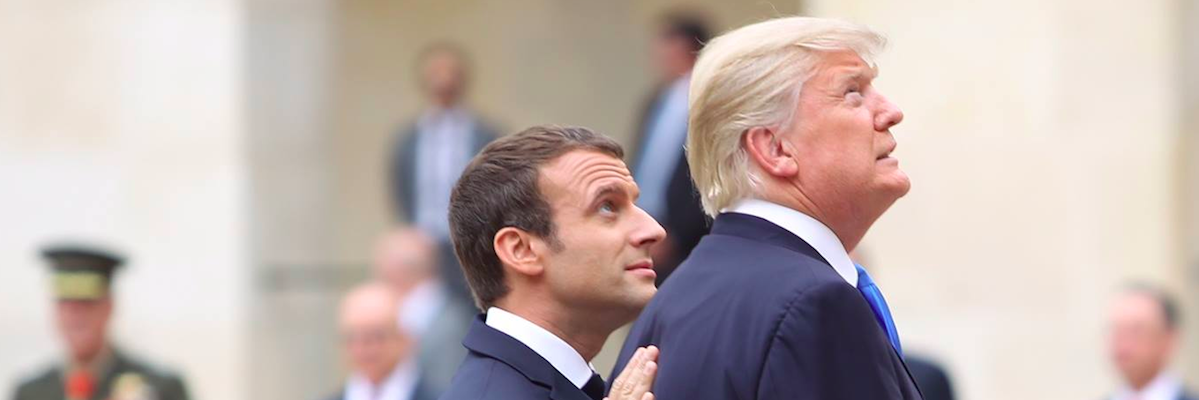
Is France Ready to Stand Up to Trump on Iran?
◢ With new U.S. sanctions on Russia and Iran set to come into force, the French Foreign Ministry issued a firm statement suggesting new U.S. sanctions could contravene international law.
◢ While Germany is likely to lead on the push back against additional Russia sanctions, the importance of the Iranian market to French enterprise may mean that Macron is best positioned to intervene with Trump to help preserve the JCPOA.
This article was originally published in LobeLog.
On July 26th, the French foreign ministry issued a declaration about the package of new sanctions targeting Russia and Iran making its way through Congress to President Trump’s desk in the Oval Office.
In the estimation of the French foreign ministry, “the extraterritorial scope of [the sanctions] appears to be unlawful under international law.” The statement outlined the need for the Europeans to “adapt our national mechanisms and update European mechanisms” to protect themselves from the U.S. legislation. The French foreign ministry called for coordination with European partners to address American overreach.
Although Germany is likely to lead the fight against additional Russian sanctions because of its reliance on Russian energy supplies, the French are likely to lead on the European pushback on new Iran sanctions, and even more urgently, to advocate for the preservation of Iran nuclear deal, otherwise known as the Joint Comprehensive Plan of Action (JCPOA).
In a recent interview with the Wall Street Journal, Trump stated, “If it was up to me, I would have had [Iran] noncompliant 180 days ago.” Subsequent reports suggest that the administration may be seeking additional access to Iranian nuclear sites. The combination of Trump’s statement and the rumored actions has put the survival of the JCPOA at risk.
France as Lead Investor
For the French, the timing of the new Iran sanctions and Trump’s statements on the nuclear deal are especially troubling. French companies have reached important milestones in the past few weeks that could be jeopardized if political uncertainty begins to undermine business confidence.
On July 3, French energy giant Total signed a landmark $5 billion contract to develop Iran’s South Pars Gas field. Twenty days later, French transportation company Alstom signed a major joint-venture agreement to produce metro carriages in Iran. French carmaker Renault is expected to conclude its long-awaited contract defining the operation of a full-fledged Iran business unit in the next week. At the same time, a steady stream of smaller French investments have brought activity to other corners of Iran’s economy. Sushi Shop, a French fast-casual restaurant chain, opened its first branch in Tehran this week. Add to this Airbus and ATR’s sale of aircraft to Iranian airlines, the mooted market entry of telecommunications giant Orange, and the local expansion of hospitality giant Accor, and the scope of French enterprise is quite large. For France, Iran is a cornerstone market, a rare country where French companies have market-leading positions in strategic sectors.
The success of French enterprises in Iran is a crucial part of France’s program to boost its global competitiveness. In a recent interview, French Minister of Foreign Affairs Jean-Yves Le Drian, noted France’s dismal trade deficit, amounting to 48 billion euros in 2016. Le Drian drew a comparison to France’s European neighbors: “France suffers from a lack of exporting companies: there are only 125,000—half of which work with only one country. We aren’t competitive enough in this respect.”
Le Drian was no doubt referencing the export prowess of Germany. This prowess also explains the differing positions of Germany and France vis-a-vis Iran. Despite being Iran’s largest trading partner prior to the imposition of sanctions, Germany sees Iran as only a part of a wider portfolio of trade partners, one of which is the United States. Tellingly, the value of German exports to the US was $114 billion in 2016, whereas French exports were valued at just $47 billion. The respective 2016 export figures for Iran are 2.9 billion euros for Germany and 1.7 billion euros for France. So, although French trade to the US dwarfs the total value of French trade with Iran, in relative terms, Iran is a more important market for France than for Germany.
This is especially true for foreign investment. French companies are increasingly establishing majority-owned business units in Iran. These units, when they become revenue generating, will deliver significant shareholder value. The best example of this is Peugeot, whose sales in the first half of 2017 dipped in both Europe and China, only to remain positive overall because of strong performance in Iran. Importantly, Peugeot does not sell cars in the United States. Although Peugeot may be an extreme case of reliance on the Iranian market, Iran-based revenues can certainly deliver increased shareholder value to French companies.
For Emmanuel Macron, who faces a massive task in revitalizing French business, the economic boon of the Iran deal will prove strong incentive to advocate for its preservation over and above the fundamental security gains that the deal was able to achieve.
France as Deal Saver?
Although coordinated action from all European allies will be necessary to convince the Trump administration to stay the course with the deal, which the international community believes to be working, France may be the country best positioned to lead on the issue. There are a few reasons why.
First, Macron has spent a considerable amount of time with Trump both in Washington and Paris, and has developed a personal relationship that constitutes, if not out-and-out rapport, then at least a kind of understanding between two self-styled “alpha males.” This relationship should give Macron the chance to appeal to Trump more directly, not necessarily relying on communications via his fractured circle of advisors, for whom Trump has “great respect” but to whom he may not listen.
Second, the timing for French leadership on the issue is right. Macron remains energized by his recent election triumph, and one recent study has seen France rise from fifth to first in a world-ranking of soft power, due to both Macron’s popularity and the influence of France’s diplomatic network. Both qualities would be brought to bear in any multilateral outreach to preserve the Iran deal in Washington. Moreover, Germany’s Angela Merkel and her government are set to enter an election contest in September, monopolizing attention during this critical period of equivocation from Trump. It would also be wise to separate the advocacy on Russia and Iran sanctions issue given the complicated ways in which the political circumstances of the two countries are both related and unrelated.
Finally, France could prove the most credible advocate for the Iran deal in Europe, since it was the toughest of the European negotiating parties of the JCPOA. Laurent Fabius, the then-French foreign minister, was seen as a potential spoiler of the deal given the firmness of French demands. The French insistence on strict Iranian adherence to the deal was underscored when Macron emphasized the point in his phone call congratulating President Hassan Rouhani on his reelection. Moreover, to the extent that the conversation around Iran’s non-compliance has been conflated in Washington with a discussion of regional security issues like support for terrorism, French intervention could be key. France is the European country most engaged on confronting global terrorism and could credibly mediate between Iranian and American political and military leaders around some of these issues.
Whether or not Macron and his team are ready to spend the time and energy to safeguard the deal is yet to be seen. But like Trump, Macron needs to show that he is “winning.” French businesses are winning in Iran right now, and the loss of the deal could mean the loss of a significant market once more.
Photo Credit: Wikicommons

We Shouldn’t Defend the JCPOA at the Expense of the Iran Deal
◢ The JCPOA has now persisted for two years, and Iran is beginning to see post-sanctions benefits. But American support for the deal is wavering, and deal supporters in Washington have upped their advocacy.
◢ But deal supporters often describe the JCPOA as an unusual concession from an otherwise threatening Iran, a characterization that undermines much of what the Iran Deal has achieved so far.
This article was originally published in LobeLog.
On the two-year anniversary of the agreement, U.S. supporters of the Joint Comprehensive Plan of Action, including many former Obama administration officials, are admirably working to defend the deal through media appearances and coordinated statements. Their message that “diplomacy works” is an important one at a time when America’s global leadership seems in doubt.
However, the rhetoric in Washington defending the JPCOA remains problematic, because it pursues the preservation of the deal in a way that undermines the unfolding detente between Iran and the international community.
On Morning Joe, former Secretary of Energy Ernest Moniz, noted that the Iran deal has eliminated the “existential threat” posed by a nuclear Iran, echoing similar language used by Secretary Kerry and other members of the Obama administration to support the deal since 2015. Similarly, Colin Kahl, another former Obama administration official, has argued in a piece in the New Republic that “If Trump exits the agreement, the prospects of a nuclear-armed Iran—or a major war to head off that outcome—would increase.” Moreover, these risks of escalation are amplified when deal supporters argue that Trump is already in breach of the Iran deal, and that these breaches are part of a concerted effort by hawks to bait Iran into conflict.
Although they seek to demonstrate the efficacy of the JCPOA, these arguments also work to confirm the demonization of Iran peddled by those opposed to the deal. The diplomatic triumph of the JCPOA is cast as directly proportional to an Iranian threat described in nearly essentialist terms. For example, the argument that the collapse of JCPOA would immediately prompt Iran to pursue a nuclear weapon suggests that it’s impossible for Iran’s leadership to choose any other strategy in response to a US withdrawal from the agreement. The argument gives the US full agency to tear up the deal but denies Iran any agency to choose not to proliferate. It also ignores the importance of the other parties to the JCPOA.
Relying on the received wisdom of Iran’s perennial threat to underscore the importance of the JCPOA is perhaps the most politically palatable way to defend the deal in Washington. But it also demonstrates that the talking points around the JCPOA have not significantly advanced in two years. The stagnant rhetoric also reflects a fundamental misunderstanding of how the other members of the P5+1 see the JCPOA.
What American deal supporters and opponents alike fail to recognize is that the JCPOA and the Iran deal are not the same thing. The difference is best described through the lens of basic game theory. Whereas the JCPOA was just one “round,” the Iran deal describes an ongoing “game.”
The Prisoner’s Dilemma
When focusing on the JCPOA alone, American deal supporters find themselves essentially defending the agreement as the unlikely outcome of a situation akin to the traditional prisoner’s dilemma. They suggest that although both the US and Iran had reasons to defect in the “game” of the negotiations to win the upper hand, the two sides decided instead to choose mutually beneficial cooperation—what the Iranian’s called aptly the “win-win” solution.
But this conception of the JCPOA completely misses the full scope of the game that Iran, Europe, Russia, and China are currently playing. The JCPOA is not the final payout of a prisoner’s dilemma-type game. It is rather just one round, which marks the beginning of a long chain of iterated negotiations that can be collectively called the “Iran deal.” As we have seen since July 14, 2015, Iran has been engaged in a multiplicity of new negotiations in both political and commercial spheres. That Iran is successfully engaging in an integrated game with numerous actors also shows that Iran deal supporters in Washington are misconstruing the agency of Iran as a rational player in the game.
When actors enter into an iterated game, the incentives around defection or cooperation change completely. If one side knows that defecting in one round of a game is likely to lead to punishment in the next round, the cost of defection goes up. Rational actors are expected to cooperate more often in games with a large number of iterated interactions. For Iran, reciprocating any American escalation would mean defecting from the constructive path it has taken with other players in the international community. On this basis, not only is the argument that Iran will necessarily reciprocate American escalation dubious, but it also ignores the fact that the costs of escalation for Iran are much higher now, particularly because Iran is cooperating fruitfully with so many other actors in the international system.
A tendency towards cooperation is evident in the quick warming of ties between Iran and other global powers over the last two years. The JCPOA launched a new “game” in which an expanding pool of players could adopt strategies of mutual cooperation, leading to positive outcomes. This includes everything from relaxed visa requirements and educational exchanges to the much-heralded commercial contracts from the likes of Boeing, Airbus, and Total. As the wider Iran Deal continues to fulfill its promise in each successive round, trust builds and the optimal strategy of mutual cooperation is reinforced.
The risks of defending the payout of the round while harming the overall game are clear. By using the risk of escalation, proliferation, and conflict to justify adherence to the JCPOA, its supporters in the United States are undermining both the logical and empirical basis for a more cooperative political strategy from Iran. The “deal-or-war” narrative makes it harder for Americans to see the JCPOA as anything more than an exceptional political concession from Iran rather than an instance of an increasingly clear pattern of rational and constructive behavior. In this sense, JCPOA supporters are deploying arguments that could even give further credence to the popular American conception of Iran as a country that can only act as a rogue state, regardless of the particular government in power or the tenor and type of policies that the government consistently adopts in consideration of myriad internal and external incentives.
Remember Europe
Finally, American supporters of the JCPOA need to be careful not to undermine European advocacy around the wider Iran deal. The approach taken by JCPOA supporters in Washington overstates the centrality of the United States to the success of the Iran deal at large. As Federica Mogherini reminded her American counterparts in comments this week, “The nuclear deal doesn’t belong to one country, it belongs to the international community.”
No doubt, if the U.S. pulls out of the agreement, domestic political forces in Iran could interfere with President Hassan Rouhani’s agenda for international engagement. But the multiplicity of actors involved in subsequent rounds of the Iran deal mean that Iran will retain strong incentives for cooperation with these other players even in the face of US escalation. This is why the Europeans have chosen to advocate for the Iran deal in Washington on the basis of the moderating impact of political and commercial engagement.
American deal supporters need to make sure their advocacy remains consistent with this message, which ultimately reflects the more salient explanation for the continuing success of the JCPOA. Harping on fears of a regional conflagration further conditions American politicians to think Iran cannot see the horrendous costs, now rising, of such a political failure, and this conditioning could thereby undermine receptiveness to the empirical evidence of moderation offered by the recent European experience with Iran.
Ultimately, game theory teaches us the importance of trust. Those who supported the JCPOA as it was being negotiated clearly trusted their Iranian counterparts to stick to their word. The defense of the deal should better reflect this spirit.
Photo Credit: Wikicommons
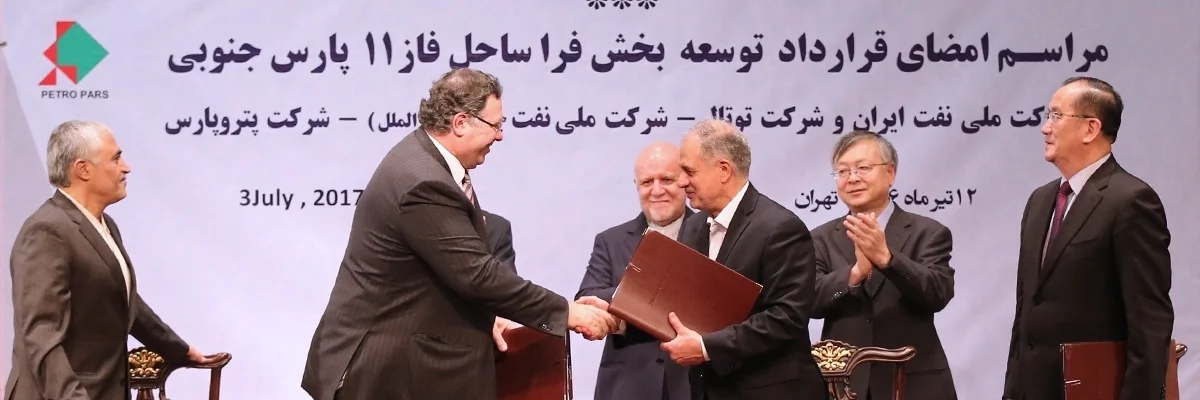
Country Managers Are Making Post-Sanctions Iran Work
◢ Behind every successful multinational deal in Iran is a country manager. These executives seek to balance the commercial goals of their companies with the needs of Iran's post-sanctions economy.
◢ Country managers are a critical link in what is essentially a bureaucratic system. Policymakers need to help make this bureaucracy work better with better rules and systems so that country managers can succeed.
This article was originally published in LobeLog.
On July 3, Patrick Pouyanné, the imposing, former rugby-playing CEO of Total, arrived in Tehran to sign a landmark $5 billion contract to develop Phase 11 of Iran’s South Pars gas field in cooperation with the China National Petroleum Corporation and Petropars, an Iranian firm. The deal was a sign of Pouyanné’s ambition and resolve in the face of the Trump administration’s rhetoric towards Iran.
But the credit for the deal should not go to Pouyanné. Behind every CEO who travels to Iran to sign a deal, there is a “country manager” who paved the way. In the case of Total, it is Eric Festa, whose formal title is managing director for Iran. Erik is one of a small but growing brigade of country managers who are on the front lines of Iran’s post-sanctions economy.
These country managers are tasked to conduct business in a market, which multinationals euphemistically classify as a “growth market” or “development market.” The country managers typically assigned to Iran have experience operating within other similarly complex markets. Most country managers do not have Persian language skills, though some companies have assigned diaspora Iranians to the role. Country managers are chosen for their understanding of the need to balance relationship-based business with strict attention to issues of risk management and compliance. They also tend to have something of a taste for adventure and a willingness to adapt to a new business culture. Some have relocated to Tehran, but most travel in and out of the country every few weeks.
“Country manager” is a grab-bag term. As a rule of thumb, the formal job title of the country manager reflects the stage of the multinational corporation’s investment in Iran. At the earliest exploratory stage, the individual could merely be a head of a project office. As the commitment to the market grows, the job gains more authority, and “country manager” becomes the more common title. As the business moves to a rollout phase, the title is commonly elevated to a corporate vice president role where the individual is also the director of the Iran business unit. For the multinationals with the most advanced investments, such as a dedicated subsidiary or joint venture, a CEO or managing director with significant autonomy and authority often leads the Iran business, overseeing a staff in the hundreds.
The Western policy community has devoted significant time and resources seeking to locate influence within Iran’s political structure, often using its byzantine nature as an excuse to declare, for reasons of expediency rather than clear evidence, that a certain individual or office is the most powerful. Yet, far less attention has been given to the organizational structures that govern the flow and operation of post-sanctions international capital into Iran.
A Useful Bureaucracy
Country managers are the critical actors behind post-sanctions investment in Iran, but they remain essentially invisible in the structure and organization of that trade. It is telling that there exist more flowcharts explaining political decision-making in Iran than commercial decision-making.
The consequence of this blind spot is an inherent distortion in the way power and influence in Iran are understood. This distortion is particularly acute given the status of economic development as the fundamental political priority across Iran’s political spectrum. This economic development hinges on the success of country managers in balancing the commercial directives of their companies with the political and practical needs of Iran’s industries. At the moment, most analyses of Iran’s post-sanctions political economy presuppose that Iranian power brokers such as members of the Revolutionary Guard are unilaterally setting the terms for commercial activity. But in reality, the process of post-sanctions trade and investment is an ongoing negotiation in which country managers have meaningful leverage: the ability to withhold much-needed foreign investment.
On this basis, a full assessment of power and influence in Iran today must account for the role of the country manager. Max Weber, when he long ago posited the concept of the bureaucracy, dispelled the idea that state administration and industrial administration were distinct. Not only are the administrative methods of the state and industry effectively the same—reflected both in the technocratic tendencies of Iran’s political class and in the emergence of multinational corporations as so-called “private empires”—but the execution of large-scale trade and investment also requires the functioning of a single overarching bureaucracy involving governmental and corporate actors from both the domestic and foreign spheres. Country managers, who serve as the administrative link between these two spheres, are the central bureaucrats of post-sanctions trade and investment in Iran.
The bureaucratic nature of trade and investment, which favors rational, technical, governable, and stable decision-making, also makes the attendant processes inherently vulnerable. Although country managers may be quite influential in Iran, none would ever boast about their power or influence. Like most bureaucrats, they feel beholden to systems much greater than themselves. Iran ranks low in ease-of-doing-business, and by no means are its domestic state or industrial bureaucracies efficient. Iran’s post-sanctions reintegration with international systems for enterprise and finance has proven difficult, and country managers experience these myriad challenges firsthand.
Strengthening the Bureaucracy
To improve the expected outcomes associated with the new influx of trade and investment in Iran, the policy community that supports constructive engagement must do more to empower country managers by addressing vulnerabilities in the bureaucratic structure in which they operate. Interventions are needed on a few fronts.
Continuing to borrow from Weber, a bureaucracy depends greatly on its legitimacy. Country managers struggle to position themselves as effective negotiators because they have a difficult time signaling that their leverage within the given commercial negotiations matters. This leverage centers on the notion that country managers can withhold the investment of their multinational companies if terms are not attractive. However, so long as a narrative persists that other political forces may prevent that investment anyway, the country manager has little to no leverage. It is not the case, as some suggest, that political uncertainty is making Iranians desperate to strike deals. Iranians see little reason to engage in reforms and offer more favorable terms when the payoff is not certain. This fact explains why European governments have devoted so much effort to tightening the coordination between government and commercial actors in regards to Iran. The creation of a credible political commitment has been fundamental to the strengthening of the negotiating power of the country managers. Importantly, in this regard, European ambassadors serve as a kind of political partner to the country managers in Iran.
However, the effort to legitimize trade and investment in Iran has its limitations. The permissibility of trade and investment in Iran is no longer primarily a question of legitimacy. Although the legal basis for post-sanctions trade provides a rational, legal authority for those who wish to pursue that business, there remains a “fear factor” associated with Iran that is sometimes inherently irrational. Policymakers have been hesitant to engage concerns around the perceived moral dubiousness or danger of engaging commercially with Iran, perhaps because they see these matters as reflective of a fraught emotional politics. But there needs to be a greater understanding that these emotional issues have a direct bearing on the ability of Iran trade and investment to become more fully bureaucratic, and thereby more fully constructive. Unless steps are taken to provide assurances on the permissibility of trade and investment beyond the basic question of legality, the fuller picture of legitimacy will never be addressed, and therefore bureaucratic actors such as country managers will always remain hamstrung, unable to fully articulate the legitimacy of a proposed engagement to key stakeholders. They will constantly struggle to relay their on-the-ground knowledge of Iran to decision-makers whose impressions are shaped by threatening headlines.
The country manager must also be empowered with a rational commercial framework in which to operate. The rules that govern trade and investment in Iran remain relatively disorganized. Lingering issues around international sanctions and Iranian regulatory frameworks alike mean that companies need to continually evaluate the rules of engagement. As such, country managers who play roughly the same role within the companies across national affiliations and across industrial sectors find themselves spending inordinate amounts of time simply clarifying the rules for their own specific commercial activities.
The most significant example can be seen when multinational corporations seek a specific license for their Iran business activities, principally from the U.S. Office of Foreign Assets Control. With this licensing policy, the U.S. political establishment is using its tools of administration to exercise jurisdiction over the bureaucratic function of European trade and investment. One bureaucracy is undermining another for the ostensible purpose of protecting security interests. But in forcing Iran trade to be less bureaucratic, less regular, and less basically normal, the policy is counterproductive.
Although general licenses are meant to set non-specific, system-wide rules about the administration and operation of business in Iran, persistent ambiguities prevent the creation of a standard practice that establishes such rules. Add to this the reputational issues around engaging with Iran and the rationale for business in Iran remains a very personal decision, dependent on the resolve and risk appetite of the country managers and their superiors. On the Iranian side, a similar personal dynamic exists. The acceptability of a commercial arrangement is based to a large extent on the strictness with which key stakeholders, such as Iranian ministers or commercial partners, apply formal regulations (such as protectionist laws) and uncodified expectations (such as political resistance).
Defining Best Practices
To address both jurisdictional interference and the personal contingency of trade and investment, European governments and industrial companies must develop a more rigorous set of standard practices that establish the rational rules for engaging with Iran. To do so, far greater effort must be spent on policy research to devise and implement best practices for Iran. Just as few studies have been made to locate domestic and foreign commercial actors within Iranian power structures, little research is being conducted to examine issues of industrial policy, economic planning, and management practices within the Iranian context. Relatively few events and forums bring country managers into dialogue with experts who can help define best practices.
The existence of best-practice rules and guidelines will also improve the bureaucratic operation of trade and investment in Iran by making individual country managers more dispensable. At the moment, the entrepreneurial nature of the role means that when country managers leave their post, the learning curve for their successor is especially steep. This “key person risk” prevents the smooth functioning of trade and investment. Iran will struggle to see adequate trade and investment if deals rely too much on the quality of the individual country manager or the administrative wherewithal of the particular company. Although Total may have been the first international oil company to sign a post-sanctions contract precisely because of the company’s unique strengths, the success of post-sanctions investment depends on the emergence of durable, sector-wide competencies.
Over all, the ability for country managers to facilitate economic development in Iran that is both great in magnitude and constructive in impact will depend on the ability for trade and investment in Iran to operate along more regularized and bureaucratic lines. To do so, policymakers must recognize the central role played by country managers in the legitimization and rationalization of commercial engagements with Iran. It is easy to take bureaucracy for granted. But in the delicate effort to improve the political and economic administration of Iran’s post-sanctions trade and investment, success must be systemic.
Photo Credit: Total
Telepizza's Arrival in Iran Shows Supersized Ambition
◢ The arrival of Telepizza, a global fast-food brand, is a significant development for Iran's food service sector.
◢ The terms of the master franchise keep economic dividends in Iranian hands, and the new entrant will likely spur new investment and improvements in offerings across the sector.
In 1990, during the final year of the Soviet Union, McDonald's opened its first branch in the country, choosing a landmark location in Pushkin Square in Moscow. On the first day, nearly 30,000 customers passed through the doors.
Telepizza, an international fast-food pizza chain, opened its first Tehran location last week. While the opening did not see quite the same fanfare as arrival of McDonald’s in the USSR, the launch is nonetheless significant.
As many articles have emphasized, Telepizza is the largest non-American pizza brand in the world by number of stores (about 1,500). But the Spanish company, which is targeting Iran as part of an ambitious global rollout plan, is one of the first globally-recognized restaurant brand to enter Iran, which has until recently had to make do with cheap imitations such as “Pizza Hat” and “Mash Donalds.”
The arrival of Telepizza follows the awarding of a master franchise agreement to Momenin Investment Group, a little known firm registered in the UK but with Iranian ownership. MIG has committed to spending EUR 100 million over 10 years in an Iran market rollout. The size of the investment makes it clear that Telepizza and MIG are aiming to dominate the market.
The fast-food sector in Iran is among the most attractive for investors, who see a large middle class with growing spending power. Today, Iranians spend about USD 7 billion annually in restaurants, of which about one-third is spent on fast-food. This expenditure is likely to double in the next decade.
To meet demand, there are about 20,000 fast-food outlets in the country, but scale has remained elusive for any single brand. The largest fast-food operators in Iran, including brands such as Haida and Boof, operate around 50 locations each. In many respects, the fractured food service sector reflects similar dynamics in the food retail sector.
It can be tempting to see the absence of major fast-food brands in Iran as a mark of Iran’s resistance to neoliberalism and the attendant exploitation. The prospect of Iranians spending their hard-earned Rials on foreign pizza is seen by many as anathema to the promise of an independent, self-sufficient Iran.
But Iranians, like most people around the world, want to enjoy the occasional pizza. They naturally deserve the best pizza at the best price. The simple fact that no Iranian fast food chain has gone on to dominate the world, suggests that there are improvements to be made in the domestic offering.
Encouragingly, the Telepizza deal keeps Iranians in charge of their own fast-food future. Whereas the McDonald’s in Pushkin Square was company-owned (the “Golden Arches” made its first franchise agreement in Russia in 2015), Iran’s Telepizza locations will all be owned and operated by MIG. This means that the Telepizza deal is consistent with the longstanding pattern of cooperation between Iranian and multinational enterprises.
Across sectors, Iranian companies have typically sought foreign assistance in technology and operations to enable more successful domestic production. Examples include IKCO’s manufacturing of French cars, Sahar Dairy’s manufacturing of Danone Products, and NIOC’s production of oil with Shell’s technology and expertise.
A similar dynamic underpins the Telepizza deal. Domestic fast-food operators in Iran have struggled to ensure efficient supply chains, intuitive inventory and sales technologies, robust brand protection, and winning management practices. This has made scale all but impossible to achieve.
These areas are precisely where a franchisor like Telepizza can offer support. Telepizza offers MIG access to unique intellectual property in the form of the food menu and branding and marketing collateral, as well as providing assistance in creation of a supply chain, training for management and staff, and implementation of key technologies for ordering, sales, and delivery. They also bring the experience of successful rollouts in other complex markets.
If Telepizza and MIG can adapt the global formula for success to the Iranian market, the food sector at large will be jolted by the new and highly-competitive entrant. This should see other fast-food chains in Iran driven to improve their product, and it will also encourage further foreign and domestic investment in the sector. Outcomes include consolidation among existing players and a diversification of the market offering for consumers.
Moreover, consolidation in the fast-food sector around a few key brands will also mean consolidation of buying-power for the food products that go into each pizza, hamburger, or burrito. Today, McDonald’s in Russia purchases most of its supplies from domestic producers. The fast-food chain’s growth was a major contributor to consolidation and expansion in Russia’s agricultural sector. A similar outcome could be expected in Iran, where large-scale farms remain rare, leading to inefficiencies across the value chain.
While the prospect of increased competition and purchasing power leading to better market offerings is consistent with the neoliberal doctrine, it is important to note that both ownership and labor will likely remain in Iranian hands. Under a master franchise agreement, the franchisor (Telepizza) would typically be entitled a recurring franchise fee and a percentage of profits, but MIG is the owner of the Iranian company and the principal beneficiary of profits. It is MIG's entrepreneurial skills that will be tested as the brand seeks to expand.
Additionally, and perhaps most importantly, expansion in the fast-food sector is a job creator precisely where Iran needs it most. Such stores typically hire younger employees who are attracted to the flexible, shift-based work schedule. Lack of significant growth among domestic players means that possible job creation has gone unrealized.
For young Iranians seeking their first jobs, or trying to make some additional income while pursuing their studies, the type of work on offer at a fast-food restaurant could prove ideal. After all, many of the world’s greatest entrepreneurs got their start delivering pizzas.
Telepizza's supersized ambition in the Iranian market might only be matched by the ambition of these yet-unheralded pizza delivery men and women, waiting for their chance.
Photo Credit: Telepizza
Long-Awaited Total Deal Signals Rising Investor Confidence in Iran
◢ On Monday, Total will sign a long-awaited USD 5 billion deal to develop Iran's South Pars gas field, becoming the first international oil company to commit to a post-sanctions investment.
◢ The Total deal indicates rising confidence that political and banking challenges can be addressed, and the contract signing will likely buoy investor confidence across sectors.
On Monday, Total will sign a long-awaited contract to develop Iran’s South Pars gas field in cooperation with China National Petroleum Company and Iranian firm Petropars. Total has been involved in developing the South Pars project since 1997 when it was the first international oil company to be awarded a contract following the Islamic Revolution. The landmark deal, which sees Total committed to a 20 year development roadmap, is valued nearly USD 5 billion. Total's share is 50.1%.
The announcement of the contract signing ceremony follows eight months of deliberations since the heads of terms was signed in November 2016. In the intervening period, Total has had to navigate a changing political environment, stubborn banking challenges, and wavering investor confidence. The move to conclude the contract signals positive developments in each of these three areas.
Total CEO Patrick Pouyanné, who has shown some bravado by speaking publicly about this deal as it progressed, had stated in February that progressing to a contract was contingent on the U.S. continuing its implementation of secondary sanctions relief as part of the Joint Comprehensive Plan of Action (JCPOA). With the increasingly hostile rhetoric of the Trump administration, continued sanctions relief had remained in doubt. But the administration has since confirmed Iran's compliance with the JCPOA and issued the relevant sanctions relief waivers in mid-May. Just a few days later, Iranian president Hassan Rouhani won a landslide reelection, solidifying his mandate to pursue international engagement and investment.
Total will also feel secure in the fact that European government leaders have been very vocal in their support for Iran and the nuclear deal. Federica Mogherini, Theresa May, Angela Merkel, and a host of European ambassadors have strongly advocated that the US stay the course with the nuclear deal both at the White House and on Capitol Hill. Looking together at these factors, Total must feel confident that the political environment remains conducive to the company's long-term investment in Iran.
At a more practical level, Pouyanné had acknowledged in April that Iran’s as-of-yet unsolved banking challenges were an impediment Total’s investment. The hesitance of international banks to provide financing or facilitate the recurring transactions necessary for day-to-day business in the country required Total to make a special effort to find its own solution. Pouyanné disclosed that Total was testing a new banking mechanism to get money in and out of Iran in a compliant way. This likely means that a medium-sized bank, probably French, has carved out a channel for Total to transfer funds to Iran without involving U.S. persons or U.S. dollars, thereby avoiding a so-called “U.S. nexus.”
While major European banks remain hesitant to do this kind of creative banking for Iran transactions, boards of directors are showing an increasing willingness to make exceptions on behalf of their largest clients and at the behest of national governments. Total's move suggests that the banking channel they created works, and this fact may help other large firms in their negotiations to receive banking facilities for Iran business.
Finally, Total’s contract signing will no-doubt boost confidence across sectors among both international and domestic investors. While Boeing and Airbus have notably concluded major contracts prior to the Total deal, the agreements for the sale of aircraft represent large-scale trade. The Total deal, which involves direct ownership and operation of physical, immovable assets in Iran, is true foreign direct investment with all of the attendant risk. That Total is proceeding is even more impressive considering the company will not start seeing revenues until 2021, when it has committed to bringing the first new gas to Iran's large domestic market.
Additionally, proceeding to a full contract reflects that Total was satisfied with the terms of Iran's new standard oil and gas contract, known as the IPC contract. While Total’s clear desire to be the first-mover in Iran’s energy sector has meant that they have been somewhat more willing to overlook the known deficiencies in the IPC model, fear of missing out may see peer companies like Shell, Eni, and OMV decide to press forward with their own investment plans within the existing IPC framework.
For Iran, the true value of the Total deal lies outside the oil and gas sector, which only accounts for about one-fifth of the country's economy. Rather, it is the investor confidence furnished by the Total deal, which will spur activity in other areas like infrastructure, transport, pharmaceuticals, and FMCG, that will really move the needle. Investors in these sectors will no-doubt welcome the deal as the sign of a rising tide.
Photo Credit: Wikicommons
