
To Save the Iran Deal, Unleash the Auditors
◢ The Obama administration is weighing its final possible measures to strengthen the Iran Deal before President Trump has a chance to make his mark.
◢ Improving transparency in the Iranian economy would have the most immediate impact on the continued viability of sanctions relief. US policy must make it easier for global consulting and auditing firms to work in Iran.
As President-elect Trump begins to assemble his cabinet, the initial panic around the survival of the Iran Deal has given way to discussions about how exactly deal supporters can work to preserve its achievements. With several vocal opponents of the deal now suggesting that the JCPOA agreement may not be slated for immediate destruction, a window has opened to strengthen and protect the processes of implementation.
In Washington, there is just enough time for a few final executive actions to be taken in order to support implementation of the Iran Deal, and the Obama administration is currently weighing its options. The administration must strike a balance. It must take significant action to signal to Iran, Europe, China, and Russia that the deal continues to be viable, while not doing anything drastic enough to provoke a harsh reaction by the incoming Trump administration.
Perhaps this is exactly why unthreatening consultants, accountants, and auditors might be the unexpected saviors of the Iran Deal. Ten months after Implementation Day, Iran’s economy remains opaque, and the many large investment opportunities that have reached MOU-stage remain contingent on further due diligence and compliance work to ensure all parties, including elusive financiers, are ready to proceed with the transaction.
As it stands, many of the world’s largest advisory companies remain unable to service clients in Iran, leaving too few advisors on the ground working to bring transparency and strategic clarity to both Iranian and international business leaders and investors. For every global management consultancy, accountancy, or communications firm that has been able to establish an Iran desk, two others remain stuck on the sidelines. The challenge is that current US general license policy, in particular General License H, is too ambiguous for the purposes of enabling many major multinational companies to create an Iran market offering that fits within larger corporate structures. Issues around governance, support services, intellectual property, technology, and billing are all unaccommodated under general licensing, making it arbitrary as to whether key stakeholders in a company will decide that it is feasible to offer services to Iran. Some firms, uncomfortable with the ambiguity in General License H, have applied to OFAC for specific licenses, but long delays and difficult dialogue mean that few companies succeed with this channel.
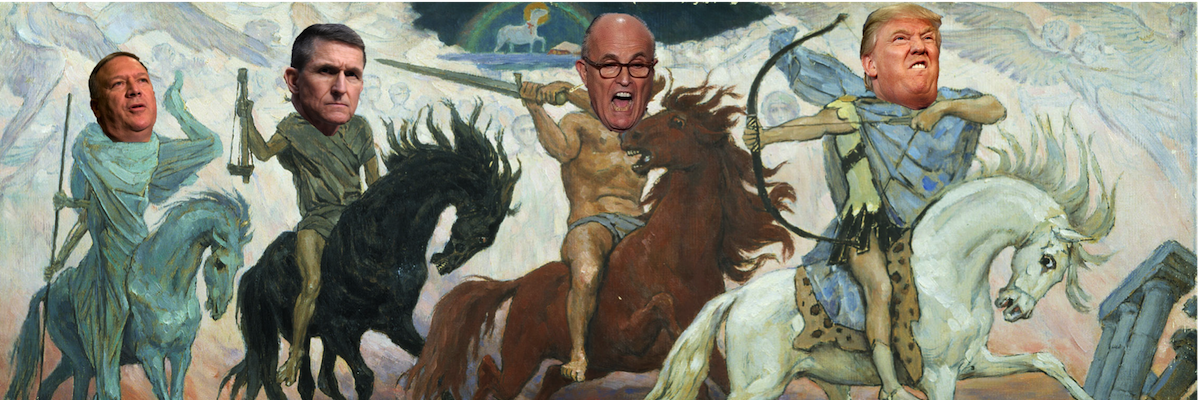
To make an immediate and lasting impact on European efforts to establish economic ties with Iran, thereby increasing the flow of investment anticipated following sanctions relief, the Obama administration must create a new general license with more expansive accommodations for services related to improving transparency in the Iranian economy. Apart from a handful of small service providers, Iran is devoid of professional accountants, management consultants, and public relations advisors that are able to work to international standards. Unleashing the “Big Four” in Iran could be a way to keep the four horsemen of the Trump administration at bay. There are three key reasons why a new general license could fundamentally improve the pace of implementation and the viability of the Iran Deal.
First, such a general license would radically improve transparency in the Iranian economy. Some experts, such as former UK Ambassador to Iran Sir Richard Dalton, have recently called on authorities to develop a “positive list” whereby companies can ascertain “the ownership and control of Iranian state entities, including entities where there is no IRGC (Islamic Revolutionary Guard Corps) presence.” Such a list would be all but impossible to institute under the Trump administration, and it is unclear whether it is even the place of any government to judge the suitability of Iranian companies for partnership. However, if a wider range of companies were able to conduct due diligence work in Iran, a potential positive list would emerge more organically. As companies are vetted by international consultants hired by strategic and financial investors, the findings will become part of the collective knowledge of the business community. It is already commonplace for business leaders to ask one another whether a given company in Iran has a “clean” reputation (Do they run parallel books? Who are the true shareholders?). While client privilege will prevent consultants from disclosing their due diligence findings directly, business leaders who do pass muster would almost certainly exercise their prerogative to market this fact widely. Word-of-mouth would combine with the commercial value of a verified reputation to create a new dynamic in the business community where transparency is paramount.
Second, getting more due diligence experts into Iran would improve the viability of the Iran Deal by diminishing the criticism of anti-deal groups. Since Implementation Day, think tanks like Foundation for Defense of Democracies and advocacy groups like United Against Nuclear Iran have had to adapt their messaging. Acknowledging that attempts to “name and shame” companies that work in Iran no longer deter major multinationals from exploring the market, these groups have recently focused on highlighting that Iran trade and investment is “risky business” and that due diligence must be taken very seriously prior to any actual engagement. The approach makes sense given that due diligence is difficult to complete in Iran—these groups are reminding companies that it is foolhardy to make investments based on leaps of faith. Should world-class due diligence become a more easily accessible service in Iran, leaps of faith would become unnecessary, and this criticism would lose its resonance. Moreover, if globally-reputable advisory firms are able to audit ongoing compliance with regulations, then US and EU authorities would be under less pressure to police whether the implementation of the Iran Deal is benefiting parties such as the IRGC.
Finally, any step to increase transparency in the Iranian economy is likely to help assuage longstanding concerns in the banking community. Major European banks remain unwilling to transact with Iran, but concern over US sanctions is not always the predominant issue. European banks are even unwilling to engage in sanctions-compliant transactions because of wider risk concerns. In effect, Iran is still seen as an economy in which ownership is shrouded and in which money moves freely between the legitimate and illicit sides of the economy. Because so few Iranian companies have undergone significant due diligence, there is very little to counteract this impression. In other markets, major banks rely on the evaluations of the Big Four auditors (EY, PWC, KPMG, and Deloitte) or the Big Three credit rating agencies (Moody’s, Standard & Poor's, and Fitch Ratings) to guide the appropriateness of engaging with particular client transactions.
As in these other markets, Iran needs a holistic approach to compliance where no one entity assumes too much risk for signing off on major transactions. The decision to provide banking services or to facilitate a transaction should depend on input from the compliance department of the client (such as a major multinational corporation), the compliance department of the bank, and the external compliance experts who have conducted due diligence on the Iranian counterparty (given that Iranian firms do not have robust internal compliance functions).
In this way, while Iranian banks work to institute sector-wide reforms including adherence to FATF guidelines, the advisory services of the Big Four, Big Three, or other respected firms could play a critical role in raising the comfort level of major banks in engaging in transactions—at least on a case-by-case basis. Given how important individual transactions by European multinationals such as Airbus, Renault, Total, or Siemens will be to the overall sentiment around the Iran Deal, even a move to increase case-by-case acceptance of Iranian financial engagements could have a major impact.
As US regulators have set expectations regarding the parameters of acceptable commercial activity with Iran by both US and non-US persons, and the requirements for due diligence therein, it behooves regulators to empower businesses to meet those expectations to the fullest ability. In the limited time that remains before the uncertain leadership of President Trump, the Obama administration should strengthen the Iran Deal by unleashing the auditors.
The Overblown Fear of Iranian State-Owned Enterprise
◢ The IRGC reportedly controls up to 40% of Iran's economy. The scale of these holdings is in line with historical levels of state ownership seen in OECD countries.
◢ US policy should apply a more nuanced approach to state-owned enterprise in Iran, and induce the market forces that are already proving to support privatization.
When the first IPC contract was awarded to Setad, an entity with ties to Iran’s Supreme Leader, critics of the nuclear deal saw confirmation of their worst fears. In their view, sanctions relief was always bound to enrich elements in the Iranian state, fueling conflict in the region.
As scholar Alex Vatanka writes in a recent piece for Foreign Affairs, the awarding of the IPC contract was a concession by the Rouhani administration to a wave of pushback by the extensive military-industrial complex mostly controlled by the Iran Revolutionary Guard Corps (IRGC). As Vatanka argues, the Rouhani administration is engaged in the “thorny process” of “compromising and whenever possible co-opting the political and economic interests of the hardliners.”
This “thorny process” is part of the larger effort of privatization in the Iranian economy, to which the Rouhani administration is vocally committed. As such, it is important to not see politically-necessary compromises as failures. On the contrary, slowly undoing the grip of Iran’s military-industrial complex on the economy requires a much more nuanced understanding of state-owned enterprise, not just by the Iranian stakeholders, but also by Western business leaders and policy makers.
Since Implementation Day, there has been little effort to examine the actual mechanics of business on the ground in Iran, particularly between Western multinationals and state- owned enterprises (SOEs). One of the few assessments is a recent report by the Foundation for Defense of Democracies (FDD), a think tank which opposed the Iran Deal. The FDD report offers an attempt to unpack the role of the IRGC in Iran’s economy in a detailed manner, looking at the history of actual acquisitions in Iran. In line with FDD’s advocacy, the report is skeptical of Iran’s capacity for reform:
Even as Iran welcomes forging strategic trading ties – inviting foreign capital and technological investment to enhance Iran’s export capabilities – it ultimately subordinates these openings to national security and foreign policy goals. The IRGC is the guarantor of this objective.
While the report ends with the expected call for additional sanctions, it remains a good case study in how a convoluted and stubborn understanding of the IRGC has been crafted in Washington, impacting how US policy is applied towards Iran’s economic recovery.
Part of the Western reaction to state ownership in the Iranian economy is a product of the neoliberal mindset. Beginning in the 1970's, Western governments spent four decades slowly untangling the state from the economy. Policymakers and business leaders in the West tend to see state-ownership in their own countries as not only undesirable, but also economically and socially irresponsible. This is particularly true in the United States, where state-owned enterprise is essentially non-existent.
American observers of Iran would do well to consider that mechanisms of political economy are complex. Ownership is easily conflated with the idea of control, but ownership is just one mechanism by which a state can influence the decision-making of commercial actors. Looking to the United States, some of the country’s largest employers, such as publicly-traded firms Boeing and Lockheed Martin, are hugely dependent on federal budgets and underlying political decisions. National security posture is equally as consequential to the economic well-being of households in an industrial city such as Everett, Washington as it is in Karaj, Iran.
In Europe, the connections between commerce and the state persist, reminding us that state ownership was once the economic norm. The push for privatization in Europe, a politically-fraught process, did not begin in earnest until the 1980's. It wasn’t until 1998 that Europe saw the total annual value of privatizations peak. Today, European governments retain significant ownership in their countries' major multinational corporations. For example, France has ownership in EDF and Airbus, Germany in Volkswagen and Deutsche Telekom, and Italy in Enel and Eni. It is also worth considering that while central government control of companies in Europe has declined, it persists at local levels. Today, only a handful of enterprises in Germany are controlled by the federal state, but according to PWC, nearly 15,000 companies are owned by local municipalities, a form of state ownership that goes unconsidered.
Overall, the 34 OECD countries boast 2,111 fully or majority-owned state-owned enterprises (SOEs) valued at USD $2.2 trillion dollars. Looking at basic averages, this is equivalent to 62 majority-owned SOEs per country with an average total value of USD $64 billion dollars. By way of comparison, the FDD report identifies “at least 229 companies with significant IRGC influence, either through equity shares or positions on the board of directors.” This figure includes firms in which the IRGC does not have a majority stake. Whether or not it is precise, there is no doubt that the IRGC owns some of Iran’s largest conglomerates, and it is widely agreed that the military-industrial complex accounts for 20% to 40% of the Iranian economy.
If we generously assume that the IRGC controls 40% of Iran’s economy (as measured by GDP), this amounts to roughly USD $150 billion in value. Using data compiled by The Economist, we can draw comparisons to key Western economies. The total value of state ownership of firms in France (including minority stakes) is USD $280 billion dollars, which is equivalent to 10% of GDP. In Italy it is USD $230 billion or 11% of GDP. In Germany it is $130 billion or 4%. In Japan it is USD $480 billion or 10% of GDP. In Sweden it is $160 billion or 30% of GDP.

In short, the IRGC is about as entrenched in Iran’s economy as the Swedish state is in Sweden’s economy. While state ownership in Iran extends beyond the IRGC to include other state-affiliated groups, it is evident that proportion and value of ownership is not as drastically different when compared to that of advanced economies.
Moreover, the scale of this ownership should be evaluated in historical perspective. Many of Europe’s leading industrial companies were forged in wartime economies that were the first installations of the “military-industrial complex.” That currently 20% to 40% of the Iranian economy can be designated as part of such a complex is in line with the norm for Western political economy in the twentieth century. Therefore, while at this point in time there are perhaps numerous companies with IRGC ownership, we should be able to imagine a time in the future when the number will decrease. Furthermore, we should take stock of the forces which may drive the relevant trend.
It is also important to draw comparisons across more comparable geographies. State ownership remains a mainstay of emerging economies around the world. High levels of state ownership can be measured by looking to the state shareholdings of the ten largest firms in the BRIC markets of Brazil (50%), Russia (81%), India (59%), and China (96%). In short, state ownership, whether or not it is economically prudent, is far more normal than many Western policymakers readily admit.
Critics maintain that the case of Iran is somewhat different. Those skeptical of engaging Iran economically argue that Iran’s industrial complex is deeply tied to forces such as the IRGC, and that the economic proceeds from IRGC-owned entities could be directly contributing to Iran’s foreign interventions and domestic repressions.
These concerns are broadly valid. The lack of transparency among state-owned enterprises raises serious concerns for any foreigners seeking to do business in Iran. But the concerns are overblown when they are used to dissuade engagement with the Iranian economy. The West determines whether to sustain state ownership in its own companies, or whether or not to engage with a Chinese or Indian SOE on a case-by-case basis. When considering Iran, however, state enterprise is raised as a reason for the blanket rejection of economic engagement, drawing often tenuous links to military activity. There are two reasons why state-ownership should not be used to justify the continued isolation of Iran’s economy.
Firstly, state-ownership exists as a spectrum. When we look at Iran’s industrial complex, it is important to mark the difference between a company being a direct enabler of illicit activity, and one being merely imbricated within a political economy that produces such effects. For example, when looking to Iran’s banking sector, the FDD report goes so far as to argue that “the distinction between IRGC-owned, IRGC-linked, and non-IRGC banks is insignificant.” But this is patently false. For example, the report indicates that the IRGC maintains ownership positions in twelve companies listed on the Tehran Stock Exchange. While this ownership may mean that the IRGC benefits financially from any increase in the share price driven by investor demand, it also means that the companies are beholden to a wider array of shareholders. The governance of a public company neutralizes some of the risks associated with IRGC ownership. Pushing more of the IRGC companies towards public share offerings may enhance the absolute value of the IRGC holding, but it would reduce the relative value (and influence) of the holding when compared with what is controlled by public shareholders.
Secondly, state-ownership is conditional on market forces. The FDD report offers a compelling example from the automotive industry. In June, 2016, the IRGC “sold its shares of Bahman Group, the country’s third-largest carmaker”, most likely because “it understood that the company could not sign contracts with foreign companies if the IRGC retained ownership.” In this way, a key outcome of sanctions relief for Iran-- increased foreign investment--is changing the incentives around state-ownership. What the FDD report leaves out is that Bahman Group was subsequently acquired by Crouse, a highly-regarded privately-held car parts manufacturer, demonstrating how consolidation and M&A activity can drive privatization in mature sectors. Had Bahman Group remained in IRGC control, it would not have been able to compete with Iran’s other carmakers, which are on the cusp of introducing new models on the back of new joint ventures with foreign partners.
By adopting a more nuanced view of state ownership in Iran’s economy, sensible policy could be devised to induce the market forces necessary to drive further privatization. Unfortunately, many in Washington who will read the FDD report are unlikely to properly configure the facts. The notion that the extent of state-ownership can be modulated or eliminated by relying on market forces will not resonate in the case of Iran, despite the compelling evidence from other countries. This is the great irony. A neoliberal doctrine that vilifies state ownership keeps lawmakers and policymakers in the US fixated on crippling the Iranian economy. However, the solution could be to simply trust that the influx of foreign investment will change incentives as a more competitive and freer marketplace emerges.
Perhaps this is why the FDD report ends with what seem to be contradictory recommendations. On the one hand the report calls for the US to “impose non-nuclear sanctions on individuals, entities, and entire sectors of the economy involved in illicit activities.” On the other hand, the authors suggest that “companies should avoid trade and investment in Iran,” while also conceding that many firms are choosing to enter the market. At the very least, the authors note, these companies should take special care in due diligence and to “require certification from Iranian partners that they are not IRGC-linked.”
Washington needs to decide whether it is going to continue with the contradictions or craft a more sensible policy. Coming to that decision will no doubt be a thorny process.
Photo Credit: Wikicommons
Why the Iran Deal Will Survive the Trump Presidency
◢ The Trump presidency poses considerable risks to the full implementation of the Iran Deal, but is unlikely to threaten the deal's survival as some have suggested.
◢ Trump's interference in the deal will be constrained by domestic politics, Russian strategic interests, and European lobbying.
This article was originally published in LobeLog.
Trump’s triumph is sending shockwaves through the foreign policy community, particularly among supporters of the Iran nuclear deal. Reuters has already reported that Trump’s election puts the Iran Deal “on shaky ground.” Richard Nephew, a former State Department official who was involved in the nuclear negotiations, told Reuters, “Say goodbye to the Iran deal.” Daryl Kimball, director of the Arms Control Association, which supported the Iran Deal, noted to The New York Times that it was unclear whether Trump “would deliberately or inadvertently take actions that unravel that agreement.”
Views from Iran echo this pessimism, as political commentators note that Trumps election could empower Iran’s hardliners. Iranian Foreign Minister Javad Zarif has sought to temper concerns by arguing that the “most important thing is that the future U.S. president sticks to agreements.”
Trump’s win no doubt introduces uncertainty into the already complicated status of the Joint Comprehensive Plan of Action (JCPOA). But the notion that Trump can or will single-handedly dismantle JCPOA overstates his likely power as president. Three factors will constrain his ability to unravel the Iran deal: the relatively low importance of Iran in the current landscape of American politics, the essential security implications of the Iran deal for Russia, and the economic ambitions of Europe.
Trump’s Priorities
Trump will arrive in the White House with little pressure to take immediate action on Iran. Although Trump did use the Iran deal as a means to impugn both Hillary and Obama, his vocal opposition to the deal probably had little to do with his electoral success, as other races show. Republican Senator Mark Kirk of Illinois, one of the most vocal opponents of the JCPOA, lost his seat to Democrat Tammy Duckworth, a deal supporter.
Although foreign policy was important in the election, it was not for the typical reasons, and this may be a saving grace for the deal. According to data from the Pew Research Center, 89% of Trump supporters highlighted terrorism as a “very important” issue, while 79% considered foreign policy to be “very important.” In both categories, the Trump supporters considered the issue more important than did Clinton supporters (74%, 73%). Although these figures might suggest that the electorate expects Trump to take action against what Trump has called a “terrorist state,” it is important to remember the tenor of the foreign policy debate in the election and what Trump came to represent.
For the Trump camp, the overall posture of foreign policy amounts to something of withdrawal. This may be reflected in the same Pew dataset—54% of voters believe Clinton would make “wise foreign policy decisions” versus just 36% for Trump. In some sense, Trump supporters may be unperturbed by his lack of foreign policy skills because they want him to make fewer foreign policy decisions overall. As Max Fisher and Amanda Taub argue persuasively in The New York Times, Trump’s success in the foreign policy debate was about avoiding the complexities of actual policy, instead using foreign policy as a discussion point to highlight his appeal as a strong leader. Voters will not likely expect Trump to meddle in the details of the Iran deal and even if he did, they would have a hard time discerning its impact. Trump’s boastful proclamations may suffice for his supporters, leaving him with little obligation to engage the thorny, multilateral nature of the Iran deal at the level of actual policy.
Security Imperatives
Although Iran and Europe have principally depended on the United States to set the pace and parameters of sanctions relief, particularly as US sanctions remain in place, the matter of implementation is actually somewhat separate from the matter of the deal’s viability. Those concerned for the Iran deal’s survival argue that President Trump will block sanctions relief for Iran, playing into the hardliner narrative that the US is obstructing the deal and thereby enabling Iran to back out.
However, the JCPOA’s promise of sanctions relief is of primary importance only if Iran and the United States remain the two pillars of the deal’s viability. With a Trump presidency, the deal will be defined by its more fundamental dimension of security. One of the principal outcomes of the JCPOA was to ameliorate Iran’s security dilemma. Iran had been on the back foot, wary of military intervention from the United States, Israel, and Saudi Arabia on the pretext of its proliferation threat. The Iran deal was conceived as an arms control agreement, despite its current billing as a kind of economic pact.
If security is the chief justification of the deal for all parties, then the new pillars of the deal are Iran and Russia. For Iran, the JCPOA eliminated an urgent threat of attack by Israel and/or Saudi Arabia by removing the only globally acceptable pretext for such an attack—a proliferation risk. The knock-on effects have freed up Iran’s security apparatus to take a more aggressive security posture in the region, particularly in Iraq and Syria. The notion that this new posture proves that the Iran Deal empowered Iran’s security apparatus is worthy of its own debate, but at the very least it has enabled Iran to align with Russia and mobilize in the theater of conflict in Syria. Russia was a key party in the Iran deal negotiations. Russian strategic interest in the JCPOA is not economic—Iranian companies remain generally uninterested in working with Russian firms, and Russian foreign policy is markedly uninfluenced by economic prerogatives as the ineffective imposition of Western sanctions shows. Realistically, Russian support for the deal was about enabling Iran to be a more active geopolitical actor in the region, uniquely free from obligations to toe the US line.
For President Trump, Russian interests may pose the biggest barrier to ripping up the deal. This is true irrespective of any special Trump relationship with Russian President Vladimir Putin, which is beyond the scope of this analysis. If Trump were to rip up the deal, Iran would need to take retaliatory action in light of domestic politics, perhaps by (at least symbolically) restarting its nuclear program. If Iran were to do so, it would put the country back on the agenda for military intervention by Israel or Saudi Arabia. Both states would be able to quickly rally support among US lawmakers for any such move—the image of Iran as a nuclear threshold state persists in Washington. But if Iran were drawn into a direct military conflict with any of its neighbors, its ability to align with Russia in the Syria conflict would be seriously compromised.
Russia, already overstretched in Syria, needs Iranian collaboration to keep Syrian leader Bashar al-Assad in power. Russia has a strong incentive to keep the current balance of power in the region intact, and the Iran deal is part of that balance. Russian enticements should be sufficient to keep Trump contained regarding Iran, while also shoring up Iran’s commitment to the deal through outreach to stakeholders in the IRGC and around the Supreme Leader. In short, the question of faltering implementation during a Trump presidency is unlikely to override the security dimension of the JCPOA. Tearing up the Iran deal means conflict with the nascent Russian-Iranian coalition.
Then There’s Europe
Stuck in the middle of this scenario is Europe. The European interest in the Iran deal is largely economic. Economic development in Iran benefits European economies but also supports the process of moderation in Iran that has been a key part of the political justification of the Iran deal in European capitals. As such, Europe cares more about implementation of sanctions relief than perhaps any other actor.
The Trump presidency will no doubt slow the process of implementation in the near-term. But European companies have yet to directly push US policymakers regarding the lingering challenges of doing business with Iran. Some observers in Iran went so far as to suggest that Trump’s business background will make him amenable to working with Tehran. Although this might be a leap too far, the notion that “money speaks” for President Trump could hold water. To the same extent that Trump’s arrival in Washington discombobulates the foreign policy community, it may do the same for lobbyists. Multinational businesses have an opportunity here to exert influence in the advocacy vacuum if they can get the right mechanisms in place. Given the first and second points made here, the bar will be relatively low: prevent interference in the deal.
Perhaps this explains the brave words already coming from key European actors regarding Iran. French oil giant Total, which this week announced a major investment in Iran’s gas industry, has indicated that “the election that took place in the United States does not change anything” regarding its projects in Iran. Other European industrial firms are likely take a similar view—after all a Clinton administration would have posed its own challenges regarding the political and compliance risks of engaging with Iran.
Importantly, Iran deal implementation is the responsibility of a dedicated group of civil servants at the State Department and the U.S. Treasury, and these individuals are unlikely to be moved from the Iran file, even if Trump’s secretary of state is a vocal opponent of the deal such as Senator Bob Corker. But the new administration’s foreign policy posture will probably sap the ability of the State Department and the U.S. Treasury to actively work on implementation issues through outreach.
So, although the deal’s survival may not be under threat, the Trump impact on implementation will certainly limit the scope of its success. To address implementation, outside actors will need to take on greater responsibility to define challenges, devise policy solutions, and drive advocacy. Selling-in policy suggestions to the Trump administration might become the true “art of the deal.”
In some ways, it is saddening to once again return to a “great-game” type discussion of US-Iran relations in the Middle East, and to suggest that better lobbying might be a way to mitigate the impact of Trump’s presidency. But Trump’s ascendency is merely a step backwards on a journey that has been halting and complicated from the outset.
Photo Credit: Wikicommons
Airplanes, Oil, Elections, and Zeno's Paradox in Iran
◢ News regarding the Airbus deal, the gas industry, and the US election mark progress in Iran's frustratingly slow post-sanctions development.
◢ But the recent increase in the incremental steps taken for Iran's economic growth should be encouraging, as the math behind Zeno's Paradox demonstrate.
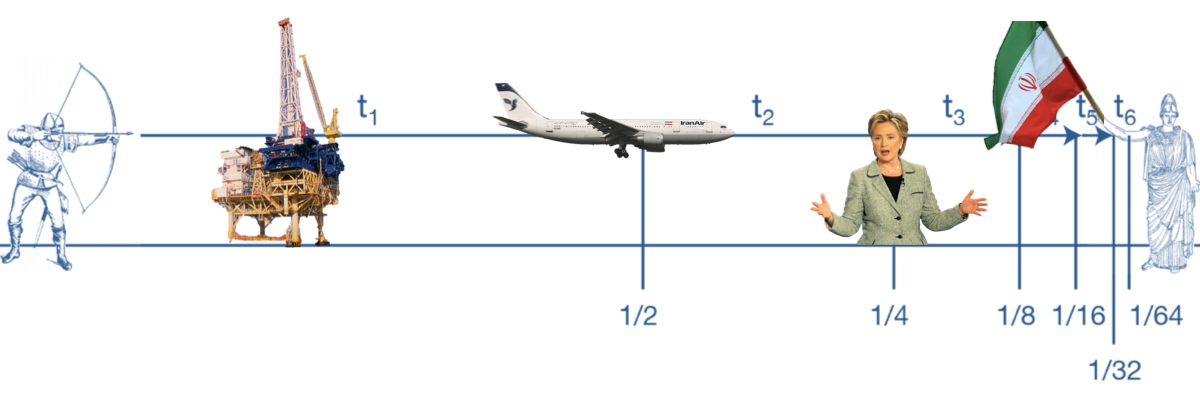
Zeno of Elea was an Ancient Greek philosopher most famous for his four paradoxes on the relationship between space and time. The most famous “Zeno’s Paradox” is the “Dichotomy Paradox.” Imagine you wish to travel from A to B. In order to reach your destination, you will need to walk half the distance. You will then need to walk half of the remaining distance (a quarter of the total distance), and then half of the remaining distance (an eighth of the total distance), and so forth. Continuing in this manner, as the basic math shows (½ + ¼ + ⅛ …), it would take an infinite number of steps to reach point B.
On Iran’s journey from A to B, from sanctions relief to economic resurgence, the Iranian and European business communities have been waiting for three key milestones: Iran’s acquisition of its first new airliners, the entry of the first international oil company to Iran, and the conclusion of the seemingly everlasting US election. There have been developments in each area this week.
First, Tim Hepher and Parisa Hafezi at Reuters report that Airbus has made progress in the effort to secure financing for its deal to sell 118 planes to Iran Air. However, the lease finance, which may come via Dubai, would only cover the first 17 planes.
Second, Benoit Fauçon at Wall Street Journal was the first to report that France’s Total and China’s CNPC would be the first international oil companies to make a post-sanctions investment in Iran’s gas industry, working with Iran’s Petropars to develop the South Pars gas field in a USD $6 billion deal. However, the signing ceremony was only for a Heads of Agreement, and the “deal is a draft that still must be completed over the next six months” according to Iranian officials.
Finally, we have passed election day in the United States, and after months of uncertainty, Iranian officials and the business community now know that Donald Trump will lead the United States for the next four years. While the outcome is concerning due to his outspoken criticism of Iran, at the very least companies can begin to evaluate political risk more concretely as they weigh investments in Iran and elsewhere. However, the nature of the US election and the discourse between Hillary Clinton and Donald Trump meant that there was no substantive discussion of Iran policy by either candidate. While the Iran-focused personnel at the State Department and the U.S. Treasury are unlikely to change, it will likely take several months for the new Trump administration to signal its overall approach on implementation of the nuclear deal and related issues.
It seems, therefore, that in each instance where there is progress in Iran’s post-sanctions agenda, something like Zeno’s Paradox remains in effect. For every milestone reached, another remains frustratingly far away, and the ultimate goal of profits and economic growth seem tantalizingly out of reach.
Part of the problem is one of perception, and here, Zeno is once again instructive. His “Arrow Paradox” describes the relationship between motion and time. If you observe an arrow in motion at a single point in time, it will appear motionless. Continuing in this manner, if the arrow is observed at every instant on its journey, it will appear motionless at every instant. Motion, therefore, would seem impossible.
In some ways, the arrow paradox describes the problem of perception and expectation around Iran’s economy. The tendency is to observe the market at a given instant, and to see banking challenges, reputation risk, and political uncertainty as barriers that have prevented trade and investment almost constantly. It might seem that no progress is being made.
The trick to understanding Zeno’s paradoxes is the same as the trick to seeing the progress in Iran’s economic recovery. Worrying too much about how to take the next step on the journey from A to B and about the challenges that presently make that next step difficult, make us blind to the importance of changes in momentum.
As the news from Airbus, Total, and the US Election demonstrates, Iran’s economic recovery is gaining momentum. Key milestones are being reached more quickly, even if the incremental steps are smaller. While the JCPOA nuclear deal took us halfway from the journey from economic isolation to economy resurgence, subsequent steps, represented by the actions and achievements of particular ministries, companies, or individuals, will be smaller. But these steps are now occurring more rapidly. As Brian Palmer explains in Slate, the trick to solving the paradox is to make “the gaps smaller at a sufficiently fast rate.”
This is exactly what is happening in Iran to solve the country's economic paradoxes. A resurgence once considered impossible is slowly coming to fruition.
Iran's First "Airport City" Blueprints a New Way of Doing Business
◢ The master plan for IKIA Airport City is one of the most ambitious in Iran and will require USD $50 billion in investment to achieve.
◢ Creating an airport city is not just about new transport links, but also about creating new models of collaboration between state and private actors.
Travelers to Tehran often wonder why Iman Khomeini International Airport (IKIA) was built so far from downtown Tehran, requiring at least an hour's drive and often much more given the city's notorious traffic. Many Iranians miss the ability to fly to international destinations from the centrally located Mehrabad Airport, from which IKIA inherited all international flights in 2007. But while Mehrabad is a 20th century airport built to serve Tehran, Iman Khomeini is built for the 21st century, with a wider range of priorities in mind. Today, airports are the key engine of economic growth for cities competing in a globalized economy and in the last decade airport development has become a central focus for urban planners and economists alike. The 2011 book Aerotropolis, written by John Kasarda, Director at the Center for Air Commerce at the University of North Carolina's Kenan-Flagler Business School, helped establish the concept of the "airport city." Kasarda argues that the airport deserves a more central role in how urban spaces are created. He writes, "Rather than banish airports to the edge of town and then do our best to avoid them, we will build this century's cities around them."
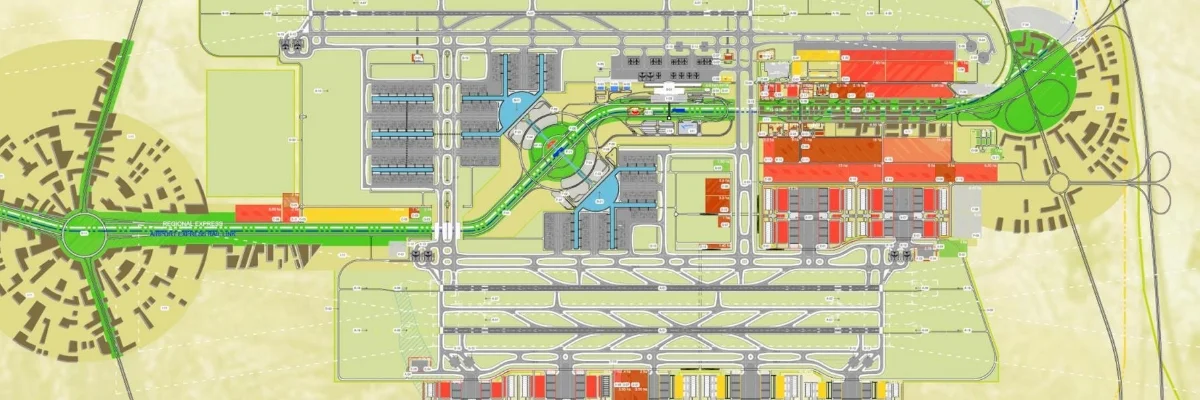
The master plan for IKIA includes the vision to create a world-class aerotropolis by building a city around IKIA. The Ministry of Roads & Urban Development has positioned IKIA to investors as "an international crossroad connecting north to south and east to west" which "makes it profoundly eligible to evolve as a regional hub, leading to [the development of ] an Airport City or an Aerotropolis." This is precisely why the airport was built so far from Tehran; it needed room for a new city to grow. Moreover, the airport was meant to connect geographies, and is accessible from Semnan Province in the east, Qom and Isfahan provinces to the south, Markazi Province to the southwest, and Alborz and Qazvin Provinces to the West.
Our firm, Rah Shahr International Group, spent several years developing the master plan concept for Iran's first such airport city, the Imam Khomeini Airport City. In this plan, the airport becomes a nucleus around which commercial centers, residential zones, and transport infrastructure would be organized. The IKIA Airport City will hopefully decentralize a good portion of Tehran's congestion by moving many offices and businesses to the new mega-site. We estimate that IKIA Airport City will require USD $50 billion of investment.
The scope and size of the IKIA project echoes Kasarda's view of airports as "components of large technical systems" that work like machines to create logistical efficiency and economic productivity. In the technical system for IKIA, there will be four major zones, an Aviation Zone (2,800 hectares), a Free Economic Zone (1,500 hectares), a Special Economic Zone (2,500 hectares), and a Mixed-Use Zone (7,000 hectares). Each zone will in turn house different facilities such as light industry, hotel and convention spaces, warehouses and logistics centers, commercial offices, and even public parks. To work effectively, these zones will need to be linked by road and rail to Tehran and Iran's four corners in a "smart" transport network. The main highway from Tehran to Bandar Abbas (with access to Isfahan and Shiraz) passes by IKIA to the East. Saveh Highway passes to the West. In terms of rail access, the extension of the Tehran metro network to a new terminus at IKIA, which is nearing completion, reflects a positive first step. The proposed Isfahan-Tehran high-speed bullet train will connect through IKIA.
Clearly, the master plan for IKIA is one of the most ambitious in Iran, and it will therefore require Iran to innovate new ways of fostering cooperation and economic development between a wide range of stakeholders. This may be the most important legacy of the airport city project. Airports and their surrounding developments rely on enterprise zones and tax abatements to attract tenants, urban development corporations to manage the project delivery, and public-private partnerships to fund the construction of critical infrastructure. As anthropologist Brenda Chaflin explains about the airport in today's globalized world, "Redesigned and reimagined, the airport is... a site of contestation and collaboration between a plethora of state overseers and the private sector, including architecture and construction firms, investors, and development banks." Getting these different groups to cooperate will be a significant challenge, but it may also be the critical outcome for Iran's long-term economic success. IKIA can serve as a testbed for developers, contractors, and investors from both Iran and abroad.
We can already see evidence of new collaborations at IKIA. In 2015, the Ministry of Roads & Urban Development established the IKIA Airport City Company to serve as the contracting party in public-private partnerships around airport city development. Through this entity, the government negotiated a joint-venture with French construction firm Bouygues and French airports operator Aéroports de Paris (AdP) to construct a new passenger terminal in a USD $2.8 billion deal that would increase airport capacity to 20 million passengers per annum in the first phase. A possible further three phases have been planned that would take the airport though 90 million passengers per annum in total capacity.
When such agreements are concluded, the challenge will be to secure financing. One of debates surrounding infrastructure development in Iran is whether the country should be looking to the West or East for support. Given the current economic conditions in Iran, the contractor, not the client, is expected to bring the majority of financing. Chinese infrastructure firms have proven their ability to fund infrastructure projects in Iran, particularly prior to the lifting of sanctions. Though Iranian officials would prefer to use European technology and expertise, most European firms have limited means to finance projects. But as a recent report on Iran from aviation industry body CAPA notes, airport development is so strategic that it may be possible for Iran to work with both sides. French and Chinese companies are already involved in financing development and renovation of Mashhad Airport through the Iran Airports Holding Company, the national airports operator. Moreover, the reports points out that "The French and Chinese have got used to working with each other. France's Toulouse Airport is managed by two Chinese companies, and relations between the two governments are positive." As the Wall Street Journal has reported, companies from South Korea and the Netherlands are also involved in consulting on aspects of airport city development. In this way, IKIA might be a project so large that it enables cooperation across a wide range of countries seeking to invest in Iran, with both economic and political dividends for the country.
In this way, the lesson of the IKIA Airport City project is that Iran's next phase of infrastructure development must focus on both physical and organizational integration. Physical integration means positioning IKIA and Iran's other airports as part of a larger transport system, improving the mobility of goods and people both within Iran and across its borders. Organizational integration means using airports as specific sites to bring different companies from different countries into closer collaboration, even in investing and developing the airports themselves. Taken together, a new way of doing business becomes clear. The subtitle of Kasarda's Aerotropolis claims that the airport city is "the way we will live next." For Iran, there is another important outcome to consider. The creation of airport cities will teach us how we will do business next in Iran.
Photo Credit: AdP
Why Iranian Companies Need to Work With International Lawyers
◢ While Iranian companies have successfully engaged international legal counsel in arbitration, the use of outside counsel in commercial negotiations is limited.
◢ The track record of Iran's commercial deals with foreign firms demonstrates how proper legal counsel is necessary to help protect Iran's commercial interests.
Iranian companies, particularly state owned enterprises, must become more accustomed to working with international legal advisors. As a general rule, Iranian organizations are hesitant in engaging international law firms at the appropriate early stages of commercial negotiations and hire outside counsel only when things go wrong.
Internal legal departments of some of these companies (such as Iran Air) are strong and competent enough. But many others overestimate their ability, while also struggling to justify the budgetary requirements of making use of international legal advice. More importantly, Iranian organizations tend to avoid outsourcing their legal affairs because of concerns over political intervention, breach of confidentiality, and hostile commercial rivalry.
Nonetheless, there are several examples where support of an international law firm has helped partially or totally state-owned Iranian companies to navigate complex issues when facing a legal challenge. A number of Iranian companies contested what was considered the unwarranted imposition of sanctions in European courts. Bank Mellat pursued legal action in both Britain’s Supreme Court and the European Court of Justice with the support of Zaiwalla & Co., a London-based law firm. The bank managed to secure favorable rulings. The Supreme Court (the final court of appeal in the UK for civil cases) ruled in June 2013 that sanctions imposed on the bank in 2009 were “irrational.” And in February of this year, the European Court of Justice made a similar finding, suggesting that the imposition of sanctions on Bank Mellat constituted an “error of law.” As a consequence of these rulings, Bank Mellat is now set to claim financial damages amounting to USD $4 billion against the UK government.
Similar cases include international law firm Stephenson Harwood representing Bank Saderat and National Iranian Tanker Company, and Eversheds representing the National Iranian Oil Company.
While positive experiences working with foreign legal advisors have been mostly limited to cases of litigation or arbitration, knowledge of international commercial law will be of utmost importance in post-sanctions deal-making. This is why there is a significant need for foreign legal advice before things go wrong. After a long period of sanctions, the legal teams of Iranian state-owned enterprises are unlikely to be up-to-scratch with the latest international regulations or the myriad difficulties of complex commercial deals.
The track record of commercial deals gives cause for concern. Several of Iran’s largest European industrial partners abandoned the market as nuclear sanctions were tightened beginning in 2009. Lack of foresight in commercial contracts, which did not include provisions for such a situation, meant that Iran found itself without legal recourse as these partners decided to renege on their contractual commitments. The most famous example is probably the withdrawal of French automaker Peugeot in 2012, which led to mothballing of primary production lines at the state owned Iranian carmaker Iran Khodro. The episode created a great deal of bad blood between the Iranian company and its French counterpart, which has had to promise voluntary compensation as part of planned return to the Iranian market. Such situations, which should be remediated within a legal framework, create lack of trust in foreign partners and become obstacles on the way to healthy future partnerships.
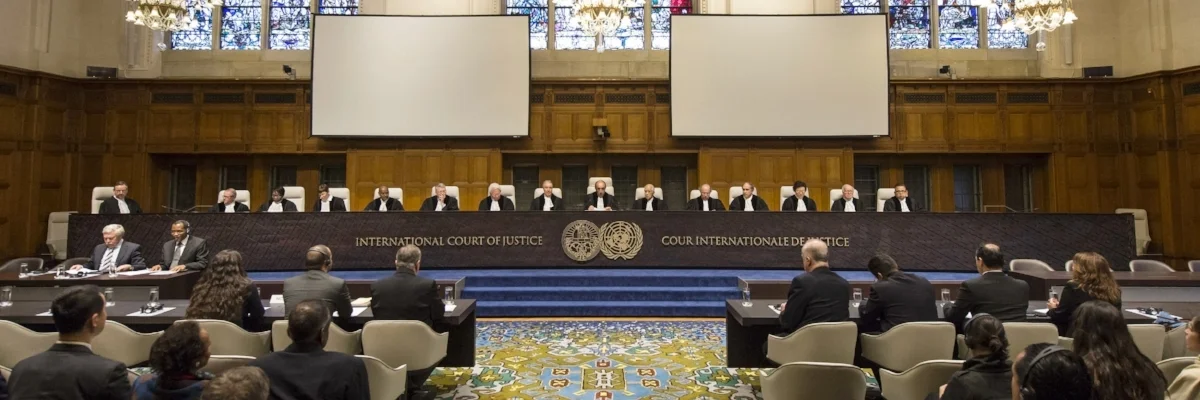
In another episode, the Central Bank of Iran purchased about USD $1.75 billion in bonds in Luxembourg through an intermediary and deposited them in a Citibank account in 2008. The Supreme Court of the United States ruled in Bank Markazi v. Peterson in 2015 that the bonds were Iranian assets and could be seized as part of compensation owed to American victims of terrorism. Iran has now referred the case to the International Court of Justice, and will probably hire international counsellors to handle the case. However, had legal advice been sought before the bonds were purchased, it might have been possible to foresee the risk of asset seizure by the US government.
Hesitations around engaging legal advice can also have consequences beyond industry and finance. For example, there have been calls for the Tehran Museum of Contemporary Art to make its remarkable collections available for international loans, which can generate fees to help revamp the museum. The plans include a possible loan to the Hirshhorn Museum in the United States, but outstanding legal claims in the United States against Iran have led to serious concerns that the pieces may be seized. As such, even Iran’s potential contribution to global arts and culture has suffered because of uncertainty about legal ramifications. Crafting loan contracts with international advice can pave the way for cultural interaction.
At a time when Iran is trying to revive and expand its economic interactions with the rest of the world, collaboration with international legal firms creates a perfect opportunity for legal departments within Iranian organizations and their counselors to exchange knowledge, upgrade their abilities, and expand their knowledge of the latest legal standards. It is time for Iranian companies and their leaders to accept the importance of legal advice for managing risks and making deals in the present international business environment.
Photo Credit: ICJ
To Work With Europe, Iran May Need to Deal with China
◢ China's outward M&A has hit a record USD $207 billion this year, with major Western multinationals the primary target, including companies active in Iran.
◢ Though Iran has looked to the West post-sanctions, the new acquisitions may force Iranians to deal with the strategic implications of Chinese ownership across industries.
A new Bloomberg report takes a closer look at the staggering success of Chinese outbound M&A activity in 2016. As the year comes to a close, Chinese companies have made acquisitions valued at USD $207 billion, most notably taking control of major European corporations such as German robotics company Kuka and the appliance division of US giant General Electric. Further announced deals include ChemChina’s planned USD $43 billion acquisition of Swiss chemicals company Syngenta, which will be the largest ever Chinese M&A transaction if antitrust regulators give approval. Some major acquisitions did not go through, such as Anbang Insurance group's attempted takeover of Starwood Hotels and Resorts. The Financial Times front page on Tuesday led with a report on how “Western resistance” to Chinese deals has prevented an additional USD $40 billion in acquisitions this year.
China has long sought to boost its global economic footprint through the acquisition of blue chip companies in the United States and Europe. Western governments, regulators, and investors once balked at the overtures, worried about notorious Chinese government intervention in corporate affairs. But as Bloomberg reports, the recent wave of successful acquisitions suggests that China has improved its ability to reassure key stakeholders and to demonstrate the commercial value of its acquisitions.
For Iran, this wave of acquisitions should be watched closely. Iranian officials and business leaders have long been skeptical of partnerships with Chinese firms, and the partnerships that have gone ahead have a mixed record of success. As Emma Scott writes in a report for Middle East Institute, a Washington think tank, “Chinese groups doing business with Iran charged higher prices and were slow to deliver" during the sanctions period of limited competition. "This behavior tainted the image of the Chinese among Iranian customers, who had little choice but to use Chinese products, which had a quality inferior to those made in the West.”
As Najmeh Bozorgmehr has reported, Chinese companies and products “lost luster” as the prospect of sanctions relief grew more likely. Scott believes that the strategy behind China’s investments in Europe and the US will mean a relative decrease in the volume of direct investment in Iran. She writes, “China’s investment destinations are changing from resource-rich developing countries to developed countries capable of providing access to advanced technologies, established brands, and extensive industry experience… Thus, even considering Iran as an emerging market does not bode well for China’s future investments in Iran.”
A recent report from US investment bank JP Morgan analyzes the changes in China’s M&A focus. Whereas between 2005-2010, most M&A activity was focused on energy (54%), industrials (26%), and financial institutions (18%), in 2016, a new mix is visible. Industrial now leads (51%), while telecommunications (18%) and consumer/retail (12%) have emerged as new areas of focus. If this mix remains the sector focus for outbound M&A, the likelihood of Chinese ownership of Iran’s Western trade partners will increase, as industry, telecommunications, and consumer sectors are perhaps the most dynamic sectors for post-sanctions trade and investment in Iran.
In some ways, the Chinese experience in Iran may have been instructive as to the value in acquiring European firms. Iranian insistence on Western technology and expertise over promised Chinese affordability would have been yet another indication to the Chinese that they could never become globally competitive on price alone. The Chinese push to promote domestic innovation in consumer and industrial technologies is now being complemented by a push to acquire world-leading firms, which are typically based in the US and Europe. These acquisitions give the Chinese access not only to new technologies and knowhow, but importantly to trusted Western brands. For example, the acquisition of Sweden’s Volvo passenger car company by Geely automotive in 2010, enabled Geely to tap into Volvo design capability, lending greater credibility to its own ambitious growth plans.
The irony for Iran is that it resisted working with Chinese firms, only for Chinese firms to acquire several European companies that have been long-standing trading partners or have shown interest in post-sanctions market entry. These acquisitions include companies from nearly all the European countries that Iran counts among its trading partners.
China’s largest target acquisition to date, Swiss firm Syngenta, is world leader in agrochemicals. The company has been a long standing supplier to Iran’s agricultural industry. Also in agribusiness, Chinese state-owned food group, COFCO, had sought to acquire Glencore’s agricultural unit in 2015, only to be rebuffed. Undeterred, COFCO completed its 100% takeover of grain trader Nidera in August of this year. The Dutch firm, which ships roughly 3 million tonnes of grain and vegetable oils to Iran annually, is seeking to grow its marketshare.
One of the most pressing infrastructure development needs in Iran is the upgrading of the country’s airports. French firm Aeroport de Lyon has been connected with airport development deals in Tehran and Mashhad, with Chinese financing as part of the package. Such cooperation became possible as Chinese firms took on ownership positions and management contracts in French airports, including a 49% stake in Toulouse airport acquired in 2014.
Italian tire manufacturer Pirelli has been connected to joint-ventures in Iran. The company was acquired in 2015 by ChemChina, the same company targeting Syngenta, in a USD $7.7 billion deal.
In Germany, China’s BAIC Motor, which produces Mercedes Benz models in China, is seeking to buy a stake in Daimler, to complete a cross-shareholding first proposed last year. Daimler is pursuing new deals with Iran Khodro (IKCO) to manufacture both commercial vehicles and passenger cars.
Automation upgrades to Daimler’s IKCO manufacturing lines in Iran would involve replacing the existing Kuka robotic arms with a newer generation. Kuka, a major supplier to Daimler worldwide, was acquired by China’s Midea Group in a USD $5 billion takeover completed this year.
The list is bound to grow.
The prospect of ultimate Chinese ownership at many of Europe’s leading industrial firms poses both an opportunity and a challenge for Iran. On one hand, Chinese outward M&A will empower Western multinationals with the financial resources necessary for new market development, such as joint-ventures with Iranian firms. Chinese owners may also be less deterred by lingering compliance and reputational risk issues that currently hamper Iran trade.
On the other hand, Chinese ownership poses a geostrategic challenge. Iran needs to carefully balance Western alliances with its relationships with Russia, China, and India. Chinese ownership of key Western multinationals will make that balancing act more complex.
Photo Credit: Newsweek
As Policies and Technologies Change, Iran's Compliance Dilemma Deepens
◢ A move to introduce personal liability for compliance officers is changing AML/CTF practices in banking and finance.
◢ New policies and new technologies are raising the bar for post-sanctions banking reforms and Iran may be left out the effort to establish new global best practices.
“Regtech” is the latest buzzword in the world of banking and finance. Last week, Martin Arnold, Banking Editor at the Financial Times, explored "regtech," the new technologies being developed to help financial institutions manage ever more complicated regulatory and compliance frameworks. This same week, Jeremy Kahn of Bloomberg reported on the rise of UK-based ComplyAdvantage, an early leader in regtech solutions, in another major story.
For Iran, the rise of regtech is a signal that the international standard for compliance policies and practices is changing at an accelerated pace. Importantly, the turn to technology is a response to the stricter policies instituted by regulators in the US and Europe, particularly in anti-money laundering (AML) and counter-terrorist financing (CTF)—key areas of reform for Iran.
In light of stricter policies, compliance work is getting more expensive. A recent report from management consultancy Accenture found that the cost of AML compliance has risen more than 50% in three years. In 2015, the Financial Times reported that for big banks such as HSBC, JPMorgan, and Deutsche Bank, compliance costs have surged past USD $1 billion each year. The costs are rising further still. A significant 72% of Middle East compliance executives surveyed as part of Thompson Reuters’ 2016 “Cost of Compliance Survey” expect costs to increase in 2017.
Costs are being driven upwards in large part due to the push by regulators to establish personal liability for compliance failings. In order to deter risky or lax activities on the part of banks, regulators intend to hold specific individuals accountable for violations. Sally Quillian Yates, Deputy Attorney General at the U.S. Department of Justice, has argued that “One of the most effective ways to combat corporate misconduct is by seeking accountability from the individuals who perpetrated the wrongdoing.” Thompson Reuters found that 60% of compliance professionals expect their personally liability to rise in just the next 12 months as new regulatory expectations come into force.
On its own, the introduction of personal liability will prove a major barrier for Iran’s reintegration to the global financial system. While banks have been deterred from engaging with Iran due to the legacy of heavy fines from regulators, personal liability introduces a whole new dimension into the risk calculation at major financial institutions. Now, compliance officers evaluating whether to facilitate transactions with Iran will have to weigh an immediate personal risk of prosecution in the event of a failure or violation. The legal precedent has already been set in the United States with a February 2016 decision in the case of U.S. Department of Treasury v. Haider in which the former Chief Compliance Officer of MoneyGram was held personally responsible for compliance failings at the company and was fined USD $1 million. In short, “green-lighting” Iran transactions is becoming fundamentally riskier despite sanctions relief.
Concurrently, the requirements for Iran’s reform efforts may be expanding as practices change in response to the new policies. According to Accenture, compliance officers are managing rising liability and heightened regulatory expectations by enhancing transaction monitoring systems, expanding know-your-customer (KYC) due diligence procedures, and creating deeper training programs to raise competency. Each of these initiatives contributes to rising compliance costs.
Iranian authorities are aware that technology needs to be a part of their reform efforts. In a recent interview with Barbara Slavin of Al Monitor, Iran’s Minister of Economic Affairs and Finance, Ali Tayebnia, stated that Iranian banks had installed software to track suspicious transactions in accordance with Iran’s effort to comply with a Financial Action Task Force (FATF) action plan. Several banking technology companies are known to be entering Iran, with Mysis, SAP, and Temenos, publicly confirming their interest.
However, the accelerated pace of technology innovation and adoption in the area of compliance is going to make it more difficult for the Iranian banking system to catch-up to international standards. According to a recent report by the International Institute of Finance, interest in regtech is exploding as financial institutions try to find ways to reduce costs. Banking executives believe that “by making compliance less complex and capacity-demanding, regtech solutions could free capital to put to more productive uses.” Yet, regtech is still a “niche sector” and there has been limited knowledge sharing or coordination between financial institutions, technology developers, and regulatory experts.
The concern for Iran is that the industry will develop new and even more complex standards at a time when Iran remains outside the “networks or platforms bringing together regulatory experts, software developers and [financial institutions], needed for regtech development.” Particularly in the area of AML/CTF compliance, the IIF report notes that while currently “surveillance is on a per-institution basis… a coordinated or centralized surveillance could significantly improve efficiency and effectiveness in recognizing suspicious trades.” Iran cannot afford to be left out of the creation of any new centralized compliance system and risk instituting reforms that will be insufficient or obsolete from the day they are announced.
Given Iran’s status as a “primary concern” for AML/CTF compliance, Iranian regulators and financial institutions need a role in the development of new international standards to ensure that their reforms can keep pace with best practices.
Unfortunately, some of the key voices in the future of compliance may be less than willing to invite Iran to the table. Speaking at the prestigious Sibos financial technology conference in last month, HSBC Chief Legal Officer Stuart Levey called on banks and regulators to work more closely to develop and adopt technology. He described “a basic structural flaw in the whole effort… The dots are not being connected, and certainly not in a real-time, iterative, and dynamic way.” Mr. Levey, former Under Secretary for Terrorism and Financial Intelligence at the US Treasury, penned a widely-read op-ed in the Wall Street Journal in May, in which he declared with antipathy that “HSBC has no intention of doing any new business involving Iran.”
Understandably, the global banking community is reluctant to engage with Iran until the country institutes difficult reforms. Yet, at the same time, global financial institutions are setting new standards for compliance best-practices, which could “move the goalposts” for Iran as it strives for financial reintegration. With limited capacity to reassure its critics, Iran faces a deepening compliance dilemma.
Photo Credit: Financial Tribune
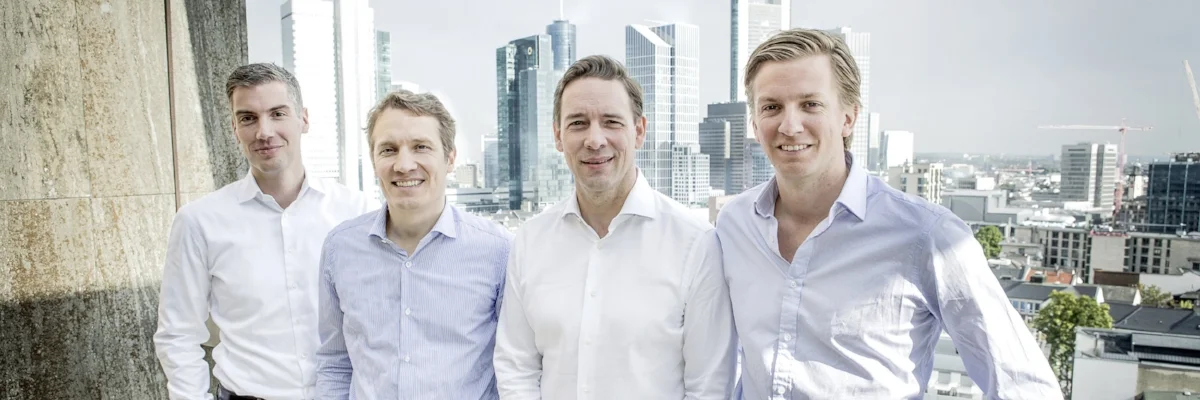
MTN's Big Bet Sheds Light on Rocket Internet in Iran
◢ Though initially reported as a Series A for ride-sharing app Snapp, MTN has made a EUR €20 million investment in the parent company Iran Internet Group
◢ But MTN's solo play breaks with a clear pattern of co-investment with Germany's Rocket Internet and it is unlikely Rocket would allow its dilution in this latest round
This week, TechCrunch reported that Tehran-based ride-sharing app Snapp raised EUR €20 million in its Series A round, with MTN, the South Africa-based telecoms group, the sole investor. Snapp CEO Shahram Shahkar told TechCrunch that the company “plan[s] to invest in [its] current operations, expand to other cities, introduce different services such as premium vehicles and offer new features.”
Snapp is an incredibly exciting company, offering a robust mobility solution for its customers in Tehran. It has achieved real scale in a short period of time. However, the capital raised by Snapp dwarfed Uber’s Series A, completed in February 2011 for USD $11 million. Even in the age of inflated valuations, and with the clear potential of the Iranian market, this would be a staggering funding round for a tech ecosystem still in its nascent stages.
The following day, TechRasa, an online publication covering Iran’s start-up scene clarified the investment. The EUR €20 million round was not just for Snapp, but for Iran Internet Group, the parent company of Snapp as well as start-ups like Bamilo (online shopping) and ZoodFood (food delivery). This clarification explained the size of the funding round, which would empower growth at a handful of firms. However, later on the same day, Bloomberg echoed TechCrunch's initial claim reporting that the funding round was exclusively for Snapp. The magnitude of the capital raised is just one of a series of unusual details reported about this investment by various outlets.
According to records on Crunchbase, MTN has never before been the sole participant in an early stage tech investment, and has only participated in two other investments to date. One of these investments was the establishment of Africa Internet Group (AIG, now known as Jumia Group) alongside Rocket and Goldman Sachs, which coincided with the creation of Middle East Internet Group (MEIG), a 50/50 joint-venture between MTN and Rocket. These two holding groups were established to incubate and grow digital businesses across Africa and the Middle East, using Rocket’s famous “start-up factory” approach. Importantly, MTN treats the holding groups as the same line item in its financial reports along with Iran Internet Group.
Given the pattern, the fact that MTN is reportedly the sole investor in IIG latest round is surprising. Is MTN really bullish on IIG and ready to go it alone? Why didn’t Rocket itself commit capital alongside MTN as it has in other markets? The answers are hard to determine with certainty, and Iran Internet Group did not respond to Bourse & Bazaar’s request for comment. But the potential synergies between MTN and Rocket in Iran offer some clues.
MTN’s key commercial challenge in Iran is the repatriation of capital. The company continued operating in Iran during the tightening of sanctions, racking up fees, which it then struggled to pay back from its local joint venture, MTN Irancell to MTN Group in South Africa. In April 2015, Reuters reported that MTN executives believed that the easing of Iran sanctions would enable the company to repatriate USD $1 billion from Iran. MTN stock rose 2.3% the day that the JCPOA agreement was announced. However, despite the lifting of international sanctions following Implementation Day, MTN, like many other companies in Iran, has continued to struggle to return its fees. MTN’s 2016 interim financial report states “MTN continues to work towards remitting some of its cash amounting to approximately R15.4 billion from MTN Irancell, although this a complex process.” Commenting on the interim report to Bloomberg, outgoing CFO Brett Goschen stated that the firm “hopes to start moving the funds out of Iran during the first half of 2017."
Rocket Internet has the converse problem. The company's ambitions in the Iranian market have become part of the country’s start-up lore. Stories abound of suitcases of cash brought into Iran in order to establish a beachhead in what is becoming the Middle East’s most exciting tech market. Rumors aside, Rocket and its founder Oliver Samwer have taken an arms-length approach to the market. The Iran Internet Group website makes no mention of Rocket, only listing MTN as a “supporter.” The TechCrunch piece did originally publicize that MTN's "has a partnership with the German-based Rocket Internet in Iran." The reference was removed from the article several hours later. TechRasa, meanwhile, took a more cautious line, noting that “there is no proof or disproof of Rocket Internet’s presence in Iran.” Although Bloomberg echoed the key detail of the initial TechCrunch report—that the funding round was exclusively for Snapp—it reported that Rocket "isn't involved in MTN's investments in Iran."
Realistically, IIG exists as a kind of sister company to AIG and MEIG, entities with which it shares many key features, and in which Rocket clearly does publicize its participation and partnership with MTN. A WHOIS database lookup reveals that the websites for Snapp, MEIG, and even Rocket's main corporate website are all connected to Cloudflare name servers. Interestingly, the IIG records reveal that the site administrator has used a privacy protection service to ensure the true site owner is not discoverable. However, Eyad Alkassar, co-founder of MEIG, is listed as the admin contact for snapp.ir. Kate Cully, the Group Finance Director at Rocket-run MEIG, is listed as the contact for the auxiliary domains zoodood.ir, snapp.taxi, snapp.live, eskano.com, and even iraninternetgroup.com.
As a publicly traded company, Rocket would face huge regulatory hurdles in openly committing its investor capital in Iran. Many of its shareholders would have compliance and reputation concerns regarding investing in the country. Moreover, even if Rocket had the approval of shareholders to invest capital in Iran, banking challenges would have made it exceedingly difficult to mobilize the funds. This was particularly true when Rocket was first establishing Iran Internet Group prior to the lifting of international sanctions (in accordance with exemptions for technology businesses).
The most immediate synergy offered by the MTN/Rocket relationship in Iran therefore hinges on access to capital. Surely, MTN has a strong interest in promoting growth in the digital economy in the markets in which it operates. It has backed that interest with significant capital in Africa and the Middle East. Furthermore, investors such as Oliver Samwer would probably openly commit capital in Iran, if they could. It is equally probable, however, that MTN’s role as the sole backer of the IIG round acts as a screen within the accounting of AIG or MEIG and that Samwer is swapping equity for MTN’s outlay in Iran. This way, MTN can repatriate capital stuck in Iran through clever accounting, and Samwer can assure the growth of Iran Internet Group without diluting Rocket.
Some simple financial reporting would make such speculation unnecessary, but a lack of transparency has been a common complaint about Rocket across all of its business dealings. The company's "opaque financial reporting" was outlined in an extensive profile of the company’s recent troubles in Bloomberg Businessweek. Though IIG's role in spurring the start-up ecosystem in Iran is laudable, the last thing Iran needs is more willful opacity in business practice. The risk for Snapp and the other IIG start-ups will come down the line. A war chest of EUR €20 million will go a long way to turning organic momentum into a protected position as market leader. In subsequent funding rounds, however, bringing in new investors will require an explanation about the Series A and the precedent (and valuation) it set. Uber’s Series B, where it raised USD $37 million, took place in December 2011, just ten months after the Series A round. If Snapp and IIG follow a similar trajectory, Rocket and MTN have relatively little time to become more transparent about their ambitions in the Iranian market.
Photo Credit: Rocket Internet
OFAC Iran FAQ Update Provides Further Clarity on US Sanctions
◢ New guidance from the Office of Foreign Assets Control has provided more clarity on U.S. dollar processing by non-U.S. financial institutions
◢ The updated FAQs also provide more detail about OFAC's expectations regarding due diligence efforts
This article was originally published on the Clyde & Co Sanctions Portal.
On 7 October 2016, OFAC issued an update to its “Frequently Asked Questions Relating to the Lifting of Certain U.S. Sanctions Under the Joint Comprehensive Plan of Action (JCPOA) on Implementation Day” (the FAQs), providing further guidance on due diligence requirements for non-U.S. persons engaged in transactions with Iran and providing an interesting clarification in respect of the processing of U.S. dollars by non-U.S. financial institutions.
The FAQs were first published on Implementation Day (16 January 2016). The FAQs do not have the force of law themselves and are only intended by OFAC to be explanatory. They do, however, provide helpful guidance on the changed U.S. sanctions regime after Implementation Day.
That said, there were a number of areas, including in relation to the use of dollars by non-U.S. financial institutions and the extent of due diligence required by non-U.S. persons, which were left ambiguous by the original FAQs published immediately after Implementation Day.
The recent update to the FAQs, whilst it does not reflect a change in the underlying legislation, does nonetheless provide helpful clarification of some of those ambiguous areas.
Due Diligence
Whilst many Iranian individuals and entities were removed from the SDN list on Implementation Day, there were still a number of individuals and entities, such as the IRGC, that remained designated as SDNs. Non-U.S. persons dealing with those SDNs after Implementation Day could face U.S. secondary sanction consequences, including menu based penalties and “designation authority sanctions” which would result in the person being designated as a SDN.
As FAQ M. 2 (which was issued immediately after Implementation Day) confirmed, it was essential that non-U.S. persons engaged in trade with Iran carried out due diligence “sufficient to ensure that [they are] not knowingly engaging in transactions with the IRGC or other Iranian or Iran-related persons on the SDN list."
However, the FAQs said nothing else in relation to due diligence and gave no assistance in relation to the extent of due diligence required. In particular, the FAQs did not clarify whether it was sufficient to establish only that one’s immediate counterpart was not a SDN or whether it was necessary to go further and ensure that the counterpart was not owned by an SDN as well.
That is remedied somewhat by new FAQ M.10 which confirms that it is not necessarily sanctionable for a non-U.S. person to engage in transactions with an entity that is not on the SDN list but that is minority owned, or that is controlled in whole or in part, by an Iranian or Iran-related person on the SDN list.
It is certainly helpful that OFAC has clarified that minority SDN ownership, or even wholesale control by a SDN, will not of itself prevent a non-U.S. person transacting with that entity. However, OFAC sounds a note of caution by adding that it recommends exercising caution in such circumstances to ensure that such transactions do not involve Iranian or Iran-related persons on the SDN list. The risk for non-U.S. persons would be that the transaction in question could still ultimately provide significant services or support to an Iranian SDN, which, if the non-U.S. person had knowledge (meaning knew or, under the circumstances, should have known of this fact), would be in contravention of US secondary sanctions that are still in force after Implementation Day. Minority SDN ownership or control is therefore a red flag that may require further investigation into the transaction to determine that such services or support were not being provided for the benefit of a SDN.
New FAQ M. 11 also provides confirmation that checking the names of one’s counterparties against the SDN list is expected but not necessarily sufficient to discharge one’s due diligence obligations. OFAC does not give any specific guidance as to what might be expected over and above that, save to recommend that due diligence procedures should conform to internal risk-assessment and overall compliance policies, which themselves should be based on best practices in the relevant industry and conform to the guidance and expectations of regulators in the non-U.S. person’s home jurisdiction.
However, one particular concern for non-U.S. persons is likely to be whether or not, notwithstanding that the counterparty is not on the SDN list, the transaction might result in services or support being made available to a SDN in contravention of a number of executive orders still in force. Other concerns will include whether or not there is more than 50% ownership by the IRGC or one if its designated officials, agents or affiliates. Proportionate due diligence enquiries are therefore likely to be focused at identifying any possible SDN involvement in the transaction outside the direct contractual counterpart and identifying shareholders in the counterpart.
In terms of the other regulatory requirements from outside the U.S. that OFAC refers to, the residual EU sanctions against Iran will certainly dictate the extent of due diligence required by persons subject to EU sanctions. The requirement on those persons to ensure that they do not provide, directly or indirectly, funds and economic resources to any person designated by the EU will mean that they have to not only establish that the person they are dealing with is not on the EU’s list of designated persons, but to also enquire into the details of the transaction and any other parties involved in it to ensure that there is no indirect provision of funds/economic resources to an EU designated person.
OFAC’s additional FAQs are therefore a timely reminder that it is still necessary to undertake due diligence to enquire into ownership and control of a counterparty and to understand the broader transaction and what other parties may be involved. Minority control of a SDN may not of itself require a non-U.S. person to refrain from entering into a particular transaction, but it is a red flag requiring further investigation to determine that the transaction concerned does not result in services or support being provided to a SDN. It also continues to be relevant to ensure that a counterparty is not owned more than 50% by the IRGC or its affiliates/agents, and for persons subject to EU sanctions it is important to confirm that funds and economic resources are not being provided to any EU designated persons as a result of the transaction.
Offshore Dollar Processing
There was some speculation in April and May 2016, amid criticism that the JCPOA had not provided the outcomes that many felt it promised, that the U.S. Treasury was considering issuing licenses to permit foreign (i.e. non-U.S.) financial institutions (FFIs) to engage in offshore U.S. dollar clearing. The suggestion that FFIs could clear U.S. dollars outside the U.S. for Iran related trade quickly attracted criticism within congress. A draft bill was presented by Senators Rubio and Kirk which would have prevented the President issuing a licence authorising FFIs to conduct an offshore U.S. dollar clearing system for transactions involving Iranian persons.
However, it was far from clear that the U.S. Iranian transactions and Sanctions Regulations (the ITSR), prevented FFIs from clearing U.S. dollars outside the U.S. in any event (provided there was no U.S. person involvement) and, therefore, whether a license was even required.
The original version of FAQ C. 7 did not provide any certainty. It asked whether, after Implementation Day, FFIs were allowed to clear U.S. dollar transactions involving Iranian persons. The somewhat ambiguous answer did not clearly state “yes” or “no." Instead, it indicated that FFIs had to ensure that they did not clear U.S. dollars through U.S. financial institutions. It intriguingly left open the possibility that U.S. dollars could, therefore, be cleared by FFIs as long as US financial institutions were not involved. However, there was naturally concern amongst FFIs that the position was far from clear enough to give them comfort that OFAC might not seek to penalize FFIs engaging in such business, even where no U.S. financial institutions were ever involved.
On 7 October FAQ C. 7 was changed significantly. The question now asks whether FFIs can “process” (not “clear”) transactions denominated in U.S. dollars or maintain U.S. dollar-denominated accounts on behalf of the Government of Iran or any person subject to the jurisdiction of the Government of Iran. The answer is unambiguous:
“Yes. [FFIs], including foreign-incorporated subsidiaries of U.S. financial institutions, may process transactions denominated in U.S. dollars or maintain U.S. dollar-denominated accounts that involve Iran or persons ordinarily resident in Iran, or in which there is an interest of a person whose property and interests in property are blocked solely pursuant to Executive Order 13599 and section 560.211 of the ITSR, including NIOC, the CBI, and other individuals and entities that meet the definition of the Government of Iran or an Iranian financial institution, provided that such transactions or account activities do not involve, directly or indirectly, the United States financial system or any United States person, and do not involve any person on the SDN List or conduct described in FAQ A.3.ii-iii."
If there was any doubt, therefore, that the ITSR prevented FFIs from processing U.S. dollars outside the U.S. financial system (provided U.S. financial institutions or SDNs were not involved), OFAC has removed it.
The clarification opens the prospect that FFIs may establish dollar denominated vostro accounts on behalf of Iranian banks to effectively process dollar payments without the involvement of the US financial system in “clearing” them. It is also of note that OFAC considers that the offshore processing of U.S. dollars is an activity that can be carried out pursuant to General Licence H, thus permitting overseas subsidiaries of U.S. financial institutions to participate.
There are still significant compliance challenges for FFIs seeking to undertake such offshore dollar processing. FFIs will have to ensure that their systems and controls are robust enough that there is no risk that U.S. dollars are inadvertently cleared through U.S. financial institutions.
However, in terms of the due diligence that FFIs are expected to undertake, OFAC have provided interesting clarification at new FAQ M.11. OFAC has clarified that whilst it considers it best practice for a FFI to perform due diligence on its own customers, OFAC does not expect an FFI to repeat the due diligence its customers have performed on an Iranian customer (unless the FFI has reason to believe that those processes are insufficient). Nevertheless, EU based FFIs will no doubt be wary of the risk of providing funds and economic resources to any EU designated persons and will probably still require some measure of due diligence on their customers’ customer to guard against this risk.
The unknown factor at present is the appetite for US financial institutions to maintain correspondent banking relationships with FFIs who choose to take advantage of offshore U.S. dollar processing for Iranian financial institutions. That may be a significant constraining influence upon the decisions of some FFIs. But there is no doubt that others will seek to take advantage of an important clarification from OFAC.
Photo Credit: U.S. Treasury
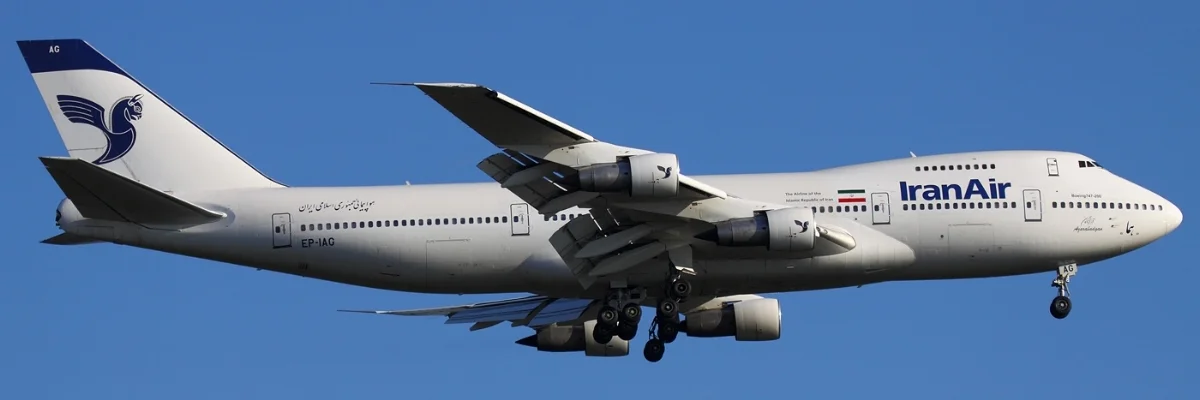
In Boeing, Airbus Negotiations, Iran Air is Flying Solo
◢ Following the approach of most Iranian state owned enterprises, Iran Air has not engaged outside counsel for its negotiations with Airbus and Boeing.
◢ Hesitation to work with international law firms may be impacting the speed and effectiveness of negotiations.
The recent announcement that US regulators have given their approval for the sale of Boeing and Airbus aircraft to Iran Air has been met with great enthusiasm. Officials at Iran Air have stated that they expect to receive the first Airbus airliners early next year. The news is remarkable on a number of levels, as the Boeing and Airbus agreements have been seen by many to be the linchpin deals that would finally help raise the comfort level of international banks to transact with Iran.
It is also noteworthy that Iran Air has negotiated the deals without the advisory of an international law firm. Despite the fact that most airlines rely on outside counsel to help navigate the aircraft acquisition process, and that international law firms are itching to increase their presence in Iran, Iran's national carrier has followed the approach of most Iranian state-owned enterprises and forgone outside legal counsel in the negotiation of these commercial agreements. Instead, the company relies on its in-house lawyers, as well as on legal experts at the Ministry of Roads and Urban Development, which oversees both Iran Air and the Civil Aviation Organization.
Iranian state enterprises avoid engaging outside lawyers due to concerns regarding security, political sensitivity, and perhaps most practically, an unwillingness to pay the fees associated with high-level international legal advice, which can often amount to millions of dollars. The few Iranian state enterprises that have regularly enlisted outside counsel are in the oil industry, where deeper pockets and an international marketplace necessitate a different approach. The National Iranian Oil Company has been advised by Eversheds and the National Iranian Tanker Company has worked with Stephenson Harwood. In both cases, briefs focused on sanctions-related arbitration.
By contrast, Iran Air’s counterparties in the negotiations, the airplane manufacturers, have a clear reliance on outside counsel. Airbus and Boeing are so large and deal with such a wide range of legal matters across so many jurisdictions, that they each rely on their won “preferred legal network” of law firms pre-approved to advise the firms. This way, internal legal teams can tap the support of particular firms that have the capabilities desirable for a given brief. Boeing works with firms such as Eversheds, Allen & Overy, and White & Case, among others. Airbus has worked with Clifford Chance, Willkie Farr & Gallagher, and DLA Piper, among others. Given the fact that Boeing and Airbus use many of the world’s top law firms, and given that partners often move from firm to firm, there have been instances where a conflict of interest has emerged between Boeing, Airbus, and their clients or counterparts. This may be one reason why Iran Air opts not to use foreign firms. As so many of the major firms have worked with Boeing and Airbus, it would be difficult to ensure that sensitive information could be kept confidential in the course of negotiations. On the other hand, having “backchannels” in complex negotiations can be an asset, but these usually work when there are longstanding relationships in place, which Iran Air does not have.
Encouragingly, the reputation of the Iran Air legal team is strong. Because state-owned firms rarely use outside counsel even within Iran, they invest in and empower capable lawyers to manage legal and contractual issues. The legal department at Iran Air is divided into two teams: local and foreign. Both teams are overseen by the Director General for Legal Affairs, whose mandate covers all airline transactions and commercial contracts, including acquisitions through purchase or lease, in addition to a whole host of other legal matters. In the Airbus and Boeing negotiations, the Iran Air legal team is supported by the Legal Bureau in the Department of Legal and Parliamentary Affairs of the Ministry of Roads and Urban Development, led by Deputy Minister Alireza Mahfouzi. This bureau has specific responsibility to supervise “the preparation and exchange of cost agreements and acquisition of financial and capital assets” for its affiliate organizations.
There is no doubt that significant legal talent is being devoted to the Iran Air acquisitions. Given the importance of these deals not only to the long-term commercial viability of Iran Air, but also to the public perception of the Rouhani administration. However, the size and complexity of the Airbus and Boeing deals, which involve not only two of the largest non-oil commercial agreements ever signed by an Iranian firm, but also the need to navigate the complexities of US and EU sanctions and trade regulations in a difficult political environment, raises questions about the decision not to use outside legal council. In some ways, the decision could be seen as emblematic of a wider challenge as Iran seeks to open its economy. Can the country afford to continue working by its own rules, or will it have to begin following the more typical practices of the global commercial environment, such as a reliance on external legal counsel? For the moment, it looks like the Airbus and Boeing deals are proceeding as planned. That is good news, because the Iranian people are expecting results. Nothing less will do.
Photo Credit: Iran Air

Limited Capital is Creating "Blocs" in Iran's Start-Up Ecosystem
◢ Iran's start-up ecosystem is dominated by the two VCs that have been successful securing foreign investment.
◢ With little competition, these VCs and their start-ups are beginning to form competitive "blocs," limiting opportunities for collaboration and innovation.
Iran’s start-up ecosystem has continued to grow and develop since it burst onto the global tech scene in 2015. Incubators and start-up accelerators, including MAPS, Avatech, and DMOND Group have established a strong presence and helped instill best-practices that borrow from those of Silicon Valley. Some of the most prominent Iranian universities, including Shahid Beheshti, Islamic Azad University, University of Tehran and Sharif University have launched or are developing their own start-up incubators.
At the heart of the incubators and accelerators, a community has emerged that helps inspire new founders through events and outreach. Iran Startups and Roshdino host regular entrepreneurial meetings where start-up veterans share their expertise with local audiences, while Hamfekr Tehran coordinates weekly networking events hosted by a different start-up every week across various cities. The local community is not totally detached from the international scene, with Startup Grind having hostedsixteen events in Tehran, and Seedstars World—a start-up competition for emerging markets—holding its second Tehran-based event this month. Several conferences held outside of Iran, such as iBRIDGES series, were created specifically to link foreign investors with the Iranian start-up scene. Publications like Techrasa and Techly collect news on the start-up scene. An ecosystem is coming together with amazing speed.
Yet, despite the positive momentum and the energy and ingenuity of Iran’s start-up founders, the ecosystem is not immune to the larger challenges of the Iranian economy. Sanctions-related constraints and uncertainty around the corporate legal and policy framework for early stage investments obstruct local and foreign investors. This introduces risk above and beyond the inherent uncertainty when investing in a nascent sector where business plans are speculative and there have yet to be any IPOs or exits.
Nonetheless, capital has begun to follow into the eco-system, with a handful of adept foreign firms making early-stage investments. The largest activity has come from Pomegranate Investment, a Swedish fund that has raised EUR 60 million earmarked for investments in tech and consumer-focused sectors in Iran. Pomegranate has invested in Sarava Pars, a VC fund with investments in Avatech in addition to start-ups including Digikala (Iran’s answer to Amazon) and Café Bazaar (an Android marketplace).
Competing with Sarava is Rocket Internet, a publicly traded German company that replicates successful online businesses and adapts them to emerging markets. Rocket has four start-up ventures currently operating in Iran. Some of these are direct competitors with indigenous start-ups, such e-commerce site Bamilo and Snapp, a taxi app. The entry of Rocket into the Iranian market in 2013 had a positive effect in jump-starting local entrepreneurs by enticing them to move quickly with their own ventures to not only fill remaining market gaps but to also create competitive alternatives to the apps Rocket was launching.
Sarava and Rocket have played a major role in fostering and funding the start-up ecosystem in Iran, but the early dominance of these two players may become a liability as the Iranian ecosystem seeks the next level in its development.
While Sarava has gained an international reputation, based on its early success investing in Iran’s most promising ventures, its success has meant that it receives the lion’s share of attention from foreign investors looking for exposure to early-stage investments in Iran. Meanwhile, smaller and less established VC funds are overlooked and have yet to raise significant foreign capital. Even with Rocket’s track record, many treat Sarava as though it is the only game in town.
Subsequently, the concentration of capital and market share within the portfolios of the two biggest and competing players in Iran’s start-up scene has led to a situation that more or less prohibits collaboration among different ventures. While many investors are warned to heed domestic politics when looking to invest in Iran, the start-up ecosystem is rife with politics of its own. Many of the start-ups funded by Sarava and Rocket Internet compete directly for market share. This makes it difficult for non-competing ventures on either side to collaborate where synergies in technology development or marketing might be possible.
Given the impact on the ecosystem, founders are calling out for more options. “Iran’s start-up ecosystem is in need of foreign investors and many more venture capital players to generate a more diversified structure”, says Pedram Assadi, the founder and CEO of Chilivery, a food delivery platform. Assadi says more funding choices are needed “to prevent the creation of start-up blocs.”
Unless more sources of capital emerge, the start-up ecosystem in Iran risks becoming comprised of inward-looking blocs of isolated start-ups, which prioritize intra-network rather than inter-network collaboration. Moreover, the concentration of capital in two blocs also affects how ideas and expertise are shared. The pool of experienced local mentors advising Iran’s start-ups is inherently small, but it is further limited when those associated with the competing blocs are effectively precluded from working with start-ups outside their network. As a result, innovation is hampered even further.
Better access to capital will change incentives. Founders will benefit when new investors are forced to seek out innovative projects in their earliest stages rather than simply deciding to pour more capital into the saturated competing networks. Competition has its merits, but reducing the control of the blocs will open the door to collaboration among ventures and would stimulate overall growth. Innovation thrives when there is a surfeit of investors always seeking the next big thing, as the successes of Silicon Valley show.
But even in the face of the current challenges, Iran’s ambitious founders are not discouraged. Until the funding environment improves, the focus will remain on the product, and many new companies are bootstrapping or using crowd-funding platforms to fund development. Hady Moslehi is one of the co-founders of Ronak—a self-funded software start-up that recently launched a team-to-team messaging app called Nested, which placed third in this month’s Seedstars Tehran competition. He insists that the “most important issue remains how to build a product that users love.” If Iran’s founders can get that right, the investors will surely follow.
Photo Credit: Avatech

What Iran's Café Culture Teaches Us About Its Consumer Culture
Coffee consumption in Iran is on the rise, but as shown in the global success of Starbucks, selling coffee is about more than just beverages. Cafés demonstrate how Iranian consumers seek places of authenticity, creativity, and community—cultural offerings that underpin commercial success.
Café culture is most often associated with the intellectual awakening of Europe in the 19th century. As Duke University Professor Jakob Norberg writes in a 2007 essay, cafés and coffeehouses were a unique public space in Europe, deeply connected to the intellectual awakening of the middle class. The café emerged as both a liberating and secure social space, a place of “vivid intellectual culture” yet also “relaxed communication.” These same qualities have made cafés in Iran susceptible to crackdowns by the authorities. The forced closure of Tehran’s Café Prague in 2013 was seen as a “significant loss for Tehran's academic and cultural life.” In the words of a patron, the café, named to evoke the intellectual milieu of 19th century Europe, “wasn't just a café; it was like home, a safe haven for us to forget all our daily troubles and burdens."
This lamentation echoes the argument of political theorist Carl Schmitt, who suggested that “coffee is a symbol of… the bourgeois desire to enjoy undisturbed security.” German philosopher Jurgen Habermas believed that “the coffeehouse is a place where bourgeois individuals can enter into relationships with one another without the restrictions of family, civil society, or the state.” As Norberg explains, “The notion… resonates with us because it is still recognizable. We have coffee, we meet in cafés, we sit down for chats with friends and acquaintances; Habermas's depiction of the coffeehouse still corresponds to an everyday practice.”
As coffee houses reemerge in the more open social and economic landscape of the Rouhani administration, the vibrant conversation among young, energetic, and creative Iranians who frequent places like the popular Sam Café corresponds to Habermas’ view of coffeehouse. At first glance, the cafés seem to offer both a liberal enclave within a larger Islamic public space—offering intellectual security and unrestricted relationships otherwise in short supply —as well as a space to reinforce socioeconomic distinctions in ways that seem typically Western. However, this view ignores the fact that coffee’s place in Iranian society predates all meaningful Westernization.
The history of coffeehouses in Iran dates back to the beginning of the 17th century, a time when coffee was more popular than tea. As relayed by social historian Rudi Matthee, coffeehouses were constructed on Esfahan’s famous Naqsh-e Jahan Square as early as 1603. The first coffeehouses in the United Kingdom were only established five decades later. The qhaveh-khaneh, literally the “coffeehouse,” was precisely the kind of open and intellectual space celebrated centuries later by the likes of Habermas and Schmitt. Matthee recounts the description of the French traveler Jean Chardin, who traveled Iran in the 1660's and 1670's:
These houses, which are big spacious and elevated halls, of various shapes, are generally the most beautiful places in the cities, since these are the locales where the people meet and seek entertainment. Several of them, especially those in the big cities, have a water basin in the middle. Around the rooms are platforms, which are about three feet high and approximately three to four feet wide, more or less according to the size of the location, and are made out of masonry or scaffolding, on which one sits in the Oriental manner. They open in the early morning and it is then, as well as in the evening, that they are most crowded… People engage in conversation, for it is there that news is communicated and where those interested in politics criticize the government in all freedom and without being fearful, since the government does not heed what the people say. Innocent games [...] resembling checkers, hopscotch, and chess, are played. In addition, mollas, dervishes, and poets take turns telling stories in verse or in prose. The narrations by the mollas and the dervishes are moral lessons, like our sermons, but it is not considered scandalous not to pay attention to them. No one is forced to give up his game or his conversation because of it. A molla will stand up, in the middle, or at one end of the qahveh-khaneh, and begin to preach in a loud voice, or a dervish enters all of a sudden, and chastises the assembled on the vanity of the world and its material goods. It often happens that two or three people talk at the same time, one on one side, the other on the opposite, and sometimes one will be a preacher and the other a storyteller.
The accounts of other travelers and scholars confirm Chardin’s description of the coffeehouses as a place of intellectual creativity and social mixing. Importantly, the coffeehouses were not confined to the imperial capital of Esfahan. Accounts speak of such establishments in Tabriz, Yazd, and Shiraz, among other cities. The coffee culture of Safavid Iran was highly developed, with characteristics that were both local and global, religious and secular. The later tendency to see café culture as a marker of Westernization, one shared today by morality authorities who often interfere with cafes and their patrons, may be tied to the role of the coffeehouse in the 20th century, when places such as Tehran’s Café Naderi became meeting places for intellectuals committed to ideological movements that originated in the West. In effect, café culture was conflated with the ideologies it was helping to foment, despite its much earlier and more local historical roots.
Today, coffee consumption in Iran is on the rise. The Customs Administration of the Islamic Republic of Iran reports that 8,000 metric tons of coffee are imported each year. Iran’s parallel import market probably means the true figure is higher. Working from the official figure, and assuming that each cup of coffee represents 7 grams, Iran’s total consumption equates to 1.1 billion cups of coffee each year (Italy, a country with 20 million fewer people, consumes a staggering 14 billion cups of coffee each year.) Importantly, just 10% of the coffee consumed in Iran is freshly ground, with the remainder being instant coffee. Nestle is the only major international brand with a significant market share, maintaining around 20% with its Nescafé instant line. The fragmented market and low overall volume reflects how tea continues to be the preferred form of caffeine consumption in Iran. However, consumption is expected to grow at the high rate of 11% CAGR until 2020, taking the value of the market to more than USD $200 million. Yet, unlocking the full commercial potential of this market is about much more than selling cups of coffee. The rise of coffee consumption will depend on the emergence of a coffee culture. New cafés are opening across Iran’s major cities. Establishments such as Tehran’s Sam Café and baristas such as Mehran Mirjani have recently garnered the attention of the global coffee community.
Overall, while the current revival of coffee in Iran is certainly a kind of re-exportation from the West (and in particular the so-called Third Wave coffee culture of Australia), it is not merely a Western phenomenon and should not be characterized as such. The implication is that companies seeking to engage in the coffee market in Iran (or the wider consumer market targeting young, urban millennials) must consider the full cultural significance of their product or service offering. Simply believing that Westernization is the most salient trend is a strategic error, particularly because of the increasing commercial importance of cultural identity.
In the past two decades, it has become clear that the world’s most successful consumer brands do more than promise effectiveness, enjoyment, or value. There is an increasing expectation for companies and their brands to address consumer demands for authenticity, creativity, and community—cultural offerings that elicit an emotional connection. Given the historical cultural significance of coffee, it is perhaps natural that one of the companies that ushered in this consumer expectation was Starbucks, whose trademark play on café culture captivated consumers. Stanley Hainsworth, Starbucks’ former VP for Global Creative explains in an interview with Fast Company:
When Howard Schultz first came to Starbucks, he wasn't the owner of the company. He joined a couple guys that had started the company. He went over to Milan and saw the coffee culture and espresso bars where people met in the morning. He saw how people caught up on the news while they sat or stood and drank their little cups of espresso. That inspired the vision he crafted from the beginning—to design a social environment where people not only came for great coffee, but also to connect to a certain culture.
The challenge for Schultz, Hainsworth and the team at Starbucks was to “create something for consumers that they don't even know they need yet.” As Hainsworth explains, consumers were looking for a new kind of place to congregate:
Howard was very wise in knowing that Starbucks was not the only company in the world to make great coffee. On the contrary, there are hundreds of other companies that can make great coffee. So what's the great differentiator? The answer is the distinction that most great brands create. There are other companies that make great running shoes or great toys or great detergent or soap, but what is the real differentiator that people keep coming back for? For Starbucks, it was creating a community, a "third place."
The lesson for the Iranian market is profound. Consumers now expect companies to show some cultural creativity at all stages of their experience—from advertising, to the retail experience, to the product itself. The ubiquity of the Apple iPhone in Iran is a strong indicator that this expectation has taken root. But perhaps most importantly, Iranians are looking for new “places” to congregate and connect.
The politicized nature of public space in Iran introduces both greater risk and greater reward for those companies willing to commit to converting “spaces into places”—but the immense popularity of sites like Palladium Mall (an upscale shopping center) or the Tabiat Bridge (a pedestrian overpass connecting two public parks in Tehran) underscores the potential. As a consequence, companies cannot simply import the branding, marketing, and product offering from Western markets. As is evident in the history of Iranian coffeehouses, what may seem like processes of Westernization are often more nuanced. The commercial imperative to create a culturally complete offering requires companies to fully commit to localization for the Iranian market.
Again, Starbucks offers some useful lessons. “Starbucks culture” was born in Seattle, Washington and encompasses everything from the “who the furniture was chosen for, what artwork would be on the walls, what music was going to be played, and how it would be played,” as Hainsworth explains. Starbucks faced an immense challenge in reinterpreting this culture for disparate markets such as China and India. As explained by Revathy Rajasekan in a case study in the IUP Journal of Brand Management, “Starbucks’ entry into tea-drinking India” hinged entirely on a dedicated effort to balance the forces of globalization with the requirements of localization. Despite an aggressive launch, Starbucks’ market entry had stalled until the right culture had been crafted for the Indian consumer. The same will be the case for all multinationals entering Iran.
It may seem incongruous to celebrate establishments like Sam Café and then claim that major corporations seeking to enter Iran ought to use the Starbucks approach to culture. By dint of its success, Starbucks is seen as a bogeyman for the kind of globalization that crushes local proprietors. But in a broadly underserved market like Iran, there is room for both independent businesses and major multinationals. It is worth remembering that Starbucks developed its identity and strategy from its original incarnation as a humble coffee roaster in Seattle. In this way, small businesses, with their inherent connections to local communities and the focused visions of their founders, offer a means to innovate cultural offerings. On the back of Starbucks’ success, which elevated consumer expectations, the “third wave” of independent coffee shops has emerged in the United States and worldwide. A similar sequence is emerging in Iran across cafés, restaurants, retail outlets, and boutique hotels. Often founded by individuals who have proven adept at melding the global and the local in an authentic cultural offering, these new “places” are signaling the larger potential for major multinationals. The revival of the coffeehouses of the past signals the emergence of new consumer expectations in Iran, providing a useful template for any future approach to the promising marketplace.
Photo Credit: Sam Café
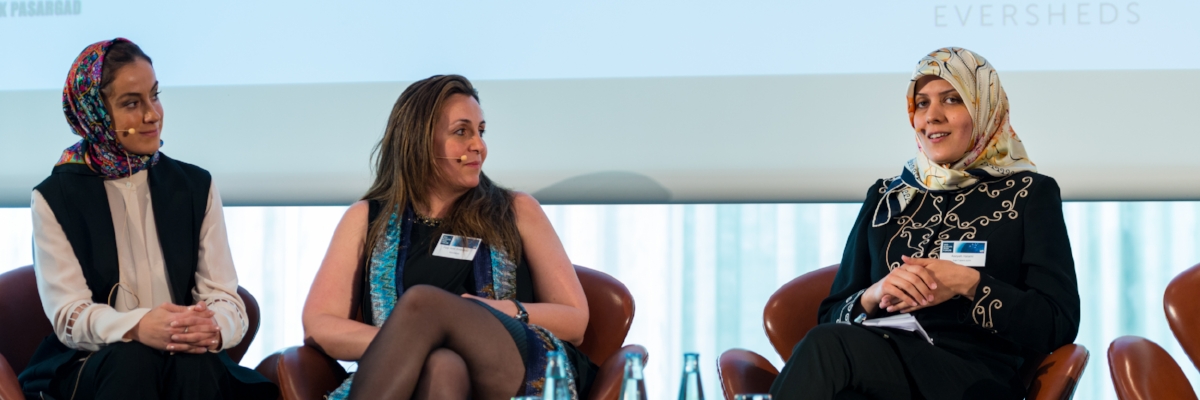
The Overlooked Potential of Iran's Women Entrepreneurs
◢ Women suffered disproportionately in Iran's economic downturn. Since 2005, the actual number of women in the workplace has fallen by nearly 1 million.
◢ But the dearth in opportunities has spawned an entrepreneurial streak among many Iranian women.
Recently, President Rouhani halted the third round of public sector hiring that is based on nationwide entrance exams. He instructed his ministers to review the sex-based quotas that have been in place for years. These quotas, which severely restrict womens' access to employment, are not opaque state targets. Rather, they are openly announced on an annual basis. The registration information for the qualifying exams of the education ministry stated upfront that of the 3,703 available positions, only a maximum of 630 will be open to women, regardless of performance on the exam. In larger urban areas where more women may be either merely interested or, more possibly, economically forced to work to make ends meet, there are more restrictive quotas because the pool of male applicants is larger. For instance, when the Ministry of Education needed 190 new hires in Tehran, only six positions were given to women. The field of education is a sector that is female-intensive across countries because teaching is considered as an "appropriate” profession for women since it is conducive for work-home balance.
With even the education sector shutting women out, other sectors are almost impossible for female candidates to penetrate. Thus, women hold only 10% of jobs in the public sector, which is the main employer of the country. During the Ahmadinejad presidency, a set of policies were introduced to presumably support working women to manage their dual roles as mothers and wives. In reality, however, these policies imposed a high cost to employers and created disincentives in the hiring of women. These extra costs were particularly heavy in the private sector, where employers had to bear the expenses. Last year the government announced that since 2005, the actual number of women in the workforce has dropped from 3.96 million to 3.1 million. For any nation, a drop of close to one million workers is a sharp decline. It is especially so for a country with an already low existing base of female workers and a large population. This disproportionality translates into a high economic dependency ratio, i.e. the number of people in a family depending on one earner. Hence, families are increasingly vulnerable to potential economic shocks and policy changes. According to the International Labor Organisation (ILO), the labor force participation of Iranian women is a mere 17%. Iran ranks among the lowest in the world, even below Saudi Arabia– a fact that surprises even Iranians.
There is, therefore, a growing consensus that the female labor force participation has reached alarming lows and that this fact is detrimental to the overall economic and societal health of the country. The issue is now being increasingly debated by economists and policy makers, and not just the women’s rights activists. Another indicator is the urgent emphasis on creating economic opportunities for university educated women. It is for this reason that President Rouhani called for a review of the fairness of quotas. Despite affirmative action quotas for men, and the restriction of certain study streams to female students in some university, women still make up about 60% of university entrants (down from 64% before), solely based on scores in gender blind university entrance exams – the Konkur. Their share in the engineering and science fields--subject matters often dominated by men in Western education systems--is approximately 70%. According to UNESCO, Iran has one of the largest cohorts (in terms of actual numbers rather than just percentages) of female engineering and science students in the world.
Despite the many obstacles, women’s entrepreneurship is a bright light in Iranian society. Market-relevant training, such as engineering and computers, and the dearth in actual opportunities have spawned an entrepreneurial streak in many Iranian women. According to a study by Bahramitash and Salehi, based on a survey of male and female-owned firms that closely follows a similar methodology of the World Bank’s Enterprise Surveys, about 9.6% (applying sample weights) have a female principal owner. Female ownership rises for large firms (50+ employees) to 13.9%. On average, these firms are slightly younger than their male peers (7.1 vs 7.8 years, respectively), which suggests that they are perhaps slightly more technologically advanced than the businesses of their male counterparts. For medium (10-49 workers) and small firms (up to 10 workers) female ownership is 8.2% and 10%, respectively. Bahramitash and Salehi further find that women entrepreneurs are in more dynamic sectors of the economy. Out of necessity, their superior educational accomplishments and ingenuity have resulted in more innovative business models and ventures.
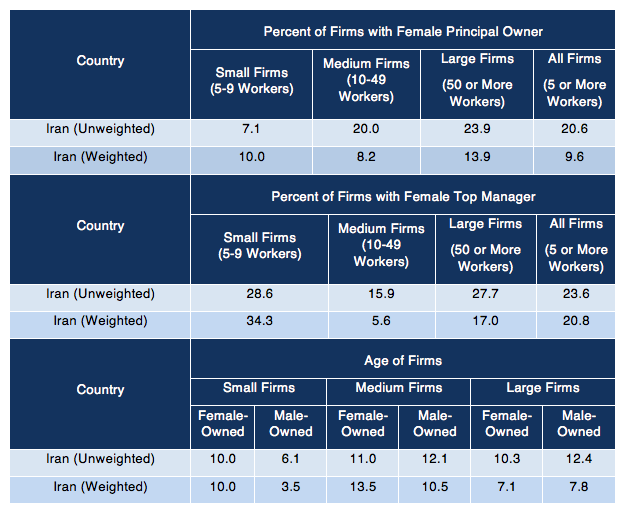
Iranian entrepreneurs have faced substantial obstacles in recent decades. Besides international sanctions, Iranian entrepreneurs must contend with policy uncertainties, limited access to telecoms (especially a slow and constricted Internet), credit constraints, non-competitive behavior in markets, difficulties in obtaining permits, corruption, and the high costs and uncertainties of the legal system. Women entrepreneurs face all of these challenges, and some more. According to the IFC's Women, Business, and Law Report (2016), Iranian women face differential treatment in 23 specific areas of the law. In the Bahramitash/Salehi study, too, women-owned firms (not just the women owners) responded more adversely to sanctions, slow internet, anti-competitive behavior, and policy uncertainty.
On a more positive note, Bahramitash and Salehi found that women-owned enterprises reported fewer problems related to corruption when obtaining permits and easier access to necessities such as finance. This may be consistent with global trends that show that bribe takers are more reluctant to approach women for bribes, and that women have a better repayment track record as borrowers.
Iran is a bastion of opportunities. In the words of Sir Martin Sorrell, CEO of global communications firm WPP, “Iran is one of the world’s last remaining untapped opportunities of that scale, short of Mars and the Moon.” Women entrepreneurs should not be overlooked when foreign companies seek potential local partners. However, most trade delegations visiting Iran have made little effort to engage Iranian businesswomen.Too few foreign delegations have included women from their own countries in their midst. And, male delegations meet Iranian male counterparts, thereby widening the existing gender gap at home and in Iran.
The chief of a recent international delegation that made the effort to meet with a group of women entrepreneurs, commented:
“I can truthfully say that I have never met such a group of dynamic and high ranking women entrepreneurs in one room before. Generally when we have such meetings with the private sector it is with men in the traditional fields and a few token women… so it is quite amazing that Iran has this caliber of women 'marching on.' What was also interesting and possibly counter-intuitive is that when asked if they faced any barriers as women, most of them said they had no real issues in the business arena that related to gender discrimination.”
This is what characterizes true entrepreneurs—seeing opportunities and not the numerous hurdles along the way. In short, Iranian women entrepreneurs are ready, savvy, willing, and able to contribute to the emerging economic possibilities coming to their country. Sidelining them robs everyone of opportunities.
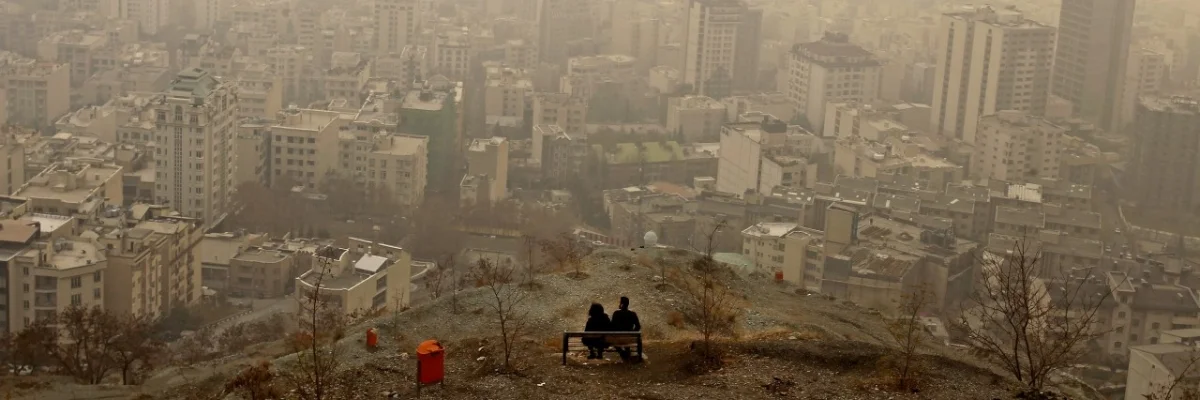
Iran's Business Leaders Must Do More to Protect the Environment
Iran's businesses have a responsibility to protect the environment alongside the government and civil society. Companies should be motivated by both profit and an ethos of corporate social responsibility to adopt more sustainable practices.
In today’s energized, almost-post-sanctions-era Iran, so much has become possible. But as growth takes place, and as increased capital flows into the country, we need to expect more from our business community as contributors to human development.
Businesses are expected to make profits. That is how wealth and jobs are created. That is how lives and livelihoods are transformed. But, along with profits, comes an expectation that the business community must act responsibly in terms of the social, environmental and economic improvement of the communities in which they make these profits. Most notably, businesses must focus on their responsibility to protect our environment.
Facing Grave Challenges
At present, our fragile, endangered planet faces many grave challenges. One of the greatest human development challenges we are witnessing in Iran is the threat of an increasingly hot and dry environment. The environment is being degraded through our actions. Climate change, coupled with the poor environmental decisions of the past, is making Iran hotter and drier. We see a country that is water-stressed, losing its forests, polluted by sand and dust storms, and energy inefficient. We see dramatically less biodiversity than even a decade ago.
The government is trying to reverse environmental degradation, but without the overall level of success required. Due to the scale of the problems and the nature of the causes, these problems can only be successfully addressed when all stakeholders who have had a share in creating them commit to finding solutions.
We all need to start acting sustainably. Governments need to do more. Citizens need to do more. And yes, frankly, the United Nations must also do more. We need to speed up our responses. Fortunately, the governments of the world, including Iran, have agreed to implement the Sustainable Development Goals (SDGs) which came in to effect in January 2016. These goals strive to end poverty, protect the planet, and ensure prosperity and peace for all through partnerships. We all need to take the time to learn, understand and apply these goals.
The United Nations is already working closely with the Iranian government to tackle many of the challenges identified through the SDGs. Encouragingly, Iranian authorities, along with most governments worldwide, are starting to frame a response to SDG targets.
Now is the time for the Iranian business community to also become more involved and visible in sustaining our environment. I believe that the business community must get involved both directly and indirectly in order to protect our environment. This can come in two ways. Direct and indirect.
Direct Efforts
Business efforts to reduce the environmental impact will increasingly become a matter of self-interest. Iran has committed, under its draft sixth Five-Year National Development Plan, to implement a low-carbon economy. Given this, plus the global commitments to which Iran has signed up to under the Paris Agreement, the Government will increasingly pass laws and policies which mandate emission reductions. Businesses therefore have a profit incentive to anticipate the regulations which will inevitably be imposed by an Iranian Government increasingly needing to comply with its own international carbon-reduction obligations.
In line with this, businesses should be innovative. Innovation brings about new opportunities and thus benefits the company and the society. “Sustainable innovation” can include such elements as a reduction in water use for production and the encouragement of companies to incentivize their customers to use less water by recycling.
Next, businesses should switch to more cost-effective techniques for their infrastructure. For example, when operating a business, one of the biggest burdens can be the cost of energy. Thus, in order to reduce these costs, the following steps can be taken:
Buy energy-efficient appliances and devices.
Switch off equipment when not in use.
Monitor your corporation’s energy usage by installing the necessary equipment (and act on what the numbers show)
Switch to using renewable sources of energy where possible (such as wind and solar).
But we also need to start with ourselves. And so, another step forward for businesses can be the engagement of employees and customers in sustainable behavior and actions. These actions entail raising awareness about a company's own “sustainable goals,” so that more people can become involved in supporting and helping to achieve those goals. It is the responsibility of every business to send the same message and encourage others to join these efforts.
Indirect Efforts
But there is another – indirect – way in which businesses can act to improve the environment. This is through Corporate Social Responsibility (CSR). Across the planet, CSR is becoming recognized as a strategic management tool for guiding corporate decisions. The ethos of CSR should also filter down to operations. In the end, and if done well, CSR will powerfully enhance a company’s corporate image in a world where, increasingly, if you are not visible, you are not relevant.
We are no longer in a position to choose pure profit. Our growth must be inclusive. Our development must be sustainable. And our environment must be safeguarded. These ideas were what drove former UN Secretary-General Kofi Annan to create the UN’s Global Compact in the year 2000. The Global Compact brings together business, governments, civil society and UN agencies to advance universal principles in the areas of environment, labor, human rights and anti-corruption. This initiative is the world's largest voluntary corporate citizenship pact. At present, over 4,100 companies from over one hundred countries participate. CSR is at the very center of our Global Compact. But there are hardly any Iranian companies represented in the Global Compact. The time has come for this to change.
CSR can contribute to overcoming human development challenges in all countries. Through CSR, companies can financially (or in-kind) support environmental causes and donate to organizations and charities that are working to overcome some of the challenges facing our planet. Irrespective of size, businesses can get involved and send a positive message to others to participate in CSR.
With this in mind, I urge business leaders in Iran to explore CSR and engage in partnerships to make growth more inclusive and more environmentally-sustainable. Living in Iran, I am encouraged by the number of private sector organizations, public corporations, and banks who wish to collaborate with entities – including those like the UN – to promote environmental initiatives and inclusive growth. Although I see encouraging signs within the private sector towards these goals, much more needs to be done.
Today, the world is demanding that companies behave responsibly vis-a-vis the environment. The spirit of “partnership” within the corporate community is at the heart of the SDGs. One goal in particular—Sustainable Development Goal 17—calls on all states to “Strengthen the means of implementation and revitalize the global partnership for sustainable development.” This is a direct call-to-action for the private sector. In order to attain sustainable development we need more hands. Each and every citizen has a role to play.
The UN stands ready to assist Iran's robust business community in promoting CSR.
Photo: Newsweek
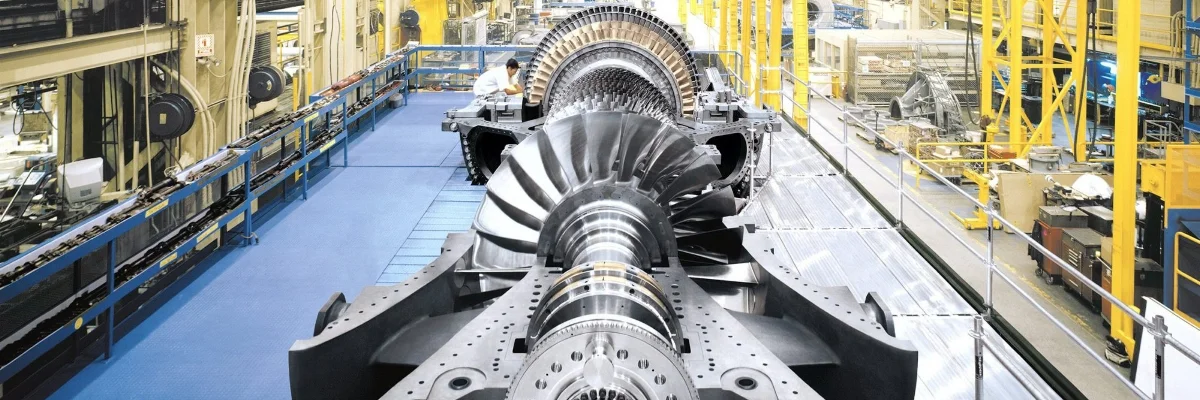
New Contracts Offer Synergies Between Players in Iran's Power Industry
◢ Iran's Ministry of Energy has devised Energy Conversion Agreements (ECAs) to encourage investment in power generation
◢ Investment is needed to upgrade an energy grid currently prone to 25% energy loss at peak times
Iran’s power industry is one of the most strategic and advanced industries among the country’s diversified industrial-based economy. The industry is not only strongly positioned to play a crucial role in Iran’s overall economic growth and industrial exports post-sanctions, but it is also a strategic component of the country’s geoeconomical importance in the South Caucuses and Central Asia.
In this new era of possibilities and opportunities, the outlook for the industry’s rapid expansion and economic growth is promising. This expansion is supported by the country’s abundant fossil fuel resources, over 600 different equipment-manufacturing companies and contractors, and over four million specialized technicians with electrical engineering backgrounds. Additionally, Iran’s large reserves of copper, aluminum, zinc, polymer, and other major raw materials allow robust capabilities for the domestic manufacturing of turbines and electrical components.
Nevertheless, considerable inefficiencies affect all segments of Iran’s power industry value chain. These deficiencies will continue to create challenges for the sustainable development of the sector. While foreign investment, and its hype, have become the main focus for meeting development objectives, other critical factors should be taken into account as the country makes its way back to the global arena.
Investment Incentives and Barriers
To attract new sources of capital to efficiently and quickly develop the power sector (for which the utilization of Class F and H turbines with net efficiency levels of 56% and 61% respectively are required), the Ministry of Energy (MoE) has introduced Energy Conversion Agreement models (ECAs) within Build-Own-Operate (BOO) and Build-Operate-Transfer (BOT) frameworks. In an attempt to reduce bureaucracy and increase efficiency in the processing of investment applications, MoE established Iran’s Thermal Power Plants Holding Company (TPPH) in early 2016, assigning it with the overall responsibility of negotiating investment deals and issuing required permits and licenses.
The Iranian power ECAs are based on two major principles: 1) free feedstock gas supply and 2) guaranteed electricity off-take at competitive tariffs. Both of these components are offered over five-year periods. The MoE has reached an agreement with the Ministry of Petroleum for the supply of gas which is converted to electricity for consumption in domestic markets. As such, these agreements are considered Energy Conversion Agreements as opposed to conventional Power Purchase Agreements (PPAs) offered elsewhere. The gas supply agreement has not been immune from political clashes between the two ministries, however. Officials of the Oil Ministry contend that by giving the project owners the opportunity to export electricity, the free supply of gas to power plants could undermine Iran’s gas export capabilities when the ECA’s term comes to an end.
ECA Model
- Fixed 5-year agreement with free supply of feedstock gas
- Guaranteed off-take agreement at pre-determined prices (which will be adjusted annually to protect investors against inflation and exchange rate fluctuations)
- Guaranteed (almost) free access to the grid for 20 years
- TPPH fixed financial modeling offering a 20% IRR
- After period of five years, the power plant can trade its electricity at the Energy Exchange market, or sell it to national or international off-takers at market prices
In order to ensure investor confidence, Iran’s Ministry of Economy and Finance backs the ECA agreements with a sovereign guarantee for the FIPPA-registered equity capital and incurred interest, which in turn, facilitates the means for investors to acquire finance at a low interest rate from international banks. In light of these attractive terms—often described as “too good to be true”—many international power companies, particularly those from Germany, Turkey and South Korea, have already signed MOU's with TTPH for multi-thousand megawatt power projects across the country.
While the MoE has been successful in attracting foreign investment, it has been less successful in engaging the Iranian private sector—namely manufacturers and contractors active in electric engineering, consultancy, and power plant construction. The post-sanctions policy of creating a "resistance economy", endorsed by Supreme Leader Ayatollah Khamenei, puts a great emphasis on the importance of empowering and supporting Iranian companies in their post-sanctions reintegration into the international economy. Entities that worked diligently and successfully during the era of sanctions to ensure the generation and flow of electricity are specifically rewarded. The requirement for establishing partnerships with competent Iranian companies – a requirement also included in the Iranian Petroleum Contracts (IPCs) - should be incorporated in power sector development contracts as well.
Another major development barrier in Iran’s power market is that despite a massive installed capacity of 75,000MW, a large number of power plants operate using extremely inefficient single-cycle E-class turbines with a stagnant efficiency of 30-35%. This level of inefficiency is even higher when combined with the energy loss in the transmission and distribution systems caused by old, inefficient and depleted network utilities and technologies. Half of the electricity appliances and cables in the distribution system are over a quarter-century old and cannot withstand heavy loads during peak times. According to a report published by the Parliament Research Centre in July, 2015, the actual level of power loss in Iran’s power system (energy conversion and transmission and distribution networks), ranges between 19-22%, and increases to over 25% during summer peak times. In practice, this means that for every 1000 MWh electricity generated during the peak time, a staggering 250MWh is wasted.
Heavy state subsidies and underpriced natural gas supplied to power plants result in depleted efficiency in Iran's power grid. A low tariff structure has caused a trend of excessive and inefficient consumption pattern per capita and the resulting inability to recover costs has led the industry to accumulate significant debt. The situation has been recently exacerbated by the urgent requirement for capital investment in developing new capacities to meet an unprecedented growth in demand. This requirement is expected to increase even further in light of post-sanctions economic growth. The expanding structural deficit has been a daunting burden on both the government and the private sector. A yearly investment of USD $5-6 billion has been required to meet the annual growth demand of 6% (or 5000 MW).
Iran as a Regional Energy Transit Hub
Iran’s power industry could play a critical role in enabling Iran to become a major regional electricity-dispatching hub, connecting the Caucuses and Central Asia with the Middle East. In addition to the realization of this project, the development of the larger alliance of the North-South corridor, which is being created among Russia, Azerbaijan and Iran, also has a strategic value for Iran. Unlike gas exports, which always face political barriers and fluctuations, electricity exports portend not only revenue, but also Iran's geo-economic relevance by creating economic and energy interdependency.
One of the major geopolitical objectives of the Iranian government is to ensure its regional ambitions by promoting energy diplomacy. While substantial progress has been made to date, (such as the synchronization of Iran's extensive national grid with all of its immediate neighbors, including Turkey, Iraq, Pakistan, Afghanistan, Armenia, Azerbaijan and Turkmenistan), this corridor requires substantial cross-border infrastructure development. The Iranian power industry, with the help of the private sector, should be at the forefront of this development. By allowing investors to solicit customers both domestically and regionally, these projects would also provide an attractive opportunity for investors to tap into regional markets for export of their generated electricity once their five-year power purchase agreement comes to an end. The ever-growing electricity demands of the Emirates, Oman and Kuwait offer a unique opportunity for power project developers in Iran.
The market knowledge and engineering know-how of Iranian companies, combined with the technological capabilities of foreign companies, will result in lucrative and substantial endeavors. As Iran re-engages with international markets, the most important policy for both government officials and Iranian power sector players is to grow sustainably, with a view to the long-term interests of the country.
Photo Credit: GE
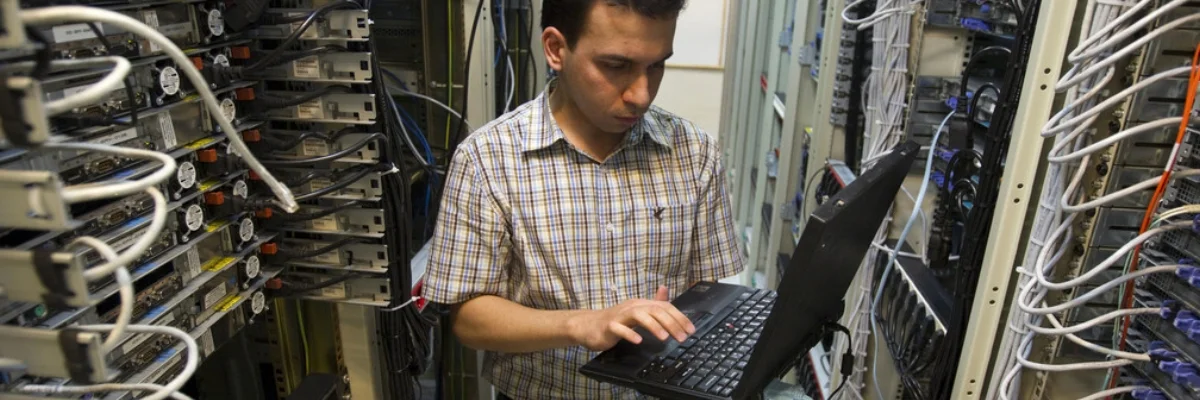
4 Megatrends That Support Rising Tech Entrepreneurship in Iran
◢ Entrepreneurial change starts with the individual, but is buoyed by favorable trends
◢ Megatrends in demographics, economics, communications technology and capital are driving growth in Iran's tech sector
Before talking about the key megatrends supporting technology entrepreneurship in Iran, I'd like to introduce the “change formula:"
(V x D) + FS > R = C
In this formula, C = change; R = resistance (fear of change); V = vision (a picture of what future looks like); D = dissatisfaction (pain of being on a burning platform); and FS = first steps (courage to take the first steps).
The change formula shows us that change needs to come from within. But at the same time, entrepreneurs look to favorable trends which help change happen faster and more readily. To analyze key "megatrends" in Iran we at Iratel Ventures used modified versions of the National Innovative Capacity and National Innovation System frameworks. Each topic forms the basis of our continuous and improving research.
The 4 key trends shaping entrepreneurship capacity in Iran are:
- Demographics (Culture, Education, Employment)
- Economics (Reconstruction, Reformation, Innovation)
- Communication Technology (Fixed, Mobile, Internet, Unified)
- Capital (Flight, Infrastructure, Exploratory, Venture)
Of particular interest to us is how venture capital will scale tech entrepreneurship among Iranians. An important aspect of this consideration is that pure scientific and technological advances which do not lead to economic applications are not a sustainable option for venture capital.
1. Demographics (Culture, Education, Employment)
Firms in innovative countries are willing to invest heavily in R&D, and have moved beyond extensive use of technology licensing. Companies focus on building their own brands, controlling international distribution, and selling globally, all of which are complementary to innovation-based strategies. Organizationally, firms from innovator countries engage in extensive training of employees, delegate authority down the organization, and make greater use of incentive compensation.
This is the vision for the future. This is the culture we need to establish in Iranian companies. One that is universal and capable of attracting top talent, not just domestically but internationally.
Having said that, Iran has abundant potential talent with 60% of the youth under the age of 30. This represents an amazing workforce but also a challenge. We need to create 1m jobs annually to keep employment under control but are only generating 300k.
Source: World Economic Forum
This pool of talent is highly educated. According to the World Economic Forum, Iran has the third highest number of graduates in engineering, manufacturing and construction (in absolute and per capita numbers).
If they’re not provided the opportunity to work on what they’re good at, Iranians will seek opportunities overseas. This phenomenon of "brain drain" is exactly what happened during the last two decades. The good news is that many are ready to establish businesses here (if not already) and make a real contribution.
This is the result of many years of good work in education, culture building and wanting to improve our place in the world. We are at the crossroads. We need to use these gifts properly or risk losing the opportunity. These high levels of innovative assets (scientists, engineers, and to some extent research institutions) have so far been hampered by the business environment and the competitive landscape in our country and now is the time to change.
2. Economic (Reconstruction, Reformation, Innovation)
Many policy discussions assume the existence of a sharp tradeoff between goals such as health, environment, safety, and short-term economic growth. However, a healthy rate of innovation increases the likelihood that new technologies will emerge that substantially temper or even eliminate such tradeoffs.
One of the main characteristics of the post-revolution economy in Iran is that growth at any rate may not be the top priority. The macro environment is affected by how economic decisions are made and how different parts of the economy are optimized in light of factors beyond profit.
This coupled with the economic shock due to the revolution, put industrial R&D and innovation at the bottom of the economic agenda. The restructuring of universities and the subsequent war led to further widening of the gap between R&D and industry. The international sanctions and eight years of devastating war further eroded our economic powers and pushed the country to the brink of economic collapse where real per capita income dropped 61% from the high of 1976 to the low of 1988.
The post war period presented an opportunity for ambitious rebuilding. Although there were great advances in this period and infrastructure was the primary beneficiary, there was still a lot of debate hampering growth. Most of the activity came from the public capital, however, private capital was slowly gaining confidence.
During the reformation, we had many social and cultural initiatives, but little in the way of economic reforms. The country was facing internal as well as external pressures especially with record low oil revenues. A bright spot was that private financial institutions and banks were set up and the first steps in turning private capital into a real player were being taken.
Next came a period of further shocks and economic isolation marked by inward looking policies that focused on tax and subsidies, rather than growth. With little incentives to stay and international pressures, foreign investors left. However, private capital was booming in many consumer related industries and there was a big disconnect between public and private economies putting further social pressure on the country. The spring was being compressed even further.
In the new post-sanctions phase, the economy is at the top of an agenda marked by an outward looking vision to reconnect with global trade and to emphasize “knowledge based” companies. One can only hope for a bright future where economic policy will act as a tail-wind for innovation.
3. Communication Technology (Fixed, Mobile, Internet, Unified)
Communication technology has had a tremendous effect of shifting an inward looking local innovation to an outward global one.
In parallel with everything that was going on in our country, the world was entering the information age at great speeds, embracing a global many-to-many communication platform called the internet.
With the convergence and unification of voice, video and all other types of communication using smartphones, the possibilities of building bigger, more open and more useful services are multiplied by an order of magnitude. Given the right circumstances, these technologies will connect us to a global audience at the push of a command and make building of previously unimaginable businesses possible. Imagine you’d told someone 40 years ago that they’ll be able to communicate with 5m people simultaneously and get responses from them in real time!
Iran was no exception in adapting this tremendous communication technology. Iran was an early adopter of the GSM standard resulting in a jump to the digital world. By the late 90s, Iran was the largest country in the ME in terms of mobile phone volumes and by mid 2010s, Iran had he highest internet population and the second highest number of smartphones in the region.
The internet and communication evolution is only marching on, with an ever increasing number of things coming online, we will have a unified system gathering, analyzing, optimizing and automating many things we do in our daily lives.
4. Capital (Flight, Infrastructure, Exploratory, Venture)
The availability of venture capital reflects the importance of risk capital in translating basic research into commercializable innovation.
Venture Capital is considered as the main financial driver of entrepreneurship that can ignite innovative streams due to its high risk tolerance and expectation factor.
In the years before the revolution and the first 10 years following the revolution, the country saw huge capital outflows and frozen assets due to political issues. During the infrastructure building phase, capital, mostly public, was being allocated to rebuilding efforts. Infrastructure investments in the major industries as well as newer ones (e.g. telecoms) was picking up. At the same time, the country’s private capital was still far from having any influence. Private capital had limited access to opportunity and was primarily locked in real estate and trade.
However, a period of economic reform began to unlock the potential in local industries. Privatization gathered pace and private financial institutions were set up and private capital started feeling more opportunistic. This helped shape the nucleus of the private capital which would take at least a decade to grow and become an important player. During the later reformation years, capital started exploring adjacent and relevant markets outside Iran. However, with the new rounds of sanctions this exploratory phase came to an abrupt halt and returns were diminished.
This growth opened the way for the emergence of a new trend, the rise of venture capital. Venture capital knows that the only way to build meaningful and sustainable returns is by building products and services that will go beyond the local constraints and have the potential to have a global footprint. Both public and private capital moved towards venture applications. Public capital was becoming more structured as seen in the establishment of a Sovereign Wealth Fund in Iran with local as well as global aspirations. Private capital had long been stuck in bank deposits. But lowered interest rates have begun to influence depositors to seek our investments that can contribute to economic production.
Source: Stanford Business School
It is this kind of capital that can move fast, add value on an operational level and bring new ways of connecting with a global audience. This is the only way we can build an innovative platform for global Iranians. Once capital gets moving, its momentum will impact the other trends and positively compound their progress.
As direct beneficiaries of many (if not all) of these trends, it is our duty to be the change we want to see in our community. This is why we think that supporting entrepreneurship is the biggest contribution we can currently make. It allows us to take a long term view and patiently build a strong foundation towards an innovation driven economy for a more prosperous Iran.
Banner Photo: World Economic Forum
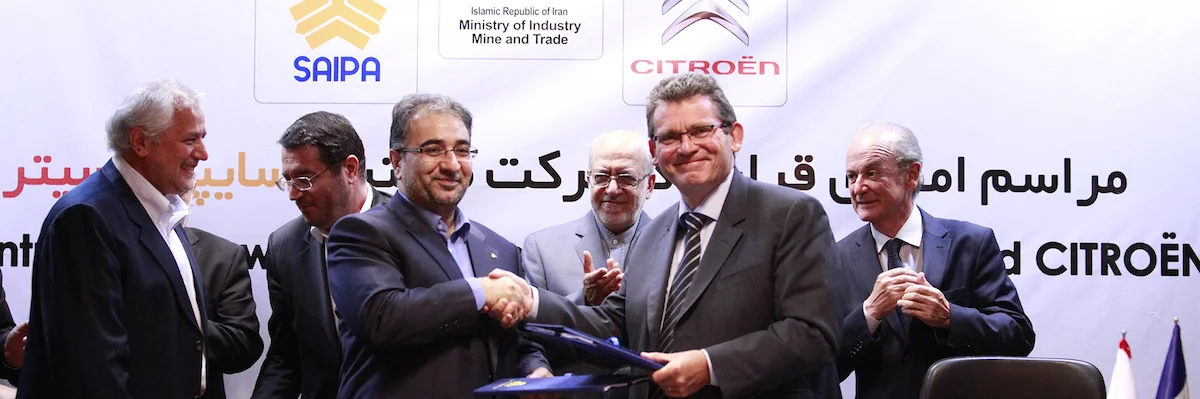
Seeing FDI as Iran’s Biggest Communications Challenge
◢ Attracting FDI is highly competitive, and Iran needs to improve its attractiveness as an investment destination.
◢ Iranian businesses need to understand both hard and soft drivers of perception and craft strategies to get hesitating investors engaged.
So much has been said about the outstanding opportunity that Iran presents for investors around the world. The country has been described as the last great emerging market opportunity available to global investors. Throughout the prolonged period of international negotiations that led to the JCPOA, the headlines focused on the significant economic fundamentals of the country—a population of 80 million people, a highly educated and skilled workforce, huge natural resources, and relatively sophisticated banking and legal systems, just to mention a few. Iran should be an enticing prospect for international investors operating in a low-growth global environment. Much has also been said about the need for Iran to attract the necessary FDI, technology, and expertise to re-invigorate an economy that has been left behind during a long period of international sanctions. But there has been less focus on the specific challenges Iran faces now as it promotes itself for greater engagement by foreign companies and investors--notably the difficult job it has to improve perceptions about the country as an investment destination.
Attracting FDI is Highly Competitive
Attracting serious FDI to a country is a highly competitive business, as so many emerging economies and developing countries now vie with one another to position themselves for investment. For Iran, isolated for so many years under sanctions, the process of promoting itself for foreign investment is going to be a major task as it seeks to compete with every other emerging market economy in the world – many of whom have become adept at global marketing and commercial diplomacy. Before launching a global advertising and media relations strategy, however, those in Iran mandated to promote FDI will need to understand what factors influence FDI decision makers. What drives a global corporation or a financial institution to invest in a country that has potential for growth, but presents significant risks?
The Drivers of FDI Decision Making
The business of attracting FDI to a country is atwo-part "contact sport". Firstly, it requires a strategic approach to understanding how investors behave when considering a destination for FDI. Secondly, there must be government-level commitment to engage closely with those investment decision-makers and stakeholders as they start to shape their sentiments around a specific investment opportunity. This requires an adequately-funded and serious communications strategy and engagement program at a national level.
In many years of working with countries and sovereign entities on FDI communications, I have learnt that a number of universal factors drive investment decisions. They can be referred to as the "hard" and "soft" drivers of investment.
Hard Drivers of Investment
The hard investment drivers influencing corporate decision makers as they consider whether to invest in a new market are principally economic. The first questions that need to be answered include what are the scope and nature of the potential business and what is the specific opportunity in our sector? It is therefore highly important that potential investors have this information available to them. For a country like Iran, isolated for so long and not used to making information available to international audiences, this will be a challenge. I find that there is a dearth of good economic information readily available on the country for international audiences. This void will need to be addressed by both trade groups and the government, in due course. Current levels of awareness about the specific investment opportunities in Iran are staggeringly low. In the UK, for example, many people compare Iran to its neighbors such as Afghanistan or Pakistan, rather than to Turkey, a more analogous comparison. This fact reveals the state of current investor misperception and ignorance regarding the country. When combined with the negative media coverage the country tends to receive from both the global and US-centric business media, a strongly negative view is created. The case for investment in Iran is a difficult one to make in the boardrooms of Europe because the perception of risk is combined with a low level of awareness of the actual economic opportunity and business environment.
Other hard drivers focus on the standard accepted processes of due diligence needed when considering a new market. Key questions that need to be addressed in FDI communications are: What are the corporate governance standards? Is the legal system reliable? What are the levels of transparency? What are the levels of corruption? How pro-business is the government? Again, the country needs to be seriously proactive in dealing with each of these issues and addressing justifiable concerns. Global indices play an increasinglyvital role in shaping investor decisions. As Iran ranks markedly behind its regional neighbours in key areas, the country will need to decide how to engage with indices such as the Heritage Foundation’s Index of Economic Freedom (Iran ranked 171 in 2016), World Bank Group’s Doing Business Report (Iran ranked 118 in 2016), Transparency International’s Corruption Perceptions Index (Iran ranked 130 in 2015) and World Economic Forum’s Global Competitiveness Report (Iran ranked 74 in 2015-16).
While these global rankings reflect Iran’s lack of engagement with the teams who compile them, they will collectively create a powerfully negative picture as investment decision makers assess potential opportunities in Iran.
Soft Drivers of Investment
The soft drivers of investment are centered around culture, not hard economic data or global rankings. Interestingly, soft drivers have a huge influence on FDI decision making. Therefore, government FDI communication has to shape both cultural and investment perceptions. Questions to be addressed include: Are women able to occupy senior roles in business? What are the career opportunities for women in the country? How strong is the infrastructure? Are there decent hotels and transport and flight links? Will my senior staff want to be posted to the country? In short, what is the "likeability" factor of the country? It is imperative that the country’s investment communication addresses these softer considerations. Because Iran has a positive narrative to highlight in this area, it must devote significant resources to building an effective campaign to addresses both hard and soft drivers. After all, decision makers are more likely to invest in a country they like.
Perception Research
The first step in developing the FDI communications program will be to conduct perception research in key markets and sectors. Perception research should be qualitative, and include in-depth interviews with investors, compliance managers, and regulatory bodies in key markets. This is a key tool in establishing a true picture of how the country is perceived by potential investors and target companies. Only then can an effective communications strategy and engagement program be developed and launched to change perceptions.
A year after the signing of the JCPOA, there is much frustration both in Iran and in Europe about the slow pace of the resumption of trade and international banking with Iran. Interested international investors are unlikely to commit to major investments until convinced that Iran is open for business. During this lull, those charged with promoting FDI into Iran must work diligently to shape perceptions and build investor appetite.
Photo Credit: SAIPA
How Think Tanks Influence the Debate on Iran
◢ Think tanks played a crucial role in both sides of the debate surrounding the Iran Deal.
◢ The success of the Iran Deal continues to depend on the influence of think tanks, particularly in Washington D.C.
At the 3rd Iran Europe Forum in Zurich earlier this year, Iranian business leaders attending frequently asked: What is a think tank?
The concept of the think tank originated in the United States with independent research institutes such as the Brookings Institution, which was founded in 1916 by a St. Louis businessman named Robert Brookings. Brookings established the institute with the goal of providing research in the fields of foreign policy, economics, and development. The actual term “think tank” was first applied in 1959 to the Center for Behavioral Sciences in Palo Alto, California. The term has since become a catch-all for thousands of organizations around the globe with a variety of agendas, funding streams and output. In some countries, think tanks are offshoots of the government and are managed by officials. The Institute for Political and International Studies in Tehran, which is affiliated with the Iranian Foreign Ministry, is one such example.
In the United States, most think tanks are privately funded by foundations and individuals, and seek to influence U.S. policymakers by publishing reports, testifying on Capitol Hill, and holding public and private events. The State Department’s Policy Planning Staff lists about 60 think tanks, mostly in Washington but some abroad, that it finds “particularly useful” in helping the department shape U.S. foreign policy.
Many U.S. think tanks, including the Atlantic Council, the Brookings Institution and the Center for Strategic and International Studies, are bi-partisan and do not endorse political candidates. They strive for balance in their staffing, analyses and events. However, their scholars are not barred from taking positions on contentious issues and are encouraged to put forward their ideas. Other organizations, such as the Heritage Foundation and the Center for American Progress, have clear leanings to the right or to the left of the political spectrum. These entities often act as lobby groups.
During the heated debate that took place last summer in Washington over the Iran nuclear deal, a number of think tanks and other organizations sought to influence the outcome. Many of the groups in support of the deal received small grants from the Ploughshares Fund, a non-profit based in San Francisco that seeks the elimination of nuclear weapons. Ploughshares was praised in the Journal of Philanthropy for its “creative and nimble thinking” in coordinating the successful campaign in support of the Joint Comprehensive Plan of Action (JCPOA). Among the groups that received funding from Ploughshares for their work on Iran were the Atlantic Council, the Arms Control Association, the Friends Committee on National Legislation (a lobby connected with the Quakers), and J-Street (a liberal Jewish-American group).
Groups on the conservative side of the political spectrum were much better funded. These organizations included the neo-conservative Foundation for Defense of Democracies and the powerful pro-Israeli government lobby, the American Israel Public Affairs Committee (AIPAC). In total, they spent an estimated $40 million on anti-JCPOA advertising directed at the U.S. Congress-- a staggeringly larger sum than that spent by the pro-deal camp. In the end, however, the effort failed to convince a sufficient number of Democrats that there was a better available alternative to the JCPOA. Indeed, the JCPOA never even came up for a vote in the U.S. Senate because opponents could not muster the 60 votes required to end the debate.
The Atlantic Council, which was founded in 1961 to promote U.S. ties with Europe, did not take a position on the JCPOA. However, a bipartisan Iran Task Force organized in February, 2010 under the leadership of then-Atlantic Council chairman (and later Defense Secretary) Chuck Hagel and former Ambassador to the European Union Stuart Eizenstat, did issue a statement in July, 2015. It gave qualified endorsement to the JCPOA while urging “special vigilance against any violation of its terms.” The Task Force also organized two private, bipartisan dinners in Washington in August, 2015 with Energy Secretary Ernie Moniz, a key member of the U.S. negotiating team. Similar events were held in New York in the fall with the Iranian ambassador to the United Nations, Gholamali Khoshroo, and with Iranian Foreign Minister Javad Zarif.
The Task Force, which has since evolved into a broader Future of Iran Initiative, seeks to increase the JCPOA’s chances for success and build on its model for conflict resolution. The Initiative also tries to promote a deeper understanding of Iran through reports and panel discussions such as a recent symposium on the implementation of the JCPOA that was addressed by two key administration officials – Deputy National Security adviser Ben Rhodes and John Smith, the acting head of the Treasury Department’s Office of Foreign Assets Control(OFAC).
In large part because the U.S. and Iran have lacked formal diplomatic relations since 1980, there is a dearth of expertise and knowledge about Iran in Washington foreign policy circles. Members of Congress, in particular, tend to view Iran through the lens of official Iranian anti-American and anti-Israel rhetoric. At the Atlantic Council, we strive to show Americans a more nuanced and realistic perspective on Iran by sponsoring events that feature individuals who have had first-hand, recent experience in Iran and who can speak to all aspects of the Islamic Republic.
Among the events the Initiative has held this year were a discussion on sports diplomacy, showcasing visits to Iran by U.S. wrestlers, a panel on hi tech startups and the innovation economy in Iran, and a discussion on the ramifications of the Iran-Saudi rift on regional conflicts. The Initiative also put out a balanced report on Iran’s human rights policies and organized a discussion that included experts on other countries in the region, including Saudi Arabia. The Initiative has also hosted Iranian officials, including Valiollah Seif, the governor of the Central Bank of Iran, for private discussions about the Iranian economy and the impact of the JCPOA. For the remainder of this year, the Initiative is planning events on environmental challenges in Iran’s Hamoun wetlands, the experiences of U.S. Peace Corps volunteers in Iran, and the country’s contemporary art scene. The Initiative also publishes a blog, IranInsight, with articles in both English and Farsi.
While there are other think tanks in Washington that have held events on the nuclear deal or Iran’s regional role, the Initiative is unique in its wide-angle view of the country. We feel we are performing an important service by acting as a bridge between two cultures that have been divided for far too long.
Photo Credit: Atlantic Council
Why Hotel Development in Iran Has Investors Excited
◢ Iran is expected to welcome 20 million tourists per year by 2025, but the country currently boasts just 650 hotels.
◢ International brands are moving into the country and strong market potential means that investors can find favorable incentives and financing packages to support development.
The lifting of sanctions on Iran has opened range of investment opportunities in the hospitality sector. After more than 35 years of economic isolation, Iran has a strong need for investments in hospitality infrastructure and will provide a major opportunity in next few years.
Iran is an extremely attractive tourist destination. The country has a rich cultural heritage with 19 UNESCO listed sites. Its tourist attractions range from ancient Persian ruins to beaches on the Persian Gulf and Caspian Sea to ski resorts in the Alborz mountains.
According to the World Travel and Tourism Council (WTTC), Iran’s tourism industry contributed 6.1% of the country’s GDP in 2014. This proportion is expected to rise by an average annual growth rate of 5.5% through 2025. Visitors export generated IRR 24,903.4bn (1.1% of total exports) in 2014 and is forecasted to grow by 3.0% pa to IRR 34,604.1bn in 2025 (0.8% of total). Moreover, WTTC data shows that the country hosted around 5 million tourists in 2014. Taking into account the positive effect of lifting of economic sanctions on Iran, this flow of tourists is expected to increase steadily to reach 20 million by 2025.
Considering its young population, 60% of which is below the age of 30, relatively high GDP per capita, and a location Iran has a strong potential to become a leading tourism market globally.
Before the 1979 revolution, Tehran’s hotel market had one of the highest penetrations of international hotel operators in the region with IHG, Hyatt, Hilton and Starwood operating hotels in prime locations. Following the revolution, the industry witnessed decades of stagnation. The departure of international hotel operators had significant impact on the quality of hotel management, resulting in a generally low quality of service.
Since the lifting of sanctions, Iran’s government has demonstrated that it is eager to attract foreign investment to meet rising demand. In the last year, the number of business travelers in Iran has increased significantly, creating demand for branded hotels operated by international hotel chains. Acording to research by Horwath HTL, a global hospitality industry consultancy, Iran currently boasts just 640 hotels with 96 located in Tehran, of which only 2 belong to an international brand. In comparison, Istanbul alone has 57 branded hotels.
Moreover, Tehran has only 13 properties that are classified as 4 or 5 stars. However, these do not meet international standards for the classifications. The lack of branded hotels and increasing demand from business travelers and tourists create a clear opportunity for international hotel chains to enter the market.
Aside from a joint Ibis and Novotel property recently opened by Accor in Tehran, there is nearly a complete lack of braded hotels in Iran, but this is set to change. Accor has plans to develop across the different segments in Iran’s major cities. Rotana group, based in the UAE, has already signed management agreements for four hotels in Iran – two in Tehran (opening in 2018) and two in Mashhad (opening in 2017). Similarly, the Spanish company Melia Hotels has announced its plans to open a 5 star hotel in a 130 meter tall tower on the Caspian Sea.
The early activity has focused on luxury and business travelers, but there are still more market segments to be covered. There is significant demand for modern mid-range hotels to cater to young Iranians travelling domestically as well as international tourists arriving on the growing numer of direct routes to Tehran opened by foreign airlines. Drivers for tourism include the appeal of cultural sites, but also the regional importance of pilgrimage sites for religous tourism and the regional appeal of Iran’s high quality of healthcare for medical tourists.
Foreign investors looking to capitalize on these opportunities have also been provided with a series of incentives by the Iranian Government. New hotels and tourism infrastructure in less developed areas will receive a 100% exemption on income tax if a license is issued by the Iranian Cultural Heritage, Handcrafts and Tourism Organisation (ICHTO). Hotels and tourism projects in developed towns and areas will also benefit from 50% income tax exemption.
Horwath HTL has prepared export finance opportunities for foreign and local investors to raise funds for the future hotel investments. In these scenarios, a European bank enables up to 80% of financing for the investments located in Tehran and maximum of 60% for investments in other regions. The financing is provided for 5 years considering the 0.5 % of CIRR interest rate for EUR (as of end of June 2016) and average annual real cost of credit (IRR) reaching the level of 4.27%.
Given that financing remains a key challenge for many projects in Iran, the favorable view taken by banks looking to hotel investments is promising. The hospitality sector will likely be one of the first to see international brands, European financial institutions, and local partners collaborate with the assistance of key advisors. Tourists in the country will hopefully experience the benefits of greater comfort and better service soon.
Photo Credit: Accor
