

Iran’s Water Protests are Not About Water
Esfahan is accused of being privileged as water protests expose regional inequalities in access to the Iranian government.
On November 8, a group of local farmers arrived in the city of Esfahan to protest in front of the offices of the official state news agency and the regional water authorities. The protestors called on the government to release water into the Zayendeh River, which has laid dusty and bare for months, a reoccurring phenomenon. Over the next days, the farmers continued their demonstration in the dried-out beds of the river, camping out close to one of downtown Esfahan’s iconic bridges.
But what started out as a small-scale protest action by farmers from east Esfahan quickly turned into the Ebrahim Raisi administration’s largest popular challenge since taking office in August. On November 19, a day after negotiations between the Esfahan Farmers’ Union and the regional government broke down again, thousands of city-dwellers suddenly joined the farmers to demand that the Zayandeh River be filled up.
The government’s initial response to the mass demonstration was conciliatory and supportive. State media broadcasted the Friday rally widely. Officials came to speak to the protestors directly, expressing their sympathy and promising to address the problem promptly. The minister of energy even formally apologised to the farmers, saying he felt “ashamed” that the government had failed to provide enough water.
Soon enough, the tone changed. Within days, security forces moved in, cracking down on the remaining protestors. Police brutally dispersed the protestors and destroyed their tents. On social media, images of farmers drenched in blood circulated widely.
In theory, water protests should have broad popular support in Iran. Not only is the country mostly arid and semi-arid, but Iranians have also suffered from worsening draughts and environmental degradation provoked by climate change, government mismanagement, and economic sanctions.
In reality, however, solidarity has been hard to obtain as ordinary Iranians, state organisations, and political elites compete fiercely about how to share the country’s increasingly scarce water resources.
Many of these rivalries are long-standing, and they broke out again following the Esfahan protests. In the capital of the neighbouring Chaharmahal and Bakhtiari province, hundreds of residents and farmers took to the street to protest against the Esfahan protestors’ demand for more water. The Chaharmahal protestors argued that their province, located in the mountainous Zagros region of southwestern Iran, already supplies too much water to the dry central plateau region, of which Esfahan is part. In turn, Esfahan farmers deployed an old tactic: they sabotaged the water pipes headed to the even drier Yazd province, arguing that “their” water is unjustly being diverted elsewhere.
This nasty and zero-sum type of group politics has become deeply entrenched in Iran over the past two decades. In this configuration, Esfahan province has certainly emerged a winner. Its rural residents earn on average about a quarter more than peers in the Zagros region or Khuzestan, which is home to the Karoon, the largest river in Iran. Moreover, Esfahan’s urban and provincial elites have been successful in turning local distributional conflicts over water use into demands for more water from the Zagros. Farmers from eastern Esfahan have long complained about excessive water use by the city of Esfahan. Regional authorities have used these protests to claim more water from upstream provinces.
Yet, rather than being diverted to eastern Esfahan, much of that extra water has gone into urban consumption and toward large-scale steel manufacturers in the region. These inefficient and wasteful factories, mostly built before the 1979 revolution, are heavily subsidized by a central government keen to maintain a degree of self-sufficiency in steel production.
It is perhaps unsurprising that, following the November 19 demonstrations, much of the debate on social media centred on Esfahan’s privileges. One popular Twitter user argued that “Esfahani greed is what has turned the Zayendeh River into an issue. Esfahanis do not only want [to produce] steel but they also expect the water of Khuzestan and Chaharmahal to be transferred to this industry. If we are to believe you, you should protest in front of the Mobarakeh and the Esfahan Steel Companies.”
Rather than blaming specific individuals, entities, or social groups, many other activists accused the “water mafia” for the opaque and mean-spirited machinations of the country’s water politics. Seyyed Yousef Moradi, an environmental activist from Yasuj, commented that: “Even though you think that people from the Zagros Mountains are simple, we are not ignorant. We understand that a ten day sit-in in Esfahan for water provision, with the wide-spread support of media and the government, is a part of the water mafia’s plan to justify projects to transport water from the deprived provinces of the Zagros.”
The term “water mafia” is also popular among the country’s political elites, who are keen to avoid direct confrontation among each other, and fear turning the conflict into an ethnic struggle between the Persian majorities of the central plateau and the Arab, Lor, and Bakhtiari minorities of southwestern Iran.
Indeed, while Esfahan’s relative wealth and power is undeniable, upstream provinces and groups do not lack political representation. In the past, the local elites in the Zagros and Khuzestan have often supported their constituents’ protests about water rights. For instance, in early 2014, the local MP and the local representative of the Supreme Leader came to the support of several thousand people who had gathered in Shahr-e Kord, the capital of Chaharmahal province. The protestors demanded a halt to construction work on tunnels designed to transport water to the central plateau.
Following similar protests in Khuzestan in the summer of 2016, Ayatollah Abbas Ka’bi, the province’s representative in the powerful Assembly of Experts, issued a fatwa prohibiting the transfer of water from Khuzestan to the central plateau for agricultural or industrial purposes. When rumours circulated last July that these water tunnels had been officially opened—thus breaking the religious ruling—protests flared up across the province. Initially, Ayatollah Ka’bi supported the protestors and called the demonstrations legitimate. He turned quiet when, as protests continued and spread over the next days, security forces decided to crack down violently.
The July protests in Khuzestan and the November protests in Esfahan are intimately related. The Esfahan protests, and the Esfahan Farmers’ Union’s failure to reach an agreement with the government over the Zayendeh River’s fate, is at least partially the product of recent struggles in Khuzestan and the Zagros to prevent the transfer of water to Esfahan. Because water in Iran is not a public good, the protests are not really about water. Rather, what protestors are fighting for is access to the government. Protestors want the government to enable their consumption of water.
For their part, state authorities are locked in a delicate balancing act. Strapped of cash in the face of a severe US-led sanctions regime, the government has not been able to cough up the investments necessary to update the country’s outdated irrigation systems and water infrastructures. While security forces are eager to crack down on what they perceive as disturbances and unrest, many other state elites are caught between, and often on the side of, various social groups and their competing demands for water.
In order to make water resource management in Iran more efficient, fair, and equitable, the country needs to move beyond its current form of interest group politics. Unfortunately, there are few indications that the broad-based solidarity such a movement requires is in the making. As a result, it is likely that water protests will continue to flow.
Photo: IRNA

To Transform the Fortunes of Iran’s Saffron Farmers, a Commitment to Technology and the Environment
◢ Keshmoon, an Iranian startup, connects carefully selected saffron farmers engaged in sustainable agriculture with premium consumers. The company has recently gained acclaim for its combination of ecommerce and "agritech" solutions.
◢ Starting with an initial cohort of 30 farmers in the town of Qaen in Khorasan Province, Keshmoon is encouraging a move to sustainable agriculture. The goal is to reduce water usage through means that also help the farmers improve their livelihoods.
Mohammad Qaempanah is a serial entrepreneur. His first business saw him act as a one-man internet service provider in his town, the connectivity from which he leveraged to start his next business, exporting saffron, a coveted spice with a heady aroma taken from the stigma of the crocus flower. Qaempanah exported the spice until sanctions made it impossible. He then opened a vegetarian restaurant in Mashhad with the aim of “educating people about the way in which their eating habits are linked to global warming.” Furthering his commitment to the environment, he then founded Iran’s first “nature school,” also in Mashhad, which offered programs to enable children from the city to experience and enjoy time in nature, learning about the environment. Having spurred something of a movement, there are today over 40 such schools around Iran.
Qaempanah, whose grandfather was a saffron farmer, has now turned his attention to agriculture in his hometown of Qaen, in the province of Khorasan, with a venture that combines his knowledge of saffron, his commitment to the environment, and his aptitude in technology. This latest venture, Keshmoon, has already won accolades. The company was recognized as the “Best Seed Stage Startup” at the recent Iran Web and Mobile Festival. Mohammad-Javad Jahromi, Iran’s young Minister of Communication and Information Technology, acknowledged the company in a subsequent tweet.
This early recognition reflects the scope of Keshmoon’s commercial ambition and its innovative vision for Iran’s agricultural sector. In Qaempanah’s words, Keshmoon combines an “ecommerce platform that serves consumers with an ‘agritech’ layer that serves suppliers.” In simpler terms, he explains, Keshmoon connects “carefully selected farmers engaged in sustainable agriculture with premium consumers.”
In founding the company alongside his brother, Hamza, and a friend, Siamak Khorrami, Qaempanah took inspiration from the increasingly popular model of direct trade coffee, where coffee roasters ethically source beans directly from growers, and also the popular ecommerce platform Etsy, which allows artists and craftsmen to sell their wares directly to consumers online. But while these platforms primarily reflect innovations in ecommerce, Keshmoon seeks to use technology to change the methods of agriculture itself.
Speaking about his vision, Qaempanah is careful to point out that his motivation in founding Keshmoon was “not to help farmers improve their economic situation.” Rather, his “foremost concern was water.” In his view, “unless the issue of water depletion is managed, it won’t matter what the farmers choose to grow, it will be impossible to cultivate anything.”
In the town of Qaen, where Qaempanah’s grandfather cultivated the particularly aromatic saffron that brought fame to the region, the qanats, a traditional system of underground channels which tap into the aquifer, have long been replaced by modern wells. Over the years, farmers drilled more wells to pump ever-increasing volumes of water, seeking to grow crops ill-suited to the arid climate. The water table has dropped precipitously. As Qaempanah relays, “wells that were once 15 meters deep now need to extend to 135 meters.”
Qaempanah believes that farmers are currently stuck in a self-defeating economic cycle. Presently, the use of more water enables higher yields and therefore higher earnings. Keshmoon was designed as a “technical infrastructure to change this cycle.” By incentivizing farmers to move towards the sustainable cultivation of saffron, which is naturally well-suited to Khorasan’s arid climate, farmers will be able to use less water, and yet enjoy greater earnings.
Gallery: The Farmers of Qaen
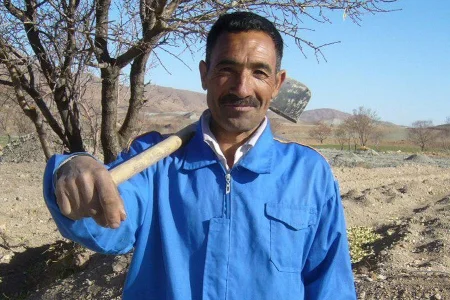
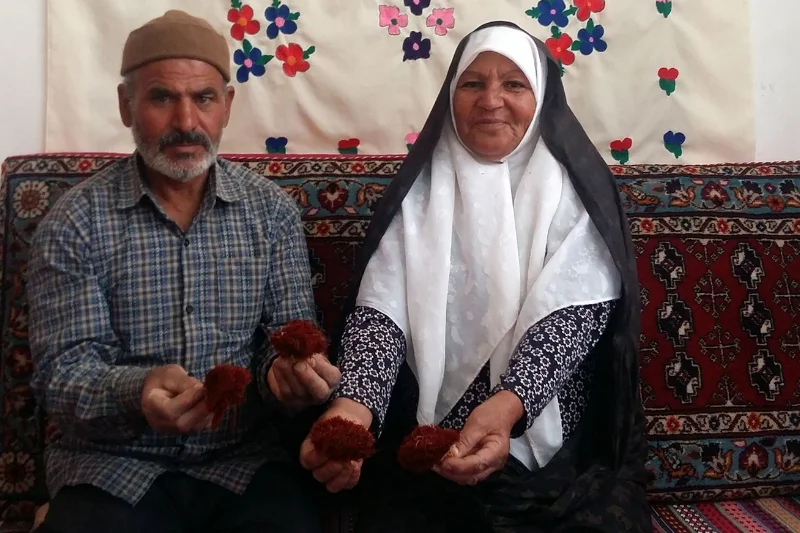
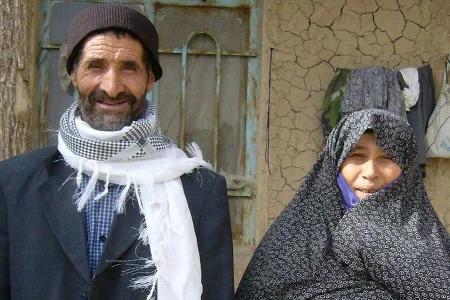
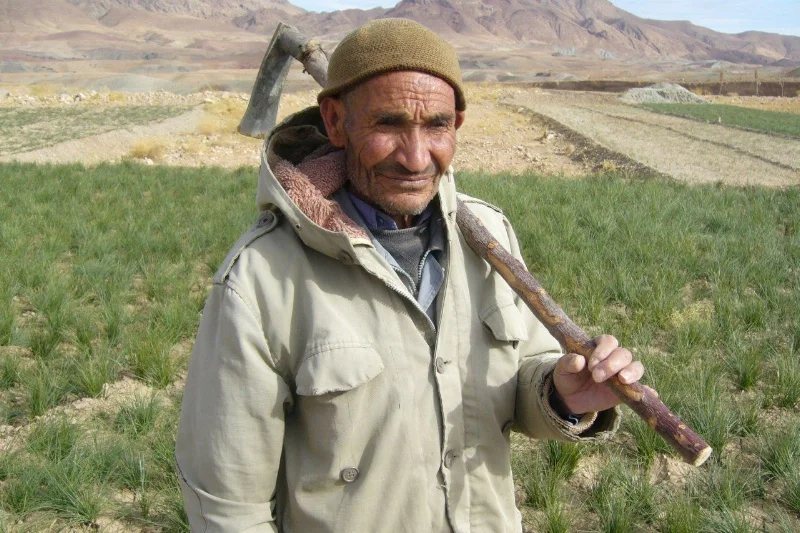
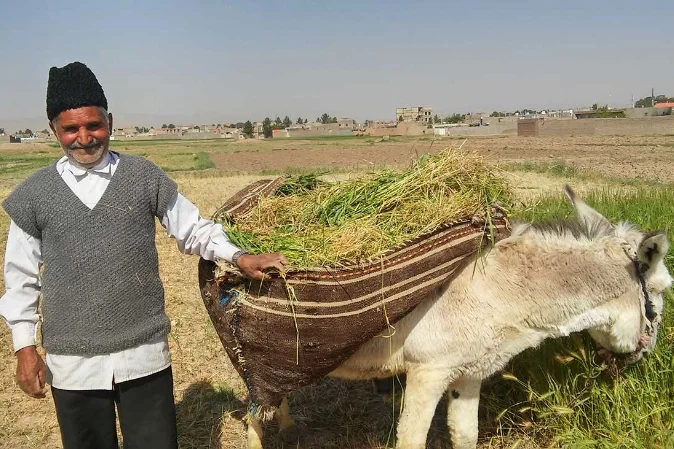
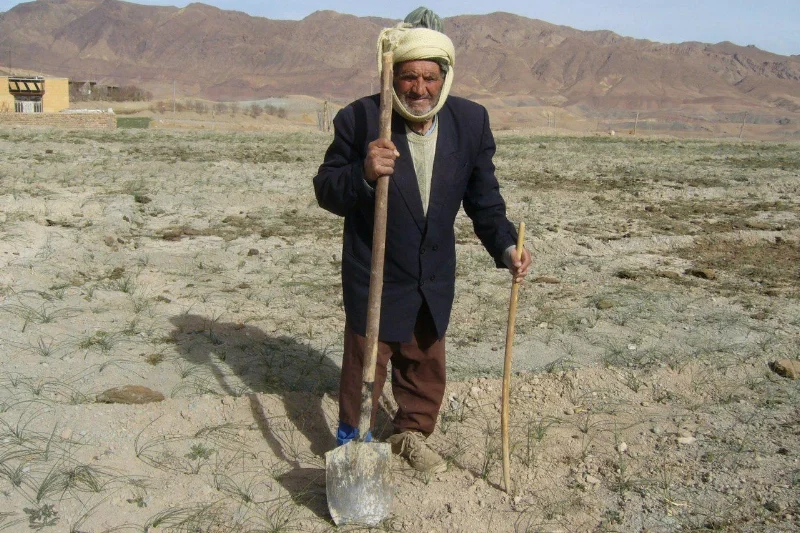
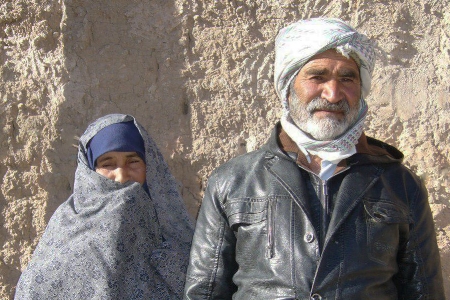
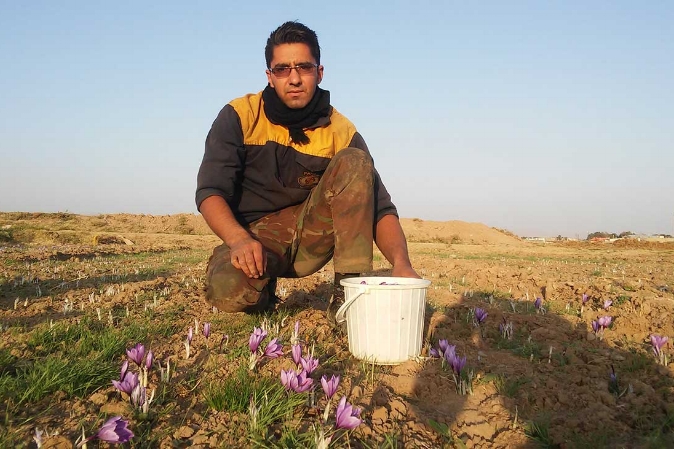
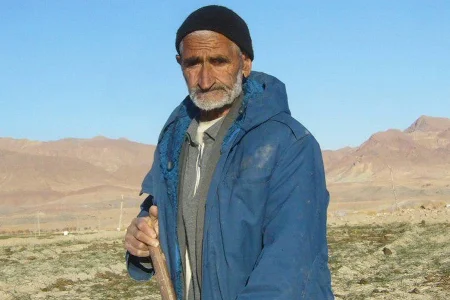
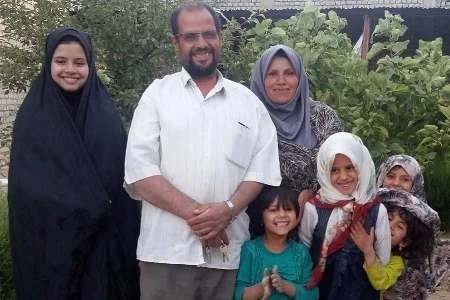
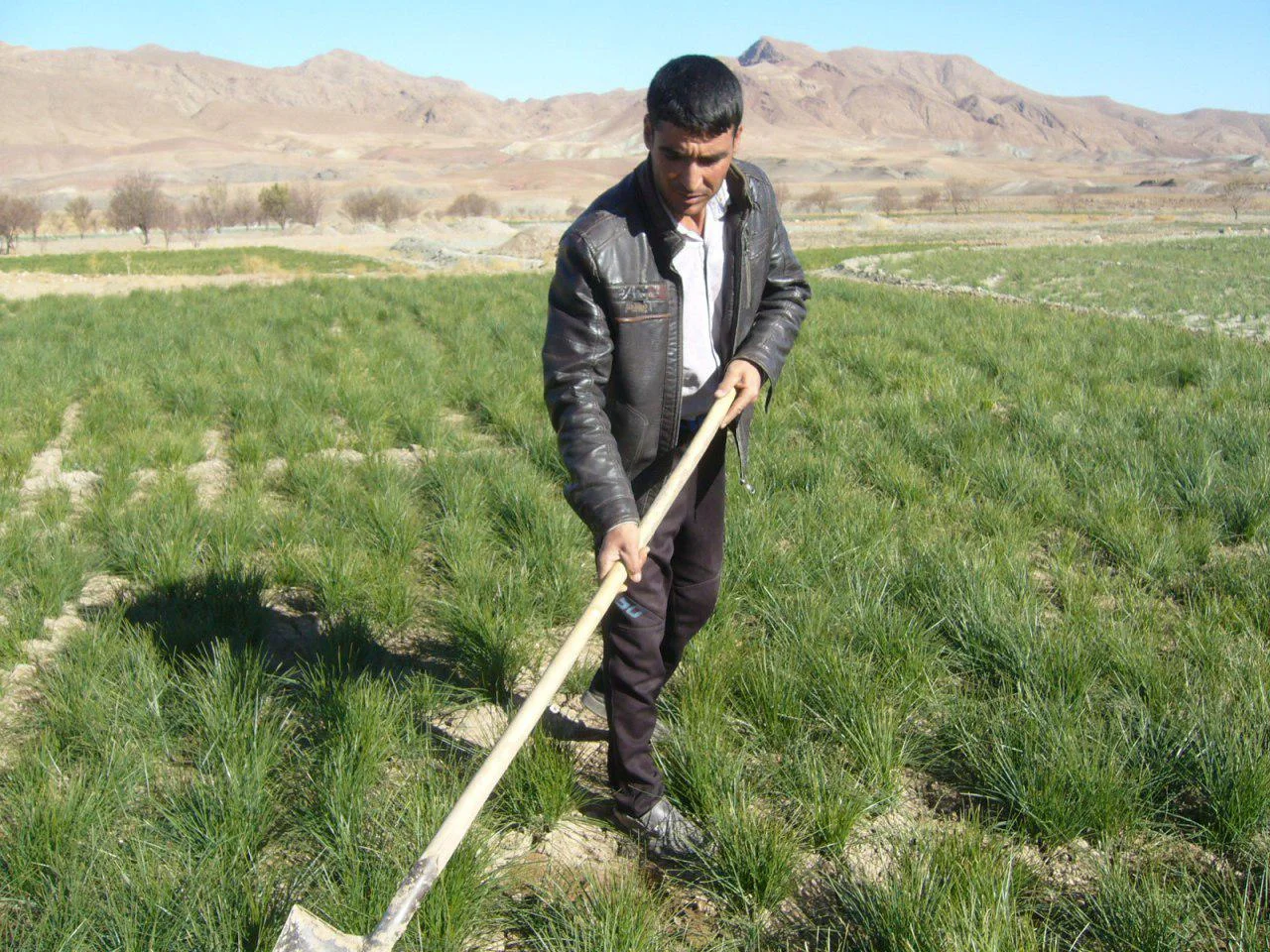
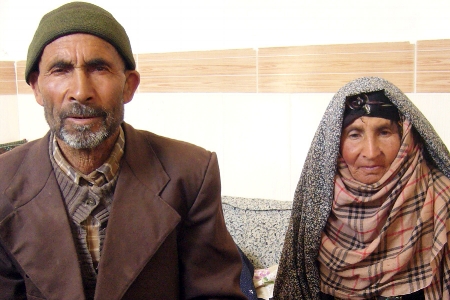
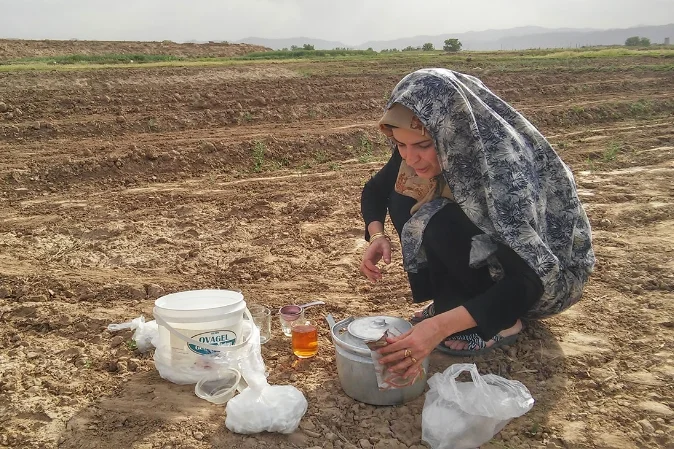
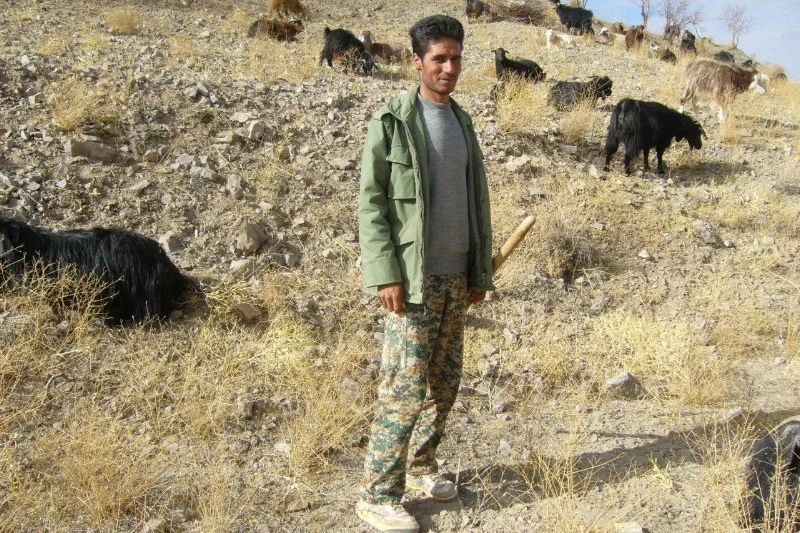
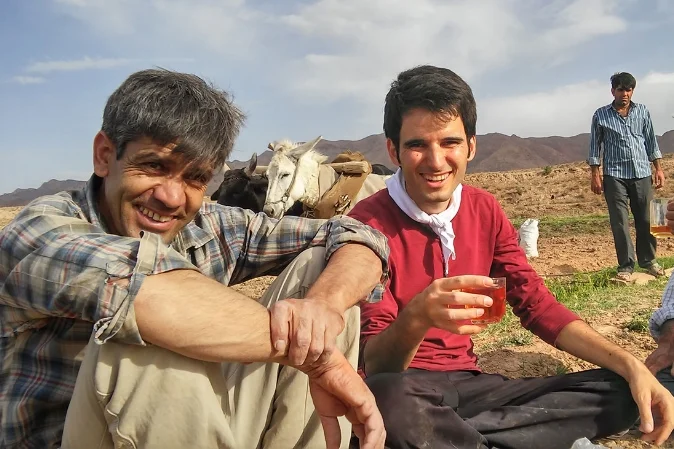
This has proven an attractive proposition to the farmers of Qaen, where Keshmoon has recruited its first cohort of 30 farmers. As Qaempanah recounts, the local saffron growers were “invited to a meeting in the town mosque, where we explained our approach, how we wanted to help, and asked them to go home and think about it.” Despite concerns that it might be hard to explain the technical aspects of the concept, the pitch worked. Today, farmers from neighboring villages and towns regularly stop by Keshmoon’s office in Qaen to learn more about the program they have heard about. The company has earned the trust of the local community.
To gain acceptance to Keshmoon’s platform, farmers need to demonstrate competency growing saffron in the traditional manner. Keshmoon will introduce more stringent requirements in the near future, introducing guidelines consistent with sustainable farming. It will take about one year to “gain critical mass and give farmers the time to make adjustments to their planting,” says Qaempanah. He foresees Keshmoon partnering with universities and other institutions to help provide training to farmers unfamiliar with growing saffron in a sustainable manner in order to help them make the switch.
For farmers, the commercial appeal of Keshmoon is the higher price achieved for their crop by selling to consumers directly, rather than selling to local traders. One drawback is that using Keshmoon will require farmers to sell their harvest incrementally, as orders come in online. Some farmers have said that they prefer selling to the local buyers, who can purchase the whole harvest in one transaction. But the price advantage is substantial. Farmers on Keshmoon can expect to generate 20-40 percent more in earnings than those who sell locally in bulk.
Laudably, Keshmoon has been very transparent about pricing for the sake of both consumers and farmers and offers a detailed breakdown on their website. Generally speaking, farmers receive 70 percent of the saffron’s retail price, while around 12 percent is earmarked for quality control, packaging, and transport, and the remaining 18 percent goes towards Keshmoon’s overhead.
Once accepted to Keshmoon, farmers need to create their online profiles. In most cases, the Keshmoon team helps by taking photos and recording the farmer’s personal details, family history, and also explanations of how the saffron is farmed. These profiles can be seen on the Keshmoon website, where consumers can even send messages to specific farmers.
Qaempanah notes that some farmers, typically those who are younger or who have had more education, have been able to author their profiles themselves. In some cases, it was the farmers’ children, many of whom own smartphones, who took responsibility for telling the story of the family farm through words and pictures. There is immense potential for the farmers to develop both some technology literacy and also their personal brand, which can help them connect with consumers more proactively. Commercial considerations aside, there is something affecting about seeing the personal portraits of the farmers and families behind Iran’s most precious crop.
A Keshmoon Giftbox
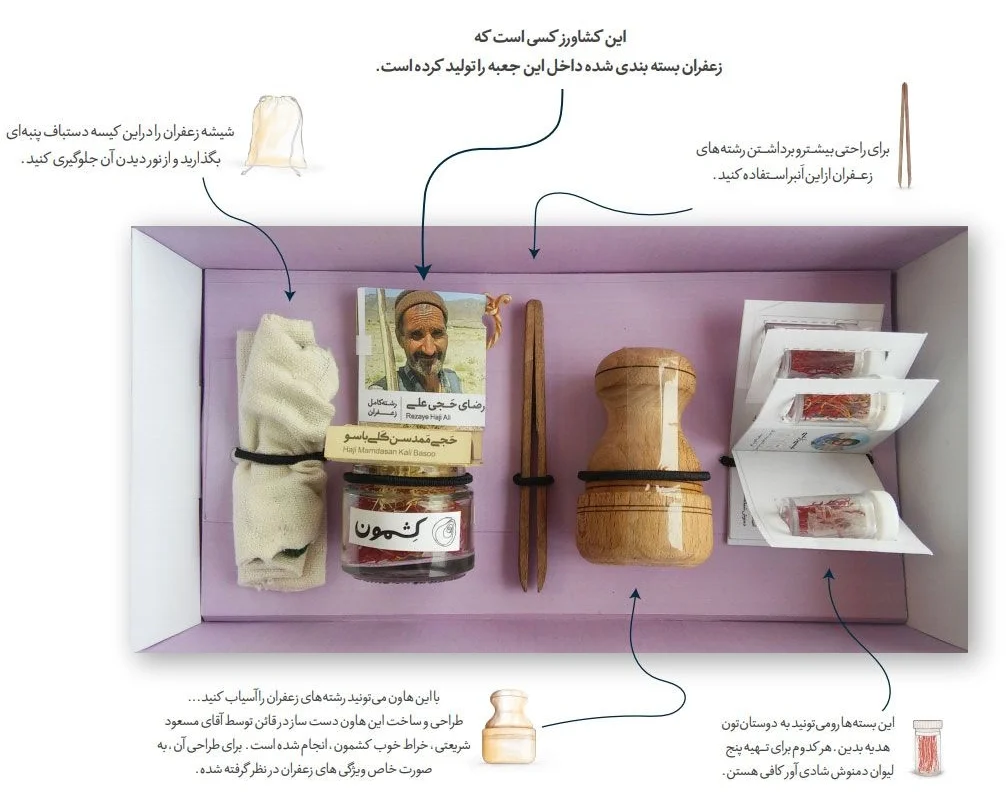
A connection to the farmers and a beautiful presentation of the saffron, including a small booklet about its origins, has proven a hit among consumers. The company has been selling online for nine months, and boasts a few hundred clients, about one-quarter of whom whom make recurring purchases. Keshmoon’s models show that it will take about 20-40 clients in order to support each farmer. At the moment, the company has stopped accepting new farmers onto its platform until is grows the client-base further. A big boost will come when the company begins selling to Europe later this year.
But while the Keshmoon story may begin with saffron, Qaempanah’s ambition is much greater. For the next few years, the Keshmoon team will focus on perfecting its “technical infrastructure,” combining ecommerce and agritech to open a new market for saffron. The big test will be in the marketing and branding. Qaempanah hopes to achieve a level of awareness such that “when people hear saffron, they think of Keshmoon.”
If this model can be developed successfully for saffron, the company plans to expand to other crops and bringing a similar model to other agricultural regions in Iran. Qaempanah imagines a situation where farmers from around the country can approach Keshmoon and receive recommendations for which crops to grow based both on analysis of the local environment and also Keshmoon’s data on which crops will sell most effectively on its marketplace. In this way, Keshmoon would serve to introduce efficiencies of scale typically reserved for large, corporatized farming. The economic and environmental impact for Iran, where the agricultural sector remains dominated by smallholder farmers, could be transformative.
But it is early days yet and the success of this grand masterplan will first depend on the successful collaboration between the saffron farmers of Qaen and the team at Keshmoon. Theirs is a collaboration that crosses talents and crosses generations—both a microcosm of the economic and environmental challenges facing Iran and a case study in the creative thinking and entrepreneurial spirit that may eventually solve those challenges.
Photo Credit: Keshmoon

Slowly But Surely, Lake Urmia Comes Back to Life
◢ Lake Urmia was once the second largest salt-water lake in the world. But years of environmental mismanagement saw the surface area of the lake shrink by 90%.
◢ After a decade-long initiative led by the United Nations, and supported by the Iranian and Japanese governments, water levels in the lake are finally beginning to rebound.
This article was originally published on the United Nations Iran website.
Life has returned to the dying Salt Lake in North-West Iran. The effort to restore what had been broken is succeeding.
Returning to the barren landscape after almost four years, I was able to see water. Not nearly enough, but much more than last time. The lake is reviving. And this revival is the result of an immensely successful collaborative effort involving many players—some Iranian, some foreign.
Lake Urmia was once Iran’s largest lake. In its prime, it was the second largest saltwater lake in the world. But years of man-made disruption—from the frenzy of 60 years of dam-building to the massive over-use of feeder rivers—had diverted the natural flow of sweet water from the surrounding basin into the salty lake. As a result, it simply dried out. It died at the hands of humans.
I also remember thinking that if the lake dried up two main things would happen. One is that salt from the dried lake bed would blow around and get dumped on farming land and crops in what essentially becomes a salt dustbowl in a fairly large radius around the lake. Secondly, we could expect people to get sick. For example, in the vicinity of the dried-out Aral Sea in Central Asia, we already see people afflicted with allergies and respiratory diseases including cancers.
But there would be a third self-destructive phenomenon at play as well. As farmers drilled ever-deeper to pump out the aquifers at the side of the lake for farming, over-exploitation of this groundwater surrounding the lake would cause saltwater seepage into those very same wells. This would hit people’s access to potable drinking water. So we were threatened by a “perfect salt storm” affecting people’s health and livelihoods.
When our plane landed in Urmia two weeks ago, having taken the normal one hour to fly from Tehran, I wondered what I would see. I had heard tell of an improvement. But such stories often vanish in the face of requests to provide evidence. I wanted to see for myself.
It was when we started to approach the vast open expanse of lake bed that I saw the morning sun glimmering off something which had not been there when last I travelled to the lake.
Water. Not deep. But enough to cover the salt dust granules which had caused such havoc before. As we drove across the bridge which bisects the lake, the glimmering started to stretch out towards the rising sun.
I must confess I was so happy that tears were welling up in my eyes. The environmental problems we create can be fixed, I thought. And here is how it happened.
First, some numbers.
When Lake Urmia was full, say 20 years ago, it was estimated to contain around 30 billion cubic meters (bcm) of water. At the worst point, 3 to 4 years ago, it contained a mere 0.5 bcm of salt water. The number now stands at 2.5 bcm. The deadly decline has been reversed. The amount of water now keeps increasing each month.
Use slider to see before and after.
Three to four years ago, when the water level was at its worst, only 500 of Lake Urmia’s 5,000 square kilometer surface was covered by any water at all. That figure has now risen to 2,300 square kilometers. Admittedly, much of that water is spread extremely thin, and some tends to evaporate easily. But it is there, offering a protective covering for the estimated 6 billion tons of salt and dust, which now no longer finds its way so easily into the air, into our eyes and lungs, and onto the farmers’ crops.
Because the amount of annual precipitation in terms of rain and snow in the basin has not changed appreciably in the last few years, we must look elsewhere for an explanation of why the lake is now filling up.
There are three main reasons. The first is engineering works to help unblock and un-silt the feeder rivers. Second is the deliberate release of water from the dams in the surrounding hills. Third, and most difficult of all to accomplish, has been a change in the way water management in the basin happens—especially among farmers. Other approaches like banning illegal wells have also had an impact.
The third approach—better water management—took considerable time and effort to achieve. But it appears here to stay. While practicing new roles and partnership of local authorities and communities within LU restoration process, it took painstaking effort to get farmers to reconsider how they grow their crops by modifying their agricultural techniques when growing wheat, barley, rapeseed and fruit and vegetables.
The new techniques are astonishingly simple: changing farm dimensions to make for smaller plots which retain water better; not using flooding as a form of irrigation, but rather trickle-irrigation which is targeted at the crops and thus not wasted; avoiding deep tillage which causes unnecessary water loss; introducing drought-resistant crop strains; ploughing plant residue back into the soil rather than burning it.
Across the board, the crop yield—despite using less water—has also increased by 40 per cent.
Use slider to see before and after.
Here is a final reassuring set of numbers. Considering the normal hydrological conditions, the lake has an average of 5.4 meters and the maximum depth in northern part around is around 15 meters. When the lake was at its worst point, the lake’s average level had dropped to almost zero. When we compare the level of the lake taken now with what prevailed at exactly this time last year, we note a 6 centimeter rise. The monthly increases have been incremental, but sustained.
The project which has brought about the improved water management is being implemented by the UN Development Programme (UNDP). Based in West and East Azerbaijan provinces with a focus on Lake Urmia surrounding cities and villages, it works closely with local farmers, provincial and national governments and others to initiate an adaptation process by implementing the “ecosystem approach."
Following a 7 year project to introduce ecosystem approach for saving Lake Urmia, with the generous financial support from the Japanese government in recent years, as well as an inflow from the Iranian government’s own resources at both the national and provincial levels, these techniques have been successfully implemented in 90 villages. But this number represents only about 10% of the irrigated farming area in the Urmia Basin. Nonetheless, in the areas where the sustainable agriculture is being practiced, there is a water saving of about one-third of the water that would otherwise have been wasted under the old inefficient practices. This saved water can flow back into the lake, thereby replenishing it.
UNDP’s interventions to save Iranian wetlands including Lake Urmia—starting 12 years ago, but intensifying significantly with the addition of three phases of Japanese funds—have focused on working with local farmers, cooperatives and government to support a new model of partnership among stakeholders and initiate an adaptation process by implementing sustainable agriculture techniques. It has also advocated alternative livelihoods for women using micro-credit and biodiversity conservation.
At present the project’s interventions cover sites all around the lake, and most affected, part of the lake basin. To boost coverage from 10%, the plan is to move towards significant upscaling of this important initiative in an emblematic effort which is being recognized at an international level.
As I got on the plane to return home to Tehran in the evening, three takeaway lessons occurred to me.
First, we face powerful environmental challenges in Iran. But we can fix what we have broken. And this is happening—right now—in Lake Urmia.
Second, the public must educate itself and speak out on the environment. The UN received a petition in 2016, containing 1.7 million signatures, requesting action on Lake Urmia. The pressure has been relentless. Such pressure must be welcomed and acted upon.
Third, in the final analysis, these environmental problems cannot be solved if we act alone. The Lake Urmia response shows that it takes leadership by public authorities, acting in collaboration with the affected communities, and sometimes with support from the international community (technical support from UNDP and financial support from a partner like Japan) to do the trick.
What has happened in Lake Urmia is an example to inspire us all—both within and beyond Iran.
Photo Credit: United Nations Iran, Nasa