

Iranian Architects Are Reshaping Their Country, Visually and Politically
Amidst recent years of social and political turmoil in Iran, a blossoming architectural scene is ever-present and defiant.
In a busy intersection in Iran’s capital city, Tehran, there is a "deceptively simple" metro station. The structure is meticulously constructed of up to 300,000 traditional bricks—a major collaboration between the station’s architects and local artisans.
Having secured the commission for the station at a time of significant protests in Iran, KA Architecture Studio wanted to recognise how public spaces “are the place of conflict in the metropolis of Tehran between the government and the people.” Such statements reflect the growing political significance that Iranian architects ascribe to their work, even when working on commissions from the government.
By placing projects like the Jahad Metro Plaza at arterial points of the city, architects in Iran are redefining the way public areas are used and determining points of congregation. In turn, their design choices spark discussion around the social and political significance of architecture beyond mere aesthetics.
Amidst recent years of social and political turmoil in Iran, a blossoming architectural scene is ever-present and defiant. Cropping up across major metropolises like Tehran and Mashhad and smaller cities like Ahvaz and Kelarabad, are new and intriguing structures, including luxury glass apartment buildings, eco-resorts with integrated mazes, colourful domed retreats, and geometric complexes. Through their ambitious designs, the structures being introduced to Iran’s cityscapes and landscapes challenge the view of Iran as a country without prospects.
These new buildings embody a cultural shift, in which features like open facades and glass walls take on a political significance. In a recent op-ed, Tehran-based correspondent Najmeh Bozorgmehr described how windows and balconies were once simply functional elements of homes in Tehran—“used for drying laundry or storing seasonal fruits and vegetables.” But today, the enlargement of open spaces in the home and the adoption of glass facades are indicative of a slow transition away from cloistered private spaces and towards an assertion of transparency and personal freedom.
While Iran’s wave of progressive architecture is growing, the completed projects vary in their accessibility to communities across Iran. Some cater to the ultra-rich, others seek to tie in varying strands of society. What can be said about either type of project is that they both strive to address qualms about Iran’s sociopolitical condition, while also attempting to invigorate a new wave of artistry, celebrate and interpret cultural heritage, and encourage a sense of community.
Historically, architects in Iran had to mask the political implications of their field. In a notable example, Architecture Magazine, long a leading publication for Iranian architects, did not “want to have the slightest conflict with the world of politics," according to one historian. Ambivalence was chosen to ensure the “survival of the architectural profession as an independent practice, on the one hand guaranteed [architects’] livelihood[s] and on the other was of great importance for the government's ‘nation-building’” objectives. But this cautious approach faded in the following decades, given that the architectural profession, like everything else in Iran for that matter, was clearly entangled with the political circumstances of the country. In 2022, during the aftermath of the arrest and death of Mahsa Amini while in the custody of the morality police, many architectural studios halted operations in solidarity and emphasised their commitment to the people.
Notably, many talented Iranian architects choose to remain in Iran despite the limitations politics may pose for their career—a decision that may be difficult to understand given the extent of brain drain plaguing other industries in the country. Mainly driven by political repression and, in turn, isolation from the global economy, young, highly-skilled Iranians are increasingly fleeing for better opportunities elsewhere. Even Iranian President Masoud Pezeshkian has claimed that up to 80 percent of students are contemplating emigration.
In an interview for this article, one young Iranian architect described his decision to stay as a “professional choice.” Architects in Iran can still pursue ambitious projects. For instance, Hooba Design Group has announced plans for a futuristic and eco-friendly residential complex in Kelarabad with a design guided by “regional architecture and local environmental laws.” Composed of stacked volumes of villas, each with their own glass facades and airy interiors, the renderings show a bold vision. Projects like this are encouraging Iranian architects to match the ambition of architects in Europe or the United States, where many had studied or worked before returning to Iran.
The homegrown team behind the Hooba project, like others, speaks to a sentiment articulated by the late Iranian architect, Ali Akbar Saremi. After having spent many years in the US, Saremi returned to Iran. When asked why he returned, he stated, “when I finished university and got my doctorate, there was no reason for me to stay there anymore. We wanted to return and develop our country… After all, our homeland is here and there was no reason to stay there.” His advice to rising architects was to “try to understand what is going on in the world,” as “we are the architects of a social class and we must understand the ins and outs of our society as well as other societies.” Such ideas have proven influential, with many Iranian architects thinking actively about their capacity to use architecture to shape social relations.
The most ambitious architects are further encouraged by opportunities for domestic recognition in the field. Memar Magazine, founded in 1988, is a bimonthly Persian publication on architecture and urban design. The prestigious Memar Award was initiated by the magazine in 2001 and strives to recognise the most prominent Iranian architects and their projects. The prize promotes a tangible sense of prestige, motivation, and visibility for architects in Iran to establish themselves both domestically and internationally, “paving the way for them to attract more clients who seek progressive designs for their projects.” Putting young designers in the spotlight in this way is a critical aspect of their pursuit of larger projects, drawing in capital to this specific industry.
Iranian architecture has also earned international accolades. The Jahad Metro Plaza, for one, was recognised by the RIBA International Awards for Excellence, as well as the Dezeen Awards. Architect Alireza Taghaboni, upon winning the Royal Academy Dorfman Award, explained how he aimed for his architecture “to have a productive purpose in a country where the context is political,” representing concerns with domestic issues in an international context.
Alongside politics, Iranian architects must also consider the state of the economy. Notable architect Farhad Ahmadi has stated that “if architecture wants to flourish in a society, the culture, knowledge, management, and economy of that country must also flourish.” It may be surprising, therefore, that a country facing significant economic challenges is home to a burgeoning architecture scene. But wealthy Iranians consider real estate to be a safe investment, and thus the field is supported by a steady stream of private commissions—even as sanctions and other economic headwinds continue to affect the construction sector. Hossein Hamdieh, an architectural researcher, noted in an interview that ‘‘avant-garde designs are often created for moneyed minorities who have both the appetite and the means to invest in such lavish, costly projects.”
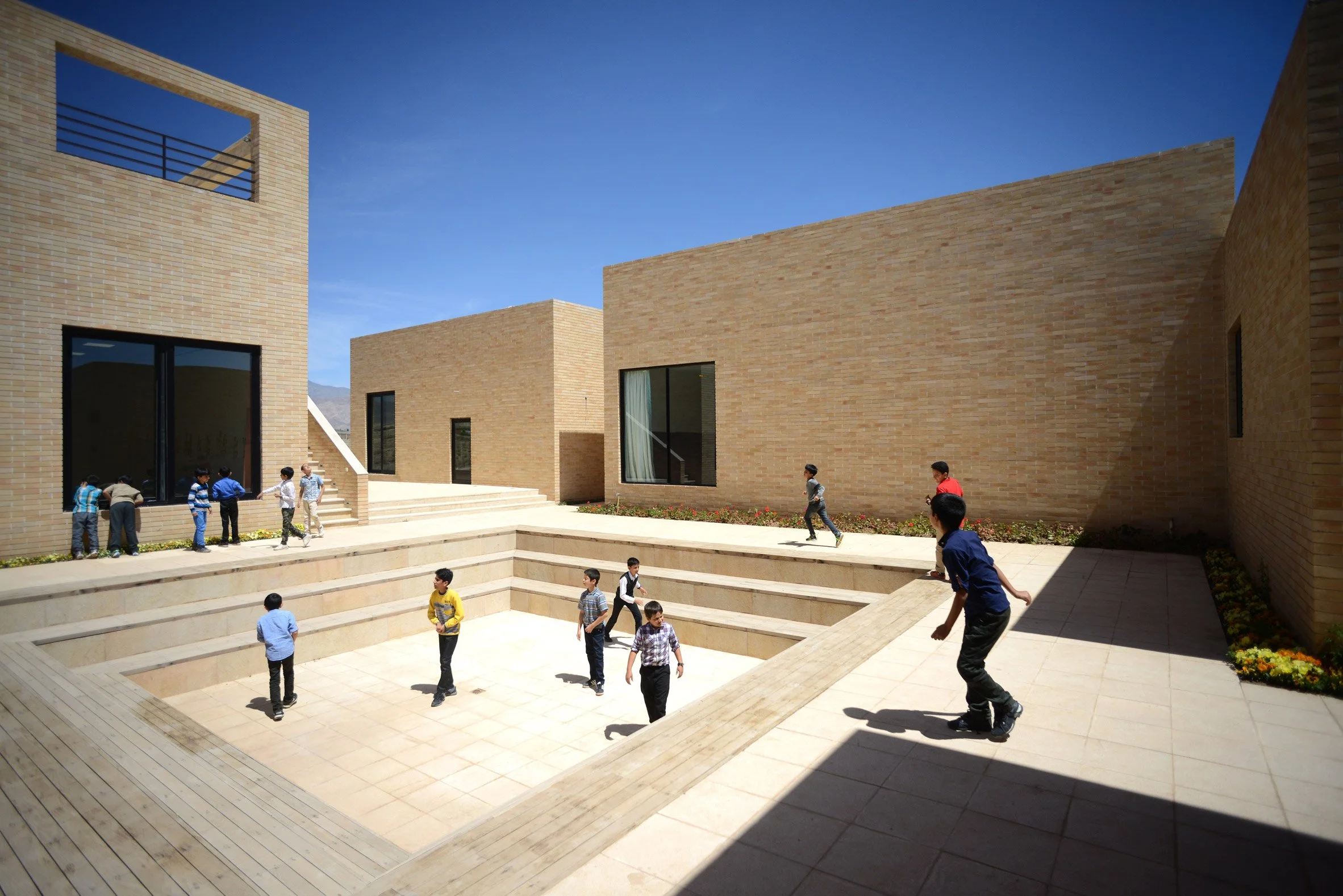
On the other hand, Iranian architects have long developed projects with specific social objectives, such as improving the welfare of ordinary people or addressing environmental issues. These projects are often delivered in partnership with civil society organisations. For instance, FEA Studio, on the behalf of the NGO Noor-e Mobin, designed an intricate network of classrooms in the desert, near Bastaam, Iran. Opened in 2014, the G2 Primary School, as it is called, is designed in ways that allow children to play freely, featuring open air rooms with balcony-style railings to maintain their safety. FEA Studio commented that “it's a complex in which the children can grow and taste life,” serving the pedagogical goals of the school.
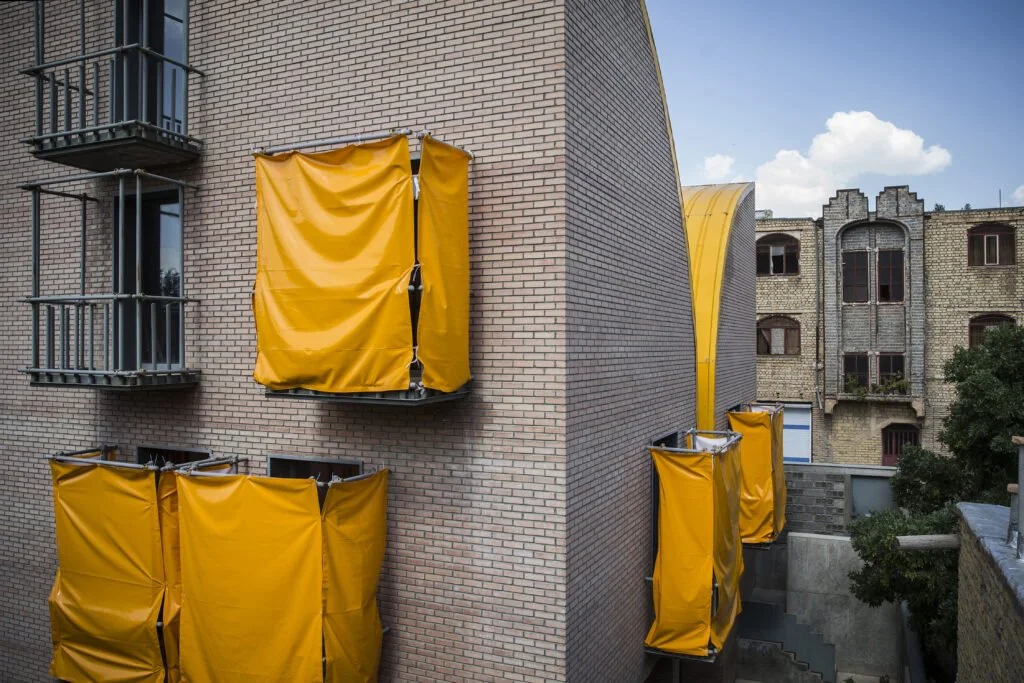
In another social project, ZAV Architects fit adjustable outdoor curtains to the balconies of an girls orphanage in Khansar, Iran. The Habitat for Orphan Girls is a residential centre aiming to protect young women, ages seven to 16, supporting them to flourish in adverse life circumstances. This particular project drew attention in the context of the anti-hijab movement in Iran. The architects aimed to allow the girls a comfortable and protected outdoor space where they can sit without a headscarf or hair covering, but used a striking yellow color to make these liminal spaces visible.
ZAV Architects’ founder, Mohamadreza Ghodousi told Dezeen that the building has the aesthetic appeal of interacting colourfully with the rest of the city, while also reminding its inhabitants that the “hijab is dynamic and you may have the right to wear it or not.” The project won the Memar Award in 2020.
The current sentiment among Iranian architects may be best summarized by one of the best, Leila Araghian. Araghian won the prestigious Aga Khan Prize for her 270-metre long bridge, Pol-e Tabiat, which connects Taleghani Park and Ab-o-Atash Park in northern Tehran. When asked what she finds exciting about contemporary architecture and design, she responded: “the possibility to affect the environment which can affect the human experience of the space seems fascinating to me. It makes me feel powerful.” It is precisely this outlook that promotes architecture as a tool for social renewal, transforming quotidian spaces for Iranians to feel a sense of liberation, agency, and connectedness.
Architecture in Iran today is more than just an artistic or functional endeavor; it is a medium for expression, resistance, and societal transformation. As architects navigate the challenges of working within an increasingly restrictive political environment, they continue to create structures that serve as both aesthetic marvels and meaningful social statements.
Whether through luxurious glass facades symbolising a desire for transparency, or community-driven projects that foster inclusivity and interaction, contemporary Iranian architecture reflects the country’s shifting landscape. At its core, this architectural movement challenges perceptions of Iran, both domestically and internationally, proving that even in times of hardship, creativity and innovation can flourish. Architects in Iran are shaping more than just skylines—they are reimagining and rebuilding the very structures of public and private life.
Photos: Mohammad Hassan Ettefagh, Soroush Majidi, ZAV Architects

Rising Prices Push Homebuyers Out of Iran's Capital
◢ A 41 percent rise in Tehran City’s average home prices has left some residents, especially renters, with no option but to leave the capital for more affordable housing units in suburban areas close to Tehran. As per the latest national census, Karaj was the top destination for residents moving out of Tehran during the five years to December 2017. In just the last three months, more than 53,000 individuals have moved from Tehran to Karaj City. In the first quarter of the Iranian fiscal year, the Karaj housing market recorded 65 percent growth in home sales and an 18 percent increase in the average price of residential units.
A 41 percent rise in Tehran City’s average home prices has left some residents, especially renters, with no option but to leave the capital for more affordable housing units in suburban areas close to Tehran.
Figures released by the Ministry of Roads and Urban Development show that 37,700 housing units were sold in Tehran city during the first quarter of the current Iranian fiscal year (March 21-June 21, 2018) at an average price of IRR 70 million per square meter. A year-on-year comparison indicates 6 percent and 41 percent increases in total number of home deals and the average prices, respectively.
The rental market has also experienced a surge in recent months. No public statistics are yet available about current year rentals in Tehran. However, Hessam Oqbaei, the deputy director of the Iranian Realtors Association, reported in a recent interview a 51 percent increase in Tehran’s rental price index in the past few months. This is while the Central Bank of Iran reported 12.5 percent growth in rental index of urban areas across the country during the third month of Iranian year.
Oqbaei believes that home prices are the key factor impacting rentals in Tehran, explaining “the surge in rents cannot be lower than the growth in home prices.” “Rentals are expected to increase rapidly in coming months,” he said, adding “This is beyond what citizens can afford.”
Monthly data released by Tehran Realtors’ Association also indicates a sharp 22 percent drop in number of rental contracts in the city during the month to June 21—the number is down from 22,143 last year to 17,200 this year.
Price Shocks
As per the latest national census conducted by Statistical Center of Iran in 2016-17, Karaj was the top destination for residents moving out of Tehran during the five years to December 2017.
In just the last three months, more than 53,000 individuals have moved from Tehran to Karaj City. In the first quarter of the Iranian fiscal year, the Karaj housing market recorded 65 percent growth in home sales and an 18 percent increase in the average price of residential units.
New housing developments and easier transport links, including expanded highways and suburban rail connected to Tehran’s subway network, have attracted homebuyers to the city.
Following Karaj, several less expensive areas also saw increased market activity. Pakdasht in the south-east of Tehran Province and Andisheh, located south of Tehran City, recorded significant growth in home deals in the first quarter—75 percent and 56 percent, respectively.
Homebuyers paid an average of IRR 900 million in Pakdasht and IRR 1.73 billion in Andisheh City, which is closer to the capital. By comparison, the average price of sold residential units in Tehran stood at IRR 6.5 billion in the same period.
The same trend can be observed in Kamal Shahr and Mohammad Shahr, which saw the highest number of home deals in Alborz Province after Karaj. More than 1,178 deals were recorded by realtors in Kamalshahr at an average price of IRR 650 million.

The Role of Speculation
Homebuyers are not the only players in Iran’s real estate market. Choas in parallel markets such as the currency market, rising inflation, and low returns on bank deposits, have spurred speculative activities in the housing market.
Speculation in smaller towns remains risky, as sudden increases in home prices could reduce the attractiveness of the suburban markets.
The government is also taking various measures to help real homebuyers in the face of speculation—this has been on top of the Ministry for Roads and Urban Development’s agenda since President Hassan Rouhani took office.
In a recent interview, the deputy minister of roads and urban development, Hamed Mazaherian, cautioned speculators over their presence in the housing market and recommended they exit the market before they bear losses.
“The ministry will soon start addressing speculation in the market by levying taxes on vacant housing units and lands…Lawmakers are also studying a bill to levy tax on revenues earned from home sales,” he declared.
The bill proposes levying taxes equal to 80 percent of the difference between the value of residential units at the time of purchase or sale. However, an exemption is considered for deals in which the owner sells the residential unit at a lower price than the money they paid at the time of purchasing it.
More than 490,000 residential units are left vacant in Tehran City, according to roads minister Abbas Akhoundi. The Ministry of Economic Affairs and Finance has also said it strongly supports the measure, for it helps balance the housing market.
In a futher move, the ministry is also considering a series of measures to support renters. According to Mazaherian, a bill has been proposed in parliament, which suggests increasing the minimum period of rent contracts from one year to two years or more.The proposed measure also includes setting a 10 percent cap for rent increases.
Photo Credit: IRNA

Encouraged by Government, Iranian Entrepreneurs Dream of 'Smart Cities'
◢ Spearheaded by the Ministry of Information and Communication Technology and the Ministry of Roads and Urban Development, the Iranian government is promoting the adoption of smart city technologies to improve the efficiency and livability of Iranian cities. Drawing on government support, major corporations and new startups alike are developing and implementing new technologies in Iran, many of them homegrown.
“Smart Cities” integrate multiple information and communications technology (ICT) and internet of things (IOT) solutions to create more successful and sustainable urban environments. There is growing interest in smart city technologies as governments around the world struggle to manage population growth and the resource consumption of major cities. Smart city transformations can improve quality of life, increase sustainability, and boost economic competitiveness.
Recently, the Iranian government has also expressed greater interest in bringing smart cities technologies to the country. Spearheaded by the Ministry of Information and Communication Technology and the Ministry of Roads and Urban Development, the Iranian government is promoting the adoption of smart city technologies and holding various events and conferences to increase awareness among government stakeholders and the business community. Iranian authorities are drawing inspiration from successful cities including Berlin and Seoul in order to adapt proven approaches to suit the Iranian cities.
With almost 120 percent internet penetration rate in Tehran, 110 percent in Mazandaran, 100 percent in Qom, 96 percent in Isfahan, and 95 percent in Khuzestan provinces, Iran already has the essential infrastructure to become “smart.” At a consumer level, Iran has 40 million smartphone users of which 28 million are mobile internet subscribers. Iran’s consumer technology and communications companies are at the forefront of smart city innovation.
MTN-Irancell, Iran’s second largest mobile network provider, is actively promoting the transformation of Iranian cities. Irancell provides relevant equipment and sensors for development of smart cities and is seeking to rollout efficient and reliable systems that will enable municipal governments to collect and manage data securely and transparently. Irancell’s technologies will allow governments to monitor, analyze, manage, and set alerts for selected urban parameters.
To prove its technologies, Irancell launched a pilot program in Khuzestan province in February 2017. Under this plan, 5,000 low-power wide-area network technology gas meters were installed in the province. In March 2017, Irancell also invested in Anzali free trade zone to implement systems for waste management, landscape watering, street lighting, parking spot management and air quality checks.
Another active company in the field is Iranian firm Nobka, which seeks to accelerate the adoption of smart city technologies in the country. One of Nobka’s projects is production of smart portable hospitals, using converted buses and shipping containers, which can support emergency responses to nature disasters. These portable hospitals use smart lighting and ventilation systems and telemedicine software to help the injured in an emergency.
Nobka is also using smart city technologies to support tourism in Gilan Province. The company has installed solar-powered Wi-Fi hotspots and smart lighting systems at Lahijan Lake. It has also used augmented reality (AR) and virtual reality (VR) to promote tourism to simulate a visit to Lounak Waterfall.
Iran’s capital, Tehran, which is approaching "megacity" status, is the primary target for smart city transformation as the government seeks to address heavy traffic jams, extreme air pollution, high energy consumption, among other challenges. The municipality of Tehran, has been actively promoting the topic, in part by supporting startups which are active in the field.
As part of its promotion efforts, Tehran Municipality, in cooperation with Pardis Technology Park, sponsored the 7th International Innovation and Technology Exhibition (INOTEX 2018). Moreover, the Tehran Municipality ICT Organization regularly holds workshops to educate the policy makers on smart cities and organizes competitions to drive innovation. The organization has also signed an agreement with China Electronics Technology Group Corporation (CETC) to spur adoption of smart city technologies. CETC will provide services including consulting, project design and research and development.
Following the withdrawal of the US from the Joint Comprehensive Plan of Action (JCPOA), the European governments have sought to support the Iran deal and sustain economic ties between the European and Iranian companies further. Cooperation around smart cities could be an ideal area of focus.
European companies and institutions have demonstrated interest in supporting smart city transformations in Iran. Austrian Institute of Technology (AIT) held a workshop in Vienna in June 2017 on “smart city development” for officials from the city of Bushehr, which was selected as a pilot smart city project by the Iranian government. This workshop provided training on topics including the application of ICT for smart cities, urban governance and big data exploration.
While the return of US sanctions poses new challenges for European investment, such educational exchanges should be sustained. European companies and institutions should continue to engage with the Iranian entrepreneurs and urban planners in a non-political environment, demonstrating their goodwill, sharing best-practices, and supporting Iranian dreams of smart cities.
Photo Credit: Inotex 2018

Notes on Navigating Tehran's Urban and Cultural Spaces
There is the potential of détente between Iran and the world and conciliatory dialogues are now slowly appearing in major media which had long vilified the country. Iran may provide a more welcoming and more comfortable urban space than many other Middle Eastern cities, some of which are well-trod destinations for Western expats.
Visit the US State Department travel page on Iran and you are presented with a rather worrying image; a mere visit to the country is warned against. Only recently has the UK removed similar warnings.
But the 35-year long political mistrust between the West and Iran is sharply contradicted by lived experiences of foreign tourists and professionals who have been traveling to the country Iran. Following the nuclear deal, we may soon witness an unprecedented growth in their numbers, whether tourists or business travelers.
There is the potential of détente between Tehran and world powers. A changing cultural conversation on Iran— conciliatory dialogues are now a mainstay on major networks like CNN— is presenting a major challenge to worn out representations of the country as a dangerous and undesired place to be avoided.
Tehran is a safe destination for expatriates. In fact, Tehran may provide a more welcoming and more comfortable urban space than many other Middle Eastern cities, some of which are well-trod destinations for Western expats.
Many of Tehran’s desirable urban features— accessible pedestrian paths, numerous public parks, a strong public transit system— are not present in other Middle Eastern capitals. Though crossing the street is a skill to be learned, you can feel safe in the well-designed pedestrian pathways and overhead bridges, or find a quiet space in one of the many public parks of the city, away from the noisy motorcycle engines and frequent honking of stressed drivers.
Then, there is the city’s nearly comprehensive and affordable public transit system. For about ten cents, you can ride the metro from the city’s south all the way to the famous northern square of Tajrish. It is true that the city’s buses are generally not well maintained; you can find broken seats and floors in need of repairs. But it is probably not an exaggeration to say that on a bus passes the station every minute on the rapid transit bus routes.
Where busses don’t go, there are shared taxis (called khatis) that run specific routes for 30-60 US cents and you get to meet interesting people who share the ride with you. At night (or even during the day), you can call one of the numerous taxi service companies located on every few street corners for a private taxi. A ride across the city can cost as little as 5 US dollars and you can always expect your drivers to keep you entertained talking about a variety of subjects with an all-knowing sense of confidence, including their favorite topic, politics. And if they’re having a bad day you’ll certainly be lectured about the terrible state of the economy.
However, what makes Tehran particularly accommodating is the diversity of ideas and lifestyles. The diversities of opinion do not always find public expression, but are nonetheless part and parcel of communal life. In public and especially private spaces it becomes clear that there are plenty of interpretations of politics and religion that that conflict with the state’s official reading or the reading often assumed in the West.
Moreover there is a lot to do for people of different tastes: entrepreneurs, artists, musicians, novelists, social critics, and poets can all find their niche. State practices do create an environment in which freedom of expression and association is pursued cautiously. Yet, Tehran’s creatives and professionals are able to associate and speak in many ways and venues, expressing themselves through the slight seams the Ministry of Culture and Islamic Guidance has left unwoven on its gradually shrinking curtain of censorship.
In short, the religious and irreligious, apolitical and radical, rule-oriented and free spirited can all find their comfort zones in Tehran. It is an increasingly cosmopolitan city. As with life in any metropolis Tehran has its stresses, but these are negotiated by uplifting episodes, exciting happenings, and intriguing company.
As such, the real challenge for Western expatriates will likely not be encountering Tehran as an urban space, but negotiating Iran’s professional culture. In the West (and the United States in particular, where I’ve spent much of my time), professional culture is very much task-and-role based; you are given a task that falls within the purview of your responsibilities and are supposed to complete it irrespective of your relationships with others.
In Iran, relationships really matter. Whether you’re seeking an appliance repair from a landlord, trying to get the attention of colleagues for a new idea you have, or seeking to beat competition to a contract, such interactions will depend on relationship dynamics perhaps more than in Western countries.
Surely, relationships are also important when it comes to who is hired, appointed, granted a contract, or favored in business relationships in the United States and Europe. However, the relationship-based economy runs deeper in Iranian society and specifically in the realm of business. This is not to say that Tehran is necessarily filled with a collective of nepotists with an indifference to merit and their professional duties. But business has its own culture that needs accommodating. The difference in work culture does not necessarily make one side better or worse. They simply remind us of what different cultures value and how each culture goes about carrying out business.
Iranians prioritize the cultivation of a reciprocal, respectful, and congenial relationship before things can get done. For some expatriates, this can be an exciting challenge, while for others it may prove difficult. As Iran’s markets will likely open up to significant foreign interventions in the upcoming years and an inflow of outside expertise, an understanding of its work culture for newly arrived expatriates can prove invaluable for successful economic outcomes.
Photo: Mohammad Ettefagh