
Trump Administration Pressures Global Financial Watchdog to ‘Blacklist’ Iran
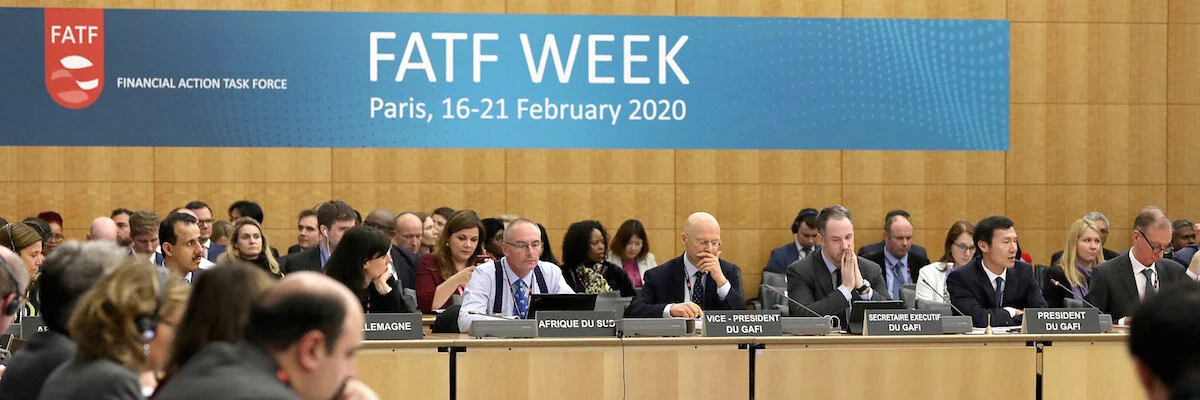
The Financial Action Task Force (FATF), a global body that sets standards to combat money laundering and terrorist finance, has placed Iran back on its infamous “blacklist,” following the failure of Iranian policymakers to enact two key bills in accordance with an action plan set in 2016.
This article was originally published by Responsible Statecraft.
The Financial Action Task Force (FATF), a global body that sets standards to combat money laundering and terrorist finance, has placed Iran back on its infamous “blacklist,” following the failure of Iranian policymakers to enact two key bills in accordance with an action plan set in 2016.
The FATF statement, issued on Friday at the conclusion of the body’s latest plenary meeting, calls on members to “to apply effective countermeasures” following Iran’s failure to implement “the Palermo and Terrorist Financing Conventions in line with the FATF Standards.”
Such countermeasures include increase monitoring, reporting, and auditing of Iran-related financial transactions for all financial institutions worldwide. While members can decide how to reimpose the countermeasures, the decision taken by FATF serves as a kind of external validation of the Trump administration’s claims that the Iranian financial system is regularly used to facilitate money laundering and terrorist finance on a massive scale. This characterization is a principle justification for the administration’s “maximum pressure” sanctions campaign and U.S. officials had been dogged in pressuring FATF to call “time out” on Iran’s reform process.
The FATF decision will be deeply disappointing to many officials in the Rouhani administration who had expended extraordinary political capital to try and get the necessary legislation enacted, succeeding in getting four key bills passed by parliament, but only managing to have two bills enacted into law. Opposition by hardliners had been fierce — the FATF issue was linked to the slow-rolling crisis around the nuclear deal and the Trump administration’s sanctions campaign. The politicization of the action plan reforms — both in Tehran and in Washington — was perhaps unprecedented in the history, putting “the task force is between a rock and a hard place,” as Tom Keatinge, as RUSI Director of the Centre for Financial Crimes and Security Studies, has recently observed.
The FATF’s decision could have a significant impact on Iran’s economy, but likely indirectly. Iranian officials who advocated for implementation of the action plan insisted that failure to do so would lead to international banks, including banks in Russia and China, to cut ties with Iran. More precisely, the reimpositon of countermeasures means that it will be exceedingly difficult for Iran to open any new cross-border financial channels. But the countermeasures set to be reimposed, including FATF’s exhortation of its members to impose enhanced supervision and reporting requirements for financial institutions handling Iran-related payments reflect a level of oversight already adopted by the few global financial institutions that continue to transact with Iran. For example, European officials do not expect the FATF decision to interfere with the operationalization of INSTEX, the mechanism established to support European trade with Iran, given the longstanding policies of the banks on which INSTEX will rely.
Existing banking channels are unlikely to be constricted for the express reason that Iran is back on the blacklist — although this does not preclude that the FATF decision will be used as a timely excuse to stop handling Iran-related payments by some banks.
The more likely damage to Iran’s economy will arise from the setback that FATF’s decision represents for the wider push for financial transparency reforms in Iran, which including everything from calls for greater fiscal transparency to the adoption of international standards for accounting. In May of last year, I wrote about how this broad campaign was suffering under the pressures of a “financial war” waged by the Trump administration. Although “transparency has become a discourse and ongoing demand” in Iran, to use the words of one reformist parliamentarian, a pervading paranoia got in the way of reforms, including those required by the FATF.
As I wrote at the time, many Iranians increasingly feared that when sanctions were being applied too aggressively, any increase in financial transparency was “akin to exposing the location of a piece of critical infrastructure and leaving it vulnerable to attack.” The Trump administration sought to actively stoke this paranoia through its use of public messaging and sanctions designations, causing a significant rift with European partners engaged in a technical dialogue with the Rouhani administration over the reform process.
I have been closely following the FATF issue for three years, during which time I have had the opportunity to discuss the action plan and its implementation with American, European, and Iranian officials as well as business leaders engaged in trade between Europe and Iran. There remain many unknowns about the economic impact and the damage the countermeasures will have. But what is profoundly clear is how easy it was for the Trump administration to seek to interfere with the apolitical work of FATF and the fragile process of financial transparency reforms in Iran, even though that process was driven in large part by the concerns of the Iranian electorate around systemic corruption.
In this way, the FATF experience offers a cautionary tale. To whatever extent the current nuclear deal will remain resilient in the face of the Trump administration’s maximum pressure and reduced compliance from Iran, and to whatever extent a new deal may be strengthened to avoid a repeat of the current crisis, any diplomatic reset with Iran will require greater protection of the myriad technical processes of reconnection and reform that will be necessary to ensure that promises are delivered. We promised to give Iran a chance. We failed those who tried to take it.
Photo: FATF
FATF Faces Test of Fairness on Iran at Plenary Meeting
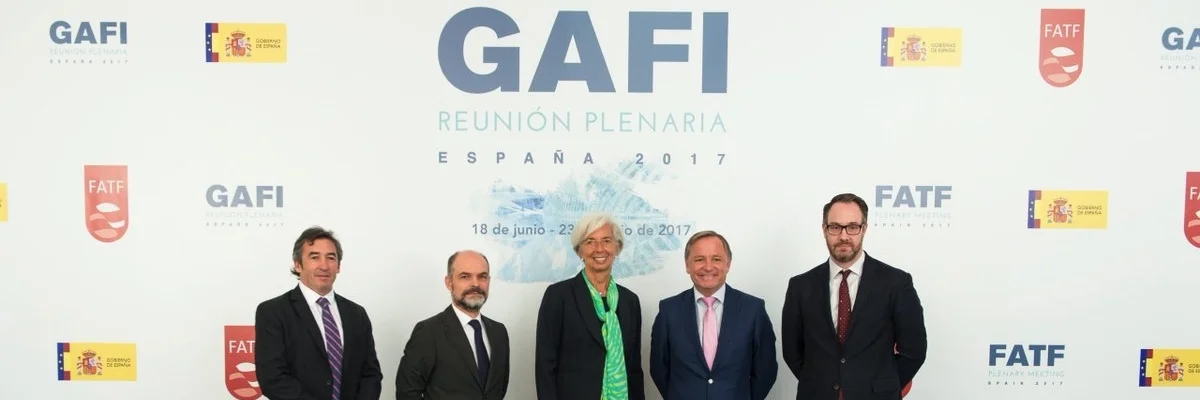
◢ Iran is facing the end of a four month extension given by the Financial Action Task Force (FATF) for the reform of the country’s AML/CFT regulations. Iran will be hoping for a further extension of the suspension of countermeasures at the June plenary of the FATF. Some FATF members have sought to characterize such extensions as exceptional. However, extensions are a common procedure, and FATF ought to treat Iran’s case in fair recognition of this fact.
Next week, Iran is facing the end of a four month extension given by the Financial Action Task Force (FATF), a global standard-setting body, for the reform of the country’s AML/CFT regulations. Beginning in June 2016, Iran gave its political commitment to the action plan, accepting technical assistance in order to effectively implement the action plan. This political commitment saw Iran removed from the so called “black list,” the informal name given to the list of Non-Cooperative Countries and Territories (NCCT). The common practice in recent years has been to apply "countermeasures" against non-cooperative countries. With countermeasures suspended, Iran was moved to a list of “high-risk” countries subject to “enhanced due diligence.”
As per the FATF procedure, Iran can only be returned to the countermeasure list if it proves to be non-cooperative. It should be noted that no country has been added to countermeasure list merely because of less-than-perfect compliance; if that was the case, in this world which is full of corruption and terrorism, the list of countries against which countermeasures should apply would be far more extensive. No country has managed to achieve perfect compliance with all forty recommendations that form the basis of FATF’s guidelines.
Iran will be hoping for a further extension of suspension of countermeasures at next week's plenary of the FATF, as it is in the process of amending its national laws. Some FATF members have sought to characterize such extensions as exceptional. However, a quick glance at the list of countries currently in the gray list or those which managed to get delisted, points to the fact that extensions are a common procedure.
Countries such as Iraq, Syria, Vanuatu, and Yemen have remained on the gray list for many years. Countries such as Bosnia and Herzegovina, Uganda, Afghanistan, and Myanmar were all eventually delisted in recognition of progress in enacting the recommended reforms, but were given between two and six years in order to proceed with their action plans. Iran has been under much more significant pressure, opening FATF to charges of unfair treatment.
For the purposes of a closer comparison, we can look to the case of one country delisted from the so-called gray list in 2017. Based on FATF’s latest evaluation, this country is non-compliant with numerous recommendations outlined in Iran’s action plan. First, the country is non-compliant in terms of “criminalizing terrorist financing.” Second, the country is non-compliant in terms of “Targeted financial sanctions related to terrorism and terrorist financing (identifying and freezing terrorist assets in line with the relevant United Nations Security Council resolutions).” Third, the country is only partially compliant with measures for “customer due diligence.” Fourth, the country is only partially compliant with establishing an effective “Financial Intelligence Unit.” Fifth, the country is non-compliant with wire transfer controls. Finally, the country is only partially compliant with recommendations on criminalizing anti-money laundering.
It is clear that this particular country has deficiencies equal-to or greater-than those of Iran as measured by Iran’s action plan. Yet the country was never included in the FATF blacklist and even managed to be delisted from the gray list as well. This raises the question—is FATF applying double standards against Iran?
FATF emphasizes that it is a technical and not a political body and that all countries are treated equally. Impartiality is important for a global standard-setting body, which seeks to ensure that countries cannot seek to politically undermine one another.
Iran has attended FATF’s face-to-face meetings and answered extensive questions. Moreover, the FATF recommendations call for the enacting of six laws: criminalizing money laundering (i.e. the AML law), criminalizing financing of terrorism (i.e. the CFT law) and four other laws regarding joining four UN conventions. Of these four laws, two had already been approved by the parliament—Iran has joined the UN Anti-Corruption and Vienna conventions. The remaining laws are being deliberated. These legislative measures are among the most difficult recommendations to enact, as they require the coordination of government agencies, parliamentarians, and other supervisory bodies and therefore it seems that the action plan of Iran has been a difficult one with a rather short deadline provided.
Passing a single law may require 18 months of work, as it needs to be reviewed by the committees of the government and the cabinet, parliamentary commissions and then the parliament itself, and finally the powerful Guardian Council. Iran has achieved a degree of compliance with some aspects of the action plan, a fact acknowledged by FATF itself. Therefore, it would be illogical for the country to be considered non-cooperative.
The authority of FATF derives from the number of countries that have trusted it as a technical body. Therefore, this is not only a sensitive juncture for Iran, but also for the legitimacy of FATF, which must strive to preserve its reputation as an impartial technical body that treats all countries equally.
Photo Credit: FATF Twitter

High Stakes for Iran in Upcoming FATF Meeting
◢ A few days ahead of an international meeting in which Iran’s efforts to improve anti-money laundering and counter-terrorist financing (AML/CFT) standards will be reviewed, Ayatollah Ali Khamenei appeared to pour cold water on the reform process. Yet, it is premature to assume that Iran’s consultations with the Financial Action Task Force (FATF) are suddenly over after two years of close coordination. As the FATF’s plenary meeting approaches, the stakes are high for Iran, which is seeking another extension for implementation of its action plan.
A few days ahead of an international meeting in which Iran’s efforts to improve anti-money laundering and counter-terrorist financing (AML/CFT) standards will be reviewed, Ayatollah Ali Khamenei appeared to pour cold water on the reform process. Yet, it is premature to assume that Iran’s consultations with the Financial Action Task Force (FATF) are suddenly over after two years of close coordination. FATF, a financial crime watchdog that develops and monitors international AML/CFT standards, faces an important decision on Iran. The stakes are high for Iran, which is seeking to reintegrate into the global economy and there are reasons to believe that FATF’s decision may have repercussions that go far beyond its June 24-29 plenary in Paris.
Consequences of Iran's AML/CFT Deficiencies
If FATF believes that Iran is not adhering to its action plan to upgrade AML/CFT standards, the intergovernmental body could call on its 37 members to reimpose strict financial safeguards. These so-called "countermeasures" would discourage or even lead to the termination of relationships between Iranian and foreign banks, and possibly include Iran losing access to global bank messaging service SWIFT. Alternatively, FATF may decide Iran has made sufficient progress to warrant an extension to the two-year suspension of the countermeasures. Regardless, there are no indications that Iran will be removed from FATF’s black list of high-risk jurisdictions and financial institutions will continue to be urged to conduct enhanced due diligence (EDD) on Iranian-related business relationships and transactions.
This type of guidance places a significant risk management burden on global banks. Through customer due diligence, banks collect information to identify and verify customers in order to comply with regulations and report suspicious activity. EDD comprises several extra steps, such as probing sources of funds, scrutinizing financial statements, and conducting thorough investigations of relevant businesses or individuals. Because of the high level of scrutiny required for the Iranian market, most foreign banks did not return even after the international nuclear deal was implemented in 2016.
Foreign financial institutions, especially those with a US presence, are unlikely to change this calculation without an improvement to transparency and governance in the local banking sector. In particular, foreign banks are worried about unwittingly facilitating transactions with sanctioned entities. Due to ongoing fears of reputational and legal liabilities, Iran’s access to the international financial system is diminished by de-risking practices of global banks for the foreseeable future.
How Iran Stands to Benefit from Reform
Although the chance to be removed from FATF’s black list is a clear reason for Iran to complete the organization’s action plan, the long-term economic impact of reforms provides another vital incentive. Mismanagement, corruption, and fragmentation in the banking sector dampens economic potential. Iran’s bad debt, estimated to be in the tens of billions of dollars, fuels fears of an imminent banking crisis. Strengthening Iran’s banking sector to align with international standards, a priority highlighted by the IMF, would lay the foundation for a more stable economy and promote reintegration with the international financial system.
FATF-related reforms will not be a panacea for Iran’s economy. This year the currency lost over 20 percent of its value against the US dollar (and much more on the black market) between January and June, foreign companies are considering plans to wind down billion-dollar investments, and a drop in oil revenue looms because of the impending renewal of US secondary sanctions. Nevertheless, if reforms convince some foreign banks to stay even after US sanctions are re-imposed, it could offer a lifeline to an economy under tremendous pressure. Moreover, new rules that improve Iranian banks’ transparency are vital to address a major grievance from protests late last year: the need to root out financial sector corruption that enriches elites and undercuts economic opportunities for the working class.
Iran’s Progress To Date
Despite Iran’s recent decision to delay vital CFT legislation, the government is taking several steps to satisfy the terms of its action plan. The Rouhani administration regularly engages with FATF experts even though there is fierce internal opposition from many of the same political, religious, and military actors who opposed the nuclear deal. In February, FATF credited Iran for establishing a cash declaration regime. In June, a draft bill to amend the AML law was approved by parliament’s judiciary commission and legislators ratified Iran’s accession to an international convention on combating transnational crime. Similarly, Iranian officials are working to implement several technical AML rules that FATF cited in a statement following the organization’s February plenary. Although full implementation will not be realized within two years of beginning the reform process, Iran continues to work toward compliance with international standards across several areas.
The widest gulf between Iran’s commitments and FATF’s expectations remains on criminalizing terrorist financing. To fully comply with FATF standards, text would need to be changed in Iran’s legislation for amending the counter-terrorist financing law and acceding to a related international convention. Both bills contain CFT exemptions for certain types of militant groups, but there is no precedent for FATF accepting legislation with such conditions. Resolving these issues will not be easy, but the political will to be removed from FATF’s black list (if not eventually acceding to FATF) should prompt ongoing discussions.
It is in this context that Khamenei’s June 20 statements, intimating that parliament should abandon the FATF process, are important. Just like in the run up to the international nuclear deal, Khamenei’s maximalist comments are open to interpretation because they may be intended for several distinctive audiences. Domestically, Khamenei is trying to assuage fears from his traditional allies who believe the FATF process is a foreign ploy to weaken the IRGC and hamper Iran’s support for Hamas and Hezbollah. However, this sentiment must be balanced against palpable angst among Iranians that believe the troubled banking sector threatens their livelihoods. This could be why Khamenei mentioned that “some of the provisions of the international treaties may be good” before suggesting that Iran legislate on money laundering and terrorist financing issues independently.
From an international perspective, Khamenei is seeking to increase pressure on European countries to receive the most favorable economic terms possible after the US pulled out of the nuclear deal. Initially, Iran cited ongoing negotiations to salvage the nuclear deal as the primary reason for delaying by two months FATF-related legislation. Only three weeks ago, Khamenei indicated strong support for Iran’s newly established High Council for Economic Coordination. This council, which is composed of leaders from the country’s executive, legislative, and judiciary branches of government, is coordinating a unified response to US sanctions. That is why it should not be overlooked that their first decision was to speed up the process for implementing the FATF action plan. Khamenei may be fed up with the FATF process, but he also may be negotiating.
FATF and Trans-Atlantic Tensions
Leading up to FATF’s plenary session in February, there were indications that the US strongly supported reprimanding Pakistan for its failure to combat terrorist financing. Yet, the decision was delayed until at least the June meeting after three FATF members (China, Turkey, and Saudi Arabia) allegedly intervened on Pakistan’s behalf. The decision exposed a potential break from strong US influence within FATF. It was also a radical departure from the intergovernmental body’s typical decision-making process that relies on consensus rulings.
Coupled with rising trans-Atlantic tensions on foreign policy and trade issues, this calls into question whether the US will be able to build consensus should it seek to reimpose countermeasures against Iran. Furthermore, it is hard to imagine European governments supporting FATF action that further constrains their efforts to salvage the nuclear deal. Beyond European countries, there are several FATF members (China, India, Russia, Turkey) that will be even less inclined to support countermeasures that hurt the foreign investment strategies of their banks, state-run entities, and private companies.
It is possible that neither the US nor Iran will be satisfied with the FATF meeting’s outcome. Still, Iran’s FATF process offers clear benefits to both. For Iran, staying engaged provides much-needed support for a weakened banking sector and a path to reintegration with the global economy. For the US, it provides a global forum to keep pressure on Iran to do more to combat money laundering and terrorist financing.
From an international AML/CFT perspective, it also makes sense to keep Iran engaged in the FATF process. Certain Iranian actors, including some banks, grew quite adept at facilitating transactions to evade sanctions over the past several decades. With the return of stringent US sanctions, these vested local interests stand to benefit once again. Re-imposing countermeasures now will reduce vital coordination to protect the global financial system from new money laundering threats. There may come a time when FATF countermeasures are viewed as the only viable option to combat AML/CFT threats emanating from Iran. However, more time is needed to support Iranian efforts to bring about legislative and regulatory reforms. For now, this is the best way to fulfill FATF’s mission to counter threats to the integrity of the international financial system.
Photo Credit: Financial Services Commission