
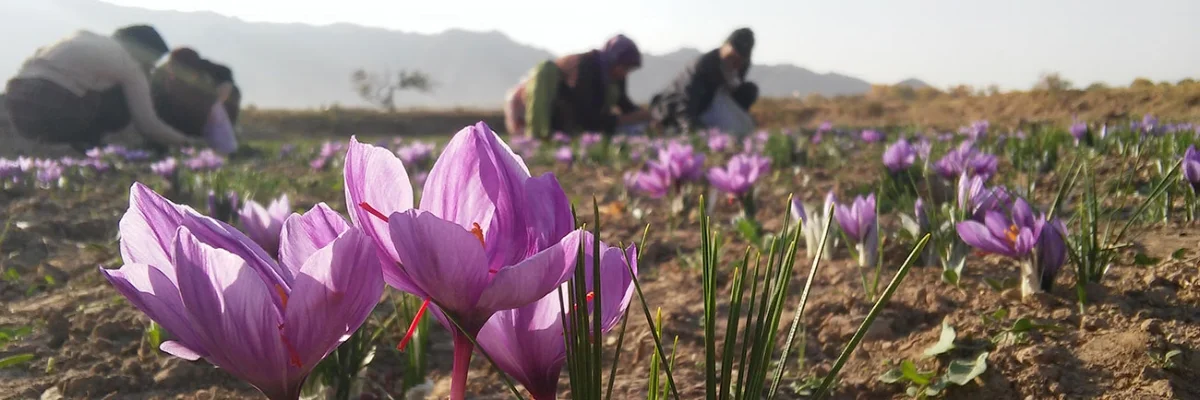
To Transform the Fortunes of Iran’s Saffron Farmers, a Commitment to Technology and the Environment
◢ Keshmoon, an Iranian startup, connects carefully selected saffron farmers engaged in sustainable agriculture with premium consumers. The company has recently gained acclaim for its combination of ecommerce and "agritech" solutions.
◢ Starting with an initial cohort of 30 farmers in the town of Qaen in Khorasan Province, Keshmoon is encouraging a move to sustainable agriculture. The goal is to reduce water usage through means that also help the farmers improve their livelihoods.
Mohammad Qaempanah is a serial entrepreneur. His first business saw him act as a one-man internet service provider in his town, the connectivity from which he leveraged to start his next business, exporting saffron, a coveted spice with a heady aroma taken from the stigma of the crocus flower. Qaempanah exported the spice until sanctions made it impossible. He then opened a vegetarian restaurant in Mashhad with the aim of “educating people about the way in which their eating habits are linked to global warming.” Furthering his commitment to the environment, he then founded Iran’s first “nature school,” also in Mashhad, which offered programs to enable children from the city to experience and enjoy time in nature, learning about the environment. Having spurred something of a movement, there are today over 40 such schools around Iran.
Qaempanah, whose grandfather was a saffron farmer, has now turned his attention to agriculture in his hometown of Qaen, in the province of Khorasan, with a venture that combines his knowledge of saffron, his commitment to the environment, and his aptitude in technology. This latest venture, Keshmoon, has already won accolades. The company was recognized as the “Best Seed Stage Startup” at the recent Iran Web and Mobile Festival. Mohammad-Javad Jahromi, Iran’s young Minister of Communication and Information Technology, acknowledged the company in a subsequent tweet.
This early recognition reflects the scope of Keshmoon’s commercial ambition and its innovative vision for Iran’s agricultural sector. In Qaempanah’s words, Keshmoon combines an “ecommerce platform that serves consumers with an ‘agritech’ layer that serves suppliers.” In simpler terms, he explains, Keshmoon connects “carefully selected farmers engaged in sustainable agriculture with premium consumers.”
In founding the company alongside his brother, Hamza, and a friend, Siamak Khorrami, Qaempanah took inspiration from the increasingly popular model of direct trade coffee, where coffee roasters ethically source beans directly from growers, and also the popular ecommerce platform Etsy, which allows artists and craftsmen to sell their wares directly to consumers online. But while these platforms primarily reflect innovations in ecommerce, Keshmoon seeks to use technology to change the methods of agriculture itself.
Speaking about his vision, Qaempanah is careful to point out that his motivation in founding Keshmoon was “not to help farmers improve their economic situation.” Rather, his “foremost concern was water.” In his view, “unless the issue of water depletion is managed, it won’t matter what the farmers choose to grow, it will be impossible to cultivate anything.”
In the town of Qaen, where Qaempanah’s grandfather cultivated the particularly aromatic saffron that brought fame to the region, the qanats, a traditional system of underground channels which tap into the aquifer, have long been replaced by modern wells. Over the years, farmers drilled more wells to pump ever-increasing volumes of water, seeking to grow crops ill-suited to the arid climate. The water table has dropped precipitously. As Qaempanah relays, “wells that were once 15 meters deep now need to extend to 135 meters.”
Qaempanah believes that farmers are currently stuck in a self-defeating economic cycle. Presently, the use of more water enables higher yields and therefore higher earnings. Keshmoon was designed as a “technical infrastructure to change this cycle.” By incentivizing farmers to move towards the sustainable cultivation of saffron, which is naturally well-suited to Khorasan’s arid climate, farmers will be able to use less water, and yet enjoy greater earnings.
Gallery: The Farmers of Qaen
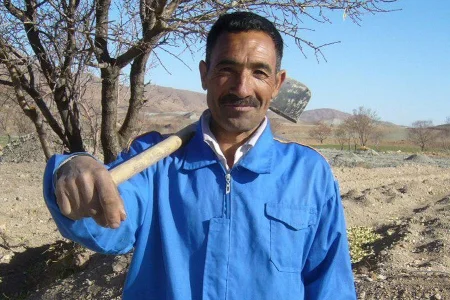
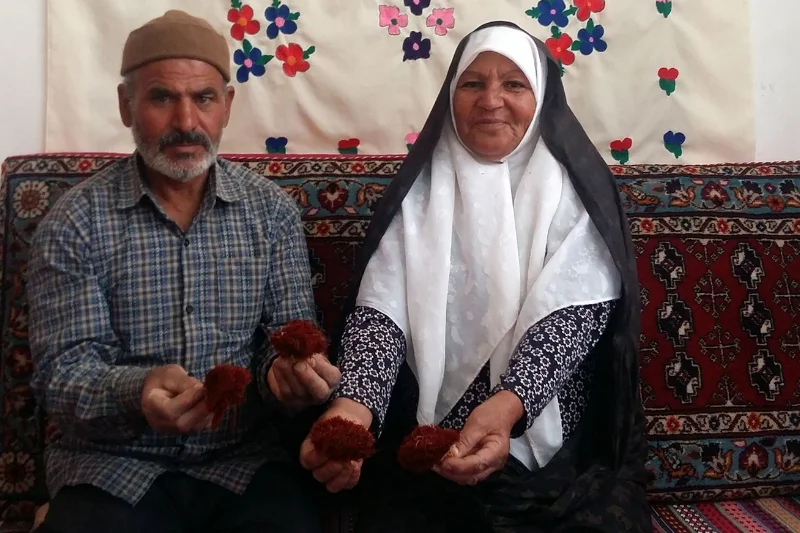
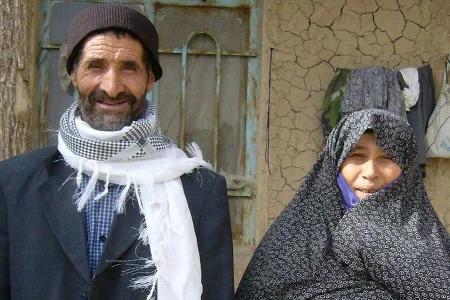
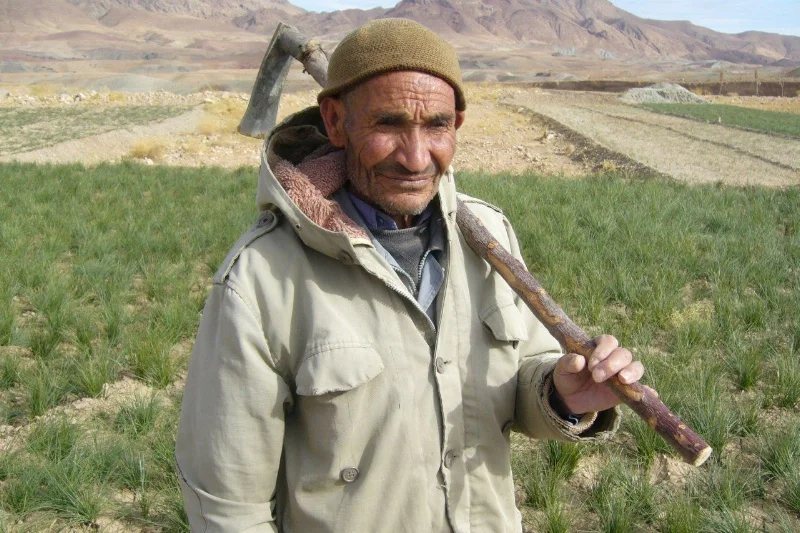
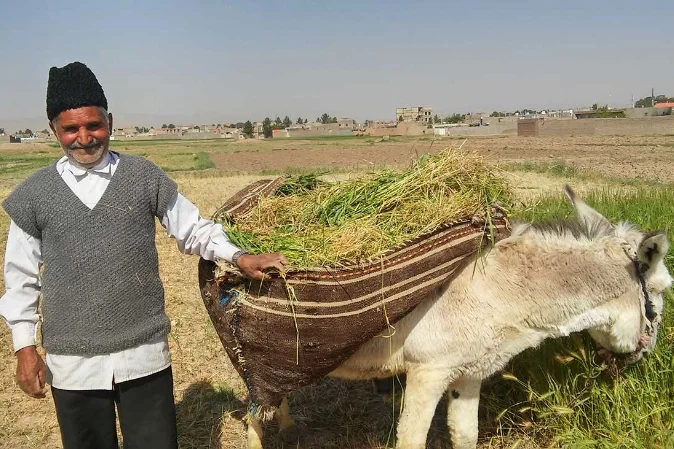
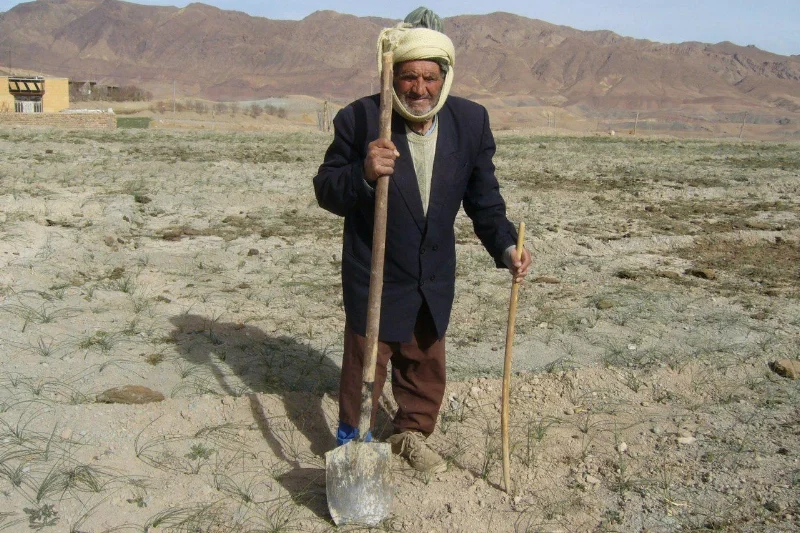
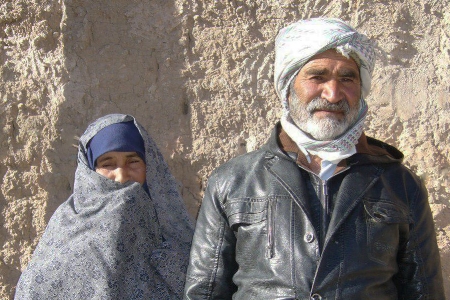
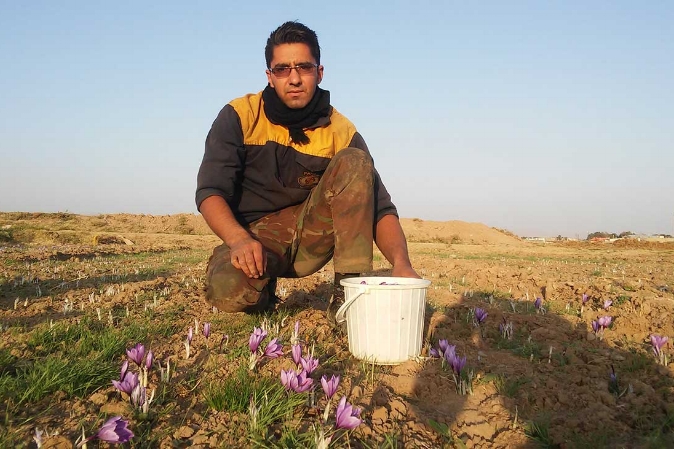
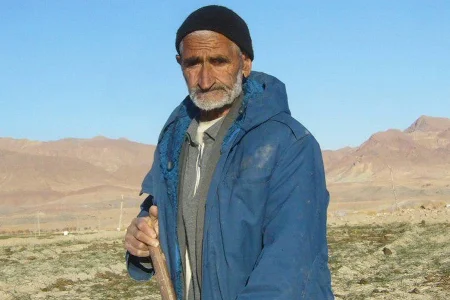
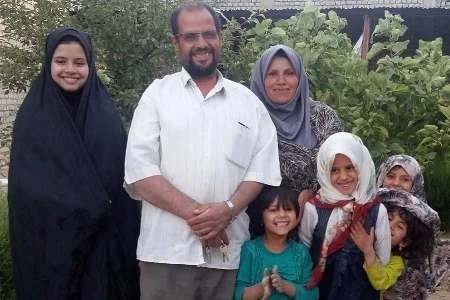
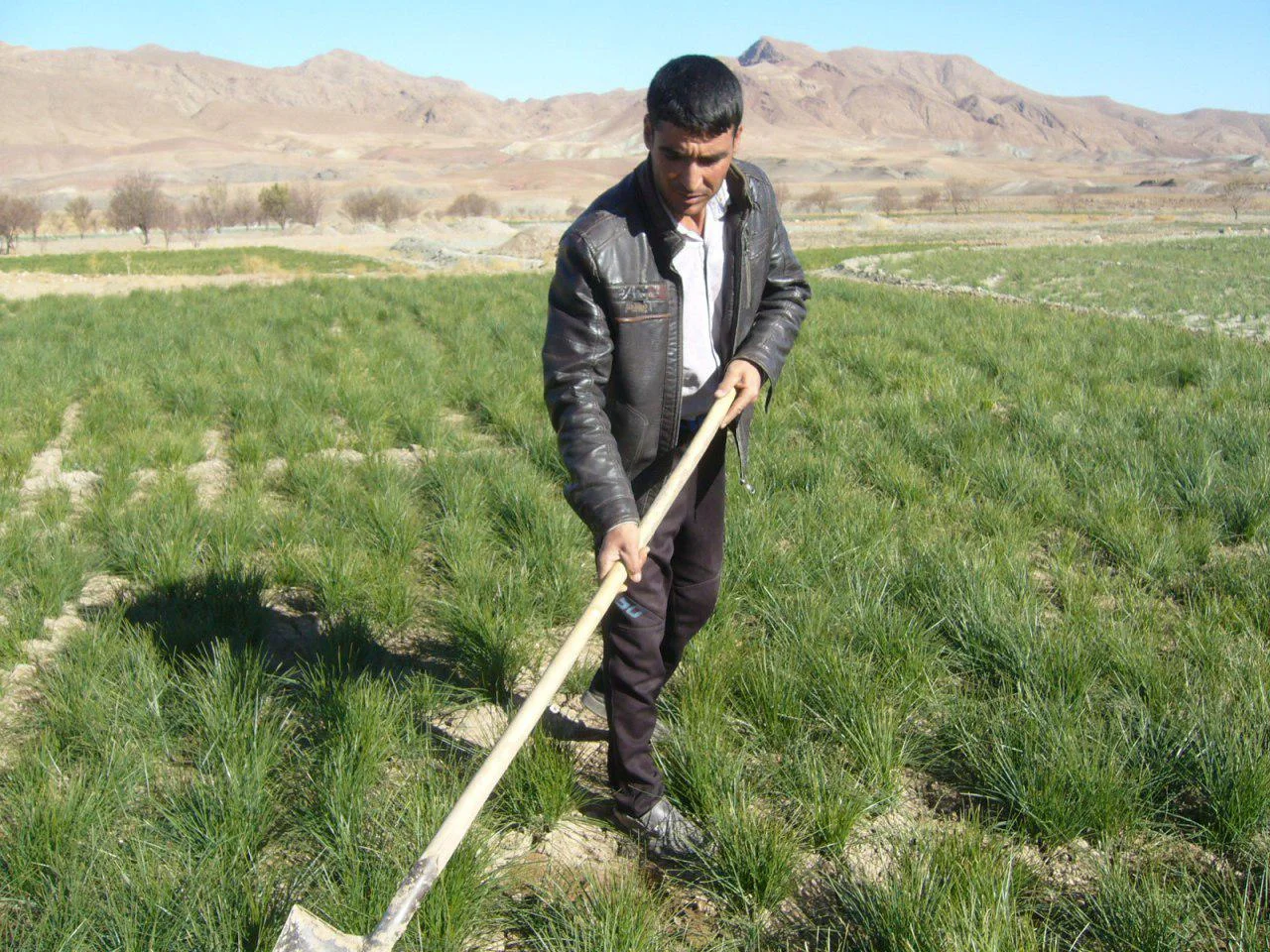
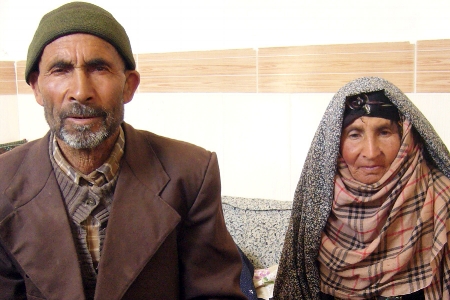
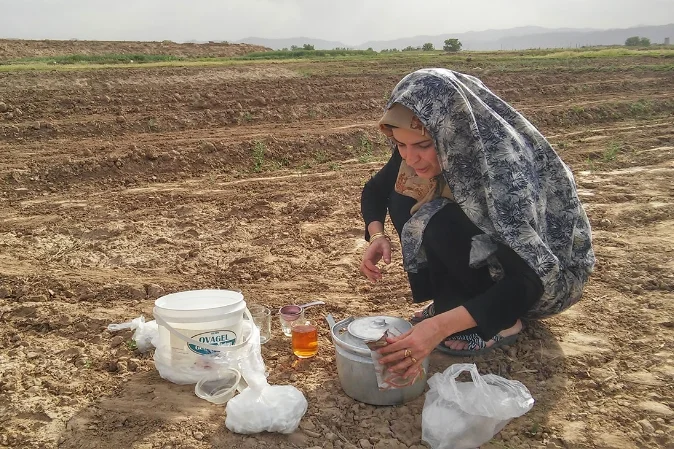
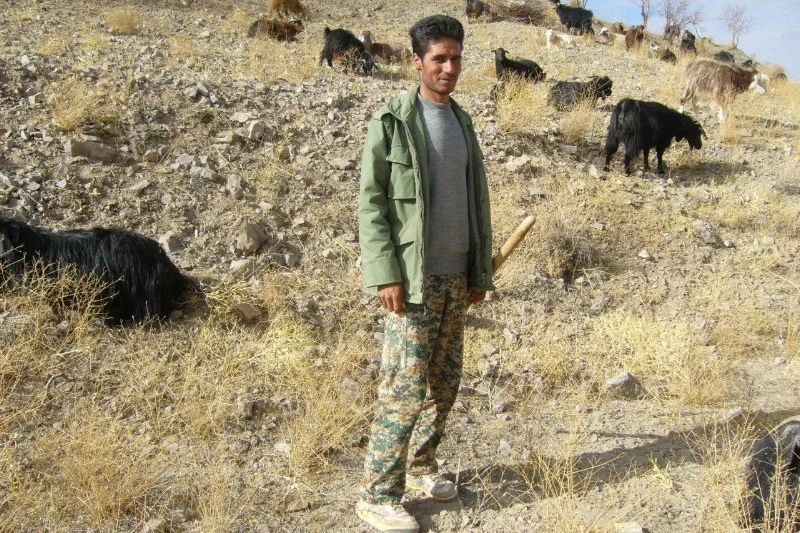
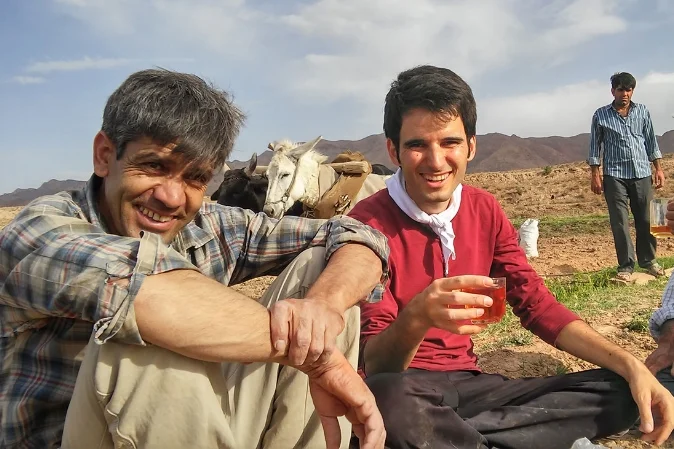
This has proven an attractive proposition to the farmers of Qaen, where Keshmoon has recruited its first cohort of 30 farmers. As Qaempanah recounts, the local saffron growers were “invited to a meeting in the town mosque, where we explained our approach, how we wanted to help, and asked them to go home and think about it.” Despite concerns that it might be hard to explain the technical aspects of the concept, the pitch worked. Today, farmers from neighboring villages and towns regularly stop by Keshmoon’s office in Qaen to learn more about the program they have heard about. The company has earned the trust of the local community.
To gain acceptance to Keshmoon’s platform, farmers need to demonstrate competency growing saffron in the traditional manner. Keshmoon will introduce more stringent requirements in the near future, introducing guidelines consistent with sustainable farming. It will take about one year to “gain critical mass and give farmers the time to make adjustments to their planting,” says Qaempanah. He foresees Keshmoon partnering with universities and other institutions to help provide training to farmers unfamiliar with growing saffron in a sustainable manner in order to help them make the switch.
For farmers, the commercial appeal of Keshmoon is the higher price achieved for their crop by selling to consumers directly, rather than selling to local traders. One drawback is that using Keshmoon will require farmers to sell their harvest incrementally, as orders come in online. Some farmers have said that they prefer selling to the local buyers, who can purchase the whole harvest in one transaction. But the price advantage is substantial. Farmers on Keshmoon can expect to generate 20-40 percent more in earnings than those who sell locally in bulk.
Laudably, Keshmoon has been very transparent about pricing for the sake of both consumers and farmers and offers a detailed breakdown on their website. Generally speaking, farmers receive 70 percent of the saffron’s retail price, while around 12 percent is earmarked for quality control, packaging, and transport, and the remaining 18 percent goes towards Keshmoon’s overhead.
Once accepted to Keshmoon, farmers need to create their online profiles. In most cases, the Keshmoon team helps by taking photos and recording the farmer’s personal details, family history, and also explanations of how the saffron is farmed. These profiles can be seen on the Keshmoon website, where consumers can even send messages to specific farmers.
Qaempanah notes that some farmers, typically those who are younger or who have had more education, have been able to author their profiles themselves. In some cases, it was the farmers’ children, many of whom own smartphones, who took responsibility for telling the story of the family farm through words and pictures. There is immense potential for the farmers to develop both some technology literacy and also their personal brand, which can help them connect with consumers more proactively. Commercial considerations aside, there is something affecting about seeing the personal portraits of the farmers and families behind Iran’s most precious crop.
A Keshmoon Giftbox
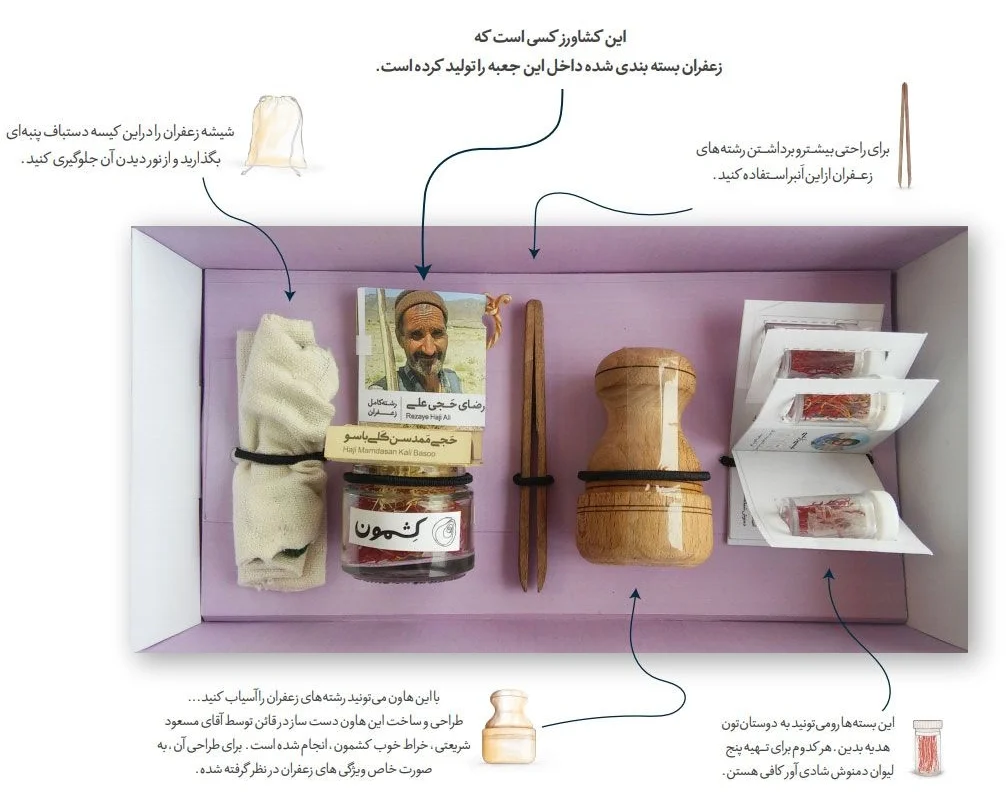
A connection to the farmers and a beautiful presentation of the saffron, including a small booklet about its origins, has proven a hit among consumers. The company has been selling online for nine months, and boasts a few hundred clients, about one-quarter of whom whom make recurring purchases. Keshmoon’s models show that it will take about 20-40 clients in order to support each farmer. At the moment, the company has stopped accepting new farmers onto its platform until is grows the client-base further. A big boost will come when the company begins selling to Europe later this year.
But while the Keshmoon story may begin with saffron, Qaempanah’s ambition is much greater. For the next few years, the Keshmoon team will focus on perfecting its “technical infrastructure,” combining ecommerce and agritech to open a new market for saffron. The big test will be in the marketing and branding. Qaempanah hopes to achieve a level of awareness such that “when people hear saffron, they think of Keshmoon.”
If this model can be developed successfully for saffron, the company plans to expand to other crops and bringing a similar model to other agricultural regions in Iran. Qaempanah imagines a situation where farmers from around the country can approach Keshmoon and receive recommendations for which crops to grow based both on analysis of the local environment and also Keshmoon’s data on which crops will sell most effectively on its marketplace. In this way, Keshmoon would serve to introduce efficiencies of scale typically reserved for large, corporatized farming. The economic and environmental impact for Iran, where the agricultural sector remains dominated by smallholder farmers, could be transformative.
But it is early days yet and the success of this grand masterplan will first depend on the successful collaboration between the saffron farmers of Qaen and the team at Keshmoon. Theirs is a collaboration that crosses talents and crosses generations—both a microcosm of the economic and environmental challenges facing Iran and a case study in the creative thinking and entrepreneurial spirit that may eventually solve those challenges.
Photo Credit: Keshmoon
Telepizza's Arrival in Iran Shows Supersized Ambition
◢ The arrival of Telepizza, a global fast-food brand, is a significant development for Iran's food service sector.
◢ The terms of the master franchise keep economic dividends in Iranian hands, and the new entrant will likely spur new investment and improvements in offerings across the sector.
In 1990, during the final year of the Soviet Union, McDonald's opened its first branch in the country, choosing a landmark location in Pushkin Square in Moscow. On the first day, nearly 30,000 customers passed through the doors.
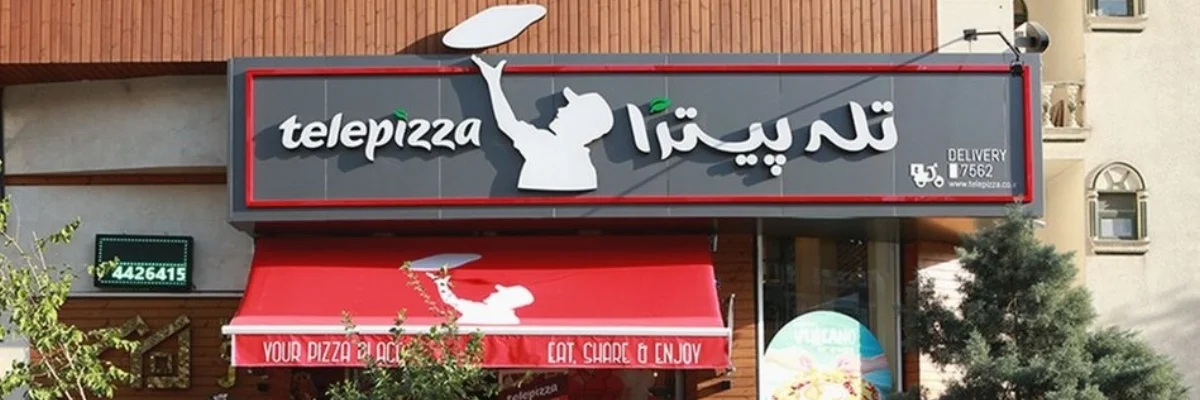
Telepizza, an international fast-food pizza chain, opened its first Tehran location last week. While the opening did not see quite the same fanfare as arrival of McDonald’s in the USSR, the launch is nonetheless significant.
As many articles have emphasized, Telepizza is the largest non-American pizza brand in the world by number of stores (about 1,500). But the Spanish company, which is targeting Iran as part of an ambitious global rollout plan, is one of the first globally-recognized restaurant brand to enter Iran, which has until recently had to make do with cheap imitations such as “Pizza Hat” and “Mash Donalds.”
The arrival of Telepizza follows the awarding of a master franchise agreement to Momenin Investment Group, a little known firm registered in the UK but with Iranian ownership. MIG has committed to spending EUR 100 million over 10 years in an Iran market rollout. The size of the investment makes it clear that Telepizza and MIG are aiming to dominate the market.
The fast-food sector in Iran is among the most attractive for investors, who see a large middle class with growing spending power. Today, Iranians spend about USD 7 billion annually in restaurants, of which about one-third is spent on fast-food. This expenditure is likely to double in the next decade.
To meet demand, there are about 20,000 fast-food outlets in the country, but scale has remained elusive for any single brand. The largest fast-food operators in Iran, including brands such as Haida and Boof, operate around 50 locations each. In many respects, the fractured food service sector reflects similar dynamics in the food retail sector.
It can be tempting to see the absence of major fast-food brands in Iran as a mark of Iran’s resistance to neoliberalism and the attendant exploitation. The prospect of Iranians spending their hard-earned Rials on foreign pizza is seen by many as anathema to the promise of an independent, self-sufficient Iran.
But Iranians, like most people around the world, want to enjoy the occasional pizza. They naturally deserve the best pizza at the best price. The simple fact that no Iranian fast food chain has gone on to dominate the world, suggests that there are improvements to be made in the domestic offering.
Encouragingly, the Telepizza deal keeps Iranians in charge of their own fast-food future. Whereas the McDonald’s in Pushkin Square was company-owned (the “Golden Arches” made its first franchise agreement in Russia in 2015), Iran’s Telepizza locations will all be owned and operated by MIG. This means that the Telepizza deal is consistent with the longstanding pattern of cooperation between Iranian and multinational enterprises.
Across sectors, Iranian companies have typically sought foreign assistance in technology and operations to enable more successful domestic production. Examples include IKCO’s manufacturing of French cars, Sahar Dairy’s manufacturing of Danone Products, and NIOC’s production of oil with Shell’s technology and expertise.
A similar dynamic underpins the Telepizza deal. Domestic fast-food operators in Iran have struggled to ensure efficient supply chains, intuitive inventory and sales technologies, robust brand protection, and winning management practices. This has made scale all but impossible to achieve.
These areas are precisely where a franchisor like Telepizza can offer support. Telepizza offers MIG access to unique intellectual property in the form of the food menu and branding and marketing collateral, as well as providing assistance in creation of a supply chain, training for management and staff, and implementation of key technologies for ordering, sales, and delivery. They also bring the experience of successful rollouts in other complex markets.
If Telepizza and MIG can adapt the global formula for success to the Iranian market, the food sector at large will be jolted by the new and highly-competitive entrant. This should see other fast-food chains in Iran driven to improve their product, and it will also encourage further foreign and domestic investment in the sector. Outcomes include consolidation among existing players and a diversification of the market offering for consumers.
Moreover, consolidation in the fast-food sector around a few key brands will also mean consolidation of buying-power for the food products that go into each pizza, hamburger, or burrito. Today, McDonald’s in Russia purchases most of its supplies from domestic producers. The fast-food chain’s growth was a major contributor to consolidation and expansion in Russia’s agricultural sector. A similar outcome could be expected in Iran, where large-scale farms remain rare, leading to inefficiencies across the value chain.
While the prospect of increased competition and purchasing power leading to better market offerings is consistent with the neoliberal doctrine, it is important to note that both ownership and labor will likely remain in Iranian hands. Under a master franchise agreement, the franchisor (Telepizza) would typically be entitled a recurring franchise fee and a percentage of profits, but MIG is the owner of the Iranian company and the principal beneficiary of profits. It is MIG's entrepreneurial skills that will be tested as the brand seeks to expand.
Additionally, and perhaps most importantly, expansion in the fast-food sector is a job creator precisely where Iran needs it most. Such stores typically hire younger employees who are attracted to the flexible, shift-based work schedule. Lack of significant growth among domestic players means that possible job creation has gone unrealized.
For young Iranians seeking their first jobs, or trying to make some additional income while pursuing their studies, the type of work on offer at a fast-food restaurant could prove ideal. After all, many of the world’s greatest entrepreneurs got their start delivering pizzas.
Telepizza's supersized ambition in the Iranian market might only be matched by the ambition of these yet-unheralded pizza delivery men and women, waiting for their chance.
Photo Credit: Telepizza
For Iran's Supermarkets, Bigger May Not Be Better
◢ Hypermarkets now account for 2% of the total value of the grocery market in Iran, and 15% of the market in Tehran.
◢ But as hypermarket growth begins to stall in Europe, retailers in Iran should take heed. Similar consumer trends are likely to manifest in Iran in the coming years. Big stores won't be enough to win sales.
Supermarkets have long been associated with modernity in Iran. The Shah, who was contemptuous of the “worm-ridden shops” of the traditional Iranian bazaar, writes in his memoirs “I could not stop building supermarkets. I wanted a modern country.” The early leaders of the Islamic Republic also wanted a modern country, and continued to build supermarkets. Most of Iran’s chain retailers are state-owned or state-affiliated enterprises. Etka Chain Stores Company, established in 1955, is controlled by the economic holding company of Iran’s armed forces. The Tehran municipality launched the Shahrvand chain in 1993. Bank Melli, Bank Tejarat, and Bank Saderat jointly launched the Refah chain the following year. Whereas the Shah was apparently building supermarkets for vainglorious reasons, the economic planners of the Islamic Republic found chain stores appealing for the ability to more directly manage supply chains and pricing.
The introduction of greater efficiency continues to motivate the modernization of Iran’s retail sector, and thereby modernize the economy at large. As part of the push for privatization that began in earnest fifteen years ago, however, the emphasis for retail sector development was moved away from state ownership. Under the Sixth Five-Year Development Plan, Iran aims to increase the share of chain stores in the retail market by 10%, but the onus of that growth is clearly on the private sector. There is plenty of potential.
Market research firm Vistar Business Monitor estimates the total value of Iran’s retail sector at USD $70 billion, of which only 8.5% can be attributed to chain stores, including hypermarkets. Traditional retailers such as neighborhood shops and bazaar vendors account for the remaining 91.5%. In Tehran, the total value of the retail market is estimated at USD 12 billion, of which 15% is attributable to chain stores.

The largest retail chain by number of stores is Etka, with nearly 500 outlets. By way of comparison, Europe’s leading food retailer, Carrefour, boasts over 6000 hypermarkets, supermarkets, and convenience stores in France alone. Given that Iran has a larger population than France, it would be easy to explain the lack of chain stores as related to the country’s lower consumer purchasing power. The average grocery-spend per household in Iran is around IRR 80 million, or roughly USD 2500. Accounting for 3-4 individuals per household, this equates to a per capita spend of roughly USD 650-800. This is on par with spending in Russia and Eastern Europe and far below the USD 3400 spent per capita in France.
Not surprisingly, purchasing power in Tehran is about three times higher than the national average. Tehran boasts a per capita grocery spend of around USD 2400, which brings this segment of the market closer to the average expenditure seen in countries like Belgium, Netherlands, and Germany. International retail brands have taken note of this spending power. The push for new retail formats coincides with Iran’s post-sanctions growth and development and the entry of international players into the Iranian market. Most notably, French retail giant Carrefour entered the Iranian market in a joint venture with Dubai-based conglomerate Majid Al Futtaim. The two companies launched “Hyperstar,” a clone of Carrefour’s highly successful hypermarket format. The first Hyperstar opened in 2009 in Tehran, and the brand has since expanded its footprint in Tehran and has added branches in Esfahan and Shiraz.

But other hypermarket brands such as France’s Auchan and Germany’s Rewe Group have yet to seriously look at Iran. Part of this reticence may be due to the fact that Iran is a difficult market to navigate from a supply chain and operations perspective, but it also reflects the fact that many of the leading grocery retailers are facing new challenges at home. While hypermarket expansion was the key driver of sector growth for the last twenty years, these massive stores, typically over 5,000 square meters in size, have begun to falter in their profitability. Across Europe, hypermarkets grew by 4.3% annually from 2004-2012. This figure is projected to fall to 2% from 2013-2018, falling below expected growth among neighborhood shops (2.6%), discounters (4.6%), and convenience stores (5.3%). Some of the drivers of the slowdown—market saturation, lack of investment, and real estate development costs—will not pose a barrier to hypermarket expansion in Iran anytime soon. However, three drivers reflect important considerations for the next wave of retail development in Iran.

First, consumers around the world are tiring of “one-stop shopping” in which a single weekly trip is made to purchase groceries and necessities in large quantities. Part of the reason for this is reduced need. Household sizes across the European Union have been dropping consistently over the last few decades and have now settled at 2.3 individuals. The most common household is a single person household, accounting for one-third of all households in the EU. While Iran’s current average household size is closer to the levels seen in Europe 50 years ago, the size is inflated by the fact that long-term economic instability has led to children continuing to live with their parents well into adulthood at higher levels than might be expected given Iran’s average levels of educational attainment and general economic development. Over the next decade, should Iran’s economic recovery gain momentum, the average household size will likely decrease, particularly as the number of single-person households rises again. Market research has shown that singles see one-stop shopping as less appealing because it requires more time and pre-planning.
Second, the global shift away from one-stop shopping is tied to growing consumer demands for convenience. In developed economies, people are increasingly busy, and two working parents often lead households, a circumstance that will become more common in Iran. This trend has led consumers to rely more on local convenience stores and to purchase groceries online. At the same time, low levels of chain store market penetration means that most Iranians continue to rely on local neighborhood stores for their daily needs. In cities where mobility is limited by traffic and poor transport links, these small shops remain far more convenient than the one-stop shopping outlets. Add to this the rapid uptake of e-commerce among Iranian consumers and the trends suggest hypermarkets may be at their most appealing right now.
Finally, consumers worldwide are insisting on a greater effort by their retailers to engage at a local or community level. The success of retailers such as Costco, Whole Foods Market, and Trader Joe’s—each of which has cultivated a reputation as a friendlier and more ethical retailer—has had a significant impact. The importance of community engagement is particularly acute in Iran, in which retailers are competing with the traditional bazaar, a unique retail space in which market transactions are deeply tied to social exchanges. Iranian consumers remain connected to the idea that purchasing a good is best done via a trusted vendor with whom a personal rapport exists.
To address these issues, Hyperstar has taken numerous steps. It has opened its locations as anchor properties within larger shopping mall developments so that a trip to the grocery store can be part of a larger retail experience. It has also begun to roll out home deliveries to better serve people’s daily needs. Furthermore, it has used in-store activations like food tastings and special events to engage at a community level. Company documents also outline a plan for Hyperstar to eventually roll out smaller “market” stores to serve neighborhoods.
Nonetheless, the combination of these trends means that while Iran’s retail market is far from saturated, Iranian and international retail companies developing entry or expansion plans for the market need to keep up with the times. Rather than replicate the business models from twenty years ago, retailers in Iran and their international partners should adapt the current best-in-class thinking about how to serve consumers. A “channel convergence” is needed in which retail brands span hypermarkets, convenience stores, discounters, and e-commerce platforms to create a multifaceted consumer offering. This is where Iran’s domestic chain stores could hold immense untapped potential. With new branding and better merchandising, these stores may be ideally positioned to benefit from the coming changes in Iranian consumer preferences.
While conventional wisdom might suggest creating a “modern” Iran will require building the biggest and brightest supermarkets possible, to be truly cutting edge, smaller stores may be the key to success.
Photo Credit: Thomas Christofoletti