

It’s Time to Admit That We Don’t Understand Iran’s Economy
◢ Give US and European officials a simple quiz about the Iranian economy and they will fail to answer fundamental questions. A poor understanding of Iran’s economy is the single most significant gap in our perception of Iran and the nature of the conflict in which it is currently mired.
This article was originally published by the Atlantic Council’s IranSource.
Give US and European officials a simple quiz about the Iranian economy and they will fail to answer fundamental questions. What is the composition of the Iranian economy? Who sets economic policy and who influences policymakers? How do monetary and fiscal policies explain Iran’s economic resilience? How does Iran use its foreign exchange reserves? Is Iran’s trade with China growing at the expense of its trade with Europe? What does the Iranian public think about the state of the economy?
The United States is pursuing an “economic war” on the basis of a very crude understanding of Iran’s economy. Should the goal of its sanctions policy be havoc, such an understanding will suffice. But if the US is serious about using sanctions as a tool to coerce Iran to change its behavior, or by extension, if the US decides to one day use economic incentives to induce Iran to change its behavior, a nuanced understanding of Iran’s economy will have a direct bearing on the probability of success. A similar determination must be made about Europe’s belated effort to defend its economic ties with Iran in the face of US secondary sanctions—a poor understanding of Iran’s economy has comprised their defense.
US President Donald Trump’s economic war on Iran has had at least one positive impact. It has helped policymakers in the United States, Europe, and even Iran to realize the fundamental role that the economy plays in shaping how the foreign policies and national security strategies of Iran and global actors intersect. These actors are now scrambling to develop a more sophisticated understanding of Iran’s economy and a better package of measures to ease sanctions pressure. As part of this work, policymakers are calling upon the expertise of those individuals in Iran, Europe, and even the United States who possess insights about Iran’s economy. But if a deeper understanding of Iran’s economy is to truly underpin policymaking, institutional efforts will be required that improve how knowledge about Iran’s economy is produced and disseminated in three areas: business journalism, academic research, and corporate communications.
The world’s leading media outlets extensively report on Iran and there remains a limited but experienced corps of foreign correspondents based in Tehran. But the overwhelming editorial focus of foreign reporting from Iran is the politics, rather than economics of the country. This bias extends even to Bloomberg and the Financial Times, the powerhouses of global business journalism. While it is common to see reports on issues such as currency devaluation or rising inflation, particularly with regards to the impacts of sanctions on Iran, these reports tend to present a vox populi view of economic issues. There remains remarkably little reporting about economic policy in Iran or developments in either financial markets or industrial sectors. Similarly, English-language reporting on these issues from Iranian publications lacks global insights.
Of course, the lack of journalistic focus on Iran’s economy is itself a product of the country’s economic isolation. One of the main commercial drivers of financial reporting is demand for information from international investors—who have no real footprint in Iran. But if the intention of the current editorial focus on Iran is to inform global readers about phenomenon driving Iran’s political decisions and security strategy, it is significant oversight not to examine economic precursors in more detail. More effective reporting on Iran from a “world affairs” perspective requires grappling with the complex narratives of the Iranian economy.
In the area of academic research, there is a small contingent of professional economists in the United States and Europe who work on Iran. These individuals are overwhelmingly of Iranian heritage, and tend to look at Iran’s economy as just one part of their research focus, due to a lack of institutional and financial support available for Iran-specific research that is not focused on political or security issues.
Better academic research on Iran’s economy requires stronger institutional support from universities, think tanks, and research centers. Greater funding must be made available so that economists with an interest in Iran can gainfully pursue an Iran-focused research agenda. Cross-disciplinary outreach is necessary to help demonstrate the salience of economic insights to the political and sociological study of Iran, as well as more topical research areas such as the growing body of academic work on sanctions. Finally, the research findings of economists working on Iran should be much more proactively translated into insights for non-specialist audiences through the publishing of research notes, providing commentary to journalists, participation in public and private meetings for non-academic audiences, and the use of social media to reach interested audiences.
Of course, pressure from the Iranian government makes journalism and academic research in and about Iran difficult, and this remains true for work on Iran’s economy. At a time of “economic war,” the Iranian government considers reporting and research on Iran’s economy to be especially sensitive. But the simple fact that so much of the current body of research and reporting on Iran’s economy is focused on the impact of sanctions or published in the context of US national security concerns feeds Iranian suspicions. Establishing more diverse and collaborative research programs and initiatives can help “de-securitize” the study and understanding of Iran’s economy.
Finally, corporate communications remains under-developed in Iran. On one side, Iranian companies have yet to adopt best practices when it comes to corporate communications and investor relations. Many large and important enterprises have little more than a website and an occasional interview by a senior executive to shed light on their role in their given sector and developments in the sector at large.
On the other side, the foreign companies active in Iran, which better understand the importance of corporate communications, have been deterred from sharing information about their operations in Iran due to the reputational risks associated with sanctions campaigns. While many companies have maintained entirely legitimate and remarkably successful business operations in Iran in the sanctions period, most of these operations are essentially invisible for those outside of the country. In the absence of such information, US officials have had a free hand to characterize Iran’s economy as unusually opaque and corrupt, when it is probably only as opaque and corrupt as other developing economies—a reality understood by the foreign companies that stubbornly operate in the country.
These dynamics had shifted somewhat during the period immediately following the implementation of the nuclear deal. Several of the European large corporations active in Iran began to use corporate communications to highlight their market activities, in part to demonstrate to Iranian stakeholders a kind of pride about their market presence or market entry. But with the re-imposition of US sanctions, companies are once again skittish. As a result of these shortcomings in corporate communications, an understanding of the most important commercial enterprises in Iran, the nature of their ownership, their product offerings, and the general status of key industries and sectors is really only readily available to those individuals or organizations with a presence in Iran or who enjoy direct access to business networks. Company-level information about Iran’s economy remains difficult to obtain for both journalists and economists.
As Iran and the US find themselves trying to avoid stumbling into a military conflict, it may seem ridiculous to suggest that developing a more sophisticated understanding of the Iranian economy is essential to finding a pathway to diplomacy. But this moment of crisis emerged from the failure of sanctions relief following implementation of the Joint Comprehensive Plan of Action (JCPOA), the hardship of the economic war now being waged by Trump, and the inability of the remaining parties of the nuclear deal to meet their basic economic commitments to Iran. Until policymakers are empowered with the insights generated by more business reporting, more academic research, and more transparent corporate communications, they will find their foreign policy and national security strategies inadequate to the task of securing peace. A poor understanding of Iran’s economy is the single most significant gap in our perception of Iran and the nature of the conflict in which it is currently mired
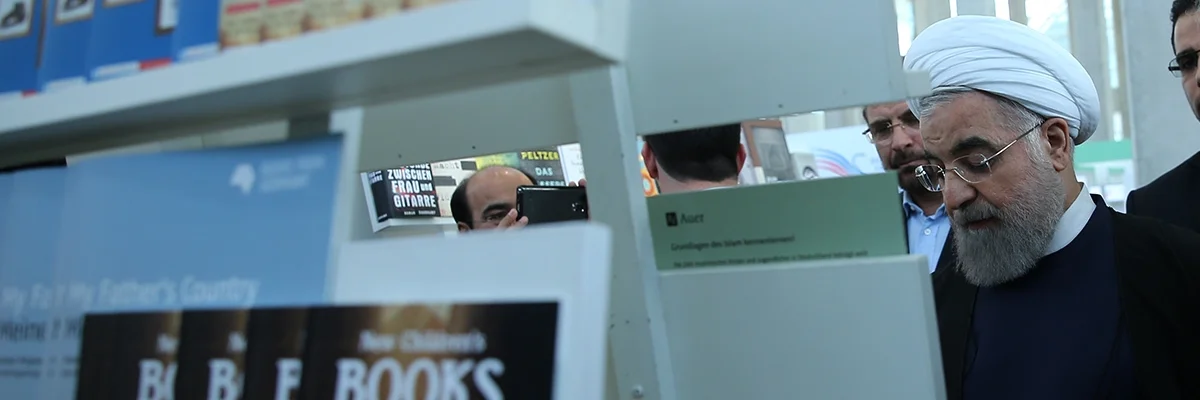
Photo: Nassredean Nasseri
9 Must-Read Books For Doing Business in Iran
◢ There are very few business-specific books on Iran published in English, and it can be difficult to know where to gather information and insights.
◢ However, certain works by noted economists, political scientists, and other academics contain important lessons and insights for any business leader devising a Iran strategy.
Getting ready for business in Iran won’t be as simple as picking up the latest business bestseller at an airport bookstore. There are essentially no quality English-language books specifically about doing business in Iran (perhaps a reflection of the country’s relative commercial isolation).
Emerging markets best practice suggests that to truly understand Iran’s market, a businesss leader will require fluency in matters of economy, politics, society, and culture. In these areas, the business journalism in the pages of Bloomberg Businessweek or The Economist lacks depth, and the off-the-shelf market research reports of firms like BMI and Euromonitor lack context.
Fortunately, economists, political scientists and other academics have studied Iran with great diligence. Although their books and writings are not specific to commercial considerations, they nonetheless contain important lessons and insights for any business leader devising an Iran strategy.
Below is a list of nine books that every businessperson should read before pursuing business in Iran.
1. A History of Modern Iran, Ervand Abrahamian, Cambridge University Press, 2008
Abrahamian’s relatively short and accessible text is a staple of undergraduate courses that deal with Iranian history or political science. His book gives a well-researched and balanced introduction to the last century of Iranian history. Anyone seeking to invest or work in Iran ought to consider a basic grasp of the country’s history as a prerequisite. Most analysis on Iran tends to fixate on the 1979 Islamic Revolution as the key historical event that explains Iran’s current position. But as Abrahamian’s astute history shows, 1979 was merely the culmination of several political, economic, and social trends. And by the same token, the present situation in Iran has to be understood within the bounds of decades-long trajectories which are helpfully introduced in this book.
2. Iran and the Global Economy: Petro Populism, Islam and Economic Sanctions, Eds. Parvin Alizadeh and Hassan Hakimian, Routledge, 2014
An understanding of Iran’s economy will be vital for all businesspeople seeking to engage opportunities in the country. Economists tend to publish findings in papers, making it difficult for non-academics to identify the key articles with the most valuable insights. Thankfully, UK-based economists Alizadeh and Hakimian edited this volume of essays covering various aspects of Iran’s economy. Published in 2014, the collected essays include a nod to future international engagement for Iran’s economy. Subsequent work by these economists and their peers will have expanded on these issues in light of recent developments, but this collection offers a compelling primer into some key matters such as banking regulation, privatization, oil revenues, and industrial capacity.
3. Iran's Struggle for Economic Independence: Reform and Counter-Reform in the Post-Revolutionary Era, Evaleila Pesaran, Routledge, 2013
Though it predates the election of President Hassan Rouhani, whom many see as a strong advocate for further liberalization of the economy, Pesaran’s book is a compelling introduction into the high-stakes debate that has developed in Iran about economic reforms. Her analysis explores how, in Iran, the simple idea of foreign direct investment (FDI) is tied to all sorts of historical and political contingencies. For business leaders seeking to pursue FDI in Iran, this book will help put their intentions in context.
4. Business Politics in the Middle East, Eds. Steffan Hertog, Giacomo Luciani, and Marc Valeri, Hurst, 2013
It will be important for business leaders devising strategy for Iran to understand broader regional trends. The economic relationships between Iran and its neighbors are complex, and understanding trends across the region should influence how companies handle risk as it pertains to Iran. This would be one reason to read Business Politics in the Middle East. But in particular, the book includes an essay by Kevan Harris, who is perhaps the most exciting thinker on Iranian political economy today. Though he has yet to write a book on the topic, Harris’ many articles explore the role of the state in Iranian economy, and the capacity for Iran’s current economic and political systems to accommodate the kind of capitalistic activities that multinational corporations and foreign investors are mulling. His use of data from the Tehran Stock Exchange to more accurately define the governance and ownership of Iran’s largest corporations reveals the complexity of determining what constitutes a state owned enterprise (SOE) in Iran. This kind of data will be fundamental to properly accounting for legal, political, and economic risk when it comes to investment and partnership targeting in Iran.
5. Bazaar and State in Iran, Arang Keshavaziran, Cambridge University Press, 2009
Keshavarzian is a sociologist by training and his book is very much academic in purpose and tone. It is a rare example of a book on modern Iran with a singular focus—in this case the seemingly timeless institution of the bazaar. As Keshavarzian’s book explains, the bazaar is no longer as powerful as it once was. But at its height Iran’s merchant class, the bazaaris, epitomized the constructive role that commercial enterprise can play in Iranian society. Business leaders today could learn from the example of collaboration, network-building, and civil society engagement that the bazaar offers. Indeed, the financial might of the bazaar was bolstered by its particular commitment to its stakeholders—owners, employees, and customers. Iranian industries, and their international partners, will find the greatest success if they take a similar approach, one devoted to value creation over profit hunting.
6. Iran's Natural Gas Industry in the Post-Revolutionary Period: Optimism, Skepticism, and Potential, Elham Hassanzadeh, Oxford University Press, 2014
The natural gas industry will no doubt be a major target for investment and development in a post-sanctions environment. But that is not the reason that Hassanzadeh’s book is worth mentioning. Her book is a model example of a deep, interdisciplinary study of a major industry in Iran. The way she weaves political and economic history into the technical discussion of the gas industry and its development prospects should be emulated. For a businessperson trying to develop an understanding of what good market intelligence and contextual knowledge looks like, Hassazadeh provides one of the best examples. Indeed, her “unique methodological approach, presenting a multidisciplinary study of the various historical, political, and economic variables” was a deliberate innovation in the work.
7. Negotiating With Iran, John Limbert, United States Institute of Peace Press, 2009
John Limbert is famous for being one of the hostages taken in the storming of the American Embassy in Tehran in 1979. Despite that unfortunate experience—or perhaps because of it—he has followed his long diplomatic career with a turn as an academic focusing on Iran. These days, the best advice holds that emerging market strategy must take into account cultural awareness to complement market intelligence. Knowing how to operate in a market necessarily requires knowledge about how to deal with local actors. Limbert makes the argument for cultural awareness with a particular focus on the progress of US-Iran political relations, but many of his insights also have a relevance to the realization of commercial relations between Iranian and Western firms. In particular, Limbert outlines “Fourteen Steps to Success” for negotiating with Iranians, many of which are superb advice for business negotiations. Steps such as “talking to the right people” and “choosing intermediaries with care” should not be taken lightly. One might worry that Limbert, as an American, would be poorly positioned to comment on Iranian culture. But having lived and taught in Iran for many years prior to the 1979 revolution, leaving him with excellent Persian language skills, Limbert is an excellent guide to these questions for a foreign audience.
8. Going to Tehran: Why America Must Accept the Islamic Republic, Hillary Mann Leverett and Flynt Leverett, Picador, 2014
The Leveretts, a husband and wife team with experience as national security analysts in the Bush and Clinton administrations, offer suggestions for moving beyond the thirty years of distrust between the United States and Iran. They argue that negotiation between the West and Iran is the only way to address longstanding political and security concerns. In exploring this topic, the book becomes particularly useful for understanding many of the contemporary dynamics within Iran’s political arena today, and by extension wider society itself. Although not directly concerned with business, the book aims to make the reader understand the society of contemporary Iran through an analytical-political lens. Similarly to Limbert’s book, Going to Tehran also aims to give the reader a glimpse of how the “Iranian”—in this case the political actor— sees himself in the wider global and regional context. Many of the issues afflicting Iran’s relationships with an array of countries can be neatly summed up in the writings of the Leverett duo.
9. The Strangling of Persia, Morgan Shuster, Mage, 2006
Morgan Shuster was an American banker who was invited to Iran in 1911 to serve as Treasurer-General and to put the finances of the newly formed Persian constitutional monarchy in order. His efforts were stymied, however, by the competition between the British and Russian Empires, which had split Iran into two spheres of influence in a 1907 convention, only to continue meddling in domestic politics as they competed for power. Shuster’s sympathy was with the Iranian people, who were trying to establish democratic institutions with little success. Ousted from Tehran by the Russians, Shuster wrote his book to expose how the British and Russians continually denied the Iranian right to self-determination. From Shuster’s time until today, Iranians have remained sensitive to the notion that true national independence has been denied by great power politics. The recent experience of sanctions has only heightened this sentiment. As foreign firms seek to enter Iran, it would behoove business leaders to develop an awareness of this perception as many of Shuster’s observations continue to ring true today.
Photo Credit: iStock