

Total CEO Pouyanné: Transatlantic Partners Risk Gifting Iran to 'China and Russia'
◢ Speaking on Thursday at the Center for Strategic and International Studies, a Washington D.C. think tank, Total CEO Patrick Pouyanné faced several questions about his company’s recently announced decision to wind down operations in Iran following the reapplication of secondary sanctions by the Trump administration. Pouyanné warned that the “Atlantic allies” risk giving “all the Middle East region to China and Russia.”
Speaking on Thursday at the Center for Strategic and International Studies, a Washington D.C. think tank, Total CEO Patrick Pouyanné faced several questions about his company’s recently announced decision to wind down operations in Iran following the reapplication of secondary sanctions by the Trump administration.
With his trademark candor, Pouyanné left no doubt that Total was obligated to comply with U.S. sanctions in regards to the USD 5 billion South Pars gas project launched in July 2017, stating “Secondary sanctions mean that the U.S. president can decide that Total cannot have access to any U.S. banks. I cannot run a company in 130 countries without access to U.S. banks.”
For Total, the South Pars project in Iran was only considered “because of the JCPOA, which meant the end of secondary sanctions.” With the nuclear deal in doubt, and sanctions set to return, “there is no possibility for us,” Pouyanné declared, further noting the role of American shareholders and the significant portfolio of American assets of the French oil company.
But the imposing, formerly rugby-playing executive, did not shut the door to Iran completely. Reiterating a point made in the company’s press release regarding South Pars, Pouyanné stated, “The only way we can proceed is with a project waiver from the U.S.”
Acknowledging a contractual obligation to the Iranians to seek all possible means to remain in the project, Pouyanné confirmed that Total was engaging “with the French government and the U.S. authorities” to raise the prospect of such a waiver, which will not be “easy to obtain.”
Looking to the wider political context, Pouyanné pointed to the early measures being taken by European governments, which may have a bearing on the effort to secure a waiver, reminding the audience that “in 1996-1997 when we made the first South Pars project, [Total] had such a waiver. It was the result of a diplomatic discussion between Europe and the U.S."
The prospects of a diplomatic discussion are dim and Pouyanné recognized that the disagreement over Iran policy is “a big test for the U.S.-Europe relationship" and one that is “beyond Total, as a commercial operation."
Nonetheless, Pouyanné issued a warning: “What would be not good neither for the U.S., nor for Europe, is if that at the end only Russia and China can do business in Iran.” Earlier on Thursday, Iranian authorities had announced that Total’s joint-venture partner in South Pars, Chinese state oil company CNPC, would be assuming Total’s share of the project. Pouyanné was also likely alluding to the presence of Russia state oil company Zarubezhneft, which has signed two major oil deals in Iran. He warned the “Atlantic allies” to consider whether they “want to give all the Middle East region to China and Russia, as this is what we are doing step after step.”
The geopolitical implication of blocking companies such as Total from working in Iran may form the basis of the companies lobbying to receive a waiver from the Trump administration.
Reflecting on what the pullout from the Iranian market meant, Pouyanné struck a philosophical tone, highlighting the importance of loyalty in the oil industry. Responding to a question about Total’s perseverance in Venezuela in an increasingly hostile environment, Pouyanné pointed to the case of Iran, noting “You have to stay as long as you can, because people remember... They remember the company when it stands together in difficult times.”
In the oil industry, he explained “leaving a country is a very tough decision, because it takes a lot of time to convince people that we can come back. It is a question of loyalty.”
Photo Credit: Wikicommons
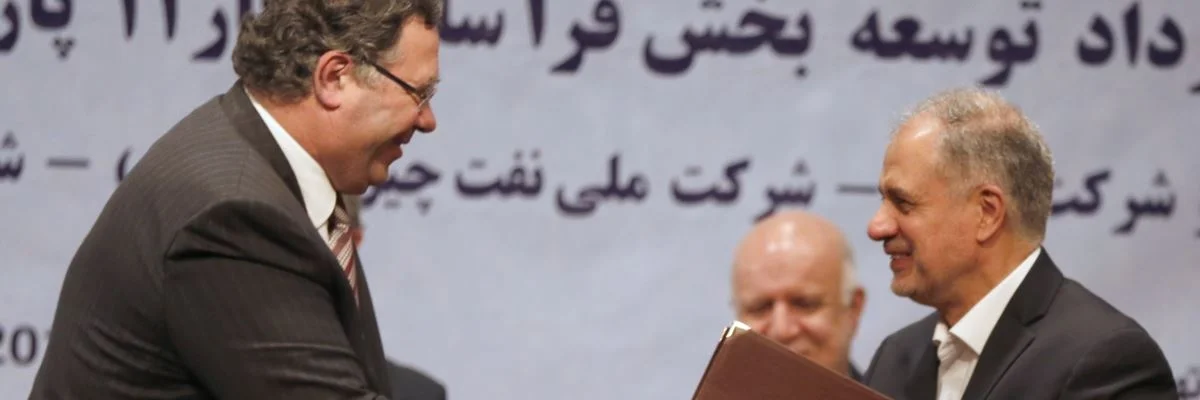
Total CEO Pouyanné Considers Measures to Protect European Business in Iran
◢ In a major interview given to French newspaper Le Monde, Total CEO Patrick Pouyanné was asked about the “American threat” to the company’s “important gas project” in Iran.
◢ Pouyanné’s forthright response marks perhaps the first time that a major European executive has publicly called for a diplomatic intervention to protect commercial interests in Iran. He points to the 1990s blocking statutes and sanctions waivers as a potential tool in the current environment.
In a major interview given to French newspaper Le Monde looking at Total’s strong performance in 2017, CEO Patrick Pouyanné was asked about the “American threat” to the company’s “important gas project” in Iran. Pouyanné’s forthright response marks perhaps the first time that a major European executive has publicly called for a diplomatic intervention to protect commercial interests in Iran.
Total’s CEO explained that the South Pars project was “progressing well, without delay, and [Total] continues to work, even if the situation with the American Congress is rather vague.” He noted that even if the Americans “decide to exit the nuclear agreement and if secondary sanctions return in place,” it would pose a “real question” for the French energy giant.
However, echoing comments made to reporters on the sidelines of Davos, Pouyanné did not cast snapback as an automatic game-over for the South Pars project. Rather, he suggested that it was necessary to “clarify the horizon for European business working in Iran.”
He explains that Total has been in discussions with French and European authorities about “means to protect investments already made in Iran, even in the case of the return of sanctions.” Pouyanné points to the experience of European blocking statutes and sanctions waivers applied in the 1990s which proved sufficient to to protect Total’s gas projects at the time. Pouyanné concludes by noting that it is “up to European diplomats to consider these questions.”
The confidence of Pouyanné’s response stands in stark comparison to the general uncertainty that has gripped the business community and will be seen as an important signal. The landmark USD 3.8 billion South Pars project is seen as a bellwether for the larger project of Iran’s post-sanctions economic recovery.
However, Total is far from the only major European multinational engaged in the Iranian market. Pouyanne was one of select group of European CEOs invited to dine with Donald Trump at a special dinner held during the American President’s trip to the World Economic Forum in Davos. Other guests included Siemens CEO Joe Kaeser, ABB CEO Ulrich Spiesshofer and Volvo CEO Martin Lundstedt. Overall, nine of the fifteen companies represented at the dinner are currently active in Iran, and a further five have had a historical presence in the market. Pouyanné’s peers are likely to share his sentiments on the need to protect European interests in Iran and the wider global economy.
While the legal value of blocking statutes or sanctions waivers is questionable given the greater interconnectivity in global markets and greater reticence of the banking sector to engage Iran when compared to the 1990s, the political message behind such measures could be valuable, enabling companies to seek creative solutions to structure their Iran engagements in a way that avoids sanctions exposure.
In a recent survey conducted by Bourse & Bazaar and commissioned by International Crisis Group, a substantial 54 percent of senior executives indicated that “assuming Iran remains committed to the nuclear deal,” blocking statutes, which would protect companies from U.S. penalties, would positively affect the “decision to invest in Iran.”
Photo Credit: Total
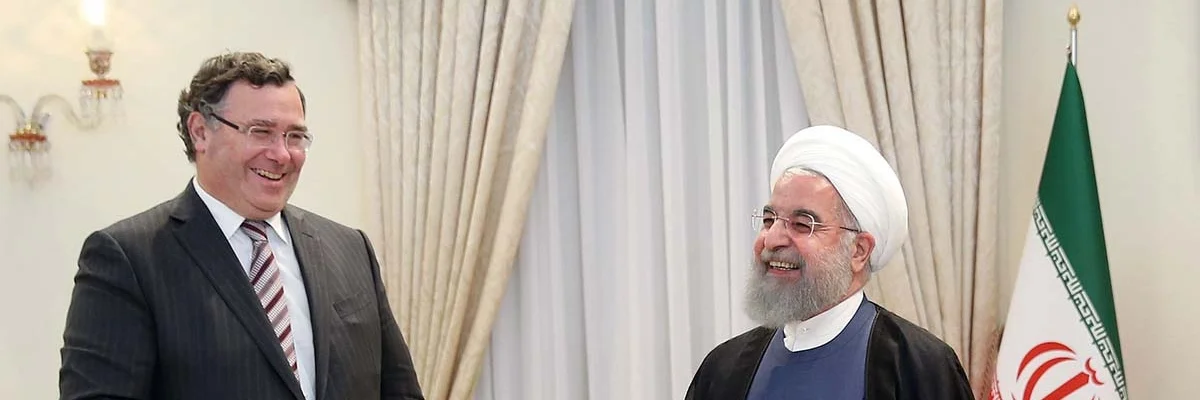
Oil Giant Total Takes to Twitter to Underscore Iran Commitment
◢ In a series of tweets published on Tuesday, Total's press office pushed back on reports that the company is rethinking its Iran strategy in light of pressure from the United States.
◢ The tweets emphasize that Total CEO Patrick Pouyanné sees no political barriers to the South Pars gas deal, and is simply waiting to see whether following Congressional action legal conditions will allow the deal to move forward.
In an unusual move, Total's press office issued a series of tweets on Tuesday in order to correct an apparent mischaracterization of the company's position on its planned USD 4.8 billion gas deal in Iran.
A piece published by CNN Money on Tuesday, and later echoed by Reuters, suggested that Total was "rethinking" its comittment to Iran in light of the company's large presence in the U.S. and President Trump's opposition to the Iran deal. The piece centered on comments made to CNN Money on the sidelines of an energy conference in Abu Dhabi, with Total CEO Patrick Pouyanné stating that "If there is a sanctions regime [on Iran], we have to look at it carefully... We work in the U.S., we have assets in the U.S., we just acquired more assets in the U.S."
But a series of tweets from Total's official press office account have since sought to dispel the idea that there has been any change in the company's policy towards Iran. The tweets explain how the comments made by Pouyanné are consistent with those made in several interviews since Trump's de-certification of the JCPOA Iran Deal.
Total's response clarifies that the company remains committed to its project in Iran's South Pars gas field and draws attention to an earlier interview in which Pouyanné stated he does not see a political barrier to conducting business in Iran. That Total is continuing to push ahead on its Iranian project demonstrates considerable resolve, especially given the company's extensive operations in both the United States and Saudi Arabia, two countries whose governments largely oppose Iran's economic opening. Indeed, the company has recently moved to more directly manage political risks by opening an office in Washington.
Pouyanné's comments to CNN Money do however raise the possibility that the United States will reimpose secondary sanctions, which would penalize non-U.S. entities for conducting business with Iran. Such a "snapback" scenario would compel nearly all European multinational firms, including Total, to pull back from the market. Total, like many other companies, is simply waiting to see what legal approach Congress is likely to take. Pouyanné told CNN, "We are working on the project. We launched the tenders, we should award contracts by January... I hope by that time, Congress will have an answer for the president and the president will have to renew, or not [renew], the certification."
Encouragingly, it remains unlikely that Congress will opt for snapback, which would constitute withdrawal from the JCPOA. Total's landmark deal still seems poised to open a new era of energy investment in Iran.
Photo Credit: IRNA