
How Shifts on Instagram Drove Iran's 'Mahsa Moment'
Iranians are using Instagram for political activism like never before. But these changes were not sudden. The “Mahsa Moment” was driven by user trends on social media that have been years in the making.
This article was originally published in Persian.
In a narrative crafted by various political and intellectual currents, the “Iranian Instagram” is often presented as a means of depoliticising the attitudes and behaviours of the Iranian people, with its users engaging in vulgar content, falling for false news and claims, cursing at famous figures, and morbidly posting accounts of the more attractive sides of their daily lives. This same formulation is used by the conservative movement (also called the Principalists movement) to realise their policy of "organisation" and "protection" of the Internet. Using comparable language, pro-change political currents also direct users to ostensibly more political platforms, such as Twitter and Clubhouse. However, if this is the case, why has Instagram become one of the most prominent platforms for expressing and even organising political protests in the “Mahsa Moment?”
The simplest and shortest response to this question is to attribute everything that has occurred over the past two to three months to the Islamic Republic's enemies. This response has been heard repeatedly on official domestic media in recent months. Some of the self-proclaimed leaders of the people's protests in the media outside of Iran have given the same answer in different words, claiming that these events are the result of their years of hard work and meticulous planning. This type of analysis of people's collective actions is not only unenlightening and ineffectual but is a significant contributor to the current crisis.
However, another approach might be to temporarily set aside preconceived notions about online social networks in favour of a more empirically grounded and scientifically sound approach to answering this question. A portion of the answer to this question can be found by analysing the changing trends on Iranian Instagram.
Those of you who have been following along for the past three years may recall that I began a longitudinal study of Iranian Instagram in 2019 and have since published an analytical update three times in the early fall of 2019, 2020, and 2021. This year, data collection and analysis took longer than usual due to Internet filtering and interruptions, delaying the report preparation for the fourth phase of this research.
With these explanations, the findings of the fourth consecutive year of this research will be presented within the context of the question posed at the beginning of the report. The findings of this study demonstrate that the transformation of the Iranian Instagram space at the “Mahsa Moment” into a platform for online protests and the organisation of offline protests cannot be attributed to a pre-planned project. Rather, we must understand and analyse this phenomenon in light of the agency of users and the gradual changes that have occurred on Instagram in Iran over the past few years. In addition, despite tightening restrictions over the past year, Iranian Instagram continues on its path, both quantitatively and qualitatively, consistent with the previously optimistic changes.
Figure 1 depicts the frequency of active popular Iranian Instagram pages between 2019 and 2022. Despite the tightening of various restrictions facing Iranian users on Instagram, the number of active Iranian pages on Instagram with more than 500,000 followers increased by 17% in 2022, reaching 2,654.
Figure 1: Frequency of active Iranian Instagram pages with over 500k followers from 2019 to 2022
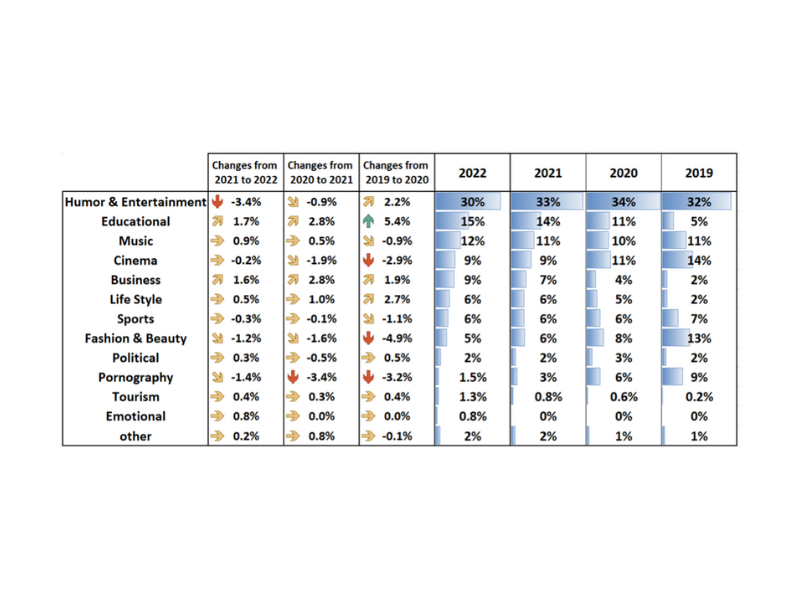
As displayed in Table 1, the share of "humour and entertainment", "fashion and beauty", and "pornography" pages among the most popular Iranian Instagram pages has decreased significantly over the past year. While the decline in "fashion and beauty" and "pornography" pages continues a longer trend, the declining ratio of "humour and entertainment" pages on Iranian Instagram over the past year is something new. In contrast, the percentage of "educational" and "business" Instagram pages has continued to rise in 2022.
The appearance of "tourism" and "emotional" pages on popular Iranian Instagram pages in 2022 is another notable change. On the tourism pages, content pertaining to tourism in various regions of Iran and the world is published, whereas, on the emotional pages, content that represents human feelings and emotions are published.
Table 1: Share of popular pages by primary subject from 2019 to 2022
The trend of changes in the network of relationships between popular Iranian Instagram pages is illustrated in Figure 2 using the Indegree Index. When comparing the changing trend of the graphs from 2019 to 2022, we observe that education (dark blue), business (brown), lifestyle (orange), and fashion and beauty (pink) pages have become increasingly integrated within their respective fields and have distanced themselves from other fields. In the upper portion of the graphs, from 2019 to 2022, we notice an increase in the intertwining of sports screens (pale blue), movies (green), and music (red). In other words, these three types of popular accounts—also known as "celebrity” accounts—have gradually shaped a field that is related to issues outside of their profession. In this multifaceted field, in addition to celebrity pages, there are humour, entertainment, political, and social pages (yellow, black, and grey).
Figure 2: Changes in the network of relationships between popular Iranian Instagram pages from 2019 to 2022, as measured by the Indegree Index
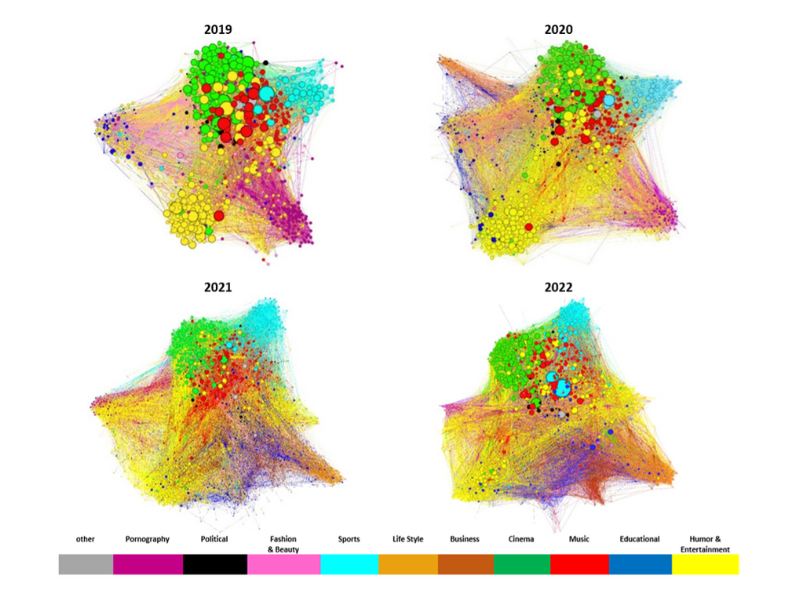
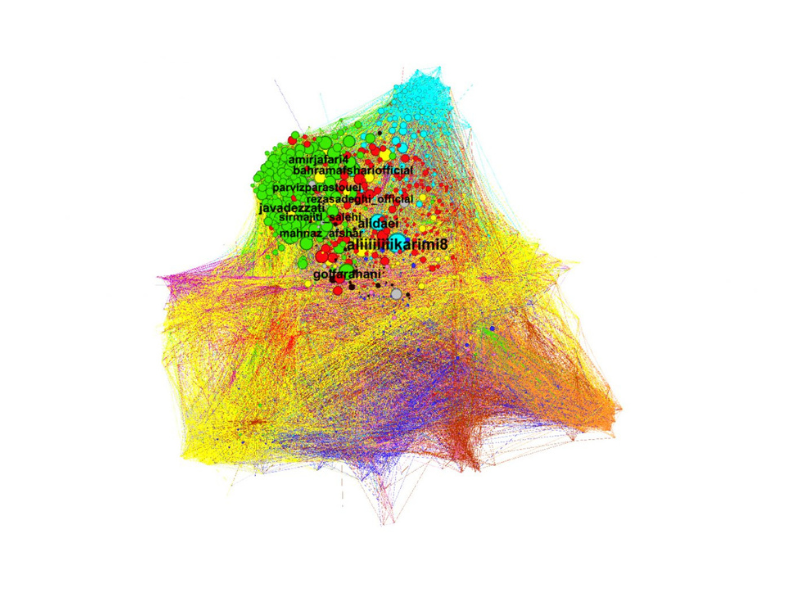
Figure 3 displays the ten Iranian Instagram influencers with the highest authority based on the Authority index. All of these individuals belong to one of the three categories: sports, film, or music. These three categories also overlap. Moreover, with the exception of two individuals, the rest post additional content on the page related to their audience's political, economic, and social concerns and demands, as well as their profession and area of expertise. Let us refer to this type of celebrity as a "celebrity-activist.”
By a significant margin, Ali Karimi has the highest authority among the most popular Iranian Instagram pages, followed by Ali Daei, Golshifteh Farahani, Javad Ezzati, Amir Jafari, Bahram Afshari, Mahnaz Afshar, Majid Salehi, Parviz Parastui, and Reza Sadeghi.
Figure 3: Network relations between popular Iranian Instagram pages in 2022, as per the Authority Index
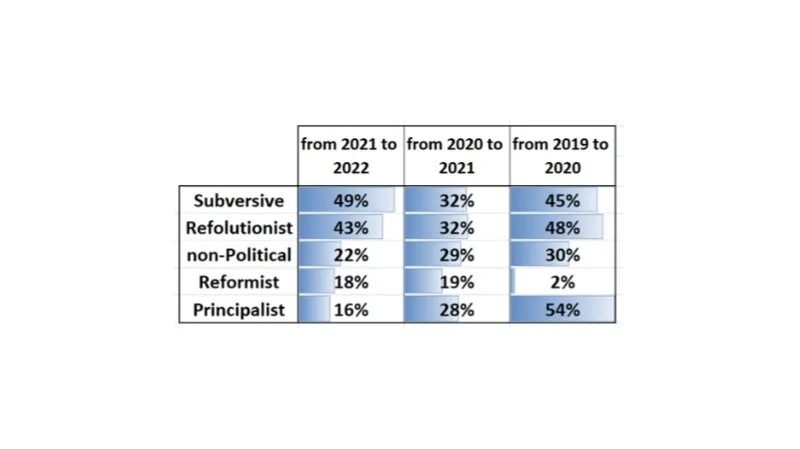
By reflecting on Table 2 and reviewing Table 1, we can gain a greater appreciation for the reasons why celebrity-activists on Iranian Instagram gain authority. Table 2 demonstrates that the number of followers of popular subversive pages has increased by 49% over the past year. This index was 43% for refolutionist (neither revolutionist nor reformist), 22% for non-politicals, 18% for reformists, and 16% for conservatives (Principalists). Comparing these statistics to those from previous years reveals that the notion of protesting the current political situation has become increasingly popular and a sought-after item on Iranian Instagram over the past year.
In contrast, as shown in Table 1, the proportion of political pages (individuals, groups, or organisations professionally engaged in political activity) among the most popular Iranian Instagram pages did not change significantly between 2019 and 2022, fluctuating by approximately 2%. In other words, Iranian political professionals of various political orientations lack the capacity and acceptance to represent the nation's political attitudes and demands. Iranian Instagram users have increased pressure on other popular Iranian Instagram pages, requesting that they reflect and even represent the political protests of the Iranian people. As previously explained, education, business, lifestyle, and fashion and beauty pages have not directly engaged with this demand of users due to professional considerations; however, a substantial portion of the movie, sports, and music pages have responded positively to the demand of their followers, largely due to their professional considerations. In actuality, it is the crisis of political representation that has placed celebrities in the position of representing the political demands of the Iranian people and given rise to the phenomenon of "celebrity-activists.”
In this sense, these are the people who have agency and have utilised the smallest opportunities to protest the status quo. In this way, they also take advantage of the opportunities provided by celebrities. In such a scenario, political professionals dissatisfied with the formation of these relationships between users and celebrities alter the truth and promote the narrative that "these excited people" have been duped by "illiterate celebrities!" Almost every political faction has employed such insults on occasion. Of course, these same "illiterate celebrities,” once defended participating in elections and voting for reformists, thereby increasing voter turnout. But, at the current time when celebrities are under the pressure of users and the online space has aligned with the Mahsa movement, conservatives and a significant portion of reformers assert that "the excited people" have been duped by the celebrities they follow. In actuality, instead of taking fundamental and principled measures to address the escalating crisis of political representation, political professionals sometimes align themselves with "concerned artists and athletes" and "intelligent people" and sometimes curse "illiterate celebrities" and "excited people" in accordance with their immediate interests.
Table 2: The rise in followers of popular Iranian Instagram pages by political orientation from 2019 to 2022
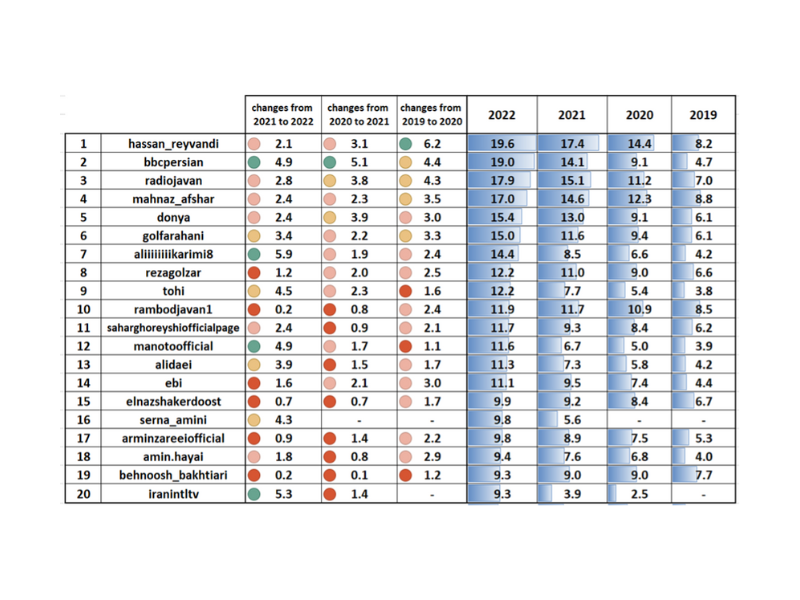
The relationship between Instagram users and popular pages has gradually developed an inherent logic over time, which can be made more tangible by examining a few examples from Table 3. Hassan Reyvandi's number of followers increased by more than 6 million between 2019 and 2020, when, in addition to political protest, the production of humour and entertainment content independent of official media was considered a high-demand commodity on Instagram. Consequently, he moved from third place in 2019 to first place in 2020. From 2020 to 2021, when humorous content independent of the official media still had some appeal, Reyvandi maintained his position by keeping a considerable distance from other prominent pages. Nonetheless, Reyvandi's position has been weakened over the past year, when "opposition to the existing political conditions" became the high-demand commodity on Iranian Instagram. Indeed, it is highly probable that he will soon be demoted. Rambod Javan has already experienced this fall. After failing to meet the expectations of political dissidents on Instagram, he dropped from the second most popular Iranian Instagram page in 2018 to the tenth most popular in 2019. Behnoosh Bakhtiari's position declined even further. Bakhtiari, who had the fourth most popular Iranian Instagram page in 2019, was harshly criticised by many Instagram users after taking several controversial positions, including publishing an Instagram post against the three protesters of November 2019 who were sentenced to execution. As a result, her page fell from the fourth most popular Iranian Instagram page to the nineteenth position within three years. Such evidence demonstrates that, contrary to the misleading term "influencer,” the resultant of the collective will of users has a substantially more direct and significant effect on the behaviour of influencers, not the reverse.
Table 3: Follower counts of the most popular Iranian pages from 2019 to 2022, per million users
From 2019 to 2021, the percentage of female Instagram celebrities in Iran rose from 32% to 42%. However, there has been no discernible change in the gender distribution of famous people over the past year. Likewise, while the percentage of popular pages based in Iran increased from 76% to 81% between 2019 and 2021, there has been no significant change in this regard over the past year.
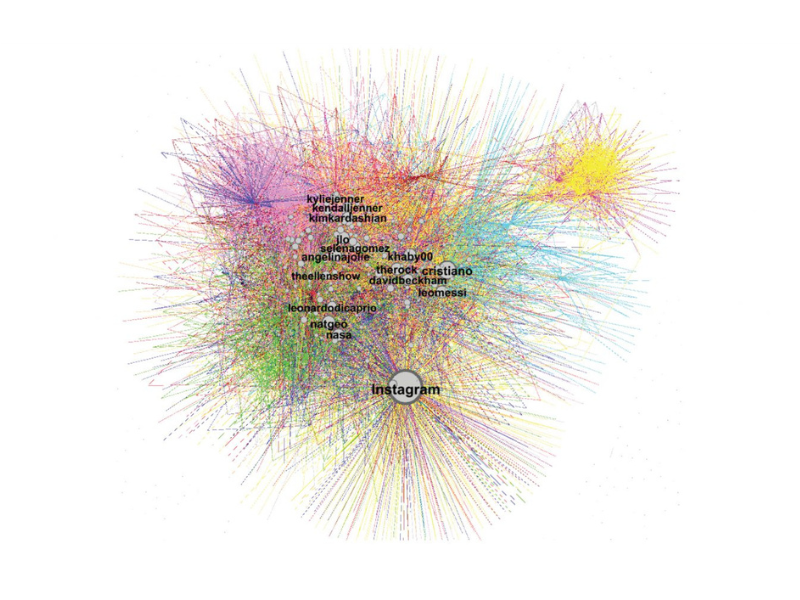
Let us conclude by examining the influence network of popular Iranian pages as affected by global authority pages. Based on the Authority Index, none of the foreign pages with high authority among the most popular Iranian Instagram pages are political. NASA, National Geographic, Leonardo DiCaprio, and Ellen DeGeneres have the most authority among film-oriented pages. Kylie Jenner, Kendall Jenner, and Kim Kardashian have the strongest authority among fashion and beauty pages. Jennifer Lopez, Selena Gomez, and Angelina Jolie have the highest authority jointly among the cinema and fashion and beauty pages. Moreover, Lionel Messi and Cristiano Ronaldo have the greatest authority among sports pages, while Khaby Lame, Dwayne Douglas Johnson, David Beckham, and the official Instagram page are authoritative among various sections of popular Iranian Instagram pages.
Figure 4: The position of authoritative international pages among popular Iranian pages on Instagram based on the Authority Index
Today, and particularly in the post-Mahsa era, the events that occur within the framework of online social networks are increasingly scrutinised by various political currents. Analysts with differing political leanings are discussing the relationship between online social networks and the collective protest actions of the Iranian people more than ever before. However, a quantitative increase in the analysis of online social networks can be considered a positive event if these analyses are continuously reviewed in conjunction with research findings in this field. Otherwise, it will not only be unenlightening but will also lead to the propagation of false stereotypes and, as a result, incorrect decisions and policies regarding this relatively new phenomenon.
Users' actions on online social networks may be correct in some cases but incorrect in others. It is crucial that whenever we find the actions of users to be inappropriate, we avoid blindly attributing everything to intelligent services, media, think tanks, or opportunistic and deceitful people. Instead of believing in these conspiracy theories, we should seek a more accurate understanding of the logic behind their actions and decisions using different methods and the logic of the situation in which users find themselves.
This methodological and analytic error is not unique to supporters of the government but is frequently committed by pro-change political currents when they encounter unpleasant phenomena in online social networks. In recent years, as a result of such a circumstance, many activists, analysts, and even some sociologists have shifted their focus from the lower levels of politics to security issues and have become experts on security issues and whistleblowers of media conspiracies and enemy think tanks.
The narrative of "excited and gullible users" is one of the recurring stereotypes regarding online social networks. In this narrative, social network users are uneducated and naive individuals who are constantly exploited by deceptive and opportunistic individuals, groups, and organisations. Throughout the past few years, and especially in the last few months, a great deal of commentary on Iranian Instagram has been based on this narrative. Interestingly, proponents of this narrative rarely question the veracity of this view and appear to see no need for scientific evidence to verify its veracity.
The results of the fourth phase of the longitudinal research I have conducted on Iranian Instagram users demonstrate conclusively that this narrative is highly misleading. Indeed, when criticising a false stereotype, we must take care not to fall into another false stereotype. Consequently, I hope that the caution that I have attempted to observe in writing this research report will be noted by the readers and that the research findings will be interpreted with the same caution.
Photo: IRNA
9 Must-Read Books For Doing Business in Iran
◢ There are very few business-specific books on Iran published in English, and it can be difficult to know where to gather information and insights.
◢ However, certain works by noted economists, political scientists, and other academics contain important lessons and insights for any business leader devising a Iran strategy.
Getting ready for business in Iran won’t be as simple as picking up the latest business bestseller at an airport bookstore. There are essentially no quality English-language books specifically about doing business in Iran (perhaps a reflection of the country’s relative commercial isolation).
Emerging markets best practice suggests that to truly understand Iran’s market, a businesss leader will require fluency in matters of economy, politics, society, and culture. In these areas, the business journalism in the pages of Bloomberg Businessweek or The Economist lacks depth, and the off-the-shelf market research reports of firms like BMI and Euromonitor lack context.
Fortunately, economists, political scientists and other academics have studied Iran with great diligence. Although their books and writings are not specific to commercial considerations, they nonetheless contain important lessons and insights for any business leader devising an Iran strategy.
Below is a list of nine books that every businessperson should read before pursuing business in Iran.
1. A History of Modern Iran, Ervand Abrahamian, Cambridge University Press, 2008
Abrahamian’s relatively short and accessible text is a staple of undergraduate courses that deal with Iranian history or political science. His book gives a well-researched and balanced introduction to the last century of Iranian history. Anyone seeking to invest or work in Iran ought to consider a basic grasp of the country’s history as a prerequisite. Most analysis on Iran tends to fixate on the 1979 Islamic Revolution as the key historical event that explains Iran’s current position. But as Abrahamian’s astute history shows, 1979 was merely the culmination of several political, economic, and social trends. And by the same token, the present situation in Iran has to be understood within the bounds of decades-long trajectories which are helpfully introduced in this book.
2. Iran and the Global Economy: Petro Populism, Islam and Economic Sanctions, Eds. Parvin Alizadeh and Hassan Hakimian, Routledge, 2014
An understanding of Iran’s economy will be vital for all businesspeople seeking to engage opportunities in the country. Economists tend to publish findings in papers, making it difficult for non-academics to identify the key articles with the most valuable insights. Thankfully, UK-based economists Alizadeh and Hakimian edited this volume of essays covering various aspects of Iran’s economy. Published in 2014, the collected essays include a nod to future international engagement for Iran’s economy. Subsequent work by these economists and their peers will have expanded on these issues in light of recent developments, but this collection offers a compelling primer into some key matters such as banking regulation, privatization, oil revenues, and industrial capacity.
3. Iran's Struggle for Economic Independence: Reform and Counter-Reform in the Post-Revolutionary Era, Evaleila Pesaran, Routledge, 2013
Though it predates the election of President Hassan Rouhani, whom many see as a strong advocate for further liberalization of the economy, Pesaran’s book is a compelling introduction into the high-stakes debate that has developed in Iran about economic reforms. Her analysis explores how, in Iran, the simple idea of foreign direct investment (FDI) is tied to all sorts of historical and political contingencies. For business leaders seeking to pursue FDI in Iran, this book will help put their intentions in context.
4. Business Politics in the Middle East, Eds. Steffan Hertog, Giacomo Luciani, and Marc Valeri, Hurst, 2013
It will be important for business leaders devising strategy for Iran to understand broader regional trends. The economic relationships between Iran and its neighbors are complex, and understanding trends across the region should influence how companies handle risk as it pertains to Iran. This would be one reason to read Business Politics in the Middle East. But in particular, the book includes an essay by Kevan Harris, who is perhaps the most exciting thinker on Iranian political economy today. Though he has yet to write a book on the topic, Harris’ many articles explore the role of the state in Iranian economy, and the capacity for Iran’s current economic and political systems to accommodate the kind of capitalistic activities that multinational corporations and foreign investors are mulling. His use of data from the Tehran Stock Exchange to more accurately define the governance and ownership of Iran’s largest corporations reveals the complexity of determining what constitutes a state owned enterprise (SOE) in Iran. This kind of data will be fundamental to properly accounting for legal, political, and economic risk when it comes to investment and partnership targeting in Iran.
5. Bazaar and State in Iran, Arang Keshavaziran, Cambridge University Press, 2009
Keshavarzian is a sociologist by training and his book is very much academic in purpose and tone. It is a rare example of a book on modern Iran with a singular focus—in this case the seemingly timeless institution of the bazaar. As Keshavarzian’s book explains, the bazaar is no longer as powerful as it once was. But at its height Iran’s merchant class, the bazaaris, epitomized the constructive role that commercial enterprise can play in Iranian society. Business leaders today could learn from the example of collaboration, network-building, and civil society engagement that the bazaar offers. Indeed, the financial might of the bazaar was bolstered by its particular commitment to its stakeholders—owners, employees, and customers. Iranian industries, and their international partners, will find the greatest success if they take a similar approach, one devoted to value creation over profit hunting.
6. Iran's Natural Gas Industry in the Post-Revolutionary Period: Optimism, Skepticism, and Potential, Elham Hassanzadeh, Oxford University Press, 2014
The natural gas industry will no doubt be a major target for investment and development in a post-sanctions environment. But that is not the reason that Hassanzadeh’s book is worth mentioning. Her book is a model example of a deep, interdisciplinary study of a major industry in Iran. The way she weaves political and economic history into the technical discussion of the gas industry and its development prospects should be emulated. For a businessperson trying to develop an understanding of what good market intelligence and contextual knowledge looks like, Hassazadeh provides one of the best examples. Indeed, her “unique methodological approach, presenting a multidisciplinary study of the various historical, political, and economic variables” was a deliberate innovation in the work.
7. Negotiating With Iran, John Limbert, United States Institute of Peace Press, 2009
John Limbert is famous for being one of the hostages taken in the storming of the American Embassy in Tehran in 1979. Despite that unfortunate experience—or perhaps because of it—he has followed his long diplomatic career with a turn as an academic focusing on Iran. These days, the best advice holds that emerging market strategy must take into account cultural awareness to complement market intelligence. Knowing how to operate in a market necessarily requires knowledge about how to deal with local actors. Limbert makes the argument for cultural awareness with a particular focus on the progress of US-Iran political relations, but many of his insights also have a relevance to the realization of commercial relations between Iranian and Western firms. In particular, Limbert outlines “Fourteen Steps to Success” for negotiating with Iranians, many of which are superb advice for business negotiations. Steps such as “talking to the right people” and “choosing intermediaries with care” should not be taken lightly. One might worry that Limbert, as an American, would be poorly positioned to comment on Iranian culture. But having lived and taught in Iran for many years prior to the 1979 revolution, leaving him with excellent Persian language skills, Limbert is an excellent guide to these questions for a foreign audience.
8. Going to Tehran: Why America Must Accept the Islamic Republic, Hillary Mann Leverett and Flynt Leverett, Picador, 2014
The Leveretts, a husband and wife team with experience as national security analysts in the Bush and Clinton administrations, offer suggestions for moving beyond the thirty years of distrust between the United States and Iran. They argue that negotiation between the West and Iran is the only way to address longstanding political and security concerns. In exploring this topic, the book becomes particularly useful for understanding many of the contemporary dynamics within Iran’s political arena today, and by extension wider society itself. Although not directly concerned with business, the book aims to make the reader understand the society of contemporary Iran through an analytical-political lens. Similarly to Limbert’s book, Going to Tehran also aims to give the reader a glimpse of how the “Iranian”—in this case the political actor— sees himself in the wider global and regional context. Many of the issues afflicting Iran’s relationships with an array of countries can be neatly summed up in the writings of the Leverett duo.
9. The Strangling of Persia, Morgan Shuster, Mage, 2006
Morgan Shuster was an American banker who was invited to Iran in 1911 to serve as Treasurer-General and to put the finances of the newly formed Persian constitutional monarchy in order. His efforts were stymied, however, by the competition between the British and Russian Empires, which had split Iran into two spheres of influence in a 1907 convention, only to continue meddling in domestic politics as they competed for power. Shuster’s sympathy was with the Iranian people, who were trying to establish democratic institutions with little success. Ousted from Tehran by the Russians, Shuster wrote his book to expose how the British and Russians continually denied the Iranian right to self-determination. From Shuster’s time until today, Iranians have remained sensitive to the notion that true national independence has been denied by great power politics. The recent experience of sanctions has only heightened this sentiment. As foreign firms seek to enter Iran, it would behoove business leaders to develop an awareness of this perception as many of Shuster’s observations continue to ring true today.
Photo Credit: iStock