

Accelerating the Gulf's Energy Transition in the Wake of Russia's War
The Russian war against Ukraine has been both a gift and a curse for oil producers in the Persian Gulf. It has stoked oil demand, but also made clear the strategic necessity of the energy transition.
This article is part of a series exploring regional energy cooperation in the Gulf and is published in cooperation with Istituto Affari Internazionali.
The 2022 Russian war against Ukraine has been both a gift and a curse for oil producers in the Persian Gulf. In the short term, the war has created restraint for the development of renewables, contributed to the high oil demand, and in doing so demonstrated the need for more international investment in oil exploration and drilling. High oil prices and the resulting profits enabled the member states of the Gulf Cooperation Council (GCC) to partially offset financial losses from previous years—and also benefitted the economies of these member states. However, the transition to a new model of global energy consumption has not been cancelled—it has only been delayed.
This conflict clearly demonstrated the economic risk of excessive dependence on hydrocarbon-based resources, and as a result the leading GCC countries began to develop clear action plans for speeding up the energy transition. For the Gulf’s traditional oil producers, this is a huge challenge: after the short hiatus forced by the war, the race to switch to renewable energy will restart and force the Gulf states to once again work against time to prepare the oil sector for the “post-oil” era.
In general, most GCC states base their current strategy on an understanding of two contradictory but coexisting trends in the global energy market—trends created by the war in Ukraine. The first relates to national security issues: individual countries may find it necessary to extend their hydrocarbon use. The second and conflicting trend is that some players may accelerate their transition to renewables for the same security considerations and to reduce their dependence on fluctuating hydrocarbon prices.
Economic Development and Political Considerations
If the GCC countries are to reduce their current economic dependence on hydrocarbon exports, they need to diversify on a large scale into renewable energies. Alongside this, there is a need to maximise income from oil exports—something which can be achieved by simultaneously reducing domestic consumption and increasing oil output. However, GCC members will need to avoid increasing the volume of CO2 emissions, as these damage the health of the population and cause environmental damage.
But the political considerations are tied to the rentier social contract model of the states in the GCC. This model is now becoming too costly; budgets are uncertain against a backdrop of fluctuating oil prices. The fourth energy transition—and related processes, such as decarbonisation, digitalisation, and the development of renewable and alternative energy sources—will enable Gulf states to generate additional sources of income to finance government subsidies and social programmes. The development of the renewables sector will additionally contribute to preserving the social contract, provided that its growth will also lead to the provision of new and high-paying jobs for the citizens in the public sector.
External Influences
Other countries are placing increasing pressure on GCC states to accelerate their energy transition—and to make the oil they export more environmentally friendly (a marketing requirement formulated by the global push for energy transition). To maintain the competitiveness of their oil in the global market, Gulf producers are forced to take steps to reduce the environmental harm that can be caused by the production and transportation of hydrocarbons. The active spread beyond the United States and the European Union (including in Asian countries, who have been the traditional sales market for the GCC countries) of what some term the “green agenda” further increases the importance of presenting hydrocarbon products as green and minimising the negative impact on the environment.
Moreover, GCC countries will inevitably be pressured by the international community to implement international climate agreements. In 2022, the Arab states took an active part in the COP 27 climate summit in Egypt, and again in 2023, when they held the COP 28 summit in the UAE. The latter was a major milestone: its final document not only summed up what the international community had done within the framework of the Paris Agreement, but also recognised the need to phase out energy derived from fossil fuels. In light of these developments, by early 2024, almost all GCC states had put forward their own net-zero emissions targets.
Circular Carbon Economy
It is important to note that the final COP 28 document calls for a gradual phase-out of the use of oil in energy systems but emphasises that this process should be carried out without prejudice to hydrocarbon producers. This duality fully meets the needs of the Persian Gulf countries. They are ready to provide consumers with hydrocarbons for as long as they are needed—for example, the European Union, which seeks greater independence from Russian supplies—and cooperate with the international community in preparing for a “post-oil” world. Under these circumstances, most GCC states now speak not only about the need to increase the proportion of energy generated by renewables, but also about the goal of creating a special form of the Gulf’s circular economy that could still be built on the base of the region’s hydrocarbon riches.
Thus, the so-called circular carbon economy concept promoted by Saudi Arabia does not reject the further development of oil and petrochemical industries of the Kingdom but implies the introduction of obligatory compensation measures for emissions through the active use of carbon capture technologies (CCUS). It also argues about the increased role of renewable energy sources in the production and transportation of hydrocarbons. Alongside these plans, the Gulf countries are also developing a strategy to become world-leading hydrogen producers.
Options for Cooperation
In Iran, deteriorating climatic conditions and attendant ecological problems are creating extra incentives for the government to increase its efforts to make the energy transition and restructure its economy. In a sense, the country started investigating ways to develop its own renewable sector long before the idea became popular among its neighbours. Possessing substantial hydro, wind, and solar energy-producing potential, Iran achieved substantial progress in developing these in 2000–2010. Unfortunately, any further progress was substantially slowed and in some areas even prevented by the sanctions placed on the country from 2010 onwards, although by 2022 Iran was still among the top five countries in the Middle East in terms of how much electricity is generated by renewables. Its experience in the renewables development field can still be of interest to other Gulf countries, and Tehran itself can learn a lot from the GCC member states about the use of CCUS technologies and renewables in the production and transportation of hydrocarbons.
The current situation might intensify levels of cooperation among the Gulf countries, and also between these countries and international partners. There is a good incentive to cooperate—between both the Gulf players within OPEC and those on the bilateral track—as the GCC economies and oil sectors will have a lot of challenges in common that they need to prepare for. Meanwhile, the Gulf states need to ensure a stable and long-term demand for Gulf hydrocarbons, which means regional players must invest more in Asian economies and attract Asian investments. Moreover, an important element of the Gulf countries’ economic strategies is now to attract and allocate in-house and international investments in both the traditional and renewable energy sectors.
Alongside other developments, the war in Ukraine has led to a clear intensification of European diplomacy in the Gulf and a revision of some past practices. Traditionally, European concerns about Gulf domestic policies limited the interaction between EU countries and GCC states in the energy field, but many of these concerns have been pushed aside. Instead, the European Union has demonstrated its readiness to help the GCC countries in their own transition to renewable energy sources, making it clear that it expects the Gulf to help the EU move away from its dependence on Russia’s oil and gas and ease the influence of geopolitical factors on oil prices.
Road Ahead
It is worth noting that the GCC countries do not intend to entirely replace the hydrocarbon sector with renewable energy production or to phase out oil usage or the development of petrochemicals. Instead, the Gulf states see the sustainable energy sector (as well as those industries accompanying the fourth energy transition) as a complement and addition to their hydrocarbon-based economies. The wealth they have accrued through hydrocarbons will allow them to accelerate diversification and make the “old” oil industry look eco-friendly. None of the Gulf states has abandoned plans to develop petrochemical production, seeing in it an opportunity to conveniently and easily diversify GCC economies and as a response to the question of what to do when oil is not in demand as feedstock for fuel production. As oil market analyst Tsvetana Paraskova puts it: “Renewable energy could replace more and more fossil fuels in power generation and transportation, but these are not the only industries using oil and gas. From medicines to cosmetics, clothing, and technology, the world will still need oil.” This is well understood in the Persian Gulf, and the various crises have shown that fluctuations in demand for hydrocarbons have not always depended on the demand for fuel.
In the medium and long term, adaptation to a new energy order would require Persian Gulf oil producers to restructure their economies and revise their social contracts to withstand a decline in demand and a reduction in prices for oil resources. They would need to rebuild their energy systems for a lower-carbon future while simultaneously ensuring the survival of their oil industries. Moreover, the Gulf states clearly understand the need to adapt to the growth of competition in traditional markets, particularly in Asia, and will need to consider multilateral cooperation to offset some challenges.
Looking into the future, the hydrocarbon production and petrochemical sectors will remain the backbone of the Gulf countries’ economic structure. The main motivations that shape the development plans in the region are twofold: to increase sources of income through diversification, including the development of hydrogen exports; and to ensure the profitability of the traditional oil sector for as long as possible. The likely success factors in this quest will be the reduction of the cost of producing both hydrocarbon-based and sustainable energy, the reduction of harmful emissions from traditional industries, and the maintenance of the necessary level of investment in both the oil sector and the new energy sources. As UAE Minister of Energy and Industry Suhail Mohammed Almazroui succinctly put it, “drop the cost, drop the carbon, maintain the investment.”
Photo: Dubai Protocol Department

EU Embargo of Russian Oil Spells Trouble for Iran
European Union leaders have agreed on a landmark embargo of Russian oil that will seek to slash imports by 90 percent by the end of the year. That is bad news for Iran.
European Union leaders have agreed on a landmark embargo of Russian oil that will seek to slash imports by 90 percent by the end of the year. The embargo represents a major intensification of European sanctions on Russia following the invasion of Ukraine.
For most oil producers, the embargo will be a boon. While the measures were widely expected and therefore may have been partly priced-in by traders, oil prices jumped on the news. Saudi Arabia, for one, is already planning how it will spend the windfall enabled by high oil prices.
But for Iran, and to a lesser extent Venezuela, the embargo of Russian oil is bad news. For countries whose oil exports are subject to U.S. or EU sanctions, China is the buyer of last resort. For several years, China has been the sole country to continue significant purchases Iranian and Venezuelan crude oil, ignoring the threat of U.S. secondary sanctions. These imports have been an important contributor to Iran’s economic resilience under sanctions. However, this is not because revenues are flowing back to Iran. The revenues accruing in China are being used to sustain Iran’s imports of crucial intermediate goods for the country’s manufacturing base.
Iran has also benefited from increased financial resources in the United Arab Emirates and Malaysia, two countries which are serving to intermediate Chinese imports of Iranian oil. Most Iranian oil arriving in China is declared as an import from the UAE or Malaysia. As it stands, Iran is consistently exporting more than 1 million barrels per day of crude oil to China.
Russia’s rise as a major energy exporter to China corresponds to the period in which Iranian oil was taken off the market due to the impacts of US, EU, and UN sanctions programmes—Iran’s demise as an oil exporter helped open the door for Russian exports.
The new EU embargo on Russian oil will intensify competition between Russia and Iran in China’s oil market. Russian suppliers are already offering buyers a 30 percent discount on benchmark prices, a much steeper discount than Iran has offered Chinese buyers in recent years. Russia and Iran will be competing for the business of the limited number of Chinese refiners willing to process “sanctioned” oil.
Already, some Chinese “teapot” refiners are replacing Iranian oil with Russian oil because of the attractive discounts on offer. So far, customs data does not reflect a dramatic swing away from Iranian imports. But it is early days and the embargo will dramatically change incentives. According to the IEA, around “60 percent of Russia’s oil exports go to OECD Europe, and another 20 percent go to China.” While some customers, such as India, might import the Russian barrels that would have otherwise gone to Europe, political and economic realities will require Russia to push more oil into the Chinese market.
Looking to Chinese customs data for April, Russia’s ability to squeeze Iran becomes clear. It is clearly a more important supplier of crude oil to China. While logistical bottlenecks might prevent an immediate jump in Chinese purchases, all of the Russian barrels already flowing to China are newly subject to discounts—China can insist on lower prices now that the EU embargo is in place. This in turn creates pressure for Iran to match Russian discounts or risk losing market share.
While it is possible that the further pressure on global supply might push oil prices even higher, minimising the loss of revenue for Iran even as Chinese imports fall, in the medium term, Russia has the means to bully Iran due to its lower fiscal breakeven price and lower production costs. At the outset of the COVID-19 pandemic, Vladimir Putin boasted that Russia could withstand oil prices of as low as $25 dollars per barrel for as long as a decade. Iran’s oil sector, already weakened by a decade of sanctions, does not have the same ability to endure low prices. In short, Russia can afford to undercut Iran.
Plus, for whatever period that Russian oil is not subject to U.S. secondary sanctions, Chinese tankers and refiners may prefer to handle Russian crude, due to the lower risk of enforcement action.
Iran has a couple of options here. First, it could try and negotiate an arrangement with Russia, agreeing not to engage in a race to the bottom when it comes to pricing their sanctioned barrels for China. Iran might even be able to play a role as an intermediary in Russian energy exports to China, importing refined products across the Caspian and exporting crude oil to China as part of a swap arrangement. But this kind of cooperation is highly unlikely given the track record of Russia-Iran relations and the fact that Russia sees Iran as the junior partner in the relationship.
The second option would be for Iran to try and get itself out of this predicament by taking decisive steps to restore the nuclear deal. Doing so would see the rollback of U.S. secondary sanctions on Iranian oil and enable the resumption of exports to European buyers precisely when those buyers need it most. Earlier this month, EU High Representative Josep Borrell commented on the heightened value of the nuclear deal for Europe in the wake of the Russia crisis. He told the Financial Times that “Europeans will be very much beneficiaries from this deal” as the “the situation has changed now.” He added that “it would be very much interesting for us to have another [crude] supplier.”
Earlier this week, Iranian officials boasted that oil revenues were up 60 percent year-on-year owing to the high oil prices. But the situation has changed now. As the EU moves forward with its historic embargo, Iran’s oil revenues are suddenly in Russian crosshairs.
Photo: Kremlin.ru

Concern in Iran Over China Commerce as Trump Gets Trade Deal
The contents of an email shared with Bourse & Bazaar by an official at Iran’s communications ministry suggest that China’s Bank of Kunlun is weighing whether to cease processing Iran-related payments. There is growing concern in Tehran that China may be planning to downgrade its trade relationship with Iran.
Last week, an official from Iran’s communications ministry received an email from a Chinese supplier informing them that Bank of Kunlun, the state-owned bank at the heart of China-Iran bilateral trade, is weighing whether to cease processing Iran-related payments.
The email warned that after an April 9 deadline, “Kunlun may stop handling payment [sic] from Iran. For the exact situation then, we can only wait for further notice from the bank.”
The bank was set to inform clients that “all the payment [sic] should be received and goods should be shipped before April 9, and all PI (pro forma invoice) dates should be before January 10.”
The official, who shared the contents of the email with Bourse & Bazaar on condition of anonymity, speculated that the change in policy at Bank of Kunlun could be related to the recent agreement reached between Chinese and American negotiators over the first phase of a new trade deal.
If the email proves accurate, this would not be the first time that Kunlun has suddenly changed its policy in response to political developments in Washington. The bank paused its Iran business for one-month period following the Trump administration’s reimposition of secondary sanctions on Iran in November 2018. When Iran transactions were resumed, a new policy limited payments for trade in “humanitarian and non-sanctioned goods and services between Iran and China,” minimizing direct contravention of U.S. sanctions.
Reached for comment, Wu Peimin, the economic counselor at the Chinese embassy in Tehran, stated the embassy had not been made aware of any impending change in policy at Kunlun and that concerns amount to a “hypothetical situation.”
As analysts Julia Gurol and Jacopo Scita detail in a recent report, China’s has continued to purchase Iranian oil in defiance of U.S. sanctions in an “attempt to appease Iran and avoid a full-scale conflict in the Persian Gulf.” Although China has rebalanced its imports in favor of Saudi Arabia and could easily find an alternative supplier for the low volumes of oil still imported from Iran, recent incidents such as the attack on the Aramco facilities in Abqaiq and Khurais have made clear the risks to Chinese energy security if Iran acts on threats to prevent all exports through the Strait of Hormuz in the event it is prevented from exporting its oil.
But while China’s strategic interests are well-served by maintaining trade ties with Iran, albeit at reduced levels, there remains the possibility that China may have made tactical concessions related to Iran as part of its trade negotiations with the United States. For their side, U.S. officials have insisted that they would not reduce sanctions pressure on Chinese firms trading with Iran in order to gain concessions from Beijing related to the trade deal.
Chinese trade with Iran has fallen due to sanctions pressures, but remains a pillar of Iran’s economic resiliency in the face of the Trump administration’s “maximum pressure” sanctions campaign. Iran’s bilateral trade with China totaled USD 23 billion last year. While the annual total has fallen 34.5 percent, Iran has sustained significant oil and non-oil exports to China, totaling just over USD 13.2 billion dollars. The earnings from this trade have enabled Iran to afford continued imports of Chinese raw materials, parts, and machinery that support Iran’s manufacturing sector—total imports were USD 9.7 billion in 2019.
Much of this trade was facilitated through the payment channels available at Kunlun, a so-called “bad bank” sanctioned by the United States in 2012 for its critical role in supporting Chinese trade with Iran, particularly oil purchases by major state refiners like CNPC and Sinopec.
Mohammad Reza Karbasi, who is responsible for international affairs at the Iran Chamber of Commerce, expressed confidence that even if Kunlun proceeds to eliminate its Iran business, other smaller Chinese banks will step-in to support the longstanding bilateral trade between China and Iran.
“Iran is important to China and the same is true the other way round as well. Sure, there are attempts by Western governments to try and interfere with the expansion of ties between us, but we believe the Chinese won’t let them succeed given the trust that has been built between our two counties through years of cooperation,” Karbasi said.
In a recent interview focused on the trade deal, Treasury Secretary Steven Mnuchin stated that the Trump administration was “working closely with [China] to make sure that they cease all additional activities [with Iran]." The Trump administration has continued to sanction Chinese firms engaged in Iran trade, most recently targeting several buyers of Iranian oil.
Mnuchin also stated that “China state companies are not buying oil from Iran.” The statement remains factually incorrect—Chinese firms such as CNPC remain directly engaged in Iran oil purchases—but it may refer to a new understanding between China and the United States that is yet to be implemented.
Richard Nephew, who led sanctions policy at the State Department during the Obama administration, recently told S&P Platts that he does not expect such designations and the related pressure to compel China to drop it’s Iran trade outright.
However, reports that Iran’s January oil exports are significantly higher than the monthly average since May 2019 may reflect stockpiling of cheap Iranian oil by Chinese refiners ahead of an expected change in policy and reduction in imports. A similar pattern was observed when exports peaked in March 2019 ahead of the May 2019 revocation of the waiver permitting Chinese purchases of Iranian oil.
Given the timing, concerns in Tehran center on whether China will further downgrade its trade with Iran in order to avoid jeopardizing its new understanding with the Trump administration on larger issues of economic policy.
Massoud Maleki, the director of the Bureau for Developing Countries at the Tehran Chamber of Commerce said he was skeptical of reports Kunlun would bring an end to its Iran business, but warned of the consequences if there were such disruptions.
“Iran and China’s trade is not a paltry amount for it to be carried out through suitcase trade or exchange bureaus. If this is true, then I’m afraid that we will have to deal with a whole lot of hardship. This, I presume, is unlikely, but if it’s confirmed we must prepare and take necessary measures,” said Maleki.
Farhad Ehteshamzad, an Iranian industrialist and former head of Iran Auto Importers Association, echoed the call for preparations in case the U.S.-China trade deal has changed China’s intentions regarding trade with Iran.
“Transactions through the Bank of Kunlun had already been made difficult during the past two or three months. Kunlun in China was like one of our small credit institutions in Iran before being trusted with the responsibility to handle Iran payments. It gets all its reputation via collaboration with Iranian businesses.’
He added that if the industry ministry official had received such an email, the Central Bank of Iran has also been forewarned and urged officials to ensure that the Iranian funds currently held in accounts at Kunlun are not blocked.
“An emergency meeting should be held to determine how much capital lies in the bank and to inform traders and economic players before their money gets blocked. Also, if there is the possibility for certain goods to be shipped before April 9, this has to be done. If there isn’t, then money has to be transferred from Kunlun bank to other banks as quickly as possible before the money is out of reach.”
Ehteshamzad estimates that around 80 percent of payments made to support China-Iran bilateral trade are currently processed via Kunlun. “Yet, this does not mean if the bank stops its services, trade will come to a halt,” he insisted.
Citing the creativity and resolve of Iran’s private sector, Ehteshamzad noted that Iranian business boast “a myriad ways to circumnavigate the U.S. sanctions. The only downside to this is that transaction costs will rise, meaning goods will take longer to be delivered and will cost more.”
For now, Iran’s business community is waiting nervously to see whether decisions made in Washington and Beijing will force them to put their creative powers to use once again.
Photo: U.S. Embassy Beijing

China’s Declared Imports of Iranian Oil Hit a (Deceptive) New Low
◢ New data from China’s customs administration show a significant drop in purchases of Iranian oil. The declared value of September imports was just USD 254 million, down 34 percent from August and down 80 percent from the same month last year. But observed exports from Iran remain high, suggesting that the customs data is not capturing the full value of Iranian oil sales to China.
New data from China’s customs administration show a significant drop in purchases of Iranian oil. The declared value of September imports was just USD 254 million, down 34 percent from August and down 80 percent from the same month last year.
The September data appears to end a period of relative stability for Chinese imports of Iranian oil following the Trump administration’s revocation of a key sanctions waiver in May, since when China has continued to purchase Iranian oil in direct violation of U.S. sanctions.
But the decline in purchases of Iranian oil was not matched by a decline in Chinese purchases of non-oil goods. Non-oil imports from Iran exceeded USD 500 million in September, a level of monthly trade that has remained stable since April of this year and which is consistent with the monthly average observed over the last two years.
This suggests that the fluctuation in oil purchases is not related to a system-wide disruption in China-Iran trade such as the banking difficulties that stymied commerce late last year. Additionally, Chinese exports to Iran did not decline month-on-month in September.
According to data provided by TankerTrackers.com, fewer barrels of oil were observed departing Iran in August than in July. Observed exports amounted to around 670,000 bpd in August, down by about 130,000 bpd from the previous month. This drop in observed exports offers one explanation as to why Chinese declared imports of Iranian oil were lower in September than in August—export levels in a given month tend to appear as declared imports in the following month given the four week journey of tankers at sea.
Notably, any decision to scale back imports of Iranian oil in September would have predated the Trump administration’s move to sanction tanker subsidiaries of Chinese state shipping giant COSCO involved in the transport of Iranian oil. The Chinese government has reportedly asked the Trump administration to remove sanctions on COSCO as part of its ongoing trade negotiations.
In July, U.S. officials had publicly expressed concern about continued Chinese purchases of Iranian oil, suggesting that China was given prior warning that its tanker fleet could be targeted with sanctions designations. This may have spurred China to reduce the use of its own VLCC tankers in the transport of Iranian oil. The fleet of the National Iranian Tanker Company (NITC) has long been the primary means by which Iranian oil is exported to China, but having fewer Chinese tankers picking up oil from terminals in Iran would nonetheless reduce export capacity, depressing overall imports.
However, data on observed exports from Iran does not correspond to the drop in declared imports in September’s customs data. The value of the observed exports is considerably higher than the USD 250 million in Chinese purchases declared for September. The market value of Iran’s August exports is over USD 1.2 billion. Syria is the only other customer currently purchasing Iranian oil and imports significantly less than China. So where is the additional oil going?
Some tankers which departed Iran for China in August are still in transit, waiting for ship-to-ship transfers that will take the Iranian crude to its final port destination. Other tankers may have delivered their oil into bonded storage, meaning that the oil has not yet been sold to China and is therefore not captured in the customs data.
But the most obvious explanation for why declared imports lag observed exports is actually captured in the customs data—just not in the entry for Iran. Reports earlier this summer noted ship-to-ship transfer activity off the coast of Malaysia that appeared to be tied to exports from Iran. Chinese customs data from the last few months illustrates how the drop declared imports from Iran is concurrent with a marked increase in imports from Malaysia.
Since May of this year, Malaysia has exported an average of USD 1.2 billion worth of oil to China each month. The monthly average in the twelve months leading up to May was just USD 1 billion. Re-export of Iranian oil via Malaysia allows China to overcome the capacity problem introduced by the threat of sanctions on major players like COSCO. China can use smaller tankers for the final leg of the journey from Iran, picking up oil from Iranian VLCCs.
Looking ahead, TankerTrackers.com has reported total Iranian exports of around 485,000 bpd in September, a decline of 185,000 bpd when compared to the previous month. With less crude at sea, the value of oil imports declared in China’s October customs data may even fall below the September level. Yet there is little evidence that China is making a strategic decision to further decrease imports of Iranian oil. On the contrary, the strategy to sustain a baseline of imports appears to be growing more sophisticated.
Photo: Depositphoto

Here’s What the French Proposal for Trump and Iran Actually Entails
◢ A new report in the Daily Beast claims that Trump is flirting with a “$15 billion bailout for Iran.” But the mechanics of the proposal Trump is considering, put forward by French President Emmanuel Macron, are far more limited and reasonable than this and other reports have suggested.
A new report in the Daily Beast exclaims that Trump is flirting with a “$15 billion bailout for Iran.” But the mechanics of the proposal Trump is considering, put forward by French President Emmanuel Macron, are far more limited and reasonable than this and other reports may have you believe. What is being deliberated is a plan that does nothing more than restore Iran economic benefits it was already receiving under the Joint Comprehensive Plan of Action (JCPOA), until Trump withdrew from the agreement, reinstating U.S. secondary sanctions.
Back in 2017, French, Italian, and Spanish refiners were importing around 600,000 bpd of Iranian oil on an annual basis. When the U.S. reimposed sanctions on Iran in November of 2018, it provided waivers for eight of Iran’s oil customers to sustain their imports at limited volumes. Italy was the only European customer to receive a waiver, but given the complicated nature of U.S. sanctions, the waiver itself was insufficient to give Italian state oil company ENI enough comfort to continue buying Iranian oil.
Eventually, in May of 2019, the oil waivers were fully eliminated, causing Iran’s oil exports to plummet further. Only China and Syria continue to buy Iranian oil in defiance of US sanctions. The cessation of European imports of Iranian oil has been the single greatest source of frustration for Iranian policymakers, who feel that Europe is failing to keep up its end of the bargain under the JCPOA nuclear deal. Iran imports a large volume of machinery and medicines from Europe—the loss of euro denominated revenues makes it much harder and more expensive for Iran to sustain these crucial imports, putting a strain on the Iranian economy.
In the face of these challenges, Europe established INSTEX, a state owned trade intermediary that would allow trade in non-sanctioned goods to flow without the need for cross-border financial transactions, and by extension, Iranian use of its now precious reserves of euros. But INSTEX has been hampered by the fact that it offers Iran no solution to sustain its oil sales to Europe. Not only is Iran ceding market share, but in its current form INSTEX will be unable to facilitate the billions of euros worth of imports from Europe that are currently left vulnerable without Iranian oil being sold to Europe in tandem.
This is the problem the French proposal seeks to solve. It is basically a riff on a proposal first put forward by the Iranians. The Iranians argued that if Europe is unable to purchase Iranian oil due to the reticence of European tanker companies and refiners to handle the crude, then Iran should “pre-sell” oil to Europe. Iran would be provided a line of credit today guaranteed against future oil sales to Europe to be completed when sanctions relief allows.
The figure that has been associated with the French plan—$15 billion—is a direct reflection of what it would take for Europe to restore the financial component of their oil purchases under the JCPOA. Over the course of a year, the value of 700,000 bpd in oil exports at a price of $58 per barrel is approximately $15 billion dollars. For context, in 2017, Europe imported 29,035,298 metric tonnes of crude oil, which is the equivalent of approximately 583,092 bpd. At the then still low oil prices, the value of those imports was just over EUR 10 billion. Accounting for a higher oil price and the need for round numbers, a $15 billion commitment is reflective of a normal state of affairs for European purchases of Iranian oil.
In short, the French are not aiming to provide any new money to Iran. Their plan is designed to provide Iran a financial benefit it was already receiving—in accordance with US sanctions relief—back in 2017. In this sense, the French are merely seeking permission from the Trump administration to restore their own compliance with the implementation of economic benefits of the JCPOA—a request growing more urgent as Iran loosens its own compliance with its nuclear commitments under the deal.
In some respects it is surprising that the French would embrace this plan given their relatively tepid push to sustain the economic benefits of the deal for Iran to date. But it would appear that President Macron believes a more substantial move is necessary to bring about a “ceasefire” in the economic war waged by Trump, and the Iranian escalations being pursued in response.
Crucially, the French plan does not call upon the U.S. to lend a single cent to Iran. The reason the Macron has appealed to Trump reflects both the political reality that he needs to de-escalate tensions between the U.S. and Iran as well as the practical reality that Europe is unable to provide the envisioned financial support without a sanctions waiver from the Treasury Department, either for the credit line itself, or for resumed oil sales.
The creation of new credit facilities for Iran was actually first considered in the summer of 2018 prior to the creation of INSTEX. European central banks were asked to consider opening a direct financial channel to Iran’s central bank to ease payment difficulties and enable the provision of export credit. But the central banks balked at the idea, both because Iran has yet to fully implement the financial crime regulations required by its FATF action plan (reforms which have still not been fully implemented) and also because of concerns about U.S. retaliation. Close advisors to the Trump administration were publicly calling for European central bankers to be sanctioned if such faculties were extended to Iran.
So some consent from the U.S. will be required to operationalized the French proposal. That may irk the Iranians, but it also makes the plan more feasible. European and Iranian policy makers alike have been disabused of the idea that direct defiance of U.S. sanctions is possible for France and the other EU member states. Macron has therefore decided to try and coax Trump towards a negotiated solution, dangling in front of him the prospect of talks with Iranian President Hassan Rouhani.
But importantly, the U.S. would be making a minimal concession to secure such talks. Any waiver granted to the Europeans could be revoked and the financial benefit Iran would receive is only part of the full financial benefits they were receiving prior to Trump’s withdrawal from the JCPOA and the reimposition of U.S. secondary sanctions.
Photo: Wikicommons

China Takes More Iranian Oil, Intensifying Sanctions Challenge
◢ China has taken its second Iranian cargo of crude oil after US waivers expired in early May, further defying US sanctions on Iran’s oil exports. The HORSE, a VLCC owned by the National Iranian Tanker Company (NITC) discharged its oil at Tianjin port in northern China, data provided by market intelligence firm Kpler shows.
China has taken its second Iranian cargo of crude oil after US waivers expired in early May, further defying sanctions on Iran’s oil exports. The HORSE, a VLCC owned by the National Iranian Tanker Company (NITC) discharged its oil at Tianjin port in northern China, data provided by market intelligence firm Kpler shows. The crude could be destined to Sinopec’s Tianjin refinery. This comes ten days after Iran’s first shipment of oil to the CNPC-operated Jinxi refinery, previously reported by Bourse & Bazaar.
Senior analyst Homayoun Falakhsahi shared Kpler’s analysis: “The HORSE arrived at Tianjin on 29 May and discharged 2.12 million barrels of crude oil it had loaded from Iran’s Kharg Island on May 6th. After its departure from Kharg the following day, the cargo went offline for a few weeks before reappearing passing Singapore on its way towards China.”
In the past, HORSE has delivered crude and condensate to refineries in China and India. The tanker’s latest voyage provides further confirmation that China has restarted importing Iranian oil after a brief pause following the expiration of US waivers. Due to their significant exposure to the US financial system, state oil companies CNPC and Sinopec had initially ceased importing Iranian oil in May, citing the risk of sanctions penalties.
China, traditionally Iran’s largest oil customer, holds the key to the future of the country’s oil exports. Under the 6-month waiver period, China imported 600 kbd of crude and condensate on average from Iran, 43 percent of the country’s oil exports in the period.
In the run-up to the revocation of the waivers, China’s imports from Iran reached an all-time high of 913 kbd in April before decreasing to 299 kbd in May, when the final vessels to have departed Iran before the waiver revocation arrived in port. Against the backdrop of the trade war with the US, Beijing now appears to be undermining Washington’s goal of bringing Iran’s oil exports down to zero. Kpler data suggests that Chinese imports in June currently total 186 kbd, including two cargoes that left Iran before May 2nd.
The resumed imports reflect state policy. “The fact that state-owned CNPC and possibly Sinopec have restarted taking Iran’s oil indicates Beijing has given the green light to do so,” said Falakshahi. China has an interest in receiving Iranian oil not just for its energy security, but also because of outstanding debts owed by Iran. Around 100 kbd of Iran’s oil to China is used by the National Iranian Oil Company in repayment of costs and remuneration for Chinese investment in the country’s upstream oil and gas sector. In the last decade, CNPC and Sinopec invested a total of $3.8 billion in the Azadegan North and Yadavaran oil fields respectively, two of Iran’s West Karun projects.
Since the revocation of US sanctions waivers, Iran has struggled to find a home for its oil. Iranian oil minister Bijan Zanganeh has said that the oil export situation is much worse than during the Iran-Iraq War, noting, “We can’t sell our oil under Iran’s name”. Shipments of oil have slumped from 1.32 mbd in April to 984 kbd in May and 515 kbd in June.
However, as much as 75 percent of these exports could reflect Iran’s recourse to floating storage as wells continue to pump more oil than buyers are willing to take. Aside from China, the other traditional buyers of Iranian oil—India, Turkey, Japan and South Korea—have fully halted their imports so far, though India says it is considering importing Iranian oil again. Iran will be hoping it’s other customers are inspired to follow China’s lead.
Photo: Shana.ir

Iran Completes Delivery of First Chinese Oil Purchase Since May
◢ According to analysis provided by TankerTrackers.com, a tanker owned by the National Iranian Tanker Company (NITC) has delivered oil to the Jinxi Refining and Chemical Complex in China, marking the first confirmed delivery of Iranian crude purchased after the Trump administration’s revocation of waivers permitting the sale of Iranian oil on May 2.
A tanker owned by the National Iranian Tanker Company (NITC) has delivered oil to the Jinxi Refining and Chemical Complex in China, marking the first confirmed delivery of Iranian crude purchased after the Trump administration’s revocation of waivers permitting the sale of Iranian oil on May 2.
Analysis provided by TankerTrackers.com shows that the medium-sized Suezmax vessel, named SALINA, departed from Iran’s Kharg Island terminal on May 24. SALINA loaded approximately one million barrels of Iranian oil before departing on May 28.
A few weeks later, on June 20, the vessel arrived at the Jinxi Refinery, located near the Port of Jinzhou, near Beijing. Notably, Jinxi is owned and operated by PetroChina, which is affiliated to China National Petroleum Corporation (CNPC), a long-time buyer of Iranian oil and the parent company of Bank of Kunlun, the financial institution that has been at the heart of China-Iran trade for the last decade.
Iran has been delivering significant volumes of crude oil into bonded storage in China over the last year, selling that oil to China in subsequent months. CNPC’s nearby storage facility—part of China’s Strategic Petroleum Reserve—can hold 19 million barrels. But in the absence of waivers, the storage of Iranian oil would still contravene US sanctions, making it likely that the delivered oil was taken by CNPC as a purchase.
SALINA’s journey serves to confirm earlier reports that China had resumed purchasing Iranian petroleum products, including crude oil and liquid petroleum gas, despite the fact that such purchases would run afoul of US sanctions. Several other tankers are expected to arrive in China in the coming weeks.
The central role of state-owned CNPC, China’s second largest energy conglomerate, suggests that China has resumed purchases of Iranian oil as a matter of government policy. During a visit to Beijing in May, Iranian foreign minister Javad Zarif was reassured by his Chinese counterpart, Wang Yi, that China would continue to support Iran, so long as Iran remained in compliance with the Joint Comprehensive Plan of Action (JCPOA) nuclear deal. However, Chinese and Iranian officials continue to deny that any purchases have been made since May, preferring to maintain ambiguity over the exports.
The Chinese General Administration of Customs declared USD 585 million in imports of Iranian petroleum products in May, down sharply from USD 1.6 billion in April. But imports are expected to rebound in June, based on the significant number of tankers that remain en route to Chinese ports.
Photo: Justo Prieto

China Restarts Purchases of Iranian Oil, Bucking Trump’s Sanctions
◢ On the same day that Iranian foreign minister Javad Zarif traveled to Beijing for talks on "regional and international issues,” the Chinese oil tanker PACIFIC BRAVO began to head east, having loaded approximately 2 million barrels of Iranian oil from the Soroosh and Kharg terminals in the Persian Gulf over the past few days, according to analysis provided by TankerTrackers.com.
On the same day that Iranian foreign minister Javad Zarif traveled to Beijing for talks on "regional and international issues,” the Chinese oil tanker PACIFIC BRAVO began traveling eastward, having loaded approximately 2 million barrels of Iranian oil from the Soroosh and Kharg terminals in the Persian Gulf over the past few days, according to analysis provided by TankerTrackers.com.
PACIFIC BRAVO is currently reporting its destination as Indonesia, but the tanker was recently acquired by Bank of Kunlun, a financial institution that is owned by the Chinese state oil company CNPC. TankerTrackers.com believes China is the ultimate destination for the oil on board.
PACIFIC BRAVO is the first major tanker to load Iranian crude after the Trump administration revoked waivers permitting the purchases by eight of Iran’s oil customers. The revocation of the waivers, which sent shockwaves through the global oil market, was a major escalation of Trump’s “maximum pressure” campaign on Iran.
The purchase of Iranian oil in the absence of a waiver exposes the companies involved in the transaction—including the tanker operator, refinery customer, and bank—to possible designation by the U.S. Treasury Department, threatening the links these companies may maintain with the U.S. financial system.
Bank of Kunlun has long been the financial institution at heart of China-Iran bilateral trade—a role for which the company was sanctioned during the Obama administration. Despite already being designated, Bank of Kunlun ceased its Iran-related activities in early May when the oil waivers were revoked. PACIFIC BRAVO’s moves point to a change in policy.
China-Iran trade slowed dramatically after the reimposition of U.S. secondary sanctions in November, suggesting the Chinese government had chosen to subordinate its economic relations with Iran to the much more important issue of its ongoing trade negotiations with the United States. But these negotiations have since broken down. This week, President Trump announced plans to impose tariffs on a further $300 billion in Chinese imports in addition to punitive measures against Chinese telecommunications giant Huawei, which has been targeted in part for its alleged violations of Iran sanctions.
These announcements stoked anger in China, which has vowed to fight back. Last week, foreign ministry spokesman Geng Shuang told reporters that China “resolutely opposes” unilateral sanctions on Iran. But until now, there had been little evidence that the Chinese government was encouraging its companies to ignore or evade U.S. sanctions in the interest of maintaining trade with Iran. While Chinese multinationals will likely remain wary of trading with Iran due to the risks posed to their increasingly global businesses, China’s apparent decision to use state-enterprises to purchase at least some Iranian oil represents a direct and significant challenge to U.S. sanctions. Earlier this week, Trump trade advisor Peter Navarro singled out China’s sanctionable activities in Iran’s metals industry in a Financial Times op-ed. With this kind of messaging, the Trump administration has made it impossible for China to keep the trade war separate from its disagreements with the United States over Iran sanctions.
For Iran, China’s decision to continue to purchase at least some Iranian oil could prove a vital lifeline as it struggles to withstand the Trump administration’s “maximum pressure” sanctions campaign. The failure of Europe, China, and Russia—the remaining parties of the Iran nuclear deal—led Iran to announce last week that it would begin to reduce its compliance with parts of the Joint Comprehensive Plan of Action (JCPOA) in 60 days.
Iran’s announcement greatly concerned European officials who have urged continued compliance with nuclear commitments under the JCPOA. In private, European officials acknowledge that the decision by the Trump administration to revoke the oil waivers was a significant escalation to which Iran was compelled to respond. Noting that economic pressures are fueling political opposition to the JCPOA in Tehran, European officials have been urging Chinese and Russian counterparts to do more to support bilateral economic ties with Iran. Dispatching PACIFIC BRAVO may be just the first step.
Photo: IRNA

Squeezing Gas Prices or Iran? Trump Must Choose
◢ The deadline for the US administration to decide whether to extend sanctions waivers granted to buyers of Iranian oil is now less than a month away, and President Donald Trump faces a tricky decision. He undoubtedly wants to increase pressure on the Persian Gulf nation, but in doing so he risks stoking oil prices and with them those all-important gas prices in swing states back home.
The deadline for the US administration to decide whether to extend sanctions waivers granted to buyers of Iranian oil is now less than a month away, and President Donald Trump faces a tricky decision. He undoubtedly wants to increase pressure on the Persian Gulf nation, but in doing so he risks stoking oil prices and with them those all-important gas prices in swing states back home.
Brian Hook, the US Special Representative for Iran, believes oil market conditions are better this year than they were in 2018 for accelerating the goal of “zeroing out all purchases of Iranian crude,” or so he told reporters last week. But the numbers tell a different story.
That is going to make it more difficult for Trump to go in hard on the remaining buyers of Iran’s oil.
Crude prices have risen nearly 50 percent since Christmas, with WTI popping above USD 62.50 a barrel last week for the first time in almost five months. Retail gasoline prices are on a tear, too. The latest data from the Department of Energy show gas prices up by 18 percent since late February, bringing them back to where they were this time last year.
Meanwhile, in the Persian Gulf, Iran’s visible exports of crude and condensate—a light form of oil produced from gas fields—have been rising steadily since the start of the year. Part of this increase may be due to more of the nation’s oil tankers sending out the radio signals that allow them to be tracked, after much of the fleet turned off transponders to disguise their movements immediately after sanctions were re-imposed. But customs data from importing nations show a similar upward trend.
America’s squeeze on Iran nevertheless allowed some nations to purchase its oil, under a series of six-month-long waivers. These were granted to eight countries, including China, South Korea, Iran, Japan and Turkey, as the restrictions were imposed in November. An estimated 1.76 million barrels a day of crude and condensate left Iran for those five countries in March, up from 1.42 million in February, according to Bloomberg tanker tracking.
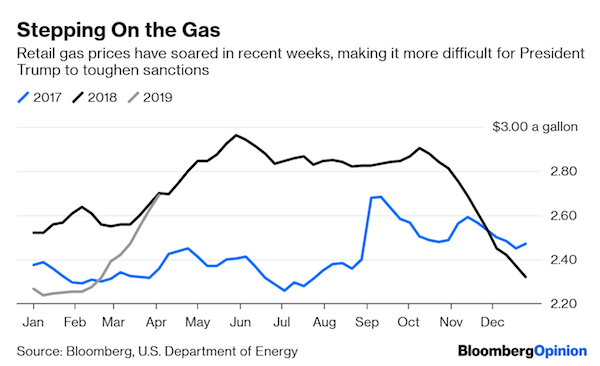
This trend contradicts Hook’s assertion that the US is “on the fast track to zeroing out all purchases of Iranian crude.” Three countries that got waivers have cut their purchases to zero, he added. In fact, those three countries—Taiwan, Greece and Italy—haven’t exercised their wavers at all since they were granted. Refiners in Greece and Italy have not received any Iranian cargoes since October, while Taiwan took its last delivery in September.
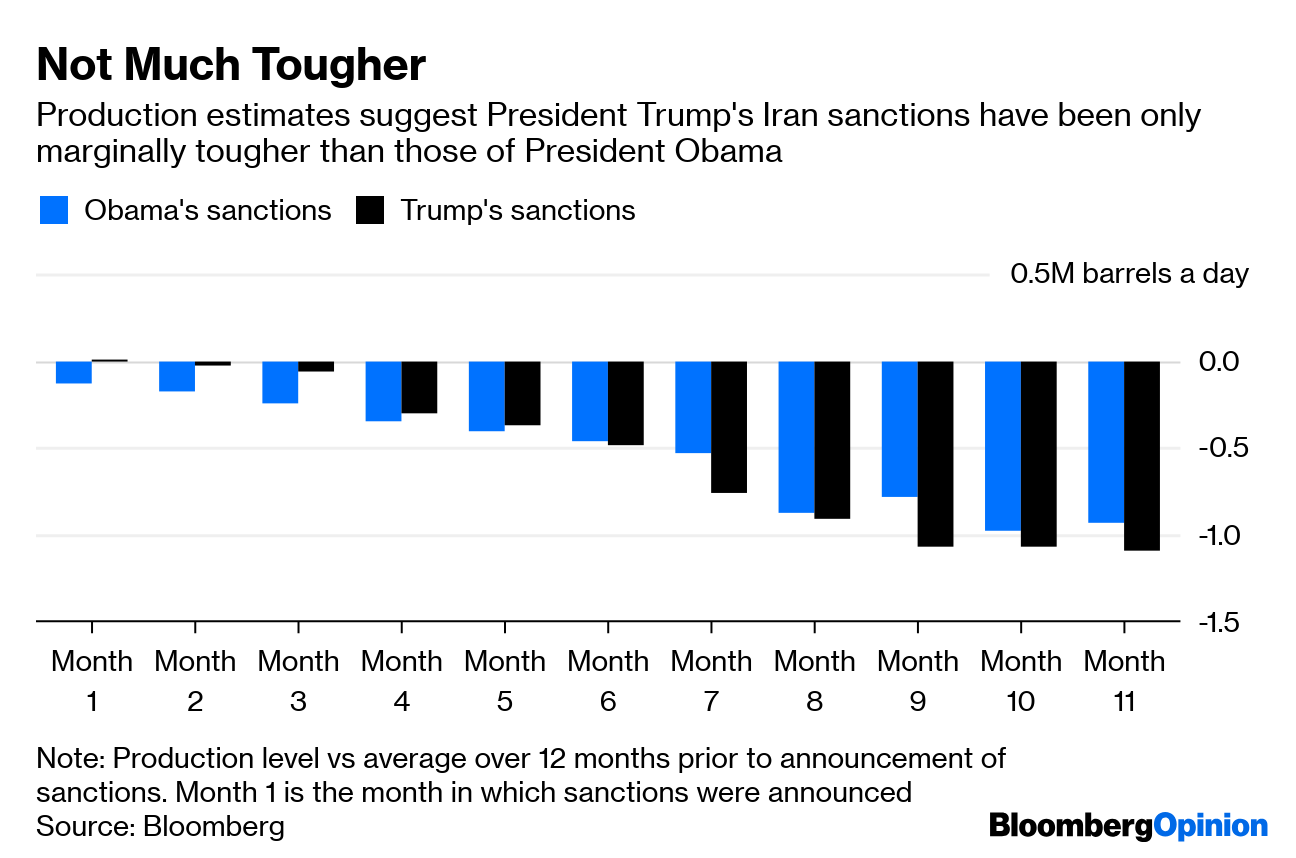
President Trump’s sanctions have been only slightly tougher than those imposed by his predecessor, despite offering fewer waivers. That will no doubt act as an additional spur for him to heap pressure on the country. But he is going to face difficulties if he wants to get much tougher on Iran next month.
Gas prices remain important to the president and their recent rise must be a source of concern.
The deteriorating situation in two of the “Shaky Six” oil-producing countries I identified a couple of weeks ago is also going to make toughening up the Iran sanctions more difficult.
Venezuela’s oil production is said to have plunged by half during blackouts that rolled across the country last month. Heavy tar-like oil began to solidify in pipelines and tanks after heating systems lost power, causing substantial damage that could take months to fix.
Sanctions imposed on Venezuela’s state oil company have accelerated the output decline, depriving Petroleos de Venezuela of its biggest buyer and the supplier of the light oil it needs to dilute the extra-heavy crude it produces. Output will fall further as the political crisis drags on.
Libya’s production is also at risk again as forces loyal to strongman Khalifa Haftar advance on the capital, Tripoli, threatening a major escalation in violence. Output rose above 1 million barrels a day last month for the first time this year, after the country’s biggest oil field was restarted following a three-month armed occupation. That recovery is now at risk again.
There are two things Trump can do, and his national security team is divided on the course he should follow.
He can allow the unused Iran waivers to expire, claiming a tougher stance without actually affecting oil flows, and perhaps trim the volumes that the remaining countries are permitted to import. Expect particular pressure on Japan and South Korea, who may be more willing than the others to acquiesce to US demands.
He can also continue to lean on Saudi Arabia and the rest of the OPEC+ group to raise output. The Saudis would be very happy to boost production at the expense of their rival, but they will be much less willing than they were last year to do that before seeing Trump actually impose tougher sanctions.
If he has to choose between lower gas prices and tougher Iran sanctions, domestic considerations will probably hold sway. Expect more tweets aimed at Saudi Arabia and OPEC, followed by an extension of five of the eight the waivers, probably permitting reduced volumes of purchases for some, if not all.
Photo Credit: IRNA

Iran Declares Gasoline Self-Sufficiency but Challenges Still Remain
◢ Aiming to achieve self-sufficiency in the production of gasoline, Iran recently launched the third phase of the Persian Gulf Star Refinery, after a massive investment of USD 4 billion. But given rising consumption, the future of genuine gasoline self-sufficiency in Iran might be less bright than the new developments at the Persian Gulf Star suggest.
During a grandiose opening ceremony attended by President Hassan Rouhani and Oil Minister Bijan Zanganeh, Iran inaugurated the third phase of its Persian Gulf Star Refinery in the energy-rich south February 18, declaring "self-sufficiency" in fulfilling national gasoline demand.
Located 25 kilometers west of the port city of Bandar Abbas, the refinery will enable Iran's average daily gasoline production to reach 105 million liters, according to official figures.
The facility, fed by condensate from the South Pars Gas Field in the Persian Gulf, converts light crude into gasoline and other byproducts. The launch of the third phase has been described as a gigantic step in a country whose economy is slowing the face of sanctions reimposed following President Donald Trump's withdrawal from the Joint Comprehensive Plan of Action (JCPOA).
Despite sitting on the world's fourth-largest proved crude oil reserves, Iran has been historically reliant on imports to meet domestic gasoline demand due to insufficient refining capacity.
The latest phase of the Persian Gulf Star Refinery has cost the country USD 4 billion, financed entirely by domestic investment, with no foreign loans secured for the project. While producing 45 million liters of gasoline and 15 million liters of gasoil per day, the refinery also delivers 3 million liters of aviation fuel, as well as 130 tons of sulfur. Iran's oil ministry expects to save USD 15 million per day as imports volumes are expected to fall. The savings are especially important for a government already struggling to supply foreign currency markets amid increasing international banking restrictions.
"Iran's gasoline production has made history with its giant leaps in the past five years," declared Zanganeh during the inauguration ceremony, adding that increased gasoline production would help Iran "to counter unilateral US sanctions".
With the new refinery added to Iran's gasoline production cycle, Iran could feasibly export surplus production. Yet uncertainty related to US sanctions as well as skyrocketing consumption at home in recent years seem to have made the government think twice about export plans. "We have intentionally decided not to export our [surplus] gasoline, because we are planning to maintain good storage,” Zanganeh added without elaborating further.
With Iran's budget largely dependent upon its oil income, experts have for long sounded the alarm on the long-term consequences of the country's single-commodity economy. Consecutive administrations have, therefore, pursued policies to make the economy less reliant on the sale of crude oil. While the goal is yet far from being met, the Rouhani government has focused on diversifying energy exports to include other, higher-value petrol products such as gasoline and gasoil.
"Self-sufficiency in gasoline and gasoil production and moving toward exports were targets set and pursued by the government of Hope and Prudence," reported Arman, a reformist newspaper. In a February 19 editorial, the paper noted that in the face of disruptions caused by the US pullout from the JCPOA, Iran's oil ministry had redoubled efforts toward the self-sufficiency in gasoline production and that more countries besides Iraq and Afghanistan are expected to join the list of Iran's gasoline customers.
The inauguration of the new refinery phase took place just one week after nationwide ceremonies to mark the fortieth anniversary of Iran's Islamic Revolution. State media outlets hailed "gasoline self-sufficiency" as an “achievement and blessing" bestowed by the Islamic Revolution upon the nation. "It came at a time of economic war being waged on our country, with the enemies going the extra mile to inject disappointment in [the minds of] young Iranians," declared a report from the Islamic Republic News Agency (IRNA).
The governor-general of Hormozgan province had earlier described the new refinery as a successful example of Iran’s push to establish a "resistance economy", a term coined by Iran's Supreme Leader Ayatollah Ali Khamenei. The concept has now evolved into a directive to all government institutions, a strategy to neutralize Western measures and a roadmap toward economic independence during sanctions times.
The leading contractor involved in the project was Khatam al-Anbia Construction Headquarters, known by the acronym GHORB. The company is an engineering, procurement, and construction firm with a near monopoly over Iran's mega projects. GHORB is affiliated with Iran's powerful Islamic Revolutionary Guard Corps (IRGC).
Saeed Mohammad, the company’s managing director, told Iran's state TV that the country's share in the enormous South Pars Field now exceeds that of neighboring Qatar. Mohammad also noted that the project was executed by an exclusively Iranian team with an average age of around 30 years old.
But even with the new refining capacity, worries persist that Iran's new gasoline self-sufficiency may be short-lived as domestic consumption continues to rise. The country’s average daily consumption last summer stood at 97 million liters, according to a report by the financial newspaper Donya-e-Eqtesad. Notwithstanding the total capacity of 105 million liters achieved after the inauguration of the third phase, the 9% annual consumption growth rate "will use up the stored gasoline,” the newspaper reports.
Consumption continues to rise because gasoline in Iran remains cheap. Despite rising inflation, Iran's government has in recent years maintained a cap on the price of gasoline. Experts lament the fact that with considerable subsidies allocated to gasoline, the government has not only failed to curb the consumption, but has in fact stoked it. President Rouhani's budget plan for the upcoming Iranian year offers no provision to reduce subsidies in order to reduce consumption.
The future of genuine gasoline self-sufficiency in Iran might be less bright than the development of the Persian Gulf Star Refinery suggests.
Photo Credit: IRNA

Iran Oil Exports: 8 Waivers and the OPEC Meeting
◢ Iran’s oil exports are likely to remain limited in 2019, with significant negative impact on Iran’s economy. Last month, the Trump administration reimposed sanctions on Iran’s energy sector as part of its ‘maximum pressure’ campaign against. But it nevertheless sought to prevent an unhelpful spike in oil prices ahead of the midterm elections. As a result the United States issued eight waivers to importers of Iranian oil:.
This article was originally published by the European Council on Foreign Relations.
Last month, the Trump administration reimposed sanctions on Iran’s energy sector as part of its ‘maximum pressure’ campaign against Iran. But it nevertheless sought to prevent an unhelpful spike in oil prices ahead of the midterm elections. As a result the United States issued eight waivers to importers of Iranian oil: China, India, Japan, South Korea, Turkey, Taiwan, Italy, and Greece. The waivers allow these countries to import a limited amount of oil from Iran without falling foul of US sanctions.
The ‘waiver effect’ was visible from the outset: oil prices dropped the day the waivers were announced. At the same time the market expected other oil producers—particularly Saudi Arabia and Russia—to cut back their temporary production, which had increased over the previous few months to cover Iran’s drop in production. Saudi Arabia and Russia agreed to this at the 7 December OPEC meeting.
The waiver decision initially appeared to be a major setback for the US ‘zero oil’ policy. Yet these eight waivers had a significant impact on the psychology and expectations of the oil market. They have created a perception that there will be an oversupply in the market in the short term, and at least through to the end of 2019.
Now, weeks on from the granting of the waivers, no guidelines or details have been announced publicly with regard to how much these countries will be able to import. This has created confusion in the market as to how much Iran will produce up to April 2019, when the 180-day waiver issued for most of these countries is set to end. Upon the announcement of the waivers, many market analysts had anticipated that Iran’s oil exports would increase to 1.5 million barrels per day (mbpd).
However, the reality could be more complicated. Iran’s oil exports are actually unlikely to increase beyond 1.1 mbpd. At most, they could increase to 1.3 mbpd if market conditions are tight and there is not enough supply in the market. And if China decides to ramp its imports back up to 500,000-560,000 barrels per day (bpd) Iran’s oil exports could increase even further, up to 1.5 mbpd.
Several factors prevent Iran oil exports from increasing significantly over the 180-day period.
China
Under the 2012-15 Obama-era nuclear sanctions, China imported roughly 440,000-530,000 bpd from Iran. However, in October 2018, in light of incoming US sanctions, its imports dropped to about 300,000 b/d. Chinese companies heavily invested in the US are worried and cautious about compliance with the sanctions. China National Petroleum Company—Iran’s largest oil consumer in China—reportedly halted its imports in October and November in order to prevent any potential risk against its business and investment interests in the US. Even though the company announced that it might resume imports from Iran, the market does not expect imports to exceed more than 300,000-360,000 bpd. Adequate market supplies provided by Saudi Arabia’s and Russia’s production mean the Chinese are disinclined to import more ‘problematic’ Iranian oil.
Besides US sanctions exposure for Chinese companies, the ongoing trade negotiations with the US are likely to influence China’s decisions. The US government is granting—on a case-by-case basis—waivers on export tariffs to Chinese companies for their trade with, and exports to, the US. It is likely that major companies and the Chinese government are exercising caution with their oil imports from Iran to avoid other sources of tension with Washington. CNPC has also recently suspended its investment in Iran’s South Pars giant gas field in order to minimise tensions over the trade negotiations. It is noteworthy that Saudi Aramco recently singed five new crude oil supply contracts with China to supply its new refinery capacity in 2019. This will significantly increase Saudi Arabia’s market share in China, reaching a total of about 1.6 mb/d. Saudi Arabia exported an average of about 1 mbpd of oil to China in first 10 months of 2018. This will increase Saudi Arabia’s market share in China by about 11 percent on 2017.
Simply put, China is using its Iran oil imports as part of its tariff negotiations with the US. This is spilling over into China’s own negotiations with Iran. Knowing Iran’s limitations for export, Bejing is bargaining hard and strong with Tehran over prices and delivery conditions. China was very late to issue oil purchase orders to National Iranian Oil Company for the month of November. Chinese refineries waited late – the third week of October—to submit their purchase orders to Iranian authorities.
Limited Shipping Capacity and Payment Issues
Iran’s oil exports have dropped significantly since August 2018 following the implementation of the first round of US secondary sanctions. These put strict limitations on Iran’s oil insurance and shipping. Most of the oil shipped since then has gone through the National Iranian Tanker Company (NITC), even oil shipments to China. Lack of access to adequate insurance has increased the risk of shipping. Most tanker owners are either unwilling to rent their tankers for shipping Iranian oil cargoes or are demanding very high leasing premiums. Hence, importers are mostly relying on NITC to deliver their oil cargoes. This has also impacted on Iran’s refined petroleum products and petrochemical export.
Historically, and in the months since August, NITC’s oil shipments stood at between only 1-1.1 mbpd; this too will prevent Iran from increasing its exports. This is especially the case for Iran’s allocated shipping export capacity to the European Union countries holding waivers (Italy and Greece), as most of its domestic shipping capacity is busy delivering oil to its customers in Asia. Meanwhile, like China, European countries will remain wary of the risks of importing Iranian oil even with the waivers in place.
Sanctions limit Iran’s access to its oil income in the form of cash and hard currency. Due to the latest US sanctions, importers of Iranian oil have to keep Iran’s oil revenues in an escrow account, and Iran can use this credit to purchase certain goods or services. Even for these clients, payment restrictions could also keep oil purchases lower than Tehran hopes. China, India, and Turkey have diverse trade relations with Iran and in theory could pay for Iranian oil with goods such as food and medicine. However, for countries such as Japan and South Korea, paying back Iran’s oil money is complicated. In the case of South Korea, Iran recently signed a food-for-oil agreement. However, there are limitations in terms of volumes and diversity of Iran’s required food from each particular country. Iran has not signed any similar contracts with Japan yet. Auto and electronics industry owners in Asian countries are highly hesitant to barter their products with Iranian oil money, again because they fear losing one of their largest markets: the US.
OPEC
The uncertainty over Iran’s oil exports created a difficult decision-making environment for OPEC members and their non-OPEC allies during their 7 December meeting to finalise a decision over production cuts. This decision aimed to maintain market balance. OPEC and Russia finally agreed to cut their production by 1.2 m/bd, of which OPEC will cut 800,000 b/d and non-OPEC countries (mostly Russia) will cut about 400,000b/d. This volume is in line with Iran’s oil exports of 1.1-1.3 mbpd until the end of the 180-day period. Russian and Saudi Arabian oil production had increased to historic highs in the past few months.
Saudi Arabia in particular came under pressure to reduce its production and generate higher prices, to in turn maintain domestic budget balances. Given the recent warm political, energy, and investment ties between Russia and Saudi Arabia, Russia supported Saudi Arabia’s target for higher oil prices. If not Saudi Arabia’s oil price target of USD 70 per barrel, Russia is supporting at least price range of around USD 60-65 per barrel. Russia also agreed to join OPEC members in a further production cut.
Another significant outcome of this meeting was that Iran was excluded from any production or export cut as its production and export is already below its usual capacity due to the sanctions. In November, Iranian crude oil exports fell slightly below 3 mbpd. The sanctions have not only had a significant impact on Iran crude oil exports, but they have also had a negative impact on Iran’s petroleum product exports. This means that some Iranian refineries are unable to run at full capacity given their export limitations.
A variety of factors are set to impact on the oil market and Iranian oil exports. If the market is adequately supplied and prices remain relatively low, even importers that have received waivers will have little incentive to import oil from Iran. With the prospects of US export capacity rising in 2019 and Saudi Arabia’s and Russia’s own considerable export capacity, Iranian oil exports of 1.1-1.3 mbpd or even less may ensue. If prices remain low countries with waivers may still choose not to import oil from Iran even up to the level for which they received the waivers. Taiwan, Italy, Greece, Turkey, and Japan might behave in this way if they are not convinced that the economic profit of importing Iranian oil is not greater than the risks related to shipping and insuring Iranian oil cargoes. Iran’s oil exports are likely to remain limited in 2019, and so the country’s annual budget for 2019 is based on an export of 1.5 mbpd. This could have a significant negative impact on Iran’s economy—particularly if oil prices remain relatively low throughout 2019.
Photo Credit: IRNA

China Unexpectedly Gambles on European Mechanism to Sustain Iran Trade
◢ China has halted its financial transactions with Iran as part of an unexpected gamble on the future of its trading relationship with the Islamic Republic. According to Majid Reza Hariri, deputy president of the Iran-China Chamber of Commerce, China is hoping to sustain its trade with Iran without putting its financial system in the crosshairs of US authorities by joining the special purpose vehicle being devised by Europe for this purpose.
China has halted its financial transactions with Iran as part of an unexpected gamble on the future of its trading relationship with the Islamic Republic.
Earlier this month, ahead of the reimposition of US sanctions on November 4, China’s Bank of Kunlun informed its clients that it would stop handling all Iran-related payments. The news followed months of speculation that Kunlun, the financial institution at the heart China-Iran trade for more than a decade, would bow to US sanctions pressure.
According to Majid Reza Hariri, deputy president of the Iran-China Chamber of Commerce, China is hoping to sustain its trade with Iran without putting its financial system in the cross hairs of US authorities by joining the special purpose vehicle (SPV) currently being devised in Europe. In the meantime, Chinese trade with Iran has ground to a halt as no banks are available to facilitate transactions.
"It seems that the fate of our trade with China is linked to the support package being prepared by the European Union," Hariri told Bourse & Bazaar in reference to the SPV promised by Iran’s key European trading partners.
The SPV would facilitate trade with Iran by offering a netting service between exporters and importers, reducing the need for funds to be transferred between Iranian banks and foreign financial institutions. Such financial transactions are increasingly difficult due to the risks posed to international banks by US sanctions.
"We are waiting for this financial mechanism to be finalized and for China to join the SPV," Hariri said. In a statement in September, EU High Representative Federica Mogherini stipulated that the SPV “could be opened to other partners in the world.”
Under the previous round of international sanctions, Beijing had designated Kunlun as its primary bank to process billions of dollars payments related to Chinese imports of Iranian oil. The bank also supported the significant growth in non-oil trade between China and Iran as European companies were forced to leave the market when US and EU sanctions came into force.
Kunlun’s perseverance led to US Department of Treasury sanctioning the bank in 2012, but the so-called “bad bank,” shielded by political support from Beijing, continued to maintain its lucrative connections to Iran.
Given this history, the news that Kunlun was cutting-off Iran has served to indicate the intensity of the Treasury Department’s sanctions threats.
Hariri relayed that during his recent trip to China, it became clear that China’s major commercial banks increasingly fear being targeted by US authorities because of links to Kunlun, even if they are not involved in Iran trade themselves.
Bourse & Bazaar also spoke to the chief executive of an Iranian industrial group that conducts significant business with Chinese firms. The executive, who requested anonymity given commercial sensitivities, relayed that large Chinese suppliers do not “want to be in export list, which is where US eyes are looking” because of a pervading fear that “in the weeks following November 4, the US will be making example cases,” targeting companies to create a “system-wide scare.”
Until the situation is better understood, Chinese authorities have opted to pause their trade with Iran and to “let chips fall into place and then figure out way” to sustain commercial ties.
The sudden pause in trade with Iran may explain why China imported an “unprecedented” 20 million barrels of oil to its Dalian refinery in October, twenty times the normal volume. Pointing to issues of energy security, oil analysts do not expect China to cease its imports of Iranian oil, and so the October purchases may have been intended to buy China some time to see if the SPV will become operational.
Two of China’s leading refiners, Sinopec Group and China National Petroleum Corporation, the parent company of Bank of Kunlun, have not placed any orders to purchase Iranian oil in November.
Reports suggest that the SPV will be legally established on or around the November 4 sanctions deadline, but it may take several months for operations to begin in earnest. There remain many hurdles. EU member states are understandably less than enthusiastic about the prospect of hosting the financial channel that will be perceived by US authorities as an attempt to circumvent sanctions.
If SPV fails to become operational or is unable to accept Chinese participation, it will fall to China and Iran to find a new bilateral banking channel, explained Hariri. "If the EU continues with its procrastination, we can once more restart efforts to continue bilateral banking relations," he said.
It is unclear what a new financial channel look like. On Monday, Iranian reports cited "credible sources" to claim that Beijing aims to establish "a new banking mechanism" to continue working with Iran and several meetings have already been held on the matter.
Iran may seek to hold an ownership stake in the new banking channel. The concept that Iranians could become shareholders in Chinese banks has been floated for about a decade. But new draft rules issued by the Chinese regulators may present Iran with a new window of opportunity. Regulators now allow foreign entities to set up wholly owned banks and branches in China.
As Hariri points out, any negotiations over the Chinese participation in the SPV or the creation of a new banking channel are made more complicated by the fact that Iran currently lacks an ambassador to Beijing. Nonetheless, it seems likely that sooner or later Iran-China trade will resume, even under US sanctions. Iran is too lucrative a market for China to simply ignore.
The question is how long Iran’s business community can wait for the rebound. While Iran may have sold a bumper volume of oil in October, private sector companies were caught off guard by China’s move to halt trade. In a matter of weeks, inventories of manufacturing inputs and finished goods will begin to run out.
Photo Credit: Xinhua

Iran’s Oil Exports May Be More Resilient Than Headlines Suggest
◢ Iran is resorting to “Houdini tricks” to sustain oil exports as US sanctions loom and new data suggests the magic might be working. While S&P Global Platts has reported Iran’s September exports at about 1.7 million bpd, marking an 11 percent decline from August, data from TankerTrackers.com, puts the export volume at just over 2 million bpd. The divergence in the datasets represents not merely 300,000 bpd, but also the difference between two narratives about the state of Iran’s exports in the face of returning US sanctions.
Iran is resorting to “Houdini tricks” to sustain oil exports as US sanctions loom. New data suggests the magic might be working. With new sleights of hand including disappearing oil tankers, the use of floating storage, and ship-to-ship transfers, tracking Iranian exports is getting harder than ever, leading to divergent estimates from oil analysts.
While S&P Global Platts has reported Iran’s September exports at about 1.7 million bpd, marking an 11 percent decline from August, data from TankerTrackers.com, a service which reports shipments and storage of crude oil globally, puts the export volume at just over 2 million bpd. The divergence in the datasets represents not merely 300,000 bpd, but also the difference between two narratives about the state of Iran’s exports in the face of returning US sanctions.
As part of S&P Global Platts’ announcement of the September figures, Paul Sheldon, chief geopolitical adviser at company, stated, "Iranian export losses have already accelerated faster than we expected.” On this basis, Platts is predicting Iran’s exports will fall to 1.1 million bpd by November, when U.S. sanctions on Iran’s oil industry are set to return. Similar analysis from Bloomberg and Reuters has contributed to the sense that Iran’s exports are dropping fast. But these assessments may be leaving a significant number of barrels uncounted by failing to properly capture tankers which have turned off their geolocation transponders.
Samir Madani, founder of TankerTrackers.com, emphasizes that such tactics are making life more difficult for those trying to measure Iran’s export volumes. "September was a very resource-demanding month from a vessel tracking perspective for not just us at TankerTrackers.com but at some of the other trackers in the industry,” he said.
For Madani and his team, properly tracking tankers laden with Iranian oil requires extensive use of satellite imagery. “The reason is because roughly half of the exports were cloaked, meaning vessel crews switched off their AIS geolocation transponders before arriving into Iran to arrange the collection of crude oil,” Samir explained. “Their transponders were switched back on many days later, once they were already out of the immediate Gulf area.”
To overcome these cloaking tactics, Madani uses daily satellite imagery to “factor in vessels that were no longer broadcasting their positions.” This methods helps explain the significant discrepancy between his September estimate of Iran’s exports to China and that published by Platts. According to Madani, Iran’s state-owned National Iranian Tanker Company is particularly adept at cloaking exports in this manner, drawing on a playbook perfected in the previous sanctions period.
Any underlying resilience of Iranian exports is particularly important following reports that the United States is “actively considering waivers on Iran oil sanctions.” The exploration of waivers represents a break with the Trump administration’s previously communicated intention that “exports of Iranian oil and gas and condensates drops to zero.”
The level of imports covered by such “significant reduction exemptions” or SREs is typically determined by looking to historical import levels and the level of imports that can be reasonably restricted by sanctions. In this context, that Iran has been able possibly sustain over 2 million bpd in exports just one month before the reimposition of US sanctions bodes well for the extent of the waivers that may be offered. In likely anticipation of waivers from US authorities, India has already announced that it plans to import at least 9 million barrels of Iranian crude in November.
In an interview conducted during the United Nations General Assembly, President Hassan Rouhani told NBC’s Lester Holt that “The United States is not capable of bringing our oil exports to zero” and describe the Trump’s administration's threats as “empty of credibility.” Despite hopeful signs, Iran’s oil exports magic show is still in its first act. Whether Rouhani can outdo the great Houdini is yet to be seen.
Photo Credit: Imaginechina

Can Iran Weather the Oil-Sanctions Storm?
◢ In the coming weeks, the US administration will intensify its economic pressure on Iran through sanctions designed to curtail the country’s oil exports. Given that these exports account for a significant percentage of state revenue, the measures will hit Iran hard. Yet the sanctions will also have an impact on energy markets far beyond Iran, and may lead to a rise in global oil prices.
This article has been republished with permission from the European Council on Foreign Relations.
In the coming weeks, the US administration will intensify its economic pressure on Iran through sanctions designed to curtail the country’s oil exports. Given that these exports account for a significant percentage of state revenue (despite government efforts at economic diversification), the measures will hit Iran hard. Yet the sanctions will also have an impact on energy markets far beyond Iran, and may lead to a rise in global oil prices. Moreover, they could have a negative effect on global energy security by tapping into most of the spare capacity in the market.
Since President Donald Trump withdrew the United States from the Iran nuclear deal (formally known as the Joint Comprehensive Plan of Action, or JCPOA) in May this year, US officials have stated that they aim to prevent Iran from exporting any oil whatsoever. Although the second phase of the new US sanctions only come into effect on 4 November, Iranian oil production and exports have already started to decline – partly because the US has issued conflicting statements on whether it will provide sanctions waivers to some importers, and partly because the August 2018 round of US sanctions set restrictions on payments, shipping, and insurance.
If the Trump administration truly seeks to ensure that Iran will export no oil, this is a strikingly different approach to that both the Obama administration and the European Union pursued between 2012 and 2015. These earlier measures caused Iran’s oil exports to drop by around 40 percent, to an average of 1.5 million barrels per day (mb/d). In contrast, the new sanctions are likely to reduce Iran’s oil exports to less than 1 mb/d by November. There are several reasons for this difference. One is that the Trump administration has taken a much tougher stance on importers of Iranian oil. Under the Obama administration, the US expected other countries to significantly reduce but not totally end their imports of Iranian oil. Although the Obama administration never stated a clear target for this reduction, it amounted to around 20 percent. Notably, the EU also banned imports of Iranian oil and EU member states halted almost all such imports.
Having borne the brunt of US secondary sanctions in 2012-2015, companies and countries around the world are now well aware of the consequences of non-compliance. They also have a good idea of how accurately the US tracks Iranian exports and how far its surveillance capabilities reach. The Obama administration had to engage in extensive negotiations with importers of Iranian oil to explain the consequences of non-compliance. This time around, the rules of the game are much clearer.
Another factor is that, unlike in 2012, there now is enough oil to make up the shortfall in the market. In recent weeks, traders and importers of Iran’s oil have said they can easily find substitutes for the product. Major oil producers such Saudi Arabia, the United Arab Emirates, and other OPEC members have collectively increased their supply of oil by around 1 mb/d since May, and have signed contracts with importers to provide substitutes for Iran’s oil in the future. However, this substitution of Iranian oil weakens the security of global energy markets: buyers are tapping into most of the world’s spare oil production capacity, heightening the risk of a rise in oil prices.
As oil prices are now much lower than they were between 2012 and 2015, the discount rates at which Iran hopes to export oil provide relatively little incentive for buyers to violate US sanctions. Meanwhile, by restricting financial transactions with Iran and the insurance of Iranian oil, the US sanctions that came in to force in August 2018 have created a tighter regime than that implemented under the Obama administration.
New Obstacles to Iran’s Exports
Ambiguities over how the US will enforce its sanctions make it difficult to estimate the size and duration of the coming decline in Iran’s oil exports. While the US sanctions in place during 2012-2015 accompanied similar EU measures and had a basis in UN sanctions targeting Iran’s nuclear programme, the US is now implementing unilateral sanctions while Russia, China, and Europe continue to support the sanctions relief specified in the JCPOA.
Yet US secondary sanctions have proved to be powerful. There are indications that importers of Iranian oil such as Japan, South Korea, Sri Lanka, and most European countries will no longer buy the product after November. Although China has consistently stated that it will continue to import oil from Iran, it is also attempting to use this position as leverage against President Trump in its ongoing trade war with the US. India, which buys more Iranian oil than any country other than China, significantly reduced its imports of the product in August, but is still negotiating with US administration over sanctions waivers.
Following the introduction of US sanctions on Iran-related financial transactions and oil tanker and cargo insurance, Iran’s crude oil exports dropped from an estimated 2.3 mb/d in July 2018 to less than 2 mb/d the following month. As such, the cause of the decline is not necessarily compliance with the US ban on Iran’s oil imports but rather the new challenges of paying for, and safely transporting, the product. Judging by purchase contracts at the National Iranian Oil Company and other sources, exports of Iranian oil may drop as low as 750,000-850,000 b/d by November.
In August, amid this sharp decline in Iranian oil exports, OPEC increased oil production to 32.89 mb/d, its highest level in ten months. It appears likely that OPEC will further increase production, despite Iran’s efforts to lobby against such a move. Potentially adding to Tehran’s woes, Russia – which is not a member of OPEC – increased its oil output by around 148,000 b/d to 11.215 mb/d in July, coming close to its post-Soviet record high of 11.247 mb/d.
As no sanctions regime is immune to shifts in the market, time could work against the US policymakers targeting Iran. Along with the increased oil supply from OPEC countries and Russia, other market conditions could have a drastic effect on Iran’s oil exports. The US administration’s ambiguous statements on the scope and duration of its sanctions could lead to non-compliance and even cause the measures to fall apart earlier than planned. For instance, if countries such as India and China continue to import discounted Iranian oil while others stop doing so, the sanctions regime may gradually become ineffective. This is especially so given that, if oil prices rise in line with market expectations, Iran’s discounts on barrels of oil and freight costs will become increasingly appealing.
Nonetheless, the new round of US sanctions will undoubtedly damage Iran’s economy. At a time when it is grappling with several domestic economic challenges, the Iranian government will have to be careful in dealing with further cuts to its revenue. Of course, having survived a series of US and EU oil embargos in the last four decades, Iranian leaders may decide to weather this latest storm through strategic patience and reliance on an “economy of resistance”. Tehran may feel it can manage these sanctions while continuing to comply with the JCPOA, allowing the measures to gradually erode.
China, Russia, and many European countries seemingly aim to support this approach, creating financial incentives that maintain Iranian compliance with the JCPOA (even if most European countries and companies are likely to comply with US sanctions). These incentives will be designed to help Iran’s economy survive the sanctions, partly by mitigating the decline in Iranian oil exports.
It is unclear whether this approach will work. The Iranian economy currently appears vulnerable to the new sanctions: the Central Back of Iran has been forced to devalue the rial much faster in recent months than it did during 2012-2015. The aftershocks of the currency devaluation and rapid inflation may exacerbate the sporadic unrest across the country that began last January – mostly due to Iranians’ economic grievances.
If American sanctions truly block the majority of Iran’s oil exports, the country may opt for an aggressive response. Iranian leaders, including President Hassan Rouhani, have suggested that Iran will disrupt oil shipments from neighbouring countries, targeting the Strait of Hormuz and/or Bab el-Mandeb. Iran could also engage in cyber sabotage or attacks in the Middle East intended to create panic among oil traders, driving up global oil prices. Such operations would create widespread chaos and perhaps lead to the formation a global political and military alliance against Iran.
The prospect of further talks between Tehran and Washington is fading as Iran’s oil production and exports continue their decline. But the ongoing negotiations between Iranian leaders and supporters of the JCPOA may produce a compromise that encourages Iran to wait patiently, in the hope that the course of events will turn in its favor and it will overcome the sanctions.
Photo Credit:

Negotiations On Legal Status of Caspian Sea Approach Finish Line
◢ Negotiations on the international legal status of the Caspian Sea, which started in 1996, appear to have at last reached the finish line. After 22 years, the five countries around the sea have come close to signing a convention on its legal status. If they do, it seems that the agreement will allow to pave the way for the construction of the underwater the Trans-Caspian Gas Pipeline and other projects and will also close the access to the sea for the armed force of third countries.
Negotiations on the international legal status of the Caspian Sea, which started in 1996, appear to have at last reached the finish line. After 22 years, the five countries around the sea have come close to signing a convention on its legal status. If they do, it seems that the agreement will allow to pave the way for the construction of the underwater the Trans-Caspian Gas Pipeline and other projects and will also close the access to the sea for the armed force of third countries.
Russia has completed its part of the work on the preparation of the convention. According to its official legal information website, the government in the end of July approved in the draft submitted by the Foreign Ministry after coordination with Azerbaijan, Iran, Kazakhstan and Turkmenistan. It is expected that the document will be signed at the summit of their heads of state on 12 August in Aktau, Kazakhstan.
Over the long negotiating process, the Caspian Five have held 51 meetings of a special working group at the level of deputy foreign ministers (the main negotiating platform established in 1996), about 10 meetings of foreign ministers and four presidential summits (in 2002 in Ashgabat, in 2007 in Tehran, in 2010 in Baku and in Astrakhan in 2014). In the last years the negotiators agreed on 90 percent of the draft convention. The delay in the agreement on the last 10 percent was because the most controversial issues remained to be solved. Two of the most acute have been the principle used for the division of the Caspian Sea and the mechanisms of approval of underwater pipeline and cable projects.
Iran has had a special position on the first issue. Insisting on Soviet-era agreements, it has not recognized the agreements between Russia, Azerbaijan and Kazakhstan on the division of the northern part of the Caspian Sea signed in 2003. These three countries used for delimitation the middle modified line (equidistant from the coast line and taking into account the length of the coastline). The Iranian position was instead to divide the sea into equal sectors of 20 per cent, since using the middle modified line would leave it with the smallest sector of about 11 per cent.
In response to such a difficult challenge, the draft of the convention does not include precise wording with geographical coordinates of the boundaries of sectors, but rather only the principles for the division of the sea. This allows for the transfer of responsibility for the division from the five-sided discussion to the two - and three-way level, as was the case when the northern part of the sea was divided.
Judging by the dynamics of recent contacts between Iran and Azerbaijan, bilateral negotiations on the division of the southern part of the sea are in full swing. This positive trend in relations between the two may have been one of the reasons for progress in the five-sided Caspian dialogue.
The second cornerstone for the negotiation process was the possibility of building trans-Caspian projects. Originally Russia and Iran emphasized the environmental danger of such projects and stressed the need for coordination by all five countries. Turkmenistan defended its right to build the Trans-Caspian Gas Pipeline without any consultations with its neighbours. In response to this challenge, the draft of the convention indicates that all submarine cables or pipelines must meet the necessary environmental requirements and standards approved under inter-state agreements. However, all the countries around the Caspian Sea would have the right to lay any pipelines and cables without the consent of their neighbours, but with the necessary notification about the routes taken. This means that, theoretically, after signing and ratifying the convention, Turkmenistan will be able to start looking for partners for the construction of the Trans-Caspian Gas Pipeline.
There is still a possibility that one of the parties refuses to endorse the draft document in its current form at the last moment. But the approval of the draft by Russia’s government and the announcement of a date for the summit indicate that the meeting will take place and, most likely, will bring about the long-awaited convention.
Photo Credit: Russian Press Service

Three Years Later: Europe’s Last Push on the Iran Nuclear Deal
◢ The Iran nuclear agreement marked its third anniversary in a gloomy state. Many hoped that the resolution of the nuclear dispute would result in a new understanding between the West and Iran, opening a pathway for detente rather than confrontation. Relations between Europe and Iran have certainly made gains in this direction, but the Trump administration’s maximalist stance on Tehran has created an extremely hazardous environment for all remaining stakeholders in the nuclear deal.
This article has been republished with permission from the European Council on Foreign Relations.
The Iran nuclear agreement marked its third anniversary in a gloomy state. Despite repeated attempts to keep him on board, US President Donald Trump withdrew the United States from the deal – signed on 14 July 2015 under the formal title the Joint Comprehensive Plan of Action (JCPOA) – and thereby pulled the rug from under Europe’s feet. European policymakers are now focused on salvaging the agreement. For a growing number of European corporate decision-makers, the deal is already dead. In reality, the JCPOA is on life support and the next few months could open either its next or final chapter. Despite the significant challenges they face, European governments have some limited time to avert the deal’s collapse.
In 2015, global powers unanimously hailed the agreement as a historic achievement that proved the effectiveness of multilateral diplomacy. Indeed, the JCPOA provides unprecedented oversight of Iran’s nuclear programme. Furthermore, the agreement states that parties anticipate it will “positively contribute to regional and international peace and security." Many hoped that the resolution of the nuclear dispute would result in a new understanding between the West and Iran, opening a pathway for detente rather than confrontation. Relations between Europe and Iran have certainly made gains in this direction, but the Trump administration’s maximalist stance on Tehran has created an extremely hazardous environment for all remaining stakeholders in the nuclear deal.
Washington's Pressure Package
Since the formal US exit from the agreement in May this year, the Trump administration has sought to sabotage European efforts to sustain the agreement. This has involved a policy of relentlessly threatening and otherwise pressuring any country or company inclined to maintain economic channels with Iran, by weaponising US secondary sanctions. Reportedly, the US administration recently rejected an appeal by the EU foreign ministers to negotiate broad exemptions to such sanctions for European companies. The US clearly intends to specifically target European trade with Iran – although there remain questions about its ability to do so and the reach of US enforcement.
Together with its allies in the Middle East – particularly Israel, the United Arab Emirates, and Saudi Arabia – the Trump administration is increasing its efforts to squeeze Iran on multiple fronts. As a new report by the European Council on Foreign Relations outlines, this anti-Iran front views the collapse of the JCPOA as the trigger for a wider policy aimed at confronting Iran. The policy seeks to cause a deep economic crisis in the country, creating domestic divisions intended to bring about regime change. As part of this, the Trump administration has signalled its willingness to go further than any previous administration by choking off Iran’s oil exports.
European Resistance to US Sanctions
European leaders’ have repeatedly stated their commitment to upholding the JCPOA. Policymakers are making genuine efforts to find an economic package that minimises the impact of looming US secondary sanctions to sustain Iranian compliance with the deal. But these efforts have yet to generate an environment in which a reasonable number of European entities can make a firm commercial decision to continue doing business with Iran.
Although the European Union’s leaders remain unified in their support of the JCPOA, divisions are emerging between the 28 member states over how far they are willing to test the limits of US secondary sanctions. Moreover, several proposed ideas for safeguarding European companies against extraterritorial US sanctions would require months or even years to implement, as they require alternative financial mechanisms that are ring-fenced from US exposure. European governments are also falling short in the political momentum needed to salvage the nuclear deal. For instance, Germany and the United Kingdom are now far more preoccupied with challenges at home than they were in 2015, and EU institutions are focused on averting further transatlantic divide on trade and NATO.
Unsurprisingly, many European firms have little confidence that European policymakers will create the conditions necessary to protect them from US secondary sanctions, including by providing alternative mechanisms for doing business with Iran that are compliant with US sanctions. This has resulted in a wave of pre-emptive corporate overcompliance with impending US regulations and a decline in European business with Iran even before sanctions come into force.
Iran's Patience Wearing Thin
This month, the foreign ministers of France, the UK, Germany, Russia, and China (the E3+2) met with Iran to discuss political and economic pathways through which they could safeguard the JCPOA. And Iran’s president, Hassan Rouhani, visited Austria and Switzerland to deliver two overarching messages. The first was that Iran’s patience was wearing thin and its full compliance with the JCPOA was only feasible if it continued to receive tangible benefits from the agreement. The second was that Tehran would abandon the agreement if it became unable to maintain oil exports and, accordingly, its share in global energy markets.
Rouhani’s visit followed a tense OPEC meeting, Trump’s call for Saudi Arabia to increase oil production, and weeks of speculation about the extent to which the US could pressure other countries to halt exports of Iranian oil. In Europe, Rouhani stated: “assuming that Iran could become the only oil producer unable to export its oil is a wrong assumption”.
The leader of Iran’s Islamic Revolutionary Guard Corps (IRGC) was quick to emphasise that elite forces were prepared to act on Rouhani’s words, noting: “we will make the enemy understand that either everyone can use the Strait of Hormuz or no one”. Iran has issued such warnings in the past, including during the 1980-88 Iran-Iraq war and in 2011 in advance of the EU and US embargo on Iranian oil. Iran may retaliate against any US attempts to curb its oil exports by disrupting regional crude shipments in the strait, through which 35% of all seaborne oil exports pass. Such measures seem unlikely for now – given the risk of military escalation with US and regional naval forces, and of damaging relations with China and Russia, which wish to keep energy markets stable.
Rouhani’s statement suggests that Iran is hardening its position. Qassem Suleimani, commander of the IRGC’s Quds Force, unexpectedly welcomed Rouhani’s threat.
Despite the significant political and economic challenges shaping Iranian domestic politics, the Trump administration’s maximalist posture may inadvertently lead to a consensus between the Rouhani government and the military elite on how to respond to national security threats. This may abruptly or gradually prompt the Iranian political establishment to shift away from diplomacy with Europe and towards confrontation with the US. Calculations on whether the JCPOA can be sustained will heavily influence this decision.
Iran is likely to continue implementing the JCPOA and engaging in diplomacy with Europe for at least a few more months, as it assesses the impact of US sanctions on its economic relations with Europe, China, and India (particularly in relation to oil exports), as well as the likely trajectory of US domestic politics in the aftermath of midterm elections.
Necessary European Action
Unless one side backs down, Tehran and Washington will escalate their dispute in a manner that poses real risks to European interests in non-proliferation, security in the Middle East, and global energy supply. It is imperative that in the coming weeks and months European governments redouble their efforts to sustain the nuclear agreement and ease regional tensions.
Firstly, they should continue to explicitly warn the US and their partners in the Middle East that they will not support a strategy aimed at destabilising Iran internally or pursuing regime change in the country. Such an approach risks destabilising a country of 80 million people close to Europe’s border. At the same time, European governments should address their many areas of disagreement with Iran – most urgently, those involving regional security. As ECFR’s new report recommends, this should be done in a strategically careful manner that avoids fuelling further conflict in the Middle East.
Secondly, European governments must strive to fulfil their commitments under the JCPOA. They have made a good start by incorporating US secondary sanctions into the EU Blocking Regulation, due to be amended in August. But they need to quickly implement more practical solutions that will affect companies’ calculations on Iran (for a detailed list of recommendations, see the box below). Otherwise, there will be an exodus of European firms from the Iranian market.
European efforts to keep Iran in the JCPOA will face major challenges, including US attempts at sabotage. The Trump administration will look to use the JCPOA as a bargaining chip in its bilateral negotiations with Europe, China, and Russia on trade policy, tariffs, and sanctions. Therefore, European leaders must make important decisions about how far they are willing to go to secure a nuclear agreement borne out of more than a decade of diplomacy. They can only do so if they act collectively and firmly. Yet they must do so to prevent escalation between the West and Iran that will have disastrous consequences for global security.
Recommendations
The EU/E3 should accelerate measures to establish a foundation for sustaining financial channels (including SWIFT) with Iran before November, when the US will introduce secondary sanctions designed to hit Iran’s oil and banking sector. In this, European central and state banks will have act as a bridging mechanism. While there are ways of moving funds to and from Iran, state banks will have to engage in operations that provide settlement and clearing facilities. At the same time, European governments should remind Iran that their banking relationship can only continue if the country follows the Financial Action Task Force’s road map.
The EU and member states should devise a financial framework within which European companies (particularly small and medium-sized enterprises) can do business with Iran while complying with US sanctions. Technical experts have called for the creation of special purpose vehicles or “gateway banks” (supported by European state banks). These mechanisms will need to avoid direct links between Iranian entities and European private banks. Cooperation on this should extend into a larger structure that crosses a coalition of willing member states, thereby sharing risk between them.
The EU and member states (particularly leading importers of Iranian oil such as France, Greece, Italy and Spain) should increase their coordination with China and Russia on measures to minimise the impact of US secondary sanctions on Iranian oil exports. European countries should firmly reject any proposed US framework for significant oil reduction from Iran in return for waivers to continue limited oil exports. This would amount to legitimising the US secondary sanctions architecture. Russia and Iran are already in talks over significant Russian investment in the Iranian energy market, which could reportedly involve increased purchases of Iranian oil that could be reprocessed for global distribution via Russia. The E3 and China, together with other relevant private sector entities, should investigate whether it is feasible to offset potential reductions in Iranian oil exports through oil-swap arrangements with non-signatories to the JCPOA such as Turkey and Iraq.
The European Commission should incorporate clear guidelines for European companies into amendments to the EU Blocking Regulation. The regulation includes a compensation mechanism (Article 6) that allows European entities to seek compensation if they become subject to extraterritorial US financial penalties. As this mechanism has rarely been enforced, its limits remain unclear. The European Commission should work with member states, regulators and the private sector to clarify and facilitate access to compensation, particularly for small and medium-sized enterprises that do business with Iran.
The European Commission should mandate a competent body to facilitate legitimate European business with Iran. The body should provide comprehensive oversight of the US Treasury’s enforcement of extraterritorial sanctions. This should involve a reporting mechanism that assesses the legal and other tactics the US Treasury adopts against European companies, pursuant to secondary sanctions. The body should also assist European companies subject to US investigations.
The European Commission should address discrimination and overcompliance relating to trade and investment with Iran in the European banking sector. As this problem is a direct consequence of US secondary sanctions, European leaders should primarily address it through regulatory measures that set a burden of proof requiring company boards to certify that their decisions are legally grounded under European law. The Blocking Regulation can provide a foundation for such measures. European regulatory bodies should provide greater oversight of European commercial banks’ decisions to block the flow of funds relating to Iran, reducing the likelihood that such decisions will be arbitrary.
The E3/EU should not invest heavily in attempts to negotiate with the US administration on exemptions from secondary sanctions, given the Trump White House’s clear lack of interest in treating European allies amicably. The E3/EU should shift to a more firm and robust negotiating posture similar to their stance on US trade tariffs. They should warn the US about the costs for Western energy consumers of reducing purchases of Iranian oil at a time when Libyan, Venezuelan, and Nigerian exports have been disrupted, given that it remains uncertain whether Saudi Arabia and Russia will increase production to offset this disruption. European governments should limit the US Treasury’s space to demonstrate the power of sanctions in Europe. EU member states should urgently engage in private consultations to prepare countermeasures against US attempts to pressure SWIFT and its board members or to target European entities – using specially designated nationals lists – for doing business with Iran deemed legitimate under EU law.
Photo Credit: IRNA

Could Trump Deliver Iran an Oil Windfall?
◢ The president’s recent statement that OPEC may have something to do with the president’s own decision to create a crisis with Iran. While attention is duly paid to how much Americans have to pay at the pump, a more subtle and complicated story will soon play out with respect to Iran and the reapplication of US sanctions ordered by Trump on May 8, 2018. In fact, unless oil prices are contained, the primary result of the president’s action may be to ensure that Iran profits from the oil market risks that sanctions have created.
This article is republished here with permission from the Columbia University Center of Global Energy Policy.
The president’s recent statement that OPEC should reduce their prices may merely be an attempt to assign blame for rising gasoline prices in the midst of the US driving season or an even more cynical attempt to rally his political base in opposition to globalism. Or, it may have something to do with the president’s own decision to create a crisis with Iran. While attention is duly paid to how much Americans have to pay at the pump, a more subtle and complicated story will soon play out with respect to Iran and the reapplication of US sanctions ordered by Trump on May 8, 2018. In fact, unless oil prices are contained, the primary result of the president’s action may be to ensure that Iran profits from the oil market risks that sanctions have created.
In Theory
A simple chart helps to bear out the point. Figure 1 is a representation of three important data points: how much oil Iran might be able to export on a given day, the price of its oil, and its daily revenue. On May 8, Iran exported approximately 2.4 million barrels per day (bpd) of oil. On that day, oil was trading at approximately USD 75 per barrel. As a result, we can assume that Iran’s oil revenue for that day was USD 180 million (as reflected by the red line).
Figure 1: Daily Oil Revenue at Various Prices and Export Volume
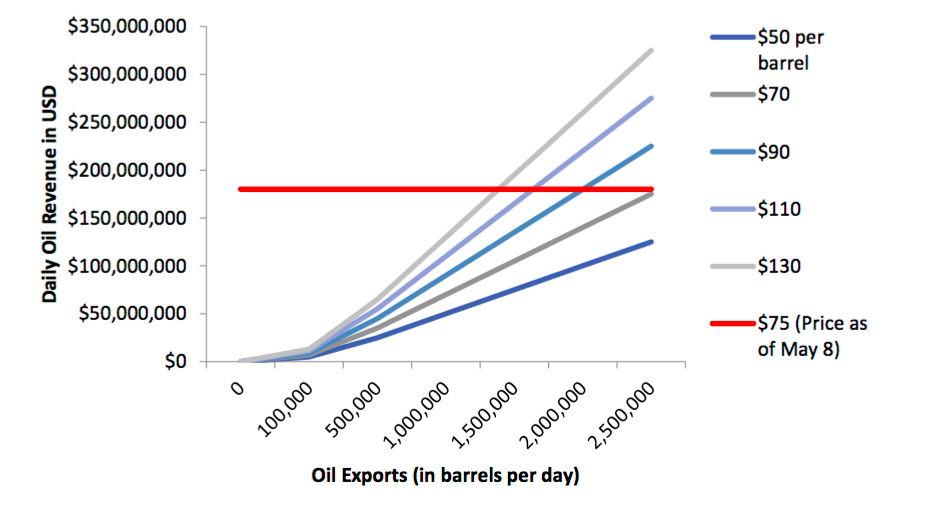
If instead oil had been trading at USD 130 per barrel on that day, Iran would have earned over USD 310 million. And if oil had been trading at USD 50 per barrel, Iran would have earned only USD 120 million—in all, a fairly straightforward math problem to solve.
Where things get more complicated is when one takes into account falling Iranian oil exports and potentially rising oil prices.
Naturally, if oil prices remain roughly the same, every lost barrel of Iranian oil exports means a real economic loss to the Iranian government. If Iranian oil exports decrease from 2.4 million bpd to 1.5 million bpd, Iran will experience a loss of approximately USD 67 million in its revenue stream. Taken over the course of a year, this would mean lost national revenue approaching USD 25 billion, a substantial sum for a country with significant economic problems and strained liquidity.
However, if oil prices go up, then—as Figure 1 shows—the immediate revenue impact of sanctions can be mitigated, potentially entirely. The red line’s intersection with various price curves shows this: at USD 130 per barrel, Iran need only export 1.38 million bpd to average the same daily revenue as at USD 75 per barrel with 2.4 million bpd in exports. With a more conservative oil price increase—for example, to only USD 100 per barrel—Iran would generate the same revenue if it exported only 1.8 million bpd.
But of course, the effects are magnified when an entire year’s worth of sales is factored in, as Table 1 demonstrates.
Table 1: Annual Revenue for Average Export Rates
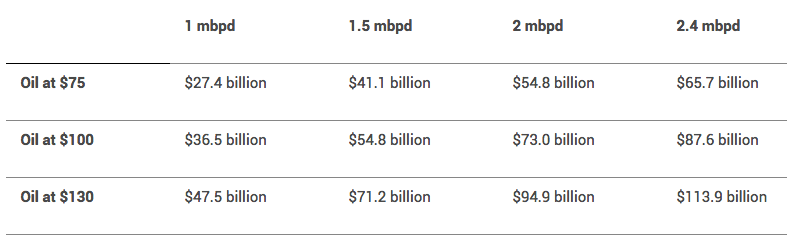
Even if the Trump administration is able to reduce Iranian oil sales to 1 mbpd, at higher oil prices, Iran’s ability to compensate is substantial. A more meager reduction, matched by higher prices? Iran might profit.
In Practice
There are myriad reasons why a simple mathematical abstraction is incapable of capturing the diversity of reactions and feedback loops that will determine Iranian oil sales and revenues. It is worth noting in this context that US officials had similar concerns that removing Iranian oil from the market would cause prices to go up during the 2011–2013 Iran sanctions experience and that these fears were ultimately unfounded. Arguably, this came because of the moderation shown by the Obama administration in its demands for reductions—20 percent every 180 days—and the revelation of US shale oil production. But still, it is an indication that unexpected forces can intervene.
To start, prices are in part set by supply and certainly by expectations of supply. To the extent that Iranian supply is not taken off the market, then this will have a moderating impact on prices, slowing their rise and ensuring that Iran bears the brunt of the sanctions pressure. The same would apply if additional supply were to be added by other producers, though finding 2.4 million bpd to add to the market by November 4 is not possible. By the same token, if the United States were able to prevent Iran from exporting any oil, then any increase in price would also not be enjoyed by Iran, no matter how high prices might go. Of course, the higher prices would be felt elsewhere in the global economy and back home in the United States. But from the simple perspective of “putting pressure on Iran,” such a scenario would mitigate the dynamics discussed here.
Moreover, oil revenue is not a perfect proxy for sanctions pressure on Iran. One of the elements of US sanctions against Iran is that Iran is barred from freely accessing its revenues held in foreign banks. Instead, per US law, banks are required to make Iran’s funds available only for bilateral trade or for the purchase of humanitarian goods. Any banks that fail to abide by these restrictions can be prohibited from opening or holding correspondent bank accounts with U.S. financial institutions – effectively banned from doing business in the United States. With this in mind, even higher oil prices and record Iranian oil revenues might not meaningfully buttress the Iranian economy if those revenues are locked up in foreign banks. But this in turn requires assumptions to be made about the level of cooperation that the United States might enjoy in sancitnos implementation. Many banks in Europe and in Asia will resist provoking US sanctions and isolation. Some, however, may decide it is worth the risk, as Chinese Bank of Kunlun did in 2012 when it was sanctioned by the United States. It remains a reasonably profitable institution, notwithstanding US sanctions, and may even become more so if other Chinese transactions with Iran were to flow through it. There is nothing in particular to stop other banks in other countries from pursuing the same path, if they determine the cost is worth the benefits.
This in turn informs another important element: whether all of this will matter in affecting Iranian behavior. From 2012–2013, the United States denied Iran over $50 billion in oil sales and prevented it from using billions more that were held in banks around the world. The result, at least in part, was the negotiation and implementation of the Joint Comprehensive Plan of Action (JCPOA). That might not be the result of another round of sanctions. Diplomacy with the United States has lost its luster in Iran, and its leaders are now talking about the possible use of military instruments to blockade the Persian Gulf, as they have in the past. Even if this extreme scenario does not come to pass, the idea that Iran’s response to renewed economic pressure would be to deal with the United States and to offer further concessions than in 2013–2015 is, at this point, hopeful speculation. There are many different factors that could undermine this hope, from the practical (Will any US partners work with the United States on sanctions?) to the theological (Would Iran be prepared to negotiate with the "Great Satan" again?). Even more importantly, these factors will interplay with one another in ways that we may not be able to anticipate at the outset.
One factor, to be sure, will be the effect of sanctions on oil prices. Given the risks of this strategy, one need hope the United States has a better plan than badgering OPEC.
Photo Credit: EPA/Shutterstock

As Trump Goes Nuclear On Iranian Oil, Europe Must Match His Brinkmanship
◢ As the US chooses the "nuclear option" on Iran's oil, Europe must find leverage and force the US to walk back on its announced policy of driving down Iranian oil exports to zero. The negative consequences for European economy could prove significant, and the risks of regional escalation are high. There are three measures that the EU can pursue to pressure Trump and prevent a dangerous escalation.
This article was originally published in LobeLog.
In the view of veteran observers of the oil industry, Trump has “gone nuclear.” Speaking during a background briefing on Tuesday, a senior state department official announced that the the Trump administration wants to completely eliminate imports of Iranian oil by its current customers. The official told journalists that, during a tour of countries that has already begun with a visit to Japan, U.S. officials will be “requesting that their oil imports go to zero, without question.”
Until recently, there had been an expectation that the Trump administration would issue significant reduction exceptions as was the case under the Obama administration, allowing countries to sustain some level of imports from Iran if significant reductions take place. Indeed, the guidance issued by the U.S. Treasury on May 8 following Trump’s withdrawal from the Joint Comprehensive Plan of Action, made specific reference to significant reduction exceptions as part of the reapplication of oil sanctions. These exceptions were to be devised following “the Secretary of State, in consultation with the Secretary of the Treasury, the Secretary of Energy, and the Director of National Intelligence” as consistent with “past practice.” A survey of oil analysts conducted by S&P Platts after May 8 suggested that “US oil sanctions on Iran will likely have an immediate impact of less than 200,000 bpd and will block less than 500,000 bpd after six months.” The announced policy is akin to a reduction of over 2 million barrels per day.
Something seems to have shifted during the OPEC meeting. As reports emerged that Japan had been asked to cease its imports of Iranian crude, Bijan Zanganeh, Iran’s oil minister, engaged in expectation management. During an interview with Bloomberg Television, he stated, “I don’t believe [the Japanese] can receive a waiver from the United States,” adding that Iran would need to “find some other way” to mitigate the effect of the oil sanctions. With Saudi Arabia cavalierly announcing that it will boost its production to record levels in July, it is easy to see how a Saudi commitment to raise production would have been coordinated with an American effort to eliminate Iran’s export market entirely.
To this end, Iran is facing the most serious challenge to its economy and political integrity to date. The Trump administration has taken its avowed commitment to exert “unprecedented financial pressure” far beyond the realm of coercion and into the realm of destruction. For Iran’s government, which receives about half of its revenues from oil sales, the prospects are grim. Of course, such an outcome is consistent with the regime-change goals of the Trump administration and its regional allies. They are seeking to engineer a collapse from within. But what is seemingly unaccounted for in such a scenario is the immense risk of regional chaos and conflict if they push Iran’s government to the brink. The risk is not merely that instability will lead to violence and mass displacement that could spill beyond Iran’s borders, but more likely that when faced with a near-existential threat, Iran’s ruling elite will seek to regain leverage in the most destructive ways possible.
In one plausible scenario, the Iranian reaction to the total embargo of its oil sales will be to try and impose a physical blockade on Saudi exports by closing the Strait of Hormuz and engaging in a new “tanker war.” The threat to close the strait has been a constant feature of hardline rhetoric from Iran over the years, and the move is easier said than done. But any suggestion that Iran could escalate in such a manner would no doubt spook oil markets—about 18 million barrels per day, equivalent to 20 percent of global supply, pass through the strait each day.
European Response
The prospect of a global oil crisis spurred by Trump’s brash move to deny waivers should frighten European leaders. Aside from the risks of confrontation in the region that would stem from any blockade attempt, the knock-on effects of an even short-term supply crisis could send the already fragile Eurozone economies into a recession. European officials have been quick to note the risks, characterizing the move as “really unhelpful and part of an escalation plan” and declaring that Europe “strongly disagree[s] with this plan.”
The timing could not be more fraught for Europe, which had been expected to present its long-awaited package of economic measures to Iran in the next week. These measures, intended to help incentivize Iran’s continued compliance with the JCPOA in the face of U.S. sanctions snapback, will have little meaning if the preservation of oil imports cannot be assured. Realistically, it will be difficult for Europe to find a way to maintain a viable importation mechanism in the absence of exemptions. If circumvention is not an option, Europe must find new leverage and compel the United States to change its policies. There are three actions that can be taken.
First, European governments must buy themselves and Iran time to reduce the chaos factor. Accelerating and increasing imports of Iranian oil over the next few months, basically allowing Iran to frontload its expected 2019 exports before the sanctions deadline kicks in, would help ensure that Iran retains an ability to sustain the rising pressure. Indian imports of Iranian oil surged in May in anticipation of the U.S. sanctions. European governments should, as a matter of national security, use any excess storage capacity to purchase as much Iranian oil as possible. In order to encourage Europe’s more independent oil traders and refiners to take on these purchases, Iran would need to offer attractive commercial terms in something akin to a flash sale.
Europe should also consider its own coercive measures. American oil exports to Europe have recently reached levels of around 500,000 barrels per day, levels approaching those of Iran. It would be relatively straightforward for Europe to declare that it will seek to eliminate imports of American oil to Europe as a countermeasure for Trump’s move to ban Iranian imports. The impact on the oil-producing American heartland and Trump’s political base could be profound. Importantly, Europe would not necessarily seek to use sanctions in order to enforce such a move. Sanctioning European companies that trade American oil would inhibit the ability of these multinational companies to pick up supply from other producers worldwide. A much more elegant way to impose a cost on the Americans would be to take a page out of the tariffs playbook. Imposing a hefty oil-import tariff would make it commercially unattractive for refiners to important American crude, and so the decision to cease importing American oil would technically be a voluntary decision rather than a decision requiring legal enforcement.
Sanctioning Trump
Finally, European entities could target Trump’s personal assets as damages for the costs incurred due to his prohibition on Iranian oil imports. Congressman Keith Ellison (D-MN) and Vox editor Matthew Yglesias have both recently argued that sanctioning Trump personally may be the best way to change his behavior. As Ellison puts it, “Sanctions targeting Trump’s own companies will sting in a way that he cannot ignore.”
But there may be a more elegant solution already at Europe’s disposal. The EU has initiated the revival of the so-called Blocking Regulation, a 1996 EU law designed to prohibit compliance with US sanctions by EU companies. The regulation includes a “clawback provision” that provides a mechanism for EU entities to sue for damages for costs arising from sanctions. The recovery of damages “may be obtained from the natural or legal person or any other entity causing the damages or from any person acting on its behalf or intermediary.” This broad definition could clearly be extended to Trump.
Moreover, the “recovery could take the form of seizure and sale of assets held by those persons, entities, persons acting on their behalf or intermediaries within the Community, including shares held in a legal person incorporated within the Community.” In short, Trump’s property and assets in Europe could be seized and sold. Given that the assessed costs related to a complete cessation of Iranian oil imports could easily amount to billions of dollars, Trump could ostensibly be threatened with the total seizure of his Europe-based wealth. Of course, the legal action probably would not need to go that far. Dragging the Trump Organization into European court would probably wake up Trump. He has a history of settling in the face of legal challenges, so a threat to his personal empire may force him to rethink his abuse of the American empire.
If Europe can muster the political courage to pursue these measures in the face of catastrophic security and economic risks introduced by the total oil embargo, it can gain the necessary leverage to push the United States to a more reasonable position. Europe must not rely on China or India or Turkey to skirt the U.S. sanctions. Given the immensity of the threat to global security arrangement represented by the abrogation of the JCPOA, and the global economic arrangement underpinned by the current composition of the oil markets, Europe must match Trump’s “nuclear option” with its own. Perhaps this kind of mutually assured financial destruction can bring the world back from the brink.
Photo Credit: IRNA

Total CEO Pouyanné: Transatlantic Partners Risk Gifting Iran to 'China and Russia'
◢ Speaking on Thursday at the Center for Strategic and International Studies, a Washington D.C. think tank, Total CEO Patrick Pouyanné faced several questions about his company’s recently announced decision to wind down operations in Iran following the reapplication of secondary sanctions by the Trump administration. Pouyanné warned that the “Atlantic allies” risk giving “all the Middle East region to China and Russia.”
Speaking on Thursday at the Center for Strategic and International Studies, a Washington D.C. think tank, Total CEO Patrick Pouyanné faced several questions about his company’s recently announced decision to wind down operations in Iran following the reapplication of secondary sanctions by the Trump administration.
With his trademark candor, Pouyanné left no doubt that Total was obligated to comply with U.S. sanctions in regards to the USD 5 billion South Pars gas project launched in July 2017, stating “Secondary sanctions mean that the U.S. president can decide that Total cannot have access to any U.S. banks. I cannot run a company in 130 countries without access to U.S. banks.”
For Total, the South Pars project in Iran was only considered “because of the JCPOA, which meant the end of secondary sanctions.” With the nuclear deal in doubt, and sanctions set to return, “there is no possibility for us,” Pouyanné declared, further noting the role of American shareholders and the significant portfolio of American assets of the French oil company.
But the imposing, formerly rugby-playing executive, did not shut the door to Iran completely. Reiterating a point made in the company’s press release regarding South Pars, Pouyanné stated, “The only way we can proceed is with a project waiver from the U.S.”
Acknowledging a contractual obligation to the Iranians to seek all possible means to remain in the project, Pouyanné confirmed that Total was engaging “with the French government and the U.S. authorities” to raise the prospect of such a waiver, which will not be “easy to obtain.”
Looking to the wider political context, Pouyanné pointed to the early measures being taken by European governments, which may have a bearing on the effort to secure a waiver, reminding the audience that “in 1996-1997 when we made the first South Pars project, [Total] had such a waiver. It was the result of a diplomatic discussion between Europe and the U.S."
The prospects of a diplomatic discussion are dim and Pouyanné recognized that the disagreement over Iran policy is “a big test for the U.S.-Europe relationship" and one that is “beyond Total, as a commercial operation."
Nonetheless, Pouyanné issued a warning: “What would be not good neither for the U.S., nor for Europe, is if that at the end only Russia and China can do business in Iran.” Earlier on Thursday, Iranian authorities had announced that Total’s joint-venture partner in South Pars, Chinese state oil company CNPC, would be assuming Total’s share of the project. Pouyanné was also likely alluding to the presence of Russia state oil company Zarubezhneft, which has signed two major oil deals in Iran. He warned the “Atlantic allies” to consider whether they “want to give all the Middle East region to China and Russia, as this is what we are doing step after step.”
The geopolitical implication of blocking companies such as Total from working in Iran may form the basis of the companies lobbying to receive a waiver from the Trump administration.
Reflecting on what the pullout from the Iranian market meant, Pouyanné struck a philosophical tone, highlighting the importance of loyalty in the oil industry. Responding to a question about Total’s perseverance in Venezuela in an increasingly hostile environment, Pouyanné pointed to the case of Iran, noting “You have to stay as long as you can, because people remember... They remember the company when it stands together in difficult times.”
In the oil industry, he explained “leaving a country is a very tough decision, because it takes a lot of time to convince people that we can come back. It is a question of loyalty.”
Photo Credit: Wikicommons

Iran’s Energy Sector Takes Stock After Year of Ambivalent Results
◢ The last Iranian year, which ended in March, saw several interesting developments for Iranian energy, both domestically and internationally. Despite persistent challenges, Iran is keen to build on the momentum of last year’s developments. In doing so, the question of whether the Trump administration will stay in the JCPOA and renew sanctions waivers on May 12 will have great importance.
This article was adapted from a report originally published by the Oxford Institute for Energy Studies.
The last Iranian year, which ended in March, saw several interesting developments for Iranian energy, both domestically and internationally.
Numerous challenges remain, hampering the growth of the country’s energy industry – not the least due to complex politics in Iran and abroad. In particular, Iranian energy is overshadowed by mounting uncertainty due to the standoff over the future of the nuclear deal. Nevertheless, there has been progress not seen in years.
Internationally, Iran commenced natural gas exports to Iraq in June 2017. This was Tehran’s first successful natural gas export project in over a decade.
Moreover, Tehran concluded its first two international energy contracts following the introduction of a new fiscal scheme, the Iran Petroleum Contract (IPC), and the implementation of the Joint Comprehensive Plan of Action (JCPOA), as the nuclear deal is formally known.
In July 2017, Petropars formed a consortium with French major Total and China’s to develop the eleventh phase of the giant South Pars natural gas field. In March 2018, the National Iranian Oil Company concluded a contract with Russia’s Zarubezhneft and private Iranian company Dana Energy to increase output at the Aban and West Payedar oil fields.
These events constitute important milestones on Iran’s journey to re-connect with global energy. At the same time, it would be wrong to assume that the obstacles hampering the growth of Iran’s energy sector are now overcome—not only because of Trump and the uncertain future of the JCPOA.
Rather, in each of these cases, the circumstances have been rather unique. As for Iraq, close political ties with Baghdad allowed for the project to succeed. This distinguishes the Iraq project from other export plans, where political and commercial issues remain complicated—for example Oman and Pakistan (ongoing) or the United Arab Emirates (in the early 2000s).
Shortly after natural gas exports to Iraq commenced, the Total/CNPC contract was signed. But here, too, the circumstances are rather unique. First, the company has a long history with Iran and the complicated international politics accompanying the country’s energy sector. Already in the 1990s, the French company’s planned engagement in Iran played a key role in the EU’s action to push back against extraterritorial US sanctions. These were introduced by Washington under the 1996 Iran and Libya Sanctions Act (ILSA). In response to ILSA (as well as US extraterritorial sanctions against Cuba), the EU introduced so-called “Blocking Regulations” legislation and filed a dispute against the US at the World Trade Organisation.
The EU’s moves forced the Clinton administration into adopting sanctions waivers, which suspended the implementation of US secondary sanctions and allowed Total to proceed in Iran. Ever since, despite being forced to leave the country in 2010 due to EU sanctions, Total has remained committed to Iran, openly criticised sanctions against the country, and always kept its office in Tehran open—different from other companies.
Second, Total is able to bring its own finance to Iran. The company affords the initial $1 billion investment from its own reserves. With the reluctance of major international banks to return to Iran, fearing punitive measures by the US, finance for large projects remains a huge problem. Being able to bring its own finance sets Total apart.
Last but not least, Total is investing in Iranian natural gas, not oil. In the political economy of Iranian energy, the two hydrocarbons differ markedly. More than half of Iran’s oil production is exported, while less than 5% of the country’s natural gas output is sent abroad. An advancement of Iranian natural gas capacities frees some oil for exports. But the link between increases in production and export revenue is much weaker. Thus, investing in natural gas does not immediately lead to more hard currency at the disposal of the Iranian state.
In light of this, a case can be made that investments in Iranian natural gas projects are more acceptable to Washington than oil. At any rate, both before and after the conclusion of the South Pars contract, Total has frequently acknowledged the importance of the US position for its engagement.
Iran’s second international energy contract, with Zarubezhneft, was particular, too. It combined two firsts in one contract: the deal marked Iran’s first upstream contract with a Russian company and also the first international contract awarded to a private Iranian company, Dana Energy.
Beyond this, the deal is further testimony to the fact that Zarubezhneft, controlled by the Russian government, seems unimpressed by the Trump administration’s harshening stance towards Iran. Unlike Western IOCs, Russian (and also Chinese) state-owned companies might benefit from being able to take a different position when it comes to assessing political and economic risks related to Iranian energy.
The significance of different risk-assessments cannot be underestimated: Iran’s energy sector continues being surrounded by multiple and complex political and economic challenges. These include ample supplies in global energy, efforts by conventional producers to keep barrels away from markets, domestic political opposition to international and especially Western companies in Iran, and—almost overshadowing everything else—the prospect of the US leaving the JCPOA.
Parallel to the ups and downs at the international level, the domestic politics of Iranian energy saw interesting developments, too. In January 2018, Supreme Leader Khamenei reportedly told the Revolutionary Guards (IRGC) to divest from those parts of their wide-spanning business conglomerate that are “irrelevant” to their core purpose. If followed up by meaningful action, this would have wide-ranging consequences for Iran’s energy sector, where the IRGC maintain a considerable presence.
However, several economic and political questions in this regard remain unresolved until now. Politically, it will need to be defined which of the IRGC’s economic activities are actually considered being “irrelevant." Arguing Iran should reduce international dependencies, conservatives might call for the IRGC to maintain a certain presence in strategically vital sectors, including energy. Economically, it is unclear who could actually take over businesses from the guards. Considering the sheer size of the IRGC’s economic holdings, Iran’s private sector seems unprepared to stem a larger IRGC divestment. Meanwhile, foreign ownership remains highly problematic in Iran.
All this suggests that IRGC divestment from the energy sector and the broader economy would at best be slow and gradual. Somewhat, the process has already begun as the administration of president Rohani reduced the number of public contracts awarded to the IRGC in recent years. Still, the IRGC have yet to indicate their willingness to actually divest. It would therefore likely take years until the IRGC have meaningfully reduced their economic profile.
Moving forward, Iran is keen to build on the momentum of last year’s developments. In doing so, the question of whether the Trump administration will stay in the JCPOA and renew sanctions waivers on May 12th will have great importance.
At the same time, a withdrawal of the US from the JCPOA and the re-imposition of nuclear-related US sanctions would not immediately bring Iran back to its pre-sanctions position. In particular, it is unlikely that Tehran’s oil exports would collapse to pre-JCPOA levels.
Europe’s role is crucial here: As long as Tehran fulfils its commitments under the JCPOA, the EU is unlikely to bring back its energy and finance sanctions against Iran. These, however, were deceive in forcing down Iranian oil exports by more than half after 2012.
Some Asian countries, most likely Japan and South Korea, might voluntarily reduce parts of their imports of Iranian oil. But without Europe joining the sanctions effort, the re-imposition of US nuclear sanctions is unlikely to dramatically affect Iranian oil exports.
Nevertheless, if the US decides to withdraw from the JCPOA on May 12th, this would obviously still hit Iranian energy hard. Very likely, it would effectively prevent further European IOCs from engaging in the country—and thereby significantly hamper the growth of Iran’s energy sector.
Photo Credit: AP/REX