
What Role Do Economic Conferences Play in Uzbekistan’s Development?
Uzbekistan is seeking a dialogue with the world and economic conference can serve to build trust and generate credibility.
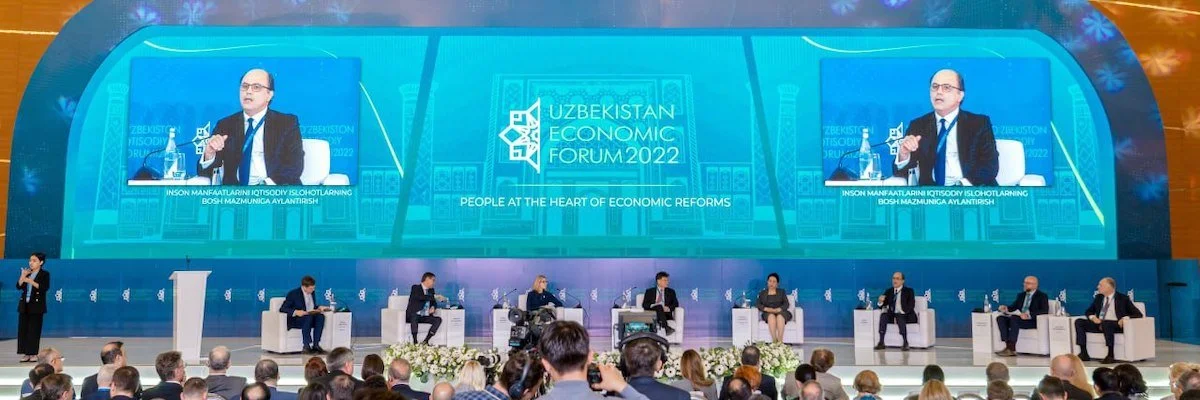
Back in November, I travelled to Samarkand to attend the Uzbekistan Economic Forum. I had been to the ancient city nearly a dozen times, but this was my first professional event there. The Uzbekistan Economic Forum did not suddenly convince everyone that Uzbekistan is a special country. But it did show that Uzbekistan was becoming a more normal one.
Not everyone in Uzbekistan was happy with the conference. Some journalists and bloggers questioned why Uzbekistan’s government needed to convene yet another major and costly event. Others wondered if the return on investment would be worth it. Concerningly, the costs of the forum were not disclosed. Clearly, the organisers could have done a better job in publicly communicating the rationale for such a large event and why such conferences matter. To me, there are three reasons why they do.
First, Uzbekistan needs to foster regular dialogue with businesses partners, investors, and lenders who are independent from the government. Such actors are accountable to their shareholders, are subject to intense international media scrutiny, and must follow varied regulations around governance and sustainibility. Therefore, they can audit Uzbekistan’s achievements and shortcomings more honestly, generating important information for local media and civil society.
A country whose debt burden is equal to 40 percent of its economic output must be open to scrutiny of its economic policies and institutions. The forum’s thoughtful programme presented the opportunity for such scrutiny, with topics ranging from political reforms to economic inclusivity. The organizers brought in people who could ask tough questions (including former CNN and Bloomberg journalists) as chairpersons for the panel discussions. Senior representatives from the IMF, IFC, World Bank, European Bank for Reconstruction and Development (EBRD), Asian Development Bank, Asian Infrastructure and Investments Bank, regional central bankers, financiers, investors, and many consultants featured on these panels.
There was a time when frankness came at a cost. In May 2003, panelists from the EBRD, which was leading Uzbekistan through its protracted post-communist transition, spoke truthfully about the country’s economic and political shortcomings at the Annual Meeting in Tashkent. By 2005, EBRD war hardly making any loans in Uzbekistan and by 2007 it had exited the country altogether, unable to operate in an environment in which the authorities demanded deference. It was not until a decade later that EBRD returned to Uzbekistan. Today, the bank has 65 active projects with over EUR 2 billion in total portfolio value. With that much at stake, it is reasonable to expect that the EBRD and peer institutions will continue to speak up, especially as its activists continue to push the bank to live-up to its pro-democracy mandate.
Second, Uzbekistan needs a platform to prove its bureaucratic capacity, as it seeks to stay the course of increasingly difficult structural reforms. In contrast to heavily protocolled political events with predetermined outcomes such as the Shanghai Cooperation Organization or Inter-Parliamentary Assembly, participants of economic forums in Uzbekistan are more demanding, represent diverse stakeholders, and care about performance dynamics. The newly formed Ministry of Economy and Finance, the Ministry of Labor and Poverty Reduction, and the Ministry of Justice—which oversee social policy—face new challenges every day. The nominally independent Central Bank and the judiciary are undergoing significant changes with unclear outcomes. They will all need to prove that they can uphold Uzbekistan’s domestic and international commitments and pay the bills.
At the same time, reform-minded public administrators themselves need businesses, civil society groups, and international professionals to get their president's attention in the highly centralized system. In Uzbekistan, the presidential administration can be reactive, prioritizing issues in response to media coverage, expert commentary, formal reports, and face-to-face meetings. It is no secret that certain business leaders may enjoy better access to the president that many ministers do not have. So, it is good when investors are both long-term thinkers and legally bound to seek clean deals. These investors and reform-minded public administrators can form coalitions as part of two-level game through which domestic reformers in transition economies find the means with which to amplify their voices.
Alongside many countries “stuck in transition,” the Uzbek government continues to face challenges outlined by the IMF in its 2014 review marking 25 years after the end of communism in Europe. Uzbekistan needs to reign in its exorbitant public expenditures, improve the business climate, enable market competition, enforce state divestment, and ensure rule of law. It was reassuring that almost all keynote speakers in Samarkand said the same. By the end of the first day (most discussions can be watched freely online), it was clear that there was broad consensus about what needs to happen to enable prosperity.
The Uzbek ministers and senior officials speaking at the conference shared this consensus and acknowledged problems. Some even joked, earning sincere laughter from the diverse audience. Importantly, the conference was held in Uzbek and English — this was more than political symbolism. Russia’s war on Ukraine has had varied effects on the Uzbek economy. These have been mostly negative (e.g. reduced financial inflows and increased social policy burden), though there have been a few silver linings (e.g. capital relocation, higher commodity prices, and parallel exports). After independence, Uzbekistan, like other post-Soviet states, pursued legislative and regulatory harmonisation with Moscow. But the country’s bureaucracy is starting to look beyond Russia. The use of the Uzbek language helps the central government connect to a wider swath of society. The use of English, meanwhile, represents a search for a wider cooperation with foreign countries.
Finally, these conferences help set expectations—and there are many expectations being set. That Uzbekistan will privatise the promised 1,000 more state-owned enterprises. That utility and energy prices will be liberalized. That the economic growth will be increasingly supported by foreign direct investment rather than direct borrowing. That more will be done to empower and separate the judiciary from the executive branches. That the Oliy Majlis, Uzbekistan’s legislature, will pass new competition law and that it will be signed. That Uzbek GDP will rise to USD 100 billion by 2026 and USD 160 billion by 2030. That the country embraces a free market economy, trusting that its people can achieve more with less state intervention. Whether Uzbekistan meets these high expectations is something that can be assessed when it is time to gather for another forum.
Uzbekistan is seeking a dialogue with the world. We can quibble about the optics of such conferences, but they do serve to build trust and generate credibility. There was a time when economic conferences in Uzbekistan had long titles, glorified the present, and discussed the future in only abstract terms. Back then, the desired outcome was applause—those conferences played no role in the country’s economic development. In Samarkand, a different kind of conference took place.
Photo: Uzbekistan Economic Forum

Trade, Not Investment, is Iran's Sanctions Relief Must-Have
Sanctions relief will enable Iran to buy the industrial goods that will undergird the country’s economic resilience for the next two decades.
Last week, the seventh round of the negotiations over the fate of the JCPOA saw Iran table an initial proposal on sanctions relief. The proposal led to complaints from Western officials that the Iranian negotiators were being unreasonable. Iranian officials responded by insisting their proposals were “pragmatic.” The initial exchange suggested to some that disagreements over sanctions relief issue are going to prove the intractable because what Iran wants—significant investment—is impossible for the P5+1 to guarantee. Gérard Araud, former French ambassador to the United States and an astute observer of the nuclear talks, tweeted that “Even if the JCPOA was restored, no Western company would dare invest a cent in Iran.”
Araud is rightly concerned. Western companies will be reluctant to invest in Iran due to fears that a Republican president could reimpose sanctions in 2025, putting their investments in jeopardy. In the months following the implementation of the JCPOA in January 2016, a flurry of big-ticket investment deals were announced. These deals became the symbols of the economic benefits of sanctions relief and of Iran’s moves towards normalised economic relations, namely with Europe and China. The deals included planned investments in Iran’s oil fields by Total and CNPC, the joint ventures planned by PSA Group and Volkswagen in Iran’s automotive sector, and Novo Nordisk’s decision to build a manufacturing plant in Iran, among others. But following President Trump’s decision to withdraw from the nuclear deal, essentially all European and Chinese efforts to invest in Iran unravelled (the Novo Nordisk project, with its humanitarian dimension, proved a rare exception).
For the P5+1, a significant technical interventions will be necessary to create conditions conducive to foreign direct investment. But, the economic value of the nuclear deal does not actually hinge on increased foreign direct investment, which was primarily sought by Iran as a commitment mechanism for technology transfer.
But for most Iranian manufacturers, the ambition is not to produce high-technology products. Rather, the ambition is to use high-technology equipment to more efficiently produce the wide range of basic goods that can be sold in the domestic and regional markets. Iran will receive most of the benefits on offer from sanctions relief when Iranian manufacturing firms can purchase new equipment from foreign suppliers that can be used to increase the quality and quantity of output. Such purchases represent a critical example of domestic investment deferred due to sanctions related pressures.
The industrial equipment on which Iranian factories depend is overwhelmingly imported from just two sources: the European Union and China. This trade can be tracked by looking at the relevant chapters of the so-called Harmonized System used by customs agencies categorise goods. Chapter 84 covers equipment such as boilers, pumps, turbines, furnaces, freezers, ovens, pulleys, cranes, forklifts, and other machinery that would be seen on a factory floor. Chapter 85 covers electrical equipment such as motors fuses, switches, lasers, heaters, magnets, batteries with various industrial applications. Looking at European and Chinese exports to Iran across these two categories offers a measure of whether Iranian factories are proving able to maintain or upgrade the equipment on their assembly lines. What’s clear is that sanctions significantly reduced European and Chinese exports of these goods to Iran, with significant consequences for Iranian productivity. Between the first quarter of 2018, prior to Trump’s withdrawal from JCPOA, and the last quarter of the year, by which point US secondary sanctions had been reimposed in full, Iran’s industrial output fell by 20 percent.
Part of the drop in production can be attributed to reduced demand. But many manufacturing firms also struggled to maintain output given difficulties not only in importing raw materials and intermediate goods, but also the parts and equipment necessary to keep assembly lines running at high capacity. Moreover, it wasn’t the wind down of foreign investment that was responsible for the drop in production—few investment projects had broken ground. Rather, it was disruption in the availability of European and Chinese industrial goods that saw Iran’s manufacturing sector regress.
In 2016, the first year of sanctions relief, European industrial exports to Iran averaged EUR 250 million per month. Over the first 8 months of 2021, the monthly average has been just EUR 80 million. That means, on an annualised basis, Iran is importing about EUR 2 billion less industrial goods from Europe than prior to the reimposition of US secondary sanctions.
The trends are similar when looking at Chinese exports to Iran. In 2016, average monthly exports to Iran totalled about USD 453 million. Over the first 10 months of 2021, the monthly average has been just USD 241 million. On an annualised basis, that is a difference of about USD 2.5 billion.
Looking at the European and Chinese data together suggests that sanctions relief could be worth around USD 4.8 billion in additional annual industrial exports to Iran from its two largest suppliers, if trade returns to pre-sanctions levels. A significant portion of the goods imported in these two categories are purchased as part of fixed capital investments by Iranian manufacturing companies, meaning that Iranian firms can be expected to invest billions of dollars in their own production capacity if sanctions are lifted and European and Chinese exports rebound.
Such a rebound is probable. For European and Chinese companies, the decision to enter the Iranian market as a supplier is far less risky than the decision to enter as an investor. Even with concerns that JCPOA implementation may falter again in 2025, the data from 2016-2017 makes clear that trade in industrial goods can rebound quickly, even in an environment where banking challenges and legal ambiguities persist. Many European and Chinese companies will be able to make lucrative sales to Iranian customers within the 2-3 year window in which sanctions relief is basically assured, especially those suppliers who are currently selling to Iran while US secondary sanctions remain in place.
Importantly, the fact that trade in industrial goods can rebound in a short period of time does not mean that the benefits will be short-lived. Equipment like pumps and furnaces have lifespans up to 20 years. Many Iranian factories are hampered with old equipment. Sanctions relief would enable these firms to finally upgrade old equipment, much of which was installed in the early 2000s during which Iranian industry underwent a critical development phase characterised by the installation of European manufacturing equipment. Should more Iranian companies be able to avail themselves of the opportunity to invest in new industrial equipment following the restoration of the JCPOA, Iran industrial output would benefit from higher productivity and greater resilience for a decade or longer, a fact that makes sanctions relief, even if cut short by political events, fundamentally attractive.
Economically speaking, trade, not investment, is the key for robust Iranian growth in the years immediately following restoration of the JCPOA. Attracting foreign direct investment would of course maximise Iran’s developmental outcomes, and has a crucial role to pay should Iran aim to return to its pre-sanctions growth trajectory, but such investment is not essential for Iran’s short-term economic recovery. The primary goal for the P5+1 should be to ensure that trade rebounds as quickly and robustly as possible. Here, the provision of trade finance is important and technical work will need to be done to ensure that global export credit agencies can serve companies that wish to sell equipment to Iran. Still, finding solutions to extend billions in trade finance will prove far easier than facilitating billions in foreign direct investment in the short term.
Politically, facilitating foreign direct investment would usefully demonstrate that the P5+1 is making good on economic commitments set forth in the JCPOA. On one hand, the Raisi administration would surely welcome more intensive efforts on the part of Western governments to ensure foreign investments can materialise, particular in sectors where such investment is really necessary like the energy sector. On the other hand, the fact that trade, and not investment, is the real economic must-have will suit the Raisi administration just fine. President Raisi is unlikely to make Western foreign investment a major target of JCPOA implementation given the emphasis on economic self-reliance that colours his administration’s economic planning and the reluctance to undertake deeper structural reforms on which many foreign investors will insist. But by focusing on trade, Raisi will have a compelling story to tell—sanctions relief will enable Iran to buy the industrial goods that will undergird the country’s economic resilience for the next two decades.
Photo: IRNA