

Delays Hit Iran’s Imports of Soybeans, Maize as Ships Remain Anchored Offshore
◢ More than a dozen cargo ships carrying agricultural commodities are spending weeks anchored off the coast of Iran as importers are delayed in making payments. With supplies of soybeans and maize restricted and demurrage costs incurred when cargoes do finally make it to shore, the delays are having a significant impact on Iran’s economy.
The bulk carrier ADA left Santos, Brazil on October 2, laden with 23 tons of maize. The Cypriot ship was charted by Cofco, China’s largest agribusiness firm and a global leader in commodities trading, to deliver its cargo to Iran. On November 8, ADA arrived at the anchorage for Bandar Imam Khomeini, located about 75 kilometers offshore. It has spent the last 32 days anchored in the same position and has not yet unloaded its important cargo.
ADA is just one of more than a dozen cargo ships carrying agricultural commodities that are spending weeks anchored off the coast of Iran as importers are delayed in making payments. With supplies of soybeans and maize restricted and demurrage costs incurred when cargoes do finally make it to shore, the delays are having a significant impact on Iran’s economy. Higher input costs are not only pushing up the price of meat and manufactured foods, but also exacerbating other pressures that risk pushing companies, such as poultry farms, into bankruptcy, threatening tens of thousands of jobs.
Global trading companies like Bunge, Cargill, and Cofco, which maintain significant business in Iran, typically dispatch their cargoes prior to receiving payment. Payment is received while the cargoes are en route and the vessel is then able to proceed to its destination port and unload.
Iranian importers and foreign exporters alike describe the recent delays as unprecedented, citing two main challenges. First, the Central Bank of Iran is struggling to allocate foreign exchange to importers in a timely manner as it continues to workout kinks in its recently implemented NIMA system, a centralized foreign exchange marketplace.
Some Iranian exporters, particularly major petrochemical companies, have proven reluctant to make their foreign exchange revenues available through the NIMA system as legally required, limiting supply. As a result, foreign exchange prices available through NIMA, which have averaged at around IRR 100,000 to the dollar in the past few weeks, are higher than what many importers consider fair, limiting uptake of the NIMA system.
As reported by Maziar Motamedi for Al Monitor, importers have “reached an agreement with the government to offer their hard currency revenues at an agreed a further subsidized rate of about IRR 80,000 to the dollar” forcing the Central Bank of Iran to essentially undercut its own marketplace. Unwilling to buy foreign exchange at the market price available via NIMA “buyers prefer to wait in long queues—sometimes taking up to three months—to receive their currencies at the subsidized rate,” according to Pedram Soltani, vice president of the Iran Chamber of Commerce, a private sector body.
It appears these added pressures are making it more difficult for the Central Bank of Iran to meet the needs of Iranian importers of essential goods such as agricultural commodities and pharmaceutical products, who are entitled to receive the lowest subsidized rate of IRR 42,000 per dollar.
In addition to these internal challenges, the Trump administration’s avowed “financial war” on Iran has made even routine banking more difficult. Despite long-standing exemptions for humanitarian trade, the reimposition of secondary sanctions has served to restrict the financial channels necessary to make payments. Even when foreign exchange is made available to importers, there are now fewer beneficiary banks in Europe and Asia willing to accept transfers from Iranian commercial banks. As a result, traders are often finding it necessary to identify new banking channels through which to conduct trades, adding to delays.
The delays are so significant that it appears some ships are being diverted to new destinations following payment delays. The bulk cargo vessel ANTHEA departed from Santos, Brazil on September 30 having been charted by commodities giant Bunge to deliver a cargo of maize to Bandar Imam Khomeini, the largest of Iran’s ports. But ANTHEA only made it as far as the anchorage point off the coast of Fujairah, United Arab Emirates, spending two days offshore before being diverted to a new destination altogether.
Encouragingly, in most cases, shipments are being completed despite the delays. CHAMPION EBONY successfully reached Iran’s Shahid Rajaee port (formerly Bandar Abbas) on November 18, having been dispatched with a cargo of soybean oil by trading firm Renova Norte. SUMMIT SUCCESS and MACHERAS departed Santos, Brazil laden with Maize in early October. Each ship took about five weeks to arrive at its destination, with SUMMIT SUCCESS offloading at Bandar Iman Khomeini for Cofco and MACHERAS offloading at Chabahar for Bunge.
Moreover, commodities traders continue to dispatch ships. SEALADY departed from a Bunge-owned port in Longview, Washington on November 1 headed to Bandar Imam Khomeini with a cargo of American soybeans.
Traders remain adamant that given the significance of the Iranian market and the resources available to the major commodities traders, financial channels will be established in order to sustain a baseline of trade, notwithstanding the currency issues and the sanctions concerns.
Europe’s planned special purpose vehicle for Iran trade could also prove useful in the area of commodities trade. But further bespoke solutions will add costs that will no doubt be passed on down the supply chain, increasing the cost of foodstuffs above what would have otherwise been expected had Iranian importers been able to make payments using more typical channels.
Photo Credit: Vahid Salemi

Fears Grow That Trump Sanctions Will Throttle Iran's Humanitarian Trade
◢ The second and final sanctions deadline of November 4 is drawing near. After this date, unilateral US sanctions on Iran’s financial sector will once again come into force. According to Iranian bankers and government officials, this could mean that Iran struggles to import humanitarian goods, including basic foodstuffs, despite longstanding exemptions for trade in these goods.
The second and final sanctions deadline of November 4 is drawing near. After this date, unilateral US sanctions on Iran’s financial sector will once again come into force. According to Iranian bankers and government officials, this could mean that Iran struggles to import humanitarian goods, including basic foodstuffs.
The sale of essential foodstuffs and medicine to Iran is exempt from sanctions, giving latitude to US officials to reiterate their claims that sanctions are targeted and not intended to hurt the Iranian people. However, while no direct legal barriers might exist for trade in humanitarian goods, potential restrictions slapped on banks that facilitate the necessary transactions might yet cause problems.
Prior to the nuclear deal, Iran’s private sector banks were exempt from secondary sanctions and thereby to be able to handle humanitarian trade payments. As sanctions are set to be reimposed, ambiguities about the scope of the returning restrictions forthcoming from the Office of Foreign Assets Control (OFAC) of the U.S. Department of Treasury have left bank leaders and government officials in Iran with more questions than answers.
To understand the growing fears around the maintenance of humanitarian trade, Bourse & Bazaar spoke to several senior bankers and government officials in Iran and executives from global trading companies who are key stakeholders in this trade. All requested to remain unnamed given the sensitive subject matter.
A veteran banker and a board member of a major Iranian private bank described two possible scenarios. "U.S. officials have said they aim to reinstate sanctions that were lifted as a result of the nuclear deal. If we use this as the basis, the interpretation is that private banks that were previously exempt from secondary sanctions and any foreign banks working with them on humanitarian trade will once again be exempt," he said.
But he warned that this time may very well be different given that the US has hardened its rhetoric and promised “maximum pressure” from the sanctions. "Your guess is as good as mine,” he quipped.
He said his bank is currently conducting business as usual but has seen some foreign counterparts take preemptive measures to reduce their transaction volume ahead of the November deadline.
“Some banks are implementing a number of limitations over concerns about what happens next. They are already doing some of the things that will be expected of them once sanctions return on November 5,” he said.
An official at the international department of another major Iranian bank expressed the same feeling of uncertainty, and highlighted concerns that private sector banks like his will not be spared from secondary sanctions this time around.
“We are already facing issues with imports of some essential goods even before [the November] sanctions snap back,” he said. In his assessment, if the bank becomes subject to secondary sanctions, there is little to nothing Iran’s central bank can do to support them.
While Iranian bankers may feel powerless to prevent the return of secondary sanctions, they are also concerned about risks stemming from an area in which Iranian stakeholders do have control—compliance with the Financial Action Task Force (FATF) action plan, which outlines steps for Iran to improve anti-money laundering and combating financing of terrorism standards.
Iran has until mid-October to demonstrate sufficient progress to the FATF or its already embattled banking system will become more isolated than ever. Time is running out for Iran to pass the required legislation in the face of domestic pushback from local interest groups and persistent lobbying by FATF member states including the US and Israel.
“If we don’t pass the bills related to the FATF, we are effectively sanctioning ourselves,” stated the deputy chairman of one of Iran’s largest private sector banks.
These external and internal threats to routine banking between Europe and Iran could have significant knock-on effects for humanitarian trade.
Speaking on background, an executive at a major multinational commodity company described how even if food sales to Iran remain permitted under US sanctions, the imposition of secondary sanctions on Iran’s private sector banks could make the trade effectively impossible.
The Government Trading Corporation of Iran (GTC), the trading arm of country’s agriculture ministry, confirmed these concerns but insisted that contingency planning is underway.
A senior official involved in foreign trade for GTC said, “We are at the moment implementing measures to ensure that we won’t have problems concerning humanitarian trade.”
The official could not share further details, beyond explaining that any such measures will fall outside the boundaries of the banking system—a likely allusion to the use of barter trade, a method which helped sustain imports in the previous sanctions period.
“We will continue to conduct our business even after November sanctions are in place because we have had the experience of working under sanctions before and the sanctions didn’t stop us,” the official said. “You can be sure that sanctions will only serve to increase costs, not close the way entirely.”
The recent announcement that the European Union would be establishing a special purpose vehicle to facilitate humanitarian trade will offer some encouragement that a significant disruption to food imports can be avoided. But with the sanctions deadline just weeks away, the risks of dangerous supply shocks are rising by the day.
Photo Credit: IRISL

Ambiguity in Trump Sanctions Could Put Humanitarian Trade with Iran at Risk
◢ In the years when Iran was under broad international sanctions, the country saw shortages in key foodstuffs and life-saving medicines. Despite attestations to the contrary, international sanctions hurt the Iranian people in cruel ways. As Iranians prepare for the return of U.S. sanctions, concerning ambiguity in OFAC’s new sanctions guidance may undermine the longstanding exemptions for humanitarian trade and the carve-outs for the Iranian banks which facilitate these sales.
In the years prior to the nuclear deal, when Iran was under broad international sanctions, the country saw shortages in key foodstuffs and life-saving medicines. Despite attestations to the contrary by proponents of the economic blockade, who spoke of its "targeted" nature, international sanctions hurt the Iranian people in cruel ways.
According to Iran's Food and Drug Administration, the list of medicines subject to shortages in Iran extended to 350 drugs in the sanctions period. Shortages were precipitated by a number of factors. Several multinational corporations downsized their operations or withdrew from the Iranian market. Interruptions in banking channels saw payments turn from the use of industry-standard letters of credit and deferred payment terms to cash-in-advance payments using exchange houses. Transaction and operational costs skyrocketed, with costs being passed on to the consumer, whose buying power was eroded by currency devaluation.
After the lifting of international sanctions as part of the Iran nuclear deal, the situation improved dramatically. Today, the number medicines subject to shortage has dropped to 65 drugs. Yet, it is important to realize that the shortages precipitated by sanctions would have been even worse had it not been for specific carve-outs for humanitarian trade established by the United States’ sanctions enforcement agency, the Office of Foreign Assets Control (OFAC), part of the Department of Treasury.
As per OFAC’s own guidance on the matter, “the U.S. maintains broad authorizations and exceptions that allow for the sale of food, medicine, and medical devices” to Iran by both U.S. and non-U.S. persons. During the sanctions period, the more committed multinational companies, often those with longstanding ties to the Iranian market, took advantage of these exemptions to maintain their sales to Iran. While a commercial incentive reigned supreme, the Iranian people benefited to the extent that the country was not under a total blockade.
Now, with U.S. sanctions poised to return, more suffering seems to be on the horizon. The Trump administration has announced that it will be reinstating all primary and secondary sanctions removed as part of the Joint Comprehensive Plan of Action (JCPOA). This total reapplication of sanctions, which is to take place despite Iran’s proven compliance with its commitments under the nuclear deal, has taken many by surprise given its extreme and unjustified breadth. But take a closer look at the mechanics of the so-called “snapback” and what the Trump administration is seeking to do could prove much more dangerous than anything Iran has been subjected to before.
There is exists an important caveat to OFAC’s exemptions for humanitarian transactions with Iran. These sales “do not trigger sanctions under U.S. law… so long as the transaction does not involve certain U.S.-designated persons (such as Iran’s Islamic Revolutionary Guard Corps or a designated Iranian bank) or proscribed conduct.” The emphasis on banks is what matters here.
Iran’s private sector banks play a vital role in facilitating humanitarian trade. The major multinational corporations selling and manufacturing agricultural commodities (eg. Cargill, Bunge), food (eg. Nestle, Danone), and medicines and medical devices (eg. Sanofi, Novartis, GE Healthcare) depend on these types of banks to access the financial services necessary for day-to-day operations in Iran.
Importantly, while Iran’s private sector banks were targeted as part of efforts to isolate Iran from the international financial system and were included on the SDN list, this was done under designations for which secondary sanctions did not apply.
Foreign companies and financial institutions were prohibited from transacting with Iranian financial institutions under the Iran Freedom and Counter-Proliferation Act (IFCA) in 2012 and Executive Order 13645 in 2013. However, there was a notable carve-out created for those "Iranian depository institution[s] whose property and interests in property are blocked solely pursuant to E.O. 13599." The Iranian financial institutions included in the E.O. 13599 list include the country's private sector banks. The unique status of the banks on this list partly reflects that these entities maintain higher compliance standards and clearer governance structures, lack exposure to government or IRGC shareholders, and have no known history of financial crime or terrorist financing.
The Trump administration has made clear that it intends to re-list all of the entities that had been removed from the SDN list as part of the JCPOA (these entities are listed in the attachments to Annex II of the nuclear deal). What remains unclear is whether Trump’s intended re-listing of these entities means returning them to their precise status prior to the nuclear deal. Legal experts and former government officials are coming to different interpretations of the relevant sanctions guidance. OFAC’s FAQs document issued following Trump’s announcement of the U.S. withdrawal from the JCPOA addresses precisely this question for entities on the E.O. 13599 list. The entry reads:
Will the persons that were placed on the List of Persons Identified as Blocked Solely Pursuant to Executive Order 13599 (E.O. 13599 List) on JCPOA Implementation Day (January 16, 2016) be put back on the SDN List?
The provided answer is concerning (emphasis added):
No later than November 5, 2018, OFAC expects to move persons identified as meeting the definition of the terms “Government of Iran” or “Iranian financial institution” from the List of Persons Blocked Solely Pursuant to E.O. 13599 (the “E.O. 13599 List”) to the SDN List. OFAC will not add these persons to the SDN List on May 8, 2018, to allow for the orderly wind down by non-U.S., non-Iranian persons of activities that had been undertaken prior to May 8, 2018, consistent with the U.S. sanctions relief provided for under the JCPOA involving persons on the E.O. 13599 List. The Government of Iran and Iranian financial institutions remain persons whose property and interests in property are blocked pursuant to E.O. 13599 and section 560.211 of the ITSR, and U.S. persons continue to be broadly prohibited from engaging in transactions or dealing with the Government of Iran and Iranian financial institutions. Beginning on November 5, 2018, activities with most persons moved from the E.O. 13599 List to the SDN List will be subject to secondary sanctions. Such persons will have a notation of “Additional Sanctions Information – Subject to Secondary Sanctions” in their SDN List entry.
The guidance indicates that the entities moved from the E.O. 13599 list to the SDN list “will be subject to secondary sanctions." In practical terms, the guidance can be interpreted to mean that all of Iran’s private sector banks will be listed with a designation more restrictive than was the case prior to the nuclear deal. In this scenario, after November 5, 2018, any company that transacts with Iran’s private sector banks will be exposed to U.S. secondary sanctions.
Several sanctions experts, speaking on background given the sensitivity of the subject, pointed to this concerning lack of clarity. In the assessment of an attorney specializing in U.S. sanctions, "It is not clear whether the mere placement of persons identified on the E.O. 13599 List back on the SDN List will subject private Iranian banks—not otherwise designated pursuant to an authority other than E.O. 13599—to secondary sanctions. If it returns to the pre-JCPOA sanctions, then it will revert to the rules established by IFCA and E.O. 13645." But if the new guidelines do reflect an intention to make secondary sanctions for Iranian banks that were previously exempt, "OFAC has the discretion to do so," the attorney noted.
This reading was echoed by a former U.S. government official: "One could read [the FAQs] to suggest the pre-JCPOA identifications, which is what E.O. 13599 was created to address, are all becoming SDNs. This would be a significant escalation. Most of the private banks on E.O. 13599 were never subject to secondary sanctions because we never had evidence of bad behavior."
If this interpretation holds, the typical exemptions for humanitarian trade will no longer apply for the multinational companies bringing vital foodstuffs and medicines to Iran. This is because the private sector banks that they have customarily used to facilitate this trade will be considered “a designated Iranian bank" exposing their counter-parties or clients to secondary sanctions. Re-listing Iran’s private sector banks in this manner would prove devastating to humanitarian trade.
Several major international law firms are advising clients that the re-listing will not exceed the restrictions of the pre-deal designations. In this assessment, the transactions that were not sanctionable pre-JCPOA should not be sanctionable on November 5. The problem is that such a fundamental question, with a direct bearing on humanitarian trade, should not be a matter for interpretation. OFAC has historically offered clear and reliable guidance is these fundamental areas.
It remains possible that OFAC has simply made a mistake in leaving things ambiguous regarding E.O. 13599 entities. In the assessment of many sanctions attorneys, the FAQs released on May 8 are sloppy and incomplete—perhaps an indication of the last-minute nature of their preparation as President Trump announced his decision on the nuclear deal earlier than expected. If this is just an error in the guidance, OFAC must immediately update its FAQs and provide clarity on the matter.
However, if the re-designation is intended as an escalation, and the United States does aim to designate Iran’s private sector banks as SDNs and target their multinational clients with secondary sanctions, the international community must use all available means to compel the Trump administration to restore full and unfettered humanitarian exemptions for Iran trade. Thousands of lives are at stake.
Photo Credit: IRNA

To Transform the Fortunes of Iran’s Saffron Farmers, a Commitment to Technology and the Environment
◢ Keshmoon, an Iranian startup, connects carefully selected saffron farmers engaged in sustainable agriculture with premium consumers. The company has recently gained acclaim for its combination of ecommerce and "agritech" solutions.
◢ Starting with an initial cohort of 30 farmers in the town of Qaen in Khorasan Province, Keshmoon is encouraging a move to sustainable agriculture. The goal is to reduce water usage through means that also help the farmers improve their livelihoods.
Mohammad Qaempanah is a serial entrepreneur. His first business saw him act as a one-man internet service provider in his town, the connectivity from which he leveraged to start his next business, exporting saffron, a coveted spice with a heady aroma taken from the stigma of the crocus flower. Qaempanah exported the spice until sanctions made it impossible. He then opened a vegetarian restaurant in Mashhad with the aim of “educating people about the way in which their eating habits are linked to global warming.” Furthering his commitment to the environment, he then founded Iran’s first “nature school,” also in Mashhad, which offered programs to enable children from the city to experience and enjoy time in nature, learning about the environment. Having spurred something of a movement, there are today over 40 such schools around Iran.
Qaempanah, whose grandfather was a saffron farmer, has now turned his attention to agriculture in his hometown of Qaen, in the province of Khorasan, with a venture that combines his knowledge of saffron, his commitment to the environment, and his aptitude in technology. This latest venture, Keshmoon, has already won accolades. The company was recognized as the “Best Seed Stage Startup” at the recent Iran Web and Mobile Festival. Mohammad-Javad Jahromi, Iran’s young Minister of Communication and Information Technology, acknowledged the company in a subsequent tweet.
This early recognition reflects the scope of Keshmoon’s commercial ambition and its innovative vision for Iran’s agricultural sector. In Qaempanah’s words, Keshmoon combines an “ecommerce platform that serves consumers with an ‘agritech’ layer that serves suppliers.” In simpler terms, he explains, Keshmoon connects “carefully selected farmers engaged in sustainable agriculture with premium consumers.”
In founding the company alongside his brother, Hamza, and a friend, Siamak Khorrami, Qaempanah took inspiration from the increasingly popular model of direct trade coffee, where coffee roasters ethically source beans directly from growers, and also the popular ecommerce platform Etsy, which allows artists and craftsmen to sell their wares directly to consumers online. But while these platforms primarily reflect innovations in ecommerce, Keshmoon seeks to use technology to change the methods of agriculture itself.
Speaking about his vision, Qaempanah is careful to point out that his motivation in founding Keshmoon was “not to help farmers improve their economic situation.” Rather, his “foremost concern was water.” In his view, “unless the issue of water depletion is managed, it won’t matter what the farmers choose to grow, it will be impossible to cultivate anything.”
In the town of Qaen, where Qaempanah’s grandfather cultivated the particularly aromatic saffron that brought fame to the region, the qanats, a traditional system of underground channels which tap into the aquifer, have long been replaced by modern wells. Over the years, farmers drilled more wells to pump ever-increasing volumes of water, seeking to grow crops ill-suited to the arid climate. The water table has dropped precipitously. As Qaempanah relays, “wells that were once 15 meters deep now need to extend to 135 meters.”
Qaempanah believes that farmers are currently stuck in a self-defeating economic cycle. Presently, the use of more water enables higher yields and therefore higher earnings. Keshmoon was designed as a “technical infrastructure to change this cycle.” By incentivizing farmers to move towards the sustainable cultivation of saffron, which is naturally well-suited to Khorasan’s arid climate, farmers will be able to use less water, and yet enjoy greater earnings.
Gallery: The Farmers of Qaen
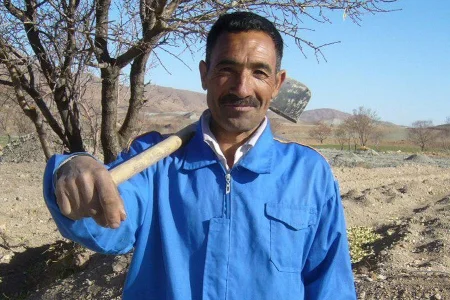
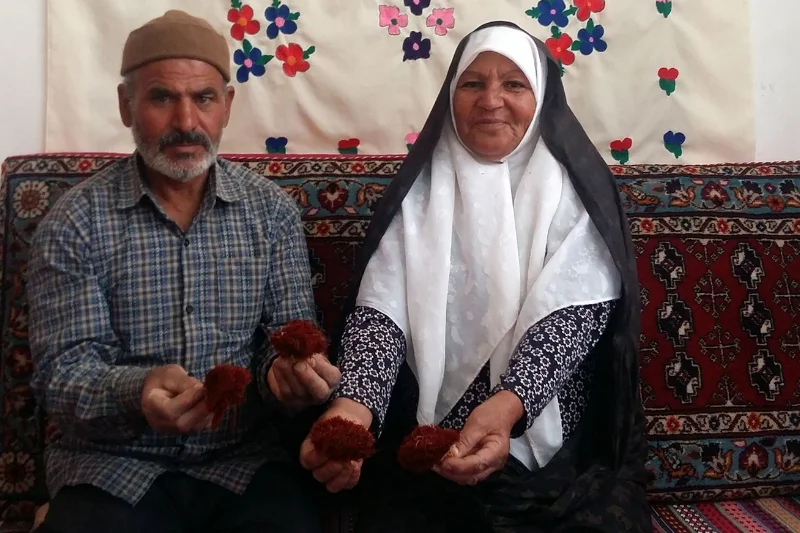
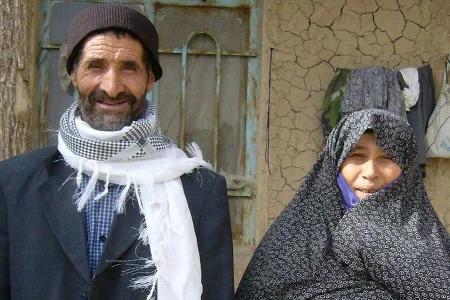
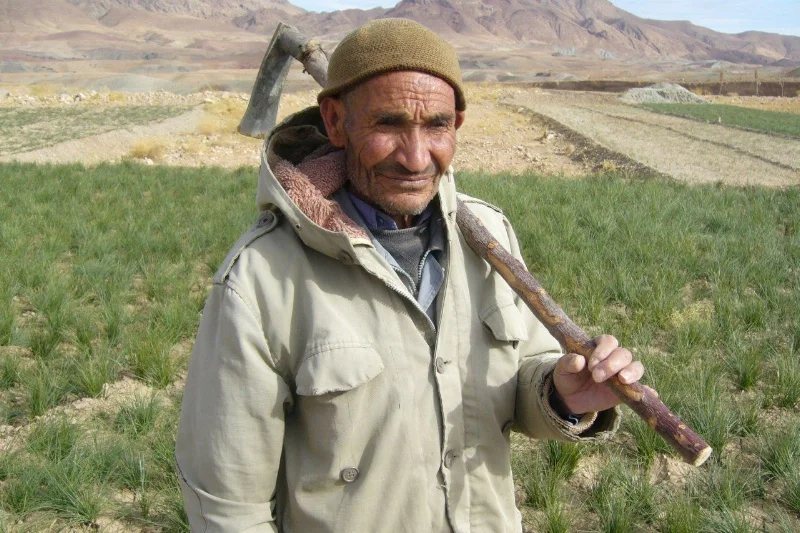
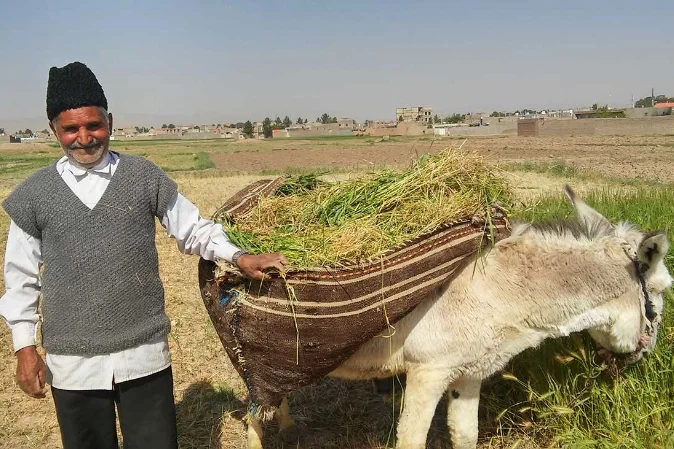
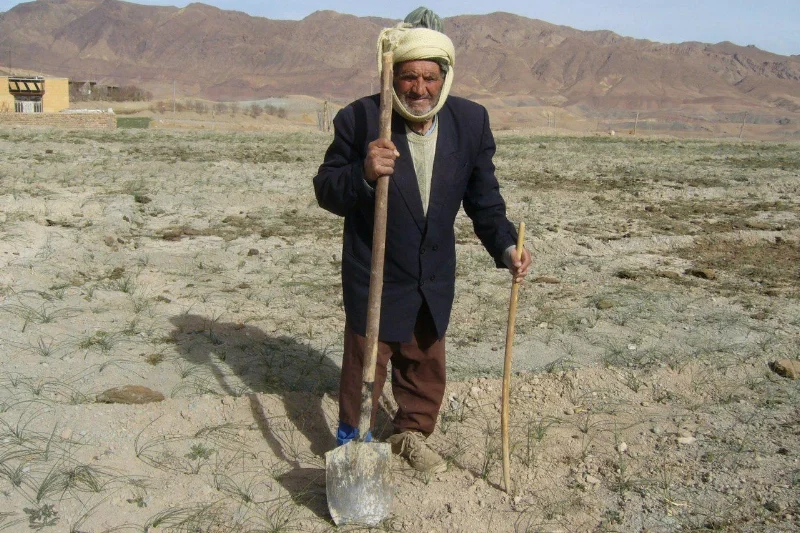
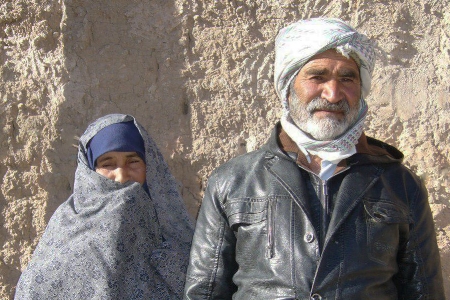
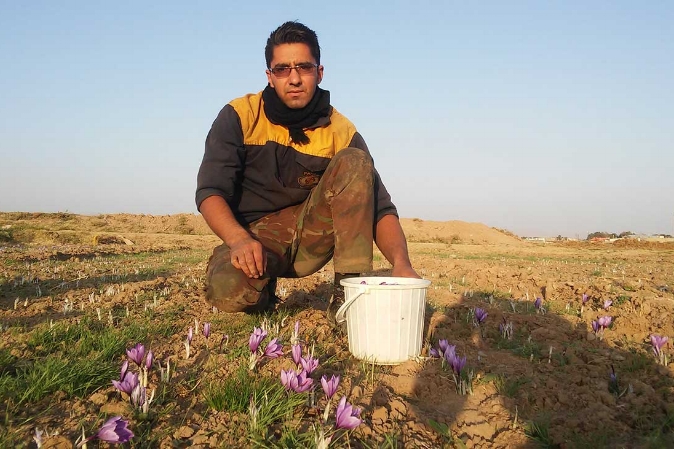
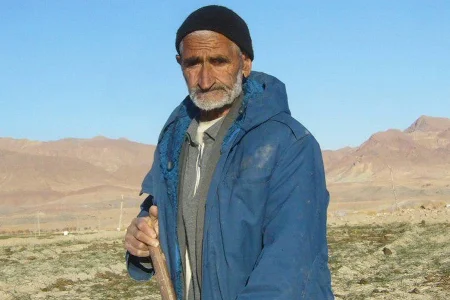
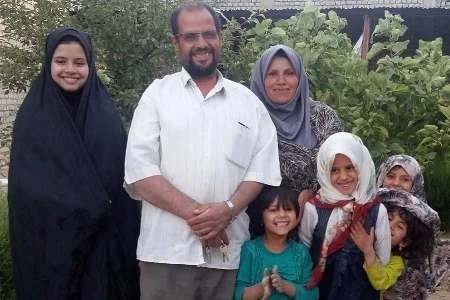
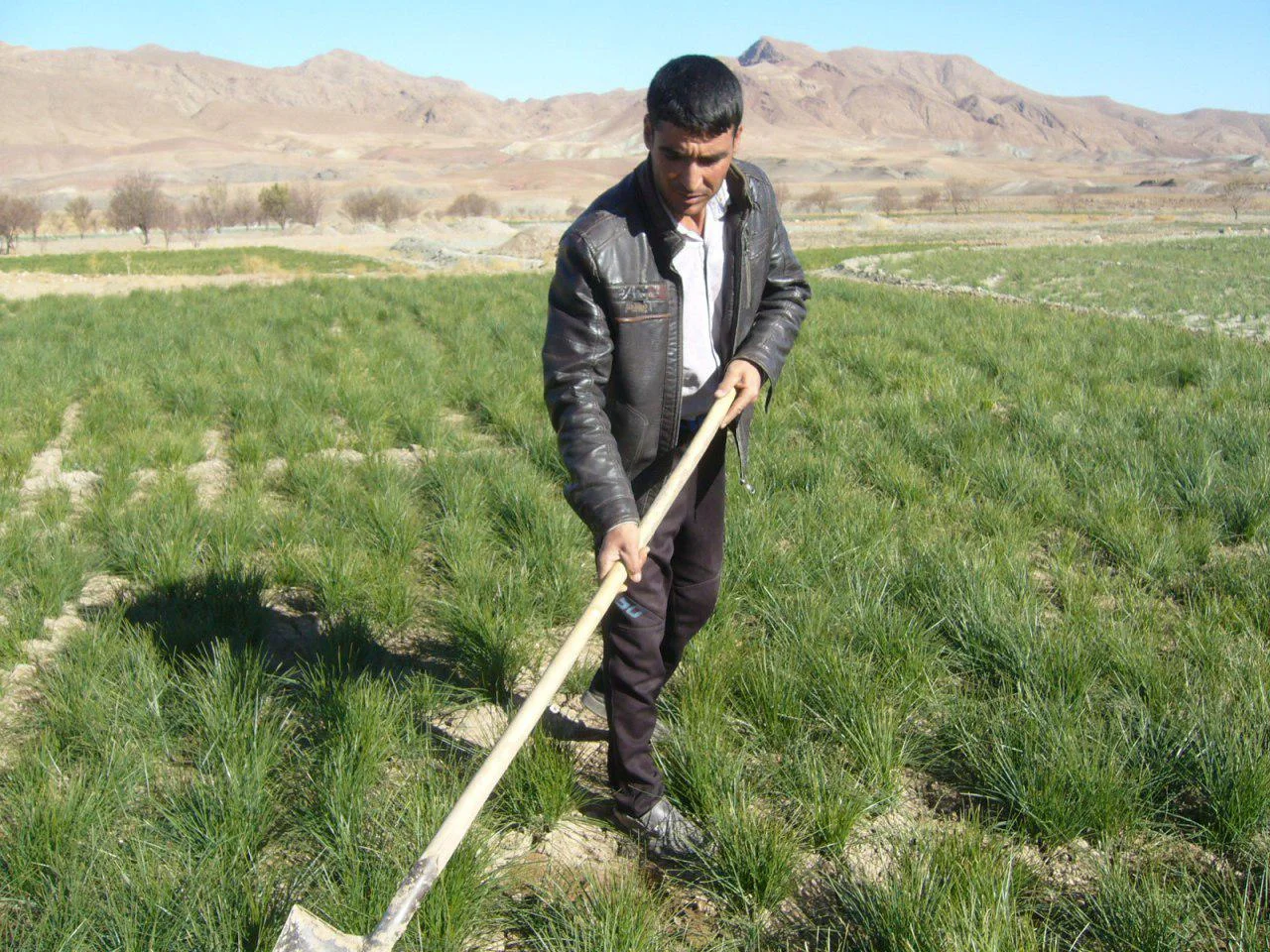
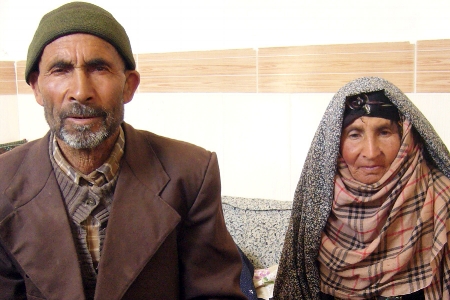
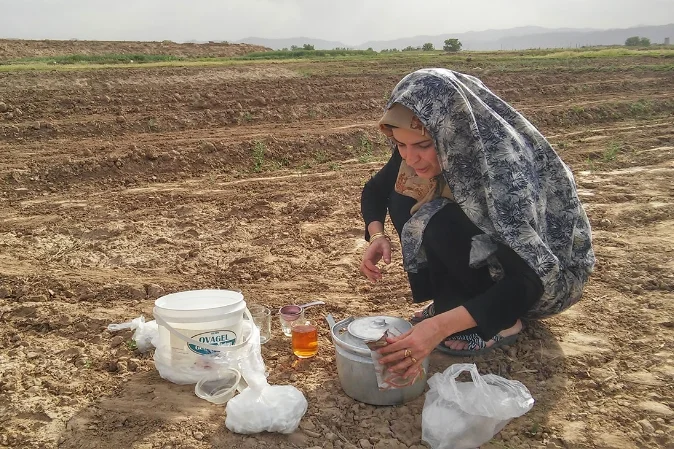
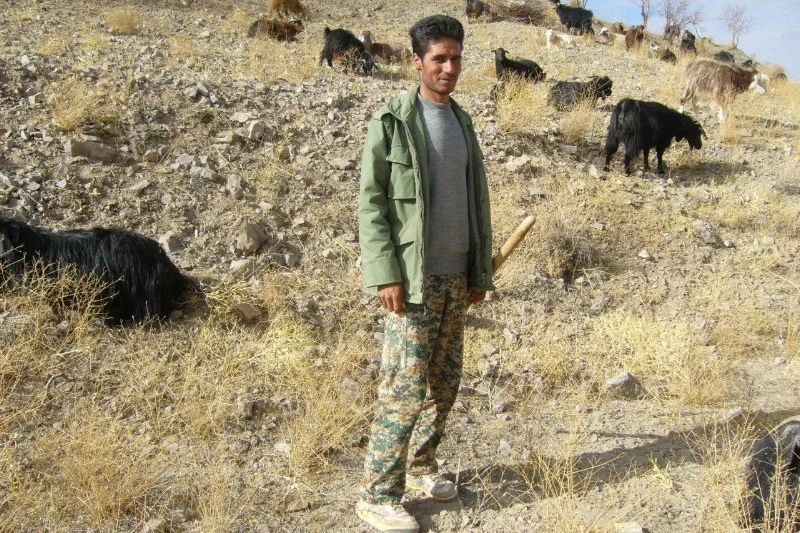
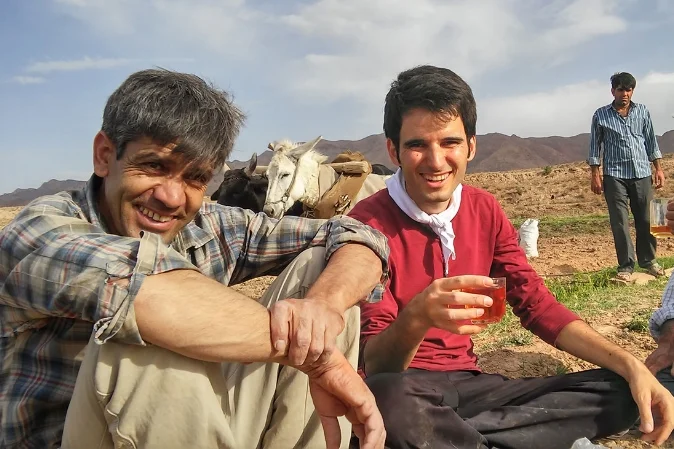
This has proven an attractive proposition to the farmers of Qaen, where Keshmoon has recruited its first cohort of 30 farmers. As Qaempanah recounts, the local saffron growers were “invited to a meeting in the town mosque, where we explained our approach, how we wanted to help, and asked them to go home and think about it.” Despite concerns that it might be hard to explain the technical aspects of the concept, the pitch worked. Today, farmers from neighboring villages and towns regularly stop by Keshmoon’s office in Qaen to learn more about the program they have heard about. The company has earned the trust of the local community.
To gain acceptance to Keshmoon’s platform, farmers need to demonstrate competency growing saffron in the traditional manner. Keshmoon will introduce more stringent requirements in the near future, introducing guidelines consistent with sustainable farming. It will take about one year to “gain critical mass and give farmers the time to make adjustments to their planting,” says Qaempanah. He foresees Keshmoon partnering with universities and other institutions to help provide training to farmers unfamiliar with growing saffron in a sustainable manner in order to help them make the switch.
For farmers, the commercial appeal of Keshmoon is the higher price achieved for their crop by selling to consumers directly, rather than selling to local traders. One drawback is that using Keshmoon will require farmers to sell their harvest incrementally, as orders come in online. Some farmers have said that they prefer selling to the local buyers, who can purchase the whole harvest in one transaction. But the price advantage is substantial. Farmers on Keshmoon can expect to generate 20-40 percent more in earnings than those who sell locally in bulk.
Laudably, Keshmoon has been very transparent about pricing for the sake of both consumers and farmers and offers a detailed breakdown on their website. Generally speaking, farmers receive 70 percent of the saffron’s retail price, while around 12 percent is earmarked for quality control, packaging, and transport, and the remaining 18 percent goes towards Keshmoon’s overhead.
Once accepted to Keshmoon, farmers need to create their online profiles. In most cases, the Keshmoon team helps by taking photos and recording the farmer’s personal details, family history, and also explanations of how the saffron is farmed. These profiles can be seen on the Keshmoon website, where consumers can even send messages to specific farmers.
Qaempanah notes that some farmers, typically those who are younger or who have had more education, have been able to author their profiles themselves. In some cases, it was the farmers’ children, many of whom own smartphones, who took responsibility for telling the story of the family farm through words and pictures. There is immense potential for the farmers to develop both some technology literacy and also their personal brand, which can help them connect with consumers more proactively. Commercial considerations aside, there is something affecting about seeing the personal portraits of the farmers and families behind Iran’s most precious crop.
A Keshmoon Giftbox
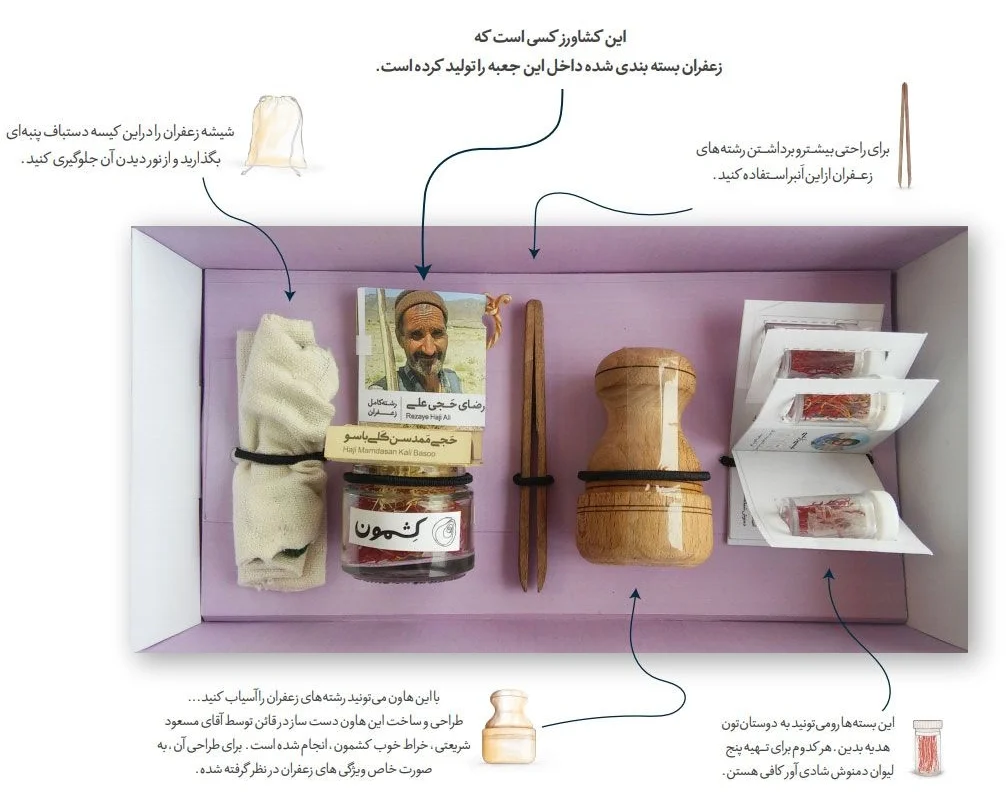
A connection to the farmers and a beautiful presentation of the saffron, including a small booklet about its origins, has proven a hit among consumers. The company has been selling online for nine months, and boasts a few hundred clients, about one-quarter of whom whom make recurring purchases. Keshmoon’s models show that it will take about 20-40 clients in order to support each farmer. At the moment, the company has stopped accepting new farmers onto its platform until is grows the client-base further. A big boost will come when the company begins selling to Europe later this year.
But while the Keshmoon story may begin with saffron, Qaempanah’s ambition is much greater. For the next few years, the Keshmoon team will focus on perfecting its “technical infrastructure,” combining ecommerce and agritech to open a new market for saffron. The big test will be in the marketing and branding. Qaempanah hopes to achieve a level of awareness such that “when people hear saffron, they think of Keshmoon.”
If this model can be developed successfully for saffron, the company plans to expand to other crops and bringing a similar model to other agricultural regions in Iran. Qaempanah imagines a situation where farmers from around the country can approach Keshmoon and receive recommendations for which crops to grow based both on analysis of the local environment and also Keshmoon’s data on which crops will sell most effectively on its marketplace. In this way, Keshmoon would serve to introduce efficiencies of scale typically reserved for large, corporatized farming. The economic and environmental impact for Iran, where the agricultural sector remains dominated by smallholder farmers, could be transformative.
But it is early days yet and the success of this grand masterplan will first depend on the successful collaboration between the saffron farmers of Qaen and the team at Keshmoon. Theirs is a collaboration that crosses talents and crosses generations—both a microcosm of the economic and environmental challenges facing Iran and a case study in the creative thinking and entrepreneurial spirit that may eventually solve those challenges.
Photo Credit: Keshmoon

Telepizza's Arrival in Iran Shows Supersized Ambition
◢ The arrival of Telepizza, a global fast-food brand, is a significant development for Iran's food service sector.
◢ The terms of the master franchise keep economic dividends in Iranian hands, and the new entrant will likely spur new investment and improvements in offerings across the sector.
In 1990, during the final year of the Soviet Union, McDonald's opened its first branch in the country, choosing a landmark location in Pushkin Square in Moscow. On the first day, nearly 30,000 customers passed through the doors.
Telepizza, an international fast-food pizza chain, opened its first Tehran location last week. While the opening did not see quite the same fanfare as arrival of McDonald’s in the USSR, the launch is nonetheless significant.
As many articles have emphasized, Telepizza is the largest non-American pizza brand in the world by number of stores (about 1,500). But the Spanish company, which is targeting Iran as part of an ambitious global rollout plan, is one of the first globally-recognized restaurant brand to enter Iran, which has until recently had to make do with cheap imitations such as “Pizza Hat” and “Mash Donalds.”
The arrival of Telepizza follows the awarding of a master franchise agreement to Momenin Investment Group, a little known firm registered in the UK but with Iranian ownership. MIG has committed to spending EUR 100 million over 10 years in an Iran market rollout. The size of the investment makes it clear that Telepizza and MIG are aiming to dominate the market.
The fast-food sector in Iran is among the most attractive for investors, who see a large middle class with growing spending power. Today, Iranians spend about USD 7 billion annually in restaurants, of which about one-third is spent on fast-food. This expenditure is likely to double in the next decade.
To meet demand, there are about 20,000 fast-food outlets in the country, but scale has remained elusive for any single brand. The largest fast-food operators in Iran, including brands such as Haida and Boof, operate around 50 locations each. In many respects, the fractured food service sector reflects similar dynamics in the food retail sector.
It can be tempting to see the absence of major fast-food brands in Iran as a mark of Iran’s resistance to neoliberalism and the attendant exploitation. The prospect of Iranians spending their hard-earned Rials on foreign pizza is seen by many as anathema to the promise of an independent, self-sufficient Iran.
But Iranians, like most people around the world, want to enjoy the occasional pizza. They naturally deserve the best pizza at the best price. The simple fact that no Iranian fast food chain has gone on to dominate the world, suggests that there are improvements to be made in the domestic offering.
Encouragingly, the Telepizza deal keeps Iranians in charge of their own fast-food future. Whereas the McDonald’s in Pushkin Square was company-owned (the “Golden Arches” made its first franchise agreement in Russia in 2015), Iran’s Telepizza locations will all be owned and operated by MIG. This means that the Telepizza deal is consistent with the longstanding pattern of cooperation between Iranian and multinational enterprises.
Across sectors, Iranian companies have typically sought foreign assistance in technology and operations to enable more successful domestic production. Examples include IKCO’s manufacturing of French cars, Sahar Dairy’s manufacturing of Danone Products, and NIOC’s production of oil with Shell’s technology and expertise.
A similar dynamic underpins the Telepizza deal. Domestic fast-food operators in Iran have struggled to ensure efficient supply chains, intuitive inventory and sales technologies, robust brand protection, and winning management practices. This has made scale all but impossible to achieve.
These areas are precisely where a franchisor like Telepizza can offer support. Telepizza offers MIG access to unique intellectual property in the form of the food menu and branding and marketing collateral, as well as providing assistance in creation of a supply chain, training for management and staff, and implementation of key technologies for ordering, sales, and delivery. They also bring the experience of successful rollouts in other complex markets.
If Telepizza and MIG can adapt the global formula for success to the Iranian market, the food sector at large will be jolted by the new and highly-competitive entrant. This should see other fast-food chains in Iran driven to improve their product, and it will also encourage further foreign and domestic investment in the sector. Outcomes include consolidation among existing players and a diversification of the market offering for consumers.
Moreover, consolidation in the fast-food sector around a few key brands will also mean consolidation of buying-power for the food products that go into each pizza, hamburger, or burrito. Today, McDonald’s in Russia purchases most of its supplies from domestic producers. The fast-food chain’s growth was a major contributor to consolidation and expansion in Russia’s agricultural sector. A similar outcome could be expected in Iran, where large-scale farms remain rare, leading to inefficiencies across the value chain.
While the prospect of increased competition and purchasing power leading to better market offerings is consistent with the neoliberal doctrine, it is important to note that both ownership and labor will likely remain in Iranian hands. Under a master franchise agreement, the franchisor (Telepizza) would typically be entitled a recurring franchise fee and a percentage of profits, but MIG is the owner of the Iranian company and the principal beneficiary of profits. It is MIG's entrepreneurial skills that will be tested as the brand seeks to expand.
Additionally, and perhaps most importantly, expansion in the fast-food sector is a job creator precisely where Iran needs it most. Such stores typically hire younger employees who are attracted to the flexible, shift-based work schedule. Lack of significant growth among domestic players means that possible job creation has gone unrealized.
For young Iranians seeking their first jobs, or trying to make some additional income while pursuing their studies, the type of work on offer at a fast-food restaurant could prove ideal. After all, many of the world’s greatest entrepreneurs got their start delivering pizzas.
Telepizza's supersized ambition in the Iranian market might only be matched by the ambition of these yet-unheralded pizza delivery men and women, waiting for their chance.
Photo Credit: Telepizza