

Iran Looks to Central Asia in Effort to Grow Exports
In the first two weeks of December, Iranian government officials and business leaders participated in bilateral economic summits with counterparts from Tajikistan, Kyrgyzstan, and Uzbekistan—the highest-level economic exchanges with these countries in several years. Iran is expanding its “neighborhood policy” to Central Asia as it seeks to grow its non-oil exports.
Over the past year, Iran has faced disruptions in its foreign trade relations following the withdrawal of the United States from the Joint Comprehensive Plan of Action. Trade with partners like Europe and China has suffered because of U.S. secondary sanctions. In the face of these uncertainties, Iran has adopted a “neighborhood policy” as it seeks to protect trade flows. The policy has been recently expanded to Central Asian states, which serve both as an export market as well as the geographic bridge as Iran seeks to strengthen integration with Russia and China. For the landlocked Central Asian states, Iran is a vital conduit to international waters. In a May 2018 speech, President Rouhani described closer ties with Central Asia as a “fundamental policy.” The policy is now in the early stages of implementation.
At the beginning of December, Tehran hosted two economic summits with Tajikistan and Kyrgyzstan, the first such meetings in two and three years respectively. A week later, an Iranian delegation traveled to Tashkent in an effort to deepen trade ties.
On December 2, a joint commission of economic cooperation was held between Iran and Tajikistan. Iranian energy minister Reza Ardakanian presided over the meeting, which focused primarily on cooperation in energy and transportation projects. Iranian contractors have a history of infrastructure development in Tajikistan, such as the Anzob Tunnel completed in 2015 and Sangtuda 2 hydroelectric power plant. But discussions at the joint commission focused on new projects that would improve Tajikistan’s links to export markets through Iran, and also help support increased bilateral trade, such as the construction of warehouse facilities at Chabahar Port, and the completion of a railway corridor that would link Tajikistan and Turkey through Iran as part of the integration efforts of the Economic Cooperation Organization.
As part of a broader effort to reset political relations, Iran’s President Rouhani made a state visit to Dushanbe in March 2019. Tajik President Emomali Rahmon may soon make his first visit to Iran in six years.
Just a day after the summit with Tajik officials, Iran held a similar high-level commission with Kyrgyzstan. Mohammad Eslami, Iran’s minister of roads and urban development, led the Iranian participation in what was the first commission meeting in three years. The negotiations, which resulted in an extensive memorandum, included a focus on banking ties and transport links.
In the area of banking the Iranian and Kyrgyz officials discussed the establishment of a protocol to ease trade conducted in national currencies among commercial banks. Iranian economy minister Farhad Dejapsand and his Kyrgyz counterpart, Hukan Batov, also discussed the establishment of a joint export bank and export credit agency to help facilitate trade. In the area of transit ties, Iranian and Kyrgyz officials continued dialogue on the use of Iran’s Chabahar port, where Kyrgyzstan has owned land since 2007 following a land swap with Iran, but has yet to develop warehouses or other infrastructure at the site. Iran has sought expanded ties with Kyrgyzstan in recent years. Kyrgyzstan so far is the only Central Asian state to have agreed a 10-year strategic roadmap with Iran—the agreement was signed in December 2016.
A week after the Tajikistan and Kyrgyzstan summits, Iranian industries minister Reza Rahmani led a delegation of over 50 Iranian companies for a two-day business summit in Tashkent, Uzbekistan. Like Tajikistan and Kyrgyzstan, Uzbek companies use Iranian ports to get their goods to global markets. But with a population of 33 million, Uzbekistan also represents a significant potential market for Iranian exporters. Iran’s Zagros Airlines has re-established a direct light between Tehran and Tashkent, after a three-year hiatus. Bilateral trade between Iran and Uzbekistan grew 40 percent in 2018.
Increased trade with neighbors such as Iraq and Turkey has been a key contributor to Iran’s economic resiliency over the past decade, particularly as sanctions depressed exports to markets like Europe and China. In this regard, improved relations with Central Asian states have a strategic importance for Iran in the face of the U.S. “maximum pressure” sanctions companies. Moreover, the Central Asian states will also play an important role in China’s growing sphere of economic influence and as part of the Russian led Eurasian Economic Union, with which Iran has recently concluded a free trade agreement. If the plans discussed by Iran with its Central Asian neighbors are properly implemented, a new pathway for regional economic development will be opened in the medium-term.
Photo: Railnews.ir

Iran Oil Exports: 8 Waivers and the OPEC Meeting
◢ Iran’s oil exports are likely to remain limited in 2019, with significant negative impact on Iran’s economy. Last month, the Trump administration reimposed sanctions on Iran’s energy sector as part of its ‘maximum pressure’ campaign against. But it nevertheless sought to prevent an unhelpful spike in oil prices ahead of the midterm elections. As a result the United States issued eight waivers to importers of Iranian oil:.
This article was originally published by the European Council on Foreign Relations.
Last month, the Trump administration reimposed sanctions on Iran’s energy sector as part of its ‘maximum pressure’ campaign against Iran. But it nevertheless sought to prevent an unhelpful spike in oil prices ahead of the midterm elections. As a result the United States issued eight waivers to importers of Iranian oil: China, India, Japan, South Korea, Turkey, Taiwan, Italy, and Greece. The waivers allow these countries to import a limited amount of oil from Iran without falling foul of US sanctions.
The ‘waiver effect’ was visible from the outset: oil prices dropped the day the waivers were announced. At the same time the market expected other oil producers—particularly Saudi Arabia and Russia—to cut back their temporary production, which had increased over the previous few months to cover Iran’s drop in production. Saudi Arabia and Russia agreed to this at the 7 December OPEC meeting.
The waiver decision initially appeared to be a major setback for the US ‘zero oil’ policy. Yet these eight waivers had a significant impact on the psychology and expectations of the oil market. They have created a perception that there will be an oversupply in the market in the short term, and at least through to the end of 2019.
Now, weeks on from the granting of the waivers, no guidelines or details have been announced publicly with regard to how much these countries will be able to import. This has created confusion in the market as to how much Iran will produce up to April 2019, when the 180-day waiver issued for most of these countries is set to end. Upon the announcement of the waivers, many market analysts had anticipated that Iran’s oil exports would increase to 1.5 million barrels per day (mbpd).
However, the reality could be more complicated. Iran’s oil exports are actually unlikely to increase beyond 1.1 mbpd. At most, they could increase to 1.3 mbpd if market conditions are tight and there is not enough supply in the market. And if China decides to ramp its imports back up to 500,000-560,000 barrels per day (bpd) Iran’s oil exports could increase even further, up to 1.5 mbpd.
Several factors prevent Iran oil exports from increasing significantly over the 180-day period.
China
Under the 2012-15 Obama-era nuclear sanctions, China imported roughly 440,000-530,000 bpd from Iran. However, in October 2018, in light of incoming US sanctions, its imports dropped to about 300,000 b/d. Chinese companies heavily invested in the US are worried and cautious about compliance with the sanctions. China National Petroleum Company—Iran’s largest oil consumer in China—reportedly halted its imports in October and November in order to prevent any potential risk against its business and investment interests in the US. Even though the company announced that it might resume imports from Iran, the market does not expect imports to exceed more than 300,000-360,000 bpd. Adequate market supplies provided by Saudi Arabia’s and Russia’s production mean the Chinese are disinclined to import more ‘problematic’ Iranian oil.
Besides US sanctions exposure for Chinese companies, the ongoing trade negotiations with the US are likely to influence China’s decisions. The US government is granting—on a case-by-case basis—waivers on export tariffs to Chinese companies for their trade with, and exports to, the US. It is likely that major companies and the Chinese government are exercising caution with their oil imports from Iran to avoid other sources of tension with Washington. CNPC has also recently suspended its investment in Iran’s South Pars giant gas field in order to minimise tensions over the trade negotiations. It is noteworthy that Saudi Aramco recently singed five new crude oil supply contracts with China to supply its new refinery capacity in 2019. This will significantly increase Saudi Arabia’s market share in China, reaching a total of about 1.6 mb/d. Saudi Arabia exported an average of about 1 mbpd of oil to China in first 10 months of 2018. This will increase Saudi Arabia’s market share in China by about 11 percent on 2017.
Simply put, China is using its Iran oil imports as part of its tariff negotiations with the US. This is spilling over into China’s own negotiations with Iran. Knowing Iran’s limitations for export, Bejing is bargaining hard and strong with Tehran over prices and delivery conditions. China was very late to issue oil purchase orders to National Iranian Oil Company for the month of November. Chinese refineries waited late – the third week of October—to submit their purchase orders to Iranian authorities.
Limited Shipping Capacity and Payment Issues
Iran’s oil exports have dropped significantly since August 2018 following the implementation of the first round of US secondary sanctions. These put strict limitations on Iran’s oil insurance and shipping. Most of the oil shipped since then has gone through the National Iranian Tanker Company (NITC), even oil shipments to China. Lack of access to adequate insurance has increased the risk of shipping. Most tanker owners are either unwilling to rent their tankers for shipping Iranian oil cargoes or are demanding very high leasing premiums. Hence, importers are mostly relying on NITC to deliver their oil cargoes. This has also impacted on Iran’s refined petroleum products and petrochemical export.
Historically, and in the months since August, NITC’s oil shipments stood at between only 1-1.1 mbpd; this too will prevent Iran from increasing its exports. This is especially the case for Iran’s allocated shipping export capacity to the European Union countries holding waivers (Italy and Greece), as most of its domestic shipping capacity is busy delivering oil to its customers in Asia. Meanwhile, like China, European countries will remain wary of the risks of importing Iranian oil even with the waivers in place.
Sanctions limit Iran’s access to its oil income in the form of cash and hard currency. Due to the latest US sanctions, importers of Iranian oil have to keep Iran’s oil revenues in an escrow account, and Iran can use this credit to purchase certain goods or services. Even for these clients, payment restrictions could also keep oil purchases lower than Tehran hopes. China, India, and Turkey have diverse trade relations with Iran and in theory could pay for Iranian oil with goods such as food and medicine. However, for countries such as Japan and South Korea, paying back Iran’s oil money is complicated. In the case of South Korea, Iran recently signed a food-for-oil agreement. However, there are limitations in terms of volumes and diversity of Iran’s required food from each particular country. Iran has not signed any similar contracts with Japan yet. Auto and electronics industry owners in Asian countries are highly hesitant to barter their products with Iranian oil money, again because they fear losing one of their largest markets: the US.
OPEC
The uncertainty over Iran’s oil exports created a difficult decision-making environment for OPEC members and their non-OPEC allies during their 7 December meeting to finalise a decision over production cuts. This decision aimed to maintain market balance. OPEC and Russia finally agreed to cut their production by 1.2 m/bd, of which OPEC will cut 800,000 b/d and non-OPEC countries (mostly Russia) will cut about 400,000b/d. This volume is in line with Iran’s oil exports of 1.1-1.3 mbpd until the end of the 180-day period. Russian and Saudi Arabian oil production had increased to historic highs in the past few months.
Saudi Arabia in particular came under pressure to reduce its production and generate higher prices, to in turn maintain domestic budget balances. Given the recent warm political, energy, and investment ties between Russia and Saudi Arabia, Russia supported Saudi Arabia’s target for higher oil prices. If not Saudi Arabia’s oil price target of USD 70 per barrel, Russia is supporting at least price range of around USD 60-65 per barrel. Russia also agreed to join OPEC members in a further production cut.
Another significant outcome of this meeting was that Iran was excluded from any production or export cut as its production and export is already below its usual capacity due to the sanctions. In November, Iranian crude oil exports fell slightly below 3 mbpd. The sanctions have not only had a significant impact on Iran crude oil exports, but they have also had a negative impact on Iran’s petroleum product exports. This means that some Iranian refineries are unable to run at full capacity given their export limitations.
A variety of factors are set to impact on the oil market and Iranian oil exports. If the market is adequately supplied and prices remain relatively low, even importers that have received waivers will have little incentive to import oil from Iran. With the prospects of US export capacity rising in 2019 and Saudi Arabia’s and Russia’s own considerable export capacity, Iranian oil exports of 1.1-1.3 mbpd or even less may ensue. If prices remain low countries with waivers may still choose not to import oil from Iran even up to the level for which they received the waivers. Taiwan, Italy, Greece, Turkey, and Japan might behave in this way if they are not convinced that the economic profit of importing Iranian oil is not greater than the risks related to shipping and insuring Iranian oil cargoes. Iran’s oil exports are likely to remain limited in 2019, and so the country’s annual budget for 2019 is based on an export of 1.5 mbpd. This could have a significant negative impact on Iran’s economy—particularly if oil prices remain relatively low throughout 2019.
Photo Credit: IRNA

Under Trump, US Sale of Medical Goods to Iran Down Nearly 40%
◢ With just two weeks until Trump reimposes secondary sanctions on Iran, administration officials are under increasing pressure to prove that the returning sanctions will not adversely impact humanitarian trade. Looking to US Census Bureau export data, a clear pattern emerges—the export of humanitarian goods like food and medicine remains significantly lower than average monthly values registered during the Obama years.
With just two weeks until Trump reimposes secondary sanctions on Iran, administration officials are under increasing pressure to prove that the returning sanctions will not adversely impact humanitarian trade.
Secretary of State Mike Pompeo has declared that “sanctions and economic pressure are directed at the regime and its malign proxies, not at the Iranian people.” But a review of US trade data shows that humanitarian exports from the US to Iran have withered under the Trump administration, lending credence to claims that while sanctions exemptions for humanitarian trade persist in principle, companies are struggling to avail themselves of these exemptions in practice.
In August, US exports to Iran surprisingly surged to nearly USD 150 million dollars, levels not seen since late 2008, when the Bush administration oversaw the sale of a significant volume of wheat to Iran, pushing monthly exports above USD 100 million for several months. The sudden increase in US exports to Iran was even reported upon by Iranian media outlets.
Looking into the content of those exports, just over USD 140 million dollars of the August trade is attributable to the sale of American soybeans to Iran, the number one destination for the crop that month. Due to Trump’s trade war, the export of soybeans to China has collapsed 95 percent, making commodities traders eager to offload supply to Iran.
But August’s sharp increase in exports to Iran remains exceptional for the Trump administration. Looking to data for the twenty months of the Trump presidency, a clear pattern emerges—along with overall trade, the export of humanitarian goods like food and medicine remains significantly lower than average monthly values registered during the Obama years.
Isolating humanitarian trade within United States Census Bureau export data can be done by analyzing twenty-one of ninety-nine standard “Schedule B” commodity codes, used to categorize trade in live animals, cereals, food oils, pharmaceuticals, and medical devices, among other goods that may fall under sanctions exempt or readily licensed trade.
Looking to the average monthly export value for goods in these categories, the Trump administration’s average of USD 15.4 million is actually about 6 percent higher than the monthly average of 14.5 million dollars registered during the Obama years. However, the Trump average is significantly distorted by the bumper trade in soybeans during July and August. When excluding these two months from the calculation of the Trump average, the monthly export value falls to just USD 7.1 million dollars, about half the level seen during the Obama years.
The significant decline in humanitarian trade is also evidenced by looking to the median monthly export value, which may better account for the natural volatility in US exports to Iran. In the 96 months of the Obama presidency, the median value of humanitarian exports to Iran was USD 9.4 million dollars per month. In the 20 months of the Trump presidency so far, the same figure has fallen to USD 5.8 million dollars per month, a 40 percent reduction.
The most regular kind of humanitarian trade between the US and Iran is the export of pharmaceutical goods. There was just a single month during the whole Obama presidency in which no exports of pharmaceutical products to Iran were registered. Likewise, pharmaceutical exports to Iran have so far been registered in every month of the Trump presidency. However, even in this routine trade, the Trump administration is falling short.
Under Obama, the United States exported an average of USD 2.1 million in pharmaceutical products to Iran each month. Under Trump, that monthly average export value has collapsed to just USD 720,000, a paltry one-third of the former level.
Importantly, in the last few years, the trade in medical devices to Iran has outpaced trade in pharmaceuticals, which may point to Iran succeeding in finding other suppliers of key medications while also boosting domestic production. The shift begins around March 2014, shortly after the January 2014 implementation of the Joint Plan of Action (JPOA)—the precursor of the nuclear deal—in accordance with which the Obama administration began to expand secondary sanctions relief for humanitarian trade, including pharmaceutical exports to Iran. It is likely that European exports continue to offset the fall in American exports, including the reexport of American-made products from European divisions of American companies.
However, when adding medical devices and equipment into an overall calculation of exports of medical goods, the picture remains dire. During the Obama years, the US exported an average of USD 6.3 million in medical goods each month. In the first 20 months of the Trump administration, that figure has fallen to USD 4.6 million, a significant 37 percent drop.
The decline of medical exports to Iran is unlikely to reflect falling Iranian demand. There were no exports of medical devices or equipment to Iran during the first nine months of the Trump presidency. But in October 2017, the same month when Trump “decertified” the JCPOA nuclear deal, exports of medical devices and equipment began again, and have recently reached the highest monthly level since 2015, despite the fact that the sharp devaluation of the real has made such imports much more expensive. Add to this the clear evidence from Iran that sanctions are beginning to result in shortages in key medicines and foodstuffs, and it is obvious that there remains significant scope for the Trump administration to expand its humanitarian trade with Iran.
It would seem that the Trump administration has reached a kind of crossroads when it comes to its strategy for humanitarian trade with Iran. It has publicly insisted that it will allow trade to flow and export volumes in the last few months are more consistent with the decade-long pattern of exports in food and medicine sustained by the US concurrently with the imposition of secondary sanctions.
At the same time, moves such as the recent sanctions targeting Parsian Bank, suggest that the administration is unwilling to send reliable signals to those companies and financial institutions engaged in vital humanitarian trade with Iran. Whether the administration will make good on its own reassurances and meet its moral obligation to facilitate humanitarian trade with Iran remains to be seen.
Photo Credit: IRNA

Iran’s Oil Exports May Be More Resilient Than Headlines Suggest
◢ Iran is resorting to “Houdini tricks” to sustain oil exports as US sanctions loom and new data suggests the magic might be working. While S&P Global Platts has reported Iran’s September exports at about 1.7 million bpd, marking an 11 percent decline from August, data from TankerTrackers.com, puts the export volume at just over 2 million bpd. The divergence in the datasets represents not merely 300,000 bpd, but also the difference between two narratives about the state of Iran’s exports in the face of returning US sanctions.
Iran is resorting to “Houdini tricks” to sustain oil exports as US sanctions loom. New data suggests the magic might be working. With new sleights of hand including disappearing oil tankers, the use of floating storage, and ship-to-ship transfers, tracking Iranian exports is getting harder than ever, leading to divergent estimates from oil analysts.
While S&P Global Platts has reported Iran’s September exports at about 1.7 million bpd, marking an 11 percent decline from August, data from TankerTrackers.com, a service which reports shipments and storage of crude oil globally, puts the export volume at just over 2 million bpd. The divergence in the datasets represents not merely 300,000 bpd, but also the difference between two narratives about the state of Iran’s exports in the face of returning US sanctions.
As part of S&P Global Platts’ announcement of the September figures, Paul Sheldon, chief geopolitical adviser at company, stated, "Iranian export losses have already accelerated faster than we expected.” On this basis, Platts is predicting Iran’s exports will fall to 1.1 million bpd by November, when U.S. sanctions on Iran’s oil industry are set to return. Similar analysis from Bloomberg and Reuters has contributed to the sense that Iran’s exports are dropping fast. But these assessments may be leaving a significant number of barrels uncounted by failing to properly capture tankers which have turned off their geolocation transponders.
Samir Madani, founder of TankerTrackers.com, emphasizes that such tactics are making life more difficult for those trying to measure Iran’s export volumes. "September was a very resource-demanding month from a vessel tracking perspective for not just us at TankerTrackers.com but at some of the other trackers in the industry,” he said.
For Madani and his team, properly tracking tankers laden with Iranian oil requires extensive use of satellite imagery. “The reason is because roughly half of the exports were cloaked, meaning vessel crews switched off their AIS geolocation transponders before arriving into Iran to arrange the collection of crude oil,” Samir explained. “Their transponders were switched back on many days later, once they were already out of the immediate Gulf area.”
To overcome these cloaking tactics, Madani uses daily satellite imagery to “factor in vessels that were no longer broadcasting their positions.” This methods helps explain the significant discrepancy between his September estimate of Iran’s exports to China and that published by Platts. According to Madani, Iran’s state-owned National Iranian Tanker Company is particularly adept at cloaking exports in this manner, drawing on a playbook perfected in the previous sanctions period.
Any underlying resilience of Iranian exports is particularly important following reports that the United States is “actively considering waivers on Iran oil sanctions.” The exploration of waivers represents a break with the Trump administration’s previously communicated intention that “exports of Iranian oil and gas and condensates drops to zero.”
The level of imports covered by such “significant reduction exemptions” or SREs is typically determined by looking to historical import levels and the level of imports that can be reasonably restricted by sanctions. In this context, that Iran has been able possibly sustain over 2 million bpd in exports just one month before the reimposition of US sanctions bodes well for the extent of the waivers that may be offered. In likely anticipation of waivers from US authorities, India has already announced that it plans to import at least 9 million barrels of Iranian crude in November.
In an interview conducted during the United Nations General Assembly, President Hassan Rouhani told NBC’s Lester Holt that “The United States is not capable of bringing our oil exports to zero” and describe the Trump’s administration's threats as “empty of credibility.” Despite hopeful signs, Iran’s oil exports magic show is still in its first act. Whether Rouhani can outdo the great Houdini is yet to be seen.
Photo Credit: Imaginechina

Can Chinese Investment Bring Sunshine Back to Iran's Solar Industry?
◢ Renewable energy has been one of the brightest sectors in the Iranian economy, achieving 70 percent growth in the last Iranian year according to official data. But this encouraging growth is now in doubt. The Trump administration’s unilateral withdrawal from the JCPOA nuclear deal has brought economic uncertainty for local investors and made foreign direct investment increasingly difficult. While there are steps the government can take to reassure local and foreign investors, as with other sectors of Iran’s economy, the withdrawal of European investors from Iran’s solar industry may mean that “Chinese money turns out to be the only option.”
Renewable energy has been one of the brightest sectors in the Iranian economy, achieving 70 percent growth in the last Iranian year according to official data. There are currently 85 large-scale and more than 1,850 small-scale renewable power plants feeding electricity into the national grid. The overall capacity of renewable power plants in Iran reached 637 MW this month. A further 41 large-scale power plants with a total output capacity of 431 MW are currently under construction across the country.
Overall, the sector is projected to generate 1,000 MW of clean electricity annually by 2022. This additional capacity is especially important as policymakers seek to meet rising electricity demand and prevent summer blackouts in coming years. It is also a source of export revenue. Iran has exported USD 4.1 billion worth of electricity to its neighbors over the last five years, with renewable energy a growing contributor.
The environmental benefits are also significant. Growing use of renewable energy has saved 541 million liters of increasingly precious water and replaced the consumption of 600 million liters of fossil fuels in the past ten years.
At a smaller scale, an increasing number of farmers, struggling with a chronic shortage of water supplies, are turning to solar power generation on their farms. Farmers in Esfahan who are no longer permitted to cultivate rice are taking advantage of a 20-year government guarantee for the supply of electricity. It is estimated that over 1,000 small-scale solar power plants are now installed in farms across rural Iran.
Attractive Legal Structure
But this encouraging growth is now in doubt. The Trump administration’s unilateral withdrawal from the JCPOA nuclear deal has brought economic uncertainty for local investors and made foreign direct investment increasingly difficult.
Mohammad Sadegh Zadeh, deputy minister of energy and head of the Renewable Energy and Energy Efficiency Organization (SATBA), recently announced that the sector has attracted IRR 100 trillion (USD 940 million) from local private-sector investors over the last two years. Foreign investment has been even more important, contributing USD 1.7 billion, nearly 70 percent of total investment since President Rouhani took the office in 2013.
Foreign investors completed several projects in this period. These include a 20 MW solar farm in Mahan backed by Swiss investors, five German-backed solar power plants in Hamedan with a total capacity of 38.5 MW, the first phase of a 50 MW solar plant backed by Italian investors, two Greek-backed 10 MW solar farms in Yazd and Isfahan; a 10 MW solar farm in Tehran backed by French investors, as well as further projects developed by Turkish, Austrian and Swedish companies.
However, Trump’s unilateral exit from the 2015 nuclear agreement with Iran, and his decision to re-impose sanctions against the country, pose a new threat toward foreign investments. The effects are already being felt in the sector.
British developer Quercus, which was set to develop Middle East’s largest solar power plant in Iran, decided to halt its work in the country, while other developers are reportedly re-thinking their plans for their future activities in the country, especially as even routine banking transactions become more difficult.
The depreciation of the rial and the tight foreign exchange market also pose a challenge for developers and make the incentives in Iran’s electricity market less attractive, according to Shahriar Sabet, a London-based renewable energy investor.
“Iran has created an attractive legal structure for investors which includes the power purchase agreement and FIPPA [Foreign Investment Promotion and Protection Act]... Also the feed-in-tariff (FiT) is an important factor as it remains one of the highest paid in the world,” Sabet says.
“Although with depreciation in rial, the FiT has dropped significantly but under FIPPA investors can still repatriate their capital and revenue under official exchange rate”, Sabet explains. “ The government is working hard to continue allocating the official exchange rate to the sector for the repatriation of revenues which in this climate is another positive sign,”
Sabet also emphsises that “institutionally, Iran has tried very hard to prioritize the renewable energy sector, with coordination between the Ministry of Energy, Ministry of Economy, SATBA, and local grid companies, to create a very supportive platform with clear procedures for foreign investment.”
“The current conditions, internally and internationally, have adverse effects on the market. However if Iran maintains its current structures, our view is that it is a market to invest in. I do believe those who are on the ground should not abandon their projects and confront the headwinds and new investors should also explore ways to enter this highly attractive and relatively stable sector in Iran,” Sabet insists.
The Need for Government Guarantees
But the government still has options to save the sector. Ehsan Imani, an expert in feasibility studies of renewable power plants, believes that the government needs to focus on three major issues to keep foreigners interested in the market.
“Payment guarantees could be the very first and the most effective tool to revive the market’s attraction. The feed-in-tarrif also should remain high although it is still higher than some other countries even after drops in recent months the. Investors cannot easily ignore Iran if the government reconsider its pricing policy and issue payment guarantees,” he explains.
Sabet agrees on the need for guarantees: “Issuing such guarantees for smaller projects will create more confidence and boost the flow of investment albeit at smaller scale.”
Regular settlement is also of high importance from Imani's point of view: “Late payments naturally could change the minds of those investors who are plans to enter the market.”
Until the recent currency crisis, SATBA had reportedly managed to meet its payment requirements on time. The Central Bank of Iran has offered to make payments in yuan instead of euros, a move not favored by European investors.
The Sun Rises in the East
As with other sectors of Iran’s economy, the withdrawal of European investors from Iran’s solar industry may mean that “Chinese money turns out to be the best available option while other investors have to miss the opportunity,” as Sabet puts it.
Chinese investors face fewer barriers to investment according to Imani, “They face no serious restrictions to sell facilities to Iran, and payments are easy to make–[even if it is paid in yuan].”
This is especially true because Chinese companies lead the world in the manufacturing of solar panels. Because the panels merely need to be installed in Iran, up to 80 percent of the total investment cost for a solar project in Iran can be paid directly to Chinese panel suppliers or plant designers in local currency.
Recent developments in the market suggest a growing role for Chinese investors. In July, Yazd province officials signed an agreement with a partnership of Chinese and Italian firms for the development of a transformative 500-1,000 MW of solar projects. The agreement includes installing 20,000 small 5 KW power plants in residential units across the province.
The provincial government in Qom province signed an MOU with a major Chinese company to develop of a 30 MW power plant in the central province. Chinese firms have also reportedly reached agreements for development of large solar power plants and the local manufacturing of solar panels in Fars, Zanjan, North Khorasan and East Azarbaijan provinces.
For Iran’s solar sector, the sun may be setting in the West. But it may rise again in the East.
Photo Credit: IRNA

Could Trump Deliver Iran an Oil Windfall?
◢ The president’s recent statement that OPEC may have something to do with the president’s own decision to create a crisis with Iran. While attention is duly paid to how much Americans have to pay at the pump, a more subtle and complicated story will soon play out with respect to Iran and the reapplication of US sanctions ordered by Trump on May 8, 2018. In fact, unless oil prices are contained, the primary result of the president’s action may be to ensure that Iran profits from the oil market risks that sanctions have created.
This article is republished here with permission from the Columbia University Center of Global Energy Policy.
The president’s recent statement that OPEC should reduce their prices may merely be an attempt to assign blame for rising gasoline prices in the midst of the US driving season or an even more cynical attempt to rally his political base in opposition to globalism. Or, it may have something to do with the president’s own decision to create a crisis with Iran. While attention is duly paid to how much Americans have to pay at the pump, a more subtle and complicated story will soon play out with respect to Iran and the reapplication of US sanctions ordered by Trump on May 8, 2018. In fact, unless oil prices are contained, the primary result of the president’s action may be to ensure that Iran profits from the oil market risks that sanctions have created.
In Theory
A simple chart helps to bear out the point. Figure 1 is a representation of three important data points: how much oil Iran might be able to export on a given day, the price of its oil, and its daily revenue. On May 8, Iran exported approximately 2.4 million barrels per day (bpd) of oil. On that day, oil was trading at approximately USD 75 per barrel. As a result, we can assume that Iran’s oil revenue for that day was USD 180 million (as reflected by the red line).
Figure 1: Daily Oil Revenue at Various Prices and Export Volume
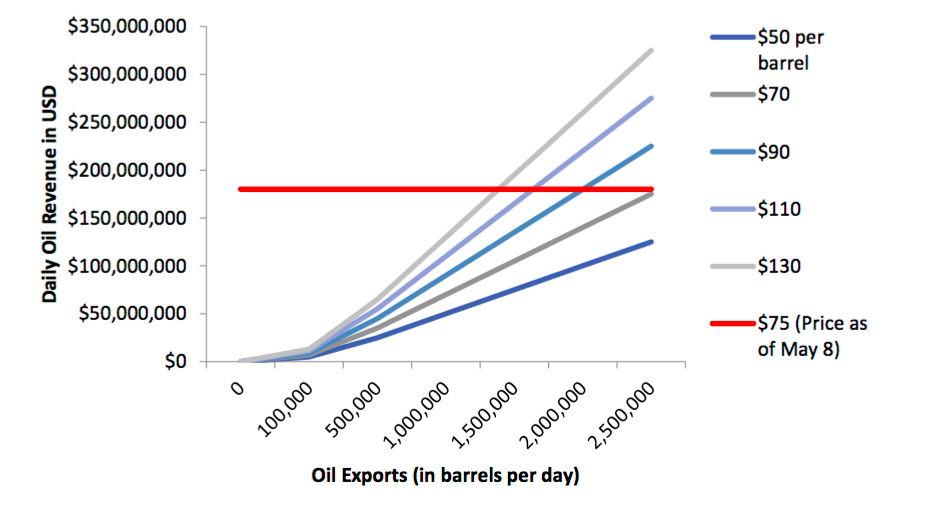
If instead oil had been trading at USD 130 per barrel on that day, Iran would have earned over USD 310 million. And if oil had been trading at USD 50 per barrel, Iran would have earned only USD 120 million—in all, a fairly straightforward math problem to solve.
Where things get more complicated is when one takes into account falling Iranian oil exports and potentially rising oil prices.
Naturally, if oil prices remain roughly the same, every lost barrel of Iranian oil exports means a real economic loss to the Iranian government. If Iranian oil exports decrease from 2.4 million bpd to 1.5 million bpd, Iran will experience a loss of approximately USD 67 million in its revenue stream. Taken over the course of a year, this would mean lost national revenue approaching USD 25 billion, a substantial sum for a country with significant economic problems and strained liquidity.
However, if oil prices go up, then—as Figure 1 shows—the immediate revenue impact of sanctions can be mitigated, potentially entirely. The red line’s intersection with various price curves shows this: at USD 130 per barrel, Iran need only export 1.38 million bpd to average the same daily revenue as at USD 75 per barrel with 2.4 million bpd in exports. With a more conservative oil price increase—for example, to only USD 100 per barrel—Iran would generate the same revenue if it exported only 1.8 million bpd.
But of course, the effects are magnified when an entire year’s worth of sales is factored in, as Table 1 demonstrates.
Table 1: Annual Revenue for Average Export Rates
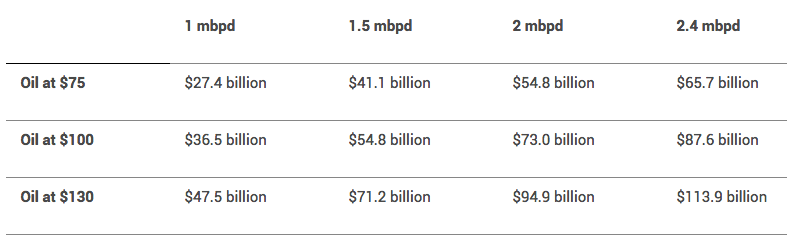
Even if the Trump administration is able to reduce Iranian oil sales to 1 mbpd, at higher oil prices, Iran’s ability to compensate is substantial. A more meager reduction, matched by higher prices? Iran might profit.
In Practice
There are myriad reasons why a simple mathematical abstraction is incapable of capturing the diversity of reactions and feedback loops that will determine Iranian oil sales and revenues. It is worth noting in this context that US officials had similar concerns that removing Iranian oil from the market would cause prices to go up during the 2011–2013 Iran sanctions experience and that these fears were ultimately unfounded. Arguably, this came because of the moderation shown by the Obama administration in its demands for reductions—20 percent every 180 days—and the revelation of US shale oil production. But still, it is an indication that unexpected forces can intervene.
To start, prices are in part set by supply and certainly by expectations of supply. To the extent that Iranian supply is not taken off the market, then this will have a moderating impact on prices, slowing their rise and ensuring that Iran bears the brunt of the sanctions pressure. The same would apply if additional supply were to be added by other producers, though finding 2.4 million bpd to add to the market by November 4 is not possible. By the same token, if the United States were able to prevent Iran from exporting any oil, then any increase in price would also not be enjoyed by Iran, no matter how high prices might go. Of course, the higher prices would be felt elsewhere in the global economy and back home in the United States. But from the simple perspective of “putting pressure on Iran,” such a scenario would mitigate the dynamics discussed here.
Moreover, oil revenue is not a perfect proxy for sanctions pressure on Iran. One of the elements of US sanctions against Iran is that Iran is barred from freely accessing its revenues held in foreign banks. Instead, per US law, banks are required to make Iran’s funds available only for bilateral trade or for the purchase of humanitarian goods. Any banks that fail to abide by these restrictions can be prohibited from opening or holding correspondent bank accounts with U.S. financial institutions – effectively banned from doing business in the United States. With this in mind, even higher oil prices and record Iranian oil revenues might not meaningfully buttress the Iranian economy if those revenues are locked up in foreign banks. But this in turn requires assumptions to be made about the level of cooperation that the United States might enjoy in sancitnos implementation. Many banks in Europe and in Asia will resist provoking US sanctions and isolation. Some, however, may decide it is worth the risk, as Chinese Bank of Kunlun did in 2012 when it was sanctioned by the United States. It remains a reasonably profitable institution, notwithstanding US sanctions, and may even become more so if other Chinese transactions with Iran were to flow through it. There is nothing in particular to stop other banks in other countries from pursuing the same path, if they determine the cost is worth the benefits.
This in turn informs another important element: whether all of this will matter in affecting Iranian behavior. From 2012–2013, the United States denied Iran over $50 billion in oil sales and prevented it from using billions more that were held in banks around the world. The result, at least in part, was the negotiation and implementation of the Joint Comprehensive Plan of Action (JCPOA). That might not be the result of another round of sanctions. Diplomacy with the United States has lost its luster in Iran, and its leaders are now talking about the possible use of military instruments to blockade the Persian Gulf, as they have in the past. Even if this extreme scenario does not come to pass, the idea that Iran’s response to renewed economic pressure would be to deal with the United States and to offer further concessions than in 2013–2015 is, at this point, hopeful speculation. There are many different factors that could undermine this hope, from the practical (Will any US partners work with the United States on sanctions?) to the theological (Would Iran be prepared to negotiate with the "Great Satan" again?). Even more importantly, these factors will interplay with one another in ways that we may not be able to anticipate at the outset.
One factor, to be sure, will be the effect of sanctions on oil prices. Given the risks of this strategy, one need hope the United States has a better plan than badgering OPEC.
Photo Credit: EPA/Shutterstock