
Iran’s Water Protests are Not About Water
Esfahan is accused of being privileged as water protests expose regional inequalities in access to the Iranian government.
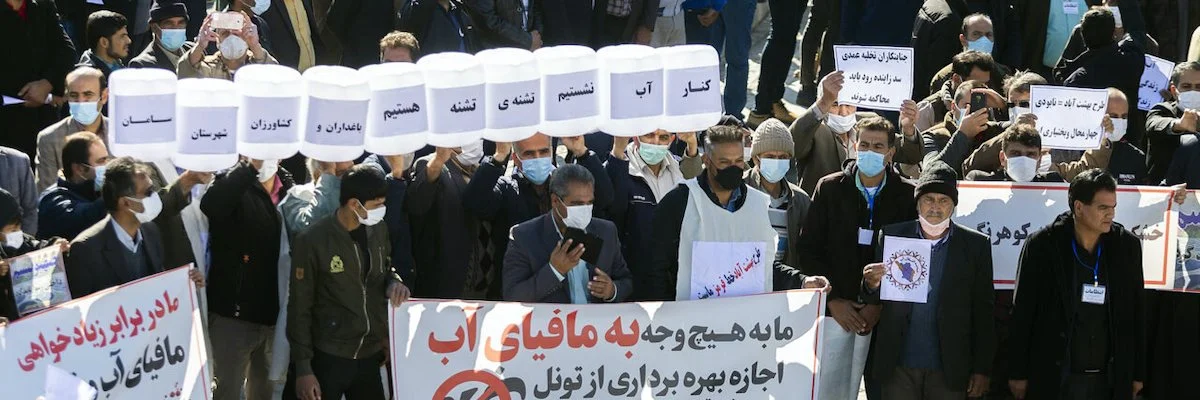
On November 8, a group of local farmers arrived in the city of Esfahan to protest in front of the offices of the official state news agency and the regional water authorities. The protestors called on the government to release water into the Zayendeh River, which has laid dusty and bare for months, a reoccurring phenomenon. Over the next days, the farmers continued their demonstration in the dried-out beds of the river, camping out close to one of downtown Esfahan’s iconic bridges.
But what started out as a small-scale protest action by farmers from east Esfahan quickly turned into the Ebrahim Raisi administration’s largest popular challenge since taking office in August. On November 19, a day after negotiations between the Esfahan Farmers’ Union and the regional government broke down again, thousands of city-dwellers suddenly joined the farmers to demand that the Zayandeh River be filled up.
The government’s initial response to the mass demonstration was conciliatory and supportive. State media broadcasted the Friday rally widely. Officials came to speak to the protestors directly, expressing their sympathy and promising to address the problem promptly. The minister of energy even formally apologised to the farmers, saying he felt “ashamed” that the government had failed to provide enough water.
Soon enough, the tone changed. Within days, security forces moved in, cracking down on the remaining protestors. Police brutally dispersed the protestors and destroyed their tents. On social media, images of farmers drenched in blood circulated widely.
In theory, water protests should have broad popular support in Iran. Not only is the country mostly arid and semi-arid, but Iranians have also suffered from worsening draughts and environmental degradation provoked by climate change, government mismanagement, and economic sanctions.
In reality, however, solidarity has been hard to obtain as ordinary Iranians, state organisations, and political elites compete fiercely about how to share the country’s increasingly scarce water resources.
Many of these rivalries are long-standing, and they broke out again following the Esfahan protests. In the capital of the neighbouring Chaharmahal and Bakhtiari province, hundreds of residents and farmers took to the street to protest against the Esfahan protestors’ demand for more water. The Chaharmahal protestors argued that their province, located in the mountainous Zagros region of southwestern Iran, already supplies too much water to the dry central plateau region, of which Esfahan is part. In turn, Esfahan farmers deployed an old tactic: they sabotaged the water pipes headed to the even drier Yazd province, arguing that “their” water is unjustly being diverted elsewhere.
This nasty and zero-sum type of group politics has become deeply entrenched in Iran over the past two decades. In this configuration, Esfahan province has certainly emerged a winner. Its rural residents earn on average about a quarter more than peers in the Zagros region or Khuzestan, which is home to the Karoon, the largest river in Iran. Moreover, Esfahan’s urban and provincial elites have been successful in turning local distributional conflicts over water use into demands for more water from the Zagros. Farmers from eastern Esfahan have long complained about excessive water use by the city of Esfahan. Regional authorities have used these protests to claim more water from upstream provinces.
Yet, rather than being diverted to eastern Esfahan, much of that extra water has gone into urban consumption and toward large-scale steel manufacturers in the region. These inefficient and wasteful factories, mostly built before the 1979 revolution, are heavily subsidized by a central government keen to maintain a degree of self-sufficiency in steel production.
It is perhaps unsurprising that, following the November 19 demonstrations, much of the debate on social media centred on Esfahan’s privileges. One popular Twitter user argued that “Esfahani greed is what has turned the Zayendeh River into an issue. Esfahanis do not only want [to produce] steel but they also expect the water of Khuzestan and Chaharmahal to be transferred to this industry. If we are to believe you, you should protest in front of the Mobarakeh and the Esfahan Steel Companies.”
Rather than blaming specific individuals, entities, or social groups, many other activists accused the “water mafia” for the opaque and mean-spirited machinations of the country’s water politics. Seyyed Yousef Moradi, an environmental activist from Yasuj, commented that: “Even though you think that people from the Zagros Mountains are simple, we are not ignorant. We understand that a ten day sit-in in Esfahan for water provision, with the wide-spread support of media and the government, is a part of the water mafia’s plan to justify projects to transport water from the deprived provinces of the Zagros.”
The term “water mafia” is also popular among the country’s political elites, who are keen to avoid direct confrontation among each other, and fear turning the conflict into an ethnic struggle between the Persian majorities of the central plateau and the Arab, Lor, and Bakhtiari minorities of southwestern Iran.
Indeed, while Esfahan’s relative wealth and power is undeniable, upstream provinces and groups do not lack political representation. In the past, the local elites in the Zagros and Khuzestan have often supported their constituents’ protests about water rights. For instance, in early 2014, the local MP and the local representative of the Supreme Leader came to the support of several thousand people who had gathered in Shahr-e Kord, the capital of Chaharmahal province. The protestors demanded a halt to construction work on tunnels designed to transport water to the central plateau.
Following similar protests in Khuzestan in the summer of 2016, Ayatollah Abbas Ka’bi, the province’s representative in the powerful Assembly of Experts, issued a fatwa prohibiting the transfer of water from Khuzestan to the central plateau for agricultural or industrial purposes. When rumours circulated last July that these water tunnels had been officially opened—thus breaking the religious ruling—protests flared up across the province. Initially, Ayatollah Ka’bi supported the protestors and called the demonstrations legitimate. He turned quiet when, as protests continued and spread over the next days, security forces decided to crack down violently.
The July protests in Khuzestan and the November protests in Esfahan are intimately related. The Esfahan protests, and the Esfahan Farmers’ Union’s failure to reach an agreement with the government over the Zayendeh River’s fate, is at least partially the product of recent struggles in Khuzestan and the Zagros to prevent the transfer of water to Esfahan. Because water in Iran is not a public good, the protests are not really about water. Rather, what protestors are fighting for is access to the government. Protestors want the government to enable their consumption of water.
For their part, state authorities are locked in a delicate balancing act. Strapped of cash in the face of a severe US-led sanctions regime, the government has not been able to cough up the investments necessary to update the country’s outdated irrigation systems and water infrastructures. While security forces are eager to crack down on what they perceive as disturbances and unrest, many other state elites are caught between, and often on the side of, various social groups and their competing demands for water.
In order to make water resource management in Iran more efficient, fair, and equitable, the country needs to move beyond its current form of interest group politics. Unfortunately, there are few indications that the broad-based solidarity such a movement requires is in the making. As a result, it is likely that water protests will continue to flow.
Photo: IRNA
Here's How the European Commission Will Allocate EUR 18 Million in Iran
◢ This month, the European Commission approved an initial tranche of EUR 18 million in development funding from an larger package of EUR 50 million that has been allocated to support projects in Iran. This represents a highly significant, “first-of-its-kind,” intervention to support Europe-Iran trade and investment. However, the funding is not primarily intended as an attempt to mitigate the effect of returning U.S. secondary sanctions. As made clear in the “action document” which details how the development funding will be distributed, the European Commission has allocated the funding “in line with the European Consensus on Development” to provide “targeted support in the areas of Prosperity, Planet and People.”
For Iran, EUR 18 million represents just a drop in the bucket in terms of the foreign direct investment that the country needs for its economic development. But in terms of development funding, this amount, an initial tranche of a larger EUR 50 million bilateral allocation introduced by the European Commission and the European External Action Service this month, represents a highly significant, “first-of-its-kind,” intervention to support Europe-Iran trade and investment.
Iran is an unusual recipient for European development aid—by the usual metrics, the country is too rich. But after some internal political wrangling, the European Commission decided to proceed with a “special measure” in order to support the policy priorities of the European Union, namely the preservation of the Joint Comprehensive Plan of Action (JCPOA).
However, the funding is not primarily intended as an attempt to mitigate the effect of returning U.S. secondary sanctions. Rather, as made clear in the “action document” which details how the development funding will be distributed, the European Commission has allocated the funding “in line with the European Consensus on Development” to provide “targeted support in the areas of Prosperity, Planet and People.”
In the area of “Prosperity,” the European Commission will seek “increased and diversified trade in goods and services” by supporting better trade policy, more effective investment promotion activities, and greater support for entrepreneurship and innovation. In the area of “Planet,” the European Commission will seek “the decoupling of economic growth from environmental degradation” by supporting programs that improve waste management and reduce water and air pollution through technologies that improve efficiency and greater awareness among policymakers and the general public. Finally, in the area of “People,” the Commission seeks to support “comprehensive and evidence-based drug use prevention, treatment, rehabilitation and social reintegration” with a special focus on the use of opiates such as heroin and its role in spreading HIV/AIDS. The “Prosperity” and “Planet” areas have been allocated EUR 8 million in funding, while “People” has been allocated EUR 2 million.
The implementation of the funding differs in each area and will use both direct and indirect management, with the Commission ensuring that “that the EU appropriate rules and procedures for providing financing to third parties are respected” in all cases.
Funding in the area of “Prosperity” will be allocated through the International Trade Center (ITC), a United Nations agency. The ITC will assist Iran’s Trade Promotion Organization, a agency of the Ministry of Industry, Mine and Trade to develop a “national export strategy” with a particular focus on boosting the capacity of small and medium-sized enterprises (SMEs) as well as the internal managerial and technological capacity of TPO. ITC and TPO will also collaborate to develop a “Youth Trade Accelerator Program” which will youth-led enterprises. Initial meetings have already been held between ITC officials and Iran’s TPO and the cooperation envisioned and funded by the Commission builds on an MOU signed between ITC and TPO in 2016.
In the area of “Planet,” the European Commission will directly administer the funding on the bases of grants and will reply upon “pillar-assessed” organizations from its member states, a designation that applies to those organizations which have been pre-approved to implement resources from the European Union’s general budget. Efforts in this area will build on the EU-Iran framework for technical cooperation on the environment signed by Iran’s vice president for environment Masoumeh Ebtekar and EU environment commissioner Karmenu Vella in Brussels in September 2016. A consortium of member-state organizations is expected partner with Iranian stakeholders to drive the implementation of pilot projects that “contribute to enhancing Iran’s self-reliance in the areas of addressing water pollution and integrated water resources management, air pollution, waste management and soil degradation.”
Finally, in the area of “People,” funding will be directly managed and dispersed via grants. The Commission will issue a single call in the “first trimester of 2019” for proposals “to finance projects aiming at comprehensive and evidence-based drug use prevention, treatment, rehabilitation and social reintegration, with special emphasis on high-risk groups.” Interestingly, these grants will not be made directly to Iranian institutions. Instead, eligibility criteria mandate that grants flow to “agency, non-governmental organization, public sector operator, local authority, international research organization, university or university related organization” from an EU member state or a small group of international organizations. While the public health benefits of these grants will no doubt be substantial, these restrictions raise the question of how much of the financial impact of the EUR 2 million in grant funding allocated for the area of “People” will be felt in Iran.
Overall, the Commission’s efforts are encouraging for their scope and the clear willingness to deepen bilateral ties between the European Union and Iran at a fraught political moment. But beyond good intentions, implementation will be key. To this end, the Commission outlines a series of “assumptions” which underpin the feasibility of the planned cooperation with Iran.
The envisaged cooperation requires that “Iran ensures the necessary human, financial and material resources to facilitate the implementation of projects as far as cooperation with national authorities is required” and—in a crucial consideration given still-unexplained arrests of Iranian environmentalists—that “technical exchanges and cooperation between public sector and civil society actors… remain non-sensitive and feasible.”
Photo Credit: European Commission
Slowly But Surely, Lake Urmia Comes Back to Life
◢ Lake Urmia was once the second largest salt-water lake in the world. But years of environmental mismanagement saw the surface area of the lake shrink by 90%.
◢ After a decade-long initiative led by the United Nations, and supported by the Iranian and Japanese governments, water levels in the lake are finally beginning to rebound.
This article was originally published on the United Nations Iran website.
Life has returned to the dying Salt Lake in North-West Iran. The effort to restore what had been broken is succeeding.
Returning to the barren landscape after almost four years, I was able to see water. Not nearly enough, but much more than last time. The lake is reviving. And this revival is the result of an immensely successful collaborative effort involving many players—some Iranian, some foreign.
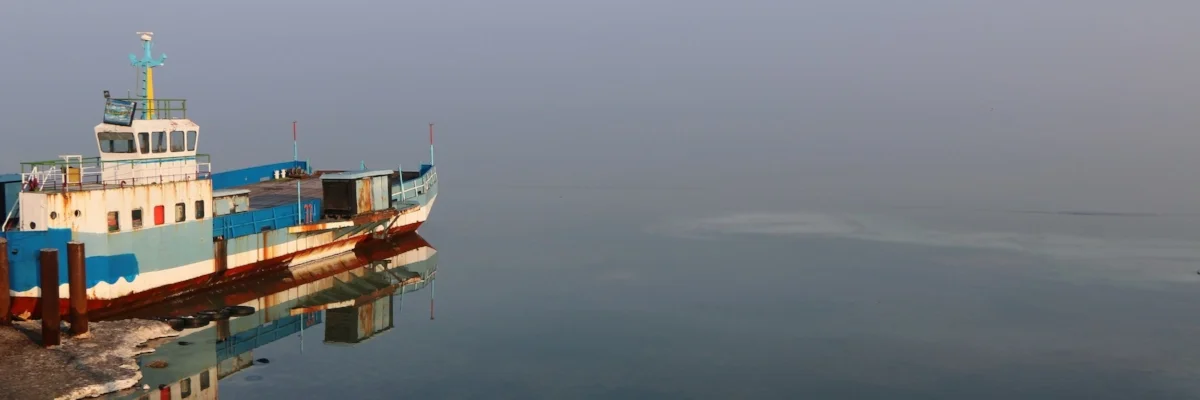
Lake Urmia was once Iran’s largest lake. In its prime, it was the second largest saltwater lake in the world. But years of man-made disruption—from the frenzy of 60 years of dam-building to the massive over-use of feeder rivers—had diverted the natural flow of sweet water from the surrounding basin into the salty lake. As a result, it simply dried out. It died at the hands of humans.
I also remember thinking that if the lake dried up two main things would happen. One is that salt from the dried lake bed would blow around and get dumped on farming land and crops in what essentially becomes a salt dustbowl in a fairly large radius around the lake. Secondly, we could expect people to get sick. For example, in the vicinity of the dried-out Aral Sea in Central Asia, we already see people afflicted with allergies and respiratory diseases including cancers.
But there would be a third self-destructive phenomenon at play as well. As farmers drilled ever-deeper to pump out the aquifers at the side of the lake for farming, over-exploitation of this groundwater surrounding the lake would cause saltwater seepage into those very same wells. This would hit people’s access to potable drinking water. So we were threatened by a “perfect salt storm” affecting people’s health and livelihoods.
When our plane landed in Urmia two weeks ago, having taken the normal one hour to fly from Tehran, I wondered what I would see. I had heard tell of an improvement. But such stories often vanish in the face of requests to provide evidence. I wanted to see for myself.
It was when we started to approach the vast open expanse of lake bed that I saw the morning sun glimmering off something which had not been there when last I travelled to the lake.
Water. Not deep. But enough to cover the salt dust granules which had caused such havoc before. As we drove across the bridge which bisects the lake, the glimmering started to stretch out towards the rising sun.
I must confess I was so happy that tears were welling up in my eyes. The environmental problems we create can be fixed, I thought. And here is how it happened.
First, some numbers.
When Lake Urmia was full, say 20 years ago, it was estimated to contain around 30 billion cubic meters (bcm) of water. At the worst point, 3 to 4 years ago, it contained a mere 0.5 bcm of salt water. The number now stands at 2.5 bcm. The deadly decline has been reversed. The amount of water now keeps increasing each month.
Use slider to see before and after.
Three to four years ago, when the water level was at its worst, only 500 of Lake Urmia’s 5,000 square kilometer surface was covered by any water at all. That figure has now risen to 2,300 square kilometers. Admittedly, much of that water is spread extremely thin, and some tends to evaporate easily. But it is there, offering a protective covering for the estimated 6 billion tons of salt and dust, which now no longer finds its way so easily into the air, into our eyes and lungs, and onto the farmers’ crops.
Because the amount of annual precipitation in terms of rain and snow in the basin has not changed appreciably in the last few years, we must look elsewhere for an explanation of why the lake is now filling up.
There are three main reasons. The first is engineering works to help unblock and un-silt the feeder rivers. Second is the deliberate release of water from the dams in the surrounding hills. Third, and most difficult of all to accomplish, has been a change in the way water management in the basin happens—especially among farmers. Other approaches like banning illegal wells have also had an impact.
The third approach—better water management—took considerable time and effort to achieve. But it appears here to stay. While practicing new roles and partnership of local authorities and communities within LU restoration process, it took painstaking effort to get farmers to reconsider how they grow their crops by modifying their agricultural techniques when growing wheat, barley, rapeseed and fruit and vegetables.
The new techniques are astonishingly simple: changing farm dimensions to make for smaller plots which retain water better; not using flooding as a form of irrigation, but rather trickle-irrigation which is targeted at the crops and thus not wasted; avoiding deep tillage which causes unnecessary water loss; introducing drought-resistant crop strains; ploughing plant residue back into the soil rather than burning it.
Across the board, the crop yield—despite using less water—has also increased by 40 per cent.
Use slider to see before and after.
Here is a final reassuring set of numbers. Considering the normal hydrological conditions, the lake has an average of 5.4 meters and the maximum depth in northern part around is around 15 meters. When the lake was at its worst point, the lake’s average level had dropped to almost zero. When we compare the level of the lake taken now with what prevailed at exactly this time last year, we note a 6 centimeter rise. The monthly increases have been incremental, but sustained.
The project which has brought about the improved water management is being implemented by the UN Development Programme (UNDP). Based in West and East Azerbaijan provinces with a focus on Lake Urmia surrounding cities and villages, it works closely with local farmers, provincial and national governments and others to initiate an adaptation process by implementing the “ecosystem approach."
Following a 7 year project to introduce ecosystem approach for saving Lake Urmia, with the generous financial support from the Japanese government in recent years, as well as an inflow from the Iranian government’s own resources at both the national and provincial levels, these techniques have been successfully implemented in 90 villages. But this number represents only about 10% of the irrigated farming area in the Urmia Basin. Nonetheless, in the areas where the sustainable agriculture is being practiced, there is a water saving of about one-third of the water that would otherwise have been wasted under the old inefficient practices. This saved water can flow back into the lake, thereby replenishing it.
UNDP’s interventions to save Iranian wetlands including Lake Urmia—starting 12 years ago, but intensifying significantly with the addition of three phases of Japanese funds—have focused on working with local farmers, cooperatives and government to support a new model of partnership among stakeholders and initiate an adaptation process by implementing sustainable agriculture techniques. It has also advocated alternative livelihoods for women using micro-credit and biodiversity conservation.
At present the project’s interventions cover sites all around the lake, and most affected, part of the lake basin. To boost coverage from 10%, the plan is to move towards significant upscaling of this important initiative in an emblematic effort which is being recognized at an international level.
As I got on the plane to return home to Tehran in the evening, three takeaway lessons occurred to me.
First, we face powerful environmental challenges in Iran. But we can fix what we have broken. And this is happening—right now—in Lake Urmia.
Second, the public must educate itself and speak out on the environment. The UN received a petition in 2016, containing 1.7 million signatures, requesting action on Lake Urmia. The pressure has been relentless. Such pressure must be welcomed and acted upon.
Third, in the final analysis, these environmental problems cannot be solved if we act alone. The Lake Urmia response shows that it takes leadership by public authorities, acting in collaboration with the affected communities, and sometimes with support from the international community (technical support from UNDP and financial support from a partner like Japan) to do the trick.
What has happened in Lake Urmia is an example to inspire us all—both within and beyond Iran.
Photo Credit: United Nations Iran, Nasa
Iran's Business Leaders Must Do More to Protect the Environment
Iran's businesses have a responsibility to protect the environment alongside the government and civil society. Companies should be motivated by both profit and an ethos of corporate social responsibility to adopt more sustainable practices.
In today’s energized, almost-post-sanctions-era Iran, so much has become possible. But as growth takes place, and as increased capital flows into the country, we need to expect more from our business community as contributors to human development.
Businesses are expected to make profits. That is how wealth and jobs are created. That is how lives and livelihoods are transformed. But, along with profits, comes an expectation that the business community must act responsibly in terms of the social, environmental and economic improvement of the communities in which they make these profits. Most notably, businesses must focus on their responsibility to protect our environment.
Facing Grave Challenges
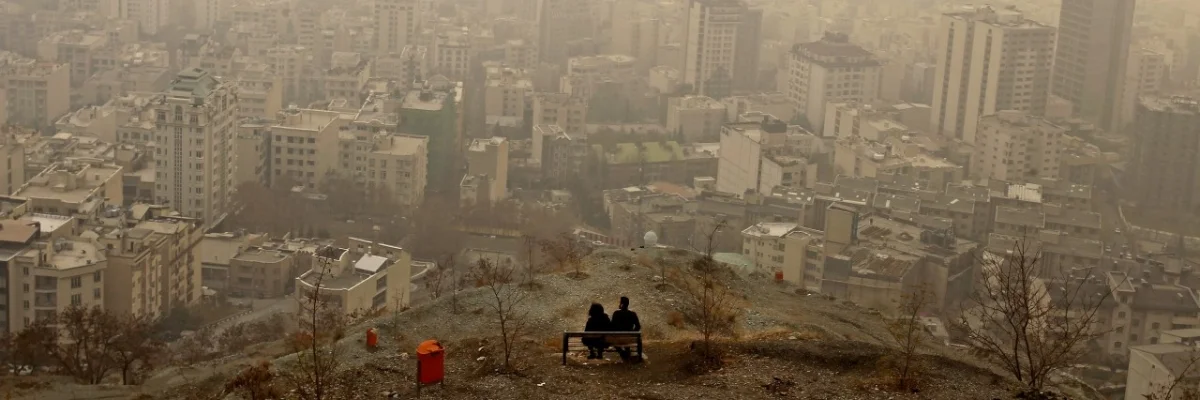
At present, our fragile, endangered planet faces many grave challenges. One of the greatest human development challenges we are witnessing in Iran is the threat of an increasingly hot and dry environment. The environment is being degraded through our actions. Climate change, coupled with the poor environmental decisions of the past, is making Iran hotter and drier. We see a country that is water-stressed, losing its forests, polluted by sand and dust storms, and energy inefficient. We see dramatically less biodiversity than even a decade ago.
The government is trying to reverse environmental degradation, but without the overall level of success required. Due to the scale of the problems and the nature of the causes, these problems can only be successfully addressed when all stakeholders who have had a share in creating them commit to finding solutions.
We all need to start acting sustainably. Governments need to do more. Citizens need to do more. And yes, frankly, the United Nations must also do more. We need to speed up our responses. Fortunately, the governments of the world, including Iran, have agreed to implement the Sustainable Development Goals (SDGs) which came in to effect in January 2016. These goals strive to end poverty, protect the planet, and ensure prosperity and peace for all through partnerships. We all need to take the time to learn, understand and apply these goals.
The United Nations is already working closely with the Iranian government to tackle many of the challenges identified through the SDGs. Encouragingly, Iranian authorities, along with most governments worldwide, are starting to frame a response to SDG targets.
Now is the time for the Iranian business community to also become more involved and visible in sustaining our environment. I believe that the business community must get involved both directly and indirectly in order to protect our environment. This can come in two ways. Direct and indirect.
Direct Efforts
Business efforts to reduce the environmental impact will increasingly become a matter of self-interest. Iran has committed, under its draft sixth Five-Year National Development Plan, to implement a low-carbon economy. Given this, plus the global commitments to which Iran has signed up to under the Paris Agreement, the Government will increasingly pass laws and policies which mandate emission reductions. Businesses therefore have a profit incentive to anticipate the regulations which will inevitably be imposed by an Iranian Government increasingly needing to comply with its own international carbon-reduction obligations.
In line with this, businesses should be innovative. Innovation brings about new opportunities and thus benefits the company and the society. “Sustainable innovation” can include such elements as a reduction in water use for production and the encouragement of companies to incentivize their customers to use less water by recycling.
Next, businesses should switch to more cost-effective techniques for their infrastructure. For example, when operating a business, one of the biggest burdens can be the cost of energy. Thus, in order to reduce these costs, the following steps can be taken:
Buy energy-efficient appliances and devices.
Switch off equipment when not in use.
Monitor your corporation’s energy usage by installing the necessary equipment (and act on what the numbers show)
Switch to using renewable sources of energy where possible (such as wind and solar).
But we also need to start with ourselves. And so, another step forward for businesses can be the engagement of employees and customers in sustainable behavior and actions. These actions entail raising awareness about a company's own “sustainable goals,” so that more people can become involved in supporting and helping to achieve those goals. It is the responsibility of every business to send the same message and encourage others to join these efforts.
Indirect Efforts
But there is another – indirect – way in which businesses can act to improve the environment. This is through Corporate Social Responsibility (CSR). Across the planet, CSR is becoming recognized as a strategic management tool for guiding corporate decisions. The ethos of CSR should also filter down to operations. In the end, and if done well, CSR will powerfully enhance a company’s corporate image in a world where, increasingly, if you are not visible, you are not relevant.
We are no longer in a position to choose pure profit. Our growth must be inclusive. Our development must be sustainable. And our environment must be safeguarded. These ideas were what drove former UN Secretary-General Kofi Annan to create the UN’s Global Compact in the year 2000. The Global Compact brings together business, governments, civil society and UN agencies to advance universal principles in the areas of environment, labor, human rights and anti-corruption. This initiative is the world's largest voluntary corporate citizenship pact. At present, over 4,100 companies from over one hundred countries participate. CSR is at the very center of our Global Compact. But there are hardly any Iranian companies represented in the Global Compact. The time has come for this to change.
CSR can contribute to overcoming human development challenges in all countries. Through CSR, companies can financially (or in-kind) support environmental causes and donate to organizations and charities that are working to overcome some of the challenges facing our planet. Irrespective of size, businesses can get involved and send a positive message to others to participate in CSR.
With this in mind, I urge business leaders in Iran to explore CSR and engage in partnerships to make growth more inclusive and more environmentally-sustainable. Living in Iran, I am encouraged by the number of private sector organizations, public corporations, and banks who wish to collaborate with entities – including those like the UN – to promote environmental initiatives and inclusive growth. Although I see encouraging signs within the private sector towards these goals, much more needs to be done.
Today, the world is demanding that companies behave responsibly vis-a-vis the environment. The spirit of “partnership” within the corporate community is at the heart of the SDGs. One goal in particular—Sustainable Development Goal 17—calls on all states to “Strengthen the means of implementation and revitalize the global partnership for sustainable development.” This is a direct call-to-action for the private sector. In order to attain sustainable development we need more hands. Each and every citizen has a role to play.
The UN stands ready to assist Iran's robust business community in promoting CSR.
Photo: Newsweek