
Here's What Iran Wants From Sanctions Relief
A new report from the Majlis Research Center offers the first assessment of what “verified” sanctions relief might look like, providing a glimpse into how negotiators will take forward a key demand set out by Iran’s Supreme Leader.
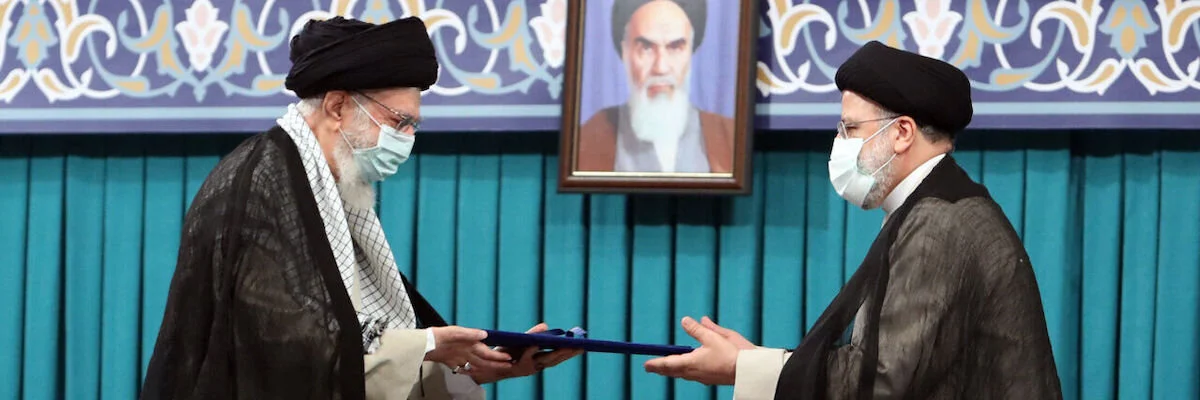
Back in February, Iran’s Supreme Leader, Ali Khamenei, set out an early condition for new negotiations over the fate of the JCPOA. In a major speech outlining Iran’s “final” stance on U.S. reentry into the nuclear deal, Khamenei declared that sanctions relief must be implemented “in practice” and not just “on paper.” Iran would also “verify” that sanctions relief commitments had been met before fulfilling its own commitments under the restored agreement.
Khamenei’s demands were shaped by the bitter experience of the Trump administration’s withdrawal from the JCPOA and unilateral reimposition of sanctions. The issues surrounding sanctions relief and Khamenei’s demands hung over six rounds of negotiations in Vienna. They are again being cited as a possible reason for the Raisi administration’s slow return to the nuclear talks. But what exactly Iranian leaders envision for verifiable sanctions relief has been unclear.
A new report, published by the Office of the Deputy for Economic Research of the Majlis Research Center, the influential research body of the Iranian parliament, offers the first detailed assessment of what verified sanctions relief might look like. The report, entitled “Verifying Sanctions Relief,” does not represent the official position of the Raisi administration, but given the timing of its publication and the affiliation with parliament, it likely represents an emerging consensus about how best to meet Khamenei’s demands while also assuaging the concerns of Iranian parliamentarians who feel the JCPOA is inherently unfair. Many of the details in this new report are drawn from an April 2021 report published by the same research centre that also looked at issues around the verification of sanctions relief. But the new report is more detailed in its diagnosis of the problem sanctions verification seeks to address and the mechanisms that should be used.
In particular, the report aims to address the perceived imbalance between paragraphs 26 and 36 of the JCPOA. Iran interprets paragraph 26 to allow it to lessen its commitments under the deal if sanctions relief is not fully implemented—an interpretation that is disputed by the P5+1. Paragraph 36, meanwhile, allows any party to trigger the dispute resolution mechanism and begin the process of “snapback” of sanctions—a provision that Iran considers a tool for the West to renege on the deal. Additionally, the report outlines an asymmetry in the ways in which Iran’s nuclear commitments under the JCPOA and the sanctions commitments of the P5+1 are overseen and implemented. Unlike nuclear commitments, sanctions relief commitments lack a verification and monitoring mechanism, can be obstructed, are slow to implemented, and can be undone unilaterally through snapback. The report summarises this asymmetry in the following table (translated here):
To address this asymmetry, the report calls for measures to be taken in three broad areas. What is striking about these measures is their practicality. The report basically calls for a more institutional and technical approach to sanctions relief in which a checklist provides Iranian policymakers an ability to assess the implementation of sanctions relief on an ongoing basis. As part of this approach, the report also sets out targets for oil exports and bilateral trade with Europe.
New Verification Body
The report calls for the designation of an Iranian body or institution to oversee verification of sanctions relief. This could be the Supreme National Security Council or it could be a new body established with its own staff and active secretariat. The body would have three tasks:
Observe and assess the actual impact of sanctions removal.
Establish a mechanism so that any Iranian person or entity can submit a complaint about issues related to sanctions relief.
Prepare an action plan for decreasing nuclear commitments in the event that other parties to the JCPOA renege on their commitments. Actions might include ceasing the voluntary application of the Additional Protocol, producing uranium metal, increasing enrichment above 20 percent, or expanding the number of operational IR6 centrifuges.
Verification Checklist
The new verification body would perform its mission in accordance with a defined “checklist.” The checklist would have two sections. The first section relates to specific actions and targets related to American and European sanctions relief commitments. The stipulations include:
Iran should be able to export oil and gas condensate according to its rightful market share of 2.5 million barrels per day (bdp) with an initial target of 2 million bdp.
This target is feasible—during the sanctions relief afforded Iran under the JCPOA in 2016-2018, Iran exports hovered between 2 and 2.5 million bpd.
Iran should be able to increase bilateral trade with key European partners and conduct normal banking transactions to facilitate that trade. The report stipulates an initial monthly target of $3 billion in transactions with EIH Bank in Germany, rising to $4.2 billion. Monthly transactions with the French branch of Tejarat Bank are targeted at $1 billion, rising to $1.5 billion.
Here, the report has highlighted Iranian-controlled financial institutions in Europe as the key conduits, perhaps reflecting how in recent years Europe-Iran trade has been increasingly run through smaller European banks without Iranian ownership or management. While the report stipulates “transactions,” the targets here are high when likely trade totals are considered. Even if we interpret that key Germany and France-based banks may process most EU-Iran trade, the total initial transaction volume envisioned of $48 billion is significantly higher than the total value of EU-Iran trade in 2016 following the lifting of sanctions. That year, bilateral trade reached just over EUR 20 billion. While the transaction targets could include foreign investment in Iran, it is unlikely that either EIH or Tejarat Bank can scale-up to handle the envisioned volumes.
Iran will also seek to verify a range of sanctions lifting measures taken by the Biden administration. This includes the removal of executive orders issued by “two American presidents,” a likely reference to Trump and Biden that suggests a desire for non-nuclear sanctions designations, such as the Foreign Terrorist Organization designation of the Islamic Revolutionary Guard Corps, to be lifted. In addition, the report calls for the update of the website of the Office of Foreign Assets Control (OFAC), the sanctions enforcement body of the U.S. Department of Treasury. OFAC is to cease publishing notices, advisories, and fact sheets that dissuade trade with Iran and should increase the issuance of licenses and exemptions to ease trade
This stipulation that means the report authors understand U.S. primary sanctions will continue to pose a challenge for Iran’s engagement with the global economy.
The second section of the checklist focuses on ongoing efforts to decrease the risks of doing business with Iran once sanctions have been lifted. These stipulations reflect the perception in Iran that following the lifting of sanctions “on paper” in January 2016, the Obama administration took a lackadaisical approach to supporting the normalisation of global trade and investment in Iran. The continued characterisation of Iran as a high-risk jurisdiction is seen to have hampered economic engagement. Therefore, the checklist would require:
The removal of all measures that have presented Iran as a jurisdiction with high risk of money laundering and adoption of measures to normalise economic relations with Iran.
Changing the basis of guidance to banks issued by the Treasury Department’s Financial Crimes Enforcement Network (FinCEN) from risk-based to rule-based.
Maximal removal of sanctioned individuals and entities from the SDN list and a substantive review of SDN and non-SDN sanctions lists.
Removal of statements by OFAC and other institutions that dissuade humanitarian trade and maritime trade with Iran. In addition, there should be new licenses issued to all banks that hold Iranian oil revenues in order to ensure the timely release of frozen assets.
A written commitment from neighbouring countries not to take action against foreign entities willing to engage Iran economically.
Official statements proclaiming that medium and long-term economic engagement with Iran is permissible and refraining from any action that would damage engagement with Iran.
Notably, the report does not indicate that Iran would make progress on key measures such as implementation of the Financial Action Task Force (FATF) action plan that would substantially change the perceived risk associated with engaging with the Iranian financial system. While the demand that FinCEN changes its guidance from risk-based to rule-based is unrealistic, it does point to a desire for a more prescriptive approach from the U.S. government that may create a basis for reciprocal regulatory reforms in Iran. Here, the report is pointing to the issue of over-compliance by international banks, which deem the risks and costs of transacting with Iran, even in support of clearly permissible trade, to be too high. FinCEN’s risk-based guidance essentially places the burden on financial institutions to determine the appropriate level of due diligence, putting bank managers in an uncomfortable position where minimising risk means maximising administrative burdens. A more prescriptive approach, like the rule-based approaches taken by some European regulators, may reduce the incidence of over-compliance by eliminating the uncertainty around just how much due diligence is required to mitigate anti-money laundering or counter-terrorist financing risks.
Ongoing Monitoring
Finally, the report envisions that the verification of JCPOA-related sanctions relief will be take place on an ongoing basis. The verification body would produce a quarterly report that would certify that Iran is benefiting from sanctions relief in accordance with the checklist. This monitoring function would track developments in five key sectors: baking and finance, transportation and logistics, oil, gas, and petrochemicals, aviation, and industry and mining. The body would also consult across government and with the private sector. As part of its report, the body would offer its recommendation as to whether Iran should remain in the JCPOA, decrease its commitments, or cease participation. The quarterly reports would be used by Iran to inform its engagement with the JCPOA Joint Commission. Interestingly, the report envisions an Iranian body tasked with verification and does not outline the creation of an international third-party body that would be the true analogue for the IAEA. This may reflect a lack of trust that the third-party body would be impartial.
Outlook for Negotiations
As the Raisi administration has delayed its return to the Vienna negotiations, fears have grown that Iran will not continue the talks where they left off in the sixth round, instead returning to the table with new and unreasonable demands. But there is little to indicate that Khamenei’s “final” stance on the talks have changed since February, meaning that the key unknown is how reasonable Iranian negotiators will be in seeking to secure his core demand for verified sanctions relief. To this end, the new report from the Majlis Research Center should be reassuring. While some of the demands are unreasonable, for example the high targets for Europe-Iran trade and the insistence on changes to how FinCEN provides guidance, they are undeniably technical. Should this report reflect an emerging consensus about how to “improve” the JCPOA not by changing its terms, but by improving its implementation, then the outlook for negotiations may be less dire that many predict. A focus on technical shortcomings rather than political or strategic flaws indicates that Iran sees the value of a restored JCPOA but wishes the benefits to be assured and durable. Should the Biden administration be prepared to acknowledge the shortcomings in the sanctions relief provided to Iran between 2016-2018, there are ways in which verification can be addressed within the context of the deal.
Photo: IRNA

Trump Administration May Use Patriot Act to Target Iran Humanitarian Trade
◢ The Trump administration has imposed successive rounds of economic sanctions targeting nearly all productive sectors of Iran’s economy. But a new wave of restrictive measures now under consideration would have the practical effect of totally severing Iran’s economy from Europe, critically undermining humanitarian trade with Iran.
The Trump administration has imposed successive rounds of economic sanctions targeting nearly all productive sectors of Iran’s economy. These sanctions have been imposed with conflicting objectives in mind, up to and including regime change. But a new wave of restrictive measures now under consideration would have the practical effect of totally severing Iran’s economy from Europe, critically undermining humanitarian trade with Iran. Considering Europe’s renewed motivation to inaugurate INSTEX—the special purpose vehicle through which Europe and Iran will facilitate non-sanctioned trade—the Trump administration’s action could undermine months of high-level diplomatic efforts to save the nuclear accord by entirely eviscerating the limited leverage that Europe possesses with respect to Iran moving forward. This is the likely intention.
Section 311 and Iran
Section 311 of the USA Patriot Act—which was enacted in response to the September 11, 2001 terrorist attacks on the United States—provides authority for the Secretary of the Treasury to designate a foreign jurisdiction, institution, class of transactions, or type of account to be of “primary money laundering concern” and thereby requiring US financial institutions to take “special measures” with respect to them. This authority has been used in relation to foreign countries such as Burma, North Korea, and Ukraine, as well as foreign financial institutions such as ABLV Bank, Banco Delta Asia, Bank of Dandong, and the Lebanese Canadian Bank. The “special measures” imposed with respect to each “money laundering concern” can range from certain minimal record-keeping and reporting requirements to a total ban on the maintenance of correspondent or payable-through accounts.
In November 2011, as part of its own campaign to ramp up the sanctions pressure on Iran, the Obama administration found Iran to be a jurisdiction of primary money laundering concern and proposed the imposition of the fifth special measure pursuant to Section 311. This “special measure” prohibits the opening or maintaining of a correspondent or payable-through account by a US bank for a foreign financial institution if the correspondent account involves Iran in any manner. In addition, the fifth “special measure” requires US banks to apply “special due diligence” with respect to all of their correspondent accounts to ensure that such accounts are not used indirectly to provide services to an Iranian financial institution.
The proposed rule never took effect during the Obama administration’s tenure, as the growing sanctions pressure on Iran made finalization of the rule superfluous and little more than a bureaucratic headache. The Obama administration had accomplished the intended purpose of the rule regardless, as Iran’s banking sector was left isolated and ostracized on the global stage—its reputation muddied by the Section 311 finding and the proposed rule. Once negotiations commenced between the US and Iran with respect to Iran’s nuclear program, the Section 311 rule-making was thrust aside—the Obama administration more immediately focused more on how to lift sanctions than how to impose additional ones.
Treasury’s New Move
But Section 311 rule-making appears to be back with a vengeance. The Trump administration is mulling the issuance of a “Final Rule” that would give the Section 311 designation the force of law. In doing so, the administration would impose the fifth special measure with respect to Iran. The administration’s outside enablers are quickly laying the public groundwork for Treasury’s imminent action. The effects could prove dramatic.
The most significant result of such rule-making could well be the total cessation of humanitarian trade with Iran, as those few foreign banks that maintain accounts for non-designated Iranian banks to facilitate legitimate trade with Iran—including humanitarian trade—shutter such accounts in order to avoid the onerous scrutiny of their US correspondents.
Under the proposed rule, US banks would be required to undertake “special due diligence” with respect to correspondent accounts maintained on behalf of foreign financial institutions. Such “special due diligence” does not require that US banks close the accounts of foreign banks that themselves maintain accounts for Iranian banks so long as such banks do not permit Iran indirect access to the US correspondent account. But US banks are unlikely to narrowly tailor their conduct to the precise nuances of law and will show reluctance to continue banking foreign correspondents that themselves bank Iran. As a result, European banks that maintain accounts on behalf of Iranian financial institutions are likely to take steps to shutter such accounts so as to sustain their own accounts at US banks.
The US Treasury Department is fully aware as to how European banks will react if the proposed rule is finalized, having long used scare tactics to undermine Iran’s banking links to the outside world, so the likely consequences of the proposed rule should be considered the intended ones. This fact provides further evidence that key figures in the Trump administration are seeking to constrict humanitarian trade with Iran, as they seek to foment conflict with Iran or within its borders.
Moreover, no one seriously believes that the proposed Section 311 action will lead Iran to remediation. In fact, the opposite is likely true. When compared to other financial sectors in the developing world, the deficiencies in Iran’s legal regime have often been grossly exaggerated, at times more the consequence of the U.S.’s punishing sanctions than their cause. As Iran continues to take steps consistent with the Action Plan agreed to with the Financial Action Task Force (FATF), Treasury’s action will have the effect of convincing Iran to end its remediation project before the global watchdog, as any such remediation will have negligible benefit in the face of Iran’s designation by the United States.
Will Europe Muster a Response?
Considering European efforts to promote non-sanctioned trade with Iran through the newly-minted INSTEX, the Trump administration’s pending action could not be more concerning. Just as Europe’s leaders work to convince Iran to forget the promised dividends of the nuclear accord and to stick to their own nuclear-related commitments thereunder for a minimum of trade ties, the Trump administration is threatening to hobble INSTEX and thereby undo months of intensive high-level diplomacy. Such an outcome would show Iran just how bound Europe is to American sanctions and how little power and influence Europe exercises within its own borders, much less without. Defying domestic laws such as the blocking regulation in order to comply with US sanctions targeting Iran, Europe’s commercial actors have made clear where power lies in the global economy.
If Europe has any self-regard for its economic sovereignty, it will be sure to publicly and privately warn Washington of the consequences of imposing the fifth special measure—not just to the nuclear accord or the humanitarian situation inside Iran, but also to the transatlantic relationship.
Those in power in the United States envision a world in which Europe has no place but in thrall to Washington. While Iran might not prove sufficiently consequential to Europe to inspire a fight back, the lesson that the Trump administration (and others in Washington) will draw from this episode will be applied more broadly—and more consequentially—to Russia, where European interests are much more significant. If Europe cedes all the ground now, it will have little to defend later.
Photo: Wikicommons

For Payment Service Venmo, 'Persian🍕' Raises Alarms
◢ Venmo is a “digital wallet” connected to one’s bank account that allows users to instantly send and receive money. Venmo users commonly include little messages when sending money to friends. But as a recent experience shows, including the words “Iranian” or “Persian” in a memo, even in reference to a pizza dinner among Iranian friends, can have transactions blocked for further review. Yet including the word “cocaine” in a payment memo will not lead to a compliance review, despite the violation of Venmo’s user agreement. This reflects the unique stigma around Iran transactions.
A few weeks ago, a group of my Iranian-American friends and I gathered after work and chatted about the current political climate over dinner. Like many millennials, we ordered food from Seamless and at the end of the night used Venmo—a “digital wallet” connected to one’s bank account that allows users to instantly send and receive money —to pay back the host for purchasing pizzas and salad for the group.
When sending her contribution to the host, one of my friends wrote “Persian🍕” in the caption. Venmo users commonly include little messages when sending money to friends. But this time the transaction was flagged and blocked immediately. Why? Because the word “Persian” was included in the transaction memo.
Tyler Cullis, an associate attorney at Ferrari & Associates, a sanctions law firm in Washington D.C., explained that “certain words trigger and raise a red flag with Venmo and its parent company, PayPal.” These triggers are any words that could raise potential sanctions compliance issues and require their compliance team to further review the payment to make sure it is not violating any sanctions law. “These regulations are laws, and U.S. persons acting in violation of them may be subject to civil and criminal penalties,” he added.
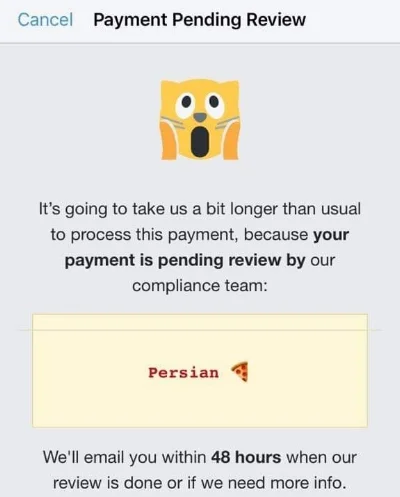
According to current U.S. law, companies have to stop any payments if they believe it to be of Iranian origin because their facilitation, intentional or not, would be a sanctions violation according to the relevant regulations, which specifically prohibit U.S. persons from engaging in any transaction or dealing in or related to goods or services of Iranian-origin.
The pizza that was ordered certainly did not come from Iran—perhaps to the dismay of many Iranians in the diaspora who swear by actual Persian pizza—ketchup and all. Plus, I would think that it would become quite soggy after it was in transatlantic transit from Tehran to Washington.
Venmo’s algorithm scans for “suspicious” transactions based on certain keywords, but it is often inconsistent and illogical. When asked how one would know whether a transaction would inadvertently include a banned word or whether a list would be published on their website for further clarity, a Venmo spokesperson stated that they would not share that since users could then potentially find a way around it.
While perhaps this may only seem to be a minor inconvenience, the impact of Venmo and PayPal’s targeted actions goes far beyond sending and receiving money for food transactions. Small businesses, academic departments, and nonprofit organizations have been directly impacted this blanket ban. Various humanitarian organizations have also had their transactions flagged for further review, delaying the receipt of donations.
Last December, after a major earthquake shook the Khuzestan region of Iran, several individuals affiliated with larger groups hosted fundraisers to gather supplies and money to send to several U.S. based organizations with OFAC licenses. In Washington D.C., one such fundraiser was organized and several donations were blocked when users typed in “Iran earthquake relief” in the memo line on Venmo to purchase their entry to the event. Individuals and smaller groups attempting to make a small impact in their community are the ones affected given many folks don’t have cash on hand or credit card machines and Venmo is known to be a fast and effective substitute.
A representative at Venmo stated that all transactions are reviewed by their compliance team for security purposes but if “something seems off, it is further investigated.” I was also told that if a transaction seems to be “against their user agreement” then it will be flagged for further review.
Several provisions violate the user agreement listed on the Venmo website, however none of those transactions had been immediately flagged. If one types in “drugs,” “cocaine,” or “heroin” into the memo line—clear violations of Venmo’s user agreement which states users may not use Venmo to conduct transactions that involve “tobacco products, prescription drugs and devices, drug paraphernalia, narcotics, steroids, certain controlled substances or other products that present a risk to consumer safety”—the transactions are not immediately flagged for additional review nor blocked.
It’s important to note that Venmo can only be set up by someone with a U.S. bank account and U.S. mobile number. These requirements make it near impossible for Iranians in Iran to engage with and utilize the app.
So what does Venmo consider to be more problematic ? A transaction entitled “Persian 🍕” or “Cocaine 👃”? That a harmless transaction for food is more strictly regulated than a transaction which could potentially be for the sale of controlled substances reflects the stigma attached to anything labeled “Iranian” or “Persian” by users.
Policing transactions with low risks of being actual sanctions violations, but ignoring those significantly more likely to be blatant violations of their own company’s user agreement and potentially abetting illegal activities, is counterintuitive. If Venmo and PayPal truly cared about users not abusing their app and making sure their transactions are appropriate, they should aim to address this issue more intelligently, and not merely implement a blanket ban against certain cultures and keywords.
Photo Credit: Venmo

US Officials Warn of ‘Deceptive Web’ of Iran Business, But Hamper Transparency Efforts
◢ In a recent speech, Under Secretary of the Treasury Sigal Mandelker warned that foreign companies that maintain a presence in Iran must conduct “extra due diligence to keep them from being caught in Iran’s deceptive web.” But background conversations with several compliance specialists reveal that US sanctions are a major barrier to key AML/CTF reforms in Iran. Industry-standard compliance software is not accessible for Iranian end users, leaving some experts to conclude that Iran is being “set up to fail.”
In a recent speech, Under Secretary of the Treasury Sigal Mandelker warned that foreign companies that maintain a presence in Iran must conduct “extra due diligence to keep them from being caught in Iran’s deceptive web.” Mandelker has been touring countries in Europe, Asia, and the Middle East, engaging governments and businesses in order to “make clear the very significant risks of doing business with companies and persons” in Iran.
Many Iranian companies, particularly in the private sector, have long taken seriously the need to conduct enhanced due diligence, including on their own customers and partners. Improved transparency is a prerequisite of working with foreign companies, which remain wary of the wrath of US regulators for any inadvertent sanctions violations.
Since the implementation of the JCPOA nuclear deal, and in anticipation of new foreign trade and investment, many Iranian enterprises have hired specialist consultants to help establish internal compliance departments and institute robust anti-money laundering (AML) and counter-terrorist financing (CTF) processes. Technology solutions are central to any such transparency efforts.
While Iran is witnessing a wider push for transparency, particularly around Iran’s compliance with the Financial Action Task Force (FATF) action plan, there remains internal resistance to compliance reforms. As explained by one consultant who advises Iranian companies on compliance policies, "Elements of the Iranian government contribute to the problem by issuing instructions that foreign companies and technologies should not be engaged to assist the banks in their compliance efforts." These sensitiveness are especially acute for the Central Bank and Ministry of Economy, where Iranian officials fear that foreign technology could be used for espionage. Given that there are no homegrown compliance tools, system-wide implementation remains a distant prospect.
In the meantime, ambitious banks such as Middle East Bank and Saman Bank have been at the forefront of the effort to empower their compliance departments and to demonstrate competencies in know-your-customer (KYC) and know-your-transaction (KYT) due diligence.
However, conversations with several international compliance specialists, who agreed to describe their experiences on background, make clear that—counterintuitively—US sanctions pose the most significant challenges in the effort to improve sanction compliance within Iranian banks and companies. These sanctions prevent industry-standard technology, including software that enables the automated searches of companies and entities for hits against global sanctions lists, from being accessed by users with Iranian IP addresses.
For example, World-Check, a market-leading compliance tool from Thomson Reuters which allows users to “automatically and cost-effectively screen all of their customers, partners, employees, and business transactions for potential Iran sanction risk,” is inaccessible from Iran, despite the fact that the company advertises a specific “Iran Economic Interest Solution” comprised of World-Check and a second product called IntegraScreen. So while foreign companies can use the product to mitigate their sanctions risks, Iranian companies cannot do so for the benefit of their foreign clients or customers.
American companies such as Thomson Reuters are reluctant to enable use of their service from Iran due to primary sanctions prohibitions on exporting a service to Iranian companies, even if that service is intended to help Iranian firms improve their compliance with US and EU sanctions laws. Compliance professionals report that smaller European software companies, which could have filled the gap, are reluctant to do so due to the possible negative impact on their US business and difficulties in processing related licensing fees.
These circumstances leave some Iranian companies to pursue less-robust software solutions from markets such as India, which can contribute to screening failures. Alternatively, Iranian companies seek back office support “offshore,” in effect subcontracting their compliance work on an ad hoc basis. Neither of these solutions reflect the compliance best-practice that US officials insist upon for those companies that wish to pursue trade and investment in Iran. In the event of a compliance failure, such measures are unlikely to hold up to regulatory scrutiny.
US officials could remedy these issues through smarter sanctions policy. Given similar fears among consumer technology companies, the US government enshrined the accessibility of internet and communications tools in 2014 with the creation of General License D, which protects the provision of services and software “incident to the exchange of personal communications over the Internet, such as instant messaging, chat and email, social networking, sharing of photos and movies, web browsing, and blogging.” The license, which has been only partially successful at preserving access to technology products for Iranians, reflected an assessment on the part of US officials that protecting the free exchange of information was consistent with the aims of Iran policy.
Despite the consistent message from US Treasury Department and State Department officials that a lack of transparency in Iran’s economy represents a national security threat to the United States, particularly in regards to terrorist financing risks, there has been no similar effort to ensure the availability of compliance tools for Iranian end users. One compliance executive, who specializes in enhanced due diligence, wondered, “If Iran cannot access the very tools that it needs in order to reform, is it being set up to fail?”
Photo Credit: Wikicommons
U.S. Sanctions on Iran Set to Return: A Simple Explainer
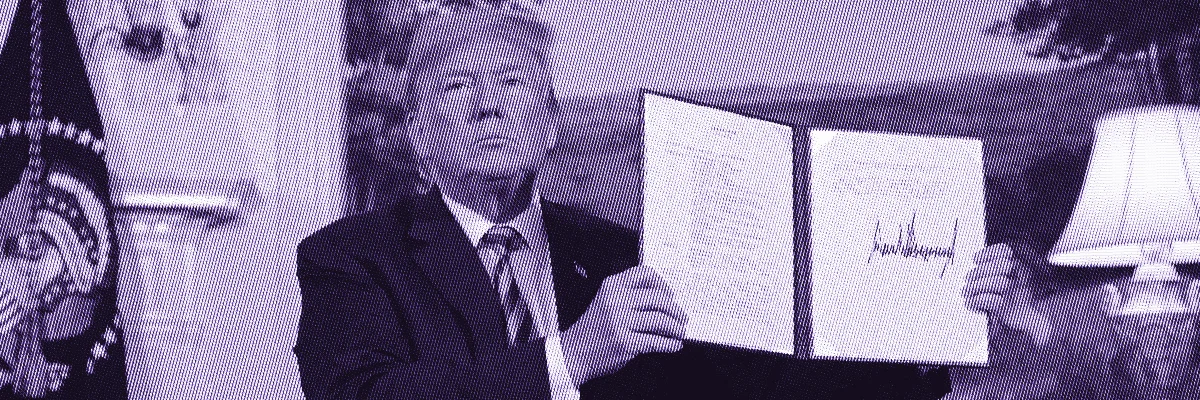
◢ On 8 May 2018, U.S. President Trump announced that the United States “will withdraw from the Iran nuclear deal” and that the United States “will be instituting the highest level of economic sanctions”. At the same time, U.S. authorities announced that U.S. sanctions would be re-instated, at the latest by 4 November 2018. What does this mean for companies who have ties to Iran or who do business in Iran?
This client note was prepared by the German trade compliance team at Dentons Europe. It is republished here with permission.
On 8 May 2018, U.S. President Trump announced that the United States “will withdraw from the Iran nuclear deal” and that the United States “will be instituting the highest level of economic sanctions”. At the same time, U.S. authorities announced that U.S. sanctions would be re-instated, at the latest by 4 November 2018. What does this mean for companies who have ties to Iran or who do business in Iran?
In January 2016, the U.S. and the EU lifted some of the sanctions that they had imposed on Iran. This was based on an international agreement, the so-called Joint Comprehensive Plan of Action (“JCPOA”). Since 2016, many European companies engaged in business activities in Iran or extended their activities. Transactions with Iran will now meet with severe difficulties, and many companies will be forced to cease and wind down their operations.
In the following, we summarize the most important developments and applicable rules.
U.S. Companies and Their Subsidiaries
Applicable U.S. laws generally prohibit U.S. companies from engaging in any business activities with a relation to Iran. This prohibition also applies to non-U.S. subsidiaries of U.S. companies. Based on the JCPOA, the U.S. had issued General License H. This General License broadly allowed non-U.S. subsidiaries of U.S. companies to engage in business activities with Iran.
General License H will be revoked “as soon as feasible”. It will then be replaced with a “new” General License H; this new General License will, however, only authorize the wind down of existing transactions and operations that had been made possible by the “old” General License H. Wind-down operations must be completed by 4 November 2018.
Adding Parties to the U.S. List of Blocked Parties
The U.S. Government has imposed prohibitions a number of individuals, entities and groups (“Specially Designated Nationals” – “SDN”). Any dealings with SDN are prohibited. In addition, all dealings with a company in which an SDN owns at least 50% of the interest are also prohibited.
Not only U.S. nationals and U.S. companies (amongst others) must comply with this prohibition. Any party must comply with these prohibitions when that party is involved in a transaction that is made in US Dollars or when a U.S. bank or U.S. company is also involved in that transaction.
In 2016, a large number of companies and individuals were removed from the SDN List of the U.S. These parties will be added to the SDN List again. It is currently unclear when that will happen, but at the latest on 5 November 2018. Amongst these parties are Iranian banks as well as the National Iranian Oil Company, and also companies and banks established outside of Iran, e.g. in the EU.
U.S. Measures Targeting Specific Industry Sectors
Before 2016, the U.S. had adopted numerous regulations to deter also non-U.S. companies from doing business with Iran. These regulations, so-called Secondary Sanctions, threaten that the U.S. Government can impose severe measures on non-U.S. companies who enter into transactions with certain industry sectors and with certain entities and individuals in Iran.
These measures can amount to a complete exclusion of the non-U.S. company from the U.S. market and from transactions with all U.S. companies worldwide. This can also mean that companies are designated as SDN. Companies which are faced with the risk of Secondary Sanctions should carefully analyze the risks for continuing their activities. U.S. authorities have stated that they want to enforce Secondary Sanctions in the future.
These measures had been waived or lifted under the JCPOA. They will now be re-instated by 6 August 2018 and by 4 November 2018. Until then, companies engaged in the industry sectors concerned must wind down their operations if they want to avoid Secondary Sanctions.
The most important Secondary Sanctions concern the following activities:
- Wind-down by 6 August 2018
- Transactions with the automotive sector;
- Sale or purchase of graphite, raw or semi-finished metals such as aluminum and steel, and coal;
- Provision of software for integrating industrial processes.
- Wind-down by 4 November 2018
- Transactions involving ports, shipping and shipbuilding, including Iranian shipping lines;
- Petroleum-related transactions;
- Transactions with the petrochemical sector;
- Investments in the development of oil resources;
- Transactions by non-U.S. banks with certain Iranian banks, including the Iranian Central Bank;
- Forwarding of “SWIFT” messages to Iranian banks.
Commercial Aircraft and Related Services
As a result of the close global cooperation in the aircraft industry, any commercial aircraft will include material parts with U.S. origin. As a consequence, commercial aircraft and most spare parts for commercial aircraft can only be supplied to Iran with a license from U.S. authorities. Similarly, even non-U.S. companies require licenses from U.S. authorities for maintenance and other services for commercial aircraft.
Under the JCPOA, U.S. authorities granted such licenses to both U.S. and non-U.S. companies. All these licenses will be revoked. U.S. and non-U.S. companies must wind down their activities under these licenses by 6 August 2018.
The Meaning of Wind-Down
Where a wind-down of operations or business relations is required, deliveries and supplies can be made, and services can be provided, until the wind-down date, but only if the contract has been concluded before 8 May 2018.
Business activities and operations must end by the applicable wind-down date. In order to end business operations, companies are allowed to “engage in all transactions ordinarily incident and necessary to wind down” the activities. This may be necessary, for example, where contracts specify delivery dates that are later than the wind-down date.
Non-Iranian companies can receive payments even after the wind-down date, if the following two conditions are fulfilled: The contract has been concluded before 8 May 2018, and all deliveries have been made by the wind-down date. This also applies to loans or credits granted by non-Iranian banks. By contrast, Iranian banks and companies may not receive any payments after the wind-down date.
Activities that Remain Permitted
Even before 2016, U.S. authorities had issued General Licenses which permit certain business activities in Iran. The most important General Licenses are a General License that permits the export to Iran of food, foodstuffs, agricultural items, pharmaceutical products (drugs) and medical devices (often referred to as the “AgriMed” General License). In addition, U.S. authorities had issued a General License that permits the export to Iran of many standard IT items and software, if these products could be acquired without restrictions on the general market (General License D-1).
Based on information that is currently available, these General Licenses will not be revoked, and exports under these General Licenses remain permitted. These General Licenses cannot only be used by U.S. companies, but by companies from other countries as well.
EU Companies: Existing EU Sanctions Still Apply
The EU has not changed or amended the respective EU sanctions. For EU companies who have business operations in or with Iran, the EU sanctions and embargo apply in addition to the U.S. measures. The most important restrictions under EU sanctions and embargos are the following.
Sanctioned Parties and “Financial” Sanctions
The EU has imposed prohibitions to enter into business transactions with a number of individuals, entities and groups in Iran (so-called “Designated Parties”). EU companies may not make any payments and any deliveries to Designated Parties. There are also restrictions for dealing with companies which are owned or controlled by Designated Parties. These range from increased due diligence requirements to prohibitions on dealing with such subsidiary.
Export Prohibitions
The EU has adopted several lists of items which may not be supplied to Iran. It is also prohibited to conclude sales contracts for these items, to provide technical support services or the provision of export financing for these products. These prohibitions apply, e.g., for military items (arms embargo) and for certain items that could be used in a nuclear program.
Export Licensing Requirements
In addition, licenses are required to supply certain items to Iran. The items concerned are also included in several lists adopted by the EU. As with the export prohibitions, licensing requirements do not only apply for the actual export of these items, but in addition for the conclusion of the respective sales contract, the provision of technical support services for these items or for the provision of export financing of these products. Licensing requirements apply, for example, for the supply of items for the interception of telecommunication, of less important items that could be used in a nuclear program or for graphite, raw or semi-finished metals such as aluminum and steel. Depending on the product in question, licensing procedures may be quite complex, because some licenses must be reviewed by a special committee established under the JCPOA before they are granted.
Restrictions for Investments in Iran
In accordance with the EU sanctions and embargo, establishing companies in Iran or investing in companies in Iran may be prohibited or may require a license. These restrictions apply to companies which engage in certain business activities in Iran (e.g. in activities linked to the nuclear sector). The same restrictions apply for providing financing to companies in Iran.
Trading With Iran in the Future
These new unilateral U.S. measures will severely impact doing business with Iran and doing business in Iran. In addition to the prohibitions and other restrictions that apply to certain business activities directly, the U.S. measures will have a severe “chilling” effect. Companies will refrain from business activities involving Iran, and banks will refuse to provide financing for business activities in Iran.
As a result of the Secondary Sanctions threatened for sending SWIFT messages to Iranian banks, there is a risk that it will become impossible (again) to make electronic transfers of funds to and from Iranian banks. In addition, banks will now be even more reluctant with processing payments to and from Iran. EU companies will face the problem again that they may have perfectly legal business activities in Iran but will not be able to find a bank where they can receive payments.
It remains to be seen if European leaders manage to find a unified response to the new measures adopted unilaterally by the U.S.
Photo Credit: REX/Shutterstock
Can Blocking Regulations Help Europe Protect Its Iran Business From Trump?
◢ In the last week, European business leaders and policymakers have grown more vocal about the possibility that the European Union would employ blocking regulations to protect European businesses from the reach of US secondary sanctions on Iran.
◢ Despite limits to their legal effectiveness, blocking regulations can serve as part of the suite of political, legal, and commercial measures employed by European governments to protect their businesses in Iran.
In the last week, European business leaders and policymakers have grown more vocal about the possibility that the European Union would employ blocking regulations to protect European businesses from the reach of US secondary sanctions on Iran. These regulations would penalize European companies for complying with secondary sanctions, which may snapback if the Trump administration decides to withdraw from the Iran nuclear agreement.
Total CEO Patrick Pouyanné became the first high-profile European executive to publically call for such measures to be considered, disclosing that Total has been in discussions with French and European authorities about “means to protect investments already made in Iran, even in the case of the return of sanctions.”
Speaking at a conference in Paris last week, Denis Chaibi, head of the Iran Task Force of the European External Action Service, stated that the EU was “looking at a number of possibilities” regarding the regulations.” In his assessment, “it is not complicated to do it legally in that the legal instrument exists, but it doesn’t require a huge internal debate,”
These public statements come as European concerns grow regarding the Trump administration's ultimatum to “fix” the Joint Comprehensive Plan of Action. The critical deadline is May 12, when the United States will need to once again waive its secondary sanctions on Iran. Failure to do so would see secondary sanctions “snapback,” exposing European companies to extraterritorial penalties for their commercial activities in Iran.
But even if the European Union finds the political will to reinstitute blocking regulations in the event of snapback, it is unclear whether they fully effective as a standalone measure to protect European trade and investment in Iran. Blocking regulations are a legal mechanism which seeks to mitigate the extraterritorial effects of sanctions under Public International Law (PIL), the body of law that governs relations between sovereign states and their unions, such as the European Union.
International trade attorney, Edward Borovikov, managing partner at the Brussels office of Dentons, a global law firm, notes that under international law “Sovereign states are expected to exercise moderation and restraint if their legal acts may affect vital economic and commercial interests of another state. But sometimes states violate the principle of restraint for their own national security considerations.” The snapback of secondary sanctions by the Trump administration would represent once such case. In such situations, “there is no efficient and universal legal avenue under PIL to challenge such non-compliance,” says Borovikov.
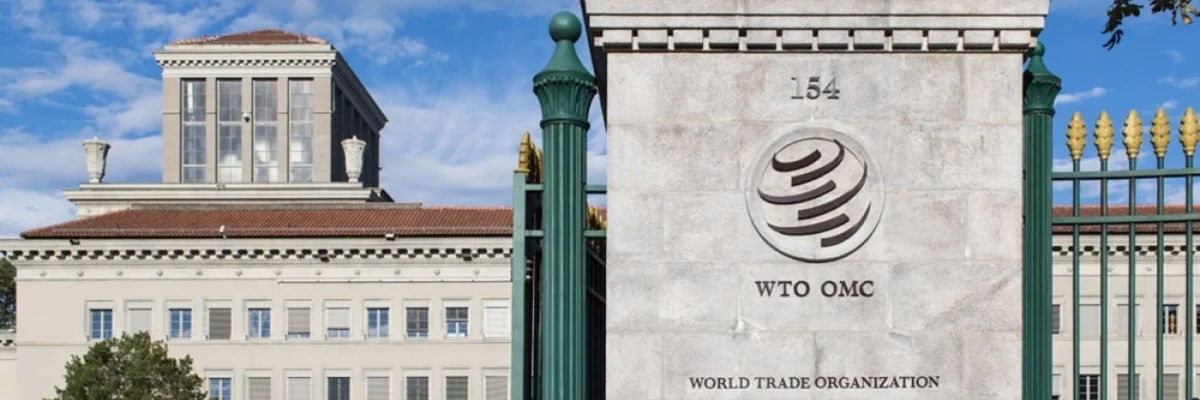
While the World Trade Organization (WTO), which was established under the authority of PIL, may seem a venue to challenge extraterritorial sanctions which restrict trade in goods and services, it is unlikely Europe would be able to successfully challenge the snapback of U.S. sanctions under the WTO’s legal authority.
Article XXI of the General Agreement on Tariffs and Trade (1994) declares that nothing in WTO rules will “prevent any contracting party from taking any action which it considers necessary for the protection of its essential security interests.” Borovikov explains that this exemption “means that member states can depart from WTO commitments on trade in goods and services” and points out that while there have been several attempts to bring to WTO adjudication disputes on the application of national security exemptions, “none of the cases ended with conclusive guidance.”
In 1996, the European Union began a dispute process against the United States with regard to extraterritorial sanctions against Cuba. This dispute reached the state of WTO consultations. But ultimately, the EU and US reached a political solution in which the US assured that its secondary sanctions would not be enforced upon European companies. The WTO case was suspended.
The political solution was necessary for a simple reason. “Even if the WTO had found in the favor of the EU, deciding that the national security exemption did not apply, the United States was never going agree with a WTO’s interpretation of its national security requirements,” observes Borovikov. “The idea that the United States would comply with WTO recommendations in such a situation is hard to believe.”
Given the dead end presented by the WTO dispute avenue, the EU has sought legal mechanisms that rely on the legal authority of the union and its member states. The legal act is the 1996 EU Blocking Regulation. This regulation was established in response to US sanctions on Iran, Cuba, and Libya. The regulations prohibit EU entities and courts from complying with foreign legal acts, such as sanctions laws, listed in an annex. Borokivov explains that “in principle any new extraterritorial laws of any third country may be added to the Annex and indeed help EU persons to continue business with a sanctioned third country.” However, the past success of such regulations in enabling European companies to continue conducting business in these jurisdictions such as Iran was the result of political rather than legal influence.
Borovikov warns that these blocking regulations “cannot provide full protection from secondary sanctions because if the EU persons doing business in the US start economic activities in the Iran, they are at risk of being penalised under the US sanctions regime.” Even if the European Union seeks to penalize its companies for complying with US sanctions, “it is clear that a lot of EU companies would simply face a dilemma between doing business in the US or Iran and where to accept the penalty,” he says.
Given the fact that the US market both frequently offers more attractive economic opportunities and poses more severe penalties and consequences for non-compliance with US law, most companies are likely to wind down their Iran operations and pay any penalties that the EU or their national governments may levy under the blocking regulations.
However, the discussion about blocking regulations is nonetheless worthwhile. Borovikov notes that the prospect of such regulations has in the past played “an important role in bringing about an acceptable solution. The regulations are secondary to the political process between the US and EU and its member states that will hopefully lead to an understanding on Iran business.”
Ellie Geranmayeh of the European Council on Foreign Relations, echoes this assessment: "The threat of reviving the EU blocking regulation in itself can be a useful political tool for Europe to create a cost for the Trump administration and make it think twice about its actions." Moreover, while the blocking regulations may only be partially effective for major multinationals, they can "provide an avenue for smaller-medium sized companies in Europe and Asia that have little or no US exposure to continue conducting business in Iran in non-dollar currencies," says Geranmayeh.
Multinational executives seem to agree. In a recent survey conducted by Bourse & Bazaar and commissioned by International Crisis Group, a substantial 54 percent of senior executives indicated that “assuming Iran remains committed to the nuclear deal,” blocking regulations, which would protect companies from U.S. penalties, would positively affect the “decision to invest in Iran.”
Blocking regulations can serve an important role as part of the suite of political, legal, and commercial measures that can be employed by European governments to protect their businesses from the consequences of snapback. At a time when the economic quid-pro-quo that underpins the nuclear deal is under threat, each and every such measure ought to be considered.
Photo Credit: WTO

A Swedish Training Program May Hold the Answer to Iran’s Banking Challenges
◢ Iran's inability to link with the European banking system stems in part from a lack of capacity in key governance and compliance functions.
◢ In the 1990s, European governments launched substantial "training and technical assistance" programs to help post-Communist states raise standards. Iran needs similar programs, and a model from Sweden may be the most effective.
For nearly a year, “banking challenges” have vexed business leaders and investors seeking to work in Iran. While some corresponding banking relationships have been re-established between Iranian and smaller European banks, the scope and type of transactions remain limited. The largest European banks are unwilling to work with Iran. The reasons for these blockages are numerous, but the blame most often falls to the obstinance of the US Department of the Treasury, and in particular, to the Office of Foreign Assets Control, for not providing adequate guidance or licensing provisions to lend confidence to major European banks that transactions with Iran are acceptable.
However, there are additional reasons unrelated to sanctions enforcement, that have reduced the appetite for conducting business in Iran. Across Europe and the United States, new and more stringent rules for banking risk management practices, which include the introduction of personal liability for compliance officers in the event of failures, have changed the risk appetite of financial institutions. On Monday, the Financial Times reported that three of the world’s largest financial institutions—BlackRock, Vanguard, and State Street—“have expanded their corporate governance teams significantly in response to growing pressure from policymakers and clients.” The “stewardship” team at BlackRock now includes 31 specially-trained individuals. Similar expansions are taking place in compliance and risk management departments. In short, international best-practice now requires more people and more specialized training than ever before. For Iran’s banking sector, these changes raise the prospect of being left behind even in the aftermath of sanctions relief.
But history teaches us that banking sectors can catch up quickly, if provided the right support. Following the dissolution of the USSR in 1991, the former Eastern Bloc countries were struggling not merely to establish connections to Western banks, but also to adopt the fundamental structures of market economies. At the same time, financial institutions in the West were rapidly adopting new technologies, as the financial industry met with the digitalization of the economy. Just as countries like Russia, Ukraine, and Poland were reformulating their basic economic priorities, the pace of change was increasing in the world’s dominant economies.
In response to these challenges, Western governments made significant efforts to institute “capacity-building” programs across a wide range of areas including democratic governance, economic liberalization, formation of commercial law, management of industrial sectors, and reform of education systems. Naturally, banking was a crucial area of focus. The provision of financial assistance by organizations such as the International Monetary Fund and World Bank was tied to participation in “training and technical assistance” programs that sought to ensure institutions in post-Communist states were able to make responsible use of the financial support. These programs were largely successful, with banking standards rising within a decade to levels that encouraged global banks to take ownership positions in regional banks—examples include both HSBC Bank Poland and Ukraine’s Raiffeisen Bank Aval.
If capacity-building programs were able to support the establishment of extensive banking relations in countries where an independent financial sector did not even exist prior to 1990, their application in Iran should be able to generate results even faster. Iran boasts a highly sophisticated banking sector which maintained significant relations with major European banks prior to the imposition of financial sanctions in 2011. Many of Iran’s top bankers were educated in the United States and Europe. Majid Ghassemi, Chairman of Pasargad Bank, and former governor of the Central Bank of Iran, holds a PhD from the University of Southampton. Vali Zarrabieh, Chairman of Saman Bank, holds masters degrees from both CASS Business School in London and from Manchester Business School. The CEO of Middle East Bank, Parviz Aghili, holds a PhD from the University of Wisconsin. Yet, while a strong knowledge base exists in the boardrooms of many of Iran’s largest banks, there is a gap in knowledge and technical ability in middle management, particularly as many of Iran’s best and brightest young bankers seek their fortunes abroad.
Despite this fact, there has been little effort to rekindle education as a basis for the advancement of Iran’s financial sector in the post-sanctions era. In order to gain the confidence of the world's major banks, Iran's first prerogative will be to meet the standards of the Financial Action Task Force (FATF) in the areas of anti-money laundering and counter terrorist finance. While FATF officials have had an ongoing dialogue with senior Iranian bankers and financial regulators, there is little evidence of a comprehensive effort to provide training that would reflect capacity-building within the sector at large. Similarly, while senior IMF officials have visited Iran and assessed economic reform efforts, no major commitments have been made to provide training or assistance. The Governor of the Central Bank of Iran, Valiollah Seif, suggested the creation of an IMF training center in Iran during a meeting with IMF Managing Director Christine Lagarde in April, 2015. Lagarde, herself, raised the prospect of training in a meeting with Iran’s Minister of Finance Ali Tayebnia in October, 2016.
In the absence of training and technical assistance, European banks will remain skeptical that Iranian banks are applying exacting compliance and governance standards. In order to build trust in the Iranian banking sector, a more wide-ranging effort is needed to educate and train the next generation of bankers in Iran, with a specific focus on the new regulatory and governance requirements that are currently coming into force. Encouragingly, such programs already exist. These protocols have long been offered to bankers in developing sectors worldwide. It is simply a matter of getting Iranian bankers involved.
One possible model is the Risk Management in Banking International Training Program (ITP) designed by KPMG Sweden. For over a decade, the program has worked to transfer Swedish and international standard risk management practices to countries with developing financial sectors. ITP was created as part of KPMG Sweden’s commitment to corporate social responsibility, and also as a means to build deeper connections in growth markets worldwide. The program is delivered with the stewardship and funding of the Swedish International Development Cooperation Agency (SIDA).
The program seeks to improve capacity across five key areas: financial markets, lending processes, regulation and supervision, risk management, and project management. Participants hail from a wide range of countries, including African nations such as Kenya, Uganda, and Rwanda, post-Communist states such as Ukraine, Moldova, and Georgia, and countries further afield including Thailand, Indonesia, and even North Korea. Indicatively, there have been no participants from Iran. Of the participants, 82% were between 21-40 years old, reflecting an important focus on junior and mid-career training that can help establish improved practices for the routine function of the bank, while also empowering the next generation of banking leadership. A total of 216 financial institutions, of which 131 were commercial banks, were included in the program. The remaining institutions included central banks, finance ministries, pension authorities, and insurance companies.
An extensive evaluation of the KPMG program, published by SIDA in 2014, looked at the efficacy of the initiative over the previous decade, and made three key observations: the transfer of skills was broadly achieved, new technical skills were adopted in financial institutions, and finally, elements of the training were largely sustained in subsequent years. The SIDA evaluation also found that the effort, though delivered in partnership with a private company, was broadly consistent with the international development commitments of the Swedish government. While the KPMG example is among the largest and most successful in Europe, similar development programs exist in other European countries and could be extended to Iran.
With the big four advisory firms hovering and with European governments keen to support Iran’s re-entry into international markets, it would be relatively easy to coordinate the key stakeholders to make a training program similar to KPMG Sweden’s ITP available to Iranian participants. Moreover, by funding such initiatives, major European corporations and banks could address thorny reputational concerns. These companies could demonstrate their strong commitment to establishing relations with their Iranian counterparts, while simultaneously indicating that it is of the utmost importance for the Iranian financial sector to upgrade its standards. In an ideal world, even American banks and regulatory bodies could play a role in supporting capacity-building, particularly as US sanctions provide clear provisions for education and training initiatives. However, due to President Trump's brash and ill-advised executive order, the prospects of any such training remain limited.
It is clear that full banking relations between Iranian and European banks will take time to re-institute. Rather than simply wishing for change, capacity-building programs are the vital next step. There is plenty that Iran's banking sector can learn while it awaits the rightful opportunity to fully participate in the global financial marketplace.
Photo Credit: President.ir
Risky Business: Four Categories of Iran Risk
◢ Managing risk is a key part of an Iran market entry strategy.
◢ There are four major categories of risk to consider: commercial, legal, political, and reputational.
It must be commonplace in meetings where opportunities for business development or investment in Iran are being discussed. Suddenly it becomes apparent that the pitch was half-baked-- it didn’t include an assessment of risks. With a simple question like “What’s the firm’s reputation?” or even “Is it legal?” the pitch falls flat.
A more systematic and proactive approach to risk assessment can avoid these pitfalls. An assessment should begin with four main categories of risk: commercial, legal, reputational, and political. Each of these categories needs to be explored in depth and in relation to the others in order to craft a useful and durable business development strategy. Even if you aren’t an expert in any of these categories (I certainly am not), having a structured approach helps identify gaps in knowledge early so that the right information can be sourced and solutions can be crafted before a problem arises or a tough question comes up in a pitch meeting.
Below is a basic introduction to the four types of business risk in the Iranian context, which will hopefully be explored in greater detail in subsequent articles.
1. Commercial Risk
The greatest challenge in evaluating commercial risk in Iran is the way expectations can quickly outpace reality in anticipation of a historic nuclear deal.
Articles in the The Economist, Wall Street Journal, Time, and other publications have trumpeted the impending “gold rush” or “bonanza” that would ensure if Iran is reintroduced into global markets for goods, services, and capital. The enthusiastic reporting of the many possible macroeconomic drivers of Iranian growth—a young population, an untapped manufacturing base, decent purchasing power, limited government debt etc.— makes it seem like investment in Iran is a “safe bet.”
But the reality is that within the positive forecasting for Iran on a macro scale, investors, business leaders, and entrepreneurs— whether foreign or Iranian—need to heed the dynamics of the micro scale. Investment opportunities ought to be judged on their own terms, and not solely in relation to the bigger picture of potential Iran growth.
What does this mean in practice? Whatever the opportunity in question, a commercial risk analysis needs to be done to ensure that the opportunity remains viable for a wide range of macroeconomic scenarios. It is tempting to treat investments as a “safe bet” because the macro projections are so good. For example, an investor might think that a heavily leveraged buy-out of a consumer goods factory, even one that is inefficient and poorly managed, would be worthwhile because consumer demand is likely to surge in the aftermath of the deal—an inefficient factory can still deliver good margins if the price of goods rises high enough. But what happens when this belief leads the investor to shirk the responsibility to make the factory operate better, whether through better management or equipment upgrades? The factory investment remains exposed to a fundamental commercial risk, and if consumer demand does not materialize, the heavily leveraged bet is lost.
Certainly, emerging markets investors in markets like China, Brazil, India and South Africa have the appetite for such risky bets, and sometimes they are able to execute aggressive strategies to great success. But if overly aggressive approaches become widespread in the post-sanctions investment landscape, the tendency will be to ignore or discount the true commercial risk.
Iran only has one chance to emerge from years of isolation and to position itself for long-term prosperity. The last thing the country needs is the wild speculation and risk-taking that typified foreign investment in Russia in the mid-nineties. The “only way is up” attitude towards economic growth ignores the necessary volatility in any major economic reorientation, and also overshadows the reality that a dud business is a dud business regardless of how good the economy might get. The goal should be mitigate commercial risk at the micro level so that the enterprise can prudently navigate any macroeconomic fluctuations.
2. Legal Risk
Iran remains subject to the most advanced and comprehensive sanctions program ever instituted. So it is perhaps especially frustrating that entrepreneurs and investors get excited about commercial opportunities before they have a close look at the legalities. When the “post-sanctions” future is imagined, the process of sanctions relief is often simplified as though sanctions will go from “on” to “off.” But the real opportunities will lie in navigating the legal landscape in order to find the viable opportunities first.
Sanctions regulations are complex and were legislated in a messy way. How they will be rolled back remains a point of debate. But generally speaking, where US sanctions go, EU and UN sanctions will largely follow. What is clear is that the rollback of sanctions will likely be a phased process, and therefore the legal landscape will be constantly evolving even in what seems to be a “post-sanctions” moment.
In the meantime, companies will be tempted to try and “outsmart” sanctions. But this is foolhardy. Compliance is important, and companies should invest in the best legal expertise available on an ongoing basis to learn how to craft an adaptive, compliant business strategy. Failure to comply could mean drastic and long-lasting commercial, reputational, and political damage. It is a bad habit shared by many firms that in order to keep costs low, the lawyer is only hired when the contracts are being drafted.
Additionally, companies shouldn’t forget about the need to comply with Iran’s domestic laws. There is a tendency for multinational firms to flout domestic laws when entering emerging markets. Usually, the perception of lax enforcement and corruption allows companies to think that domestic laws can be heeded selectively. This is also foolhardy. Not only is Iran’s enforcement capacity greater than the average emerging market (it has very strong state institutions, despite levels of corruption), but failure to pay taxes, ensure safety, or abide by environmental protections will earn the ire of the highly-educated Iranian public, who should be respected even more than the prosecutors.
3. Reputational Risk
I touched on the topic of reputational risk in this November article for LobeLog, and I consider it one of the most fascinating challenges of doing business in Iran. The commercial and legal risk present in Iran is commensurate with levels in numerous markets, but the level of reputational risk is perhaps the highest in the world.
A poll published by BBC World Service in June 2014 identified Iran as the most “unfavorably viewed country” by individuals worldwide. Certainly, much of the international criticism is deserved and companies need to be honest with their customers, employees, and shareholders about their corporate responsibility to support positive social outcomes in all markets, including Iran.
But from the standpoint of business development it is worth considering the specific allergic reaction often exhibited when the ideas of “Iran” and “business” are combined. Special interest groups use public campaigns to name and shame companies that do legal business in Iran. Sometimes even humanitarian trade is targeted. So when we consider the idea of normalization, we are really discussing a new normal in which the combination of the ideas “Iran” and “business” is no longer the cause for concern or condemnation.
In practical terms, managing reputational risk will require savvy branding and an excellent communications and public relations strategy. This involves everything from redesigned websites to better disclosure of company activities, announced through new mechanisms of corporate communications. Transparency will be key in order to assuage negative perceptions and present a new normal of a responsible and resurgent business community.
4. Political Risk
The fourth and final category of risk is perhaps the most difficult to evaluate. Political risk is about “street smarts”— understanding the commercial landscape of a country like Iran in a very deep way, capturing the political, social and cultural dimensions. Those seeking to do business in Iran will have a lot to learn in little time.
At the macro level, political debates around privatization and foreign ownership may impact how commercial and contract law is carried out, but there are actually existing laws written to protect foreign investment and private enterprise—they just have had limited use in a period of low FDI. Firms will need to develop skills in government relations to ensure they stay on top of these debates and the consequences for their business.
Looking to the micro level, Iranian society places great importance on personal or institutional reputation and pride. Any partnership or venture is judged on the reputation of its constituent parties. But rather than seeing reputation as a question of branding, this is a more political understanding of “reputation.”
For example, a certain individual or company might be the most commercially powerful of among the potential partners, but may also have a more questionable reputation within the industry. This partner may be best positioned to mitigate commercial risk in a given venture, but how does the politics of a potential partnership effect reputational or legal risk in the medium to long term? Would a company that is less commercially powerful, but held in higher esteem actually make a better partner?
To be clear, the need to make such political evaluations is not a trait unique to Iran. Even Silicon Valley is a place where the partner you choose or the investor you secure can drastically alter the trajectory for success. In Iran, as in Silicon Valley, political risk means knowing who are the key actors, how they are perceived, and the resources they are able to mobilize. But for a foreign investor or firm, the learning curve in a new market like Iran will be especially steep.
Conclusion
Looking at these four categories holistically, responsible companies will seek to turn risks into strengths. A proactive and careful approach to developing the commercial, legal, reputational, and political facets of a business development strategy can offer firms a competitive edge in the marketplace. Mitigating risks can be expensive and time-consuming, and may require seeking analysts, lawyers, PR consultants or other experts to help fill gaps in knowledge. But companies that can internalize and deeply understand risk/reward calculations for the new phase of Iran’s development will reap immense rewards.
Photo Credit: Morteza Nikoubazi/Reuters