

Increased Competition Squeezes Air France in Iran
◢ Air France recently announced the reduction of its flights from Paris to Tehran after first switching the service on the route to its subsidiary airline JOON. At a time of uncertainty surrounding the future of the Iran nuclear deal, the reduction of flights led to speculation that the move may have been influenced by the return of sanctions. But a look to the current competitive environment shows other significant changes to the market to which Air France was forced to react.
Air France recently announced the reduction of its flights from Paris to Tehran after first switching the service on the route to its subsidiary airline JOON. At a time of uncertainty surrounding the future of the Iran nuclear deal, the reduction of flights led to speculation that the move may have been influenced by the return of sanctions. But a look to the current competitive environment shows other significant changes to the market to which Air France was forced to react.
Starting in October 2018, Air France flights will only operate on the Paris-Tehran route during the summer season. A statement from the airline said: "After two years of operations and faced with a weak economic and commercial performance, Air France took the decision to adjust this route's flight schedule to be in line with demand."
The Iranian travel market has changed considerably from when Air France resumed its flights in April 2016, first operating flights three times a week with Airbus A340 aircraft and a seating capacity for 255 passengers. At the time, Air France was the only airline flying between Paris Charles de Gaulle Airport and Tehran and the only competition facing the French national carrier was Iran Air’s weekly flight out of Paris Orly Airport.
A few months later, Mahan Air began flights to Paris three times a week with its own A340 aircraft. Just recently, Iran Air moved its flights from Paris Orly to Paris Charles de Gaulle Airport, while also upgrading its aircraft to a brand new A330. In January, Mahan Air announced that it will increase its frequencies to Paris from three weekly flights to four for the summer 2018 season.
Looking to the new competition, travelers journeying between Paris and Tehran have more options than ever before. With Iran Air and Mahan Air flying to Paris with higher frequencies and lower prices, Air France has definitely felt the competitive pressure.
According to figures from the French government, 107,317 passengers travelled between Paris and Tehran on the relaunched service in 2016, a 178 percent increase from the previous year. The following year, the number of passengers further increased to 145,896, up 36 percent. Much of this growth can be attributed to Air France's connecting passengers, traveling from Paris to other destinations.
The impending return of sanctions is likely to reduce demand from tourists and business travelers on Paris-Tehran route, making the impact of Iran Air's capacity increases and the new Mahan flights more acutely felt. The recent increase in departure taxes and currency restrictions may affect outbound travel from Iran to foreign destinations including France.
Moreover, the expansion of Iranian airlines is also in doubt as European growth is dependent on the arrival of its new aircraft. Iran Air's deals with Airbus and Boeing are now in jeopardy after President Trump withdrew from the nuclear deal, canceling licenses for aircraft sales.
Nevertheless, Air France also faces more competition with European airlines than it did in 2016. British Airways and KLM resumed flights to Tehran in late 2016, while Austrian Airlines increased its presence in Iran with additional flights to Tehran, Isfahan, and Shiraz, focusing more on Iran’s tourism industry. Aegean Airlines and Ukrainian International Airlines are attracting more connecting passengers and have also increased their presence in Iran.
With more than two years for foreign airlines to observe the Iranian market since 2015, flight adjustments and schedule changes are quite normal to react to over estimations in demand. British Airways and Alitalia have adjusted their schedules with slight decreases in frequencies or capacities to better meet the demand as Iran Air has grown its presence in both London and Rome.
Air France has been flying to Iran since 1946 with few suspensions. Despite the recent adjustments, 2018 will certainly not be the last year of a full service between Paris and Tehran.
Photo Credit: Wikicommons
Boeing, Iran, and American Jobs
◢ The first new Boeing jetliner is likely to be delivered to Iran Air later this month in what will a historic moment for US-Iran relations.
◢ Boeing's deal with Iran Air represents a unique instance in which an American company's exports to Iran directly support American jobs. This simple fact may provide a framework on which US-Iran ties could be stablizied during the course of the Trump administration.
This article was originally published in LobeLog.
New reports suggest that Iran Air’s first new Boeing jetliner could be delivered within the month.
According to Reuters, Boeing is reallocating a 777 originally designated for Turkish Airlines. This would be the first aircraft of eighty for which Boeing and Iran Air signed a $16.6 billion in December 2016. Deliveries for the order, which include fifty 737 MAX 8s and thirty 777s in two variants, were originally slated to begin in December 2018.
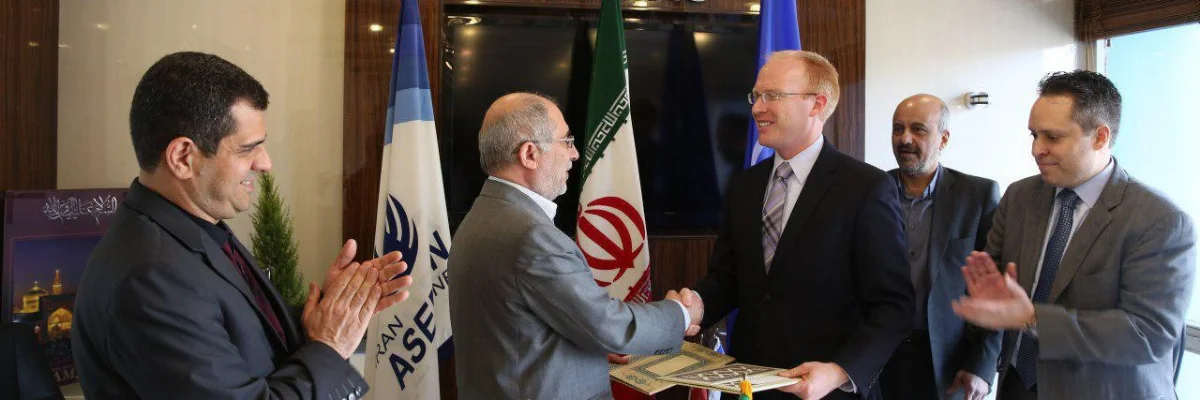
The early deliver will be a boost to President Hassan Rouhani’s reelection push, and follows Boeing’s announcement last week of its second agreement to sell passenger airplanes to an Iranian airline—a deal to sell thirty 737 MAX 8 airplanes to Iran Aseman airlines, valued at $3 billion.
The Iran Air and Iran Aseman deals are among Boeing’s largest open orders and come at a time of softening demand for commercial aircraft among the world’s airlines.
Expectations are also high for the deal within the Iranian business community. Many business leaders in Iran, as well as their European peers, see the Iran Air and Iran Aseman contracts as important bellwethers of the willingness of the United States to continue to implement sanctions relief commitments under the Joint Comprehensive Plan of Action (JCPOA) nuclear deal. Specifically, the deals are a test of whether the US Treasury’s Office of Foreign Asset Control will continue to provide licenses to both American and European companies that seek to engage opportunities in Iran. Athough Iran Air and Boeing were able to proceed from a memorandum of agreement to a full contract on the back of an OFAC license issued for the relevant transactions, the license was granted in the final months of the Obama administration. The Iran Aseman deal, which is currently limited to a memorandum of agreement, will only be able to proceed to a full contract when the Trump administration issues an OFAC license.
Trump has called the Iran Deal the “the worst deal ever negotiated.” The question is whether he will see Boeing’s opportunity as a redeeming feature.
When Iran Means Jobs
Boeing’s engagement with Iran pits the Trump administration's skepticism of the value of the Iran nuclear deal directly against an avowed commitment to support American jobs, particularly in the manufacturing sector.
Numerous American companies are engaged in business with Iran, either via their non-US subsidiaries as permitted under General License H or on the basis of humanitarian exemptions for the export of agricultural commodities or pharmaceutical products. However, it is rare for the products eventually exported to Iran to originate in the United States. Generally, the exported goods of American companies are produced in a non-U.S. manufacturing facility as part of a globalized supply chain. As such, for most American multinational corporations, engaging in opportunities in Iran may deliver shareholder value but won’t unlikely support American job creation on a large scale.
Boeing is an exception to this pattern. For political and practical reasons, the production of airplanes was never offshored and therefore a direct link exists between the orders placed in Iran and American labor at Boeing’s primary production facilities in Bellevue, Washington and to a lesser extent, North Charleston, South Carolina.
Although Boeing is a large, successful American company, it remains politically delicate to pursue business in Iran. Cognizant of this fact, the company has sought to speak Trump’s language when discussing its sales to Iran.
Boeing has highlighted American manufacturing jobs as a fundamental consideration of both the 2016 deal with Iran Air and the recent deal with Iran Aseman. According to Boeing’s official statement on December 11, 2016 announcing the deal to deliver airplanes to Iran Air, the sales will “support tens of thousands of U.S. jobs directly associated with production and delivery of the 777-300ERs and nearly 100,000 U.S. jobs in the U.S. aerospace value stream for the full course of deliveries.” Similarly, the April 4, 2017 announcement of the agreement with Iran Aseman noted “an aerospace sale of this magnitude creates or sustains approximately 18,000 jobs in the United States.”
Boeing’s government relations outreach isn’t limited to public statements. Following Trump’s public lambasting of the company for the cost of a proposed replacement for Air Force One, Boeing CEO Dennis A. Muilenburg has made it a priority to build a direct relationship with the Trump, first meeting with then-president-elect at Trump Tower on January 17. One month later, President Trump visited the Boeing facility in North Charleston, South Carolina which manufactures the 787 Dreamliner. That Trump visited the North Charleston facility rather than the larger Bellevue, Washington facility likely reflected the fact that Trump carried South Carolina in the election, but lost Washington state. Perhaps conveniently, North Charleston is the main manufacturing facility for the 787 Dreamliner, which has not been ordered by Iran Air or Iran Aseman.
After touring the facility, Trump presided over a rally attended by Boeing workers and Muilenberg. “My focus has been all about jobs. And jobs is one of the primary reasons I'm standing here today as your president,” he declared. “I will never, ever disappoint you. Believe me, I will not disappoint you.”
Given the clear parallel between Trump’s speech and Boeing’s positioning of its deals with Iran, it is highly unlikely that Muilenburg and Trump did not discuss Boeing’s Iran business, although there has been no public statement to this effect. It is likewise unlikely that Boeing would have proceeded with the deal with Iran Aseman unless it was reasonably confident in the viability of the deal. Certainly, the executives at Iran Aseman, a privately held airline that has not yet announced a similar deal with Airbus, would have insisted on Boeing’s assurances that the aircraft deliveries were politically viable.
Boeing’s Commitment to Iran
Boeing’s commitment to Iran requires not just political resolve, but also long-term thinking. Not only will these deals take many years to come to fruition—the Iran Air deliveries set to begin in earnest in 2018 and the Iran Aseman deliveries only in 2022—but the full extent of the export opportunity represented by Iran will only materialize over the next two decades.
There are three key considerations that Boeing needs to make. First, the company’s ability to supply aircraft to Iran is of great significance given that it has only one other true global competitor in Airbus. If Boeing is unable to fulfill these agreements it will no doubt lose significant orders to the European giant.
Second, Iran’s current orders are primarily focused on the modernization of existing fleets and the addition of capacity on existing routes. At the moment, Turkish and Emirates Airlines have significant market share in Iran’s international travel market from Iran because of their ability to operate more flights from destinations in Iran to Europe through their respective hubs in Istanbul and Dubai. European airlines have also made significant inroads in the market in the last two years. For example, although Iran Air only operates flights from Tehran to London three times a week, British Airways now operates a daily service. At the same time, an aging fleet makes Iran Air unappealing to travelers and hurts the airline’s ability to compete with international carriers.
In the next decade, during which time existing fleets would have been modernized, Iran’s economic recovery and its favorable geography should combine to further boost tourist and business travel to Iran from a wider range of international markets. Indeed, the IATA has forecasted that Iran’s passenger volume could rise from 12 million passengers today to 44 million passengers in 2034.
Iran Air currently flies to about 50 destinations worldwide. By comparison, Turkish Airlines, leveraging the geography of its Istanbul hub, now flies to 296 destinations worldwide. It’s unlikely that Iran Air or any Iranian airline has the financial resources and market conditions to become a “mega-carrier”—and indeed these airlines are beginning to struggle. Still, Iranian carriers have significant room for growth, particularly in serving “transit” roles, which means that further orders are possible, especially for long-haul aircraft like the 787 Dreamliner.
Finally, Iran’s most commercially successful airline is privately held Mahan Air. Mahan continues to be listed on the OFAC Specially Designated Nationals (SDN) list for the use of its civilian aircraft in airlifting troops and munitions from Iran to Syria. But it’s fleet size of 50 aircraft is significantly greater than Iran Air’s 29 aircraft, and it flies to more destinations with greater regularity and a higher passenger volume. Should Mahan reform its business practices and clarify its ownership, Boeing and Airbus could be competing for another significant set of orders.
Framework for “Business Diplomacy”
For the above reasons, Boeing’s engagement with Iran isn’t about a couple of one-off transactions. It is about a longterm commitment to a market that will generate substantial orders over the next two decades. From a political standpoint, this makes Boeing’s foray into Iran so important.
Whereas US diplomats have no access to Iran and limited direct dialogue with Iranian counterparts, American executives are opening substantial channels of communication. In this sense, leaders like Muilenburg become the unlikely interlocutors between pragmatic commercial and governmental stakeholders in Iran seeking to engage US-Iran relations on a transactional basis, and the American political establishment, most notably President Trump himself.
Boeing’s deals could help build a framework on which to develop US-Iran ties in the coming years. In some respects, Boeing’s situation echoes the aborted Conocophillips oil exploration and production deal from 1995. Likewise heralded as a rekindling of US-Iran ties, the Conoco deal died at the hands of congressional pressure and sanctions legislation. But the Boeing deal may have better prospects for three reasons: it does not require an investment in Iran, the sale of new and safer airplanes principally benefits the Iranian people, and most crucially, it supports American jobs.
The Boeing deals need their own “implementation.” This process will keep critical commercial and political stakeholders engaged in a discussion about what constructive engagement with Iran can achieve. In its first phase, under the auspices of President Trump, the scope of engagement will likely remain limited to protecting aircraft manufacturing jobs. Let’s just hope he doesn’t let the workers down.
Photo Credit: Iran Aseman