
Long-Awaited Uzbek-Kyrgyz Border Deal Sparks Unrest
The final demarcation of the Uzbek-Kyrgyz border was expected to be a tremendous political victory for Kyrgyzstan. But instead of celebration, the agreement has spurred domestic unrest and intensified repression.
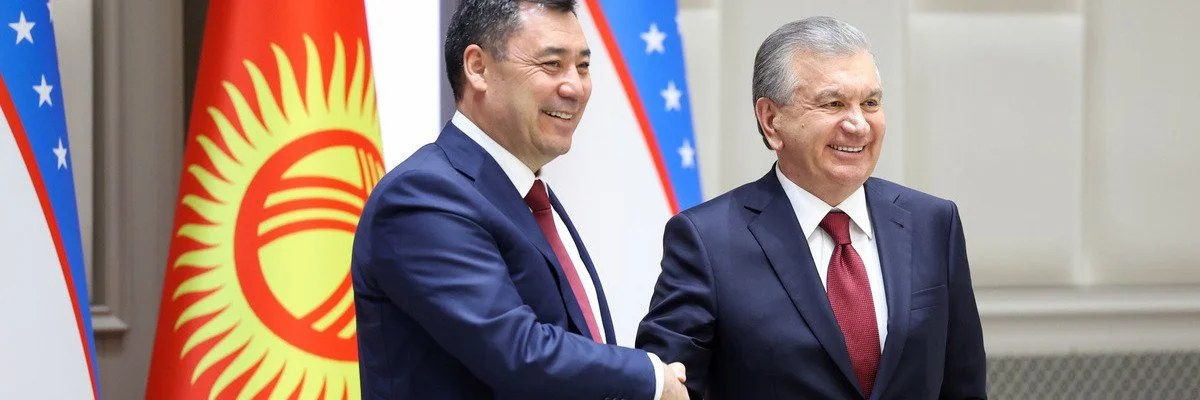
In October, the final demarcation of the Uzbek-Kyrgyz border was expected to be successfully concluded after three decades of negotiations. The agreement was supposed to be a tremendous political victory for Kyrgyzstan, especially for President Sadyr Japarov. But instead of celebration, the agreement has spurred domestic unrest and intensified repression.
Most visibly, the unrest is due to the Kempir-Abad water reservoir in the Uzgen district. The local population in Uzgen believes that the government and president’s close ally Kamchybek Tashiev's negotiating team failed to fully address state borders, land ownership, and water management in the area and did not adequately explain the deal to the public. Concerns about ceding the important reservoir to another country and abandoning Kyrgyz land were frequently voiced, but the government downplayed concerns. Some members of a parliamentary committee responsible for the preliminary approval of the new border also complained about the secrecy of the agreement. The exact full wording of the deal was not published, which led to uncertainty about what they were actually voting for, and some parliamentarians refused to vote at all.
Japarov faced opposition to the announced border agreement both in media and in the streets. On October 22, a committee for the protection of Kempir-Abad reservoir was formed. Activists also organised a demonstration denouncing the deal and demanding transparent public discussions. However, Japarov labeled the protests as the product of the "evil intentions” of a few opponents.
To succeed, the regime has resorted to silencing the opposition voices until the deal is officially signed. On October 23, there was a mass detention of two dozen vocal opposition activists in Bishkek and elsewhere around the country. The Kyrgyz government also decided to take action against the local operations of Radio Free Europe and blocked the broadcaster’s website for two months over the alleged spreading of disinformation. Later, the National Security Committee—headed by Tashiev—ordered Demir Bank to close RFE’s local account.
The crisis over Kempir-Abad and the entire border demarcation process illustrates one of the core problems of the current Kyrgyz government: an authoritarian approach to sensitive domestic issues. On the agreement with Uzbekistan, Japarov and Tashiev decided to push the deal through the opposition using their political influence and power. There is no exact date of the official signature announced, and under the current circumstances, neither the official implementation nor peaceful acceptance of the deal by the Kyrgyz society is certain.
Since his ascendence to power after large public protests in October 2020, Japarov has relied on his image as a strong national leader. Issues regarding territory, national interests, mineral resources, and economic prosperity have formed the core aspects of his political agenda. In recent months, however, he has faced mounting challenges in every domain. Moreover, attempts by Kyrgyzstan to present a border agreement regarding Kempir-Abad failed last year. Experiencing the same failure again would be a huge blow to Japarov’s political career.
Aside from its border issues with Uzbekistan, Kyrgyzstan also lacks fully demarcated borders with Tajikistan. Various factors have delayed the demarcation process since the dissolution of the former Soviet Union. These include complicated physical geography, mixed ethnic populations, and domestic political stakes. Tensions between Kyrgyzstan and Tajikistan have been rising in the past few years and there is little hope that the situation will improve in the foreseeable future.
The government’s nationalist rhetoric has not helped. This rhetoric has been accompanied by armed clashes and unprecedented levels of violence earlier this year. Neither Bishkek nor Dushanbe are interested in launching a full-scale war against one another, and destabilisation of the wider region is against the interests of their neighbours too. Even so, neither side has shown the willingness to engage in negotiations. For the time being, leaders in Kyrgyzstan and Tajikistan are using to justify consolidation of power at home.
While condemnable, Japarov and Tashiev’s attempts to secure the regime's position by silencing critics are hardly surprising. But the scale of the repression is concerning. Despite domestic turmoil, Kyrgyzstan still enjoys a reputation as a country with a more vibrant civil society and greater democratic mechanisms than its neighbours in Central Asia. However, researchers, activists, and civil society members interviewed by the author in recent months unanimously pointed to a worsening outlook and cited the disappearance of previously understood “red lines” and the unpredictability of authorities’ punitive actions.
Tashiev’s participation at a meeting with Vladimir Putin in Moscow last week under the auspices of the Commonwealth of Independent States illustrates Kyrgyzstan's slide towards more oppression. During the meeting in Moscow, non-governmental organisations and international bodies were labeled as threats and destructive forces.
The unrest and regime instability in Kyrgyzstan may have a negative impact also on other international projects, including the China-Kyrgyzstan-Uzbek railway, which has been on the table for two decades with no traction until last month when it was finally put forward. If the unrest persists, the parties to the rail deal may run out of patience. Moreover, Uzbekistan may either delay the ratification of the border agreement or demand more favourable conditions at Bishkek’s expense.
But even if the border deal materialises and both Kyrgyzstan and Uzbekistan implement the agreement, issues on the ground will likely persist. The newly demarcated border requires effective border management, trust, and mutual endorsement by the locals on both sides. Without a proper arrangement, even a minor skirmish might escalate to a major border conflict. Moreover, the contested future of the Kempir-Abad water reservoir further adds to the complexity to an already fragile situation at the Kyrgyz-Uzbek border.
Photo: Press Service of the President of Uzbekistan
Can SCO Members Achieve Connectivity in the Face of Conflict?
If the SCO is to mature as an organisation and make good on its vision of connectivity, it must also serve as a platform for conflict resolution.
The two-day Shanghai Cooperation Organisation (SCO) summit took place last week in Samarkand, Uzbekistan. Aside from agreeing to the Samarkand Declaration, which summarises the intention of SCO members to foster deeper economic partnerships, the gathered leaders also signed 44 documents consisting of numerous memorandums, roadmaps, and action plans for cooperation in tourism, artificial intelligence, and energy.
The SCO leaders mostly focused on the importance of new transit routes and economic cooperation. Chinese President Xi Jinping, who travelled to the summit as part of his first foreign tour since the COVID-19 pandemic, touted ambitious plans to expand economic cooperation with Central Asian states.
Negotiations over the China–Kyrgyzstan–Uzbekistan railway took place in the sidelines of the summit and the three parties agreed to conduct a feasibility study with a view to constructing the new route. Uzbek officials also lobbied for another transit corridor from Uzbekistan through Afghanistan and Pakistan, but support among SCO members has been tepid given the need to engage with the Taliban government in Kabul.
Uzbekistan also signed 17 cooperation agreements with Iran focused primarily on transport and trade. Tashkent is seeking further access to Iran’s Chabahar port for its economic development. The Iranian delegation, led by president Ebrahim Raisi, signed a Memorandum of Obligations that paves the way for full SCO membership. Iran’s accession process could be completed in less than a year. The presence of Turkish President Recep Tayyip Erdogan and Belarusian President Aleksandr Lukashenko reflected the SCO’s interest in expanding its influence, even among non-member countries.
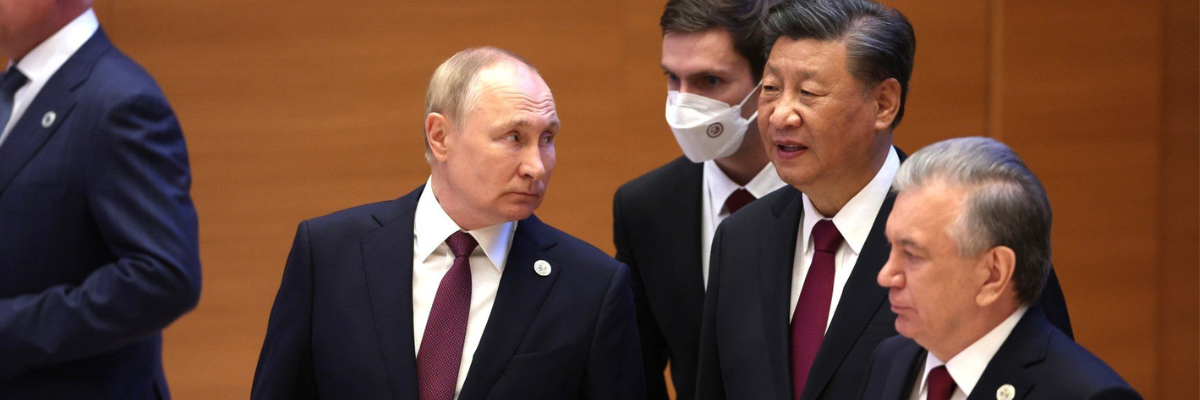
But the spirit of cooperation and the visions of connectivity were undermined by reminders of the numerous conflicts in which SCO member countries are involved. During the summit, Russian President Vladimir Putin’s interactions with fellow leaders were tainted by the war in Ukraine. While there were no official statements about the Ukraine invasion during the summit, most member states found their way to express dissatisfaction with the economic turmoil and destabilisation caused by Russia's invasion. Indian Prime Minister Narendra Modi told his Russian counterpart that “now is not an era of war.” Several leaders, including Kyrgyz President Sadyr Japarov, made Putin wait in front of cameras before meeting him—a power move that Putin has famously used in recent years.
China, too, expressed its concerns over the consequences of the current events in Ukraine. The strongest message came in the form of vocal support for Kazakhstan. In a statement, Xi said that “no matter how the international situation changes, we will continue to resolutely support Kazakhstan in protecting its independence, sovereignty, and territorial integrity.” Russian hawks had recently threatened Kazakhstan after Kazakh leaders took steps to distance themselves from Moscow.
But the war in Ukraine was not the only conflict to cast a shadow over the summit. During the summit, clashes began between two member states, Tajikistan and Kyrgyzstan. Meanwhile, tensions also rose between Armenia and Azerbaijan, an SCO dialogue partner whose president, Ilham Aliyev was in attendance at the summit.
The border between Tajikistan and Kyrgyzstan has been troubled since the demise of the Soviet Union. The former Soviet Republics have failed to properly demarcate their shared border due to complicated geographic terrain, mixed ethnic populations, and general political instability. But since last year, the regular border clashes have become more dangerous and more deadly. New clashes between Tajik and Kyrgyz forces erupted during the SCO summit, leaving dozens dead and hundreds injured. As the clashes between the two Central Asian republic escalated, Russia attempted to show its influence. Just after the summit, Putin spoke with the Tajik and Kyrgyz presidents and called on them to "prevent further escalation." Both countries are members of the Russia-led Collective Security Treaty Organization. A tenuous ceasefire is now in place.
Other SCO member states and dialogue partners may be implicated in the conflict if it escalates further. Earlier this year, Tajikistan began production of Iranian-designed drones as part of a novel joint venture. Meanwhile Kyrgyzstan has purchased Bayraktar drones from Turkey.
The Samarkand Summit demonstrated the value of the SCO as a platform for bilateral and multilateral initiatives of its member and associate countries. The SCO is especially attractive for strong personalist leaders, whose politics prevent active participation in other international rules-based blocs and bodies. However, because the SCO does not contribute to a rules-based order, the organisation has struggled in the face of conflict—such as the clashes that took place last week between Tajikistan and Kyrgyzstan.
If the SCO is to mature as an organisation and make good on its vision of connectivity, it must also serve as a platform for conflict resolution. Until now, SCO member states have viewed longstanding tensions among other members as something outside the bounds of the bloc. India is assuming presidency of the SCO and Modi did chide Putin over his invasion of Ukraine during their bilateral meeting. Will far-flung conflicts in Eastern Europe, the Caucasus, and Central Asia, be of little concern or too costly to ignore?
Photo: Kremlin.ru
As China-Led Bloc Heads to Samarkand, Leaders Struggle to Find Common Aims
Members of the China-led Shanghai Cooperation Organisation will meet later this week in Samarkand. But the assembled leaders may struggle to find common ground in the face of regional and global crises.
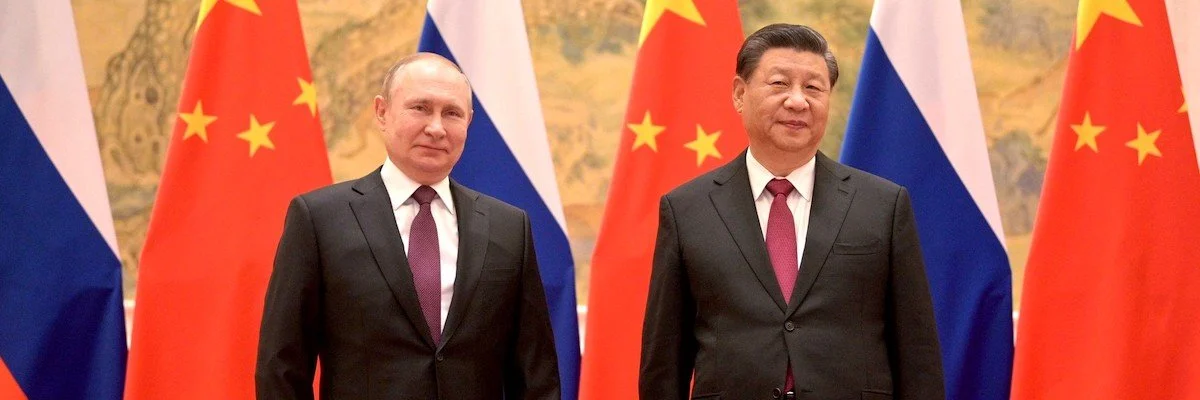
This week, Uzbekistan is hosting the Shanghai Cooperation Organisation (SCO) in Samarkand. The two-day summit begins on September 15. The leaders of China, Russia, India, Pakistan, Iran and other member and observer states are expected to attend. It will be the first time since the 2019 summit in Bishkek, Kyrgyzstan, that leaders will meet face to face in the SCO format.
The upcoming summit in Samarkand aims to present the organisation as a stable, capable, and evolving bloc with the capacity to address regional and global crises. For the host nation, Uzbekistan, the summit is a chance to promote the “Spirit of Samarkand” and to encourage global cooperation over global competition.
For years, the Uzbek government has sought to deepen its relations with other SCO member states. Having the opportunity to host the summit cements Uzbekistan’s position as a valuable member of the SCO community and allows it to push its regional agenda forward. Connectivity, cooperation, and the promotion of regional stability are at the core of President Shavkat Mirziyoyev’s goals, outlined on the eve of the summit.
Iran Takes Next Membership Step
One of the most important events expected to take place during the summit is Iran’s signing of binding documents related to its admission as a full member of the organisation. Iran’s accession will mark only the third time since its founding in which the SCO has admitted a new member—India and Pakistan joined in 2017. While Iran’s membership will not become official for at least another year, the procedures for its full membership will commence at the summit. Iranian leaders have faced a long wait for admission—it has been 15 years since Iran formally applied to join the bloc.
Tehran views joining the SCO as an important diplomatic achievement. The SCO represents a platform for non-western alignment and provides a platform for negotiations on tangible security and economic projects with other member states. Taking Iran on board, however, does not automatically guarantee either significant immediate benefits for Iran or an increase in the bloc’s capacity to effectively address security and economic challenges facing Asia, particularly while Iran remains under US secondary sanctions.
Eyes on Afghanistan
The situation in Afghanistan has proved strategically important for all SCO members, and especially the Central Asian republics. Security and humanitarian issues in Afghanistan were discussed in a large international conference hosted by Uzbekistan in July.
Among the Central Asian states, Uzbekistan is the loudest supporter of a taking a proactive approach towards the Taliban. While there are clear political issues with the Taliban, the Uzbek government realises that the critical south-eastern infrastructure corridor runs through Afghanistan. Development of this route promises significant economic benefits for Uzbekistan. The Uzbek president has stated that the SCO “must share the story of its success with Afghanistan.” In other words, it is a task for all regional states to engage with Kabul, and this task may become a benchmark for the capacity of SCO as an organisation. However, Afghanistan must become stable and a reliable partner to allow for its own development, as well to enable regional infrastructure projects to advance.
Tajikistan has a fundamentally different view towards the regime now in charge in Kabul. Dushanbe remains highly critical of the Taliban, raising concerns regarding terrorism and the safety of the Tajik ethnic groups in Afghanistan. However, neither Mirziyoyev or Emomali Rahmon, his Tajik counterpart, wishes to see Afghanistan further destabilised. China, India, and Russia basically hold the same position. Most regional countries are facing security threats from the Islamic State Khorasan Province and its affiliated groups. To add to the worries of the Central Asian states, Pakistan, a major player in Afghanistan, has itself faced political turmoil in the past year following the ousting of Prime Minister Imran Khan.
A Russian Dilemma
Russian president, Vladimir Putin, will face a difficult task in presenting his country as a global power in the face of unsuccessful military operations in Ukraine and economic strains caused by sanctions. The countries of Central Asia have close economic ties to Russia and are suffering the inevitable consequences of Moscow’s isolation.
As most regional countries are engaged in efforts to find ways to mitigate the negative impact of the Russian invasion of Ukraine, Moscow is expecting a not-so-warm welcome in Samarkand. Recently reported battlefield losses in Ukraine have incentivised some SCO member states to more forcefully resist Moscow's ongoing attempts to influence their foreign policy, including their aims and activities within the organisation.
The SCO is largely dominated by China rather than Russia, but Russia has long been seen as a key partner in shaping the bloc’s political and economic aims. But it appears that Russia’s future position and influence within the organisation will be increasingly determined by the priorities of other member states and not Moscow’s ambitions. Moreover, while Russia’s ties with China have been described as a “partnership with no limits” by Chinese officials, the upcoming summit will be the first time Xi and Putin meet in-person since the start of the Ukraine invasion. Their engagements on the side-line of the summit will be telling of the extent of the bilateral partnership, particularly within the framework of the SCO.
Struggling for Common Aims
According to the Uzbek foreign ministry, numerous agreements on cooperation in specific areas, ranging from digital security to climate change, are will be discussed at the summit. The SCO is also seeking to establish partnerships with countries outside its primary geographical core, namely with Egypt, Saudi Arabia, and Qatar, in an effort to further extend the bloc’s political reach.
Until now, the greatest advantage of the SCO was that the bloc did not impose strict rules or apply pressure to prevent its members from cooperation with non-member states, even those who may be perceived as adversaries to China and Russia. This flexibility has been particularly important for Central Asian states who maintain significant security and economic relations with the United States and Europe alongside their partnerships with China, Russia, and India—as required by their multi-vector foreign policies.
Since the Russian invasion of Ukraine, however, that flexibility seems at risk. For example, Russian politician Nikolai Patrushev recently declared that military training provided by the United States to certain SCO members poses a threat to Russia. Such accusations will no doubt colour bilateral and multilateral engagements in Samarkand.
Issued at the end of the summit, the "Samarkand Declaration" will present "a comprehensive political declaration on the SCO's position on international politics, economy and a range of other aspects." To what extent the SCO will be able to accommodate its members' varied and even contradictory aims is a question yet to be answered. The Samarkand summit will convene an organisation still searching for its trajectory.
Photo: Wikicommons
EU Embargo of Russian Oil Spells Trouble for Iran
European Union leaders have agreed on a landmark embargo of Russian oil that will seek to slash imports by 90 percent by the end of the year. That is bad news for Iran.
European Union leaders have agreed on a landmark embargo of Russian oil that will seek to slash imports by 90 percent by the end of the year. The embargo represents a major intensification of European sanctions on Russia following the invasion of Ukraine.
For most oil producers, the embargo will be a boon. While the measures were widely expected and therefore may have been partly priced-in by traders, oil prices jumped on the news. Saudi Arabia, for one, is already planning how it will spend the windfall enabled by high oil prices.
But for Iran, and to a lesser extent Venezuela, the embargo of Russian oil is bad news. For countries whose oil exports are subject to U.S. or EU sanctions, China is the buyer of last resort. For several years, China has been the sole country to continue significant purchases Iranian and Venezuelan crude oil, ignoring the threat of U.S. secondary sanctions. These imports have been an important contributor to Iran’s economic resilience under sanctions. However, this is not because revenues are flowing back to Iran. The revenues accruing in China are being used to sustain Iran’s imports of crucial intermediate goods for the country’s manufacturing base.
Iran has also benefited from increased financial resources in the United Arab Emirates and Malaysia, two countries which are serving to intermediate Chinese imports of Iranian oil. Most Iranian oil arriving in China is declared as an import from the UAE or Malaysia. As it stands, Iran is consistently exporting more than 1 million barrels per day of crude oil to China.
Russia’s rise as a major energy exporter to China corresponds to the period in which Iranian oil was taken off the market due to the impacts of US, EU, and UN sanctions programmes—Iran’s demise as an oil exporter helped open the door for Russian exports.
The new EU embargo on Russian oil will intensify competition between Russia and Iran in China’s oil market. Russian suppliers are already offering buyers a 30 percent discount on benchmark prices, a much steeper discount than Iran has offered Chinese buyers in recent years. Russia and Iran will be competing for the business of the limited number of Chinese refiners willing to process “sanctioned” oil.
Already, some Chinese “teapot” refiners are replacing Iranian oil with Russian oil because of the attractive discounts on offer. So far, customs data does not reflect a dramatic swing away from Iranian imports. But it is early days and the embargo will dramatically change incentives. According to the IEA, around “60 percent of Russia’s oil exports go to OECD Europe, and another 20 percent go to China.” While some customers, such as India, might import the Russian barrels that would have otherwise gone to Europe, political and economic realities will require Russia to push more oil into the Chinese market.
Looking to Chinese customs data for April, Russia’s ability to squeeze Iran becomes clear. It is clearly a more important supplier of crude oil to China. While logistical bottlenecks might prevent an immediate jump in Chinese purchases, all of the Russian barrels already flowing to China are newly subject to discounts—China can insist on lower prices now that the EU embargo is in place. This in turn creates pressure for Iran to match Russian discounts or risk losing market share.
While it is possible that the further pressure on global supply might push oil prices even higher, minimising the loss of revenue for Iran even as Chinese imports fall, in the medium term, Russia has the means to bully Iran due to its lower fiscal breakeven price and lower production costs. At the outset of the COVID-19 pandemic, Vladimir Putin boasted that Russia could withstand oil prices of as low as $25 dollars per barrel for as long as a decade. Iran’s oil sector, already weakened by a decade of sanctions, does not have the same ability to endure low prices. In short, Russia can afford to undercut Iran.
Plus, for whatever period that Russian oil is not subject to U.S. secondary sanctions, Chinese tankers and refiners may prefer to handle Russian crude, due to the lower risk of enforcement action.
Iran has a couple of options here. First, it could try and negotiate an arrangement with Russia, agreeing not to engage in a race to the bottom when it comes to pricing their sanctioned barrels for China. Iran might even be able to play a role as an intermediary in Russian energy exports to China, importing refined products across the Caspian and exporting crude oil to China as part of a swap arrangement. But this kind of cooperation is highly unlikely given the track record of Russia-Iran relations and the fact that Russia sees Iran as the junior partner in the relationship.
The second option would be for Iran to try and get itself out of this predicament by taking decisive steps to restore the nuclear deal. Doing so would see the rollback of U.S. secondary sanctions on Iranian oil and enable the resumption of exports to European buyers precisely when those buyers need it most. Earlier this month, EU High Representative Josep Borrell commented on the heightened value of the nuclear deal for Europe in the wake of the Russia crisis. He told the Financial Times that “Europeans will be very much beneficiaries from this deal” as the “the situation has changed now.” He added that “it would be very much interesting for us to have another [crude] supplier.”
Earlier this week, Iranian officials boasted that oil revenues were up 60 percent year-on-year owing to the high oil prices. But the situation has changed now. As the EU moves forward with its historic embargo, Iran’s oil revenues are suddenly in Russian crosshairs.
Photo: Kremlin.ru
Russia’s Economic Crisis Threatens Uzbekistan from Within
Significant attention has been paid to the impact of the Ukraine crisis and Russia’s economic contraction on Uzbekistan. But Uzbekistan’s exposure to the crisis does not just stem from the contraction of remittances coming from Russia.
This article was originally published by the East Asia Forum.
Russia’s invasion of Ukraine is devastating the lives of Ukrainian civilians and impacting the global economy. Low-income economies that were hit hardest by the COVID-19 pandemic, such as Uzbekistan, are the most vulnerable to supply chain disruptions and potential political unrest caused by the invasion.
Significant attention has been paid to the impact of the Ukraine crisis and Russia’s economic contraction on Uzbekistan. But this analysis is somewhat incomplete—Uzbekistan’s exposure to the crisis does not just stem from the contraction of remittances coming from Russia.
The greatest danger for Central Asian economies emanates from weak political institutions. The economic shock rippling from Russia to Uzbekistan is compounding the economic effects of the COVID-19 pandemic, which had already spurred protectionist economic policy and threatened the reform agenda in Uzbekistan. This new crisis might convince policymakers to impose trade restrictions, price controls and rollback reforms.
Since 2016, bold market reforms have enabled Uzbekistan to unlock higher rates of economic growth. But public sector entities will likely seek further subsidies and preferential schemes from the state, attributing their inefficiency to yet another economic shock. This could further entrench rentierism in an economy that has been taking important strides towards fiscal discipline, privatisation and the targeting of fiscal spending towards private sector businesses and households.
To emerge from the new economic crisis, Uzbekistan must double down on its reform agenda. Policy interventions might be necessary to support businesses given the scale of the economic crisis. But these interventions should be targeted and limited to avoid hobbling reforms. Instead of providing carte blanche support for inefficient businesses—raising the government debt burden—Uzbekistan should condition state aid in ways that support reforms, especially those reforms seeking to reduce state dominance of the economy.
The Uzbek government continues to provide preferential loans, subsidies for economic operators and preferential tax regimes in ways that favour state-owned enterprises and politically-connected firms. Economic resources flow from taxpayers to these firms, while households and small and medium-sized enterprises remain vulnerable to economic headwinds. The country’s privatisation plan, a largely untapped source of government revenue, risks being further delayed as state-owned enterprises cite the crisis as a reason to slow critical reforms. The speed and transparency of privatisation auctions should be increased.
The stalled land reform must also be advanced. Agriculture accounts for 28 per cent of the Uzbek economy and employs the same proportion of the labour force. The government should expand property rights reform cover to all types of land, including agricultural land, which would boost private investment and production of food staples now subject to rising prices. This reform could also soften the blow of lower remittances, as repatriated labour migrants could earn their livelihoods as smallholder farmers or agricultural labourers.
In the case of Uzbekistan, a country in which expansive price controls have historically distorted incentives, the temptation to introduce price ceilings should be avoided. Higher prices will encourage producers to increase supply—increased investment by private producers will boost employment and eventually stabilise prices.
The government should continue to prioritise inclusive development by focusing on poverty reduction. Uzbekistan has made progress in measuring poverty. Uzbek President Shavkat Mirziyoyev has acknowledged that 12–15 per cent of the population is living below the poverty line and created specialised registries to capture unemployed youth, vulnerable women and people with disabilities.
Such approaches have also underpinned the rollout of programs targeted at the community level. Some initiatives, such as the free school meals and conditional cash transfers for the purchase of agricultural equipment or livestock, will likely produce mixed results due to distorted incentives. Other community-based initiatives, such as cash transfers for families dependent on labour migrants, record educational subsidies, incentives to hire women and mass health screenings, are more promising.
But citizens are not merely a target for support during periods of economic crisis—they are also a source of economic resilience. The government should continue to engage communities to better target fiscal interventions during the crisis. Uzbekistan’s timely Open Budget initiative gathered 6.7 million votes and offers a powerful platform for local communities to voice their needs in the pursuit of a more efficient allocation of state resources.
Easing the registration and operation of NGOs will result in the broader empowerment of vulnerable populations and better distribution of state aid. This may improve trust in the state institutions by ensuring that a larger portion of aid reaches the intended audiences.
The government needs to carefully delimit policy interventions so as not to derail the broader reform agenda that requires Uzbekistan to move away from excessive state intervention in the banking sector. For a short period, the Central Bank of Uzbekistan instituted recommended exchange rates for the Russian rouble that were effectively compulsory and below market rates. Over 80 per cent of Uzbekistan’s banking sector being state-owned is especially concerning at a time when policymakers are under pressure to expand financial support to banks.
Given the new economic reality, Uzbekistan should prioritise its talks on WTO membership and actively pursue new trade partnerships. To incentivise both local producers and foreign suppliers to continue to meet the needs of Uzbek consumers, fostering free markets is vital. Uzbek policymakers should resist the temptation to revert to the orthodoxies of the planned economy as they devise their crisis response—the best way out of the crisis is to look forward, not back.
Photo: Kremlin.ru
Iran, Russia, and the Limits of Financial War
Comparing the economies of Russia and Iran, it is reasonable to assume that Russia will endure its financial war.
In response to Vladimir Putin’s increasingly brutal invasion of Ukraine, the West has declared a financial war on Russia. The US Department of Treasury unveiled new sanctions on the Russian financial sector late last week, measures that “target nearly 80 percent of all banking assets” in the country. Forthcoming sanctions on the Central Bank of Russia (CBR), announced by the European Union jointly with the United States, United Kingdom, and Canada, will effectively freeze Russia’s gross international reserves. Further measures targeting Russia’s energy sector will make the Western sanctions programme among the most expansive ever devised, and certainly the most significant to target such a large economy. There has been impressive coordination between US and European authorities in designing and implementing these sanctions, which have been justified by Putin’s provocations. In their rapid imposition and their broad scope, these sanctions are clearly intended to have significant deleterious effects on the Russian economy. The strategy has shifted from deterrence to attrition and from targeted measures to full financial war.
The only other comparable financial war waged by the United States and Europe has targeted Iran. The Iran sanctions were applied more gradually than those being applied to Russia today. But in 2012, Iran’s central bank assets and energy exports were targeted in move that will be the model for the sanctions on CBR and Russia’s energy industry. These sanctions were initially multilateral in nature, with UN, US, and EU measures imposed in tandem. The multilateral sanctions were in place until 2016, when the implementation of the Joint Comprehensive Plan of Action (JCPOA) saw the lifting of most UN and EU sanctions as well as US secondary sanctions. Iran benefited from sanctions relief for just two years, enough time for a return to economic growth, but not enough time for a remediation of the harm that sanctions had caused most Iranian households. In 2018, President Trump withdrew from the JCPOA and reimposed US secondary sanctions on Iran, once again thrusting Iran into an economic crisis, later compounded by the COVID-19 pandemic.
Broadly speaking, the financial war on Iran has been in effect for a decade. The damage incurred by the Iranian economy has been extensive. Currency volatility and high inflation have sapped Iranian purchasing power, pushing millions of Iranians below the poverty line. Chronic weaknesses of the Iranian economy, such as high unemployment and systemic corruption have been exacerbated. Still, despite the many hardships, the Iranian economy did not collapse. Rather, the economy stagnated, growing an average of just 0.37 percent between 2012 and 2020. When excluding 2016 and 2017—the two years of sanctions relief under the JCPOA—the average falls to -1.96 percent. A decade of stagnation and the diminishing welfare of ordinary Iranians combined to create new political pressures on the Iranian government. Labour mobilisations have become commonplace and there have been multiple waves of nationwide protests focused on economic grievances. These protests have been violently suppressed by authorities. Even so, the Iranian government is today pursuing sanctions relief—in the context of renewed negotiations over the JCPOA—not because of fears an impending economic collapse, but because of a view that economic resilience allows Iran to engage in negotiations from a position of relative strength, seeking the conditions for a return to growth.
Unsurprisingly, Iran has become a touchpoint in the discussion around the growing Russia sanctions programme. But the focus has been the Iranian precedent for key moves, such as the removal of Russian banks from the SWIFT messaging network. So far, there has been little consideration of what the outcomes of the financial war on Iran might tell us about the prospects for the financial war on Russia. The cases are not only comparable because of the kinds of sanctions that are being applied, but because the two economies share important similarities. Of course, Russia and Iran are both major energy producers and revenues from oil and gas exports are centrally important for government budgets. But the two countries also boast large manufacturing sectors principally supplying internal markets. Despite general corruption and rentierism, key institutions exhibit technocratic sophistication.
In response to the 2012 and 2018 sanctions shocks, Iran demonstrated that its flawed economy could undergo structural adjustments to sanctions pressure. Such adjustments begin immediately, meaning economies targeted by sanctions can return to fragile growth in as little as a year. In Iran, this capacity for adjustment reflected the bottom-up resilience of households and companies seeking to survive the financial war. The Iranian state lucked out. Officials boasted of their “resistance economy” policies, despite failing to develop a cohesive response to sanctions pressure. Meanwhile, the composition of the Iranian economy meant that sanctions pressure could be absorbed. There is reason to believe that Russia will also absorb such pressure. Across key indicators, Russia appears in a stronger position than Iran was at the outset of its financial war.
Access to Foreign Exchange
Sanctions targeting a country’s central bank are the most significant measure in any financial war because of the direct impact on the national currency. During the Trump administration’s “maximum pressure” sanctions campaign, Iranian authorities maintained ready access to just 10 percent of the country’s gross international reserves, putting enormous pressure on the Iranian currency and making it very difficult for Iran to manage deficits with key trade partners. In January 2018, a few months before Trump announced his withdrawal from the nuclear deal, the free market dollar exchange rate in Iran was IRR 46,000. Today the exchange rate is IRR 263,000. The dramatic devaluation of the rial is often cited as evidence of the devastating impact of US sanctions. Indeed, devaluation made imported goods, including foodstuffs like wheat, on which Iranian households rely, more expensive. But the Iranian government demonstrated an ability to return order to currency markets, both by finding ways to supply foreign exchange into the market despite sanctions and also through better technical management of the market itself, including through the creation of a parallel market whereby exporters are required to sell foreign exchange earnings to importers. Russia is arguably in a better position than Iran to weather the attack on the value of its currency. It has gone through this storm before—the rouble lost half its value following the imposition of more limited sanctions in 2014, as part of the Western response to the annexation of Crimea. In response to the latest crisis, CBR has already hiked interest rates to 20 percent and imposed a new requirement for companies to repatriate foreign exchange earnings. If we assume that the 10 percent figure represents maximum efficacy for the freezing of central bank reserves, then that would leave CBR with access to approximately $63 billion. However, Russian reserves are equivalent to about 42 percent of GDP. In 2012, Iran’s reserves (then $104 billion) amounted to just 17 percent of GDP. So even if a similarly small percentage of the reserves remain available to CBR following the implementation of the financial sanctions, Russian authorities could fare better than their Iranian counterparts in stabilising the value of the rouble after the latest devaluation shock caused by the financial sanctions.
Energy Revenues and Fiscal Space
Despite initial attempts to create carve-outs for Russia’s energy exports, motivated by a desire to shield Europe from an economic shock and to leave room for escalation, it now appears likely that Russian energy exports will be targeted by Western sanctions. In the case of Iran, such sanctions provided highly effective in reducing exports of crude oil and mostly effective at reducing exports of petrochemical products. Broadly speaking the purpose of energy sanctions is to induce a fiscal crisis. Even in periods in which Iran was permitted to export limited volumes of crude oil under so-called Significant Reduction Exemption waivers, the revenues from these sales could only be used for humanitarian trade, meaning that the fiscal constraints remained significant. In the lead-up to 2012, oil sales accounted for around 80 percent of Iran’s total exports and around 60 percent of government revenues. Russia has a significantly lower dependence on energy sales, which today account for around 60 percent of exports and around 40 percent of government revenues. Tax administration in Russia is also significantly more developed than in Iran. In 2020, the Russian government collected $387 billion in tax revenue, equivalent to around one-fourth of GDP. By comparison, tax revenue in Iran was just $32 billion in 2012, equivalent to one-twentieth of GDP. Like the Iranian government, the Russian government is not heavily indebted. In 2012, Iran’s government debt was equivalent to 10 percent of GDP. Government debt in Russia was equivalent to 16 percent of GDP in 2021. The Russian government is likely to have more fiscal space than Iran in the aftermath of the sanctions shock given a similar debt level and more robust revenue sources. Notably, Iran did not really use what fiscal space it had as part of its response to sanctions, choosing to run austerity budgets aimed at slowing inflation. Russia could take a different approach, directing state investment to compensate for the lost growth in the energy sector.
Dependence on Manufacturing
Russia is the world’s second largest consumer of natural gas. Iran is the fourth. These high rates of consumption reflect that natural gas is used for heating homes, for power generation, and as feedstock in the manufacturing sector. The energy sector in Russia will contract dramatically just as it has in Iran over the last decade, but it will not collapse in large part because of the important role of the manufacturing sector in the adjustment to sanctions and wider economic resilience. In 2012, Iran’s manufacturing sector accounted for 14.4 percent of GDP. In Russia, based on data for 2020, the manufacturing sector accounted for 13.3 percent of GDP. The sectors are of similar importance to their respective economies. But these statistics also underestimate that importance. The relative size of the manufacturing sector in Russia and Iran fluctuates with the oil price—high prices mean that the oil sector contributes more than usual to GDP. Moreover, in both countries the manufacturing sector is a larger employer than the energy sector, given the relatively limited manpower necessary to operate modern energy infrastructure. Manufacturing is the sector that really matters.
The latest World Bank report on Iran, which details the country’s fragile economic recovery, notes that recent growth has been driven by manufacturing. The report points to two aspects of the adjustment to sanctions: “Less market competition—due to import restrictions on nonessential goods—and the price competitiveness of manufacturing and mining production—following the currency depreciation.” The resilience of Iran’s manufacturing sector under sanctions has been further detailed in a study by Hadi Esfahani, who used firm-level data to show that “manufacturing firms adapted to the sanctions environment, and many resumed growth based on domestic demand and resources.” While the sanctions shock does lead to a contraction in the manufacturing sector, it is declining output, not “exits” that are to blame. In other words, manufacturing firms do not tend to go out of business. In fact, manufacturers who produce goods for export markets, especially regional markets, can grow their profit margins as they earn foreign exchange. This adjustment is easiest for firms engaged in light manufacturing, as demand for consumer goods is relatively inelastic and as production of these goods is less capital intensive, shielding manufacturers from higher producer prices. But to take advantage of these conditions, manufacturing firms must maintain output.
Shifts in Trade Composition
The fundamental challenge for the Iranian manufacturing sector since 2012 has been disruptions in the supply of inputs and high producer prices. In this way, the impact of sanctions on imports of industrial goods may be more consequential for the targeted economy than the impact of sanctions on the sale of energy products. Iranian manufacturing firms remain in business and continue to produce for a large domestic market and newly growing regional demand. But to do so, they needed to maintain imports of industrial equipment. Purchasing managers’ index data for Iran makes clear that the primary constraint on the manufacturing sector’s economic performance under sanctions has been the reduction in raw materials and intermediate goods inventories and the high cost of replenishing those inventories. Historically, intermediate inputs and equipment were sourced from Europe. But beginning in the late 2000s, China became a larger supplier. The financial war on Iran accelerated the shift in the country’s trade composition as Chinese suppliers proved more willing to sell to Iran in the face of sanctions. One way to express the relative importance of Chinese and European supply is to look at the ratio of exports from the two suppliers. In 2012, Iran imported 1.2 times more goods from China than it did from the European Union. But machinery imports (HS Chapters 84 and 85) from China and Europe were about equal. By comparison, Russia is significantly more dependent on Europe as its financial war begins. The total value of all imports from the European Union is about twice that from China. The dependence is slightly lower when looking at machinery—the total value of Chinese machinery exports to Russia is 70 percent of European Union exports.
On one hand, this higher dependence may mean that the sanctions shock to the Russian manufacturing sector will be greater than that in Iran. But on the other hand, it demonstrates that Russia has yet to make the “Eastward turn” that many have observed in Iran and other Eurasian economies. To be clear, Chinese firms did not completely ignore Western sanctions on Iran and did engage in de-risking that left Iran behind its regional neighbours with regards to economic ties to China. Bilateral trade has stagnated since 2012 and the inability of Iran to maintain significant oil sales to China for large periods over the last decade also posed financial challenges for maintaining industrial imports. But whereas Iran is one of China’s many economic partners in West Asia, Russia has presented itself as a unique geopolitical partner within a wider Eurasian context. This may make the difference as Russian manufacturers seek alternative suppliers for crucial industrial goods.
Capital and Its Survival Instincts
If Russia does demonstrate a similar kind of economic resilience to Iran, that does not mean that there will not be economic hardship. In Iran, annual inflation exceeded 30 percent following the 2012 and 2018 sanctions shocks. Skyrocketing prices, especially for food products, pushed many working-class families into poverty. For a once upwardly mobile middle class, the diminished standard of living has been embittering. For most in Iran’s upper class, sanctions have been a nuisance. For some among the wealthy, they have been a boon.
One unique feature of the Russia sanctions programme is the focus on oligarchs and the perverse influence that individuals with extreme wealth have on the country’s politics, particularly in their perceived fealty to Putin. Western officials are directly targeting these oligarchs, both by targeting their personal assets and through measures targeted at the conglomerates they own. The Moscow Exchange suspended trading last week after a massive sell-off saw the main index fall 50 percent. European and American regulators are promising to review the lax rules that have allowed Russian oligarchs to purchase extensive real estate in Western cities. In both capital markets and real estate, the wealth of Russia’s ruling classes has been augmented by the commingling of domestic and foreign investor capital. As foreign investors retreat from Russia, and as high-net worth Russians are blocked from foreign real estate markets, oligarchs will take a hit. But capital has its own survival instincts.
Russia’s capital markets are far more developed than those of Iran. Unlike the Moscow Exchange, the Tehran Stock Exchange has never hosted significant foreign investment. Still, capital markets did play a role in Iran’s sanctions response in a way that diminished the political, if not absolute economic, impact of sanctions. In 2019, deep into Trump’s restarted financial war on Iran, the Tehran Stock Exchange was the world’s best performing equity market, with market value doubling in dollar terms. There were three reasons for this remarkable performance. First, many listed companies, particularly manufacturing firms, were posting strong financial results after adjusting to the new sanctions reality. Second, high inflation left Iranians scrambling to invest in a safe asset while sanctions made capital flight difficult and costly. For middle class families, the safe havens were hard currency or gold. For upper class families they were domestic real estate or stocks. Third, as wealthy Iranians increased their exposure to capital markets, a policy shift took place. Suddenly, developing the capital markets became a priority for the government and for the nascent financial services industry, particularly with the aim of increasing the number of retail investors. More money poured into the market, even from middle class households, driving prices higher. The returns outpaced inflation, drawing in more investment, and giving rise to what many considered to be a dangerous bubble. But in the meantime, a new feature of Iranian political economy emerged. The newfound importance of the country’s capital markets, an outcome of the financial war, was exemplified in the decision of the government to liberalise a “justice shares” programme that had granted shares in state-owned enterprises listed on the stock exchange to disadvantaged families. Overnight, Iran had 50 million new retail investors with an interest in the political and economy stability that favours stock price appreciation.
By comparison, Russia has around 13 million retail investors. There is significant potential for domestic wealth to pour into the stock exchange, whether spurred by the inflationary environment or encouraged as a matter of new government policy. The implication is that capital markets are useful tools for preserving capital—the desperation of middle and working classes in Russia may help shore the wealth of oligarchs, already in stocks and real estate. Many of the enterprises that oligarchs control may successfully adjust to the new reality and remain profitable. A new class of “light” oligarchs may emerge as certain light manufacturing enterprises benefit from reduced competition and better export prospects. The financial war could also provide a pretext for state capture, with private capital facilitating rentierism, corruption, or smuggling deemed expedient in the face of sanctions.
Take all of this together and it becomes clear that the most problematic aspects of Russian political economy—the obscene concentration of wealth among a politically-connected ruling class—will remain unchanged in the financial war. Meanwhile, the immiseration of the middle and working classes will further disempower civil society, creating a dynamic where dangerous protests are the only means through which to air grievances and in which deprivation focuses those protests on wages and bread. As Bourse & Bazaar Foundation board member Djavad Salehi-Isfahani has shown, just as poverty has increased since sanctions were imposed on Iran, so too has inequality risen. The rich are not getting poorer, but the poor certainly are.
Confounding Aspects
Iran’s economic resilience in the face of sanctions owes little to the state and a lot to its people, who have simply tried to prevent their own financial ruin. Economies are made up of individuals—some wealthy, most poor—who marshal the resources they have. How those resources are distributed determines the effects of sanctions on the wider economy. When comparing the fundamentals of the Russian and Iranian economies—the depth of the comparison here is limited by my lack of detailed knowledge about the Russian economy—it seems reasonable to assume that Russia will endure its financial war. The composition of its industry, the size of its domestic and regional markets, and the resources available to the state are all comparable to what Iran had at its disposal in 2012 on the eve of the financial war that has now lasted a decade. Given the fundamental comparability of the Russian and Iranian economies, it stands to reason that the Russian structural adjustment to the newly imposed sanctions may not even require astute political leadership. This may be a good thing. The Iranian leadership was more inclined to pursue diplomacy when it believed that it had achieved a stalemate in the economic war.
As Nicholas Mulder has observed, “Perhaps the most confounding aspect of sanctions is that regardless of technical sophistication, their outcome is never a matter of economic factors alone.” Western governments will no doubt be able to cause massive damage to the Russian economy, but the individuals who comprise that economy will attempt to adjust. The Russian public, like the Iranian public, is at best ambivalent about the policies of their leaders in response to which sanctions have been imposed. In Iran, a decade later, there is a widespread sense that the price endured by ordinary people is no longer proportional to the wrongs committed by their government. If the sanctions persist in the aftermath of a cessation of the conflict in Ukraine—which is likely—a similar reality may come to pass for the Russia. In this context, the resilience of ordinary people in the face of financial war will not be an act of political resistance, but of basic survival. They will toil for low wages in factories and fields, struggling to put food on the table and at times they will protest, facing down the violence of the state. Meanwhile, the economy will stagnate. So too will a dismal political reality.
Photo: Getty Images
As Putin Invades Ukraine, Uzbekistan Feels Vindication and Fear
The unfolding crisis in Ukraine offers the latest evidence of Putin’s irredentist obsessions and the ways in which those obsessions threaten the political and economic integrity of Russia’s neighbours.
Vladimir Putin has begun his invasion of Ukraine, sending troops across the border to “defend” the Luhansk and Donetsk People’s Republics, which Russia has now recognized as independent states. The unfolding crisis in Ukraine offers the latest evidence of Putin’s irredentist obsessions and the ways in which those obsessions threaten the political and economic integrity of Russia’s neighbours.
Last week, Uzbekistan marked Ukraine’s “Day of Unity,” a Ukrainian national holiday. The façade of the historic Hotel Uzbekistan, overlooking Tashkent’s main square, was lit in the colors of the Ukrainian flag. Beyond shared affinities, Uzbekistan and Ukraine are both confronted by the challenge that is Putin. For Uzbekistan, the events unfolding in Ukraine validate a decades-long effort to hedge relations with Russia. But they also raise the spectre that Putin will no longer tolerate divided loyalties among the former Soviet republics.
As Maximillian Hess has written, Uzbek president Shavkat Mirziyoyev has sought to rebuild relations with Russia since coming to power in 2016. Mirziyoyev‘s predecessor, Islam Karimov, who led Uzbekistan from 1989 until his death in 2016, believed that “Moscow’s vision for Central Asia was to keep it as a colonial backwater.” In both security and economic spheres, Karimov challenged Russia’s regional dominance. Uzbekistan was an on-again, off-again member of the Collective Security Treaty Organization (CSTO), a military alliance of post-Soviet countries. Uzbekistan served as a staging ground for NATO operations in Afghanistan from 2001 to 2005. Karimov also delayed joining the customs union that preceded the founding of the Eurasian Economic Union (EEAU), Putin’s grand vision for an economic bloc.
Mirziyoyev’s ascendence to the presidency required horse-trading. Developing more constructive ties with Putin was an important aspect of his attempts to consolidate his authority after a power struggle with Rustam Inoyatov, the chief of Uzbekistan’s intelligence services. Inoyatov was eventually sacked in January 2018. In October of that year, Putin visited Uzbekistan bringing with him a large delegation of Russian companies. The visit saw the signing of contracts totalling $9 billion, including provisional agreements for the construction of a nuclear plant that would help Uzbekistan free its natural gas production for export.
But Mirziyoyev has also sought to limit Russian political and economic influence in Uzbekistan by pursuing a multilateral foreign policy and economic liberalisation. While Uzbekistan is expected to join the EEAU, Mirziyoyev has slow-rolled accession, meanwhile pursuing formalised ties with the European Union, including preferential trade terms under the EU’s Generalized Scheme of Preferences. Uzbek officials have continued to engage with counterparts in the United States, building on a state visit by Mirziyoyev to Washington in May 2018. Since the outset of his term, Mirziyoyev has also sought to develop better relations with neighbours. At the heart of this strategy is a series of “consultative meetings” among Central Asian leaders that exclude the presence of either Russia or China, the two states that typically wield convening power.
In this way, Uzbekistan has hedged in its relations with Russia. While developing more constructive bilateral relations, it has also ensured that parallel developments in its foreign policy and economic agenda serve to circumscribe Russian influence. Recent events have shown the prudence of such an approach.
In January, as protests accelerated into a full-blown political crisis in Kazakhstan, the Uzbek government reacted cautiously. But Putin’s deployment to Kazakhstan of a “peacekeeping” mission comprised of CSTO forces raised concerns over Russia’s respect for the sovereignty of its neighbours. Likely commenting on the circumspection of Uzbek leaders, Belarussian president Alexander Lukashenko issued a veiled threat to Uzbekistan, suggesting that the country’s failure to join CSTO would leave it vulnerable to “terrorists.”
For many Uzbek political commentators, the threat underscored the risks of posed by the increasingly irredentist Russia. Xushnudbek Xudoyberdiyev, deputy director of state news agency UzA and a prominent blogger, criticized Lukashenko, calling the CSTO a “trojan horse.” In a lengthy interview published two days after the threat, political analysts Farhod Tolipov and Kamoliddin Rabbimov questioned the wisdom of joining the EEAU.
Similar dynamics can be seen in the response to the Russian aggression against Ukraine. While Uzbek officials have yet to issue statements on the crisis, Uzbek editors and bloggers have been quick to label Putin a “savage,” a “criminal,” and a “bandit,” who has “lost his mind” and “spit on international law.” Political commentators have questioned the slow response to the new crisis from the Uzbek Ministry of Foreign Affairs and have also wondered about the risk posed by deepening economic ties with Russia.
Uzbekistan does not share a border with Russia—perhaps a silver lining of being one of just two double landlocked countries in the world. But the Ukraine crisis does have a bearing on Uzbekistan’s place in the political and economic order in West Asia. As Putin takes a more confrontational approach with the West, he may begin to see Mirziyoyev’s hedging of its relations with Russia as an afront, putting Uzbek elites with strong ties to Russia in a difficult position.
Moreover, if Western countries place Russia under significant sanctions as is expected, the consequences for the Uzbek economy could be profound. Russia hosts 3 million migrant workers from Uzbekistan, whose remittances shore Uzbek household consumption. As the rouble comes under pressure and as the economy falters, these workers, already struggling due to Russia’s general economic malaise, will see their employment prospects diminish and the value of their earnings erode. The devaluation of the rouble would also hit Uzbekistan’s economic elite who maintain assets in Russian banks. Moreover, financial sanctions placed on those banks could see a significant portion of Uzbek wealth effectively frozen.
Over the last five years, Uzbekistan has been one of the few former Soviet republics to enjoy political stability and economic prosperity. That alone sets Uzbekistan apart. But the country’s political and economic agenda is also unique given the ways in which it has sought to modulate Russian influence. Putin’s invasion of Ukraine vindicates that agenda, but it will also stoke fear. Among Putin’s complaints about Ukraine is that its leadership “preferred to act in such a way that in relations with Russia they had all the rights and advantages, but did not bear any obligations.” One can imagine a similar charge being made against Uzbekistan.
Photo: Kremlin.ru
Iran Trade Deal with Russia-Led Bloc Warrants Cautious Optimism
◢ A free trade agreement between Iran and the Eurasian Economic Union (EAEU) will come into force on October 27, enabling preferential trade between Iran and a trading bloc comprised of 183 million people. But a leading research body has cautioned that the “low level of Iran’s commercial complimentary” with the EEAU market will temper prospects in the short term.
On September 30, Iranian President Hassan Rouhani arrived in Yerevan, Armenia to attend the Eurasian Economic Union (EAEU) Summit. A free trade agreement (FTA) between Iran and the EAEU will come into force on October 27, creating conditions for preferential trade between Iran and the current EEAU members: Armenia, Belarus, Kazakhstan, Kyrgyzstan and Russia. The FTA will give Iran access to a single market comprised of 183 million people and with an aggregate GDP of USD 4 trillion.
Iranian policymakers have welcomed the FTA with cautious optimism. With parliamentary elections fast approaching, the Rouhani administration and parliamentarians alike are eager to implement policies that may help bolster Iran’s economy as sanctions cause a sharp recession. Reza Rahmani, Iran’s industry minister has stated that the FTA could help counteract Iran’s isolation in the face of U.S. sanctions. Mohammadreza Jahanbiglari, an economist and member Iran’s Chamber of Commerce, has predicted that if properly implemented, the FTA could see Iran’s trade turnover with EAEU member states quadruple to reach USD 10 billion within one year—a view echoed by Mehdi Mirashrafi, the head of Iran’s customs administration. The Iran Chamber of Commerce has been invited to establish a specific body to support exchanges with EAEU counterparts.
However, the highly regarded Islamic Parliament Research Center, the research arm of the country’s legislative assembly, has issued a more conservative assessment, outlining in a June 2019 report that the “low level of Iran’s commercial complimentary” with EAEU member states will result in a “minor impact from the FTA on the country's economy.”
The Parliament Research Center nonetheless concluded that the FTA could help Iran develop its non-oil exports, a central aim of the doctrine behind the “Economy of Resistance” called for by the Supreme Leader, Ali Khamenei. Under the FTA, a list of 502 goods will enjoy preferential tariffs when exported to the EAEU.
Utilization of the so-called “soft infrastructure” represented by the FTA may also spur the development of Iran’s geo-economic position in the Middle East through the creation of new “hard infrastructure.” Russian leadership of the EAEU is complimentary with its “Pivot to the East” strategy. In this context, Iran can provide the shortest, safest, and cheapest route for Russian goods to the Indian Ocean as envisioned in the International North–South Transport Corridor (INSTC). During the Yerevan summit, Iranian foreign minister, Mohammad Javad Zarif highlighted the pivotal role Iran can play in these plans, tweeting, “With parallel work on North-South & South-West Transit Corridors, ground paved for expansion in regional trade & cementing of our role as vital transit hub.”
Despite practical concerns about the facilitation of trade in the face of US secondary sanctions, Iran will also likely find a sympathetic group of countries among the EAEU, which has an anti-sanctions outlook. The EAEU Treaty was signed on May 29, 2014, after the first round of sanctions were imposed against Russia. Like Iran, Russia has seen the expansion of trade among the countries of the former Soviet Union as a possible bulwark against sanctions.
Before leaving Iran for the Yerevan summit, President Rouhani highlighted the potential for the FTA with the EAEU to help Iran mitigate the effects of U.S. sanctions. One of the key issues barriers for Iran’s cross-border trade is the absence of reliable banking channels. Iran and Russia have been exploring the use of local currencies in bilateral trade as well as the use of a new Russian bank messaging system called SPFS, which is intended as an alternative to SWIFT. Abdolnasser Hemmati, the governor of Iran’s central bank, has stated that Russia has agreed to Iran’s proposal to expand SPFS to the countries of the EEAU.
Beyond banking, Iranian business leaders are concerned about the harmonization of the trading regimes. For example, while EEAU countries use the more detailed 10-digit “Harmonized System” (HS), Iran uses the 8-digit version. Proper harmonization will require input from a wide range of Iranian regulatory bodies, including the customs administration, the National Standard Organization, the Veterinary Organization, and the Food and Drugs Administration. Aside from the administrative challenges on the Iranian side, there are also concerns around the internal dynamics of the EAEU, in which economic ambitious have not been matched with the kind of political frameworks that have made the European Union customs union so successful. The FTA between Iran and the EAEU is an interim agreement that will remain in force for three years—a short period to overcome a wide range of bureaucratic hurdles.
While Iran might not find drastic gains by joining the EAEU, it certainly has nothing to lose. Over time, if enabled by the creation of more robust banking channels and investment in new transport infrastructure, Iran’s non-oil trade with the EAEU could prove a real boon for the economy.
Photo: Kremlin.ru