
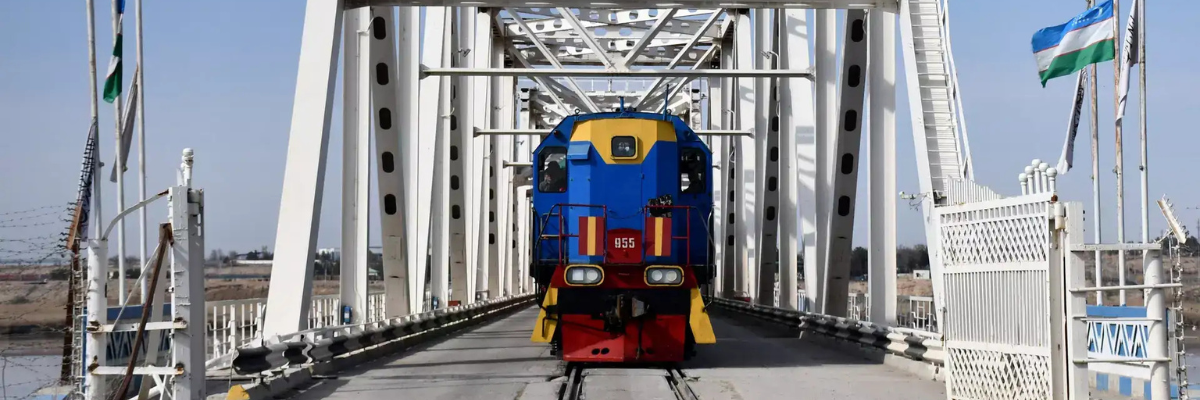
Afghan Authorities Accelerate Push for Road and Rail Projects
As the Taliban government pursues an assertive policy to enhance Afghanistan’s logistical infrastructure, interest in the country’s role as a southern transit hub is gaining momentum across West Asia.
As the Taliban government pursues an assertive policy to enhance Afghanistan’s logistical infrastructure, interest in the country’s role as a southern transit hub is gaining momentum across West Asia, facilitating the joint implementation of a wide range of new road and rail projects. Leading the charge is Uzbekistan, which has revived its ambitions through the Termez–Mazar-i-Sharif–Kabul–Peshawar railway—better known as the Kabul Corridor—positioning itself at the forefront of regional integration.
Meanwhile, Turkmenistan, backed by Kazakhstan, is advancing a parallel railway initiative through western Afghanistan to secure more direct access to Pakistan’s seaports. In a symbolic move, the foundation for the 22-kilometre Torghundi-Sanobar railway line was laid in September 2024, making a significant step towards reshaping regional connectivity.
The growing engagement between the Central Asian republics and Kabul in the development of transport infrastructure reflects a shared ambition to diversify foreign trade routes and establish more efficient supply chains to access the vast South Asian market. Alongside ongoing projects involving Uzbekistan, Turkmenistan, and Kazakhstan, Afghan authorities have announced plans to construct the Mazar-i-Sharif–Herat–Kandahar railway. This line has the potential to become the shortest trade route between India and Russia, enabling New Delhi to build transport links with Afghanistan and Central Asia while bypassing Pakistan.
Even Iran, which remains the primary conduit linking Central Asia to the warm waters of the Indian Ocean, and, by extension, to global trade, is seeking stronger transport links with Afghanistan. Tehran is planning to launch two railway connections to Afghanistan simultaneously: the Khaf–Herat line in the north and the Zahedan–Zaranj line in the south-west. The railway from Khaf to Herat is nearly complete, and the Taliban intend to extend it to Mazar-i-Sharif, a key Afghan trade hub already connected to the Uzbek-built Hairatan–Mazar-i-Sharif railway (launched in 2011) and the planned Kabul Corridor. Integrating these routes could eventually allow Iran to reach the Wakhan Valley in Afghanistan’s Badakhshan province, which is the narrow strip of land separating Afghanistan from China.
Notably, during a Taliban delegation’s two-day visit to Tashkent in February 2025, Uzbek and Afghan authorities agreed to jointly implement the Mazar-i-Sharif-Herat railway route. According to the Afghan Deputy Prime Minister for Economic Affairs, Mullah Abdul Ghani Baradar Akhund, this project would expand Tashkent’s trade with South Asia, Iran, and China, reinforcing the idea that Tehran could utilise the Kabul Corridor to reach the borders of China’s Xinjiang region. Another potential route could see the Zahedan-Zaranj railway extended to Kandahar and Kabul with its subsequent link to the Wakhan Corridor.
In 2020, Iran began constructing the Chabahar–Zahedan railway line, with plans to extend it to Zaranj in Afghanistan’s border province of Nimroz and further onward to Dilaram and Kandahar. Engineering surveys have already been conducted on the Afghan side for the Zaranj–Kandahar railway, which could offer Tehran an alternative access route to Afghanistan beyond the Herat Road—bringing it one step closer to creating a new overland trade route to China.
Nevertheless, the prospect of reviving the Wakhan Corridor— an outcome eagerly anticipated by Tehran—remains uncertain. In 2024, Afghanistan’s Ministry of Rural Rehabilitation and Development announced the completion of gravel laying on a 50-kilometre stretch of the road. However, substantial investments are needed to turn the ancient route into a viable commercial transit point. The Taliban are striving for help from China, although Beijing has so far adopted a cautious, wait-and-see approach and is in no rush to open its arms to Afghanistan.
Despite this limited progress, Tehran appears unlikely to back down, particularly as it pursues other ambitious projects. One of these is the proposed Iran–Afghanistan–Tajikistan–Kyrgyzstan–China railway corridor, also known as the Five Nation Road.
Its initial section will be the Khaf-Herat railway, scheduled to begin full operations later this year. The route would continue through Sheberghan, Mazar-i-Sharif, Khulm, and Kunduz, ultimately reaching the Tajik border at the Sherkhan Bandar crossing. It would then stretch eastwards across Central Asia to Kashgar in western China, spanning an estimated 2,000 kilometres. In this context, the Taliban’s proposed Mazar-i-Sharif–Herat railway becomes a strategic segment of a broader transit route from Iran to China.
The creation of a Five Nation Transit Corridor could also benefit Turkmenistan, which has long pursued a railway link to Tajikistan via Afghanistan through the TAT project. This initiative emerged in 2013 amid rising tensions between Tashkent and Dushanbe over transit routes and the desire to bypass Uzbekistan.
Turkmenistan completed the first stage of the TAT railway in 2016, spanning from Atamurat (Kerki) through Ymamnazar to Akina. The Akina–Andkhoy segment followed in early 2021. However, the Taliban’s return to power in summer 2021 brought work to a halt, as regional actors reassessed the group’s stance on cross-border infrastructure and foreign engagement. Yet contrary to initial concerns, the new Afghan leadership has shown a pragmatic approach to regional connectivity.
In February 2025, Afghanistan and Turkmenistan agreed to carry out survey and design work for the 55-kilometre Andkhoy–Sheberghan railway line, a project first announced by the Taliban in 2024. Meanwhile, in July 2024, Tajikistan’s Ministry of Transport and the Korea International Cooperation Agency signed a protocol to develop a feasibility study for a 51-kilometre Jaloliddini-Balkhi–Panji Poyon railway, linking Tajikistan to the Afghan border. Both developments indicate a resumption of the TAT project, which could raise concerns in Uzbekistan, given its longstanding role as a key transit country for several of its neighbours’ access to global markets.
The development of trans-Afghan logistics infrastructure is also of growing interest to Russia, which sees the new corridors as a means of extending its flagship International North–South Transport Corridor (INSTC) to Pakistan.
A clear indication of this was the visit of a Russian delegation led by Security Council Secretary Sergei Shoigu to Kabul on 25 November 2024, during which the construction of the Trans-Afghan Railway was discussed. Following talks with the Taliban, Russian Deputy Prime Minister Alexei Overchuk stated that the Russian Federation considers this project as an integral component of the INSTC.
The Russian Ministry of Transport later announced that it would collaborate with Uzbekistan to prepare a feasibility study for a railway through Afghanistan, based on two agreed routes: Mazar-i-Sharif–Herat–Dilaram–Kandahar–Chaman and Termez–Naibabad–Logar–Kharlachi. But this announcement was not confirmed by Uzbekistan Railways.
Russian involvement in constructing both the western and eastern Afghan railway routes—starting from the borders with Turkmenistan and Uzbekistan, respectively—would allow Ashgabat and Tashkent to secure a share of cargo flows between Northern Eurasia to South Asia. Increased competition along these routes is likely to drive down the cost of transit transport over time.
The opening of new trade routes through Afghanistan presents significant opportunities for realising Central Asia’s economic and transport-transit potential. Several key factors should be considered when assessing further developments in this area.
One consideration is the potential reorientation of Uzbekistan towards the western Trans-Afghan railway route. The relative cost-effectiveness of the Kandahar Corridor, compared to the railway via Kabul, could serve as a catalyst for such a shift. Although the Mazar-i-Sharif-Herat-Kandahar-Chaman route (1,468 km) is longer than the Kabul Corridor (647 km), it offers advantages in terms of terrain and security. Additionally, the route can branch towards Iran through the border province of Nimroz in south-western Afghanistan, providing a valuable strategic link for future transport corridors.
Another important factor is the growing security risks in Pakistan, coupled with increasing tensions in Afghan-Pakistani relations. These dynamics may prompt Tashkent and its external partners to reconsider their preferences on the trans-Afghan track, favouring the Kandahar Corridor instead. In this context, prioritising a transit route that connects to the southern regions of Pakistan—those closest to the ocean—would be more appropriate.
Given the growing significance of Afghan transit in transregional logistics, Central Asian countries will need to balance the interests of all stakeholders to prevent the emergence of intensified geopolitical rivalries along these evolving trade corridors. Harmonisation of the trans-Afghan routes currently under development appears to be both the most likely and most favourable scenario for the future. In such a case, the key stakeholders, particularly Uzbekistan, Turkmenistan and Kazakhstan, could pool their resources to establish a unified transregional railway corridor through Afghanistan.
This collaborative approach would enhance the prospects for attracting external investment and accelerating project implementation. Moreover, a consolidated approach is vital for strengthening the region's role in shaping the emerging architecture of trans-Afghan connectivity. If done successfully, Afghanistan could gain a genuine opportunity to position itself as a new transit hub at the heart of Eurasia.
Photo: Asian Development Bank
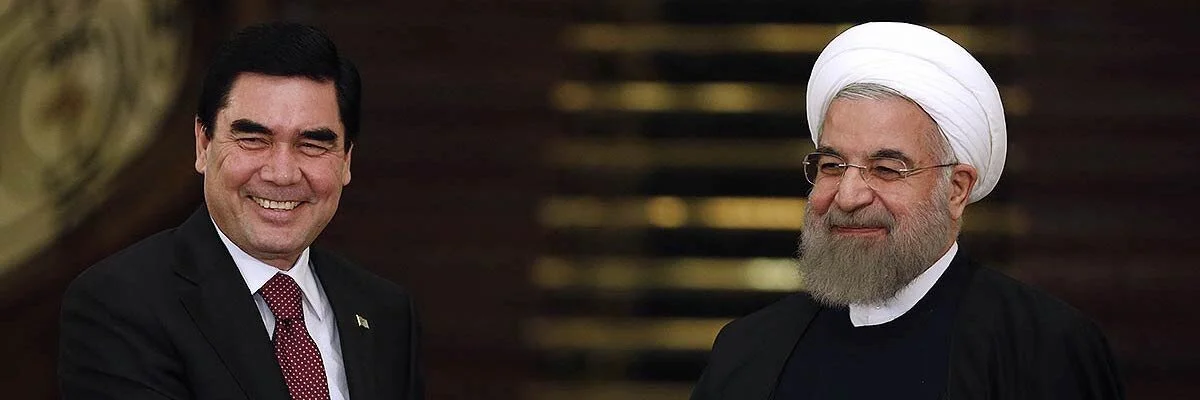
Iran Can Solve Turkmenistan’s Natural Gas Dilemma
Turkmenistan has long struggled to sell its enormous natural gas reserves to a diverse range of customers. With the country’s natural gas surplus expected to rise even higher in the coming years, increasing exports to Iran may be the best solution.
Bordering Iran on the northeast, Turkmenistan is a Central Asian country with a population of 6 million. What Turkmenistan lacks in population it makes up in enormous energy reserves. Domestically produced natural gas accounts for 80 percent of the feedstock used for electricity production. In 2006, discovery of the world’s second largest natural field, Galkynysh, saw the country become the country with the fourth largest natural gas reserves worldwide.
From the first days of independence from Soviet Union, Turkmen energy policy has focused on the diversification of its export destinations. At the time, Russia was the primary customer. But tensions in energy negotiations with Russia in 1997 led to concerns over dependence on a single country for energy exports. Turkmenistan launched negotiations with Iran to create a new market for its natural gas exports. That same year, the Korpezhe–Kurt Kui pipeline was commissioned and began exporting 6 billion cubic meters (bcm) per year of natural gas to Iran as part of a 25 year-long contract.
Since then, Turkmenistan has pursued other destinations for its natural has exports, with mixed success. In 2006, Turkmenistan and China signed a production sharing contract to develop a large portion of Turkmenistan’s natural gas reserves as well as an agreement on the construction of the Turkmenistan–China gas pipeline. The initial phase of the pipeline was inaugrated in 2009. That same year, the Turkmen government failed to agree upon the new contractual terms with Russia, leading to a 75 percent decrease in the volume sold to their primary customer. China became Turkmenistan’s leading customer, with construction of parallel lines on the Turkmenistan–China gas pipeline continuing through 2014.
The collective capacity of the three pipelines equaled 55 bcm per year, making China the largest buyer of Turkmenistan natural gas with more than 30 percent share of exports. Today, Turkmenistan is seeking new customers to prevent over-dependence on the Chinese energy market. For this purpose, in 2015, Turkmenistan launched construction a new pipeline connecting Turkmenistan’s natural gas fields to Afghanistan, Pakistan, and India—this project is known as TAPI pipeline.
Despite these efforts, Turkmenistan has failed to find a reliable means to increase its export capacity and its natural gas production surplus is only set to grow. Turkmenistan’s largest natural gas field, Galkynysh, currently produces 30 bcm per year. Predictions show that the number may rise to 70 bcm per year by 2025. Moreover, offshore fields which are producing at their minimum capacities, may see production rise to 20 bcm per year in near future. In addition, there are several undeveloped small fields, production potential of which estimated to be 20 bcm per year. Turkmen officials have made even more optimistic predictions of future production of natural gas. For instance, Ashirguli Begliyev, CEO of state energy giant Turkmengaz, has declared that production totals will reach as high as 230 bcm per year by 2030.
Looking to consumption side, subsidies have led to natural gas consumption figures higher than international averages. In 2015, domestic consumption was 34 bcm and is expected to rise 5 percent annually. Therefore, domestic consumption will ultimately reach to 55 bcm per year by 2030. Looking at difference between production and consumption, and subtracting the 50 bcm per year of exports to China, Turkmenistan’s surplus natural gas production can be expected to rise to at least 40 bcm per year by the end of the decade.
For Iran, Turkmenistan’s growing surplus is not only a potential source of competition in the global natural gas market, but also an opportunity. Turkmenistan will need to find ways to export its production to various new and existing customers at higher volumes than every before. Turkmen policymakers have four options.
First, Turkmenistan may rely on the TAPI pipeline. This pipeline is designed to export 30 bcm per year of natural gas through Afghanistan and Pakistan to its final destination, India. Although TAPI is the main prospect for Turkmenistan’s natural gas exports, particularly because the project is supported by the United States as an alternative to the suspended Iran–Pakistan gas pipeline, also known as the Peace pipeline, the TAPI project remains hampered by instability and security issues in Afghan territory.
Second, Turkmenistan may rely on the planned Trans-Caspian pipeline. If constructed, the pipeline would connect Turkmenistan’s gas fields to the European customers through Azerbaijan. However, the technical complexities of pipeline construction in deep sea areas, legal issues around maritime boundaries, the negative views of Russia and Iran towards the project, and Azerbaijan’s reluctance to extend the pipeline to Turkmenistan all make implementation an unlikely prospect.
Third, Turkmenistan could seek the construction of a new pipeline to China, relaying on a route across its Central Asian neighbors of Uzbekistan, Tajikistan, and Kyrgyzstan. However, such an option would be at odds with Turkmenistan’s efforts to diversify its export destinations.
Finally, Turkmenistan could seek to increase export volumes to Iran, either through the full utilization of the 24 bcm per year of capacity available in existing pipelines or through the construction of new infrastructure. Increasing natural gas exports to Iran may prove Turkmenistan’s best option. For Iran, there are also numerous benefits. Due to Iran’s proximity to Turkemistan’s natural gas fields import costs would be low. The addition of supply from Turkmenistan would enable Iran to supply the northeast, while using its southern natural gas fields to increase export volumes to Iraq and other customers. Iran’s central role in the region can also enable the country to serve as a natural gas hub, including for liquid natural gas shipments through the Persian Gulf.
Considering the difficulties associated with facilitating exports to Azerbaijan, Afghanistan, and China, Turkmenistan and Iran have an opportunity to enter new gas deals on the basis of clear mutual benefits. Iran’s strategy to become the natural gas hub of the region depends on developing several gas corridors with its neighbors—gas-rich Turkmenistan ought to be a key partner in this strategy.
Photo: IRNA
Negotiations On Legal Status of Caspian Sea Approach Finish Line
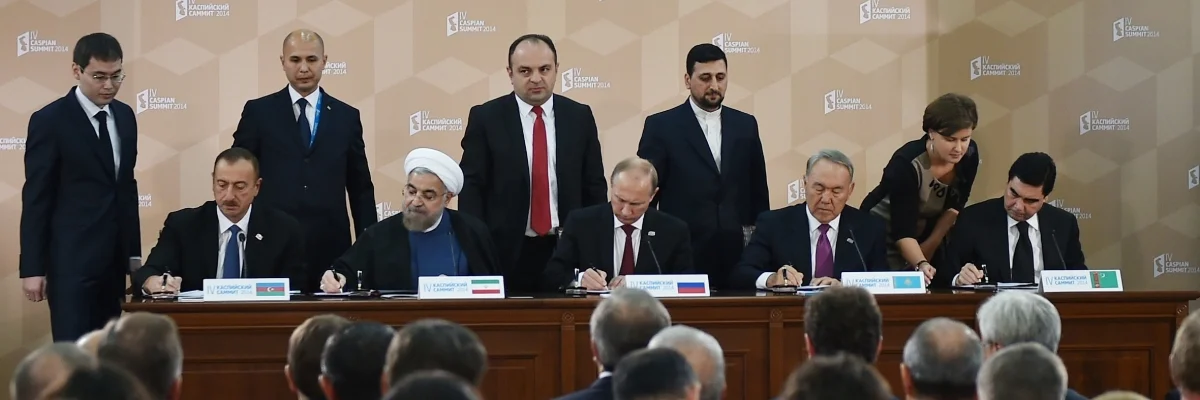
◢ Negotiations on the international legal status of the Caspian Sea, which started in 1996, appear to have at last reached the finish line. After 22 years, the five countries around the sea have come close to signing a convention on its legal status. If they do, it seems that the agreement will allow to pave the way for the construction of the underwater the Trans-Caspian Gas Pipeline and other projects and will also close the access to the sea for the armed force of third countries.
Negotiations on the international legal status of the Caspian Sea, which started in 1996, appear to have at last reached the finish line. After 22 years, the five countries around the sea have come close to signing a convention on its legal status. If they do, it seems that the agreement will allow to pave the way for the construction of the underwater the Trans-Caspian Gas Pipeline and other projects and will also close the access to the sea for the armed force of third countries.
Russia has completed its part of the work on the preparation of the convention. According to its official legal information website, the government in the end of July approved in the draft submitted by the Foreign Ministry after coordination with Azerbaijan, Iran, Kazakhstan and Turkmenistan. It is expected that the document will be signed at the summit of their heads of state on 12 August in Aktau, Kazakhstan.
Over the long negotiating process, the Caspian Five have held 51 meetings of a special working group at the level of deputy foreign ministers (the main negotiating platform established in 1996), about 10 meetings of foreign ministers and four presidential summits (in 2002 in Ashgabat, in 2007 in Tehran, in 2010 in Baku and in Astrakhan in 2014). In the last years the negotiators agreed on 90 percent of the draft convention. The delay in the agreement on the last 10 percent was because the most controversial issues remained to be solved. Two of the most acute have been the principle used for the division of the Caspian Sea and the mechanisms of approval of underwater pipeline and cable projects.
Iran has had a special position on the first issue. Insisting on Soviet-era agreements, it has not recognized the agreements between Russia, Azerbaijan and Kazakhstan on the division of the northern part of the Caspian Sea signed in 2003. These three countries used for delimitation the middle modified line (equidistant from the coast line and taking into account the length of the coastline). The Iranian position was instead to divide the sea into equal sectors of 20 per cent, since using the middle modified line would leave it with the smallest sector of about 11 per cent.
In response to such a difficult challenge, the draft of the convention does not include precise wording with geographical coordinates of the boundaries of sectors, but rather only the principles for the division of the sea. This allows for the transfer of responsibility for the division from the five-sided discussion to the two - and three-way level, as was the case when the northern part of the sea was divided.
Judging by the dynamics of recent contacts between Iran and Azerbaijan, bilateral negotiations on the division of the southern part of the sea are in full swing. This positive trend in relations between the two may have been one of the reasons for progress in the five-sided Caspian dialogue.
The second cornerstone for the negotiation process was the possibility of building trans-Caspian projects. Originally Russia and Iran emphasized the environmental danger of such projects and stressed the need for coordination by all five countries. Turkmenistan defended its right to build the Trans-Caspian Gas Pipeline without any consultations with its neighbours. In response to this challenge, the draft of the convention indicates that all submarine cables or pipelines must meet the necessary environmental requirements and standards approved under inter-state agreements. However, all the countries around the Caspian Sea would have the right to lay any pipelines and cables without the consent of their neighbours, but with the necessary notification about the routes taken. This means that, theoretically, after signing and ratifying the convention, Turkmenistan will be able to start looking for partners for the construction of the Trans-Caspian Gas Pipeline.
There is still a possibility that one of the parties refuses to endorse the draft document in its current form at the last moment. But the approval of the draft by Russia’s government and the announcement of a date for the summit indicate that the meeting will take place and, most likely, will bring about the long-awaited convention.
Photo Credit: Russian Press Service