

Iran Needs Humanitarian Aid. Trump Should Help.
Medicines and foodstuffs are exempted from the U.S. sanctions on Iran, but the prospect of punishment has spooked potential suppliers, and especially foreign banks. Although this problem is easily fixed, President Donald Trump’s administration has been shamefully tardy in doing so.
It was the smallest of gestures, and might easily have been missed if it wasn’t for the identities of those involved. In the chamber of the United Nations Security Council on Thursday, the American ambassador to the UN walked over to her Iranian counterpart to offer condolences.
Kelly Craft was responding to a speech by Majid Takht-Ravanchi, in which the Iranian ambassador mourned the death of Ava, a two-year-old girl in Tehran, whose doctors had been unable to procure bandages for skin blisters caused by a rare genetic disease. Takht-Ravanchi blamed U.S. sanctions — specifically, their impact on supplies of essential medicines.
It would’ve been easy enough to dismiss the story as a disingenuous play for sympathy, and an opportunistic attempt to deflect blame by a regime that has in recent weeks slaughtered hundreds of its own citizens—including children. But Craft was right to express compassion for the plight of ordinary Iranians. In fact, a bigger, more meaningful gesture is long overdue: making sure no other Ava need die for her government’s faults.
Medicines and foodstuffs are exempted from the U.S. sanctions on Iran, but the prospect of punishment has spooked potential suppliers, and especially foreign banks. Although this problem is easily fixed, President Donald Trump’s administration has been shamefully tardy in doing so.
What it will take is for the U.S. to green-light a proposed Swiss channel for humanitarian trade, and to expand the channel’s mandate to include non-Swiss suppliers. The channel has been in the works for more than a year. The most obvious European beneficiaries would be Swiss drugmakers Roche Holding AG and Novartis AG, and the food group Nestle SA, which have a long history of trade with Iran. But there’s no logical reason other companies, even American ones, shouldn’t be allowed to use the conduit.
U.S. authorities have blocked the channel, mainly by dragging their feet in clarifying what they would and would not allow through it. Some progress was announced in October, and still more earlier this month.
This isn’t good enough. While it’s true that the Iranian regime uses the sanctions as a convenient cover for its own failings — and some of the medical shortages are of its own making — there’s no gainsaying that trade restrictions inflict real pain on many people. Human-rights groups have documented how the sanctions harm Iranians’ right to health.
At the same time, they have encouraged European governments to seek alternative routes such as INSTEX, a so-called “special purpose vehicle” designed to sidestep the American financial system. It hasn’t worked yet. But it has put the Trump administration in the unedifying position of threatening its allies over humanitarian trade.
American intransigence on this has also given Iran a stick with which to beat the Europeans. When not shedding crocodile tears over Ava, the regime in Tehran threatens to ratchet up its enrichment of uranium, unless Europe opens up trade channels.
By clearing the legal and bureaucratic path for the Swiss channel, the Trump administration would not only be doing the right thing by the Iranian people, it would be revealing the regime’s threats for what they are: nuclear blackmail. It would also free the Europeans to impose sanctions of their own, guilt-free.
All of this is long overdue. But if politics requires a propitious moment for the big gesture, it so happens that one is close at hand: January marks the 40th anniversary of Switzerland’s role as the de-facto representative of American interests in Tehran. It’s hard to think of a better time to announce a Swiss-American humanitarian channel.
And should the channel need a name, something more meaningful than “INSTEX,” something that conveys a political message as well as a humanitarian one ... how about Ava?
Photo: IRNA

New Iran Metals Sanctions Target Jobs, Not Government Revenue
◢ The Trump administration has announced a new wave of sanctions on Iran’s steel, aluminum and copper industries. But while the administration has claimed the move is intended to deny Iran’s government foreign exchange revenue, the likelier intention behind targeting the metals industry related to the sector’s role as perhaps the single most important employer in Iran.
The Trump administration has announced a new wave of sanctions on Iran’s steel, aluminum and copper industries. A statement from President Trump declares, “Today's action targets Iran's revenue from the export of industrial metals—10 percent of its export economy—and puts other nations on notice that allowing Iranian steel and other metals into your ports will no longer be tolerated.”
It is true that Iran’s metals exports are an important source of foreign exchange revenue. But to put the overall value in perspective, Iran’s finished metals industry accounts for the same share of exports as Iran’s vegetable industry. The largest product group in metals exports, semi-finished iron (USD 503 million), earns Iran less than the largest product group in the food industry, nuts (USD 649 million).
Moreover, it is important to recognize that Iran is already struggling to repatriate foreign exchange revenues due to the severe sanctioned-related constrictions on international banking channels. So the notion that additional sanctions were necessary to constrain this particular source of foreign exchange is dubious at best. Had cutting access to foreign exchange been the specific aim, a waiver system like that formerly in place for oil exports, in which Iran’s earnings would accrue in tightly controlled escrow accounts, would have sufficed.
So why is it so important for the Trump administration to target the metals and mining industry? The answer is that the metals and mining industry is perhaps the single most important employer in Iran’s economy. Metals and mining companies directly employ over 600,000 workers. The country’s automotive sector, the largest consumer of Iranian steel, directly employs a further 1 million workers. Combined, the two sectors account for 6 percent of the country’s total labor force.
The new sanctions will likely hit the earnings of Iran’s major metals companies, such as Mobarakeh Steel or the National Iranian Copper Industries Company. But any impact on government revenues will be secondary. Foremost, a disruption to earnings will further deteriorate the balance sheets of Iran’s heavily indebted metals and mining companies. Even if the government steps in to prevent bankruptcies, the likely disruptions to cash flow will lead to wages going unpaid and the prospect of layoffs. Furthermore, a disruption in steel output—whether through shortages or price increases—could also impact output within Iran’s automotive sector, where production has already fallen nearly 40 percent year-on-year and where layoffs have begun to take effect. Just last week, on the occasion of International Labor Day, President Rouhani told an audience of Iranian blue collar workers that they are on the "on the front line" of an economic war.
In April, Donya-e-Eqtesad, Iran’s leading financial newspaper, ran an in depth report on prospects for Iran’s steel exports. The report observed that already significant disruptions in exports were contributing to “the cessation of production and the unemployment of thousands.”
Creating the conditions for mass unemployment—especially among the blue collar workers employed by state-owned enterprises who form the backbone of Iran’s economy—is the likely aim of the Trump administration’s latest round of sanctions. Last month, Mark Dubowitz, a principal advisor on the Trump administration’s Iran policy, called upon the US to more actively support labor mobilizations in the country, drawing an analogy to the US support for the trade-union led Solidarity movement in Poland. To this end, stoking unrest by creating mass unemployment within the metals industry would be consistent with the Trump administration’s “maximum pressure” aims, especially as administration officials have grown more open to confessing their regime change goals.
Photo: IRNA

Europe Tries to Sidestep the U.S. Finance System
◢ The standoff between the Trump administration and Iran is escalating, and Europe is caught in the middle. Brussels and national governments in the U.K., France and Germany, meanwhile, have been criticized by Iran for their response to U.S. sanctions. Europeans “speak eloquently”, Iran’s foreign minister Mohammad Javad Zarif said in February. “They also need to walk the walk.” But it would be wrong to dismiss Europe’s efforts as hopeless.
The standoff between the Trump administration and Iran is escalating, and Europe is caught in the middle. The U.S. is exerting pressure through renewed economic sanctions, and hardliners in Tehran are issuing fiery threats of retaliation.
Brussels and national governments in the U.K., France and Germany, meanwhile, have been criticized by both sides for promising to preserve trade with Iran while also treading softly with the Americans to avoid a full-blown diplomatic crisis. Europeans “speak eloquently”, Iran’s foreign minister Mohammad Javad Zarif said in February. “They also need to walk the walk.”
But it would be wrong to dismiss Europe’s efforts as hopeless.
A big source of contention for both Washington and Tehran is INSTEX, a special-purpose vehicle unveiled by Paris, Berlin and London in January. Its ultimate ambitions are bold: To keep trade between Iran and Europe going without relying on cross-border financial transactions (which might fall foul of the U.S.). While not explicitly a sanctions-busting vehicle, it was clearly designed with President Trump in mind. It was his re-imposition of the U.S. trade ban that led to Iranian banks being cut off from the SWIFT banking network, and to international businesses scrapping their investment plans in the Islamic Republic.
By using INSTEX like a central clearing house, the idea would be that buyers and sellers in Iran and Europe could get their money without making transfers into and out of the Middle East country. It’s a complicated system, but in a very simplified form you could imagine having a European trader who wants to buy gas from an Iranian supplier and a European manufacturer who wants to sell aircraft parts to an Iranian company. Instead of the trader paying the Iranians for the gas, they would transfer the money to their fellow European manufacturer (in lieu of payment from its Iranian customer). At the same time, the Iranian aircraft company would pay its compatriot gas supplier for the supplies sent to Europe. Hence no cross-border money flows.
To be clear, INSTEX right now only wants to deal in humanitarian essentials – medicine and food, for example – but Europe has said it wants to expand the facility in the long term. Combined with new “blocking regulations” that make it an offense for EU businesses to comply with U.S. extraterritorial sanctions, there’s a loud message here that Europe’s leaders want to go their own way.
Criticism has focused on the everyday practicality of using INSTEX beyond those humanitarian aims, plus the wisdom of Europe resisting its key NATO ally, whose dominant currency affords it huge extra-territorial reach when waging economic war. For the Trump administration, the special purpose vehicle is a misguided attempt to “break” American sanctions and offer cover to the Islamic Republic. For Iran, it’s a paper tiger. Zarif says Europe has dragged its feet and is clearly reluctant to launch the system.
Neither complaint is entirely fair. INSTEX is obviously a work-in-progress, a sketch on paper more than a reality. But for London, Paris and Berlin, whose unity tends to crumble under U.S. pressure, a public commitment to this vehicle is a kind of success in itself. And it is being taken seriously by parts of the American establishment, who are aware of any risks—however distant—to the dollar’s dominance. “The plumbing is being built and tested to work around the United States,” former Treasury Secretary Jack Lew warned in February. “There will increasingly be alternatives that will chip away at the centrality of the United States.”
In Iran, behind the official skepticism, there are signs of progress. Press reports suggest Tehran has set up its own matching facility for INSTEX, which is needed to make the system work. Europe has also insisted that Tehran has to meet certain standards to participate, including conforming to global rules on money-laundering and terrorist financing. If this happens, it would be significant.
It will probably take years for INSTEX to become genuinely viable in terms of participating countries and trade flows. But it’s serving a political purpose already: Giving Iran an incentive to stay aboard the nuclear deal, and reminding the U.S. that sanctions overreach may harm its interests. INSTEX can’t stop the Middle East from sliding into war, but it’s a marker worth laying down.
Photo: Bloomberg

Economic War on Iran is America’s New ‘Forever War’
◢ The administration of US President Donald Trump last week designated the Islamic Revolutionary Guard Corps, part of Iran’s armed forces, as a Foreign Terrorist Organization. With the future of both the Iran nuclear deal and prospects for US-Iran diplomacy at stake, a political fallout is the clear intention behind designating the IRGC a terrorist organization.
This article was originally published in the Asia Times.
The administration of US President Donald Trump last week designated the Islamic Revolutionary Guard Corps, part of Iran’s armed forces, as a Foreign Terrorist Organization. A White House statement boasted that it was “the first time that the United States has ever named a part of another government as an FTO” and declared that the “action will significantly expand the scope and scale of our maximum pressure on the Iranian regime.”
In a briefing related to the announcement of the new designation, Secretary of State Mike Pompeo told reporters that he hopes “other governments and the private sector will now see more clearly how deeply the IRGC has enmeshed itself in the Iranian economy through both licit and illicit means”.
While there is no doubt that the Trump administration is waging a self-described “financial war” on Iran, designating the IRGC as a terrorist organization has little to do with adding new economic pressure, despite the administration’s claims. As sanctions attorney Tyler Cullis has argued, the IRGC and the wider Iranian economy are already subject to a “veritable labyrinth of US sanctions” meaning that “the designation of the IRGC as an FTO has limited, if any, immediate practical consequence.”
While the new designation does introduce increased criminal liabilities for those individuals or entities that can be shown to have provided “material support” to the IRGC, legitimate businesses were adequately deterred from engaging with the IRGC because of risks stemming from pre-existing sanctions designations.
Building a Sanctions Wall
The new designation may have limited economic impact, but it has certainly proved politically provocative. In Tehran, leaders from across political lines were unified in their condemnation of the designation and in their solidarity with the IRGC. In Washington, officials at the Pentagon and Central Intelligence Agency reportedly consider the move counterproductive, possibility putting US military and intelligence assets in the Middle East at risk of blowback. In Paris, French President Emmanuel Macron has called for all sides to practice restraint. He also spoke to Iranian President Hassan Rouhani by phone to reassure him of European support for the nuclear deal, which the US abandoned in May 2018.
In Baghdad, Iraqi Prime Minister Adel Abdel Mahdi told reporters that his government had tried to persuade the Trump administration not to proceed with the designation, noting that any escalation “would make us all losers.”
With the future of both the Iran nuclear deal and prospects for US-Iran diplomacy at stake, a political fallout is the clear intention behind designating the IRGC a terrorist organization. In an op-ed in The Wall Street Journal published just a week before the designation, the head of the hawkish Foundation for Defense of Democracies called for the Trump administration to create a “sanctions wall” that would hobble efforts by a potential Democratic president to re-enter the Iran nuclear deal in 2021. Mark Dubowitz has been among the most vocal proponents of designating the IRGC as a Foreign Terrorist Organization.
To understand how the FTO designation helps build a “sanctions wall,” it is important to consider how such a designation fits into the recent development of US sanctions powers. Today’s financialized sanctions were largely developed in response to the “forever wars” of the US invasions of Afghanistan and Iraq and the realization that the “war on terror” could not be won through conventional military conflict.
With public sentiment turning against further military deployments, and with the threat of terrorism expanding in part because of the fallout of the US invasions in the Middle East, the Treasury Department was tasked to develop new sanctions powers intended to weaken terrorist organizations by cutting their access to financial resources. As described by Juan Zarate, who served as deputy national security adviser for combating terrorism under president George W Bush, the US sought to develop its means of “financial war,” in which sanctions would “increasingly become the national-security tools of choice for the hard international security issues facing the United States.”
By the time Barack Obama took office as president, the use of sanctions in the “global war on terror” was overtaken by a new national-security imperative: addressing the perceived threat of Iranian nuclear proliferation. Suddenly, sanctions tools that had been developed primarily to target terrorist financing were being turned against governments, in part by leaning on the formal designation of countries like Iran as “state sponsors of terror.”
Building a Stigma
The application of sanctions seemed sensible – the US would leverage its primacy in the global financial system in order to block the assets of terrorist organizations and their state sponsors, while also putting their commercial enablers in legal jeopardy. Obama saw “diplomacy, backed with strong sanctions” as a direct alternative to reliance on military brinksmanship – ”a failed policy that has seen Iran strengthen its position.”
But there were unintended effects. While the US was tightening its sanctions on Iran, American officials toured the world warning companies that, despite their extensive due diligence, the opaque nature of the Iranian system meant an ever-present risk that routine commercial transactions could see funds diverted to designated groups that finance terrorism.
The stigma that arose around Iran’s economy and particularly its financial sector was so great that when Obama’s bet on diplomacy and sanctions finally paid off in the form of the historic JCPOA (Joint Comprehensive Plan of Action) nuclear deal, he ultimately proved unable to deliver Iran the economic benefits of sanctions relief promised as part of the agreement, bringing it to the brink of collapse. Even though the US lifted a large proportion of its sanctions on Iran as a matter of legal fact, companies and the banks Tehran needed remained fearful to engage, rendering the practical impact negligible.
Opponents of Obama’s nuclear deal were quick to recognize this fact. When Trump came into office having promised to tear up a “decaying and rotten deal.” some even argued that his administration could advance its anti-Iran agenda while remaining in the JCPOA on the basis that Iran was receiving no meaningful benefits. Eventually Trump did withdraw from the agreement, but as hawks opposed to engagement with Iran look to the post-Trump future, whether that future arrives in 2021 or 2025, there is a clear desire to exploit the ways in which sanctions themselves have proven a liability to diplomacy.
In this way, given the lack of practical impact, the designation of the IRGC as a terrorist organization has little to do with the activities of the corps as a military force, concerning though they may be.
Rather, by designating part of Iran’s state as a terrorist organization, a label that extends to millions of conscripts, those who wish to build a “sanctions wall” are seeking to close a political feedback loop. Not only does the FTO designation aim retroactively to justify the whole architecture of US sanctions on Iran, but even if the political circumstances between Washington and Tehran change in the future, sanctions will continue to be justified as a matter basic definitions. A future US administration seeking to lift sanctions on Iran will not merely need to argue the political expediency of that decision – it will now be forced in effect to “redefine” the most powerful force in Iranian national security, a tall order after 40 years of entrenched animosity.
What the FTO designation makes clear it that “financial war” on Iran is America’s new “forever war.”
Photo Credit: IRNA

Squeezing Gas Prices or Iran? Trump Must Choose
◢ The deadline for the US administration to decide whether to extend sanctions waivers granted to buyers of Iranian oil is now less than a month away, and President Donald Trump faces a tricky decision. He undoubtedly wants to increase pressure on the Persian Gulf nation, but in doing so he risks stoking oil prices and with them those all-important gas prices in swing states back home.
The deadline for the US administration to decide whether to extend sanctions waivers granted to buyers of Iranian oil is now less than a month away, and President Donald Trump faces a tricky decision. He undoubtedly wants to increase pressure on the Persian Gulf nation, but in doing so he risks stoking oil prices and with them those all-important gas prices in swing states back home.
Brian Hook, the US Special Representative for Iran, believes oil market conditions are better this year than they were in 2018 for accelerating the goal of “zeroing out all purchases of Iranian crude,” or so he told reporters last week. But the numbers tell a different story.
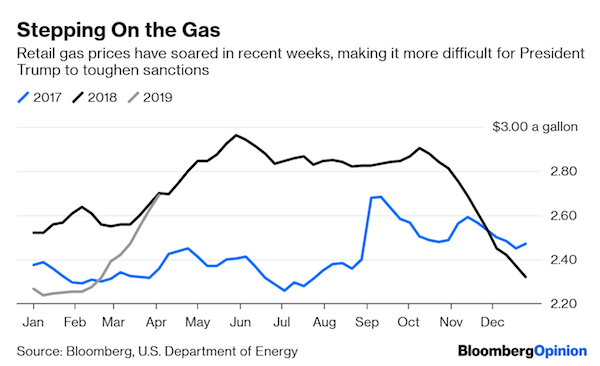
That is going to make it more difficult for Trump to go in hard on the remaining buyers of Iran’s oil.
Crude prices have risen nearly 50 percent since Christmas, with WTI popping above USD 62.50 a barrel last week for the first time in almost five months. Retail gasoline prices are on a tear, too. The latest data from the Department of Energy show gas prices up by 18 percent since late February, bringing them back to where they were this time last year.
Meanwhile, in the Persian Gulf, Iran’s visible exports of crude and condensate—a light form of oil produced from gas fields—have been rising steadily since the start of the year. Part of this increase may be due to more of the nation’s oil tankers sending out the radio signals that allow them to be tracked, after much of the fleet turned off transponders to disguise their movements immediately after sanctions were re-imposed. But customs data from importing nations show a similar upward trend.
America’s squeeze on Iran nevertheless allowed some nations to purchase its oil, under a series of six-month-long waivers. These were granted to eight countries, including China, South Korea, Iran, Japan and Turkey, as the restrictions were imposed in November. An estimated 1.76 million barrels a day of crude and condensate left Iran for those five countries in March, up from 1.42 million in February, according to Bloomberg tanker tracking.
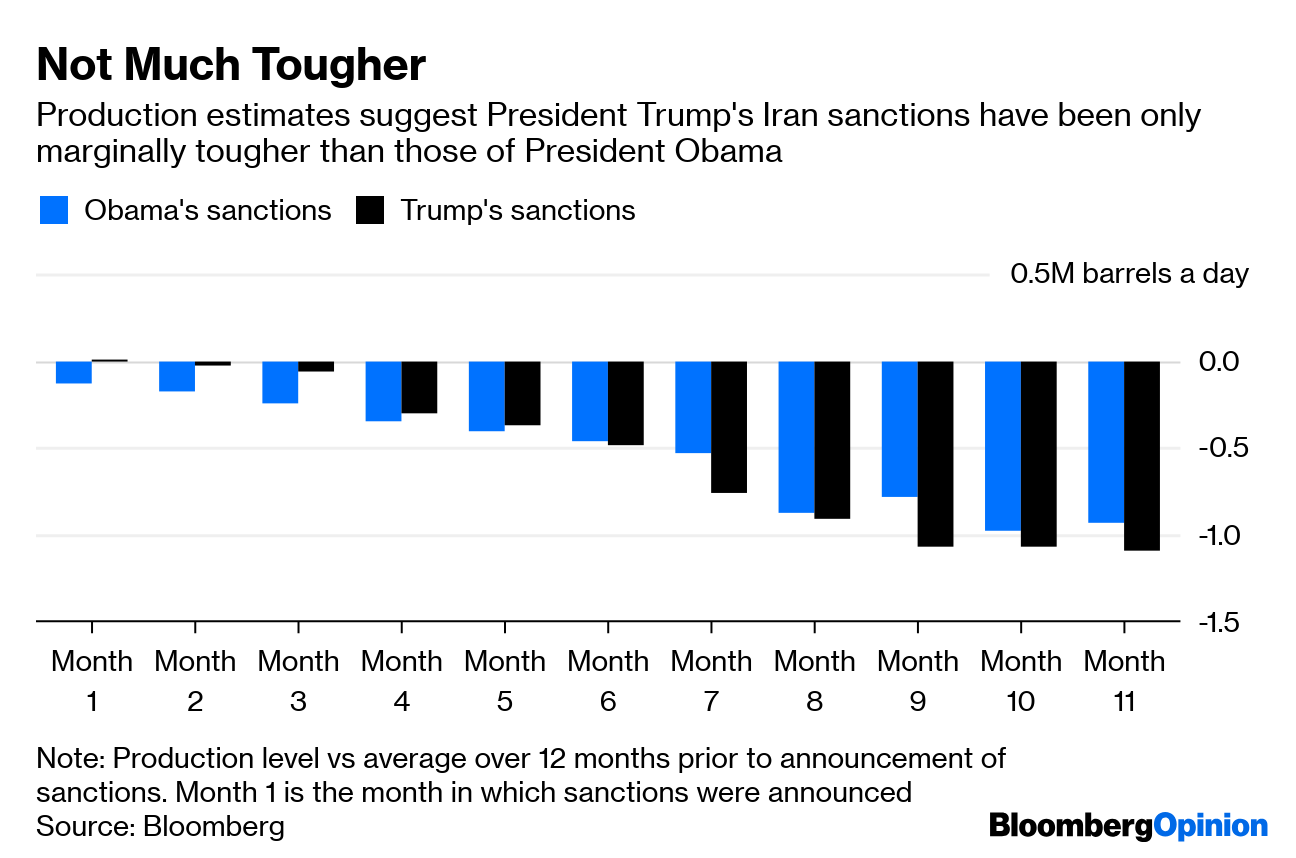
This trend contradicts Hook’s assertion that the US is “on the fast track to zeroing out all purchases of Iranian crude.” Three countries that got waivers have cut their purchases to zero, he added. In fact, those three countries—Taiwan, Greece and Italy—haven’t exercised their wavers at all since they were granted. Refiners in Greece and Italy have not received any Iranian cargoes since October, while Taiwan took its last delivery in September.
President Trump’s sanctions have been only slightly tougher than those imposed by his predecessor, despite offering fewer waivers. That will no doubt act as an additional spur for him to heap pressure on the country. But he is going to face difficulties if he wants to get much tougher on Iran next month.
Gas prices remain important to the president and their recent rise must be a source of concern.
The deteriorating situation in two of the “Shaky Six” oil-producing countries I identified a couple of weeks ago is also going to make toughening up the Iran sanctions more difficult.
Venezuela’s oil production is said to have plunged by half during blackouts that rolled across the country last month. Heavy tar-like oil began to solidify in pipelines and tanks after heating systems lost power, causing substantial damage that could take months to fix.
Sanctions imposed on Venezuela’s state oil company have accelerated the output decline, depriving Petroleos de Venezuela of its biggest buyer and the supplier of the light oil it needs to dilute the extra-heavy crude it produces. Output will fall further as the political crisis drags on.
Libya’s production is also at risk again as forces loyal to strongman Khalifa Haftar advance on the capital, Tripoli, threatening a major escalation in violence. Output rose above 1 million barrels a day last month for the first time this year, after the country’s biggest oil field was restarted following a three-month armed occupation. That recovery is now at risk again.
There are two things Trump can do, and his national security team is divided on the course he should follow.
He can allow the unused Iran waivers to expire, claiming a tougher stance without actually affecting oil flows, and perhaps trim the volumes that the remaining countries are permitted to import. Expect particular pressure on Japan and South Korea, who may be more willing than the others to acquiesce to US demands.
He can also continue to lean on Saudi Arabia and the rest of the OPEC+ group to raise output. The Saudis would be very happy to boost production at the expense of their rival, but they will be much less willing than they were last year to do that before seeing Trump actually impose tougher sanctions.
If he has to choose between lower gas prices and tougher Iran sanctions, domestic considerations will probably hold sway. Expect more tweets aimed at Saudi Arabia and OPEC, followed by an extension of five of the eight the waivers, probably permitting reduced volumes of purchases for some, if not all.
Photo Credit: IRNA

Here’s How the United States Can Help Iran's Flood Recovery
◢ In order improve preparedness for frequent earthquakes, floods, sandstorms, and heat-waves, Iran urgently needs to upgrade its surveying and monitoring technologies to better model and predict meteorological, hydrological, and geological events. The United States should create a new general license to remove the sanctions-related barriers to Iran’s acquisition of these much needed technologies.
Over the last two weeks, Iran has been ravaged by unprecedented floods, resulting in over 60 deaths and the devastation of whole communities. The natural disaster has only added to the the country’s woes, already reeling from an economic crisis brought about in part by the reimposition of the Trump administration’s decision to reimpose secondary sanctions in November 2018. The coincidence of tightening sanctions and a major natural disaster has led for calls for the Trump administration to take steps to ensure that sanctions policies do not unduly interfere with relief efforts. In the aftermath of the 2003 Bam Earthquake, the Bush administration established new licenses to ensure that the program of then-expanding US sanctions would not stymie relief efforts in Iran, which even came to include the dispatch of American search-and-rescue teams. In 2012, the Obama administration took similar steps to ensure financial aid could reach Iran in the aftermath of yet more devastating earthquakes.
So far, the Trump administration has given no indication that it intends issue new licenses to provide legal clarity to those individuals and organizations wishing to provide aid or to support relief efforts in Iran. A brief statement from Secretary of State Pompeo declared that the US “stands ready to assist and contribute to the International Federation of Red Cross and Red Crescent Societies, which would then direct the money through the Iranian Red Crescent for relief.” However, in an indication of the depth of the Trump administration’s sympathies, Pompeo also claimed that “it is the [Iranian regime’s] mismanagement that has led to this disaster.”
Given the administration’s commitment to imposing “maximum pressure” on Iran through an ever-expanding sanctions program, it is highly unlikely that the administration will prove willing to make it easier for American or foreign entities to provide substantial material or financial relief for the recent floods. However, despite the Trump administration’s regrettable political stance, there are still measures that administration should take—with encouragement from Congress—to ensure that Iran is able to more effectively recover from the floods, in particular by enabling preparedness efforts in advance of the next major natural disaster.
Iran, like all countries worldwide, is facing new and growing challenges related to both climate change and natural disasters. In addressing these challenges, proactive measures of preparation, prediction, and prevention will always have a greater bearing on the protection of human life and mitigation of destruction than the provision of financial aid for relief efforts in the aftermath of a disaster. But in order to succeed in boosting national preparedness for frequent earthquakes, floods, sandstorms, and heat-waves, Iran urgently needs to upgrade its surveying and monitoring technologies to better model and predict meteorological, hydrological, and geological events.
Acquisition of these technologies has been made significantly more difficult by the recent reimposition of US secondary sanctions, meaning that even if Iran takes on board the difficult lessons of the recent floods, it will be hampered in its ability to adapt. The Trump administration should create a new general license to permit the sale of such surveying and monitoring technologies, which produce nothing more than useful information that can be used to save lives. Over the last decade, Iran has undertaken several systematic reviews of its climate change and disaster readiness. In each instance, the acquisition of better technology has been identified as key a priority for authorities.
In December 2017, Iran submitted its “Third National Communication” to the United Nations Framework Convention on Climate Change, a major report which detailed the country’s assessment of the challenges posed by climate change and the status of its preparedness and remediation efforts. The report, compiled by Iran’s Department of Environment in collaboration with the United Nations Development Programme, offers a sober assessment of the Iran’s failures to adequately deal with the effects of climate change—failures which stem largely from weak regulations and mismanagement. But the report also highlights how “years of economic instability and unfair sanctions have delayed mitigation and adaptation measures.” In particular, the report notes that “this situation even has prevented civil technologies transfer to Iran, which has constrained mitigation measures and actions.”
As part of the its national communication report, Iran also submitted a separate “Technological Needs Assessment.” Focused largely on technologies that would help increase energy efficiency and reduce emissions, the report also details ways in which Iran has struggled to acquire the survey and monitoring technology necessary to understand and adapt to new climate change phenomena. New technology is needed to identify “the emerging environmental phenomena and challenges such as desertification, drought, sand and dust storms… and mainstreaming environmental considerations in future national development plans.” Notably, the report also details that “climate change causes inconsistencies in historical and data series obtained from the meteorological and hydrometric monitoring stations,” a reference to the fact that Iran is seeing more unprecedented weather events. Today, Iran’s dams are nearly at capacity after historic rainfall, offering a real world example “of greater inaccuracies in estimating water return period for designing and construction of hydrostructures.”
Beyond climate change, a similar emphasis on the need to improve monitoring technologies can be seen in Iran’s official assessments of disaster readiness. Iran’s 2013 assessment report for disaster readiness, complained in accordance with the United Nation’s Hyogo Framework for Action, identified “neither comprehensive nor substantial” achievement in regards to the availability of “national and local risk assessments based on hazard data and vulnerability information.” The report’s authors point to a wide range of issues preventing effective monitoring for natural disaster risks and providing adequate warnings to the population. These challenges include a lack of satellite imagery and the software to interpret that imagery, a lack of a robust climatological models to develop seasonal forecasts, and a lack of tools to predict the severity of complex weather phenomena while they are developing. Pointing to the dual threats of earthquakes and weather-related disasters, the report notes that sanctions are “a serious hindrance in the increase of seismic monitoring instruments and upgrading early warning systems.”
The lack of sophisticated meteorological tools can also contribute to the loss of life even when there is no full-blown natural disaster. In February 2018, an Aseman Airlines ATR 72-212 aircraft crashed in Iran’s Zagros Mountains, killing all 66 people on board. The interim investigation report released last month by Iran’s Civil Aviation Organization concludes that the accident was mainly the result of “human factors,” including the actions of the cockpit crew. However, the accident transpired as the aircraft entered adverse weather conditions and the investigators have concluded that contributing factors included a lack of “significant meteorological information” about the wind conditions in the mountain area. This oversight was identified in part because data provided by Météo-France, the French national meteorological association, was more accurate in modeling the wind and ice formation conditions at the time of the accident than the data available to Iran’s own meteorological agency. The report recommends that the Islamic Republic of Iran Meteorological Organization undertake efforts to research how it can provide more sophisticated information on mountain weather hazards, something which will require new monitoring technologies.
Multiple agencies in Iran, looking at issues of climate change, disaster management, and aviation safety, have formally detailed the need for more advanced survey and monitoring technologies. They have also identified sanctions as a major impediment to the acquisition of these technologies. It is a common claim that Iranian authorities point to sanctions to deflect away from their own mismanagement. However, in regards to climate change and disaster management efforts, sanctions-related challenges have consistently been described by authorities as just one of many challenges, most of which stem for domestic failures of best-practice adoption. Additionally, the effect of sanctions on Iran’s ability to acquire these much needed surveying and monitoring technologies is readily observed in the relevant trade data.
A general license issued by US Treasury Office of Foreign Assets Control would drastically increase the ease with which suppliers of meteorological, geological, and hydrological monitoring equipment could determine the compliance of sales to Iranian customers. Such a license would benefit US companies as there is precedent for sales of such equipment to Iran. In 2007 and 2008, before US secondary sanctions on Iran were expanded, with just under USD 8,000 dollars worth of “surveying instruments and appliances,” specifically exported in 2007 and just under USD 80,000 exported in 2008, according to trade data from the US Census Bureau.
But more importantly, a general license would significantly impact the ability of European companies, including the European subsidiaries of American companies, to export meteorological, geological, and hydrological survey and monitoring instruments to Iran. Europe is by far the largest exporter of such technology to Iran, but it’s exports have been significantly impacted by US secondary sanctions.
A review of European exports to Iran since 2000 makes it clear that the vast majority of “hydrographic, oceanographic, hydrological, meteorological or geophysical instruments” (HS code 9015) were purchased by Iran prior to 2009, meaning that much of the technology Iran has deployed is at least a decade old. The imposition of international sanctions on Iran saw exports in these categories fall precipitously, with totals falling from a high of over EUR 16 million in 2006 to just over EUR 375,000 in 2014. A small recovery can be observed in 2016, when Iran received sanctions relief following the implementation of the Joint Comprehensive Plan of Action, but the limited recovery tallied suggests that the lingering impact of US sanctions on banking channels and the anticipation of the Trump administration’s possible withdrawal from the JCPOA dampened sales. In a concerning indication of the likely impact of the reimposition of US secondary sanctions on Iran in November 2018, European exports of goods in these categories fell to just over EUR 5,000 in December of last year, rising slightly to just over EUR 40,000 in the first month of this year. A general license would help address the decline in exports by giving legal clarity to European companies and banks regarding the status of the trade.
Given the seriously degraded commercial environment, any new general license would need to make several provisions. The license should draw on the model of General License D-1, which covers sales to Iran of “certain services, software, and hardware incident to personal communications.” The operational relationship between climate monitoring hardware, captured datasets, and modeling software would be critical to reflect in the license. However, General License D-1 only allows the provision of communications-related services to the government of Iran on the basis they are “no cost.” In the case of the survey and monitoring technology necessary for climate change or disaster readiness, any license must include the more expansive provisions outlined in the longstanding exemptions for humanitarian trade of food and medicine with Iran. Specifically, the general license should authorize sales “to the Government of Iran, to any individual or entity in Iran, to persons in third countries purchasing specifically for resale to any of the foregoing.” In addition, the general license must authorize the activities necessary for the related transactions, such as “the making of shipping and cargo inspection arrangements, the obtaining of insurance, the arrangement of financing and payment, shipping of the goods, receipt of payment, and the entry into contracts.” It should also include permissions for training and technical assistance necessary for the proper implementation of newly acquired technologies in the field. Finally, given that these sales will be denominated in foreign currency, the license must enable Iran to use funds originating from the Central Bank of Iran, such as funds currently held in escrow accounts related to the Trump administration’s waivers for the import of Iranian crude.
The establishment of such a general license, if matched by genuine and proactive communication from the US Department of State and US Department of Treasury, would significantly improve Iran’s ability to acquire much needed surveying and monitoring instruments. Because of its own political decisions, the Trump administration can do little to help Iran respond to the recent devastating floods. However, if American policymakers, including leaders in Congress, truly wish to see the resolution of the current political disagreements with Iran and to reduce the costs borne by the Iranian people, they ought to think long-term. Decisions taken today to provide targeted sanctions relief can help Iranian authorities save lives tomorrow. The provision of scientific tools can empower Iranian stakeholders with more sophisticated information about the evolving risks of floods, earthquakes, forest fires, sandstorms, heat-waves, droughts, and other threats. Preventing Iran’s access to this critical information, even if the unintended consequence of a broad sanctions policy, in no way serves US national security interests and only serves to complicate the earnest work of individuals and organizations committed to protecting lives by improving Iran’s response to mounting environmental threats.
Photo Credit: IRNA

The United States and Iran are in a Quantum War
◢ It took just under an hour for staff at Israel’s Government Press Office to delete a tweet that suggested that Prime Minister Benjamin Netanyahu had finally decided to wage war on Iran. The conflict Iran faces today is neither a hot war nor a cold war. It is a quantum war—a superimposition of two states of conflict. Put another way, depending on when you observe the facts, Iran is both at war and it is not.
It took just under an hour for staff at Israel’s Government Press Office to delete a tweet that suggested that Prime Minister Benjamin Netanyahu had finally decided to wage war on Iran. The office replaced that tweet with another one that clarified that Israel merely seeks to join with Arab nations to “combat Iran.” The most striking thing about the whole fiasco was not that the prime minister was agitating for war. It was that the English word in the original translations seemed so precise and unambiguous: war.
There was a kind of refreshing clarity to the translation that has been elusive in Iran policy, particularly as articulated by the Trump administration. Donald Trump has placed sanctions on Iran ostensibly as an alternative to military confrontation, but he still refers to the sanctions program as part of an “economic war.” The administration creates exemptions for humanitarian trade but ensures that they are not operable. Officials declare their unwavering support for the Iranian people, but bar them from entering the United States under the “Muslim Ban.” The U.S. government devises covert programs to sabotage Iran’s defensive capabilities but then leaks their existence to the press.
Fittingly, Netanyahu’s mistranslation fiasco came during a summit that Trump administration officials insisted was “not a trash-Iran conference.” Yet the prime minister himself assured reporters that the meeting was focused on Iran.
At first glance these might just seem like the hallmarks of the Trump administration’s chaotic, incoherent, and hypocritical policymaking. But perhaps these contradictions are the basis of a new kind of warfare. The conflict Iran faces today is neither a hot war nor a cold war. It is a quantum war—a superimposition of two states of conflict. Put another way, depending on when you observe the facts, Iran is both at war and it is not.
Iran has been stuck in a kind of liminal space of international relations for four decades. But the international community and Iran’s domestic political constituencies now face an unprecedent number of internal divisions over the question of Iran’s place in the world.
Whereas Iran once counted on the support of Russia and China and the relative ambivalence of the Arab states to head off a multilateral challenge from the United States and Europe, today, the United States joins the Arab states and Israel to form a nascent coalition against Iran. These anti-Iranian actors seem principally united by a shared perception of Iran’s threat expressed in increasingly ideological terms. Lacking political legitimacy, such a coalition can neither marshal the kind of containment required for a cold war nor credibly engage in a hot war. What is left is quantum war.
In some respects, this is the worst circumstance for Iran. Whereas hot and cold wars tend to unite people in the country under attack, a quantum war is politically more insidious. Some Iranians believe the nuclear deal is still viable and channels of dialogue with Europe still open, so they remain committed to diplomacy. Others focus on airstrikes from Israel and terrorist attacks abetted by Arab governments, and therefore see no alternative to conflict. According to the 2019 worldwide threat assessment from the director of national intelligence, as a result of such dynamics, “regime hardliners will be more emboldened to challenge rival centrists by undermining their domestic reform efforts and pushing a more confrontational posture toward the United States and its allies.” The Iranian public is equally divided. Today half of Iranians support the nuclear deal, while half do not.
In response to such domestic pressures, Iran has once again returned to hedging on matters related to its foreign relations. In the same week that President Hassan Rouhani announced his willingness to negotiate with the United States should it “repent,” Supreme Leader Ali Khamenei declared that when it comes to the United States, “no problem can be solved.”
The quantum war also poses dilemmas for Europe, which finds itself struggling to craft a coherent policy. A recent statement from the foreign affairs council of the European Union inelegantly sought to warn Iran on its role in Syria, its ballistic missile activities, and its role in assassination plots on European soil while also boasting of the extraordinary efforts being made to sustain bilateral trade in the face of U.S. secondary sanctions. The contradictions do not merely exist on paper. Divisions are increasing not just among EU member states but also within foreign ministries about the right pathway on Iran. Depending on whom you ask, Iran is either a possible regional partner or an incorrigible regional proliferator. Of course, disagreement, debate, and compromise are part of effective policymaking. But at the same time, the European response to the quantum war increasingly resembles quantum diplomacy.
When Erwin Schrödinger devised his famous “Schrödinger Cat” thought experiment to describe the phenomenon of superimposed states, he used a term apt for discussions of foreign policy: verschränkung, or “entanglement.” In the context of quantum mechanics, entanglement occurs “when two particles are inextricably linked together no matter their separation from one another.” Moreover, “although these entangled particles are not physically connected, they still are able to share information with each other instantaneously.”
Few concepts could better describe the quantum war between the United States and Iran, separated by space, but linked in time, signaling their intentions with the immediacy of tweets.
Photo Credit: IRNA

As Sanctions Impede Business, Where Next for Iran-Italy Relations?
◢ Despite strong relations, President Trump’s withdrawal from the JCPOA and his reimposition of economic sanctions has introduced significant challenges for Italian enterprises active in Iran. As with other European companies, Italian firms are unwilling to jeopardize their presence in the US market for the sake of opportunities in Iran. Yet, Italy and Europe have every interest to see that Iran continues to be an important trading partner and a supplier of energy.
Iran-Italy relations, which date back to the time of the Roman and Persian empires, are marked by important affinities. Historical and cultural traditions as well as commercial and economic connections have deeply shaped mutual perceptions. Unlike the other major EU countries, Italy is not seen as a former colonial power still trying to "dominate" relations with Iran, but rather is appreciated as a partner willing to expand tied based on mutual respect.
The legacy of Iran-Italy commercial ties begins in earnest with Enrico Mattei and Italian state oil company ENI. Mattei’s excellent leadership in the 1950s and 1960s strengthened Iran-Italy ties through energy cooperation. Mattei’s approach still influences the way most Italian companies engage their Iranian counterparts—with great respect and consideration. Iranian companies are inclined to deal with Italian companies because they talk a similar business language.
Back in 2003, the positive perception of Italy among European nations led Iran to insist that Italy join the European group pursuing the first nuclear talks. Despite the fact that the Italian government did not participate so as not to strain relations with the US already stressed by disagreements over the Iraq war, Iran’s point of view did not change. Rouhani’s choice of Rome as the first European capital to visit following the implementation of the JCPOA nuclear deal is indicative. More recently, Italy was asked by the E3 nations of France, Germany, and the United Kingdom to become a member of the new E4 group driving negotiations with Iran on Yemen.
Despite these strong relations, President Trump’s withdrawal from the JCPOA and his reimposition of economic sanctions, has introduced significant challenges for Italian enterprises. As with other European companies, Italian firms are unwilling to jeopardize their presence in the US market for the sake of opportunities in Iran.
While some firms have opted to remain—shipbuilder Fincantieri, railways company Ferrovie Dello Stato, and power giant Ansaldo among them—other companies have announced their activities are on pause. Italian oil giant has stated “We have no presence in the country” and Gruppo Ventura affirmed, “We were expecting to expand to Iran, build rails there. We are no longer going to proceed.” The state-owned vehicle intended to finance Italian projects in Iran, Invitalia, announced “the “project is on pause” and that the company is “waiting for the situation between the United States, Europe and Iran to be clarified.” One estimate suggests US sanctions have impacted EUR 30 billion of planned Iran-Italy trade and investment.
The US government’s decision to grant an oil waiver to Italy will probably mean little. There is no indication that Italy intends to use the waiver. In any case, major banks in Italy are still reluctant to facilitate trade.
Yet, Italy and Europe have every interest to see that Iran continues to be an important trading partner and a supplier of energy. Iran can be a source of stability in the region if positive commercial ties, help dissuade expansionist tendencies. In order to maintain trade relations with Tehran despite US sanctions, different proposals emerged, including using Russia and other third countries as a trade intermediary as well as joining the special purpose vehicle (SPV) being developed by France, Germany, and the UK. This is undoubtedly a very delicate set of challenges, as they involve the Italian government and its international alliances.
Italy is a particularly important partner for the development of Iran’s industry and infrastructure. Italy delivers high quality manufacturing technology and infrastructural works. The "made in Italy" concept has burnished the value of Italian exports. Italy exported over EUR 1 billion in machinery and transportation equipment to Iran in 2017.
However, given the current political situation, many commercial relationships with Iran have come to a momentary halt. The entrepreneurs and consultants I have interviewed have confirmed that at least since February 2018 commercial ties with Iran have weakened—banks lack the willingness to support exporters. Furthermore, the deterioration of Iran’s economy, including high inflation, points to insecurity in the investment environment. Tecon, a manufacturer of equipment for the footwear and leather goods industry, is but one example; due to the devaluation of the Rial, their products have become too expensive for Iranian buyers.
Today, the question is how Italy-Iran relations will develop. The Tehran-Rome axis remains mutually beneficial: to Italy for its important exports flow, to Iran for the economic and political advantage of being a partner of a Western country that can act as a mediator. This was clear during Iranian foreign minister Javad Zarif’s contribution during the Mediterranean Dialogues conference sponsored by the Italian Ministry of Foreign Affairs.
Hope for the future lies in the two populations’ intrinsic will to continue their mutual relations despite today’s uncertain and confusing scenario of international relations.
Photo Credit: IRNA

Why The Iran Nuclear Deal Still Matters for Europe
◢ The JCPOA continues to hang together—but only just. There are growing indications of signatory states’ fatigue and frustration in attempting to prevent the collapse of the JCPOA, following the US withdrawal from it last May. In this climate, it is important for the deal’s stakeholders to remember why it remains valuable
Three years ago, Iran and global powers implemented the Joint Comprehensive Plan of Action (JCPOA), curtailing the country’s nuclear weapons program in exchange for sanctions relief. The deal continues to hang together—but only just. There are growing indications of signatory states’ fatigue and frustration in attempting to prevent the collapse of the JCPOA, following the US withdrawal from it last May. In this climate, it is important for the deal’s stakeholders to remember why it remains valuable:
The JCPOA is the product of more than a decade of negotiation. The West worried that Iran’s expanding nuclear programme posed a major nuclear proliferation risk. Most troublingly for Europe, there was a possibility that the United States, Israel, or both would launch military attacks on a country of 80 million people. After the invasions of Afghanistan in 2001 and Iraq in 2003, Europeans wanted to avoid further instability in their neighborhood.
The JCPOA is imperfect for all sides. But it centers on a political compromise that addresses the core concerns of both Iran and P5+1 (the US, France, the United Kingdom, China, Russia, and Germany). According to US estimates, the JCPOA increased the period it would take Iran to create a nuclear bomb – its “break-out time” – from two or three months to roughly one year. In return, Tehran received relief from UN, EU, and US nuclear-related sanctions. Although the US has reimposed the sanctions it originally lifted under the JCPOA, the UN and the EU have refrained from doing so.
Under the JCPOA, Iran shipped out 98 percent of its enriched uranium; capped its level of uranium enrichment at 3.67 percent; removed two-thirds of its installed centrifuges; agreed to convert Fordow enrichment plant into a research facility; redesigned the Arak heavy water reactor; and provided international inspectors with broader access to its nuclear facilities. (For more on this, see ECFR’s JCPOA explainer.)
The International Atomic Energy Agency (IAEA), which oversees the JCPOA, has produced more than ten reports verifying that Iran continues to comply with the deal. The country has done so despite President Donald Trump’s abrogation of US responsibilities under the deal. Trump did so despite the US intelligence community’s confirmation of IAEA conclusions on Iranian compliance.
Besides its nuclear benefits, the JCPOA created a political opening for the West and Iran to gradually ease their mutual hostility on the nuclear issue – and to perhaps work towards eventually normalising their relationship.
This normalisation is an outcome that Iran’s foes in the Middle East fear most. Thus, Israel and Saudi Arabia have stepped up their efforts to precipitate the collapse of the JCPOA. The United States’ withdrawal from the deal and “maximum pressure” campaign—as Trump calls it—is a gift to both this camp and to hardliners in Tehran, all of whom seek to undermine relations between Europe and Iran.
Europe faces growing pressure from the US, Israel, and Saudi Arabia to downgrade its ties with Iran at all levels and jump onto the maximum pressure bandwagon. The summit on the Middle East (which will reportedly focused on Iran) that the US and Poland plan to host in Warsaw next month forms part of this strategy to drive a wedge between Europe and Iran.
Until now, despite the difficulties facing the JCPOA, mounting US pressure, and recent strains on relations with Iran, European governments and the EU have continued to engage with Tehran. Europe’s strong political commitment to the nuclear deal, not least through its promise to create a special purpose vehicle (SPV) designed to facilitate trade with Iran, is one of the key factors in the country’s adherence to the JCPOA.
Given the severity of the latest US secondary sanctions, Iran is likely to only continue complying with the nuclear deal if Europe, China, and Russia provide it with far more tangible reasons for doing so. There are growing signs that Iran’s patience will not last forever, especially given that its oil sales, a critical source of revenue for the country, have reportedly fallen by almost 60 percent since the US reimposed its sanctions.
Ultimately, all signatories to the JCPOA recognise that it will only fully function once the US re-engages with it in some fashion, at least easing its secondary sanctions on foreign firms that do business with Iran. Until then, Europe must maintain its efforts to hold the JCPOA together. This will require the registration and operationalisation of the SPV (while genuine work on the measure is under way, it is reportedly still weeks away from completion). China must also do its part to address the recent decline in trade with Iran rather than waiting to see whether it can benefit from a European SPV.
The collapse of the JCPOA would create a real risk of further military conflict in the Middle East. Indeed, influential figures in the Trump administration, especially National Security Advisor John Bolton, have long advocated a US military operation against Iran. As recent history suggests, such an intervention would come at a high cost for Europe – and it is an outcome that Europe must do all it can to avoid.
Photo Credit: IRNA

The Economic War Iran Faces is Bigger Than it Thinks
◢ On the third anniversary of the implementation of the Joint Comprehensive Plan of Action (JCPOA) and the fortieth anniversary of the Islamic Republic, the era of hope ushered in by the election of Hassan Rouhani and the implementation of the nuclear deal seems a lifetime ago. Iran remains in compliance with the agreement, but begrudgingly. Europe looks impotent in the face of U.S. sanctions. But Iran’s economic war isn't just a fight against sanctions. Iran is the frontline of an intensifying economic war between the US, Europe, China, and Russia.
This article was originally published in LobeLog.
There is a telling line in Thomas Erdbrink’s recent report on Iran’s roiling currency crisis. Erbrink speaks to Kaveh and Reihaneh Taymouri, whose monthly household income fell from about $1,400 to just $90 following the collapse of their small electronics business. Reflecting on her household’s “downfall,” Reihaneh Taymouri told Erdbrink, “I’m not really that sad, because we are not alone… It’s happening to so many people.”
On the third anniversary of the implementation of the Joint Comprehensive Plan of Action (JCPOA) and the fortieth anniversary of the Islamic Republic, the era of hope ushered in by the election of Hassan Rouhani and the implementation of the nuclear deal seems a lifetime ago. Iran remains in compliance with the agreement, but begrudgingly. Europe looks impotent in the face of U.S. sanctions. Russia and China are demonstrating the contingent nature of their commitments to Iran as both seek to extract concessions in return for providing an economic lifeline.
There was a time when Iranians could look forward to the promise of sanctions relief. But the experience of sanctions relief under the JCPOA has been sobering. When the relief finally comes again, Iranians now know not to expect a dramatic rebound. On one hand, the political and economic machinery of U.S. sanctions means they are incredibly difficult to roll back given the myriad ways in which lingering stigma and the whims of a new administration can combine to undercut the relief.
On the other hand, looking beyond sanctions, the political and economic machinery of the Islamic Republic is too developed for policy to produce anything more than marginal improvements in outcomes. The path to prosperity requires the thousands of incremental steps that allow marginal gains to become substantial. The challenge of incrementalism is that taking each step continues to require significant political capital, even as gains diminish in absolute terms. Governments need to be politically dominant to achieve even modest economic and social victories, and policymakers can hardly afford to make mistakes.
This is the dilemma facing all middle-income countries, once labeled “emerging markets,” whose high growth rates were burnished by external finance. Since the global financial crisis, Brazil, Mexico, Russia, Turkey, and South Africa have all failed to achieve more than a few percentage points of economic growth each year, contributing to considerable electoral turmoil and, in turn, illiberal politics. Looking across its peer countries, Iran may be uniquely hampered by “maximum pressure” sanctions, but it is not clear that the absence of sanctions would have seen Iran achieve levels of growth necessary for it to escape the global middle-income doldrums. The deadline for “convergence” has been pushed back.
But this is not to say that the return of sanctions and the attendant recession are unimportant. Marginal changes in a country’s macroeconomic circumstances do correspond to dramatic changes in the fortunes of individuals and households in both good times and bad.
The one-year period between the implementation of the Iran deal and the inauguration of Donald Trump saw the emergence of a “gold rush” mentality in Iran. Although Iranians witnessed improvements in the range of goods and services available to them, the greatest expectations were tied to the idea that in the new period anyone could “strike gold” and achieve a major reversal in their fortunes. Any minor improvements in quality of life were far less important than the possibility of a major uplift.
Today, the same dichotomy between the marginal and major is at play, but now it is the dichotomy between marginal deterioration and major downfall. The IMF has already predicted that Iran could emerge from its new recession as soon as 2020. In the short term, Iran’s government can spend its way out of a contraction, using the same monetary and fiscal tools employed by governments in the aftermath of the financial crisis. But these interventions will matter little for the many households that have already undergone a significant decline. The trajectory of Iran’s economy may reverse in due course, but for the Taymouri family and other middle-class families like them, their personal trajectories have propelled them into a new and embattled reality. The Taymouri family now lives in “a 485-square-foot apartment in one of the city’s worst neighborhoods, next to its sprawling cemetery.” It will be difficult for them to escape the new middle-class doldrums.
The fate of Iran’s middle class is directly tied to that of its private sector. The growth of Iran’s private-sector companies over the last 20 years, catering to the burgeoning consumer tastes of the middle class, has been the subject of continual lip service in the government’s economic plans. But in practice, entrepreneurs have had to fight entrenched interests and a stifling bureaucracy in order to carve out a more modern and efficient corner of the economy.
On the back of the sanctions relief afforded by the nuclear deal, the private sector was poised to take its place at the center of Iran’s economy. A spate of new contracts struck with foreign partners saw privately owned enterprises cross the threshold in the energy, automotive, and telecommunications sectors, long the domains of Iran’s state-owned firms. Across Iran’s political establishment, calls were being made to curtail state control of the economy in order to boost Iran’s appeal to foreign investors.
Today, European governments are struggling to protect their own private-sector companies from the impact of US secondary sanctions. On one hand, given a deep ideological commitment to liberal markets, European governments are loath to pressure their companies and banks to continue working in Iran. Moreover, as evidenced by the lack of implementation of the blocking regulation, European governments cannot even compel their businesses and banks to provide basic services to those few European companies that do wish to maintain commercial activities in Iran. As foreign partners flee Iran and the private sector reels, major contracts are once again going to groups such as the Revolutionary Guard. In this way, the considerable power European private-sector firms wield over their governments will condemn Iranian private-sector companies to remain beholden to the state.
Europe’s struggle to maintain commercial ties with Iran has inspired calls for greater “economic sovereignty.” France, Germany, and the UK are developing a state-owned special purpose vehicle to facilitate trade with Iran. The mechanism represents the kind of trade intermediary more common in the 1960s, before Europe had cast aside statist approaches to economic development. In recent decades, because of market liberalization, Europe has separated economic power from state power. Increasingly, European governments are reckoning with the political limits of their unified economic model, which leverages little more than the slim technological advantage and brand power of European products. Meanwhile, the United States is continuing to wield powerful sanctions, exposing how the financialization of the global economy has dramatically increased U.S. state power despite the appeals to free-market mantras. As Bruno Maçães has compellingly argued, after flirting with liberalization, Russia and China have reaffirmed the ultimate importance of economy as a tool of state power. Russia is advancing its vision for a Eurasian Economic Union. China is spending billions on its Belt and Road projects.
Iran is perhaps the only country in the world where all four of these distinct economic agendas currently clash and compete. So far, it is not clear which model will prevail. Cognizant that Iran has been starved of the investment its unique geography and large population warrant, Iranian officials debate whether their economic planning should face “East” or “West,” as though the orientation of Iran’s own economic planning will suffice to break the deadlock. But in fact, Iran faces domestic economic challenges that are also global economic realities. The “economic war” in which Iran finds itself is larger than the Iranian leadership or Iranian people may realize.
Photo Credit:

Europe’s SPV Will Be a ‘Rare Victory’ Only if Iran Makes it So
◢ Technical work on Europe’s SPV for Iran trade continues to move forward. Meanwhile, the Iranian government seems content to exercise “strategic patience” as it waits for the new mechanism to come online. But while this patience is commendable, Iran should be taking a much more active role in shaping the SPV to suit its needs.
This article was originally published in Persian in Etemad Newspaper.
In a recent speech, President Rouhani declared that Iran had achieved a “rare victory” insofar as Europe is seeking ways to sustain its trade with Iran in the face of US sanctions. While this may be true in a political sense, practically speaking, the President is declaring victory too soon. Iran should be doing much more to ensure Europe’s efforts result in solutions that can maximize the flow of trade while banking ties remain restricted.
As US sanctions are reimposed, European efforts to sustain trade center on the creation of a new “special purpose vehicle” (SPV) which will serve to reduce the reliance of Europe-Iran commerce on the international financial system. The SPV, which will be owned by a group of European states with strong commercial ties to Iran and will help coordinate the “netting” of Europe-Iran trade, minimizing the need for cross-border financial transactions. There seems to be serious political will. In an interview with the Financial Times, French economy minister Bruno Le Maire expressed his hope that the SPV would evolve into a “real intergovernmental institution that will serve as the financial instrument of Europe’s independence.” The new mechanism “should allow us to trade in any product, with any country, so long as it is in line with international law and Europe’s commitments.”
The necessary technical work is proving complex, but continues to move forward. While the SPV is expected to be legally registered in the next few weeks, it will take more time for the new entity to become fully operational. The Iranian government seems content to exercise “strategic patience” as it waits for the SPV to come online. But while this patience is commendable, Iran should be taking a much more active role in shaping the SPV to suit its needs.
There is a precedent for Iran to take a more active role in implementing new financial mechanisms. When the Joint Plan of Action (JPOA), the precursor to the JCPOA, was agreed on November 24, 2013, Iran received its first round of sanctions relief. This relief included the creation of a channel to facilitate humanitarian-related transactions including trade in food and medicine at a time when strict banking sanctions remained in place.
The OFAC guidelines issued upon implementation of the JPOA outline that the “[foreign financial institutions] whose involvement is sought by Iran in hosting this new mechanism will be contacted directly by the USG and provided specific guidance.” What this means is that Iranian technical assistance was crucial in helping the United States identify the foreign banks that could facilitate humanitarian trade if given the proper assurances.
Today, same kind of Iranian input is necessary to ensure the European SPV is effective, particularly for the sake of sustaining humanitarian trade. There are two areas where Iran must play a more active role in advising its European partners on the structure and operation of the SPV.
First, Iran should ensure Europe to establishes multiple SPVs so that sanction-exempt humanitarian trade can be facilitated through a separate channel from sanctionable trade such as oil exports. Presently, only a single SPV is being considered by European governments. While facilitating all trade through a single entity is consistent with EU law, which does not see trade in food as different from trade in oil, for example, creating a single SPV will make the new mechanism more vulnerable to US sanctions. Given that in the short term, the SPV will be focused on humanitarian trade, it would be sensible to create a dedicated channel for these transactions. US officials have publicly promised they do not seek to inhibit humanitarian trade. Any mechanism focused exclusively on humanitarian trade is unlikely to be targeted by additional sanctions.
Second, the SPV will need to conduct due diligence on each of transactions it facilitates. This will be a costly and time-intensive process. In order to maximize the volume of trade that the SPV can facilitate, Iran should create tools that will make it easier for the managers of the SPV to conduct the necessary due diligence. For example, the SPV could be given access, via a portal administered by the Central Bank of Iran, to registration and ownership information of Iranian companies currently only available to Iranian banks. Iran could also nominate a list of well-established companies authorized to use the SPV, reducing the risk that the SPV will be overwhelmed with unprofessional requests or abused by untransparent actors.
If the SPV can be implemented successfully, it would indeed be a rare victory in which Iran’s trading relationships will become less vulnerable to US economic warfare. But this opportunity is as urgent as it is historic and, over the next few months, Iran must take a more active role in shaping the planned European mechanisms to ensure their optimal operation.
Photo Credit: IRNA

America’s Latest Wave of Iran Sanctions: An Explainer
◢ On 5 November, the Trump administration’s latest and most significant wave of sanctions against Iran came into effect. The US Treasury has issued a list of more than 700 Specially Designated Nationals (SDNs) and Blocked Persons, which includes roughly 300 entities that did not feature in Obama-era sanctions. The new sanctions impact Iran’s oil and transportation industries and banking sector in important ways.
This article was originally published by the European Council on Foreign Relations.
On 5 November, the Trump administration’s latest and most significant wave of sanctions against Iran came into effect. The US Treasury has issued a list of more than 700 Specially Designated Nationals (SDNs) and Blocked Persons, which includes roughly 300 entities that did not feature in Obama-era sanctions. The designations combine with a series of briefings from senior US administration officials, along with fact sheets and guidelines from the US Treasury’s Office of Foreign Assets Control (OFAC). Below is an overview what we know so far about how the US will implement its sanctions.
Waivers allow Iran to maintain some of its oil exports
American sanctions targeting Iran’s oil exports and related banking activity will cause many companies and countries to halt or reduce their purchases of Iranian oil. The US administration has stressed that, in contrast to Obama-era measures, the latest sanctions target Iranian condensate as much as crude oil, thereby affecting another source of energy revenue.
Yet the US administration has issued Significant Reduction Exemptions (SREs) to eight countries: China, India, Italy, Greece, Japan, South Korean, Turkey, and Taiwan. Iraq did not receive an SRE, but obtained a waiver to continue purchasing Iranian electricity.
The United States did not issue a formal response to the joint letter from the E3 (Germany, France, and the United Kingdom) issued in June 2018 to request that EU companies be exempt from secondary sanctions. Other EU member states were surprised that Italy and Greece obtained waivers, suggesting that they separately negotiated country-specific rather than EU-wide exemptions. That China sought a waiver indicates that it may be avoiding confrontation with the US as it seeks to sustain trade with Iran.
The US authorities will review these waivers periodically (it is unclear when), requiring recipient countries to prove that they have substantially reduced their imports of Iranian oil (under Obama-era sanctions, these reductions were around 20 percent). According to Secretary of State Pompeo, two of the countries will eventually “completely end imports as part of their agreements”, but – again – the timing is unclear.
The US has abandoned its stated objective of reducing Iran’s oil exports to “zero”, seemingly due to concerns that this would cause a spike in global oil prices. However, revenues from Iran’s oil sales will be held in escrow accounts and can only be used for trade in humanitarian goods or other non-sanctioned products. As such, the US administration is insisting that its oil waivers are still consistent with its aim of ensuring that Iran’s government has “zero oil revenue” that can be used for “malign activity” in the region.
Banking measures allow for limited humanitarian trade
While most Iranian financial institutions are subject to US secondary sanctions, a few of Iran’s private banks are exempt from these measures. In principle, these banks can facilitate humanitarian trade even with US companies, a situation akin to that prior to the implementation of the sanctions relief that followed the implementation of the Joint Comprehensive Plan of Action (JCPOA).
Until recently, four private companies were responsible for facilitating nearly all of Iran’s humanitarian trade: Parsian Bank, Middle East Bank, Saman Bank, and Pasargad Bank. But, on 16 October, the US Treasury named Parsian Bank as a Specially Designated Global Terrorist. This new measure bans the bank from facilitating humanitarian trade. Responding to the designation, Kourosh Parvizian, Parsian’s CEO, described the new sanctions as a “mistake” that threatened “a bank that handles the transactions behind the majority of imports of foodstuffs, medicine and other humanitarian trade items for the Iranian people.”
The US clearly intended the designation of Parsian Bank to send a message to the Iranian financial system and its international counterparties. Commenting on the thin grounds for designating the bank a terrorist organisation, sanctions attorneys have expressed concern about the US Treasury’s approach to humanitarian trade.
The Parsian designation will loom over the remaining entities engaged in humanitarian trade with Iran, reminding them that the US could block their access to the international financial system at any moment. For now, the White House has not applied new terrorism- or proliferation-related designations to Middle East Bank, Pasargad Bank, or Saman Bank. This is crucial to these companies’ capacity to facilitate humanitarian trade.
OFAC guidelines state: “broadly speaking, transactions for the sale of agricultural commodities, food, medicine, or medical devices to Iran are not sanctionable unless they involve persons on the SDN List that have been designated in connection with Iran’s support for international terrorism or proliferation of weapons of mass destruction.” Companies that use these banks to conduct transactions for humanitarian trade must ensure that no other SDN-listed entities are involved in this trade.
Overall, the manner in which the US has reimposed sanctions allows humanitarian trade to continue. But the US has not taken any steps to actively safeguard vital trade in food and medicine, leaving European companies in the lurch about the risks involved in humanitarian trade linked with Iran and placing the citizens of Iran under intense pressure.
Partly to address this urgent problem, Switzerland is negotiating directly with the US authorities to create a humanitarian banking channel with Iran. Under Obama-era sanctions, several small Swiss merchant banks maintained ties with the likes of Parsian, Middle East Bank, Saman, and Pasargad. That the Swiss government now considers it necessary to intervene could indicate that these Swiss banks are more reluctant to engage with Iranian companies due to the Trump administration’s aggressive stance on all Iran-related commerce. Home to several major pharmaceuticals manufacturers, food companies, and commodities traders, Switzerland is perhaps Iran’s most important partner in humanitarian trade.
Iran’s access to SWIFT has been significantly restricted but not blocked
For several months, there has been widespread speculation about whether the US would pressure Belgium-based financial messaging organisation SWIFT to block payments from all Iranian banks. Treasury Secretary Steven Mnuchin noted the US has required SWIFT to disconnects any Iranian entity that the country designates as a terrorist or proliferation entity. For now, a handful of Iranian banks that are not subject to designations will likely remain connected to SWIFT.
On Monday, SWIFT stated that it would suspend some Iranian banks’ access to its network, noting “this step, while regrettable, has been taken in the interest of the stability and integrity of the wider global financial system”. The move is unsurprising given Mnuchin’s warning that “SWIFT would be subject to US sanctions if it provides financial messaging services to certain designated Iranian financial institutions”. Thus, it is possible that there will be a showdown between the European Union and the US if SWIFT decides not to disconnect all targeted Iranian entities and the US Treasury responds with sanctions against the organisation.
Expanded targeting of civilian aircraft and maritime vessels
American sanctions on aircraft belonging to Iran Air, the country’s national carrier, will complicate its operations. Under Obama-era sanctions, such measures made it difficult for Iran Air to receive ground handling and refuelling services at many European airports. This forced Iran Air planes flying between Europe and Iran to refuel in third countries.
Notably, the US Treasury has targeted Iran Air’s recently acquired ATR regional aircraft, which largely conduct domestic flights. The move may be designed to complicate maintenance of the aircraft, increasing safety risks for Iranian passengers.
The US Treasury has also sanctioned a wide range of Iranian oil tankers, as well as other cargo vessels and container ships. This will restrict Iran’s ability to engage in trade, as ports may refuse to service the vessels.
Civilian nuclear cooperation is permitted in limited cases
The US has placed the Atomic Energy Agency Organization of Iran on its SDN list, subjecting it to secondary sanctions. The organisation is the main entity responsible for implementing Iran’s nuclear-related obligations under the JCPOA.
To fully comply with the agreement, Iran must make several adjustments to its nuclear programme, such as redesigning its heavy water reactor at Arak and converting the Fordow enrichment facility into a research complex. To carry out this technical work, Iran is cooperating with the United Kingdom, China, and Russia.
The US has clarified that “all nuclear cooperation with Iran, except for the limited activities for which waivers are being granted, will be sanctionable”. Nonetheless, the US has granted sanctions waivers to non-proliferation projects at Arak, Bushehr, and Fordow facilities, noting that “each of the waivers we are granting is conditional on the cooperation of the various stakeholders”.
The US is monitoring Europe’s planned SPV
In response to America’s reimposition of sanctions this year, the EU and E3 governments reiterated their intention to create a Special Purpose Vehicle (SPV), a new mechanism to facilitate trade with Iran while reducing Iranian reliance on the international financial system. European officials still hope to legally establish the SPV in the coming weeks, but the mechanism is unlikely to become operational for several months. When asked by reporters about the SPV, US policy adviser Brian Hook noted that the “United States will not hesitate to sanction any sanctionable activity in connection with our Iran sanctions regime”.
European governments could establish an SPV to facilitate humanitarian trade alone, thereby minimising the risk that the US will target the mechanism. But it appears that they are planning a single SPV that would include trade the US regards as sanctionable.
That the White House has issued some waivers to allow for civil nuclear cooperation with Iran signals its desire to maintain the JCPOA’s limitations on Iran without allowing the country any of the tangible economic benefits envisaged under the deal. According to one senior Iranian official, unless the remaining JCPOA parties can provide Iran with a meaningful economic package in the coming months, Tehran is likely to re-evaluate its stance on the agreement. In this respect, it is crucial that Europe demonstrates its ability to successfully launch the SPV and, together with China and Russia, takes both economic and political measures to signal that the JCPOA can weather the American sanctions storm.
Photo Credit: IRNA

China Unexpectedly Gambles on European Mechanism to Sustain Iran Trade
◢ China has halted its financial transactions with Iran as part of an unexpected gamble on the future of its trading relationship with the Islamic Republic. According to Majid Reza Hariri, deputy president of the Iran-China Chamber of Commerce, China is hoping to sustain its trade with Iran without putting its financial system in the crosshairs of US authorities by joining the special purpose vehicle being devised by Europe for this purpose.
China has halted its financial transactions with Iran as part of an unexpected gamble on the future of its trading relationship with the Islamic Republic.
Earlier this month, ahead of the reimposition of US sanctions on November 4, China’s Bank of Kunlun informed its clients that it would stop handling all Iran-related payments. The news followed months of speculation that Kunlun, the financial institution at the heart China-Iran trade for more than a decade, would bow to US sanctions pressure.
According to Majid Reza Hariri, deputy president of the Iran-China Chamber of Commerce, China is hoping to sustain its trade with Iran without putting its financial system in the cross hairs of US authorities by joining the special purpose vehicle (SPV) currently being devised in Europe. In the meantime, Chinese trade with Iran has ground to a halt as no banks are available to facilitate transactions.
"It seems that the fate of our trade with China is linked to the support package being prepared by the European Union," Hariri told Bourse & Bazaar in reference to the SPV promised by Iran’s key European trading partners.
The SPV would facilitate trade with Iran by offering a netting service between exporters and importers, reducing the need for funds to be transferred between Iranian banks and foreign financial institutions. Such financial transactions are increasingly difficult due to the risks posed to international banks by US sanctions.
"We are waiting for this financial mechanism to be finalized and for China to join the SPV," Hariri said. In a statement in September, EU High Representative Federica Mogherini stipulated that the SPV “could be opened to other partners in the world.”
Under the previous round of international sanctions, Beijing had designated Kunlun as its primary bank to process billions of dollars payments related to Chinese imports of Iranian oil. The bank also supported the significant growth in non-oil trade between China and Iran as European companies were forced to leave the market when US and EU sanctions came into force.
Kunlun’s perseverance led to US Department of Treasury sanctioning the bank in 2012, but the so-called “bad bank,” shielded by political support from Beijing, continued to maintain its lucrative connections to Iran.
Given this history, the news that Kunlun was cutting-off Iran has served to indicate the intensity of the Treasury Department’s sanctions threats.
Hariri relayed that during his recent trip to China, it became clear that China’s major commercial banks increasingly fear being targeted by US authorities because of links to Kunlun, even if they are not involved in Iran trade themselves.
Bourse & Bazaar also spoke to the chief executive of an Iranian industrial group that conducts significant business with Chinese firms. The executive, who requested anonymity given commercial sensitivities, relayed that large Chinese suppliers do not “want to be in export list, which is where US eyes are looking” because of a pervading fear that “in the weeks following November 4, the US will be making example cases,” targeting companies to create a “system-wide scare.”
Until the situation is better understood, Chinese authorities have opted to pause their trade with Iran and to “let chips fall into place and then figure out way” to sustain commercial ties.
The sudden pause in trade with Iran may explain why China imported an “unprecedented” 20 million barrels of oil to its Dalian refinery in October, twenty times the normal volume. Pointing to issues of energy security, oil analysts do not expect China to cease its imports of Iranian oil, and so the October purchases may have been intended to buy China some time to see if the SPV will become operational.
Two of China’s leading refiners, Sinopec Group and China National Petroleum Corporation, the parent company of Bank of Kunlun, have not placed any orders to purchase Iranian oil in November.
Reports suggest that the SPV will be legally established on or around the November 4 sanctions deadline, but it may take several months for operations to begin in earnest. There remain many hurdles. EU member states are understandably less than enthusiastic about the prospect of hosting the financial channel that will be perceived by US authorities as an attempt to circumvent sanctions.
If SPV fails to become operational or is unable to accept Chinese participation, it will fall to China and Iran to find a new bilateral banking channel, explained Hariri. "If the EU continues with its procrastination, we can once more restart efforts to continue bilateral banking relations," he said.
It is unclear what a new financial channel look like. On Monday, Iranian reports cited "credible sources" to claim that Beijing aims to establish "a new banking mechanism" to continue working with Iran and several meetings have already been held on the matter.
Iran may seek to hold an ownership stake in the new banking channel. The concept that Iranians could become shareholders in Chinese banks has been floated for about a decade. But new draft rules issued by the Chinese regulators may present Iran with a new window of opportunity. Regulators now allow foreign entities to set up wholly owned banks and branches in China.
As Hariri points out, any negotiations over the Chinese participation in the SPV or the creation of a new banking channel are made more complicated by the fact that Iran currently lacks an ambassador to Beijing. Nonetheless, it seems likely that sooner or later Iran-China trade will resume, even under US sanctions. Iran is too lucrative a market for China to simply ignore.
The question is how long Iran’s business community can wait for the rebound. While Iran may have sold a bumper volume of oil in October, private sector companies were caught off guard by China’s move to halt trade. In a matter of weeks, inventories of manufacturing inputs and finished goods will begin to run out.
Photo Credit: Xinhua

Parsian Bank CEO: US Treasury Made ‘Mistake’ in Iran Sanctions Designation
◢ In an exclusive interview with Bourse & Bazaar, CEO of Iran’s Parsian Bank, which was sanctioned last week by the US Treasury, has described the designation of the bank as a Specially Designated Global Terrorist (SDGT) a “mistake.” The move against one of Iran’s leading private sector banks by has many in Iran’s banking sector worried about the ongoing viability of humanitarian trade.
The CEO of Iran’s Parsian Bank, which was sanctioned last week by the US Treasury, has described the designation of the bank as a Specially Designated Global Terrorist (SDGT) a “mistake.” The unprecedented move against one of Iran’s leading private sector banks by US authorities has many in Iran’s banking sector worried, especially with regards to the ongoing viability of humanitarian trade.
On October 16, the US Treasury Office of Foreign Assets Control (OFAC) designated twenty Iranian entities as SDGTs for allegedly providing support to Bonyad Taavon Basij, a holding company associated with Iran’s Basij paramilitary force. Several banks and financial institutions were among the targeted entities—the most prominent among them was Parsian Bank, a private sector financial institution.
Parsian was designated "for assisting, sponsoring, or providing financial, material, or technological support for, or financial or other services to or in support of, Andisheh Mehvaran Investment Company", itself one of several intermediaries ultimately linked back to Bonyad Taavon Basij.
The designation of Parsian seemed to confirm growing concerns that the Trump administration intends to target Iranian banks previously exempt from secondary sanctions as part of its “maximum pressure” policy on Iran.
According to Parsian Bank’s CEO, Kourosh Parvizian, US authorities have exaggerated a financial link in order to designate the bank. "Parsian was sanctioned because one company, Andisheh Mevaran, bought and sold less than 0.3 percent of the total shares of the bank in the stock market," Parvizian told Bourse & Bazaar, adding that such a small shareholder would have no influence over the management or operations of the bank, meaning that any financial link fell well below OFAC’s typical concern with the “control” of Iranian companies by sanctioned entities.
The number of shares purchased by Andisheh Mehvaran even falls below the normal threshold for regulatory oversight by the Central Bank of Iran. The markets regulator only requires approval for share purchases when real or legal persons are seeking to purchase more than 5 or 10 percent of the firm's total outstanding shares respectively. Parsian Bank has 23.7 billion shares currently outstanding on the Tehran Stock Exchange and counts over 70,000 shareholders.
By either deliberately or negligently misconstruing the bank as beholden to Andisheh Mehvaran, US treasury officials made a “mistake at the expense of over 70,000 shareholders and 6.5 million customers of a bank that handles the transactions behind the majority of imports of foodstuffs, medicine and other humanitarian trade items for the Iranian people," Parvizian said.
The belief that Parsian Bank’s designation is a result of a "mistake" runs counter to the views of many sanctions attorneys, who believe that the Trump administration is trying to send signal of zero-tolerance to Iranians banks and their international partners.
Adam Smith, of law firm Gibson Dunn & Crutcher, told the Wall Street Journal’s Samuel Rubenfeld that the designation of Parsian Bank “will make it more difficult to get financing for humanitarian projects.” Smith, a former Treasury Department official, is “very nervous” about how a more hardline sanctions policy from the Trump administration could impact humanitarian trade.
Iran's Foreign Minister Javad Zarif seemingly agrees that the designation of Parsian Bank was intended to send a signal, slamming the Trump administration’s “addiction to sanctions” in a tweet. Zarif specifically pointed to the eight degrees of separation between Parsian Bank and Bonyad Taavon Basij, the primary target of the sanctions action.
Iran’s foreign minister also decried the disregard for the ruling earlier this month from the International Court of Justice (ICJ) which called on the US to lift restrictions on humanitarian trade. Likewise, Parvizian stated, “The designation [of Parsian] runs counter to remarks made by senior US officials that foodstuffs and medicines will not be targeted by sanctions.”
In the aftermath of the designation, Parsian Bank has sought to reassure its customers and shareholders. Shortly after Parsian was added to the SDGTs list, the bank released statements both for the general public and for its shareholders declaring that operations will not be significantly impacted since the bank had already halted all dollar-denominated transactions years ago due to sanctions. Parvizian added, "I cannot say the sanctions won't have any effects, but those effects won't be what the US wants.”
But in some respects, the damage has already been done. Parvizian is understandably upset that his customers and shareholders will bear the brunt of the designation. They had put their trust in the bank being spared from the full extent of sanctions since Parsian was among the Iranian banks that enjoyed a favorable position relative to the wider Iranian financial system prior to the JCPOA nuclear deal. "On top of everything, the designation has considerably increased our reputational risk," he said.
Over the years, the bank’s reputation has benefited from its investments in raising managerial standards, including improving anti-money laundering (AML) and combating financing of terrorism (CFT) compliance procedures as well as know your customer (KYC) due diligence. Parvizian believes that US authorities are fully aware of Parsian’s efforts in these areas.
"For instance, during our non-dollar dealings with Iraq, even the Central Bank of Iraq made an inquiry with US authorities about Parsian and they had answered positively," he said.
That Parsian serves as an example for other banks in compliance standards is especially important given the intense debate that has surrounded Iran’s progress on instituting the reforms required by the Financial Action Task Force (FATF) action plan.
Last Friday, the global standard-setting body extended Iran's deadline to complete its action plan until February, a victory over US and several of its allies have long sought to blacklist the Islamic Republic. The push for financial reforms will be harder to justify if banks like Parsian, which are among the closest to meeting FATF standards in their international operations, will nonetheless be targeted with new US sanctions.
As relayed by Parvizian, the history of private sector banking in Iran is a story of overcoming adversity. This episode is no different. The bank, which had not been contacted or otherwise informed by the OFAC prior to its designation, is now working through "defined channels" to explore whether it can appeal to have the designation reversed.
Photo Credit: Ibena.ir

Under Trump, US Sale of Medical Goods to Iran Down Nearly 40%
◢ With just two weeks until Trump reimposes secondary sanctions on Iran, administration officials are under increasing pressure to prove that the returning sanctions will not adversely impact humanitarian trade. Looking to US Census Bureau export data, a clear pattern emerges—the export of humanitarian goods like food and medicine remains significantly lower than average monthly values registered during the Obama years.
With just two weeks until Trump reimposes secondary sanctions on Iran, administration officials are under increasing pressure to prove that the returning sanctions will not adversely impact humanitarian trade.
Secretary of State Mike Pompeo has declared that “sanctions and economic pressure are directed at the regime and its malign proxies, not at the Iranian people.” But a review of US trade data shows that humanitarian exports from the US to Iran have withered under the Trump administration, lending credence to claims that while sanctions exemptions for humanitarian trade persist in principle, companies are struggling to avail themselves of these exemptions in practice.
In August, US exports to Iran surprisingly surged to nearly USD 150 million dollars, levels not seen since late 2008, when the Bush administration oversaw the sale of a significant volume of wheat to Iran, pushing monthly exports above USD 100 million for several months. The sudden increase in US exports to Iran was even reported upon by Iranian media outlets.
Looking into the content of those exports, just over USD 140 million dollars of the August trade is attributable to the sale of American soybeans to Iran, the number one destination for the crop that month. Due to Trump’s trade war, the export of soybeans to China has collapsed 95 percent, making commodities traders eager to offload supply to Iran.
But August’s sharp increase in exports to Iran remains exceptional for the Trump administration. Looking to data for the twenty months of the Trump presidency, a clear pattern emerges—along with overall trade, the export of humanitarian goods like food and medicine remains significantly lower than average monthly values registered during the Obama years.
Isolating humanitarian trade within United States Census Bureau export data can be done by analyzing twenty-one of ninety-nine standard “Schedule B” commodity codes, used to categorize trade in live animals, cereals, food oils, pharmaceuticals, and medical devices, among other goods that may fall under sanctions exempt or readily licensed trade.
Looking to the average monthly export value for goods in these categories, the Trump administration’s average of USD 15.4 million is actually about 6 percent higher than the monthly average of 14.5 million dollars registered during the Obama years. However, the Trump average is significantly distorted by the bumper trade in soybeans during July and August. When excluding these two months from the calculation of the Trump average, the monthly export value falls to just USD 7.1 million dollars, about half the level seen during the Obama years.
The significant decline in humanitarian trade is also evidenced by looking to the median monthly export value, which may better account for the natural volatility in US exports to Iran. In the 96 months of the Obama presidency, the median value of humanitarian exports to Iran was USD 9.4 million dollars per month. In the 20 months of the Trump presidency so far, the same figure has fallen to USD 5.8 million dollars per month, a 40 percent reduction.
The most regular kind of humanitarian trade between the US and Iran is the export of pharmaceutical goods. There was just a single month during the whole Obama presidency in which no exports of pharmaceutical products to Iran were registered. Likewise, pharmaceutical exports to Iran have so far been registered in every month of the Trump presidency. However, even in this routine trade, the Trump administration is falling short.
Under Obama, the United States exported an average of USD 2.1 million in pharmaceutical products to Iran each month. Under Trump, that monthly average export value has collapsed to just USD 720,000, a paltry one-third of the former level.
Importantly, in the last few years, the trade in medical devices to Iran has outpaced trade in pharmaceuticals, which may point to Iran succeeding in finding other suppliers of key medications while also boosting domestic production. The shift begins around March 2014, shortly after the January 2014 implementation of the Joint Plan of Action (JPOA)—the precursor of the nuclear deal—in accordance with which the Obama administration began to expand secondary sanctions relief for humanitarian trade, including pharmaceutical exports to Iran. It is likely that European exports continue to offset the fall in American exports, including the reexport of American-made products from European divisions of American companies.
However, when adding medical devices and equipment into an overall calculation of exports of medical goods, the picture remains dire. During the Obama years, the US exported an average of USD 6.3 million in medical goods each month. In the first 20 months of the Trump administration, that figure has fallen to USD 4.6 million, a significant 37 percent drop.
The decline of medical exports to Iran is unlikely to reflect falling Iranian demand. There were no exports of medical devices or equipment to Iran during the first nine months of the Trump presidency. But in October 2017, the same month when Trump “decertified” the JCPOA nuclear deal, exports of medical devices and equipment began again, and have recently reached the highest monthly level since 2015, despite the fact that the sharp devaluation of the real has made such imports much more expensive. Add to this the clear evidence from Iran that sanctions are beginning to result in shortages in key medicines and foodstuffs, and it is obvious that there remains significant scope for the Trump administration to expand its humanitarian trade with Iran.
It would seem that the Trump administration has reached a kind of crossroads when it comes to its strategy for humanitarian trade with Iran. It has publicly insisted that it will allow trade to flow and export volumes in the last few months are more consistent with the decade-long pattern of exports in food and medicine sustained by the US concurrently with the imposition of secondary sanctions.
At the same time, moves such as the recent sanctions targeting Parsian Bank, suggest that the administration is unwilling to send reliable signals to those companies and financial institutions engaged in vital humanitarian trade with Iran. Whether the administration will make good on its own reassurances and meet its moral obligation to facilitate humanitarian trade with Iran remains to be seen.
Photo Credit: IRNA

Iranian Newspaper Editors Decry Trump's 'Immoral' Sanctions
◢ In a remarkable joint editorial published Monday, the editors of four of Iran’s leading newspapers—Iran, Hamshahri, Etelaat, and Sazandegi—have invoked the United States Declaration of Independence to decry the reimposition of sanctions as a violation of the “unalienable rights” of the Iranian people to “life, liberty and the pursuit of happiness.”
In a remarkable joint editorial published Monday, the editors of four of Iran’s leading newspapers—Iran, Hamshahri, Etelaat, and Sazandegi—have invoked the United States Declaration of Independence to decry the reimposition of sanctions as a violation of the “unalienable rights” of the Iranian people to “life, liberty and the pursuit of happiness.”
Published in both Persian and English, the editorial casts President Trump’s decision to leave the Iran nuclear deal and to reimpose sanctions as inconsistent with both the spirit of the US constitution and the letter of international law. Drawing extensively on the values of international liberalism and citing an intellectual legacy from “Thomas Jefferson to Francis Fukuyama,” the editorial serves as an example of the increasingly vocal position taken by Iranian editors and journalists when it comes to holding both the Iranian government and foreign governments to task for restrictions on freedom.
Most strikingly, the self-proclaimed “freethinking” and “freestanding” journalists question the claims of the Iranian and US governments alike. “The US government claims that its sanctions are targeted on Iranian governance, not on Iranian people, while Iranian government believes that the sanction would come to no harm,” note the editors. They forcefully disagree, arguing that “contrary to what governments claim, the US tyrannical sanctions have brought about destructive repercussions for the lives of millions of Iranian citizens who legitimately enjoy the right of life under optimal conditions.”
The criticism of the Iranian government’s line of sanctions is especially notable given that two of the four newspapers, Iran and Hamshahri, are affiliated with the presidency and the municipality of Tehran, respectively. Moreover, while Sazandegi is a reformist paper, Etelaat is known to have a conservative outlook, suggesting that the editorial position crosses political lines.
The editors explain that the “access to medicine, drugs and medical equipments” offers “obvious proof” that it is “children, women and men” who are “actually targeted by blind sanctions.” The recession caused by sanctions will see “many job opportunities lost” in industry and agriculture, effects that will “subsequently provoke escalation of poverty among the households, and these households are just those who constitute Iranian people.”
Citing the principles of the International Human Rights Charter, the recent ruling of the International Court of Justice, and the UN Charter’s provisions for the role of the Security Council in the “authorization of any coercive measure, including sanctions,” the editors detail how Trump’s reimposition of sanctions violates international law. This appeal to multilateral institutions and international legal norms, which are under attack by illiberal political movements around the world, is remarkable.
Looking to American leadership at large, the editors question the Trump administration’s might-makes-right approach to international affairs, asking “Is economic power and authority, by its very nature, sufficiently eligible to foreclose the authenticity of collective rationality, removing it from the processes of decision and policy-making in the international arena?” They also ask whether the “eccentric development” of Trump’s withdrawal from the nuclear deal heralds an attempt to undermine the United Nations, “the highest institution in the world that works based on collective rationality and democratic values.”
The editorial ends with an exhortation to “free-thinking peers all around the globe” to “speak out in defense of the truth” lest the achievements of liberal thinkers including “Thomas Jefferson, John Dewey and Walter Lippmann to Abraham Lincoln, Mahatma Gandhi, Martin Luther King, Nelson Mandela, John Stuart Mill, Friedrich Hayek and Karl Popper and to Isaiah Berlin, Hannah Arendt, Francis Fukuyama” be lost.
High-minded in both principles and style, the editorial is nonetheless an important expression of the kind of righteous indignation felt among many Iranians. For now, the imposition of sanctions is taking place without a clear justification—Iran continues to uphold its commitments under the JCPOA. As such, while there is anger over the Rouhani administration’s somewhat facile reassurances regarding the impact of sanctions, there is greater anger felt towards the Trump administration, which has appeared to cast aside the long-standing liberal principles of American leadership, simply to enact suffering on the Iranian people.
Photo Credit: Depositphotos

Iran: The Case for Protecting Humanitarian Trade
◢ A crisis is looming in Iran’s healthcare sector: patients are reporting shortages in life-saving medicine. The situation is expected to worsen once US sanctions on Iran are reimposed in November. European and US companies that can provide the advanced medicine and equipment needed to treat chronic diseases inside Iran are grappling with how to sustain their operations. New US sanctions will put the health of ordinary Iranians at risk. Europe can take concrete steps to minimize this—steps which also support its ongoing commitment to the nuclear deal.
This article has been republished with permission from the European Council on Foreign Relations.
A crisis is looming in Iran’s healthcare sector: patients are reporting shortages in life-saving medicine. The situation is expected to worsen once US sanctions on Iran are reimposed in November. European and US companies that can provide the advanced medicine and equipment needed to treat chronic diseases inside Iran are grappling with how to sustain their operations. The goods that are making it into Iran are being sold at soaring prices due to a sharp currency downturn following Donald Trump’s sanctions decision.
Millions of ordinary Iranians are bracing themselves for the impact of these sanctions. The UN special rapporteur for human rights warned that the sanctions will undermine human rights in the country, drive people into poverty, and make imported goods unaffordable. The impact of incoming sanctions on the humanitarian sector contradicts the US administration’s repeated statements in support of the Iranian people.
Iranians experienced similar hardship between 2012-2013 when the United States and Europe introduced the severest of sanctions to pressure Iran to restrict its nuclear program. At the time, the US Treasury provided broad authorization and exceptions for the sale of medicine and medical devices. Yet only a limited number of Western companies managed to operate under these conditions. Many were forced to halt or downsize trade due to disruptions in banking and high operational costs.
A repeat of this situation must be prevented. Unilateral US sanctions must not be allowed to needlessly cause suffering to millions of Iranian citizens. This is especially the case given that Iran continues to implement restrictions on its nuclear program under the 2015 deal. Europe, China, and Russia have also vowed to uphold the agreement.
The overarching hurdle facing many companies that export medical goods and services to Iran is related to securing banking services and finance to enable such transactions to happen. This includes a recent foreign currency shortage with which to reimburse European companies. The lack of clarity over how the US will enforce its sanctions has exacerbated these problems. For example, while the latest US OFAC guidelines reaffirm that there is broad authorization for humanitarian transactions, there is ambiguity over how extensively the US will use secondary sanctions to target private Iranian banks.
Since the nuclear deal, such banks were clearly exempt from secondary sanctions. That meant that non-US companies could establish ties with such banks to facilitate payments for the sale of humanitarian goods to Iran. Their position is now unclear. The US has outlined plans to sanction the Central Bank of Iran (CBI); but it is inevitable that any local private Iranian bank will have to transact with the CBI. Under the current US sanctions framework it is unclear if this would trigger a designation for that local bank, meaning that European banks would most likely refuse to transact with that entity.
Such uncertainty can effectively block payment channels into Iran and prevent life-saving assistance from reaching doctors and Iranian patients. Indeed, several leading pharmaceutical companies currently engaged in Iran have shared with us their concerns that banks, insurance companies, and distribution channels that have facilitated humanitarian trade with Iran are getting cold feet, fearing they could fall foul of US sanctions. Competing interpretations of the OFAC guidelines also are causing over-compliance by European companies whose board members are reluctant to accept reputational damage in the US even for humanitarian exchanges with Iran.
For Iranians, access to basic healthcare is a constitutionally protected fundamental human right. In recent years, health conditions in Iran have been gradually improving for underprivileged patients. In part this has been due to the easing of international sanctions that have made healthcare products more affordable and easily accessible. President Hassan Rouhani’s government also introduced new reforms that offer healthcare to almost 11 million previously unprotected people.
Treatment for chronic diseases is a major challenge for Iran where successful treatment requires advanced devices, training, and pharmaceuticals that are often provided through Western companies. Protecting access of such companies to Iran is therefore imperative.
As global powers look to salvage the nuclear deal despite the US withdrawal, they should seek to preserve humanitarian trade with Iran. Despite opposing views between Europe and the US on the nuclear agreement, saving the lives of Iranians should not be a topic of debate. Brian Hook, the newly appointed US special representative for Iran, recently stated that the US and Europe should be working together to “find lasting solutions that truly support Iran’s people”. Europe should press the US to fulfill this offer by working to immediately facilitate and remove obstacles to humanitarian trade with Iran.
European governments should urge the US Treasury to quickly clarify the ambiguities created by its latest guidelines and ensure that a reasonable number of Iranian private financial institutions remain exempt from US secondary sanctions. The European Union should double down on efforts to ensure payment channels with Iran are preserved, including Iran’s access to the SWIFT financial messaging service. As a matter of priority it should aim for banks in Europe to remain open for humanitarian trade with Iran. To help foreign companies sustain the profit margins of operations inside Iran, the Iranian government could also offer cost-saving incentives for companies that import medicine and medical goods into the country.
The European Commission recently announced it will provide an €18m economic package for the social benefit of ordinary Iranians. If required, it should introduce similar new provisions after November to bridge any gaps in funding and payment facilities for medicine exported by European companies. This lending mechanism (in euros as opposed to US dollars), should be large enough to at least cover the import of life-saving medicine into Iran and should be flexible enough to respond to new needs. The EU and Iran could also consider establishing a medical fund for donating pharmaceuticals and equipment to Iran. In such instances, no banking transactions will be required and therefore the risks to European companies will be reduced.
The EU could also encourage expanded scientific cooperation with Iran in medical research and training. Relative to many countries in the Middle East, Iran has advanced public and private medical research institutions that are likely to welcome such bilateral cooperation. In fact, Iranian and US scientists have long engaged in successful health diplomacy projects. European governments can support and facilitate such humanitarian-focused projects. Such measures from Europe can demonstrate that their commitment to the humanitarian needs of Iranian people goes beyond rhetoric.
Many Western governments view sanctions as an effective economic tool to alter the actions of adversary states. Yet sanctions have repeatedly hit ordinary people the hardest and resulted in a negative impact on health in the targeted country. The human cost of sanctions in countries such as Iraq, Iran, Syria, and Venezuela has been severe. Going forward, the international community must implement safeguards to fully protect humanitarian sectors of trade. As Europe pledges to demonstrate its commitment to the Iran nuclear deal, it could take a lead in this dialogue and provide concrete solutions.
Photo Credit: IRNA

Here's How the European Commission Will Allocate EUR 18 Million in Iran
◢ This month, the European Commission approved an initial tranche of EUR 18 million in development funding from an larger package of EUR 50 million that has been allocated to support projects in Iran. This represents a highly significant, “first-of-its-kind,” intervention to support Europe-Iran trade and investment. However, the funding is not primarily intended as an attempt to mitigate the effect of returning U.S. secondary sanctions. As made clear in the “action document” which details how the development funding will be distributed, the European Commission has allocated the funding “in line with the European Consensus on Development” to provide “targeted support in the areas of Prosperity, Planet and People.”
For Iran, EUR 18 million represents just a drop in the bucket in terms of the foreign direct investment that the country needs for its economic development. But in terms of development funding, this amount, an initial tranche of a larger EUR 50 million bilateral allocation introduced by the European Commission and the European External Action Service this month, represents a highly significant, “first-of-its-kind,” intervention to support Europe-Iran trade and investment.
Iran is an unusual recipient for European development aid—by the usual metrics, the country is too rich. But after some internal political wrangling, the European Commission decided to proceed with a “special measure” in order to support the policy priorities of the European Union, namely the preservation of the Joint Comprehensive Plan of Action (JCPOA).
However, the funding is not primarily intended as an attempt to mitigate the effect of returning U.S. secondary sanctions. Rather, as made clear in the “action document” which details how the development funding will be distributed, the European Commission has allocated the funding “in line with the European Consensus on Development” to provide “targeted support in the areas of Prosperity, Planet and People.”
In the area of “Prosperity,” the European Commission will seek “increased and diversified trade in goods and services” by supporting better trade policy, more effective investment promotion activities, and greater support for entrepreneurship and innovation. In the area of “Planet,” the European Commission will seek “the decoupling of economic growth from environmental degradation” by supporting programs that improve waste management and reduce water and air pollution through technologies that improve efficiency and greater awareness among policymakers and the general public. Finally, in the area of “People,” the Commission seeks to support “comprehensive and evidence-based drug use prevention, treatment, rehabilitation and social reintegration” with a special focus on the use of opiates such as heroin and its role in spreading HIV/AIDS. The “Prosperity” and “Planet” areas have been allocated EUR 8 million in funding, while “People” has been allocated EUR 2 million.
The implementation of the funding differs in each area and will use both direct and indirect management, with the Commission ensuring that “that the EU appropriate rules and procedures for providing financing to third parties are respected” in all cases.
Funding in the area of “Prosperity” will be allocated through the International Trade Center (ITC), a United Nations agency. The ITC will assist Iran’s Trade Promotion Organization, a agency of the Ministry of Industry, Mine and Trade to develop a “national export strategy” with a particular focus on boosting the capacity of small and medium-sized enterprises (SMEs) as well as the internal managerial and technological capacity of TPO. ITC and TPO will also collaborate to develop a “Youth Trade Accelerator Program” which will youth-led enterprises. Initial meetings have already been held between ITC officials and Iran’s TPO and the cooperation envisioned and funded by the Commission builds on an MOU signed between ITC and TPO in 2016.
In the area of “Planet,” the European Commission will directly administer the funding on the bases of grants and will reply upon “pillar-assessed” organizations from its member states, a designation that applies to those organizations which have been pre-approved to implement resources from the European Union’s general budget. Efforts in this area will build on the EU-Iran framework for technical cooperation on the environment signed by Iran’s vice president for environment Masoumeh Ebtekar and EU environment commissioner Karmenu Vella in Brussels in September 2016. A consortium of member-state organizations is expected partner with Iranian stakeholders to drive the implementation of pilot projects that “contribute to enhancing Iran’s self-reliance in the areas of addressing water pollution and integrated water resources management, air pollution, waste management and soil degradation.”
Finally, in the area of “People,” funding will be directly managed and dispersed via grants. The Commission will issue a single call in the “first trimester of 2019” for proposals “to finance projects aiming at comprehensive and evidence-based drug use prevention, treatment, rehabilitation and social reintegration, with special emphasis on high-risk groups.” Interestingly, these grants will not be made directly to Iranian institutions. Instead, eligibility criteria mandate that grants flow to “agency, non-governmental organization, public sector operator, local authority, international research organization, university or university related organization” from an EU member state or a small group of international organizations. While the public health benefits of these grants will no doubt be substantial, these restrictions raise the question of how much of the financial impact of the EUR 2 million in grant funding allocated for the area of “People” will be felt in Iran.
Overall, the Commission’s efforts are encouraging for their scope and the clear willingness to deepen bilateral ties between the European Union and Iran at a fraught political moment. But beyond good intentions, implementation will be key. To this end, the Commission outlines a series of “assumptions” which underpin the feasibility of the planned cooperation with Iran.
The envisaged cooperation requires that “Iran ensures the necessary human, financial and material resources to facilitate the implementation of projects as far as cooperation with national authorities is required” and—in a crucial consideration given still-unexplained arrests of Iranian environmentalists—that “technical exchanges and cooperation between public sector and civil society actors… remain non-sensitive and feasible.”
Photo Credit: European Commission

Iran Sanctions Hopes Fly on Possible Delivery of Eight ATR Aircraft
◢ In a recent interview, French Economy Minister Bruno Le Maire expressed optimism for the delivery of eight ATR turboprops to Iran as part of a contract with Iran Air, the country’s national airline. Le Maire spoke of being “hopeful that the United States will provide authorization to deliver these aircraft.” The ATR deliveries, like the three Airbus deliveries made prior to President Trump’s withdrawal from the Iran nuclear deal, are highly symbolic of the hope and expectations for increased trade and investment following the implementation of the Joint Comprehensive Plan of Action (JCPOA).
In a recent interview, French Economy Minister Bruno Le Maire expressed optimism for the delivery of eight ATR turboprops to Iran as part of a contract with Iran Air, the country’s national airline.
The encouraging comments come after Le Maire disclosed two weeks ago that the United States had rejected a joint European letter requesting a broad range of waivers and exemptions that had been sent to Secretary of Treasury Steve Mnuchin and Secretary of State Mike Pompeo in June.
In a change of tone, Le Maire spoke of being “hopeful that the United States will provide authorization to deliver these aircraft.” The ATR deliveries, like the three Airbus deliveries made prior to President Trump’s withdrawal from the Iran nuclear deal, are highly symbolic of the hope and expectations for increased trade and investment following the implementation of the Joint Comprehensive Plan of Action (JCPOA).
Le Maire described the intention for ATR to deliver eight aircraft prior to the August 6 sanctions deadline. At least four ATR 72-600 aircraft have been registered to Iran Air. A further four aircraft have been photographed in Iran Air livery, but have not yet had their registrations altered. These eight aircraft can be identified as follows:
- F-WWEP (now EP-ITI)
- F-WWEU (now EP-ITJ)
- F-WWEF (now EP-ITK)
- F-WWEG (now EP-ITL)
- F-WWEC
- F-WWED
- F-WWEE
- F-WWEX
To date, Iran Air has received an initial eight ATR aircraft, having signed a contract in April 2017 for 20 planes. Iran Air is using these planes as part of a new regional service.
The ATR contract, like so many others, was immediately put in doubt following President Trump's withdrawal from the nuclear deal on May 8 and the announcement that the US would be reimposing secondary sanctions that had been removed as part of the JCPOA. Having already manufactured the aircraft on specification for Iran Air, only to see delivery delayed by financing issues related to sanctions concerns, ATR announced it would seek a new license from the US Treasury to permit the delivery of the aircraft following the US withdrawal form the nuclear deal.
In July, US Department of Treasury assistant secretary of terrorist financing Marshall Billingslea downplayed the likeliness of any such licenses being granted, telling FlightGlobal, "At this stage, I think we are not in a position to suggest we would be issuing such licenses.” Billingslea cited an inability to “show flexibility on transactions.”
But Le Maire’s comments will give rise to new hope that the US authorities may be adopting a more flexible stance. The French minister disclosed that he has been “negotiating for weeks” with his counterpart, Mnuchin, “fighting so that in the health sector, in the agri-food sector, which are now sanctions exempt, there may be funding channels that remain open."
In the context of this fight, the delivery of the ATR aircraft will prove the most clear indication of US flexibility. There are three reasons US authorities might decide to issue a waiver. First, ATR’s smaller aircraft are used for regional routes. This limits concerns of possible “dual use” of the aircraft for military applications. US authorities have sanctioned Iranian airlines and aircraft for conducting “resupply” flights to the conflict in Syria. Such concerns clouded the Airbus and Boeing contracts for larger commercial aircraft.
Second, unlike Airbus aircraft, ATR turboprops, manufactured under a joint venture between Airbus and Italian aerospace company Leonardo, have limited US parts content. According to ATR executives, US components account for “slightly over 10%” of total parts content, or just above the sanctions threshold. Additionally, the aircraft are already manufactured, meaning that there is no further activities necessary with US entities along the supply chain.
Finally, there is a clear humanitarian justification. As shown by the tragic crash of an Aseman Airlines ATR 72 in February, smaller aircraft are especially vulnerable to accidents caused by aging and poor maintenance. Improving air safety has been a primary consideration for Iranian authorities as they sought to acquire new aircraft following the lifting of sanctions.
A focus on delivering eight turboprops and protecting banking channels for sanctions exempt sectors does not equate to a full-defense of French business interests in Iran. It is clear that Iran contracts of leading French enterprises such as Total, Peugeot, Alstom, and Airbus remain outside the scope of compromise with the US Treasury.
However, even a small victory would be important for Le Maire, as it would push the Trump administration into a mindset of negotiated compromise rather than blanket rejection. The Trump administration is unlikely to announce any softening in their position. So the clearest indicator will be whether the eight ATR aircraft make their long-awaited flights to Tehran. The eyes of a nation will be watching.
Photo Credit: ATR

Three Years Later: Europe’s Last Push on the Iran Nuclear Deal
◢ The Iran nuclear agreement marked its third anniversary in a gloomy state. Many hoped that the resolution of the nuclear dispute would result in a new understanding between the West and Iran, opening a pathway for detente rather than confrontation. Relations between Europe and Iran have certainly made gains in this direction, but the Trump administration’s maximalist stance on Tehran has created an extremely hazardous environment for all remaining stakeholders in the nuclear deal.
This article has been republished with permission from the European Council on Foreign Relations.
The Iran nuclear agreement marked its third anniversary in a gloomy state. Despite repeated attempts to keep him on board, US President Donald Trump withdrew the United States from the deal – signed on 14 July 2015 under the formal title the Joint Comprehensive Plan of Action (JCPOA) – and thereby pulled the rug from under Europe’s feet. European policymakers are now focused on salvaging the agreement. For a growing number of European corporate decision-makers, the deal is already dead. In reality, the JCPOA is on life support and the next few months could open either its next or final chapter. Despite the significant challenges they face, European governments have some limited time to avert the deal’s collapse.
In 2015, global powers unanimously hailed the agreement as a historic achievement that proved the effectiveness of multilateral diplomacy. Indeed, the JCPOA provides unprecedented oversight of Iran’s nuclear programme. Furthermore, the agreement states that parties anticipate it will “positively contribute to regional and international peace and security." Many hoped that the resolution of the nuclear dispute would result in a new understanding between the West and Iran, opening a pathway for detente rather than confrontation. Relations between Europe and Iran have certainly made gains in this direction, but the Trump administration’s maximalist stance on Tehran has created an extremely hazardous environment for all remaining stakeholders in the nuclear deal.
Washington's Pressure Package
Since the formal US exit from the agreement in May this year, the Trump administration has sought to sabotage European efforts to sustain the agreement. This has involved a policy of relentlessly threatening and otherwise pressuring any country or company inclined to maintain economic channels with Iran, by weaponising US secondary sanctions. Reportedly, the US administration recently rejected an appeal by the EU foreign ministers to negotiate broad exemptions to such sanctions for European companies. The US clearly intends to specifically target European trade with Iran – although there remain questions about its ability to do so and the reach of US enforcement.
Together with its allies in the Middle East – particularly Israel, the United Arab Emirates, and Saudi Arabia – the Trump administration is increasing its efforts to squeeze Iran on multiple fronts. As a new report by the European Council on Foreign Relations outlines, this anti-Iran front views the collapse of the JCPOA as the trigger for a wider policy aimed at confronting Iran. The policy seeks to cause a deep economic crisis in the country, creating domestic divisions intended to bring about regime change. As part of this, the Trump administration has signalled its willingness to go further than any previous administration by choking off Iran’s oil exports.
European Resistance to US Sanctions
European leaders’ have repeatedly stated their commitment to upholding the JCPOA. Policymakers are making genuine efforts to find an economic package that minimises the impact of looming US secondary sanctions to sustain Iranian compliance with the deal. But these efforts have yet to generate an environment in which a reasonable number of European entities can make a firm commercial decision to continue doing business with Iran.
Although the European Union’s leaders remain unified in their support of the JCPOA, divisions are emerging between the 28 member states over how far they are willing to test the limits of US secondary sanctions. Moreover, several proposed ideas for safeguarding European companies against extraterritorial US sanctions would require months or even years to implement, as they require alternative financial mechanisms that are ring-fenced from US exposure. European governments are also falling short in the political momentum needed to salvage the nuclear deal. For instance, Germany and the United Kingdom are now far more preoccupied with challenges at home than they were in 2015, and EU institutions are focused on averting further transatlantic divide on trade and NATO.
Unsurprisingly, many European firms have little confidence that European policymakers will create the conditions necessary to protect them from US secondary sanctions, including by providing alternative mechanisms for doing business with Iran that are compliant with US sanctions. This has resulted in a wave of pre-emptive corporate overcompliance with impending US regulations and a decline in European business with Iran even before sanctions come into force.
Iran's Patience Wearing Thin
This month, the foreign ministers of France, the UK, Germany, Russia, and China (the E3+2) met with Iran to discuss political and economic pathways through which they could safeguard the JCPOA. And Iran’s president, Hassan Rouhani, visited Austria and Switzerland to deliver two overarching messages. The first was that Iran’s patience was wearing thin and its full compliance with the JCPOA was only feasible if it continued to receive tangible benefits from the agreement. The second was that Tehran would abandon the agreement if it became unable to maintain oil exports and, accordingly, its share in global energy markets.
Rouhani’s visit followed a tense OPEC meeting, Trump’s call for Saudi Arabia to increase oil production, and weeks of speculation about the extent to which the US could pressure other countries to halt exports of Iranian oil. In Europe, Rouhani stated: “assuming that Iran could become the only oil producer unable to export its oil is a wrong assumption”.
The leader of Iran’s Islamic Revolutionary Guard Corps (IRGC) was quick to emphasise that elite forces were prepared to act on Rouhani’s words, noting: “we will make the enemy understand that either everyone can use the Strait of Hormuz or no one”. Iran has issued such warnings in the past, including during the 1980-88 Iran-Iraq war and in 2011 in advance of the EU and US embargo on Iranian oil. Iran may retaliate against any US attempts to curb its oil exports by disrupting regional crude shipments in the strait, through which 35% of all seaborne oil exports pass. Such measures seem unlikely for now – given the risk of military escalation with US and regional naval forces, and of damaging relations with China and Russia, which wish to keep energy markets stable.
Rouhani’s statement suggests that Iran is hardening its position. Qassem Suleimani, commander of the IRGC’s Quds Force, unexpectedly welcomed Rouhani’s threat.
Despite the significant political and economic challenges shaping Iranian domestic politics, the Trump administration’s maximalist posture may inadvertently lead to a consensus between the Rouhani government and the military elite on how to respond to national security threats. This may abruptly or gradually prompt the Iranian political establishment to shift away from diplomacy with Europe and towards confrontation with the US. Calculations on whether the JCPOA can be sustained will heavily influence this decision.
Iran is likely to continue implementing the JCPOA and engaging in diplomacy with Europe for at least a few more months, as it assesses the impact of US sanctions on its economic relations with Europe, China, and India (particularly in relation to oil exports), as well as the likely trajectory of US domestic politics in the aftermath of midterm elections.
Necessary European Action
Unless one side backs down, Tehran and Washington will escalate their dispute in a manner that poses real risks to European interests in non-proliferation, security in the Middle East, and global energy supply. It is imperative that in the coming weeks and months European governments redouble their efforts to sustain the nuclear agreement and ease regional tensions.
Firstly, they should continue to explicitly warn the US and their partners in the Middle East that they will not support a strategy aimed at destabilising Iran internally or pursuing regime change in the country. Such an approach risks destabilising a country of 80 million people close to Europe’s border. At the same time, European governments should address their many areas of disagreement with Iran – most urgently, those involving regional security. As ECFR’s new report recommends, this should be done in a strategically careful manner that avoids fuelling further conflict in the Middle East.
Secondly, European governments must strive to fulfil their commitments under the JCPOA. They have made a good start by incorporating US secondary sanctions into the EU Blocking Regulation, due to be amended in August. But they need to quickly implement more practical solutions that will affect companies’ calculations on Iran (for a detailed list of recommendations, see the box below). Otherwise, there will be an exodus of European firms from the Iranian market.
European efforts to keep Iran in the JCPOA will face major challenges, including US attempts at sabotage. The Trump administration will look to use the JCPOA as a bargaining chip in its bilateral negotiations with Europe, China, and Russia on trade policy, tariffs, and sanctions. Therefore, European leaders must make important decisions about how far they are willing to go to secure a nuclear agreement borne out of more than a decade of diplomacy. They can only do so if they act collectively and firmly. Yet they must do so to prevent escalation between the West and Iran that will have disastrous consequences for global security.
Recommendations
The EU/E3 should accelerate measures to establish a foundation for sustaining financial channels (including SWIFT) with Iran before November, when the US will introduce secondary sanctions designed to hit Iran’s oil and banking sector. In this, European central and state banks will have act as a bridging mechanism. While there are ways of moving funds to and from Iran, state banks will have to engage in operations that provide settlement and clearing facilities. At the same time, European governments should remind Iran that their banking relationship can only continue if the country follows the Financial Action Task Force’s road map.
The EU and member states should devise a financial framework within which European companies (particularly small and medium-sized enterprises) can do business with Iran while complying with US sanctions. Technical experts have called for the creation of special purpose vehicles or “gateway banks” (supported by European state banks). These mechanisms will need to avoid direct links between Iranian entities and European private banks. Cooperation on this should extend into a larger structure that crosses a coalition of willing member states, thereby sharing risk between them.
The EU and member states (particularly leading importers of Iranian oil such as France, Greece, Italy and Spain) should increase their coordination with China and Russia on measures to minimise the impact of US secondary sanctions on Iranian oil exports. European countries should firmly reject any proposed US framework for significant oil reduction from Iran in return for waivers to continue limited oil exports. This would amount to legitimising the US secondary sanctions architecture. Russia and Iran are already in talks over significant Russian investment in the Iranian energy market, which could reportedly involve increased purchases of Iranian oil that could be reprocessed for global distribution via Russia. The E3 and China, together with other relevant private sector entities, should investigate whether it is feasible to offset potential reductions in Iranian oil exports through oil-swap arrangements with non-signatories to the JCPOA such as Turkey and Iraq.
The European Commission should incorporate clear guidelines for European companies into amendments to the EU Blocking Regulation. The regulation includes a compensation mechanism (Article 6) that allows European entities to seek compensation if they become subject to extraterritorial US financial penalties. As this mechanism has rarely been enforced, its limits remain unclear. The European Commission should work with member states, regulators and the private sector to clarify and facilitate access to compensation, particularly for small and medium-sized enterprises that do business with Iran.
The European Commission should mandate a competent body to facilitate legitimate European business with Iran. The body should provide comprehensive oversight of the US Treasury’s enforcement of extraterritorial sanctions. This should involve a reporting mechanism that assesses the legal and other tactics the US Treasury adopts against European companies, pursuant to secondary sanctions. The body should also assist European companies subject to US investigations.
The European Commission should address discrimination and overcompliance relating to trade and investment with Iran in the European banking sector. As this problem is a direct consequence of US secondary sanctions, European leaders should primarily address it through regulatory measures that set a burden of proof requiring company boards to certify that their decisions are legally grounded under European law. The Blocking Regulation can provide a foundation for such measures. European regulatory bodies should provide greater oversight of European commercial banks’ decisions to block the flow of funds relating to Iran, reducing the likelihood that such decisions will be arbitrary.
The E3/EU should not invest heavily in attempts to negotiate with the US administration on exemptions from secondary sanctions, given the Trump White House’s clear lack of interest in treating European allies amicably. The E3/EU should shift to a more firm and robust negotiating posture similar to their stance on US trade tariffs. They should warn the US about the costs for Western energy consumers of reducing purchases of Iranian oil at a time when Libyan, Venezuelan, and Nigerian exports have been disrupted, given that it remains uncertain whether Saudi Arabia and Russia will increase production to offset this disruption. European governments should limit the US Treasury’s space to demonstrate the power of sanctions in Europe. EU member states should urgently engage in private consultations to prepare countermeasures against US attempts to pressure SWIFT and its board members or to target European entities – using specially designated nationals lists – for doing business with Iran deemed legitimate under EU law.
Photo Credit: IRNA