
Iranian Architects Are Reshaping Their Country, Visually and Politically
Amidst recent years of social and political turmoil in Iran, a blossoming architectural scene is ever-present and defiant.
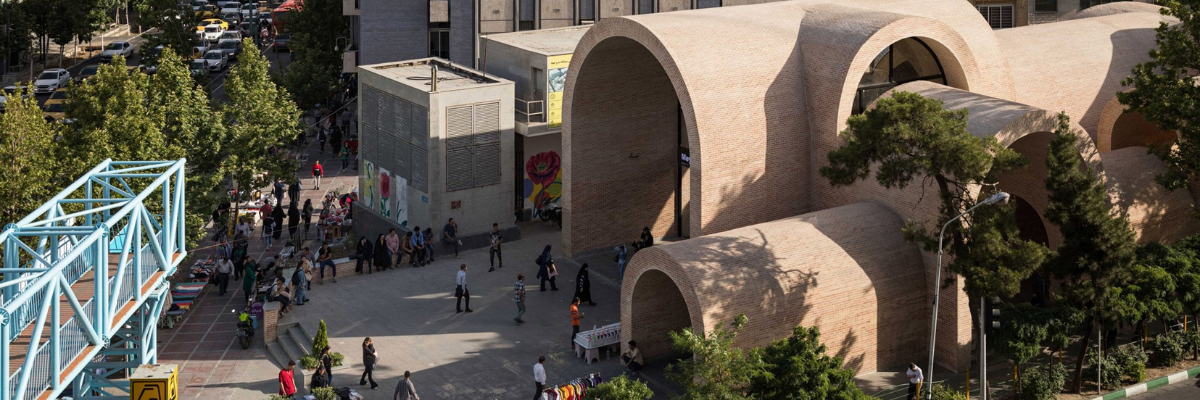
In a busy intersection in Iran’s capital city, Tehran, there is a "deceptively simple" metro station. The structure is meticulously constructed of up to 300,000 traditional bricks—a major collaboration between the station’s architects and local artisans.
Having secured the commission for the station at a time of significant protests in Iran, KA Architecture Studio wanted to recognise how public spaces “are the place of conflict in the metropolis of Tehran between the government and the people.” Such statements reflect the growing political significance that Iranian architects ascribe to their work, even when working on commissions from the government.
By placing projects like the Jahad Metro Plaza at arterial points of the city, architects in Iran are redefining the way public areas are used and determining points of congregation. In turn, their design choices spark discussion around the social and political significance of architecture beyond mere aesthetics.
Amidst recent years of social and political turmoil in Iran, a blossoming architectural scene is ever-present and defiant. Cropping up across major metropolises like Tehran and Mashhad and smaller cities like Ahvaz and Kelarabad, are new and intriguing structures, including luxury glass apartment buildings, eco-resorts with integrated mazes, colourful domed retreats, and geometric complexes. Through their ambitious designs, the structures being introduced to Iran’s cityscapes and landscapes challenge the view of Iran as a country without prospects.
These new buildings embody a cultural shift, in which features like open facades and glass walls take on a political significance. In a recent op-ed, Tehran-based correspondent Najmeh Bozorgmehr described how windows and balconies were once simply functional elements of homes in Tehran—“used for drying laundry or storing seasonal fruits and vegetables.” But today, the enlargement of open spaces in the home and the adoption of glass facades are indicative of a slow transition away from cloistered private spaces and towards an assertion of transparency and personal freedom.
While Iran’s wave of progressive architecture is growing, the completed projects vary in their accessibility to communities across Iran. Some cater to the ultra-rich, others seek to tie in varying strands of society. What can be said about either type of project is that they both strive to address qualms about Iran’s sociopolitical condition, while also attempting to invigorate a new wave of artistry, celebrate and interpret cultural heritage, and encourage a sense of community.
Historically, architects in Iran had to mask the political implications of their field. In a notable example, Architecture Magazine, long a leading publication for Iranian architects, did not “want to have the slightest conflict with the world of politics," according to one historian. Ambivalence was chosen to ensure the “survival of the architectural profession as an independent practice, on the one hand guaranteed [architects’] livelihood[s] and on the other was of great importance for the government's ‘nation-building’” objectives. But this cautious approach faded in the following decades, given that the architectural profession, like everything else in Iran for that matter, was clearly entangled with the political circumstances of the country. In 2022, during the aftermath of the arrest and death of Mahsa Amini while in the custody of the morality police, many architectural studios halted operations in solidarity and emphasised their commitment to the people.
Notably, many talented Iranian architects choose to remain in Iran despite the limitations politics may pose for their career—a decision that may be difficult to understand given the extent of brain drain plaguing other industries in the country. Mainly driven by political repression and, in turn, isolation from the global economy, young, highly-skilled Iranians are increasingly fleeing for better opportunities elsewhere. Even Iranian President Masoud Pezeshkian has claimed that up to 80 percent of students are contemplating emigration.
In an interview for this article, one young Iranian architect described his decision to stay as a “professional choice.” Architects in Iran can still pursue ambitious projects. For instance, Hooba Design Group has announced plans for a futuristic and eco-friendly residential complex in Kelarabad with a design guided by “regional architecture and local environmental laws.” Composed of stacked volumes of villas, each with their own glass facades and airy interiors, the renderings show a bold vision. Projects like this are encouraging Iranian architects to match the ambition of architects in Europe or the United States, where many had studied or worked before returning to Iran.
The homegrown team behind the Hooba project, like others, speaks to a sentiment articulated by the late Iranian architect, Ali Akbar Saremi. After having spent many years in the US, Saremi returned to Iran. When asked why he returned, he stated, “when I finished university and got my doctorate, there was no reason for me to stay there anymore. We wanted to return and develop our country… After all, our homeland is here and there was no reason to stay there.” His advice to rising architects was to “try to understand what is going on in the world,” as “we are the architects of a social class and we must understand the ins and outs of our society as well as other societies.” Such ideas have proven influential, with many Iranian architects thinking actively about their capacity to use architecture to shape social relations.
The most ambitious architects are further encouraged by opportunities for domestic recognition in the field. Memar Magazine, founded in 1988, is a bimonthly Persian publication on architecture and urban design. The prestigious Memar Award was initiated by the magazine in 2001 and strives to recognise the most prominent Iranian architects and their projects. The prize promotes a tangible sense of prestige, motivation, and visibility for architects in Iran to establish themselves both domestically and internationally, “paving the way for them to attract more clients who seek progressive designs for their projects.” Putting young designers in the spotlight in this way is a critical aspect of their pursuit of larger projects, drawing in capital to this specific industry.
Iranian architecture has also earned international accolades. The Jahad Metro Plaza, for one, was recognised by the RIBA International Awards for Excellence, as well as the Dezeen Awards. Architect Alireza Taghaboni, upon winning the Royal Academy Dorfman Award, explained how he aimed for his architecture “to have a productive purpose in a country where the context is political,” representing concerns with domestic issues in an international context.
Alongside politics, Iranian architects must also consider the state of the economy. Notable architect Farhad Ahmadi has stated that “if architecture wants to flourish in a society, the culture, knowledge, management, and economy of that country must also flourish.” It may be surprising, therefore, that a country facing significant economic challenges is home to a burgeoning architecture scene. But wealthy Iranians consider real estate to be a safe investment, and thus the field is supported by a steady stream of private commissions—even as sanctions and other economic headwinds continue to affect the construction sector. Hossein Hamdieh, an architectural researcher, noted in an interview that ‘‘avant-garde designs are often created for moneyed minorities who have both the appetite and the means to invest in such lavish, costly projects.”
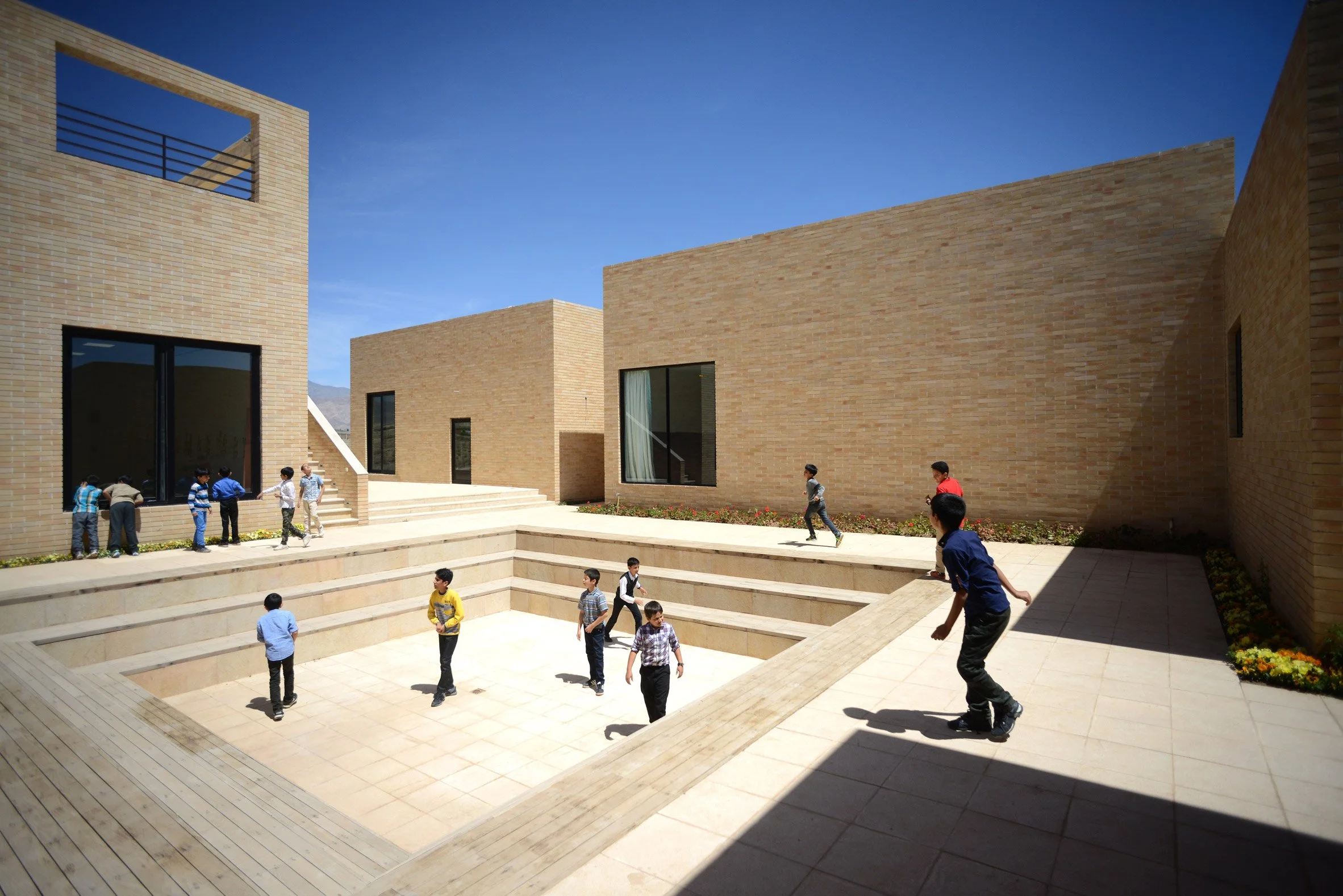
On the other hand, Iranian architects have long developed projects with specific social objectives, such as improving the welfare of ordinary people or addressing environmental issues. These projects are often delivered in partnership with civil society organisations. For instance, FEA Studio, on the behalf of the NGO Noor-e Mobin, designed an intricate network of classrooms in the desert, near Bastaam, Iran. Opened in 2014, the G2 Primary School, as it is called, is designed in ways that allow children to play freely, featuring open air rooms with balcony-style railings to maintain their safety. FEA Studio commented that “it's a complex in which the children can grow and taste life,” serving the pedagogical goals of the school.
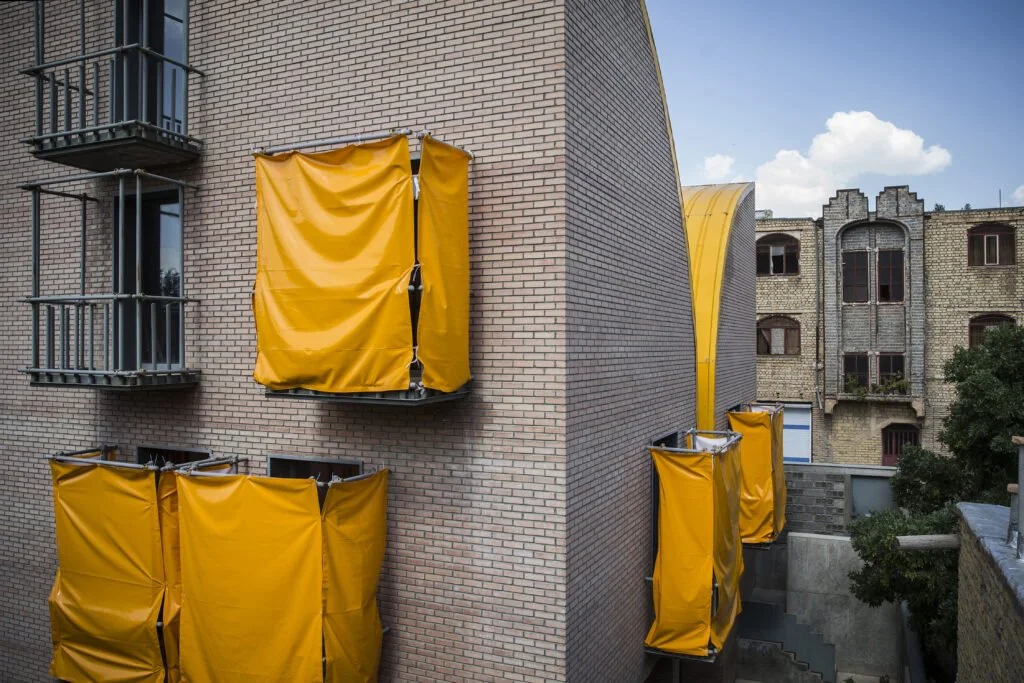
In another social project, ZAV Architects fit adjustable outdoor curtains to the balconies of an girls orphanage in Khansar, Iran. The Habitat for Orphan Girls is a residential centre aiming to protect young women, ages seven to 16, supporting them to flourish in adverse life circumstances. This particular project drew attention in the context of the anti-hijab movement in Iran. The architects aimed to allow the girls a comfortable and protected outdoor space where they can sit without a headscarf or hair covering, but used a striking yellow color to make these liminal spaces visible.
ZAV Architects’ founder, Mohamadreza Ghodousi told Dezeen that the building has the aesthetic appeal of interacting colourfully with the rest of the city, while also reminding its inhabitants that the “hijab is dynamic and you may have the right to wear it or not.” The project won the Memar Award in 2020.
The current sentiment among Iranian architects may be best summarized by one of the best, Leila Araghian. Araghian won the prestigious Aga Khan Prize for her 270-metre long bridge, Pol-e Tabiat, which connects Taleghani Park and Ab-o-Atash Park in northern Tehran. When asked what she finds exciting about contemporary architecture and design, she responded: “the possibility to affect the environment which can affect the human experience of the space seems fascinating to me. It makes me feel powerful.” It is precisely this outlook that promotes architecture as a tool for social renewal, transforming quotidian spaces for Iranians to feel a sense of liberation, agency, and connectedness.
Architecture in Iran today is more than just an artistic or functional endeavor; it is a medium for expression, resistance, and societal transformation. As architects navigate the challenges of working within an increasingly restrictive political environment, they continue to create structures that serve as both aesthetic marvels and meaningful social statements.
Whether through luxurious glass facades symbolising a desire for transparency, or community-driven projects that foster inclusivity and interaction, contemporary Iranian architecture reflects the country’s shifting landscape. At its core, this architectural movement challenges perceptions of Iran, both domestically and internationally, proving that even in times of hardship, creativity and innovation can flourish. Architects in Iran are shaping more than just skylines—they are reimagining and rebuilding the very structures of public and private life.
Photos: Mohammad Hassan Ettefagh, Soroush Majidi, ZAV Architects
Iranian Civil Society, Businesses Step-Up in Virus Fight
Faced with the gravity of the COVID-19 outbreak, members of Iranian civil society and private sector business leaders have joined the fight against the virus, seeking to address gaps in the government’s response.
It may be springtime, but the nights are still chilly in Shiraz. It is 2:30 am. The streets of Iran’s fifth largest city are deserted and Ali Mousavi and his team of volunteers are walking along the boulevards and back-alleys with their disinfection equipment.
Shiraz has been an epicenter for cases of COVID-19 in Iran. Less than two weeks ago the city council wrote a letter to Iran’s president, Hassan Rouhani, expressing grave concerns over the soaring number of the new cases and calling for the government to take more serious action.
But many Shirazis were not content to wait for government interventions that tend to arrive slowly and often fail to provide adequate support. Mousavi, who is a lecturer at a local university, decided to take matters into his own hand by launching a volunteer effort, as they had last year in response to the deadly flash floods that hit Shiraz.
Mousavi and his team began disinfecting neighborhoods just a few days after Iran officially disclosed its first cases of COVID-19. Starting with two groups of 20 volunteers, there are now over 300 people contributing their time. Mousavi reports on the group’s efforts on Twitter.
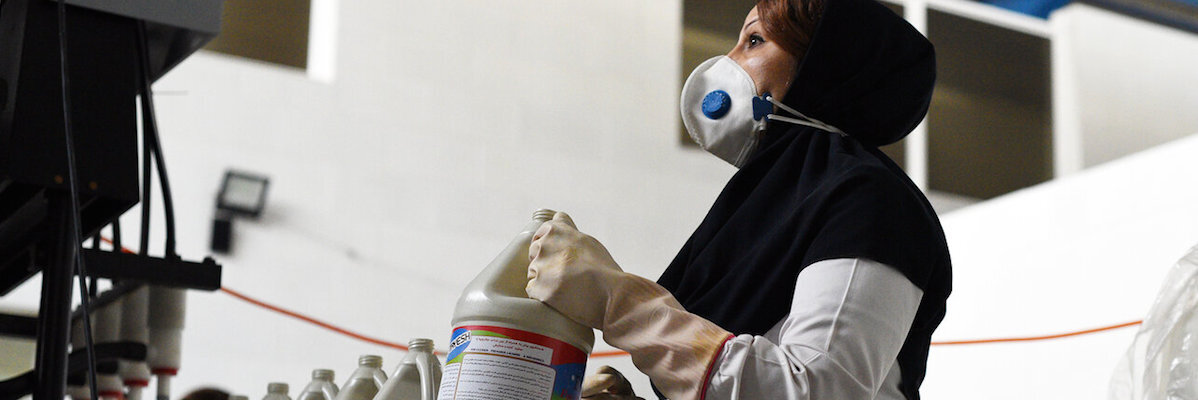
The volunteers have also helped with the production of protective face masks and hand sanitizer. “A local factory was understaffed and we could contribute manpower,” Mousavi explained. “With the coordination of Shiraz University of Medical Sciences, our team started working at the facility in three shifts producing 20,000 disposable surgical masks daily to meet the new demand.”
Grassroots Efforts Across Iran
COVID-19 has killed over 3,603 in Iran and the country has registered more than 58,000 cases of the illness, with 2,483 new cases announced just yesterday.
The government’s slow response to the virus allowed it to spread unhindered for several weeks before serious action was taken.
As the toll from the outbreak continues to mount, already diminished stockpiles of critical medical equipment are nearly depleted. To make matters worse, the Iranian government faces a significant budget deficit as a result of a collapse in the global oil price, a fall in regional trade, the pressure of U.S. sanctions, and fiscal mismanagement.
Faced with the gravity of the situation, members of Iranian civil society and private sector business leaders have joined the fight against COVID-19, seeking to address gaps in the government’s response.
Groups of concerned citizens have organized in dozens of cities across Iran, mobilizing to support sanitation efforts, to increase production of critical supplies, and to deliver groceries and medication to the homes of those most vulnerable to infection, including the elderly and those living in underprivileged communities.
A group of young seminary students in Mashhad were lauded after they volunteered to wash the bodies of coronavirus victims before burial, in keeping with Islamic custom—a risky job that few people were willing to do.
Volunteers are working selflessly, putting themselves at risk to help people in need, explained Mousavi, describing it as the “right spirit.” When asked whether any of his volunteers had been infected, Mousavi responded “no one so far, thank God.”
Mousavi and his team, like many similar groups around the country, are funded by donations. “Many people think we receive financial help from the government or military institutions, but in reality we receive limited support from those bodies.” He presents a receipt for a purchase of 400 pairs of industrial gloves for his disinfection teams, paid for by donations.
So far, Mousavi has collected around USD 20,000 in donations to purchase food and basic supplies for vulnerable households, especially those families that have lost their breadwinners to COVID-19.
Major Companies Join the Effort
Perhaps the largest philanthropic campaign under way in Iran is the Nafas Campaign (nafas means “breath” in Persian, but it is also the base of the Persian idiom for “trust in oneself”). Launched in late February, over 200 companies from Iran’s private sector have joined the campaign, coordinated by chambers of commerce and the philanthropic arms of several of Iran’s largest firms. Together, the members have donated over USD 1,000,000, medical equipment, in-kind services, and cash assistance to help fight COVID-19.
The Nafas Campaign has managed to supply ventilators to hospitals across the country. Last week, the campaign donated 55 ventilators, valued at around USD 350,000, to hospitals in Golestan, a province facing one of the most severe outbreaks of COVID-19 in the country.
Hospitals are also facing unprecedented demand for medical oxygen cylinders—and the Tehran Compressed Gas Association has stepped-up. Mahrad Ebad, vice chairman of the association, described a market under strain. "Unfortunately, in recent months, oxygen cylinders have been in short supply in Iran for variety of reasons, including high demand, sanctions pressures, and the depreciating rial. Prices have skyrocketed and we are seeing cylinders sold at prices as high as 2 to 3 million toman (USD 125 to USD 185).”
“Within the framework of our support to the Nafas Campaign, we have procured and donated over 1800 oxygen cylinders for use at hospitals across the country.” Ebad added.
Medical systems around the world are scrambling to procure N95 masks used by healthcare workers to protect themselves from the risk of infection. Tapping into the supplier relationships of its member companies, the Nafas Campaign has imported over 500,000 N95 masks from China, with another 120,000 masks slated to arrive in the coming days.
The Nafas Campaign’s flagship project was the construction of the Nafas Clinic, a center where patients can be tested for COVID-19 and other acute respiratory disease. Built in just eight days, the clinic, located in Tehran’s Sadeqieh square and adjacent to Ebnesina Hospital, has the capacity to test 300 patients daily and is open 24 hours, seven days a week.
Despite these successes, campaign members continue to be disappointed by the bureaucratic hurdles and lengthy custom clearance procedures that have delayed delivery of critically needed items to hospitals. “It is unacceptable that such key supplies are held for days merely for certain bureaucratic processes while our medical centers are facing shortage of protective gears,” said Farzin Fardis, communications director for the campaign. The campaign has called on the government to reduce the red tape.
Fadis believes the campaign is pioneering a new model of civic action, and the private sector nature of the initiative has enabled donations to be solicited from Iranians abroad. “The fact that so many businesses have come together to cooperate in civic activities as part of this campaign, sets an important precedent in Iran and we hope that when the coronavirus crisis is over, this campaign will be considered a successful model for such efforts.”
Photo: IRNA

Shutters Come Down for Iran’s Cafés and Restaurants
While Iran’s economy has struggled over the last two years, the country has nonetheless seen a boom in new restaurant and café openings, especially in the bustling capital, Tehran. But the COVID-19 outbreak has brought the shutters down at establishments across the country, leaving the owners to wonder if they will ever open again.
While Iran’s economy has struggled over the last two years, the country experienced a boom in new restaurant and café openings, especially in the bustling capital, Tehran. Even in times of financial hardship, a foodie culture has seen Iranians of all walks of life enthusiastically patronize new restaurants, cafés, and fast-food joints.
But the COVID-19 outbreak, which has now led to the infection of more than 15,000 Iranians according to official figures, has brought the shutters down at establishments across the country, leaving the owners to wonder if they will ever open again.
“Many businesses will not be able to survive this crisis if it lasts for a month or two. Even if they survive, the crisis will lead to layoffs and a sharp surge in prices,” said Shahram Rajabi, owner of Sakura Sushi Restaurant, which is located in Ava Center, a mall in the upscale Aqdasiyeh neighborhood of Tehran.
Rajabi owns two other food businesses in Ava Center—a bakery and a café. In total, he employs 70 people—it is not clear how much longer he can afford to keep them on the payroll. “Only the bakery is still open. Sales have dropped 80 percent, but we have kept the doors open. The café and restaurant’s employees are all on paid leave.”
Nowruz—a two-week period during with Iranians celebrate the new year—is fast approaching. Before Iran found itself in the midst of a public health crisis, bakeries were already working around the clock to prepare the confections and treats that Iranians traditionally enjoy during the holiday. But this year there is little cause for celebration.
“With the fear of coronavirus hanging over everything, no one is in the mood to celebrate. People aren’t buying ready-made confectionaries. These businesses will be forced to dump what they had baked. All that money and effort will go to waste,” Rajabi said. “The pandemic is taking a harsh toll on businesses and is pushing many to the verge of bankruptcy. I don’t know how long we can survive,” he added.
Social Media Outreach
Behzad Mosayyebi is the owner of Café Hedayat in Shiraz, where he employs around 25 people. He too is struggling to keep his business afloat.
“A week after news broke about COVID-19 spreading in Iran, our sales plummeted by 70 percent. Initially, we tried to keep business going but a week into the outbreak, with sales nose-diving we were forced to shutter the café,” Mosayyebi said.
Currently, his employees are on paid leave. “Employees are the most valuable assets of any business. We have invested in training our staff. But if the situation does not improve in a month or so we’ll be forced to let our staff go.”
Mosayyebi acknowledged that even after the epidemic is over, the café might need to hike prices to cover its losses—but he hopes his customers will remain loyal even if they go weeks or months without visiting.
In order to keep his clientele engaged, Mosayyebi has launched a campaign on Instagram, which features his employees and social media influencers offering easy recipes and cooking tutorials for everything from dal to pasta.
Other restaurants have also launched similar campaigns. Vitrin Kitchen, a trendy eatery located in Tehran’s A.S.P Towers, recently closed in light of the spread of COVID-19. Vitrin’s chef, Armin Milani, has self-quarantined at home. But from his kitchen, he continues to keep the restaurant’s Instagram active by posting pictures of his latest creations, accompanied by short reflections on being in isolation. His posts reach over 60,000 followers.
Some restaurants, especially fast-food chains, have endeavored to remain open despite the outbreak. These establishments have turned to social media to reassure buyers that they are doing their best to keep their food “COVID-19 Free.” Popular burger joint Burgerator has posted a video on Instagram that shows the body temperature of its staff being checked and explains how “every surface is sanitized.” The video ends with a tag line, “We care for you.”
Famous fast-food chain Barooj is sending out text messages to customers announcing a new offer: “half-cooked” pizza. Customers are meant to finish cooking the pizza in their home oven. The text message explains that “high temperature kills coronavirus.” One of the oldest delivery pizza shops in Tehran, Dar-be-Dar, has likewise started selling par-baked pizza.
Perseverance
Just a few days after Iran announced its first confirmed case of COVID-19, employees at Yerma House café off Karimkhan Street in downtown Tehran, were geared-up with latex gloves and face masks.
Located in a chic pre-Islamic Revolution building, Yerma House is part gallery and part café. A large self-portrait by Frida Kahlo dominates the space and the aroma of freshly roasted coffee and spices usually waft through the air.
Startled by the staff’s appearance, a customer asked “what was the hassle for.” The cashier, her headscarf fashioned as a turban, replied, “We are just trying to keep you safe, love.” Later the same day, the manager decided to shutdown the café until further notice.
Yerma’s manager, Neda Hengami, is worried. “The COVID-19 outbreak hit us hard. Right now I am trying to help people get through the crisis and pass time while social distancing by conducting a writing contest.”
Hengami feels a responsibility to sustain the business and find a way to keep paying her employees as they face difficult times. She said that she is considering setting up a take-away-only service. “But I’m not certain whether it’d work. We can’t do much, can we?”
At the end of the interview she recalled a passage from Strait is the Gate, a novel written at the turn of the 20th century by André Gide. “I read the book ages ago,” she explained. “There is a section where Gide describes a Bible sermon.” Hengami proceeded to quote from memory: “Enter ye in at the strait gate: for wide is the gate and broad is the way that leadeth to destruction, and many there be which go in thereat. Because strait is the gate, and narrow is the way, which leadeth unto life, and few there be that find it.”
“The passage has stuck with me over the years. It has helped me through the hard times,” she said.
Photo: IRNA
As Sanctions Impede Business, Where Next for Iran-Italy Relations?
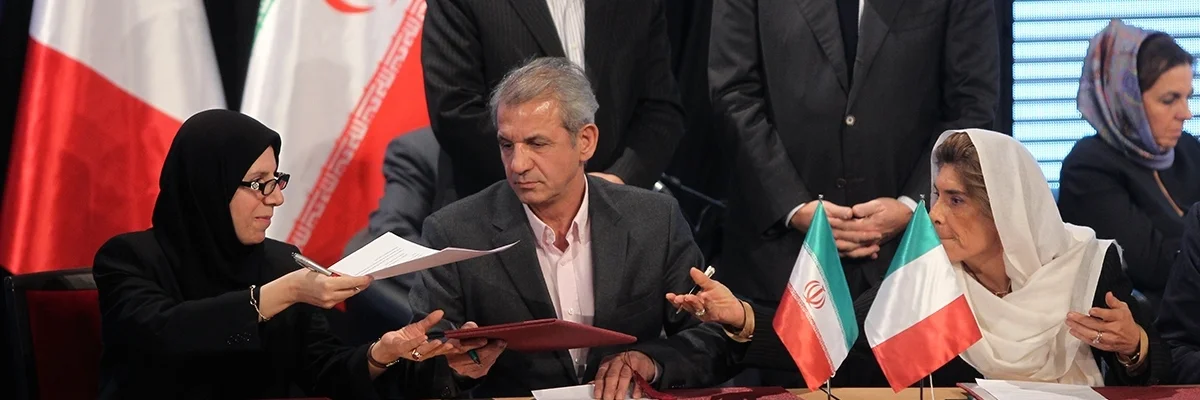
◢ Despite strong relations, President Trump’s withdrawal from the JCPOA and his reimposition of economic sanctions has introduced significant challenges for Italian enterprises active in Iran. As with other European companies, Italian firms are unwilling to jeopardize their presence in the US market for the sake of opportunities in Iran. Yet, Italy and Europe have every interest to see that Iran continues to be an important trading partner and a supplier of energy.
Iran-Italy relations, which date back to the time of the Roman and Persian empires, are marked by important affinities. Historical and cultural traditions as well as commercial and economic connections have deeply shaped mutual perceptions. Unlike the other major EU countries, Italy is not seen as a former colonial power still trying to "dominate" relations with Iran, but rather is appreciated as a partner willing to expand tied based on mutual respect.
The legacy of Iran-Italy commercial ties begins in earnest with Enrico Mattei and Italian state oil company ENI. Mattei’s excellent leadership in the 1950s and 1960s strengthened Iran-Italy ties through energy cooperation. Mattei’s approach still influences the way most Italian companies engage their Iranian counterparts—with great respect and consideration. Iranian companies are inclined to deal with Italian companies because they talk a similar business language.
Back in 2003, the positive perception of Italy among European nations led Iran to insist that Italy join the European group pursuing the first nuclear talks. Despite the fact that the Italian government did not participate so as not to strain relations with the US already stressed by disagreements over the Iraq war, Iran’s point of view did not change. Rouhani’s choice of Rome as the first European capital to visit following the implementation of the JCPOA nuclear deal is indicative. More recently, Italy was asked by the E3 nations of France, Germany, and the United Kingdom to become a member of the new E4 group driving negotiations with Iran on Yemen.
Despite these strong relations, President Trump’s withdrawal from the JCPOA and his reimposition of economic sanctions, has introduced significant challenges for Italian enterprises. As with other European companies, Italian firms are unwilling to jeopardize their presence in the US market for the sake of opportunities in Iran.
While some firms have opted to remain—shipbuilder Fincantieri, railways company Ferrovie Dello Stato, and power giant Ansaldo among them—other companies have announced their activities are on pause. Italian oil giant has stated “We have no presence in the country” and Gruppo Ventura affirmed, “We were expecting to expand to Iran, build rails there. We are no longer going to proceed.” The state-owned vehicle intended to finance Italian projects in Iran, Invitalia, announced “the “project is on pause” and that the company is “waiting for the situation between the United States, Europe and Iran to be clarified.” One estimate suggests US sanctions have impacted EUR 30 billion of planned Iran-Italy trade and investment.
The US government’s decision to grant an oil waiver to Italy will probably mean little. There is no indication that Italy intends to use the waiver. In any case, major banks in Italy are still reluctant to facilitate trade.
Yet, Italy and Europe have every interest to see that Iran continues to be an important trading partner and a supplier of energy. Iran can be a source of stability in the region if positive commercial ties, help dissuade expansionist tendencies. In order to maintain trade relations with Tehran despite US sanctions, different proposals emerged, including using Russia and other third countries as a trade intermediary as well as joining the special purpose vehicle (SPV) being developed by France, Germany, and the UK. This is undoubtedly a very delicate set of challenges, as they involve the Italian government and its international alliances.
Italy is a particularly important partner for the development of Iran’s industry and infrastructure. Italy delivers high quality manufacturing technology and infrastructural works. The "made in Italy" concept has burnished the value of Italian exports. Italy exported over EUR 1 billion in machinery and transportation equipment to Iran in 2017.
However, given the current political situation, many commercial relationships with Iran have come to a momentary halt. The entrepreneurs and consultants I have interviewed have confirmed that at least since February 2018 commercial ties with Iran have weakened—banks lack the willingness to support exporters. Furthermore, the deterioration of Iran’s economy, including high inflation, points to insecurity in the investment environment. Tecon, a manufacturer of equipment for the footwear and leather goods industry, is but one example; due to the devaluation of the Rial, their products have become too expensive for Iranian buyers.
Today, the question is how Italy-Iran relations will develop. The Tehran-Rome axis remains mutually beneficial: to Italy for its important exports flow, to Iran for the economic and political advantage of being a partner of a Western country that can act as a mediator. This was clear during Iranian foreign minister Javad Zarif’s contribution during the Mediterranean Dialogues conference sponsored by the Italian Ministry of Foreign Affairs.
Hope for the future lies in the two populations’ intrinsic will to continue their mutual relations despite today’s uncertain and confusing scenario of international relations.
Photo Credit: IRNA
Cañete to Discuss Vital Central Banking Solution on Iran Visit
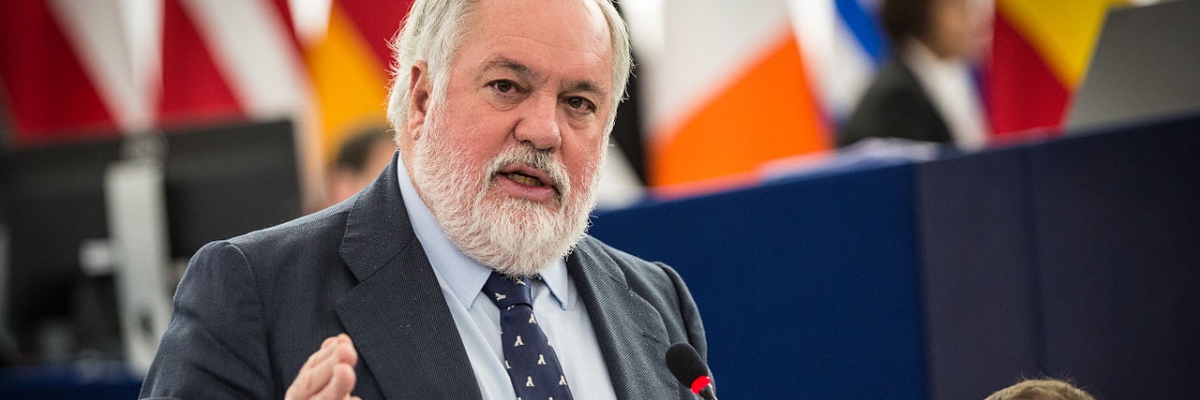
◢ Europe’s Commissioner for Climate Action and Energy, Miguel Arias Cañete is set to travel to Tehran this weekend. Cañete’s visit will include discussions on possible new payment mechanisms designed to allow Europe to repatriate oil revenues to Iran’s central bank despite despite Trump’s withdrawal from the nuclear deal, offering a vital lifeline for the Iranian economy as sanctions begin to bite.
In a statement released Friday, European Commission president Jean-Claude Juncker declared that the Commission has a “duty… to do what we can to protect our European businesses, especially SMEs.”
As Europe steps-up its efforts to fulfill that duty, the commission took two concrete steps, launching the formal process to revive the blocking regulation that will prohibit EU companies from “complying with the extraterritorial effects of US sanctions.” The regulation also “allows companies to recover damages arising from such sanctions from the person causing them.”
The European Commission also launched the formal process to enable the European Investment Bank (EIB) to finance activities in Iran under an EU budget guarantee. Helga Schmid, Secretary General of the European External Action Service, first announced that EIB would be receiving such a mandate, at the Europe-Iran Forum, a business conference organized by Bourse & Bazaar, in October 2017.
Friday’s statement further highlighted the pending visit of Europe’s Commissioner for Climate Action and Energy, Miguel Arias Cañete, to Tehran. The visit, which will take place over the weekend, is a continuation of a program of “sectoral cooperation” launched in 2016.
But the most significant announcement was the news that the European Commission is “encouraging member states to explore the possibility of one-off bank transfers to the Central Bank of Iran” in order to assist Iran in receiving “oil-related revenues, particularly in case of US sanctions which could target EU entities active in oil transactions with Iran.”
Experts have pointed to the creation of channels for such transfers as an important short-term measure. A report published earlier this month by International Crisis Group, suggests enabling “pertinent European central banks to process related payments” as a means of “empowering those in the Iranian leadership who advocate continued compliance with the deal.”
Speaking on background, an EU official confirmed that Cañete’s visit would include “discussions on how the mechanics of all of this would work.” European authorities have identified two priorities: “One is to work out how you can facilitate payment of Iran for imports of oil to the European Union. But, secondly and equally importantly, the repatriation of Iranian funds that are currently in the European Union.”
The emphasis on repatriation is especially important as Iran seeks a route to sustained economic growth despite the snapback of primary and secondary U.S. sanctions. Economists have identified that increased public investment could help Iran achieve growth in the absence of the foreign investment that had been expected to follow the lifting of sanctions in 2015. Typically, half of Iran’s oil revenues are earmarked for the government budget, and a just under a third of revenues are allocated to the National Development Fund.
During recent consultations, experts from the International Monetary Fund implored Iranian authorities “to explore the scope to use oil revenues to fund bank recapitalization, and noted the importance of replenishing the Oil Stabilization Fund to provide the budget a buffer.”
Seen in this context, oil revenues are a lifeline for the Iranian economy. As Iran’s economy begins to lose momentum in advance of full sanctions snapback, Iranian business leaders and consumers will be watching intently to see if Europe can keep oil flowing in and revenues flowing out.
Photo Credit: Wikicommons
Why Tech Companies Get Iran Wrong
◢ Iranian consumers already have access to the latest gadgets from the world's leading brands. What they lack are easy shopping experiences and after sales support.
◢ Global technology companies needs to go beyond marketing and brand appeal to win over Iranian consumers through customer service.
Iran has been touted as the greatest untapped market on earth for multinational technology companies. Bar a couple of exceptions like Samsung and HTC few of the international giants have an official presence in the country.
Articles commonly tout a handful of key demographic facts when describing Iran's potential:
Sanctions have kept 77 million Iranian consumers from Western goods and services for decades. And Iran’s population is young (two-thirds of the population is under 35), smart (the highest share of engineering graduates in the world), tech-savvy (the highest internet penetration in the Middle East) and relatively wealthy (the world’s 21st largest economy in 2013, despite sanctions, and a GDP higher than India’s).
But what do these young, smart, tech-savvy, and wealthy consumers really expect from consumer electronics?
Western consumer electronics have been sold in the Iranian market in large quantities since the mid-1990s, in step with the digital revolution. In recent years, the Iranian uptake of the iPhone demonstrates the tendency of Iranian consumers to both adopt new technology quickly, and to develop creative trade connections to ensure supply, sometimes purchasing the latest devices directly from factories in China and elswhere.
For example, I once discovered a Motorola Moto smartphone – a phone made at the time in the United States – in a Tehran store display cabinet brandishing the factory-applied logo of American carrier AT&T.
Items like this imported smartphone show how sanctions hinder both multinational manufacturers and the Iranian consumer. With these grey market imports, Motorola simply cannot gain any real data on Iranian purchasing patterns nor can it understand the local mobile telephone market. It competes in a market in which it has no direct contact with its consumers.
On the other hand, the Iranian consumer is also shortchanged. Their chosen phone lacks company support or warranty and they pay a hefty premium on each device.
In this unusual status quo, American companies, most hindered by sanctions, fare the worst. Their corporate researchers, anticipating the eventual opening of the market, rely on second, third or fourth hand information regurgitated in the media coverage of Iran's commercial potential. This coverage creates a warped view of the domestic Iranian market. Moreover, with the inconsistent and sometimes contractionary market reports produced by Iran's domestic media, this problem is only exacerbated.
But even the absence of many major multinational still doesn't fully explain why so much data on Iran is duff. For that you need to get to the finer points of publicly available reports and then it all starts to become clear.
The onus rests on the international market research firms which produce reports on the Iranian market. These firms use a myriad of unorthodox tactics to gather market data on the domestic Iranian market.
In many instances they simply use fluent Persian language speakers based abroad to read and monitor news reports about specific industries. For more granular information, they might also sometimes cold call Iranian households to ask survey questions about product preferences. These piecemeal methods unfortunately leave big gaps when the finalized data is published.
It is only with on the ground analysis and street-level market reporting that it becomes possible to decipher why certain consumer electronics companies do well in Iran, or why a given device or operating system is the most popular.
Out of all foreign companies it is the South Korean conglomerates which have the best data on Iran, owing to their official precense in the country. They are not likely to share this vital information with their American competition. A recent report on the website of Press TV's– Iran's official English-language international news service–highlights that Samsung in particular is ramping up efforts to strengthen its market position.
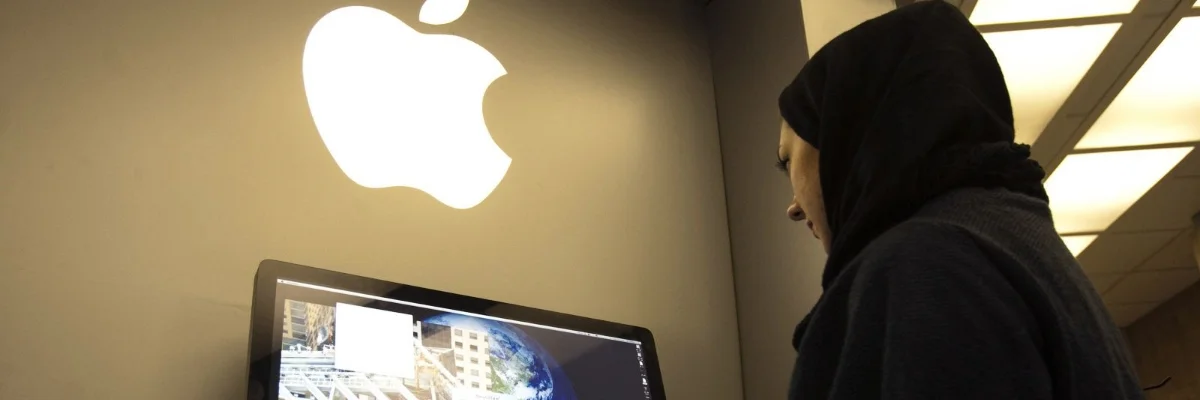
However, Apple has so far outpaced all other manufacturers in terms of appeal. This might be unsurprising given that it is now the world's leading smartphone manufacturer. Yet, the Cupertino firm still doesn't have an official representative in the Iranian capital, nor does it offer warranties by third or even fourth party vendors. The grey market imports available on the market are also unusually expensive. But the appeal of the iPhone 6 and Macbook continues to trounce all the other devices available to Iranian consumers.
As part of the global battle with their American foe, Samsung has had an uphill struggle against Apple in Iran. Knowing it lacks the same brand appeal, the Korean firm has invested millions of dollars to establish flagship stores across the country, battling sanctions to offer warranties and even creating Iran's most prolific corporate social responsibility (CSR) policy among foreign companies. But despite all these feathers to their hat, they still have to fight the overall brand power of their main American rival.
Bluechip Japanese electronics firms have also struggled in the Iranian environment in recent years. Some industry insiders admit that Sony, for example, spends one-tenth the amount on marketing budgeted by Samsung. JVC, has all but disappeared from the country's high streets with the last remaining stores stocking dated LCD TVs. Panasonic on the other hand seems to be increasing its presence once again. A flagship store on Shariati Street in Tehran recently saw a complete overhaul.
Yet, massive investment in Iran is no guarantee for success and consumer electronics and technology companies have blundered before. One example can be seen in the case of Nokia in 2009. The Finnish firm reigned supreme among multinationals in the Iranian market, even maintaining a major office on Bucharest Street in Tehran.
However, poorly structured telecommunications deals with their local Iranian partner, misinformation spreading like wildfire, and the firm's general unwillingness to develop a global smartphone strategy quickly put an end to their dominance. No amount of investment could rebuild the tarnished brand in the eyes of the Iranian consumer.
It isn't just hardware or device manufactures who fall short. Microsoft has also squandered an advantage in the brand appeal of its software. Even though the Obama administration eased sanctions on the sale of electronics in 2013, Microsoft has little engagement of Iranian consumers.
Microsoft has continuously punished Iranian users for their use of illegal software, forcing nearly the entire country to rely on unreliable pirated editions purchased cheaply in Iran. The lack of official product support is especially vexing for Iranians as the newest updates, patches, and features remain unavailable for all those unable to purchase an official software license. In fact the problem for the American software firm is so great that thousands of Iranians have petitioned Microsoft to offer official support. Again, despite a dominant market share, negative experiences will continue to color the Iranian view of Microsoft products.
If American, European, and East Asian technology companies want to get a grasp of the Iranian market they are going to need to understand a few things about the average Iranian consumer that data cannot capture. Firstly, as a conversation with any traders or consumers will reveal, the two largest issues for local consumers are warranties and sales support. This is something which foreign manufacturers generally only pay lip service to. For now, it seems Samsung is the exception, having smartly spent huge sums of money on after-sales support. LG comes a close second in terms of support and has also recently stepped up efforts to offer a better consumer experience in major cities like Tehran.
Secondly, rationalization of the shopping experience is a must for most consumers. The traditional bazaar shopping experience continues to this day with many consumers purchasing their electronic items from independent stores, who set inconsistent prices and cannot vouch for the authenticity of their products. This shopping experience leaves a lot to be desired, and often if any problem arises with said items, people have no recourse when something goes awry. The discrepancy between this shopping experience and the carefully calibrated environment of an Apple or Microsoft store abroad must be noted.
In sum, Iranian consumers' requirements are similar to those found in any developed market. Sanctions have not prevented access to the latest technology, but they have made the overall buying experience more strenuous and costly than in perhaps any other market. In a post-sanctions environment, the battle will not be to ensure Iranians purchase devices. Rather, multinational firms must vie to offer the best overall customer service and generate positive brand experiences. The most successful companies will be those that focus less on the hard sales data, and focus more on the more intangible needs and preferences of the Iranian consumer.
In a world of apps and product ecosystems, consumer technology is about more than just the device. The same will become true in Iran.
Photo Credit: Reuters, Raheb Homavandi