
Iran Is Becoming Immune to US Pressure
Trump’s so-called maximum pressure campaign has empowered hard-line figures in Tehran, marginalizing those eager to take the diplomatic route.
By Sina Toosi
U.S. President Donald Trump said on June 5 that Iran should not wait until after the presidential election “to make the Big deal,” but can get a “better deal” with him now. Trump’s remarks came after a recent prisoner swap, which saw detained U.S. Navy veteran Michael White released from Iran in exchange for Iranian American doctor Majid Taheri. However, while Trump may want to negotiate with Iran and reinforce his self-avowed reputation as a deal-maker before the U.S. election, his “maximum pressure” policy has all but eliminated the chance for U.S.-Iranian diplomacy in the months to come.
Iran has proven resilient in the face of U.S. pressure. While many ordinary Iranians are suffering, the economy is not in total free fall, as many in Washington hoped for. Instead, the country has shown signs of economic recovery, with domestic production and employment increasing. According to Iran’s Central Bank chief Abdolnaser Hemmati, Iran’s nonoil gross domestic product grew by 1.1 percent last year. Prominent Iranian economist Saeed Laylaz also contends that Iran’s economy can weather the coronavirus pandemic and may experience growth this year despite the virus.
Trump’s bellicose rhetoric and actions have not made Iran more inclined to do a deal, but they have undermined any Iranian officials who supported negotiations with the United States. Whether wittingly or not, Trump’s policy decisions have closed the potential for diplomacy. The political cost one faces in Tehran for arguing in favor of negotiations is now simply too high. This is evident in how Iranian officials have reacted to the recent prisoner exchange.
Ali Shamkhani, the secretary of Iran’s Supreme National Security Council, one of the highest decision-making bodies in Iran, said in response to Trump’s offer for a deal, “The exchange of prisoners is not the result of negotiations & no talks will happen in the future.” Shamkhani’s remarks reflect a consistent line in Tehran: Negotiations with the United States are off the table. Even moderate President Hassan Rouhani’s foreign minister, Javad Zarif, and spokesperson Ali Rabiee now maintain that prisoner swaps can occur without negotiations.
The situation was different just a few months ago. The only other time the United States and Iran exchanged prisoners under the Trump administration was in December 2019, when Iran released Princeton doctorate student Xiyue Wang for Iranian scientist Masoud Soleimani. Unlike the recent White-Taheri exchange, the December swap also saw high-level meetings between U.S. and Iranian officials, a rare instance of bilateral U.S.-Iranian talks under the Trump administration. The United States has called for such a meeting again, but Iranian officials now accuse it of sabotaging diplomatic efforts.
Rouhani’s rhetoric around the time of the December swap also suggested he was more open to a new round of negotiations with the United States. Rouhani explicitly declared in the lead-up to the swap that Tehran had not ruled out talks and that negotiations could be “revolutionary.”
Then, in late December, Rouhani traveled to Japan in a trip that Japanese media said was greenlighted by Washington. There was speculation that the trip could have led to a “small deal” between the United States and Iran, with Iranian media reporting that Japan could get a U.S. waiver for importing Iranian oil and release billions of dollars in frozen Iranian oil revenues. Such a deal could have built confidence and met Rouhani’s precondition of sanctions removal for negotiating with Trump.
However, any hope that the positive diplomatic momentum built in late 2019 would lead to diplomatic progress between the United States and Iran was crushed in early January, with the U.S. assassination of Iranian military commander Qassem Suleimani. Many millions thronged Iran’s cities calling for revenge after the killing. Rouhani defiantly exclaimed in February: “They thought that with maximum pressure they can take us to the table of negotiation in a position of weakness … this will never happen.”
The political climate in Iran has since decisively turned hostile to any talk of negotiating with the United States, reestablishing a taboo that existed for years before the nuclear negotiations during the presidency of Barack Obama.
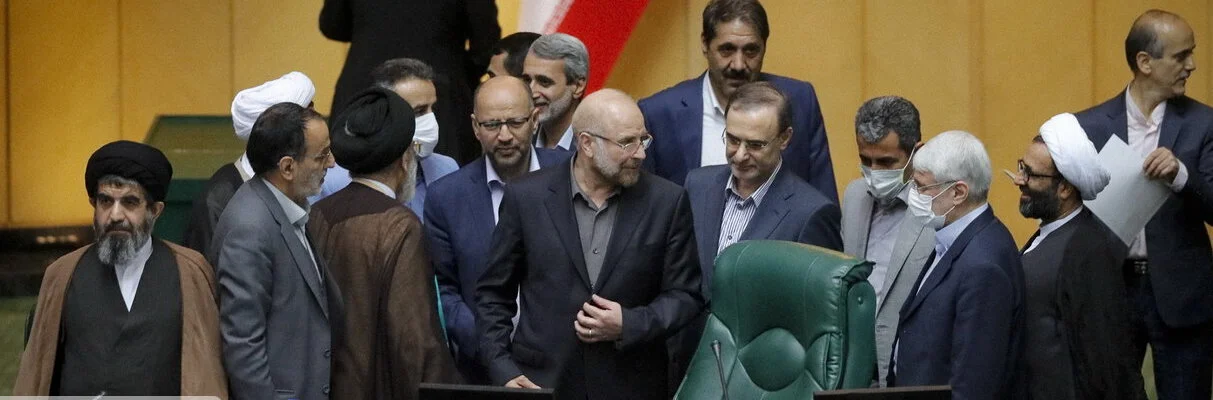
“Negotiations and compromise with America, the focal point of global arrogance, are useless and harmful,” said Mohammad Bagher Ghalibaf, Iran’s new parliamentary speaker, in his first speech to the body, “Our strategy toward the terroristic America is to complete our vengeance for the blood of the martyr Suleimani.”
Ghalibaf, a former commander in the Islamic Revolutionary Guard Corps and an old friend of Suleimani, unsuccessfully ran against Rouhani in both Iran’s 2013 and 2017 presidential elections. He assumed his parliamentary post in May, after parliamentary elections in February that swept conservatives to power. Importantly, that conservative victory occurred amid record-low turnout in the election and the widespread disqualification of reformist and moderate candidates by the Guardian Council.
Nevertheless, the total capture of parliament by conservatives cements the marginalization of reformists such as Rouhani and his allies that began after Trump scuttled the 2015 nuclear deal. Rouhani had sunk all his political capital into negotiating the accord and promised it would give the Iranian people major economic dividends.
Ghalibaf has now replaced Rouhani’s ally Ali Larijani as parliamentary speaker. Meanwhile, the judiciary, considered one of the three branches of government in Iran alongside the presidency and legislature, is being run by Rouhani’s other former 2017 rival, conservative cleric Ebrahim Raisi.
The changing political winds are significant for the future of Iranian foreign policy. Within the byzantine Islamic Republic system, Rouhani managed to forge necessary consensus on negotiations with the United States during the Obama administration, which included nods of approval from both the Supreme National Security Council and the supreme leader, Ayatollah Ali Khamenei. Unlike his hard-line predecessor, the boisterous and belligerent Mahmoud Ahmadinejad, Rouhani formed a cabinet of many U.S.-educated technocrats and his ambitions laid squarely on securing Iran’s economic integration to the world. For a time, Rouhani was riding high in public opinion polls, but that has dramatically reversed.
Ghalibaf, while not as aggressively ideological as Ahmadinejad, has made it clear that he will do everything in his power to ensure Rouhani remains a lame duck for the rest of his presidency. In his first address as parliamentary speaker, he lambasted Rouhani’s administration for its “focus on the outside [world]” and not believing in “the principles of jihadi management.”
Ironically, Ghalibaf himself has been described as a technocrat, drawing from his 12-year run as mayor of Tehran. During his tenure, he oversaw the construction of major infrastructure projects, voiced support for the nuclear deal, and participated in international summits such as the World Economic Forum in Davos, Switzerland, where in 2008 he called for international investment in Iran.
However, political expediency compels Ghalibaf to oppose Rouhani for the rest of his term, which ends next year. As parliamentary speaker, Ghalibaf presides over disparate conservative factions, ranging from the fundamentalist Front of Islamic Revolution Stability to the free-market-oriented Islamic Coalition Party. Targeting Rouhani and his agenda is an easy and effective way for Ghalibaf to unite conservatives behind him. Above all, the goal will be to obstruct Rouhani’s ability to negotiate with the United States and restore the political fortunes of his camp.
Trump is mistaken if he believes “maximum pressure” is getting him closer to a deal with Iran. The policy is not leading to Iran’s capitulation or collapse, but entrenching U.S.-Iran hostilities and keeping the United States perennially at the cusp of war in the Middle East. Trump, who ran in 2016 on getting the United States out of costly Middle Eastern wars, nearly went to war last June and again in January over his decision to escalate with Iran.
An alternative approach is possible but requires Trump to ditch maximum pressure and rebuild the trust necessary for successful negotiations. International relations and the real estate market are not similar. Bullying and bluster do not win deals; mutual respect and “win-win” compromise do. Trump has styled himself as a deal-maker, but ahead of the November election he has zero foreign-policy victories to his name. If he wants any semblance of a positive foreign-policy legacy, he needs to get off the path to war and on a path to negotiations with Iran.
Sina Toossi is a senior research analyst for the National Iranian American Council. Follow him at @SinaToossi.
Photo: IRNA
Abu Dhabi Can’t Afford To Keep Iran Out Of Dubai
◢ During the last financial crisis, capital flight from Iran offered a hidden bailout for Dubai as global investors pulled back. With a new crisis on the horizon, Iranian business leaders are wondering—how long can Abu Dhabi afford to freeze them out?
This article was originally published in LobeLog.
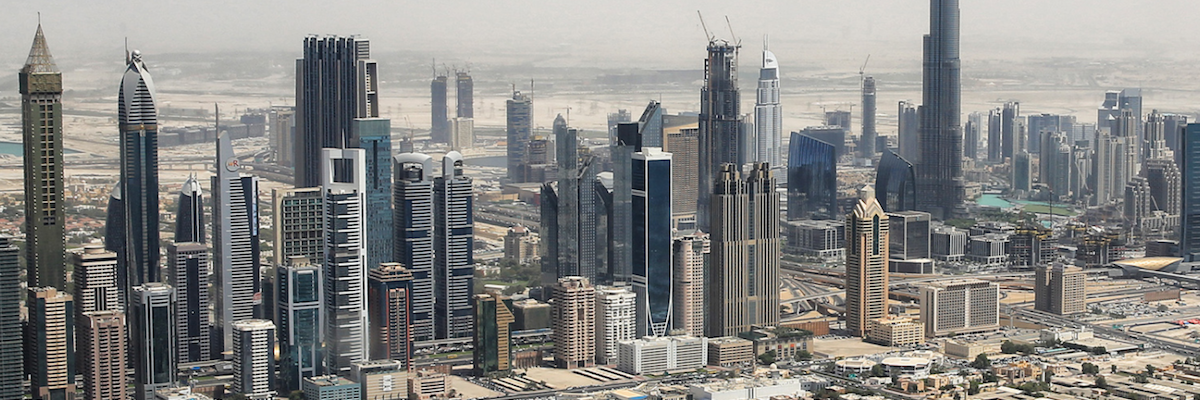
As the world teeters on the edge of another financial crisis, few places are being gripped by anxiety like Dubai. Every week a new headline portends the coming crisis in the city of skyscrapers. Dubai villa prices are at their lowest level in a decade, down 24 percent in just one year. A slump in tourism has seen Dubai hotels hit their lowest occupancy rate since the 2008 financial crisis, even as the country gears up to host the Expo 2020 next year. As Bloomberg’s Zainab Fattah reported in November of last year, Dubai has begun to “lose its shine,” its role as a center for global commerce “undermined by a global tariff war—and in particular by the U.S. drive to shut down commerce with nearby Iran.”
Dubai, an entrepôt where the workers are migrants and where property is king, is especially vulnerable to global recessions. In the immediate aftermath of the global financial crisis in 2009, Dubai’s real estate market collapsed, threatening insolvency for several banks and major development companies, some of them state-linked. Abu Dhabi, which controls the UAE’s vast oil wealth, threw Dubai a lifeline with an initial $10 billion bailout, later expanded to $20 billion.
But there was a second, hidden “bailout” that helped keep Dubai afloat. When the Bush administration enacted the Iran Sanctions Act in 2006, deepening Iran’s economic turmoil under President Mahmoud Ahmadinejad, there was a significant increase in the already significant volume of capital flight from Iran, most of which landed in Dubai. One 2009 estimate places the total value of Iranian investments in Dubai at $300 billion.
While global investors pulled their capital out of Dubai in the aftermath of the global financial crisis, the Iranian business community mostly stayed put, maintaining their deposits in Dubai’s teetering banks. Iranians continued to invest in Dubai’s ailing property market and used Dubai’s ports to conduct re-exports as sanctions restricted Iran’s direct access to global markets. For Iran’s captains of industry and finance, Dubai was not some far flung emerging market, but a vital channel to the global economy in the face of tightening sanctions. As Iranian economist Saeed Laylaz smartly observed in 2009, “Dubai is the most important city on earth to the Islamic Republic of Iran, with the exception of Tehran.”
The financial crisis and U.S. sanctions had served to deepen the mutual dependence between Dubai and Iran—an outcome that ran counter to the goals of policymakers in both Abu Dhabi and Washington.
The Crown Prince of Abu Dhabi and the defacto ruler of the UAE, Sheikh Mohammad bin Zayed (MBZ), has long seen Iran as a rival. MBZ is hostile to Iranian influence over Dubai, where many of the leading trading families can trace their roots to Iran, a legacy of centuries of trade in the Persian Gulf. MBZ’s dream of an assertive UAE would have been undercut had Dubai continued to develop into the Hong Kong to Iran’s China.
The Obama administration’s effort to build a multilateral sanctions campaign offered MBZ the opportunity to curtail Iran’s presence in Dubai’s economy. As they sought to isolate Iran economically, U.S. officials traveled to Dubai to meet with banks and companies to discourage them from engaging in commercial activities with Iran. Rather than resisting U.S. interference in the UAE’s economic sovereignty, Abu Dhabi amplified the American message– the bailout had put Abu Dhabi in a position to dictate policy to Dubai. The new policy called for Dubai to close its doors to Iranian money.
In subsequent years, the presence of Iranians in Dubai’s economy has diminished significantly. Trade persists, but banks refuse Iran-origin funds, close the accounts of Iranian companies, and deny services to individuals who maintain Iranian citizenship. More recently, as the Trump administration cultivated ties with MBZ, the UAE began to reject more Iranian applications for residency and business visas were routinely denied. Nearly 50,000 Iranian residents have left the UAE in the last three years.
But there are new signs that Dubai may be seeking to repair its trade relationship with Iran. In a recent interview, Abdul Qader Faghihi, president of the Iranian Business Council in Dubai, declared that a “space for trade between Iran and the UAE has been reopened.” Though any opening remains in its initial stages, Faghihi referred to negotiations with “the rulers of Dubai” in which Dubai authorities “accepted that Iranians who have the capital and intend to conduct legitimate trade with the UAE will be granted business visas and that banks will open accounts for these Iranians on instruction from Dubai authorities.”
This small opening may be related to efforts to reduce tensions around the Strait of Hormuz as Abu Dhabi reconsiders its regional entanglements and the risk of conflict in the region—it is unlikely that Dubai would be able to extend an olive branch to the Iranian business community without the consent of Abu Dhabi. But economic fears, and not security concerns, provide the clearest reason why a change in policy may be on the cards—Dubai will soon need another “bailout” from Iran. Farshid Farzanegan, head of the Iran-UAE Joint Chamber of Commerce, recently stated “The UAE’s behavior towards Iranian businessmen has changed… and moves are being taken to resume relations… As the UAE economy slumps, officials have decided to cooperate with Iran.”
Ten years on from the last financial crisis, Dubai is still repaying its debts to Abu Dhabi. As the UAE braces itself for the next global recession, Iran remains the only country capable of injecting significant capital into Dubai at a time when global investors will pullback. Iranian business leaders in Dubai are wondering—how long can Abu Dhabi afford to freeze them out?
Photo: Wikicommons
Iran's Government Steps in to Address Paper Crisis, But Papers Over the Cracks
◢ Iran is battling a paper crisis. Gradual price hikes have been increasing pressure on book and newspaper publishers over the last year, but the scale of the crisis became clear when Culture Minister Abbas Salehi announced on August 4 that the country has just enough newsprint paper in storage to meet two months worth of demand. The government has rolled out a support package that includes importing paper as an essential good. But the move defers real reform that is needed to address a decades-long problem of corruption and inefficiency.
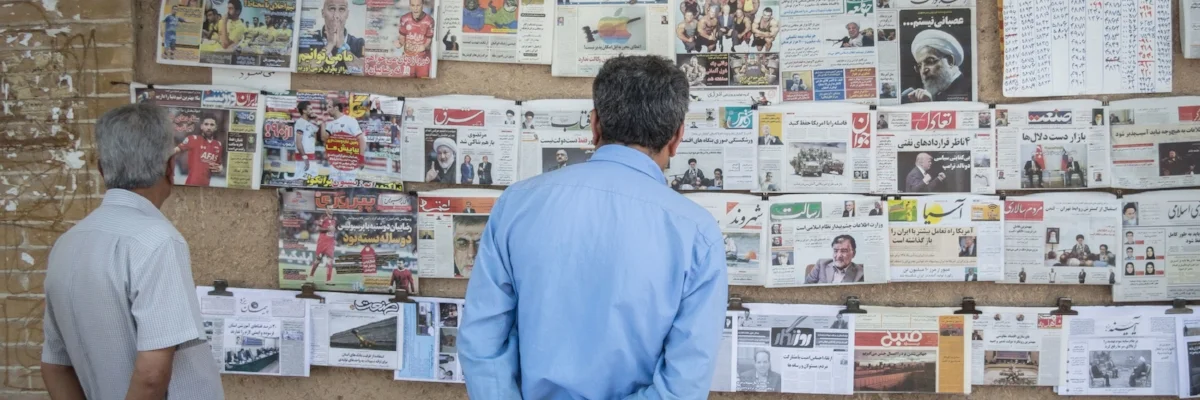
Among currency fluctuations and returning sanctions, Iran is now battling a paper crisis. Gradual price hikes have been increasing pressure on book and newspaper publishers over the last year, but the scale of the crisis became clear when Culture Minister Abbas Salehi announced on August 4 that the country has just enough newsprint paper in storage to meet two months worth of demand. In response to the shortage, some newspapers have been forced to cease publishing, while others, including the popular reformist newspaper Shargh, have put up a pay wall.
The government has rolled out a support package that includes importing paper as an essential good. This will most likely calm agitated publishers in the short-term, but will prolong a vicious cycle and defer the real reform needed to address a decades-long problem of corruption and inefficiency. The paper crisis represents something bigger.
Mahmoud Sadri, a veteran journalist who currently heads the publishing department of Donya-e-Eqtesad, Iran's foremost business daily, sees the paper crisis as just the latest manifestation of “Iran's economic inefficiency.” Speaking to Bourse & Bazaar, Sadri explained, "We have no phenomenon called a paper crisis as a separate and standalone phenomenon. It's not accurate to just say paper is in crisis since many goods are in crisis.”
In Sadri’s view, the paper crisis has its roots in the time of the 1979 Islamic Revolution, during which the government took on the mission to foster cultural production and provided for all the paper and raw material needs of the publishing industry. In order to do that, the Iranian government has typically opted for one of two options: they have either purchased the paper and offered it at cheap subsidized rates or offered handouts directly to private importers.
This misguided approach created conditions ripe for rent-seeking and corruption. Importers sought to abuse the cheap money they were being provided instead of creating actual in-demand value.
Such rent seeking accelerated in recent months, as the Iranian rial came under increased pressure due to returning US sanctions. "A group of profiteers and rent-seekers have entered the market and are making things much harder for paper consumers," Abolfazl Roghani Golpaygani, president of the Iran Paper and Paperboard Syndicate said in a recent interview.
But the government seems intent to maintain the longstanding subsidies. On August 6, the Ministry of Industry announced that paper used for publishing had been added to the limited list of essential commodities that will be imported using the preferential government exchange rate of IRR 42,000 to the dollar. That rate is to remain unchanged until at least March 2019 as President Hassan Rouhani promised recently. Furthermore, the ministry agreed to immediately import 20,000 tons of paper to address the shortage.
Many journalists and publishers, like Sadri, are critical of this arrangement. They believe that the government should not use taxpayer money for handouts to publishers who often publish content simply to maintain their license, or who wish to publish content in accordance with their own political and economic leanings. There are growing calls for for a free market approach to publishing in order to encourage competition that will boost newspaper quality and balance prices.
"How and based on what logic has paper been considered an essential good under the current circumstances?" asked Saeed Laylaz, a prominent journalist and pundit in a recent interview. He also referred to the decision as "explicit theft.”
However, cutting the flow of government support will mean that hundreds of book, newspaper, and magazine publishers will fold, with the potential for thousands of job losses at a time when high unemployment is a major challenge for the Rouhani administration. It should come as no surprise that the administration is unwilling to take a leap and reform the paper subsidies, despite Rouhani’s longstanding intention to reduce subsidies across the economy.
"The other issue is that the majority don't accept that government paper subsidies are wrong in essence," Sadri adds. In this way, Iran's government is failing to address the long-term problem by dealing with the current paper crisis as a short-term phenomenon.
But while change to the government policy may not be imminent, Sadri does believe it is inevitable. "Even if no prospects of change are foreseeable at the moment, it will happen either way," he said, pointing out that many countries have undergone similar processes of reform that on many occasions took decades to realize. In publishing, as with other parts of Iran’s economy, reform remains a waiting game.
Photo Credit: Deposit Photo