
Devastating Floods Further Strain Iran's Creaking Economy
◢ Iran’s economy was already creaking as two weeks of flooding devastated communities across the country, killing 76 people and damaging critical infrastructure and industries. Hundreds of thousands of Iranians have been left to pick up the pieces at a time when economic pressures may mean that their government and fellow countrymen will struggle to provide adequate relief.
Iran’s economy was already creaking as two weeks of flooding devastated communities across the country, killing 76 people and damaging critical infrastructure and industries. Hundreds of thousands of Iranians have been left to pick up the pieces at a time when economic pressures may mean that their government and fellow countrymen will struggle to provide adequate relief.
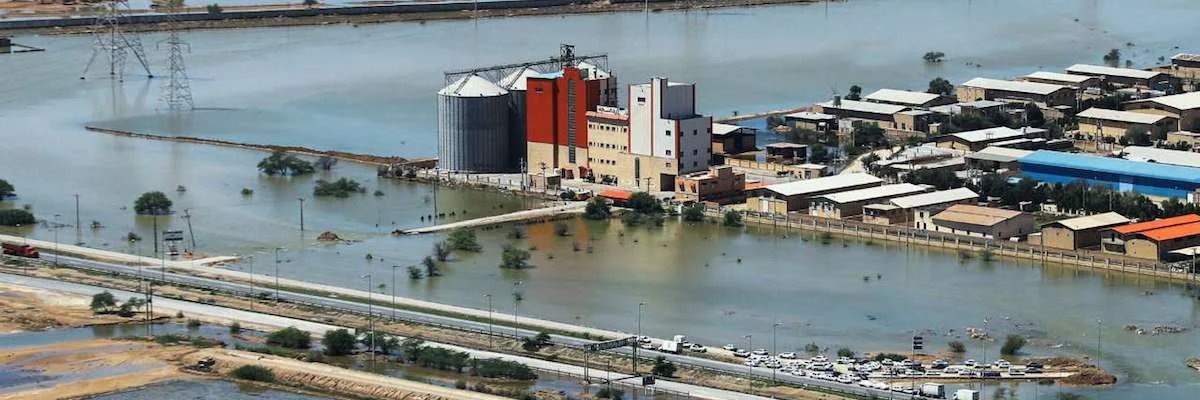
Initial estimates put the flood damage at USD 3.5 billion. Nearly 90,000 homes have been rendered uninhabitable. Thousands of farms have also been submerged, with damage to the agricultural sector alone estimated at nearly USD 200 million. Across the agricultural centers of Golestan, Khuzestan, Lorestan, and Mazandaran, over 800,000 hectares of crops have been destroyed.
Individual communities have been hammered as factories and farms have closed. In the northern town of Agh Ghala, 5000 people have been rendered jobless after the floods devastated 15 individual industrial plants. At least 60 chicken farms have also suffered major damage.
Although Iran’s largest factories remain intact, the Ministry of Industry has identified 400 industrial sites across six provinces that were hit by flooding. In Lorestan province alone, over 100 manufacturing facilities were affected.
In oil-rich but underdeveloped Khuzestan, the floods hit oil fields and sugarcane fields alike. Officials have confirmed that downpours partially destroyed five out of seven sugar producing factories in the Arab-majority province, including the Dehkhoda Sugarcane Cultivation and Industry Company. Floodwaters also inundated over 30,000 hectares of the adjacent sugarcane fields.
Iran’s roads infrastructure has also seen significant damage. Roads Minister Mohammad Eslami, told reporters that nearly 14,000 kilometers of roads, making up a third of the country's overall network, has been damaged.
An Underwhelming Response
As Iranians take stock of the devastation, the debate over the government’s disaster management has only grown more heated. On one hand, relief efforts have been complicated by US secondary sanctions. The country's Red Crescent Society issued a statement lamenting "inhumane US sanctions" which it said had blocked the transfer of international cash contributions. "Not a single dollar or euro [in foreign transactions] has managed to get through," the organization said in an updated statement broadcast on state TV a week later. The Iranian agency has also complained about how its ageing fleet of 24 helicopters has slowed response to the disaster.
On the other hand, the government seems to have done little to address public anger over perceived mismanagement. Iranian social media has hosted numerous videos of citizens berating government officials, including an argument between the governor-general of Khuzestan province and a frustrated local who criticized the government for "aiding Syrians" while neglecting the plight of the flood-stricken at home. In an offensive tone, the governor-general attacked the man for being a "rude opponent" of the regime. The viral video sparked a backlash, prompting the interior minister to intervene and ask the governor-general to apologize to the man. Two days later, another video was released with a title suggesting an apology. But interviewed later, the man in the first video denied claims that he had been approached by the governor-general for an apology.
Flood relief has also become a new battleground for political rivalries. The recent move by the Trump administration to designate the Islamic Revolutionary Guard Corps (IRGC) as a terrorist organization spurred supporters to share photos of IRGC officers and commanders, rushing to provide aid to flood-stricken villages in muddy fatigues. "This is a terrorist back from a dangerous terror operation with his gun, a shovel in his hands," tweeted one user in a sarcastic tone meant to question the logic behind the US measure.
But Iranians have found hope in extraordinary acts of service. In a video widely circulated last week, a group of young men locked arms to form a human dam as rampaging waters threatened to break through a levee in Dehlavieh, near the city of Ahvaz. The dramatic scene was printed on the front pages of leading newspapers.
Reconstruction Efforts Begin
As the extent of the flood damage continues to become clear, the government now considers it "inevitable" that it will be necessary to draw upon foreign currency reserves held by the country’s sovereign wealth fund, the National Development Fund of Iran.
But grassroots reconstruction will also depend in part on donations from the public. In the aftermath of the 2017 earthquake in Kermanshah, which killed over 600, low levels of confidence in government agencies saw the public seek out other fundraising initiatives, including efforts spearheaded by celebrities, who raised huge sums for relief and reconstruction. But a lack of transparency and later controversies surrounding some of those appeals seems to have led the public to once again donate primarily through traditional agencies.
An opinion poll conducted by the Iranian Students Polling Agency (ISPA), suggests that confidence in government relief organizations has risen when compared to previous disasters, notably the 2017 earthquake. In a sign of the country’s economic hardship, 58 percent of respondents said they had not donated because of their own financial circumstances, while 42 percent of respondents had made a donation. Those who were able to give reported donating to a wide range of organizations, including the Red Crescent, the Iman Khomeini Relief Foundation, local mosques, celebrity-led campaigns, as well as directly to flood victims. Just 19 percent of respondents expressed doubts that the donations would reach flood victims. Of the recipient organizations, the Red Crescent, which has already collected over USD 30 million in private donations from within Iran, was the most trusted, chosen by 31 percent of respondents. The Iman Khomeini Relief Foundation was the chosen recipient organization for just 8 percent of respondents, lower even than direct donations to flood victims.
The challenge now facing Iran’s government is how to maintain momentum and political attention as devastated communities face years-long recovery efforts. As Iran’s economy faces unprecedented strain, it may be the strength of Iran’s social ties that determine the fate of the thousands whose livelihoods have been disrupted.
Photo: IRNA
Iran Budget Under Scrutiny As Oil Revenues Fall
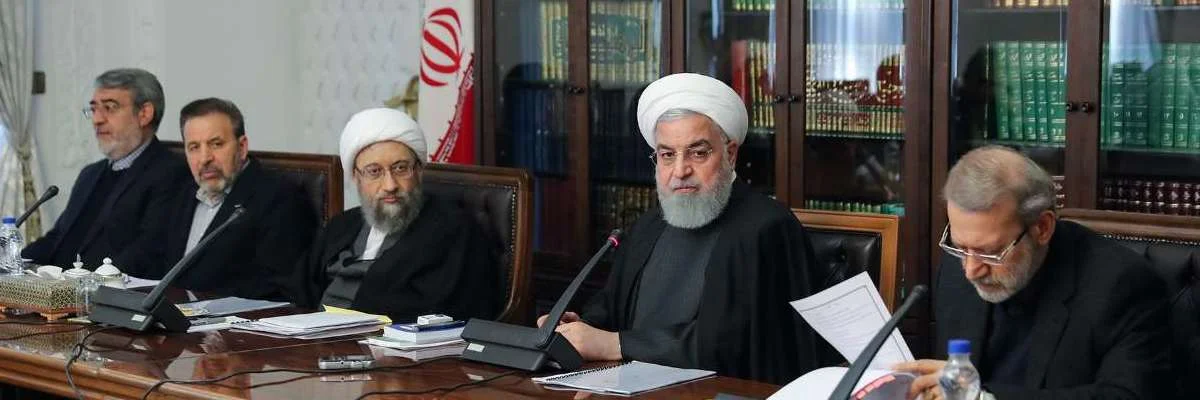
◢ Next week, President Hassan Rouhani will submit a budget proposal for the forthcoming Persian year (covering March 2019-2020). Currently, the Rouhani administration has few options as it seeks to avoid a budget deficit. Yet the political tradeoffs required when devising a budget under sanctions may prove more difficult to manage than the economic challenges.
Next week, President Hassan Rouhani will submit a budget proposal for the forthcoming Persian year (covering March 2019-2020). The budget bill’s adherence to fiscal rules and the reasonableness of its estimates will be under intense scrutiny given the volatile political and economic climate in Iran.
Policymakers and business leaders see the budget as having four purposes: to maintain economic stability, to boost economic growth, to expand redistribution for poverty reduction, and to supply public goods. Given limited resources related to the reimpositon of sanctions, the Rouhani administration intends to focus on the latter two goals. For example, the administration is slated to earmark USD 14 billion of its hard-earned oil dollars to ease importation of a group of 25 items classified as basic goods and medications.
In the face of such emergency expenditures, the cabinet must carefully balance its budget to ensure that spending is kept in line with revenue, especially given the impact of sanctions on the contribution of oil revenues.
Assuming that Iran will continue to sell 1 million barrels per day (mbpd) of crude oil at USD 54 per barrel, total oil revenues next year will reach approximately USD 20 billion or about IRR 1,140 trillion, at the effective official exchange rate of IRR 57,000. More optimistically, if Iran can manage to keep exports around 1.5 mbpd, the state will earn USD 30 billion, or IRR 1,710 trillion.
According to Iran’s Sixth Development Plan, which establishes guidelines for government budgets and covers a five-year period from 2016, revenue estimates for oil and gas condensate exports cannot exceed a forecasted IRR 1,150 trillion by more than 15 percent. As such, the budget must technically be balanced based on oil revenues of IRR 1,300 trillion. A draft version of the budget places oil revenues at IRR 1,690 trillion, flouting the rule.
Moreover, the Sixth Development Plan mandates that 14.5 percent of oil revenues be allocated to the National Iranian Oil Company, 34 percent to the National Development Fund of Iran (NDFI) and 3 percent for investment in Iran’s underdeveloped regions. The remaining revenues are earmarked for use by the central government.
In an effort to increase its available resources, the Rouhani administration planned to cancel the allocation of oil revenues to NDFI. But Iran’s Supreme Leader, Ayatollah Ali Khamenei, intervened to ensure NDFI secures at least a 14 percent allocation. When allocations are reduced, the government typically does not actually transfer the diverted revenue to the Central Bank of Iran, maintaining the funds outside of Iran. This means that the government is effectively printing money, adding inflationary pressure.
A further challenge for the Rouhani government will be that even if oil revenues can be sustained, sanctions will force the government to receive most of its foreign exchange earnings in currencies such as the Indian Rupee, Iraqi Dinar, Turkish Lira and Chinese Yuan. These funds, deposited into escrow accounts as governed by the Significant Reduction Exemptions (SREs) issued by the Trump administration to eight of Iran’s oil purchasers, will not prove as valuable or liquid.
While some have speculated that allowing the rial to depreciate could have served to minimize a budget deficit given the large proportion of foreign exchange revenues, the overall reduction in oil revenue and the need for new expenditures, such as allocations for the import of basic goods and pharmaceuticals, negates any benefit.
In the same vein, given high interest rates on Iran's debt market during the sanctions era, the government will face difficulties in repaying its deferred debts through the issuance of bonds. Furthermore, the Plan and Budget Organization of Iran is set to issue new debt in 2019-20 close to the IRR 560 trillion ceiling specified in the Sixth Development Program.
With revenue squeezed for the reasons outlined above, Rouhani will be under pressure to reduce spending, especially through the elimination of subsidies. First, the administration could decide to end the allocation of subsidized dollars for the import of essential goods and medication. This may exacerbate inflation, but it is not clear as to whether the subsidies are actually serving to keep consumer prices low, or whether importers and wholesalers are padding their profits. If inflation continues slow in coming months as the rial regains value, there may be a case for reducing the subsidy.
Second, the some economic commentators have proposed eliminating subsidies for fuel in the favor of shopping cards that enable households to get discounted prices for essential foodstuffs. This would replace a subsidy for essential goods importers with a subsidy for consumers. Not only would such an approach protect foreign exchange reserves, it arguably would more effectively support underprivileged groups in the society.
Currently, the Rouhani administration has few options as it seeks to avoid a budget deficit. Yet the political tradeoffs required when devising a budget under sanctions may prove more difficult to manage than the economic challenges.
Photo Credit: IRNA