
Young Candidates Enter Fray for Iran Presidency
With less than a year until Iran’s presidential election, political camps are making preparations for what is expected to be a watershed contest to decide who will succeed moderate president Hassan Rouhani.
With less than a year until Iran’s presidential election, political camps are making preparations for what is expected to be a watershed contest to decide who will succeed moderate president Hassan Rouhani.
The state of Iran’s economy will be the key issue for most Iranian voters, and by extension, there will be a fierce debate among hardline camps, which now control the parliament and the judiciary, as to whether the country should continue the pro-engagement politics introduced by Rouhani and his political allies following the 2013 election.
But alongside this political debate, another question has emerged—whether it is time for younger candidates to come to the fore.
“I have stressed time and again that I do believe in a young and religiously committed administration,” said Supreme Leader Ali Khamenei in a May 17 virtual meeting with representatives of student unions.
Khamenei, however, made it clear that the notion of a young government does not mean electing a president who is “say 32 years old.” Rather, Khamenei called for “an administration … within an age range capable of working hard, one that is not fatigued.”
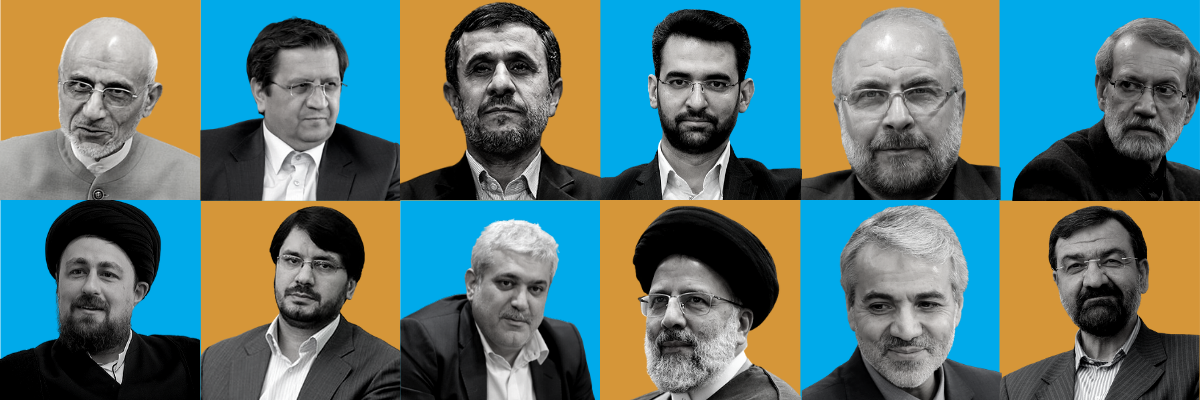
The supreme leader’s speech has spurred new names to be added to the already long list of candidates expected to run for president. Iranian media have touted three rising figures who may be aiming to succeed Rouhani.
Topping the list of young candidates is Mohammad Javad Azari Jahromi, the country’s 39-year-old minister communications minister, who has positioned himself as a progressive technocrat. Jahromi has sought to earn the trust of younger Iranians by seeking to make his ministry more transparent and by vowing to protect access to social media platforms such as Instagram.
“Let them rest easy that I will not run for president,” Jahromi told reporters when asked whether his push for transparency was a stunt to gain popularity ahead of the election. Of course, Iranian politicians typically deny their ambitions for as long as possible, and Jahromi’s statements have not put an end to speculation that he is planning to run.
Another young would-be candidate is Sorena Sattari, the Rouhani administration’s Vice President for Science and Technology. The son of a late air force commander, Sattari is seen as someone who maintains ties on both ends of the Iranian political spectrum. Trained as a mechanical engineer, he is understood to maintain strong ties to the supreme leader’s office. But he is also seen as forward-looking and has won praise for his relentless support of the country’s start-up ecosystem, hardly a bastion of conservatism.
Sensing that a generational shift is underway in Iranian politics, conservative camps have also sought to elevate younger politicians. Now 40 years old, Mehrdad Bazrpash, began his political career at the age of 25 and has been ruthless in his criticism of the Rouhani administration, especially with regards to the state of the economy and efforts to normalize ties with the West.
But for all the appeals of youth, the old guard is not ready to step aside just yet. Within the reformist-moderate bloc that supported President Rouhani, debate continues about the candidacy of former parliament speaker Ali Larijani, one of the most powerful politicians in the history of the Islamic Republic, who underwent a transformation over the last decade from a conservative firebrand to a moderate figurehead. Rouhani owes much of the internal backing for the nuclear deal to Larijani.
Still, reformists remain divided about Larijani and his loyalties. “The Reformists will not resort to a proxy candidate,” said Hamid-Reza Jalaeepour, a key voice in reformist circles. But other leading reformists, including Mohammad Atrianfar, consider Larijani the only viable candidate to continue the political project Rouhani began. In a recent interview, Atrianfar argued that Larijani had “significantly distanced himself from the hardline conservatives in recent years and insists on maintaining this distance.”
Parviz Fattah, an IRGC member and the head of the Mostazafan Foundation, one of the country’s largest bonyads, or charitable endowments, has also been touted as an attractive presidential candidate in hardliner circles. Fattah is seen as someone who, if not young himself, may be able to galvanize conservative-minded youth through his uncompromising ideological outlook.
With the economy looming large in the minds of voters, a theme of technocratic competence has also emerged much like the theme of youth. There is growing speculation that the governor of Iran’s central bank, Abdolnasser Hemmati, could come forward as a candidate, allowing the reformists and moderates to avoid some of the internecine tensions that would surround a Larijani candidacy. Hemmati’s performance at Iran’s central bank has not been without controversy, with some questioning his heavy-handed approach to the country’s turbulent foreign exchange markets. But he is broadly seen as someone who has reinstated the relative independence of Iran’s central bank, instituting policies that have eased some of the impacts of U.S. secondary sanctions.
In a similar vein, Mohammad Bagher Nobakht, the head of the country’s Plan and Budget Organization and a longstanding figure in Iranian economic policy, has fueled speculation about his own candidacy after several trips to Iranian provinces, which included campaign-style posters and press conferences. Nobakht has, nevertheless, dismissed speculation of his candidacy as “unfounded.”
But if the reformists and moderates are to recapture some of the enthusiasm that thrust Hassan Rouhani to two landslide election victories, charisma may be key. Hossein Kanani-Moghaddam, founder of the center-right Green Party of Iran, has suggested that the greatest hope for those wishing to preserve the political project begun under Rouhani comes in the form of Hassan Khomeini, the grandson of Ayatollah Rouhollah Khomeini, the founder of the Islamic Republic. The 47-year-old cleric is a close ally of the spiritual leader of the reform movement, Mohammad Khatami, but has largely stayed away from the political scene and has declined calls to run in past presidential elections.
Whomever the reformists and moderates put forth, the most difficult hurdle will be the vetting process carried out by the Guardian Council, a body dominated by conservative clerics. In a worrying sign, the council purged the majority of pro-reform candidates ahead of the February parliamentary vote, a move which contributed to the lowest turnout in any major election since the founding of the Islamic Republic.
Akbar Torkan, a veteran moderate politician and a former senior aide to Rouhani, believes that the presidential election will have much in common with the parliamentary polls, warning that the Guardian Council will “select the candidates on their own just to have the public approve them at the ballot box.”
Outspoken political scientist Sadegh Zibakalam has made an even more pessimistic predication, arguing that the “reform movement is over.” In his view, those who voted for Rouhani in 2017 have become disillusioned, contributing to low turnout. “It’s not about names, even someone like Khatami cannot garner votes,” he said of the dwindling popularity of the reformist camp.
Zibakalam believes that a low-turnout election will favor a hardline figure who can mobilize his base, perhaps even Mahmoud Ahmadinejad, the controversial former president who refused to rule out plans for his candidacy in a recent interview. Ahmadinejad, who has cultivated a populist image by focusing on the grievances of Iran’s lower classes, has already begun touring the country, mustering large crowds that give credence to Zibakalam’s warnings.
Ahmadinejad was barred by the Guardian Council from the 2017 presidential race. But he is reportedly engaged in behind-the-scene talks with the vetting body to get the green-light for next year’s election “An Ahmadinejad candidacy could disrupt all the calculations,” said prominent conservative politician Morteza Talaee, noting that the ex-president technically belongs to no major camp after breaking away from the hardliners, who once supported him unequivocally.
Ahmadinejad’s national profile is matched by just a few other potential candidates—prominent political figures who continued to eye the presidency after failed bids.
Former Tehran mayor, Mohammad Bagher Ghalibaf, who was named the new parliament speaker in June, has failed to become president in 2005, 2013, and 2017. In recent years, Ghalibaf has cast himself as a conservative stalwart in an attempt to galvanize the new generation of “revolutionary” youth behind his leadership.
Chief Justice Ibrahim Raisi, who came second to Rouhani in the 2017 election is also expected by many pundits to be considering a second run. But another election defeat would dent Raisi’s hopes of becoming the country’s next supreme leader and he may wish to focus on the ambitious anti-corruption drive widely seen as a gambit to increase his chances of succeeding Khamanei.
Finally, Mohsen Rezaee, a former commander of the Islamic Revolutionary Guard Corps, who has already had three failed bids for the presidency, appears to be warming up for another fight. As a proponent of “resistance economy”, Rezaee has recently sharpened his attacks against the Rouhani government’s economic performance, including a slogan-like tweet issued last week. “I can give our people assurances that by pushing aside the pro-Americans from power … our national currency will become the strongest in the entire region,” Rezaee declared.
Iranian voters have a long wait to see who will appear on their ballots. But the crowded field makes it clear that Iran is set to have a watershed election, one that will combine a likely shift away from progressive reformism with the potential emergence of a new generation of political leaders.
Photo: Various
Iran is Losing Sight of its 'Developmental Vision'
Today, a new Iranian precariat is seeking economic justice. Iranian economic planners and policymakers, like their fellow technocrats around the world, are struggling to find the pathway to continued growth in the face of factional infighting and foreign interference.
This article was originally published by the Atlantic Council.
On December 11, Iran’s information minister announced via social media that he had a “surprise” to reveal. Mohammad-Javad Azari Jahromi, the Islamic Republic’s youngest-ever cabinet minister, had been the subject of intense criticism from the Iranian public following a week-long internet blackout. Authorities had taken the unprecedented step to cut internet access in response to the nationwide protests that erupted on November 15 following a subsidy reform that doubled fuel prices. Angered by the crackdown, many Iranians “surprised” Jahromi by blocking him on Twitter.
Undeterred, Jahromi made his grand reveal on December 12: a slickly produced video that showed Iran’s postal service delivering a package to the information ministry by drone. While such drones may be helpful for rural communities and disaster response, Iranians were understandably bewildered by the PR stunt.
Jahromi’s postal drone offers a metaphor for perhaps the central political challenge facing the Islamic Republic. In the wake of a brutal response to protests that has left over 300 dead, commentators have pointed to a crisisof legitimacy now facing Iran’s leaders and their ideological tenets. But in reality, it is the compounding failure of technocrats like Jahromi to manage a decade of economic volatility that best explains Iran’s new political turmoil.
As a recent study of the fuel protests shows, “economic grievances were likelier to inspire protest in areas where frustration with the whole system was endemic… Economic hardship turned frustrations with the system into assertive protest activities.” The protests appear to have comprised largely of individuals newly confronting economic hardship, which suggests the emergence of a precariat class in Iran. Just last year, 1.6 million Iranians fell into poverty due to high inflation. The study details how the counties in Iran which saw protests were often those more dependent on state support, meaning that the withdrawal of that support—such as the reduction of the fuel subsidy—was felt most acutely. As the study observes, “the Islamic Republic, through its long-term developmental and welfare programs, has empowered a citizenry that now resists neoliberal policies, such as cuts to energy subsidies.”
These long-term developmental and welfare programs are the underappreciated pillars of the Islamic Republic. As sociologist Kevan Harris has described, state-society relations in Iran have been shaped by a “developmental vision” established when the young Islamic Republic began to emerge from the brutal Iran-Iraq War. As revolutionary fervor and wartime zeal ebbed, a core group of technocrats, many of whom had served in the Shah’s civil service and who had been educated abroad, began to set the country’s development agenda. After a few years of structural readjustment, the country’s economy started to grow, and the technocrats became firmly ensconced in the powerstructures of the Islamic Republic.
Iran’s GDP per capita peaked in 2012, buoyed by record-high oil prices. But the same year, the international community imposed strict sanctions on Iran over its nuclear program, triggering a 7.4 percent contraction and ending 23 years of consecutive increases in GDP per capita, which had risen from just over $2,200 in 1989 to just under $8,000 by 2012. The developmental vision of the Islamic Republic had significantly improved the welfare of the average Iranian. For millions of Iranian households, development meant the arrival of electricity, gas, refrigeration, personal mobility—and in the last decade, access to the internet. But success in economic development is inherently relative. Iran fared much better than Iraq in the two decades following their eight-year war. Iraq’s GDP per capita had been higher than Iran’s in 1989, at $3,800, but rose to just $6,800 by 2012, having lagged behind Iran even before the 2003 US invasion. In the same period, however, Poland, which emerged from its stagnation behind the Iron Curtain in 1989, saw its GDP per capita rise from just below $1,800 to $13,000, becoming a widely touted example of successful development.
That Iran finds itself between Iraq and Poland on the measure of GDP per capita speaks to the predicament facing the country’s technocrats. The political establishment in Iran is, in some respects, the victim of its success. Economic development became, even in an ostensibly “revolutionary” state, the foremost expectation of governance among the Iranian people. The Islamic Republic has only recently ceased delivering consistent distributive economic growth, leaving chronic and underlying issues of inflation, unemployment, and corruption unassuaged by economic expansion. Sanctions—which have deprived the country of investment, stifled trade, and weakened the currency—have contributed to nearly a decade of stagnation.
In a prescient 2011 study on the impact of economic crises on Iran’s youth, economist Djavad Salehi-Esfahani concludes with a question. He wonders how a lack of economic opportunity “shapes the attitudes of Iran’s youth about the country’s future and their ability to lead and build the nation.” Are Iranian youth “slowly losing not only their skills but also their hope and optimism?”
While Jahromi was busy toying with postal drones, a new budget was being prepared for the forthcoming Iranian year (March 2020). As analyst Henry Rome explains in his study of the new budget, the Iranian government will seek to mitigate the harms of high inflation, which the IMF projects at around 30 percent next year, by instituting new cash transfers and increasing the wages of public sector employees. Overall, the new budget represents an 8 percent increase in spending in rial terms. But with the contribution of oil revenues down from 29 percent in last year’s budget to a likely-too-optimistic 9 percent, the government will be seeking to increase tax revenue in to fulfill its fiscal burdens, ostensibly increasing the importance of functional state-society relations.
Iran’s technocrats will continue to seek policy solutions to address widespread economic frustrations and alleviate poverty. But as Salehi-Isfahani observes in his study from eight years ago, there is only so much that the technocratic solutions can achieve. In the face of myriad economic pressures, including “maximum pressure” sanctions, Iran’s resilience is a remarkable achievement, but it is nonetheless approaching a kind of political limit. Referring to the government’s response to the economic malaise of the Mahmoud Ahmadinejad years, Salehi-Isfahani notes, “there are new policy initiatives ranging from the reform of the nation’s decades-old subsidies, to amending the family laws, to reviving population growth, not to mention the nuclear standoff with the West, but none that help salvage Iran’s demographic gift.” That an article written years ago describes the current dilemmas so accurately speaks to Iran’s stagnation.
In the aftermath of the protests, Iran’s political elites have begun to realize the stakes. In a speech one week after the fuel protests, Mohsen Rezaei, the hardline secretary of the country’s influential Expediency Council, acknowledged that Iran was failing to deliver economic development. Pointing to the importance of economic development in state-society relations, Rezaei stated, “Since the beginning of the revolution until today each government of the Iranian people has tried to make an impact on the economy, and particularly in the last two decades the focus various stakeholders has been the economy, but we have yet to find a pathway that gives us optimism for the future.” While the Islamic Republic had proven able to “address the issue of elections, defense, security, and freedom,” it had failed to reach the optimal model for “economic development and economic justice.”
Today, an Iranian precariat class is seeking economic justice. Iranian economic planners and policymakers, like their fellow technocrats around the world, are struggling to find the pathway to continued growth in the face of factional infighting and foreign interference. Signing-off in his announcement of the postal drone, Jahromi declared, “We must make Iran the best and most advanced country in the world!”
If only it were so easy.
Photo: IRNA