
How the UAE will Underwrite the Iran Deal's Success
Most of the questions around the JCPOA’s economic prospects revolve around whether European companies will bother to engage in the Iranian market given the challenging experience of the last few years. But there is another trade relationship that arguably matters more.
As negotiations on the restoration of the Iran nuclear deal reach their “final stage,” doubts persist about whether the lifting of US secondary sanctions will really boost Iran’s economy. Iranian leaders are seeking “guarantees” that they will accrue the economic benefits promised under the Joint Comprehensive Plan of Action (JCPOA), citing both the disappointing experience of sanctions relief between 2016-2018 and the pall that has been cast by President Donald Trump’s unilateral withdrawal from the agreement.
Doubts around the JCPOA’s economic prospects revolve around whether European companies will bother to engage the Iranian market given the challenging experience of the last few years. But there is another trade relationship that arguably matters more for the future of the JCPOA.
The United Arab Emirates (UAE) did not play a significant role in Iran’s economic recovery during the period of sanctions relief between 2016-2018. This is notable because in the period leading up to the imposition of financial sanctions on Iran in 2012, the UAE was catching up to the European Union as one of Iran’s top trade partners. In the ten years from 2001 to 2011, UAE trade with Iran rose at twice the pace of European trade, rising from $2.2 billion to $24.2 billion. In the same period, EU trade with Iran rose from $12.8 billion to $36.8 billion.
According to data published by IRICA, Iran’s customs authority, UAE trade with Iran peaked in 2011 at $24 billion. That same year, data from Eurostat shows that EU trade with Iran also reached an all-time high at $36 billion. To put it another way, the volume of Iranian trade passing through the UAE was equivalent to two-thirds of Iran’s direct trade with the whole of Europe. During the first decade of the millennium, Iran underwent significant industrial development enabled by the forces of globalisation. Iran lacked a global port and global banks. But its proximity to the UAE offered a conduit to global markets. Dubai was to Iran what Hong Kong was to China in the 1990s—the world’s gateway to a fast-growing economy.
After the imposition of financial sanctions in 2012, both EU and UAE trade with Iran took a hit as the Iranian economy was thrust into a recession. EU trade with Iran averaged just $10.6 billion per year between 2012 and 2015. UAE trade fell less dramatically, given that a large portion of Iranian exports to the UAE, destined for third countries, is comprised of food and consumer goods that fall outside of the scope of sectoral sanctions. The value of UAE trade with Iran averaged $15.3 billion in this period.
In January 2016, the implementation of the JCPOA saw the lifting of a wide range of UN, US, and EU sanctions on Iran. EU trade with Iran rebounded sharply as Iranian exports to Europe rose, driven by oil sales. Iran used its euro-denominated revenues to purchase European goods, especially industrial goods. EU trade with Iran rose to $23 billion in 2017, still down compared to the 2011 peak, but a marked improvement over the period prior to the implementation of the JCPOA. By contrast, trade with the UAE did not rebound. Total trade between the UAE and Iran averaged $14.4 billion from 2016 to 2018—slightly lower than the trade volumes in the period before sanctions relief.
This is the overlooked aspect of why Iran’s experience of JCPOA sanctions relief was underwhelming. While trade with Europe failed to return to its pre-sanctions peak, the greater constraint on Iran’s economic recovery was that trade facilitated through the UAE did not really rebound at all. Consequently, Iran’s ability to engage with all of its trading partners remained diminished. Iranian and foreign companies seeking to do business in the aftermath of sanctions relief could not avail themselves of the most obvious and efficient financial and logistical channels to do so.
For the last decade, UAE relations with Iran have been strained. The UAE was quick to support the multilateral sanctions on Iran, with Abu Dhabi reigning in Dubai-based banks and companies that had long profited from their links to Iran. Under instruction from the UAE central bank, commercial banks closed the accounts of Iranian companies and Iranian nationals. Multinational companies that had used their UAE-based subsidiaries to conduct business with Iran shifted their operations (Turkish banks emerged as an alternative financial channel for trade with Iran, especially for the European trade that persisted in the sanctions period). The UAE gave tepid support to the Obama administration’s efforts to constrain Iran’s nuclear programme but felt excluded from discussions around the possible impact of the deal, which seemed poised to tip the regional balance of power in Iran’s favour. On January 2, 2016, a crowd attacked the Saudi embassy in Tehran. Two days later, and just ten days before the JCPOA was formally implemented, the UAE downgraded its diplomatic ties with Iran. Over the next year, Mohammed bin Zayed, crown prince of Abu Dhabi, joined with Mohammed bin Salman, crown prince of Saudi Arabia, to push back on Iranian influence in the region. By the end of 2018, following a unilateral withdrawal from the JCPOA, the Trump administration had reimposed secondary sanctions on Iran in full, with the full support of UAE leaders.
In May 2019, the same month that Trump revoked a set of waivers permitting Iran to sell limited volumes of oil to its historic customers, four tankers were damaged in an attack off the coast of Fujairah. The attack, attributed to Iran, was the first incident in a series of escalations that constituted Iran’s response to the Trump administration’s maximum pressure sanctions. Just a few months later, the UAE dispatched a delegation to Iran to discuss maritime security. Leaders in Iran and the UAE eventually came to realise that renewed dialogue could help avoid a spiralling regional security crisis. In December of last year, Tahnoon bin Zayed, brother to Abu Dhabi’s crown prince and the UAE’s national security advisor, visited Tehran. The maturation of this diplomacy has been supported by economic engagement. Over the course of the last two years, the UAE has taken steps to reprise its role as a facilitator of Iran’s trade links, emerging as a key intermediary in Iran’s oil exports to China, despite these exports taking place in violation of US secondary sanctions.
Back in 2019, as the first signs of renewed economic diplomacy emerged, I argued that “Abu Dhabi can’t afford to keep Iran out of Dubai.” The argument still holds true. Dubai and the wider UAE have performed an economic miracle, emerging from the desert as a global center of trade and finance. But as a new analysis from the IMF makes clear, further growth and greater resilience will require regional economic integration. While the IMF report limits its discussion to GCC countries, a restoration of UAE-Iran trade to pre-sanctions levels would be an enormous catalyst for growth. UAE leaders are aware of this fact. In a statement jointly issued with the United States, GCC leaders declared that “deeper economic ties after the lifting of US sanctions under the JCPOA are in the mutual interest of the region.”
When it comes to the prospects for renewed sanctions relief, the increasingly constructive relations between the UAE and Iran must be taken into account. If the UAE plays an active role in facilitating increased trade with Iran following the restoration of the JCPOA, the rise in trade could compensate for any diminished rebound in trade between Europe and Iran. More optimistically, if UAE banks are instructed to resume support for Iran-related transactions, the increase in available foreign exchange liquidity and the multiplication of the available payment channels could have a dramatic impact on the full range of Iran’s bilateral trade relations. Where European and Asian banks may remain hesitant to facilitate trade, UAE banks can step in as intermediaries, taking on the burden of the compliance requirements. They will have enough business to justify the costs of working with Iran.
While the normalisation of UAE-Iran ties remains tentative, UAE leaders aware of the role they can play as underwriters of the restored nuclear deal. The Biden administration, eager to consolidate the restored JCPOA, will likely encourage the UAE to reprise its role as Iran’s primary gateway to the global economy, with the U.S. Department of Treasury and U.S. Department of State engaging directly with UAE regulators and companies to help them navigate the new compliance landscape. The potential is enormous. UAE-Iran trade grew at an annualised rate of 28 percent between 2001 and 2011. Had this growth been sustained for just five more years, total trade would have exceeded $80 billion. What matters most for the long-term viability of the nuclear deal is not whether trade with Europe will return to pre-sanctions levels, but whether revitalised trade with the UAE can accelerate Iran’s reintegration into the global economy.
Photo: WAM
UAE Earns Big as Iran Sells Oil to China
Leaders in the United Arab Emirates are eyeing an economic windfall should the Biden administration succeed in its effort to return to Iran nuclear deal. But they have not waited for the lifting of sanctions to begin earning billions from Iran.
Leaders in the United Arab Emirates are eyeing an economic windfall should the Biden administration succeed in its effort to return to the Joint Comprehensive Plan of Action (JCPOA). But they have not waited for the lifting of sanctions to begin earning billions from Iran.
During a press conference on Monday following consultations in Abu Dhabi, US Special Envoy for Iran Rob Malley told reporters that “all” of the Biden administration’s regional interlocutors had made clear they would seek “to find ways to engage Iran economically consistent with the lifting of sanctions that would occur” if the JCPOA were restored, a step that would also require Iran to return to full compliance with its nuclear commitments under the deal.
Malley added that should Iran and the P5+1 manage to restore the nuclear deal, it “would also allow countries in the region to develop closer ties economically with Iran.” Malley had understood from his conversations with GCC counterparts that this was “one of [their] goals.”
The comments were notable in light of recent developments in bilateral trade between the UAE and Iran. At first, the UAE was fully on board with the “maximum pressure” sanctions imposed by Trump on Iran in 2018 and so far maintained by Biden. In the Iranian calendar ending March 2019, roughly one year following the Trump administration’s decision to withdraw from the JCPOA and reimpose secondary sanctions on Iran, Iranian imports from the UAE declined 30 percent from around USD 8.2 billion to USD 5.7 billion, while exports to the UAE declined 11 percent from USD 6.7 billion to USD 6 billion. In this period, UAE leaders sought to tamp down on the burgeoning trade between the UAE and Iran, principally channelled through Dubai. Iranian companies and businesspeople were essentially hounded out of the country, as customers severed relationships and banks shut accounts.
But in 2019, the first signs of a change in policy began to emerge. Fearing a further deterioration in the regional security situation after limpet mines were detonated on commercial vessels in the Gulf of Oman in May and June of that year, the UAE opened a tentative dialogue with Iran. Trump’s Iran envoy, Brian Hook, traveled to Abu Dhabi in September 2019 to try and keep the UAE on board with the maximum pressure strategy. One month later, reports emerged that the UAE had released USD 700 million of Iranian assets that had been frozen as part of the UAE’s support for the U.S. sanctions campaign. A thaw in economic relations was underway.
In the Iranian calendar year ending March 2021, total Iranian imports from the UAE exceeded USD 9 billion, back to pre-sanctions levels. In the first five months of the current Iranian calendar year, imports have totalled over USD 5 billion, meaning that total annual imports are on course to exceed USD 12 billion by March 2022. The UAE is a major re-export hub, meaning that Iran sources goods from a wide range of countries from suppliers in the UAE. The growth in Iranian imports from the UAE has been so rapid that the Arab entrepôt has now replaced China as Iran’s top import partner.
In an interview in September, Farshid Farzanegan, head of the Iran-UAE Joint Chamber of Commerce, attributed the UAE’s rise as Iran’s top import partner to increased purchases of agricultural commodities from Dubai-based traders and an overall decline in China-Iran trade. But he also notes that the growth in imports is taking place despite continuing challenges in cross-border banking between Iran and the UAE related to the fact that US secondary sanctions remained in place. Moreover, the recovery in Iranian exports to the UAE has been comparatively modest—total exports are on track to be just USD 4.5 billion this year, still below their pre-sanctions levels. So how is Iran able to buy so much more from the UAE?
The answer probably has to do with the decline in China-Iran trade. Over the course of the last year, China has significantly increased its purchases of Iranian oil. These purchases, which are made in direct defiance of US secondary sanctions, are not reflected in the data produced by China’s customs authority. This is because Iran is not delivering oil directly to China. Iran’s deliveries are intermediated, meaning that the oil is taken to a third country, before being transferred onto tankers that deliver to Chinese refiners. When this oil arrives in China, it is declared as an import from the country serving as the waypoint. The two biggest countries playing that role are Malaysia and the UAE.
Looking at customs data for Chinese oil imports, the rise in imports from Malaysia and the UAE occurs precisely around the time that China begins to reduce direct imports of oil from Iran. At first glance, it might seem that China is simply buying more oil from existing customers as Iran ceases to be an option. But the volumes being purchased from Malaysia and the UAE are so great that the oil cannot come from the production of those two countries—it must be Iranian oil.
The amount of oil China is importing from Malaysia, estimated by dividing the monthly value of declared imports by the average monthly oil price is 94 percent higher so far in 2021 than it was in the six months leading up to the Trump administration’s full imposition of sanctions on Iranian oil in May 2019. Looking to the UAE, the same figure is 31 percent higher. Looking across the two periods, the crude oil price is just 4 percent higher meaning that the surge in the value of Chinese imports is not merely a function of higher oil prices.
The inclusion of Iranian oil in the Chinese customs data is even clearer when comparing that data to OPEC estimates for Malaysia and UAE oil exports. According to OPEC, Malaysia exported an average of 280,000 barrels per day of oil in 2020, the equivalent of just over 100 million barrels over the whole year. Based on the 2020 average market price of USD 41.75, China’s declared oil imports from Malaysia, which are valued at USD 13.6 billion, are the equivalent of 330 million barrels (some of this total is Venezuelan oil, also being imported by China via Malaysia). Doing the same calculation, the UAE’s export total, as reported by OPEC, is about 880 million barrels in 2020. The barrel equivalent of total imports declared by China is 290 million, meaning that China would account for one-third of all UAE oil exports—an implausible proportion.
Looking back to the significant trade deficit Iran is running with the UAE, the likeliest explanation for how Iran is able to finance this deficit, which may total nearly USD 8 billion in this Iranian calendar year, is that it is drawing on revenues related to the UAE’s role as an intermediary in oil sales to China. Iran is clearly not spending the money it is being paid by Chinese customers in China—there has been no rise in Iranian imports of goods from China in the period in which we know China has increased its purchases of Iranian oil. Rather, that hidden surplus in China-Iran trade is being spent, at least in part, in the UAE, and thereby making a direct contribution to the UAE economy during a critical period of post-pandemic recovery. Facilitating Chinese purchases of Iranian oil also allows the UAE to reduce the risks of regional escalation. Iran has repeatedly threatened to prevent exports by the UAE and other producers if its own exports are blocked by sanctions.
So it should be no surprise that GCC leaders told Malley that they seek to deepen economic engagement with Iran if the US lifts secondary sanctions. They have already increased economic ties to levels approaching those last seen before US sanctions were reimposed, even while sanctions remain in place. The thaw in economic relations between the UAE and Iran is an overlooked aspect of the recent developments in regional diplomacy and could prove an important driver for continued talks in bilateral and multilateral formats. The recent growth in trade also suggests that there has been a fundamental shift in the attitudes of Emirati policymakers, who rebuffed President Obama’s request for an increase in Arab diplomatic and economic engagement with Iran made during the 2016 US-GCC summit. In this way, the shared interests of Iran, China, and the UAE appear to be giving the Biden administration new and much-needed space to pursue diplomacy.
Photo: Chinese Foreign Ministry
Abu Dhabi Can’t Afford To Keep Iran Out Of Dubai
◢ During the last financial crisis, capital flight from Iran offered a hidden bailout for Dubai as global investors pulled back. With a new crisis on the horizon, Iranian business leaders are wondering—how long can Abu Dhabi afford to freeze them out?
This article was originally published in LobeLog.
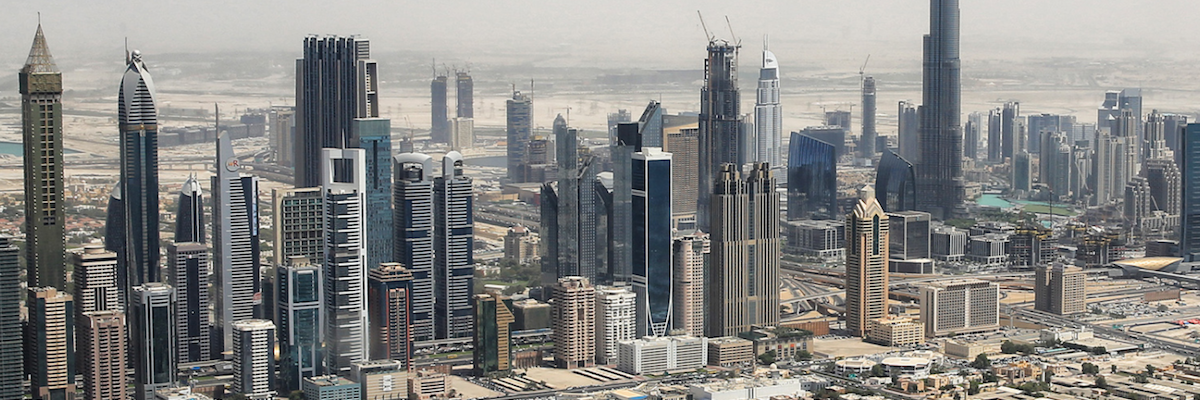
As the world teeters on the edge of another financial crisis, few places are being gripped by anxiety like Dubai. Every week a new headline portends the coming crisis in the city of skyscrapers. Dubai villa prices are at their lowest level in a decade, down 24 percent in just one year. A slump in tourism has seen Dubai hotels hit their lowest occupancy rate since the 2008 financial crisis, even as the country gears up to host the Expo 2020 next year. As Bloomberg’s Zainab Fattah reported in November of last year, Dubai has begun to “lose its shine,” its role as a center for global commerce “undermined by a global tariff war—and in particular by the U.S. drive to shut down commerce with nearby Iran.”
Dubai, an entrepôt where the workers are migrants and where property is king, is especially vulnerable to global recessions. In the immediate aftermath of the global financial crisis in 2009, Dubai’s real estate market collapsed, threatening insolvency for several banks and major development companies, some of them state-linked. Abu Dhabi, which controls the UAE’s vast oil wealth, threw Dubai a lifeline with an initial $10 billion bailout, later expanded to $20 billion.
But there was a second, hidden “bailout” that helped keep Dubai afloat. When the Bush administration enacted the Iran Sanctions Act in 2006, deepening Iran’s economic turmoil under President Mahmoud Ahmadinejad, there was a significant increase in the already significant volume of capital flight from Iran, most of which landed in Dubai. One 2009 estimate places the total value of Iranian investments in Dubai at $300 billion.
While global investors pulled their capital out of Dubai in the aftermath of the global financial crisis, the Iranian business community mostly stayed put, maintaining their deposits in Dubai’s teetering banks. Iranians continued to invest in Dubai’s ailing property market and used Dubai’s ports to conduct re-exports as sanctions restricted Iran’s direct access to global markets. For Iran’s captains of industry and finance, Dubai was not some far flung emerging market, but a vital channel to the global economy in the face of tightening sanctions. As Iranian economist Saeed Laylaz smartly observed in 2009, “Dubai is the most important city on earth to the Islamic Republic of Iran, with the exception of Tehran.”
The financial crisis and U.S. sanctions had served to deepen the mutual dependence between Dubai and Iran—an outcome that ran counter to the goals of policymakers in both Abu Dhabi and Washington.
The Crown Prince of Abu Dhabi and the defacto ruler of the UAE, Sheikh Mohammad bin Zayed (MBZ), has long seen Iran as a rival. MBZ is hostile to Iranian influence over Dubai, where many of the leading trading families can trace their roots to Iran, a legacy of centuries of trade in the Persian Gulf. MBZ’s dream of an assertive UAE would have been undercut had Dubai continued to develop into the Hong Kong to Iran’s China.
The Obama administration’s effort to build a multilateral sanctions campaign offered MBZ the opportunity to curtail Iran’s presence in Dubai’s economy. As they sought to isolate Iran economically, U.S. officials traveled to Dubai to meet with banks and companies to discourage them from engaging in commercial activities with Iran. Rather than resisting U.S. interference in the UAE’s economic sovereignty, Abu Dhabi amplified the American message– the bailout had put Abu Dhabi in a position to dictate policy to Dubai. The new policy called for Dubai to close its doors to Iranian money.
In subsequent years, the presence of Iranians in Dubai’s economy has diminished significantly. Trade persists, but banks refuse Iran-origin funds, close the accounts of Iranian companies, and deny services to individuals who maintain Iranian citizenship. More recently, as the Trump administration cultivated ties with MBZ, the UAE began to reject more Iranian applications for residency and business visas were routinely denied. Nearly 50,000 Iranian residents have left the UAE in the last three years.
But there are new signs that Dubai may be seeking to repair its trade relationship with Iran. In a recent interview, Abdul Qader Faghihi, president of the Iranian Business Council in Dubai, declared that a “space for trade between Iran and the UAE has been reopened.” Though any opening remains in its initial stages, Faghihi referred to negotiations with “the rulers of Dubai” in which Dubai authorities “accepted that Iranians who have the capital and intend to conduct legitimate trade with the UAE will be granted business visas and that banks will open accounts for these Iranians on instruction from Dubai authorities.”
This small opening may be related to efforts to reduce tensions around the Strait of Hormuz as Abu Dhabi reconsiders its regional entanglements and the risk of conflict in the region—it is unlikely that Dubai would be able to extend an olive branch to the Iranian business community without the consent of Abu Dhabi. But economic fears, and not security concerns, provide the clearest reason why a change in policy may be on the cards—Dubai will soon need another “bailout” from Iran. Farshid Farzanegan, head of the Iran-UAE Joint Chamber of Commerce, recently stated “The UAE’s behavior towards Iranian businessmen has changed… and moves are being taken to resume relations… As the UAE economy slumps, officials have decided to cooperate with Iran.”
Ten years on from the last financial crisis, Dubai is still repaying its debts to Abu Dhabi. As the UAE braces itself for the next global recession, Iran remains the only country capable of injecting significant capital into Dubai at a time when global investors will pullback. Iranian business leaders in Dubai are wondering—how long can Abu Dhabi afford to freeze them out?
Photo: Wikicommons