
Bankless Task: Can Europe Stay Connected to Iran?
◢ With US sanctions on Iran’s banking sector due to come into effect soon, European countries are now considering measures that would facilitate trade transactions with Iran through a new legal and institutional structure. European governments have been reviewing this legal entity, known as a Special Purpose Vehicle (SPV), for months. The timing of this public announcement suggests that they have a degree of confidence that the SPV can become operational, and that Europe can use the model to showcase its ability to deliver on its commitments.
This article is re-published with permission from the European Council on Foreign Relations.
As part of the effort to salvage the Iran nuclear deal, European governments have vowed to sustain their economic ties—not least their banking connections—with Iran. From 4 November, American sanctions targeting Iran’s banks will make it extremely difficult for European companies to engage in transactions with firms in the country. Many of the pathways to reducing the secondary impact of US secondary sanctions on the European financial sector present significant technical and political challenges—which stem from the US financial system’s global dominance and the integration of the US and European banking sectors. Moreover, the Iranian financial sector must take several proactive steps to ensure it meets the international compliance standards European banks require.
The Banking Blockage
With the incoming US sanctions, European companies face an even greater struggle to engage in transactions with Iran. For instance, Swedish automaker Volvo is leaving Iran because, as one of its spokesman put it, “with all these sanctions and everything that the United States put [in place] ... the [banking] system doesn’t work in Iran … We can’t get paid.”
This problem has driven most of the multinationals once active in the Iranian market to suspend their operations there, ahead of the new round of US sanctions. There is a widespread expectation that several Iranian private banks and the Central Bank of Iran will be designated entities under the measures.
Some European companies, such as Airbus and Total, require a licence or waiver from the US authorities to continue their operations in Iran, as they work in sectors subject to targeted sanctions. Many areas of Iranian trade, such as that in basic goods, are either unsanctionable or will be exempt from the measures. Yet US sanctions have adversely affected even these areas, as outlined in a recent ruling of the International Court of Justice.
Such restrictions on trade arise from the contamination risk that US secondary sanctions pose to European financial institutions, which generates unique pressure on the Iranian banking sector. This risk combines with Iran’s current shortfalls in meeting its commitments under a Financial Action Task Force (FATF) action plan – although the recent passage of the Combating Financing of Terrorism Bill suggests that Tehran is raising its compliance standards. Until the FATF changes Iran’s designation as a high-risk jurisdiction, global financial institutions will limit their dealings with Iranian banks.
Since President Donald Trump withdrew the US from the Iran nuclear deal in May this year and announced the re-imposition of secondary sanctions on Iran, banks in Europe have come under growing direct and indirect pressure from American regulators. Following the repeal of international sanctions on Iran in 2016, many large European banks began quietly facilitating transactions involving Iran for their largest industrial clients, especially those with long-standing operations in the country. Among these institutions, Danske Bank was the most visibly open to business with Iran, even opening a €500 million line of credit to support Danish firms’ expansion in the country. But as it falls into disrepute over suspected money laundering at its Estonian subsidiary, Danske Bank has opted to cease transactions involving Iran as an immediate show of responsiveness to US regulators. More broadly, banks tend to jettison their business with Iran if regulators exert pressure on them, even in the absence of a direct compliance issue.
Meanwhile, small European banks are coming under pressure from their larger competitors. When these institutions, which have relatively limited exposure to the US financial system, engage in Iran-related transactions, their routine SEPA transfers – payments to other banks within the Single European Payments Area – are often refused outright. This isolates the banks and complicates other aspects of their business. And the refusals extend beyond Europe. Asian banks have shown increasing concern about dealing with small European financial institutions that engage in business with Iran, understanding that they too could fall foul of the US authorities.
Europeans banks have been reluctant to engage with Iran due to fears about the response from their shareholders and creditors. This is most clear in the case of the European Investment Bank (EIB), which has refused to invest in Iran. European governments (which number among the bank’s shareholders) encouraged the EIB to consider lending to Iran, but the bank’s leadership felt that investing in the country would jeopardise its ability to raise capital from American institutional investors in the bond market.
Europe’s Possible Solutions
Despite their efforts to sustain economic channels with Iran, European governments have been unable to ease this pressure on banks. With US sanctions on Iran’s banking sector due to come into effect soon, European countries are now considering measures that would facilitate trade transactions with Iran through a new legal and institutional structure.
On the sidelines of the recent United Nations General Assembly, EU High Representative Federica Mogherini announced that “EU Member States will set up a legal entity to facilitate legitimate financial transactions with Iran and this will allow European companies to continue trade with Iran, in accordance with European Union law, and could be opened to other partners in the world”.
European governments have been reviewing this legal entity, known as a Special Purpose Vehicle (SPV), for months. The timing of this public announcement suggests that they have a degree of confidence that the SPV can become operational, and that Europe can use the model to showcase its ability to deliver on its commitments.
US Secretary of State Mike Pompeo immediately responded that he was “disturbed and indeed deeply disappointed” at the news. US National Security Advisor John Bolton commented: “we will be watching the development of this structure that doesn’t exist yet and has no target date to be created. We do not intend to allow our sanctions to be evaded by Europe or anybody else.”
There remains scant detail on the SPV. In her statement, Mogherini added that more information will become available “as the technical work continues in the coming days”. It may be advisable for European actors involved in the creation of the SPV to keep the details private for now. Operationalising the SPV will require a period of trial and error. Making the details of the project public in its early stages would provide the structure’s opponents with further opportunities to undermine it.
Can the SPV Model Work?
Reportedly, an internal European Commission paper describes the European Union’s efforts to “bundle and reduce cross-border payments to and from Iran”. In this way, the SPV would “avoid or severely restrict the role of commercial banks in the payment system and protect payment transactions with Iran from US sanctions”. European policymakers’ apparent consideration of this approach indicates that they want to avoid placing critical European financial institutions, such as the EIB, in the crosshairs of the Trump administration.
To operationalise the SPV, policymakers will need to quickly make progress in several technical areas. Firstly, European governments need to determine how aggressively they will push back against US sanctions; this is a consideration of the first order for the structure and operation of the SPV. Theoretically, the SPV could facilitate payments for what the US authorities consider to be sanctionable activity. Indeed, European officials have openly discussed their intention to use the SPV to support purchases of Iranian oil.
As guidelines from the US Treasury’s Office of Foreign Assets Control make clear, even barter arrangements involving petroleum or petroleum products from Iran are sanctionable – on the basis that they provide “material support” to Iran’s oil industry “regardless of whether a financial institution is involved”. However, because the envisaged SPV would bypass the US financial system and foreign branches of US banks, the American authorities would have no direct jurisdiction over it. Thus, transactions the SPV facilitated would not give rise to the same kind of civil liability that led to hefty fines on Europe’s largest banks in the previous era of sanctions.
The US authorities could, in theory, prevent entities engaged in the SPV from accessing the US market. American officials have stressed that US sanctions will target European central banks and SWIFT – an international payments messaging system headquartered in Belgium – if these institutions facilitate transactions with Iran. Furthermore, this targeting would extend beyond entities engaged in oil purchases, covering all companies that use the SPV to engage in transactions with Iran – even those in sectors that are exempt from sanctions, such food and pharmaceuticals.
European governments working on the SPV will have to find a way to counter such measures. On a technical level, they may be able to use creative structuring solutions. The SPV could be set up primarily as a payment mechanism for only small and medium-sized companies that are content to be excluded from the US market. And the mandate of the SPV could initially facilitate just payments for trade that is exempt from US sanctions.
The SPV is most likely to succeed if takes this approach, starting off small and gradually expanding. The basic structure of the vehicle is replicable. One SPV could focus on sanctionable trade related to support for Iran’s oil, automotive, or aviation sectors. Another could be limited to sanctions-exempt trade in consumer goods, food, and pharmaceuticals – allowing multinationals to use it as a convenient payment channel. With multiple SPVs available, companies could engage with Iranian entities in accordance with their appetite for risk and their business models.
Each SPV could take a different form. It could be a stand-alone, state-owned bank; a conduit for payments that European central banks ultimately facilitate; or simply a clearing house for companies that transfer money to Iran, repatriate funds from the country, or engage in barter trade with it.
The process of establishing the SPV will prove instructive in testing the limits of America’s sanctions power and US willingness to use sanctions as a weapon against its putative allies. Reports indicate that the US Department of the Treasury is already starting to push back against the White House over proposals to sanction European financial institutions, particularly SWIFT, for maintaining ties with Iran.
Of course, creating the SPV will require significant technical work. For its part, Iran will need to demonstrate that its financial system is also continuing to reform in accordance with international standards on money-laundering and terrorism financing. European governments will closely watch the country’s progress in implementing the FATF action plan ahead of an important review on 14-19 October.
From a political perspective, Iran has drawn encouragement from European countries’ sustained and unanimous commitment to the nuclear agreement. Iranian President Hassan Rouhani praised Europe for taking a “big step” to maintain trade. Iran’s foreign minister, Javad Zarif, stated that while implementing the SPV will be difficult, Iran is willing to show “a little bit more patience” with Europe. The SPV is an important immediate contribution to improving conditions for trade between Europe and Iran, but both sides must view it as the start of a road map for long-term economic engagement.
Photo Credit: Depositphoto
Three Years Later: Europe’s Last Push on the Iran Nuclear Deal
◢ The Iran nuclear agreement marked its third anniversary in a gloomy state. Many hoped that the resolution of the nuclear dispute would result in a new understanding between the West and Iran, opening a pathway for detente rather than confrontation. Relations between Europe and Iran have certainly made gains in this direction, but the Trump administration’s maximalist stance on Tehran has created an extremely hazardous environment for all remaining stakeholders in the nuclear deal.
This article has been republished with permission from the European Council on Foreign Relations.
The Iran nuclear agreement marked its third anniversary in a gloomy state. Despite repeated attempts to keep him on board, US President Donald Trump withdrew the United States from the deal – signed on 14 July 2015 under the formal title the Joint Comprehensive Plan of Action (JCPOA) – and thereby pulled the rug from under Europe’s feet. European policymakers are now focused on salvaging the agreement. For a growing number of European corporate decision-makers, the deal is already dead. In reality, the JCPOA is on life support and the next few months could open either its next or final chapter. Despite the significant challenges they face, European governments have some limited time to avert the deal’s collapse.
In 2015, global powers unanimously hailed the agreement as a historic achievement that proved the effectiveness of multilateral diplomacy. Indeed, the JCPOA provides unprecedented oversight of Iran’s nuclear programme. Furthermore, the agreement states that parties anticipate it will “positively contribute to regional and international peace and security." Many hoped that the resolution of the nuclear dispute would result in a new understanding between the West and Iran, opening a pathway for detente rather than confrontation. Relations between Europe and Iran have certainly made gains in this direction, but the Trump administration’s maximalist stance on Tehran has created an extremely hazardous environment for all remaining stakeholders in the nuclear deal.
Washington's Pressure Package
Since the formal US exit from the agreement in May this year, the Trump administration has sought to sabotage European efforts to sustain the agreement. This has involved a policy of relentlessly threatening and otherwise pressuring any country or company inclined to maintain economic channels with Iran, by weaponising US secondary sanctions. Reportedly, the US administration recently rejected an appeal by the EU foreign ministers to negotiate broad exemptions to such sanctions for European companies. The US clearly intends to specifically target European trade with Iran – although there remain questions about its ability to do so and the reach of US enforcement.
Together with its allies in the Middle East – particularly Israel, the United Arab Emirates, and Saudi Arabia – the Trump administration is increasing its efforts to squeeze Iran on multiple fronts. As a new report by the European Council on Foreign Relations outlines, this anti-Iran front views the collapse of the JCPOA as the trigger for a wider policy aimed at confronting Iran. The policy seeks to cause a deep economic crisis in the country, creating domestic divisions intended to bring about regime change. As part of this, the Trump administration has signalled its willingness to go further than any previous administration by choking off Iran’s oil exports.
European Resistance to US Sanctions
European leaders’ have repeatedly stated their commitment to upholding the JCPOA. Policymakers are making genuine efforts to find an economic package that minimises the impact of looming US secondary sanctions to sustain Iranian compliance with the deal. But these efforts have yet to generate an environment in which a reasonable number of European entities can make a firm commercial decision to continue doing business with Iran.
Although the European Union’s leaders remain unified in their support of the JCPOA, divisions are emerging between the 28 member states over how far they are willing to test the limits of US secondary sanctions. Moreover, several proposed ideas for safeguarding European companies against extraterritorial US sanctions would require months or even years to implement, as they require alternative financial mechanisms that are ring-fenced from US exposure. European governments are also falling short in the political momentum needed to salvage the nuclear deal. For instance, Germany and the United Kingdom are now far more preoccupied with challenges at home than they were in 2015, and EU institutions are focused on averting further transatlantic divide on trade and NATO.
Unsurprisingly, many European firms have little confidence that European policymakers will create the conditions necessary to protect them from US secondary sanctions, including by providing alternative mechanisms for doing business with Iran that are compliant with US sanctions. This has resulted in a wave of pre-emptive corporate overcompliance with impending US regulations and a decline in European business with Iran even before sanctions come into force.
Iran's Patience Wearing Thin
This month, the foreign ministers of France, the UK, Germany, Russia, and China (the E3+2) met with Iran to discuss political and economic pathways through which they could safeguard the JCPOA. And Iran’s president, Hassan Rouhani, visited Austria and Switzerland to deliver two overarching messages. The first was that Iran’s patience was wearing thin and its full compliance with the JCPOA was only feasible if it continued to receive tangible benefits from the agreement. The second was that Tehran would abandon the agreement if it became unable to maintain oil exports and, accordingly, its share in global energy markets.
Rouhani’s visit followed a tense OPEC meeting, Trump’s call for Saudi Arabia to increase oil production, and weeks of speculation about the extent to which the US could pressure other countries to halt exports of Iranian oil. In Europe, Rouhani stated: “assuming that Iran could become the only oil producer unable to export its oil is a wrong assumption”.
The leader of Iran’s Islamic Revolutionary Guard Corps (IRGC) was quick to emphasise that elite forces were prepared to act on Rouhani’s words, noting: “we will make the enemy understand that either everyone can use the Strait of Hormuz or no one”. Iran has issued such warnings in the past, including during the 1980-88 Iran-Iraq war and in 2011 in advance of the EU and US embargo on Iranian oil. Iran may retaliate against any US attempts to curb its oil exports by disrupting regional crude shipments in the strait, through which 35% of all seaborne oil exports pass. Such measures seem unlikely for now – given the risk of military escalation with US and regional naval forces, and of damaging relations with China and Russia, which wish to keep energy markets stable.
Rouhani’s statement suggests that Iran is hardening its position. Qassem Suleimani, commander of the IRGC’s Quds Force, unexpectedly welcomed Rouhani’s threat.
Despite the significant political and economic challenges shaping Iranian domestic politics, the Trump administration’s maximalist posture may inadvertently lead to a consensus between the Rouhani government and the military elite on how to respond to national security threats. This may abruptly or gradually prompt the Iranian political establishment to shift away from diplomacy with Europe and towards confrontation with the US. Calculations on whether the JCPOA can be sustained will heavily influence this decision.
Iran is likely to continue implementing the JCPOA and engaging in diplomacy with Europe for at least a few more months, as it assesses the impact of US sanctions on its economic relations with Europe, China, and India (particularly in relation to oil exports), as well as the likely trajectory of US domestic politics in the aftermath of midterm elections.
Necessary European Action
Unless one side backs down, Tehran and Washington will escalate their dispute in a manner that poses real risks to European interests in non-proliferation, security in the Middle East, and global energy supply. It is imperative that in the coming weeks and months European governments redouble their efforts to sustain the nuclear agreement and ease regional tensions.
Firstly, they should continue to explicitly warn the US and their partners in the Middle East that they will not support a strategy aimed at destabilising Iran internally or pursuing regime change in the country. Such an approach risks destabilising a country of 80 million people close to Europe’s border. At the same time, European governments should address their many areas of disagreement with Iran – most urgently, those involving regional security. As ECFR’s new report recommends, this should be done in a strategically careful manner that avoids fuelling further conflict in the Middle East.
Secondly, European governments must strive to fulfil their commitments under the JCPOA. They have made a good start by incorporating US secondary sanctions into the EU Blocking Regulation, due to be amended in August. But they need to quickly implement more practical solutions that will affect companies’ calculations on Iran (for a detailed list of recommendations, see the box below). Otherwise, there will be an exodus of European firms from the Iranian market.
European efforts to keep Iran in the JCPOA will face major challenges, including US attempts at sabotage. The Trump administration will look to use the JCPOA as a bargaining chip in its bilateral negotiations with Europe, China, and Russia on trade policy, tariffs, and sanctions. Therefore, European leaders must make important decisions about how far they are willing to go to secure a nuclear agreement borne out of more than a decade of diplomacy. They can only do so if they act collectively and firmly. Yet they must do so to prevent escalation between the West and Iran that will have disastrous consequences for global security.
Recommendations
The EU/E3 should accelerate measures to establish a foundation for sustaining financial channels (including SWIFT) with Iran before November, when the US will introduce secondary sanctions designed to hit Iran’s oil and banking sector. In this, European central and state banks will have act as a bridging mechanism. While there are ways of moving funds to and from Iran, state banks will have to engage in operations that provide settlement and clearing facilities. At the same time, European governments should remind Iran that their banking relationship can only continue if the country follows the Financial Action Task Force’s road map.
The EU and member states should devise a financial framework within which European companies (particularly small and medium-sized enterprises) can do business with Iran while complying with US sanctions. Technical experts have called for the creation of special purpose vehicles or “gateway banks” (supported by European state banks). These mechanisms will need to avoid direct links between Iranian entities and European private banks. Cooperation on this should extend into a larger structure that crosses a coalition of willing member states, thereby sharing risk between them.
The EU and member states (particularly leading importers of Iranian oil such as France, Greece, Italy and Spain) should increase their coordination with China and Russia on measures to minimise the impact of US secondary sanctions on Iranian oil exports. European countries should firmly reject any proposed US framework for significant oil reduction from Iran in return for waivers to continue limited oil exports. This would amount to legitimising the US secondary sanctions architecture. Russia and Iran are already in talks over significant Russian investment in the Iranian energy market, which could reportedly involve increased purchases of Iranian oil that could be reprocessed for global distribution via Russia. The E3 and China, together with other relevant private sector entities, should investigate whether it is feasible to offset potential reductions in Iranian oil exports through oil-swap arrangements with non-signatories to the JCPOA such as Turkey and Iraq.
The European Commission should incorporate clear guidelines for European companies into amendments to the EU Blocking Regulation. The regulation includes a compensation mechanism (Article 6) that allows European entities to seek compensation if they become subject to extraterritorial US financial penalties. As this mechanism has rarely been enforced, its limits remain unclear. The European Commission should work with member states, regulators and the private sector to clarify and facilitate access to compensation, particularly for small and medium-sized enterprises that do business with Iran.
The European Commission should mandate a competent body to facilitate legitimate European business with Iran. The body should provide comprehensive oversight of the US Treasury’s enforcement of extraterritorial sanctions. This should involve a reporting mechanism that assesses the legal and other tactics the US Treasury adopts against European companies, pursuant to secondary sanctions. The body should also assist European companies subject to US investigations.
The European Commission should address discrimination and overcompliance relating to trade and investment with Iran in the European banking sector. As this problem is a direct consequence of US secondary sanctions, European leaders should primarily address it through regulatory measures that set a burden of proof requiring company boards to certify that their decisions are legally grounded under European law. The Blocking Regulation can provide a foundation for such measures. European regulatory bodies should provide greater oversight of European commercial banks’ decisions to block the flow of funds relating to Iran, reducing the likelihood that such decisions will be arbitrary.
The E3/EU should not invest heavily in attempts to negotiate with the US administration on exemptions from secondary sanctions, given the Trump White House’s clear lack of interest in treating European allies amicably. The E3/EU should shift to a more firm and robust negotiating posture similar to their stance on US trade tariffs. They should warn the US about the costs for Western energy consumers of reducing purchases of Iranian oil at a time when Libyan, Venezuelan, and Nigerian exports have been disrupted, given that it remains uncertain whether Saudi Arabia and Russia will increase production to offset this disruption. European governments should limit the US Treasury’s space to demonstrate the power of sanctions in Europe. EU member states should urgently engage in private consultations to prepare countermeasures against US attempts to pressure SWIFT and its board members or to target European entities – using specially designated nationals lists – for doing business with Iran deemed legitimate under EU law.
Photo Credit: IRNA
Global Academic, Cultural Leaders Declare ‘European Imperative’ to Save Iran Deal
◢ In a new open letter, over 150 global academic and cultural leaders have called upon the European Union to “discharge its international obligations” and ensure that “Iran and its people enjoy the full economic and political dividends” of the nuclear deal, despite President Trump’s unilateral withdrawal from the agreement earlier this month.
A new open letter calls upon the European Union to “discharge its international obligations” and ensure that “Iran and its people enjoy the full economic and political dividends” of the nuclear deal, despite President Trump’s unilateral withdrawal from the agreement earlier this month.
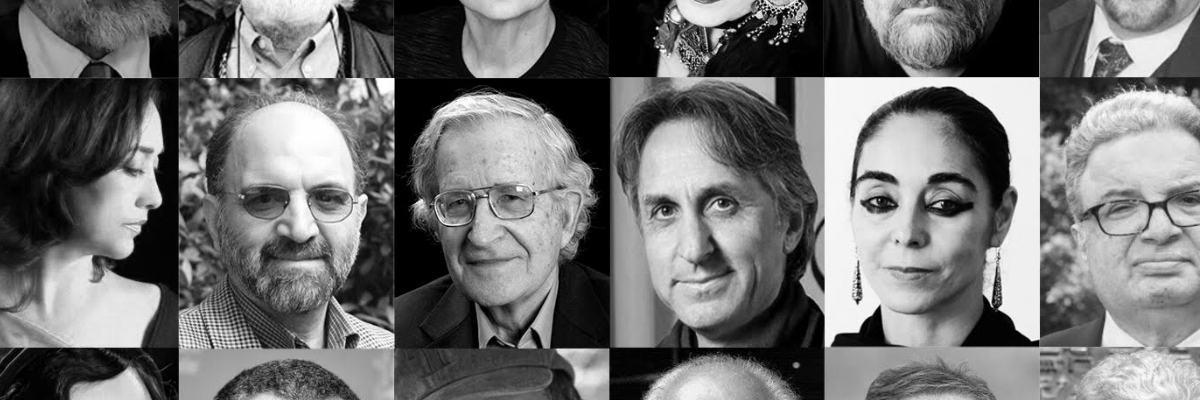
Over 150 figures have signed the letter so far, including some of the most prominent names in the humanities and social sciences, among them Judith Butler, Noam Chomsky, Peter Singer, Slavoj Žižek, Cornel West, and Talal Asad. Iranian scholars who have signed the letter include Hamid Dabashi and Ervand Abrahamian. Other signatories include Iranian actress Taraneh Alidoosti and artist Shirin Neshat.
The letter, hosted online and addressed to European Union High Representative Federica Mogherini, applauds the “‘universal language’ of respect and dialogue” she employed in her May 8 speech responding to Trump’s aborgation of the deal. Mogherini insisted that Europe was committed not to “let anyone dismantle this agreement.” Drawing on this sentiment, the letter declares that “failure is not an option” in this “age of extremes” as Europe seeks to protect the credibility of diplomacy and the durability of peace.
One of the creators of the open letter, Eskandar Sadeghi-Boroujerdi, is a postdoctoral research fellow at the University of Oxford. Sadeghi-Boroujerdi sought to unify the voices of people who “possess considerable intellectual and ethical weight and who can influence public opinion.” He sees the threat to a nuclear deal as “deeply concerning” foremost because the deal represented a “promise to the Iranian people” that risks being broken.
Notably, the body of the letter focuses on the “heartfelt support for this hard-won diplomatic accord” demonstrated by the majority of the Iranian people, as shown through “their two-time election of a president promising to initiate constructive dialogue with the world.” The betrayal of this popular support is to be most acutely felt as the Trump administration prepares to reimpose sanctions, “a form of economic warfare which inevitability impact the health, wealth and personal security of ordinary Iranians,” explains Sadeghi-Boroujerdi.
The open letter once again highlights the broad international support for the nuclear deal and follows a similar campaign from April in which saw 500 lawmakers from Germany, France and Britain sign an open letter imploring U.S. congressional leaders to support the JCPOA.
Photo Credit: Open Letter
Trump's Unequivocal Iran Deal Withdrawal Was the Best Outcome for Iran
◢ President Trump has violated the Joint Comprehensive Plan of Action and withdrawn from a landmark arms control agreement that enjoyed broad international support. Crucially, he did so more decisively than many expected. It is this decisiveness which may offer a sliver lining for Iran and Europe, who will find it easier to coordinate a robust response in the face of such a definitive action by Trump.
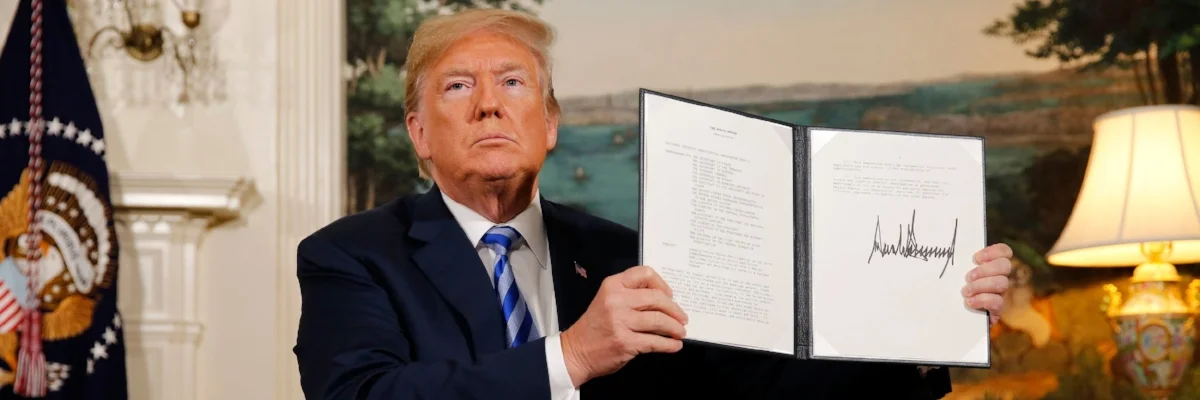
President Trump has violated the Joint Comprehensive Plan of Action and withdrawn from a landmark arms control agreement that enjoyed broad international support. Crucially, he did so more decisively than many expected. In his televised announcement on Tuesday, Trump clearly relished the opportunity to follow through on his campaign promise to “rip up” the Iran nuclear deal, declaring, “The United States no longer makes empty threats. When I make promises, I keep them.”
There is no doubt that the JCPOA is in jeopardy. But the deal has been in jeopardy for a long time. New polling data from IranPoll, drawing on a nationally representative survey of Iranians conducted between April 13-17 and released on May 8 at a Bourse & Bazaar round table in Stockholm, illustrates this point. When asked how confident they are that the “United States will live up to its obligations toward the nuclear agreement,” a resounding 92 percent of Iranians indicated that they lacked confidence, up dramatically from 41 percent in September 2015. Iranians consider U.S. violations of the deal to have been indisputable, even prior to today’s announcement.
The real question is whether the decisiveness with which Trump discarded three months of negotiations with the E3 on a “fix” to the Iran deal will change political perceptions in Europe. European leaders may have be tempted to latch onto any ambiguity in the extent of the U.S. withdrawal, for example had Trump pursued the reapplication of sanctions without immediate enforcement. Over the last few months, France, Germany, and the United Kingdom have proven reluctant to take a robust stance vis-a-vis the United States’ unilateral demands for the renegotiation of the JCPOA. Unsurprisingly, the E3 negotiating strategy was lambasted as one of “appeasement” by Tehran.
The significant and very public investment of political capital in trying to convince Trump to remain in the deal, which saw Macron and Merkel make visits to Washington, as well as British foreign secretary Boris Johnson, meant that an admission of defeat would always have been unlikely. Had Trump taken a more muddled stance on the future of the United States as a party to the nuclear deal, it is not difficult to image that the E3 would have “welcomed” certain aspects of Trump’s relevant announcement.
But there was no muddling on Tuesday. As per the White House statement, Trump “has directed his Administration to immediately begin the process of re-imposing sanctions related to the JCPOA” with the aim of targeting “critical sectors of Iran’s economy, such as its energy, petrochemical, and financial sectors.” The implementation memo shared with the Secretary of State, Secretary of Treasury, and other key actors within the executive branch makes the detail of the impending actions even more clear.
Responding to Trump’s bold move, the joint statement from Macron, Merkel, and May calls for “the US to ensure that the structures of the JCPOA can remain intact, and to avoid taking action which obstructs its full implementation by all other parties to the deal.” Moreover, the statement declares that the E3 will “remain committed to ensuring the agreement is upheld, and will work with all the remaining parties to the deal to ensure this remains the case including through ensuring the continuing economic benefits to the Iranian people that are linked to the agreement.”
The statement from European Union High Representative Federica Mogherini further declares the importance of protecting trade and investment, stressing that “The lifting of nuclear related sanctions is an essential part of the agreement” and “that the lifting of nuclear related sanctions has not only a positive impact on trade and economic relations with Iran, but also and mainly crucial benefits for the Iranian people. The European Union is fully committed to ensuring that this continues to be delivered on.”
Bold statements beget bold statements and European governments are growing increasingly confident in signaling their willingness to protect channels for trade and investment with Iran. However, signaling will need to be followed-up by action. Again, the decisiveness of Trump’s move on Tuesday will probably help ensure that practical measures are pursued in earnest.
The clear failure of the E3 negotiating strategy will likely see the mantle of leadership on Europe-Iran relations return to Mogherini and the European External Action Service. This will happen first and foremost with the convening of the Joint Commission of the JCPOA which is expected in the coming week. Mogherini’s position draws on the foreign policy consensus of the EU’s 28 member state governments. With the policy debate once again expanded to this wider group, the input of the governments of Sweden, Austria, Italy, and the Netherlands, among other countries, will become more influential as Europe seeks to preserve the JCPOA’s economic benefits and keep Iran in the deal. Importantly, these smaller member states are those which have made the most progress in devising special financial vehicles, concluding export credit agreements, and encouraging banks to engage in the Iranian market in adverse conditions. In short, Trump’s rebuke of the E3 can restore the mantle of JCPOA engagement to the wider EU—an outcome that is good for Iran.
Moreover, in taking itself out of the deal, the Trump administration may have actually limited the damage it can do to the legal environment for trade and investment in Iran. Administration officials have confirmed that the United States will not pursue the snapback of UN sanctions lifted as part of United Nations Security Council resolution 2231, which enshrined the JCPOA in international law. As the United States is out of the deal, they no longer have the right to trigger such a vote as per Article 37 of the JCPOA. So while the White House has announced a full snapback of U.S. primary and secondary sanctions eased under the nuclear deal, European and Iranian commercial actors can take some comfort that EU and UN sanctions will not snapback (so long as Iran continues to abide by its commitments under the deal).
Finally, and perhaps most importantly, the nature of Trump’s withdrawal will impact public opinion in Iran. For President Rouhani, there will be great pressure to retaliate in order to prove that Iran cannot be bullied by the United States. This pressure is coming not just from hardliners, but from the general public as well.
When asked whether Iran should “retaliate” or “continue to live by the JCPOA” in the event that “the United States takes measures against Iran that are in violation of the JCPOA agreement,” 67 percent of Iranians believe that Iran should retaliate. Just 31 percent believe that Iran should stick with its commitments under the deal. The proportion of Iranians calling for retaliation has risen 8 percent in the past three months, which corresponds precisely to the period in which the E3 launched its attempt to fix the deal by placating Trump. The political consequences of that strategy are starkly exhibited in the new polling.
Yet, the undeniably aggressive nature of Trump’s move may actually serve to inspire Iranians to choose resilience over retaliation. Resilience is what has made Iran one of the world’s twenty largest economies despite enduring both a decade of war and a decade of sanctions in just the last forty years. In his address to the nation, Rouhani described Trump's decision as "an act of psychological warfare against Iran.” The Iranian response to this psychological warfare will be determined following consultations with the remaining parties in the JCPOA. If the Rouhani administration can credibly demonstrate to the public that there is a plan for principled defiance, and if that plan includes clear commitments from Europe to protect Iran’s economic prospects, it remains possible for Iran to remain in the deal. If this can be achieved, following such a direct attempt by Trump to kill the deal, Iran will reassert its strength in a remarkable way. Cooperative resilience, not retaliation, must prevail. Defying Trump must be the rallying cry.
Photo Credit: REX/Shutterstock