
Iran's Rouhani Ousts Industry Minister Seen as Disloyal and Doomed
When industry minister Reza Rahmani sat down for a meeting with Iranian Vice President Eshaq Jahangiri on Monday, he did not know that he was about to be sacked.
When Iran’s industry minister, Reza Rahmani, sat down for a meeting with Iranian Vice President Eshaq Jahangiri on Monday, he did not know that he was about to be fired.
Rahmani was accompanied to the meeting by his deputy Hossein Modarres Khiabani, who would soon be named as his interim replacement.
After the axe came down, Rahmani wrote an open letter to President Hassan Rouhani in which he claims his dismissal was part of “a political plot.”
“Despite enemies’ plots, and in line with the Supreme Leader’s wishes, I have been able to boost production while sustaining the supply of essential goods. I am proud [of my record]. I am surprised that I am being ousted for political reasons alone,” Rahmani writes.
In the letter, Rahmani also claims Rouhani’s that chief of staff, Mahmoud Vaezi, strong-armed him to get a government-sponsored bill passed. The bill, which was shot down by parliament on Sunday, would have paved the way for the re-establishment of the Ministry of Trade which was dissolved and merged with Ministry of Industry and Mine in 2011.
Rahmani writes, “Mr. Vaezi threatened that if the bill does not pass, I would be sacked. He also told me that I must lobby MPs and whip the vote. I responded that the parliament is not controlled by me, but I don’t oppose the bill.” Rahmani, a three-term parliamentary representative, was believed to hold sway over many of his former colleagues, especially MPs of Azeri heritage.
In response to the letter, Vaezi’s office released a blistering statement accusing Rahmani of twisting facts to put his conduct in a better light. In a deliberate turn of phrase, the statement condemns Rahmani’s letter as tailored “to mislead the people and disturb public opinion,” an act that is a crime under Iran’s Islamic Penal Code. While the Rouhani administration is unlikely to press charges against a former minister, the statement was clearly intended to intimidate.
In response to Rahmani’s accusations, the statement claimed that the former minister “was not requested to support the government-sponsored bill but to put an end to his three confidants lobbying efforts against the bill—the three individuals' names will be released if need be. [Rahmani] was warned by the president that his continued conduct was unacceptable and that such conduct would be dealt with decisively.”
The Wrong Man
Despite his sudden ouster, many in the business community had not expected Rahmani to last in the role of industry minister. Hamid Reza Salehi, secretary general of the Energy Commission of the Iran Chamber of Commerce explained that many pitfalls face Iran’s industry minister.
“Over the years, without an exception, every politician appointed as industry minister has faced the gargantuan task of regulating and facilitating the growth of varying and at times conflicting business sectors. With the US maximum pressure campaign squeezing Iran’s economy, the burden has become heavier,” he said.
In October 2018, during the lead-up to his confirmation hearings, Rahmani met with chambers of commerce and other industries bodies to garner the support of the business community. Salehi noted, “From the first day after Rahmani’s appointment, everyone knew he was the wrong man for the job.”
Like most Iranian business leaders engaged in foreign trade, Salehi is critical of the ministry’s overwhelming focusing on industrial development, at the expense of support for trade promotion. The challenges facing Iran’s economy go beyond government officials finding themselves out of their depths. “Iran’s economy is afflicted with fundamental challenges: heavy-handed government interventionism, state interference with the natural supply and demand equilibrium, rent-seeking practices, and inherent corruption,” Salehi observed.
He added, “Iranian authorities still believe they can sell oil and distribute the proceeds. They simply do not adhere to market-economy principles or believe any good would come out of them. Anyone put at the helm of that ministry would have to grapple with all these misconceptions and hurdles. Replacing the minister will just lead to another media circus, nothing more.”
Salehi believes that the 2011 merger of the ministries of industry and trade “could have been a good move” that would have helped reduce the size of government. “Many countries have taken similar steps over the years. But since the merger, different administrations have failed to find someone to properly lead the ministry.”
Salehi is skeptical that the government’s plan to establish a new trade ministry, which would essentially reserve the 2011 merger, is well-considered. “If you were to tell me that a new ministry is to be established that will focus on streamlining exports, I would support that. But if the government motion solely intends to reverse the merger, I oppose it. I don’t support decisions that are only intended to reverse change. Fundamental issues need to be addressed and that would not happen even with the establishment of a dozen new ministries.”
Mehdi Zahedi Avval, who is the CEO a trading company active in the export of food products, agrees with Salehi that Rahmani was not up to the role of industry minister.
“Rahmani did not have the mettle for the job. President Rouhani tapped him because he had extensive ties to the parliament and, in theory, could have whipped the vote for government-sponsored bills. We all now know how that ended for the president,” he said. Zahedi notes that Rahmani had been tapped for the role of minister by his predecessor Mohammad Shariatmadari, who was similarly pushed out of the role despite his former position as the head of SETAD, the holding company affiliated with the office of Iran’s Supreme Leader.
Zahedi supports the re-establishment of the trade ministry. “Merging the ministries was a mistake. A single government agency can’t be in charge of regulating industry and trade simultaneously. On many occasions, these two sectors have conflicting interests.” Having separate ministries which could voice their demands on behalf of their respective interest groups who “would help create a transparent equilibrium,” Zahedi said. “But now all decisions are made behind closed doors.”
The reestablishment of the Ministry of Trade has been debated on numerous occasions by members of the Tehran Chamber of Commerce, according to member Farhad Ehteshamzad, an Iranian industrialist and the former head of the Iran Auto Importers Association.
“After the two ministries of trade and industries were merged in 2011, no structural reform was implemented. The departments and offices of the two ministries are now operating under a single minister’s watch,” Ehteshamzad said.
Moretza Miri, a board member of Iran’s influential Carpet Manufacturers and Exporters Association, also pointed to the failures of the 2011 merger. “After the merger was implemented only 403 employees were laid off. All the assets of the dissolved ministry including all of the buildings, are now owned by the Ministry of Industry, Mine and Trade. How does that translate into cutting government down to size?”
The Trade Taboo
Rahmani and his allies deny the Rouhani administration’s narrative that he was lobbying against the bill to establish a trade ministry. However, many lend credence to the narrative coming out of the presidential palace.
“Rahmani knew that re-establishment of the commerce ministry would limit his powers. Coming face to face with that fact, he started lobbying MPs to kill the bill. A government minister standing against a government-sponsored bill; it is no surprise that Rouhani sacked him so quickly,” said Miri.
Uncharacteristically for Iranian bureaucratic correspondence, the letter in which Rouhani named Khiabani as the caretaker minister made no mention of Rahmani. Such letters are usually offer lavish praise for the outgoing official, even when they have been fired.
Miri is hopeful that Rahmani’s replacement will prioritize trade at a time when Iran needs to further diversity exports to make up for the collapse in oil revenues. “I have directly worked with Rahmani’s replacement. Khiabani is hardworking and has had a focus on non-oil exports. That will be a plus.”
But not everyone is so encouraged. Nasim Tavakol, who runs an e-commerce business specializing in imported electronics, is worried Khaiabani lacks the necessary experience. “Does Khiabani have any solid experience in trade and industry? He has been a board member of a few state-owned companies. And what these board members do? They attend meetings that revolve around sharing a cup of tea and having some snacks. In my book that’s zero experience in business and trade,” she said.
Speaking of the ousted minister, Tavakol said, “In his letter, Rahmani claims that he supported businesses. What he did was not ‘supporting businesses’. He helped rent-seekers line their pockets while his hasty decisions disrupted legitimate businesses.”
Tavakol believes that despite his poor performance Rahami avoided impeachment due to support from key allies in parliament, including reformist MP Masoud Pezeshkian. Reportedly, the same allies helped kill the trade ministry bill. Pezeshkian and his office were not available for comment.
Tavakol had expected the trade ministry bill to fail, “The decision-making processes are utterly politicized in Iran. And the parliament wouldn’t ratify a major motion put forward by Rouhani administration.”
The debate over the creation of a trade ministry has also been politicized due to fears that its creation would lead to increased reliance on imports and capital flight. Tavakol explained that imports have become “taboo” in Iran. “Most MPs would think twice before supporting such a bill.”
So far, just six MPs have reacted publicly to Rahmani’s ouster. Outspoken reformist MP Mahmoud Sadeghi tweeted obtusely, “One of the problems of Rouhani admin has been lack of coordination between different ministries; one lobbies in favor of a bill, another against it.”
Ahmad Amirabadi, a former IRGC officer and conservative MP representing Qom, voiced his support of Rahmani, writing on Twitter,“Dear people, you need to know that Mr. Rouhani did not sack Mr. Rahmani over your problems or car prices. Rahmani was warned that he must resign if the Majlis does not vote in favor of the trade ministry (read: ministry of imports and rent-seeking). He declined to resign and was sacked.”
Conservative MP Abdollah Razian has so far been the only politician to have actuallly defended Rahmani’s record. “Considering the current conditions, Rahmani’s conduct was proper,” he stated in an interview with the parliamentary news agency, ICANA.
Yet, while Abdollah Razian claimed that the industry minister did not take a stance against the bill to reestablish a separate trade ministry, he conceded that Rahmani “did not do anything to get it passed.”
Rahmani failed to whip, so he got the axe.
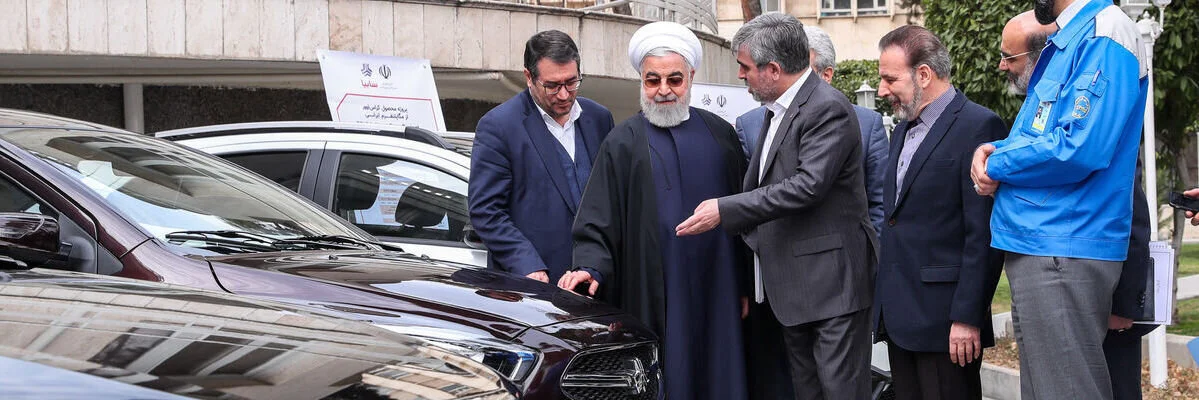
Photo: IRNA
Iran's Automakers Need a Rescue, But Face a Reckoning
Iran’s giant automakers, Iran Khodro and Saipa, are in a tug of war with the Rouhani administration over demands to lift price controls. The state-owned firms are seeking to increase prices by 40 percent.
Iran’s giant automakers, Iran Khodro and Saipa, are in a tug of war with the Rouhani administration over demands to lift price controls. The state-owned firms are seeking to increase prices by 40 percent.
Executives in Iran’s automotive industry, which counts among the country’s largest employers and includes both state-owned and private sector enterprises, argue that rising inflation and the increased cost of parts and raw materials justify increasing automobile prices, which have long been subject to controls. Rising inflation in Iran has been spurred by the depreciation of the rial, first triggered by the reimposition of secondary sanctions by the administration of U.S. President Donald Trump.
The final say on any price increase lies with the Market Regulation Authority of Iran’s industry ministry. A meeting of the authority on May 4 led to a disappointing outcome for the automakers, as the authority’s board gave preliminary approval to a price increase of just 5 percent.
Despite the outcome, market regulators appear increasingly sympathetic to the demands of automakers and further deliberations are planned. The deputy minister who chaired the meeting, Hossein Modarres Khiabani, acknowledged the challenges facing Iran’s automotive sector, stating “For 15 months, the price controls have remained unchanged while many of the production costs have jumped during the period in question.” While carmakers have been unable to increase their prices, the price of automobiles on the secondary market has surged as inflation picked-up. The growing margin between the two prices has given license to many car dealers to engage in enormous profiteering.
However, regulators are reluctant to allow automakers to increase prices without demonstrating some new economic value. The 5 percent price increase preliminarily approved earlier this month is conditioned on a “70 percent improvement in efficiency,” although no detail was provided as to how improved efficiency is to be assessed.
For decades, the poor-quality of locally produced automobiles has been at the core of growing discontent among Iranian consumers with state-owned carmakers. Iran Khodro and Saipa are accused of exploiting an uncompetitive market, operating as a duopoly and disregarding customer satisfaction in order to produce cars with fewer features and worse build quality. Even Iran’s Supreme Leader appeared to acknowledge the lagging quality of domestic cars in a recent tweet.
Despite the role that the price controls have played in deepening losses, Iran Khodro and Saipa have also been repeatedly bailed out by administrations unwilling to swallow the political consequences of mass layoffs. Iranian carmakers, particular those that are state owned, benefit from unfettered access to financing and cheap foreign currency, despite a track record of contributing to the non-performing loan crisis at many Iranian banks and a reputation for corruption among senior management. By one estimate, Iran Khodro and Saipa have received over USD 4.7 billion in foreign currency at the subsidized government rate. With the Rouhani administration now facing an unprecedented fiscal crisis spurred by sanctions, low oil prices, and the COVID-19 crisis, observers of the automotive sector are wondering whether the state remains able to support the embattled auto industry.
Any prolonged shutdown at Iran Khodro or Sapia would hammer Iran’s many parts manufacturers, which constitute the backbone of the auto industry. These companies have already been squeezed as sanctions have made sourcing the foreign currency needed to pay for imported raw materials far more difficult. Parts manufacturers are also owed huge sums by the likes of Iran Khodro and Saipa, who use their dominance in the domestic market to bully suppliers.
But the increasingly dysfunctional supply chain is catching up to the automakers. A recent report from Donya-e-Eqtesad estimates that up to 50,000 cars remain unfinished, parked in storage yards, due to a lack of parts. Falling productivity in the automotive sector, which accounts for 4 percent of Iran’s gross domestic product, could have a significant impact on the wider economy. The negative outlook for the sector stands in stark contrast to the optimism that followed the implementation of the nuclear deal. In 2017, buoyed by the resumption of industrial cooperation and investment by European automakers such as France’s PSA Group, automobile production hit a record high of over 1.4 million vehicles.
The swift decline in output spurred by the reimposition of U.S. secondary sanctions the following year has only been accelerated by the global pandemic. In the period from March 21 to April 20, corresponding to the first month of the Iranian calendar year, Iran Khodro manufactured just 23,246 vehicles, registering a stunning 43 percent decline in production year-on-year. The automaker has discontinued production of seven models, which relied on imported complete knock-down kits, including the Peugeot 2008 SUV and the Suzuki Vitaras. Production at Saipa fell even further, registering a 56 percent decline year-on-year, with just over 9,000 cars produced in the same period. Part of this slowdown is attributable to measures being taken to reduce the risk of transmission of COVID-19 among assembly line workers. Nonetheless, the collapse in production and the controversies around price controls contributed to the ouster of industry minister Reza Rahmani earlier this week. Khiabani has been appointed as caretaker.
The Rouhani administration finds itself at a crossroads and the auto industry faces a reckoning. While regulators have been unwilling to increase the price of automobiles for fear of angering a public already facing diminishing purchasing power, the government cannot simply continue to rescue automakers that have failed to operate efficiently and transparently, selling their products into a profoundly dysfunctional market.
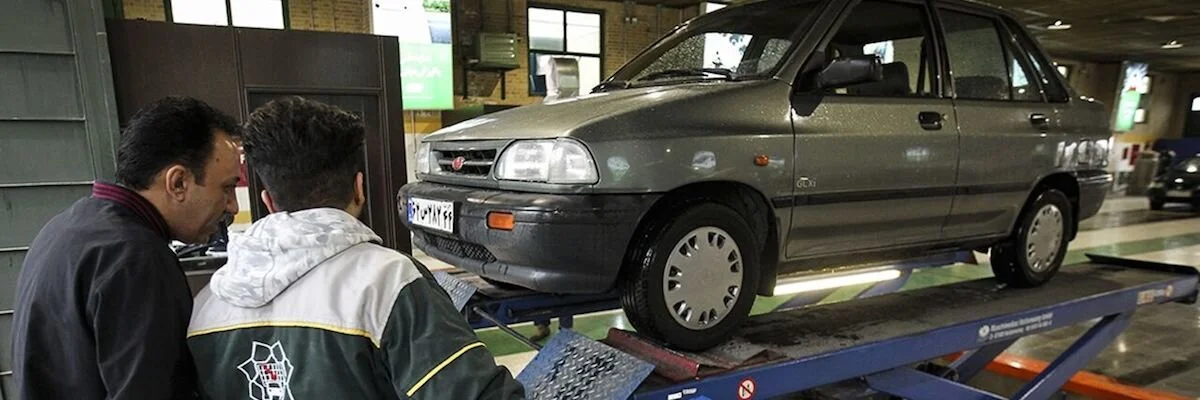
Photo: IRNA