
After Trump’s Iran Decision: Time for Europe to Step Up
◢ The E3 should now acknowledge that its negotiating tactic of accommodation and comprise with Trump has failed. If Europe is to have any influence forthcoming US policy on Iran, European governments should quickly shift tack, unifying behind a more assertive diplomatic strategy aimed at deterring the worst-case scenario of renewed Iranian nuclear program and more instability and violence in a region close to its borders.
This article was originally published on the website of the European Council on Foreign Relations.
Despite months of E3-US negotiations to avert an unnecessary crisis over the Iran nuclear deal, President Trump has declared a hard exit from the nuclear agreement. The decision demonstrates that the US has decided that confrontation with Iran is both necessary and inevitable, regardless of what European allies think. The US administration looks set to increase tensions with Tehran and promote an implosion of Iran’s economy in ways that significantly increase risks of greater military escalation in the Middle East. Moreover, in the coming weeks, United States looks set to lead an economic and political assault on European interests.
The E3 should now acknowledge that its negotiating tactic of accommodation and comprise with Trump has failed. If Europe is to have any influence forthcoming US policy on Iran, European governments should quickly shift tack, unifying behind a more assertive diplomatic strategy aimed at deterring the worst-case scenario of renewed Iranian nuclear program and more instability and violence in a region close to its borders.
European governments are clearly tempted to think that the delays in implementation of sanctions mean they still have time to persuade the US president to reverse course. But the US president has acted on his promise to fully withdraw from the deal. He is now supported in that view by key advisors who have long advocated a forceful stand against Iran, not just on the nuclear deal but also in terms of encouraging regime change in Iran. It should now be abundantly clear that the current US administration cannot be a partner in salvaging the deal.
In this context the EU and its member states should now prioritize the following action points:
- European leaders should use the forthcoming May 17 European Council meeting in Sofia to publicly and unanimously condemn the U.S. decision to withdraw from a multilateral global security arrangement and place the responsibility for any instability that results on the Trump administration.
- European leaders should reject further negotiation between the E3 and the US administration on a “broader framework” on Iran policy, including the prospect of further EU sanctions targeting Iran, until and unless the Trump administration makes significant adjustments to minimise the enforcement of US secondary sanctions targeting European companies doing business with Iran.
- European governments should prioritise measures aimed at maintaining Iranian adherence the deal. The E3/EU should meet with Iranian counterparts at foreign ministerial level to agree on contingency plans. European governments should make a case to the Iranian government and public as to why the deal can be sustained and continue to serve Iran’s interest. This should emphasise the immediate economic benefits of continued oil exports (which Europe must vow to maintain as an priority). In this effort to entice Iran, Europe should cooperate with Russia and China, the other parties to the nuclear deal.
- Europe’s approach should include the formulation of clear legal conditions for strategic sectors of trade with Iran aimed at protecting key European commercial deals seen as barometers of nuclear deal’s success and its ongoing survival (namely in the energy domain, aviation and automotive industries). The E3/EU should prioritise securing exemptions and waivers from enforcement of US secondary sanctions for European energy companies and related financial services to allow continued oil imports from and payments to Iran. Towards this end, EU member states should begin consultations regarding counter-measures against the United States. This should include political and legal threats that the EU will consider reviving the EU Blocking Regulation and even impose new penalties against assets of US companies based in Europe to allow for “claw-back” of unfair and illegal fines imposed on European companies doing business with Iran. European leaders should press this issue very hard with the Trump administration, making clear that this is a critical issue for the transatlantic relationship, as well as ongoing cooperation on regional issues in the Middle East.
- European governments should also look to find bridging solutions to maintain banking connections with Iran even if at far reduced levels, including by temporarily connecting respective central banks in EU member states to the Central Bank of Iran and creating emergency export credit lines. The EU EAS should accelerate coordination among leading member states, their export credit agencies and state-owned banks to devise novel banking mechanisms allowing a degree of risk-sharing between governments and the financial sector on business with Iran. This effort should aim to facilitate a pan-European approach towards creating special purpose vehicles to finance sector-specific trade and investment with Iran. The EU EEAS should also advance existing proposals for the European Investment Bank to become a lending bank for long-term and medium-sized investments inside Iran.
- It will now be more critical than ever for Europeans to maintain a dialogue with Iran on regional and ballistic missile issues, given that the US exit from the nuclear deal is already feeding wider regional escalation. This is particularly true given that the Trump administration is likely to work with its key regional allies to accompany the nuclear agreement withdrawal with a wider push against Iran. Germany, France, the UK and Italy should accelerate and formalise recently launched regional talks with Iran, including efforts to advance de-escalation possibilities between Iran and Israel in Syria where the situation is becoming increasingly febrile.
In the end, Europe may not be capable of salvaging the nuclear deal. But if the Europeans want to promote non-proliferation in the region and reduce regional instability, they need to demonstrate to the Americans, the Iranians and others that they are willing to try. Allowing the collapse of the nuclear deal without a proper fight will have immediate and disastrous consequences in the Middle East, while also significantly reducing European relevance on global security. Europe faces a critical and historic choice and must demonstrate its political will to advance its security interests through robust diplomacy.
Photo Credit: HR VP
Trump's Unequivocal Iran Deal Withdrawal Was the Best Outcome for Iran
◢ President Trump has violated the Joint Comprehensive Plan of Action and withdrawn from a landmark arms control agreement that enjoyed broad international support. Crucially, he did so more decisively than many expected. It is this decisiveness which may offer a sliver lining for Iran and Europe, who will find it easier to coordinate a robust response in the face of such a definitive action by Trump.
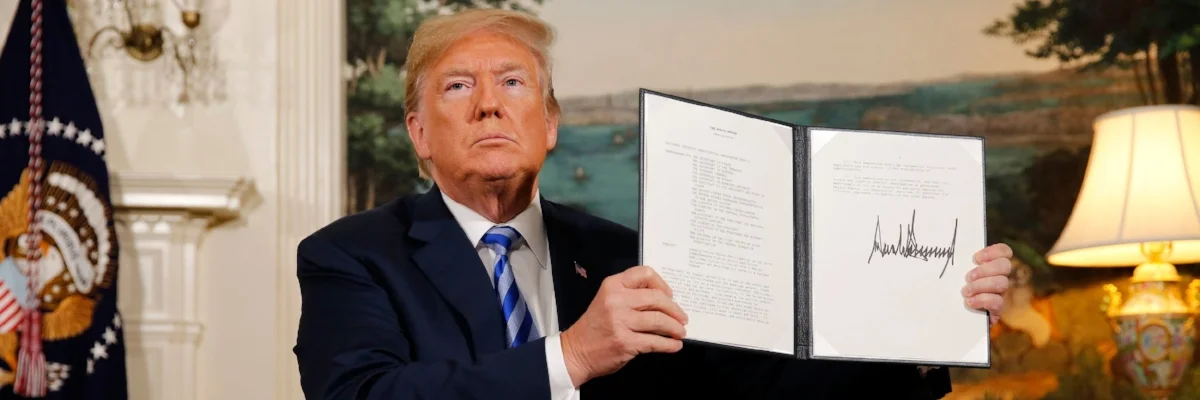
President Trump has violated the Joint Comprehensive Plan of Action and withdrawn from a landmark arms control agreement that enjoyed broad international support. Crucially, he did so more decisively than many expected. In his televised announcement on Tuesday, Trump clearly relished the opportunity to follow through on his campaign promise to “rip up” the Iran nuclear deal, declaring, “The United States no longer makes empty threats. When I make promises, I keep them.”
There is no doubt that the JCPOA is in jeopardy. But the deal has been in jeopardy for a long time. New polling data from IranPoll, drawing on a nationally representative survey of Iranians conducted between April 13-17 and released on May 8 at a Bourse & Bazaar round table in Stockholm, illustrates this point. When asked how confident they are that the “United States will live up to its obligations toward the nuclear agreement,” a resounding 92 percent of Iranians indicated that they lacked confidence, up dramatically from 41 percent in September 2015. Iranians consider U.S. violations of the deal to have been indisputable, even prior to today’s announcement.
The real question is whether the decisiveness with which Trump discarded three months of negotiations with the E3 on a “fix” to the Iran deal will change political perceptions in Europe. European leaders may have be tempted to latch onto any ambiguity in the extent of the U.S. withdrawal, for example had Trump pursued the reapplication of sanctions without immediate enforcement. Over the last few months, France, Germany, and the United Kingdom have proven reluctant to take a robust stance vis-a-vis the United States’ unilateral demands for the renegotiation of the JCPOA. Unsurprisingly, the E3 negotiating strategy was lambasted as one of “appeasement” by Tehran.
The significant and very public investment of political capital in trying to convince Trump to remain in the deal, which saw Macron and Merkel make visits to Washington, as well as British foreign secretary Boris Johnson, meant that an admission of defeat would always have been unlikely. Had Trump taken a more muddled stance on the future of the United States as a party to the nuclear deal, it is not difficult to image that the E3 would have “welcomed” certain aspects of Trump’s relevant announcement.
But there was no muddling on Tuesday. As per the White House statement, Trump “has directed his Administration to immediately begin the process of re-imposing sanctions related to the JCPOA” with the aim of targeting “critical sectors of Iran’s economy, such as its energy, petrochemical, and financial sectors.” The implementation memo shared with the Secretary of State, Secretary of Treasury, and other key actors within the executive branch makes the detail of the impending actions even more clear.
Responding to Trump’s bold move, the joint statement from Macron, Merkel, and May calls for “the US to ensure that the structures of the JCPOA can remain intact, and to avoid taking action which obstructs its full implementation by all other parties to the deal.” Moreover, the statement declares that the E3 will “remain committed to ensuring the agreement is upheld, and will work with all the remaining parties to the deal to ensure this remains the case including through ensuring the continuing economic benefits to the Iranian people that are linked to the agreement.”
The statement from European Union High Representative Federica Mogherini further declares the importance of protecting trade and investment, stressing that “The lifting of nuclear related sanctions is an essential part of the agreement” and “that the lifting of nuclear related sanctions has not only a positive impact on trade and economic relations with Iran, but also and mainly crucial benefits for the Iranian people. The European Union is fully committed to ensuring that this continues to be delivered on.”
Bold statements beget bold statements and European governments are growing increasingly confident in signaling their willingness to protect channels for trade and investment with Iran. However, signaling will need to be followed-up by action. Again, the decisiveness of Trump’s move on Tuesday will probably help ensure that practical measures are pursued in earnest.
The clear failure of the E3 negotiating strategy will likely see the mantle of leadership on Europe-Iran relations return to Mogherini and the European External Action Service. This will happen first and foremost with the convening of the Joint Commission of the JCPOA which is expected in the coming week. Mogherini’s position draws on the foreign policy consensus of the EU’s 28 member state governments. With the policy debate once again expanded to this wider group, the input of the governments of Sweden, Austria, Italy, and the Netherlands, among other countries, will become more influential as Europe seeks to preserve the JCPOA’s economic benefits and keep Iran in the deal. Importantly, these smaller member states are those which have made the most progress in devising special financial vehicles, concluding export credit agreements, and encouraging banks to engage in the Iranian market in adverse conditions. In short, Trump’s rebuke of the E3 can restore the mantle of JCPOA engagement to the wider EU—an outcome that is good for Iran.
Moreover, in taking itself out of the deal, the Trump administration may have actually limited the damage it can do to the legal environment for trade and investment in Iran. Administration officials have confirmed that the United States will not pursue the snapback of UN sanctions lifted as part of United Nations Security Council resolution 2231, which enshrined the JCPOA in international law. As the United States is out of the deal, they no longer have the right to trigger such a vote as per Article 37 of the JCPOA. So while the White House has announced a full snapback of U.S. primary and secondary sanctions eased under the nuclear deal, European and Iranian commercial actors can take some comfort that EU and UN sanctions will not snapback (so long as Iran continues to abide by its commitments under the deal).
Finally, and perhaps most importantly, the nature of Trump’s withdrawal will impact public opinion in Iran. For President Rouhani, there will be great pressure to retaliate in order to prove that Iran cannot be bullied by the United States. This pressure is coming not just from hardliners, but from the general public as well.
When asked whether Iran should “retaliate” or “continue to live by the JCPOA” in the event that “the United States takes measures against Iran that are in violation of the JCPOA agreement,” 67 percent of Iranians believe that Iran should retaliate. Just 31 percent believe that Iran should stick with its commitments under the deal. The proportion of Iranians calling for retaliation has risen 8 percent in the past three months, which corresponds precisely to the period in which the E3 launched its attempt to fix the deal by placating Trump. The political consequences of that strategy are starkly exhibited in the new polling.
Yet, the undeniably aggressive nature of Trump’s move may actually serve to inspire Iranians to choose resilience over retaliation. Resilience is what has made Iran one of the world’s twenty largest economies despite enduring both a decade of war and a decade of sanctions in just the last forty years. In his address to the nation, Rouhani described Trump's decision as "an act of psychological warfare against Iran.” The Iranian response to this psychological warfare will be determined following consultations with the remaining parties in the JCPOA. If the Rouhani administration can credibly demonstrate to the public that there is a plan for principled defiance, and if that plan includes clear commitments from Europe to protect Iran’s economic prospects, it remains possible for Iran to remain in the deal. If this can be achieved, following such a direct attempt by Trump to kill the deal, Iran will reassert its strength in a remarkable way. Cooperative resilience, not retaliation, must prevail. Defying Trump must be the rallying cry.
Photo Credit: REX/Shutterstock
Europe’s Balancing Act on the Nuclear Deal: Wooing Trump Without Losing Iran
◢ European leaders have been assiduous in lobbying Washington on the nuclear deal. But Europe must step up its diplomacy to ensure it does not lose Tehran in the process and should further make a strong case to the Iranian government and public as to why the nuclear deal can continue to serve Iran’s security and economic interest even without the US.
This piece was originally published on the website of the European Council on Foreign Relations.
For much of Iran’s political elite, and its overwhelmingly young population, the nuclear deal is becoming a story of failure. This situation risks impacting on Tehran’s willingness to engage politically and to reach diplomatic compromises with Western powers. Last week European leaders were in Washington for a last push to keep the United States on board ahead of the 12 May deadline for Donald Trump to issue waivers required under the nuclear deal. During his visit, Emmanuel Macron suggested that the US and Europe could work on a “new deal” with Iran – one which preserves but expands on the 2015 accord. But with Iran kept out of the European-US talks, Hassan Rouhani has questioned the legitimacy of proposals now put forward by Macron and Angela Merkel for Iran to negotiate further deals on its nuclear programme and regional issues. In the process of wooing Washington on this bigger and better deal, Europe must ensure it does not end up losing Tehran, whose buy-in will be essential to succeeding in this effort.
Iran's Rethink on Europe
Despite increasing pressures coming from Trump, Iran has continued to fulfil its part of the deal, as verified by the International Atomic Energy Agency 11 times since the deal was implemented in January 2016. Iran has waited to see what actions Trump would take and carefully assessed the ability and willingness of Europe to safeguard the nuclear deal. In October, Tehran sent out clear signals that it would consider sticking to the deal so long as Europe, China, and Russia could deliver a package that served Iran’s national security interests. But as talks between the US and the EU3 (Germany, France, and the United Kingdom) have stepped up over the last few months, Iranian thinking on European positioning has begun to sour.
Officials and experts from Iran, interviewed on condition of anonymity over the past month, outlined a growing perception inside Tehran that Europe is unable and/or unwilling to deliver on the nuclear agreement without the US. Even those who defend the nuclear deal inside the country are finding it difficult to continue to do so, not just because of Trump but also because of European tactics, which one Iranian official described as “appeasement by Europe to reward the violator of the deal and Iran’s expense”.
This perception has contributed to considerably hardened Iranian rhetoric in recent weeks around a possible US withdrawal. The secretary of Iran’s Supreme National Security Council (SNSC), which includes the most important decision-makers inside the country, warned that Iran may not only walk away from the nuclear deal, but also withdraw from the Non-Proliferation Treaty. Such public statements from senior figures signal that a rethink may be taking place over Iran’s foreign policy orientation and openness to engaging with the West. Decision-makers in Europe should be alert to the gravity of such political shifts.
Keeping Iran on Board
Iranian officials have repeatedly outlined that Iran will abide by the nuclear deal so long as the US does not violate the agreement. If Europe wants to keep Iran on board with the agreement in the scenario where Trump does not issue the sanctions waivers required, or to even sell a new European-US framework to Iran, it will need to shore up its fast-diminishing political capital with Tehran. While Macron’s hour-long call with Rouhani on Sunday was a good start, greater activity is urgently needed.
First, Europeans should seek to alleviate growing Iranian fears that the price of saving the deal will be a wider “pressure package”, one which returns their relations to the pre-2013 policy of isolation and sanctions. While the focus is understandably now on securing ongoing US support for the deal, the EU3 should not neglect the fact that any new framework agreed will require at least some Iranian buy-in to make it workable. In the current political climate in Iran, this is not a given.
As such, the EU3 should, as a unified coalition, work at the highest level with Iran’s foreign ministry to shore up confidence regarding the nuclear deal. In advance of the 12 May deadline, if it looks increasingly likely that Trump will not waive sanctions, the newly appointed German foreign minister should follow up on Macron’s call to Rouhani with a visit to Tehran to meet with their Iranian counterpart and consider contingencies (some measures for which are outlined below).
Second, EU member states should delay the prospect of new sanctions targeting Iranian regional behaviour, at least until firmer guarantees are in place regarding Trump’s decision on the nuclear deal. The timing of such sanctions has reportedly been the topic of heated debate among the 28 member states. At a minimum, the countries supporting such measures should step up their public messaging to communicate the reasons and the targeted nature of new sanctions, including a commitment that these are not the start of more far-reaching sanctions that will hurt the wider Iranian economy. This is particularly the case with Iran’s private sector, which constantly meets new hurdles placed in its way when seeking to do business with Europe.
Third, European governments should double down on efforts to maintain Iranian compliance to the nuclear deal if Trump fails to renew waivers due on 12 May. Such action by the White House would result in the snap-back of US secondary sanctions and are likely to be viewed in Tehran as significant non-performance of the nuclear deal. Europe will need to coordinate with Russia and China to persuade Iran to continue adhering to its nuclear obligations, at least for a period of time. The exhaustion of the dispute resolution mechanism under the nuclear deal can buy time (estimated to be between 2-3 months) for contingency planning while allowing Iran to save face.
In this scenario, European governments will need to convince the US that it will be in their mutual interest to agree on an amicable separation on the nuclear deal. Europeans will need to argue that such a settlement would allow Trump to claim victory with his base for withdrawing US participation in the JCPOA, while avoiding deeper damage to transatlantic relations and possibly maintaining Europe’s quiet compliance on regional issues. This path should also allow the US to reverse its course (Europeans should continue to encourage such a reversal, whatever the 12 May decision).
As part of this contingency plan, to keep Iran on board Europeans will need to offer some degree of economic relief. It will be critical to reach a pan-European deal with the Trump administration to limit the extent to which the US secondary sanctions that may snap back are actually enforced by US regulators. This should include a series of exemptions and carve-outs for European companies already involved in strategic areas of trade and investment with Iran, with the priority being to limit the immediate shock to Iranian oil exports.
European governments should further make a strong case to the Iranian government and public as to why the nuclear deal can continue to serve Iran’s security and economic interest even without the US. They should emphasize the immediate economic benefits of continued oil exports to Europe and possible longer-term commitments for investments in the country. Sustained political rapprochement between Europe and Iran could also influence Asian countries that closely watch European actions (such as Japan, South Korea, and India) to retain economic ties with Iran.
Finally, regardless of the fate of the nuclear deal, Europe should keep the pathway open for regional talks with Iran. Germany, France, the UK, and Italy should establish and formalize a regular high-level regional dialogue with Iran that builds on those held in February in Munich. It is a positive sign that a second round of such talks is reportedly due to be held this month in Rome. Such engagement will become even more important if the US withdraws from the nuclear deal, increasing the risk of regional military escalation that is already surfacing between Israel and Iran in Syria. Europeans should focus these talks on damage limitation and de-escalation in both Yemen and Syria, to help create an Israeli-Iranian and Saudi-Iranian modus vivendi in both conflict theaters (something which the US seems uninterested in).
Ultimately, Iran’s willingness to implement any follow-up measures on regional issues will be heavily influenced by the fate of the nuclear deal and how the fallout over Trump’s actions is managed. Europe may well not be capable of salvaging the deal if the US withdraws from or violates it. But Europe must at least attempt to do so and demonstrate its political willingness through actions that serve as a precedent for the international community. To do otherwise is likely to have an immediate and consequential impact on Iranian foreign policy and significantly reduce Europe’s relevance for the Iranian political establishment. For Iran’s youth, as the largest population bloc in the country, this will be an important experience in how far Europe is willing to go in delivering on its promises to defend the nuclear deal, whose collapse would affect the Iranian psyche and domestic political discourse for years to come.
Photo Credit: Wikicommons
Macron and Merkel Must Flex Muscles to Save Iran Nuclear Deal
◢ The forthcoming visits to Washington by French President Emmanuel Macron and German Chancellor Angela Merkel come at a time of great importance for the Iran nuclear deal, regional security, and transatlantic relations. European policymakers are considering credible ways to signal that the EU is willing to take action if confronted with U.S. withdrawal from the deal, but a significant resolve will be needed.
This article is adapted from a recent report from the European Leadership Network.
The fate of the international nuclear agreement with Iran, known as the Joint Comprehensive Plan of Action (JCPOA), looks increasingly uncertain in light of repeated attacks from U.S. President Donald Trump, who has threatened to walk out of the deal unless Congress and European counterparts agree to “fix it.” The recent appointments of Mike Pompeo and John Bolton—both vocal critics of the JCPOA and widely seen as staunch hawks on Iran—make it less likely that Trump will keep the United States in the deal at his next decision point by 12 May. Faced now with the likelihood of U.S. withdrawal, Europe must decide how far to go to try to preserve the agreement in the face of renewed U.S. sanctions.
Against this backdrop, the forthcoming visits to Washington by French President Emmanuel Macron and German Chancellor Angela Markel come at a time of great importance for the nuclear agreement, regional security, and transatlantic relations. Macron’s meeting with Trump will be of particular significance, given the good rapport between the two leaders. Syria will likely feature at the top of the agenda, but the visit will offer an urgent opportunity to remind President Trump of the importance of the nuclear deal for his European allies.
U.S. decision makers can still be influenced. Washington’s position on the nuclear deal is far from monolithic and it is still possible that President Trump could be influenced by congressional opinion, which remains sensitive to European concerns. There is no congressional majority for a unilateral U.S. withdrawal from the JCPOA while Iran remains compliant, still less for the re-imposing secondary nuclear-related sanctions on European allies. Even if the United States decides to leave, some main provisions of the deal might still be kept.
This leaves plenty of scope for European intervention. Representatives of the European signatories of the JCPOA, the so-called E3 (Germany, France, and the United Kingdom), are currently engaged in consultations with their U.S. counterparts to save the agreement. This includes discussions on how to accommodate President Trump’s concerns over the deal’s inspection provisions and “sunset clauses,” as well as over Iran’s missile programs and regional activities. But European leaders are also making clear that they will not just fall into line if Washington decides to leave the agreement and re-introduce sanctions.
A re-introduction of sanctions does not necessarily equate to a full re-introduction of all U.S. sanctions without exemptions. American policymakers can calibrate the sanctions they choose to re-instate and the executive powers of the president in matters of national security add to this flexibility. This means that there is plenty for Europeans to negotiate for with their U.S. counterparts about the terms of any U.S. withdrawal. It is possible to envision a transatlantic quid pro quo in which U.S. secondary sanctions are waived even if the United States leaves the agreement.
The risks of a U.S. withdrawal and a comprehensive snap back and enforcement of secondary are nonetheless tangible. As a result, European policymakers are considering credible ways to signal that the EU is willing to take action if confronted with this scenario. This includes reviving EU “blocking regulation” (which seeks to prohibit EU persons from complying with U.S. secondary sanctions or acknowledging the jurisdiction of non-EU courts or authorities with respect to those sanctions) and filing complaints at the World Trade Organization (WTO).
There are significant and inherent risks with these options. These retaliatory measures could easily escalate into an unpredictable and unmanageable tit-for-tat. This would not only impose significant costs on the EU and cause serious friction in the transatlantic relationship but also do damage to the institutions that uphold the free movement of goods, services, and ideas – bedrocks of the multilateralism the EU cherishes. After all, pushing back against the United States requires political will. And while there is undivided support for the JCPOA within the EU, there is little appetite for further confrontations with the United States.
Notably, this could change if Washington is seen as taking further steps to undermine transatlantic relations and European interests. An already fractured partnership is sensitive to further blows – for instance if the United States would go ahead and impose tariffs on European exports after the temporary exemptions on EU steel and aluminum exports expire on May 1.
The wider international context in May is therefore going to matter a great deal for the fate of the JCPOA. So too will the way that the Europeans choose to frame their differences with Washington over the deal. A choice between the JCPOA and good relations with Washington is one thing; the ability of the EU to maintain its security, its autonomy and the values it thinks should define the international order is quite another. The latter would merit a tougher stance.
Still, an inconvenient truth remains—no EU action can completely shield European businesses and investments in Iran. In this sense, there is no bulletproof defense of the JCPOA’s economic benefits in the event of a U.S. withdrawal. The EU and its member states can pursue measures to shield existing links, encourage further business activity and boost investors’ confidence in the Iranian market, but while government can facilitate business, it cannot control it.
Consider the lingering caution of financial institutions despite sanctions relaxation under the JCPOA, which is a sobering reminder of the challenge of steering the private sector through Iranian market obstacles. As the chief legal officer at HSBC noted in response to the Obama administration’s push to encourage European banking activity in Iran, “Governments can lift sanctions, but the private sector is still responsible for managing its own risk and no doubt will be held accountable if it falls short.” In light of the current uncertainty surrounding President Trump’s policy towards Iran, private sector actors will have plenty of reasons to be wary of the Iranian market. This will continue to restrict investment for the foreseeable future.
As a result of struggles with financing, major businesses are canceling or scaling back their planned activities in Iran. Airbus is struggling to complete its sales of Aircraft to Iran; Total, the French energy giant, is deep into contingency planning for its Iranian operations; and Bouguyes, a French industrial group, has decided to put their Iranian plans on the shelf. As noted in a recent Bourse & Bazaar study, this risks dragging the JCPOA into a “zombie state.”
Europe nevertheless has realistic options in the face of a U.S. withdrawal. There is a strong commercial interest in engaging with Iran, and European policymakers can promote policies that help turn interest into action. They need not—indeed, should not—put all their eggs in one basket but should pursue an array of options in parallel. This includes solidifying international support for the JCPOA, demonstrating that re-imposing sanctions unilaterally will come at a cost for the United States, seeking U.S. exemptions for European businesses to continue operating in Iran, and bolstering international business confidence in the Iranian market. Such practical steps, taken now, can bolster European negotiating leverage with Washington, send useful signals to Tehran and strengthen European political will to defend the JCPOA.
Photo Credit: Armando Babani/EPA