

In Iran, ‘Ordinary Women’ Lead an Extraordinary Movement
One year has passed since the tragic death of Mahsa (Jina) Amini in police custody and the start of the Woman, Life, Freedom movement, which has induced cultural transformations within society and families in Iran.
One year has passed since the tragic death of Mahsa (Jina) Amini in police custody, the event that ignited the Woman, Life, Freedom movement. This movement has provided a platform for acknowledging the enduring struggles of ordinary women in Iran, a battle that had been ongoing long before September 16, 2022. By “ordinary women,” I refer to individuals outside the elite and activist spectrum, adapting from sociologist Asef Bayat’s definition of “ordinary people” in his book Revolutionary Life. The struggles of ordinary women in Iran were often ignored or sidelined until last year. While I respect the efforts of all women’s rights activists dedicated to improving women’s rights in Iran, I believe the “Mahsa movement” stands on the shoulders of ordinary women, many of whom may not belong to the middle class or possess feminist knowledge, but who are undeniably fighting for the freedom to lead ordinary lives.
The Woman, Life, Freedom movement has induced cultural transformations within society and families in Iran. Many parents who previously advised their daughters to accept the mandatory hijab as a “minor issue” have now thrown their support behind their daughters’ quest for freedom of choice. The presence of women with uncovered hair has become more widely accepted. Women feel safer going out without the hijab. As one woman told me, “before the Woman, Life, Freedom movement, when I went out without hijab, I felt I was breaking social norms and that I was doing something weird in the eyes of society. But now I feel safe and know if somebody scolds me about the hijab, other people in the streets will come to protect me.’’ These cultural changes in the Iranian society are not limited to the hijab issue. The status of women within families has largely changed, and more women are gaining autonomy.
One of the most intriguing aspects of the Mahsa movement is the newfound overt support from men. Women have historically borne the brunt of struggles against a patriarchal society and state, but the Mahsa movement marks a turning point where men have joined in supporting women’s causes. Whether this support will extend to other women’s issues, such as unequal inheritance and divorce laws, remains to be seen.
The Woman, Life, Freedom movement has also significantly transformed the subjectivity of ordinary women. It has united women with shared experiences and pain, reminding them that they are not alone. While there have always been small support networks among women, this movement has elevated this solidarity to a national (and international) scale. In one instance, I saw a police officer who wanted to confiscate a vendor’s goods in the Tehran subway. Women inside the wagon rushed to save the vendor, pulling her and her goods inside. The collective struggle to reclaim public spaces has emboldened women, many of whom now proclaim, “I have become braver.”
But the Mahsa movement has not been limited to women’s rights alone. The movement initially protested against mandatory hijab but, like an umbrella, it now encompasses a range of other issues in Iran, including the unbearable economic challenges and ethnic and religious discrimination. Protesters have also been calling for the overthrow of the Islamic Republic. Yet, the state’s brutal suppression of these protests underscores the complexity of achieving political goals such as regime change. According to Jack Goldstone, a scholar of social movements, the Mahsa movement continues to lack some of the key factors needed for a full-scale revolution, such as an organised programme and the involvement of older generations.
The conflict between Iranian authorities and Iranian women dates back to the establishment of the Islamic Republic in 1979, when women’s rights were among the first to be compromised. Women did come to the streets to protest against the enactment of the compulsory hijab law and abrogation of the family protection law in March 1979—but the state prevailed in curtailing women’s rights. Four decades later, despite various policies, ideological education, and unequal laws aimed at curbing their economic, social, and political opportunities, Iranian girls and women are trying to break free from traditional gender roles.
What is undeniable today is the Iranian women’s desire for both “freedom” and an “ordinary life.” These two desires resonate strongly in my conversations with many Iranian women from around the country. Iranian women have made strides in education despite numerous obstacles. They are rising against gender-based oppression and have exhibited remarkable resilience in their quest. However, their economic participation remains disproportionately low, forcing many into the informal economy. Women are also denied the right to run for president, and the majority are disqualified to run for public office.
The Iranian state has persistently attempted to exclude women from various spheres, yet they persist in resisting. They aspire to careers as diverse as football referees, aerospace engineers, mathematicians, musicians, and much more. The evolving lifestyle of ordinary women highlights the failure of the Islamic Republic’s discourse in imposing gender roles. Their fight for the freedom to choose how they dress is just one aspect of the broader rights they seek. According to political scientist Fatemeh Sadeghi, the actions of Iranian women are not rooted in anger. Rather, they represent the transformation of anger into a force for change. Accordingly, political change, in their view, will emerge from social empowerment. These women are, in essence, revolutionaries without a revolution. They do not want to achieve freedom through revolution. They aim to achieve revolution through freedom.
Photo: Rouzbeh Fouladi

How Shifts on Instagram Drove Iran's 'Mahsa Moment'
Iranians are using Instagram for political activism like never before. But these changes were not sudden. The “Mahsa Moment” was driven by user trends on social media that have been years in the making.
This article was originally published in Persian.
In a narrative crafted by various political and intellectual currents, the “Iranian Instagram” is often presented as a means of depoliticising the attitudes and behaviours of the Iranian people, with its users engaging in vulgar content, falling for false news and claims, cursing at famous figures, and morbidly posting accounts of the more attractive sides of their daily lives. This same formulation is used by the conservative movement (also called the Principalists movement) to realise their policy of "organisation" and "protection" of the Internet. Using comparable language, pro-change political currents also direct users to ostensibly more political platforms, such as Twitter and Clubhouse. However, if this is the case, why has Instagram become one of the most prominent platforms for expressing and even organising political protests in the “Mahsa Moment?”
The simplest and shortest response to this question is to attribute everything that has occurred over the past two to three months to the Islamic Republic's enemies. This response has been heard repeatedly on official domestic media in recent months. Some of the self-proclaimed leaders of the people's protests in the media outside of Iran have given the same answer in different words, claiming that these events are the result of their years of hard work and meticulous planning. This type of analysis of people's collective actions is not only unenlightening and ineffectual but is a significant contributor to the current crisis.
However, another approach might be to temporarily set aside preconceived notions about online social networks in favour of a more empirically grounded and scientifically sound approach to answering this question. A portion of the answer to this question can be found by analysing the changing trends on Iranian Instagram.
Those of you who have been following along for the past three years may recall that I began a longitudinal study of Iranian Instagram in 2019 and have since published an analytical update three times in the early fall of 2019, 2020, and 2021. This year, data collection and analysis took longer than usual due to Internet filtering and interruptions, delaying the report preparation for the fourth phase of this research.
With these explanations, the findings of the fourth consecutive year of this research will be presented within the context of the question posed at the beginning of the report. The findings of this study demonstrate that the transformation of the Iranian Instagram space at the “Mahsa Moment” into a platform for online protests and the organisation of offline protests cannot be attributed to a pre-planned project. Rather, we must understand and analyse this phenomenon in light of the agency of users and the gradual changes that have occurred on Instagram in Iran over the past few years. In addition, despite tightening restrictions over the past year, Iranian Instagram continues on its path, both quantitatively and qualitatively, consistent with the previously optimistic changes.
Figure 1 depicts the frequency of active popular Iranian Instagram pages between 2019 and 2022. Despite the tightening of various restrictions facing Iranian users on Instagram, the number of active Iranian pages on Instagram with more than 500,000 followers increased by 17% in 2022, reaching 2,654.
Figure 1: Frequency of active Iranian Instagram pages with over 500k followers from 2019 to 2022
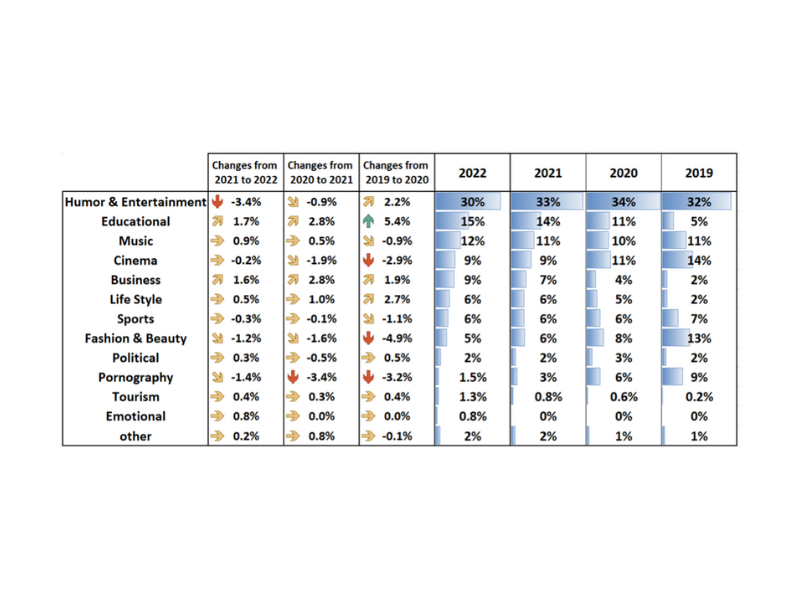
As displayed in Table 1, the share of "humour and entertainment", "fashion and beauty", and "pornography" pages among the most popular Iranian Instagram pages has decreased significantly over the past year. While the decline in "fashion and beauty" and "pornography" pages continues a longer trend, the declining ratio of "humour and entertainment" pages on Iranian Instagram over the past year is something new. In contrast, the percentage of "educational" and "business" Instagram pages has continued to rise in 2022.
The appearance of "tourism" and "emotional" pages on popular Iranian Instagram pages in 2022 is another notable change. On the tourism pages, content pertaining to tourism in various regions of Iran and the world is published, whereas, on the emotional pages, content that represents human feelings and emotions are published.
Table 1: Share of popular pages by primary subject from 2019 to 2022
The trend of changes in the network of relationships between popular Iranian Instagram pages is illustrated in Figure 2 using the Indegree Index. When comparing the changing trend of the graphs from 2019 to 2022, we observe that education (dark blue), business (brown), lifestyle (orange), and fashion and beauty (pink) pages have become increasingly integrated within their respective fields and have distanced themselves from other fields. In the upper portion of the graphs, from 2019 to 2022, we notice an increase in the intertwining of sports screens (pale blue), movies (green), and music (red). In other words, these three types of popular accounts—also known as "celebrity” accounts—have gradually shaped a field that is related to issues outside of their profession. In this multifaceted field, in addition to celebrity pages, there are humour, entertainment, political, and social pages (yellow, black, and grey).
Figure 2: Changes in the network of relationships between popular Iranian Instagram pages from 2019 to 2022, as measured by the Indegree Index
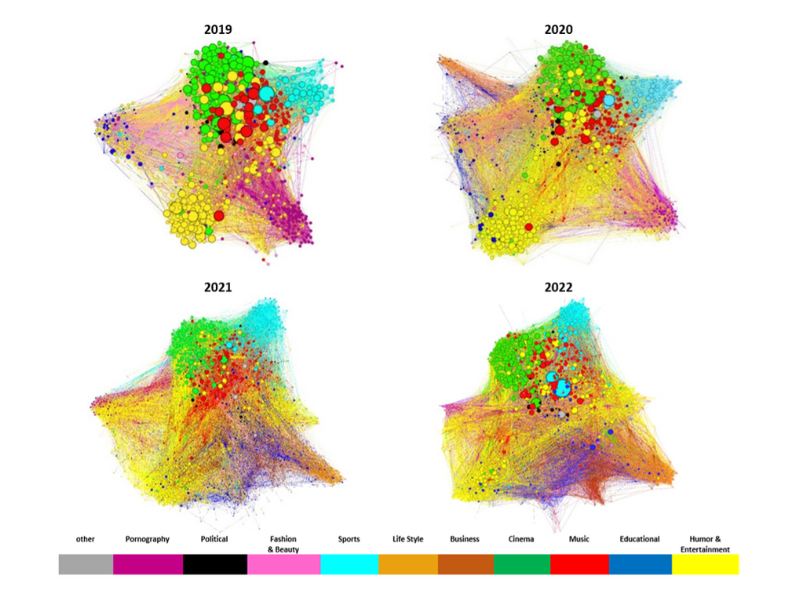
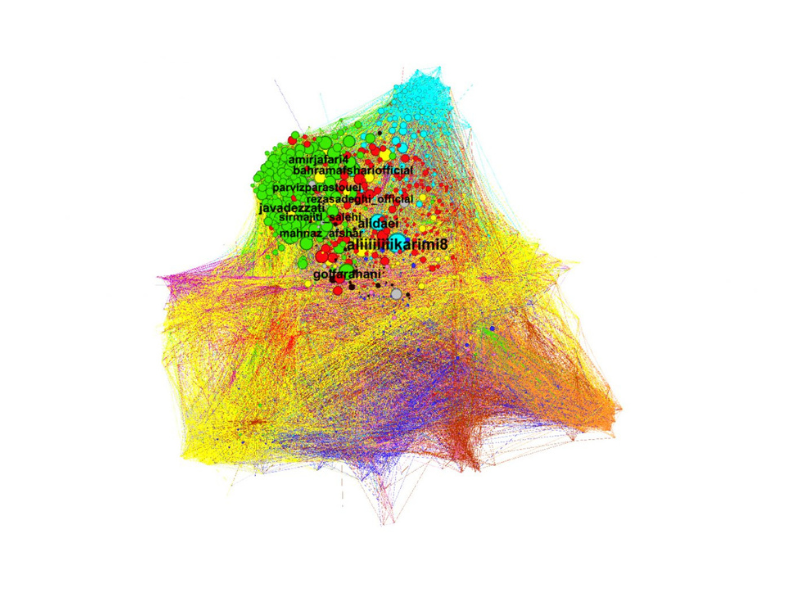
Figure 3 displays the ten Iranian Instagram influencers with the highest authority based on the Authority index. All of these individuals belong to one of the three categories: sports, film, or music. These three categories also overlap. Moreover, with the exception of two individuals, the rest post additional content on the page related to their audience's political, economic, and social concerns and demands, as well as their profession and area of expertise. Let us refer to this type of celebrity as a "celebrity-activist.”
By a significant margin, Ali Karimi has the highest authority among the most popular Iranian Instagram pages, followed by Ali Daei, Golshifteh Farahani, Javad Ezzati, Amir Jafari, Bahram Afshari, Mahnaz Afshar, Majid Salehi, Parviz Parastui, and Reza Sadeghi.
Figure 3: Network relations between popular Iranian Instagram pages in 2022, as per the Authority Index
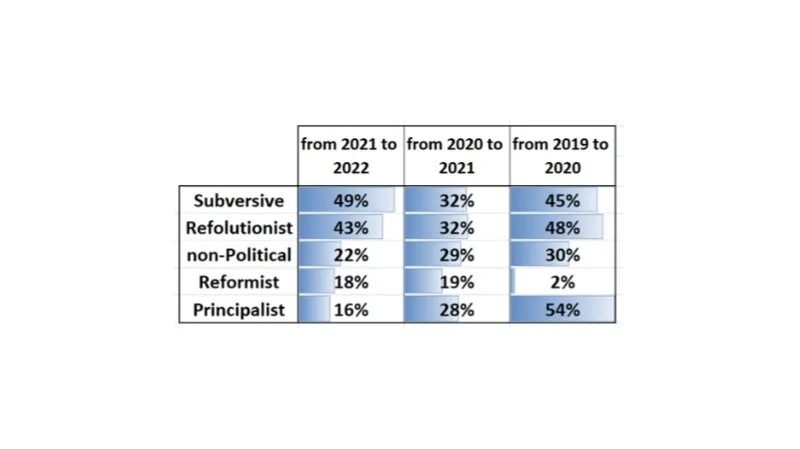
By reflecting on Table 2 and reviewing Table 1, we can gain a greater appreciation for the reasons why celebrity-activists on Iranian Instagram gain authority. Table 2 demonstrates that the number of followers of popular subversive pages has increased by 49% over the past year. This index was 43% for refolutionist (neither revolutionist nor reformist), 22% for non-politicals, 18% for reformists, and 16% for conservatives (Principalists). Comparing these statistics to those from previous years reveals that the notion of protesting the current political situation has become increasingly popular and a sought-after item on Iranian Instagram over the past year.
In contrast, as shown in Table 1, the proportion of political pages (individuals, groups, or organisations professionally engaged in political activity) among the most popular Iranian Instagram pages did not change significantly between 2019 and 2022, fluctuating by approximately 2%. In other words, Iranian political professionals of various political orientations lack the capacity and acceptance to represent the nation's political attitudes and demands. Iranian Instagram users have increased pressure on other popular Iranian Instagram pages, requesting that they reflect and even represent the political protests of the Iranian people. As previously explained, education, business, lifestyle, and fashion and beauty pages have not directly engaged with this demand of users due to professional considerations; however, a substantial portion of the movie, sports, and music pages have responded positively to the demand of their followers, largely due to their professional considerations. In actuality, it is the crisis of political representation that has placed celebrities in the position of representing the political demands of the Iranian people and given rise to the phenomenon of "celebrity-activists.”
In this sense, these are the people who have agency and have utilised the smallest opportunities to protest the status quo. In this way, they also take advantage of the opportunities provided by celebrities. In such a scenario, political professionals dissatisfied with the formation of these relationships between users and celebrities alter the truth and promote the narrative that "these excited people" have been duped by "illiterate celebrities!" Almost every political faction has employed such insults on occasion. Of course, these same "illiterate celebrities,” once defended participating in elections and voting for reformists, thereby increasing voter turnout. But, at the current time when celebrities are under the pressure of users and the online space has aligned with the Mahsa movement, conservatives and a significant portion of reformers assert that "the excited people" have been duped by the celebrities they follow. In actuality, instead of taking fundamental and principled measures to address the escalating crisis of political representation, political professionals sometimes align themselves with "concerned artists and athletes" and "intelligent people" and sometimes curse "illiterate celebrities" and "excited people" in accordance with their immediate interests.
Table 2: The rise in followers of popular Iranian Instagram pages by political orientation from 2019 to 2022
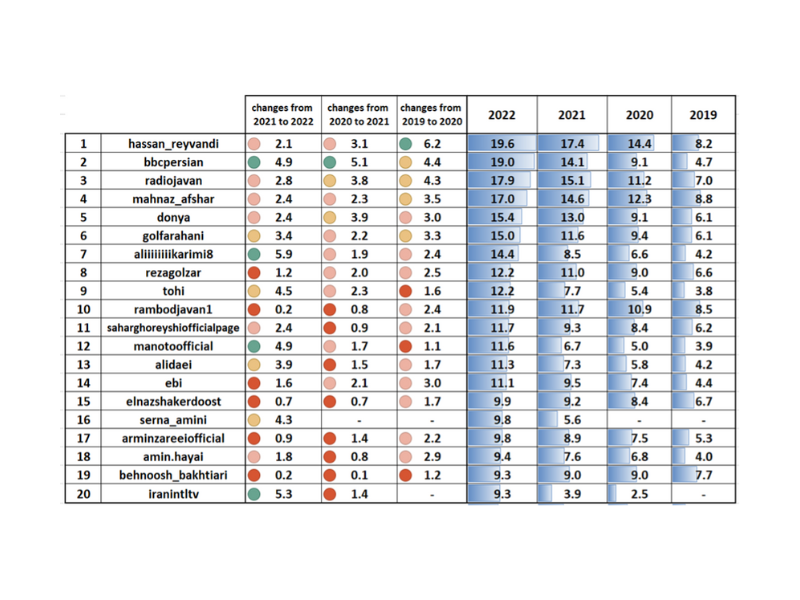
The relationship between Instagram users and popular pages has gradually developed an inherent logic over time, which can be made more tangible by examining a few examples from Table 3. Hassan Reyvandi's number of followers increased by more than 6 million between 2019 and 2020, when, in addition to political protest, the production of humour and entertainment content independent of official media was considered a high-demand commodity on Instagram. Consequently, he moved from third place in 2019 to first place in 2020. From 2020 to 2021, when humorous content independent of the official media still had some appeal, Reyvandi maintained his position by keeping a considerable distance from other prominent pages. Nonetheless, Reyvandi's position has been weakened over the past year, when "opposition to the existing political conditions" became the high-demand commodity on Iranian Instagram. Indeed, it is highly probable that he will soon be demoted. Rambod Javan has already experienced this fall. After failing to meet the expectations of political dissidents on Instagram, he dropped from the second most popular Iranian Instagram page in 2018 to the tenth most popular in 2019. Behnoosh Bakhtiari's position declined even further. Bakhtiari, who had the fourth most popular Iranian Instagram page in 2019, was harshly criticised by many Instagram users after taking several controversial positions, including publishing an Instagram post against the three protesters of November 2019 who were sentenced to execution. As a result, her page fell from the fourth most popular Iranian Instagram page to the nineteenth position within three years. Such evidence demonstrates that, contrary to the misleading term "influencer,” the resultant of the collective will of users has a substantially more direct and significant effect on the behaviour of influencers, not the reverse.
Table 3: Follower counts of the most popular Iranian pages from 2019 to 2022, per million users
From 2019 to 2021, the percentage of female Instagram celebrities in Iran rose from 32% to 42%. However, there has been no discernible change in the gender distribution of famous people over the past year. Likewise, while the percentage of popular pages based in Iran increased from 76% to 81% between 2019 and 2021, there has been no significant change in this regard over the past year.
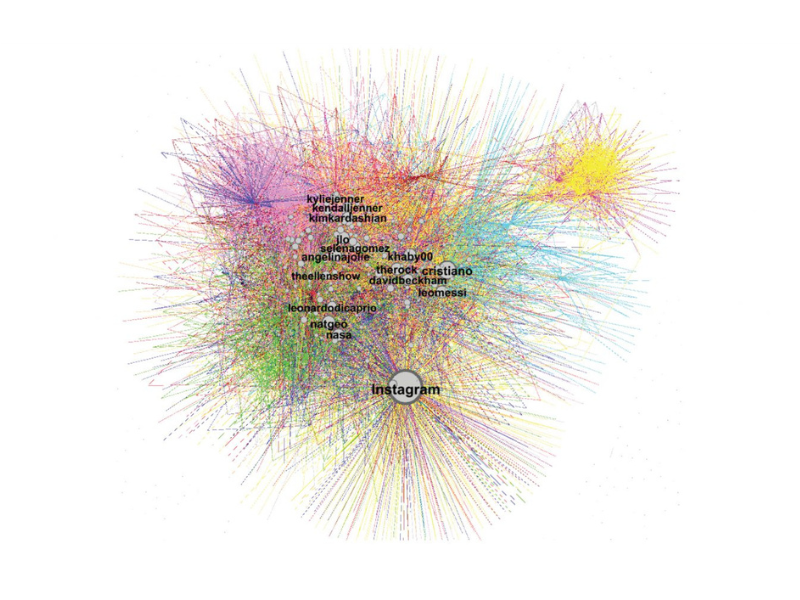
Let us conclude by examining the influence network of popular Iranian pages as affected by global authority pages. Based on the Authority Index, none of the foreign pages with high authority among the most popular Iranian Instagram pages are political. NASA, National Geographic, Leonardo DiCaprio, and Ellen DeGeneres have the most authority among film-oriented pages. Kylie Jenner, Kendall Jenner, and Kim Kardashian have the strongest authority among fashion and beauty pages. Jennifer Lopez, Selena Gomez, and Angelina Jolie have the highest authority jointly among the cinema and fashion and beauty pages. Moreover, Lionel Messi and Cristiano Ronaldo have the greatest authority among sports pages, while Khaby Lame, Dwayne Douglas Johnson, David Beckham, and the official Instagram page are authoritative among various sections of popular Iranian Instagram pages.
Figure 4: The position of authoritative international pages among popular Iranian pages on Instagram based on the Authority Index
Today, and particularly in the post-Mahsa era, the events that occur within the framework of online social networks are increasingly scrutinised by various political currents. Analysts with differing political leanings are discussing the relationship between online social networks and the collective protest actions of the Iranian people more than ever before. However, a quantitative increase in the analysis of online social networks can be considered a positive event if these analyses are continuously reviewed in conjunction with research findings in this field. Otherwise, it will not only be unenlightening but will also lead to the propagation of false stereotypes and, as a result, incorrect decisions and policies regarding this relatively new phenomenon.
Users' actions on online social networks may be correct in some cases but incorrect in others. It is crucial that whenever we find the actions of users to be inappropriate, we avoid blindly attributing everything to intelligent services, media, think tanks, or opportunistic and deceitful people. Instead of believing in these conspiracy theories, we should seek a more accurate understanding of the logic behind their actions and decisions using different methods and the logic of the situation in which users find themselves.
This methodological and analytic error is not unique to supporters of the government but is frequently committed by pro-change political currents when they encounter unpleasant phenomena in online social networks. In recent years, as a result of such a circumstance, many activists, analysts, and even some sociologists have shifted their focus from the lower levels of politics to security issues and have become experts on security issues and whistleblowers of media conspiracies and enemy think tanks.
The narrative of "excited and gullible users" is one of the recurring stereotypes regarding online social networks. In this narrative, social network users are uneducated and naive individuals who are constantly exploited by deceptive and opportunistic individuals, groups, and organisations. Throughout the past few years, and especially in the last few months, a great deal of commentary on Iranian Instagram has been based on this narrative. Interestingly, proponents of this narrative rarely question the veracity of this view and appear to see no need for scientific evidence to verify its veracity.
The results of the fourth phase of the longitudinal research I have conducted on Iranian Instagram users demonstrate conclusively that this narrative is highly misleading. Indeed, when criticising a false stereotype, we must take care not to fall into another false stereotype. Consequently, I hope that the caution that I have attempted to observe in writing this research report will be noted by the readers and that the research findings will be interpreted with the same caution.
Photo: IRNA

As Protests Continue, Biden Should Enable Remittance Transfers to Iran
The Biden administration should adjust its sanctions policies to authorise remittance transfers to Iran, making it possible for Iranians in the diaspora to support their family members in ways that strengthen capacities for political participation.
Protests in Iran are continuing as the Iranian people bravely maintain a presence in the streets and on social media. So far, Iranian authorities have given no clear indication that they will reform policies in line with protest demands and have signalled that a larger crackdown may be coming.
While the protests have meaningfully shifted the political discourse around women’s rights and state repression, it is unclear whether Iran’s civil society has the resources necessary to generate a large and lasting protest movement that maintains pressure on Iranian authorities and raises the costs of further crackdowns. One critical factor is the economic disempowerment of Iranian society over the last decade.
Between 2010 and 2020, the spending power of the average Iranian household has fallen by just over 20%. This loss of economic welfare is primarily the result of U.S. sanctions, particularly those imposed in 2012 and re-imposed in 2018. In the two decades leading up to 2012, Iranian households enjoyed an unbroken period in which living standards were rising.
U.S. sanctions policy has made protests in Iran more frequent, but also less likely to succeed. The economic precarity that has become a dominant feature of the Iranian social condition over the last decade makes it harder to sustain protest movements. Many Iranians literally cannot afford to organise and mobilise over weeks and months. Workers are reluctant to strike given the risk of losing their jobs. Even those who retain the economic means to protest lack the tools to organise.
In institutional terms, sanctions have weakened the formal and informal civil society organisations that help mobilise the middle class and channel middle class resources towards political action. Charities, advocacy groups, legal aid providers are starved of resources. Civic-minded women, who are at the forefront of Iran’s new protest movement, have been hit especially hard. As one Iranian activist put it last year, “Activists are struggling to survive… If they do end up with a bit of time at the end of the day for their activism, they are often too exhausted and preoccupied with economic survival to be effective.”
The recent protests have no doubt energised a wide range of social groups in Iran, but looking in both economic and institutional terms, the balance of power between Iranian state and Iranian society has clearly shifted in the state’s favour. Mobilisations have become more frequent, but they tend to be smaller and more fleeting, making it easier for the state to either crackdown or to simply wait out the protests.
As such, the Biden administration should adjust its sanctions policies to broadly authorise remittance transfers to Iran, making it possible for Iranians in the diaspora to support family and friends in ways that reduced economic hardship and strengthen capacities for political participation.
Remittance flows are restricted because banks and money transfer companies do not facilitate transfers to Iran owing to sanctions on the Iranian financial system. Most remittances are therefore made via exchange bureaus (known to Iranians as sarafis) or are hand-carried into Iran by individuals. U.S. persons are explicitly authorised to hand-carry personal remittances but are not permitted to use money service businesses. The financial flows made through exchange bureaus and hand-carry channels are difficult to track and so the true extent of remittance flows may not be reflected in authoritative estimates, but Iran is likely receiving far less remittance transfers than countries with similar economic characteristics.
The World Bank estimates Iran received $1.3 billion of remittances in 2021, equivalent to just one-tenth of a percent of GDP. By comparison, Thailand, a country with a higher per capita GDP ($19,000 vs. $16,000 in PPP terms) and a smaller population (70 million vs. 84 million), received $9.0 billion of remittances, equivalent to 1.8 percent of GDP.
It is unlikely that exchange bureaus and physical transfers total in the many billions of dollars. In short, Iran’s remittances inflows are much lower than expected given the size of the economy and the economic needs of the population. Remittances flows are far too limited to shore the economic welfare of households in the face of the generalised economic crisis to which sectoral sanctions contribute—a fact evidenced by the erosion of household consumption over the last decade.
A significant body of academic research suggests that remittances encourage political participation, including in protests. In a 2017 paper, Malcolm Easton and Gabriella Montinola use individual-level data from Latin America to explore the relationship between the receipt of remittances and political participation. They find that “remittance recipients are more likely to select protest rather than the base response” whether in a democracy or autocracy. Additionally, in autocracies, remittances make political change seem more achievable. Easton and Montinola explain that “receiving remittances increases the odds of selecting protest relative to believing change is not possible by 34%.” Abel Escriba-Folch, Covadonga Meseguer, and Joseph Wright arrive at a similar conclusion in their 2018 study which used individual-level data from eight African countries. They find strong evidence that “remittances increase protest by augmenting the resources available to political opponents” and “remittances may thus help advance political change.”
The Iranian diaspora in the United States is the largest and most politically active in the world. As U.S. persons, members of the diaspora living in the United States are unable to send remittances to Iran beyond the hand-carry method, which is not an option for those who cannot travel to Iran for personal or political reasons, or who are opting not to travel to Iran due to the increased risks facing dual nationals. To provide routine and reliable financial support to family and friends in Iran, members of the Iranian diaspora should be able to avail themselves of money service businesses or other payments solutions.
The relevant regulation does stipulate that remittance transfers “processed by a United States depository institution or a United States registered broker or dealer in securities” are authorised. However, there is a lack of such institutions offering remittance services for Iran—U.S. banks do not maintain correspondent accounts at Iranian financial institutions. As such, the Biden administration should update its regulations to enable U.S. persons to make remittances transfers through other channels. This can be done through the issuance of a new general license with two aims.
First, the Biden administration could authorise the use by U.S. persons of money service businesses, such as Europe-based exchange bureaus, to transfer non-commercial, personal remittances to Iran. Second, and perhaps more usefully, the Biden administration could authorise the use by U.S. persons of cryptocurrency exchanges to purchase USDC stablecoins and transfer those stablecoins as non-commercial, personal remittances to Iran. The administration would also need to authorise U.S. cryptocurrency exchanges to onboard users in Iran.
Exchange bureaus can typically make deposits to accounts at Iranian financial institutions. The existing regulations do state that U.S. banks can engage with money service businesses in third-countries to make remittance transfers to Iran. But that makes such transfers subject to the discretion of U.S. banks. The guidance should be modified such that U.S. persons can directly engage exchange bureaus, for example those in Europe, to make transfers to Iranian bank accounts. Making it possible for U.S. persons to use third-country money service businesses would have an immediate impact on the volume of remittances sent to Iran. However, this channel cannot scale indefinitely as money service businesses generally need to balance inflows and outflows to make transfers in a netting process.
The use of cryptocurrency could be even more impactful. While few Iranians maintain cryptocurrency accounts, the technology provides one of the few scalable options for enabling U.S. persons to make remittance transfers to Iran. So long as cryptocurrency exchanges receive guidance that allows them to onboard Iranian users, Iranians can be expected to adopt the technology and U.S. persons will be able to transfer cryptocurrency without a constraint on scale.
The authorisation should be limited to exchanges and should not cover transfers made directly to addresses or via wallet providers, because of the additional controls that the exchange can impose. It is technically feasible for cryptocurrency exchanges (such as Coinbase and FTX) to limit the value of transfers that can be received and held by Iranian users in line with the provisions of the authorisation. Additionally, transactions processed by the exchange do not happen on cryptocurrency blockchains, they are run within the exchange’s internal database. This enables the exchange to freeze any account held by its user and block further transfers if necessary. Moreover, the exchange could ensure that users were only able to transfer certain cryptocurrencies to Iran, such as traceable USD stablecoins which are pegged to the dollar (the best option is USDC, which has a track record of cooperation with US regulators). This would ensure that exchanges are not providing a platform for speculative trading by Iranian users and that Iranians do not have a perverse incentive to hold onto their remittances. These exchanges can also require additional KYC for U.S. persons and Iranian individuals on either end of a given transfer.
To be effective, these authorisations would need to be followed by extensive outreach by the U.S. Department of Treasury and U.S. Department of State to ensure that money service businesses and cryptocurrency exchanges begin supporting Iran-related transfers. U.S. authorities would also impress the importance of monitoring for suspicious transactions and could ask for data on the remittance flows to enable better enforcement. Any authorisation could be granted based on a limit to the value of remittances made by a U.S. person each month—a limit as low as a few hundred U.S. dollars could make a significant difference in supporting basic household welfare in Iran.
There is a risk of abuse by individuals seeking to transfer funds to designated entities or individuals in Iran. But the risk is limited. Flows of USDC cannot be directly taxed or expropriated by the state. To spend any remittances they have received, Iranians would either need to pay for goods and services by transferring USDC to another Iranian user that has created an account on the exchange, or by finding an Iranian user who is willing to exchange USDC for cash.
The lack of hard currency flows means that the proposed action does not entail a substantive change to the structure of U.S. sanctions on Iranian economic sectors and state-owned and controlled entities. Even so, the authorisations can significantly boost the economic resources of Iranian civil society and enable more robust political participation, including in protests. However, the decision to participate in the protests lies with each Iranian. Unlike a strike fund, this policy does not create an incentive for protest, nor are the remittances made contingent on certain kinds of political action.
There is a precedent for this approach. Even while adding sanctions on the Maduro government, the Trump and Biden administrations have notably allowed Venezuelans to continue to use U.S.-based financial services, such as the payments app Zelle, to send and receive U.S. dollars. This has had the effect of shielding many Venezuelans from even steeper declines in economic welfare as the country experienced a steep sanctions-induced recession.
Enabling Iranian-Americans to make remittance transfers to their family members in Iran within the context of existing sanctions regulations would mean that the Biden administration is not only seeking to deprive the Iranian state of resources for repression but is also working actively to preserve the power of the civil society at a time of general economic crisis. This is what true solidarity would look like.
Photo: IRNA

Iranian Women are Colliding with the Iranian State
Iranian women, supported by the many men who have now joined them, are challenging the discrimination they have experienced for decades.
On the day that Ebrahim Raisi, Iran’s President, was giving a speech at the United Nations headquarters in New York about the double standards with which human rights are pursued around the world, a tear gas canister flew past me and hit a car that was parked a few metres away. I was among the protesters running down Palestine Street in the centre of Tehran, and the tear gas was being fired directly at us by anti-riot police. We were doing nothing more than shouting slogans, but any of us could have been severely injured or killed—this was not an isolated incident. According to human rights groups, more than 90 people have been killed in the ongoing protests across Iran. The protests were ignited by the death of 22-year-old Mahsa Amini while she was in the custody of the morality police. The authorities have responded to these protests with a brutal crackdown—beating, shooting, arresting—and an internet blackout that has blocked access to platforms such as WhatsApp and Instagram.
Twenty years ago, it would have been hard to imagine that dozens of cities in Iran would erupt in protests against imposed religious rules. The death of Zahara Bani Yaghuob, an Iranian medical doctor arrested by authorities in Hamedan in 2007, did not lead to widespread protests at the time. But the Iranian state is reaping what they have unintentionally sown. Despite rolling back some women’s rights, such as the Family Protection Law introduced under Mohammad Reza Pahlavi, and imposing an Islamic dress code, after the revolution, a so-called Islamic educational system helped more women in rural and lower social classes to receive an education. While women in upper and middle social classes benefited from progressive laws prior to the revolution, traditional families, typically from disadvantaged backgrounds, felt more comfortable sending their daughters to school under Islamic laws. Today, women account for 60 percent of university students in Iran. It is no coincidence that Generation Z, now on the frontlines of the recent protests, are the children of Iran’s 1980s baby boomers. Generation Z’s parents were the first cohort to see a dramatic shift in the numbers of women receiving higher education in Iran.
A few hours before the tear gas canister nearly struck me on Palestine Street, I was passing security forces on Revolution Avenue when a man in plain clothes and a helmet came up to me and said, “Our cameras will capture your face. If I see you again in this area, you’ll get arrested.” “For what crime?” I asked. “No offence required,” he replied, “I have the power, and I’ll use it against you.”
The man’s boast is the key to understanding the recent protests in Iran. After Sepideh Rashnoo was harassed on a bus by a fellow citizen over her “improper” hijab in July, the dangerous power that had been delegated to pro-regime citizens became clearer. Iranians watched Rashnoo, a writer and artist, make a humiliating forced “confession” on national TV. In contrast to Rashnoo’s humiliation, the woman who harassed her over her hijab enjoyed a kind of authority bestowed upon her by the government.
Along with the morality police, the citizens who have been granted this authority stepped up their policing of the hijab rules since Raisi’s election, which was marred by record low turnout. The death of Mahsa Amini while in police custody has revealed the conflict between the Iranian government and citizens who do not want to comply with rules they believe infringe on their civil rights. There is significant disillusionment and profound doubt about the prospects of reforming a system that has shown zero interest in compromise. If the Green Movement’s slogans were full of verses from Qur’an and other Islamic references, the slogans heard in the recent protests contain no Islamic references and no requests for narrow reforms.
Despite the economic stagnation, systematic corruption, and mismanagement in recent years, economic grievances do not feature in the slogans either. The protests have coalesced around dissatisfaction about how the Iranian state relates to society. The protests that erupted after Mahsa Amini’s death emerged mainly from marginalised groups: Kurds who are an ethnic minority, the middle class which as encountered so much hostility from the government, women who are not even recognised or protected in the system if not wearing a hijab, and the working class who have witnessed widespread governmental corruption in the recent years.
While living under the strict rules of an increasingly authoritarian state, the future for these oppressed groups is grim—they see a dead end. Accordingly, for the Iranian authorities, the unification of these various social groups, which has happened for the first time since the 1979 revolution, poses a new challenge.
In recent years, Iran’s middle class has been shrinking because of international sanctions and economic decline. Still, they have had some spaces, such as social media and satellite television, to engage with progressive ideas on human rights. Long before the recent protests forced Iran’s national television to address the issue of compulsory hijab on their programmes, subjects such as the hijab, personal freedom, and gender politics have been debated on social media and foreign-based television channels before large audiences. In this way, two different worlds have coexisted and one is now crashing into the other.
Are we witnessing another revolution in Iran? It is hard to ascertain. Iran’s state ideology still has sincere supporters, not just at home but also across the region. Some analysts have pointed to the limited number of protesters to suggest the protests are a “virtual revolution” that exists only on social media. Still, a revolutionary turn does not necessarily depend on the number of active protesters; it arises from a dead-end situation. Following Ayatollah Khamenei’s speech in which he called the protests “riots” and blamed a foreign plot for the unrest, the obstruction has never been clearer.
Nevertheless, there is a movement in Iran. Motivated by their anger following Mahsa Amini’s death, a growing number of women who have found the courage to go out with their hair uncovered in public. For a political system that places enormous emphasis on women’s appearance, this is a profound form of protest. Iranian women, supported by the many men who have now joined them, are challenging the discrimination they have experienced for decades. They have already achieved a great victory by making their voice heard around the world.
Photo: EPA-EFE

Grief and Grievance in Iran’s Growing Protests
For four days, protestors have been in Iranian streets. Iran has seen multiple waves of unrest in recent years. But this time, the protests seem different.
For four days, protestors have marched on Iranian streets. The protests were triggered by the killing of Mahsa Amini, who was fatally injured while in the custody of the Guidance Patrol, a police unit in Iran that mainly enforces the country’s Islamic dress code. Amini, who was 22 years old, died last Friday after several days in a coma. She was visiting Tehran from the province of Kurdistan to see her relatives.
Iran has seen multiple waves of protests in recent years. In 2017, protests erupted in response to a sharp drop in the value of the rial and grew to include claims of economic mismanagement and corruption. In 2019, nationwide protests were triggered by a fuel subsidy reform and Iranians took to the streets to decry declining living standards. In 2021, protests focused on water rights recurred in various Iranian provinces. This year, labour protests have taken place across the country as a public sector employees and blue-collar workers seek job security and wage increases.
In many respects these protests have been linked. In each round of unrest, protestors mobilised because of similar grievances, mainly economic. They shouted the same slogans—“Death to the dictator!”—expressing anger at a sclerotic political establishment. They faced the same brutal response from security forces, who injured and killed with impunity.
But the protests triggered by the killing of Mahsa Amini appear different and are arguably more significant. While there are similarities with previous protests when considering the grievances, the slogans, and the repression, there is something distinct about the emotions being foregrounded as the mobilisations take place.
So far, people of different backgrounds and different classes have joined these protests. They have taken to the streets of Amini’s hometown of Saghez and have assembled on college campuses in Tehran to express their anger and sadness. These protests are motivated by grief, not mere grievance. Grief has opened the way for a new, wider mobilisation.
As my colleague Zep Kalb has observed, looking across recent protests in Iran, “solidarity has been hard to obtain.” Reflecting on last year’s water protests in Esfahan, Kalb explained that the protests forced “ordinary Iranians, state organisations, and political elites” to “compete fiercely about how to share the country’s increasingly scarce water resources.” Communities involved in the protests shared the same grievances—they were all demanding their water rights—but in an environment of scarcity their demands pitted them against one another.
The same can be said for the earlier rounds of economic protests in Iran. The individuals who took to the streets all shared economic grievances and wished an end to their unfair treatment in the face of low wages, high prices, and growing inequality, due in large part to the accumulative effect of sanctions. But the protests, while frequently dispersed, did not overcome class and communal divisions.
The fragmented nature of these past protests has made it easier for authorities to respond with carrots and sticks, shirking calls for broader reform. Last year, Iranian authorities used live rounds to suppress protests in Khuzestan, a region in southwest Iran beset by poverty pollution, and water shortages. Their use of violence in a region many Iranians see as a backwater had limited political repercussions. Earlier this month, the Raisi administration inaugurated a major water infrastructure project to increase water supply in 26 cities in the province. In this way, national resources have been used to address local grievances, while systemic reforms are rejected. After all, many Iranian protestors did not necessarily care if the restoration of their rights and economic welfare came at the expense of others and without broader reform. In this way, the politics of scarcity has undermined the solidarity necessary for broader mobilisation.
But the emotion that has brought so many Iranians to the streets after Amini’s death—grief—is anything but scarce. A photograph of Amini’s parents, utterly alone and in a mournful embrace in the hospital ward, struck a chord and was widely shared on social media. Millions of Iranians have endured such private moments of grief in recent years. The scene in the hospital ward even evoked the unprocessed pain of the COVID-19 pandemic—during which 144,000 Iranians lost their lives according to official statistics. The sadness of Amini’s killing was profoundly relatable.
There is also anger. Another daughter of Iran has had her life ruined or ended by state brutality. Over the last year, apprehensions had grown about the increasingly aggressive actions of the Guidance Patrol and Amini’s killing was the inevitable conclusion.
If Amini’s death seemed inevitable, it was also because the same thing has happened before. Comparisons have been made with the death of the “Blue Girl” in September 2019. Sahar Khodayari set herself on fire as an act of protest and died of her injuries a week later. Khodayari had faced prosecution for attempting to attend a football match at the stadium of Esteghlal, her beloved club, whose uniforms are blue.
Another aspect of Amini’s death, the idea that she was killed simply because she was in the wrong place at the wrong time, has led to comparisons with the January 2020 downing of Ukraine International Airlines Flight 752, in which 176 people were killed. Iranian authorities admitted shooting down the civilian airliner, which was departing from Tehran’s international airport, but claims it was accidental. In the aftermath of such senseless events, many Iranians, especially women and youth, feel they live in the wrong place at the wrong time.
Perhaps unsurprisingly, a nationally representative poll conducted by Gallup in 2021 reveals Iran to be a country beset by anger and sadness. Respondents were asked what emotions they had felt in the previous day. The responses were stark—34 percent experienced anger, 36 percent experienced pain, 40 percent experienced sadness, and 43 percent experienced stress. Responding to Amini’s death, journalist Omid Tousheh captured the national mood succinctly in a tweet: “Grief, anger, and desperation pour forth from the door and the walls.”
The hope for Iran is that these crushing feelings will not lead to dejection. There is a power in the emotions that are being unleashed in this new round of protests. There remains a possibility that a broad mobilisation can lead to reform, if the Iranian people can harness the deep solidarity that grief—not grievance—can foster.
Photo: AP