
As Trump Goes Nuclear On Iranian Oil, Europe Must Match His Brinkmanship
◢ As the US chooses the "nuclear option" on Iran's oil, Europe must find leverage and force the US to walk back on its announced policy of driving down Iranian oil exports to zero. The negative consequences for European economy could prove significant, and the risks of regional escalation are high. There are three measures that the EU can pursue to pressure Trump and prevent a dangerous escalation.
This article was originally published in LobeLog.
In the view of veteran observers of the oil industry, Trump has “gone nuclear.” Speaking during a background briefing on Tuesday, a senior state department official announced that the the Trump administration wants to completely eliminate imports of Iranian oil by its current customers. The official told journalists that, during a tour of countries that has already begun with a visit to Japan, U.S. officials will be “requesting that their oil imports go to zero, without question.”
Until recently, there had been an expectation that the Trump administration would issue significant reduction exceptions as was the case under the Obama administration, allowing countries to sustain some level of imports from Iran if significant reductions take place. Indeed, the guidance issued by the U.S. Treasury on May 8 following Trump’s withdrawal from the Joint Comprehensive Plan of Action, made specific reference to significant reduction exceptions as part of the reapplication of oil sanctions. These exceptions were to be devised following “the Secretary of State, in consultation with the Secretary of the Treasury, the Secretary of Energy, and the Director of National Intelligence” as consistent with “past practice.” A survey of oil analysts conducted by S&P Platts after May 8 suggested that “US oil sanctions on Iran will likely have an immediate impact of less than 200,000 bpd and will block less than 500,000 bpd after six months.” The announced policy is akin to a reduction of over 2 million barrels per day.
Something seems to have shifted during the OPEC meeting. As reports emerged that Japan had been asked to cease its imports of Iranian crude, Bijan Zanganeh, Iran’s oil minister, engaged in expectation management. During an interview with Bloomberg Television, he stated, “I don’t believe [the Japanese] can receive a waiver from the United States,” adding that Iran would need to “find some other way” to mitigate the effect of the oil sanctions. With Saudi Arabia cavalierly announcing that it will boost its production to record levels in July, it is easy to see how a Saudi commitment to raise production would have been coordinated with an American effort to eliminate Iran’s export market entirely.
To this end, Iran is facing the most serious challenge to its economy and political integrity to date. The Trump administration has taken its avowed commitment to exert “unprecedented financial pressure” far beyond the realm of coercion and into the realm of destruction. For Iran’s government, which receives about half of its revenues from oil sales, the prospects are grim. Of course, such an outcome is consistent with the regime-change goals of the Trump administration and its regional allies. They are seeking to engineer a collapse from within. But what is seemingly unaccounted for in such a scenario is the immense risk of regional chaos and conflict if they push Iran’s government to the brink. The risk is not merely that instability will lead to violence and mass displacement that could spill beyond Iran’s borders, but more likely that when faced with a near-existential threat, Iran’s ruling elite will seek to regain leverage in the most destructive ways possible.
In one plausible scenario, the Iranian reaction to the total embargo of its oil sales will be to try and impose a physical blockade on Saudi exports by closing the Strait of Hormuz and engaging in a new “tanker war.” The threat to close the strait has been a constant feature of hardline rhetoric from Iran over the years, and the move is easier said than done. But any suggestion that Iran could escalate in such a manner would no doubt spook oil markets—about 18 million barrels per day, equivalent to 20 percent of global supply, pass through the strait each day.
European Response
The prospect of a global oil crisis spurred by Trump’s brash move to deny waivers should frighten European leaders. Aside from the risks of confrontation in the region that would stem from any blockade attempt, the knock-on effects of an even short-term supply crisis could send the already fragile Eurozone economies into a recession. European officials have been quick to note the risks, characterizing the move as “really unhelpful and part of an escalation plan” and declaring that Europe “strongly disagree[s] with this plan.”
The timing could not be more fraught for Europe, which had been expected to present its long-awaited package of economic measures to Iran in the next week. These measures, intended to help incentivize Iran’s continued compliance with the JCPOA in the face of U.S. sanctions snapback, will have little meaning if the preservation of oil imports cannot be assured. Realistically, it will be difficult for Europe to find a way to maintain a viable importation mechanism in the absence of exemptions. If circumvention is not an option, Europe must find new leverage and compel the United States to change its policies. There are three actions that can be taken.
First, European governments must buy themselves and Iran time to reduce the chaos factor. Accelerating and increasing imports of Iranian oil over the next few months, basically allowing Iran to frontload its expected 2019 exports before the sanctions deadline kicks in, would help ensure that Iran retains an ability to sustain the rising pressure. Indian imports of Iranian oil surged in May in anticipation of the U.S. sanctions. European governments should, as a matter of national security, use any excess storage capacity to purchase as much Iranian oil as possible. In order to encourage Europe’s more independent oil traders and refiners to take on these purchases, Iran would need to offer attractive commercial terms in something akin to a flash sale.
Europe should also consider its own coercive measures. American oil exports to Europe have recently reached levels of around 500,000 barrels per day, levels approaching those of Iran. It would be relatively straightforward for Europe to declare that it will seek to eliminate imports of American oil to Europe as a countermeasure for Trump’s move to ban Iranian imports. The impact on the oil-producing American heartland and Trump’s political base could be profound. Importantly, Europe would not necessarily seek to use sanctions in order to enforce such a move. Sanctioning European companies that trade American oil would inhibit the ability of these multinational companies to pick up supply from other producers worldwide. A much more elegant way to impose a cost on the Americans would be to take a page out of the tariffs playbook. Imposing a hefty oil-import tariff would make it commercially unattractive for refiners to important American crude, and so the decision to cease importing American oil would technically be a voluntary decision rather than a decision requiring legal enforcement.
Sanctioning Trump
Finally, European entities could target Trump’s personal assets as damages for the costs incurred due to his prohibition on Iranian oil imports. Congressman Keith Ellison (D-MN) and Vox editor Matthew Yglesias have both recently argued that sanctioning Trump personally may be the best way to change his behavior. As Ellison puts it, “Sanctions targeting Trump’s own companies will sting in a way that he cannot ignore.”
But there may be a more elegant solution already at Europe’s disposal. The EU has initiated the revival of the so-called Blocking Regulation, a 1996 EU law designed to prohibit compliance with US sanctions by EU companies. The regulation includes a “clawback provision” that provides a mechanism for EU entities to sue for damages for costs arising from sanctions. The recovery of damages “may be obtained from the natural or legal person or any other entity causing the damages or from any person acting on its behalf or intermediary.” This broad definition could clearly be extended to Trump.
Moreover, the “recovery could take the form of seizure and sale of assets held by those persons, entities, persons acting on their behalf or intermediaries within the Community, including shares held in a legal person incorporated within the Community.” In short, Trump’s property and assets in Europe could be seized and sold. Given that the assessed costs related to a complete cessation of Iranian oil imports could easily amount to billions of dollars, Trump could ostensibly be threatened with the total seizure of his Europe-based wealth. Of course, the legal action probably would not need to go that far. Dragging the Trump Organization into European court would probably wake up Trump. He has a history of settling in the face of legal challenges, so a threat to his personal empire may force him to rethink his abuse of the American empire.
If Europe can muster the political courage to pursue these measures in the face of catastrophic security and economic risks introduced by the total oil embargo, it can gain the necessary leverage to push the United States to a more reasonable position. Europe must not rely on China or India or Turkey to skirt the U.S. sanctions. Given the immensity of the threat to global security arrangement represented by the abrogation of the JCPOA, and the global economic arrangement underpinned by the current composition of the oil markets, Europe must match Trump’s “nuclear option” with its own. Perhaps this kind of mutually assured financial destruction can bring the world back from the brink.
Photo Credit: IRNA
Struggling to Trade With Iran, Japanese Companies Look to European Examples
◢ Japan is one of Iran's major historical trading partners. But Japanese companies have fallen behind European, Chinese, and Korean firms in post-sanctions investment.
◢ Japanese companies are now looking to European firms as they seek to balance political and reputational risks, especially in the absence of a high-level delegation to Iran.
On July 19, Bourse & Bazaar held a round table in Tokyo, part of a global series of meetings being held in advance of the 4th Europe-Iran Forum. This event, hosted by the JIME Center of the Institute for Energy Economics, Japan’s leading Middle East research institute, brought together senior executives from some of the largest Japanese companies to discuss their progress and frustrations in the Iranian market.
Since Implementation Day, Japan has been slowly increasing its economic activity in Iran. Japan has committed to establishing a financing facility worth USD 10 billion to support new investments in Iran by Japanese companies, which have begun to sign new investment contracts across several sectors. Most recently, Toyo Engineering Corporation signed an agreement with Iran’s National Iranian Oil Company to rehabilitate Iran’s Salman oil and gas field in partnership with domestic oil firm Petropars.
However, the pace of post-sanctions trade and investment has lagged behind expectations. Japan was among Iran’s most established trading partners prior to the tightening of international sanctions, and Japanese multinationals have longstanding partnerships in the country. But the rush of activity from European and Korean multinationals has seemingly left the Japanese behind. Japanese executives are asking: “How are the Europeans doing it?” As Trump ups his rhetoric against Iran, and as the GCC crisis continues to roil, Japanese companies are trying to understand and replicate the ability of European multinationals to forge ahead and sign binding commercial agreements in Iran.
On one hand, Japanese companies should be better suited than their European counterparts to crack-open the Iranian market. From a management perspective, Japanese multinationals benefit from tight coordination across sectors and secondarily, a close relationship with the relevant government ministries. The so-called keiretsu, or business groups, link together financial institutions, industrial giants, energy firms, and shipping companies into informal groups that commonly work together in domestic and international markets. Though keiretsu ties are now looser than in their 1990s heyday, bids for large infrastructure or industrial projects by Japanese multinationals are often enhanced by the provision of financing by the main keiretsu bank. At a time when Iran is starved for financing, and while European companies are struggling to enlist major banks for Iran investments, this historic coordination could put Japan in a highly competitive position. Japanese megabanks maintain significant non-dollar financial channels and Iran possesses significant yen-denominated reserves in Japan—proceeds from decades of oil sales.
Yet, coordination is also a curse when the importance of coordination among companies is also reflected within decision-making processes. Japanese companies are managed on the basis of consensus. Approval for decisions is achieved through the process of nemawashi, by which support for an idea is achieved by gathering input and support from a wide range of internal stakeholders. This process both helps explain the impressive track record of Japanese companies in finding commercially successful strategies, but it is also a reflection of the high-degree of caution exercised by Japanese managers, who seek a wide consensus on any given strategy, rather than assume sole responsibility for risky decisions.
Both the aversion to risk and the responsibility for risk pose an understandable barriers when comes to Iran investments. Multiply risk aversion across company departments, and then across the companies within a keiretsu group, and subsequently, the prospects for an Iran investment “green light” grow slim. The Japanese country managers responsible for business development in Iran have the unenviable task of seeking especially broad consensus for key decisions, likely involving a greater number of individuals than in a European corporate context. Consensus-building is further complicated by the fact that the political environment for Iran trade and investment seems to change on a near weekly basis. The longer the decision-making process, the more likely it will be that decision-makers will want to reevaluate in light of recent developments.
Crucially, Japanese management teams are struggling to build consensus around new investments in Iran in part because of lack of political support. The largest Japanese enterprises are in regular communication with organizations such as the Ministry of Economy, Trade and Industry (METI), the Ministry of Foreign Affairs, and the Japanese External Trade Organization (JETRO). Each of these organizations boast staff with deep knowledge of the Iranian market and experience executing large agreements that is perhaps even deeper than among the equivalent European agencies. But Japan, unlike Europe, has yet to set an overarching policy regarding renewed economic ties in Iran, rendering this coordination with government inert.
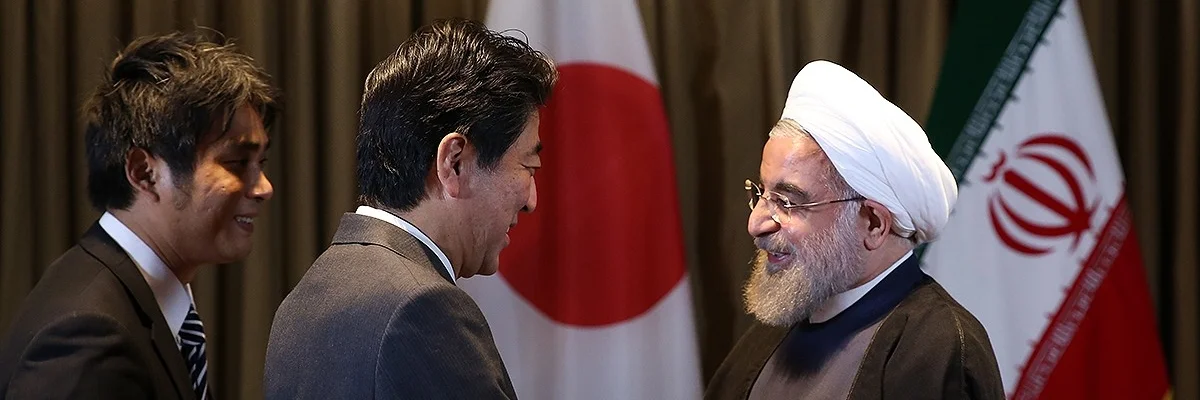
The lack of high-level political support remains the primary difference between the recent experiences of European and Japanese enterprises in Iran. Japanese Prime Minister Shinzo Abe was scheduled to travel to Iran in August 2016, only for the trip to be delayed over concerns that Japan’s first such visit since 1978 could sour possible ties with Donald Trump, who was growing resurgent in the U.S. presidential elections at the time. While Rouhani and Abe did meet on the sidelines of the United Nations General Assembly in October 2016, a high-level state visit to Iran is now on indefinite hold. Trump's eventual triumph saw Abe become among the first world leaders to visit the new president, in February of this year. While numerous European heads of state have traveled to Iran in the last two years, offering valuable political support to their engaged companies, Abe’s lack of a clear stance leaves Japanese companies exposed to possible reputational risks in the United States possibility even at the hands of Trump himself.
Second, Japan’s government and Japanese companies are contending with political pressure from Saudi Arabia and the United Arab Emirates. While Iran was Japan’s largest exporter of oil up until the tightening of international sanctions in 2012, Iranian oil imports were replaced by imports from Saudi Arabia and the United Arab Emirates. Recent data from the Petroleum Association of Japan shows Saudi and UAE oil accounting for a combined 70% of the country's imports.

The governments of Saudi Arabia and the United Arab Emirates have used this energy dependence to send a clear message to Japanese companies regarding Iran: “It is us or them.” This pressure explains in part why Japan’s oil imports from Iran in 2017 are down 51% on the previous year. Japanese companies report being pressured not to invest in Iran, at the risk of losing major contracts in Saudi Arabia and UAE. European companies have also been subject to similar pressure from Saudi and Emirati authorities, but have been more effective in pushing back on false ultimatums. In a recent investor call, Total CFO Patrick de la Chevardiere disclosed that the company had informed its Saudi partners about its intention to sign a full agreement to develop Iran’s South Pars Gas field.
Absent more direct political support, Japanese companies may remain frustrated in their attempts to engage Iran’s investment opportunities more aggressively. But there are a few strategies that could help create basic momentum behind investment plans while still mitigating risk.
First, Japanese companies need to take the keiretsu mentality and use it to create consortia with European firms. European companies have already sought partnerships with Chinese financial and industrial partners to help spread the risk of projects in Iran. Japanese multinationals should more actively position themselves as possible partners for such arrangements, particularly given that Japanese companies already operate substantial business units or joint-ventures in Europe with many of the European companies engaged in Iran.
Second, Japanese companies should be more creative in seeking ways to build credibility and stakeholder relationships in Iran. European companies, cognizant that significant investments would take a long time to move from initial discussions to binding contract, have used smaller projects to help demonstrate their commitment to the market while negotiations are ongoing. One compelling example can be seen in the case of French carmaker Renault, which has provided hardware and expertise to support the study of electric vehicles by students at Azad University. Japanese companies, which lead the world in many technologies, would be well-positioned to devise similar knowledge transfer projects in Iran. Such efforts who help build stakeholder relationships and also provide Japanese companies early examples of corporate social responsibility in Iran that can be used to help mitigate reputational risk.
Japanese ambitions in Iran may remain constrained by politics for some time. But Japanese multinationals can and should remain committed to the market, seeking creative solutions to remain present and active. Ceding market share to European, Chinese, and Korean multinationals would prove a strategic blunder, particularly as cooperation remains a viable option.
Photo Credit: IranThisWay