

GCC and Central Asia Want More Trade, But Connectivity Remains a Hurdle
The transit corridor competition that is currently underway between Iraq, Iran, and Afghanistan will increase the land connectivity options among the GCC and Central Asian countries.
Over the course of the past five years, the six countries of the Gulf Cooperation Council (GCC) and the five republics of Central Asia have taken several important steps to expand their economic and diplomatic relations. In addition to the advancement of bilateral relations among members of these two blocs, efforts have also been made at the regional level involving multiple countries from both sides. This includes several gatherings at the ministerial level, as well as the 2023 GCC-C5 summit that convened the six GCC and five Central Asian countries—Kyrgyzstan, Kazakhstan, Uzbekistan, Tajikistan, and Turkmenistan—in Saudi Arabia. The high-level summit resulted in a joint statement on the framework for economic relations. Preparations are currently underway for a follow-up summit in May 2025 in Samarkand.
The volume of trade between the two blocs is currently small. According to data compiled by the World Bank, the share of GCC countries in total exports of goods by Central Asian countries was only 0.8 percent in 2022. The ratio was even smaller for Central Asia’s largest economy, Kazakhstan, which exported only $462 million to GCC countries. This amounted to 0.55 percent of its $83.5 billion total goods exports in that year.
Trade relations are expected to expand from this low base if the forthcoming summit in Samarkand is fruitful. Not only is the GCC interested in the minerals, metals, and agricultural commodities that Central Asia can offer, but both regions are moving toward economic diversification. This will increase the range of manufactured and semi-processed goods that they can exchange.
While both sides have expressed a strong desire to expand their investment and trade relations in many sectors, transit routes and transportation costs pose important considerations for their respective political leaders and business communities. In their July 2023 summit, the leaders of GCC and Central Asia were already mindful of this issue. Connectivity was addressed in the Article 12 of the Summit’s Joint Statement: “The leaders stressed the importance of developing connected transportation routes between the two regions, building strong logistical and commercial networks, and developing effective systems that contribute to the exchange of products.”
The transport networks between GCC and Central Asia cross through several countries. Three distinct transport routes can potentially provide land connectivity between the regions in the coming years. These are the North-South Transport Corridor (NSTC) that runs mainly through Iran, the Development Road Project (DRP) that runs through Iraq, and the Trans-Afghan Corridor. Each of these multi-modal routes presents its own unique opportunities and challenges.
Firstly, it is important to consider the NSTC route through Iran. Currently the Central Asian countries have access to highway and rail transit through Iran to the Persian Gulf and the Gulf of Oman. With cooperation of Iran, Russia, and several Central Asian countries the rail connectivity has been operational since 2016. The trans-Iranian Railway connects the Sarakhs railway station on Iran-Turkmenistan border to the Bandar Abbas port on the Persian Gulf and this route is already in use by the Central Asian countries.
Highway transit for cars and trucks is also operational; Iran’s network of roads and highways connects the Iran-Turkmenistan border crossings to several seaports in the Persian Gulf, from which containers can be transported to GCC countries by ship. The railroad transit will expand further with the completion of the Sarakhs-Chabahar railway line. Nearly two thirds of this route is already complete. The only remaining piece is the Chabahar-Zahedan segment which is currently under construction, though progress is slow due to economic sanctions. Iranian government officials expect this project to be completed by late 2025.
These transit routes through Iran are safe, offering the shortest and most cost-effective routes for GCC-CA connectivity. However, many GCC economic operators will avoid using this route in compliance with the U.S. economic sanctions against Iran. GCC countries have demonstrated high compliance with the U.S. sanctions against Iran because of their heavy reliance on American security and military protection; this cooperation is likely to continue in the future.
Another transit route that can be used for trade between the GCC and Central Asia is the proposed north-south Development Road Project, which will, using rail and highway, connect Iraq’s Faw port at the tip of the Persian Gulf to Turkey’s broader transport network. This project is currently in its final planning stage according to Iraq’s Transport Minister, Razzaq Muhibis Al-Saadawi. After the recent improvement of diplomatic relations between Iraq and GCC countries, Qatar and the UAE have expressed an interest in providing additional financial support, assisting Iraq and Turkey in the endeavor.
The DRP offers a significantly longer transit route compared to the Iran option. Additionally, it requires greater international coordination, as it passes through multiple countries—Iraq, Turkey, Georgia, and Azerbaijan—before requiring sea transport across the Caspian Sea to reach either Turkmenistan or Kazakhstan for connections to Central Asia. The Turkey-Turkmenistan segment, which is part of the Belt and Road Initiative’s middle corridor between Asia and Europe, is already operational. If Azerbaijan and Turkey can convince Armenia to provide them with a transit corridor, this route will become shorter and more cost efficient, yet still less economical than the Iran option.
The DRP also faces several geopolitical and governance challenges. Kurdish militias that are in war with Turkey operate in the mountainous regions of Northern Iraq, near the Turkish border, posing a security risk to the road both during its construction and after completion. The Iraqi government’s opposition to the participation of the Kurdish Regional Government (KRG) poses another obstacle to the viability of this project as disagreements between Baghdad and KRG can lead to more disruption.
Another challenge is the many governance issues in Iraq’s fragmented government structure, which has reduced the government’s efficacy and ability to implement long-term plans. Fortunately, Iraq’s political system has become more stable in recent years, contributing to better conditions for the implementation of the DRP. A recent security agreement between Turkey and Iraq might also reduce the security risks in northern Iraq.
A third land transit route between the GCC and Central Asia is the Trans-Afghan option, which will offer rail transit from Uzbekistan to Pakistan’s Karachi and Gwadar seaports on the Arabian Sea through Afghanistan. Cargo would be able to be transported from these ports to various GCC destinations in the Persian Gulf by ship. The Trans-Afghan Corridor has received support from Kazakhstan and Uzbekistan as the primary Central Asian stakeholders. Uzbekistan has also approached Qatar and the UAE for financial investment in this project, which is estimated to cost $7 billion.
Under the previous Afghan government, the Taliban posed a security risk to the Trans-Afghan Corridor. Now, in a turn of events, the Taliban-led government is a strong supporter, engaging in active negotiations with all stakeholders to expedite the project. In 2024, Afghanistan signed an agreement with Uzbekistan and the UAE to launch a feasibility study for the project. Pakistan is also lobbying the Central Asian countries, Qatar, and the UAE for support.
Another important tailwind behind this project is the support of several other countries, including Russia and Belarus, which are also interested in development of the Afghan route. For Russia, which faces sanctions and security risks along its Baltic and Mediterranean transit routes, the Trans-Afghan Corridor will serve as an additional branch of the already operational NSTC route through Iran. In addition to the Uzbek option, Russia is also advancing an alternative branch of the Trans-Afghan railway via the Turkmenistan-Afghanistan border, further expanding the capacity of transit routes through Afghanistan.
The transit corridor competition that is currently underway between Iraq, Iran, and Afghanistan will increase the land connectivity options among the GCC and Central Asian countries in the coming years, reducing exposure to the risk factors in any single country that lies between the two blocs. While at present the only operational route is via Iran, it is encumbered by sanctions risks. The completion of the DRP and the Trans-Afghan Corridor will provide valuable alternatives despite being lengthier and hence more expensive. Their development will be reassuring to both the GCC countries and the Central Asian countries as they seek to boost trade ties as part of a process of West Asian integration.
Photo: Leonid Andronov
Iran Trade Deal with Russia-Led Bloc Warrants Cautious Optimism
◢ A free trade agreement between Iran and the Eurasian Economic Union (EAEU) will come into force on October 27, enabling preferential trade between Iran and a trading bloc comprised of 183 million people. But a leading research body has cautioned that the “low level of Iran’s commercial complimentary” with the EEAU market will temper prospects in the short term.
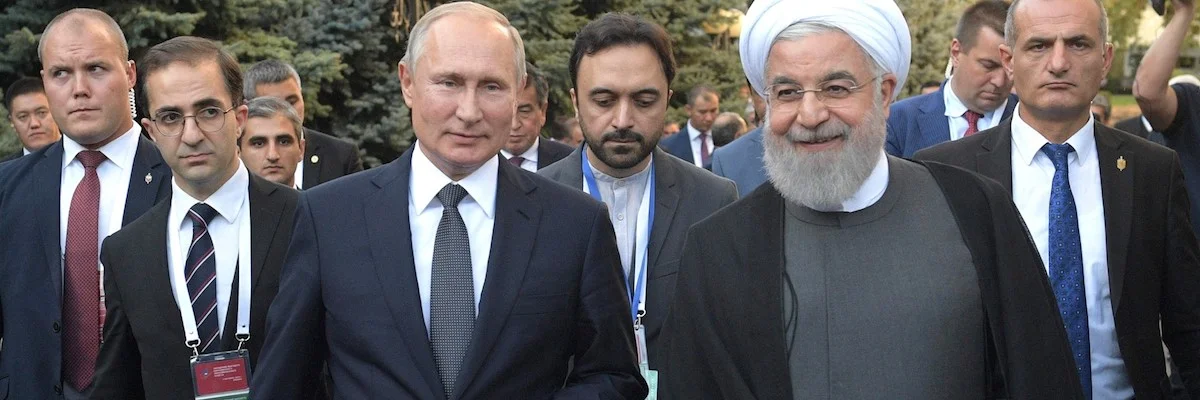
On September 30, Iranian President Hassan Rouhani arrived in Yerevan, Armenia to attend the Eurasian Economic Union (EAEU) Summit. A free trade agreement (FTA) between Iran and the EAEU will come into force on October 27, creating conditions for preferential trade between Iran and the current EEAU members: Armenia, Belarus, Kazakhstan, Kyrgyzstan and Russia. The FTA will give Iran access to a single market comprised of 183 million people and with an aggregate GDP of USD 4 trillion.
Iranian policymakers have welcomed the FTA with cautious optimism. With parliamentary elections fast approaching, the Rouhani administration and parliamentarians alike are eager to implement policies that may help bolster Iran’s economy as sanctions cause a sharp recession. Reza Rahmani, Iran’s industry minister has stated that the FTA could help counteract Iran’s isolation in the face of U.S. sanctions. Mohammadreza Jahanbiglari, an economist and member Iran’s Chamber of Commerce, has predicted that if properly implemented, the FTA could see Iran’s trade turnover with EAEU member states quadruple to reach USD 10 billion within one year—a view echoed by Mehdi Mirashrafi, the head of Iran’s customs administration. The Iran Chamber of Commerce has been invited to establish a specific body to support exchanges with EAEU counterparts.
However, the highly regarded Islamic Parliament Research Center, the research arm of the country’s legislative assembly, has issued a more conservative assessment, outlining in a June 2019 report that the “low level of Iran’s commercial complimentary” with EAEU member states will result in a “minor impact from the FTA on the country's economy.”
The Parliament Research Center nonetheless concluded that the FTA could help Iran develop its non-oil exports, a central aim of the doctrine behind the “Economy of Resistance” called for by the Supreme Leader, Ali Khamenei. Under the FTA, a list of 502 goods will enjoy preferential tariffs when exported to the EAEU.
Utilization of the so-called “soft infrastructure” represented by the FTA may also spur the development of Iran’s geo-economic position in the Middle East through the creation of new “hard infrastructure.” Russian leadership of the EAEU is complimentary with its “Pivot to the East” strategy. In this context, Iran can provide the shortest, safest, and cheapest route for Russian goods to the Indian Ocean as envisioned in the International North–South Transport Corridor (INSTC). During the Yerevan summit, Iranian foreign minister, Mohammad Javad Zarif highlighted the pivotal role Iran can play in these plans, tweeting, “With parallel work on North-South & South-West Transit Corridors, ground paved for expansion in regional trade & cementing of our role as vital transit hub.”
Despite practical concerns about the facilitation of trade in the face of US secondary sanctions, Iran will also likely find a sympathetic group of countries among the EAEU, which has an anti-sanctions outlook. The EAEU Treaty was signed on May 29, 2014, after the first round of sanctions were imposed against Russia. Like Iran, Russia has seen the expansion of trade among the countries of the former Soviet Union as a possible bulwark against sanctions.
Before leaving Iran for the Yerevan summit, President Rouhani highlighted the potential for the FTA with the EAEU to help Iran mitigate the effects of U.S. sanctions. One of the key issues barriers for Iran’s cross-border trade is the absence of reliable banking channels. Iran and Russia have been exploring the use of local currencies in bilateral trade as well as the use of a new Russian bank messaging system called SPFS, which is intended as an alternative to SWIFT. Abdolnasser Hemmati, the governor of Iran’s central bank, has stated that Russia has agreed to Iran’s proposal to expand SPFS to the countries of the EEAU.
Beyond banking, Iranian business leaders are concerned about the harmonization of the trading regimes. For example, while EEAU countries use the more detailed 10-digit “Harmonized System” (HS), Iran uses the 8-digit version. Proper harmonization will require input from a wide range of Iranian regulatory bodies, including the customs administration, the National Standard Organization, the Veterinary Organization, and the Food and Drugs Administration. Aside from the administrative challenges on the Iranian side, there are also concerns around the internal dynamics of the EAEU, in which economic ambitious have not been matched with the kind of political frameworks that have made the European Union customs union so successful. The FTA between Iran and the EAEU is an interim agreement that will remain in force for three years—a short period to overcome a wide range of bureaucratic hurdles.
While Iran might not find drastic gains by joining the EAEU, it certainly has nothing to lose. Over time, if enabled by the creation of more robust banking channels and investment in new transport infrastructure, Iran’s non-oil trade with the EAEU could prove a real boon for the economy.
Photo: Kremlin.ru
