

Iran's Instagram Crackdown is Jeopardising Women's Livelihoods
In recent years, Iranian women have accounted for a growing share of major Iranian accounts on Instagram, seizing economic opportunities that are unavailable in Iran’s offline economy. Today, that progress is at risk.
Iranian women have been striving to enhance their socioeconomic status, both online and offline. Statistics show that this is not an easy task: in 2023, the World Economic Forum ranked Iran 143rd out of 146 countries in its annual gender gap report. Iran also sits at 144th for economic participation and opportunity. Consequently, many women resort to informal employment in areas such as sales, homeworking, catering, and domestic work. Due to the informal nature of this kind of work, it is difficult to collect data on the number of women in such roles.
Although it has become increasingly difficult for Iranians—particularly women—to make a living, many micro-entrepreneurs have used Instagram to start businesses. Due to its relatively low entry barriers and easy access to potential customers, the platform had been ideal for this purpose. However, Iranian women are now encountering serious obstacles. A move by authorities to block Instagram and throttle internet speeds, as well as steep increases in internet package prices and arrests of prominent influencers, have all made it more difficult for women to seek economic opportunities online.
World Bank figures from 2021 show that approximately 79 percent of Iran’s population uses the internet. In February 2024, the Iranian Students’ News Agency (ISNA) reported that after Telegram, WhatsApp was the most popular platform, with about 47.7 million users. Instagram ranked third, with 47 million users. Of Iranian Instagram users, 46 percent are female—more than 21 million women.
For the last five years, Abolfazl Hajizadegan, a sociologist at the University of Tehran, has published an annual report on Iran's social media sphere. Hajizadegan’s most recent report clearly shows that, despite the shutdown of Instagram by the Islamic Republic (which occurred at the beginning of the Woman, Life, Freedom movement in Iran), women persist in their online presence.
In this piece, I have chosen to focus specifically on accounts from which influencers generate income. The accounts I discuss do not necessarily belong to the most famous people but to ones who have amassed a large number of followers and are engaged in online business.
The table above is drawn from Hajizadegan’s reports and shows that the share of women has increased among Iranian social media influencers. Among lifestyle-oriented accounts on Instagram, the proportion of women has risen from 58 percent in 2019 to 89 percent in 2023. One of the women who has experienced the highest growth in followers in recent years is Yegane Rezaee, a lifestyle blogger. With one million followers, she chronicles her daily life and earns an income through sponsored posts.
Women are strongly represented among fashion and beauty accounts and one of the influencers in this area is Farzaneh Mezon, who has 153,000 followers. Mezon advertises her products by showcasing various outfits in the photos she uploads. Perhaps because of her popularity, her online store was blocked in July 2023. She soon posted the following statement on Instagram: “Our website has been blocked by a court order. We have been asked to delete all photos that go against Islamic values and the proper hijab framework.” Farzaneh was able to continue her work after appealing to her followers, who wrote comments of solidarity under the post and vowed to support her in making the necessary changes to her website.
Iranian women also account for a growing share of Instagram accounts focused on educational content. The share of women-led accounts has risen from 14 percent in 2019 to 45 percent in 2023. Havin Hosseiny manages a page that focuses on empowering women by improving their life skills. Her bio states, “Our goal is to improve women’s mental health and help them increase their income.’’ With 739,000 followers, she explains gender equality to the audience on her page by publishing short animated videos with attractive content and simple language. She also founded the Havin School, which offers online courses for women that focus on issues such as personal relationships, career advancement, self-confidence, stress reduction, and financial awareness. In addition to providing free educational content, she earns money from other educational workshops.
In the comedy and entertainment field, the gap between women and men remains significant despite women’s share increasing from 6 percent in 2019 to 29 percent in 2023. Zeinab Musavi, known as Emperor Kuzco, creates short comic videos. With 645,000 followers, she is one of the most famous Iranian comedians online. To earn an income, she asks her followers to donate any amount they wish: “These videos I create and publish on this page are my job. And if you enjoy them, you can contribute through two links I have provided in my bio.’’
Men dominate the sports pages. However, pages such as the one run by Elnaz Rekabi, a competition climber with 653,000 followers, are among the most popular on Instagram. It is worth bearing in mind that the low number of women participating in this field likely reflects restrictions placed on female athletes. For instance, the Instagram page of Sogol Rahbar, a bodybuilder with 290,000 followers, was temporarily shut by the Law Enforcement Command of the Islamic Republic of Iran, known by its Persian acroynym, FARAJA. A post on Rahbar’s account carried this message: “Due to the publication of criminal content against public morals and decency, Faraja has blocked this page.’’ However, after deleting posts deemed to depict “improper hijab,’’ Sogol resumed her activities. She earns money through advertising, providing exercise and nutrition programmes, and conducting online classes.
According to Hajizadegan’s research, women do not run any popular religious pages. However, conservative values are represented in other spheres. For example, there are business pages run by conservative women, one of whom is Khadije Faghih, who teaches mat weaving and has 37,800 followers. In addition to publishing free educational content, she earns money by holding classes.
Because Iranian women are excluded from the formal economy, many have sought opportunities in the informal economy. The widespread use of social media platforms has allowed many creative and enterprising women to engage in online business. Instagram is one of the most widely used platforms in Iran, but the crackdowns following the Women, Life, Freedom movement, have created new obstacles for women seeking opportunities on the platform. Moves by authorities to pressure women to observe the “proper hijab’’ have economic consequences. Moreover, President Ebrahim Raisi has yet to fulfill an election promise to provide free internet to all people on low incomes. Instead, internet prices remain high, and the government filtering of platforms like Instagram means that people are forced to buy virtual private networks (VPNs). This has dramatically reduced internet access for economically disadvantaged women.
According to the Tehran-based Beta Research Center, more than two million Iranian businesses market products and services on Instagram, and less than one-fifth of these enterprises also sells their products offline. Importantly, 64 percent of these businesses are owned by women, who have been disproportionately impacted by the internet crackdowns. Rural women who relied on online businesses for their livelihoods have been especially affected—many have been forced to peddle their products on city streets.
In February, Iran’s National Center for Cyberspace officially prohibited the use of VPNs. At present, despite campaigns to repeal the new prohibition, the future of the Iranian internet is uncertain. In recent years, Iranian women have accounted for a growing share of major accounts on Instagram, seizing economic opportunities that are unavailable in Iran’s offline economy. Today, their livelihoods are in jeopardy.
Photo: Farzaneh Mezon

How Shifts on Instagram Drove Iran's 'Mahsa Moment'
Iranians are using Instagram for political activism like never before. But these changes were not sudden. The “Mahsa Moment” was driven by user trends on social media that have been years in the making.
This article was originally published in Persian.
In a narrative crafted by various political and intellectual currents, the “Iranian Instagram” is often presented as a means of depoliticising the attitudes and behaviours of the Iranian people, with its users engaging in vulgar content, falling for false news and claims, cursing at famous figures, and morbidly posting accounts of the more attractive sides of their daily lives. This same formulation is used by the conservative movement (also called the Principalists movement) to realise their policy of "organisation" and "protection" of the Internet. Using comparable language, pro-change political currents also direct users to ostensibly more political platforms, such as Twitter and Clubhouse. However, if this is the case, why has Instagram become one of the most prominent platforms for expressing and even organising political protests in the “Mahsa Moment?”
The simplest and shortest response to this question is to attribute everything that has occurred over the past two to three months to the Islamic Republic's enemies. This response has been heard repeatedly on official domestic media in recent months. Some of the self-proclaimed leaders of the people's protests in the media outside of Iran have given the same answer in different words, claiming that these events are the result of their years of hard work and meticulous planning. This type of analysis of people's collective actions is not only unenlightening and ineffectual but is a significant contributor to the current crisis.
However, another approach might be to temporarily set aside preconceived notions about online social networks in favour of a more empirically grounded and scientifically sound approach to answering this question. A portion of the answer to this question can be found by analysing the changing trends on Iranian Instagram.
Those of you who have been following along for the past three years may recall that I began a longitudinal study of Iranian Instagram in 2019 and have since published an analytical update three times in the early fall of 2019, 2020, and 2021. This year, data collection and analysis took longer than usual due to Internet filtering and interruptions, delaying the report preparation for the fourth phase of this research.
With these explanations, the findings of the fourth consecutive year of this research will be presented within the context of the question posed at the beginning of the report. The findings of this study demonstrate that the transformation of the Iranian Instagram space at the “Mahsa Moment” into a platform for online protests and the organisation of offline protests cannot be attributed to a pre-planned project. Rather, we must understand and analyse this phenomenon in light of the agency of users and the gradual changes that have occurred on Instagram in Iran over the past few years. In addition, despite tightening restrictions over the past year, Iranian Instagram continues on its path, both quantitatively and qualitatively, consistent with the previously optimistic changes.
Figure 1 depicts the frequency of active popular Iranian Instagram pages between 2019 and 2022. Despite the tightening of various restrictions facing Iranian users on Instagram, the number of active Iranian pages on Instagram with more than 500,000 followers increased by 17% in 2022, reaching 2,654.
Figure 1: Frequency of active Iranian Instagram pages with over 500k followers from 2019 to 2022
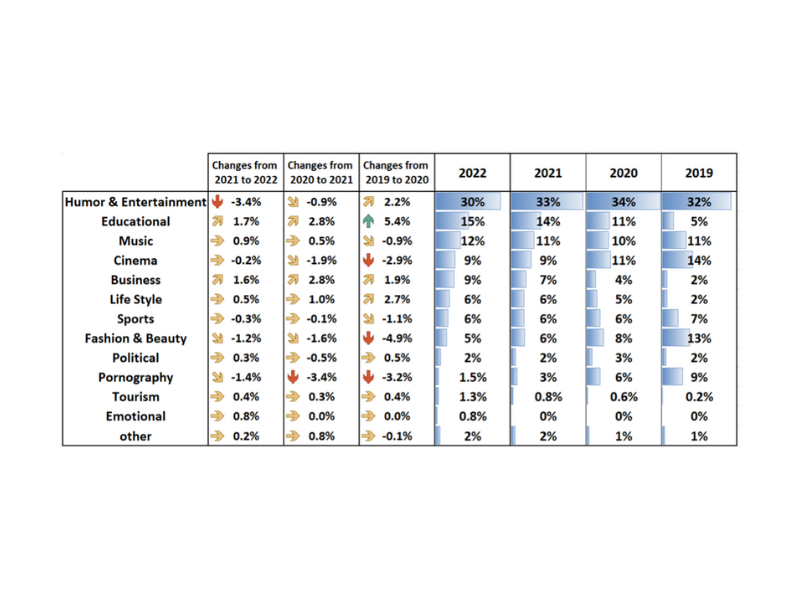
As displayed in Table 1, the share of "humour and entertainment", "fashion and beauty", and "pornography" pages among the most popular Iranian Instagram pages has decreased significantly over the past year. While the decline in "fashion and beauty" and "pornography" pages continues a longer trend, the declining ratio of "humour and entertainment" pages on Iranian Instagram over the past year is something new. In contrast, the percentage of "educational" and "business" Instagram pages has continued to rise in 2022.
The appearance of "tourism" and "emotional" pages on popular Iranian Instagram pages in 2022 is another notable change. On the tourism pages, content pertaining to tourism in various regions of Iran and the world is published, whereas, on the emotional pages, content that represents human feelings and emotions are published.
Table 1: Share of popular pages by primary subject from 2019 to 2022
The trend of changes in the network of relationships between popular Iranian Instagram pages is illustrated in Figure 2 using the Indegree Index. When comparing the changing trend of the graphs from 2019 to 2022, we observe that education (dark blue), business (brown), lifestyle (orange), and fashion and beauty (pink) pages have become increasingly integrated within their respective fields and have distanced themselves from other fields. In the upper portion of the graphs, from 2019 to 2022, we notice an increase in the intertwining of sports screens (pale blue), movies (green), and music (red). In other words, these three types of popular accounts—also known as "celebrity” accounts—have gradually shaped a field that is related to issues outside of their profession. In this multifaceted field, in addition to celebrity pages, there are humour, entertainment, political, and social pages (yellow, black, and grey).
Figure 2: Changes in the network of relationships between popular Iranian Instagram pages from 2019 to 2022, as measured by the Indegree Index
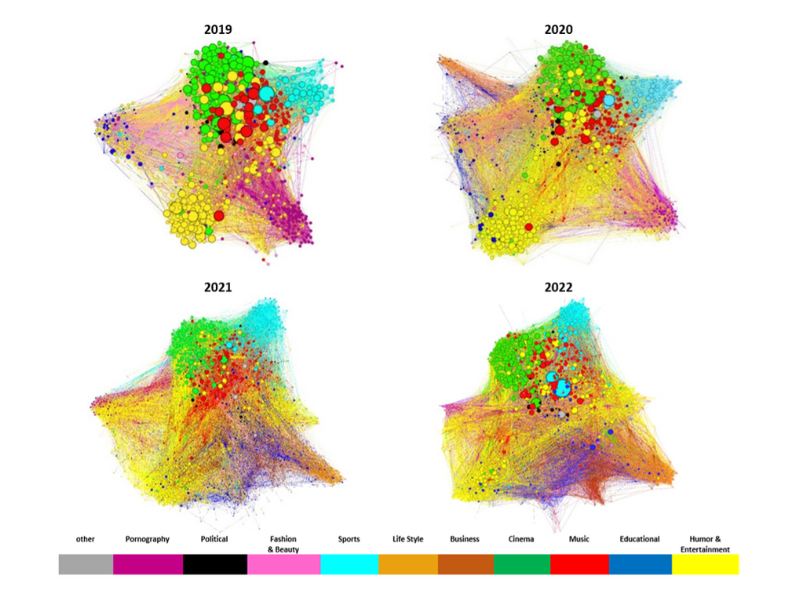
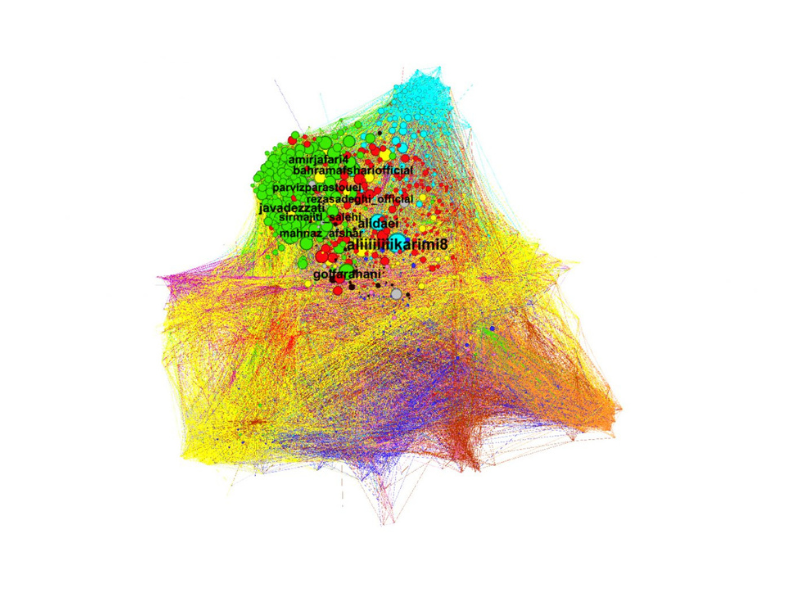
Figure 3 displays the ten Iranian Instagram influencers with the highest authority based on the Authority index. All of these individuals belong to one of the three categories: sports, film, or music. These three categories also overlap. Moreover, with the exception of two individuals, the rest post additional content on the page related to their audience's political, economic, and social concerns and demands, as well as their profession and area of expertise. Let us refer to this type of celebrity as a "celebrity-activist.”
By a significant margin, Ali Karimi has the highest authority among the most popular Iranian Instagram pages, followed by Ali Daei, Golshifteh Farahani, Javad Ezzati, Amir Jafari, Bahram Afshari, Mahnaz Afshar, Majid Salehi, Parviz Parastui, and Reza Sadeghi.
Figure 3: Network relations between popular Iranian Instagram pages in 2022, as per the Authority Index
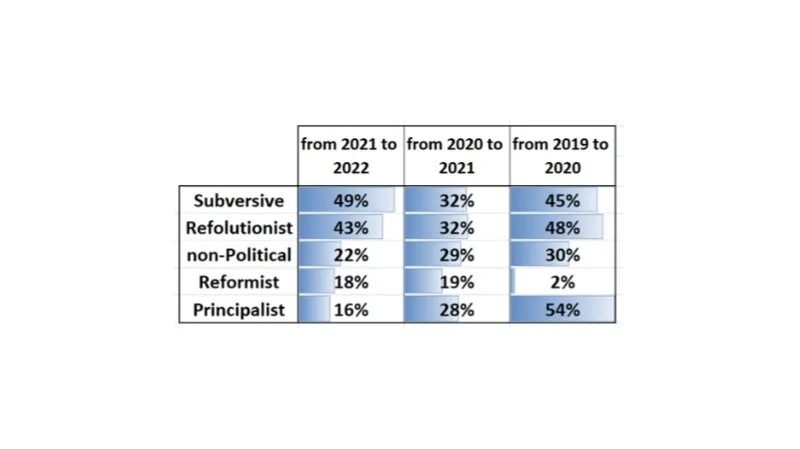
By reflecting on Table 2 and reviewing Table 1, we can gain a greater appreciation for the reasons why celebrity-activists on Iranian Instagram gain authority. Table 2 demonstrates that the number of followers of popular subversive pages has increased by 49% over the past year. This index was 43% for refolutionist (neither revolutionist nor reformist), 22% for non-politicals, 18% for reformists, and 16% for conservatives (Principalists). Comparing these statistics to those from previous years reveals that the notion of protesting the current political situation has become increasingly popular and a sought-after item on Iranian Instagram over the past year.
In contrast, as shown in Table 1, the proportion of political pages (individuals, groups, or organisations professionally engaged in political activity) among the most popular Iranian Instagram pages did not change significantly between 2019 and 2022, fluctuating by approximately 2%. In other words, Iranian political professionals of various political orientations lack the capacity and acceptance to represent the nation's political attitudes and demands. Iranian Instagram users have increased pressure on other popular Iranian Instagram pages, requesting that they reflect and even represent the political protests of the Iranian people. As previously explained, education, business, lifestyle, and fashion and beauty pages have not directly engaged with this demand of users due to professional considerations; however, a substantial portion of the movie, sports, and music pages have responded positively to the demand of their followers, largely due to their professional considerations. In actuality, it is the crisis of political representation that has placed celebrities in the position of representing the political demands of the Iranian people and given rise to the phenomenon of "celebrity-activists.”
In this sense, these are the people who have agency and have utilised the smallest opportunities to protest the status quo. In this way, they also take advantage of the opportunities provided by celebrities. In such a scenario, political professionals dissatisfied with the formation of these relationships between users and celebrities alter the truth and promote the narrative that "these excited people" have been duped by "illiterate celebrities!" Almost every political faction has employed such insults on occasion. Of course, these same "illiterate celebrities,” once defended participating in elections and voting for reformists, thereby increasing voter turnout. But, at the current time when celebrities are under the pressure of users and the online space has aligned with the Mahsa movement, conservatives and a significant portion of reformers assert that "the excited people" have been duped by the celebrities they follow. In actuality, instead of taking fundamental and principled measures to address the escalating crisis of political representation, political professionals sometimes align themselves with "concerned artists and athletes" and "intelligent people" and sometimes curse "illiterate celebrities" and "excited people" in accordance with their immediate interests.
Table 2: The rise in followers of popular Iranian Instagram pages by political orientation from 2019 to 2022
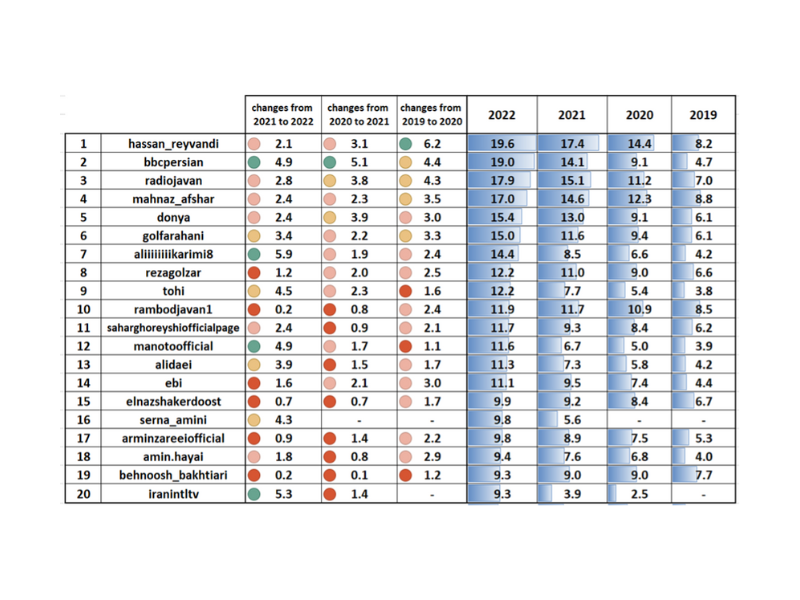
The relationship between Instagram users and popular pages has gradually developed an inherent logic over time, which can be made more tangible by examining a few examples from Table 3. Hassan Reyvandi's number of followers increased by more than 6 million between 2019 and 2020, when, in addition to political protest, the production of humour and entertainment content independent of official media was considered a high-demand commodity on Instagram. Consequently, he moved from third place in 2019 to first place in 2020. From 2020 to 2021, when humorous content independent of the official media still had some appeal, Reyvandi maintained his position by keeping a considerable distance from other prominent pages. Nonetheless, Reyvandi's position has been weakened over the past year, when "opposition to the existing political conditions" became the high-demand commodity on Iranian Instagram. Indeed, it is highly probable that he will soon be demoted. Rambod Javan has already experienced this fall. After failing to meet the expectations of political dissidents on Instagram, he dropped from the second most popular Iranian Instagram page in 2018 to the tenth most popular in 2019. Behnoosh Bakhtiari's position declined even further. Bakhtiari, who had the fourth most popular Iranian Instagram page in 2019, was harshly criticised by many Instagram users after taking several controversial positions, including publishing an Instagram post against the three protesters of November 2019 who were sentenced to execution. As a result, her page fell from the fourth most popular Iranian Instagram page to the nineteenth position within three years. Such evidence demonstrates that, contrary to the misleading term "influencer,” the resultant of the collective will of users has a substantially more direct and significant effect on the behaviour of influencers, not the reverse.
Table 3: Follower counts of the most popular Iranian pages from 2019 to 2022, per million users
From 2019 to 2021, the percentage of female Instagram celebrities in Iran rose from 32% to 42%. However, there has been no discernible change in the gender distribution of famous people over the past year. Likewise, while the percentage of popular pages based in Iran increased from 76% to 81% between 2019 and 2021, there has been no significant change in this regard over the past year.
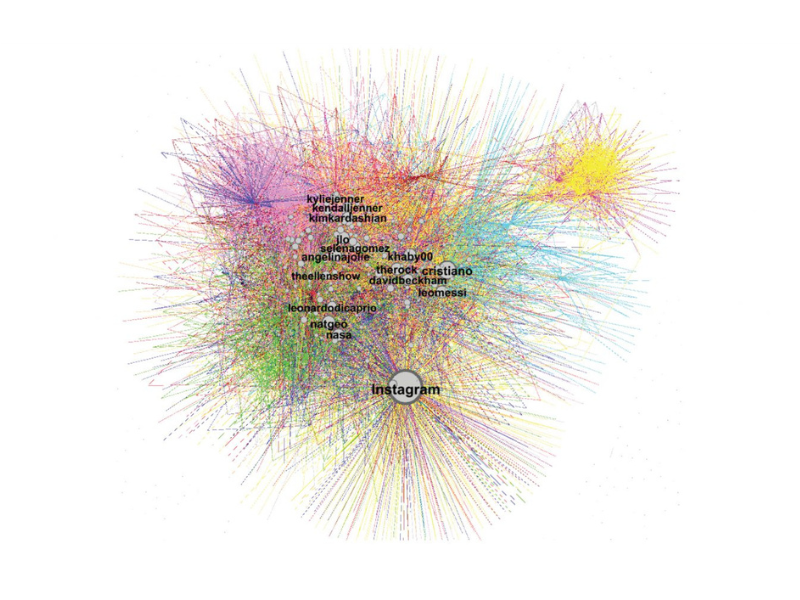
Let us conclude by examining the influence network of popular Iranian pages as affected by global authority pages. Based on the Authority Index, none of the foreign pages with high authority among the most popular Iranian Instagram pages are political. NASA, National Geographic, Leonardo DiCaprio, and Ellen DeGeneres have the most authority among film-oriented pages. Kylie Jenner, Kendall Jenner, and Kim Kardashian have the strongest authority among fashion and beauty pages. Jennifer Lopez, Selena Gomez, and Angelina Jolie have the highest authority jointly among the cinema and fashion and beauty pages. Moreover, Lionel Messi and Cristiano Ronaldo have the greatest authority among sports pages, while Khaby Lame, Dwayne Douglas Johnson, David Beckham, and the official Instagram page are authoritative among various sections of popular Iranian Instagram pages.
Figure 4: The position of authoritative international pages among popular Iranian pages on Instagram based on the Authority Index
Today, and particularly in the post-Mahsa era, the events that occur within the framework of online social networks are increasingly scrutinised by various political currents. Analysts with differing political leanings are discussing the relationship between online social networks and the collective protest actions of the Iranian people more than ever before. However, a quantitative increase in the analysis of online social networks can be considered a positive event if these analyses are continuously reviewed in conjunction with research findings in this field. Otherwise, it will not only be unenlightening but will also lead to the propagation of false stereotypes and, as a result, incorrect decisions and policies regarding this relatively new phenomenon.
Users' actions on online social networks may be correct in some cases but incorrect in others. It is crucial that whenever we find the actions of users to be inappropriate, we avoid blindly attributing everything to intelligent services, media, think tanks, or opportunistic and deceitful people. Instead of believing in these conspiracy theories, we should seek a more accurate understanding of the logic behind their actions and decisions using different methods and the logic of the situation in which users find themselves.
This methodological and analytic error is not unique to supporters of the government but is frequently committed by pro-change political currents when they encounter unpleasant phenomena in online social networks. In recent years, as a result of such a circumstance, many activists, analysts, and even some sociologists have shifted their focus from the lower levels of politics to security issues and have become experts on security issues and whistleblowers of media conspiracies and enemy think tanks.
The narrative of "excited and gullible users" is one of the recurring stereotypes regarding online social networks. In this narrative, social network users are uneducated and naive individuals who are constantly exploited by deceptive and opportunistic individuals, groups, and organisations. Throughout the past few years, and especially in the last few months, a great deal of commentary on Iranian Instagram has been based on this narrative. Interestingly, proponents of this narrative rarely question the veracity of this view and appear to see no need for scientific evidence to verify its veracity.
The results of the fourth phase of the longitudinal research I have conducted on Iranian Instagram users demonstrate conclusively that this narrative is highly misleading. Indeed, when criticising a false stereotype, we must take care not to fall into another false stereotype. Consequently, I hope that the caution that I have attempted to observe in writing this research report will be noted by the readers and that the research findings will be interpreted with the same caution.
Photo: IRNA