
Iranian Businesses Take Stock After Soleimani Assassination
Iran’s business community is taking stock after the assassination of Major General Qassem Soleimani as the possibility of a direct conflict with the United States threatens serious consequences for an already beleaguered Iranian economy. Both the currency market and stock market saw further losses on Monday, the final day of a three-day period of mourning.
Iran’s business community is taking stock after the assassination of Major General Qassem Soleimani while the possibility of a direct conflict with the United States threatens serious consequences for an already beleaguered Iranian economy.
The economic impact of Soleimani’s death was first felt in currency markets on Saturday, the first day of the working week in Iran. The dollar was priced at about IRR 133,500 before currency markets opened, but jumped to IRR 137,500 by Saturday’s close. On Sunday, the dollar appreciated further against the real to close at IRR 139,500, marking a 4.5 percent drop in value over the two days. The Iranian rial has stabilized over the last year after losing more than 60 percent of its value in 2018.
Similar volatility was could be seen in Iran’s main stock market, which had made significant gains over the last year. TEDPIX, the main index of the Tehran Stock Exchange (TSE), closed at 367,334.20 on Saturday, down by 4.6 percent. It dropped another 1.4 percent by Sunday’s close to reach 362,259.30.
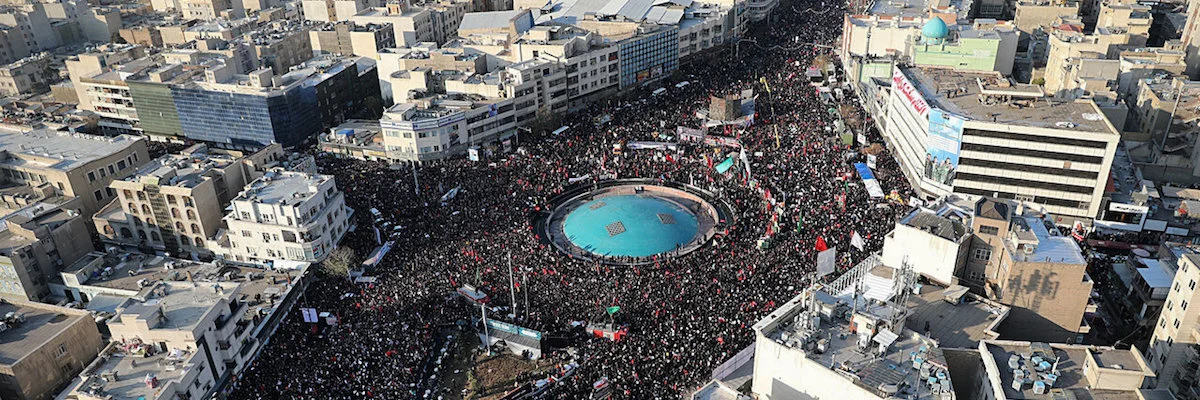
Both the currency market and stock market saw further losses on Monday, the final day of a three-day period of mourning. Millions of Iranians have taken to the streets of Iran’s major cities to participate in funeral processions.
Supreme Leader Ali Khamenei has vowed to exact “severe revenge” for Soleimani’s death. Secretary of the powerful Supreme National Security Council Ali Shamkhani said Sunday that Iran’s “response to this crime will certainly be military, but won’t be limited to military efforts.”
Trump has doubled down on the assassination, using Twitter to threaten the destruction of 52 targets in Iran, including sites important to the “Iranian culture.” Perhaps indicating his knowledge of the target list, Senator Lindsey Graham suggested the president should target Iran’s oil refineries in further airstrikes.
The economic ramifications of a direct conflict with the United States would be serious. But even absent war, the heightened tensions and greater uncertainty will have an impact on the business environment in Iran.
“We are now in a state of limbo where it is unclear what will happen next,” said market analyst Hamid Babalhavaeji.
Babalhavaeji told Bourse & Bazaar he is indeed worried about a potential armed conflict, but also pointed out that Iran’s economy is already in a state of economic war, gripped by high uncertainty and confined to short-term strategies.
Iran’s economy has struggled in the face of a volatile currency and high inflation since the US unilaterally withdrew from the JCPOA nuclear deal and reimposed secondary sanctions last year.
As to whether foreign companies currently working with Iran will be discouraged continuing their dealings as tensions rise, Babalhavaeji believes only a direct conflict touching Iranian soil would have a meaningful negative impact.
In his view, the economy’s key vulnerability is disruptions to the flow of trade through Iran’s southern ports in the Persian Gulf. “But for now, the main issue continues to be sanctions and challenges in transfer of money,” he said.
Iran’s difficulties in international banking have been compounded by its slow progress in implementing an action plan set forth by the Financial Action Task Force (FATF).
In October, the intergovernmental global standard-setting body for anti-money laundering and combating terrorist financing body renewed the suspension of active countermeasures against Iran, but placed a fast-approaching deadline for further progress on legislative reforms.
“If before February 2020, Iran does not enact the Palermo and Terrorist Financing Conventions in line with the FATF Standards, then the FATF will fully lift the suspension of counter-measures and call on its members and urge all jurisdictions to apply effective counter-measures,” the organization declared.
In the weeks prior to the Soleimani assassination, there appeared to be progress in getting the two outstanding bills passed. The Expediency Council, a body that arbitrates disputes between Iran’s parliament and the Guardian Council, had blocked implementation of the bills, arguing that they threatened national security.
But aggressive lobbying by the Rouhani administration and stakeholders in the business community had sought to explain the risks of not passing the required legislation by the mid-February deadline. Pedram Soltani, vice chairman of the Iran Chamber of Commerce, Industries, Mines and Agriculture, had revealed that the governor of the Central Bank of Russia had informed the governor of Iran’s central bank, Abdolnasser Hemmati, that Russian banks would be unable to work with Iranian banks should Iran fail to implement the FATF reforms.
The assassination of Soleimani and Iran’s unfolding national security crisis, will likely halt efforts to enact the Palermo and Terrorist Financing Conventions. Iranian business leaders hope that FATF member states recognize the impossibility of passing such sensitive reforms in the wake of the unprecedented American airstrike, granting more time for reform.
Ali Khosroshahi, an executive vice president at Sepehr Investment Bank, thinks the repercussions of Soleimani’s assassination should be viewed in the context of Iran’s existing economic isolation, which has left companies battling significant financial constraints.
“We are already in war conditions from an economic standpoint. This event has only made things more difficult and increased tensions alongside a whole set of other conditions,” he said.
Khosroshahi expects that if a major political breakthrough—which he considers unlikely—does not materialize, Iran’s economy will continue to experience high inflation at least until the end of the next calendar year in early 2021.
Speaking on background given the sensitive nature of the topic, a board member of a large Iranian manufacturing firm said that his company has yet to do formal contingency planning around further escalation, but that so far there “hasn’t been any noticeable effect on business as the events have yet to affect material or financing flows.”
The board member suggested that while “what happened wasn’t expected by anyone” the risk of conflict was already “accounted for” in Iranian markets. In his view, it’s global investors that have yet to properly “educate themselves about the growing risks” as Trump grows more erratic.
As financial economist Peter Dragicevich told Bloomberg, “Everyone got comfortable in that fact that the truce in the trade war had come through and the outlook for 2020 looked a little bit better and then we had another geopolitical reminder come through.”
The US-Iran tensions are “going to be a big driver of markets in the short term,” he added.
Photo: IRNA
Facing a Damaging Ban, Iran’s Crypto Community Seeks Policy Breakthrough
◢ A new draft framework put forward by the Central Bank of Iran proposes a ban on the use of global cryptocurrencies for payments within the country, disappointing members of Iran’s burgeoning “crypto” community. The central bank has given the community one month to offer feedback on the proposed rules and now members are hard at work trying to reach a consensus to solve a thorny problem of monetary policy.
For decades, Iranians have had to contend with almost complete isolation from international payment systems due to US sanctions. The situation has only worsened following President Donald Trump’s decision to withdraw from the Iran nuclear deal and embark on a “maximum pressure” campaign that targets average Iranians.
Given these restrictions on traditional banking, it should come as little surprise that Iran is home to a vibrant and passionate cryptocurrency community. Iranians are increasingly turning to bitcoin and other cryptocurrencies to transact with the outside world. Soheil Nikzad, a board member of the Iran Blockchain Community, recently estimated that USD 10 million worth of bitcoin transactions are conducted in Iran on a daily basis.
The decentralized and anonymous nature of cryptocurrency payments means that the Iranian government has so far proven unable to stop adoption of the new technology. But regulators are trying to exert greater control as made clear when the Central Bank of Iran (CBI) published its draft regulatory framework on cryptocurrencies in late January.
The “version 0.0” framework asserts that “using global cryptocurrencies as methods of payment inside the country is forbidden.” Even though the framework recognizes global cryptocurrencies and allows them to be traded in official exchanges in accordance with the country’s foreign currency rules, the proposed ban on their use for payments has disappointed many in the local “crypto” community.
“I don’t view CBI’s framework as remotely adequate because they’ve forbidden many things and in doing so, they’ve created barriers for people trying to develop valuable projects,” blockchain researcher Hamid Babalhavaeji told Bourse & Bazaar, referring to CBI’s ban on the issuance of rial-backed tokens as an example.
Babalhavaeji’s frustration is shared by many in the community. Twitter feeds and Telegram channels are abuzz with debates and sharp criticism of the CBI framework. But there are nuances at play.
“Within the existing legal frameworks, including sensitive rules concerning foreign currencies and money laundering, it was perhaps the best that could be proposed at the moment,” Babalhavaeji acknowledged.
In this vein, many in the community believe it would be unproductive to simply dismiss the proposed framework as just another instance of overbearing regulations. The community understands the pressures faced by the government, which is grappling with what senior Iranian officials have referred to as an “economic war” being waged on Iran by the U.S.
Reimposed US sanctions have contributed to the rial losing more than 60 percent of its value in 2018. Naturally, at a time when public trust in the national currency is at a low, CBI wishes to keep a tight leash on the currency markets.
Authorizing several dozen global cryptocurrencies as methods of payment inside the country, some of which are pegged to global currencies, could further weaken the rial, threatening the livelihoods of millions of Iranians as inflation worsens due to currency volatility.
On one hand, businesses would be tempted to establish payment gateways to accept cryptocurrencies pegged to the US dollar or other stable globally currencies. As wealthier Iranians begin to earn and spend cryptocurrencies, those in the working class, still paid in rials, would see their meager wages lose even more purchasing power.
On the other hand, fully eliminating the prospect of using global cryptocurrencies as a local method of payment could hurt Iran in other ways. It would create a stigma around a promising new technology, stalling innovation and deterring would-be enthusiasts from employing cryptocurrencies to meet Iran’s need for robust and legitimate payment solutions.
The central bank has given the community one month to offer feedback and has vowed to review and reevaluate its framework in six-months. The crypto community is hard at work trying to devise practical solutions.
One proposal would see cryptocurrency payments connected to the rial, meaning that certified gateways would accept cryptocurrency payments, but the actual clearance would be made in rials. Another proposal would see the payments cleared using Iran’s forthcoming official rial-backed cryptocurrency. Community members aim to arrive at a consensus soon, which they will present to the central bank.
“At the end of the day, it’s about coming up with creative ideas to make the best out of a restrictive framework. We don’t want to create any potential legal challenges for the central bank,” Babalhavaeji said.
Despite the payments dilemma, some have welcomed CBI’s draft framework as a step forward. The proposed regulations recognize cryptocurrency mining as a legitimate industry, authorize digital wallets and cryptocurrency exchanges, and allow issuance of tokens that are not backed by rials, foreign currencies, or gold and other precious metals. Furthermore, the new framework is slated to replace the blanket ban on cryptocurrencies that was issued in April 2018 in the early days of the currency crisis.
“In 2017 when cryptocurrency prices were soaring and new investors were pouring into markets, strange rumors circulated that purchasing and holding cryptocurrencies is illegal in Iran and at times the central bank would be referenced as the source,” explained Tina Kheiri, a young crypto and blockchain educator with Iran Blockchain Academy.
“At least people active in this field now have the reassurance that their activities don’t violate any laws, and this alone should encourage more newcomers to enter the industry,” she added.
But Kheiri also believes the proposed framework ought to be more flexible. She would like to see more straightforward initial coin offerings (ICOs) for businesses and greater use of cryptocurrencies for routine transactions—such as when selling tickets for her courses.
Kheiri also thinks she might have a solution for the threat posed by cryptocurrencies to Iran’s currency markets. “Boosting the mining industry could encourage major players to invest in Iran due to its cheap electricity, something that could actually attract foreign currencies and increase the value of the rial,” she explained.
The community is not short of innovative ideas, but it remains to be seen whether it will achieve a policy breakthrough with the central bank.
Photo Credit: Bourse & Bazaar