

Iran’s Pact With China Is Bad News for the West
Tehran’s new strategic partnership with Beijing will give the Chinese a strategic foothold and strengthen Iran’s economy and regional clout.
By Alam Saleh and Zakieh Yazdanshenas
A recently leaked document suggests that China and Iran are entering a 25-year strategic partnership in trade, politics, culture, and security.
Cooperation between China and Middle Eastern countries is neither new nor recent. Yet what distinguishes this development from others is that both China and Iran have global and regional ambitions, both have confrontational relationships with the United States, and there is a security component to the agreement. The military aspect of the agreement concerns the United States, just as last year’s unprecedented Iran-China-Russia joint naval exercise in the Indian Ocean and Gulf of Oman spooked Washington.
China’s growing influence in East Asia and Africa has challenged U.S. interests, and the Middle East is the next battlefield on which Beijing can challenge U.S. hegemony—this time through Iran. This is particularly important since the agreement and its implications go beyond the economic sphere and bilateral relations: It operates at the internal, regional, and global level.
Internally, the agreement can be an economic lifeline for Iran, saving its sanctions-hit, cash-strapped economy by ensuring the sale of its oil and gas to China. In addition, Iran will be able to use its strategic ties with China as a bargaining chip in any possible future negotiations with the West by taking advantage of its ability to expand China’s footprint in the Persian Gulf.
While there are only three months left before the 2020 U.S. presidential election, closer scrutiny of the new Iran-China strategic partnership could jeopardize the possibility of a Republican victory. That’s because the China-Iran strategic partnership proves that the Trump administration’s maximum pressure strategy has been a failure; not only did it fail to restrain Iran and change its regional behavior, but it pushed Tehran into the arms of Beijing.
In the long term, Iran’s strategic proximity to China implies that Tehran is adapting the so-called “Look East” policy in order to boost its regional and military power and to defy and undermine U.S. power in the Persian Gulf region.
For China, the pact can help guarantee its energy security. The Persian Gulf supplies more than half of China’s energy needs. Thus, securing freedom of navigation through the Persian Gulf is of great importance for China. Saudi Arabia, a close U.S. ally, has now become the top supplier of crude oil to China, as Chinese imports from the kingdom in May set a new record of 2.16 million barrels per day. This dependence is at odds with China’s general policy of diversifying its energy sources and not being reliant on one supplier. (China’s other Arab oil suppliers in the Persian Gulf region have close security ties with the United States.)
China fears that as the trade war between the two countries intensifies, the United States may put pressure on those countries not to supply Beijing with the energy it needs. A comprehensive strategic partnership with Iran is both a hedge and an insurance policy; it can provide China with a guaranteed and discounted source of energy.
Chinese-Iranian ties will inevitably reshape the political landscape of the region in favor of Iran and China, further undermining U.S. influence. Indeed, the agreement allows China to play a greater role in one of the most important regions in the world. The strategic landscape has shifted since the 2003 U.S. invasion of Iraq. In the new regional order, transnational identities based on religious and sectarian divisions spread and changed the essence of power dynamics.
These changes, as well as U.S. troop withdrawals and the unrest of the Arab Spring, provided an opportunity for middle powers like Iran to fill the gaps and to boost their regional power. Simultaneously, since Xi Jinping assumed power in 2012, the Chinese government has expressed a stronger desire to make China a world power and to play a more active role in other regions. This ambition manifested itself in introducing the Belt and Road Initiative (BRI), which highlighted the strategic importance of the Middle East.
China grasps Iran’s position and importance as a regional power in the new Middle East. Regional developments in recent years have consolidated Iran’s influence. Unlike the United States, China has adopted an apolitical development-oriented approach to the region, utilizing Iran’s regional power to expand economic relations with nearby countries and establish security in the region through what it calls developmental peace—rather than the Western notion of democratic peace. It’s an approach that authoritarian states in the Middle East tend to welcome.
U.S. President Donald Trump’s withdrawal from the nuclear deal with Iran in 2018, and the subsequent introduction of the maximum pressure policy, was the last effort by the U.S. government to halt Iran’s growing influence in the region. Although this policy has hit Iran’s economy hard, it has not been able to change the country’s ambitious regional and military policies yet. As such, the newfound strategic cooperation between China and Iran will further undermine U.S. leverage, paving the way for China to play a more active role in the Middle East.
The Chinese-Iranian strategic partnership will also impact neighboring regions, including South Asia. In 2016, India and Iran signed an agreement to invest in Iran’s strategic Chabahar Port and to construct the railway connecting the southeastern port city of Chabahar to the eastern city of Zahedan and to link India to landlocked Afghanistan and Central Asia. Iran now accuses India of delaying its investments under U.S. pressure and has dismissed India from the project.
While Iranian officials have refused to link India’s removal from Chabahar-Zahedan project to the new 25-year deal with China, it seems that India’s close ties to Washington led to this decision. Replacing India with China in such a strategic project will alter the balance of power in South Asia to the detriment of New Delhi.
China now has the chance to connect Chabahar Port to Gwadar in Pakistan, which is a critical hub in the BRI program. Regardless of what Washington thinks, the new China-Iran relationship will ultimately undermine India’s interests in the region, particularly if Pakistan gets on board. The implementation of Iran’s proposal to expand the existing China-Pakistan Economic Corridor along northern, western, and southern axes and link Gwadar Port in Pakistan to Chabahar and then to Europe and to Central Asia through Iran by a rail network is now more probable. If that plan proceeds, the golden ring consisting of China, Pakistan, Iran, Russia, and Turkey will turn into the centerpiece of BRI, linking China to Iran and onward to Central Asia, the Caspian Sea, and to the Mediterranean Sea through Iraq and Syria.
On July 16, Iranian President Hassan Rouhani announced that Jask Port would become the country’s main oil loading point. By placing a greater focus on the development of the two strategic ports of Jask and Chabahar, Iran is attempting to shift its geostrategic focus from the Persian Gulf to the Gulf of Oman. This would allow Tehran to avoid the tense Persian Gulf region, reduces the journey distance for oil tankers shipping Iranian oil, and also enables Tehran to close the Strait of Hormuz when needed.
The bilateral agreement provides China with an extraordinary opportunity to participate in the development of this port. China will be able to add Jask to its network of strategic hubs in the region. According to this plan, regional industrial parks developed by Chinese companies in some Persian Gulf countries will link up to ports where China has a strong presence. This interconnected network of industrial parks and ports can further challenge the United States’ dominant position in the region surrounding the strategically vital Strait of Hormuz.
A strategic partnership between Iran and China will also affect the great-power rivalry between the United States and China. While China remains the largest trading partner of the United States and there are still extensive bilateral relations between the two global powers, their competition has intensified in various fields to the point that many observers argue the world is entering a new cold war. Given the geopolitical and economic importance of the Middle East, the deal with Iran gives China yet another perch from which it can challenge U.S. power.
Meanwhile, in addition to ensuring its survival, Tehran is going to take advantage of ties with Beijing to consolidate its regional position. Last but not least, while the United States has been benefiting from rivalry and division in the region, Chinese-Iranian partnership could eventually reshape the region’s security landscape by promoting stability through the Chinese approach of developmental peace.
Alam Saleh is a lecturer in Iranian studies at Australian National University’s Centre for Arab and Islamic Studies. He is also a council member of the British Society for Middle Eastern Studies. Follow him at @alamsaleh1.
Zakiyeh Yazdanshenas is a research fellow at the Center for Middle East Strategic Studies. Her expertise mainly focuses on great-power rivalries in the Middle East. Follow her at @YzdZakiyeh.
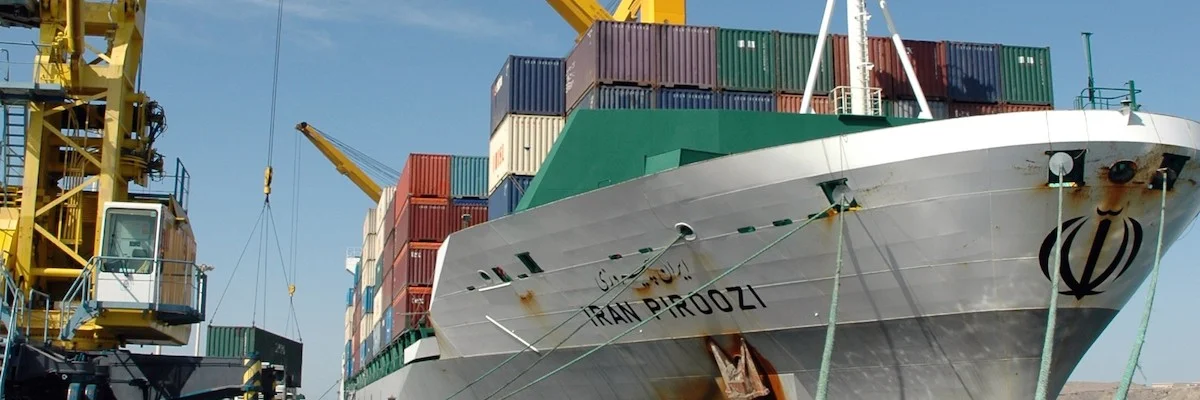
Photo: IRNA
India’s Iran Port Plans Languish Despite US Waiver
◢ Trump may have exempted Iran’s Chabahar port from sanctions, but India has struggled to realize its ambitions for the major infrastructure project. Recent government data confirms that no Indian investment has been made in the port in two years. As one Indian official involved with the project since its origins put it, “This was not what we hoped to achieve. Chabahar is only about photo-ops now, not substance.”
A year has passed since the US reimposed sanctions on Iran. During this time, the Trump administration exempted India’s investments in the Iranian port of Chabahar from sanctions in order to protect India’s strategic interests. Despite this accommodation, recent government data suggests that no new Indian investments have been made in the port project in the last two years.
Foreign aid expenditure figures released in July by the re-elected Modi government show that India has not spent any of its allocated funds for Chabahar since 2017. There is a conspicuous absence of spending even though roughly USD 20 million (150 crore rupees) was set aside each year. The government has now allocated a significantly lower, and perhaps more realistic, USD 6 million for the current year.
These figures confirm reports that India’s ambitions for Chabahar had hit a stumbling block even before Trump withdrew from the JCPOA nuclear deal. Evidently, the sanctions waiver has not been of much use either.
India’s Chabahar Ambitions
Indian prime minister Narendra Modi, now in his second term, has declared regional connectivity as a primary foreign policy goal and injected momentum into major initiatives to India’s east and west. A part of this was certainly driven by the state’s concerns about China’s own mammoth connectivity drive—the Belt and Road Initiative (BRI)—that runs through its immediate neighborhood and traditional sphere of influence. The project ideas themselves, however, pre-date the BRI.
The main regional connectivity project to India’s west is the Iran-India-Afghanistan transit initiative that hinges on the development of the Chabahar port along with road and rail links connecting it to Afghanistan. With Pakistan denying land access to India, New Delhi intends to use Chabahar to engage with the Afghan market and support Afghanistan’s trade and economic development.
Four years after Modi injected fresh momentum into the project, development at Chabahar has been slow—largely owing to US sanctions against Iran.
As per Iran’s original four-phase development plan, India was to invest USD 85 million to upgrade, equip, and operate two terminals on a ten-year lease. Indian prime minister Narendra Modi and Iranian President Hassan Rouhani oversaw the signing of this contract in May 2016 during the former’s visit to Iran.
Subsequently, Iran upgraded existing port infrastructure as per their agreed first phase of development. This upgraded port was inaugurated in December 2017 with great fanfare. The following year, India took over operations of the port but not much else went according to plan.
Ambitions vs. Reality
When it comes to sanctions, talk is never cheap.
Statements are more than enough to spook companies, heighten risk-aversion, and add further costs to proposed ventures. This was the case for Chabahar as early as Trump’s election campaign, long before the US president violated the nuclear deal.
The Indians first faced an investment chill at home. The Chabahar project calls for a private Indian firm to come on board as a strategic partner to manage, operate and maintain the port for ten years. The government entity created to oversee India’s foreign port projects—India Global Ports Limited (IGPL)—held two bidding rounds since 2016 with no result. It is now rewriting the terms a third time. Given the delay, the Indians signed on an Iranian firm (Kaveh Port and Marine Services) in the interim to take over operations.
A second task was to equip the port. European firms were Iran’s first preference but predictably after Trump’s win, they showed little-to-no interest in equipment bids. This left India with no choice but to work with Chinese firms. Interestingly, a Chinese company that won a bid to supply cranes in 2017 is blacklisted within India. Recent reports in the Indian media now suggest that some of these companies are reluctant to deliver equipment. Again, an environment of fear and uncertainty remains despite the US exemption.
A third aspect is the larger regional project on connectivity between India, Iran, and Afghanistan. As things stand, all parties are working with existing port infrastructure, roadways and operational capacity on this transit project. The route was tested successfully in October 2017 when Indian shipments of wheat arrived at Chabahar from Kandla (Gujarat) and made their way into Afghanistan. There is much left to be done, including the building of a new railway route, but Trump’s sector-specific sanctions pose new complications.
Making Do and Muddling Through
Three years on, Chabahar’s progress does not match India’s original expectations and Trump’s exemption has proven to be inadequate.
This project was touted to be India’s first foreign port development endeavour. For many assessing New Delhi’s record on infrastructure development abroad, the Chabahar project is no longer a useful indicator. It continues to rely heavily on stopgap measures with neither Indian nor foreign companies coming on board. It was a venture that New Delhi could have fought harder to preserve. But the reality is that it chose not to—a decision that merits an entirely separate discussion on the nuances of the India-US partnership and Iran’s reduced place in it.
All signs today point to the stakeholders behind the Chabahar project muddling through with what exists on the ground in Iran. As one Indian official involved with the project since its origins lamented, “This was not what we hoped to achieve. Chabahar is only about photo-ops now, not substance.”
Photo; Logiscm.ir