

US Weighing Sanctions to Cripple Iran Humanitarian Trade
The Trump administration is reportedly considering new sanctions targeting several Iranian banks, a move that would cripple the few reliable banking channels for Iranian imports of food and medicine.
The Trump administration is reportedly considering a new set of sanctions designations targeting 14 Iranian banks that are not currently subject to secondary sanctions. The new designations would be made under authorities associated with “terrorism, ballistic-missile development and human-rights abuses.” The targeting of these banks would cripple Iran’s already degraded channels for the importation of humanitarian goods—including food and medicine—at a time when the country is battling the COVID-19 pandemic.
This new proposal, spearheaded by the Foundation for Defense of Democracies, long-time opponents of the 2015 nuclear deal, would be the latest and most extreme in a series of sanctions moves intended to deliberately undermined long-standing protections for humanitarian trade. Proponents of the proposal believe that it will be “possible to mitigate the humanitarian costs, chiefly through so-called comfort letters from the Treasury Department.”
However, considering the precedent set by the Trump administration, there is no reason to believe that the humanitarian costs can be mitigated. In 2019, Iran imported over $1 billion of pharmaceutical products and over $3.5 billion in cereals. This trade is so sizable that no degree of licensing or special accommodations by the Treasury Department, nor any recourse to the still non-functional Swiss Humanitarian Trade Arrangement, will suffice to ensure that ordinary Iranians are not unduly impacted by the consequences of the move. In short, the Treasury Department lacks the means to designate these banks while ensuring that Iran’s imports of food and medicine remain routine and reliable.
The designation would have three distinct consequences:
1. Iran’s rial would lose value.
The designation would serve as a supply-side and demand-side shock for Iran’s foreign exchange markets. On the supply-side, the closure of the few remaining correspondent banking channels between Iran and the global financial system would make it near-impossible for Iranian exporters to repatriate foreign exchange revenue. This makes it significantly more expensive for Iranian importers to purchase foreign exchange through the centralized NIMA exchange.
On the demand-side, ordinary Iranians will respond to the new uncertainty by seeking to convert more of their savings into foreign currency, pushing up the free market exchange rate, beyond its recent historic highs. The net effect will be that all Iranian imports become more expensive in the short-term, exacerbating the already significant inflationary pressures that have seen year-on-year inflation rise as high as 50 percent in recent months. Because Iran imports significant volumes of food and medicine products, these humanitarian goods will likewise become more expensive for Iranian households.
2. There would be a liquidity crisis around Iran’s humanitarian trade.
While foreign currency within Iran would become more expensive, the foreign currency held by Iranian these banks and their Iranian clients in accounts outside of Iran will be frozen . Since the Trump administration hit Iran’s central bank with a new designation in September 2019, it has become increasingly difficult for the Central Bank of Iran to freely use its funds for the purposes of facilitating humanitarian trade as long allowed under US sanctions exemptions. In July of this year, Reuters reported on how these challenges were having a direct impact on Iran’s ability to make payments for purchases of food commodities such as grain and soybeans.
In the face of these challenges, Iranian pharmaceutical and food importers have increasingly used funds held by private sector banks and companies outside of Iran as means to make payments for goods. These funds are often held at accounts belonging to Iranian banks at foreign financial institutions in countries such as Turkey, South Korea, and China. If these Iranian banks are designated in a manner that eliminates the clear exemptions for the use of Iranian-origin funds for humanitarian trade, foreign financial institutions will be obligated to freeze the accounts of Iranian banks and their clients.
Such a situation, which is functionally the same as the situation facing funds belonging to Iran’s central bank, would contribute to a sudden liquidity crisis. Even if European and Asian companies remain willing to sell humanitarian goods to Iran, and even if the Treasury Department issues new licenses and comfort letters to try and reassure companies about the permissibility of these sales, Iranian importers will struggle to source the foreign currency needed to pay for these goods. This will likely contribute to significantly more delays in the importation of food and medicine which could lead to issues of scarcity and affordability.
Because of the restrictions imposed by sanctions on Iran’s banking sector, the financial transactions that enabled these imports are facilitated through an increasingly complex and fragile set of banking channels. Iranian importers and their suppliers are required to have multiple channels, knowing that new sanctions designations or financial circumstances could render any channel non-viable overnight. This byzantine system is the direct opposite of the simple, reliable banking channels countries need to ensure the availability of food and medicine. Targeting these key Iranian banks with new sanction will smash the remaining few reliable channels.
3. Many global pharmaceutical and food companies would quit the Iranian market.
Among the banks that may be targeted are those Iranian institutions that have gone to the greatest lengths to adopt anti-money laundering and counter terrorist financing policies, including those policies recommended by the Financial Action Task Force. While such policies have been only partially implemented across the wider Iranian financial system, these banks have instituted policies that exceed regulatory requirements in Iran in order to effectively serve Iranian importers and the multinational pharmaceutical and food commodities companies that supply them. These banks take an active role in helping these companies meet the stringent due diligence requirements necessary to successfully process Iran-related payments at banks in Europe and Asia. The impact of such a designation on these banks would be grave.
We know this because of the experience of Parsian Bank, a similar private sector financial institution which became subject to a terrorism-related designation in October 2018. As reported by the Washington Post, the designation of Parsian Bank left many multinational companies, including German drugs giant Bayer, scrambling to transfer their accounts to new Iranian banks in order to maintain their sales to Iran. But should the Trump administration move to designate all the remaining banks, there will be no alternatives available.
This will be a significant blow to the operations of many multinational companies which still maintain a local presence in Iran—companies overwhelmingly involved in the importation and production of food and medicine. Given these new operational restrictions, it is likely that many of the European and Asian companies still selling into Iran will either temporarily or permanently cease operations. As an employee at Bayer Iran commented to the Washington Post on the impact of sanctions on foreign pharmaceutical companies in Iran, “Many companies have started limiting their activities and laying off employees.”
Consequences for the US
What is striking about the proposed sanctions is the lack of any clear policy rationale for their imposition. The targeting of these banks in no way advances the Trump administration’s stated aims to curtail Iran’s “malign behaviors.” These banks are not significant vectors for money laundering and terrorist financing nor are they substantively linked to the Iranian government nor entities such as the Islamic Revolutionary Guard Corps. These banks have not been designated so far under the proposed authorities precisely because they are unlike most other Iranian banks. It is these distinct governance and operational characteristics that have enabled several of these banks to play a crucial role in humanitarian trade. As such, there is no national security justification for the designations—the only clear impact will be the further immiseration of ordinary Iranians as the supply of food and medicine becomes increasingly erratic.
Those who support targeting these banks have spoken openly about their intention to make future diplomacy with Iran more difficult in the event that Joe Biden wins the election in the next few weeks. This admission itself exposes the cynical thinking behind the proposal. But more consequentially for those individuals who have spent more than a decade developing US sanctions powers, the application of sanctions in the manner being proposed will no doubt damage the credibility of US sanctions as a tool of foreign policy.
Following significant concerns raised by governments, international organizations, and activists about the ability of sanctioned countries to respond to the COVID-19 pandemic, the Treasury Department issued a new fact sheet in April to clarify the exemptions and general licenses that govern humanitarian trade. At the time, OFAC director Andrea Gakci reaffirmed her office’s commitment to protecting “humanitarian relief efforts related to the COVID-19 crisis.”
The factsheet touted the launch of the Swiss Humanitarian Trade Arrangement (SHTA) as a model financial channel that would enable food and medicine to flow to Iran. SHTA has processed just one transaction during the COVID-19 crisis in Iran. One of the principle challenges facing SHTA and similar financial channels being considered is the failure of the Treasury Department to clearly permit the Central Bank of Iran, to access the foreign exchange reserves necessary to make payments through the channel. Such impediments will only get worse if Iran’s private sector banks are made subject to a similar designation as the central bank.
“Maximum pressure” sanctions are increasingly seen by US allies, and not least the Iranian public, as so poorly targeted as to intentionally harm the health and wellbeing of ordinary Iranians. Any move to designate the remaining Iranian banks at the heart of the country’s humanitarian trade would not only confirm this view of US sanctions policy, but also serve to directly undermine the commitments made by US officials, including Treasury Secretary Steven Mnuchin, who stated in April that his department was “committed to working with financial institutions and non-profit organizations in their efforts to mitigate risks and allow humanitarian assistance and associated payments to flow to those who need it.” Mnuchin should stand by his word and the US government should stand by its principles—the proposal to designate these banks must be rejected.
Photo: IRNA
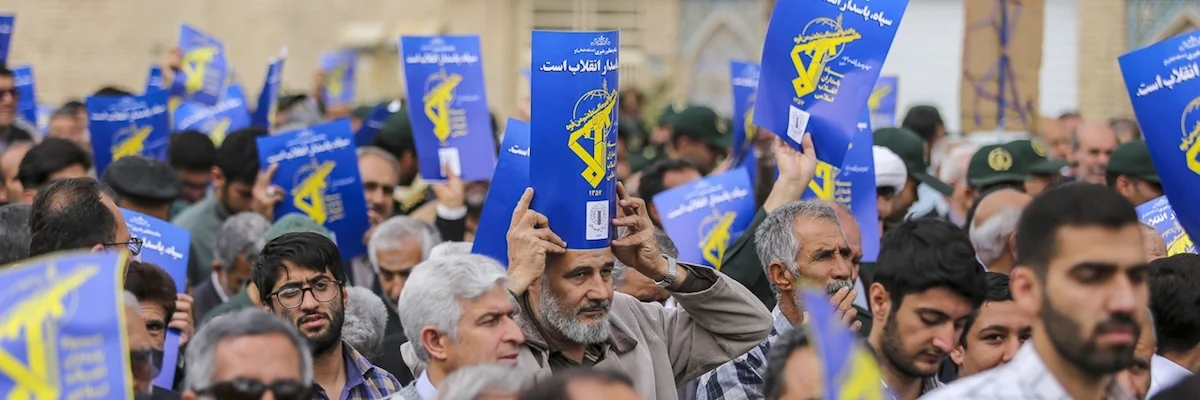
Economic War on Iran is America’s New ‘Forever War’
◢ The administration of US President Donald Trump last week designated the Islamic Revolutionary Guard Corps, part of Iran’s armed forces, as a Foreign Terrorist Organization. With the future of both the Iran nuclear deal and prospects for US-Iran diplomacy at stake, a political fallout is the clear intention behind designating the IRGC a terrorist organization.
This article was originally published in the Asia Times.
The administration of US President Donald Trump last week designated the Islamic Revolutionary Guard Corps, part of Iran’s armed forces, as a Foreign Terrorist Organization. A White House statement boasted that it was “the first time that the United States has ever named a part of another government as an FTO” and declared that the “action will significantly expand the scope and scale of our maximum pressure on the Iranian regime.”
In a briefing related to the announcement of the new designation, Secretary of State Mike Pompeo told reporters that he hopes “other governments and the private sector will now see more clearly how deeply the IRGC has enmeshed itself in the Iranian economy through both licit and illicit means”.
While there is no doubt that the Trump administration is waging a self-described “financial war” on Iran, designating the IRGC as a terrorist organization has little to do with adding new economic pressure, despite the administration’s claims. As sanctions attorney Tyler Cullis has argued, the IRGC and the wider Iranian economy are already subject to a “veritable labyrinth of US sanctions” meaning that “the designation of the IRGC as an FTO has limited, if any, immediate practical consequence.”
While the new designation does introduce increased criminal liabilities for those individuals or entities that can be shown to have provided “material support” to the IRGC, legitimate businesses were adequately deterred from engaging with the IRGC because of risks stemming from pre-existing sanctions designations.
Building a Sanctions Wall
The new designation may have limited economic impact, but it has certainly proved politically provocative. In Tehran, leaders from across political lines were unified in their condemnation of the designation and in their solidarity with the IRGC. In Washington, officials at the Pentagon and Central Intelligence Agency reportedly consider the move counterproductive, possibility putting US military and intelligence assets in the Middle East at risk of blowback. In Paris, French President Emmanuel Macron has called for all sides to practice restraint. He also spoke to Iranian President Hassan Rouhani by phone to reassure him of European support for the nuclear deal, which the US abandoned in May 2018.
In Baghdad, Iraqi Prime Minister Adel Abdel Mahdi told reporters that his government had tried to persuade the Trump administration not to proceed with the designation, noting that any escalation “would make us all losers.”
With the future of both the Iran nuclear deal and prospects for US-Iran diplomacy at stake, a political fallout is the clear intention behind designating the IRGC a terrorist organization. In an op-ed in The Wall Street Journal published just a week before the designation, the head of the hawkish Foundation for Defense of Democracies called for the Trump administration to create a “sanctions wall” that would hobble efforts by a potential Democratic president to re-enter the Iran nuclear deal in 2021. Mark Dubowitz has been among the most vocal proponents of designating the IRGC as a Foreign Terrorist Organization.
To understand how the FTO designation helps build a “sanctions wall,” it is important to consider how such a designation fits into the recent development of US sanctions powers. Today’s financialized sanctions were largely developed in response to the “forever wars” of the US invasions of Afghanistan and Iraq and the realization that the “war on terror” could not be won through conventional military conflict.
With public sentiment turning against further military deployments, and with the threat of terrorism expanding in part because of the fallout of the US invasions in the Middle East, the Treasury Department was tasked to develop new sanctions powers intended to weaken terrorist organizations by cutting their access to financial resources. As described by Juan Zarate, who served as deputy national security adviser for combating terrorism under president George W Bush, the US sought to develop its means of “financial war,” in which sanctions would “increasingly become the national-security tools of choice for the hard international security issues facing the United States.”
By the time Barack Obama took office as president, the use of sanctions in the “global war on terror” was overtaken by a new national-security imperative: addressing the perceived threat of Iranian nuclear proliferation. Suddenly, sanctions tools that had been developed primarily to target terrorist financing were being turned against governments, in part by leaning on the formal designation of countries like Iran as “state sponsors of terror.”
Building a Stigma
The application of sanctions seemed sensible – the US would leverage its primacy in the global financial system in order to block the assets of terrorist organizations and their state sponsors, while also putting their commercial enablers in legal jeopardy. Obama saw “diplomacy, backed with strong sanctions” as a direct alternative to reliance on military brinksmanship – ”a failed policy that has seen Iran strengthen its position.”
But there were unintended effects. While the US was tightening its sanctions on Iran, American officials toured the world warning companies that, despite their extensive due diligence, the opaque nature of the Iranian system meant an ever-present risk that routine commercial transactions could see funds diverted to designated groups that finance terrorism.
The stigma that arose around Iran’s economy and particularly its financial sector was so great that when Obama’s bet on diplomacy and sanctions finally paid off in the form of the historic JCPOA (Joint Comprehensive Plan of Action) nuclear deal, he ultimately proved unable to deliver Iran the economic benefits of sanctions relief promised as part of the agreement, bringing it to the brink of collapse. Even though the US lifted a large proportion of its sanctions on Iran as a matter of legal fact, companies and the banks Tehran needed remained fearful to engage, rendering the practical impact negligible.
Opponents of Obama’s nuclear deal were quick to recognize this fact. When Trump came into office having promised to tear up a “decaying and rotten deal.” some even argued that his administration could advance its anti-Iran agenda while remaining in the JCPOA on the basis that Iran was receiving no meaningful benefits. Eventually Trump did withdraw from the agreement, but as hawks opposed to engagement with Iran look to the post-Trump future, whether that future arrives in 2021 or 2025, there is a clear desire to exploit the ways in which sanctions themselves have proven a liability to diplomacy.
In this way, given the lack of practical impact, the designation of the IRGC as a terrorist organization has little to do with the activities of the corps as a military force, concerning though they may be.
Rather, by designating part of Iran’s state as a terrorist organization, a label that extends to millions of conscripts, those who wish to build a “sanctions wall” are seeking to close a political feedback loop. Not only does the FTO designation aim retroactively to justify the whole architecture of US sanctions on Iran, but even if the political circumstances between Washington and Tehran change in the future, sanctions will continue to be justified as a matter basic definitions. A future US administration seeking to lift sanctions on Iran will not merely need to argue the political expediency of that decision – it will now be forced in effect to “redefine” the most powerful force in Iranian national security, a tall order after 40 years of entrenched animosity.
What the FTO designation makes clear it that “financial war” on Iran is America’s new “forever war.”
Photo Credit: IRNA
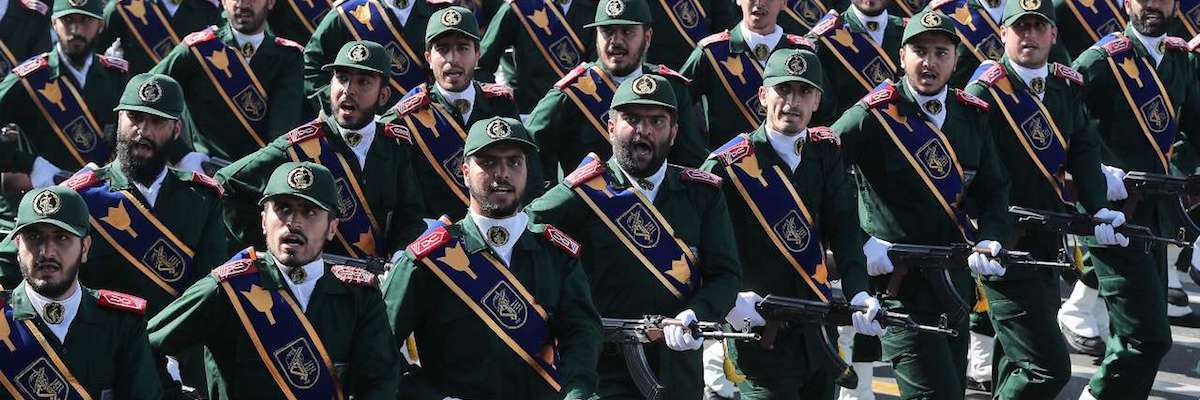
Political Risks Outweigh Legal Impact of IRGC Terrorism Designation
◢ The Trump administration announced the designation of the Islamic Revolutionary Guards Corps (IRGC)—a branch of Iran’s armed forces—as a Foreign Terrorist Organization (FTO) pursuant to section 219 of the Immigration and Nationality Act (INA). While the practical effect of the FTO designation is negligible at best, the risks to the US from the designation could be severe.
This article was originally published by The Black List.
The Trump administration announced the designation of the Islamic Revolutionary Guards Corps (IRGC)—a branch of Iran’s armed forces—as a Foreign Terrorist Organization (FTO) pursuant to section 219 of the Immigration and Nationality Act (INA). In the White House press statement, President Trump called the designation “unprecedented,” underscoring that it represents “the first time that the United States has ever named a part of another government as a FTO.”
Trump underlined that the designation “will significantly expand the scope and scale of our maximum pressure on the Iranian regime.” Secretary of State Mike Pompeo echoed those remarks in his own press conference announcing the designation, noting that the designation “will help starve the regime of the means to execute [the IRGC’s] destructive policy.” Helping amp up the designation action, US officials (dubiously) argued that the designation will target more than 11 million people comprising the IRGC’s network.
Hyperbole aside, the practical effect of the FTO designation is negligible at best. Considering the multiple sanctions programs under which the IRGC is currently designated, the FTO designation appears entirely superfluous, exerting no additional substantial pressure against the IRGC.
On the other hand, the risks to the US from the designation could be severe. As long reported, the Department of Defense and the CIA have been steadfastly opposed to designating the IRGC an FTO—viewing the designation as fraught with consequences for US troops and without material benefit for the United States. Their opposition appears to have been overcome, however, by those in the White House and State Department who have rallied to increase the pressure-in substance or rhetoric-against Iran regardless of the potential consequences.
Legal Authority for FTO Designation and the Sanctions Consequences
12 U.S.C. § 1189 authorizes the Secretary of State to designate an organization an FTO if the Secretary finds that the organization is a foreign organization that engages in terrorist activity that threatens US nationals or US national security. The Secretary’s intent to designate a foreign organization an FTO is first communicated to members of the Congress, along with the findings and factual basis for the Secretary’s decision to designate the organization, which explains the apparent delay between President Trump’s announcement and the formal designation of the IRGC as an FTO.
The immediate consequences of an FTO designation are limited in scope. Pursuant to 12 U.S.C. § 1189(2)(C), the Secretary of Treasury is given discretionary authority to require US financial institutions to block all financial transactions involving assets of an FTO. In addition, all members of an FTO are prohibited from entering the United States under 12 U.S.C. § 1182(a)(3). This latter provision could be used to block Iranian persons who performed mandatory military service in Iran from entering the United States. This could explain the “11 million people” claim by members of the Trump administration.
Preexisting US Sanctions Targeting IRGC
The IRGC is already designated under multiple U.S. sanctions authorities—most of which cover the ground of an FTO designation. For instance, the IRGC is designated under:
E.O. 13224 as a Specially Designated Global Terrorist;
E.O. 13382 as a WMD Proliferator;
E.O. 13553 as a human rights abuser; and
E.O. 13606 as a human rights abuser as well.
These designations have significant U.S. secondary sanctions consequences. For instance, 31 C.F.R. § 561.201 exposes foreign financial institutions that conduct a significant financial transaction with, or provide significant financial services for or on behalf of the IRGC or a person designated pursuant to E.O. 13224 or E.O. 13382, to correspondent or payable-through account sanctions. In addition, the Iran Freedom Counter-Proliferation Act subjects foreign banks to correspondent or payable-through account sanctions, and foreign persons to menu-based sanctions, for engaging in significant transactions with Iranian persons, which would include the IRGC.
Due to the serious secondary sanctions consequences inherent in dealing with the IRGC, OFAC has long given the IRGC its own program tag “[IRGC]” to aid foreign persons seeking to comply with U.S. sanctions targeting the group.
In addition, multiple US statutory authorities require the President to identify officials, agents, or affiliates of the IRGC and to impose sanctions with respect to them. These reporting requirements ensure that the U.S. remains hyper-focused on the IRGC and its activities and prepared to impose additional designations as warranted.
Practical Consequences of FTO Designation
Amidst this veritable labyrinth of US sanctions targeting the IRGC, the designation of the IRGC as an FTO has limited, if any, immediate practical consequence. For instance, the blocking of the IRGC’s assets is already mandated by the executive authorities under which the IRGC is designated—some of which also impose visa requirements. Iranian persons who formerly served in the IRGC have long been subject to intensified scrutiny from US immigration authorities and have often been denied entry on these grounds.
The sole possible additional consequence arising from an FTO designation is the extraterritorial criminal jurisdiction afforded over foreign persons acting outside the United States that knowingly provide material support to an FTO. 18 U.S.C. § 2339B states that persons who knowingly provide material support or resources to an FTO or attempt or conspire to do so are subject to fine or imprisonment of not more than twenty (20) years (unless death results from the prohibited act). Material support is defined broadly to include any property or service.
18 U.S.C. § 2339B(d)(1) expressly provides for extraterritorial criminal jurisdiction, stating that there is jurisdiction over an offense “if . . . after the conduct required for the offense occurs an offender is brought into or found within the United States, even if the conduct required for the offense occurs outside the United States.” This means that foreign persons providing material support to an FTO are subject to criminal prosecution in the United States, even if the foreign person has no legal status in the United States; acted outside of the United States; and the conduct did not touch or otherwise have effects within the United States.
This provision could lead foreign parties conducting business with Iran to exercise even more heightened due diligence with regard to their dealings. Yet, the consequences of dealing with the IRGC are already especially dire, and foreign parties doing legitimate trade with Iran are likely to have taken steps to ensure the absence of IRGC-related parties.
So What’s the Purpose...?
Considering the negligible benefits of an FTO designation, the Trump administration appears to have two things in mind through its designation of the IRGC: (1) to invite an Iranian response that could collapse the nuclear deal and risk a broader conflict with the United States; and (2) to use the threat of criminal prosecution to deter even legitimate business with Iran, as members of the Trump administration have long claimed that the IRGC controls broad sectors of the Iranian economy. This latter element could also be used to constrain a future President from re-entering the Iran nuclear accord and complying with its terms, considering the potential political pitfalls inherent in rescinding the FTO designation.
Indeed, chief proponent of the FTO designation and close adviser to the Trump administration Mark Dubowitz of the Foundation for Defense of Democracies stated that the designation “just layers on top of all of the current sanctions an additional and more expansive, punitive measure that will deter more business and . . . diminish current business that’s still ongoing between the Europeans and the Iranians, and the Asians and the Iranians.” The purpose of this, he earlier wrote, is to “make the case for dismantling these sanctions [hard],” thereby “block[ing] [the next administration] from delivering sanctions relief to Iran” consistent with the Iran nuclear accord.
Such motivations—if accurately depicting internal deliberations by the administration—would prove a grave abuse of the FTO designation process and the broader use of US sanctions authorities to target activities anathema to US security interests.
Photo Credit: IRNA