

Iran’s Pact With China Is Bad News for the West
Tehran’s new strategic partnership with Beijing will give the Chinese a strategic foothold and strengthen Iran’s economy and regional clout.
By Alam Saleh and Zakieh Yazdanshenas
A recently leaked document suggests that China and Iran are entering a 25-year strategic partnership in trade, politics, culture, and security.
Cooperation between China and Middle Eastern countries is neither new nor recent. Yet what distinguishes this development from others is that both China and Iran have global and regional ambitions, both have confrontational relationships with the United States, and there is a security component to the agreement. The military aspect of the agreement concerns the United States, just as last year’s unprecedented Iran-China-Russia joint naval exercise in the Indian Ocean and Gulf of Oman spooked Washington.
China’s growing influence in East Asia and Africa has challenged U.S. interests, and the Middle East is the next battlefield on which Beijing can challenge U.S. hegemony—this time through Iran. This is particularly important since the agreement and its implications go beyond the economic sphere and bilateral relations: It operates at the internal, regional, and global level.
Internally, the agreement can be an economic lifeline for Iran, saving its sanctions-hit, cash-strapped economy by ensuring the sale of its oil and gas to China. In addition, Iran will be able to use its strategic ties with China as a bargaining chip in any possible future negotiations with the West by taking advantage of its ability to expand China’s footprint in the Persian Gulf.
While there are only three months left before the 2020 U.S. presidential election, closer scrutiny of the new Iran-China strategic partnership could jeopardize the possibility of a Republican victory. That’s because the China-Iran strategic partnership proves that the Trump administration’s maximum pressure strategy has been a failure; not only did it fail to restrain Iran and change its regional behavior, but it pushed Tehran into the arms of Beijing.
In the long term, Iran’s strategic proximity to China implies that Tehran is adapting the so-called “Look East” policy in order to boost its regional and military power and to defy and undermine U.S. power in the Persian Gulf region.
For China, the pact can help guarantee its energy security. The Persian Gulf supplies more than half of China’s energy needs. Thus, securing freedom of navigation through the Persian Gulf is of great importance for China. Saudi Arabia, a close U.S. ally, has now become the top supplier of crude oil to China, as Chinese imports from the kingdom in May set a new record of 2.16 million barrels per day. This dependence is at odds with China’s general policy of diversifying its energy sources and not being reliant on one supplier. (China’s other Arab oil suppliers in the Persian Gulf region have close security ties with the United States.)
China fears that as the trade war between the two countries intensifies, the United States may put pressure on those countries not to supply Beijing with the energy it needs. A comprehensive strategic partnership with Iran is both a hedge and an insurance policy; it can provide China with a guaranteed and discounted source of energy.
Chinese-Iranian ties will inevitably reshape the political landscape of the region in favor of Iran and China, further undermining U.S. influence. Indeed, the agreement allows China to play a greater role in one of the most important regions in the world. The strategic landscape has shifted since the 2003 U.S. invasion of Iraq. In the new regional order, transnational identities based on religious and sectarian divisions spread and changed the essence of power dynamics.
These changes, as well as U.S. troop withdrawals and the unrest of the Arab Spring, provided an opportunity for middle powers like Iran to fill the gaps and to boost their regional power. Simultaneously, since Xi Jinping assumed power in 2012, the Chinese government has expressed a stronger desire to make China a world power and to play a more active role in other regions. This ambition manifested itself in introducing the Belt and Road Initiative (BRI), which highlighted the strategic importance of the Middle East.
China grasps Iran’s position and importance as a regional power in the new Middle East. Regional developments in recent years have consolidated Iran’s influence. Unlike the United States, China has adopted an apolitical development-oriented approach to the region, utilizing Iran’s regional power to expand economic relations with nearby countries and establish security in the region through what it calls developmental peace—rather than the Western notion of democratic peace. It’s an approach that authoritarian states in the Middle East tend to welcome.
U.S. President Donald Trump’s withdrawal from the nuclear deal with Iran in 2018, and the subsequent introduction of the maximum pressure policy, was the last effort by the U.S. government to halt Iran’s growing influence in the region. Although this policy has hit Iran’s economy hard, it has not been able to change the country’s ambitious regional and military policies yet. As such, the newfound strategic cooperation between China and Iran will further undermine U.S. leverage, paving the way for China to play a more active role in the Middle East.
The Chinese-Iranian strategic partnership will also impact neighboring regions, including South Asia. In 2016, India and Iran signed an agreement to invest in Iran’s strategic Chabahar Port and to construct the railway connecting the southeastern port city of Chabahar to the eastern city of Zahedan and to link India to landlocked Afghanistan and Central Asia. Iran now accuses India of delaying its investments under U.S. pressure and has dismissed India from the project.
While Iranian officials have refused to link India’s removal from Chabahar-Zahedan project to the new 25-year deal with China, it seems that India’s close ties to Washington led to this decision. Replacing India with China in such a strategic project will alter the balance of power in South Asia to the detriment of New Delhi.
China now has the chance to connect Chabahar Port to Gwadar in Pakistan, which is a critical hub in the BRI program. Regardless of what Washington thinks, the new China-Iran relationship will ultimately undermine India’s interests in the region, particularly if Pakistan gets on board. The implementation of Iran’s proposal to expand the existing China-Pakistan Economic Corridor along northern, western, and southern axes and link Gwadar Port in Pakistan to Chabahar and then to Europe and to Central Asia through Iran by a rail network is now more probable. If that plan proceeds, the golden ring consisting of China, Pakistan, Iran, Russia, and Turkey will turn into the centerpiece of BRI, linking China to Iran and onward to Central Asia, the Caspian Sea, and to the Mediterranean Sea through Iraq and Syria.
On July 16, Iranian President Hassan Rouhani announced that Jask Port would become the country’s main oil loading point. By placing a greater focus on the development of the two strategic ports of Jask and Chabahar, Iran is attempting to shift its geostrategic focus from the Persian Gulf to the Gulf of Oman. This would allow Tehran to avoid the tense Persian Gulf region, reduces the journey distance for oil tankers shipping Iranian oil, and also enables Tehran to close the Strait of Hormuz when needed.
The bilateral agreement provides China with an extraordinary opportunity to participate in the development of this port. China will be able to add Jask to its network of strategic hubs in the region. According to this plan, regional industrial parks developed by Chinese companies in some Persian Gulf countries will link up to ports where China has a strong presence. This interconnected network of industrial parks and ports can further challenge the United States’ dominant position in the region surrounding the strategically vital Strait of Hormuz.
A strategic partnership between Iran and China will also affect the great-power rivalry between the United States and China. While China remains the largest trading partner of the United States and there are still extensive bilateral relations between the two global powers, their competition has intensified in various fields to the point that many observers argue the world is entering a new cold war. Given the geopolitical and economic importance of the Middle East, the deal with Iran gives China yet another perch from which it can challenge U.S. power.
Meanwhile, in addition to ensuring its survival, Tehran is going to take advantage of ties with Beijing to consolidate its regional position. Last but not least, while the United States has been benefiting from rivalry and division in the region, Chinese-Iranian partnership could eventually reshape the region’s security landscape by promoting stability through the Chinese approach of developmental peace.
Alam Saleh is a lecturer in Iranian studies at Australian National University’s Centre for Arab and Islamic Studies. He is also a council member of the British Society for Middle Eastern Studies. Follow him at @alamsaleh1.
Zakiyeh Yazdanshenas is a research fellow at the Center for Middle East Strategic Studies. Her expertise mainly focuses on great-power rivalries in the Middle East. Follow her at @YzdZakiyeh.
Photo: IRNA
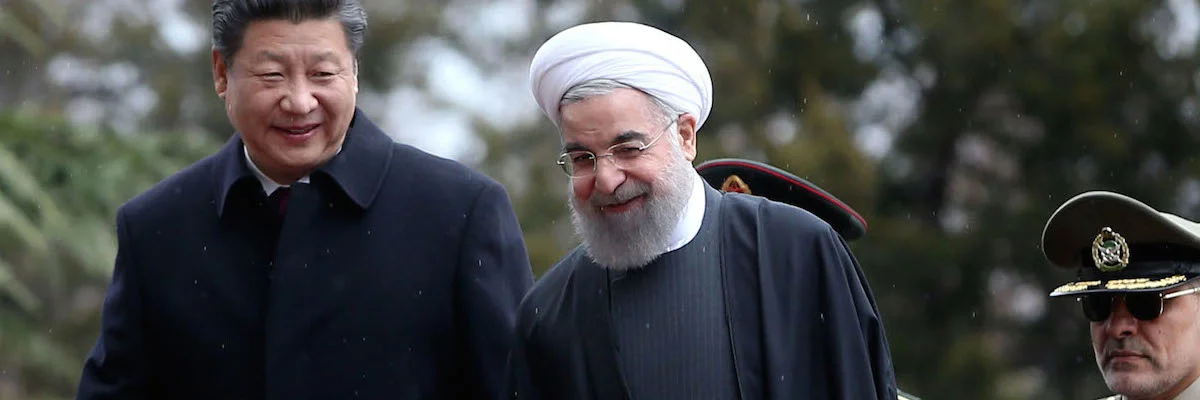
No, China Isn't Giving Iran $400 Billion
◢ A recent report from the London-based publication Petroleum Economist offers a cautionary tale of “fake news.” The claim that China will extend a $400 billion credit line to Iran is poorly sourced and inconsistent with both recent trends in China-Iran trade and the scope of China’s Belt and Road Initiative.
A recent report from the London-based publication Petroleum Economist offers a cautionary tale of “fake news” having spurred an unprecedented debate in about Sino-Iranian relations.
Quoting an anonymous senior source “closely connected” to Iran’s petroleum ministry, the article claims the existence of a major new agreement between Tehran and Beijing that could reflect “a potentially material shift to the global balance of the oil and gas sector.” The figures presented to back up this claim are astronomical—China will invest a total of $400 billion in Iran over the next 5 years, split between $280 billion in the development of Iran’s energy sector and $120 billion for infrastructure projects. This first round of investments is claimed to be part of a 25-year plan with capital injected in the Iranian economy every five years. Despite the attention that the report garnered, with follow-up articles in Forbes and Al Monitor among other publications, Petroleum Economist’s figures do not appear plausible.
China and Iran signed a comprehensive strategic partnership, the highest level in the hierarchy of Beijing’s partnership diplomacy, in 2016. On the occasion, Xi Jinping and Hassan Rouhani signed a comprehensive 25-year deal which included a series of multi-sector agreements intended to boost bilateral trade to $600 billion within a decade. Even considering the potential for trade following the listing of international sanctions after the implementation of the JCPOA, the goal was extremely ambitious, if not totally unrealistic.
Indeed, the re-imposition of US secondary sanctions in November 2018 has deeply impacted the level of China-Iran trade. As detailed in a Bourse & Bazaar special report, in the last trimester of 2018 Chinese exports to Iran dropped by nearly 70 percent, falling from the already low figure of $1.2 billion in October to a dramatic low of $400 million in December. Exports to Iran have now stabilized at just under $1billion each month.
Meanwhile, the flow of crude oil from Tehran to Beijing—undoubtedly the engine of Sino-Iranian trade—suffered a major slowdown due to the revocation of US oil waivers expired in May 2019. Despite China continuing buying Iranian oil in defiance of US sanctions, using ship-to-ship transfers and ghost tankers, the level of imports remain about half of pre-sanctions levels.
Post-November 2018 trade figures show a clear picture. Although China remains Iran’s most important foreign partner, Beijing has adopted a mixed policy vis-à-vis US sanctions—certainly bolder than European states, but still cautious. In short, the pattern of China-Iran trade suggests that a five-year, three-digit investment program is not credible, especially with oil imports at their minimum, secondary sanctions in place, and the poor record for project delivery of Chinese infrastructure projects in Iran. Moreover, it is unrealistic that Iran’s suffering economy could absorb such a massive injection of capital.
Petroleum Economist’s figures look even less realistic if looked from a broader perspective. According to Morgan Stanley, the total Chinese investment in the Belt and Road Initiative could reach $1.2-1.3 trillion in 2027. In May 2017, Ning Jizhe, the vice-chairman of China’s National Development and Reform Commission (CNDR), declared that Beijing’s investments in the BRI for the following five years (2017-2022) were expected to be between $600 billion and $800 billion. Therefore, it is hard to believe that China will invest almost the equivalent of two-thirds of its planned budget for its most ambitious and largest foreign project in Iran alone. If the Chinese were indeed set to spend $400 billion on Iran, the recent French proposal to extend a $15 billion credit line to restore JCPOA’s economic benefits would be completely useless given Chinese largesse.
The anonymous source painted an idealistic picture for Petroleum Economist, claiming that China has agreed to keep increasing its import of Iran’s oil in defiance of the United States and “to put up the pace on its development” of Phase 11 of South Pars gas field—which, ironically, represents one the clearest examples of Beijing’s difficulties in delivering its projects.
Most perplexingly, the source claimed that the deal “will include up to 5000 Chinese security personnel on the ground in Iran to protect Chinese projects.” Such a claim directly contradicts Beijing’s strategy of remaining disengaged from the Persian Gulf, especially considering the current tensions. Indeed, China’s apolitical approach to the region and good relations with Saudi Arabia and the UAE—with which China has comprehensive strategic partnerships—would be severely undermined by the presence of a Chinese armed contingent on the ground in Iran. The presence of foreign troops is also a political impossibility in Iran, where the refueling of Russian bombers at an Iranian airbase caused a political scandal last year.
With the exception of a Fars News piece quoted by Middle East Monitor, practically no Iranian nor Chinese official and semi-official news outlet have reported or confirmed the figures presented by Petroleum Economist. State news agency IRNA, which launched its Chinese channel only days before the news came out, had no corroborating report. When asked, Iran’s oil minister Bijan Zanganeh denied rumors about the $400 billion investment plan, succinctly stating: “I have not heard such a thing.” The head of the Iran-China Chamber of Commerce called the reports “a joke” and urged people to be more careful about the news they share.
The figures quoted by Petroleum Economist do not accurately reflect the future of Chinese investment in Iran. Nevertheless, the news achieved what could be assumed to be its original goal— to bait clicks.
No doubt, Iran is trying to put some pressure on the West, and perhaps on China itself, by reinforcing the idea of a strong, growing, and unique relationship between Tehran and Beijing. It should also be noted that before his trip to China at the end of August, Iran’s foreign minister, Javad Zarif published an op-ed in Global Times—a practice that is typical of Xi Jinping—calling, with quite unprecedented audacity, for a new phase in Sino-Iranian relations.
However, ties between Iran and China should not be overestimated and deserve careful consideration. In the short-term, Beijing represents Iran’s minimum insurance against US sanctions; in the long-term Tehran may be forced to more expansive eastward shift. But this will happen at the pace of China’s “strategic patience,” and there will be no $400 billion bonanza.
Photo: IRNA
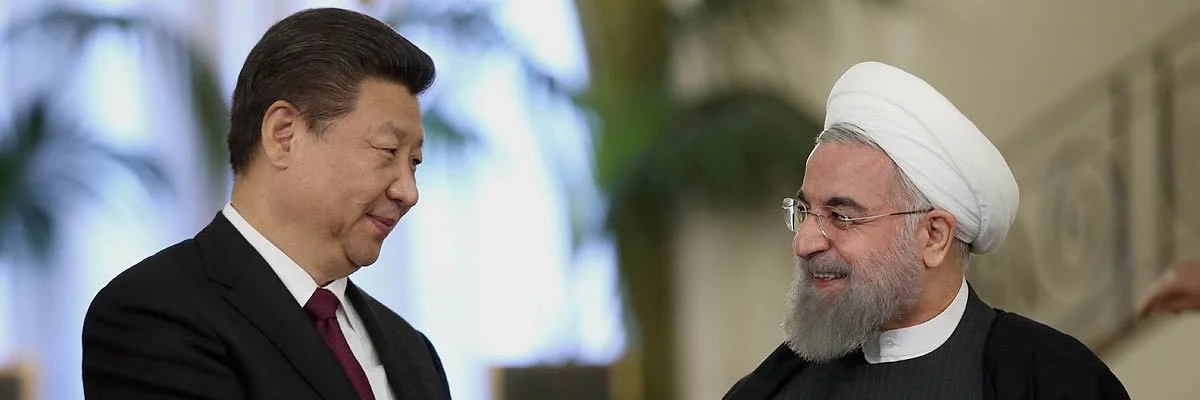
Why China Isn’t Standing By Iran
◢ Last week, Iran’s economic minister was in Beijing for talks on bilateral trade and investment. An official readout of the discussions from China’s commerce ministry describes China and Iran as “comprehensive strategic partners.” Unfortunately for Iran, the data tells a different story from the official rhetoric.
Last week, Iran’s economic minister was in Beijing for talks on bilateral trade and investment. An official readout of the discussions from China’s commerce ministry describes China and Iran as “comprehensive strategic partners.” This echoes the language used by President Xi Jinping a few weeks earlier, when he welcomed a delegation that included Iran’s foreign minister, oil minister and parliament speaker. Xi declared that “No matter how the international and regional situation changes, China’s resolve to develop a comprehensive strategic partnership with Iran will remain unchanged.”
Unfortunately for Iran, the data tells a different story from the official rhetoric.
The reimposition of U.S. secondary sanctions on Iran in November has significantly slowed Chinese-Iranian bilateral trade. Chinese exports to Iran—mainly crucial machinery and parts for Iran’s manufacturing sector—fell from USD 1.2 billion in October to just USD 428 million in February. Exports had averaged $1.6 billion a month in the period from 2014 until the beginning of 2018.
Imports from Iran, mainly crude oil, which had fallen to $1 billion in October, rose after November, when the Trump administration granted China a waiver to permit continued oil purchases. Imports hit USD 1.3 billion in February, of which USD 866 million is attributed to oil imports. These figures are consistent with the monthly averages in the period from 2014 until the beginning of 2018.
In short, while China is continuing to benefit from Iran’s energy resources, Iran is struggling to use its earnings to purchase Chinese exports.
This challenges the long-standing assumption in Tehran that China would stand by Iran despite sanctions pressures. In the previous sanctions period from 2008 to 2016, Chinese businesses significantly expanded their commercial presence in Iran, stepping in as Western companies exited the market. Iranians welcomed commercial partnerships with a country they believed to be economically minded, and unconcerned by Iran’s regional activities or its domestic governance.
These hopes received an early jolt in October, when the Iranian business community was left scrambling after Bank of Kunlun, the state-owned bank at the heart of China-Iran trade, suspended most financial transactions with Iran. Although the bank resumed trade in January, it announced a new policy: It would only service trade exempt from U.S. secondary sanctions. This means trade in food, medicine and consumer goods, for which China is not Iran’s leading source of imports. Bank of Kunlun’s move is consistent with the terms of the oil waiver, which requires Iran’s earnings be paid into an escrow account and used exclusively for non-sanctioned bilateral trade.
Seen through the prism of short-term considerations, China’s policy adjustments at the expense of its trade with Iran are easy to understand. As Pedram Soltani, vice president of the Iran Chamber of Commerce, has observed, the roiling trade war with the U.S. remains a much higher priority for China. Additionally, the arrest of Huawei executive Meng Wanzhou has made Chinese enterprises, particularly those with the most global reach, reticent to engage opportunities in Iran for fear of being similarly targeted by American authorities.
But China’s acquiescence to secondary sanctions is inconsistent with Beijing’s stated opposition to extraterritorial sanctions. In October, foreign ministry spokesperson Hua Chunying told reporters: “China always opposes the unilateral sanctions and long-arm jurisdiction. China’s normal cooperation with Iran under the framework of the international law is reasonable, legitimate and legal, and it should be respected and upheld.”
While Europe has made extraordinary efforts to both assert its economic sovereignty and preserve the nuclear deal, even going so far as to establish a new state-owned trade financial intermediary, China has taken no commensurate effort to shield its own trade from the long arm of American law.
Also, by downgrading the trading relationship with Iran, Beijing is in effect signaling to Washington that secondary sanctions can be used to stymie China’s economic ambitions abroad. As the U.S. struggles to respond to China’s Belt-and-Road strategy and its new role as a Eurasian superpower, there will be a temptation to use sanctions to raise barriers to China’s expansion. By failing to resist secondary sanctions on Iran now, China is inviting more pressure on key trade and investment relationships in the future, while also shirking its obligation to help preserve the nuclear deal.
It is possible that Chinese-Iranian trade could recover to a new steady state later this year, and that Beijing could designate a new bank to facilitate non-oil exports. But when the waivers come up for renewal in early May, the Trump administration could make such a waiver contingent on China continuing to downsize its non-oil trade with Iran. Since Iran is more important for China as an energy supplier than as an export market, China will likely sacrifice its exports to sustain oil imports—especially since it is unclear that Iran has sufficient leverage to insist that China avoid making such a trade-off.
Photo Credit: IRNA

The Economic War Iran Faces is Bigger Than it Thinks
◢ On the third anniversary of the implementation of the Joint Comprehensive Plan of Action (JCPOA) and the fortieth anniversary of the Islamic Republic, the era of hope ushered in by the election of Hassan Rouhani and the implementation of the nuclear deal seems a lifetime ago. Iran remains in compliance with the agreement, but begrudgingly. Europe looks impotent in the face of U.S. sanctions. But Iran’s economic war isn't just a fight against sanctions. Iran is the frontline of an intensifying economic war between the US, Europe, China, and Russia.
This article was originally published in LobeLog.
There is a telling line in Thomas Erdbrink’s recent report on Iran’s roiling currency crisis. Erbrink speaks to Kaveh and Reihaneh Taymouri, whose monthly household income fell from about $1,400 to just $90 following the collapse of their small electronics business. Reflecting on her household’s “downfall,” Reihaneh Taymouri told Erdbrink, “I’m not really that sad, because we are not alone… It’s happening to so many people.”
On the third anniversary of the implementation of the Joint Comprehensive Plan of Action (JCPOA) and the fortieth anniversary of the Islamic Republic, the era of hope ushered in by the election of Hassan Rouhani and the implementation of the nuclear deal seems a lifetime ago. Iran remains in compliance with the agreement, but begrudgingly. Europe looks impotent in the face of U.S. sanctions. Russia and China are demonstrating the contingent nature of their commitments to Iran as both seek to extract concessions in return for providing an economic lifeline.
There was a time when Iranians could look forward to the promise of sanctions relief. But the experience of sanctions relief under the JCPOA has been sobering. When the relief finally comes again, Iranians now know not to expect a dramatic rebound. On one hand, the political and economic machinery of U.S. sanctions means they are incredibly difficult to roll back given the myriad ways in which lingering stigma and the whims of a new administration can combine to undercut the relief.
On the other hand, looking beyond sanctions, the political and economic machinery of the Islamic Republic is too developed for policy to produce anything more than marginal improvements in outcomes. The path to prosperity requires the thousands of incremental steps that allow marginal gains to become substantial. The challenge of incrementalism is that taking each step continues to require significant political capital, even as gains diminish in absolute terms. Governments need to be politically dominant to achieve even modest economic and social victories, and policymakers can hardly afford to make mistakes.
This is the dilemma facing all middle-income countries, once labeled “emerging markets,” whose high growth rates were burnished by external finance. Since the global financial crisis, Brazil, Mexico, Russia, Turkey, and South Africa have all failed to achieve more than a few percentage points of economic growth each year, contributing to considerable electoral turmoil and, in turn, illiberal politics. Looking across its peer countries, Iran may be uniquely hampered by “maximum pressure” sanctions, but it is not clear that the absence of sanctions would have seen Iran achieve levels of growth necessary for it to escape the global middle-income doldrums. The deadline for “convergence” has been pushed back.
But this is not to say that the return of sanctions and the attendant recession are unimportant. Marginal changes in a country’s macroeconomic circumstances do correspond to dramatic changes in the fortunes of individuals and households in both good times and bad.
The one-year period between the implementation of the Iran deal and the inauguration of Donald Trump saw the emergence of a “gold rush” mentality in Iran. Although Iranians witnessed improvements in the range of goods and services available to them, the greatest expectations were tied to the idea that in the new period anyone could “strike gold” and achieve a major reversal in their fortunes. Any minor improvements in quality of life were far less important than the possibility of a major uplift.
Today, the same dichotomy between the marginal and major is at play, but now it is the dichotomy between marginal deterioration and major downfall. The IMF has already predicted that Iran could emerge from its new recession as soon as 2020. In the short term, Iran’s government can spend its way out of a contraction, using the same monetary and fiscal tools employed by governments in the aftermath of the financial crisis. But these interventions will matter little for the many households that have already undergone a significant decline. The trajectory of Iran’s economy may reverse in due course, but for the Taymouri family and other middle-class families like them, their personal trajectories have propelled them into a new and embattled reality. The Taymouri family now lives in “a 485-square-foot apartment in one of the city’s worst neighborhoods, next to its sprawling cemetery.” It will be difficult for them to escape the new middle-class doldrums.
The fate of Iran’s middle class is directly tied to that of its private sector. The growth of Iran’s private-sector companies over the last 20 years, catering to the burgeoning consumer tastes of the middle class, has been the subject of continual lip service in the government’s economic plans. But in practice, entrepreneurs have had to fight entrenched interests and a stifling bureaucracy in order to carve out a more modern and efficient corner of the economy.
On the back of the sanctions relief afforded by the nuclear deal, the private sector was poised to take its place at the center of Iran’s economy. A spate of new contracts struck with foreign partners saw privately owned enterprises cross the threshold in the energy, automotive, and telecommunications sectors, long the domains of Iran’s state-owned firms. Across Iran’s political establishment, calls were being made to curtail state control of the economy in order to boost Iran’s appeal to foreign investors.
Today, European governments are struggling to protect their own private-sector companies from the impact of US secondary sanctions. On one hand, given a deep ideological commitment to liberal markets, European governments are loath to pressure their companies and banks to continue working in Iran. Moreover, as evidenced by the lack of implementation of the blocking regulation, European governments cannot even compel their businesses and banks to provide basic services to those few European companies that do wish to maintain commercial activities in Iran. As foreign partners flee Iran and the private sector reels, major contracts are once again going to groups such as the Revolutionary Guard. In this way, the considerable power European private-sector firms wield over their governments will condemn Iranian private-sector companies to remain beholden to the state.
Europe’s struggle to maintain commercial ties with Iran has inspired calls for greater “economic sovereignty.” France, Germany, and the UK are developing a state-owned special purpose vehicle to facilitate trade with Iran. The mechanism represents the kind of trade intermediary more common in the 1960s, before Europe had cast aside statist approaches to economic development. In recent decades, because of market liberalization, Europe has separated economic power from state power. Increasingly, European governments are reckoning with the political limits of their unified economic model, which leverages little more than the slim technological advantage and brand power of European products. Meanwhile, the United States is continuing to wield powerful sanctions, exposing how the financialization of the global economy has dramatically increased U.S. state power despite the appeals to free-market mantras. As Bruno Maçães has compellingly argued, after flirting with liberalization, Russia and China have reaffirmed the ultimate importance of economy as a tool of state power. Russia is advancing its vision for a Eurasian Economic Union. China is spending billions on its Belt and Road projects.
Iran is perhaps the only country in the world where all four of these distinct economic agendas currently clash and compete. So far, it is not clear which model will prevail. Cognizant that Iran has been starved of the investment its unique geography and large population warrant, Iranian officials debate whether their economic planning should face “East” or “West,” as though the orientation of Iran’s own economic planning will suffice to break the deadlock. But in fact, Iran faces domestic economic challenges that are also global economic realities. The “economic war” in which Iran finds itself is larger than the Iranian leadership or Iranian people may realize.
Photo Credit: