

Iran's Year Under Maximum Pressure
Since the Trump administration reimposed secondary sanctions on Iran in November 2018 as part of its “economic war,” the Iranian economy has faced higher inflation, disruption in trade, and a manufacturing slowdown. But over the least year, there are signs of resilience and readjustment that suggest that Iran’s economy is unlikely to be brought “to its knees,” despite the fact that the economy continues to face significant hurdles.

Download Report
January 2020 - 14 Pages
Please enter your email address in order to download the full report.
Executive Summary
Since the Trump administration reimposed secondary sanctions on Iran on November 5, 2018 as part of its campaign of “economic war” on the Islamic Republic, there has been a great deal of speculation as to whether unilateral sanctions would prove sufficient to bring Iran’s economy “to its knees.” One year later, the serious impacts of the Trump administration’s “maximum pressure” policy are impossible to deny. The International Monetary Fund (IMF) projects that Iran’s economy will contract by 9.5 percent this year, the largest contraction since the height of the Iran-Iraq War in 1984. However, there are already signs of readjustment in the Iranian economy. The IMF’s also projects that Iran will return to zero growth in 2020—a rebound that would parallel Iran’s experience in 2012-2013, in which Iran rebounded from a 7.4 percent contraction to minor 0.2 percent contraction the following year.
In the second half of 2019, marked improvements in several areas of Iran’s economy suggest that the country may emerge from its recession in 2020. Foreign exchange markets have largely stabilized, manufacturing activity is expanding, and non-oil sectors of the economy are beginning to generate new jobs. However, significant risks remain. A recent move by the Supreme National Security Council to reduce a long-standing fuel subsidy, which effectively tripled the price of gasoline, triggered widespread protests beginning in the nighttime of November 15. The subsequent violent crackdown, which led to more than 300 deaths and thousands of arrests, no only gave rise to a crisis in state-society relations in Iran, but has also threatened to undo much of the progress in the government’s efforts to stabilize the economy. The Iranian rial lost 10 percent of its value in the weeks following the protests. Events at the outset of 2020, including the airstrike that killed Qods Force commander Qassem Soleimani and the accidental downing of Ukrainian International Airlines Flight 572 by Iranian air defense, have further contributed to political and social instability in Iran, which may have a bearing on economic resiliency moving forward.
Trump administration officials have pointed to the unrest in Iran to argue that their maximum pressure campaign is working, and have warned that Iran’s government is poised to collapse. These prognostications are premature, despite the seriousness of the recent protests and the strain in state-society relations. Macroeconomic indicators point to a considerable ability among Iranian government institutions and economic operators to adapt to the headwinds. This report will present a narrative analysis of the Iranian economy in order to describe both the factors that continue to stave Iran’s economic collapse as well as areas of ongoing vulnerability.

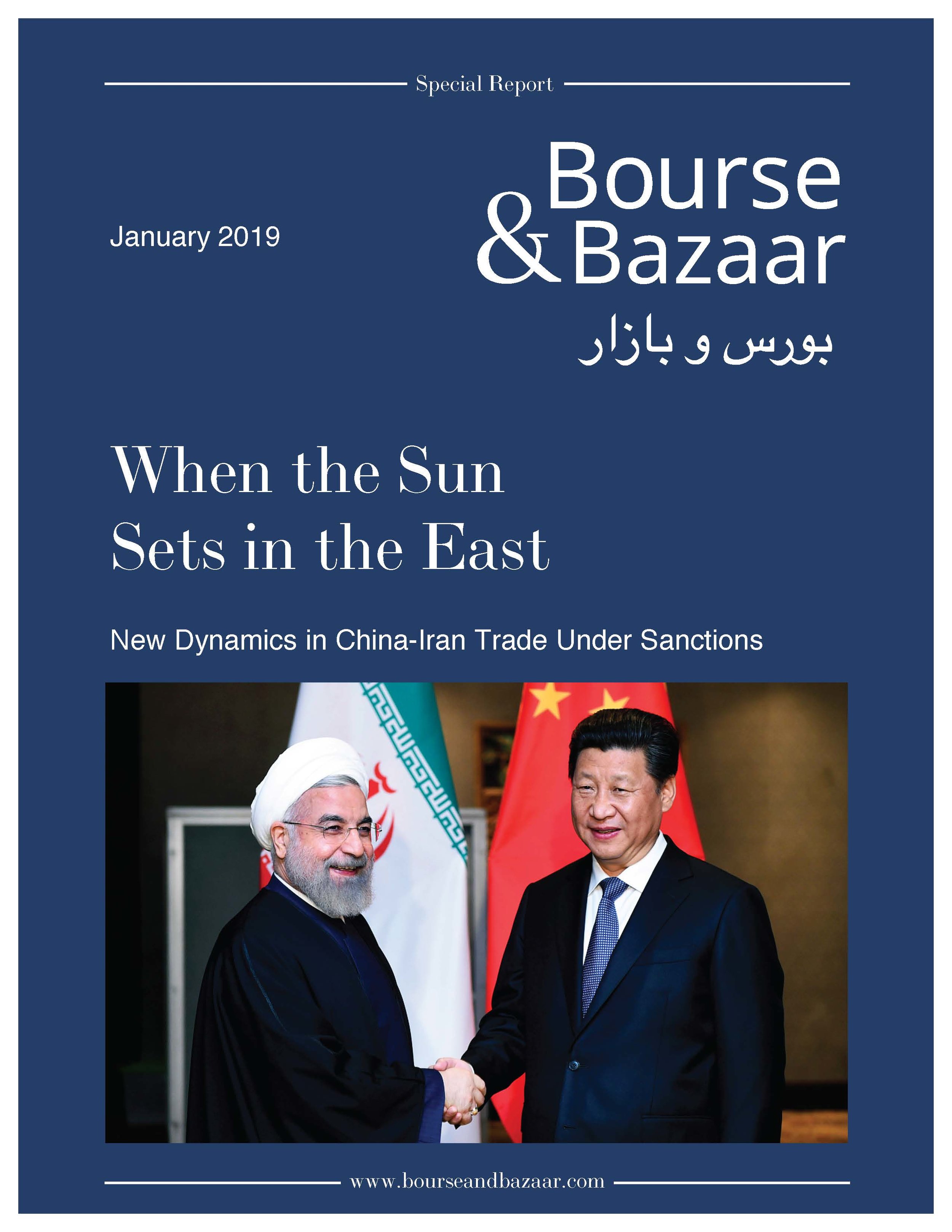
New Dynamics in China-Iran Trade Under Sanctions
A review of trade data from the General Customs Administration of the People’s Republic of China shows that China-Iran trade has fallen dramatically in the two months following the reimposition of US secondary sanctions. Chinese exports to Iran have collapsed from about USD 1.2 billion in October 2018 to just USD 391 million in December 2018—a fall of nearly 70 percent.
Download Report
January 2019 - 12 Pages
Please enter your email address in order to download the full report.
Executive Summary
A review of trade data from the General Customs Administration of the People’s Republic of China shows that China-Iran trade has fallen dramatically in the two months following the reimposition of US secondary sanctions. Chinese exports to Iran have collapsed from about USD 1.2 billion in October 2018 to just USD 391 million in December 2018—a fall of nearly 70 percent.
Looking to trade data and recent developments, this paper suggests that China may be abandoning the policy of sustaining trade with Iran in direct contravention of US sanctions, introducing both economic risks in regards to Iran’s continued industrialization and political risks in regards to Iran’s continued compliance with the JCPOA.
If China remains unwilling or unable to sustain trade ties with Iran in the face of US sanctions, the consequences in Iran will prove significant. While pressures were expected in Europe-Iran trade, the addition of pressures stemming from China will further weaken Iran’s economy. The slowdown in exports of food, medicine, and consumer goods from Europe will contribute to inflation, while the slowdown in exports of machinery and equipment from China will lead to decreasing production and layoffs in the manufacturing sector. A recent survey of members conducted by the Tehran Chamber of Commerce identified that 72 percent of enterprises expect to business conditions will worsen for their firm over the coming year.
To the extent a change in policy in Beijing will contribute to layoffs across Iran in the coming months, the trajectory of China-Iran trade may prove more consequential than Europe-Iran trade for Iran’s ability to remain in the JCPOA.

The Economic Implementation of the JCPOA
Following President Trump's decision to reissue key sanctions waivers and keep the United States in the Iran Deal for the time being, Bourse & Bazaar is launching a special report on the two year anniversary of the implementation of the JCPOA. This report draws on a new survey designed and implemented in collaboration with International Crisis Group. The survey includes detailed insights from over 60 multinational senior executives working in Iran. The survey was administered in December 2017.
Download Report
January 2018 - 22 Pages
Please enter your email address in order to download the full report.
Key Findings
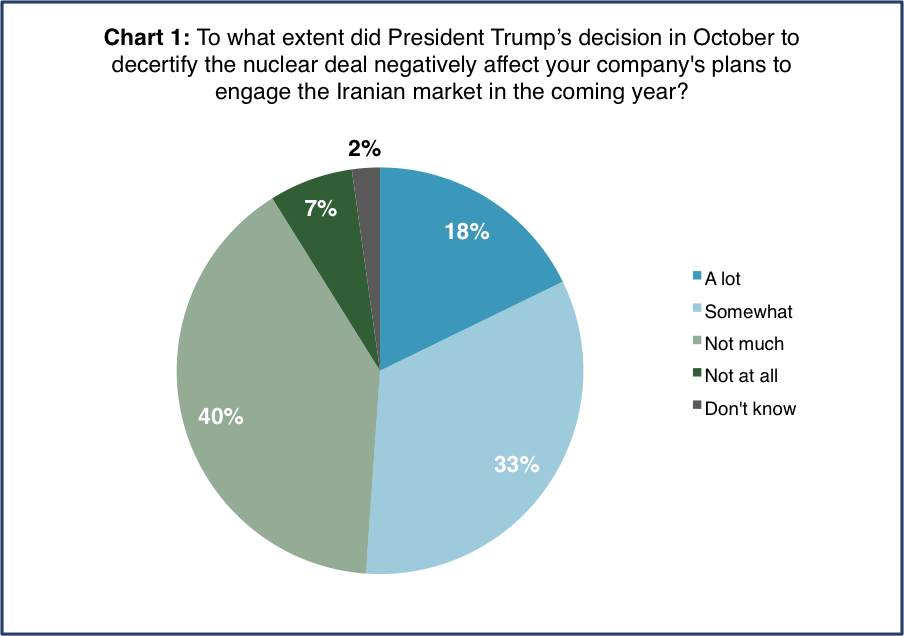
A clear slowdown: Executives clearly believe that there has been a slowdown in Iran business. When asked to evaluate the pace of trade and investment in Iran, 83 percent of senior managers at multinational companies indicate that companies “are moving slower than they could” to engage in the Iranian market. Moreover, 51 percent of executives report that their company’s investment plans were adversely affected by Trump’s October de-certification. The fear of snapback looms large given the reluctance with which waivers are being issued and the tone of today's statements will likely exacerbate these concerns.
External, not internal, barriers: Iran is a difficult place to do business, but senior executives currently see the primary barriers to their commercial plans as external, not internal challenges. When asked what is the “primary obstacle facing your market rollout in Iran,” 32 percent of survey respondents indicate sanctions compliance, while 20 percent point to “managing political and reputational risk.” By comparison, 21 percent point to “access to financing.” These are all external barriers. Domestic commercial and operational issues such as finding a local partner or structuring a local entity are far less frequently identified as major barriers, or as priorities for redress.
Stubborn confidence: Despite all the frustrations, companies remain a source of stubborn optimism and valuable pragmatism on Iran. A majority of executives (63 percent) believe that the Iran Deal is likely to even if the United States pulls out. A staggering 91 percent of executives still believe their company can be commercially successful in Iran. Policymakers, particularly in Europe, need to engage business leaders and support solutions to increase trade and investment. By doing so they can draw upon this increasingly rare confidence to help protect the nuclear deal. The report makes several recommendations about how to do this.
Executive Summary
The story of Iran’s post-sanctions economic recovery is so far one of great expectations and frustrating delays. On the two-year anniversary of the implementation of the Joint Comprehensive Plan of Action, this report examines the “economic implementation” of the nuclear deal. Multinational companies remain committed to the Iranian market, but the much-needed flow of external finance, including foreign direct investment, has yet to materialize. The provision of external finance has been hampered primarily by external factors, and not challenges endemic to Iran’s business environment.
Drawing on a unique survey commissioned by International Crisis Group, including over sixty senior executives, this report details how the risk of sanctions snapback and rising political tension, largely amplified by the rhetoric of the Trump administration, have caused material delays in the Iran investment plans of some of the world’s largest companies. Executives clearly believe that there has been a slowdown in Iran business. When asked to evaluate the pace of trade and investment in Iran, 83 percent of senior managers at multinational companies indicate that companies “are moving slower than they could” to engage in the Iranian market. While Trump has this week opted to reissue the sanctions waivers that keep the United States in the nuclear deal, the act of decertification alone has already compounded delays—51 percent of executives report that their company’s investment plans were adversely affected by Trump’s October announcement.
Against this backdrop, the nuclear deal is sliding into “zombie state.” Neither totally dead, nor totally alive, the deal exists in an ambiguous position that stymies most commercial actors. To address chronic uncertainty, European stakeholders ought to spearhead a technical, programmatic dialogue on the obstacles preventing external finance flows to Iran. In doing so, business leaders will be better positioned to bring their stubborn optimism and valuable pragmatism to bear in support of the quid-pro-quo that underpins the nuclear deal.
This rare optimism should not be taken for granted—a staggering 91 percent of executives surveyed for this report still believe that their companies can be commercially successful in Iran. Given the recent protests in the country, which have made the political imperatives of job creation and economic reform absolutely clear, policymakers should extend every effort to support the success of these companies, whose investments were expected by Iranians as a central outcome of the nuclear deal.