
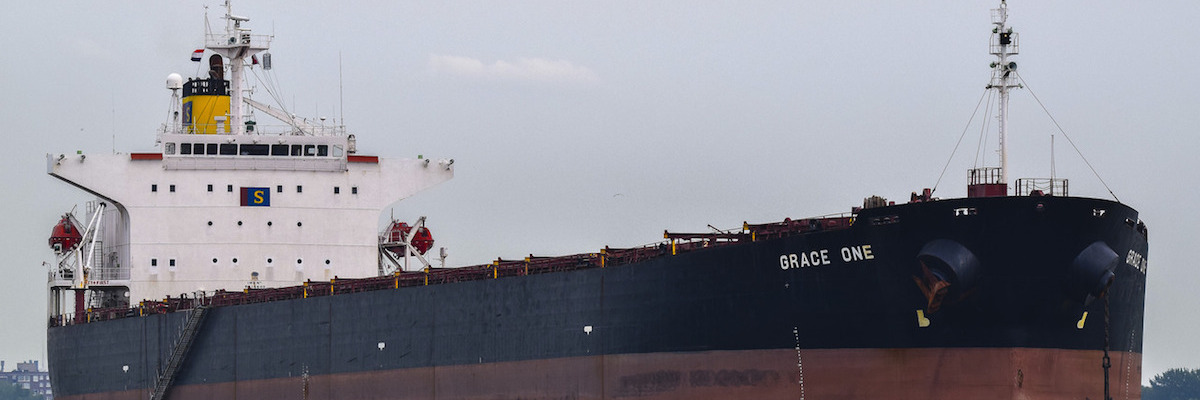
Gibraltar Court Agrees to Release Detained Oil Tanker
◢ A Gibraltar court agreed to release the supertanker Grace 1, which had been held since last month on suspicion of hauling Iranian crude oil to Syria in violation of European sanctions. The U.S. was seeking to seize the vessel, though it didn’t put in a legal request to do so, according to the judge in the case.
By Jonathan Browning and Alex Longley
The U.S. is gravely disappointed with the U.K. after a Gibraltar court allowed the release of an Iranian tanker suspected of hauling oil to Syria, and threatened sanctions against ports, banks and anyone else who does business with the ship or its crew, two administration officials said.
The court’s decision Thursday to release the Grace 1 was a missed opportunity and the Trump administration hopes that the U.K. government and authorities in Gibraltar will reconsider, according to the officials, who asked not to be identified discussing private deliberations. They said the court order rewards Iranian terrorism and Tehran will interpret the action as appeasement.
The Grace 1 had been held in Gibraltar after British forces seized it last month on suspicion that it was hauling Iranian crude oil to Syria. The U.S. Department of Justice is seeking to block the vessel’s release, but the Gibraltar Supreme Court on Thursday said American authorities hadn’t filed the appropriate legal application.
The two administration officials said the Grace 1 should now be considered a pariah. Anyone that does business with the ship, its crew or its owners, or provides financial transactions or port services to the vessel could be liable for evading U.S. sanctions, the officials said.
They argued that the U.K. should think of the tanker issue in terms of the broader relationship with the U.S., particularly as Prime Minister Boris Johnson’s government presses forward with departing the European Union and seeks a free-trade agreement with the U.S. While the people wouldn’t say the release threatens prospects for that deal, they added that the U.K. should ask if it wants to do business with the U.S. or Iran.
Iran said the ship wouldn’t sail to a sanctioned destination and is now rushing to return it to international waters before the U.S. finds a way to prolong its six-week detention.
“In light of the assurances we have received, there are no longer any reasonable grounds for the continued legal detention of the Grace 1 in order to ensure compliance” with European sanctions, the Gibraltar government said in an emailed statement.
The decision now essentially sets up a race between Iran and the U.S. over the ship’s fate. The vessel is bound for a port in the Mediterranean, Iran’s Mehr news agency said, citing Jalil Eslami, deputy for maritime affairs of the Iranian ports and maritime organization. Tanker-tracking data compiled by Bloomberg show that the vessel hadn’t moved as of 5:30 p.m. New York time.
Diplomatic Row
The seizure of the tanker set off a diplomatic row, underscoring tense relations between Iran and the West that have only worsened since the U.S. reimposed sanctions on the Persian Gulf state last year. Tensions have been high in the region in recent months amid a series of vessel attacks and seizures, which have threatened shipping in the Strait of Hormuz, the world’s most critical chokepoint for oil shipments.
Following the detention of the ship on July 4, Iran seized a British-flagged vessel, the Stena Impero, which it continues to hold.
Gibraltar’s decision to release the Grace 1 “is a satisfactory result for the U.K.,” Cara Hatton, an analyst at Falanx Assynt Ltd., a geopolitical risk consulting firm, said in an emailed statement. It “fully justifies Britain’s initial seizure of the ship, and increases the likelihood that Iran will now release the Stena Impero without giving the impression that the countries are engaged in a tanker swap.”
The U.K. Foreign and Commonwealth Office cautioned that there was no connection between Gibraltar’s enforcement of sanctions and Iran’s activities at the mouth of the Persian Gulf.
“There is no comparison or linkage between Iran’s unacceptable and illegal seizure of, and attacks on, commercial shipping vessels in the Strait of Hormuz and the enforcement of EU Syria sanctions by the Government of Gibraltar,” it said in an emailed statement. “Freedom of navigation for commercial shipping must be respected and international law upheld.”
The two U.S. officials rejected that idea, saying that the U.K. was trying to deescalate the situation with Iran and remove any distractions it faces to focus on Brexit.
The Gibraltar government said in its statement that it held several meetings with Iranian representatives this month and last to negotiate the tanker’s fate, and on Tuesday, the Islamic Republic agreed that the ship’s final destination wouldn’t be subject to European Union sanctions.
Iran agreed to re-flag and insure the vessel, which was carrying about $140 million in crude oil to the Baniyas refinery in Syria. It will now travel under the Iranian flag.
Four crew members from the Grace 1—the captain, chief officer and two second mates—have been released, according to the Gibraltar government. The vessel’s captain has no intention of going back aboard the ship, said his lawyer, John Wilkinson. “He wants to go home to India,” he said. Most of the 28 crew are on board, he said.
Photo: Fleet Mon

U.S. Seeks Further Detention of Seized Tanker, Gibraltar Says
◢ The United States applied on Thursday for Gibraltar to keep in detention an Iranian oil tanker at the center of a stand-off between Tehran and London, the public prosecutor said. Chief Justice Anthony Dudley made clear that were it not for the US move, "the ship would have sailed" from the overseas British territory.
The United States applied on Thursday for Gibraltar to keep in detention an Iranian oil tanker at the center of a stand-off between Tehran and London, the public prosecutor said.
The announcement by attorney Joseph Triay delayed a court decision on whether to extend the detention of Grace 1, which is suspected of smuggling oil to Syria and has been held since July 4.
Triay did not detail in court the basis for the US request other than as "mutual legal assistance".
Chief Justice Anthony Dudley made clear that were it not for the US move, "the ship would have sailed" from the overseas British territory.
The Gibraltar Supreme Court decision on the fate of the ship has been adjourned until after four pm (14:00 GMT).
The captain and three officers from Grace 1, had their bail lifted and were formally released, a Gibraltar government spokesman said.
The supertanker, carrying 2.1 million barrels of Iranian oil, was seized by Gibraltar police and British special forces, provoking a diplomatic crisis. It was suspected of carrying oil to war-torn Syria in violation of EU sanctions.
Photo: Wikicommons
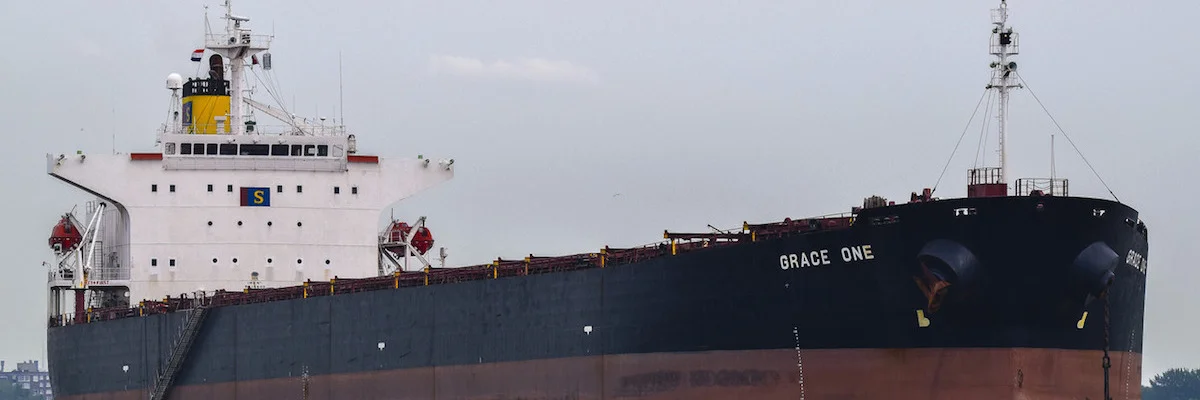
Iran Says It Expects Tanker Held by U.K. to Be Released Soon
◢ Iran expects an oil tanker seized by the U.K. in the Strait of Gibraltar in July will be released soon, the semi-official Fars News agency reported Tuesday. “Official and unofficial documents have been exchanged to resolve the matter and we hope the problem will be dealt with in the very near future,” said Jalil Eslami, deputy for maritime affairs at Iran’s Ports and Maritime Organization.
By Arsalan Shahla
Iran expects an oil tanker seized by the U.K. in the Strait of Gibraltar in July will be released soon, the semi-official Fars News agency reported Tuesday, a move that could help to ease concerns about the safety of shipping routes in the Middle East.
“Official and unofficial documents have been exchanged to resolve the matter and we hope the problem will be dealt with in the very near future,” Fars cited Jalil Eslami, deputy for maritime affairs at Iran’s Ports and Maritime Organization, as saying. The future of a U.K.-flagged tanker that Iran seized later in the Persian Gulf depends on “the necessary judicial processes,” Eslami added.
Iran’s Grace 1 tanker was seized by the Royal Navy on suspicion it was sending crude oil to Syria in violation of European Union sanctions. Tehran denied breaking sanctions and two weeks later impounded the U.K.-flagged Stena Impero near the Strait of Hormuz, the world’s most important chokepoint for oil.
Gibraltar’s Supreme Court is scheduled to hold its next hearing on the vessel on Thursday, according to the official Gibraltar news service in Spain. The current detention order for the ship expires late on Saturday, local media reported. A spokesperson for the U.K. Foreign Office said that the “ongoing investigation” into the Grace 1 was a matter for Gibraltar authorities.
The tanker seizures and other suspected Iranian operations against shipping in the Persian Gulf region have inflamed a crisis between Iran and the West triggered by the Trump administration’s decision to quit the multiparty nuclear deal with Iran a year ago and renew crippling economic sanctions. Iran has responded by abandoning some restrictions on uranium enrichment imposed by the 2015 accord.
The frictions on the seas have led the U.S. and U.K. to mount a joint mission to protect commercial shipping lanes in the Middle East. Reports of Israeli involvement in that mission have drawn fire from Tehran, and on Tuesday, the commander of Iran’s Revolutionary Guards Corp’s naval forces warned against “any illegal presence in the Persian Gulf and Strait of Hormuz, especially Israel’s.”
“We in the Iranian Revolutionary Guards Corps are in charge of providing security for the Strait of Hormuz and the Persian Gulf, and there is no need for strangers,” Rear Admiral Alireza Tangsiri said, according to the semi-official Iranian Students’ News Agency.
Last week, Israel’s Ynet website reported that Israel is providing intelligence and other, unspecified assistance to U.S.-led efforts to protect Persian Gulf shipping routes. It cited Foreign Minister Israel Katz’s remarks to parliament’s foreign affairs and defense committee.
Israel considers Iran to be its most formidable enemy, due to its nuclear work, ballistic missile program and support for anti-Israel militant groups in the Middle East. Iranian officials have also referred multiple times to Israel’s annihilation. Prime Minister Benjamin Netanyahu lobbied hard against the nuclear deal, and pressed President Donald Trump to abandon it.
Israel has been striking Iranian targets in Syria over the past few years in an effort to limit the Islamic Republic’s presence in its immediate neighborhood, and according to recent reports, has expanded those operations to hit Iranian-backed militias in Iraq.
Photo: Fleet Mon
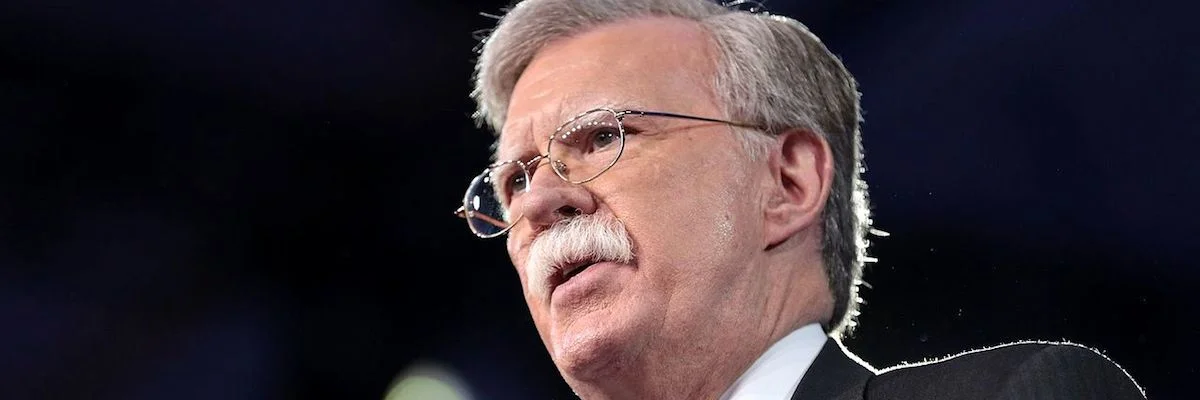
Bolton to Press Britain's Johnson on Iran
◢ US National Security Advisor John Bolton was Monday to sound out British Prime Minister Boris Johnson on global disputes that include an escalating Gulf standoff with Iran. The hawkish White House aide is the most senior US official to meet Johnson since he succeeded Theresa May as UK government leader last month.
US National Security Advisor John Bolton was Monday to sound out British Prime Minister Boris Johnson on global disputes that include an escalating Gulf standoff with Iran.
The hawkish White House aide is the most senior US official to meet Johnson since he succeeded Theresa May as UK government leader last month.
A spokesman for Johnson said the two would talk about "a range of security issues, including Iran".
The meeting comes with US President Donald Trump's administration pursuing a "maximum pressure" campaign designed to force the Islamic republic to limit nuclear and military activities.
Washington also wants its close European ally to drop—or at the very least severely restrict—plans to use 5G technology made by China's Huawei when it rolls out the next-generation data network.
US media reports said Washington was not expecting a decision from London on either issue during Bolton's two-day visit.
The Downing Street spokesman said London's position on both Iran and Huawei "remains the same.”
Uncertain Future
Bolton's trip comes with Britain in political crisis and the pound straddling multi-year lows as deadline approaches for the UK to leave the EU after more than 40 years.
Johnson has vowed to meet the twice-delayed Brexit date—now October 31—even if it means leaving without a proper plan to regulate trade and other ties.
Senior UK economic officials and big industries warn that this "no-deal Brexit" option could create border chaos and set off global financial tremors in the short term.
The EU is refusing to re-open negotiations on the deal the bloc's 27 leaders signed last year with May. Johnson and his supporters call the existing agreement unfair.
But a clean break with the EU would allow the UK to immediately launch negotiations on a free trade agreement with the United States.
The US president openly rooted for Johnson during his campaign for May's job following her resignation over the Brexit impasse.
He branded Johnson as Britain's Trump and said the sides were on the verge of making a breakthrough in ties.
Britain and its European allies have irritated Trump's team by trying to save a landmark nuclear agreement with Iran which Washington pulled out of last year.
Britain last week decided to join forces with the US to protect merchant vessels in the Gulf.
It marked a departure in policy for Johnson following May's attempts to form a European-led group.
Britain's decision on Huawei—a private firm that Washington says is obliged to spy for the Chinese government—has been repeatedly delayed due to mixed signals from Trump about his own administration's next steps.
Johnson's spokesman said the UK government was "still assessing the impact" of Trump's decision in May to effectively ban Huawei from trading with US firms.
Photo: Wikicommons
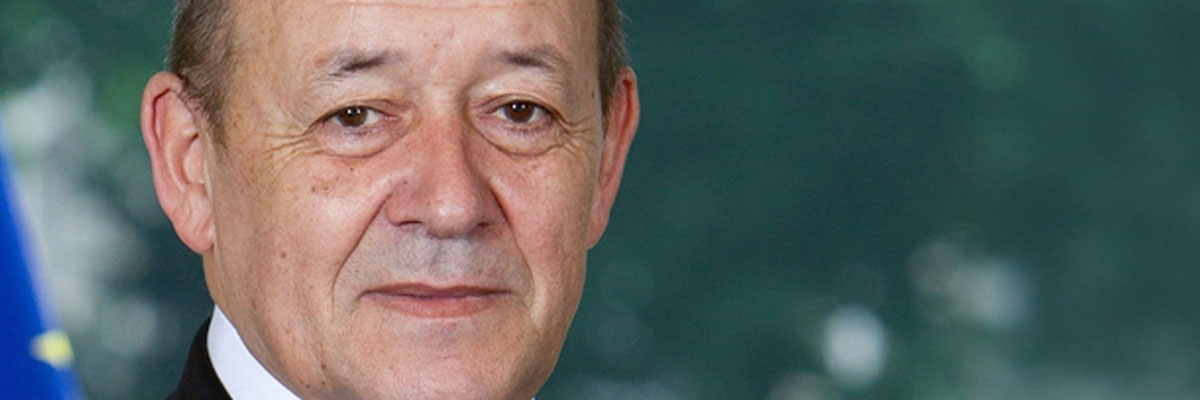
France Says 'Needs No Permission' for Iran Dialogue After Trump Swipe
◢ France said Friday that it "needs no permission" to work towards easing tensions between Iran and the US, after President Donald Trump accused his French counterpart Emmanuel Macron of meddling in the dispute. In a tweet Thursday, Trump claimed that Iranian officials want "desperately to talk to the US, but are given mixed signals from all of those purporting to represent us, including President Macron of France."
France said Friday that it "needs no permission" to work towards easing tensions between Iran and the US, after President Donald Trump accused his French counterpart Emmanuel Macron of meddling in the dispute.
"On Iran, France speaks with complete sovereignty. It is working hard for peace and security in the region, it is working to facilitate a de-escalation in tensions and it needs no permission to do so," Foreign Minister Jean-Yves Le Drian said in a statement.
In a tweet Thursday, Trump claimed that Iranian officials want "desperately to talk to the US, but are given mixed signals from all of those purporting to represent us, including President Macron of France."
"I know Emmanuel means well, as do all others, but nobody speaks for the United States but the United States itself. No one is authorized in any way, shape, or form, to represent us!" he said.
Trump has reimposed crippling sanctions on Iran after pulling out of an international deal aimed at curbing the country's nuclear ambitions.
But the European partners to the accord, including France, have resisted his attempts to isolate the Iranians.
Le Drian said the worsening tensions between Tehran and Washington, which have been blamed for attacks on oil tankers in the Gulf and downings of drones, called for initiatives to try to restore dialogue.
"That's what President Macron is doing, in full transparency with our partners, above all our European partners," he said, adding that Macron was "obviously keeping American authorities informed".
On Tuesday, the Al-Monitor news site reported that Macron, who speaks regularly by telephone with Iranian President Hassan Rouhani, had invited Rouhani to attend the G7 summit in France on August 24-26 to meet with Trump.
The report, which cited two unidentified sources, said Rouhani had declined to attend or send a representative.
The French presidency has denied the report, saying Macron never put forward any such proposal.
After a call with Rouhani on Tuesday, the French leader, who has attempted to mediate in several disputes in North Africa and the Middle East, said it was France's role "to make every effort to ensure that all parties agree to a break and open negotiations."
The dispute with Iran is expected to be a major issue at the G7 summit in the southwestern city of Biarritz.
Paris has engaged in intense diplomacy to try to resolve the tensions, with Macron's foreign policy advisor Emmanuel Bonne twice visiting Tehran.
Russian President Vladimir Putin is scheduled to visit Macron at his holiday retreat on France's Mediterranean coast on August 19 to discuss the Iranian situation, ahead of the G7 meeting.
Photo: French MFA
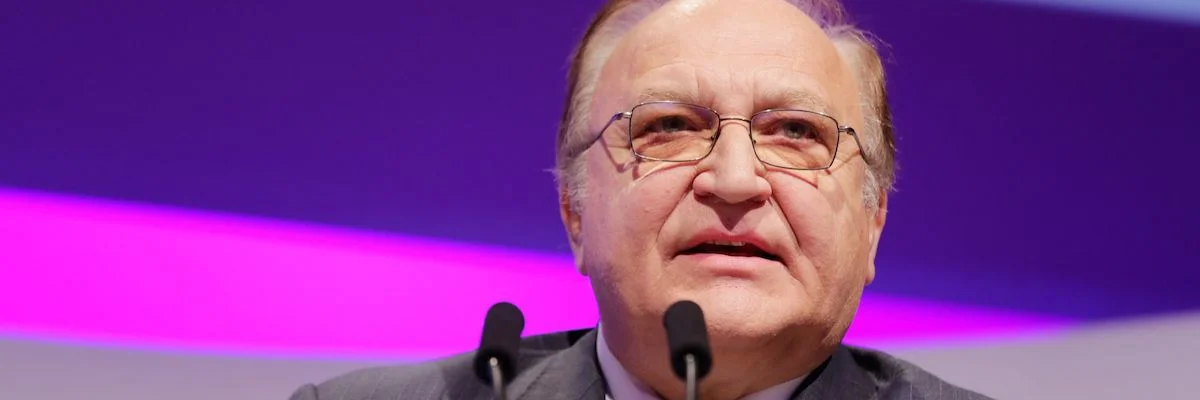
German Tapped to Head INSTEX Withdraws After Israel Controversy
◢ A German senior diplomat who had been designated to run INSTEX, a mechanism to allow trade with Iran despite US sanctions, will not assume the post, it emerged Friday, following controversial comments he made on Israel. German's foreign office told AFP that Bernd Erbel, 71, had informed it "that he is not available for personal reasons.”
A German senior diplomat who had been designated to run INSTEX, a mechanism to allow trade with Iran despite US sanctions, will not assume the post, it emerged Friday, following controversial comments he made on Israel.
German's foreign office told AFP that Bernd Erbel, 71, had informed it "that he is not available for personal reasons".
Germany's top-selling newspaper Bild said Erbel's appointment was halted after it reported on controversial comments the ex-ambassador to Baghdad and Tehran had made in recent interviews.
Bild slammed "two scandalous appearances" in which Erbel had given long interviews to former public radio journalist Ken Jebsen, whom the tabloid-style paper accused of being "a conspiracy theorist and anti-Semite.”
Erbel had said that Israel represents "a foreign body in the region" and had been founded "at the expense of another people that lost their homeland".
He also said, according to the Bild article, that "the Palestinians are the victims of our victims. Quite simple.”
Bild also charged that Erbel had broadly shown a pro-Iran attitude and played down, for example, militancy by the Iranian Revolutionary Guards and their allies in the region.
he newspaper said in a rare English-language article on its website that "after Bild contacted Erbel regarding dubious interviews he had granted previously, he was forced to resign".
Germany, Britain and France in January founded the Instrument in Support of Trade Exchanges to facilitate barter trade with Iran to get around US sanctions that block financial transfers.
However, INSTEX is not yet operational.
Berlin remains in talks with London and Paris on filling the post of INSTEX managing director, which needs confirmation from the institution's supervisory board.
Photo: Anna McMaster
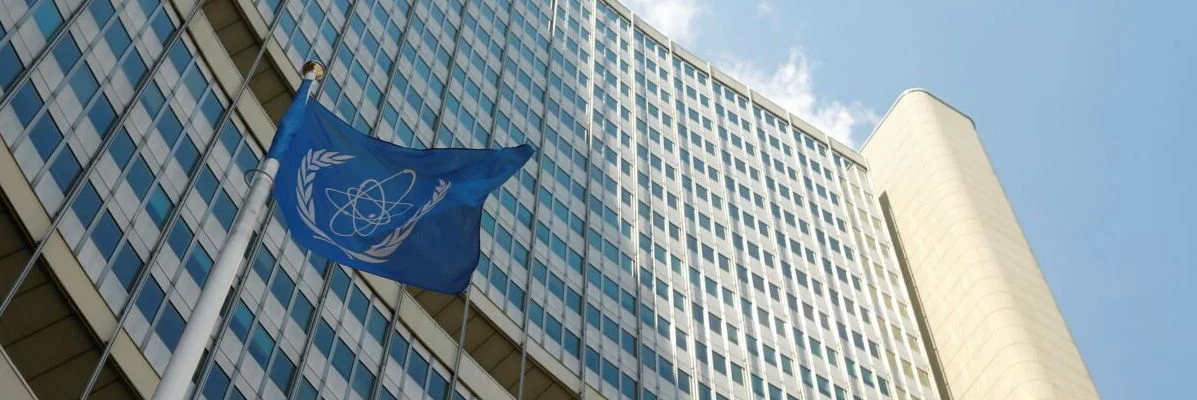
Iran Offered Lesson by Argentine Bid to Head Nuclear Agency
◢ Argentine diplomat Rafael Grossi says inspectors monitoring Iran’s nuclear deal could benefit from more openness and suggested his country’s nuclear program holds a lesson for Iranian leaders. As a top candidate to head the International Atomic Energy Agency, Grossi faces the prospect of walking the tightrope between keeping tabs on Iran and other crises while steering the nominally technical agency through geopolitics.
By Jonathan Tirone
Argentine diplomat Rafael Grossi says inspectors monitoring Iran’s nuclear deal could benefit from more openness and suggested his country’s nuclear program holds a lesson for Iranian leaders.
As a top candidate to head the International Atomic Energy Agency, Grossi faces the prospect of walking the tightrope between keeping tabs on Iran and other crises while steering the nominally technical agency through geopolitics.
If elected by member nations, he’s likely to face U.S. and Israeli pressure to open a new investigation based on documents and nuclear material allegedly discovered in a warehouse in Tehran. President Donald Trump accused Iran last month of “secretly” enriching uranium, something international inspectors haven’t reported.
“Uncertainty arises from silence,” Grossi said in an interview, explaining his view that IAEA safeguards inspectors should communicate more clearly. He pledged “firm but fair” monitoring and a “constant dialog” with member governments.
The agency is in transition after Director General Yukiya Amano died in July, just weeks after inspectors said Iran surpassed limits on its enriched-uranium stockpile set in a 2015 agreement. European governments, Russia and China are seeking to salvage the deal after Trump withdrew the U.S. in 2018.
The next director will wade into some of the thorniest terrain in global relations. The IAEA won a Nobel Peace Prize for debunking false intelligence that led up to the 2003 war in Iraq. Later, it was thrust into disputes in Syria and North Korea as well as international concern over nuclear safety after the Fukushima reactor meltdowns in Japan in 2011.
For its part, Argentina has spent decades building a nuclear industry even as boom-and-bust cycles roiled its economy, triggering a record $56 billion bailout by the International Monetary Fund. That has included supplying Iran’s research reactor with nuclear fuel and training Iranian scientists in what Grossi called a close but complex relationship.
“Playing by the rules has enabled our industry’s development,” Grossi said. “We’ve proven you can be a middle-sized nation with nuclear power and returns on technology research.”
Grossi, Argentina’s ambassador to the IAEA, was Amano’s deputy at the height of the Iran investigation, traveling to Tehran as part of a team that published a report in November 2011 that detailed Iran’s past nuclear-military activities.
His candidacy has won backing from Brazil, a Latin American ally and member of the agency’s board of governors. A new director general is expected to be named by October. Other contenders, probably including acting director Cornel Feruta, are expected to join the race in early September.
Falklands Effect
How Argentina came to do nuclear business with Iran is a story tied to the tides of geopolitics.
Argentina’s nuclear program languished from a lack of funding under military dictators in the 1970s and 1980s. When the junta fell and democratic rule took hold in the wake of Argentina’s defeat in the Falklands War, its scientists focused on developing expertise in research reactors and fuel, rather than immediately building up industrial-scale uranium enrichment.
Other clients of state-run INVAP SE include Australia, India, the Netherlands and Saudi Arabia. The Bariloche-based conglomerate has used its position as a maker of research reactors and nuclear technology to expand into aerospace and defense. Its 1,400 employees generated orders worth $918 million, according to the latest annual report.
Argentina’s decision to turn its nuclear program over to professionals in its National Atomic Energy Commission helped insulate it against “its often turbulent politics,” Jacques Hymans, a University of Southern California professor who has studied the history, said by email.
“Argentina’s nuclear program became not just a domestic success, but an international one as well,” Hymans said.
Photo: IRNA

Trump Criticizes French President for Sending Iran 'Mixed Signals'
◢ President Donald Trump on Thursday (Aug 8) accused his French counterpart Emmanuel Macron of getting in the way of US policy and sending "mixed signals" to Iran. "Iran is in serious financial trouble. They want desperately to talk to the US, but are given mixed signals from all of those purporting to represent us, including President Macron of France," Trump tweeted.
President Donald Trump on Thursday (Aug 8) accused his French counterpart Emmanuel Macron of getting in the way of US policy and sending "mixed signals" to Iran.
"Iran is in serious financial trouble. They want desperately to talk to the US, but are given mixed signals from all of those purporting to represent us, including President Macron of France," Trump tweeted.
Trump has imposed crippling sanctions on Iran and sought to sink an international deal for managing the country's contested nuclear industry, but several major allies and other partners, including France, have resisted the US attempt to isolate the Iranians.
That division over how to handle Iran appears to be frustrating Trump, who is now left with few options other than to keep adding US pressure on Teheran - so far with little tangible benefit.
Trump lashed out at Macron, saying "I know Emmanuel means well, as do all others, but nobody speaks for the United States but the United States itself. No one is authorized in any way, shape, or form, to represent us!"
As the US-Iranian standoff deepens, tensions are soaring in the strategic region, with drones downed, tankers seized by Teheran and mysterious attacks on ships in Gulf waters.
Washington and its Gulf allies have accused the Islamic republic of the attacks on ships, which Teheran denies.
In response, the US has been seeking to form a coalition whose mission- dubbed Operation Sentinel - it says is to guarantee freedom of navigation in the Gulf.
Britain, which already has warships on protection duty in the Gulf after a UK-flagged tanker was seized by Iranian Revolutionary Guards, has said it will join the planned operation.
But other European countries have kept out, for fear it might harm European efforts to reach a negotiated settlement with Iran.
Photo: Wikicommons

Pompeo Talks Maritime Security, Iran With Saudi Crown Prince
◢ U.S. Secretary of State Mike Pompeo discussed maritime security, Iran and Yemen with Saudi Arabia's Crown Prince Mohammed bin Salman in a phone call on Wednesday. "The secretary discussed heightened tensions in the region and the need for stronger maritime security in order to promote freedom of navigation," State Department spokeswoman Morgan Ortagus said.
U.S. Secretary of State Mike Pompeo discussed maritime security, Iran and Yemen with Saudi Arabia's Crown Prince Mohammed bin Salman in a phone call on Wednesday.
"The secretary discussed heightened tensions in the region and the need for stronger maritime security in order to promote freedom of navigation," State Department spokeswoman Morgan Ortagus said in a statement.
Iran has seized three tanker ships in strategic Gulf waters in a month, and the United States has accused it of carrying out multiple attacks on ships in the region.
The U.S. has been struggling to piece together an international coalition to protect cargo ships travelling through the Gulf, with allies concerned about being dragged into conflict with Iran.
Ortagus also said that the top U.S. diplomat and the crown prince "discussed other bilateral and regional developments, including countering the Iranian regime's destabilizing activities."
Tensions between Washington and Tehran -- Saudi Arabia's arch foe -- have soared since U.S. President Donald Trump pulled the United States out of a nuclear deal with Iran last year and imposed punishing sanctions.
Twelve months on from the U.S. withdrawal, Iran responded by suspending some of its commitments under the nuclear deal.
Iran meanwhile shot down an American drone in June, with Trump saying he called off retaliatory air strikes at the last minute, and the United States says it has since downed one and possibly two of Tehran's unmanned aircraft, which the Islamic republic has denied.
On Yemen, "the secretary and the crown prince reaffirmed their strong support for UN Special Envoy Martin Griffiths' efforts to advance the political process," Ortagus said.
Saudi Arabia is locked in a bloody war in the country against the Iran-backed Huthis, a conflict that has killed tens of thousands of people, many of them civilians, relief agencies say.
Trump vetoed congressional resolutions last month that would have blocked arms sales to the kingdom that critics fear would aggravate the devastating Yemen war, which the UN said has triggered the world's worst humanitarian crisis.
Photo: Wikicommons
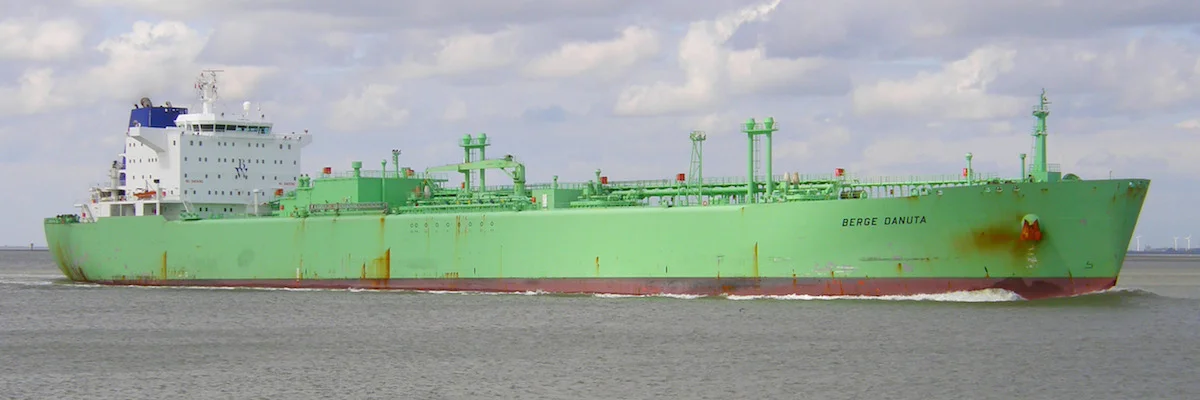
Iran Sanctions Breach Suspicion Prompts Bank to Seize Ships
◢ Reports alleging that fuel tankers appeared to breach U.S. sanctions against Iran were cited in court filings by a bank as it sought to seize the ships, accusing the owners of loan default. The accusations, which led to the the temporary arrest of the vessels in Singapore late last month, come as the U.S. seeks to isolate the regime in Tehran by cutting off oil sales, a major source of revenue.
By Saket Sundria, Serene Cheong and Dan Murtaugh
Reports alleging that fuel tankers appeared to breach U.S. sanctions against Iran were cited in court filings by a bank as it sought to seize the ships, accusing the owners of loan default.
The accusations, which led to the the temporary arrest of the vessels in Singapore late last month, come as the U.S. seeks to isolate the regime in Tehran by cutting off oil sales, a major source of revenue. They also underscore how traders and shippers suspected of violating sanctions can run foul of their own lenders, not just governments.
Hanover-based Norddeutsche Landesbank-Girozentrale, known as NordLB, detailed its claim in documents filed last month in the High Court of Singapore seeking the arrest of the vessels, accusing their China-based owner of defaulting on a $30 million mortgage agreement.
The German lender said in the filings it was notified June 25 by the London P&I Club, a ship owners’ association that provides protection and indemnity insurance, that coverage on the ships would be terminated. That came one day before Lloyd’s List, an industry news publication, reported that two of the ships—Gas Infinity and Gas Dignity—appeared to have transported Iranian liquefied petroleum gas in breach of U.S. sanctions, the bank said.
Transponders Off
NordLB said it believes London P&I terminated coverage after being contacted by Lloyd’s to comment for the article. The London P&I club confirmed that it no longer insures Gas Infinity, but declined to comment further.
The tankers, along with Sea Dragon, were used as collateral for a $30 million loan NordLB made in July 2018 to Silvana Limited, Sea Dragon Group and Sea Dolphin Co., with China’s Kunlun Holding Co. and Kunlun Shipping as guarantors, according to the affidavit. The companies have offices in Shanghai and Hong Kong.
Gas Infinity and Gas Dignity turned off their transponders, which usually publicly broadcast their locations, when approaching the Strait of Hormuz and then turned them on again several days later when they were laden with fuel, the bank said in the affidavit, citing the Lloyd’s article. The bank also cited a Bloomberg article describing similar activity by another LPG tanker owned by Kunlun Trading Co., a shareholder of the borrower.
Sheriff’s Arrest
While the bank only cited media reports for its suspicions the ships broke sanctions, it described the actions, as well as losing satisfactory insurance coverage, as “events of default” on the mortgage.
Gas Infinity was placed under sheriff’s arrest in Singapore on July 22 and Sea Dragon on July 24, according to information from the Supreme Court of Singapore. Both ships have since been released. Gas Infinity is currently signaling China as its next destination while Sea Dragon is anchored off the south of India and indicating U.A.E.’s Khor Fakkan as its next destination, Bloomberg ship-tracking data show.
A woman who answered the phone at Kunlun Holding’s office Friday declined to comment and an email to Hong Kong-based Kunlun Shipping Co. went unanswered. Nobody responded to emails and phone calls to people associated with the Chinese companies whose contact information was included in court exhibits. NordLB declined to comment on the case.
In the court documents, NordLB said that the owners denied Gas Dignity had been in Iranian waters. But, it added, their response included location data missing days that corresponded to the time when Lloyd’s reported the transponder was turned off.
The bank also said that the copies of logbooks provided by the owners to show Gas Infinity was undergoing sea trials were mostly illegible and didn’t identify the name of the ship, according to the documents.
The two ships that were detained in Singapore under sheriff’s arrest, Gas Infinity and Sea Dragon, have both since sailed. Allen & Gledhill, representing NordLB, called for the release of the tankers in Singapore’s high court on July 29. The attorneys didn’t respond to an email seeking comment on the issue.
Photo: Fleetmon

Trump Sees Chance With Boris Johnson to Lure UK on Iran, Huawei
◢ As Boris Johnson hurtles toward a no-deal Brexit that could leave the U.K. diplomatically adrift and economically vulnerable, President Donald Trump is looking to seize an opportunity to lure the country away from Europe on some of his top foreign policy priorities: Iran and Huawei.
By David Wainer
As Boris Johnson hurtles toward a no-deal Brexit that could leave the U.K. diplomatically adrift and economically vulnerable, President Donald Trump is looking to seize an opportunity to lure the country away from Europe on some of his top foreign policy priorities: Iran and Huawei.
Yet with Johnson focused on negotiating a breakup with the European Union—and perhaps a snap election at home—the White House may have to be patient in its hopes that the U.K.’s leadership change will bring closer alignment on issues including sanctioning Iran’s nuclear program and blocking Huawei Technologies Co. equipment from new 5G mobile networks.
Trump is pressing his case regardless. He and Johnson spoke by phone last week about “areas of further cooperation,” including trade, 5G technology and global security, according to a White House statement. With Johnson—a “good man” Trump has long praised for wanting to leave the EU—now at 10 Downing Street, the U.S. sees Johnson’s need for an eventual bilateral trade deal with America as leverage to peel Britain away from Europe on key issues.
In a first bid to serve as a bridge between the White House and European allies, the U.K. announced on Monday that it will lead “an international mission to restore safe passage” in the Persian Gulf, working with partners including the U.S. Navy. The move offers a face-saving opportunity for countries that spurned a U.S.-led initiative because they blame Trump for quitting the 2015 nuclear accord with Iran.
A senior White House official said the U.S. expects cooperation will grow more robust with the new government, as the two countries work together extensively on security issues including North Korea. Secretary of State Michael Pompeo predicted the nations that long have boasted of their “special relationship” will grow even closer.
“I think we’ll find that there’s a very good working relationship there,” Pompeo said in a Bloomberg TV interview last month. “When the prime minister gets his feet on the ground, I’m looking forward to having a chance to chat with him and his foreign secretary so that we can deliver on behalf of these two important democracies.”
New Foreign Secretary Dominic Raab will be in Washington this week, and his language will be mined for clues on where the U.K. is headed.
Working in the U.S.’s favor is Johnson’s need to seal a trade deal with Washington after the U.K.’s departure from the EU, expected Oct. 31. To help smooth that process, Johnson could take more symbolic steps to spurn Europe and sidle up to Trump.
Key Question: Iran
Johnson’s proposal on Gulf maritime security was welcomed by the U.S. But that doesn’t mean he’s ready to follow Trump in quitting the multinational nuclear agreement the American president has called the “worst deal ever.” In announcing the maritime mission, Raab, the foreign minister, said, “We remain committed to working with Iran and our international partners to de-escalate the situation and maintain the nuclear deal.”
Johnson has repeatedly signaled that he’s a strong supporter of the nuclear deal, which the U.K. and other participating nations have struggled to maintain in the face of renewed U.S. sanctions against Iran. As British foreign minister in 2018, when Trump pulled out of the agreement, Johnson said talks with Tehran culminating in a new accord were difficult to imagine.
“One of the big questions is whether he will break with European unity on Iran,” said Richard Nephew, a Columbia University scholar who was part of the U.S. team that negotiated the nuclear accord. “He needs Trump on his side, at the very least promising a favorable trade deal, as he takes the U.K. down the Brexit route.”
Germany’s Worries
In Germany, there’s concern that Johnson and Trump will try to build a new version of the “special relationship,” according to a coalition official in Berlin.
The Germans see Johnson’s intention to seek a trade deal with the U.S. at a time when the EU is already negotiating such a pact as further evidence of a breach, said the official, who asked not to identified discussing Britain’s political direction. French President Emmanuel Macron’s aides also routinely say that they see the British as potential trouble-makers on trade.
Despite receiving invitations, Johnson hasn’t traveled to the major European capitals. By contrast, his predecessor went to Berlin within days of coming to power.
In the most telling example of friction between London and its European partners, the U.K. undercut a French-led initiative to find a common candidate to lead the International Monetary Fund. Mere hours before EU governments were to begin voting on a candidate, the U.K. suddenly objected to the process and said it wouldn’t take part in offering a potential nominee or in the voting, according to a source familiar with the interaction.
All this is fertile ground for the White House to act to pull the U.K. away, and the promise of a free-trade deal is the biggest carrot of all for a prime minister determined to bring about Brexit and deliver on its promised benefits. That’s why Johnson’s meeting with Trump at the Group of Seven summit in France this month will be the most-watched bilateral of them all for the Europeans.
Picking an Envoy
Johnson will also have a chance to appoint a new ambassador to Washington because Kim Darroch abruptly resigned last month after the leak of internal messages in which he criticized the Trump administration as “clumsy and inept.”
Johnson’s failure to defend Darroch in a televised campaign debate brought criticism from a Foreign Office official who said he’d thrown the ambassador “under a bus.”
Trump had failed to win British support on a number of issues under former Prime Minister Theresa May. A U.K. government official said the U.S. relationship can only improve in light of May’s lack of rapport with Trump. The official predicted a strengthening of relations, drawing on new opportunities on trade and other issues, but not a total reset of ties.
Even under Johnson, breaking the U.K. away from the European Union on foreign policy will be tough, according to three senior European diplomats with knowledge of the new British government. Any moves to cozy up to Trump may be more symbolic than substantive, particularly because Johnson has to worry about maintaining a single-seat majority in the House of Commons.
‘Political Opportunists’
“What Trump and Johnson have in common is they are political opportunists,” said Charles Kupchan, former senior director for European Affairs at the National Security Council in the Obama administration. “They believe in America First, Britain First. They’re out for themselves and I don’t think either Trump or Johnson will be making sacrifices to help each other.”
And while the U.K. is still reviewing its position on Huawei, which the U.S. sees as a stalking horse for Chinese spying and wants banned from allied nations, all four U.K. carriers are already building their 5G networks using equipment from Huawei. BT Group Plc’s EE and Vodafone Group Plc have even gone live with their Huawei-supported 5G. Delaying or freezing that deployment would be an additional hit to an increasingly fragile British economy.
Showman Politics
Trump may have to be patient, knowing the U.K. leader has other priorities. Unlike May, who Trump publicly criticized on multiple occasions, the president sees in Johnson’s rise a vindication of his own style of showman politics.
“Trump from the get-go has been a supporter of getting on with Brexit and he likes populist and right-wing leaders, wherever they may be,” said Kupchan, the former Obama administration official who’s now a senior fellow at the Council on Foreign Relations.
But unlike Trump, Johnson has less room for error on the world stage and is therefore expected to be less volatile. While Trump can insult allies and foes, tear up agreements, and still command any leader’s attention, the U.K. is a diminishing power, said Andreas Krieg, who teaches defense studies at King’s College London.
“He talks about building a Global Britain but he know there’s no capacity to build a global power,” said Krieg. “He understands Britain is not America.”
Photo: Wikicommons
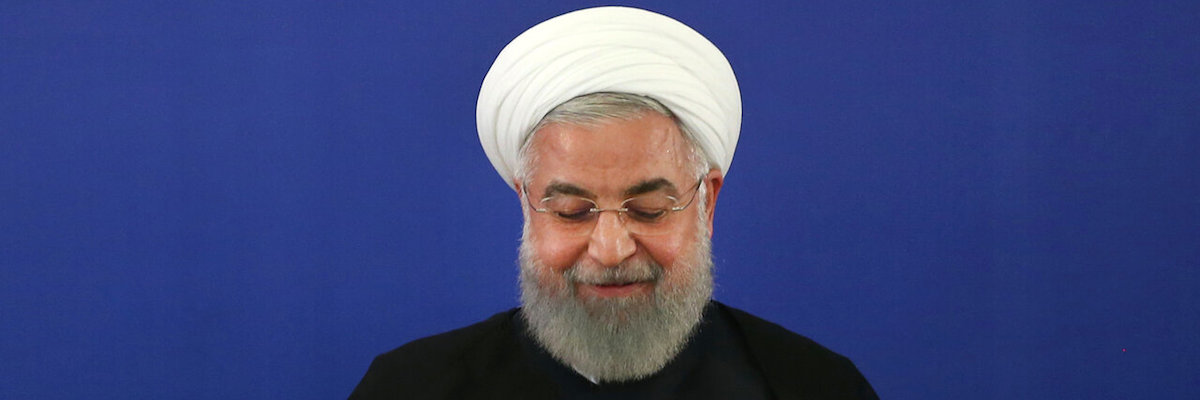
Iran 'Favors' Talks Despite Trump Snub
◢ President Hassan Rouhani said on Tuesday that Iran favors talks with the US if it lifts sanctions against the Islamic republic, despite his top diplomat turning down a meeting with US President Donald Trump. Rouhani said "peace with Iran is the mother of all peace" and "war with Iran is the mother of all wars" as he defended a landmark 2015 nuclear deal between Iran and world powers.
By David Vujanovic
President Hassan Rouhani said on Tuesday that Iran favors talks with the US if it lifts sanctions against the Islamic republic, despite his top diplomat turning down a meeting with US President Donald Trump.
Rouhani said "peace with Iran is the mother of all peace" and "war with Iran is the mother of all wars" as he defended a landmark 2015 nuclear deal between Iran and world powers.
"Iran favours talks and negotiations and, if the US really wants to talk, before anything else it should lift all sanctions," Rouhani said in remarks aired live on state television.
Tensions between Iran and the US have been rising since Trump unilaterally withdrew the US from the nuclear deal in May 2018 and began imposing sanctions on it as part of a "maximum pressure" campaign.
Rouhani, speaking after meeting with his top diplomat, Mohammad Javad Zarif, said Iran was ready for talks regardless of whether or not the US was party to the deal.
"Whether they want to come into the JCPOA or not, it's up to them," said Rouhani, referring to the accord known formally as the Joint Comprehensive Plan of Action.
"All sanctions should be lifted so that there will be no criminals facing us," he said, accusing the US of committing acts of "economic terrorism" for blocking food and medicine imports.
In response, the US ambassador on disarmament Robert Wood said: "Iran simply needs to make up its mind to decide what it wants to do".
"My president has said he is willing to sit down and have a discussion with Iran. We are not sure Iran wants to have that discussion," he said in answer to a question from AFP on the sidelines of a conference in Geneva.
However Rouhani described as "weird" the US approach of calling for negotiations and then slapping sanctions on Zarif.
"So how should we negotiate?" he said on Tuesday. "The person in charge of negotiations is the foreign minister. He must talk to you."
Trump has said publicly several times he is willing to hold talks with Iran even as he lambasts its leadership as corrupt, incompetent and a threat to regional security and US interests.
'Warmongers' Deceived Trump
Twelve months on from the US withdrawal, Iran responded by suspending some of its commitments under the nuclear deal.
The situation threatened to spiral out of control with ships attacked, drones downed and oil tankers seized.
At the height of the crisis, Trump called off air strikes against Iran at the last minute in June after its forces shot down a US drone.
Rouhani, with Zarif sitting beside him, defended the foreign minister who has faced criticism from hardliners over his role in the deal ultimately abandoned by the Americans.
"We had so many economic victories (in the wake of the deal) that it enraged some people," he said.
Rouhani said the US made a mistake when it thought "everything will be over" for Iran after "some planned a street riot" in December 2017.
At that time, Iran was rocked by days of deadly protests reportedly sparked by austerity measures.
"This caused Americans to be trapped. They thought Iran's system is weakened," he said.
"They said, 'One more push. Iran has reached a stage where if we give it another push, everything will be over'."
This push by "warmongers" deceived Trump and led to his decision to leave the JCPOA, he said.
'Oil for Oil'
Rouhani later spoke by phone with French President Emmanuel Macron and voiced support for further cooperation between Iran and Europe, according to the government's official website.
But "unfortunately, simultaneous with Iran and France's attempts to reduce tensions and create favorable conditions for peaceful coexistence in the region, we witness escalatory moves from the US," Rouhani told Macron.
In his earlier televised remarks, Rouhani urged the US to be ready to negotiate fairly
"Peace for peace and oil for oil," he said. "You cannot say that you won't allow our oil to be exported.
"It cannot be that the Strait of Hormuz is free for you and the Strait of Gibraltar is not free for us." Iran has also been locked in a high-seas standoff with US ally Britain since Royal Marines helped to seize a tanker carrying Iranian oil off the British overseas territory of Gibraltar on July 4.
Weeks later, Iran's Revolutionary Guards impounded a British-flagged tanker in the Strait of Hormuz—the conduit for much of the world's crude. Separately on Tuesday, Iran's military unveiled three precision-guided missiles, with Defense Minister Amir Hatami saying they showed the country was ready to defend itself in the face of US "viciousness and conspiracies.”
Photo: IRNA
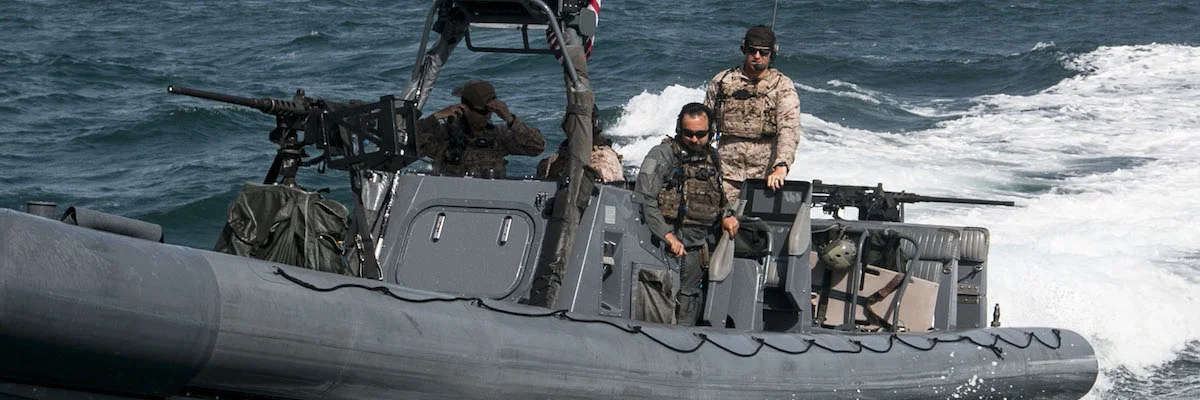
UK Joins US in Persian Gulf Mission After Iran Taunts
◢ Britain said Monday it will join forces with the United States to protect merchant vessels in the Persian Gulf amid heightened tensions with Iran, after Tehran taunted Washington that its allies were too "ashamed" to join the mission. Britain's decision to form the joint maritime taskforce with the United States marks a departure in policy under new Prime Minister Boris Johnson.
By Joe Jackson and Amir Havasi
Britain said Monday it will join forces with the United States to protect merchant vessels in the Persian Gulf amid heightened tensions with Iran, after Tehran taunted Washington that its allies were too "ashamed" to join the mission.
Britain's decision to form the joint maritime taskforce with the United States marks a departure in policy under new Prime Minister Boris Johnson, after efforts under his predecessor Theresa May to form a European-led grouping.
It follows a spate of incidents -- including the seizure of ships -- between Iran and Western powers, in particular Britain and the US, centred on the vital Strait of Hormuz thoroughfare.
"The UK is determined to ensure her shipping is protected from unlawful threats, and for that reason we have today joined the new maritime security mission in the Gulf," Defence Secretary Ben Wallace said in a statement.
The announcement from Britain's defence ministry did not detail which, if any, other countries would be joining the new naval coalition.
Britain was also at pains to stress that it had not changed its broader policy towards Tehran.
"We remain committed to working with Iran and our international partners to de-escalate the situation and maintain the nuclear deal," Foreign Secretary Dominic Raab said.
The announcement came hours after Iranian Foreign Minister Mohammad Javad Zarif said Washington was increasingly isolated in its hardline stance against Tehran and its allies were too "ashamed" to join its forces in the Gulf.
He also dismissed US calls for talks as a sham, confirming he had turned down an offer to meet President Donald Trump last month despite the threat of US sanctions against him.
"Today the United States is alone in the world and cannot create a coalition," he said.
"Friendly countries are too ashamed of being in a coalition with them," Zarif told a news conference, saying they had "brought this situation upon themselves, with law-breaking, by creating tensions and crises."
Germany 'Not in Favor’
Tehran and Washington have been locked in a battle of nerves since last year when Trump withdrew the US from a landmark 2015 deal placing curbs on Iran's nuclear programme and began reimposing sanctions.
Tensions have spiked since the Trump administration began stepping up a campaign of "maximum pressure" against Iran.
Drones have been downed and tankers seized by Iranian authorities or mysteriously attacked in Gulf waters, while Britain has detained an Iranian tanker off Gibraltar.
At the height of the crisis, Trump called off air strikes against Iran at the last minute in June after the Islamic republic's forces shot down a US drone.
Iran said on Sunday its forces had seized a "foreign" tanker carrying smuggled fuel in what would be the third such seizure in less than a month in Persian Gulf waters—a conduit for much of the world's crude oil.
Last month the Guards said they had impounded the Panama-flagged MT Riah for alleged fuel smuggling as well as the British-flagged Stena Impero for breaking "international maritime rules".
In response to such incidents, the US has been seeking to form a coalition—dubbed Operation Sentinel—to guarantee freedom of navigation in the Persian Gulf.
Last month Britain, while still led by former prime minister May, proposed a European-led maritime protection force.
But both plans struggled to find partners, with European countries believed to be reluctant to be dragged into a conflict.
Germany said Monday it was currently "not in favour" of joining an American-led coalition.
'Left the Table'
Meanwhile the US continues to target Iran economically, while holding out the prospect of possible talks.
It imposed sanctions against Zarif on Wednesday—under the same sanctions already applied to supreme leader Ayatollah Ali Khamenei—targeting any assets he has in America and squeezing his ability to travel.
Meanwhile however the New Yorker magazine reported that Senator Rand Paul had met Zarif in the US on July 15 and had Trump's blessing when he invited the Iranian minister to go to the White House.
Zarif dismissed as disingenuous US "claims" it wants dialogue.
"They were the ones who left the table... Who do they want to negotiate with?" he said.
But Zarif did not rule out talks in the future, saying: "Even in times of war negotiations will exist."
Photo: CENTCOM
Iran Seizes Small Oil Tanker Suspected of Smuggling Fuel
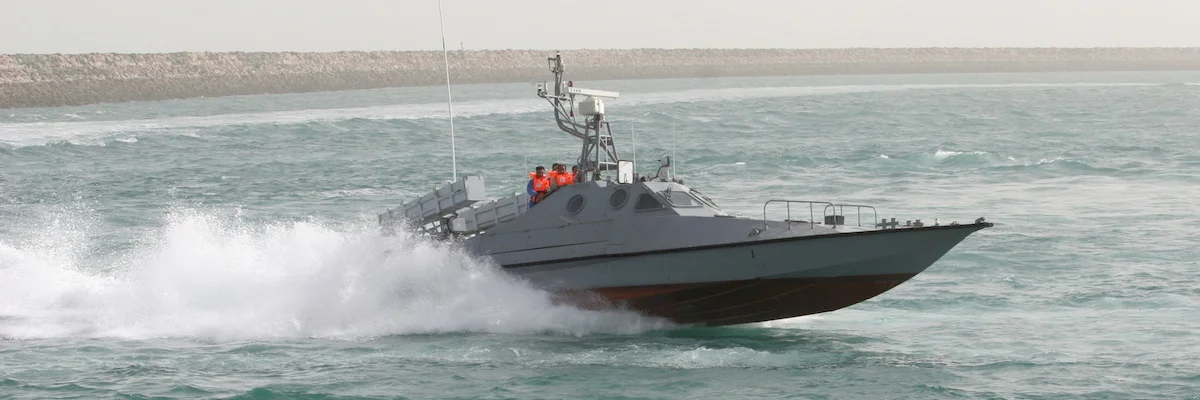
◢ Iran’s Revolutionary Guards seized a foreign oil tanker in the Persian Gulf on July 31, compounding concerns about the safety of shipping in a region crucial to oil exports. The vessel—the third foreign ship seized by the guards in the Gulf since July 14—is suspected of smuggling a large volume of fuel, the Guards said on their Sepah News portal.
By Shaji Mathew and Arsalan Shahla
Iran’s Revolutionary Guards seized a foreign oil tanker in the Persian Gulf on July 31, compounding concerns about the safety of shipping in a region crucial to oil exports.
The vessel—the third foreign ship seized by the guards in the Gulf since July 14—is suspected of smuggling a large volume of fuel, the Guards said on their Sepah News portal, without giving any details about the flag or nationality of the ship or its operator.
The ship was carrying 700,000 liters (4,403 barrels) of smuggled fuel when it was seized near Farsi Island in the western part of the Gulf, off Iran’s southwestern coast, Sepah News reported. That’s about 400 miles (640 kilometers) from the Strait of Hormuz, which has been at the center of Iran’s standoff with the West in recent weeks. Iran’s state-run Press TV reported that the seized ship is an Iraqi tanker that was delivering the fuel to some Arab countries in the Persian Gulf.
The allegedly smuggled volume is a minuscule amount in oil terms: the largest supertankers are capable of hauling cargoes of 2 million barrels.
Even so, the impounding of the ship could escalate the tensions that have flared in the region’s waters as Iran resists U.S. sanctions that are crippling its all-important oil exports and hits back after one of its ships was seized July 4 near Gibraltar. Iran grabbed a British tanker, the Stena Impero, in Hormuz two weeks later and continues to hold it.
The passage at the mouth of the Persian Gulf accounts for about a third of the world’s seaborne oil flows. To reduce the risks of navigating the waterway, the Royal Navy has started to escort British ships, and a plan for a European naval mission is taking shape.
The U.S. has embarked on a parallel operation that the Europeans are wary of joining for fear of being identified with President Donald Trump’s “maximum pressure campaign” against Iran and its economy. In response to that campaign, Iran has abandoned restrictions on uranium enrichment, downed a U.S. drone and test-fired a ballistic missile. It’s also been accused of carrying out a number of attacks on tankers near Hormuz.
Cargo Confiscated
According to Sepah News, the ship seized last week had loaded fuel from other vessels before it was impounded. It was taken to Bushehr port on Iran’s southwest coast, and its cargo was confiscated and handed over to the National Oil Distribution Company of Iran. All seven foreign crew members were arrested.
The announcement of the ship’s capture coincides with a joint meeting between the Iranian and Qatari coast guards in Tehran aimed at improving and developing maritime cooperation between the Gulf neighbors, state-run Islamic Republic News Agency reported earlier Sunday. That gathering follows a rare meeting between the coast guards of Iran and the U.A.E. last week.
Photo: Tasnim
EU to Work With Top Iran Diplomat Despite US Sanctions
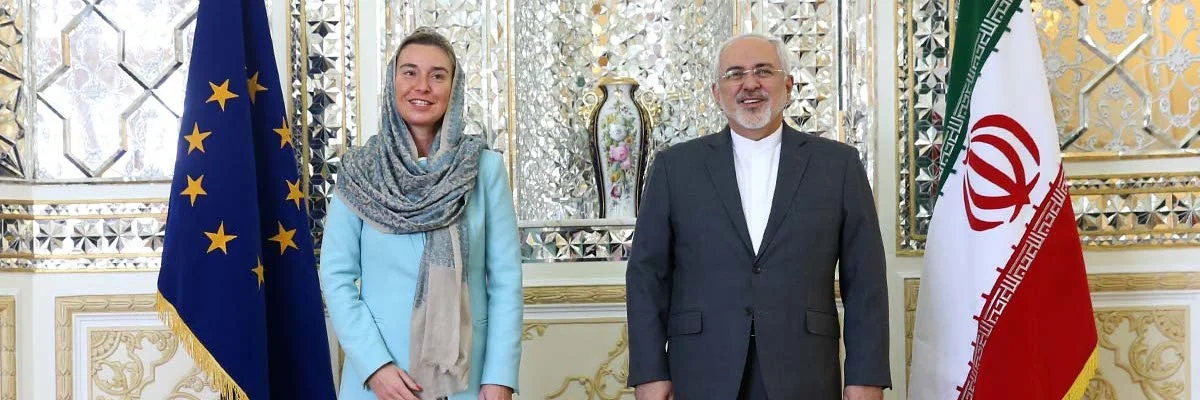
◢ The European Union said Thursday it regrets the US decision to impose sanctions against Iran’s foreign minister Mohammad Javad Zarif and vowed to continue working with him. “We regret this decision,” said Carlos Martin Ruiz De Gordejuela, a spokesman for EU diplomatic chief Federica Mogherini.
The European Union said Thursday it regrets the US decision to impose sanctions against Iran’s foreign minister Mohammad Javad Zarif and vowed to continue working with him.
The decision Wednesday was the latest blow by US President Donald Trump to the 2015 international deal to curb Iran’s nuclear program, which Brussels has been trying to salvage.
“We regret this decision,” said Carlos Martin Ruiz De Gordejuela, a spokesman for EU diplomatic chief Federica Mogherini.
“From our side, we will continue to work with Mr Zarif as Iran’s most senior diplomat and in view of the importance of maintaining diplomatic channels,” Martin said.
The US government announced Wednesday it was freezing any of Zarif’s assets that are in the United States or are controlled by US entities, adding it also will curtail his international travel.
Trump last year pulled out of a 2015 deal struck by his predecessor Barack Obama, EU powers, China and Russia aimed at curbing Iran’s nuclear program.
The EU has been trying to salvage the deal ever since.
Zarif has been at the heart of complex talks with foreign capitals over Iran’s nuclear power industry, which Tehran says is peaceful, but Washington and regional allies including Israel insist is cover for a secret weapons program.
But a senior Trump administration official said that Zarif’s diplomatic image—bolstered by his fluent English, self-effacing humor and background as a US-educated academic—was false.
Photo: IRNA
Iran Says Sanctions Show US 'Afraid' of Top Diplomat
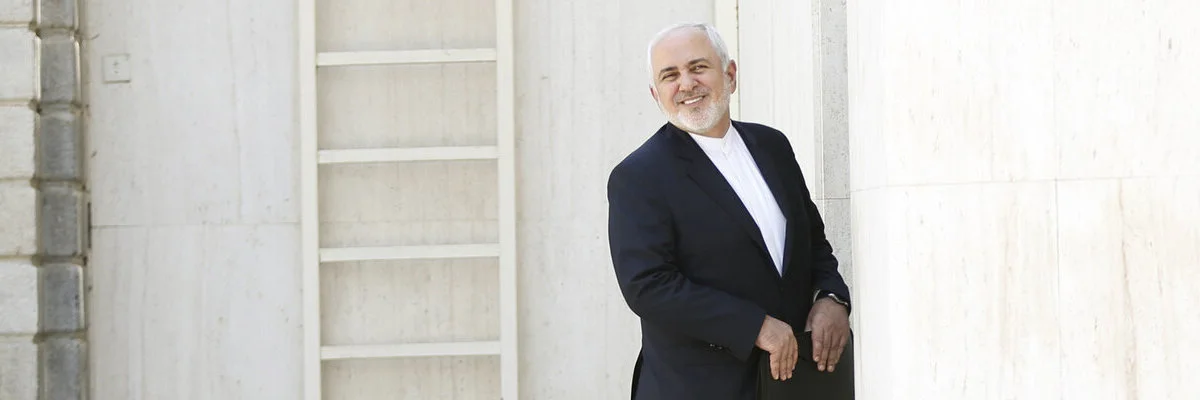
◢ Iran’s President Hassan Rouhani on Thursday mocked a US decision to impose sanctions on his top diplomat Mohammad Javad Zarif, saying it showed Washington was "afraid" of him as tensions again flare between the arch-enemies. The US Treasury said the sanctions would freeze any of Zarif's assets in the United States or controlled by US entities, as well as squeeze his ability to function as a globe-trotting diplomat.
By Amir Havasi
Iran's President Hassan Rouhani on Thursday mocked a US decision to impose sanctions on his top diplomat Mohammad Javad Zarif, saying it showed Washington was "afraid" of him as tensions again flare between the arch-enemies.
The US Treasury said the sanctions would freeze any of Zarif's assets in the United States or controlled by US entities, as well as squeeze his ability to function as a globe-trotting diplomat.
"They are afraid of our foreign minister's interviews," Rouhani said in a televised speech, referring to a recent round of interviews Zarif gave to foreign media in New York.
"It is completely clear that the foundations of the White House have been shaken by the words and logic of an informed, devoted and diplomatic individual.
"They are doing childish things now," Rouhani said on a visit to the northwestern city of Tabriz.
"Our enemies are so helpless that they have lost the ability to act and think wisely."
Iran's powerful Revolutionary Guards called the designation "absurd" and thanked Zarif for his service.
"Americans have once again shown their anger at the Islamic Revolution's inspiring... discourse and made evident their enmity towards Iran's system and proud nation," said a statement on the Guards' official website.
The designation of Zarif under the same sanctions already applied to supreme leader Ayatollah Ali Khamenei is the latest in a series of US moves against Iran.
‘Maximum Pressure'
Zarif is expected to be able to continue to visit the United Nations in New York, albeit under tight restrictions.
"Zarif implements the reckless agenda of Iran's supreme leader, and is the regime's primary spokesperson around the world," Treasury Secretary Steven Mnuchin said in a statement.
"The United States is sending a clear message to the Iranian regime that its recent behaviour is completely unacceptable."
The arch-foes have been locked in a battle of nerves since President Donald Trump withdrew the US from a landmark 2015 deal placing limits on Iran's nuclear programme and began reimposing sanctions.
The situation has worsened since the Trump administration stepped up its campaign of "maximum pressure" against Iran this year, with drones downed and tankers mysteriously attacked in Gulf waters.
But in a mixed message to Tehran, Washington on Wednesday extended waivers for three Iranian civil nuclear projects, to avoid upsetting the other parties to the 2015 agreement -- Britain, China, France, Germany and Russia.
"This is a short 90-day extension," said White House national security adviser John Bolton, a champion of the hawkish policy towards Iran.
"We are watching those nuclear activities very closely, they remain under daily scrutiny," he told Fox Business.
Zarif has been at the heart of complex talks with foreign capitals over Iran's nuclear power industry, which Tehran says is peaceful, but Washington and regional allies including Israel insist is cover for a secret weapons programme.
Freedom of Speech
But a senior Trump administration official said Zarif's diplomatic image—bolstered by his fluent English, self-effacing humor and US academic background—was false.
"The key issue is that he has had this veneer... of being the sincere and reasonable interlocutor for the regime. Our point today is that he is no such thing," the official said on condition of anonymity.
"Today President Trump decided enough was enough," the official said, accusing Zarif of functioning as "propaganda minister, not foreign minister".
Zarif shot back, tweeting that the United States was trying to silence Iran on the international stage.
"The US' reason for designating me is that I am Iran's 'primary spokesperson around the world' Is the truth really that painful?" he wrote.
"We know that calling for dialog & peace is an existential threat to #B_Team," he added, referring to Bolton, Israeli Prime Minister Benjamin Netanyahu and others pushing a hard line on Iran.
Other Iranian officials echoed Zarif's comments.
"America is not only afraid of Iran's missiles but also of Iran talking," Abbas Ali Kadkhodayi, spokesman for Iran's law-vetting Guardian Council, said on Twitter.
Photo: IRNA
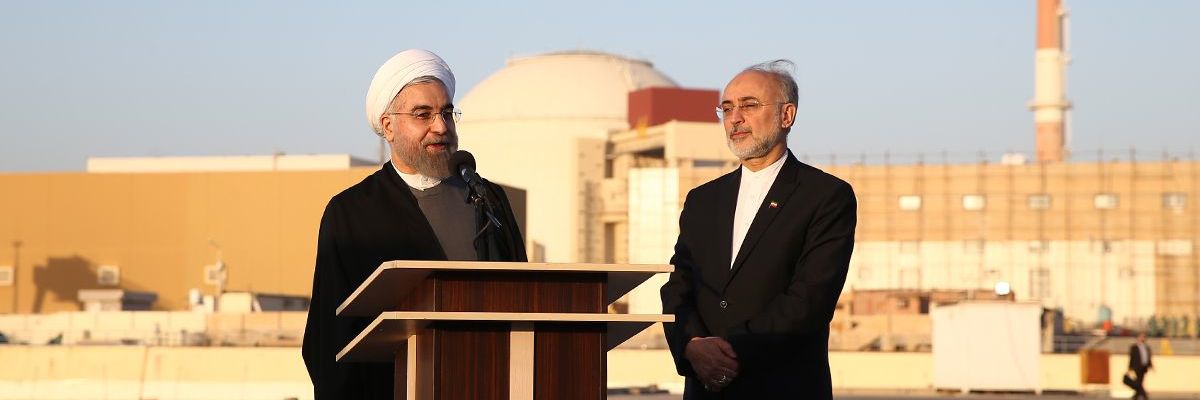
US Renews Waivers for Iran Civil Nuclear Projects
◢ The United States said Wednesday it was extending waivers for three civilian nuclear projects in Iran, despite Washington's withdrawal from the 2015 nuclear agreement. "This is a short 90 day extension," said White House National Security Advisor John Bolton, a champion of the hawkish policy towards Tehran.
The United States said Wednesday it was extending waivers for three civilian nuclear projects in Iran, despite Washington's withdrawal from the 2015 nuclear agreement.
"This is a short 90 day extension," said White House National Security Advisor John Bolton, a champion of the hawkish policy towards Tehran.
"We are watching those nuclear activities very, very closely, they remain under daily scrutiny," he told Fox Business.
The projects include the Bushehr nuclear power plant, the Arak heavy water reactor, which has been modified under the supervision of the international community to render it impossible to produce plutonium for military use, and the Fordow fuel enrichment plant.
The State Department downplayed the move, as it did when it last granted an extension in May, describing the waivers as "continued restrictions on the Iranian regime's nuclear program".
"The action today will help preserve oversight of Iran's civil nuclear program, reduce proliferation risks, constrain Iran's ability to shorten its 'breakout time' to a nuclear weapon, and prevent the regime from
reconstituting sites for proliferation-sensitive purposes," Secretary of State Mike Pompeo's spokeswoman Morgan Ortagus said in a statement.
In reality, the move extends exemptions for the three Iranian civil nuclear projects, the State Department confirmed to AFP.
There was debate in President Donald Trump's administration about these exemptions, with hawks saying that after Washington's withdrawal from the Iran nuclear deal in 2018, it would have been logical to stop them in order to further increase the pressure on Tehran.
But the more moderate line has prevailed for the moment, so as not to upset the other signatories to the 2015 deal—China, Russia, Germany, France and Britain—amid escalating tensions between the US and Iran.
The 2015 agreement promised that world powers would assist Iran in developing civilian nuclear energy -- the clerical regime's stated goal for its atomic program.
The waiver announcement came as Washington imposed sanctions Wednesday on Iranian Foreign Minister Mohammad Javad Zarif.
Photo: President.ir
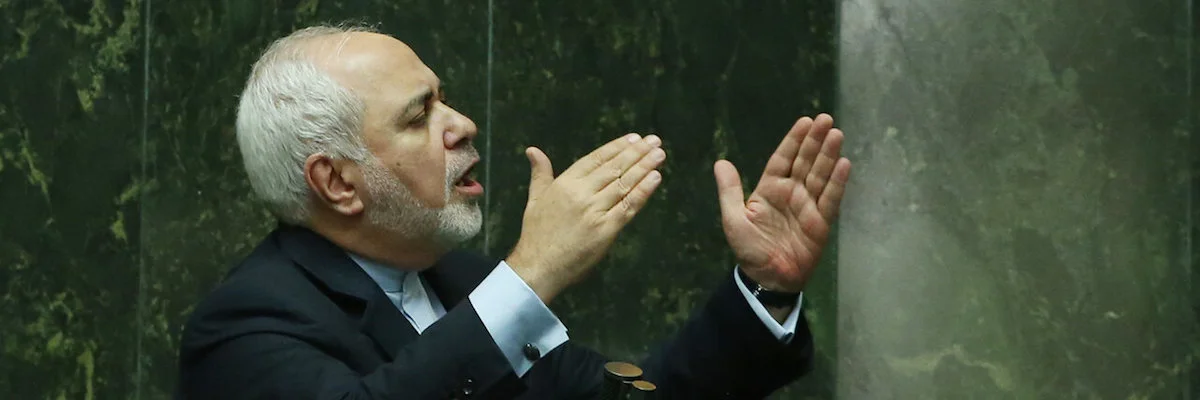
U.S. Sanctions Iranian Foreign Minister Zarif as Tensions Rise
◢ The Trump administration on Wednesday imposed sanctions against Iranian Foreign Minister Javad Zarif in a provocative move that diminishes the prospects for a diplomatic solution to rising tensions that have brought the U.S. and Tehran to the brink of war. The U.S. said Zarif, viewed as Iran’s most skilled diplomat, acts on behalf of Ayatollah Ali Khamenei, who was previously sanctioned.
By Saleha Mohsin and Justin Sink
The Trump administration on Wednesday imposed sanctions against Iranian Foreign Minister Javad Zarif in a provocative move that diminishes the prospects for a diplomatic solution to rising tensions that have brought the U.S. and Tehran to the brink of war.
The U.S. said Zarif, viewed as Iran’s most skilled diplomat, acts on behalf of Ayatollah Ali Khamenei, who was previously sanctioned.
“Javad Zarif implements the reckless agenda of Iran’s Supreme Leader and is the regime’s primary spokesperson around the world,” Treasury Secretary Steven Mnuchin said in a statement. “The United States is sending a clear message to the Iranian regime that its recent behavior is completely unacceptable.”
Tensions have been flaring around the Strait of Hormuz in recent weeks as Iran lashes out against U.S. sanctions that are crippling its oil exports. Iran is producing oil at the slowest clip since 1986, making U.S. sanctions one of the toughest challenges confronting Iran’s economy since the 1979 revolution.
The largely symbolic sanctions won’t prevent Zarif from traveling to the United Nations in New York for official business. The penalties would block Zarif’s access to any property the has in the U.S., though he said in a tweet that he has none so the sanctions will have no effect.
Zarif, who has been Iran’s foreign minister since 2013, was the lead negotiator in the multinational nuclear deal known as the Joint Comprehensive Plan of Action. It was supposed to yield economic advantages for Iran, but instead renewed U.S. sanctions have shattered that expectation since President Donald Trump quit the accord last year.
The U.S. sanctions may bolster Zarif’s standing in Iran, where hard-liners have long blamed him for helping to craft the nuclear accord. “Thank you for considering me such a huge threat to your agenda,” Zarif said in his tweet.
Zarif oversees a Foreign Ministry that has “coordinated with one of the Iranian regime’s most nefarious state entities, the IRGC-Qods Force (IRGC-QF), which is designated pursuant to terrorism and human rights authorities,” according to a statement from the Treasury Department.
The Trump administration said last month it was planning to sanction Zarif, who received his bachelor’s and advanced degrees at U.S. universities.
Secretary of State Mike Pompeo has dismissed Zarif’s role in setting the government’s policy, which he said is driven by Khamenei and the Islamic Revolutionary Guard Corps.
“Foreign Minister Zarif is no more in charge of what’s going on in Iran than a man in the moon,” Pompeo said on Bloomberg Television last week. “At the end of the day, this is driven by the ayatollah. He will be the ultimate decision-maker here.”
Zarif said earlier this month that Iran’s leaders know they can’t count on Trump losing his 2020 re-election bid.
“There is a better than 50% chance that he might still be in office, so we will need to deal with him for another six years,” Zarif said in an interview on Bloomberg Television.
Photo: IRNA
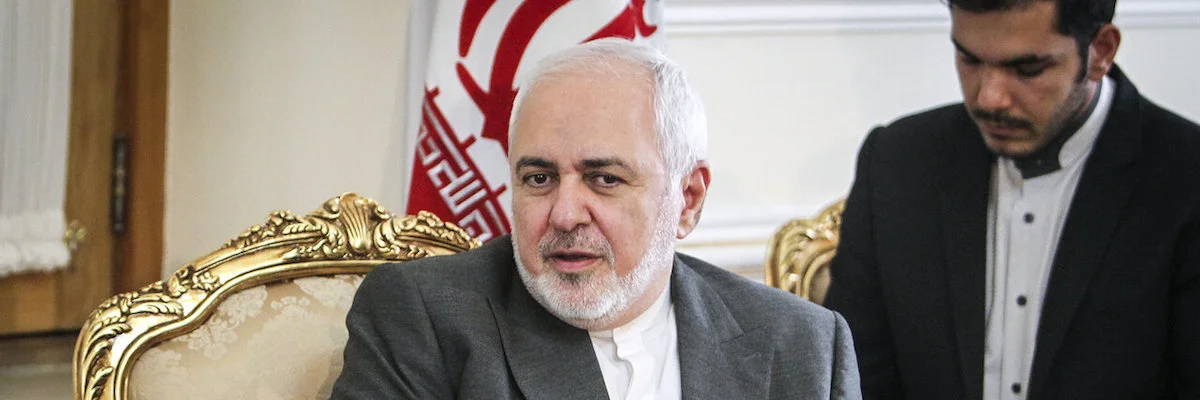
Iran Says Europe 'Obliged' to Let it Sell and Ship Oil
◢ Iran said Wednesday that European nations still party to the 2015 nuclear deal are "obliged" to allow it to sell and ship oil, amid a standoff with Britain over the seizure of tankers. "They (the European parties) have set out their commitments and announced them, they (include) the sale of Iran's oil, the transportation of Iran's oil, and the return of Iran's oil income," said Iranian Foreign Minister Mohammad Javad Zarif.
Iran said Wednesday that European nations still party to the 2015 nuclear deal are "obliged" to allow it to sell and ship oil, amid a standoff with Britain over the seizure of tankers.
The deal over Iran's nuclear programme has begun to unravel since President Donald Trump announced the United States was withdrawing from the agreement last year and reimposing sanctions.
Iran has been pushing the European parties to the deal—Britain, France and Germany—to adhere to their commitments under the agreement despite US pressure.
British authorities seized a tanker carrying Iranian oil off its territory Gibraltar on July 4, a move Spain's foreign minister said was carried out at the request of the United States.
"They (the European parties) have set out their commitments and announced them, they (include) the sale of Iran's oil, the transportation of Iran's oil, and the return of Iran's oil income," said Iranian Foreign Minister Mohammad Javad Zarif.
"It is clear that today's tensions and problems are due to America's economic terrorism and Europe's inability to fulfil its commitments which means going along with America's economic terrorism," he said, quoted by state media.
Zarif's remarks come after a meeting in Vienna on Sunday of the remaining parties to the nuclear deal -- the three European nations plus China and Russia.
In remarks broadcast on state television, the top Iranian diplomat described the talks as "challenging".
"We raised our stance and the importance of the fulfilment of the commitments of other parties to the JCPOA, in particular European countries," he said, referring to the deal by its formal name, the Joint Comprehensive Plan of Action.
Europeans 'Must Have Courage'
"We clearly explained to them that these commitments that have been raised have not been implemented and that INSTEX... still isn't fully operational," said Zarif.
INSTEX was a mechanism set up by Britain, France and Germany to facilitate trade with Iran in the face of US sanctions.
"It should not be the case that INSTEX becomes a tool for implementing America's orders," the foreign minister said.
"INSTEX must be considered as a European measure.
"They (the Europeans) must have the courage to act according to their commitments and not according to America's demands," he said.
One year after the US pullout, Iran said in May it would begin scaling back its commitments, and it has since started increasing its stockpile of enriched uranium and the level of enrichment beyond the deal's limits.
Zarif said Iran was ready to take a third step to reduce its commitments under the deal unless the remaining parties fulfil theirs, as they reiterated in Vienna.
"Now we'll have to see how they are going to act," he said.
"But in the current circumstances and as long as necessary measures are not taken, the Islamic Republic of Iran's third step will certainly be operational."
Photo: IRNA
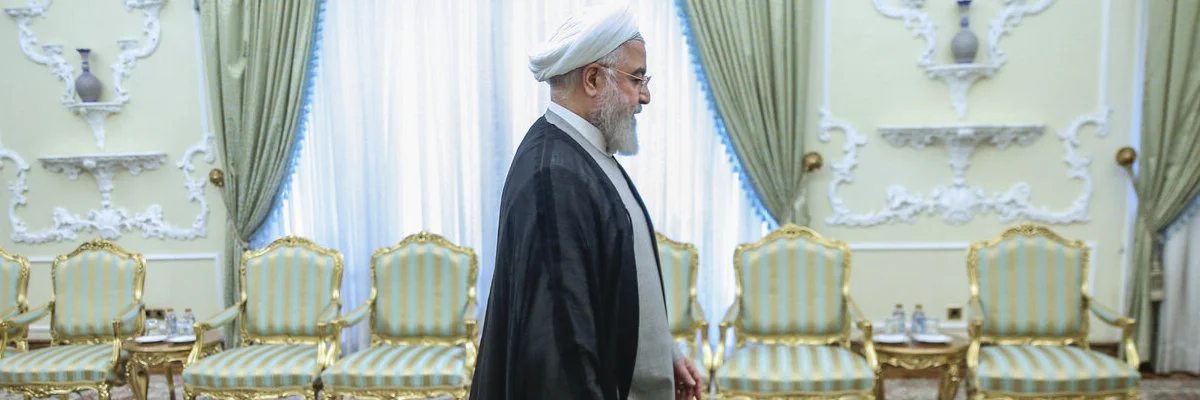
Macron, Rouhani Hold Talks Over Iran-US Tensions
◢ French President Emmanuel Macron on Tuesday spoke with his Iranian counterpart Hassan Rouhani and reiterated his call for a de-escalation of tensions between Iran and the United States, the Elysee said. "It is France´s role to make every effort to ensure that all parties agree to a break and open negotiations," the French presidency said.
French President Emmanuel Macron on Tuesday spoke with his Iranian counterpart Hassan Rouhani and reiterated his call for a de-escalation of tensions between Iran and the United States, the Elysee said.
"It is France´s role to make every effort to ensure that all parties agree to a break and open negotiations," the French presidency said.
The 2015 deal over Iran´s nuclear programme has begun to unravel since US President Donald Trump announced Washington was pulling out of the agreement last year and reimposed sanctions, to the dismay of European allies.
France, Britain and Germany were among the key players in the pact.
Macron had a "long" discussion with Rouhani during the French leader´s annual holiday at his summer retreat, the medieval fort of Bregancon on France´s Mediterranean coast, the Elysee said.
Macron "recalled the need to initiate a de-escalation of tensions," it added.
Paris has engaged in intense diplomacy seeking to solve the current tensions, with Macron´s foreign policy advisor Emmanuel Bonne twice visiting Tehran.
Russian President Vladimir Putin is due to visit Macron in Bregancon in mid-August ahead of a G7 summit in Biarritz which will present "new opportunities to discuss the Iranian issue", according to the Elysee.
Photo: IRNA
