
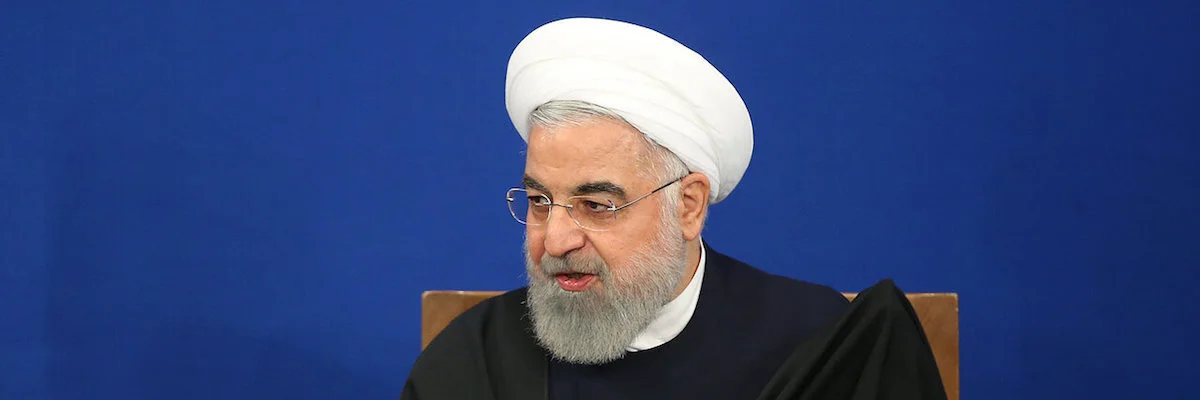
Iran's Beleaguered President Rouhani Rules Out Resigning
◢ Iran's President Hassan Rouhani on Sunday ruled out resigning and vowed to see out his term, even as he admitted he had offered to step aside twice since being elected. Speaking ahead of a general election next Friday, Rouhani also appealed to voters to turn out despite the fact that many moderate and reformist candidates were disqualified from the race.
By Amir Havasi
Iran's President Hassan Rouhani on Sunday ruled out resigning and vowed to see out his term, even as he admitted he had offered to step aside twice since being elected.
Speaking ahead of a general election next Friday, Rouhani also appealed to voters to turn out despite the fact that many moderate and reformist candidates were disqualified from the race.
Rumours have swirled in Iran recently that the 71-year-old, whose second and last term ends next year, had been planning to quit, but his office denied the reports.
Rouhani's government has come under fire over the state of Iran's sanctions-hit economy and for allegedly failing to fulfil election promises.
The legitimacy of Rouhani and his government have been called into question after they were left in the dark for days after the armed forces admitted they "accidentally" shot down a Ukrainian airliner on January 8.
Hardliners have attacked his administration for negotiating a nuclear deal with world powers that ultimately backfired when the United States withdrew unilaterally and reimposed harsh sanctions.
"My resignation does not make much sense... we have made promises to the people and we will continue to fulfil those promises" despite the economic situation and pressure from "the enemy", Rouhani said, referring to the US.
"The idea of resigning (because of these recent problems) never occurred to me."
But Rouhani admitted he had offered to resign twice in the past, and that they were rejected by supreme leader Ayatollah Ali Khamenei.
"In the first months after my election, I told the supreme leader 'If you think for some reason that someone else or another government can serve the country better, I'm ready to go'," said Rouhani.
"He vehemently rejected it," he told a news conference in Tehran.
Rouhani, a moderate conservative, said he raised the issue with the supreme leader again during his second term.
"I would not even let the government leave its responsibility an hour earlier, not a month or a week earlier'," he quoted Khamenei as saying.
Election Appeal
Rouhani's supporters suffered a setback in the lead-up to the February 21 election after more than half of the 14,444 who sought to stand were disqualified, most of them moderates and reformists.
Despite the purge, Rouhani called for a strong showing at the election.
"All elections are important to us, and I urge all people to come to the ballot box and vote... to choose the best (candidates) and have a good parliament," he told Sunday's news conference.
Iran's seventh president, Rouhani won election in 2013 after promising greater social freedoms and the benefits of engagement with the West.
He delivered on the second pledge in 2015, when Iran agreed to limit its nuclear activities in return for the lifting of international sanctions.
The president was re-elected in 2017 with the support of reformists.
But support from those who backed him in the past has fallen away badly amid criticism over his austerity measures.
In November, street protests broke out in Iran over a surprise petrol price hike.
They spread to dozens of urban centres and turned violent before being put down by the security forces.
Iran's economy has been battered since the US pulled out of the nuclear deal, with the World Bank estimating it shrunk by 8.7 percent in 2019.
Photo: IRNA
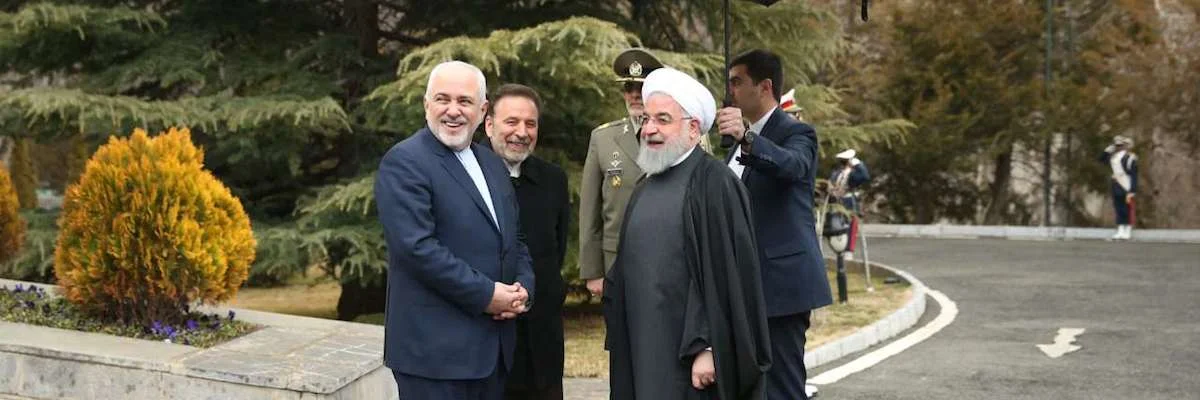
Iran President Rejects FM Zarif's Resignation
◢ Iranian President Hassan Rouhani rejected Foreign Minister Mohammad Javad Zarif's resignation on Wednesday, the government's official website said. "I believe your resignation is against the country's interests and do not approve it," Rouhani wrote in a letter to Zarif, the website said.
Iranian President Hassan Rouhani rejected Foreign Minister Mohammad Javad Zarif's resignation on Wednesday, the government's official website said.
"I believe your resignation is against the country's interests and do not approve it," Rouhani wrote in a letter to Zarif, the website said.
"I consider you, as put by the leader, to be 'trustworthy, brave and pious' and in the forefront of resistance against America's all-out pressure," he added. referring to Iran's supreme leader Ayatollah Ali Khamenei.
Zarif abruptly tendered his resignation on Instagram on Monday, seemingly over being left out of meetings with visiting Syrian President Bashar al-Assad earlier in the day, Iran's Entekhab news agency reported.
Assad, a major recipient of Iranian aid during his country's nearly eight-year civil war, met with both Khamenei and Rouhani on his rare foreign visit, but not with Zarif.
Rouhani praised Zarif's "relentless efforts and endeavours" in bearing the "heavy responsibility" of the foreign affairs portfolio.
He stressed that Zarif was the point-man in the conduct of Iran's foreign policy.
"As ordered several times, all bodies—including government or state bodies—must be in full coordination with this ministry with regards to foreign relations," the president said in his letter.
Entekhab said it tried to reach Zarif after Assad's visit and received the following message: "After the photos of today's meetings, Javad Zarif no longer has any credibility in the world as the foreign minister!"
Photo Credit:

Iran Foreign Minister Zarif Announces Resignation on Instagram
◢ Iranian Foreign Minister Mohammad Javad Zarif, who was the lead negotiator in the 2015 nuclear deal, announced his resignation on Instagram on Monday, which can only take effect once President Hassan Rouhani accepts it. "I apologize for my inability to continue serving and for all the shortcomings during my term in office," Zarif said in a message posted on his verified Instagram account.
Iranian Foreign Minister Mohammad Javad Zarif, who was the lead negotiator in the 2015 nuclear deal, announced his resignation on Instagram on Monday, which can only take effect once President Hassan Rouhani accepts it.
"I apologize for my inability to continue serving and for all the shortcomings during my term in office," Zarif said in a message posted on his verified Instagram account.
Zarif thanked Iranians and "respected officials" for their support "in the last 67 months".
The resignation of Iran's top diplomat was confirmed by an informed source, however Rouhani's chief of staff strongly denied reports that the president had accepted Zarif's resignation in a tweet.
The resignations happened hours after a surprise visit by Syrian President Bashar Al-Assad to Tehran. However, according to the semi-official ISNA News Agency, Zarif was not present at any of Assad's meetings with Iran's supreme leader Ayatollah Ali Khamanei and Rouhani.
Prominent members of parliaments immediately called for Rouhani not to accept the resignation.
"Undoubtedly the Iranian people, government and state will not benefit from this resignation," said Mostafa Kavakebian, a reformist MP.
“A great majority of MPs demand that the president never accept this resignation," he said in a tweet.
The head of parliament's influential national security and foreign policy commission told ISNA how a planned trip to Geneva with Zarif on Monday afternoon had been cancelled at the last minute with no explanation.
Under Pressure
"I suddenly got a text message saying the trip has been cancelled," Heshmatollah Falahatpisheh told ISNA, adding that this was not the first time Zarif had resigned but "that he has done so publicly this time means that he wants the president to accept it this time."
Zarif, 59, has served as Rouhani's foreign minister since August 2013 and has been under constant pressure and criticism by hardliners who opposed his policy of détente with the west.
His standing within Iran's political establishment took a hit when the US withdrew from the nuclear deal in May 2018 and the deal's achievements became less and less clear as Iran's economy nosedived.
Zarif was blamed by ultra-conservatives for negotiating a bad deal that had not gained anything meaningful for Iran for all the concessions it had made in its nuclear program.
The faceoff between the minister and his critics only intensified as time passed, with Zarif saying his main worry throughout the nuclear talks had been from pressure from inside Iran.
"We were more worried by the daggers that were struck from behind than the negotiations," he told a local newspaper on February 2.
"The other side never managed to wear me down during the negotiations... but internal pressure wore me down both during and after the talks," he said.
The latest point of contention between Zarif and hardliners was the implementation of the Financial Action Task Force's requirements regarding money laundering in Iran.
The rift on the issue pitched the government and the parliament against supervisory councils.
On Sunday, ISNA reported that Zarif had warned the Expediency Council, an arbitration body tasked with solving such impasses, that it should "understand the consequences of its decision."
He was immediately attacked by the ultra-conservatives who deemed what Zarif had said as a threat.
Photo Credit: Hadi Zand, ISNA

Iran Environmentalist, Symbol of Expat Return, Quits
◢ A top Iranian environment official, who symbolized government efforts to encourage expat Iranians to return home, has quit just seven months into his job, sources said Monday. The resignation of Kaveh Madani, who was a young professor at London's Imperial College before returning to Iran in September 2017, followed reports of mounting conservative pressure against him.
A top Iranian environment official, who symbolized government efforts to encourage expat Iranians to return home, has quit just seven months into his job, sources said Monday.
The resignation of Kaveh Madani, who was a young professor at London's Imperial College before returning to Iran in September 2017, followed reports of mounting conservative pressure against him.
The government of President Hassan Rouhani, which has called on Iranians abroad to come home and help develop the country, appointed the water conservation expert as deputy head of the country's environment department.
But in recent weeks, conservative outlets published photos purporting to show him drinking and dancing on holiday. Hardliners called him "debauched" and demanded he be sacked.
Shortly after arriving in Iran last year, Madani had told the English-language Tehran Times that many Iranians abroad were "waiting and watching closely to see what's going to happen".
"If I succeed, we might see more people coming back to help the government," he said. But on Monday a colleague of Madani confirmed reports that he had resigned while out of the country.
In February, Madani was briefly detained by one of Iran's security agencies amid a crackdown on environmentalists that saw several activists arrested on espionage charges.
One, Kavous Seyed Emami, died in Tehran's Evin prison after being accused of spying for the United States and Israel. Iranian authorities said he had committed suicide in his cell, but this has been disputed by the family.
Madani studied in Tabriz in northern Iran before getting his PhD in civil and environmental engineering from the University of California, according to Imperial College's website.
"I'm the representative of a generation who left the country and the whole country is complaining about losing this generation and brain drain," he told the Tehran Times in December.
He also tweeted at the time: "I have returned with the hope of creating
#hope". After hearing of Madani's resignation, reformist lawmaker Mahmoud Sadeghi criticised authorities for the message he said they were sending to "elite Iranians living abroad".
The water expert's departure comes as Iran suffers from years of drought, which has devastated its agriculture.
There have been reports of persistant protests by farmers in Isfahan in recent weeks, which have been denounced by conservatives including the city's Friday prayers leader.
Photo Credit: Kaveh Madani Twitter