
Iran Suggests Up to 225 Killed in November Protests
Iran's interior minister has suggested that up to 225 people were killed in November protests sparked by a petrol price hike, ISNA news agency reported on Sunday.
Iran's interior minister has suggested that up to 225 people were killed in November protests sparked by a petrol price hike, ISNA news agency reported on Sunday.
Officials in Iran have yet to issue an overall death toll for the unrest, while London-based human rights group Amnesty International has put the number at more than 300.
The protests erupted on November 15 in several cities and rapidly spread to at least 100 cities and towns, with petrol pumps torched, police stations attacked and shops looted, before being put down by security forces amid a near-total internet blackout.
Officials had repeatedly denied death tolls given by foreign media and human rights groups as "lies", and passed responsibility of reporting on it between different state bodies.
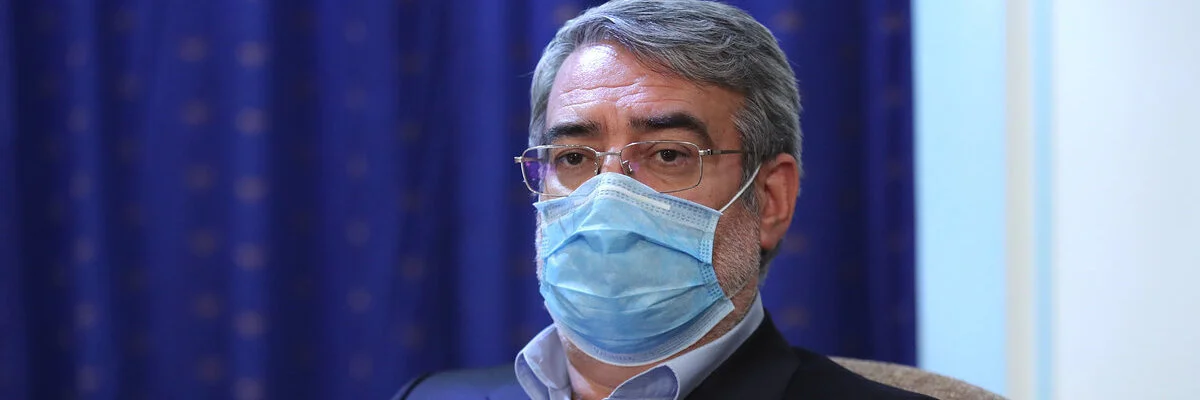
"Sad things happened. About 40 or 45 people, meaning around 20 percent of those killed, were shot with non-standard issue weapons and martyred," said Interior Minister Abdolreza Rahmani Fazli.
"No armed confrontation with the people happened... but when they attack a police station, they have to be confronted," ISNA quoted him as saying.
His breakdown indicated that, according to the government, between 200 and 225 people were killed in the violence.
According to Amnesty, at least 304 people were killed during the unrest.
A group of independent UN rights experts said in December that based on unconfirmed reports more than 400 people could have been killed in the crackdown.
The experts said at the time that at least 12 of those killed were children.
They pointed to reports and footage apparently showing that security forces "not only fired live ammunition at unarmed protesters, but also aimed at their heads and vital organs".
The United States has claimed that more than 1,000 were killed in the violence.
Iran has blamed the violence that broke out during the protests on "thugs" backed by its foes the United States, Israel and Saudi Arabia.
It has singled out exiled royalists and the People's Mujahedeen of Iran (MEK), an exiled former rebel group which it considers a "terrorist cult".
The minister said the petrol price hike had been "just an excuse" for creating chaos as foes had wanted a "civil war" in Iran.
He also defended the internet blackout, saying that the MEK, monarchists, and the Islamic State group were "giving military training through the internet.”
Photo: IRNA
Khamenei Claims a Blow to U.S. Power in Rare Friday Sermon
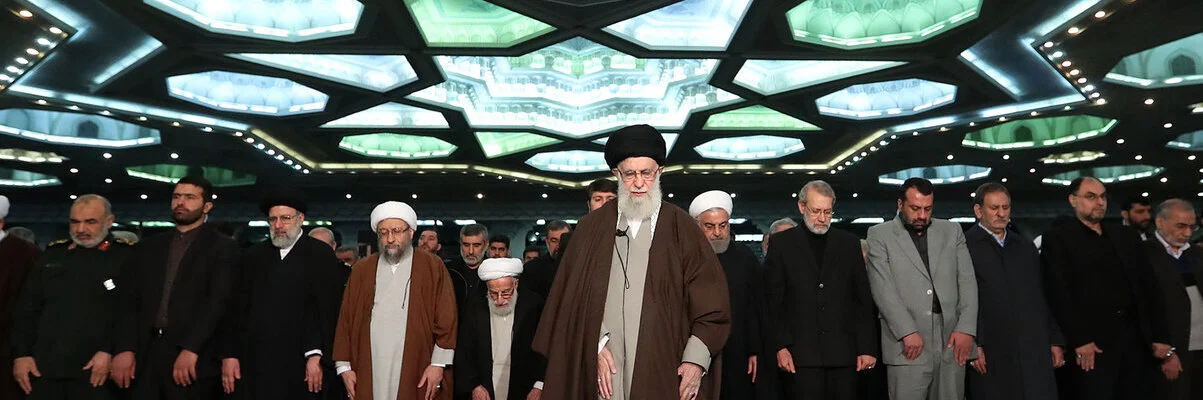
◢ Supreme Leader Ayatollah Ali Khamenei said Iran had delivered a “slap to the U.S.’s image as a superpower” in this month’s military confrontation, seeking to rally Iranians around an embattled establishment as he led Friday prayers in Tehran for the first time in eight years.
By Golnar Motevalli
Supreme Leader Ayatollah Ali Khamenei said Iran had delivered a “slap to the U.S.’s image as a superpower” in this month’s military confrontation, seeking to rally Iranians around an embattled establishment as he led Friday prayers in Tehran for the first time in eight years.
His speech came amid unprecedented international scrutiny over the Islamic Revolutionary Guard’s unintentional shooting down of a Ukrainian passenger plane just hours after Iran had fired missiles into Iraqi bases housing American troops without causing fatalities. That attack had been in retaliation for the killing of a top Iranian commander by the U.S.
“They’re hit by strikes in Syria, in Iraq, in Lebanon and in Afghanistan at the hands of the power of resistance, but this strike was greater than all of those, it was a strike on prestige,” Khamenei said of the Iranian action in Iraq. U.S. officials, including President Donald Trump, who claimed to be on the side of the Iranian people are “clowns,” he said.
Khamenei branded the U.S. “terrorists” for the Jan. 3 killing of General Qassem Soleimani, whom he credited with being the most effective force in defeating Islamic State.
Soleimani was a hero to many Iranians for his leadership of an elite unit of the Guard which orchestrated Iran’s military policy overseas, playing a major role in destroying the extremist group’s rule in Syria and Iraq. His killing brought the nation together in mourning but that sense of unity was shattered by the downing of the Ukraine International Airlines plane, which killed all 176 people on board. Most of the victims were Iranian citizens or dual nationals.
‘Bitter Incident’
Khamenei called the jet disaster an “extremely bitter incident” but said public opinion over the tragedy had been manipulated by U.K. and U.S.-based television channels. The top cleric directly instructed the Revolutionary Guard to carry out a full investigation and guarantee that there could never be a repeat.
Once Iranian officials finally accepted responsibility, after days of denials, protests against the government broke out in Tehran and other cities. Just weeks earlier, security forces had crushed some of the biggest and most sustained anti-regime demonstrations in more than a decade. Human rights groups say hundreds of people were killed in that crackdown.
While Iran’s leaders admitted culpability for the jet disaster they have also blamed the U.S. for creating the sense of crisis that preceded it. In the part of his sermon conducted in Arabic, Khamenei said the “real punishment” for the U.S. would be its forced ouster from the Middle East.
Under pressure from Democrats at home, Trump has offered various justifications for the decision to kill Soleimani, including intelligence that he said pointed to imminent attacks on U.S. embassies, as well as past American military deaths due to Iranian actions supervised by Soleimani in Iraq.
A report on Friday said that nearly a dozen U.S. troops were treated for concussion after Iran’s missile attacks in Iraq. The U.S. and Iran have since both signaled they want to back away from further military conflict, but with the two arch foes locked in a deepening confrontation over Iran’s nuclear program and American sanctions, tensions in the Gulf remain high.
On Tuesday the U.K., Germany and France angered Tehran by announcing they would activate a dispute resolution mechanism contained in the 2015 nuclear deal which Trump exited before reimposing sanctions. The European move nudged the accord closer to the brink of collapse.
Khamenei accused the European countries of working with the U.S. to try and force Iran “to its knees,” and said he had “never trusted them since day one.”
Photo: IRNA
Khamenei to Lead Friday Prayers Amid Iranian Tumult
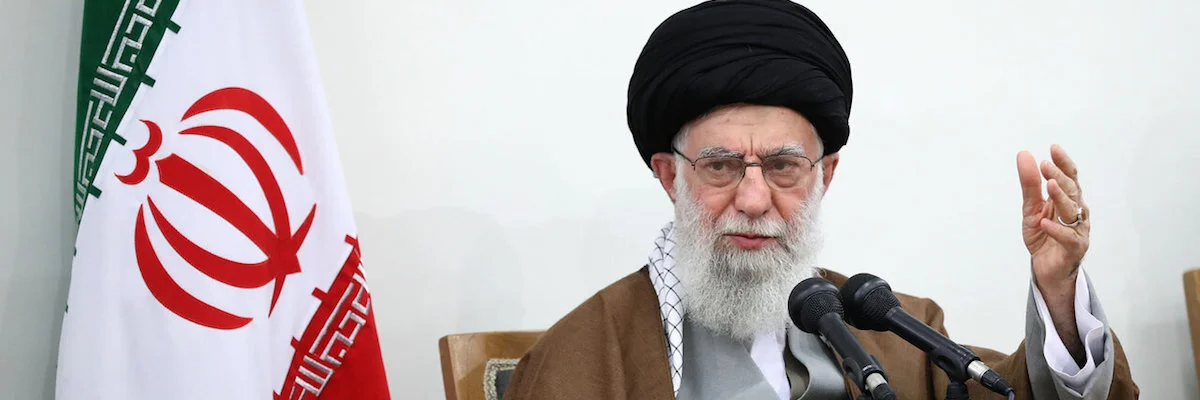
◢ Iran's supreme leader is expected to lead the main weekly Muslim prayers in Tehran on Friday, after a traumatic month in which the country had appeared on the brink of war with the United States and accidentally downed a Ukrainian passenger jet. The last time Ayatollah Ali Khamenei led Friday prayers at Tehran's Mosalla mosque was in February 2012.
Iran's supreme leader is expected to lead the main weekly Muslim prayers in Tehran on Friday, after a traumatic month in which the country had appeared on the brink of war with the United States and accidentally downed a Ukrainian passenger jet.
The last time Ayatollah Ali Khamenei led Friday prayers at Tehran's Mosalla mosque was in February 2012, on the 33rd anniversary of the Islamic revolution and at a time of crisis over the Iran nuclear issue.
His Friday appearance comes at a tumultuous moment for the country which had seemed headed for conflict earlier in January after the United States killed its top general Qasem Soleimani in a drone strike in Baghdad, prompting Iran to retaliate against US military targets in Iraq with a volley of missiles.
The strike, which caused significant material damage, wounded 11 US troops, according to a statement by US Central Command released Thursday, which contradicted the military's previous assessment of no casualties.
Earlier in the day President Hassan Rouhani emphasized in a televised speech that Iran "is working daily to prevent military confrontation or war", and maintained that a dialogue with the world was still "possible".
Tensions between Washington and Tehran seemed to subside in the wake of the accidental downing of a Ukrainian passenger airliner hours after Iran's retaliatory strikes, as Tehran was on high alert for US reprisals.
The tragedy killed 176 people, mostly Iranians and Canadians.
Better Governance
Canada's foreign minister on Thursday vowed to push Iran for answers about the tragedy.
Ottawa said earlier that US President Donald Trump's policies had contributed to the heightened tensions that led to the catastrophe.
In June 2019, Iran and the United States had also appeared to be on the brink of direct military confrontation after Tehran shot down a US drone it said had violated its airspace.
Trump said he called off retaliatory strikes at the last minute.
The animosity between Washington and Tehran has increased since Trump withdrew the United States from the landmark 2015 nuclear deal in 2018 and reimposed biting sanctions.
In Iran, the air disaster sparked public outrage and anti-government demonstrations took place every day from Saturday to Wednesday.
Security forces were deployed across the capital in response to the protests.
According to an AFP journalist, around 50 riot police with batons, motorbikes and what appeared to be a tear gas launcher were posted at a major junction in north Tehran on Thursday evening.
Concentrated in the capital, the protests appeared smaller than a wave of national demonstrations in November, prompted by a fuel price hike. They had been met with a crackdown that left at least 300 people dead, according to Amnesty International.
Rouhani implicitly acknowledged a crisis of confidence in authorities, but called Wednesday for "national unity", better governance and greater pluralism.
On Thursday, Rouhani also defended the policy of openness that he has pursued since his first election in 2013, and which Iran's ultra-conservatives criticise.
"Of course, it's difficult," he acknowledged, but added, "the people elected us to lower tensions and animosity" between the Islamic republic and the world.
That said, Khamenei, who maintains that the West is not trustworthy, bans dialogue with Trump.
'High School Bully'
On Thursday, Rouhani said Iran's "daily enrichment" of uranium was currently "higher" than before the conclusion of the 2015 nuclear deal.
Rouhani, who instigated the negotiations, made the comments while justifying his nuclear policy and Iran's progressive disengagement from the accord. He also stated his willingness to continue dialogue on the agreement.
In response to the US withdrawal from the deal and sanctions, an increasingly frustrated Iran has hit back with a step-by-step suspension of its own commitments under the deal, which drastically limited its nuclear activities.
On Tuesday, Germany, the UK and France -- the three European parties to the deal -- announced they had triggered a dispute mechanism in response to the latest step back from the deal by Tehran.
Germany on Thursday confirmed a Washington Post report that the US had threatened to impose a 25 percent tariff on imports of European cars if EU governments continued to back the nuclear deal.
Iranian Foreign Minister Mohammad Javad Zarif accused the European parties of having "sold out" the deal to avoid trade reprisals from the United States, and said Trump was again behaving like a "high school bully.”
Photo:
Iran Protests Turn Violent in Ongoing Anger Over Downed Jet
◢ Conditions boiled over as Iranians gathered for a second night of protests after the government admitted it had mistakenly downed a Ukrainian passenger jet, triggering global outrage as well as internal dissent. Security forces stepped up their patrols as protesters, many of them students, came out in force in Tehran’s landmark Azadi Square and at Shahid Beheshti University.
By Aoyon Ashraf and Arsalan Shahla
Conditions boiled over as Iranians gathered for a second night of protests after the government admitted it had mistakenly downed a Ukrainian passenger jet, triggering global outrage as well as internal dissent.
Security forces stepped up their patrols as protesters, many of them students, came out in force in Tehran’s landmark Azadi Square and at Shahid Beheshti University, as well as in several regional cities.
Videos posted on social media, which could not immediately be verified by Bloomberg News, showed clashes between protesters and riot police, trails of blood on a main street, chants in opposition to Supreme Leader Ayatollah Ali Khamenei, and calls to rid the country of the Islamic Revolutionary Guards Corps. Protesters in the videos said arrests had been made and tear gas fired at crowds.
Anger spread across the globe after Iran’s leaders admitted on Saturday that its military accidentally shot down the Ukrainian jet on Wednesday, killing all 176 people on board, after mistaking it for a cruise missile.
The announcement was a dramatic reversal after the regime spent days accusing Western governments of “psychological warfare.” Iran’s government said Sunday it was forming a working group to probe the crash and compensate victims.
President Donald Trump, who a week ago threatened to bomb Iranian cultural sites, sent a series of tweets in Farsi over the weekend expressing support for protesters and warning Iran’s leaders not to intervene. “DO NOT KILL YOUR PROTESTERS,” Trump said.
Earlier, videos showed motorcycle-mounted security forces in green camouflage and anti-riot body armor stationed on Tehran’s central Valiasr Square. There was also a heavy police presence outside Tehran University.
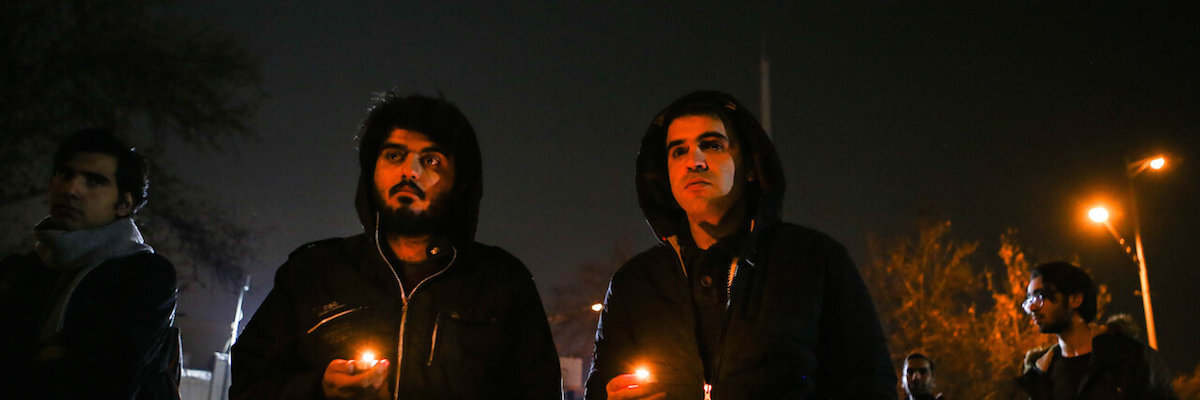
In the face of the growing tensions, some of the organizers of a candlelight vigil Saturday—which turned into an angry protest against the regime—urged people on social media to avoid a rally initially planned for 6 p.m. local time, at Azadi Square.
Large crowds of students demonstrated outside Amir Kabir University in downtown Tehran late Saturday for the candlelight vigil, according to witnesses, before starting chants of “death to the dictator” and “resignation is not enough, a trial is needed!” Security forces intervened to disperse the demonstrators. The British Ambassador to Iran Rob Macaire was briefly detained after he attended the vigil, triggering an international incident.
Others used social media to vent their anger, contrasting the plane deaths with reports that the Iranian attack on the Iraqi bases on Wednesday when the plane was downed was specifically designed not to injure Americans.
The government’s admission that Iran’s security forces hold ultimate responsibility for the downing of the plane -- albeit at a time of conflict with their chief foe -- is a further blow for the country’s ruling clerics at a time when the economy has been devastated by U.S. sanctions. The admission appears to have undercut the sense of national unity that built after the Jan. 3 killing by the U.S. of General Qassem Soleimani, a hero to many Iranians for his work in Iraq and Syria helping to defeat Islamic State.
On Sunday, General Hossein Salami, commander of Iran’s Revolutionary Guards, apologized for the jet downing during a speech n parliament, CBS reported, citing Iranian state television.
“I swear to almighty God that I wished I were in that plane and had crashed with them and had burned, and had not witnessed this tragic incident,” Salami said.
Canadian Prime Minister Justin Trudeau Saturday said he was “outraged” and “furious” by the admission that Iran had shot down Ukrainian International Airlines Flight PS752. At least 57 Canadians were among the dead.
“What Iran has admitted to is very serious. Shooting down a civilian aircraft is horrific. Iran must take full responsibility,” Trudeau said Saturday at a press briefing in Ottawa. He earlier declared the incident a national tragedy.
Ukrainian President Volodymyr Zelenskiy said in a televised address that he wants a full admission of guilt by Iran for what authorities there called a “disastrous mistake.”
Ukraine and Iran will work jointly to decode the black boxes of the doomed Ukrainian Boeing jet, Zelenskiy said. The Ukrainian government will make payments to the families of each of those who died in the crash, he said.
“I urge all international partners of Ukraine, the entire world community, to be united and to keep pressing until the full and final investigation into all the circumstances of this catastrophe is delivered,” said Zelenskiy.
The three-year-old Boeing Co. 737-800 was shot down about two minutes after takeoff from Tehran. The tragedy occurred hours after Iran started launching rockets against Iraqi bases where U.S. forces are stationed, in retaliation for Soleimani’s targeted killing. Nearly half the victims were Iranians, while many of the other passengers, including citizens of Canada, Sweden and the U.K., were of Iranian descent.
U.S. Defense Secretary Mark Esper said Iran was attempting to make itself the victim by blaming the jet incident, in part, on the escalation in tensions with Washington.
“Clearly, it was just a horrible mistake,” Esper said of downing of the Ukrainian commercial airliner in an interview with CBS News. “To somehow allow Iran to play the victim card with the international community is just ridiculous.”
The commander of the IRGC’s aerospace force, Amir Ali Hajizadeh, blamed the tragedy on a communications failure. The operative who first mistakenly identified the plane as an incoming missile failed to get a second opinion due to a “disturbance” and had only 10 seconds to make a decision, he said. The army had previously said that “culprits” would be turned over to judicial authorities.
Iran’s supreme leader offered his condolences to the victims of the Ukrainian flight, while President Hassan Rouhani said the Islamic Republic “deeply regrets the disastrous mistake” and vowed compensation for the families of victims.
Meanwhile, the fate of the 2015 Vienna Nuclear Agreement between world powers and Iran hung in the balance. German, France and the U.K. on Sunday affirmed their commitment to the deal, which Trump pulled the U.S. out of in 2018.
Tehran this month announced it would stop abiding by limits on uranium enrichment, which had been agreed to in return for sanctions relief. The U.S. has instead pressed ahead with a series of measures against the Islamic Republic.
Additional U.S. sanctions announced last week, and a new executive order signed by Trump, “gave us additional capabilities to target both primary and secondary sanctions in different sectors, including the metals industry, construction, and travel,” U.S. Treasury Secretary Steven Mnuchin said Sunday on Fox News.
Photo: IRNA
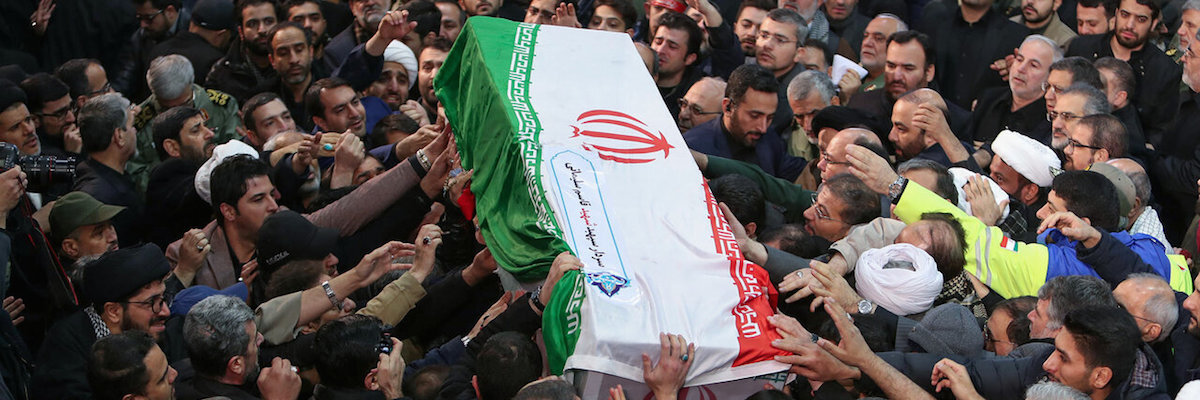
'Million-Strong' Homage for General Brings Tehran to Standstill
◢ Downtown Tehran was brought to a standstill Monday as mourners flooded the Iranian capital to pay an emotional homage to Qassem Soleimani, the "heroic" general killed in a US strike. Young and old were packed shoulder-to-shoulder in the streets, including women dressed in black-clad chadors and others wearing loose-fitting hijabs.
By Amir Havasi
Downtown Tehran was brought to a standstill Monday as mourners flooded the Iranian capital to pay an emotional homage to Qassem Soleimani, the "heroic" general killed in a US strike.
Young and old were packed shoulder-to-shoulder in the streets, including women dressed in black-clad chadors and others wearing loose-fitting hijabs.
Soleimani, one of Iran's most popular public figures, was killed in a US drone strike on Friday near Baghdad international airport. He was 62.
His assassination drove up tensions between arch-enemies Washington and Tehran, which has vowed "severe revenge".
"He was a hero. He defeated Daesh," said a woman in her 30s, referring to the Islamic State group.
"What America did is definitely a crime," said the woman who only gave her surname as Mohammadi.
"I'm here to mourn his martyrdom. There must be a response but we don't want war. Nobody wants war," she told AFP.
State television said it was a "several million-strong" turnout.
Supreme leader Ayatollah Ali Khamenei, who has vowed "severe revenge" for the US attack, presided over prayers for the slain general.
He appeared to cry beside the flag-draped coffins containing the remains of Soleimani and five other "martyrs" killed in the strike.
The streets of Tehran were so full of people that many were unable to emerge from underground metro stations, semi-official news agency ISNA reported.
"There are large crowds at metro stations but as there is also a huge crowd at the street level, it isn't possible to evacuate passengers," metro chief Farnoush Nobakht was quoted as saying.
The sheer number of mourners left many people stuck in sidestreets around Enghelab (Revolution) Street, the main route of a procession to a ceremony at Tehran University.
'Crushing Response'
It was silent in one alley until a child who climbed a tree to see if the street ahead had opened uttered "Death to America".
People within earshot soon joined in and loudly chanted the same phrase.
Chants of "Death to infidels," "Death to seditionists" and "Death to al-Saud"—a reference to the Saudi ruling family—were then heard.
But most of the anger was directed at Tehran's arch-enemy Washington and US President Donald Trump.
One man said he had come to the capital with his wife and child before dawn from Karaj, a city about 40 kilometres (25 miles) west of the Iranian capital.
"Our message to America is we will hit you. We'll make you pay for the blood you spilled," said Mehdi Ghorbani.
"America should know they started this, but we will end it," he told AFP.
A group of teenagers stood in a circle holding banners, one reading: "Haj Qasem's shoe is worth more than Trump's head".
Other mourners called for US forces to be driven out of the region.
"We must give a crushing response," one of the mourners told AFP.
"We must target whatever military base they have in the region. We must attack all that are in the range of our missiles," said the 61-year-old businessman who gave his name as Afkhami.
"Americans being thrown out (of Iraq) is not enough."
Photo: IRNA
Mourners Pack Iran Cities as Top General's Remains Return
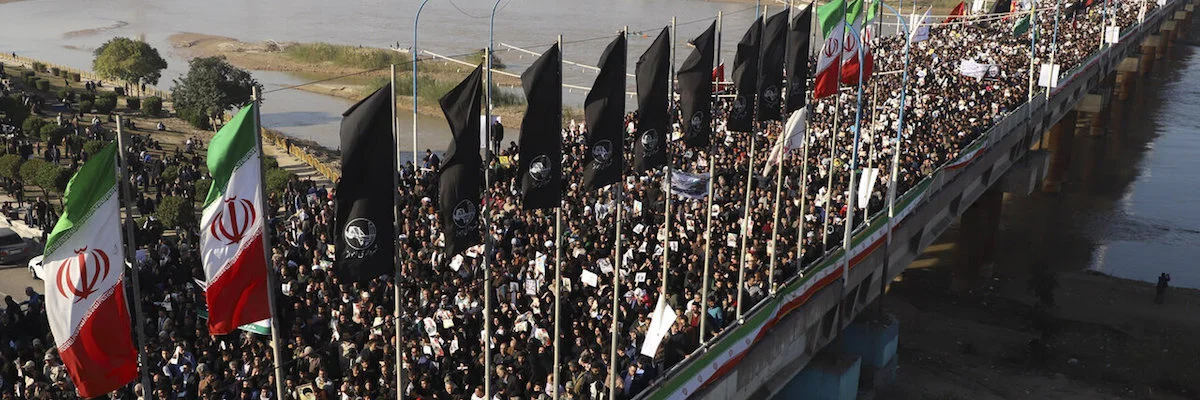
◢ Mourners flooded the Iranian cities of Ahvaz and Mashhad Sunday, weeping and beating their chests in homage to top general Qasem Soleimani who was killed in a US strike in Baghdad. In the northeastern city of Mashhad, scores took to streets around the Imam Reza shrine and, addressing the US, chanted "Be afraid of your own shadow".
By Amir Havasi
Mourners flooded the Iranian cities of Ahvaz and Mashhad Sunday, weeping and beating their chests in homage to top general Qassem Soleimani who was killed in a US strike in Baghdad.
"Death to America," they chanted as they packed Ahvaz's streets and a long bridge spanning a river in the southwestern city to receive the casket containing Soleimani's remains.
As Shiite chants resonated in the air, people held portraits of the man seen as a hero of the 1980-88 Iran-Iraq war and for spearheading Iran's Middle East operations as commander of the Revolutionary Guards' Quds Force.
In the northeastern city of Mashhad, scores took to streets around the Imam Reza shrine and, addressing the US, chanted "Be afraid of your own shadow".
Soleimani was killed in a US drone strike Friday near Baghdad airport, shocking the Islamic republic. He was 62.
The attack was ordered by President Donald Trump, who said the Quds commander had been planning an "imminent" attack on US diplomats and forces in Iraq.
In the face of growing Iraqi anger over the strike, the country's parliament was expected to vote Sunday on whether to oust the roughly 5,200 American troops in Iraq.
Soleimani's assassination ratcheted up tensions between arch-enemies Tehran and Washington and sparked fears of a new Middle East war.
Iran's supreme leader Ayatollah Ali Khamenei vowed "severe revenge" and declared three days of mourning.
But Trump warned late Saturday that America was targeting 52 sites "important to Iran & Iranian culture" and would hit them "very fast and very hard" if the country attacks American personnel or assets.
In a series of saber-rattling tweets, Trump said the choice of 52 targets represented the number of Americans held hostage at the US embassy in Tehran for more than a year starting in late 1979.
'Terrorist in a Suit'
Iran's top diplomat Mohammad Javad Zarif tweeted that "targeting cultural sites is a WAR CRIME".
For Iran's army chief, Trump's threat was an attempt to distract the world from Soleimani's "unjustifiable" assassination.
"I doubt they have the courage to initiate" a conflict, said Major General Abdolrahim Mousavi.
Iran's communications minister, Mohammad Javad Jahromi, branded Trump a "terrorist in a suit" and said in a tweet that he is "like ISIS, like Hitler, like Genghis (Khan)! They all hate cultures".
US-Iran tensions escalated in 2018 when Trump unilaterally withdrew from a landmark accord that gave Tehran relief from sanctions in return for curbs on its nuclear programme.
A year on, Iran began hitting back by reducing its nuclear commitments with a series of steps every 60 days, the most recent deadline passing on Saturday.
Its foreign ministry spokesman, Abbas Mousavi, said Tehran would finalise the fifth step in a meeting on Sunday night, noting the nature of its move was altered by Soleimani's killing.
On Sunday, thousands of mourners dressed in black gathered in Ahvaz.
Crowds massed in Mollavi Square with flags in green, white and red—depicting the blood of "martyrs".
"A glorious crowd is at the ceremony," said state television.
In Tehran, deputies chanted "Death to America" for a few minutes during a regular session of parliament.
"Trump, this is the voice of the Iranian nation, listen," said speaker Ali Larijani.
Soleimani's remains and those of five other Iranians—all Guards members—killed in the US drone strike had arrived at Ahvaz airport before dawn, semi-official news agency ISNA said.
With them were the remains of Abu Mahdi al-Muhandis, the deputy commander of Iraq's powerful Hashed al-Shaabi paramilitary umbrella group, who was also killed in the US strike.
Soleimani's remains arrived in Mashhad in the afternoon and are due to be flown to Tehran for more tributes on Sunday evening.
On Monday, Khamenei is expected to pray over Soleimani's remains at Tehran University before a procession to Azadi Square.
His remains are then due to be taken to the holy city of Qom for a ceremony at Masumeh shrine, ahead of a funeral Tuesday in his hometown Kerman.
Cyber Attack
In neighbouring Iraq, pro-Iran factions ramped up pressure on US installations with missiles and warnings to Iraq's troops late Saturday.
In the first hints of a possible retaliatory response, two mortar rounds struck Saturday near the US embassy in Baghdad, security sources said.
Almost simultaneously, two rockets slammed into the Al-Balad airbase where American troops are deployed.
Iraq said there were no casualties. The US military also said no coalition troops were hurt.
Photo: IRNA
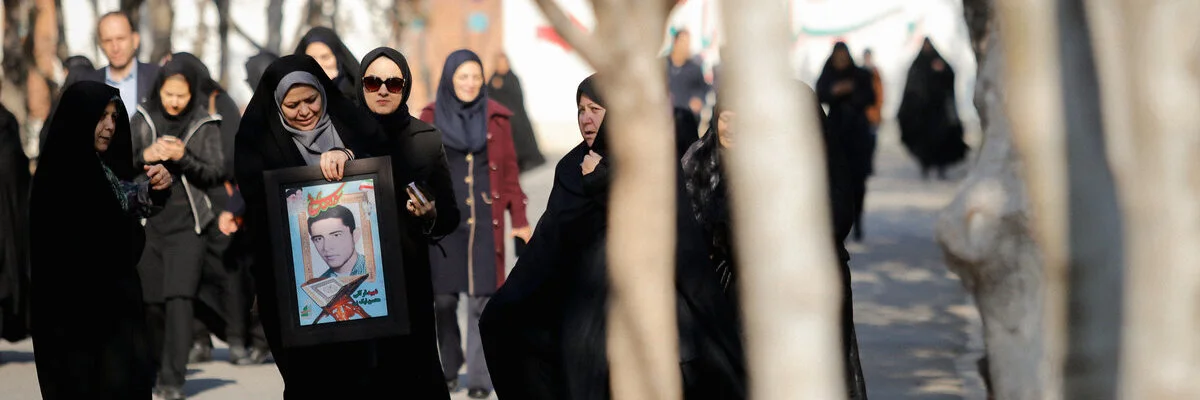
Iran Poll Shows Majority Backs Right to Protest After Crackdown
◢ About three-quarters of Iranians surveyed in a government-backed poll said they supported the rights of protesters to take to the streets in last month’s countrywide demonstrations. The Iranian Students’ Polling Agency also found that 62% of respondents saw “dialogue with protesters” as the government’s best means of addressing popular discontent.
By Arsalan Shahla
About three-quarters of Iranians surveyed in a government-backed poll said they supported the rights of protesters to take to the streets in last month’s countrywide demonstrations, a reformist newspaper reported.
The Iranian Students’ Polling Agency, which surveyed 2,027 people in the province of Tehran, also found that 62 percent of respondents saw “dialogue with protesters” as the government’s best means of addressing popular discontent, the daily Etemad newspaper said.
The expression of support, especially in a survey conducted by a state-backed polling organization, suggests that grievances still run deep in Iran. Triggered by a steep rise in gasoline prices, November’s protests met with a violent crackdown, becoming the bloodiest in Iran since the 1979 revolution.
The government so far hasn’t provided an official death toll for the unrest, but the London-based rights group Amnesty International estimates that some 304 people were killed by security forces.
The demonstrations spread to scores of cities and towns throughout the country and several of Tehran’s districts and its outskirts were swept up in the unrest.
Officials have consistently claimed that the majority of those who took part in demonstrations and clashed with police were “rioters” and “terrorists” acting on behalf of foreign governments. Hundreds of people remain in prison.
The most deadly violence took place in the oil-rich, Arab-speaking province of Khuzestan, which the ISPA survey doesn’t cover.
According to the survey, 71% of people said impartiality at Iran’s state broadcaster, which holds a monopoly over the country’s entire broadcasting services, was “low” or “very low” when it came to covering the protests. Some 90% of respondents said they used alternative news sources such as social media and satellite TV.
Photo: IRNA
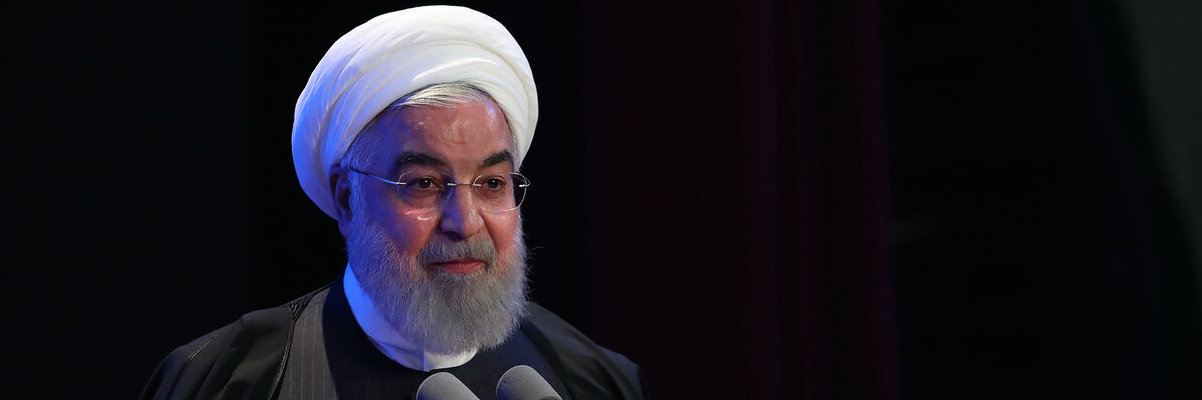
Iran Says Still Ready for Talks if US Lifts Sanctions
◢ Iran is willing to return to the negotiating table if the United States first drops sanctions, President Hassan Rouhani said Wednesday, after a fuel price hike sparked deadly violence ahead of elections. "If they are prepared to put aside the sanctions, we are ready to talk and negotiate, even at the level of heads of the 5+1 countries," Rouhani said in remarks aired live on state television.
Iran is willing to return to the negotiating table if the United States first drops sanctions, President Hassan Rouhani said Wednesday, after a fuel price hike sparked deadly violence ahead of elections.
European countries have been pushing for talks with Iran to salvage a 2015 nuclear deal that has all but collapsed since the United States withdrew and reimposed sanctions last year.
Rouhani has long demanded the lifting of US sanctions for Iran's return to talks under the auspices of the so-called P5+1 that reached the deal—the five veto-wielding permanent members of the UN Security Council plus Germany.
His latest statement comes after a shock announcement in mid-November that the price of petrol was going up by as much as 200 percent triggered demonstrations across Iran that turned deadly.
The decision came at a sensitive time ahead of a February parliamentary election.
It is a rise many Iranians can ill afford in a country whose sanctions-hit economy is expected to contract by 9.5 percent this year.
"If they are prepared to put aside the sanctions, we are ready to talk and negotiate, even at the level of heads of the 5+1 countries," Rouhani said in remarks aired live on state television.
"We are under sanctions. This situation... is (because of) incitement by the Zionists and the region's reactionary," he said, referring to Iran's regional rivals Israel and Saudi Arabia.
His remarks came after France and Germany raised the possibility of triggering a mechanism in the deal that could lead to the reimposition of UN sanctions.
‘Cruel Act'
Rouhani described the sanctions as "a cruel act by the White House".
"We have no choice but to resist and persevere," he said. "At the same time, we have not closed the window for negotiations.
"I tell the nation of Iran that any time America is prepared to lift and put aside its wrong, cruel, unlawful, incorrect, terrorist sanctions, immediately the heads of 5+1 can meet and we have no problem."
The landmark 2015 deal gave Iran relief from economic sanctions in return for curbs on its nuclear programme.
It has been at risk of falling apart since US President Donald Trump unilaterally withdrew from it in May last year and reimposed sanctions.
Known formally as the Joint Comprehensive Plan of Action (JCPOA), it was agreed between Britain, China, France, Russia and the United States, plus Germany.
Twelve months on from the US pullout, Iran began reducing its commitments to the deal hoping to win concessions from those still party to the accord.
Its latest step back came last month, when engineers began feeding uranium hexafluoride gas into mothballed enrichment centrifuges at the underground Fordow plant south of Tehran.
In his remarks, Rouhani said his government strived to remain in the nuclear deal despite "pressures" that were on it.
‘Utter Lies'
The statement comes after angry demonstrations erupted against a shock decision to raise petrol prices on November 15.
London-based human rights group Amnesty International said on Monday that at least 208 people were killed in a crackdown on the demonstrations, citing what it called credible reports.
Iran's judiciary spokesman Gholamhossein Esmaili on Tuesday rejected as "utter lies" unofficial casualty figures given by "hostile groups" based abroad.
On Monday night, state television charged that foreign media had been "hyping up" the death toll.
It said "the security forces had no choice but to resort to authoritative and tough confrontation... and a number of rioters were killed".
The unrest started hours after it was announced that the price of petrol would rise from 10,000 rials per litre to 15,000 (12 US cents) for the first 60 litres, and to 30,000 rials for any extra fuel bought after that each month.
Rouhani has said proceeds would go to the most needy.
State news agency IRNA said the payments had since been made in three installments between November 18 and 23.
Photo: IRNA
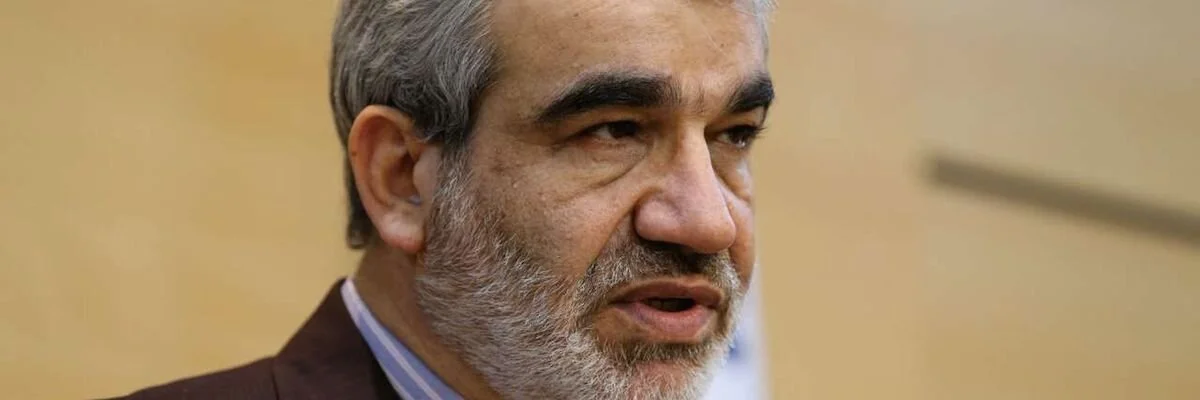
Iran Official Points to More Open Elections
◢ A senior Iranian official has suggested in an interview with AFP that authorities may be more open than in the past in approving candidates for a looming parliamentary election. "We don't consider ourselves immune from criticism," said Guardian Council spokesman Abbas Ali Kadkhodaee.
By Marc Jourdier
A senior Iranian official has suggested in an interview with AFP that authorities may be more open than in the past in approving candidates for a looming parliamentary election.
"We don't consider ourselves immune from criticism. We may also accept that mistakes have been made in the past," said Guardian Council spokesman Abbas Ali Kadkhodaee.
"But for the next legislative elections we are trying to reduce our mistakes and respect the rights of candidates."
Kadkhodaee was speaking to AFP on the eve of the opening on Sunday of the registration of candidates for the parliamentary election to be held on February 21.
The Guardian Council, which is under the control of ultra-conservatives, is responsible for organising and monitoring elections in Iran, including vetting candidates.
"If we insist on enforcing the law, we'll be able to satisfy as many candidates as possible," said Kadkhodaee.
In past elections, the council has faced accusations in Iran, particularly by reformists, of barring candidates more on political than constitutional grounds.
In November, President Hassan Rouhani, a moderate conservative, called on the council to stick to the letter of the law in view of the forthcoming election.
At Iran's last parliamentary election in February 2016, the council authorized 6,229 candidates for the 290 seats at stake—just over 51 percent of those who sought to stand.
In the interview, Kadkhodaee said a higher number of successful candidates should also lead to a "higher participation rate".
The opening of the registration period, which runs until Saturday, comes two weeks after around 100 cities and towns in sanctions-hit Iran saw protests against a shock fuel price hike that turned violent.
Authorities say they have restored calm after "rioting" backed by enemies of the Islamic republic, including the United States, Israel and Saudi Arabia.
London-based human rights group Amnesty International said 161 demonstrators were killed in a crackdown.
'Unjust Economic Sanctions'
But Iran's deputy interior minister, Jamal Orf, said such figures were "exaggerated", in remarks published on Saturday by state news agency IRNA.
For Kadkhodaee, the unrest was not a sign of the rejection of the political system of the Islamic republic.
The people would "continue to support the country despite the difficulties, as they have patiently endured the unjust economic sanctions imposed by Western countries," he said.
They would "continue to support the Iranian political system", he added.
Iran's economy has been battered since last year when the United States withdrew from a landmark 2015 nuclear deal and began reimposing crippling sanctions.
The International Monetary Fund expects the country's economy to shrink by 9.5 percent this year.
"Sometimes the participation rate can be low when the people are not happy with the country's economic situation," said Kadkhodaee.
"But we are sure that we will have a good participation rate, even if it is lower than it may have been in the past," said the Guardian Council spokesman.
"Generally in Iran, the participation rate is between 50 and 70 percent, depending on the economic and social situation in the country," he told AFP.
"Even if the turnout is low, it does not endanger the Iranian political system. We know that there are ups and downs depending on elections.
"Personally I expect and hope that the rate will be higher than 50 percent."
Photo IRNA
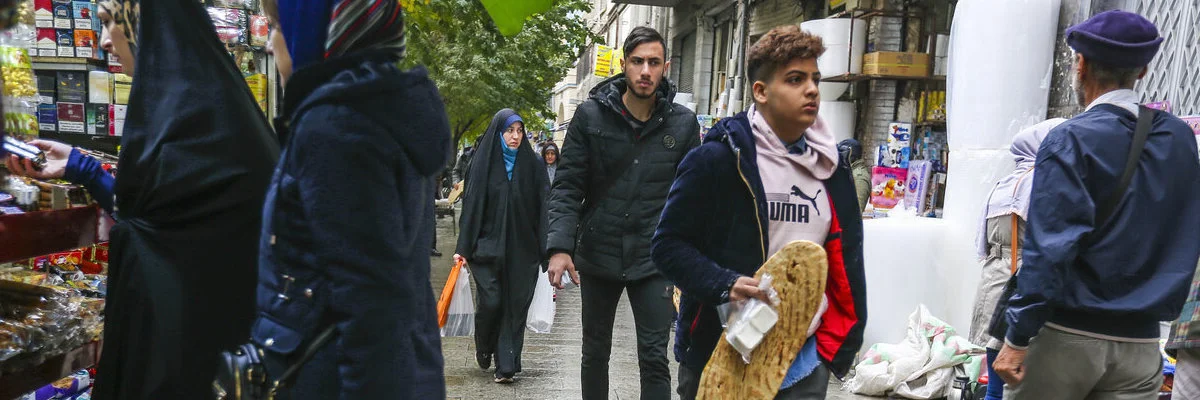
Internet Outage Forces Iranians to Resort to Old Ways
◢ Iranians struggled to adjust to life offline for almost a week and were forced to resort to old ways due to a near-total internet blackout imposed amid violent protests. The country has a thriving online economy, with its own equivalents for apps like Airbnb, Amazon and Uber.
Iranians struggled to adjust to life offline for almost a week and were forced to resort to old ways due to a near-total internet blackout imposed amid violent protests.
The demonstrations flared on November 15, hours after a shock decision announced at midnight to raise the price of petrol by up to 200 percent in the sanctions-hit country.
The timing of the announcement was seen as a bid to forestall chaos, such as caused by motorists stocking up on fuel before the hike took effect.
The internet restrictions, for their part, apparently aimed to temper shows of dissent and anger over the move and stop footage of the unrest from being shared.
Brigadier General Salar Abnoosh, a deputy head of the Basij volunteer militia, said Friday that the internet outage had helped to "disrupt the complicated" plans by Iran's enemies.
On Saturday—day seven of the internet restrictions and the start of the working week in Iran -- people in Tehran were trying to overcome problems brought on by the outage.
Some said they had been forced to make long journeys to carry out simple transactions that they used to be able to do in a couple of clicks online.
"We have no other choice," said a woman in her 30s who only gave her name as Asgari.
"What I could have done by using internet now I have to do by telephone or some other means," she told AFP.
"I've taken today off from work to come into town to do something which I could've done by using the internet."
Others said they were having difficulty reaching loved ones overseas.
"I wanted to call my children but I couldn't," said Taheri, a man in his 70s. "They were worried and had to go and get a card to call us. This is not right."
Economic Impact
For many in Iran, the lack of internet access was more than just a hindrance to social activity.
The country has a thriving online economy, with its own equivalents for apps like Airbnb, Amazon and Uber.
They have come through the outage largely unscathed as people can still access domestic applications on their phones.
However, smaller businesses that rely heavily on social media to stay in touch with their clients suffered during the outage.
Among them were travel agencies whose services were badly disrupted.
"An acute problem has been created for all travel agencies," said Hormatollah Rafiei, head of the Travel Agents Guild Association.
"The sale of foreign tickets and reservations for foreign hotels reached zero and some travel agencies closed due to financial losses," he said, quoted by ILNA news agency.
Connectivity in Iran "began to fluctuate on Friday evening (November 15) before a sequence of cuts that saw levels fall to a nadir of four percent" compared with normal levels, said Netblocks, a site that monitors global internet disruptions.
“Apart from fluctuations on Sunday, access to the outside world flatlined consistently until Thursday when limited connectivity appeared across most regions," it said
On Saturday, connectivity was back up, the monitor added.
'What Can We Do?'
Iran's arch-enemy the United States slapped sanctions on its telecommunications minister overnight "for restricting internet access".
The minister, Mohammad-Javad Azari Jahromi, said he was just another Iranian made to suffer the consequences of sanctions that the US reimposed after withdrawing from a 2015 nuclear deal.
"I'm not the only member of club of sanctioned persons," he tweeted.
"Before me, Iran ICT startups, Developers, Cancer patients and EB children were there," he said, referring to epidermolysis bullosa (EB).
Iran says the US sanctions have hindered its access to drugs for EB, a skin condition that afflicts children, causing several deaths.
The government said it would unblock the internet only when it was sure it would not be abused.
Mina, a woman in her 50s, said she had little choice but to sit tight
"My family lives abroad and I was always in touch with them but now I have no contact with them," she told AFP.
"I need to get a phone card because it's too expensive to call abroad (from a fixed line phone)," she added.
"What can we do? We are trying to stay patient."
Photo: IRNA
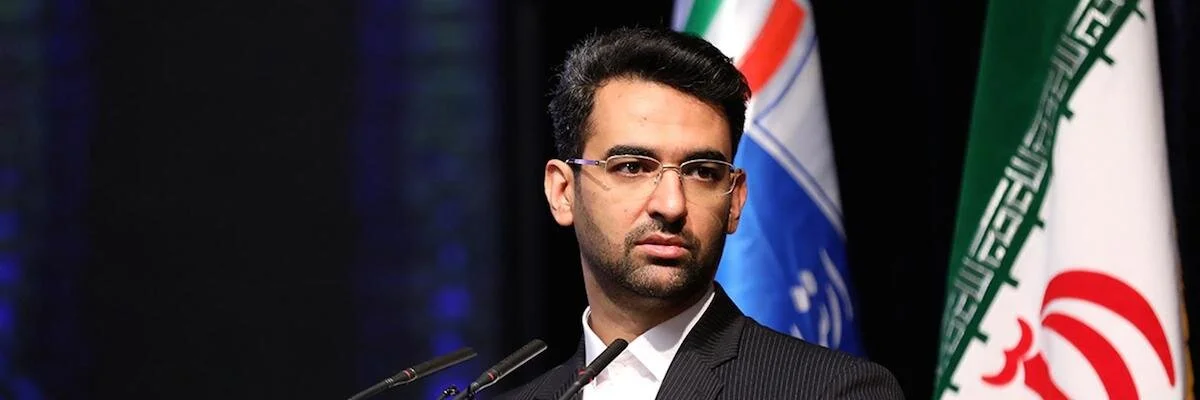
US Sanctions Iran Minister Over Internet Censorship
◢ The US Treasury slapped punitive sanctions on Iran's communications minister, Mohammad Javad Azari Jahromi, Friday after Tehran blocked internet communications amid violent protests triggered by a petrol price hike. On Thursday, President Donald Trump accused Iran of blocking the internet to cover up "death and tragedy" resulting from the protests.
The US Treasury slapped punitive sanctions on Iran's communications minister, Mohammad Javad Azari Jahromi, Friday after Tehran blocked internet communications amid violent protests triggered by a petrol price hike.
"We are sanctioning Iran's Minister of Information and Communications Technology for restricting internet access, including to popular messaging applications that help tens of millions of Iranians stay connected to each other and the outside world," said Treasury Secretary Steven Mnuchin in a statement.
"Iran's leaders know that a free and open internet exposes their illegitimacy, so they seek to censor internet access to quell anti-regime protests," Mnuchin said.
The protests erupted across the country on November 15, after the price of petrol was raised by as much as 200 percent.
Officials have confirmed five deaths, while Amnesty International said that more than 100 demonstrators were believed to have been killed after authorities reportedly used live ammunition to quell the protests, which brought attacks on police stations and petrol stations and some looting of shops.
The Treasury said Azari Jahomi is a former official of the Ministry of Intelligence who has “been involved in surveillance against opposition activists," the Treasury said.
Internet service remained mostly blocked on Friday for a sixth day, with officials and news agencies saying the blackout was gradually being rolled back.
The sanctions would freeze financial assets and property Azari Jahomi has in US jurisdictions and forbid Americans or US businesses, especially banks, from dealing with him.
On Thursday, President Donald Trump accused Iran of blocking the internet to cover up "death and tragedy" resulting from the protests.
"Iran has become so unstable that the regime has shut down their entire Internet System so that the Great Iranian people cannot talk about the tremendous violence taking place within the country," Trump tweeted.
"They want ZERO transparency, thinking the world will not find out the death and tragedy that the Iranian Regime is causing!" he wrote.
Photo: IRNA
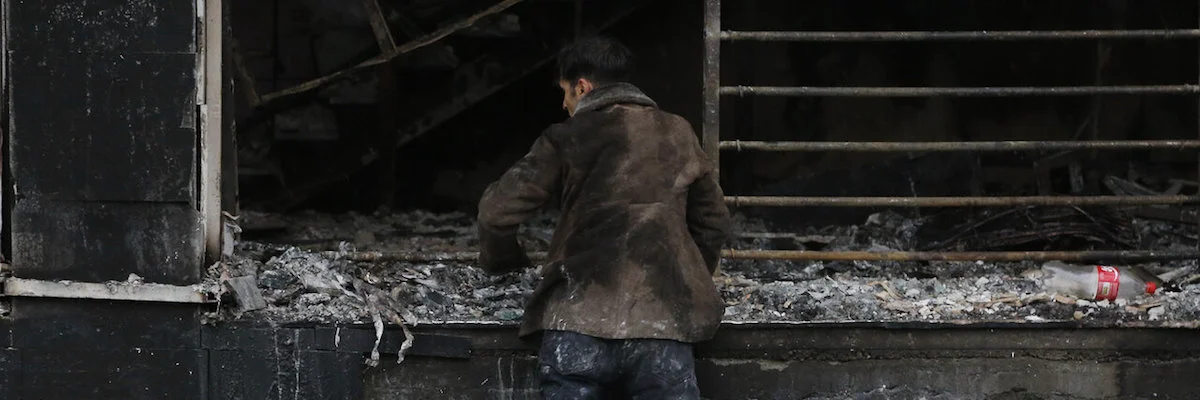
Iran Unrest Shows No Signs of Subsiding
◢ Three security personnel have been killed by "rioters" in Iran, the latest deaths in protests that showed no sign of subsiding Tuesday despite a wave of arrests and an internet shutdown. The United Nations expressed alarm on Tuesday "that the use of live ammunition has allegedly caused a significant number of deaths across the country.”
Three security personnel have been killed by "rioters" in Iran, the latest deaths in protests that showed no sign of subsiding Tuesday despite a wave of arrests and an internet shutdown.
The deaths take to at least five the number of people confirmed to have been killed in the nationwide demonstrations that erupted on Friday against a shock decision to impose petrol price hikes.
The situation on the streets remains unclear largely due to the government-imposed internet outage which has entered a third day.'
The United Nations expressed alarm on Tuesday "that the use of live ammunition has allegedly caused a significant number of deaths across the country.”
On Tuesday morning, AFP journalists saw two petrol stations in central Tehran gutted by fire and damage to other infrastructure including a police station and pedestrian overpass.
But they were prevented from filming as hundreds of riot police stood guard at entrances to major squares in the Iranian capital with armoured vehicles and water cannon.
When the demonstrations broke out on Friday, drivers stopped their vehicles on major thoroughfares in Tehran to block traffic.
They soon turned violent and spread to more than 20 cities and towns across Iran, with banks, petrol stations and other public property set alight and shops looted.
The demonstrations erupted after it was announced the price of petrol would be raised by 50 percent for the first 60 litres purchased over a month and 200 percent for any extra fuel after that.
Iran's economy has been battered since May last year when President Donald Trump unilaterally withdrew the US from a 2015 nuclear agreement and reimposed crippling sanctions.
Ambush
Footage of masked young men clashing with security forces has been broadcast on state television, which rarely shows any signs of dissent.
In a new video aired Monday night, a man can be seen firing what appears to be an assault rifle as others hurl stones apparently at security forces in the western city of Andimeshk.
In the latest bloodshed, assailants wielding knives and machetes ambushed and killed three security personnel west of Tehran, the ISNA and Fars news agencies reported late Monday.
One of the three was identified as Morteza Ebrahimi, a commander of the Islamic Revolutionary Guard Corps and father of a newborn child, according to Fars.
The other two were Majid Sheikhi, 22, and Mostafa Rezaie, 33. Both served in the Basij militia, a volunteer force loyal to the establishment.
The overall toll—which also includes a civilian and policeman—is expected to rise, with unofficial reports saying that at least six other people have been killed.
It is the worst violence since at least 25 lives were lost in protests over economic hardship that started in Iran's second city Mashhad in December 2017 before spreading to other urban centers.
Internet Outage
In response to the violence, the authorities say they have arrested more than 200 people.
The internet outage has stemmed the flow of videos shared on social media of protests or associated acts of violence.
"National connectivity remains at just five percent of normal levels, leaving Iranians cut off from the world," tweeted Netblocks, a website that monitors global net shutdowns.
Iran announced the decision to impose petrol price hikes and rationing at midnight Thursday-Friday, saying the move was aimed at helping the needy with cash handouts.
The plan agreed by a council made up of the president, parliament speaker and judiciary chief comes at a sensitive time ahead of February parliamentary elections
It has received the public support of Iran's supreme leader Ayatollah Ali Khamenei.
President Hassan Rouhani has defended the price hike saying the proceeds will be used to make welfare payments to 60 million Iranians.
The United States has condemned Iran for using "lethal force".
Iran hit back at its arch-enemy on Monday, slamming US Secretary of State Mike Pompeo after he tweeted "the United States is with you" in response to the demonstrations.
Germany called for dialogue between the government and "legitimate" protesters while France reiterated its support for the right to peaceful demonstration and voiced regret over the deaths.
Judiciary spokesman Gholamhossein Esmaili warned on Tuesday that the authorities would deal firmly with those who endanger security and carry out arson attacks.
In televised remarks, he also called on citizens to inform on "seditionists" who have committed acts of violence.
Photo: IRNA
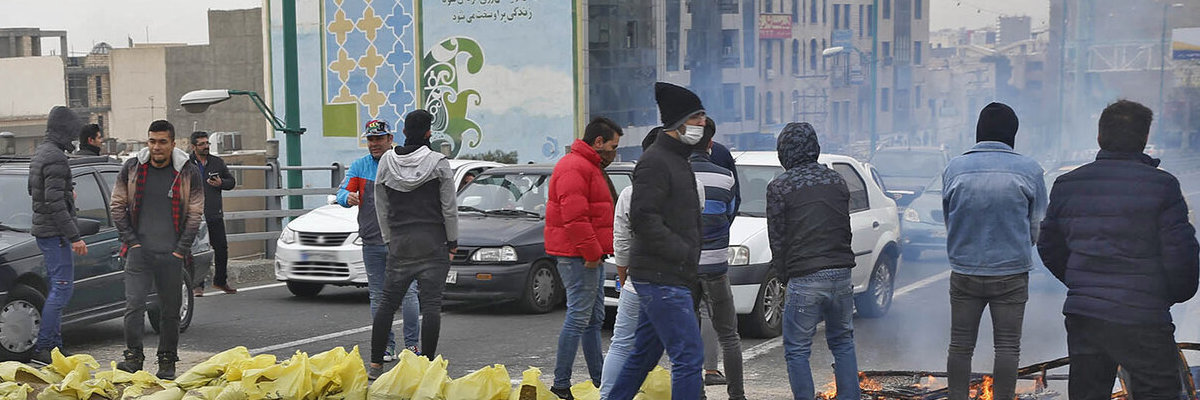
Iran 'Calmer' Despite More Riots Over Oil Price Hikes
◢ Iran said it still faces "riots" even though the situation was calmer Monday after days of violent protests sparked by a shock decision to hike petrol prices in the sanctions-hit country. Major roads have been blocked, banks torched and shops looted in the nationwide unrest that has left at least two dead—a civilian and a police.
By Amir Havasi
Iran said it still faces "riots" even though the situation was calmer Monday after days of violent protests sparked by a shock decision to hike petrol prices in the sanctions-hit country.
Major roads have been blocked, banks torched and shops looted in the nationwide unrest that has left at least two dead—a civilian and a policeman.
Footage of the violence showing masked young men on debris-strewn streets setting buildings ablaze has been aired on state television, which rarely shows any signs of dissent.
The Basij militia, whose commander Brigadier General Gholamreza Soleimani said "America's plot (had) failed", reported looting, according to semi-official news agency ISNA.
Demonstrations broke out on Friday after it was announced that the price of petrol would be raised by 50 percent for the first 60 litres and 200 percent for any extra fuel after that each month.
The authorities in the Islamic republic say they have arrested more than 200 people and restricted internet access.
Netblocks, a website that monitors net traffic, tweeted: "40 hours after #Iran implemented a near-total internet shutdown, connectivity to the outside world remains at just 5% of ordinary levels".
Government spokesman Ali Rabiei said the situation was "calmer" on Monday.
But there were still "some minor issues and tomorrow and the day after we won't have any issues with regard to riots", he told a news conference, without elaborating.
"There have been gatherings in some cities, in some provinces," he said.
Pressed to give figures on the number of casualties in the unrest, he said: "What I can tell you today is that gatherings are about 80 percent less than the previous day."
The situation on the streets has been unclear largely due to the internet outage that has stemmed the flow of videos shared on social media of protests or associated acts of violence.
Iran's economy has been battered since May last year when President Donald Trump unilaterally withdrew the US from a 2015 nuclear agreement and reimposed crippling sanctions.
'Lethal Force'
The US on Sunday condemned Iran for using "lethal force" against demonstrators.
"The United States supports the Iranian people in their peaceful protests against the regime that is supposed to lead them," said White House press secretary Stephanie Grisham.
Iran's foreign ministry slammed US Secretary of State Mike Pompeo after he tweeted "the United States is with you" Saturday in response to the demonstrations.
In a statement issued late Sunday, the ministry said it was reacting to Pompeo's "expression of support... for a group of rioters in some cities of Iran and condemned such support and interventionist remarks".
"The dignified people of Iran know well that such hypocritical remarks do not carry any honest sympathy," ministry spokesman Abbas Mousavi was quoted as saying.
"The acts of a rioter and saboteur group supported by the likes of (Pompeo) have no congruity with the conduct of the wise Iranian people."
The statement blasted Washington's "ill-intent" over its decision to reimpose sanctions on Tehran after withdrawing from the nuclear deal.
"It's curious that the sympathising is being done with the people who are under the pressure of America's economic terrorism," Mousavi said.
‘Welfare Payments’
For its part, Germany called Monday for dialogue between the government and "legitimate" protesters in Iran.
"It is legitimate and deserving of our respect when people courageously air their economic and political grievances, as is currently happening in Iran," said Chancellor Angela Merkel's spokeswoman Ulrike Demmer.
"The Iranian government should respond to the current protests with a willingness to engage in dialogue," she added.
Iran announced the decision to impose petrol price hikes and rationing at midnight Thursday-Friday, saying the move was aimed at helping the needy with cash handouts.
The plan agreed by a council made up of the president, parliament speaker and judiciary chief comes at a sensitive time ahead of February parliamentary elections.
It won support on Sunday from Iran's supreme leader Ayatollah Ali Khamenei.
Khamenei blamed "hooligans" for damaging property and said "all the centres of the world's wickedness against us have cheered" the street protests.
President Hassan Rouhani on Sunday defended the controversial petrol price hike whose proceeds are to be used to make welfare payments to 60 million Iranians.
Rouhani also announced the first payments would be made to 20 million people on Monday evening.
But he also warned that Iran could not allow "insecurity.”
"Protesting is the people's right, but protesting is different from rioting. We should not allow insecurity in the society," said Rouhani.
The intelligence ministry said at the weekend that it has identified those behind the unrest and that measures would be taken against them.
Forty people have already been arrested in the central city of Yazd, ISNA reported on Sunday.
Another 180 people were arrested in the past three days in the southern province of Khuzestan, state news agency IRNA said Monday.
Fars news agency, which is close to Iran's Revolutionary Guards, said it was unclear when the internet restrictions would be lifted, citing an informed government source.
Photo: IRNA
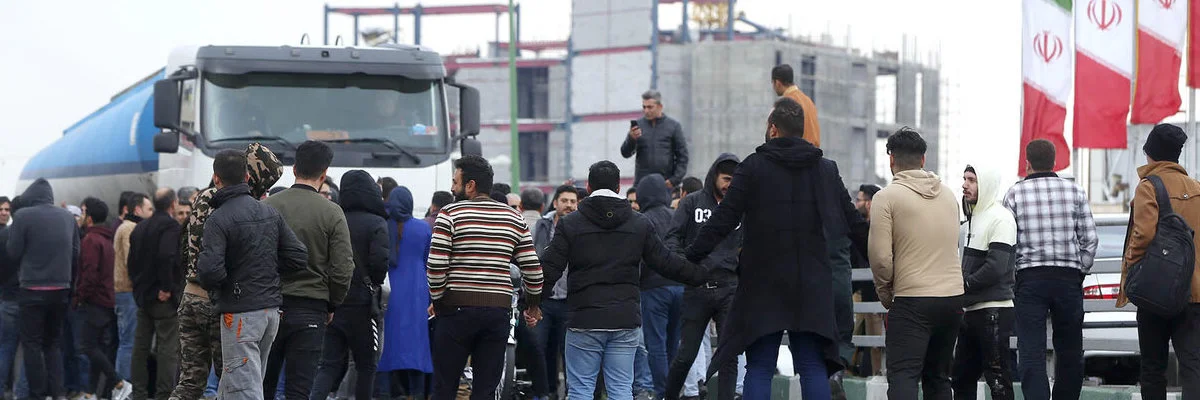
Rouhani Warns Protest-Hit Iran Cannot Allow 'Insecurity'
◢ Iran's supreme leader on Sunday threw his support behind a decision to hike petrol prices, a move that sparked nationwide unrest in which he said "some lost their lives.” The protests flared hours after it was announced that the price of petrol would be raised by 50 percent for the first 60 liters and by 300 percent for anything above that each month.
By Amir Havasi
IPresident Hassan Rouhani warned Sunday that riot-hit Iran could not allow "insecurity" after two days of unrest killed two people and saw authorities arrest dozens and restrict internet access.
"Protesting is the people's right, but protesting is different from rioting. We should not allow insecurity in the society," he said.
Rouhani defended the controversial petrol price hike that triggered the protests -- a project which the government says will finance social welfare spending amid a sharp economic downturn.
The unrest erupted on Friday, hours after it was announced the price of petrol would rise to 15,000 rials per litre (12 US cents) from 10,000 for the first 60 litres, and to 30,000 rials for any extra fuel bought after that each month.
It is a rise many consumers can ill afford, given that Iran's economy has been battered since May last year when President Donald Trump unilaterally withdrew the US from a 2015 nuclear agreement and reimposed crippling sanctions.
The rial has plummeted, inflation is running at more than 40 percent and the International Monetary Fund expects Iran's economy to contract by 9.5 percent this year and stagnate in 2020.
The petrol plan is expected to generate 300 trillion rials ($2.55 billion) per annum, from which the government says about 60 million needy would receive payments.
"For this... we should either increase taxes on the people, export more oil... or reduce subsidies and return the revenues to the people in need," said Rouhani.
‘Centers of Wickedness’
Iran's supreme leader Ayatollah Ali Khamenei said "some lost their lives" in the violence and blamed "hooligans".
"All the centres of the world's wickedness against us have cheered" the street protests, he said.
The latest death was a policeman shot in a clash with "rioters" in the western city of Kermanhshah.
Several people were also wounded and dozens arrested in the demonstrations that saw motorists block highways and others torch public property.
A 24-hour internet blackout appeared to have stemmed the flow of images shared on social media, with only officials' accounts and local news agencies still active.
Semi-official news agency ISNA said the protests had "mostly subsided" by Sunday evening, a report that could not be verified due to the online outage and limited news from agencies.
The petrol pricing plan was agreed by the High Council of Economic Coordination made up of the president, parliament speaker and judiciary chief.
Khamenei said that "I am not an expert and there are different opinions but I had said that if the heads of the three branches make a decision I will support it.
"Some people would definitely get upset over this decision... but damaging and setting fire (to property) is not something (normal) people would do. It is hooligans."
Following his speech, parliament cancelled a motion to reverse the price hike, semi-official news agency ISNA reported.
A lawmaker resigned Sunday to protest the decision which circumvented parliament, saying the presence of MPs was now "meaningless".
Internet Blocked
Access to the internet was restricted a day after the demonstrations broke out.
Netblocks, an internet monitoring website, tweeted Saturday that "Iran is now in the midst of a near-total national internet shutdown".
It came after a decision by the Supreme National Security Council, according to ISNA.
"Upon the decision of the Security Council of Iran and communicated to internet operators, access to internet has been limited as of last night and for 24 hours," it said, quoting an informed source at the information and communications technology ministry.
Some of the worst violence seen so far was in the central city of Sirjan, where acting governor Mohammad Mahmoudabadi said a civilian was killed and fuel stations were among the public property attacked and damaged.
In Kermanshah, a policeman died Sunday, a day after a "confrontation with a number of rioters and thugs," the provincial police chief told IRNA.
In Tehran on Saturday, protesters were seen burning tyres on a street and shouting slogans.
Similar scenes were witnessed in the cities of Shiraz, Isfahan and Bushehr, where security forces fired tear gas and water cannon at demonstrators.
Forty "disruptors" were arrested in the central city of Yazd after clashing with police, the province's public prosecutor told ISNA on Sunday. Most were not locals, he added.
Police said security forces would "not hesitate to confront those disrupting peace and security and will identify the ringleaders and field forces and confront them".
The intelligence ministry said those behind the unrest "have been identified" and that measures would be taken against them, according to ISNA.
Photo: IRNA
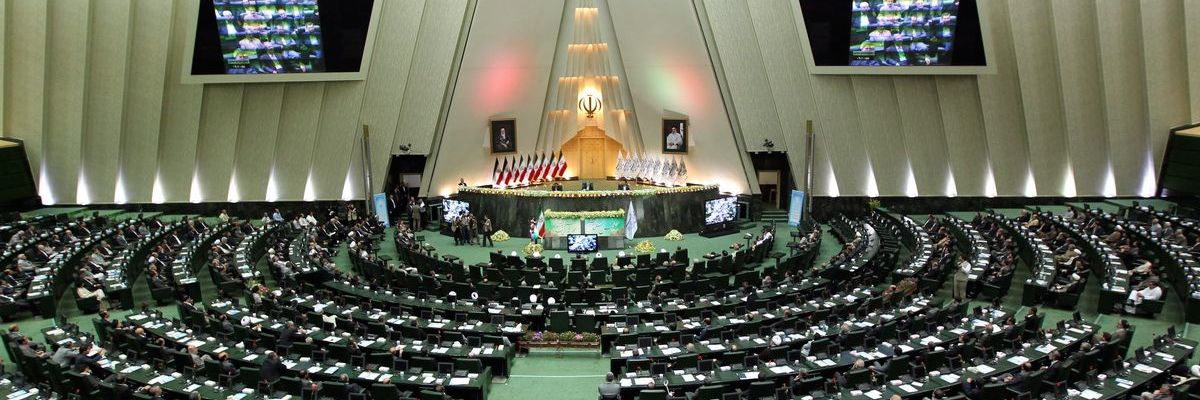
Iran MPs to Investigate Protester Torture Claims
◢ Iran's parliament will investigate claims by a labor protest leader that he was tortured in prison following strikes at a sugar factory, the semi-official ISNA news agency reported on Sunday. Alireza Rahimi, a member of parliament's presiding board, said his request for an investigation had been accepted by speaker Ali Larijani, according to ISNA.
Iran's parliament will investigate claims by a labor protest leader that he was tortured in prison following strikes at a sugar factory, the semi-official ISNA news agency reported on Sunday.
Alireza Rahimi, a member of parliament's presiding board, said his request for an investigation had been accepted by speaker Ali Larijani, according to ISNA.
It followed claims by Esmail Bakhshi, written on his Instagram account and reported by the reformist Etemad newspaper, that he was tortured during 25 days in detention in southwestern Khuzestan province late last year.
Bakhshi was one of the organizers of weeks-long protests at the Haft Tapeh sugar factory in Shush over unpaid wages and alleged criminal activity by new private owners.
Ali Motahari, an outspoken member of parliament, wrote a column in Etemad on Sunday titled "Source of shame", demanding answers from the intelligence ministry.
The governor of Khuzestan, Gholamreza Shariati, denied Bakhshi's claims.
"I checked with the relevant bodies and the claim of torture was strongly denied," he told the Jamaran news site.
Rahimi said Intelligence Minister Mahmoud Alavi will attend the commission hearings in parliament, according to ISNA.
The strike at Haft Tapeh, which has around 4,000 workers, largely ended in December after the workers received their wages.
Iran has been hit by strikes over working conditions in several key sectors this year, including education, mines, transport and the steel industry, mainly outside Tehran.
In November the head of Iran's judiciary warned restive workers against creating "disorder.”
"Workers should not allow their demands to become an excuse and an instrument for the enemy," Ayatollah Sadegh Larijani said, quoted by the judiciary's news agency Mizan Online.
Photo Credit: IRNA
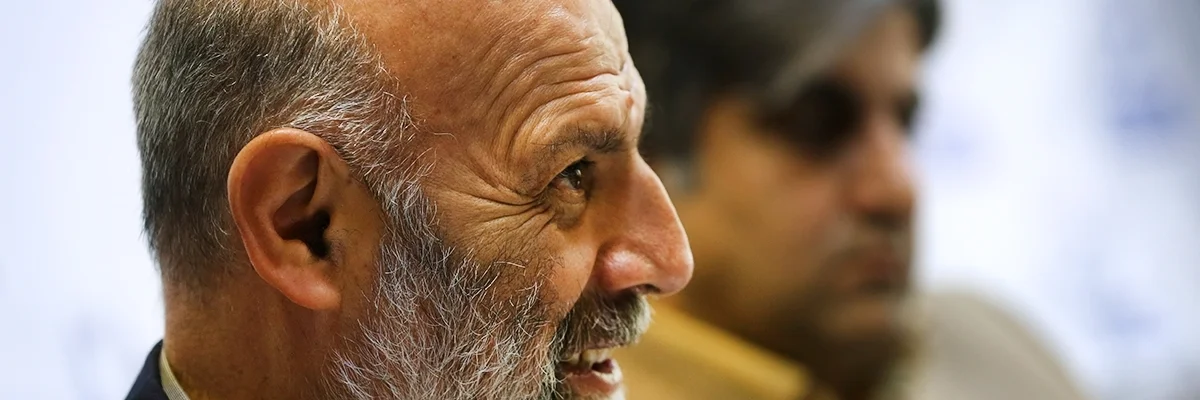
Iran MP Denounces Arrest of Striking Workers
◢ An Iranian member of parliament denounced the arrest of several striking workers following weeks of protests at a steel plant in southwestern Iran, the semi-official ISNA news agency reported Wednesday. "A number of workers of the National Steel Group who had work-related complaints were arrested two days ago," Alireza Mahjoub, head of parliament's labor faction, said in a speech to lawmakers.
An Iranian member of parliament denounced the arrest of several striking workers following weeks of protests at a steel plant in southwestern Iran, the semi-official ISNA news agency reported Wednesday.
"A number of workers of the National Steel Group who had work-related complaints were arrested two days ago," Alireza Mahjoub, head of parliament's labor faction, said in a speech to lawmakers.
"This is a violation of the constitution," he added, calling on parliament to intervene to free the arrested workers.
Staff at the National Steel Industrial Group in Ahvaz in Khuzestan province have been on strike since November 9 over unpaid wages and benefits, said labor-focused news agency ILNA.
The Ahvaz protests started shortly after a strike by workers at the Haft Tapeh sugar factory in nearby Shush over wage arrears and alleged criminal activity by new private owners.
The strike at Haft Tapeh, which has around 4,000 workers, ended after the workers received their wages.
Iran has been hit by strikes over working conditions in several key sectors this year, including education, mines, transport and the steel industry, mainly outside Tehran.
In November the head of Iran's judiciary warned restive workers against creating "disorder".
"Workers should not allow their demands to become an excuse and an instrument for the enemy," Ayatollah Sadegh Larijani said, quoted by the judiciary's news agency Mizan Online.
Photo Credit: IRNA
Four Arrested in Iran Sugar Protests
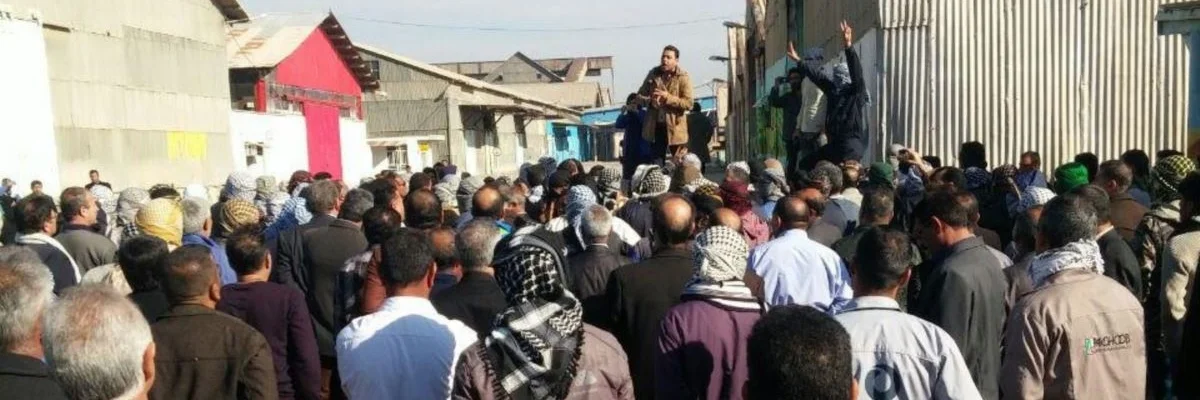
◢ Four people were arrested in southwestern Iran on Sunday as locals joined striking sugar workers in mounting protests over unpaid wages and alleged criminal activity by managers, the official IRNA news agency said. Protests by workers from the Haft Tapeh sugar company in Shush, a city in Khuzestan province, have been building in recent days.
Four people were arrested in southwestern Iran on Sunday as locals joined striking sugar workers in mounting protests over unpaid wages and alleged criminal activity by managers, the official IRNA news agency said.
Protests by workers from the Haft Tapeh sugar company in Shush, a city in Khuzestan province, have been building in recent days.
IRNA said locals had joined the demonstrations on Sunday, without giving numbers.
Those arrested included two local workers' representatives and a female reporter, it added.
Iran has seen multiple strikes and protests in recent months over working conditions and unpaid wages in a range of sectors, including steel, education, mining and transport.
Haft Tapeh, which employs about 4,000 people, has been hit with multiple protests over mismanagement and alleged criminality since the firm was privatised in 2016.
The head of Iran's privatization organization Mir Ali Ashraf Pouri-Hosseini said Sunday that several board members had been arrested "over forex issues and other ambiguities,” according to the Hamshahri newspaper.
Haft Tapeh's managing director is "on the run", lawmaker Hossein Naghavi-Hosseini said following a meeting with the judiciary, according to IRNA.
There were reports the government was preparing to pay two months of delayed wages, but workers remained sceptical.
"For years we have repeatedly heard officials saying that our demands have been met but nothing has happened. We will continue our gatherings until it happens," an unnamed protester told the semi-official ILNA news agency.
Photo Credit: Citizen Journalist

As Sanctions Bite, Where Next for Trump's Iran Strategy
◢ A wave of US sanctions kicks in against Iran on Tuesday, cementing Washington's hard line against Tehran after President Donald Trump pulled out of the 2015 nuclear pact. Already facing broad economic fallout as their currency implodes, Iranians are wondering how the next phase of the crisis in US relations will play out—and what, exactly, America's longterm strategy is toward their country.
A wave of US sanctions kicks in against Iran on Tuesday, cementing Washington's hard line against Tehran after President Donald Trump pulled out of the 2015 nuclear pact.
Already facing broad economic fallout as their currency implodes, Iranians are wondering how the next phase of the crisis in US relations will play out—and what, exactly, America's longterm strategy is toward their country.
At least for now, the US is fixated on bringing as much diplomatic and economic pressure to Iran as possible—though it is not clear where things are headed, or if there is an increased risk of conflict.
The US walked out of the 2015 nuclear deal in May and is bringing back "maximum pressure" sanctions for most sectors on August 6, and the energy sector on November 4.
As of 0401 GMT Tuesday, the Iran government can no longer buy US banknotes and broad sanctions will be slapped on Iranian industries, including its rug exports.
Asked Sunday if Tehran would be able to evade the measures, US Secretary of State Mike Pompeo vowed the United States would "enforce the sanctions," saying heaping pressure on Tehran was meant to "push back against Iranian malign activity."
"This is just about Iranians' dissatisfaction with their own government, and the President is pretty clear, we want the Iranian people to have a strong voice in who their leadership will be," he told reporters.
Room for dialogue?
After months of fierce rhetoric, Trump surprised observers last week when he offered to meet with Iranian President Hassan Rouhani "any time"—and without preconditions.
The dramatic about-face, which Secretary of State Mike Pompeo quickly tamped down, came just days after the enigmatic US president and Rouhani traded barbs.
Trump at one point unleashed a Twitter tirade in which he blasted, using all caps, Rouhani's "DEMENTED WORDS OF VIOLENCE."
He was responding to a July 22 warning from Rouhani that the US should not "play with the lion's tail" and warned that any conflict with Iran would be the "mother of all wars."
Trump's offer for dialogue came after Pompeo seemed to suggest support for a change in Iran leadership, telling an audience of Iranian expats in California that the regime had been a "nightmare."
And John Bolton, the president's national security advisor, is a well-known Iran hawk who has advocated for regime change.
"For Bolton and others, pressure is an end in and of itself," Suzanne Maloney, deputy director of the foreign policy program at the Brookings Institution, told AFP.
For the administration, "if it leads to a wholesale capitulation fine, if it leads to regime change, even better," she added.
Under Pressure
Trump's pressure campaign appears to have had some results. For instance, US officials in recent years have accused both the regular Iranian navy and the Iranian Revolutionary Guards Corps of routinely harassing American warships in the Gulf.
But this year, to the surprise of some military officials, there have been no such incidents.
If Iran senses "American steel they back down, if they perceive American mush they push forward—and right now they perceive steel," said Mark Dubowitz, chief executive of Foundation for Defense of Democracies, a Washington think tank that lobbied for a renegotiation of the Iran nuclear deal.
Dubowitz, who noted that Iran has tested fewer missiles of late, said Trump's rhetoric and position on Iran actually lowers the risk of escalation toward conflict.
"He's assuming that if he talks tough, that will bolster the credibility of American military power," Dubowitz told AFP.
Both Trump and Rouhani are due to address the United Nations General Assembly in New York next month.
It's not inconceivable a meeting on the sidelines could occur then—Tehran will be looking anxiously to a November deadline for oil buyers to stop purchasing Iranian crude.
ver the weekend Trump once again floated the idea of meeting, tweeting "I will meet, or not meet, it doesn't matter—it is up to them!"
"Iran, and its economy, is going very bad, and fast!" he said in the same missive.
'Malign Influence'
US Defense Secretary Jim Mattis said on July 27 there was no policy that had been put in place with the goal of collapsing or changing the Iranian regime.
"We need them to change their behavior on a number of threats they can pose with their military, with their secret services, with their surrogates and with their proxies," Mattis told Pentagon reporters.
Experts see a number of possible outcomes for the current US policy toward
Iran.
Sanctions and diplomatic pressure could pile enough pressure on the regime that it comes to the negotiating table—something Trump has advocated for.
The financial crisis in Iran could worsen to the point that mass protests make it impossible for the regime to hold on to power—though economic pressures risk galvanizing growing anti-American sentiment and support for hardliners.
Or the regime could start to address what America calls its "malign influence" in the region, including its support to Syrian President Bashar al-Assad and threats to shut down the strategic Strait of Hormuz, a vital shipping lane for international oil supplies.
"I think (the Trump administration) would be pleased with any one of those end states," Dubowitz said.
Photo Credit: Wikicommons

Trump Hits Back at Iran 'War' Talk
◢ President Donald Trump on Sunday hit back at bellicose comments by Iran's president, warning him of consequences "the likes of which few throughout history have ever suffered," as the US intensifies its campaign against the Islamic republic. The high-stakes verbal sparring is reminiscent of the exchanges Trump had last year with North Korean leader Kim Jong Un, before the two leaders met in a historic summit last month.
President Donald Trump on Sunday hit back at bellicose comments by Iran's president, warning him of consequences "the likes of which few throughout history have ever suffered," as the US intensifies its campaign against the Islamic republic.
"NEVER, EVER THREATEN THE UNITED STATES AGAIN OR YOU WILL SUFFER CONSEQUENCES THE LIKES OF WHICH FEW THROUGHOUT HISTORY HAVE EVER SUFFERED BEFORE," Trump said on Twitter in a direct message to President Hassan Rouhani, who earlier Sunday warned Trump not to "play with the lion's tail," saying that conflict with Iran would be the "mother of all wars".
The US president, writing his entire message in capital letters, continued his riposte: "WE ARE NO LONGER A COUNTRY THAT WILL STAND FOR YOUR DEMENTED WORDS OF VIOLENCE & DEATH. BE CAUTIOUS!"
The high-stakes verbal sparring is reminiscent of the exchanges Trump had last year with North Korean leader Kim Jong Un, before the two leaders met in a historic summit last month.
Trump has made Iran a favorite target since his rapprochement with nuclear-armed North Korea. His comments Sunday night came after his Secretary of State Mike Pompeo, in a major address to the Iranian diaspora in California, said Washington is not afraid to sanction top-ranking leaders of the "nightmare" Iranian regime.
Trump in May pulled the US out of a hard-won agreement with Tehran, also signed by Britain, China, France, Germany and Russia, which lifted sanctions in exchange for curbs on Iran's nuclear program.
The 2015 agreement was in response to fears that Iran was developing a nuclear bomb.
European allies maintain their support for the deal and have vowed to stay in it, though their businesses fear US penalties.
Following Washington's pullout Pompeo unveiled Washington's tougher line under which, he said, the US would lift its new sanctions if Iran ended its ballistic missile program and interventions in regional conflicts from Yemen to Syria.
"You cannot provoke the Iranian people against their own security and interests," Rouhani said in a televised speech Sunday, ahead of Pompeo's address.
'More to Come'
Rouhani repeated his warning that Iran could shut down the strategic Strait of Hormuz, a vital shipping lane for international oil supplies.
"Peace with Iran would be the mother of all peace and war with Iran would be the mother of all wars," Rouhani said.
On Saturday, Iran's supreme leader Ayatollah Ali Khamenei said the US does not abide by agreements.
"As I have previously said, we cannot trust in the words of the United States and even in their signature, so negotiations with the United States are useless," Khamenei told a gathering of Iranian diplomats in Tehran.
Pompeo on Sunday noted that the US in January had already sanctioned Sadeq Larijani, the head of Iran's judiciary, for human rights violations.
"We weren't afraid to tackle the regime at its highest level," he said, also confirming that Washington wants all countries to reduce their imports of Iranian oil "as close to zero as possible" by November 4, or face American sanctions.
"There's more to come," Pompeo said of the US financial penalties.
"Regime leaders—especially those at the top of the IRGC and the Quds Force like Qasem Soleimani—must be made to feel painful consequences of their bad decision making," said Pompeo, a longtime Iran hawk. He was referring to Iran's special forces and Revolutionary Guards.
Roundly applauded by his audience, Pompeo affirmed support by Washington for protesters in the Islamic republic.
"The regime in Iran has been a nightmare for the Iranian people," he said.
Washington's top diplomat announced an intensified American propaganda campaign, with the launch of a multimedia channel with 24-hour coverage on television, radio, and social media.
This will ensure that "ordinary Iranians inside Iran and around the globe can know that America stands with them," he said.
Regularly suspected of favoring regime change in Iran, Pompeo refused to distinguish between moderates and radicals at the heart of the Islamic republic.
"Our hope is that ultimately the regime will make meaningful changes in its behavior both inside Iran and globally," he said.
Photo Credit: Wikicommons
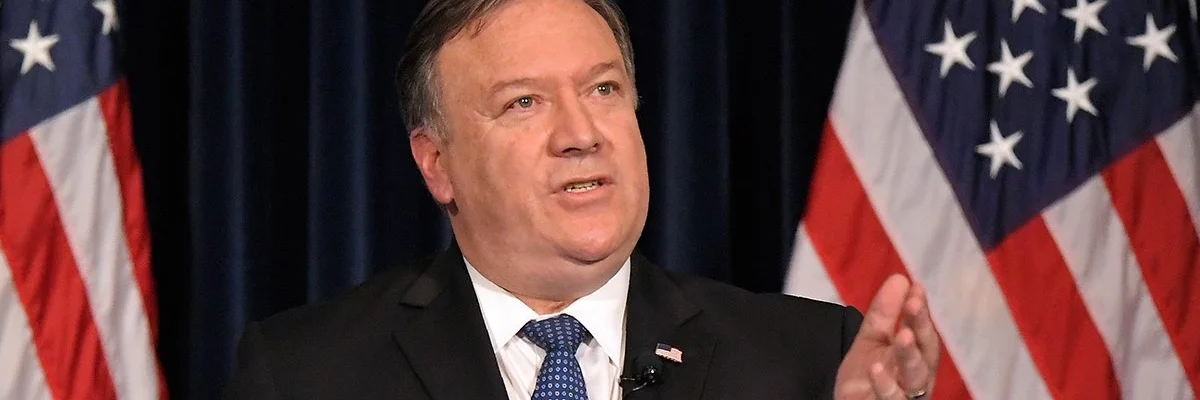
US Not Afraid to Sanction Top Iran Leaders: Pompeo
◢ The United States is not afraid to sanction top-ranking leaders of the "nightmare" Iranian regime, Secretary of State Mike Pompeo said on Sunday, pursuing a strategy aimed at Iranian compliance with stringent US demands. Following Washington's pullout from the Iran nuclear accord that stunned Washington's closest European allies, Pompeo on May 21 unveiled the "new strategy" to force Iran's submission to a dozen demands.
The United States is not afraid to sanction top-ranking leaders of the "nightmare" Iranian regime, Secretary of State Mike Pompeo said on Sunday, pursuing a strategy aimed at Iranian compliance with stringent US demands.
Following Washington's pullout from the Iran nuclear accord that stunned Washington's closest European allies, Pompeo on May 21 unveiled the "new strategy" to force Iran's submission to a dozen demands.
"We weren't afraid to tackle the regime at its highest level," Pompeo said in a speech to the Iranian diaspora in California, referring to sanctions leveled in January against Sadeq Larijani, the head of Iran's judiciary, for human rights violations.
Pompeo also confirmed that Washington wants all countries to reduce their imports of Iranian oil "as close to zero as possible" by November 4, or face American sanctions.
"There's more to come," Pompeo said of the US financial penalties.
US President Donald Trump on May 8 decided to restore all the sanctions that had been lifted as part of a multi-national agreement, signed on to by former president Barack Obama's administration in exchange for curbs on Iran's nuclear program.
The 2015 agreement was in response to fears that Iran was developing a nuclear bomb.
European allies maintain their support for that hard-won deal and are trying all means to save it.
"Regime leaders—especially those at the top of the IRGC and the Quds Force like Qasem Soleimani—must be made to feel painful consequences of their bad decision making," said Pompeo, a longtime Iran hawk.
He was referring to Iran's special forces and Revolutionary Guards.
Roundly applauded by his audience, Pompeo affirmed support by Washington for protesters in the Islamic republic.
"The regime in Iran has been a nightmare for the Iranian people," he said.
Pompeo announced an intensified American propaganda campaign, with the launch of a multimedia channel with 24-hour coverage on television, radio, and social media.
This will ensure that "ordinary Iranians inside Iran and around the globe can know that America stands with them," he said.
Regularly suspected of favoring regime change in Iran, Pompeo refused to distinguish between moderates and radicals at the heart of the Iranian republic.
"Our hope is that ultimately the regime will make meaningful changes in its behavior both inside Iran and globally," he said.
Under Washington's tougher line after withdrawal from the international nuclear accord, Pompeo has said the US would lift its new sanctions if Iran ended its ballistic missile program and interventions in regional conflicts from Yemen to Syria.
Iranian President Hassan Rouhani has dismissed such threats, saying the rest of the world no longer accepts Washington making decisions on their behalf.
Photo Credit: State Department