
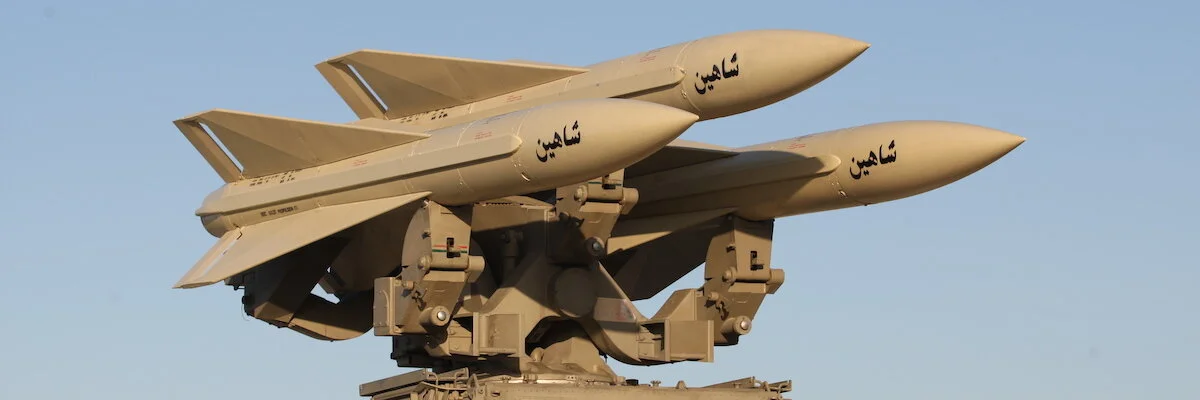
Iran Tests Home-Made Air Defence System
Iran on Wednesday tested home-made air defence systems during military exercises, state media said, days after the expiry of an international arms embargo against the Islamic republic.
Iran on Wednesday tested home-made air defence systems during military exercises, state media said, days after the expiry of an international arms embargo against the Islamic republic.
The manoeuvres—dubbed "Defenders of the Sky"—took place in "an area covering half of the country's surface", state television's Iribnews website reported.
They came after Tehran ruled on Sunday that a UN arms embargo on its weapons had expired under the terms of the international agreement on Iran's nuclear programme and UN Security Council Resolution 2231.
Iran on Monday said it was more inclined to sell weapons rather than buy them, after announcing the end of the longstanding embargo.
"In these exercises, the new generation systems of the army and Revolutionary Guard have shown their strength by relying on the power" of local production, said Iribnews.
The website said targets at medium and high altitudes were shot down by Iran's Khordad 3 and Khordad 15 air defence systems and that fighter jets took part in the manoeuvres.
"Our forces have achieved all the objectives set," General Qader Rahimzadeh, who is commanding the exercises, told state television.
The lifting of the arms embargo allows Iran to buy and sell military equipment including tanks, armoured vehicles, combat aircraft, helicopters and heavy artillery.
Iranian Foreign Minister Mohammad Javad Zarif said Tuesday that his country did not intend to engage in an "arms race in the region.”
Photo: Wikicommons
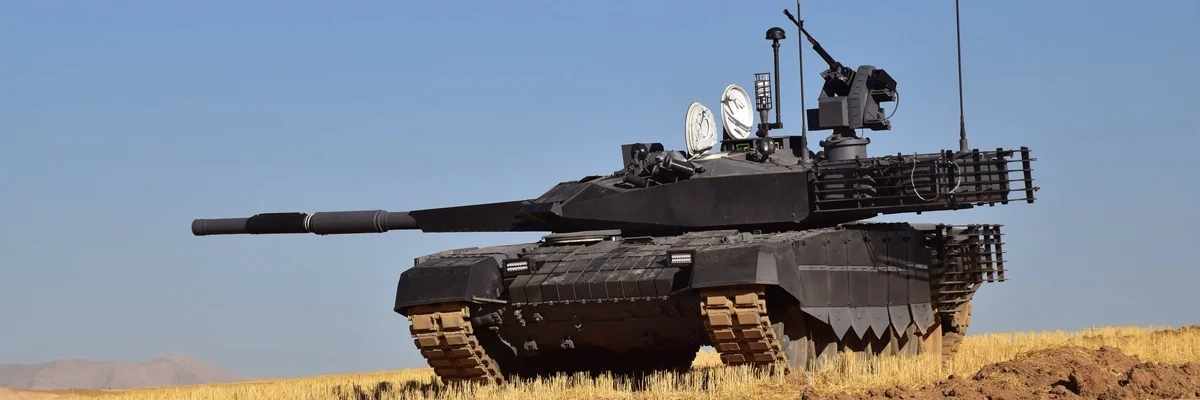
Iran to Seek Advanced Arms as UN Embargo Expires, Pentagon Says
◢ Iran will seek to modernize its forces by purchasing advanced weapons systems once a United Nations arms embargo expires next year, the Pentagon is warning in a new report. Iran wants to purchase weapons “it has largely been unable to acquire for decades” when the embargo expires in October 2020.
By David Wainer and Tony Capaccio
Iran will seek to modernize its forces by purchasing advanced weapons systems once a United Nations arms embargo expires next year, the Pentagon is warning in a new report.
Iran wants to purchase weapons “it has largely been unable to acquire for decades” when the embargo expires in October 2020 in a compromise that’s part of the 2015 nuclear accord with world powers, according to an assessment released Tuesday by the Defense Intelligence Agency. Iran will be permitted to purchase weapons that it’s unable to produce domestically, such as advanced fighter aircraft and main battle tanks.
While U.S. President Donald Trump withdrew from the nuclear accord, his administration is pushing the international community to keep Iran from purchasing advanced weapons, arguing it will add to instability in the region. During a UN Security Council meeting in August, Secretary of State Michael Pompeo warned that the expiration of the embargo will unshackle Iran “to create new turmoil.”
“Because of the flawed Iran deal, the UN arms embargo on Iran will expire in one year,” Pompeo tweeted last month. “Countries like Russia and China will be able to sell Iran sophisticated weapons. The Iranian regime will be free to sell weapons to anyone. This will trigger a new arms race in the Middle East.”
Russian Weapons
Iran is already evaluating and discussing military hardware for purchase, primarily from Russia, but also to a lesser extent from China, the Pentagon report found. Iran’s potential acquisitions include Russian Su-30 fighters, Yak-130 trainers and T-90 tanks. Iran has also shown interest in acquiring the S-400 air defense system and Bastian coastal defense system from Russia, it said.
The report also highlights Iran’s growing use of unconventional tactics to deter large Western countries such as the U.S. Iran maintains an estimated inventory of more than 5,000 naval mines, which it can rapidly deploy in the Persian Gulf and Strait of Hormuz using high-speed small boats, it said.
It also warns that Iran’s forces are becoming “increasingly survivable, precise, and responsive.” It said the Islamic Republic’s capabilities, such as “swarms of small boats, large inventory of naval mines, and arsenal of antiship missiles” are a significant threat to maritime traffic in the Strait of Hormuz.
Kenneth Katzman, the primary Iran expert for the nonpartisan Congressional Research Service, said the report reinforces a “growing consensus in the expert community that Iran is close to accomplishing its core national security goals—the ability to project power in all corners of the region and thereby deter any regional or international actor from attacking Iran.”
Photo: IRNA
Iran Shows Trump That It’s Too Big to Be Crushed or Marginalized
◢ Earlier this year, President Donald Trump warned that “it’s going to be a bad problem for Iran if something happens.” Something big has happened with an attack on Saudi oil infrastructure, and yet it isn’t obvious how the U.S. can effectively retaliate against a country that is already under maximum economic sanctions.
By Marc Champion and Zainab Fattah
Earlier this year, President Donald Trump warned that “it’s going to be a bad problem for Iran if something happens.” Something big has happened with an attack on Saudi oil infrastructure, and yet the administration in Washington looks like the one with the problem.
After leading voices in the Trump administration laid the blame squarely on Iran, it isn’t obvious how the U.S. can effectively retaliate against a country that is already under maximum economic sanctions. Iran is too big for the U.S. to invade even if there were appetite among U.S. voters for another Gulf war, and has demonstrated its ability to strike back hard should the U.S. decide to escalate.
U.S. sanctions have cratered the Iranian economy. Yet administration hopes that this would lead to a popular backlash against the government in Tehran, forcing it to cave to American demands, have yet to bear fruit.
Instead, the regime has relied on responses honed over 40 years of international isolation, upping the ante to show that if the U.S. continues forcing Iranian oil exports to zero in an attempt to bankrupt its government, Iran has the power to halt the oil exports of U.S. ally Saudi Arabia, too.
“We are caught in this vicious circle,” said Ali Vaez, Iran Project Director at the Brussels-based International Crisis Group. “The U.S. has to realize that Iran is part of this region. Iran cannot be excised.”
Revolutionary Guard
Rather than retreat in the face of withering revenues, which was a part of the logic that informed U.S. withdrawal from the 2015 nuclear deal that had lifted sanctions, the elite Islamic Revolutionary Guard Corps is increasingly active in Iraq, Lebanon, Syria, Yemen and even Afghanistan.
For the Guard—which has long defined itself as the Middle East’s ultimate bulwark against U.S. military power—sanctions are almost seen as a call to arms.
“Saudi Arabia’s Backbone is Broken; The U.S. and al Saud are in Mourning!” crowed the front page headline in Monday’s edition of Kayhan newspaper, whose chief editor is directly appointed by Iran’s Supreme Leader Ayatollah Ali Khamenei.
A 2017 clip of Saudi Crown Prince Mohammad bin Salman saying “we won’t wait for the war to come to Saudi Arabia, we’ll take the war to Iran,” has been widely recirculated and mocked in recent days. “Well Bin Salman my brother, tell me how’s Aramco doing?” said one Twitter user’s caption for the clip, referring to Saudi Arabia’s leviathan oil company.
Regional Influence
That bravado is ultimately misplaced, because nothing Iran has done to date has brought the lifting of sanctions—the central problem for the country of 82 million as a whole—any closer, according to Michael Knights, senior fellow at the Washington Institute for Near East Policy. At the same time, Iran’s capacity to make its interests felt across the region has been on full display.
“We have a sequence of events since about May 12, where the Iranians have pushed on one red line and relationship after another,” said Knights. “From a military perspective it has really been superbly executed, from tanker attacks that didn’t spill a drop of oil into the Gulf, to these now, which were of the same quality that the U.S. would have displayed in the mid-90s, using the cruise missiles it had then.”
Each tactical success has further raised Iran’s prestige in the region, a higher priority for regime conservatives and the IRGC than restoring the economy, according to Knights.
That forward-leaning approach is part of a longer term game plan, as Iran seeks to benefit from a gradual U.S. withdrawal from the region that’s likely to continue regardless of who is elected president in 2020.
“The U.S. has been looking for years for a re-posturing in the Middle East that would entail a lighter commitment on their end,” said Cinzia Bianco, Arabian Peninsula research fellow at the European Council on Foreign Relations in Berlin, a think tank. “This is crucial to what happened with Aramco, because the IRGC is fully aware of this context and is trying to test its new limitations.”
Balance of Power
The attack could have a lasting impact on the balance of power in the region, because it cruelly exposed the scale of an ongoing change in the U.S.-Saudi relationship, according to Pierre Noel, senior fellow for economic and energy security at the International Institute for Security studies, in London. “The Saudis lost in 30 minutes the war they had been preparing for for 50 years,” Noel said in a briefing on Tuesday. “They lost 50 percent of their national oil output, to Iran, and without the U.S. being immediately able or willing to offer cover.”
That has rendered empty, or at least severely limited, the absolute U.S. security guarantee for Saudi Arabia and its oil fields that Saudi and other countries in the region have long assumed.
Much of what happens next will depend on how hard the U.S. and Saudi decide to push their case that Iran, rather than its Houthi proxies in Yemen, was responsible for Saturday’s bombing of Saudi Arabia’s oil infrastructure at Abqaiq. If the U.S. decides to force the issue and produce hard evidence in public, the pressure to be seen to retaliate will be high, according to Knights and others.
Iran has denied responsibility for the attack, which the Houthis have claimed for themselves. It won’t negotiate with the U.S. at any level, Khamenei said on Tuesday. That would appear to rule out a meeting of Trump and President Hassan Rouhani at the UN General Assembly in New York this month.
Missiles and Drones
The European signatories to the Iran nuclear deal that Trump abandoned unilaterally last year in a precursor to re-imposing sanctions are content to stay on the fence for now. The governments of France and Germany, both of which were instrumental in establishing a special purpose vehicle meant to aid Iran over U.S. opposition, condemned the attacks without laying blame.
Iran’s military, at least, appears to be calculating that Trump will prefer to leave the case inconclusive and stick with less risky, costly and unpopular alternatives to an act of war.
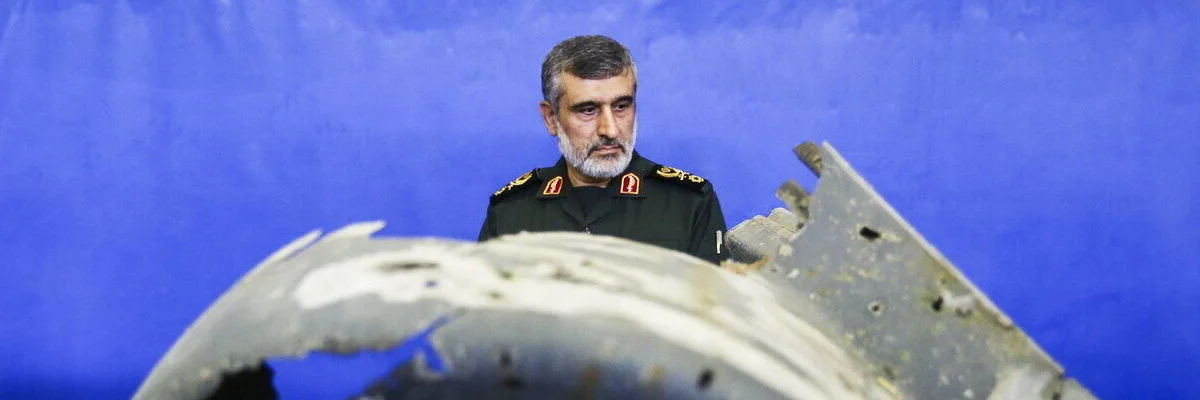
“It’s necessary for everyone to know that all U.S. bases and their vessels are within a 2,000 kilometer (1,240 mile) reach of our missiles,” the IRGC’s aerospace forces commander, Brig. Gen. Amirali Hajizadeh said in an interview with the Iranian news agency, Tasnim, on Sunday.
Iran has about 50 medium range ballistic missiles deployed and others in development, as well as about 130 drones, according to the International Institute for Strategic Studies in London. “Neither we nor the Americans have any intention of going to war,” the brigadier general said.
Photo: IRNA
Thousands Attend Funeral for Iran Attack Dead
◢ Tens of thousands of mourners attended a funeral on Monday in the southwestern Iranian city of Ahvaz for soldiers and civilians killed in an attack on a military parade. Four militants attacked the Saturday parade marking the start of the 1980-1988 Iran-Iraq war, spraying the crowd with gunfire and killing 24 people.
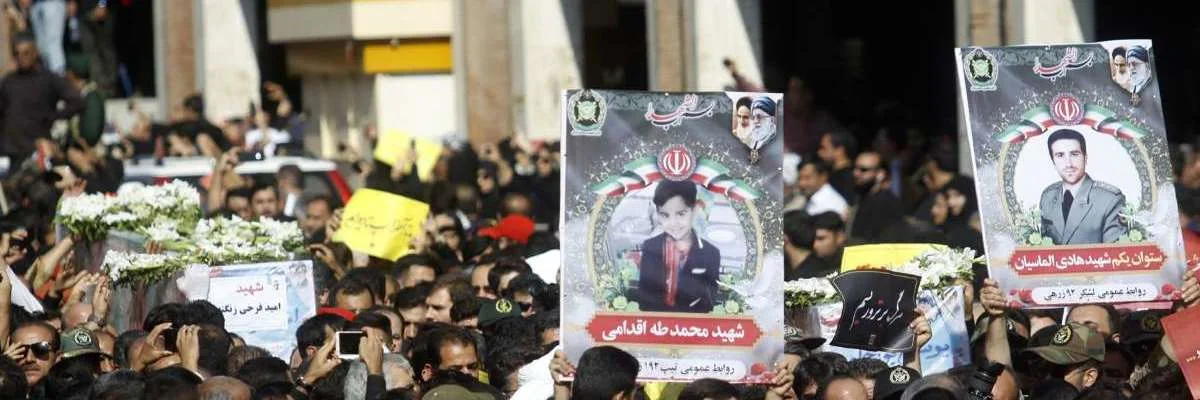
Tens of thousands of mourners attended a funeral on Monday in the southwestern Iranian city of Ahvaz for soldiers and civilians killed in an attack on a military parade.
Four militants attacked the Saturday parade marking the start of the 1980-1988 Iran-Iraq war, spraying the crowd with gunfire and killing 24 people.
Iranian officials blamed Arab separatists, backed by Gulf Arab allies of the US, for the operation.
AFP reporters on Monday saw members of the public and the military carrying coffins draped in the Iranian flag, some bearing pictures of the deceased.
The mourners, mostly wearing black, carried pictures of the dead along with banners reading "we will stand to the end" and "no to terrorism.”
Under blazing sun, crowds streamed in from all four main streets leading into the city-centre square where the funeral was held, three of them dedicated to men and the fourth to women.
In the square itself, also segregated, a woman dressed in the traditional Arab-style chador wailed loudly and held a picture of her son, Reza Shoaibi, a conscript who was among the dead.
As the funeral progressed, her wailing and expressions of sorrow steadily grew louder until she fainted.
The heat became so intolerable that trucks sprayed water onto the crowd as temperatures hit 40 degrees Celsius (105 fahrenheit).
Mourners waved red, green and black flags with revolutionary messages, as well as the flags of Arab tribes from the surrounding Khuzestan region.
Iranian authorities have blamed Arab separatists and accused the United States, Israel and Gulf Arab monarchies of backing Saturday's "terrorist" attack.
The Islamic State group also claimed responsibility.
Khuzestan, which has a large ethnic Sunni Arab community, was a major battleground of the 1980s war with Iraq and it saw unrest in 2005 and 2011.
Kurdish rebels frequently attack military patrols on the border further north, but attacks on government targets in major cities are rare.
'Devastating' Revenge
Monday's ceremony began in front of the square's Sarallah Mosque with speeches by generals and security officials.
Intelligence Minister Mahmoud Alavi said that arrests had already been made.
"The terrorists themselves have perished, our agents will identify their remnants and supporters to the last man. A major part of them have already been arrested," he told the crowd.
Brigadier General Hossein Salami, the deputy head of the Islamic Revolutionary Guards Corps, vowed to exact vengeance.
“We promise that our reaction will be devastating, we warn everyone that we will take revenge," he told mourners.
After the speeches ended, a famous wartime religious chanter sang songs of lamentation as thousands of mourners beat their chests in unison, a traditional mourning practice of Shiite Muslims.
Later, the coffins were transported to the city cemetery and laid to rest.
The dead ranged from a preschool boy to a wheelchair-bound war veteran.
Pictures of women and children scrambling to find cover evoked an emotional response from Iranians.
Abdolzahra Savari, an ethnic Arab who had attended the funeral, called the attackers infidels.
"These are ruthless people with no shred of humanity in them," he said.
Sabah Abiad, a middle-aged bank employee who attended the funeral, said the unity among the region's different groups was self-evident.
"As you can see now, all of the people, whether they're Lor, Arab, Shushtari or Dezfuli, are all here today and all say death to the terrorists," he told AFP.
Iran holds regular military parades to mark national anniversaries and show off its latest military hardware, notably missiles.
This year's parades had special significance as tensions with the United States have peaked since the US withdrew from the 2015 nuclear deal in May and began to re-impose unilateral economic sanctions on Tehran.
Iran's presence in Syria has also triggered rising tensions with Israel.
Photo Credit: IRNA
Iran Unveils First Domestic Fighter Jet
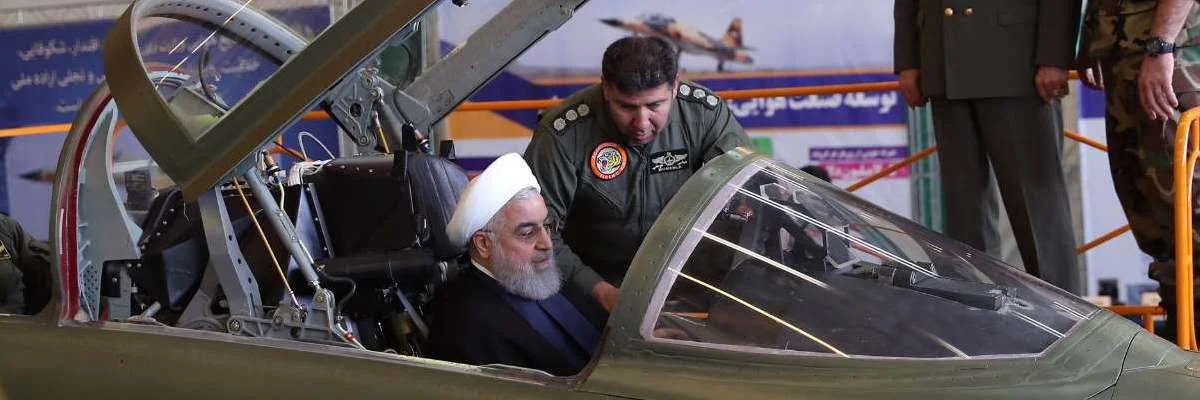
◢ Iran unveiled its first domestic fighter jet on Tuesday, with President Hassan Rouhani insisting that Tehran's military strength was only designed to deter enemies and create "lasting peace.” Images on state television showed Rouhani sitting in the cockpit of the new "Kowsar" fourth-generation fighter at the National Defence Industry exhibition in Tehran. State media said it had "advanced avionics" and multi-purpose radar, and that it was "100-percent indigenously made" for the first time.
Iran unveiled its first domestic fighter jet on Tuesday, with President Hassan Rouhani insisting that Tehran's military strength was only designed to deter enemies and create "lasting peace".
Images on state television showed Rouhani sitting in the cockpit of the new "Kowsar" fourth-generation fighter at the National Defence Industry exhibition in Tehran.
State media said it had "advanced avionics" and multi-purpose radar, and that it was "100-percent indigenously made" for the first time.
Footage of the Kowsar's test flights was circulated by various official media.
But live footage of the plane taxiing along a runway at the defense show was cut before it could take off.
"When I speak of our readiness to defend, it means we seek lasting peace. If we lack readiness, we welcome war," Rouhani said in a televised speech shortly after.
"Some think when we increase our military power, this means we seek war. (But) this is peace-seeking because we don't want war to happen," he added.
"If we don't have a deterrent... it gives a green light for others to enter this country."
The plane was first publicly announced on Saturday by Defense Minister Amir Hatami, who had said it would be unveiled on Wednesday.
He gave few details of the project, focusing instead on Iran's efforts to upgrade its missile defenses.
Hatami said the defence programme was motivated by memories of the missile attacks Iran suffered during its eight-year war with Iraq in the 1980s, and by repeated threats from Israel and the United States that "all options are on the table" in dealing with the Islamic republic.
"We have learned in the (Iran-Iraq) war that we cannot rely on anyone but ourselves," he said in a televised interview.
The US has sold hundreds of billions of dollars of weapons to Iran's regional rivals, but has demanded that Tehran curb its defense programs, and is in the process of reimposing crippling sanctions in a bid to force its capitulation.
Rouhani said Iran must show restraint as well as deterrence, in an apparent swipe at his hardline opponents who seek to provoke the US with aggressive slogans.
"With a couple of sentences one can start a fight. With a couple of military moves one can enter confrontation. But then it will be costly," he said.
"The skill is to protect the country with minimum cost," he said
That mirrored a line from the defence minister, who said on Saturday: "Our resources are limited and we are committed to establishing security at a minimum cost."
Following the withdrawal of the United States from the 2015 nuclear deal in May, Iran has avoided an aggressive response and sought to maintain its good will with other international partners who oppose Washington's move.
Rouhani said US pressure was also a spur to action.
"Why does America impose economic sanctions on us? Why does it impose them on Turkey? Why does it drag China into an economic war? Because it feels each one of them has a weak point. We must fix our weak points."
Photo Credit: IRNA
US Navy Sees Better Iranian Behavior in Persian Gulf
◢ The Iranian military's behavior in the Gulf has changed "across the board" in recent months, the US Navy said on Thursday, after years of tensions in the busy waterway. Last year and in 2016, the US Navy complained repeatedly about the behaviour of Iranian Revolutionary Guard vessels, which would often shadow and steer towards US ships.
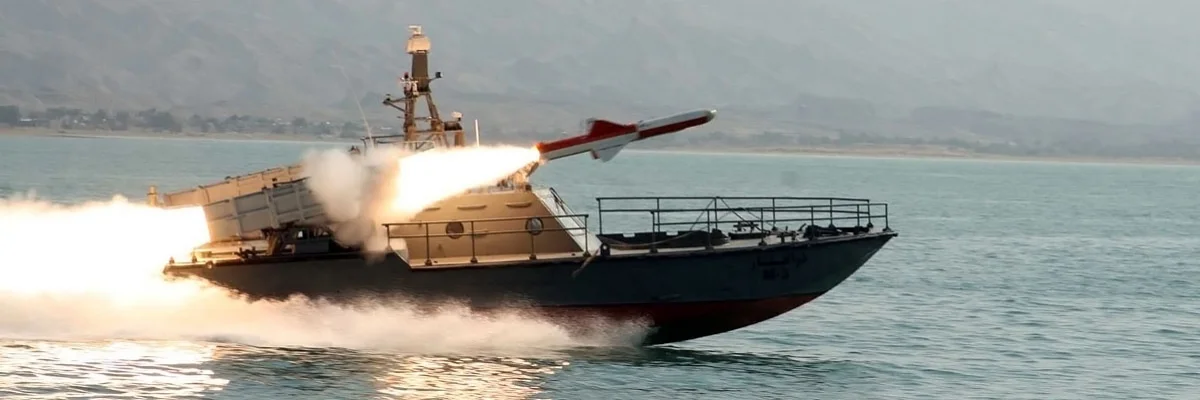
The Iranian military's behavior in the Persian Gulf has changed "across the board" in recent months, the US Navy said on Thursday, after years of tensions in the busy waterway.
Commander Bill Urban, spokesman for the Navy's Bahrain-based Fifth Fleet, said there had been no "unsafe or unprofessional" interactions with the Iranians at sea since August 14, 2017 when an Iranian drone with no lights on flew close to US aircraft operating in the Gulf.
It "is a substantial period time since then, and something that we think is great," Urban told reporters.
Last year and in 2016, the US Navy complained repeatedly about the behaviour of Iranian Revolutionary Guard vessels, which would often shadow and steer towards US ships.
In at least one incident, US sailors had to fire flares and warning shots before the Iranians turned away.
Urban said that since then, the Iranians have stopped approaching so closely.
"We have seen an across-the-board change in behaviour," Urban said. "I don't necessarily have a reason for that but it's pretty clear that it's something they are consciously doing."
The change comes amid increased rhetoric from Washington about Iran's "malign influence" in the region and US President Donald Trump's persistent railing against the 2015 Iran nuclear deal.
The Fifth Fleet and its associated task forces patrol the Gulf continuously and inspect some of the ships passing through.
In 2016, navy personnel seized weapons, including machine guns and rocket launchers, they suspected were headed from Iran to Yemen.
Urban said task forces this year have seized record amounts of heroin, some of which may have been from the Taliban, Afghanistan's biggest militant group. The Iranian Revolutionary Guards is a paramilitary force that answers directly to the Islamic republic's supreme leader Ayatollah Ali Khamenei.
In January 2016, the Iranians briefly captured the crew of two small US patrol boats that strayed into Iranian waters. The 10 US sailors were released 24 hours later.
Photo Credit: Global Military Review