

US Warns Against Dealing With Top Iran Shipper
The United States warned Monday that it would punish any country that deals with Iran's top shipping company, accusing it of contributing to Tehran's contested weapons programs.
The United States warned Monday that it would punish any country that deals with Iran's top shipping company, accusing it of contributing to Tehran's contested weapons programs.
The Treasury Department said sanctions came into effect Monday against the Islamic Republic of Iran Shipping Lines, known by its acronym IRISL, as well as its Shanghai-based subsidiary E-Sail.
Under the sanctions, the United States threatens unilateral action against any government, business or person that does business with IRISL.
"We urge government authorities worldwide to investigate all IRISL and E-Sail activity in your ports and territorial seas and take appropriate action to put a halt to it," Secretary of State Mike Pompeo said in a statement.
"The world must be vigilant and take action to prevent Iran from acquiring proliferation-sensitive items that further threaten regional stability and security," he said.
IRISL, which has interests around the globe, is the world's 15th largest shipping line in terms of cargo carried, according to the latest figures available from database Alphaliner.
US officials say that IRISL has shipped sensitive cargo for Iran's military and assisted its ballistic missile program, which Tehran insists is legal as UN Security Council resolutions ban only nuclear-related activity.
IRISL was already under US sanctions related to Iran's nuclear program, but the latest move toughens the ramifications by targeting it more broadly over weapons of mass destruction.
The United States announced the sanctions in December but delayed their implementation, saying it wanted to give countries time to find other ways to conduct humanitarian trade not subject to US sanctions.
President Donald Trump imposed unilateral sanctions on Iran in 2018 when he walked out of a nuclear deal under which Tehran drastically scaled back its atomic activities in exchange for promises of economic relief.
China remains the primary trading partner of Iran, with US allies leaving the country due to the threat of US sanctions.
Photo: Wikicommons
Iran Looks to Remote Port to Beat US Sanctions
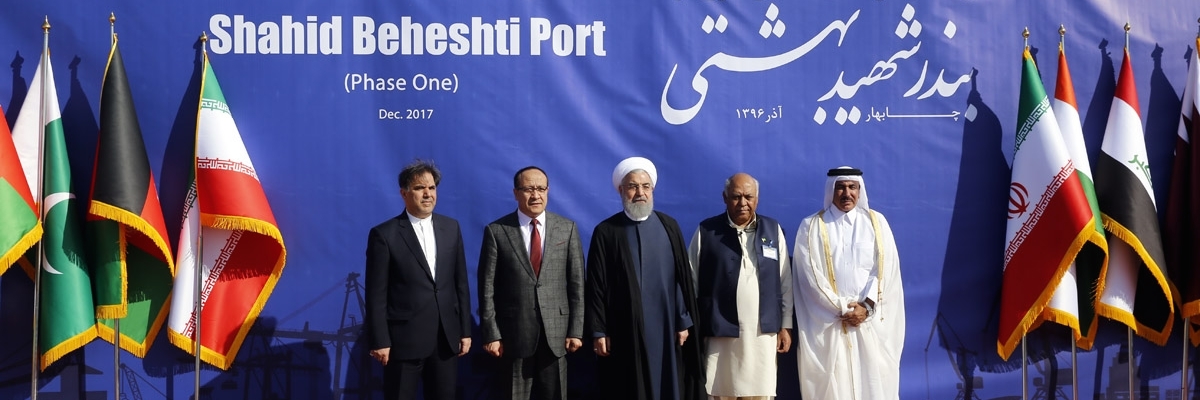
◢ With the web of US sanctions tightening, Iran faces a host of challenges as it looks to an isolated port in the country's far southeast to maintain the flow of goods. The port in Chabahar, only about 100 kilometers (62 miles) from the Pakistan border and located on the Indian Ocean, is Iran's largest outside the Gulf.
With the web of US sanctions tightening, Iran faces a host of challenges as it looks to an isolated port in the country's far southeast to maintain the flow of goods.
The port in Chabahar, only about 100 kilometers (62 miles) from the Pakistan border and located on the Indian Ocean, is Iran's largest outside the Gulf.
It is also the only Iranian port with exemptions from unilateral economic sanctions reimposed by the United States in 2018.
That is due mainly to the pivotal role of the port, and a planned railway line, in breaking landlocked Afghanistan's dependence on Pakistan for trade with the world, especially India.
Afghan trade as well as plans for a trading route by rail between central Asia and the Indian Ocean called the North-South Corridor are the main reasons the Islamic republic has invested one billion dollars in Chabahar's Shahid Beheshti port, official sources say.
"We will keep on developing this port... our rail network, road network and airport are all being developed, so that we can implement the North-South Corridor," Roads and Urban Development Minister Mohammad Eslami told AFP while visiting Chabahar for a development conference.
‘Traffic will Pick Up'
More than 200 hectares (almost 500 acres) of land have been reclaimed from the sea for the project and over 17.5 million cubic meters (618 million cubic feet) dredged, creating a 16.5-meter (54-foot) draught.
But more than a year since the new installations became operational in December 2017, business has yet to pick up.
The ships that officials say have docked in the past year have only loaded and unloaded 2.1 million tonnes of cargo, a far cry from the port's annual capacity of 8.5 million tonnes.
Only 20 ships have docked at the new section of the port and most of its three kilometers of waterfront remains unutilized, with new machinery and neatly lined-up cranes standing idle.
But authorities remain upbeat about the prospects for growth.
Hossein Shahdadi of the provincial ports and maritime authority said that in the first 11 months of the past Iranian year, which started on March 21, 2018, "there has been a 56 percent increase in cargo handled at the port compared with the previous year.”
"We've also had a 25 percent rise in the number of ships calling at the port" on the Gulf of Oman, he said.
Arun Kumar Gupta, managing director of India Ports Global Limited which has a 10-year concession at the new port, played down the startup issues.
"Any port will have a gestation period, there will be lulls but we are very sure that traffic will pick up," Gupta told AFP.
'Born with Sanctions'
The Indian company began work in December and has so far handled only an average of 60,000 tonnes of cargo per month.
But Gupta is counting on the port's proximity to India and Afghanistan to attract business.
Chabahar's location, however, carries its own risks as it lies in the volatile Sistan Baluchistan province where militant jihadists operate.
In December, a suicide attack on the local police headquarters killed two policemen.
During an investment conference in February, security was tight with many roads cut off and hundreds of armed security personnel deployed to protect delegates.
Apart from security concerns, US sanctions banning financial transactions with Iran make it ever harder to pay or receive payments.
Some like Afsaneh Rabiani, who runs a freight forwarding company, see Chabahar as an opportunity for "those willing to take the risk".
“I've been researching Chabahar for the past year and a half, and the infrastructure is now in place to do serious work here," she said.
As for the sanctions, Iran's roads minister said the challenge was nothing new.
"We were born with sanctions. Ever since the (1979 Islamic) revolution, we have been under sanctions and we are working on how to counter them," Eslami said, as he oversaw the unloading of a first shipment of Afghan goods lined up to be re-exported from Chabahar.
Photo Credit: IRNA
Iran Factor Seen in Tajikistan’s Stranded Trucks
◢ For the last two weeks, around 50 trucks traveling to or from Tajikistan have lain stranded on the northern and southern borders of Turkmenistan in a standoff that defies immediate explanation. Senior transportation officials in Dushanbe have told Eurasianet on condition of anonymity that one working suspicion is that the blockade may have been instigated by Iran, which shares a long border with Turkmenistan.
This article has been republished with permission from Eurasianet.
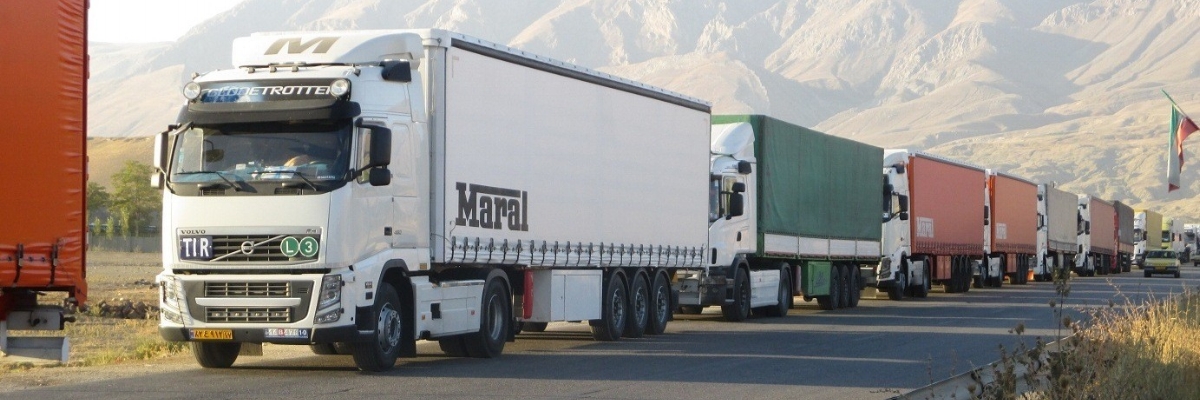
For the last two weeks, around 50 trucks traveling to or from Tajikistan have lain stranded on the northern and southern borders of Turkmenistan in a standoff that defies immediate explanation.
The trucks traveling from Tajikistan are carrying aluminum, produced at the country’s giant Talco plant, to Turkey. The cargo coming in the other direction comprises mainly textiles.
It is not clear why Turkmenistan should have barred Tajik vehicles from crossing its territory. In fact, senior transportation officials in Dushanbe have told Eurasianet on condition of anonymity that one working suspicion is that the blockade may have been instigated by Iran, which shares a long border with Turkmenistan.
One long-haul driver, who also asked that his name not be published for fear of repercussions, said that in the 10 years he has been ferrying aluminum from the Talco plant in the town of Tursunzoda, this is the first time he has run into such trouble. On September 4, when Eurasianet spoke with the driver, who is parked with his freight in a location on the Uzbek-Turkmen border, he had been waiting for nine days to be allowed through.
“They will not give us a reason. We thought the problem might be something to with transit permits, which we didn’t bring with us from Tajikistan,” the driver said, referring to a document issued to long-haul truckers by Tajikistan’s Transportation Ministry. “But even with the permits they won’t let us through.”
Turkmen border officials have purportedly told Tajik drivers that they might as well turn around and find another route, since they will not be allowed through. Meanwhile, large vehicles registered anywhere but Tajikistan are being let into Turkmenistan.
Khairullo Abidov, director of the Dushanbe-based Real Trans freight company, told Eurasianet that in addition to the 50 or so Tajik trucks stuck on either side of Turkmenistan, there are also some 15 Turkish trucks—whose manifests show Tajikistan as their final destination—not being permitted to leave Iran.
“They would not even allow our trucks into the neutral zone, they are just waiting in the parking lot on the Uzbek side and the Iranian side,” Abidov said.
Transportation Ministry officials in Dushanbe have told Eurasianet that they have received no explanation from Turkmenistan for the cause of this blockade. A formal note requesting clarification has been submitted by the Foreign Ministry to the Turkmen Embassy in Dushanbe, but no response has been forthcoming.
“For a week, we have yet to receive a clear explanation from Turkmenistan, and so we are advising our drivers to go through [Kazakhstan and] Azerbaijan. The road is longer and more expensive. It depends on the drivers whether they want to wait or drive further,” one high-level ministry source said.
Abidov said that for now, he will bide his time.
“But if the worst comes to the worse, then we will have to take our vehicles across the Caspian to Kazakhstan, and from there to Uzbekistan and Tajikistan. But that is an additional USD 1,200 for each truck,” he said.
The Transportation Ministry official told Eurasianet that one of the possibilities being considered in Dushanbe is that the situation has been instigated by Iran. Turkmen officials have told their Tajik colleagues that Iran is allowing only 40 trucks through their border daily, but that does not seem to explain why the Tajiks are being singled out for this treatment.
“We know perfectly well that they are letting through all vehicles except those from Tajikistan,” the ministry official said.
Relations between Tajikistan and Iran have fallen to an all-time low of late. With encouragement from Saudi Arabia, which has disbursed several dozen million dollars in aid to Dushanbe, the Tajik government has embarked on an often outlandish demonization campaign against Iran.
In an interview in July, Saudi Arabia’s ambassador to Tajikistan, Abdulaziz ibn Muhammad al-Badi, boasted that by doling out USD 200 million in aid over the years, Riyadh had managed to squeeze Iran out of the country. In the same exchange, al-Badi indicated that he gave credence to Tajik state media claims that Iran is trying to lay the ground for an Islamic revolution in Tajikistan.
Most recently, Tajik officials have sought to imply that Iran was somehow involved in a hit-and-run attack in late July that left four foreign cyclists, including two Americans, dead. The killings were claimed by the Islamic State group.
Whether suggestions that Iran may have somehow leaned on Turkmenistan to impose the blockade is part of a broader smear campaign, or if Tehran is engaging in reprisals, remains uncertain.
Another theory is that Turkmenistan is adopting stricter security measures in response to a possible discovery of drugs being carried across the border. Tajikistan is believed by international drug enforcement officials to be a major hub for the trafficking of heroin originating in Afghanistan.
One final, if implausible, scenario mooted in Dushanbe is that Turkmenistan has adopted this unfriendly policy in response to an incident on August 21 in which a young Turkmen woman died while waiting in a line at the Tajik consulate. Securing visas can entail months of wrangling and standing for endless hours in stuffy hot rooms, so the suggestion is that the woman may have succumbed to exhaustion. Tajik officials have said they think it unlikely this would have been enough to instigate a blockade, however.
Photo Credit: IRNA